Problem 7.1
Fill in the blank. Show your work.
b. ____ ft ·lbf = energy to lift 10 N weight through elevation difference of 125 m.
Recall that energy and work have the same dimensions. Here we are asked to find
c. 12000 Btu = _______kWh.
d. 32 ft-lbf/s = ________ hp.
e. [E]=[energy]=
1

Problem 7.2
Internet search – no solution provided
2
Problem 7.3
Answer the questions below.
a. What are common forms of energy? Which of these are relevant to fluid mechanics?
•Mechanical Energy = Energy that matter has because of its motion (i.e. kinetic
energy) or its position.(potential energy associated with a spring; gravitational
potential energy). Highly relevant to fluid mechanics. Examples of KE include.
—KE in a river that is flowing. KE in air that is being used to drive a wind
•Other forms of energy include electrical energy, nuclear energy, thermal energy,
and chemical energy. Each of these forms of energy can be related to fluid
mechanics.
b. What is work? Give three examples that are relevant to fluid mechanics.
•In mechanics, work is done when a force acts on a body as the body moves
c. Common units of power: horsepower and watts.
d. Differences between power and energy
3
Problem 7.4
Apply the grid method to each situation described below. Note: Unit cancellations
are not shown in this solution.
a)
Situation:
A pump operates for 6 hours.
Cost = C=$0.15/kW ·h.
P=1hp,t=6h.
Find:
Amount of energy used (joules).
Cost of this energy ($’s).
Solution:
b)
Situation:
A motor is turning the shaft of a centrifugal pump.
T=100lbf·in,ω=850rpm.
P=Tω.
Find:
Power in watts.
c)
Situation:
A turbine produces power.
P=7500ftlbf/s.
Find:
Covert the power to watts and hp.
5
Solution:
6

Problem 7.5
Energy (select all that are correct):
a. has same units as work
b.hassameunitsaspower
c. hassameunitswork/time
d. can have units of Joule
e. can have units of Watt
f. can have units of ft-lbf
g. can have units of calories
SOLUTION
7
Problem 7.6
Power (select all that are correct)
a. has same units as energy
b.hassameunitsasenergy/time
c. hassameunitsaswork/time
d. can have units of Joule
e. can have units of Watt
f. can have units of horsepower
g. can have units of ft-lbf
SOLUTION
8
7.7: PROBLEM DEFINITION
Situation:
Water is being sprayed out a spray bottle.
Find:
Estimate the power (watts) required.
PLAN
1. Acquire data from a spray bottle.
2. Find power using P=∆W/∆t,where∆Wis the amount of work in the time
interval ∆t.
SOLUTION
1. Data:
2. Power:
9
7.8: PROBLEM DEFINITION
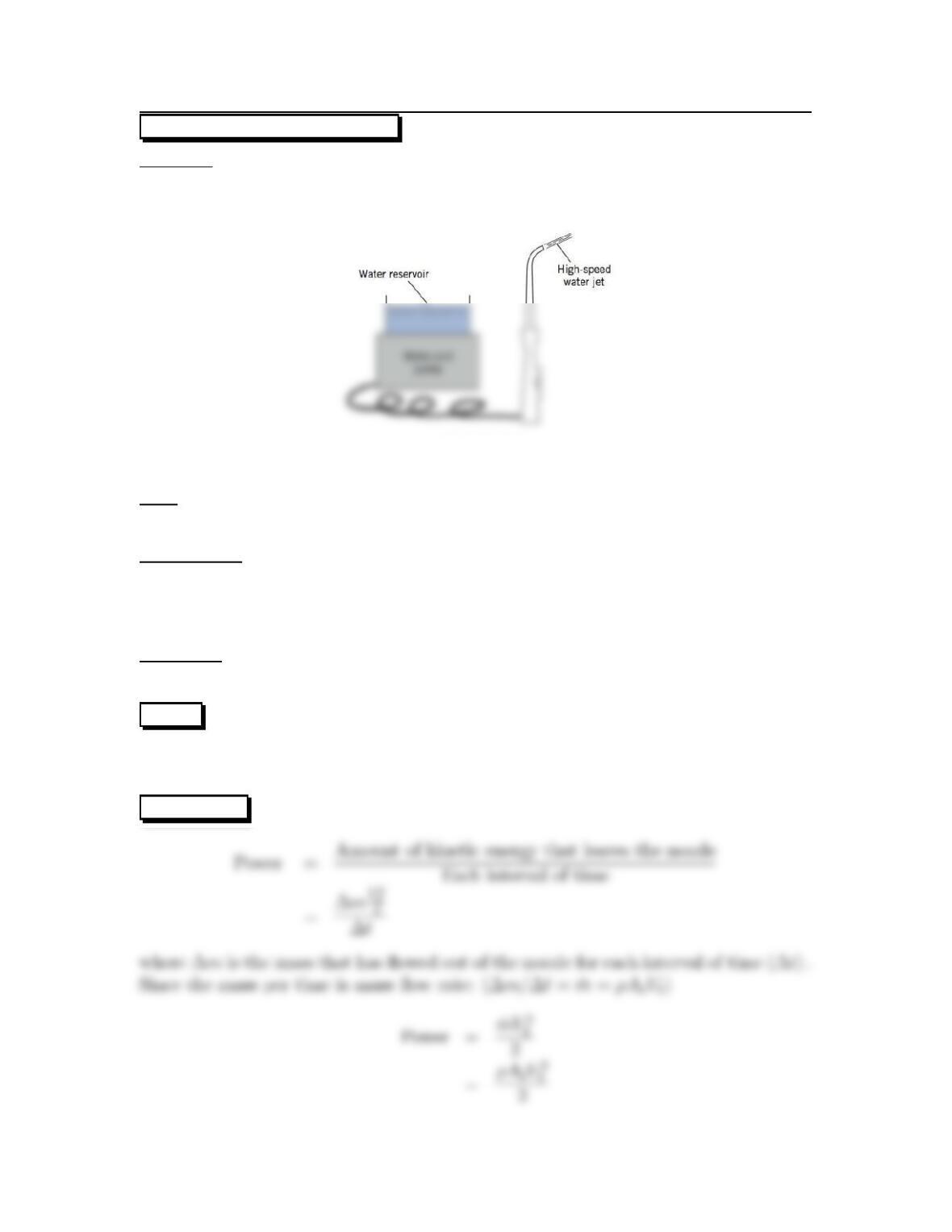
Situation:
A water pik is producing a high-speed jet.
d=1mm,V2=27m/s.
Find:
Minimum electrical power (watts).
Assumptions:
Neglect energy losses in the mechanical system—e.g. motor, gears, and pump.
Neglect all energy losses associated with viscosity.
Neglect potential energy changes because these are very small.
Properties:
Water (10 ◦C) ,Table A.5: ρ=1000kg/m3.
PLAN
Balance electrical power with the rate at which water carries kinetic energy out of
the nozzle.
SOLUTION
10

Exit area
Thus:
REVIEW
Based on Ohm’s law, the current drawn by this water pik on a U.S. household circuit
is about: I=P/V =7.73 W/115 V = 0.67 A.
11
7.9: PROBLEM DEFINITION
Situation:
A small wind turbine is being developed.
D=1.25 m,V=15mph = 6.71 m/s.
Turbine efficiency: η=20%.
Find:
Power (watts) produced by the turbine.
Properties:
Air (10 ◦C,0.9bar=90kPa), R=287J/kg ·K.
PLAN
Find the density of air using the idea gas law. Then, find the kinetic energy of the
wind and use 20% of this value to find the power that is produced.
SOLUTION
Ideal gas law
Kinetic energy of the wind
12
(∆m/∆t=˙m=ρAV )
The area is
REVIEW
The amount of energy in the wind is diffuse (i.e. spread out). For this situation, the
wind turbine provides enough power for approximately one 40 watt light bulb.
13
Problem 7.10
The first law of thermodynamics for a closed system can be characterized in words as
a. (change in energy in a system) = (thermal energy in) — (work done on surroundings)
b. (change in energy in a system) = (thermal energy out) — (work done by surround-
ings)
c. either of the above
SOLUTION
14

Problem 7.11
Applying the Reynold’s Transport Theorem to the first law of thermodynamics (select
all that are correct)
a. refers to the increase of energy stored in a closed system
b. extends the applicability of the first law from a closed system to an open system
(control volume)
c. refers only to heat transfer, and not to work
SOLUTION
15

Problem 7.12
No solution provided.
16
7.13: PROBLEM DEFINITION
Situation:
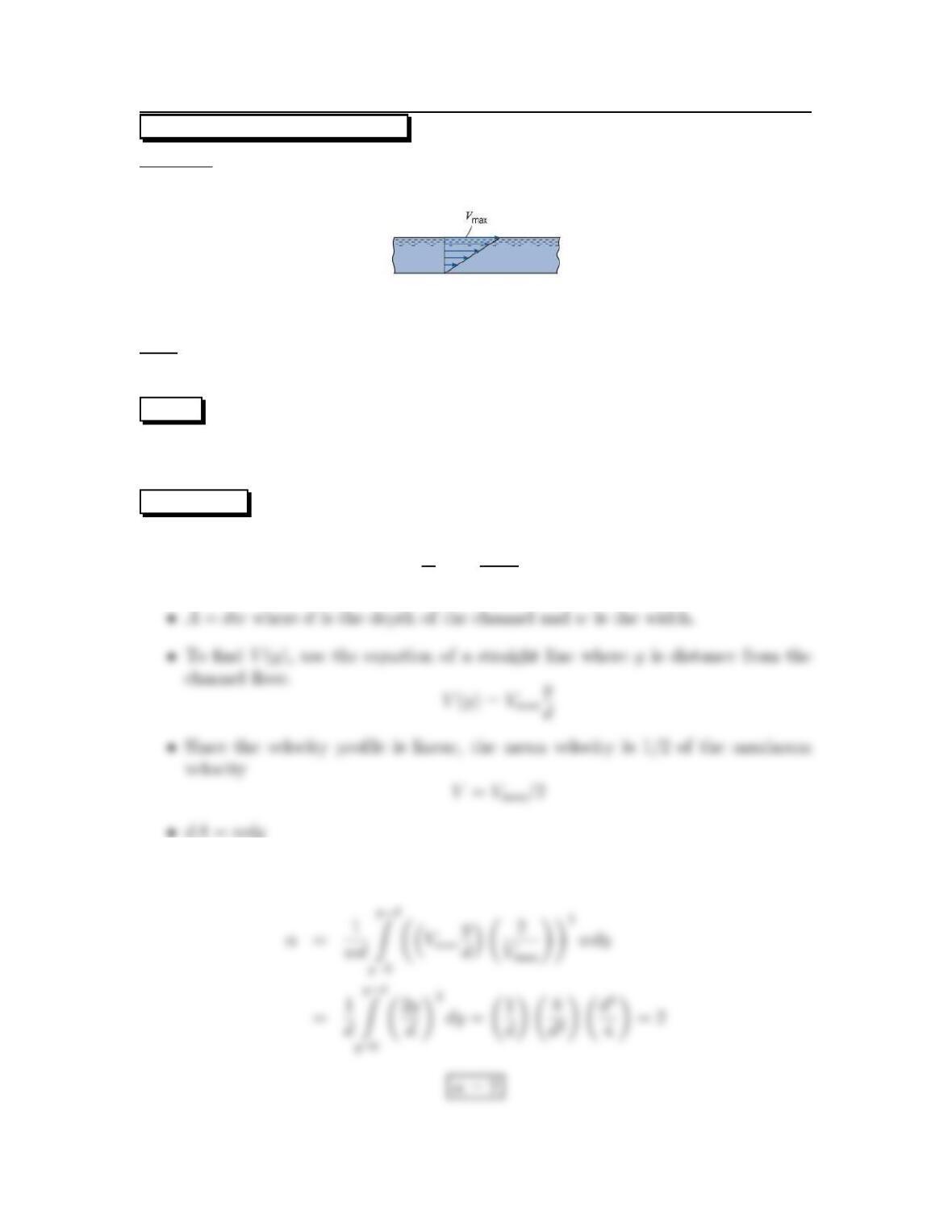
There is a linear velocity distribution in a rectangular channel.
Find:
Kinetic energy correction factor: α
PLAN
1. Use the definition of α(Eq. 7.21 in EFM10e), and then do a term-by-term analysis.
2. Combine terms.
SOLUTION
1. Definition of α
α=1
AZAµV(y)
¯
V¶3
dA (1)
2. Substitute terms into Eq. (1)
17
7.14: PROBLEM DEFINITION
Situation:
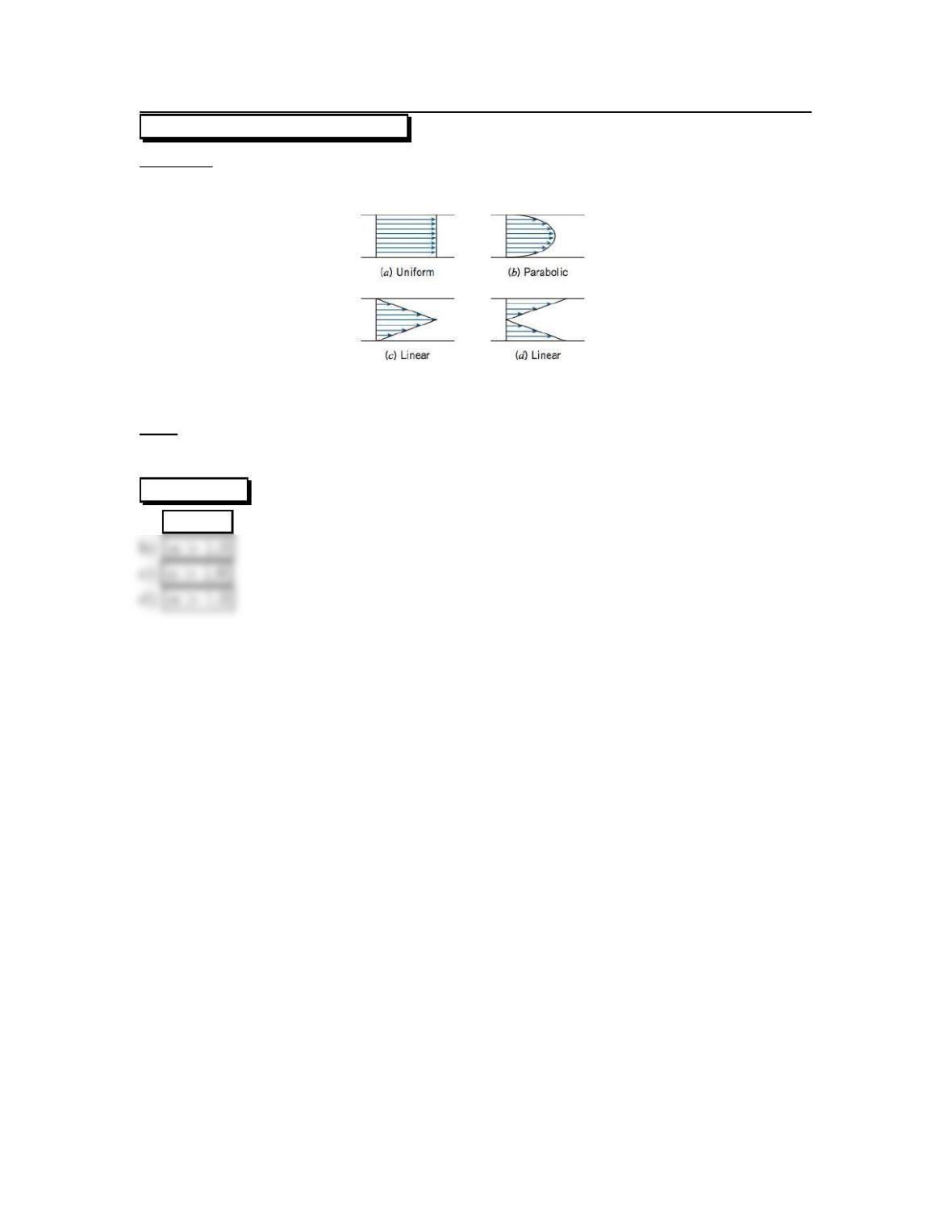
Velocity distributions (a) through (d) are shown in the sketch.
Find:
Indicate whether αis less than, equal to, or less than unity.
SOLUTION
a) α=1.0
18
7.15: PROBLEM DEFINITION
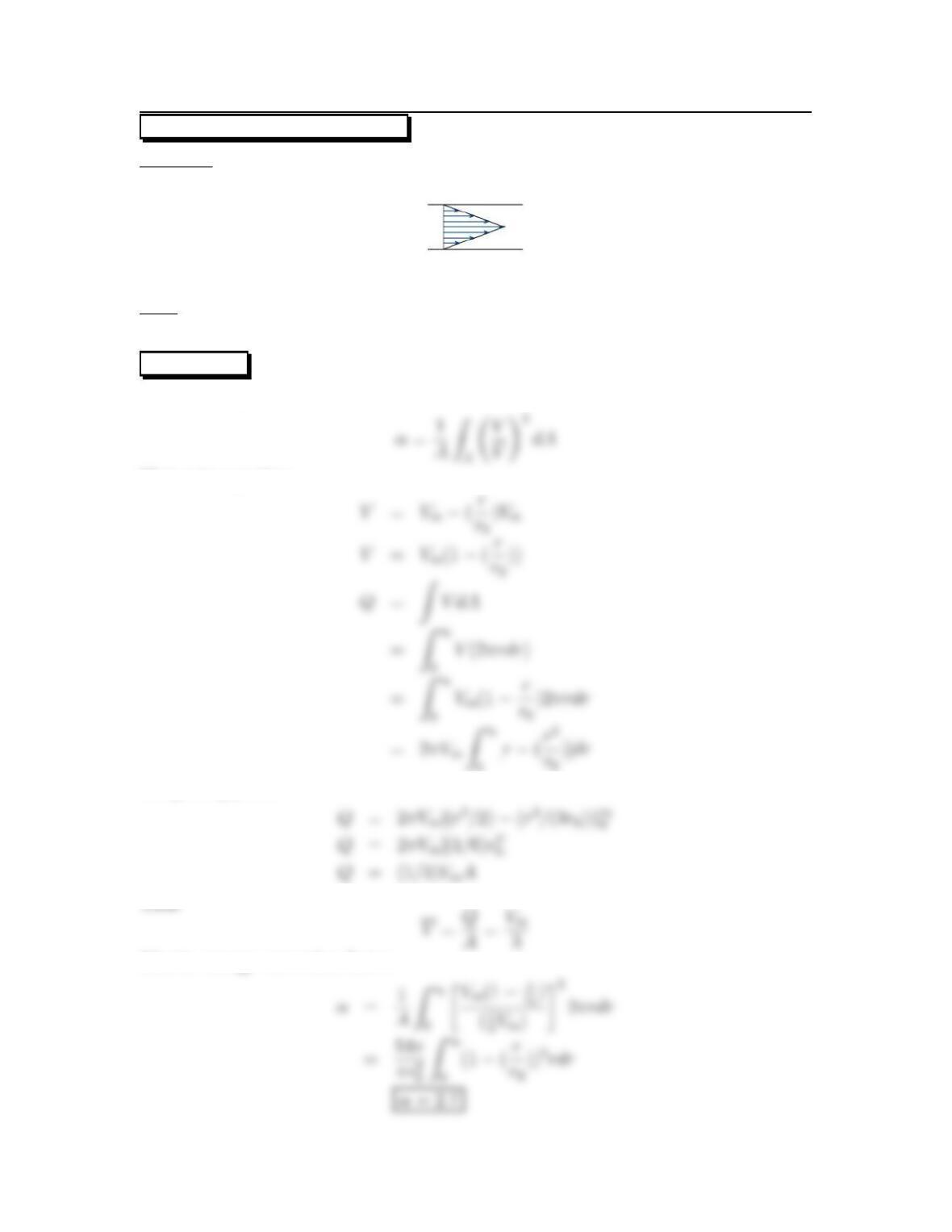
Situation:
There is a linear velocity distribution in a round pipe.
Find:
Kinetic energy correction factor: α
SOLUTION
Kinetic energy correction factor
Flow rate equation
0
Integrating yields
Thus
Kinetic energy correction factor
19
7.16: PROBLEM DEFINITION
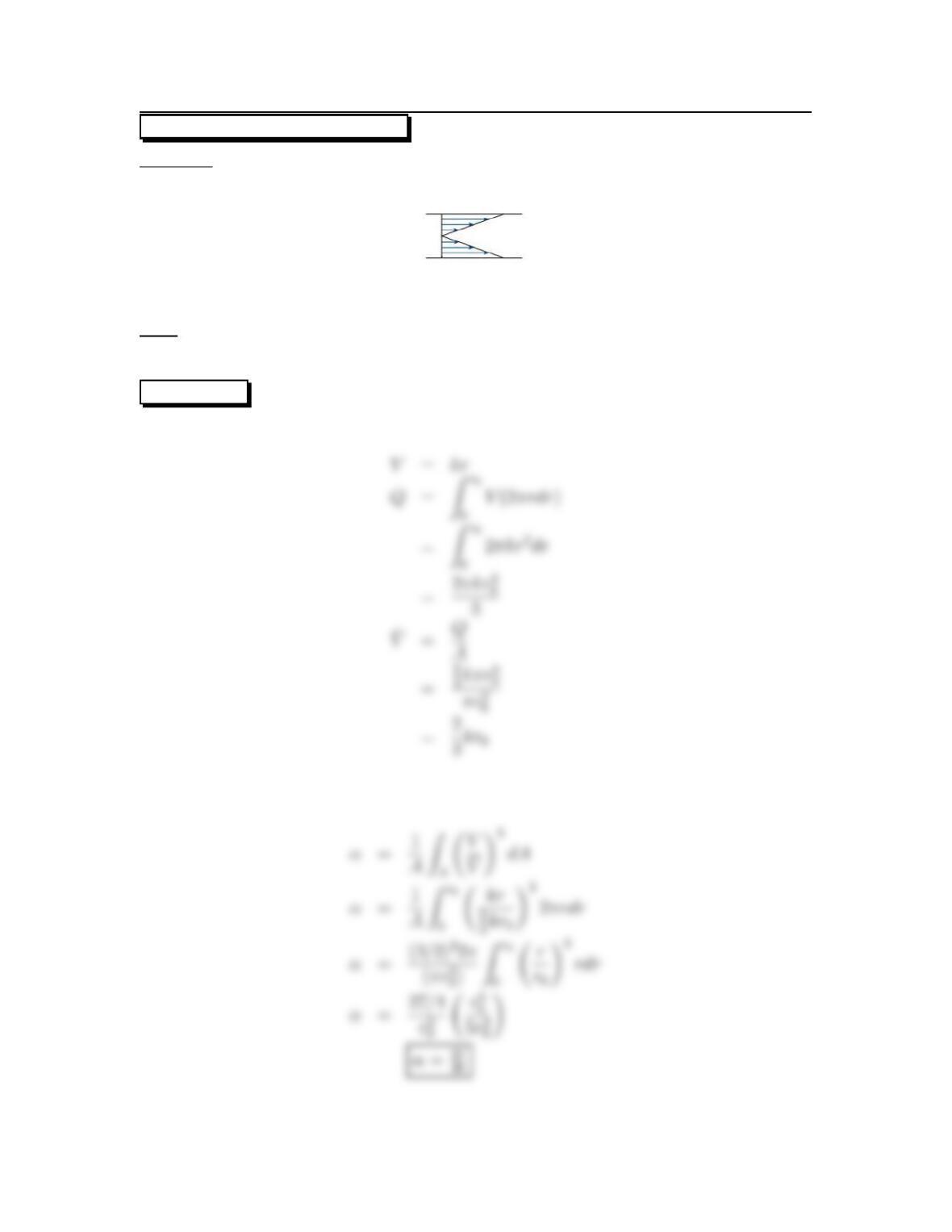
Situation:
There is a linear velocity distribution in a round pipe.
Find:
Kinetic energy correction factor: α
SOLUTION
Flow rate equation
Kinetic energy correction factor
20