
41
7.32: PROBLEM DEFINITION
Situation:
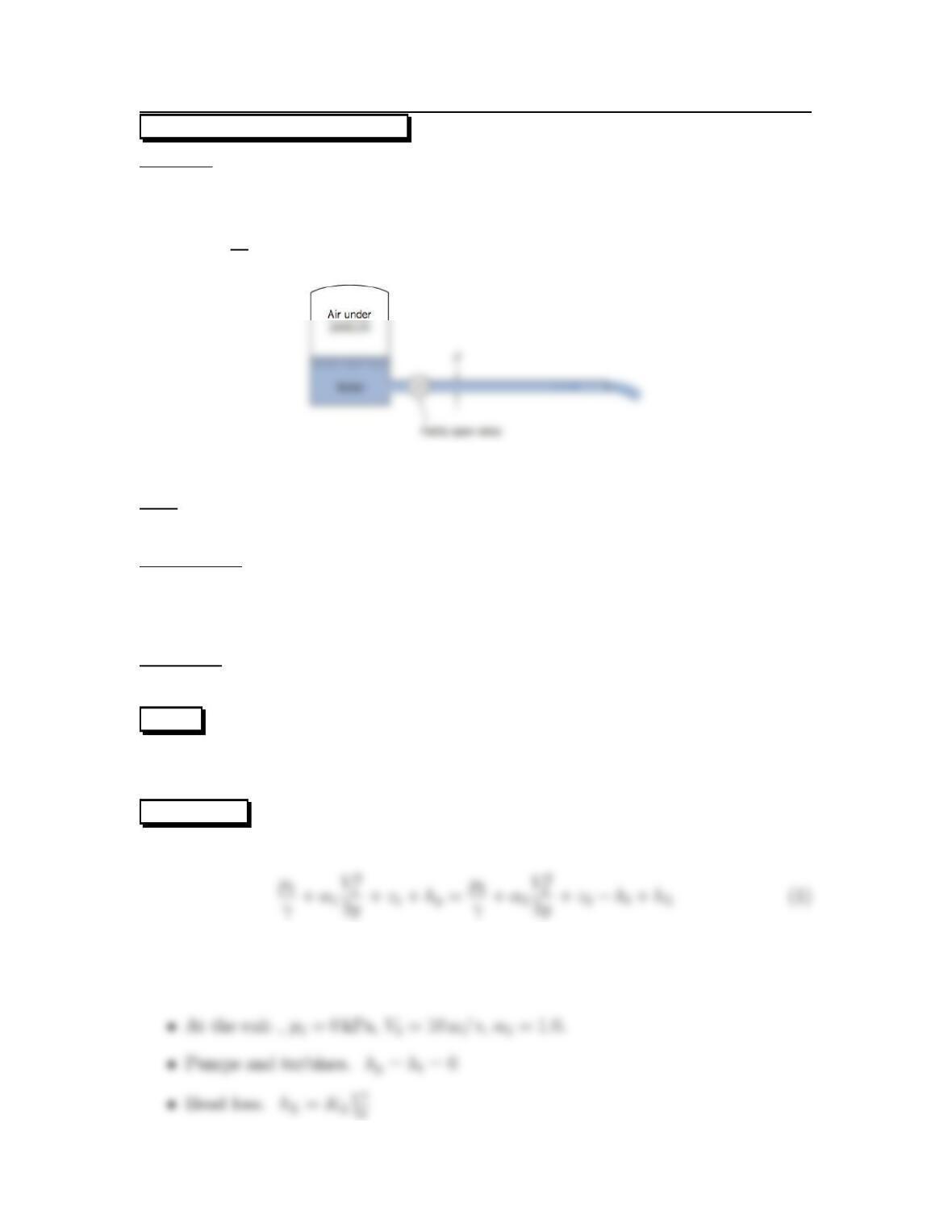
Water flows from a pressurized tank, through a valve and out a pipe.
p1=100kPa,z1=8m.
p2=0kPa,z
2=0m.
hL=KLV2
2g,V2=10m/s.
Find:
The minor loss coefficient (KL).
Assumptions:
Steady flow.
Outlet flow is turbulent so that α2=1.0.
V1≈0.
Properties:
Water (15 ◦C),TableA.5:γ=9800N/m3.
PLAN
Apply the energy equation and then solve the resulting equation to find the minor
loss coefficient.
SOLUTION
Energy equation (section 1 on water surface in tank; section 2 at pipe outlet)
Term by term analysis:
•At the inlet. p1=100kPa,V1≈0,z1=8m
42
Eq. (1) simplifies to
Thus
REVIEW
1. The minor loss coefficient (KL=2.57) is typical of a valve (this information is
presented in Chapter 10).
2. The head at the inlet ³p1
γ+z1=22.2m
´represents available energy. Most of
7.33: PROBLEM DEFINITION
Situation:
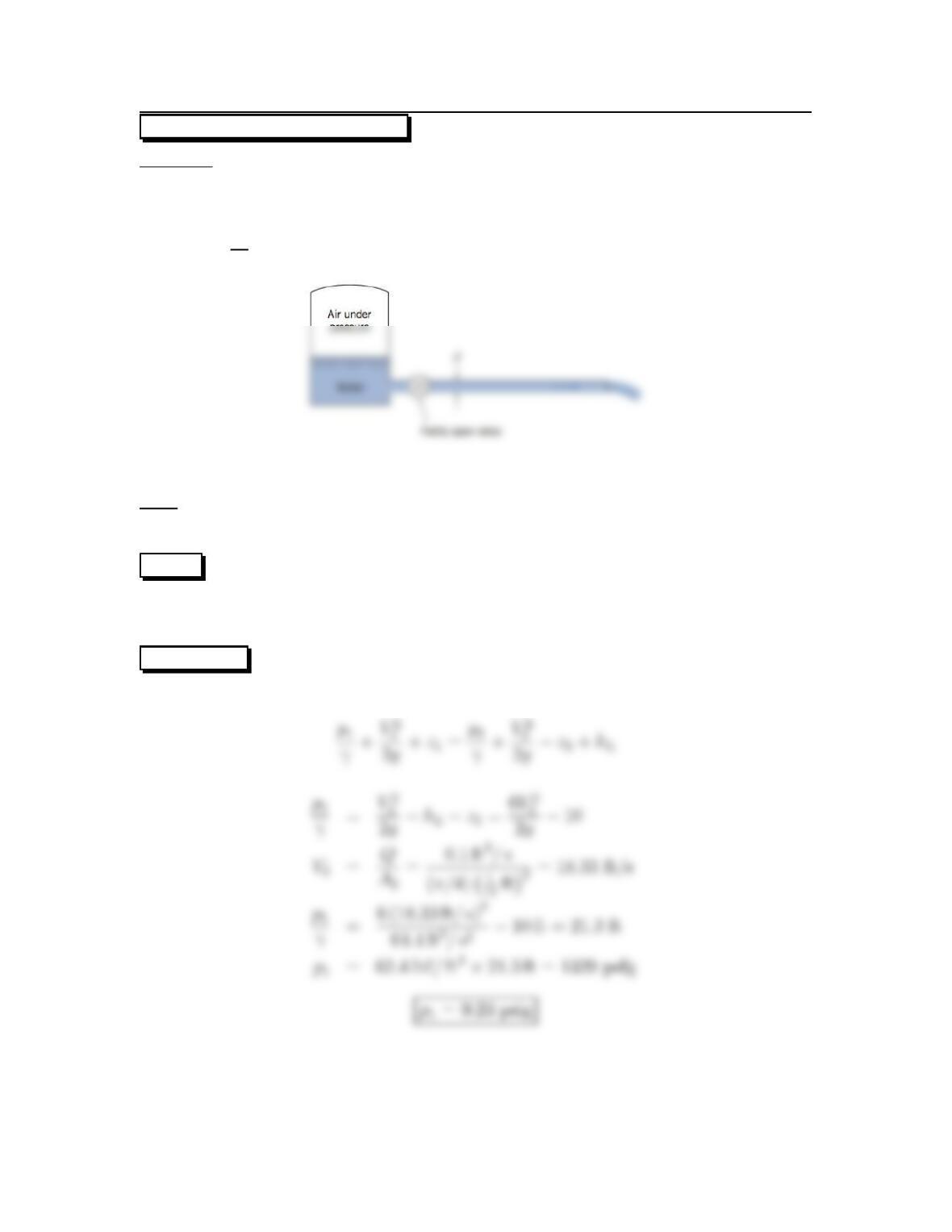
Water flows from a pressurized tank, through a valve and out a pipe.
Q=0.1ft
3/s,∆z=10ft.
p2=0psig,D=1in.
hL=KLV2
2g.
Find:
Pressure in tank (psig).
PLAN
Apply the energy equation and then solve the resulting equation to give pressure in
the tank.
SOLUTION
Energy equation (from the water surface in the tank to the outlet)
44
7.34: PROBLEM DEFINITION
Situation:
Water flows from an open tank, through a valve and out a pipe.
A=8cm
2,∆z=9m.
p1=p2=0kPa.
hL=4
V2
2g.
Find:
Discharge in pipe.
Assumptions:
α=1.
PLAN
Apply the energy equation from the water surface in the reservoir (pt. 1) to the outlet
end of the pipe (pt. 2).
SOLUTION
Energy equation:
Term by term analysis:
The energy equation becomes.
Flow rate equation
45
Problem 7.35
Situation:
Minor artery in the human arm
D=3mm,L=20cm,d=1.6mm
Blood pressure at Dis 110 mm Hg, and at dis 85 mm Hg.
S= 1.06, and Q=300mL/min
Arm is being held horizontally.
Idealize flow as steady, the fluid as Newtonian, and walls of the artery as rigid.
Find:
Head loss (m) that occurs over the 20-cm distance
PLAN
Apply the energy equation from x=0to x=20cm.
You’re given P1,A1,P2,A2and Q.
Use flow rate equation and continuity to find V1and V2.
Solve for head loss.
SOLUTION
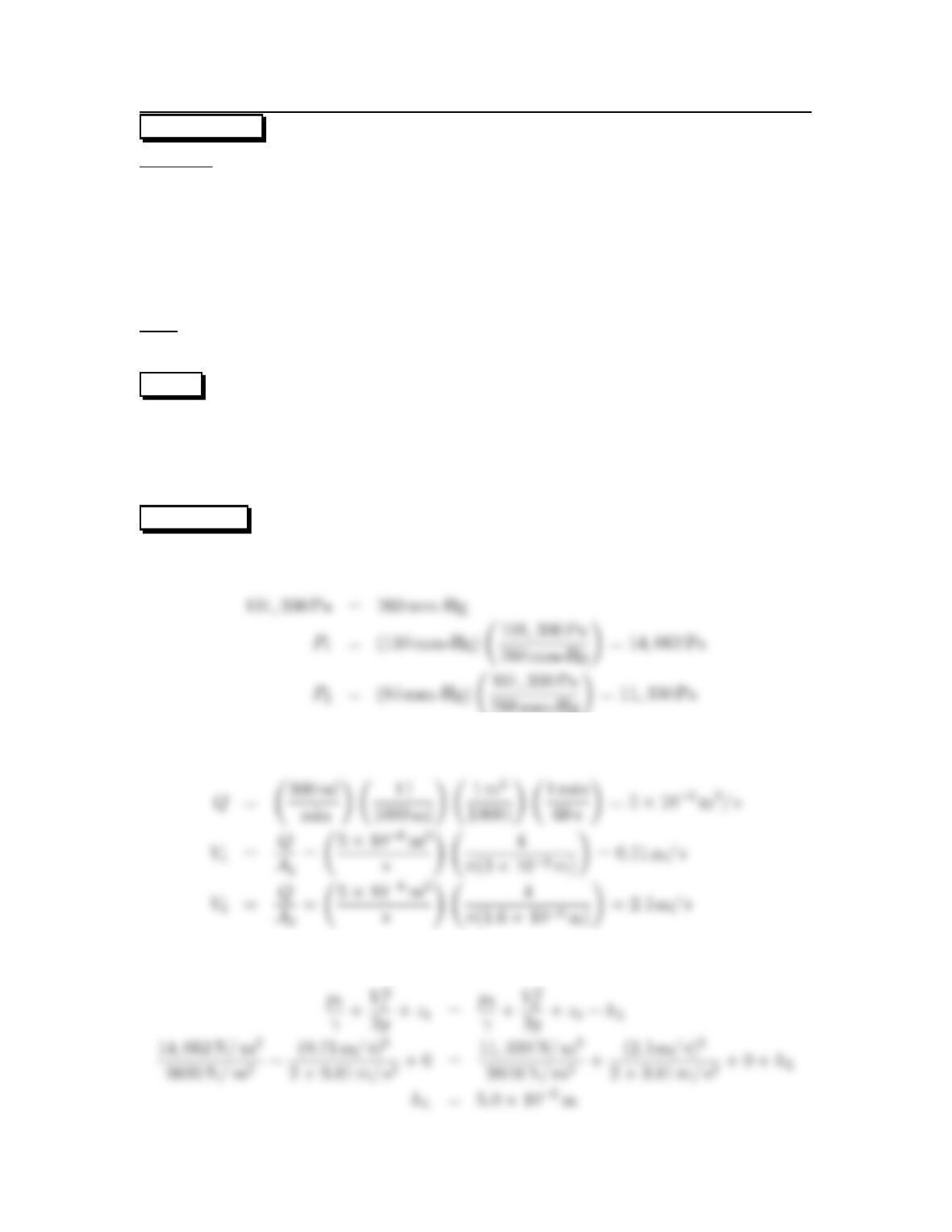
Convert blood pressure from mm-Hg to Pa.
Convert Qfrom mL/min to m3/s.
Apply the energy eqn.
46

7.36: PROBLEM DEFINITION
Situation:
A microchannel is designed to transfer fluid in a MEMS application.
D=200μm,L=5cm.
Q=0.1μL/s.
hL=32μLV
γD2.
Find:
Pressure in syringe pump (Pa).
Assumptions:
α=2.
Properties:
Table A.4: ρ=799kg/m3.
PLAN
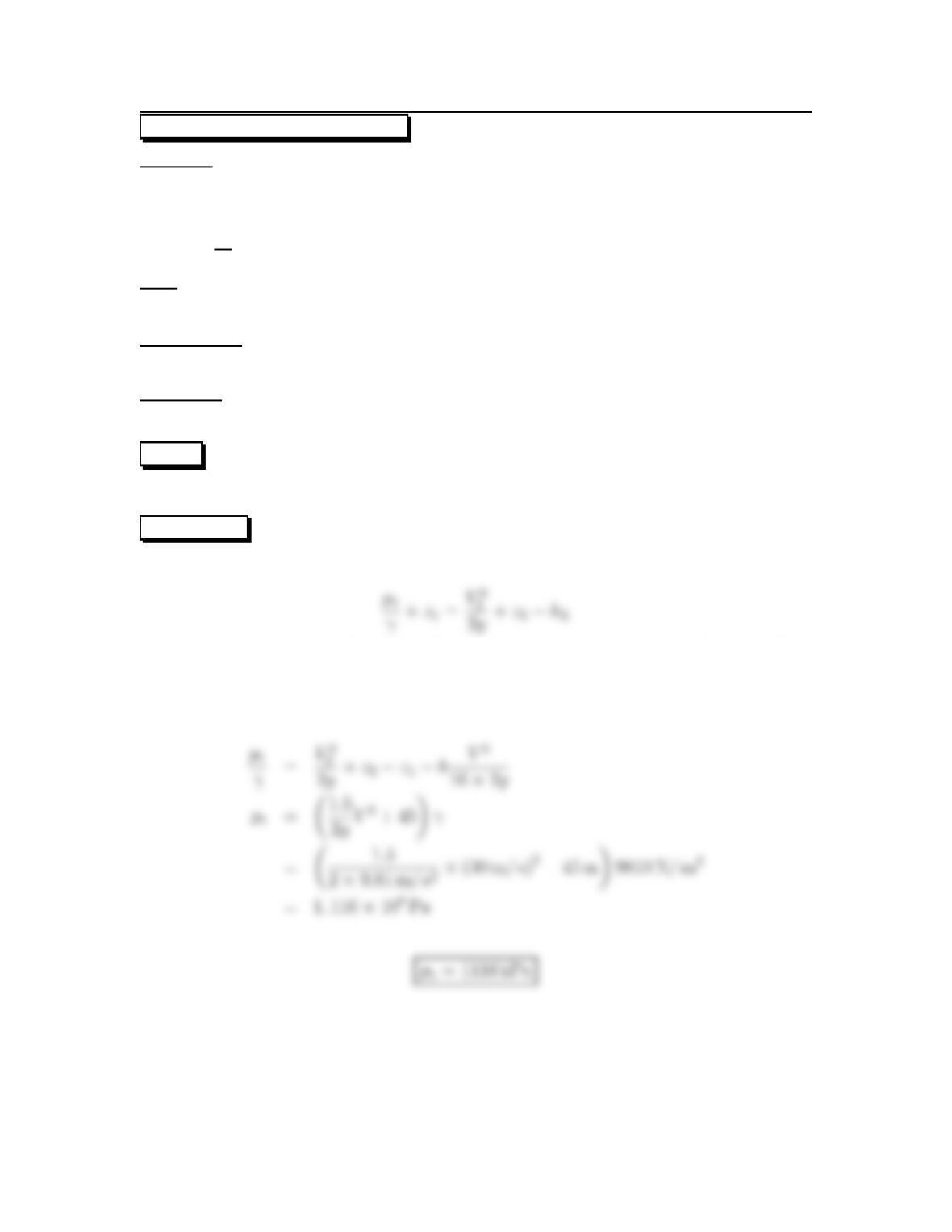
Apply the energy equation and the flow rate equation.
SOLUTION
Energy equation (locate section 1 inside the pumping chamber; section 2 at the outlet
of the channel)
Flow rate
The cross-sectional area of the channel is 3.14×10⁻⁸m2.Aflow rate of 0.1 μl/s is
10−7l/s or 10−10 m3/s. The flow velocity is
47
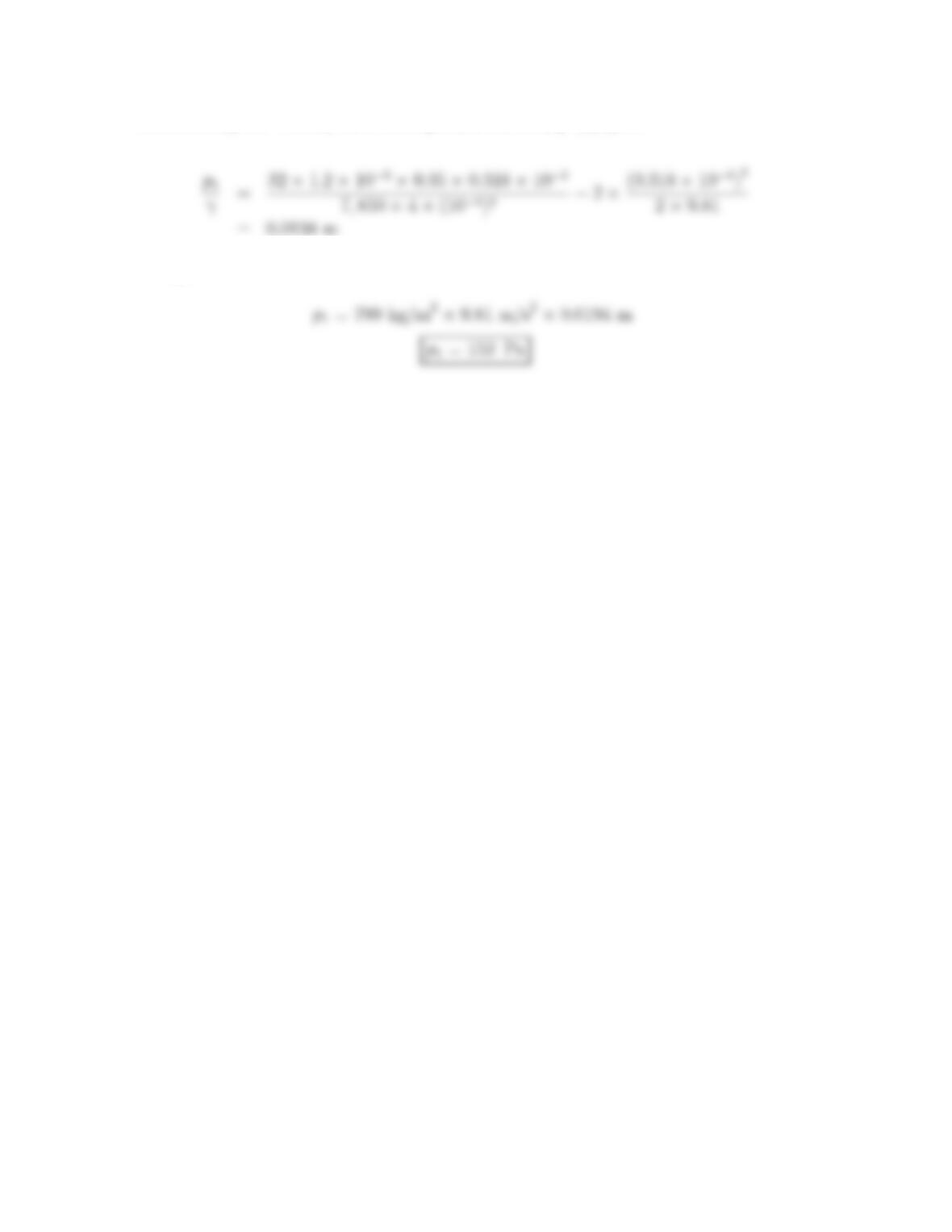
Substituting the velocity and other parameters in Eq. (1) gives
The pressure is
48
7.37: PROBLEM DEFINITION
Situation:
Water flows out of a fire nozzle.
V=30m/s,∆z=45m.
Ae/Ahose =1/4.
hL=8
V2
2g.
Find:
Pressure at hydrant.
Assumptions:
Hydrant supply pipe is much larger than the firehose.
Properties:
Water, Table A.5, γ=9810N/m3.
PLAN
Apply the energy equation.
SOLUTION
Energy equation
where the kinetic energy of the fluid feeding the hydrant is neglected. Because of the
contraction at the exit, the outlet velocity is 4 times the velocity in the pipe, so the
energy equation becomes
49
7.38: PROBLEM DEFINITION
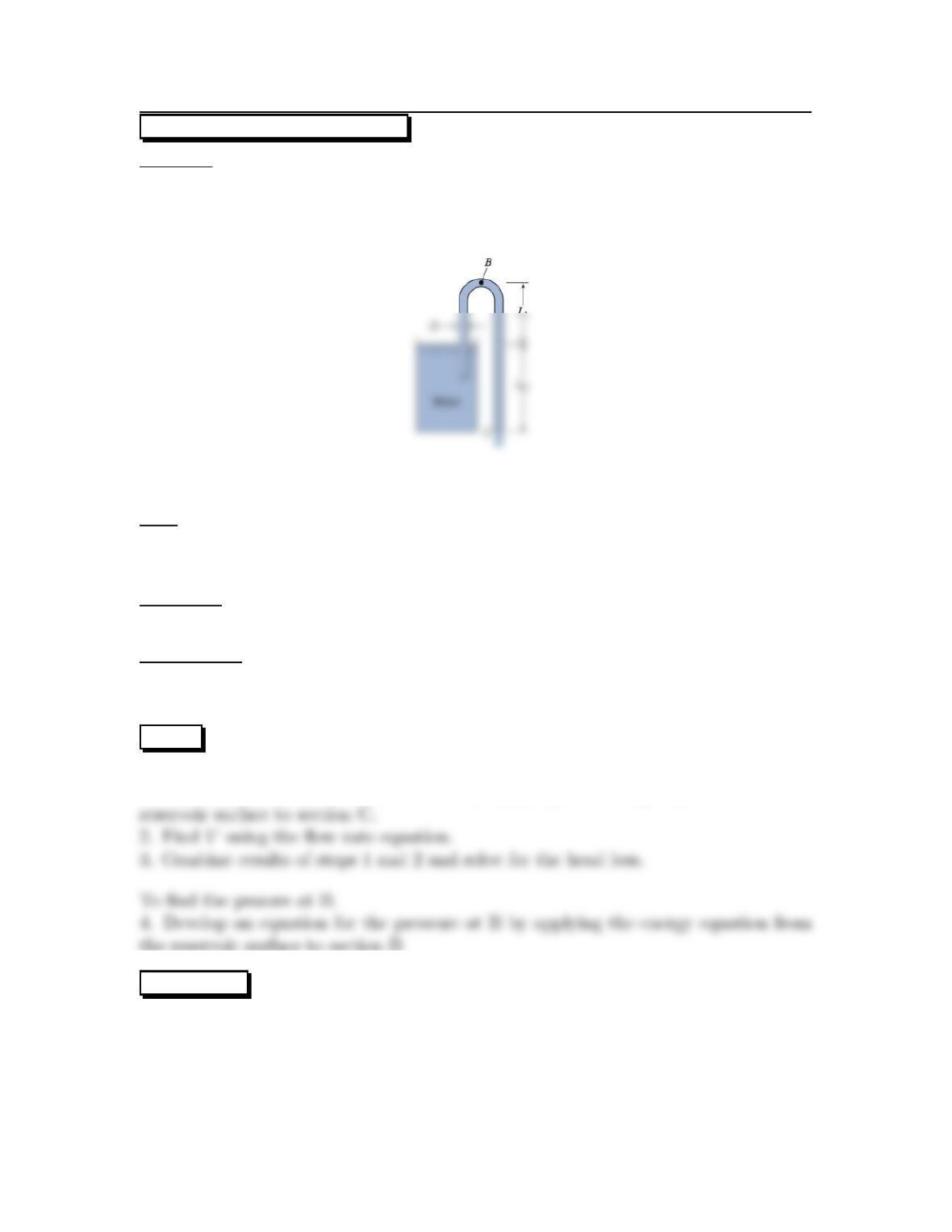
Situation:
Water flows out of a syphon.
L1=L2=3ft.
Q=2.8ft
3/s,D=8in.
Find:
Head loss between reservoir surface and point C.
Pressure at point B.
Properties:
Water (60 ◦F), Table A.5, γ=62.4lbf/ft3.
Assumptions:
α=1.
Three quarters of head loss is between reservoir surface and point B.
PLAN
To find head loss between reservoir surface and point C
1. Develop an equation for head loss by applying the energy equation from the
the reservoir surface to section B
SOLUTION
1. Energy equation (from reservoir surface to section C)
50
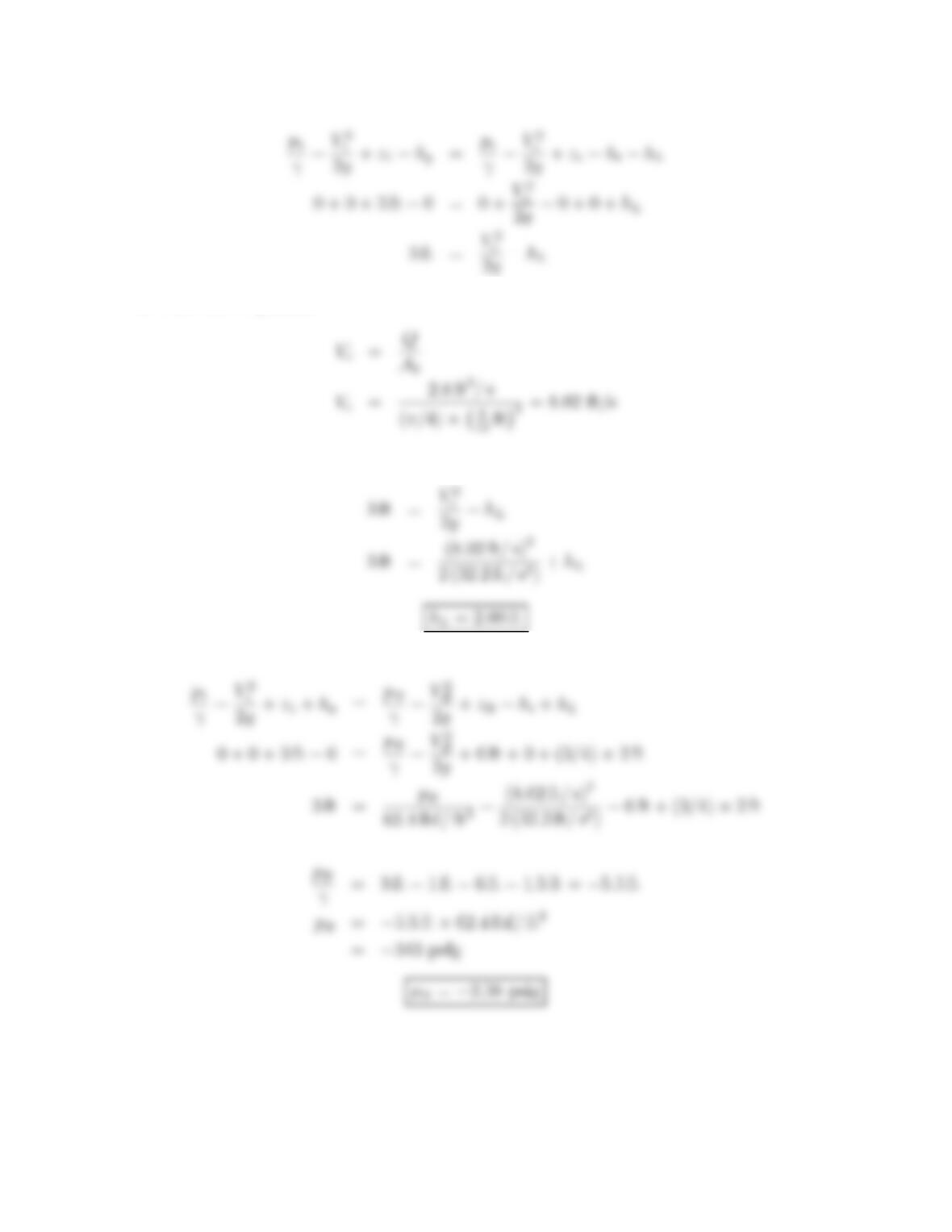
2. Flow rate equation
3.Combineresultsofstep1and2.
4. Energy equation (from reservoir surface to section B).
51
7.39: PROBLEM DEFINITION
Situation:
A siphon transports water from one reservoir to another.
zA=30m,zB=32m.
zC=27m,zD=26m.
D=25cm.
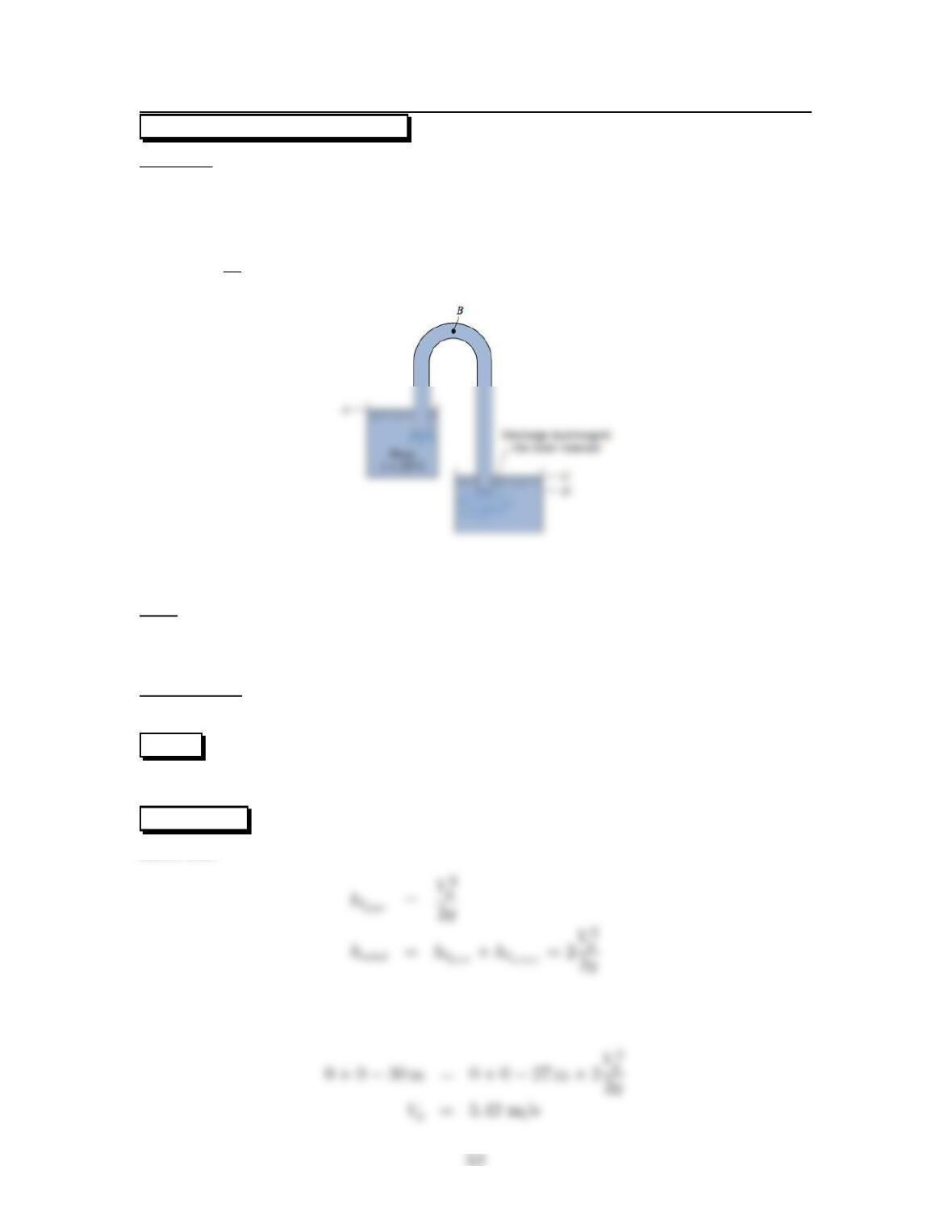
hpipe =V2
p
2g.
Find:
Discharge.
Pressure at point B.
Assumptions:
α=1.
PLAN
Apply the energy equation from A to C, then from A to B.
SOLUTION
Head loss
Energy equation (from A to C)
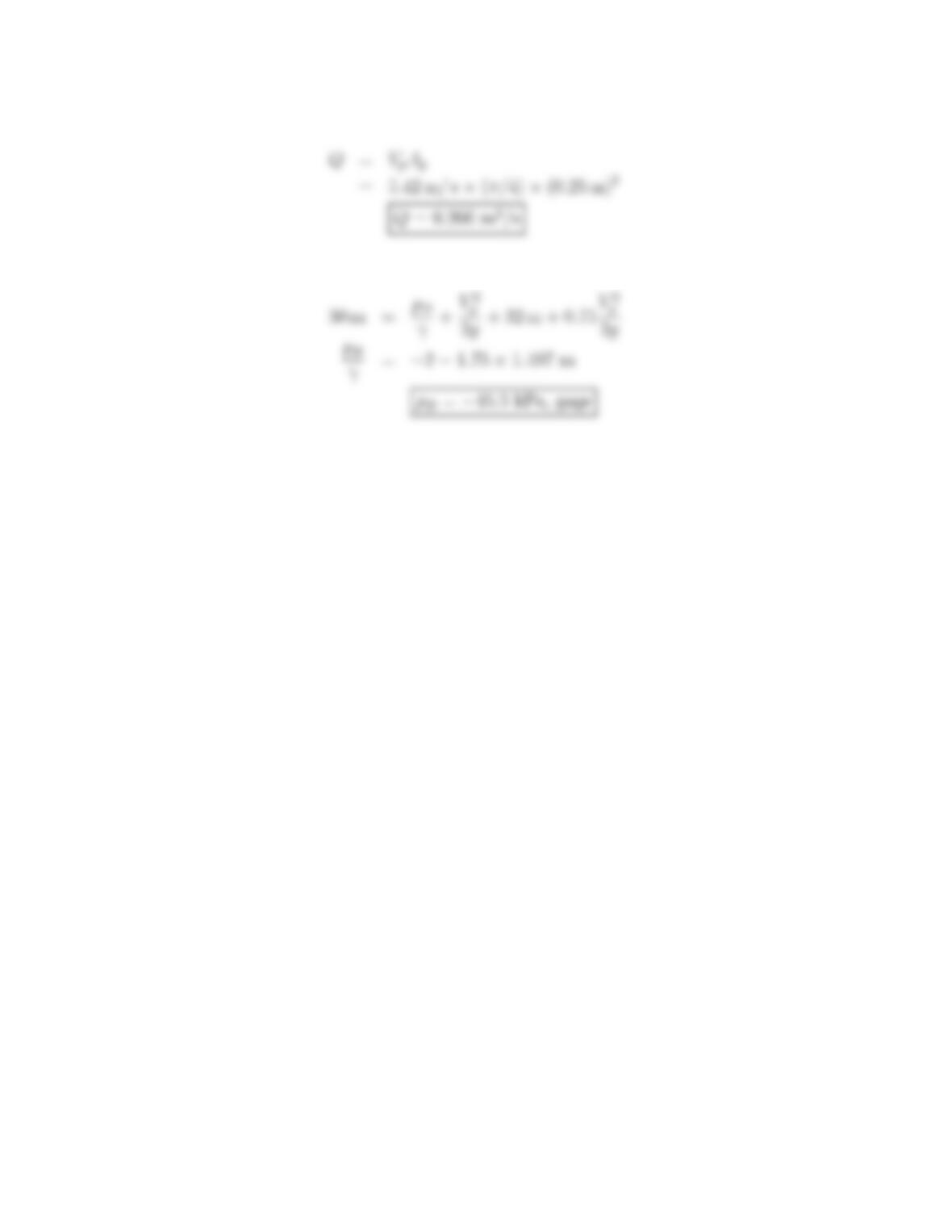
Flow rate equation
Energy equation (from A to B)
53
7.40: PROBLEM DEFINITION
Situation:
A siphon transports water from one reservoir to another.
pv=1.23 kPa,patm = 100 kPa.
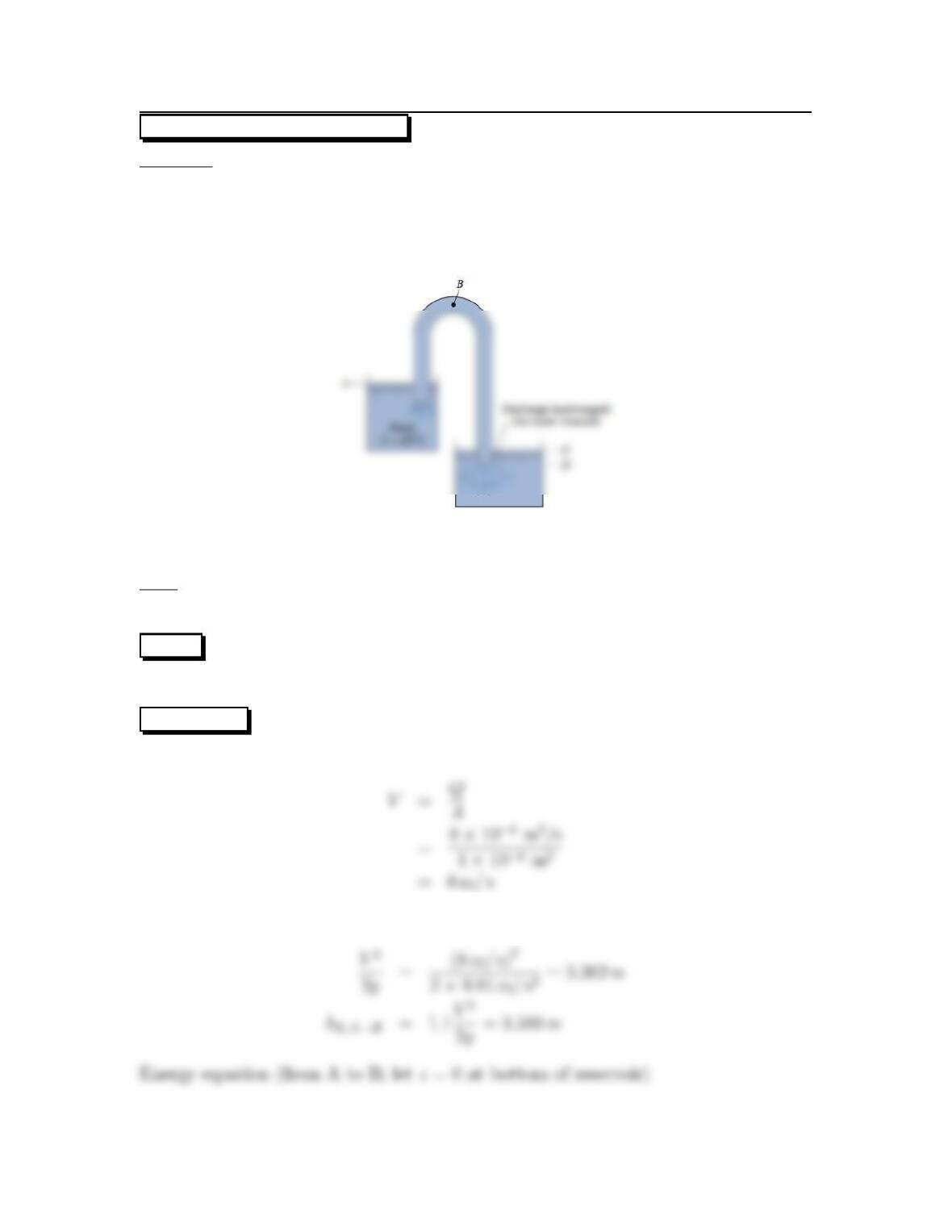
Q=8×10⁻⁴m3/s,A=10
−4m2.
hL,A→B=1.1V2/2g.
Find:
Depth of water in upper reservoir for incipient cavitation.
PLAN
Apply the energy equation from point A to point B.
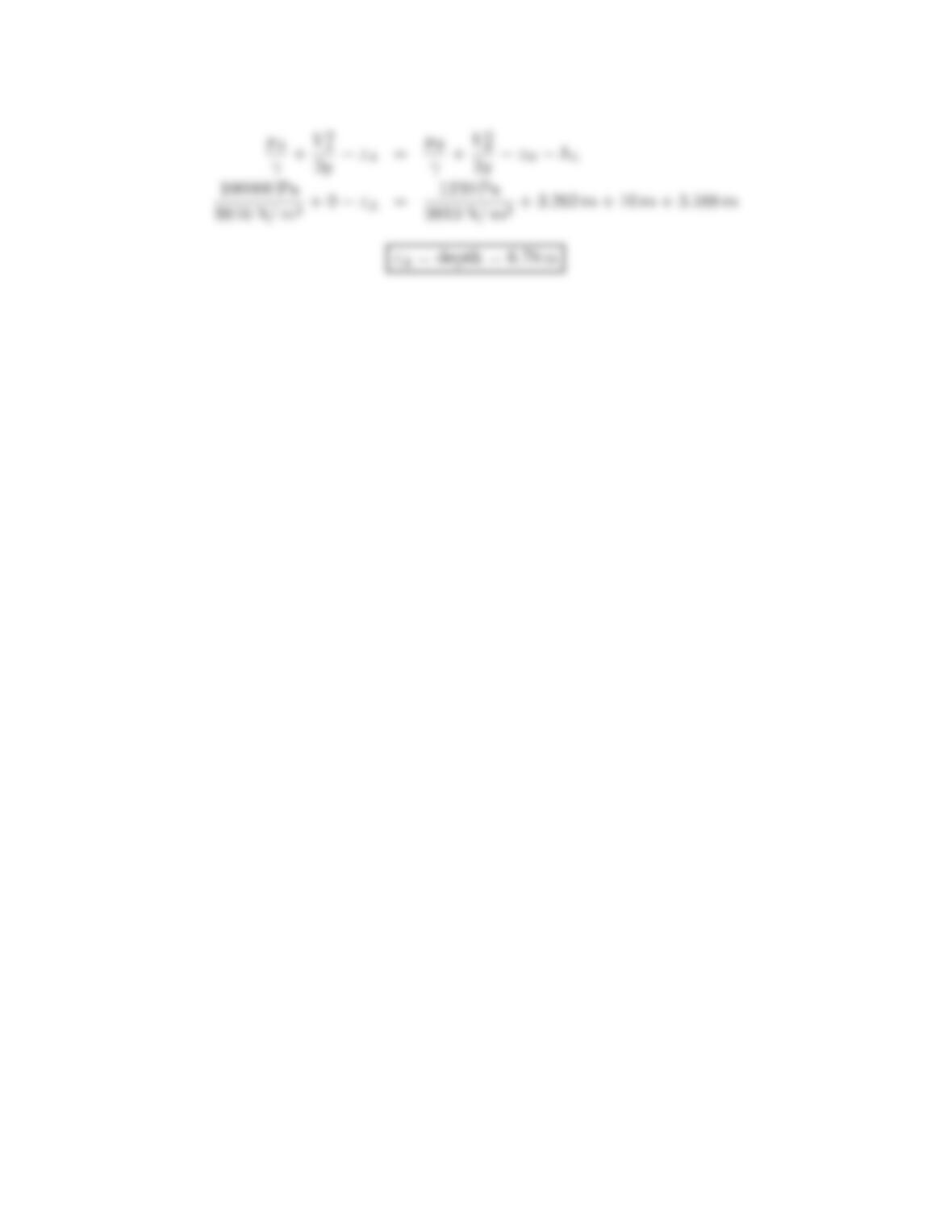
SOLUTION
Flow rate equation
Calculations
54
55
7.41: PROBLEM DEFINITION
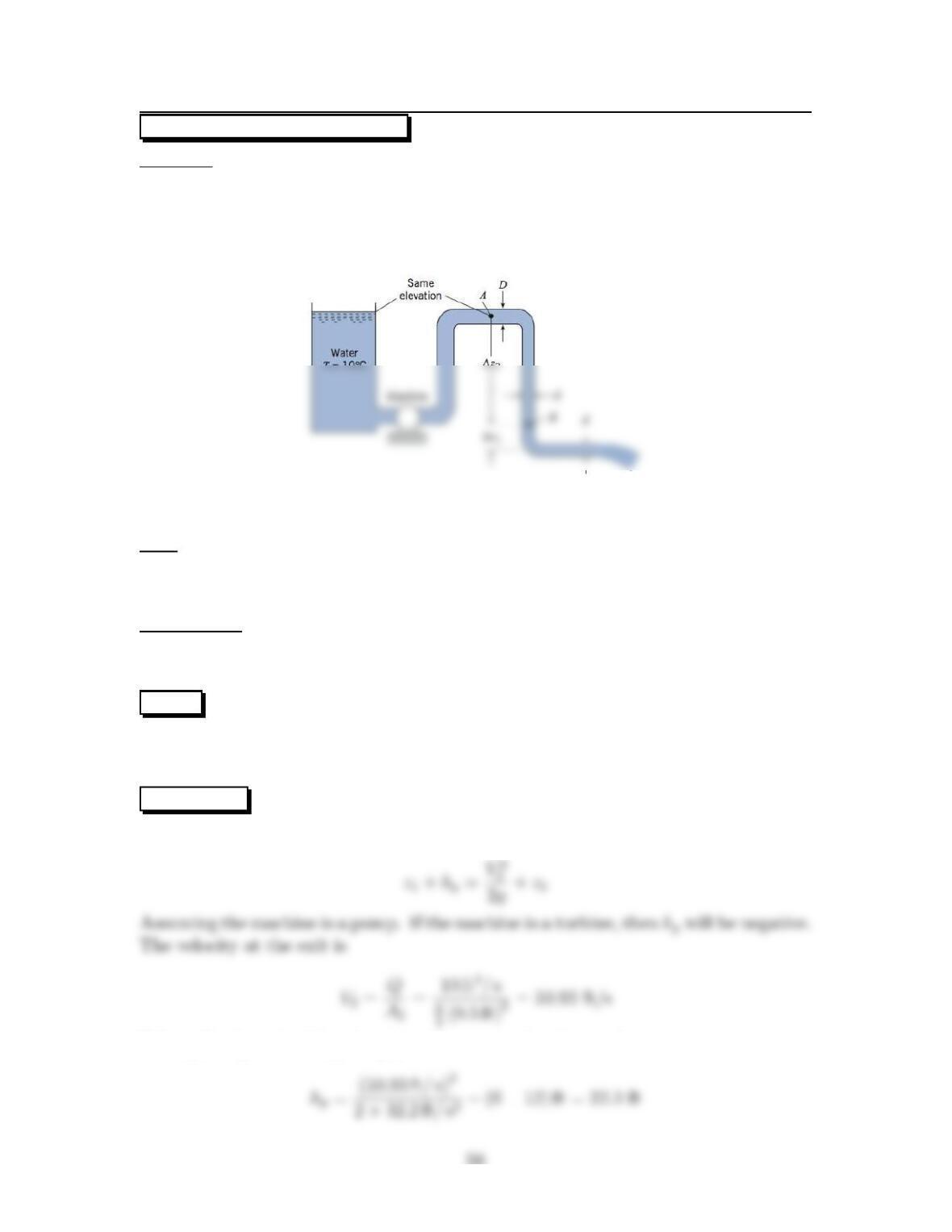
Situation:
A reservoir discharges water into a pipe with a machine.
d=6in,D=12in.
∆z1=6ft,∆z2=12ft.
Q=10ft
3/s.
Find:
Is the machine a pump or a turbine?
Pressures at points Aand B(psig).
Assumptions:
Machine is a pump.
α=1.0.
PLAN
Apply the energy equation between the top of the tank and the exit, then between
point B and the exit, finally between point A and the exit.
SOLUTION
Energy equation
Solving for hpand taking the pipe exit as zero elevation we have
56
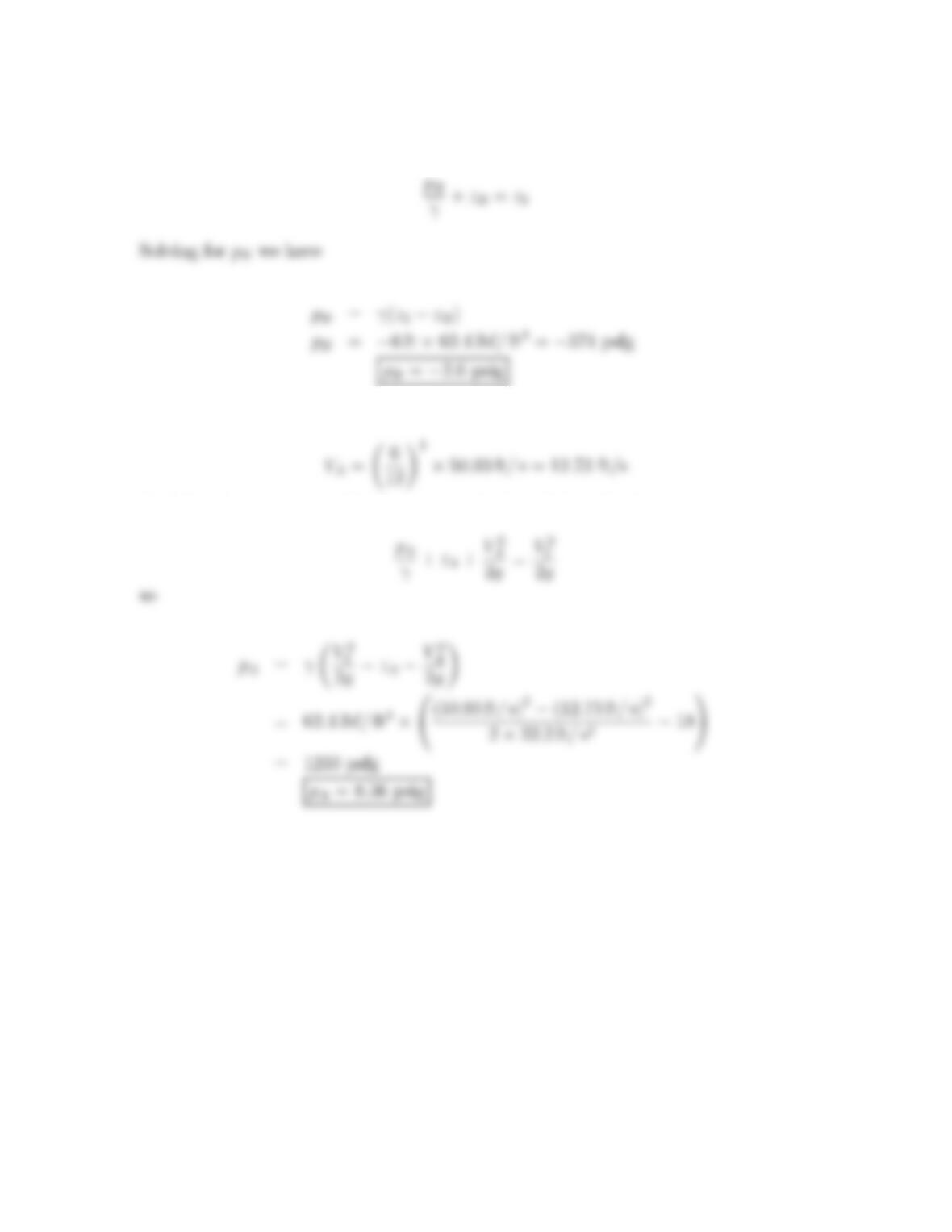
Therefore the machine is a pump.
Applying the energy equation between point B and the exit gives
Velo city at A
Applying the energy equation between point A and the exit gives
57
7.42: PROBLEM DEFINITION
Situation:
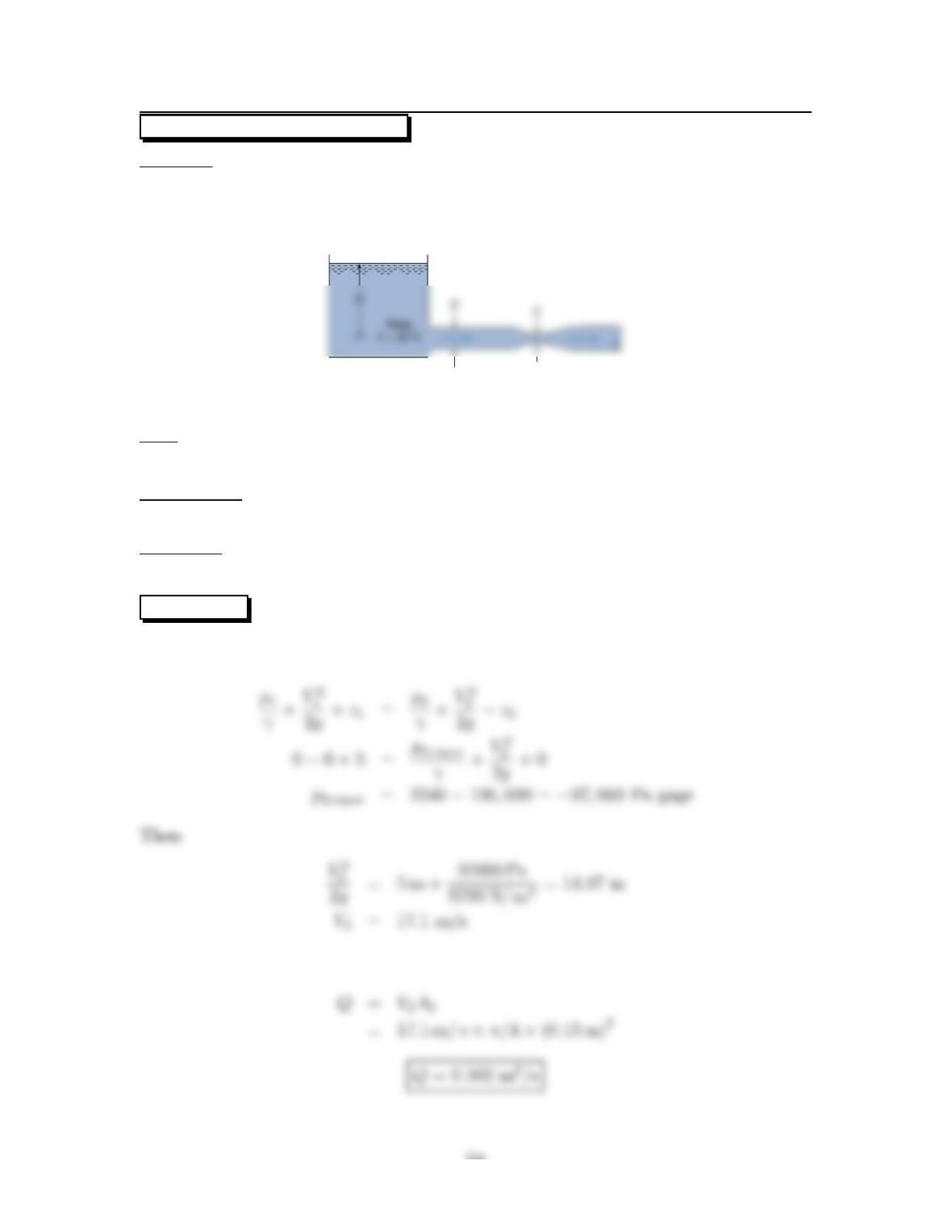
Water flows through a pipe with a venturi meter.
D=30cm,d=15cm.
patm =100kPa,H=5m.
Find:
Maximum allowable discharge before cavitation.
Assumptions:
α=1.0.
Properties:
Water (10 ◦C) ,Table A.5: pv= 2340 Pa, abs.
SOLUTION
Energy equation (locate 1 on the surface of the tank; 2 at the throat of the venturi)
Flow rate equation
58
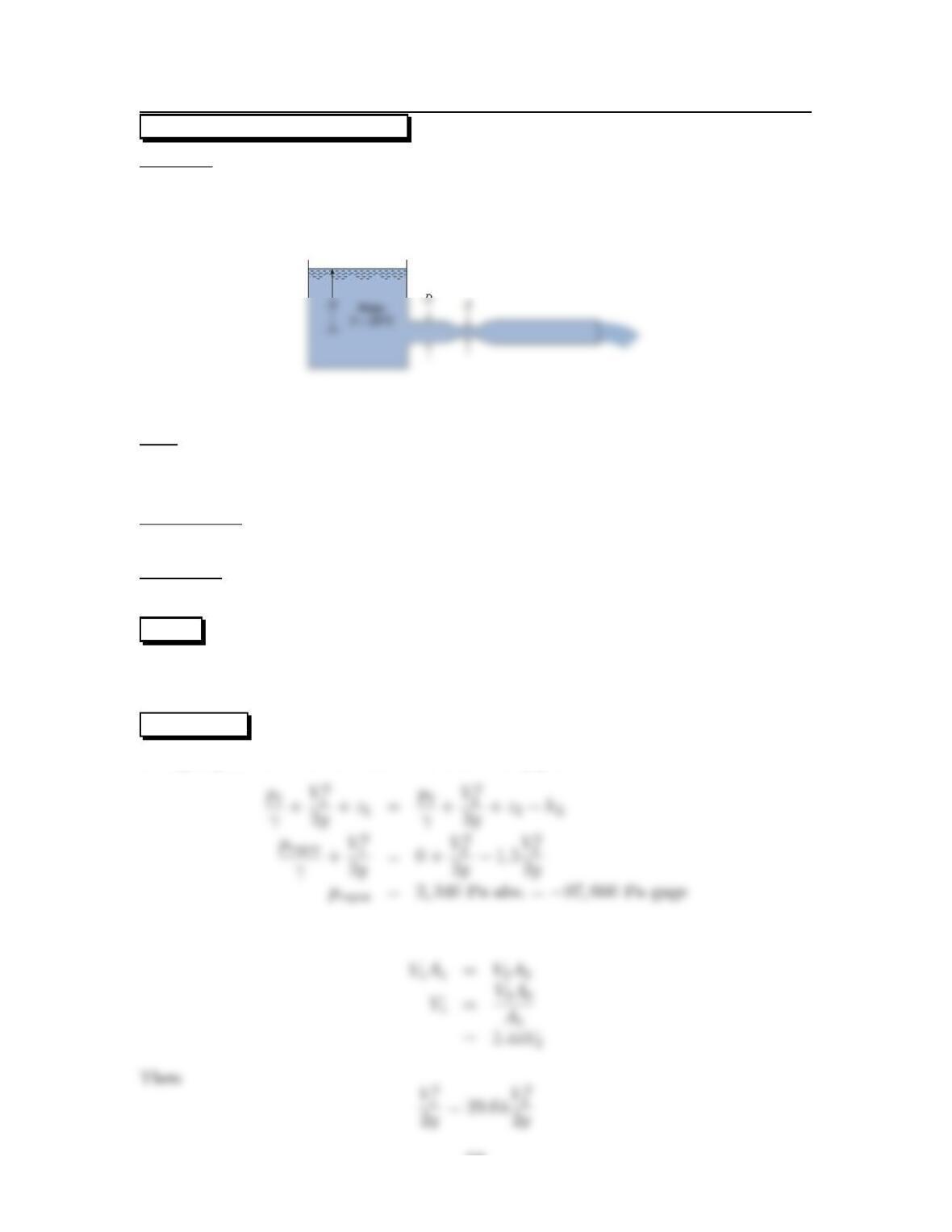
7.43: PROBLEM DEFINITION
Situation:
A reservoir discharges to a pipe with a venturi meter before draining to atmosphere.
D=35cm,d=15cm.
patm = 100 kPa,hL=1.5V2
2/2g.
Find:
Head at incipient cavitation (m).
Discharge at incipient cavitation (m
3/s).
Assumptions:
α=1.0.
Properties:
From Table A.5 pv=2340Pa, abs.
PLAN
FirstapplytheenergyequationfromtheVenturisectiontotheendofthepipe. Then
apply the energy equation from reservoir water surface to outlet:
SOLUTION
Energy equation from Venturi section to end of pipe:
Continuity principle
59
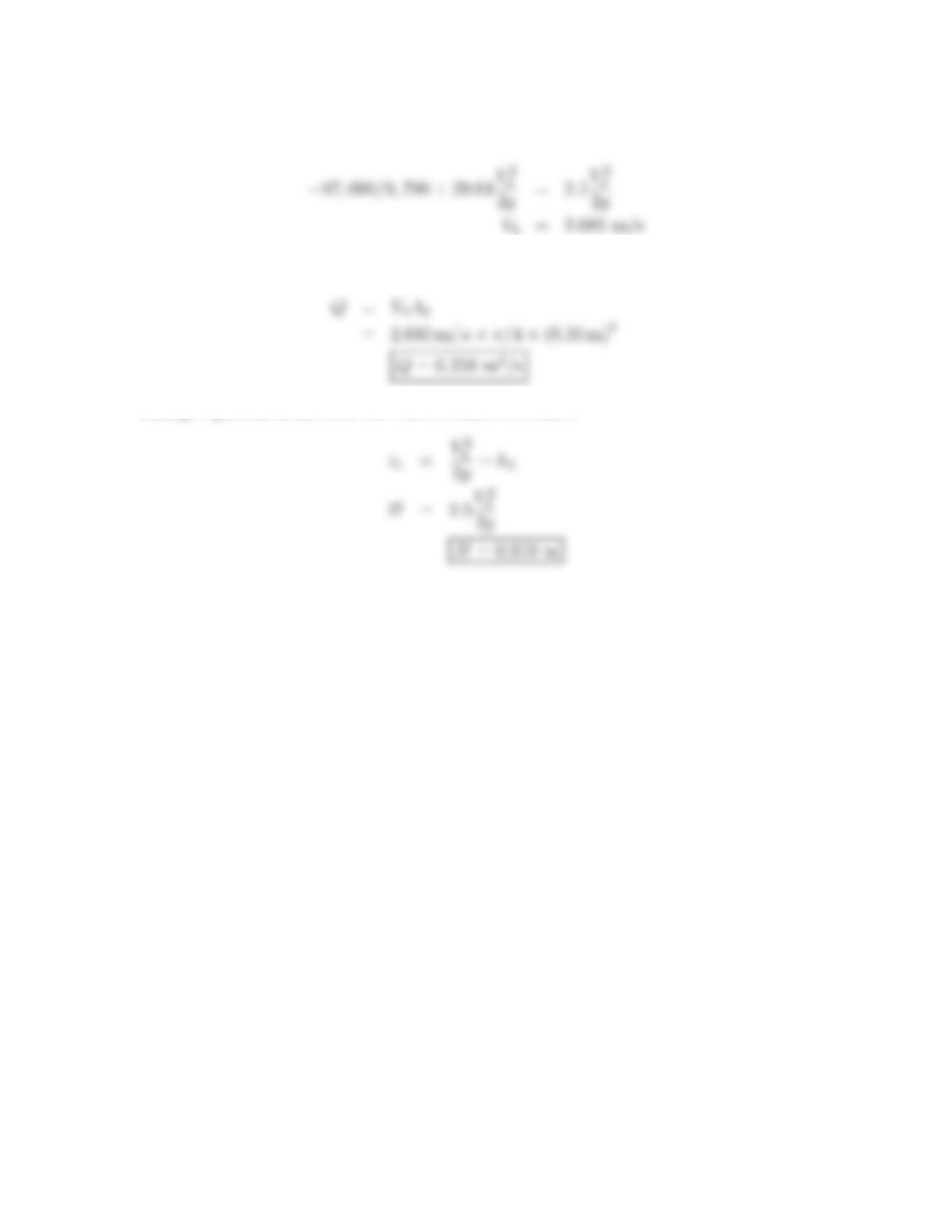
Substituting into energy equation
Flow rate equation
Energy equation from reservoir water surface to outlet:
60