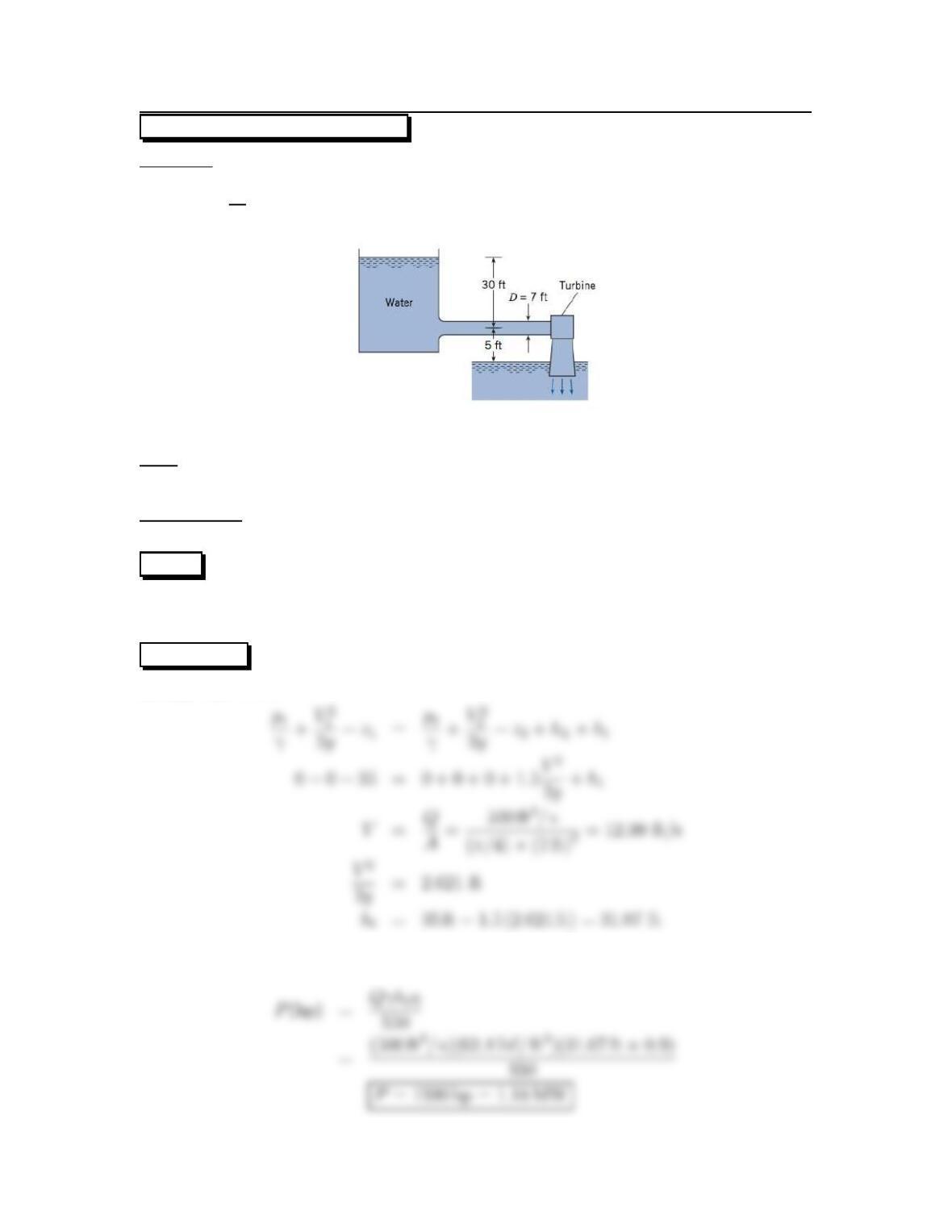
7.55: PROBLEM DEFINITION
Situation:
Q=500cfs, η=90%.
hL=1.5V2
2g,D=7ft.
z1=35ft,z2=0ft.
Find:
Power output from turbine.
Assumptions:
α=1.0.
PLAN
Apply the energy equation from the upstream water surface to the downstream water
surface. Then apply the power equation.
SOLUTION
Energy equation:
Power equation:
81
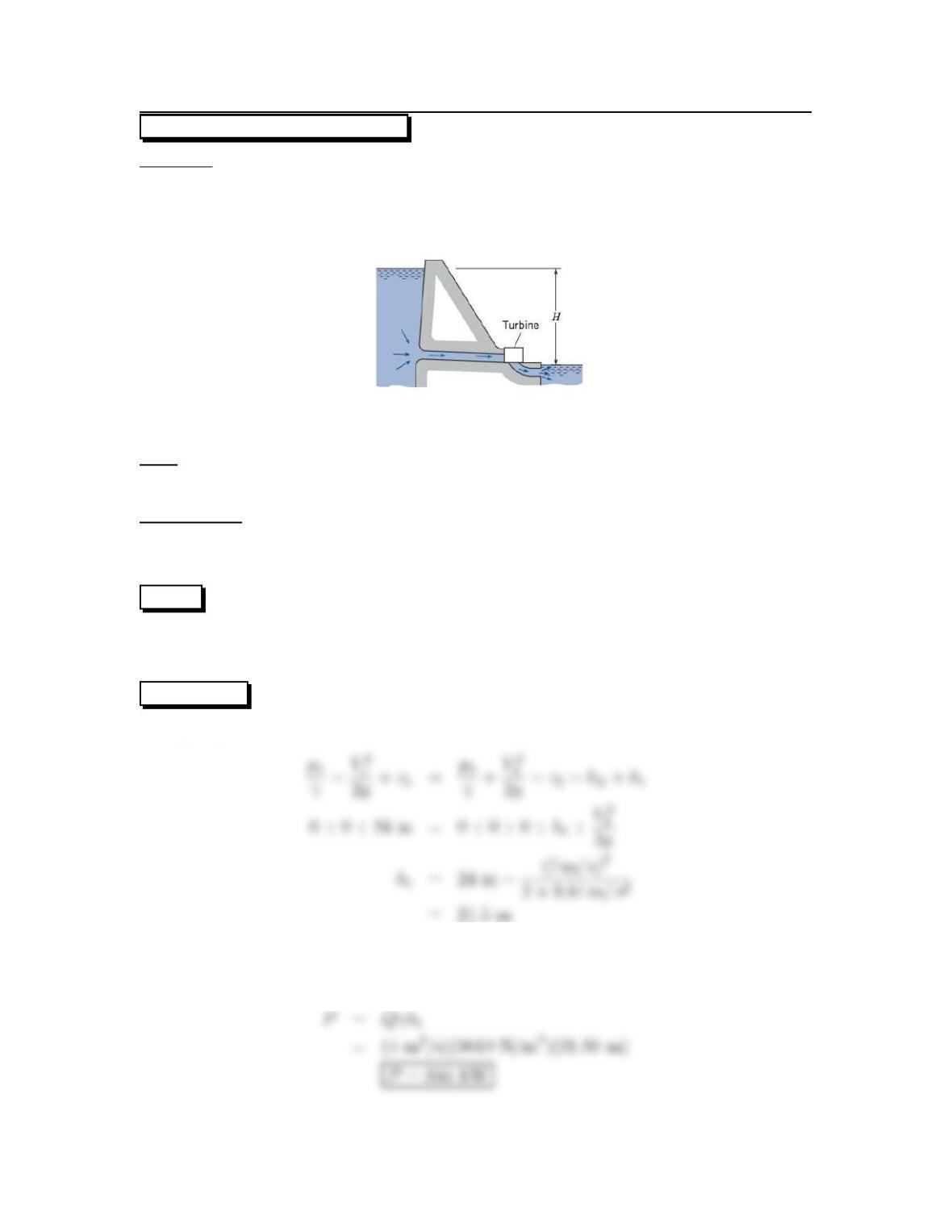
7.56: PROBLEM DEFINITION
Situation:
A hydraulic power system consists of a dam with an inlet connected to a turbine.
H=24m,V2=7m/s.
Q=4m
3/s.
Find:
Power produced by turbine (kW).
Assumptions:
All head loss is expansion loss.
100% efficiency.
PLAN
Apply the energy equation from the upstream water surface to the downstream water
surface. Then apply the power equation.
SOLUTION
Energy equation
Power equation
82
7.57: PROBLEM DEFINITION
Situation:
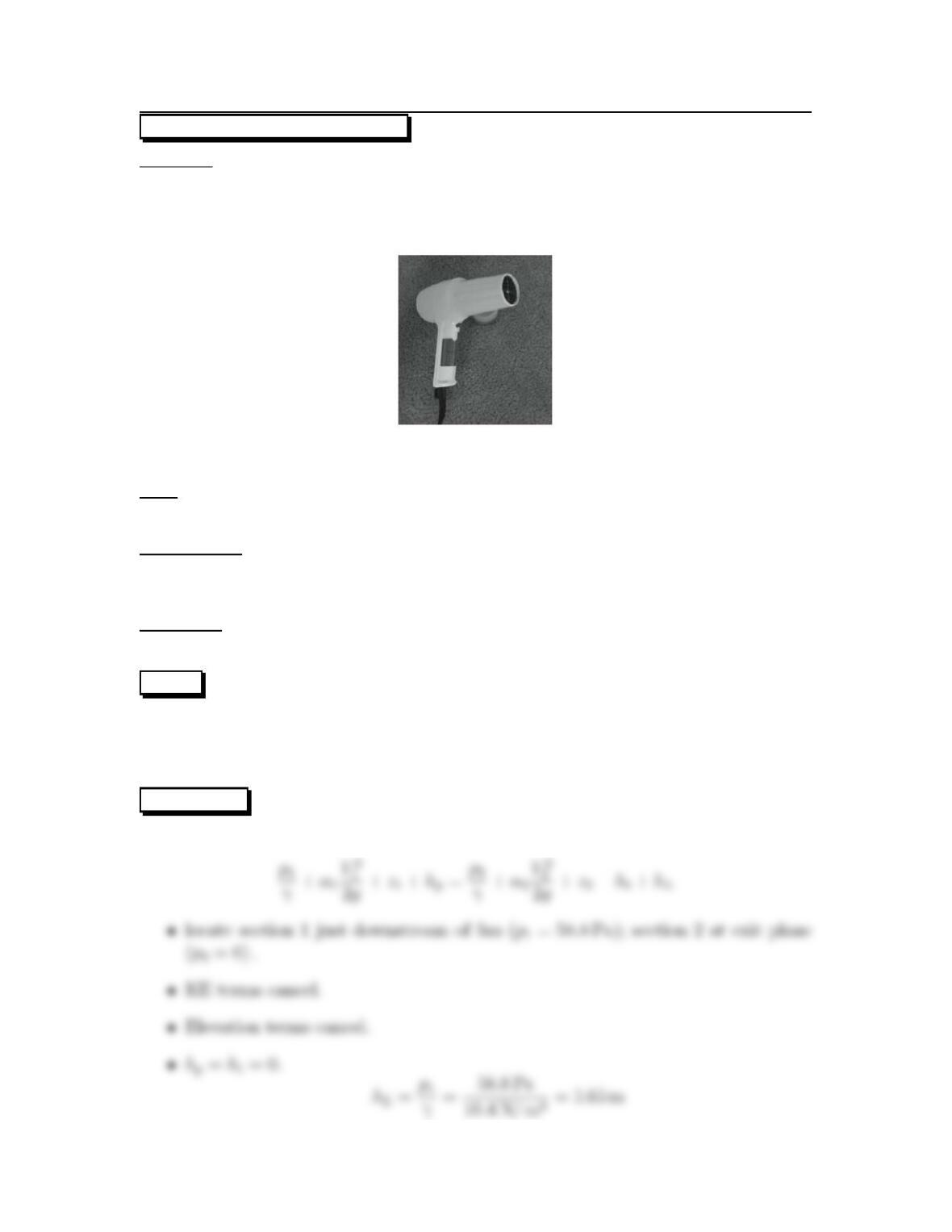
A fan is moving air through a hair dryer.
∆p=6mm-H20 = 58.8Pa,V =10m/s.
D=0.044 m,η=60%.
Find:
Electrical power (watts) to operate the fan.
Assumptions:
Air is at a constant temperature.
Constant diameter: D1=D2=0.044 m.
Properties:
Air (60 ◦C), Table A.3, γ=10.4N/m3.
PLAN
1. Find head loss using the energy equation.
2. Find power supplied to the air using the power equation.
3. Find electrical power using the efficiency equation.
SOLUTION
1. Energy equation:
83
2. Power equation:
REVIEW
The electrical power to operate the fan (≈1.5W) is small compared to the electrical
power to heat the air.
84
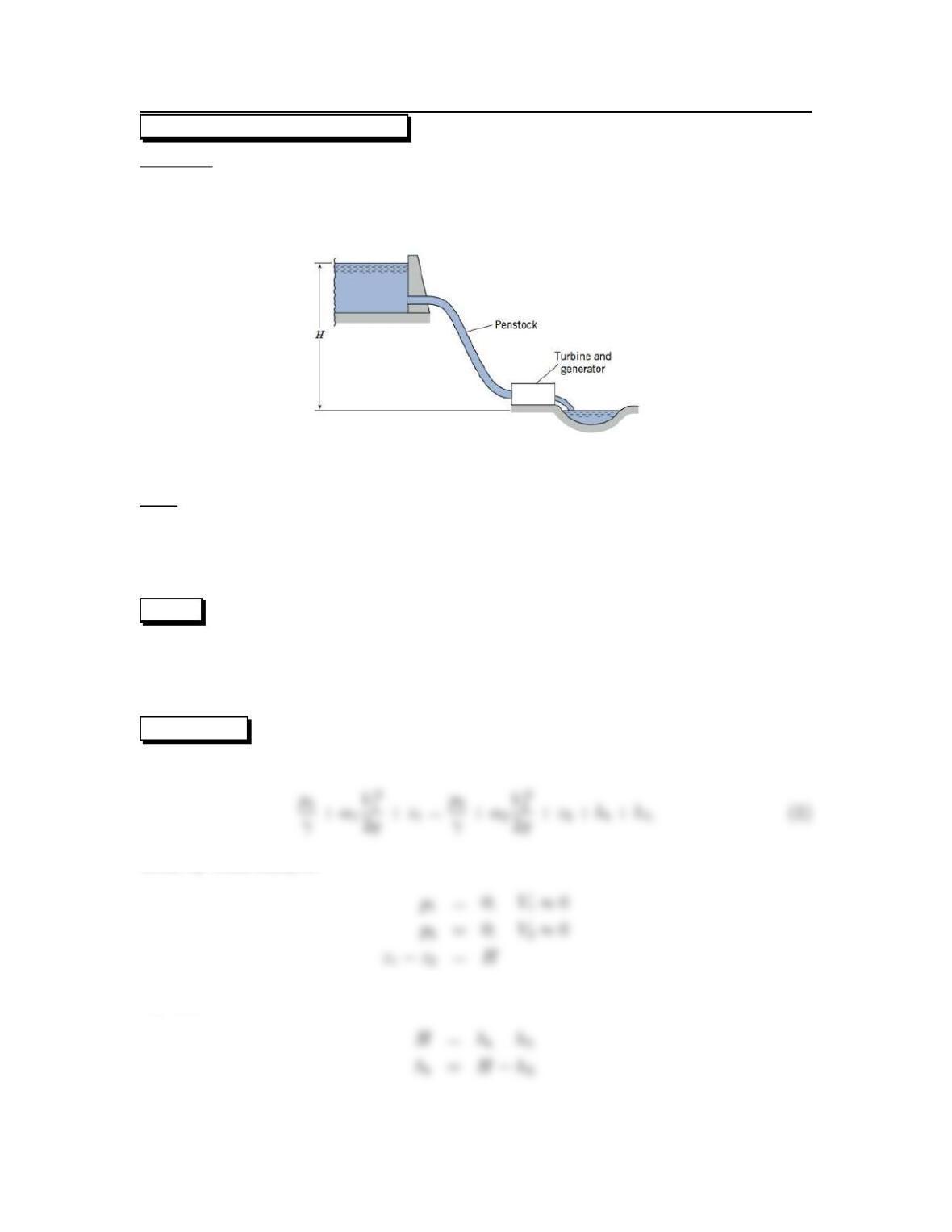
7.58: PROBLEM DEFINITION
Situation:
An engineer is estimating the power that can be produced by a small stream.
Q=1.4cfs, T=40◦F,H=34 ft.
Find:
Estimate the maximum power that can be generated (kW) if:
hL=0ft,ηt=100%,ηg=100%.
hL=5.5ft,ηt=70%,ηg=90%.
PLAN To find the head of the turbine (ht), apply the energy equation from the
upper water surface (section 1) to the lower water surface (section 2). To calculation
power, use P=η(˙mght),where ηaccounts for the combined efficiency of the turbine
and generator.
SOLUTION
Energy equation
Term by term analysis
Eq. (1) becomes
85

Flow rate
Power (case a)
Power (case b).
REVIEW
1. In the ideal case (case a), all of the elevation head is used to make power.
When typical head losses and machine efficiencies are accounted for, the power
productioniscutbynearly50%.
2. From Ohm’s law, a power of 2.13 kW will produce a current of about 17.5 amps
at a voltage of 120V. Thus, the turbine will provide enough power for about
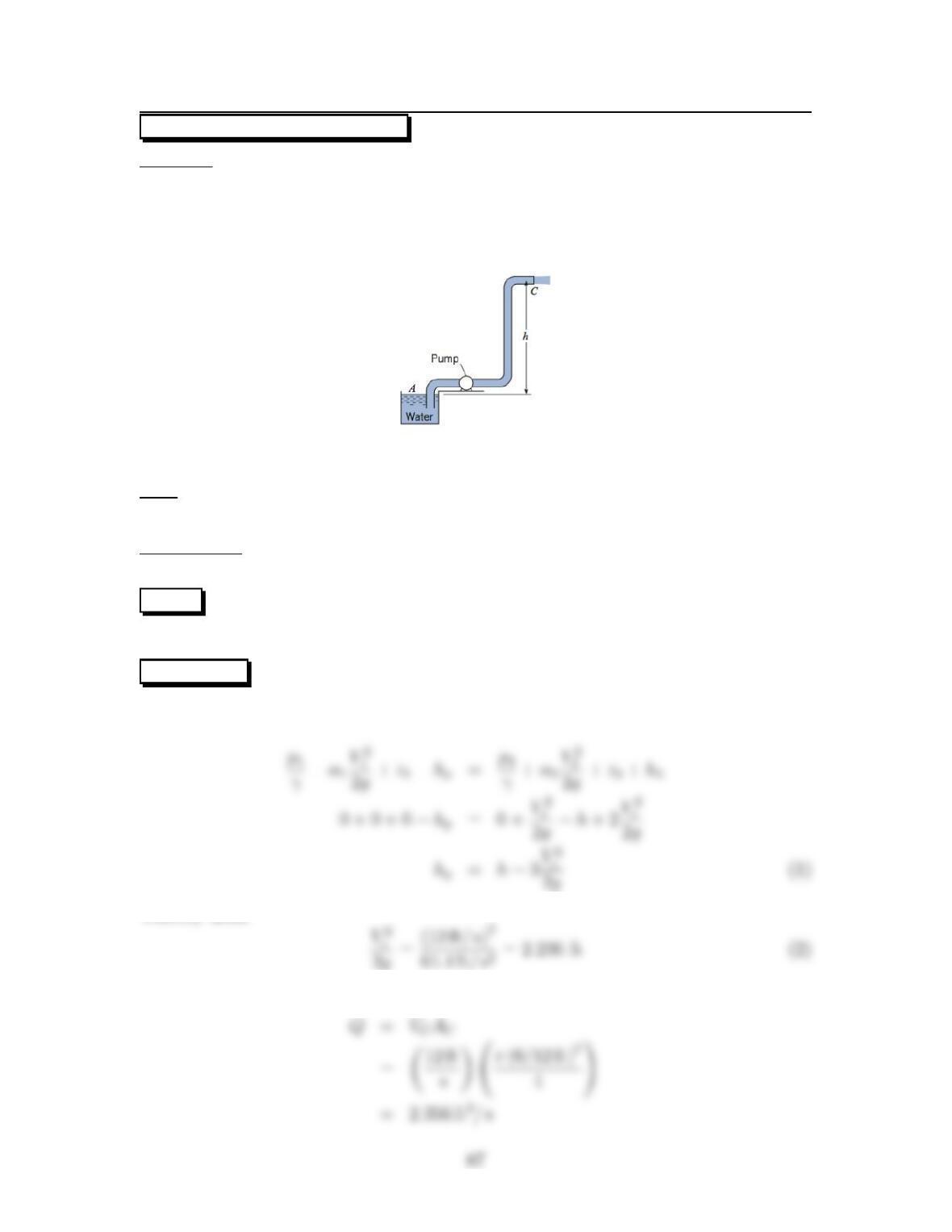
7.59: PROBLEM DEFINITION
Situation:
A pump draws water out of a tank and moves this water to a higher elevation.
DA=8in,DC=6in.
VC=12ft/s,P=17hp.
η=60%,h
L=2V2
C/2g.
Find:
Height (h)above water surface.
Assumptions:
α=1.0.
PLAN
Apply the energy equation from the reservoir water surface to the outlet.
SOLUTION
Energy equation
Velocity head
Flow rate equation
Power equation
Substitute Eqs. (2) and (3) into Eq. (1)
88
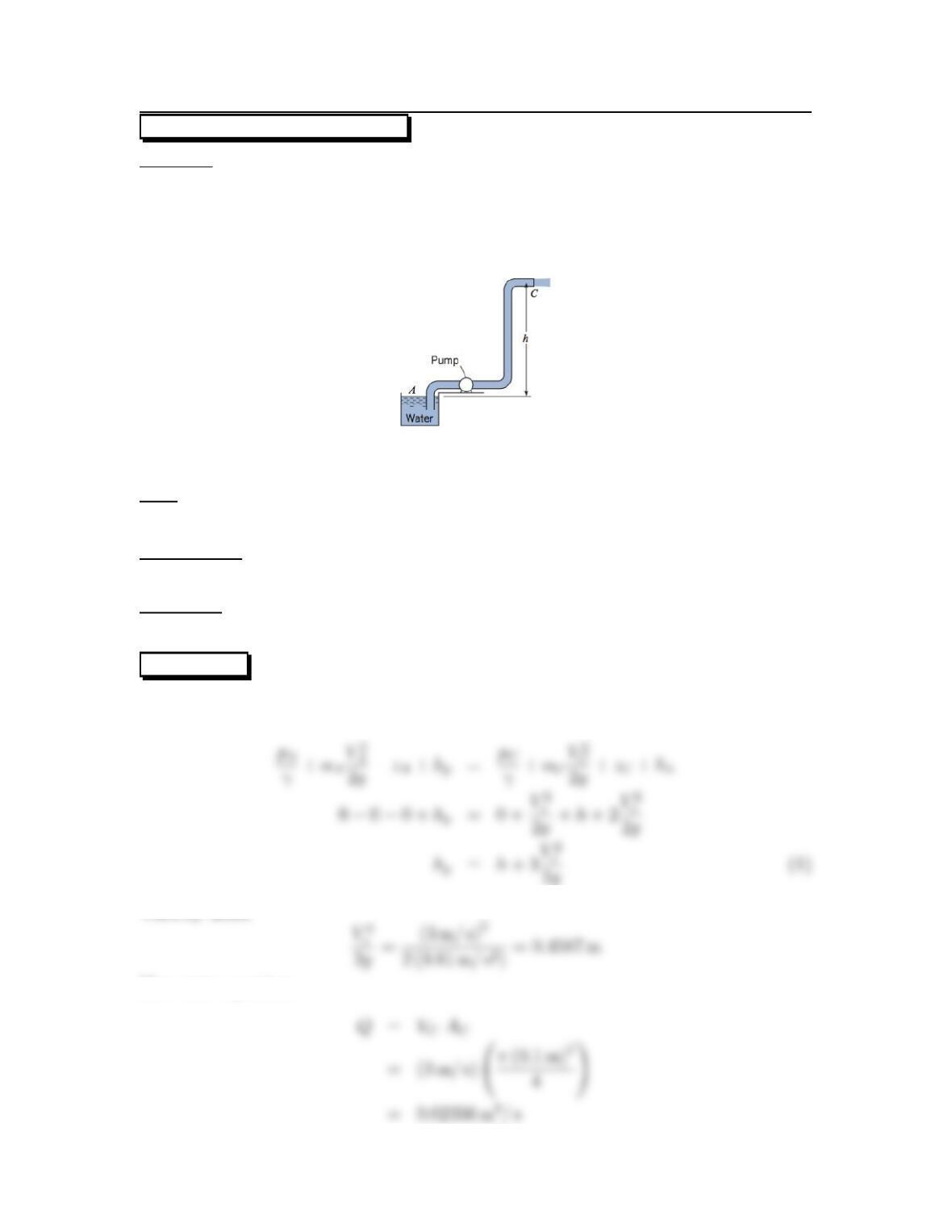
7.60: PROBLEM DEFINITION
Situation:
A pump draws water out of a tank and moves this water to a higher elevation.
DA=20cm,DC=10cm.
VC=3m/s,P=26kW.
η=60%,h
L=2V2
C/2g.
Find:
Height hin meters.
Assumptions:
α=1.0.
Properties:
Water (20 ◦C), Table A.5: γ=9790N/m3.
SOLUTION
Energy equation:
Velocity head:
Flow rate equation:
89
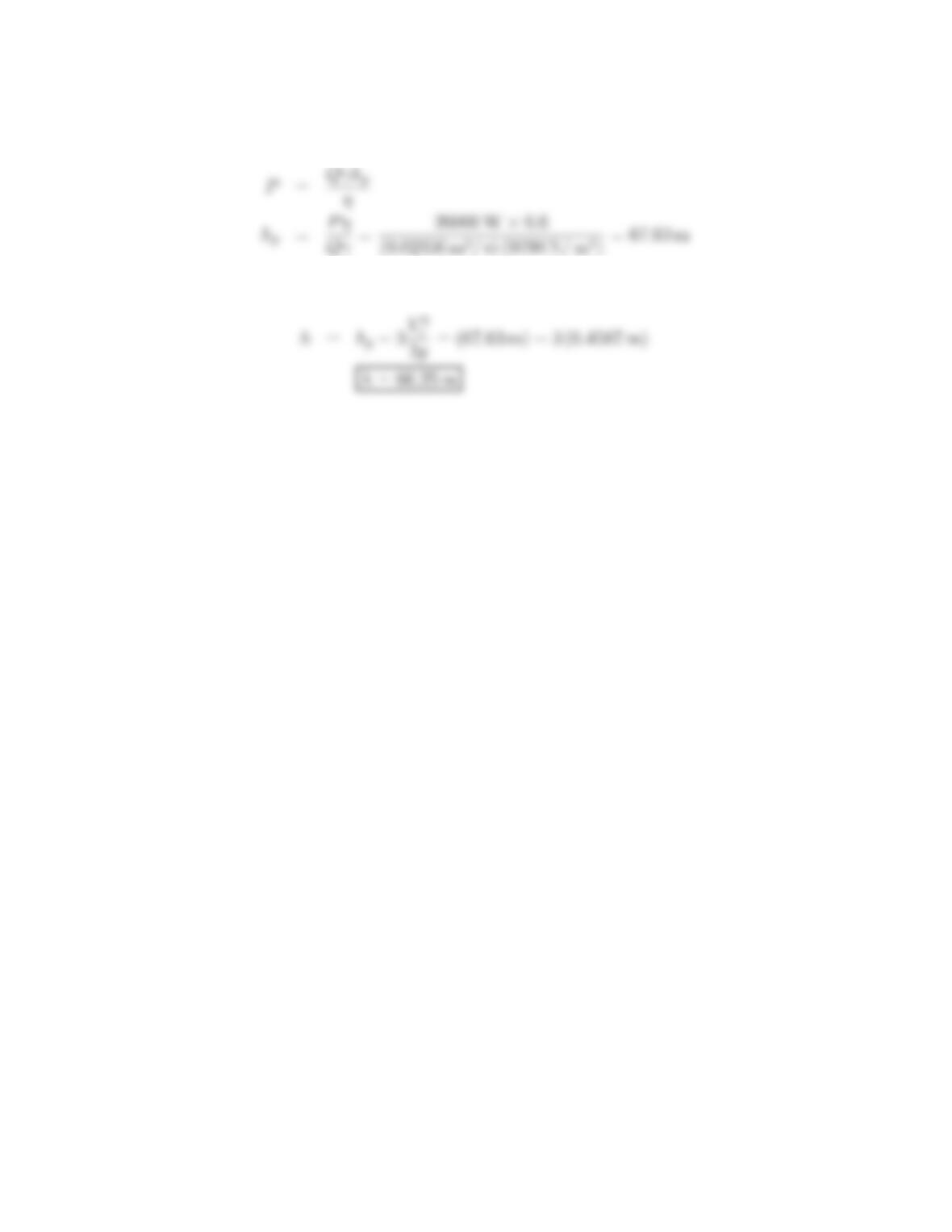
Power equation:
Eq. (1):
90
7.61: PROBLEM DEFINITION
Situation:
A pumping system pumps oil.
L=1mi,D=1ft.
Q=3500gpm, ∆z=200ft.
∆p=60psi.
Find:
Power required for pump (hp).
Properties:
γ=0.53 lbf/ft3.
SOLUTION
Energy equation
Expressing this equation in terms of pressure
Flow rate equation
Power equation
91
Problem 7.62
How is the energy equation (Eq. 7.29 in EFM 10e) similar to the Bernoulli equation?
How is it different? Give three important similarities and three important differences.
SOLUTION
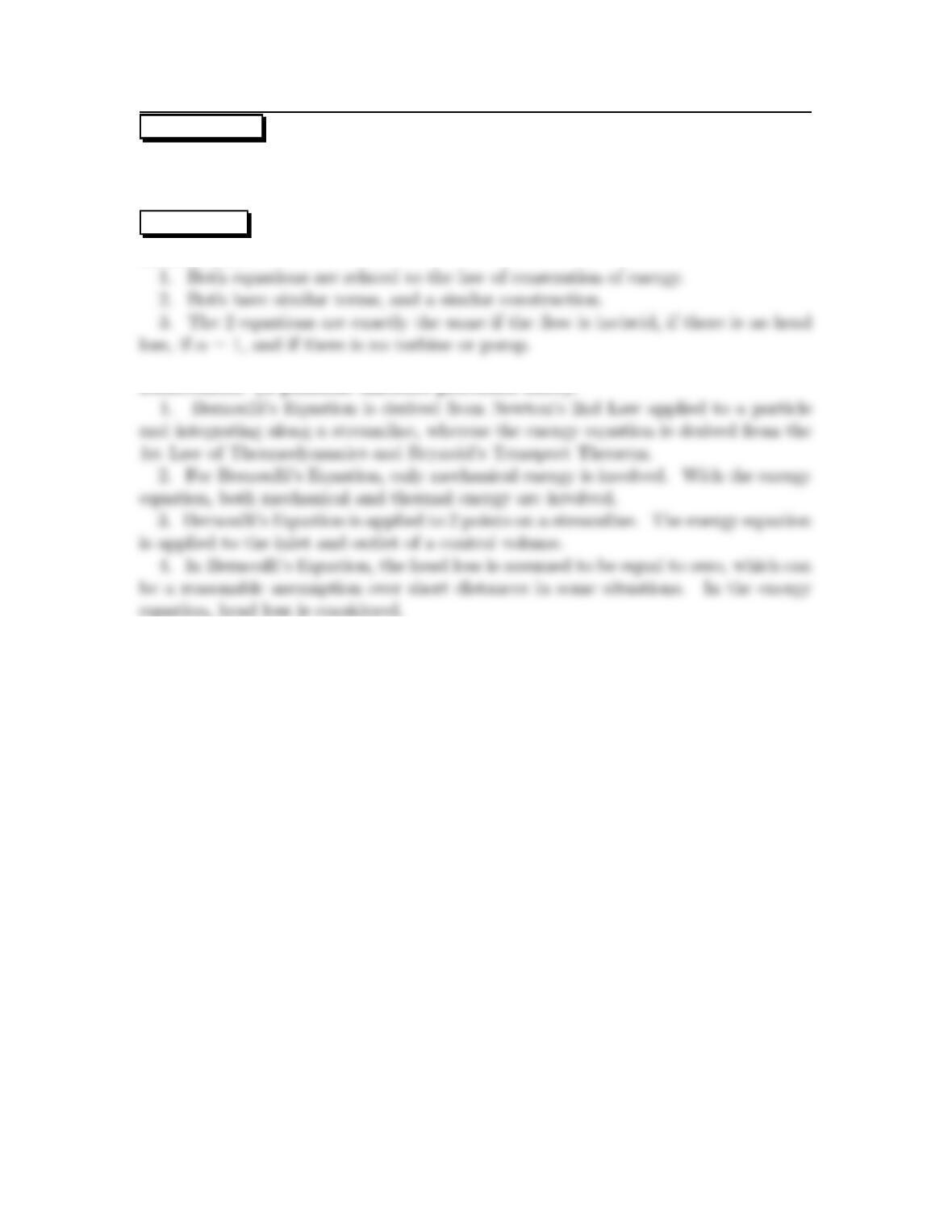
Similarities:
Differences: (4 possible answers provided here).
92

7.63: PROBLEM DEFINITION
Situation:
A pipe discharges water into a reservoir.
Q=10cfs, D=12in.
Find:
Head loss at pipe outlet (ft).
PLAN
Apply the flow rate equation, then the sudden expansion head loss equation.
SOLUTION
Flow rate equation
Sudden expansion head loss equation
93

7.64: PROBLEM DEFINITION
Situation:
A pipe discharges water into a reservoir.
Q=0.5m
3/s,D=50cm.
Find:
Head loss at pipe outlet (m).
PLAN
Apply the flow rate equation, then the sudden expansion head loss equation.
SOLUTION
Flow rate equation
Sudden expansion head loss equation
94
7.65: PROBLEM DEFINITION
Situation:
Water flows through a sudden expansion.
D8=7cm,V8=2m/s.
D15 =15cm.
Find:
Head loss caused by the sudden expansion (m).
PLAN
Apply the continuity principle, then the sudden expansion head loss equation.
SOLUTION
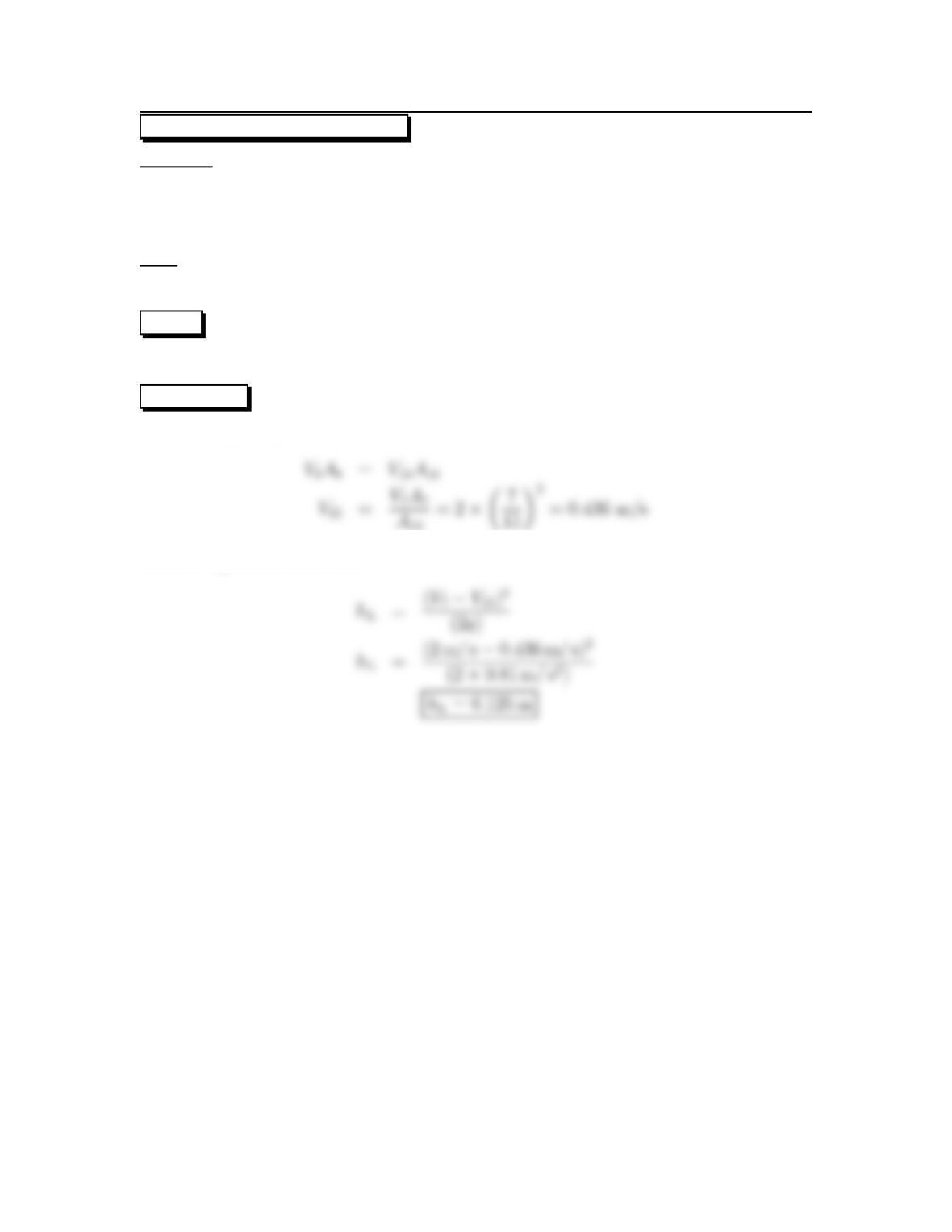
Continuity principle:
Sudden expansion head loss:
95
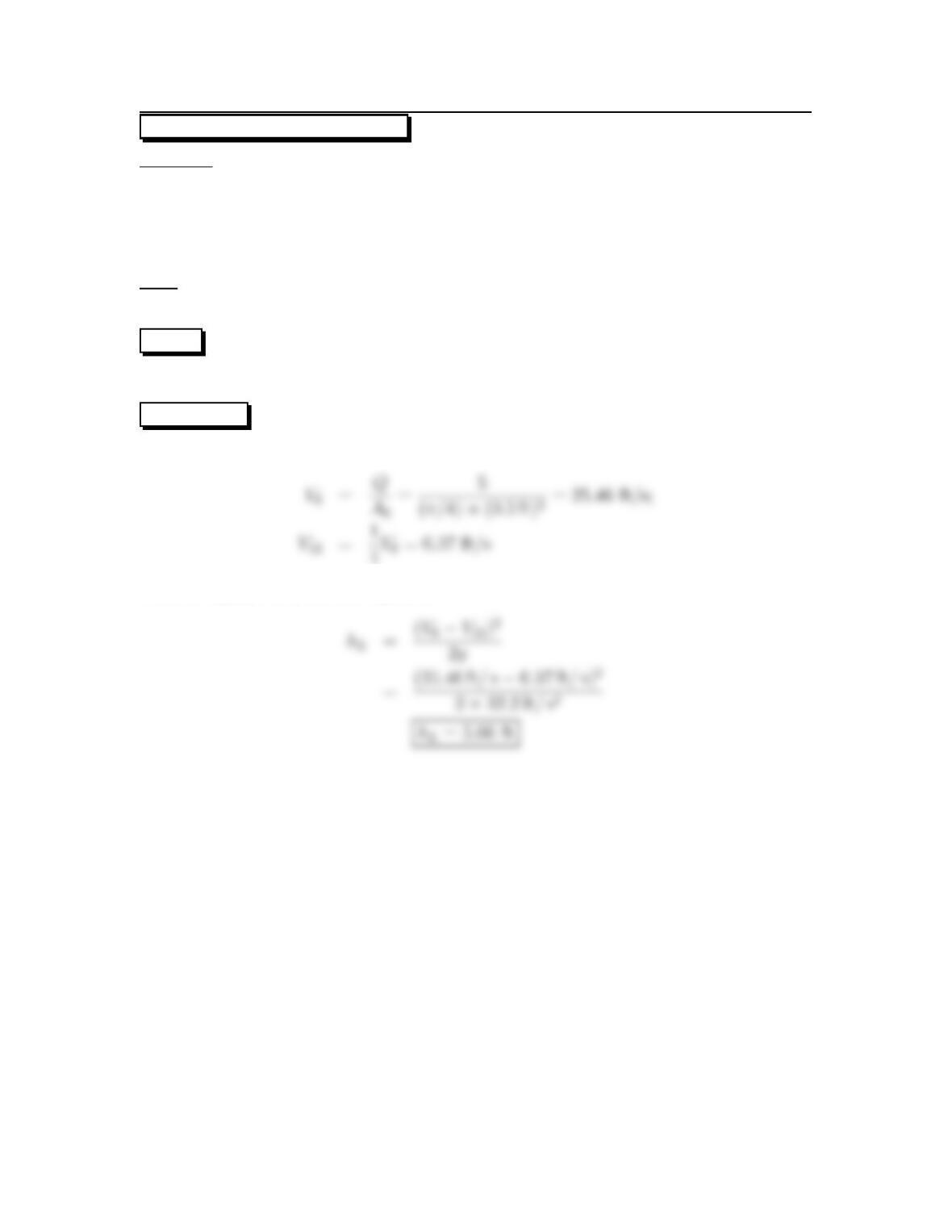
7.66: PROBLEM DEFINITION
Situation:
Water flows through a sudden expansion.
D6=6in=0.5ft.
D12 =12in=1ft.
Q=5cfs.
Find:
Head loss
PLAN
Apply the flow rate equation, then the sudden expansion head loss equation.
SOLUTION
Flow rate equation
Sudden expansion head loss equation
96
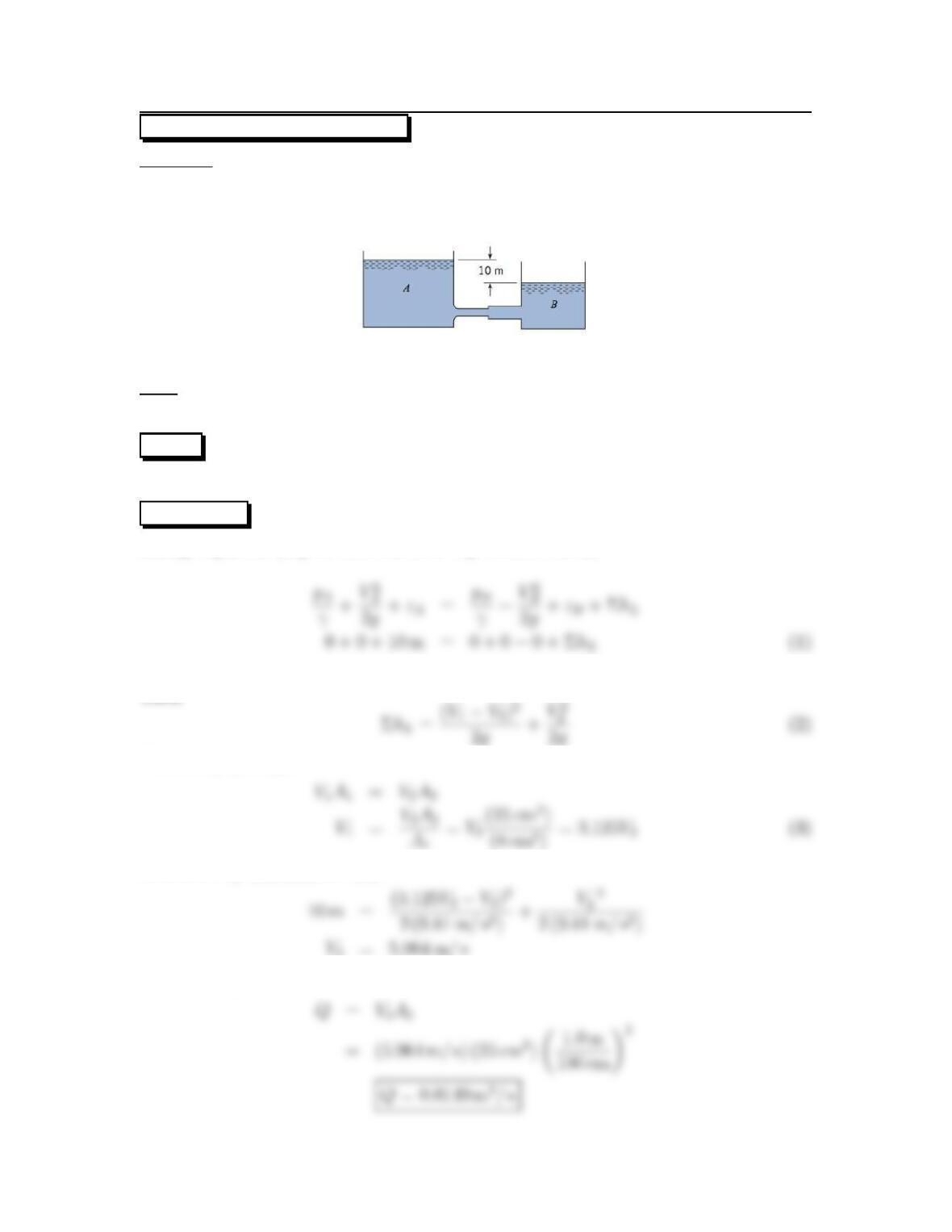
7.67: PROBLEM DEFINITION
Situation:
Two tanks are connected by a pipe with a sudden expansion.
∆z=10m,A1=8cm
2.
A2=25cm
2.
Find:
Discharge between two tanks (m
3/s)
PLAN
Apply the energy equation from water surface in A to water surface in B.
SOLUTION
Energy equation (top of reservoir A to top of reservoir B)
Let the pipe from A be called pipe 1. Let the pipe into B be called pipe 2
Then
Continuity principle:
Combine Eq. (1), (2), and (3):
Flow rate equation:
97

7.68: PROBLEM DEFINITION
Situation:
A horizontal pipe with an abrupt expansion.
D40 =40cm,D60 =cm.
Q=1.0m
3/s,p1=70kPagage.
Find:
Horizontal force required to hold transition in place (kN).
Head loss (m).
Assumptions:
α=1.0.
Properties:
Water, ρ=1000kg/m3.
PLAN
Apply the flow rate equation, the sudden expansion head lossequation,theenergy
equation, and the momentum principle.
SOLUTION
Flow rate equation
Sudden expansion head loss equation
Energy equation
98
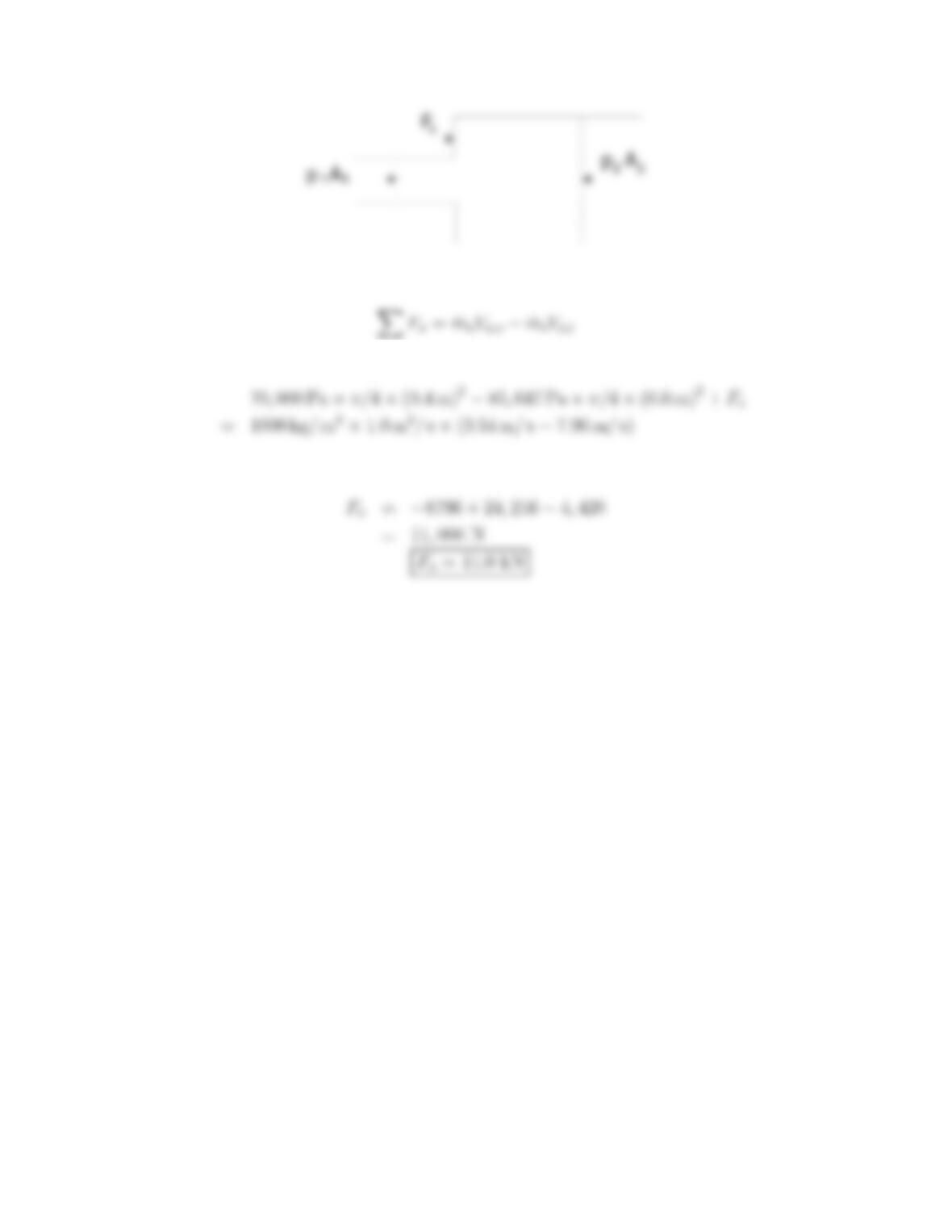
Substituting values
The result is
99
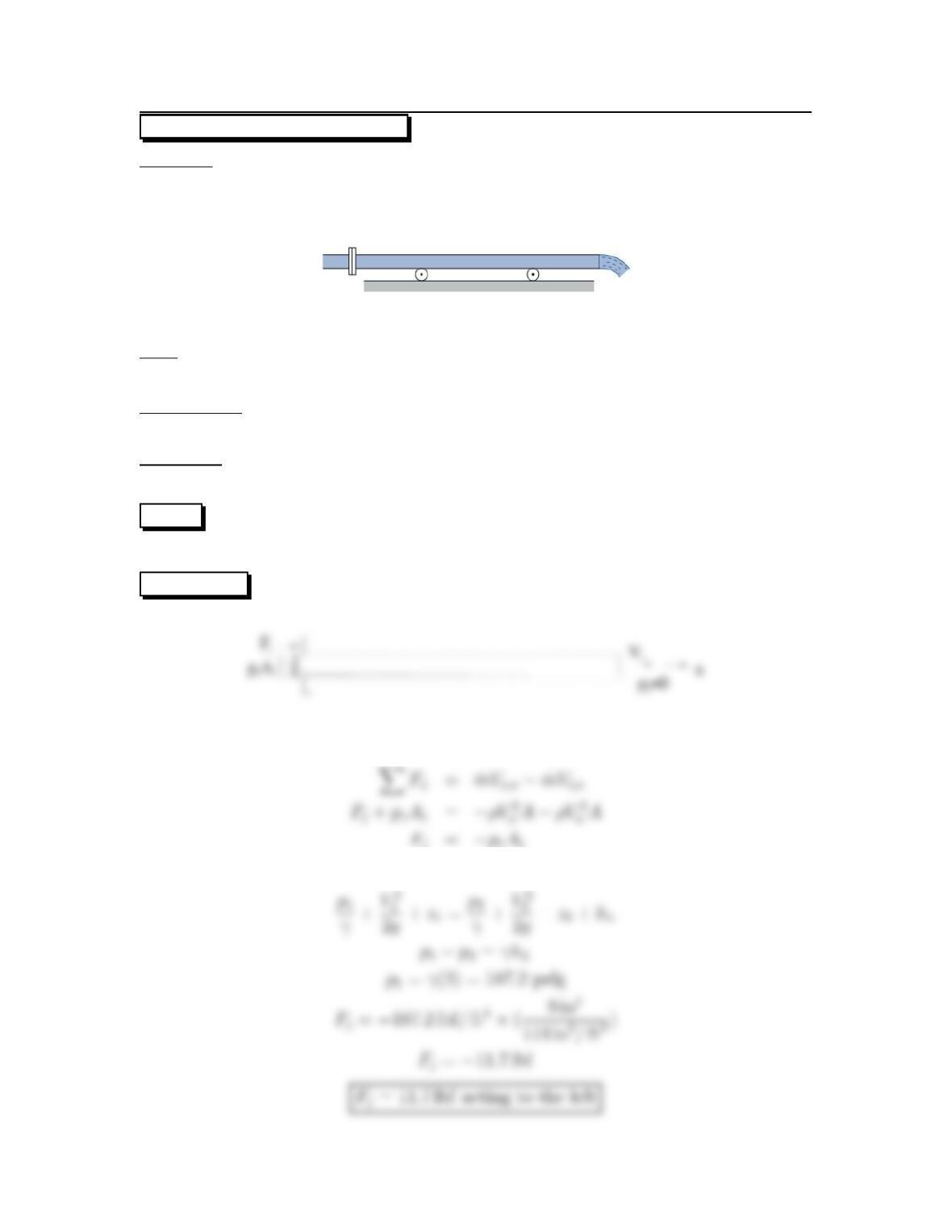
7.69: PROBLEM DEFINITION
Situation:
Water flows in a horizontal pipe before discharging to atmosphere.
A=9in
2,V=15ft/s.
hL=3ft.
Find:
Forceonpipejoint.
Assumptions:
α=1.0.
Properties:
γ=62.4lbf/ft3.
PLAN
Apply the momentum principle, then the energy equation.
SOLUTION
Momentum Equation XFx=˙mVo,x −˙mVi,x
Energy equation
100