7-41
P7-15 (continued)
2. HARRIS CORPORATION
Journal Entry
December 31, 2010
Bad Debt Expense 60,300
from a change in accounting estimate.
P7-16 (AICPA adapted solution)
1. SUMMIT COMPANY
Journal Entry
January 1, 2011
Retained Earnings 20,000
Schedule 1 : Computation of Allowance for Doubtful Accounts
at January 1, 2011
P7-16 (continued)
1. (continued)
Schedule 2: Computation of Doubtful Accounts Expense as a Percentage
to Credit Sales From Inception to December 31, 2010
Year Credit Sales Accounts Written Off Net of Recoveries
2. SUMMIT COMPANY
Analysis of Changes in the Allowance for Doubtful Accounts
For the Year Ended December 31, 2011
Balance at January 1, 2011 $ 20,000
Schedule 3: Computation of Allowance for Doubtful Accounts
at December 31, 2011
P7-16 (continued)
2. (continued)
Schedule 4: Computation of Doubtful Accounts Expense as a Percentage
to Credit Sales for Five Years Ended December 31, 2011
Year Credit Sales Accounts Written Off Net of Recoveries
P7-17
1. 2010
During Accounts Receivable 2,200,000
the Sales 2,200,000
year
Cash 1,900,000
P7-17 (continued)
1. (continued)
aLicata Note
Face value of note $4,800.00
Interest to maturity ($4,800 x 0.13 x 120/360) 208.00
bEagle Note
Face value of note $6,900.00
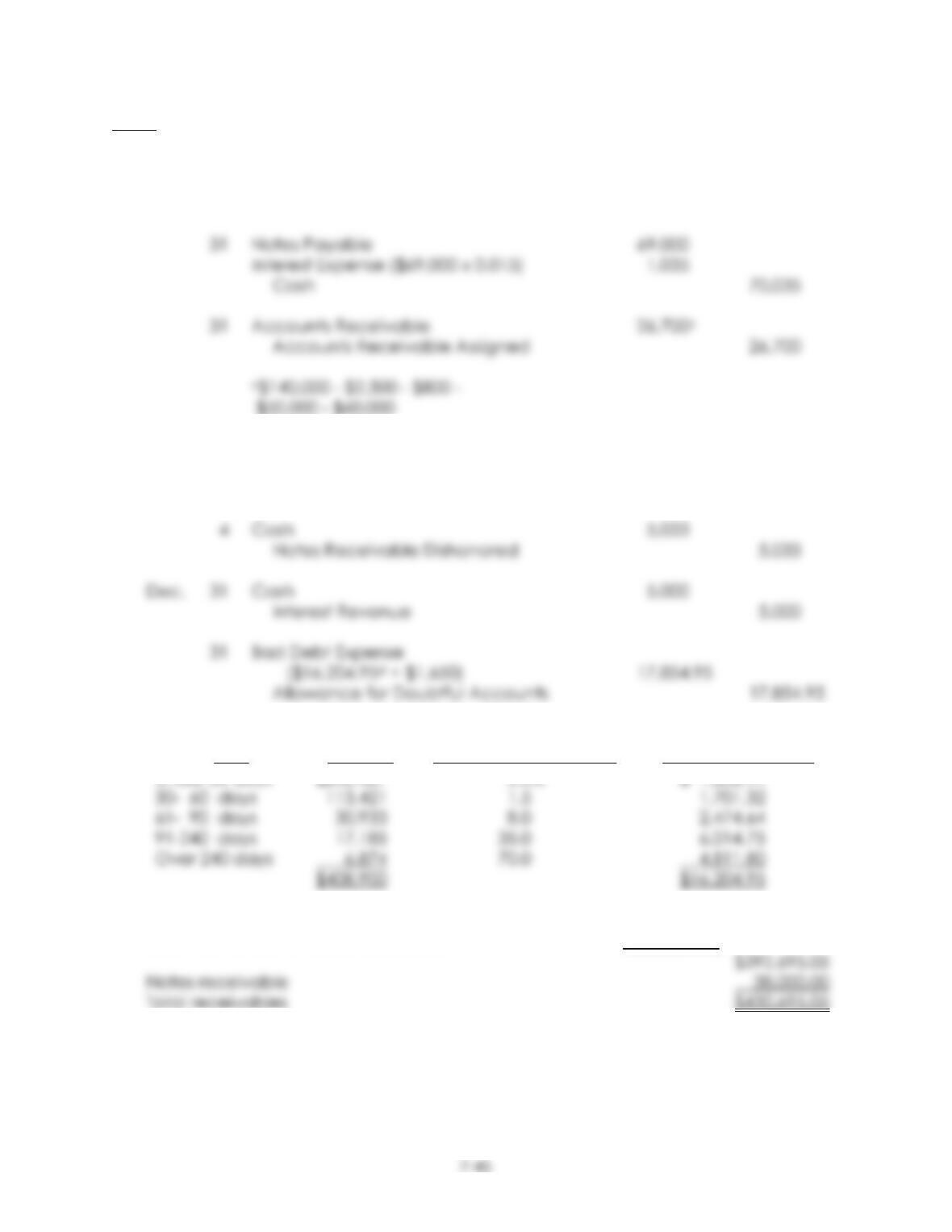
July 1 Cash [($140,000 x 0.85) – $5,000] 114,000
Assignment Service Charge Expense 5,000
Notes Payable 119,000
P7-17 (continued)
1. (continued)
Aug. 31 Cash 60,000
Accounts Receivable Assigned 60,000
Sept. 1 Notes Receivable Dishonored 5,033
Cash [$4,800 + ($4,800 x 0.13 x
120/360) + $25] 5,033
dAge
Amount
Estimated Percentage
Uncollectible
Estimated Amount
Uncollectible
Under 30 days
$240,487
0.5%
$ 1,202.44
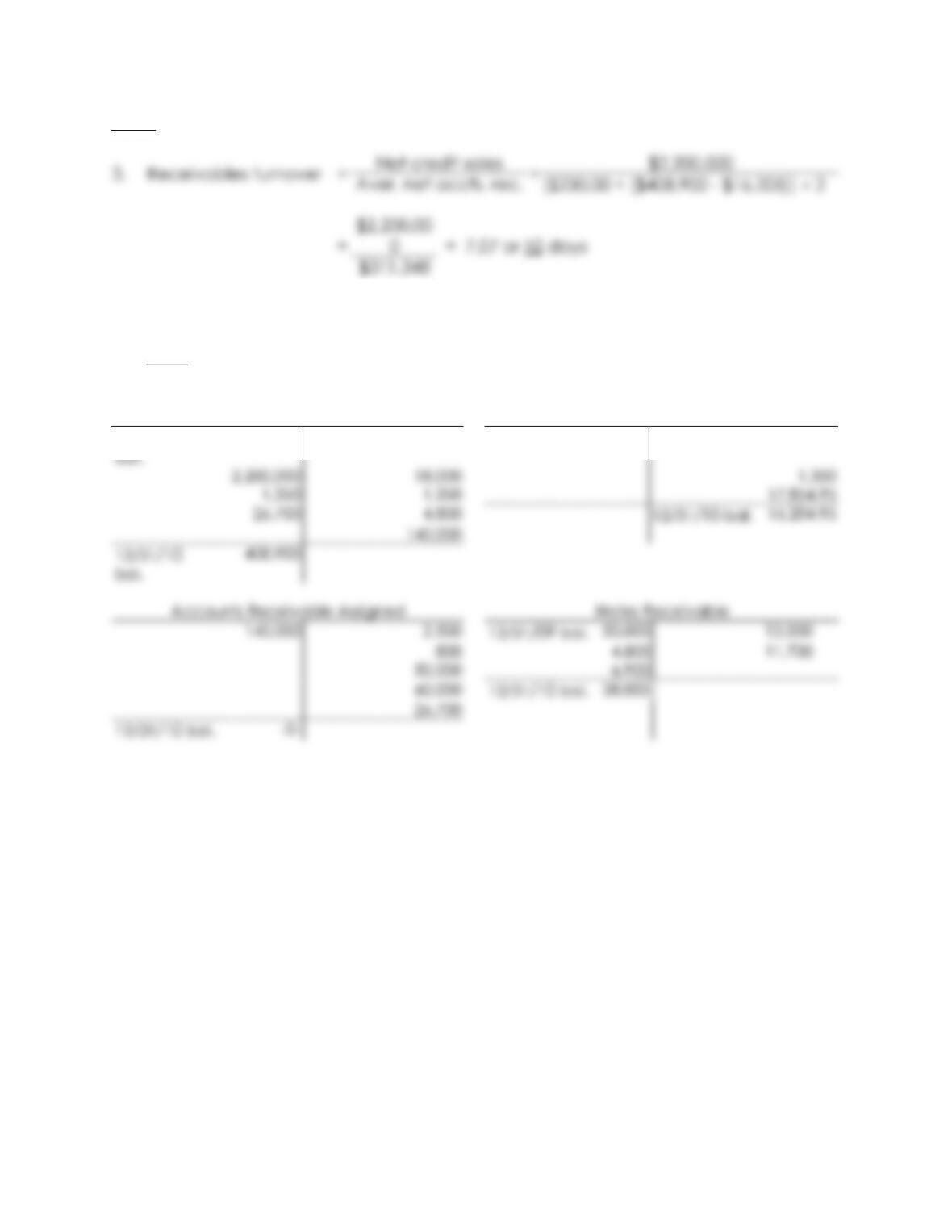
2. Accounts receivable $408,900.00
Less: Allowance for doubtful accounts (16,204.95)
7-46
P7-17 (continued)
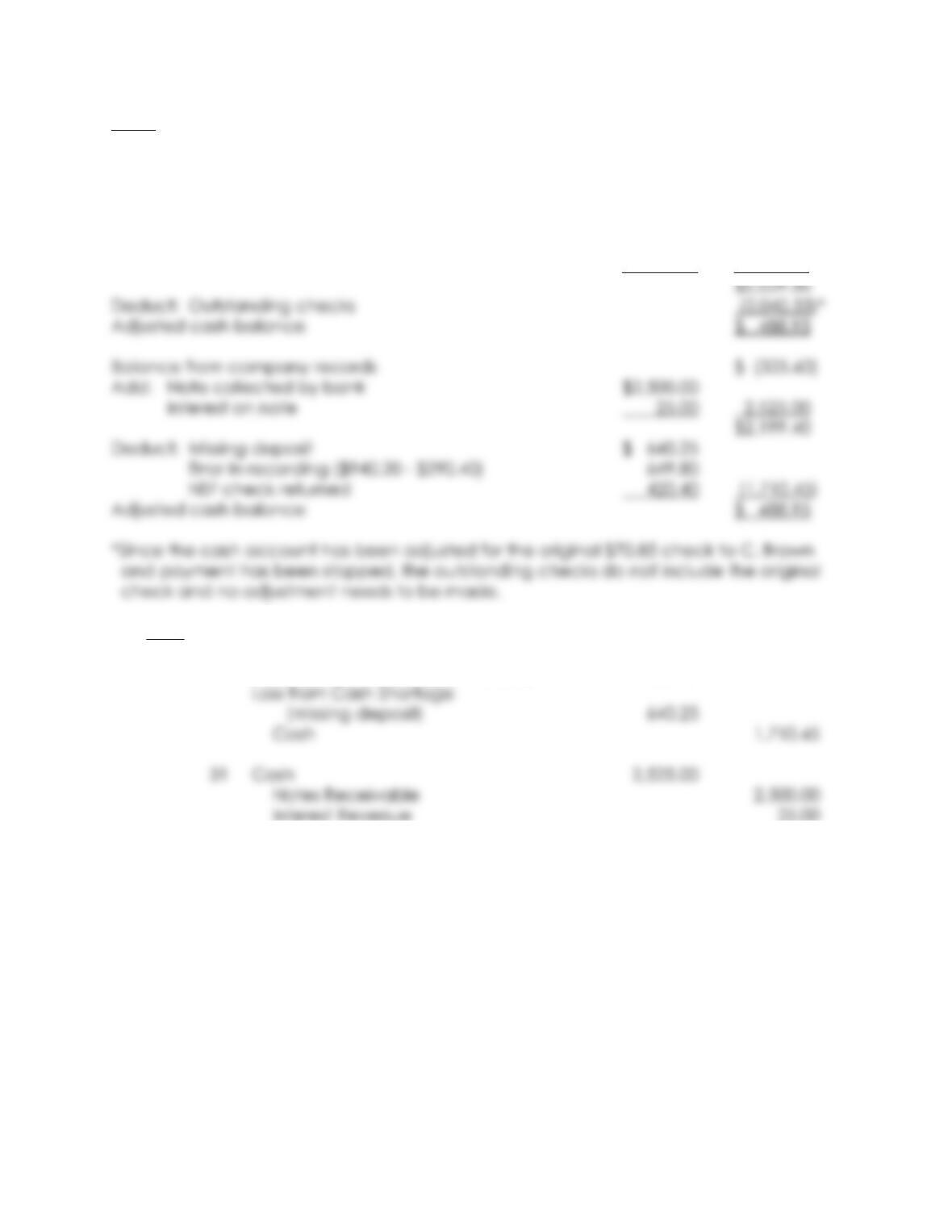
Since Blackmon’s terms are n/EOM, its 52-day accounts receivable turnover seems
slightly slow but not unreasonable.
Note: The amounts listed in Requirement 2 are based on the following account
balances.
Accounts Receivable Allowance for Doubtful Accounts
12/31/09
245,000
1,900,000
18,000
12/31/09 bal. 15,000
4. If Blackman Corporation uses IFRS, it might use the heading “Loans and
Receivables” for the accounts receivable section in Requirement 2.
7-47
P7-18
1. MILLER CORPORATION
Bank Reconciliation
December 31, 2010
Balance from bank statement $2,049.25
Add: Deposit in transit $ 350.00
Cash on hand (undeposited sales receipts) 130.25 480.25
2. 2010
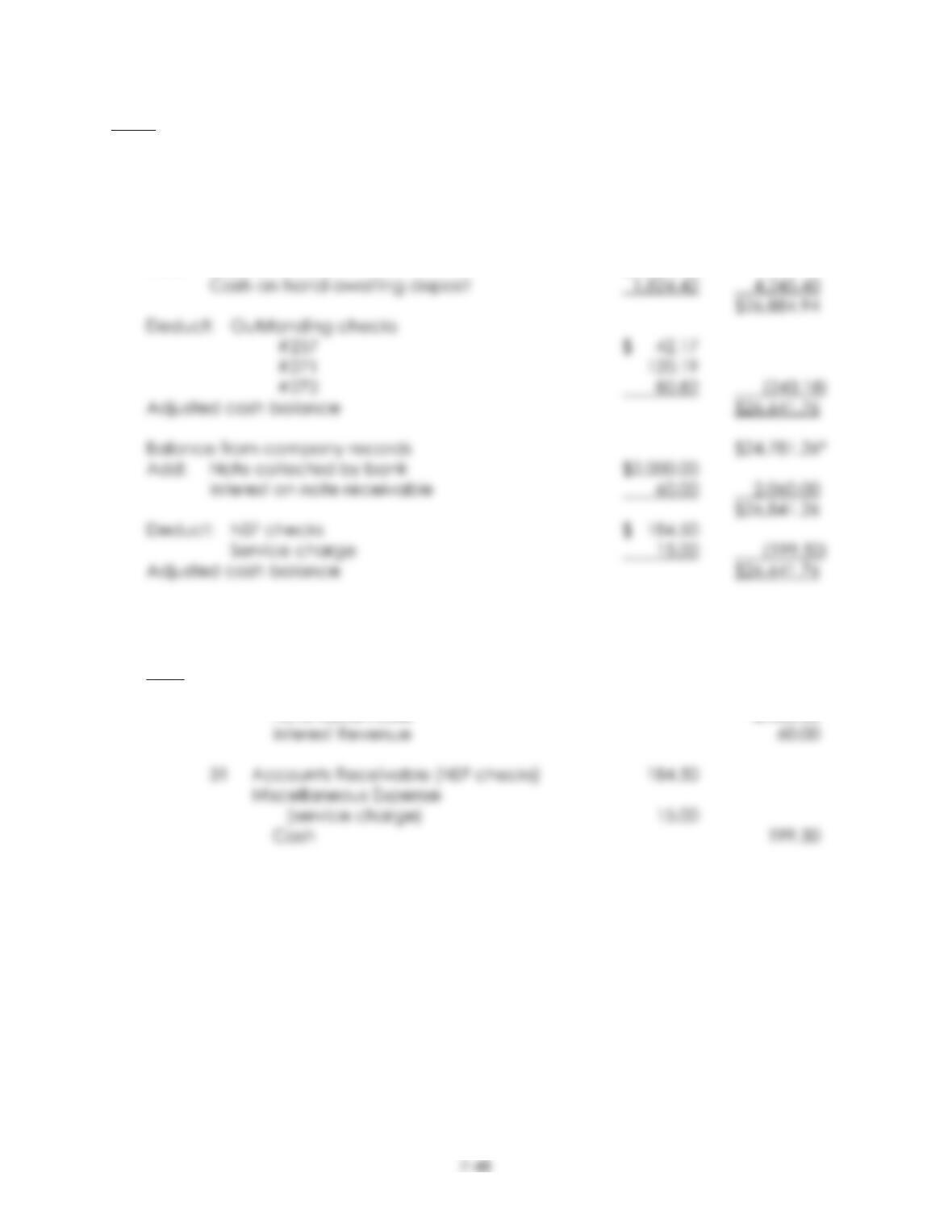
Dec. 31 Accounts Receivable (error) 649.80
Accounts Receivable (NSF check) 420.40
P7-19
1. NAKAMOTO CORPORATION
Bank Reconciliation
July 31, 2010
Balance from bank statement $22,639.54
Add: Deposit in transit $2,420.98
2. *Unadjusted book balance is $24,781.26. ($26,641.76+$199.50-$2,060.00)
3. 2010
July 31 Cash 2,060.00
Note Receivable 2,000.00
7-49
P7-20
1. DAISY COMPANY
Bank Reconciliation
February 28, 2010
Balance from bank statement $6,344.38
Deduct: Outstanding checks: No. 158 $ 589.02
No. 160 2,742.63
2. 2010
Feb. 28 Cash 460
Collection Expense 5
7-50
P7-21 (AICPA adapted solution)
1. TRAIN COMPANY
Bank Reconciliation
December 31, 2010
Balance from bank statement $ 91,174.63
Add: Deposit omitted $ 2,892.41
Balance from books $ 59,088.46
Add: Proceeds of bank loan $11,640.00
Proceeds of note 2,035.00 13,675.00
$ 72,763.46
2. Cash 11,640.00
Prepaid Interest 360.00
Notes Payable 12,000.00
To record proceeds of bank loan.
ANSWERS TO CASES
C7-1
The two main aspects of cash management are cash planning systems and cash control
systems. Cash planning systems are those methods and procedures that a company uses
to ensure that it has adequate cash available to meet maturing obligations and that it
invests any unused or excess cash. Cash control systems are the methods and procedures
used to safeguard its funds.
C7-2 (AICPA adapted solution)
1. There are basically two methods of recognizing bad debt expense: (1) direct write-off
and (2) allowance.
The direct write-off method requires the identification of specific balances that are
deemed to be uncollectible before any bad debt expense is recognized. At the time that
a specific account is deemed uncollectible, the account is removed from accounts
2. The allowance method is preferable because it matches the cost of making a credit sale
with the revenues generated by the sale in the same period and achieves a proper
7-52
C7-3
1. In order to obtain cash, the Moore Company could:
a. pledge accounts receivable
b. assign accounts receivable
c. factor accounts receivable (sale without recourse)
2. The existence of pledging, assignment, or factoring agreements must be disclosed
3. The Moore Company should report the sale of receivables as a factoring agreement
when all of the following conditions are met:
C7-4 (AICPA adapted solution)
1. To account for the accounts receivable factored on April 3, 2010, Magrath should
decrease accounts receivable by the amount of accounts receivable factored, increase
7-53
C7-4 (continued)
2. The carrying amount of the 9-month note at August 1, 2010 is the principal. The interest
revenue for 2010 should be determined by multiplying the carrying amount of the note at
3. Magrath should account for the collection of the accounts previously written off as
4. One approach estimates uncollectible accounts based on credit sales. This approach
focuses on income determination by attempting to match uncollectible accounts
C7-5
A bank reconciliation is a schedule that a company prepares to analyze the difference
between the ending cash balance in its accounting records and the ending cash
balance reported by its bank in a bank statement to determine the correct ending cash
C7-6
Note to Instructor: This case is slightly advanced for students but provides a good basis for
class discussion.
1. A lockbox account might benefit a company in the following ways:
a. Improve funds availability by reducing float caused by mail, processing, and check
C7-6 (continued)
2. DGK COMPANY
Bank Reconciliation
December 31,
2010
3. Adjusting Entries Required:
Cash 30,000
Accounts Receivable 30,000
C7-7 (AICPA adapted solution)
1. Cash normally consists of coins and currency on hand, bank deposits, and various kinds of
orders for cash such as bank checks, money orders, traveler’s checks, demand bills of
exchange, bank drafts, cashier’s checks, and letters of credit. Balances on deposit in banks
2. Valuation problems can arise when cash balances are in foreign countries or when a
domestic entity holds a bill of exchange payable in foreign money. All balances expressed
in foreign money must be converted into domestic dollar equivalents. The conversion of
C7-7 (continued)
2. (continued)
There is some potential for loss any time an entity accepts checks. However, only those
C7-8 (AICPA adapted solution)
1. The allowance method based on credit sales attempts to match bad debts with the
revenues generated by the sales in the same period. Thus, it focuses on the income
statement rather than the balance sheet.
2. Carme Company should report on its balance sheet at December 31, 2010, the balance in
C7-9
1. The first method (gross price method) a company could use to record accounts receivable
when cash discounts are involved is to record accounts receivable and sales at the gross
price. In using this method, the company records both accounts at the total invoice price
as if no cash discount were involved. When the customer pays, if the allowable cash
2. The second method is theoretically sound because it values the accounts receivable at the
net realizable value and states sales and financial revenue properly. The first method states
7-56
C7-10 (AICPA adapted solution)
1. Because the trade accounts receivable are assigned on a with-recourse, nonnotification
basis, Marie Company is responsible for collection and assumes the risks of any losses. Marie
2. Because the trade accounts receivable were factored on a without-recourse basis, the
factor is responsible for collection. On November 3, 2010, Marie should credit accounts
C7-11 (AICPA adapted solution)
1. Hogan should account for the sales discounts at the date of sale using the net method by
recording accounts receivable and sales revenue at the amount of sales less the sales
2. a. There is no effect on Hogan’s sales revenues when customers do not take the sales
discounts. Hogan’s net income is increased by the amount of interest (discount) earned
when customers do not take the sales discounts.
b. Trade discounts are neither recorded in the accounts nor reported in the financial
statements. Therefore, the amount recorded as sales revenues and accounts
7-57
C7-12 (AICPA adapted solution)
1. Tidal should account for the assignment of trade accounts receivable by debiting trade
accounts receivable assigned and crediting trade accounts receivable for the amount of
trade accounts receivable assigned. Tidal should account for the note payable to Herb
Finance by debiting cash for 70 percent, debiting finance fee expense for 5 percent, and
2. a. Tidal should determine the amount of the discount for the note receivable as follows:
(1) Determine the maturity value of the note receivable (the face value of the note
b. The discounting transaction should be accounted for by debiting cash and crediting
C7-13
1. The cash and cash equivalents were $4,093 million at the end of 2007 (p. 67). Marketable
securities that are highly liquid and have maturities of three months or less at the date of
C7-14
Note to Instructor: This case does not have a definitive answer. From a financial reporting
perspective, GAAP is identified and summarized. From an ethical perspective, various issues
are raised for discussion purposes.
From an ethical perspective, the issues are whether revenue on sales with the right of return
should be recognized at the time of sale (1) when it is unclear that the criteria have been
met, and (2) because a previous year’s returns have already been recorded in the current
year. In either case, current earnings would be increased. The stakeholders are you, the
controller, and the stockholders. If current earnings are increased, the controller (and you)
may appear to be efficient, but the stockholders may be misled about the future earning
potential of the company.
7-59
ANSWER TO RESEARCH SIMULATION
R7-1
Note to Instructor: Students are expected to cite references to GAAP in their research of
this issue. They might use the FARS electronic database, pronouncements listed on the FASB
web site, the FASB Original Pronouncements, the FASB Current text, or other primary sources
of GAAP to obtain these references. They may also use the FASB Accounting Standards
Codification which is cited in parentheses.
To: President, Hamilton Company
From: Student
I have researched the issue of how Hamilton Company should account for the $100,000
receivables that it pledged as a collateral for a loan. According to FAS 140, par. 9, (FASB
Cod. # 860-10-40-5) a transfer of financial assets in which the transferor surrenders control
According to FAS 140, par. 11 (FASB Cod. # 860-30-25-2), if the transfer is accounted for as a
sale, the transferor shall remove the assets sold from its accounts, recognize the proceeds
received, recognize any liabilities incurred in the sale, and recognize any gain or loss on the
sale. According to FAS 140, par. 12 (FASB Cod. # 860-30-25-2), if a transfer of financial assets
does not meet the criteria for a sale, the transferor shall account for the transfer as a
secured borrowing with a pledge of collateral.