
Lussier, Management Fundamentals, 7e
© 2017, SAGE Publications
Answers to Questions in the Text
Chapter 7: Organizing and Delegating
Work
WORK APPLICATION SAMPLE ANSWERS
Most of the answers are actual student answers or based on student answers. You may give these
answers as part of your lecture before, after, or in place of getting student answers.
7–1. Follow the chain of command from your present position (or one you held in the past) to the top
of the organization. Start by identifying anyone who reported to you, then list your boss’s title, your
boss’s boss’s title, and on up to the top manager’s title.
I worked as a teller for a bank, and no one reported to me. My boss was the head teller, and her boss
7–2. Identify your boss’s span of management, or your own if you are or were a manager. How many
levels of management are there in your organization? Is it a flat or a tall organization?
At the bank, my head teller had around ten tellers, but only three to seven worked at any given time.
7–3. Does an organization you work for or have worked for emphasize following the standing
procedures or being flexible? Explain your answer.
The clothing store I work for emphasizes following standing procedures. I’m in the situation listed in the
trouble.
7–4. Identify and explain your level of authority for a specific task in an organization.
Working as a mechanic at a gas station, I had the authority to report. My boss, the owner, would give
7–5. Describe the type of authority (centralized or decentralized) used in an organization you work for
or have worked for.
Lussier, Management Fundamentals, 7e
© 2017, SAGE Publications
Cortney most definitely utilizes centralized authority. Not only are important decisions made by the
7–6. Identify one or more line and staff positions in an organization you work for or have worked for.
Also, indicate whether the staff positions are general staff or specialist staff.
One of the staff positions at the container company I worked for was the personnel director. He was a
7–7. Draw a simple organization chart for an organization you work for or have worked for. Identify
the type of departmentalization and staff positions, if any.
Answers will vary. What I usually do is draw the organization chart for my college. I begin with the
7–8. Describe how a job at an organization you work for or have worked for could be simplified. Be
sure to specify if you are eliminating, combining, or changing the sequence of the job.
When I worked at Shore Co., I had to keep track of the present employees. We used to use lists of
7–9. Describe how a job at an organization you work for or have worked for could be expanded. Be
sure to specify if you are using job rotation, job enlargement, or job enrichment and to be explicit
about how the job is changed.
At the shipping warehouse, delegating more responsibility to employees could be, and should be, used
7–10. Describe how an organization you work for or have worked for uses, or could use, teams. Be
sure to specify if the teams are integrated or self-managed.
I work in the training department of a supermarket. We train managers in several of the topics in this
Lussier, Management Fundamentals, 7e
© 2017, SAGE Publications
7–11. List three to five tasks you must complete in the near future and prioritize them using Exhibit 7–
10.
1. High priority: Greet the doctor’s patients and bring them to the examining room with their
7–12. Describe an obstacle to delegation or sign of delegating too little that you have observed.
I worked in the office at Kennedy’s and observed a supervisor who had the “I can do it faster attitude”
7–13. Select a manager you work for or have worked for and analyze how well he or she implements
the four steps of delegation. Which steps does the manager typically follow and not follow?
Step 1. Explain the need for delegating and the reasons for selecting the employee. Poor. I
was never told this.
REVIEW QUESTION ANSWERS
7–1. What is the difference between unity of command and unity of direction?
Lussier, Management Fundamentals, 7e
© 2017, SAGE Publications
The principle of unity of command requires that each employee should report to only one boss. The
principle of unity of direction requires that all activities be directed toward the same objectives.
7–2. What is the relationship between the chain of command and the span of management?
Chain of command is the clear line of authority from the top to the bottom of an organization. The span
7–3. What do the terms differentiation and integration mean?
7–4. What is the difference between responsibility and authority?
7–5. Can accountability be delegated?
7–6. How does the scope of authority change throughout an organization, and what is the flow of
responsibility, authority, and accountability?
The scope of authority is a hierarchy that narrows as it flows down the organization. Responsibility and
7–7. What is the difference between general staff and specialist staff?
7–8. What does an organization chart show? What doesn’t it show?
An organization chart is a graphic illustration of the organization’s management hierarchy and
Lussier, Management Fundamentals, 7e
© 2017, SAGE Publications
7–9. What is the difference between product and customer departmentalization?
Product (service) departmentalization involves organizing departments around goods (or services).
7–10. What is the difference between a network structure and a virtual organization?
Networks are boundaryless interrelationships among different organizations. A network firm may be
7–11. What is job design, and why is it necessary?
Job design is the process of identifying tasks that each employee is responsible for completing. Job
7–12. What is the difference between an integrated work team and a self-managed work team?
Integrated work teams are assigned a number of tasks by a manager, and the team in turn gives specific
7–13. Why is the strength of employees’ need for growth important to the job characteristics model?
The core job dimensions, critical psychological states, and personal and work outcomes are all
7–14. Why is it important to update priorities on a to-do list?
7–15. As a simple guide, what one question can a manager ask to determine what and what not to
delegate?
“Do I need to be personally involved because of my unique knowledge or skills?” This is the first priority–
Lussier, Management Fundamentals, 7e
© 2017, SAGE Publications
7–16. Why is each of the four steps in the delegation process necessary?
Step 1. Explain the need for delegating and the reasons for selecting the employee. It is
helpful for an employee to whom you delegate a task to understand why the assignment must
COMMUNICATION SKILLS ANSWERS
7–1. Does formal organizational structure really matter? In other words, shouldn’t management just
focus on getting the work done?
7–2. How is division of labor (specialization of jobs) used in the medical profession and in schools?
How does the restaurant industry use specialization?
In the medical profession, there are doctors and nurses and other specialty jobs. Teachers in many
7–3. Is centralized or decentralized authority better?
7–4. As firms grow, should they have division of labor and add staff positions? Give examples with
your answer.
7–5. Chandler suggested that structure should follow strategy. Should a firm develop the strategy first
and then develop the organization structure? Why or why not?
Lussier, Management Fundamentals, 7e
© 2017, SAGE Publications
7–6. Matrix departmentalization violates the unity of command principle. Should companies not use
matrix departmentalization?
Answers will vary. Students should realize that it depends on the company. Students should also take
7–7. What impact does technology have on organizational structure?
Answers will vary.
7–8. Why has there been a trend toward more team, network, virtual, and learning organizations? Is
this a fad, or will it last?
7–9. When focusing on jobs, is it better to use job simplification or job expansion?
7–10. Are setting priorities and delegating really all that important?
Yes. As a manager, you’ll be required to carry out several tasks at any given time. How you select the
APPLYING THE CONCEPT ANSWERS
Applying the Concept 7–1: Principles of Organization
Identify which organizational principle or principles are represented by each statement.
A. unity of command and direction
B. chain of command
C. span of management
D. division of labor
E. coordination
F. balanced responsibility and authority
G. delegation
H. flexibility

Lussier, Management Fundamentals, 7e
© 2017, SAGE Publications
1. “I know it will be difficult to supervise 20 employees reporting to you, Ed, but by cutting two
managers, we all have to take on more employees.”
C. Span of management. The number of employees reporting to a manager is the span of management.
2. “She is a good customer, Sean, so make her happy and ignore the rule and give her a cash refund
without the sales receipt.”
3. “To make your job more interesting, Helen, I’m going to assign a new task to you.”
4. “My department manager, Carlos, tells me to do one thing, but my project manager, Chris, tells me
to do something else at the same time. Whom should I listen to?”
5. “I need Rick to do some research for me, but as a middle manager, I can’t give an operative
employee a direct order to do it. I have to have my supervisor, Betty, give Rick the assignment for
me.”
6. “The ambulance is on the way. Latina, call Dr. Rodriguez and have her get to emergency room A in
10 minutes. Arron, prepare emergency room A. Juan, get the paperwork ready.”
E. Coordination. The head nurse is coordinating the organization’s resources through ordering or
instructing employees to do their jobs rather than truly delegating new tasks to them.
7. “Tonya told me to use her computer to get some information for her. But when I got to her
computer, it was turned off, and when it booted up, I didn’t have her password, so I couldn’t get the
information.”
8. “Tom handles all the accounts receivable transactions, and Brenda does all the accounts payable
transactions.”
D. Division of labor. They specialize by business accounting functions.
Applying the Concept 7–2: Authority
Identify the type of authority referred to in each statement.
A. formal
B. informal
C. centralized
D. decentralized
E. line
F. staff

Lussier, Management Fundamentals, 7e
© 2017, SAGE Publications
10. “I like being a manager here because I have the autonomy to run the department the way I want
11. “Be sure you don’t take any action until you check with me for my approval.”
C. Centralized. The higher level manager is going to make the decision—micromanagement.
12. “I like your creative idea for a new product. I’ll talk to the boss, and if he likes it, he’ll let us
present the idea to his boss.”
13. “When I recommend good sales rep job candidates to the marketing manager, I get angry when he
does not hire them.”
14. “Employees at all levels throughout the organization are encouraged to share information with
everyone else to get the job done.”
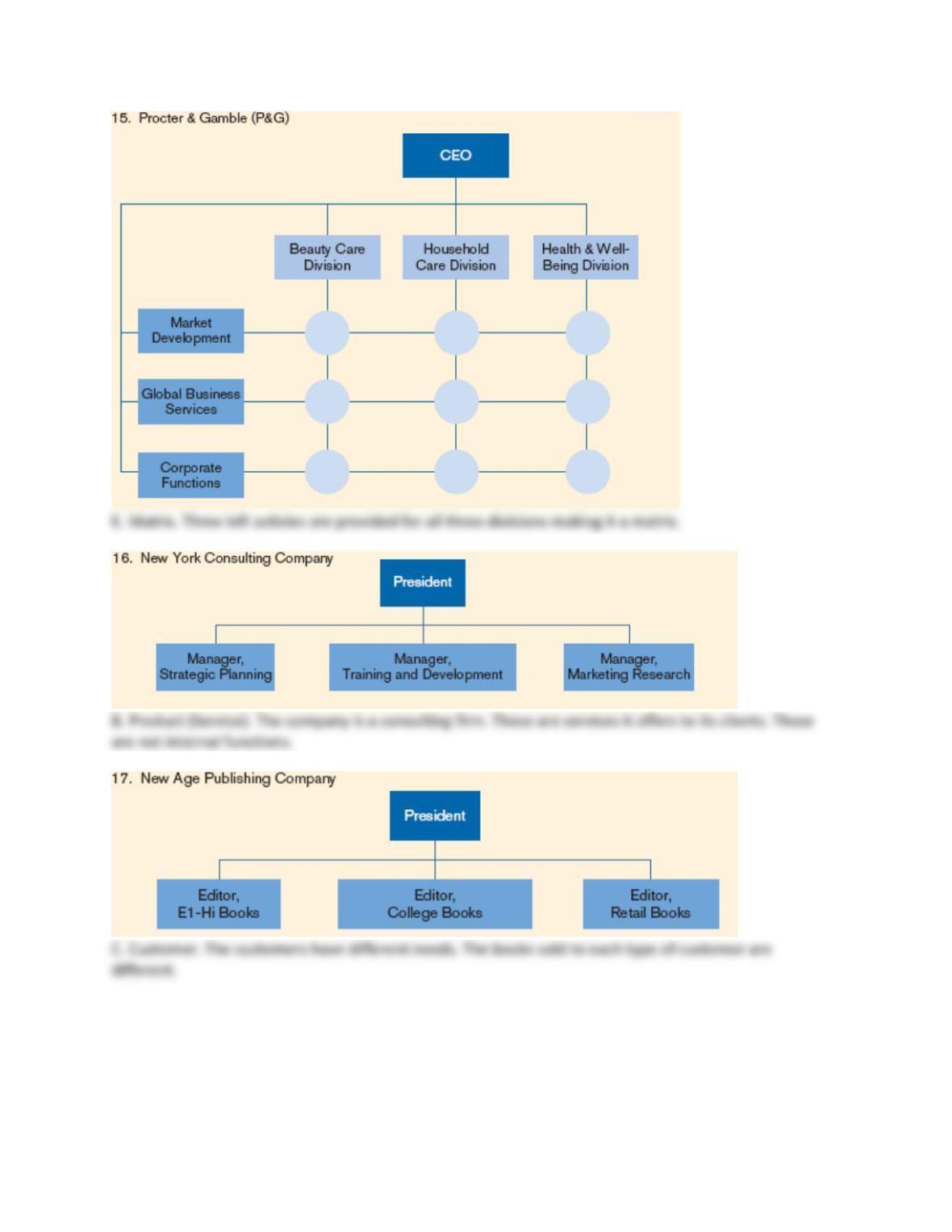
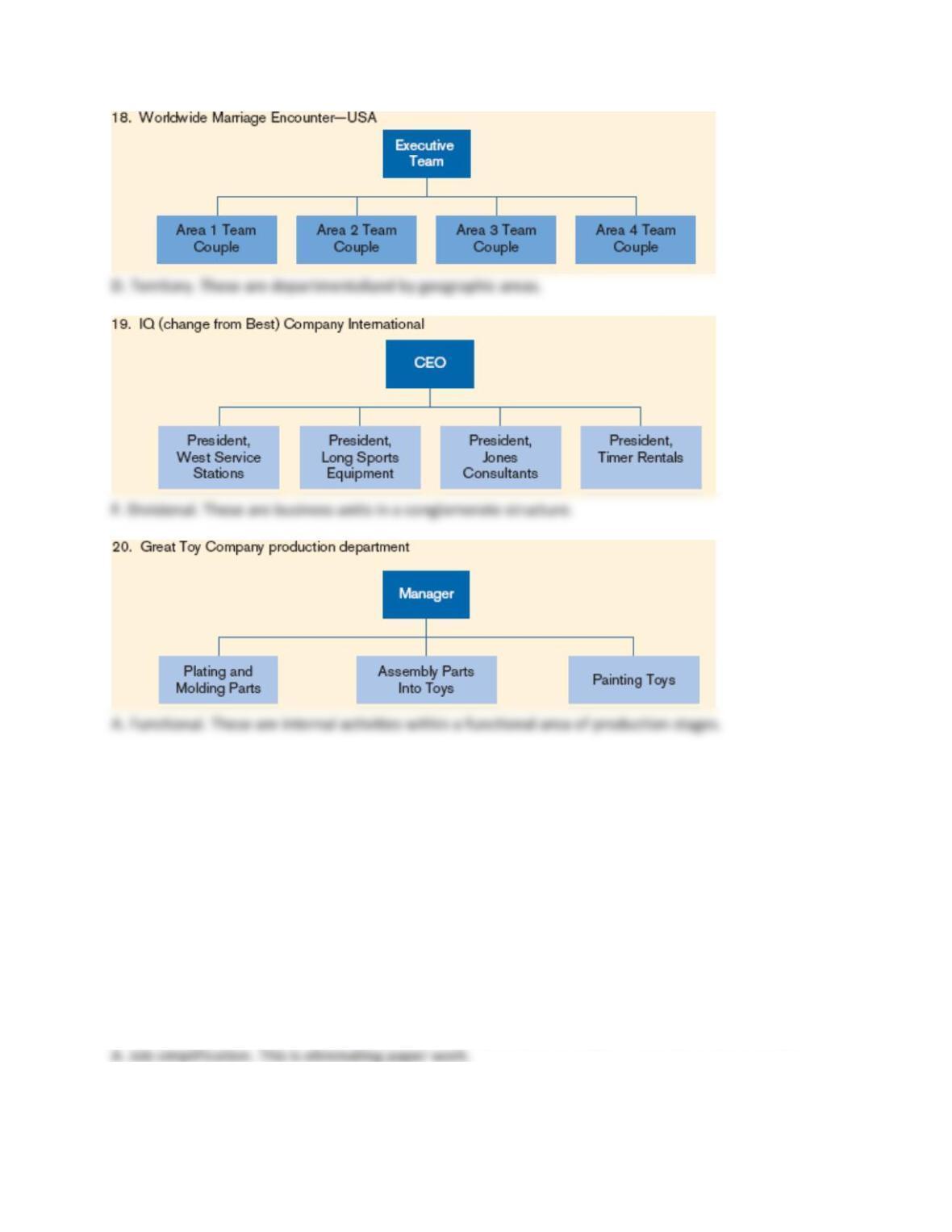
Applying the Concept 7–3: Departmentalization
Identify the type of departmentalization illustrated by each organization chart.
a. functional
b. product (service)
c. customer
d. territory (geographic)
e. matrix
f. divisional
Lussier, Management Fundamentals, 7e
© 2017, SAGE Publications
Lussier, Management Fundamentals, 7e
© 2017, SAGE Publications
Applying the Concept 7–4: Job Designs
Identify which job design technique is exemplified in each statement.
A. job simplification
B. job rotation
C. job enlargement
D. job enrichment/Job Characteristics Model
E. work teams
21. “Karen, would you like me to delegate a new task to you to make your job more challenging?”
D. Job enrichment. Delegating challenging tasks is a simple way to enrich jobs.
22. “When you travel, you will be given $25 per meal, so you no longer need to provide a receipt.”

Lussier, Management Fundamentals, 7e
© 2017, SAGE Publications
23. “Tommy, would you like your job to be less repetitive? If so, I can add a couple new tasks to your
job responsibility.”
C. Job enlargement. Adding new tasks to a job is enlarging it.
24. “Jamal, I’d like you to learn how to run the switchboard so that you can fill in for Bridget while she
is on vacation.”
25. “I’ve called this meeting because I’d like you guys to work together to come up with ways to
improve how the department jobs get done.”
JOIN THE DISCUSSION ANSWERS
Join the Discussion 7–1: Breaking the Rules
Suppose you are a sales rep for a major pharmaceutical company. You get paid by commission, so the
more drugs you sell to doctors, the more money you make. You know that sales reps in your company
have been visiting doctors and telling them that if they prescribe your company’s medication, they will
receive 5% of the sales revenues. This arrangement can bring in thousands of dollars each year for both
the sales reps and the doctors. You know the names of a few sales reps who are allegedly giving these
kickbacks, but you are not sure how many sales reps are involved. You also don’t know if sales managers
know about the kickbacks or are receiving payments from the reps.
1. Is it unethical to be flexible and break the law against kickbacks?
2. Why are kickbacks illegal? Who benefits from kickbacks, who gets hurt by them, and how?
3. What would you do in this situation? (Would you start giving kickbacks yourself? Blow the whistle
on sales reps to their managers? Blow the whistle to an outside source like the government or the
media? Do nothing?)
Answers vary
Join the Discussion 7–2: Delegating Destroying Documents
Arthur Andersen, a consulting company, was taken to court for destroying evidence that could have
been used in court to support allegations of illegal activities. Arthur Andersen destroyed evidence
related to the auditing of Enron to protect both companies from being found guilty of engaging in illegal
business practices. Arthur Andersen claimed that it was not trying to destroy incriminating evidence, but
was simply destroying records, which is done periodically. Destroying documents is, in fact, routine. The
key question is this: “What is being destroyed, and why is it being destroyed?”

Lussier, Management Fundamentals, 7e
© 2017, SAGE Publications
1. Is it ethical and socially responsible to delegate the task of destroying documents that may
potentially be used as evidence of wrongdoing?
Answers vary
2. What would you do if your boss asked you to destroy documents and you thought the goal was to
cover up evidence of wrongdoing by the firm? (Would you just do it? Say nothing but neglect to do it?
Question your boss’s motives? Look closely at what you were asked to destroy? Check with your
boss’s boss to make sure it’s OK to do it? Tell the boss you will not do it? Tell the boss to do it him– or
herself? Blow the whistle to an outside source?)
3. If you were charged with destroying evidence, do you believe it would be a good defense to say, “I
was only following orders”?