7-12 Groundwater – Fundamentals and One-Dimensional Flow Chap. 7
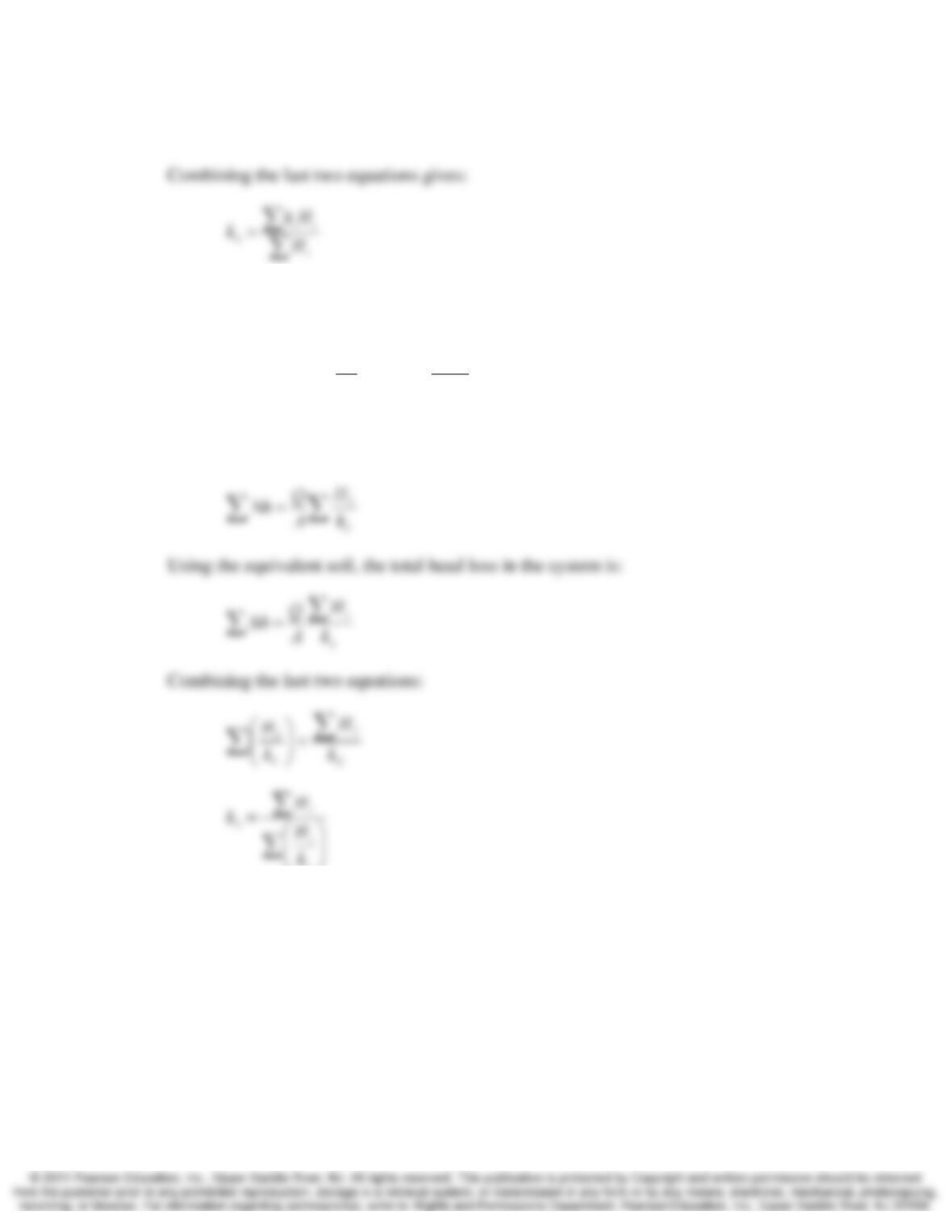
∑
== ix HiLkkiAQ
Equation 7.26:
Let
Δ
hi = the head loss through one of the layer:
Ak
QH
h
kA
Q
ikiAQ
i
i
i=Δ→=→=
Noting that Q and A are the same for each layer, the total head loss in the system
is:
⎠
⎝
i
7.25 A sandy soil with k = 3×10⁻² cm/s contains a series of 5 mm thick horizontal silt layers
spaced 300 mm on center. The silt layers have k = 5×10⁻⁶ cm/s. Compute kx and kz and
the ratio kx/kz.
Solution
Chap. 7 Groundwater – Fundamentals and One-Dimensional Flow 7-13
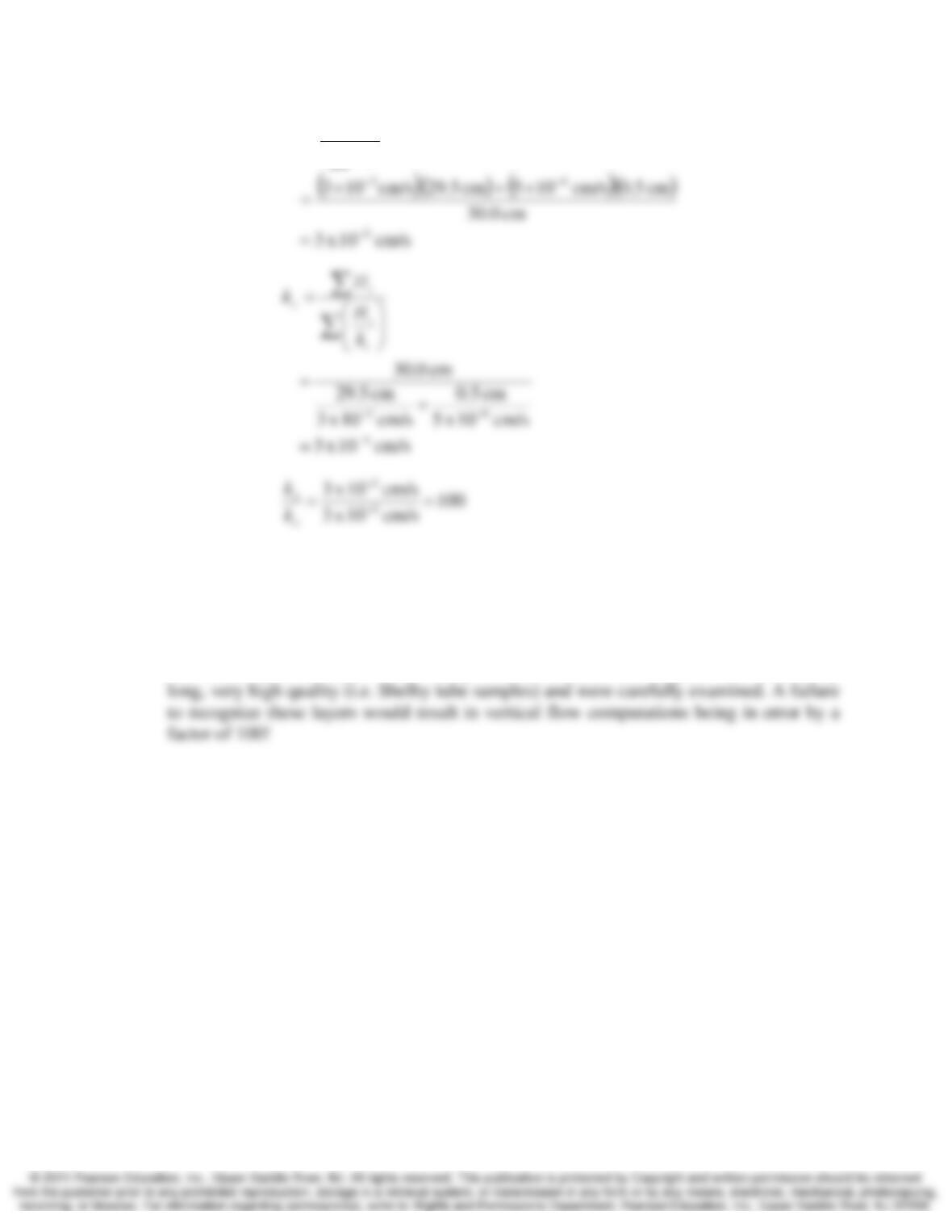
=∑
∑
i
ii
xH
Hk
k
7.26 When drilling an exploratory boring through the soil described in Problem 7.25, how
easy would it be to miss the silt layers? If we did miss them, how much effect would our
ignorance have on computations of Q for water flowing vertically? Explain.
Solution
The 5 mm thick silt layers could easily be missed unless the samples were sufficiently
Comprehensive Questions
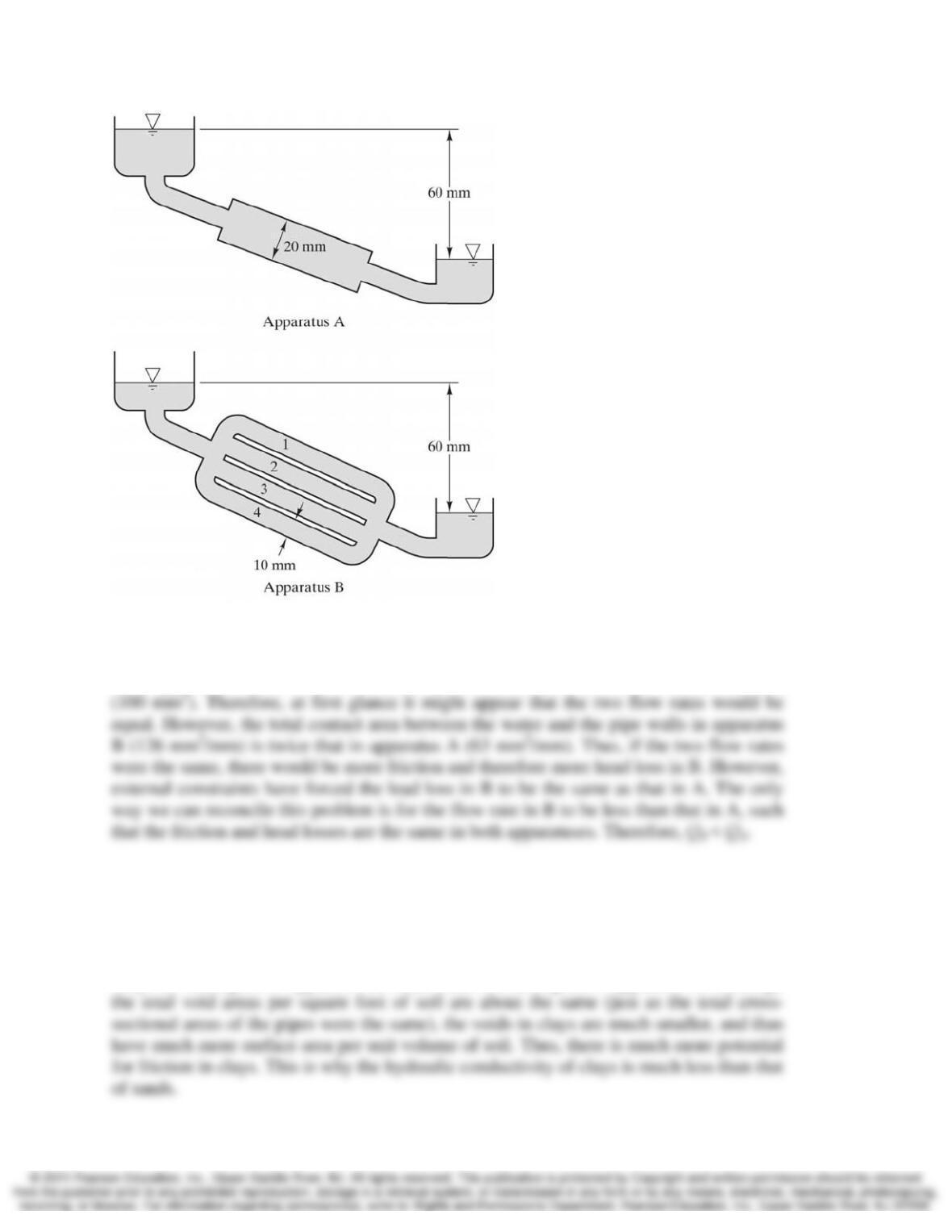
7.27 Apparatus A, shown in Figure 7.23, consists of a single 20 mm diameter pipe and is
subjected to a head difference of 60 mm. Apparatus B consists of four 10 mm diameter
pipes connected in parallel. How will the flow rate through A compare with that through
B? Explain.
7-14 Groundwater – Fundamentals and One-Dimensional Flow Chap. 7
Figure 7.23 Pipe networks for Problem 7.27.
Solution
Both apparatuses have the same head loss (60mm) and the same total cross-sectional area
7.28 On the Basis of your observations in Problem 7.27, explain why saturated clays have a
significantly lower hydraulic conductivity than saturated sands, even though the total
void areas per square foot of soil are about the same for both.
Solution
Clays are analogous to apparatus B, while sands are analogous to apparatus A. Although
Chap. 7 Groundwater – Fundamentals and One-Dimensional Flow 7-15
7.29 An engineer is searching for a suitable soil to cap a sanitary landfill. This soil must have
a hydraulic conductivity no greater than 1×10⁻⁸ cm/s. A soil sample from a potential
borrow site has been tested in a falling head permeameter similar to the one in Figure
7.19. This sample was 120 mm in diameter and 32 mm tall. The standpipe had an inside
diameter of 8.0 mm. Initially, the water in the standpipe was 503 mm above the water in
the water bath surrounding the sample. Then, 8 hours 12 min later the water was 322 mm
above the water in the water bath. Compute k and determine if this soil meets the
specification.
Solution
(
)
2
2
2
cm 503.0
4
cm 0.8
4
=== πd
a
π
(
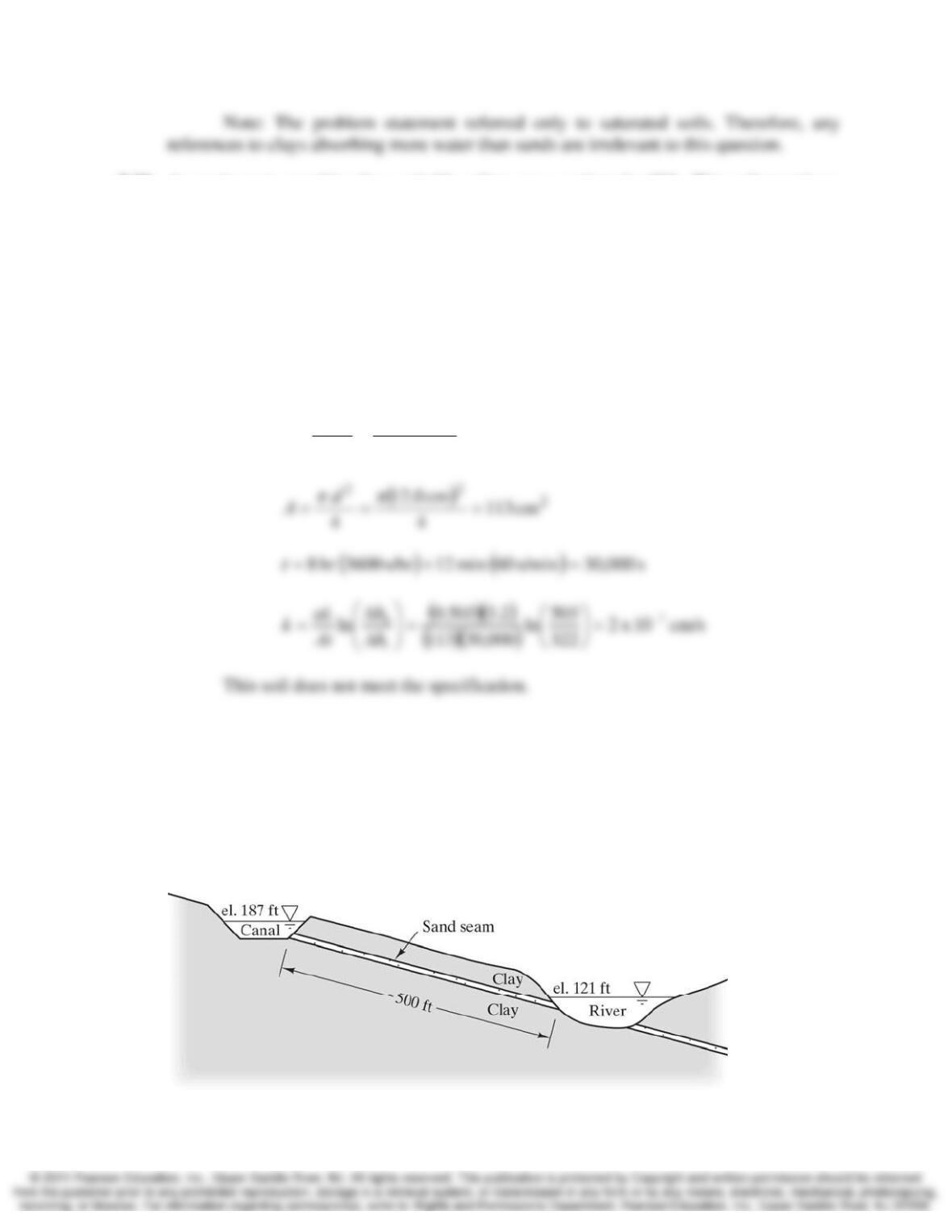
7.30 An unlined irrigation canal is aligned parallel to a river, as shown in Figure 7.24. This
cross-section continues for 4.25 miles. The soils are generally clays, but a 6 inch thick
sand seam is present as shown. This sand has k = 9×10⁻² cm/s. Compute the water loss
from the canal to the river due to seepage through this sand layer and express your
answer in acre-ft per month.
Note: One acre-foot is the amount of water that would cover one acre of ground to
a depth of one foot, and thus equals 43,560 ft3.
Figure 7.24 Cross-section for Problem 7.30. el. = elevation.
7-16 Groundwater – Fundamentals and One-Dimensional Flow Chap. 7
Solution
()
ft/s 10 x 3
cm 30.5
ft 1
cm/s 10 x 9 32 −− =
⎟
⎠
⎞
⎜
⎝
⎛
=k
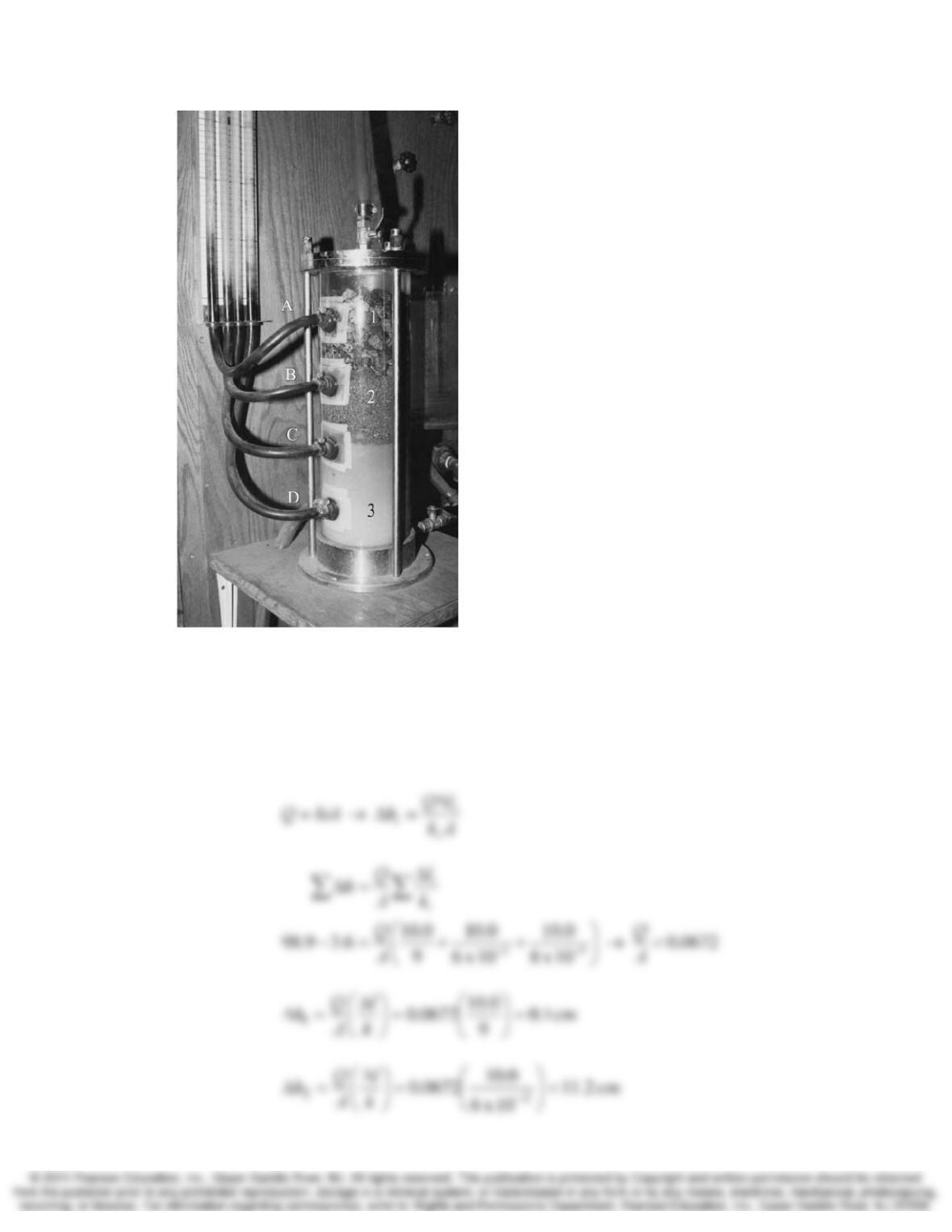
7.31 The constant head permeameter shown in Figure 7.25 contains three different soils as
shown. Their hydraulic conductivities are:
Soil 1 — k = 9 cm/s
Soil 2 — k = 6×10⁻² cm/s
Soil 3 — k = 8×10⁻³ cm/s
The four piezometer tips are spaced at 100 mm intervals, and the soil interfaces
are exactly aligned with piezometer tips B and C. The total heads in piezometers A and
D are 98.9 and 3.6 cm, respectively. Compute the total heads in piezometers B and C.
Chap. 7 Groundwater – Fundamentals and One-Dimensional Flow 7-17
Figure 7.25 Constant-head permeameter for Problem 7.31.
Solution
Q and A are the same for all three soils, and i=
Δ
h/
Δ
l. Therefore, we can rewrite Darcy’s
Law as:
7-18 Groundwater – Fundamentals and One-Dimensional Flow Chap. 7
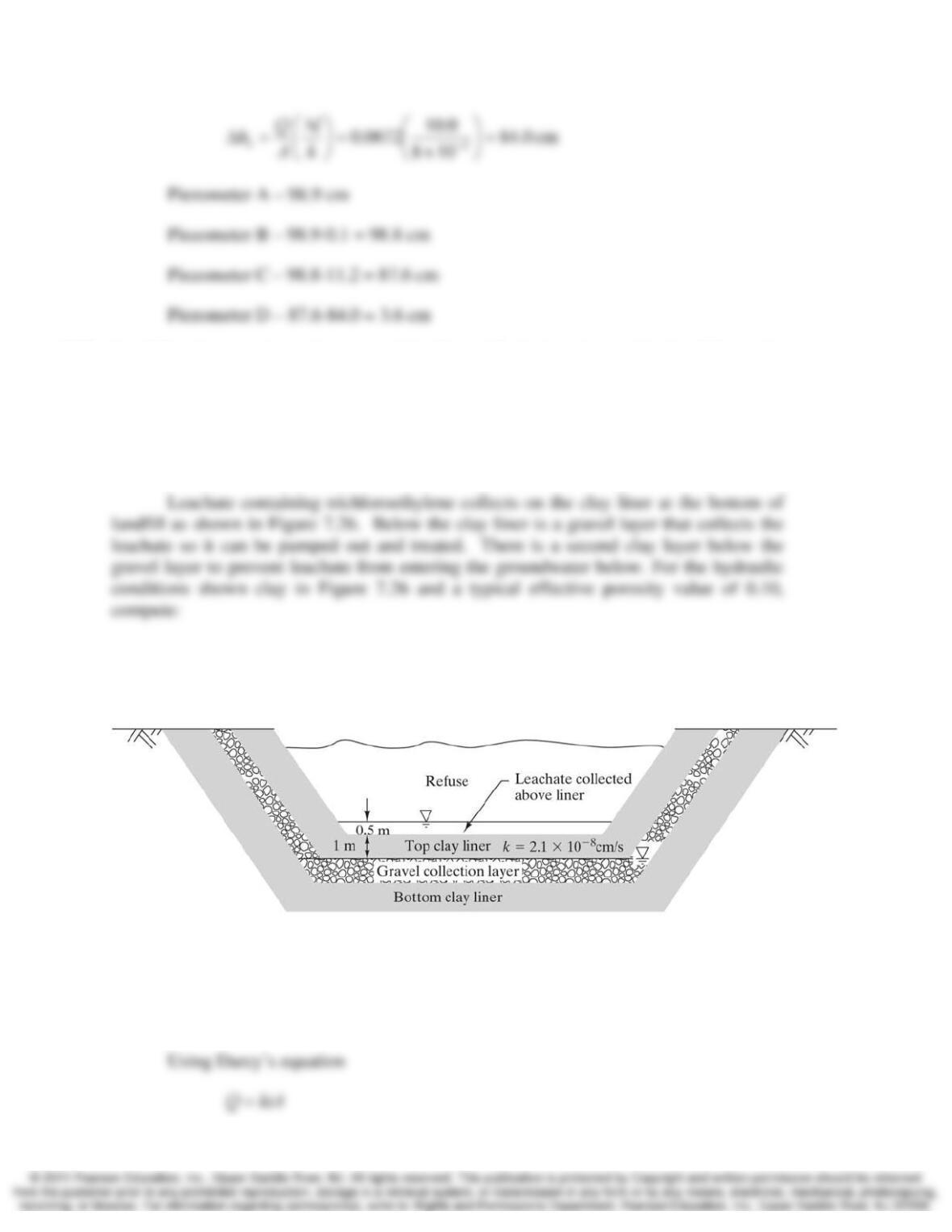
7.32 Landfills often use clay soils to control the flow of fluids in and out of the landfill. At the
sides and bottom of the land fill, compacted clay liners are used to contain the
accumulating fluid within the landfill (called leachate). At the top of the landfill, clay
cover systems keeps water from rain and snow from infiltrating into the landfill and
creating excess leachate. The fluid flow though these liner systems can generally be
approximated as one-dimensional flow.
(a) The total amount of leachate that must be collected and treated each year.
Assume the total area of the landfill base is 5,000 m2
(b) The time it takes the leachate to penetrate through the top clay liner.
Figure 7.26 Cross-section of landfill liner for Problem 7.32.
Solution
(a)

Chap. 7 Groundwater – Fundamentals and One-Dimensional Flow 7-19
(b)
10.0=
e
n
e
sn
ki
v=
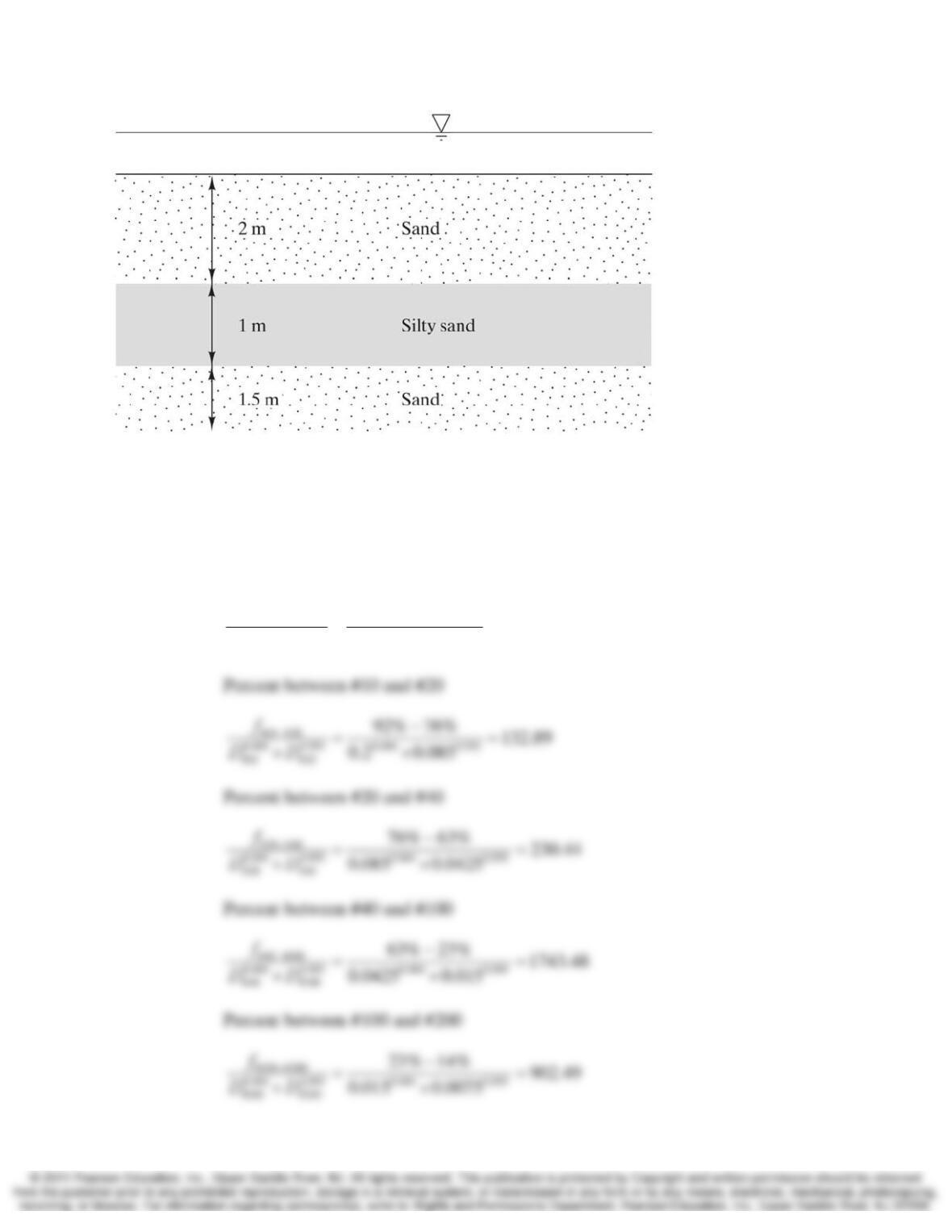
7.33 The cross section shown in Figure 7.27 consist of alternating layers of sand and silty sand.
Assume the soils have subangular grain shapes and the grain size distributions shown
below. Use the Kozeny-Carmen method to find k for each soil. The void ratio for the silty
sand is 0.63 and sand is 0.59. Then compute kx and kz for the layered system.
Sieve
Opening (cm) Sieve Size Percent Passing
Sand Silty Sand
0.475 #4 100 100
0.2 #10 86 92
0.085 #20 72 76
0.0425 #40 48 63
0.015 #100 8 23
0.0075 #200 4 14
Estimated D0 0.05 mm 0.01 mm
7-20 Groundwater – Fundamentals and One-Dimensional Flow Chap. 7
Figure 7.27 Cross-section for Problem 7.33.
Solution
Silty Sand
Percent between #4 and #10
16.28
2.0475.0
%92%100
595.0404.0595.0
10#
404.0
4#
10#4# =
×
−
=
×
−
DD
f
−
−
−
−
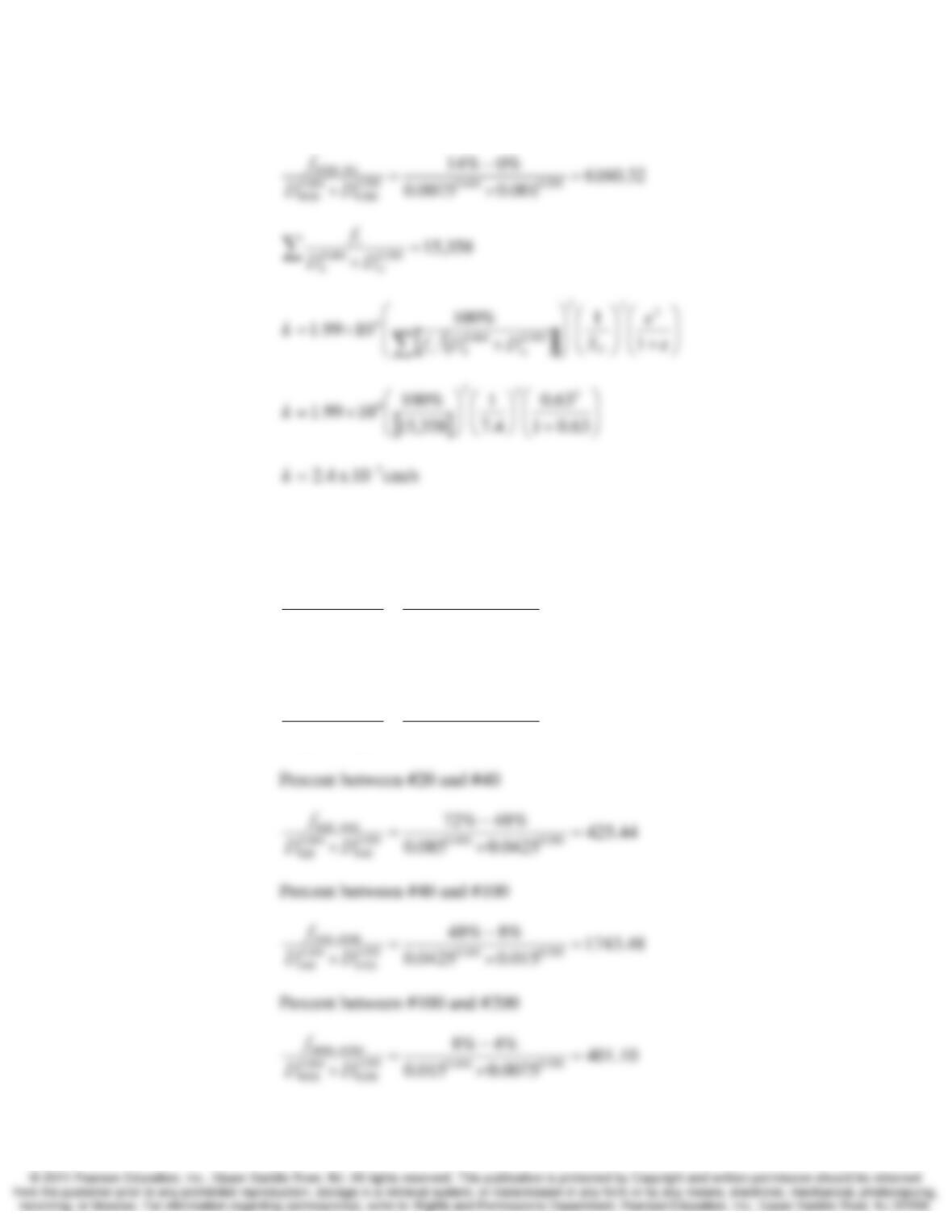
Chap. 7 Groundwater – Fundamentals and One-Dimensional Flow 7-21
Percent between #200 and 0% passing
Sand
Percent between #4 and #10
28.49
2.0475.0
%86%100
595.0404.0595.0
10#
404.0
4#
10#4# =
×
−
=
×
−
DD
f
Percent between #10 and #20
28.116
085.02.0
%72%86
595.0404.0595.0
20#
404.0
10#
20#10# =
×
−
=
×
−
DD
f
−
−
−
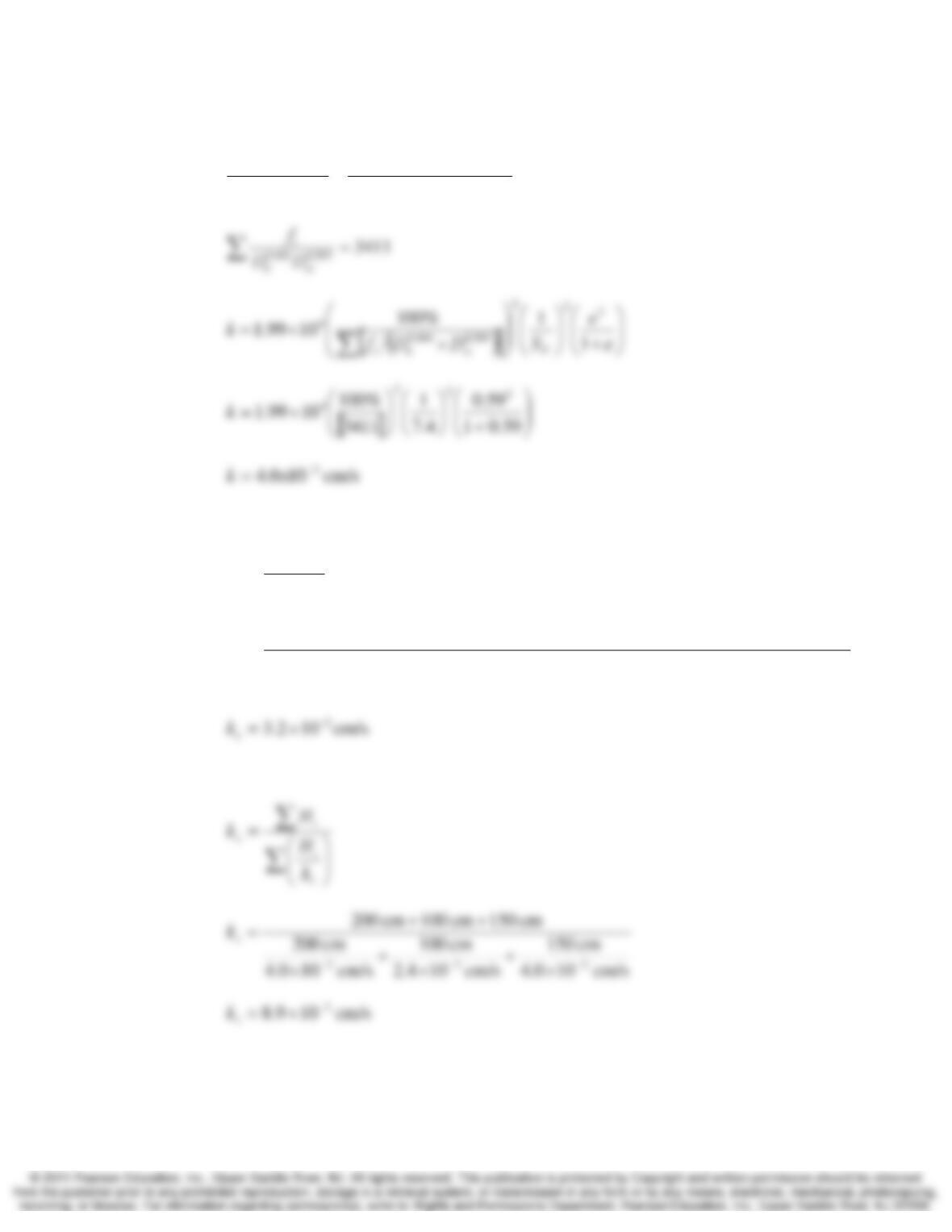
7-22 Groundwater – Fundamentals and One-Dimensional Flow Chap. 7
Percent between #200 and 0% passing
53.675
005.00075.0
%0%4
595.0404.0595.0
200#
404.0
100#
%0200# =
×
−
=
×
−
DD
f
∑
∑
=
i
ii
xH
Hk
k
()
(
)
(
)
(
)
(
)
(
)
cm 150cm 100cm 200
cm 150cm/s 100.4cm 100cm/s 104.2cm 200cm/s 100.4 232
++
×+×+×
=
−−−
x
k