Problem 7.65
The drag characteristics of an airplane are to be determined by model tests in a wind tunnel
operated at an absolute pressure of 1300 kPa. If the prototype is to cruise in standard air at
385 km/hr, and the corresponding speed of the model is not to differ by more than 20%
from this (so that compressibility effects may be ignored), what range of length scales may
be used if Reynolds number similarity is to be maintained? Assume the viscosity of air is
unaffected by pressure, and the temperature of air in the tunnel is equal to the temperature
of the air in which the airplane will fly.
Solution 7.65
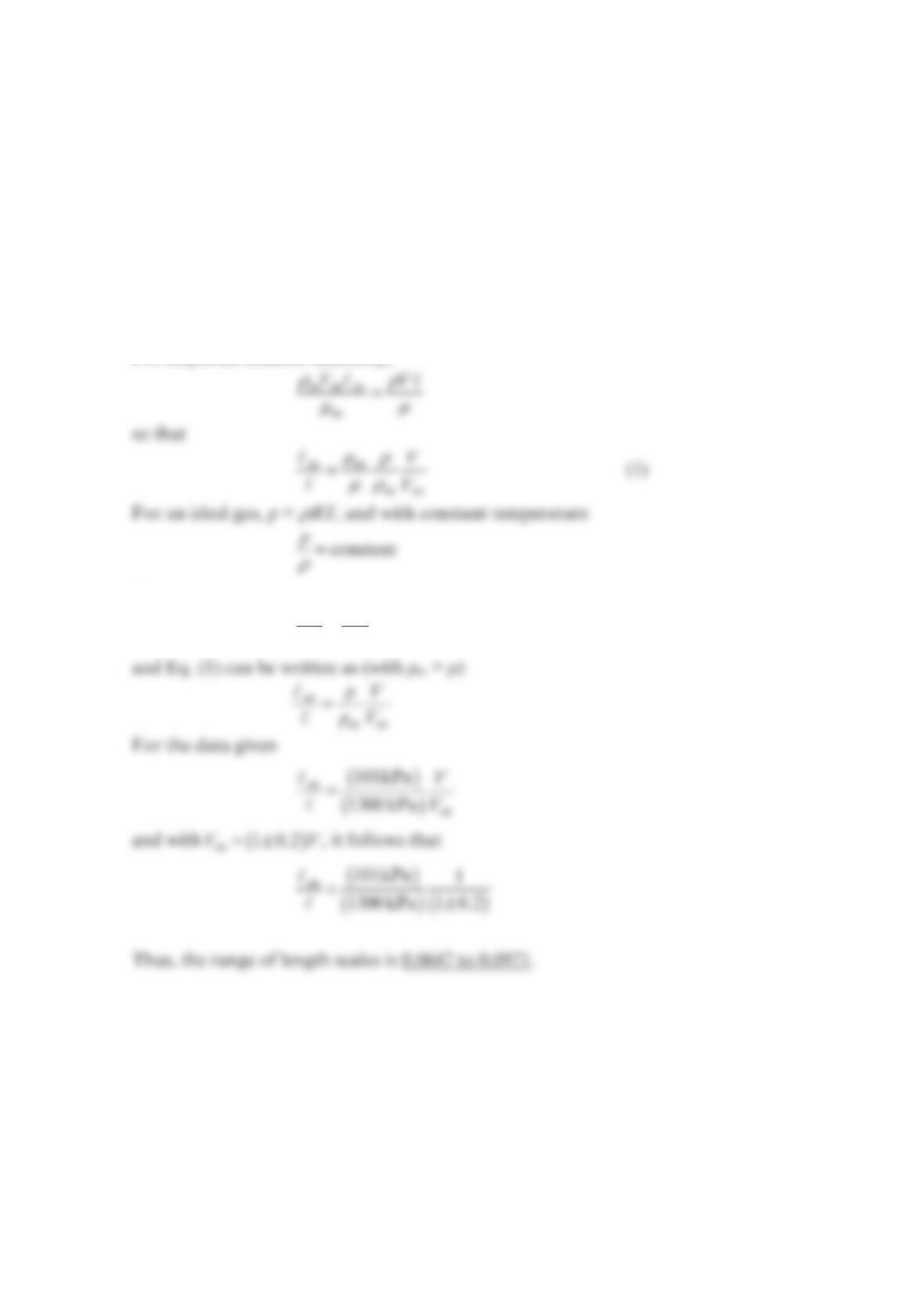
For Reynolds number similarity,
or
ρ
ρ
=
mm
p
p
p
p
ρ
ρ
µ
ρ
Problem 7.66
The drag on a sphere moving in a fluid is known to be a function of the sphere diameter,
the velocity, and the fluid viscosity and density. Laboratory tests on a 4-in.- diameter
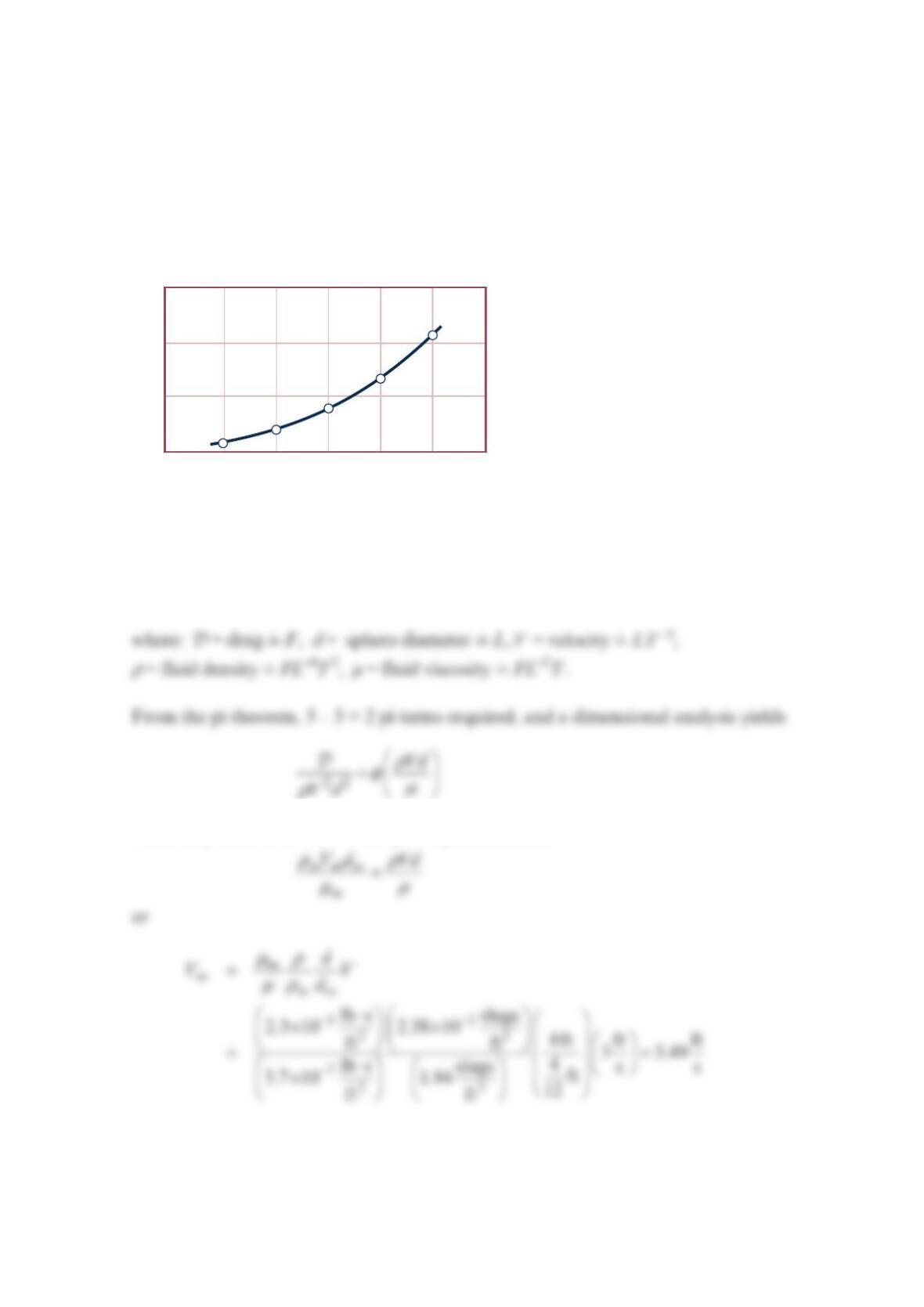
sphere were performed in a water tunnel and some model data are plotted in the figure
below. For these tests, the viscosity of the water was 2.3 × 10⁻⁵ lb ∙ s/ft2 and the water
density was 1.94 slugs/ft3. Estimate the drag on an 8-ft- diameter balloon moving in air at a
velocity of 3 ft/s. Assume the air to have a viscosity of 3.7 × 10⁻⁷ lb ∙ s/ft2 and a density of
2.38 × 10⁻³ slugs/ft3.
Solution 7.66
ρµ
=(, , , )fdV
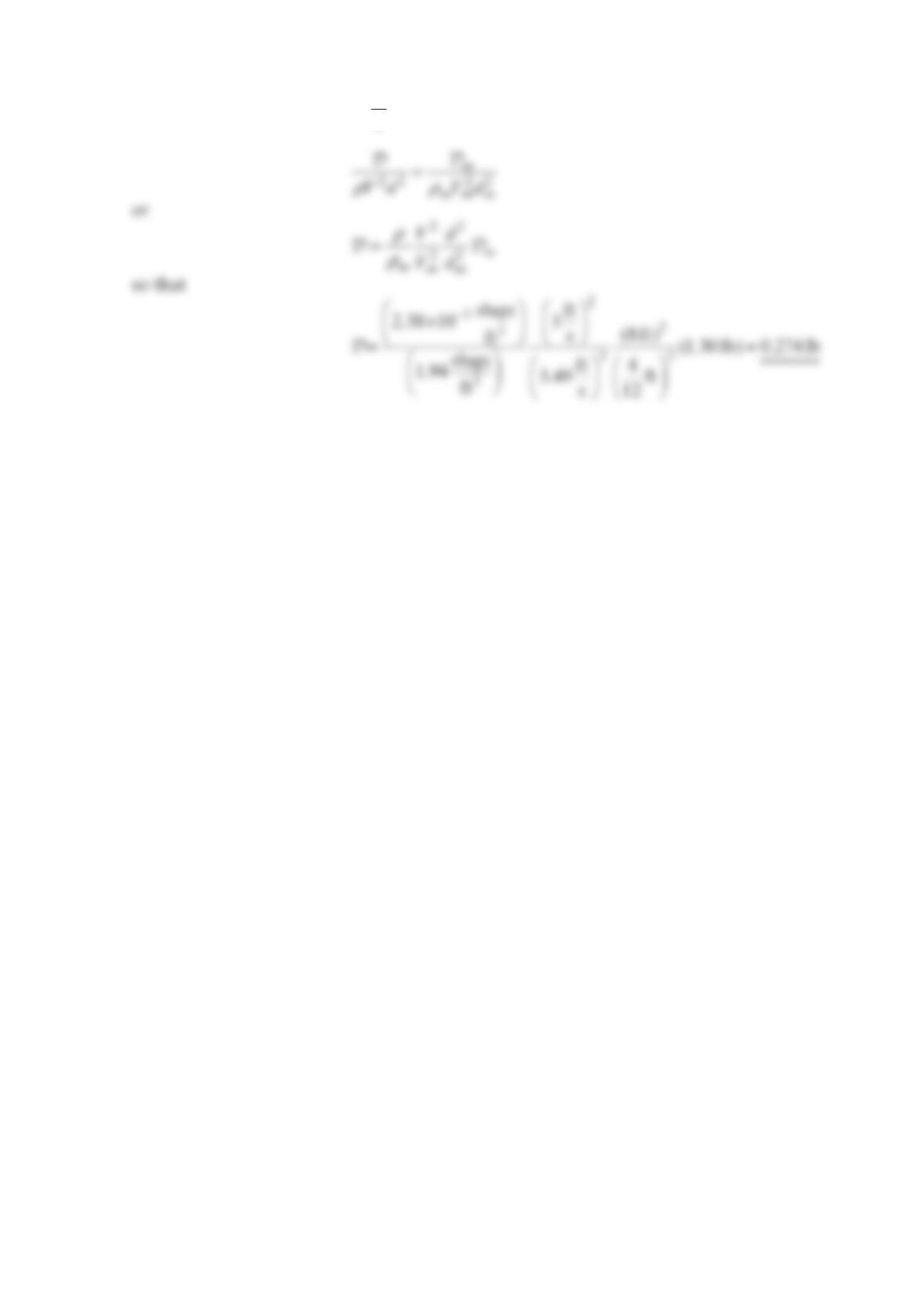
Thus, Reynolds number similarity is required so that
6
4
2
00 2 4 6 8 10 12
Model velocity (ft/s)
Model drag (lb)
From the graph, for ==
ft
5.49 , 1.30 lb
s
mm
V
. Since
Problem 7.67
A dam spillway is 40 ft long and has fluid velocity of 10 ft/s. Considering Weber number
effects as minor, calculate the corresponding model fluid velocity for a model length of 5 ft.
Solution 7.67
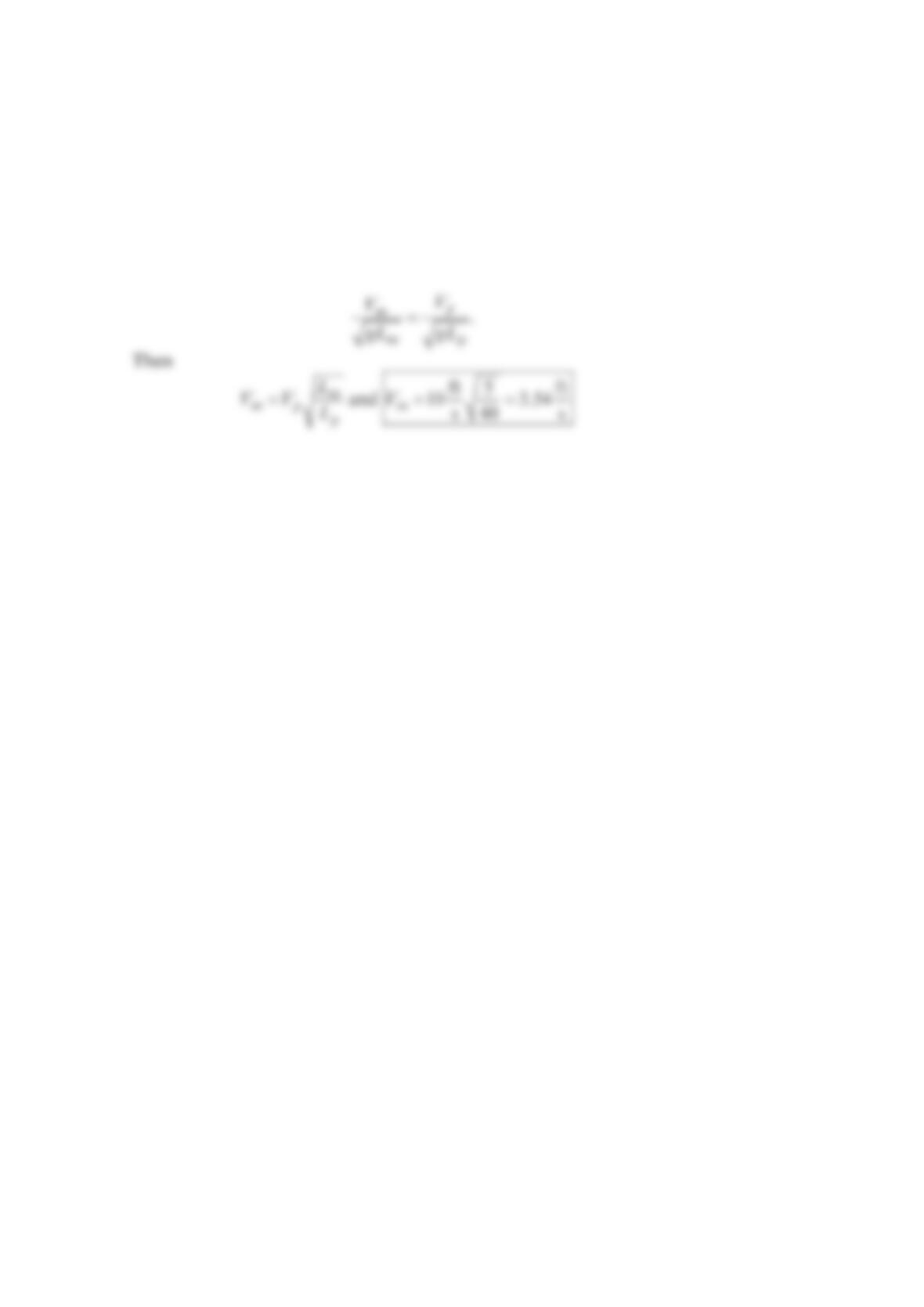
The primary similarity parameter is Froude number,
Problem 7.68
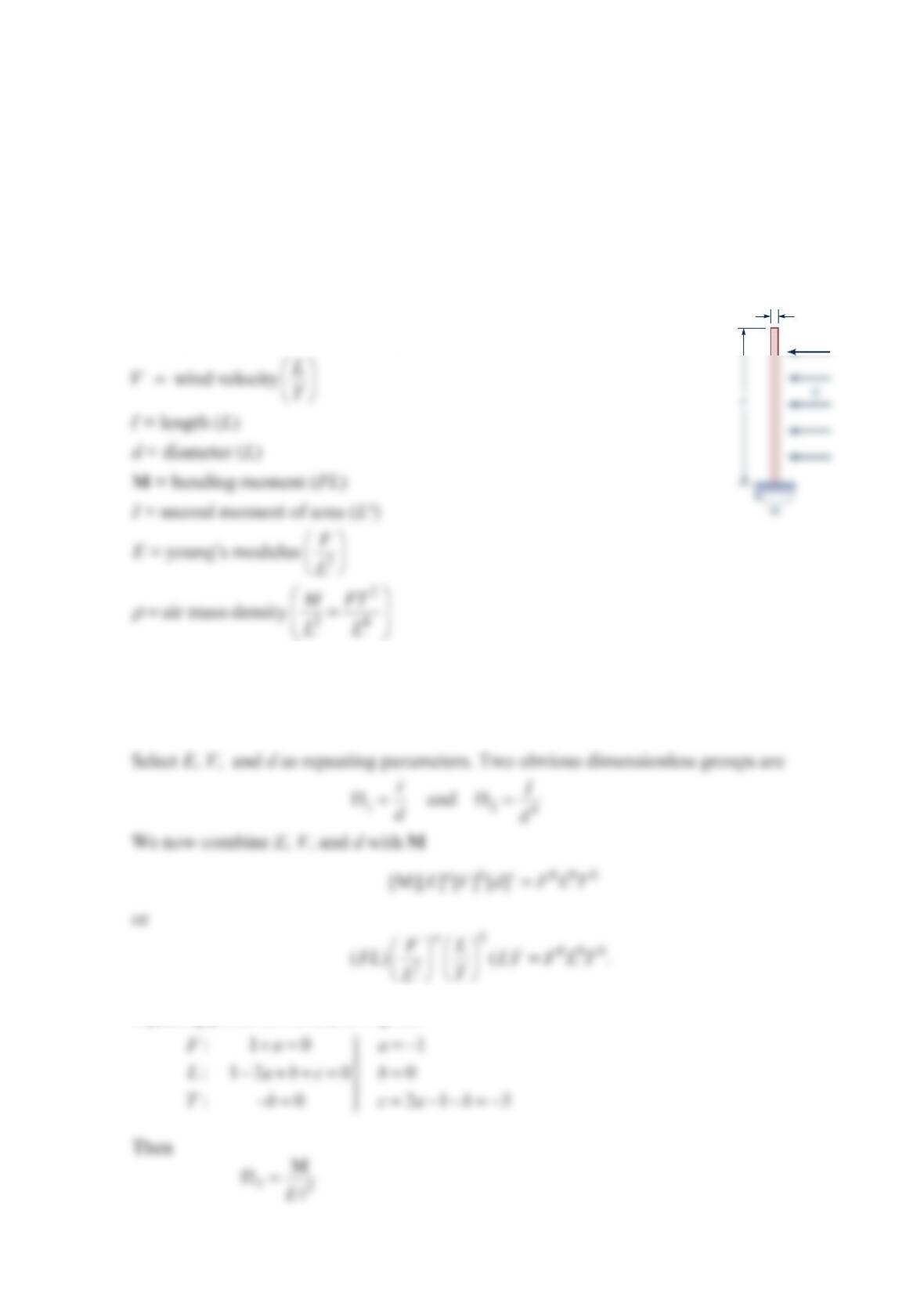
A flagpole has a diameter of 1.0 ft and is 45 ft. long. The manufacturer wants to find the
bending moment at the base of the pole for a wind speed of 60 mph. To do so, a scale
model of the flagpole is built with a diameter of 1.0 in. and a length of 45 in. (a) What must
be the air speed at which the model is tested? (b) If the wind velocity over the flagpole in
part (a) is reduced by 50%, how much would the bending moment at the base be reduced?
Solution 7.68
We first develop the dimensionless groups and will use the pi theorem.
Identify the relevant dimensional parameters,
Determine the number of dimensionless parameters. There are three fundamentals
(F, L, T). Since E, V, and d cannot form a dimensionless group, k = 3 and n – k = 7 – 3 = 4
dimensionless groups.
Equating power of F, L, and T gives
d
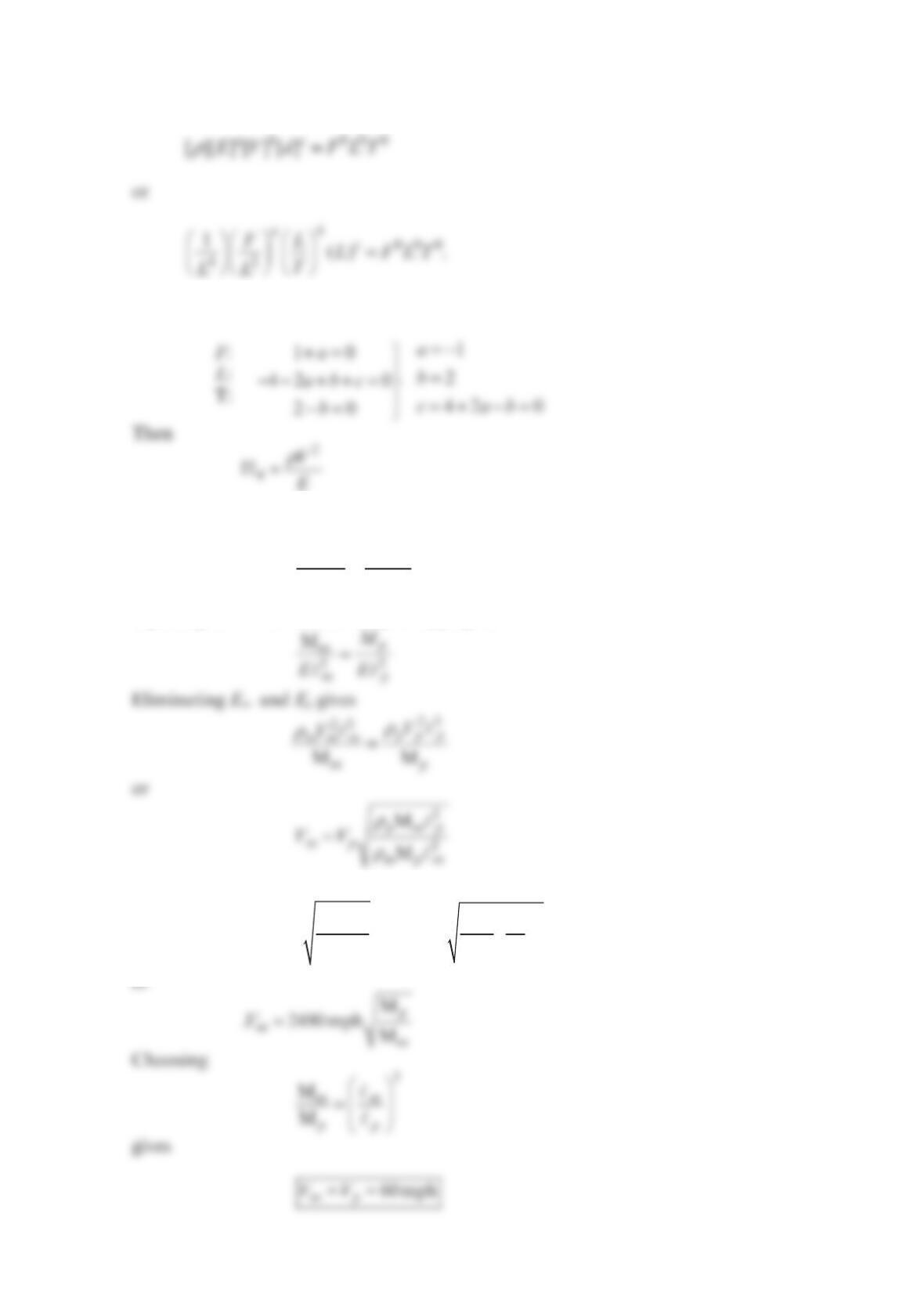
We now combine E, V, and d with
ρ
.
Equating power of F, L, and T gives
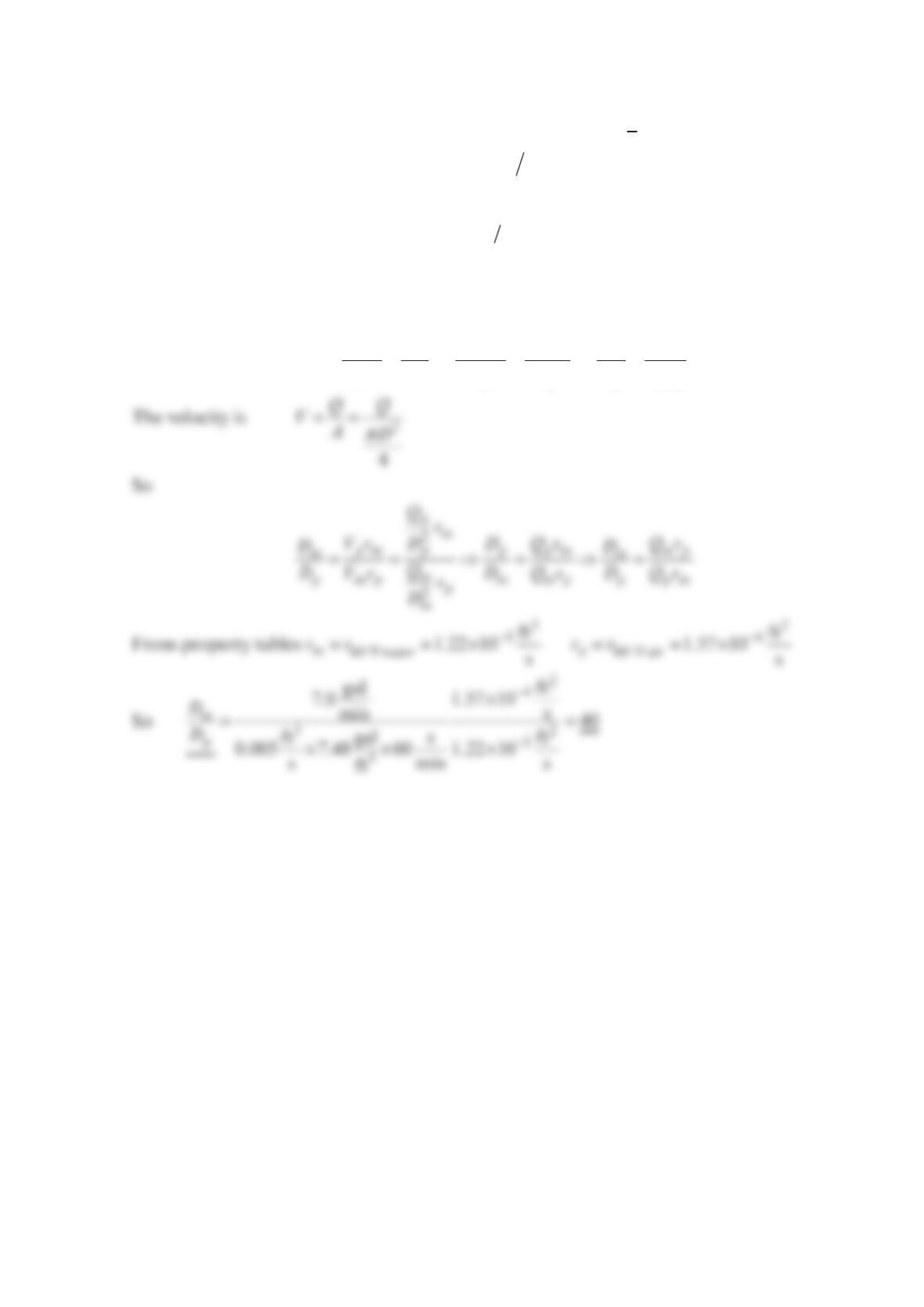
Equating Π4 for the model and prototype gives
ρ
ρ
=
2
2
p
p
mm
mp
V
V
EE
.
Equating Π3 for the model and prototype gives
p
V
If we assumed
ρ
m =
ρ
p (same air temperature),
==
33
3
MM12
60 mph M1
M
mp m
mp
p
pm
V
V
Problem 7.69
A very small needle valve is used to control the flow of air in a 1-in
.
8 air line. The valve has a
pressure drop of 4.0 psi at a flowrate of 3
0.005ft s of
6
0F
air. Tests are performed on a
large, geometrically similar valve and the results are used to predict the performance of the
smaller valve. How many times larger can the model valve be if
6
0F
water is used in the
test and the water flowrate is limited to
7
.0 gal min?
Solution 7.69
We will match the Reynolds Number
ρ
µ
====Re pp pm
mm m
mppmp
VD Vv
VD D
VD VD
vv vDVv
Comment When using the Property Tables, the kinematic viscosity of air was evaluated at
atmospheric pressure. Actually, the pressure of the air is unknown. If it is near atmospheric,
the 4.0 psi pressure drop would cause compressibility effects and Mach Number must also
be considered.
Problem 7.70
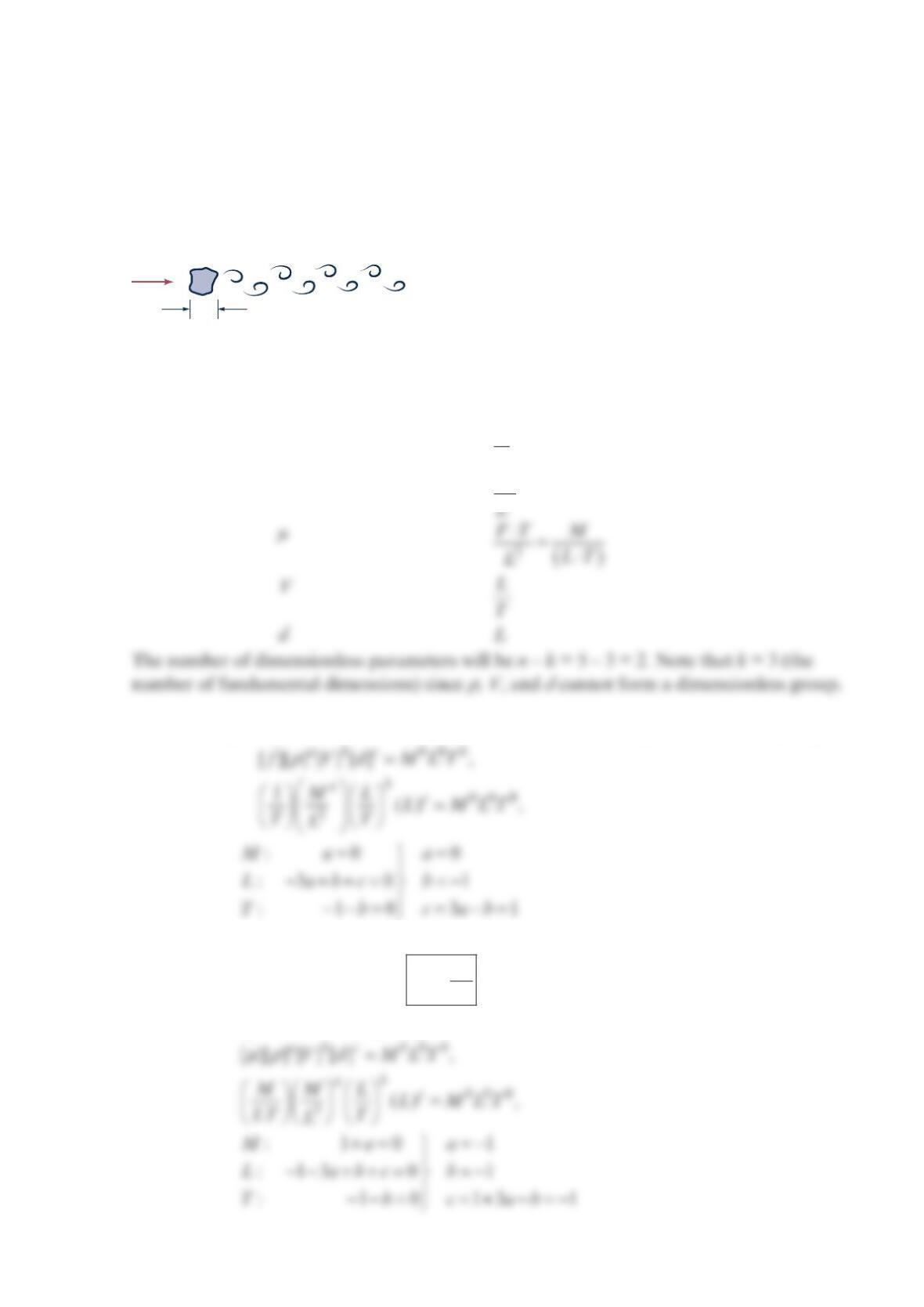
In low-speed external flow over a bluff object, vortices are shed from the object (as shown
in the figure below). The frequency of vortex shedding, f ≐ 1/T, depends on
ρ
, μ, V, and d.
Make a dimensional analysis of this phenomenon. Transform the dimensionless parameters
that you developed into “standard” parameters. What are their names? Two identically
shaped objects with a size ratio 2:1 are tested in air flow. What velocity ratio is necessary
for dynamic similarity? What is the ratio of vortex-shedding frequencies?
Solution 7.70
The dimensional parameters have been identified. Their dimensions are
f
1
T
ρ
3
M
Select the repeating parameters as
ρ
, V, and d. We now combine
ρ
, V, and D with f to get
The first dimensionless parameter is
01
11
or fd
fVd V
ρ
−
Π
=Π=
Next combine
ρ
V, and D with μ to get
V
d
The second dimensionless parameter is
For (assumed) equal air temperature and pressure,
ρ
1 =
ρ
2 and μ1 = μ2 so
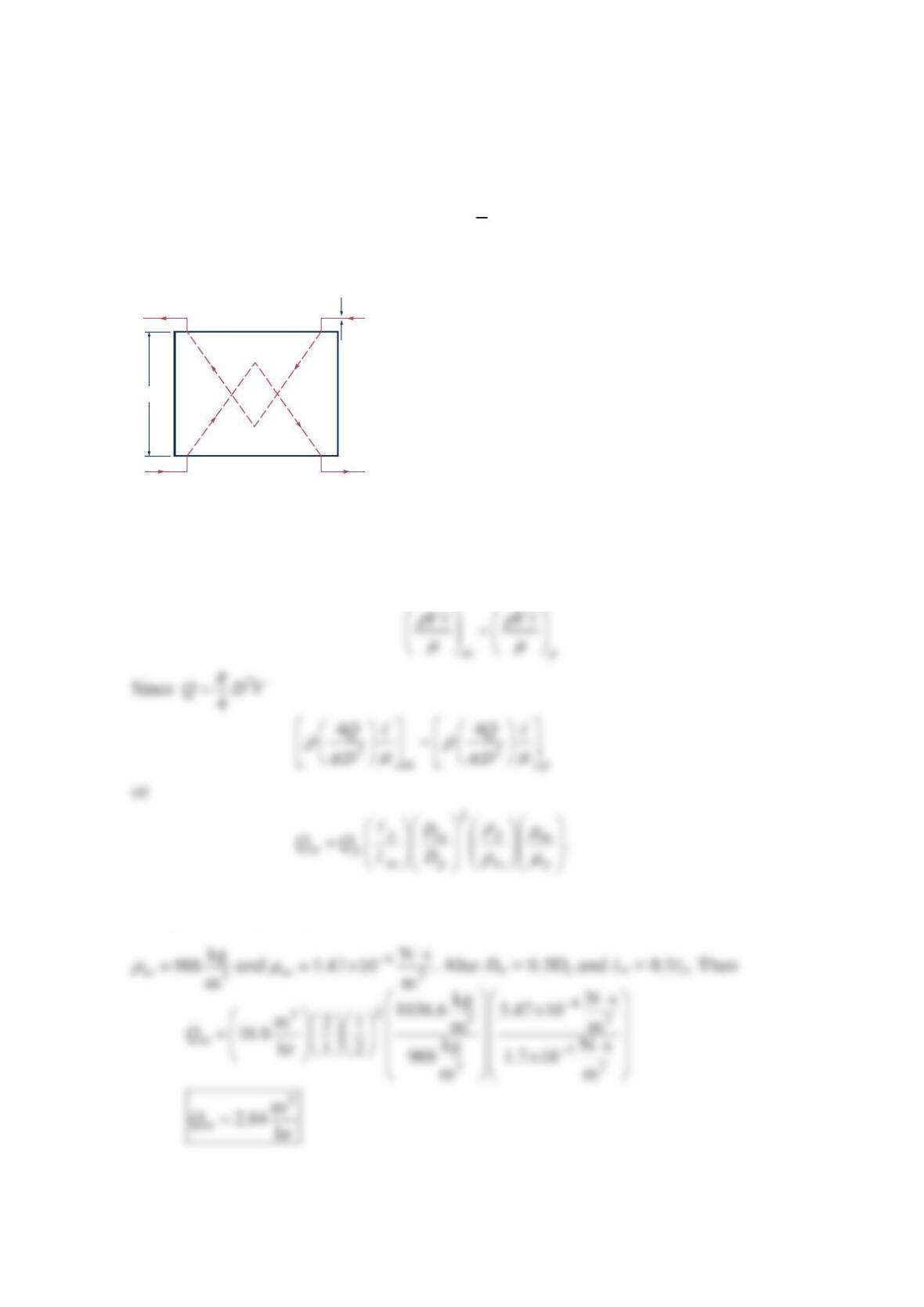
Equality of the Strouhal number gives
Problem 7.71
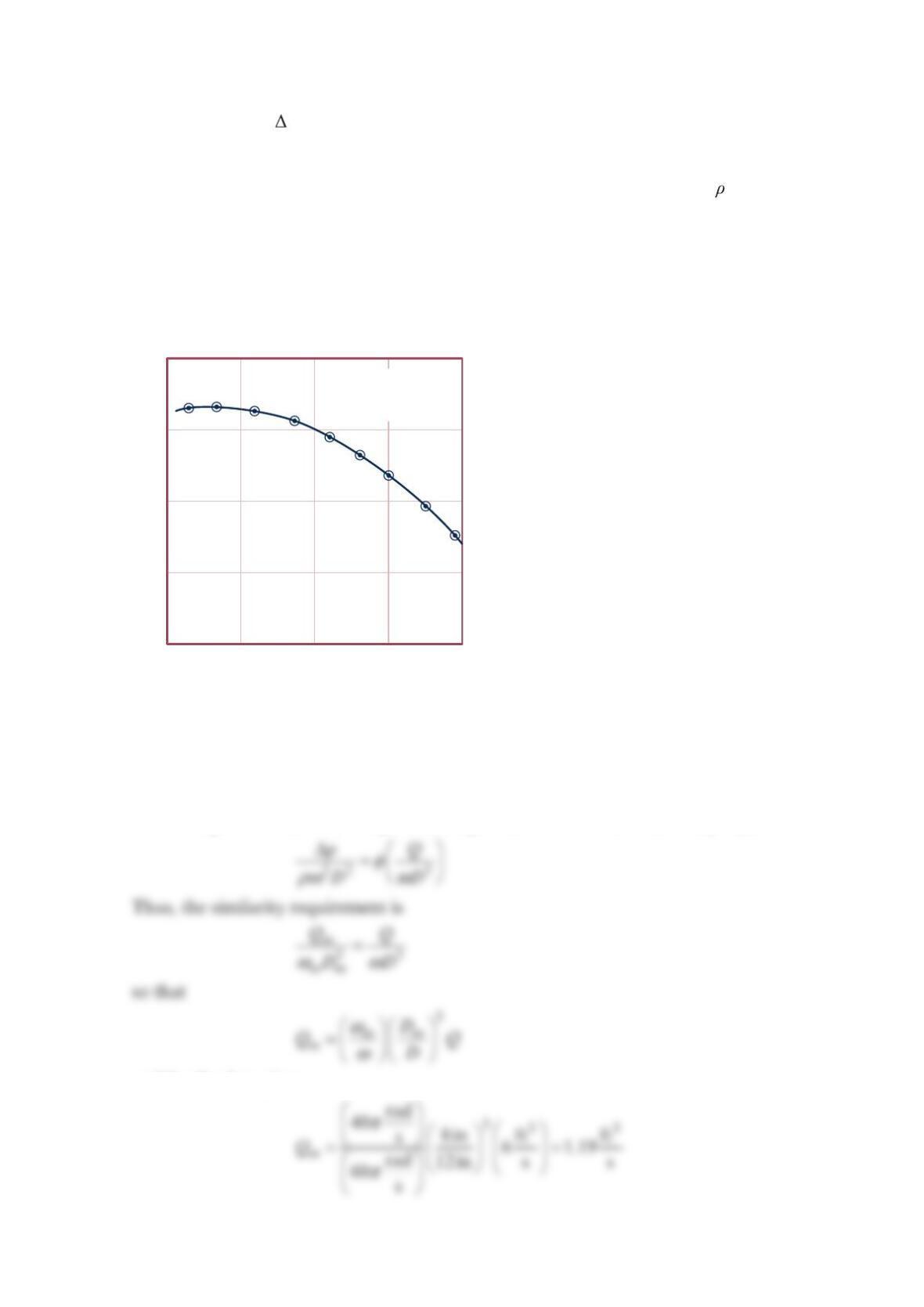
In a nutritional products plant, a plate heat exchanger cools infant formula by
approximately 25 °C from an inlet temperature of 68 °C as it flows through the plates as
shown in the figure below. The process engineer would like to be able to cool the infant
formula by as much as 35 °C as it passes through the plates. The plate heat exchanger is
currently in use, so he would like to build a 1
2-scale model for testing purposes. In the
model, water will be used instead of infant formula. What flowrate is needed in the model?
Solution 7.71
The Reynolds number must be the same for the model (water) and the prototype (formula).
Using an average temperature of 50 °C water,
1.4 m
D = 0.05 m
Infant formula
at average formula
temperature
30% glycol solution
= 1036.6 kg/m
3
Q = 16.8 m
3
/hr
= 1.7 × 10⁻³ N·s/m
2
ρ
μ
Problem 7.72
The pressure rise, p, across a centrifugal pump of a given shape can be expressed as
()
,,,
p
fD Q
ω
ρ
Δ
=
where D is the impeller diameter,
ω
is the angular velocity of the impeller, is the fluid
density, and Q is the volume rate of flow through the pump. A model pump having a
diameter of 8 in. is tested in the laboratory using water. When operated at an angular
velocity of 40
π
rad/s the model pressure rise as a function of Q is shown in the figure below.
Use this curve to predict the pressure rise across a geometrically similar pump (prototype)
for a prototype flowrate of 6 ft3/s. The prototype has a diameter of 12 in. and operates at an
angular velocity of 60
π
rad/s. The prototype fluid is also water.
Solution 7.72
ω
ρ
ωρ
−−−−
Δ=
Δ
=
214231
(,,,)
p
fD Q
p
FL D L T FL T Q L T
From the pi theorem, 5 – 3 = 2 pi terms required, and a dimensional analysis yields
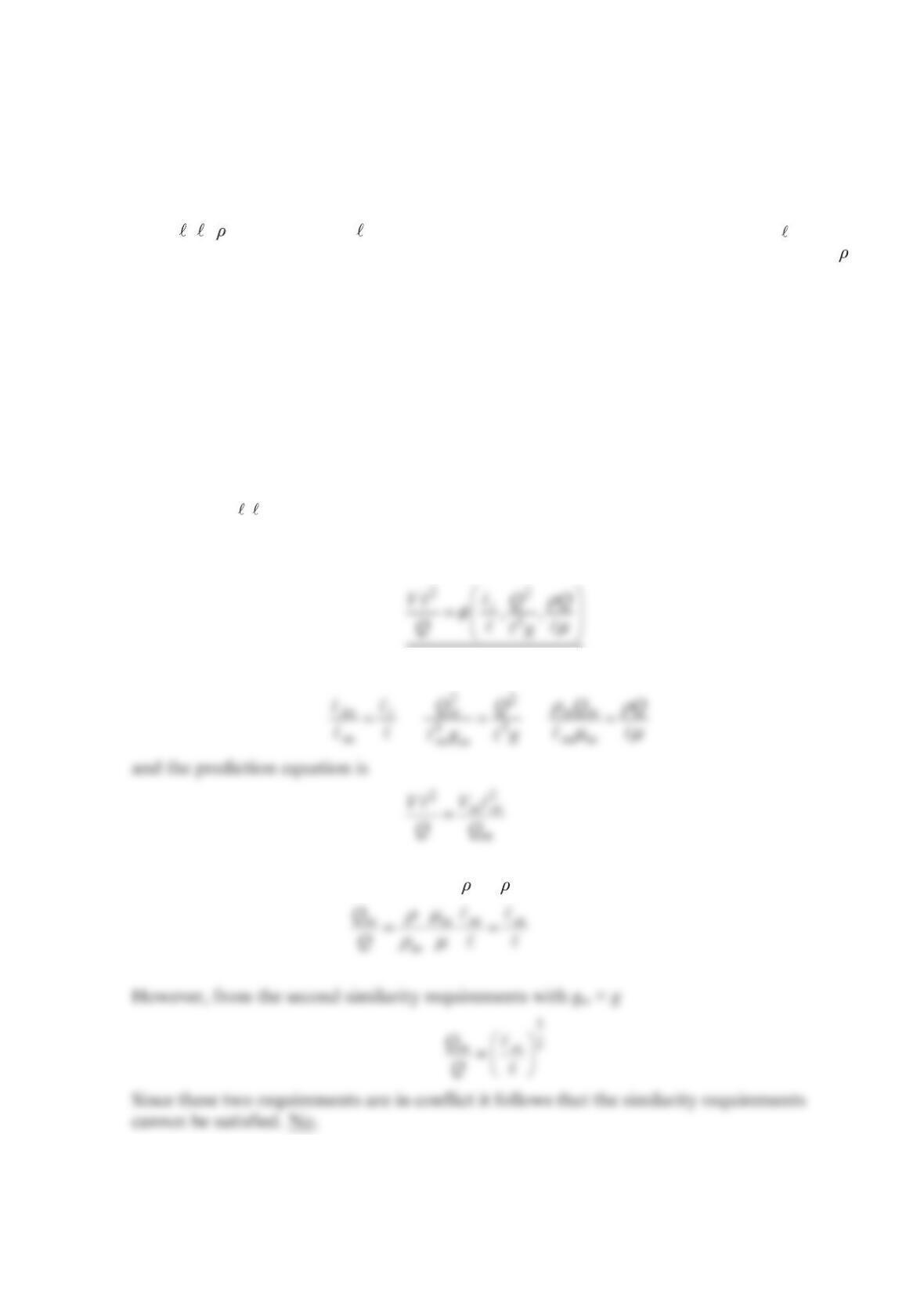
and for the data given
0
2
4
6
8
p
m
(psi)
Δ
Q
m
(ft
3
/s)
0 0.5 1.0 1.5 2.0
Model data
m
= 40
rad/s
ω
D
m
= 8 in.
π
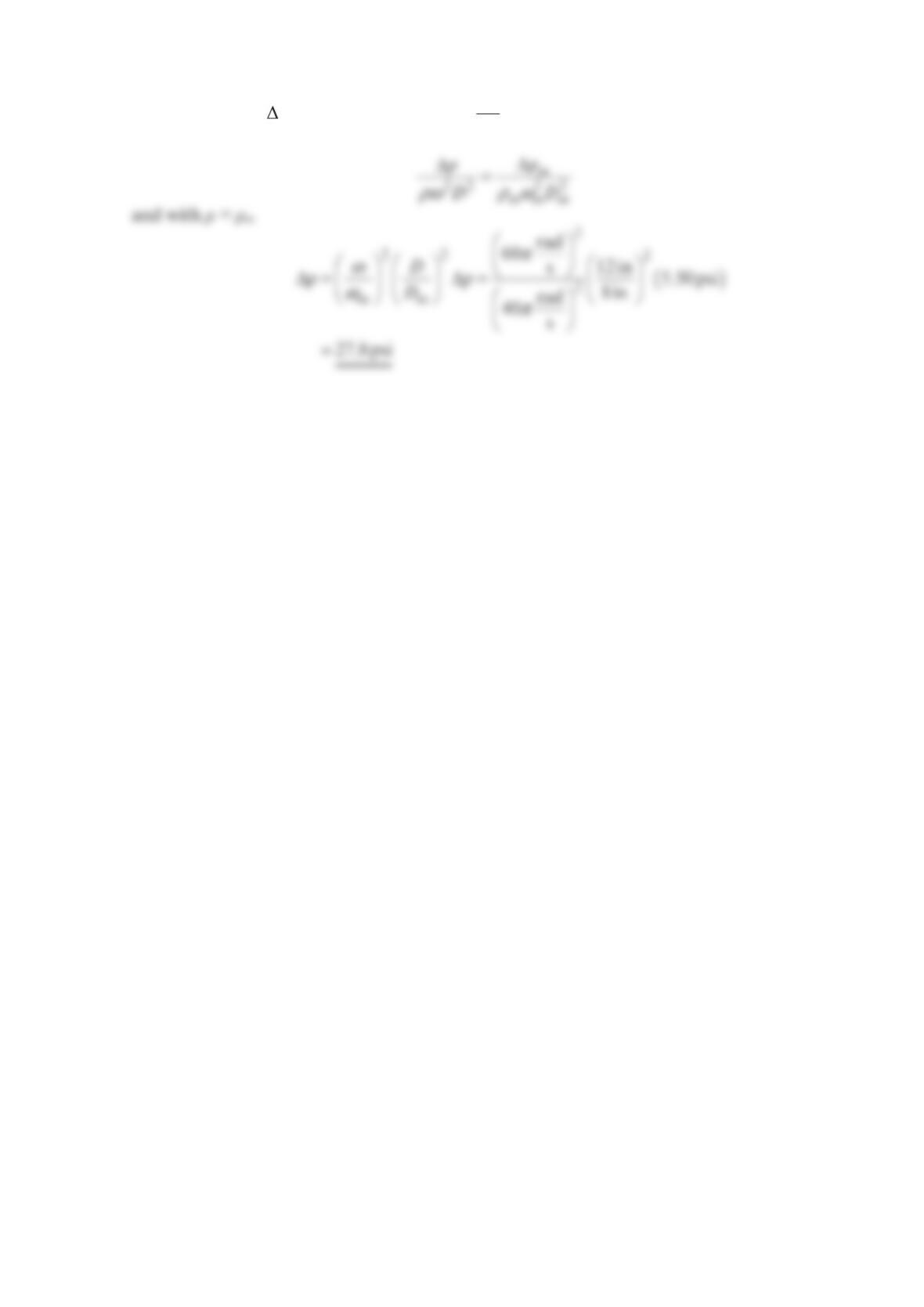
From the graph, pm = 5.50 psi for =
3
ft
1.19 s
Q. Thus,
Problem 7.73
At a large fish hatchery, the fishes are reared in open, water-filled tanks. Each tank is
approximately square in shape with curved corners, and the walls are smooth. To create
motion in the tanks, water is supplied through a pipe at the edge of the tank. The water is
drained from the tank through an opening at the center. A model with a length scale of 1:13
is to be used to determine the velocity, V, at various locations within the tank. Assume that
V = f(, i, , μ, g, Q) where is some characteristic length such as the tank width, i
represents a series of other pertinent lengths, such as inlet pipe diameter, fluid depth, etc.,
is the fluid density, μ is the fluid viscosity, g is the acceleration of gravity, and Q is the
discharge through the tank. (a) Determine a suitable set of dimensionless parameters for
this problem and the prediction equation for the velocity. If water is to be used for the
model, can all of the similarity requirements be satisfied? Explain and support your answer
with the necessary calculations. (b) If the flowrate into the full-sized tank is 250 gpm,
determine the required value for the model discharge assuming Froude number similarity.
What model depth will correspond to a depth of 32 in. in the full-sized tank?
Solution 7.73
(a)
(, , , , , )
i
V
fgQ
ρµ
=
From the pi theorem, 7 – 3 = 4 pi terms required, and a dimensional analysis yields
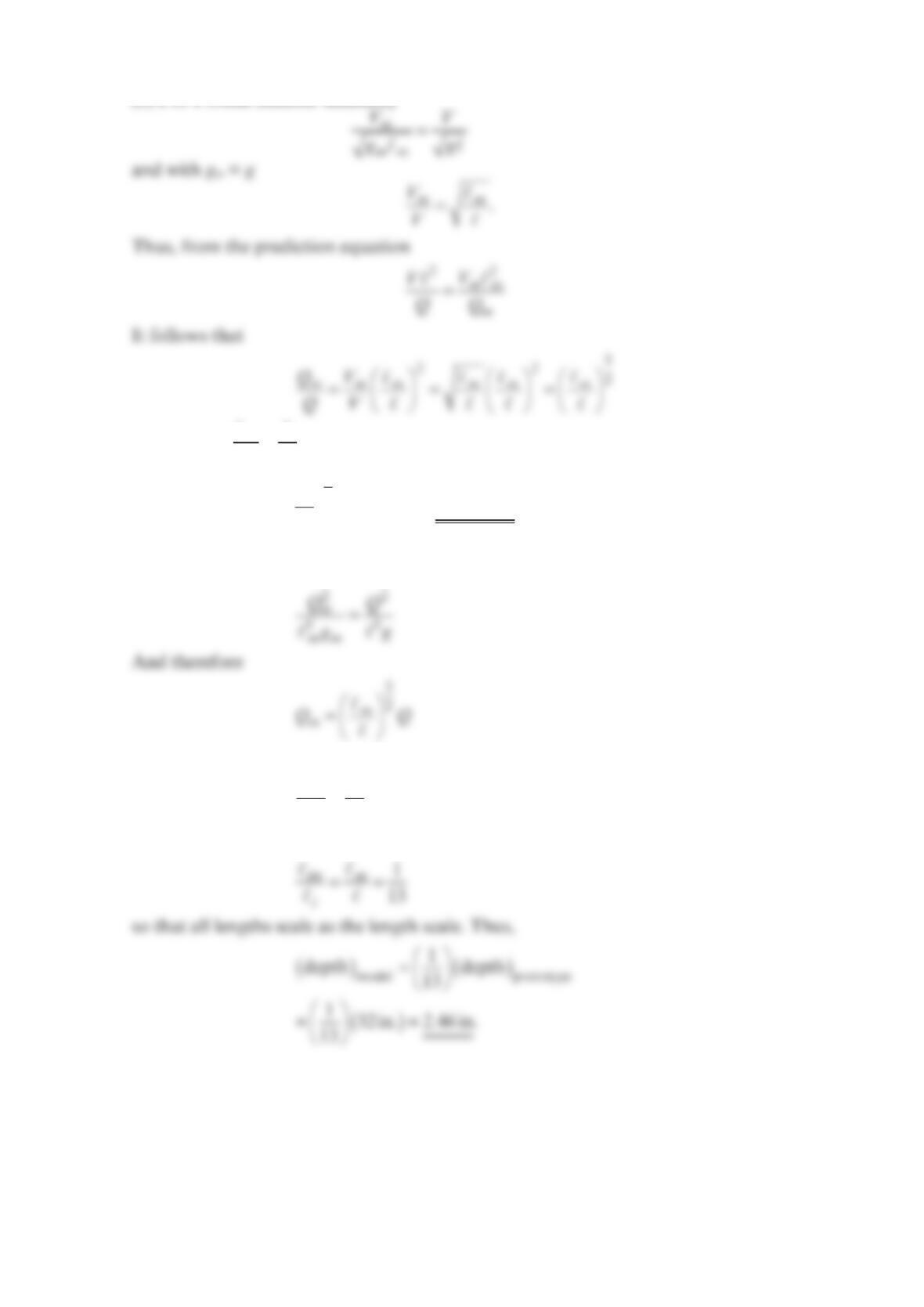
Thus, the similarity requirements are
From the last similarity requirement with m = and μm = μ
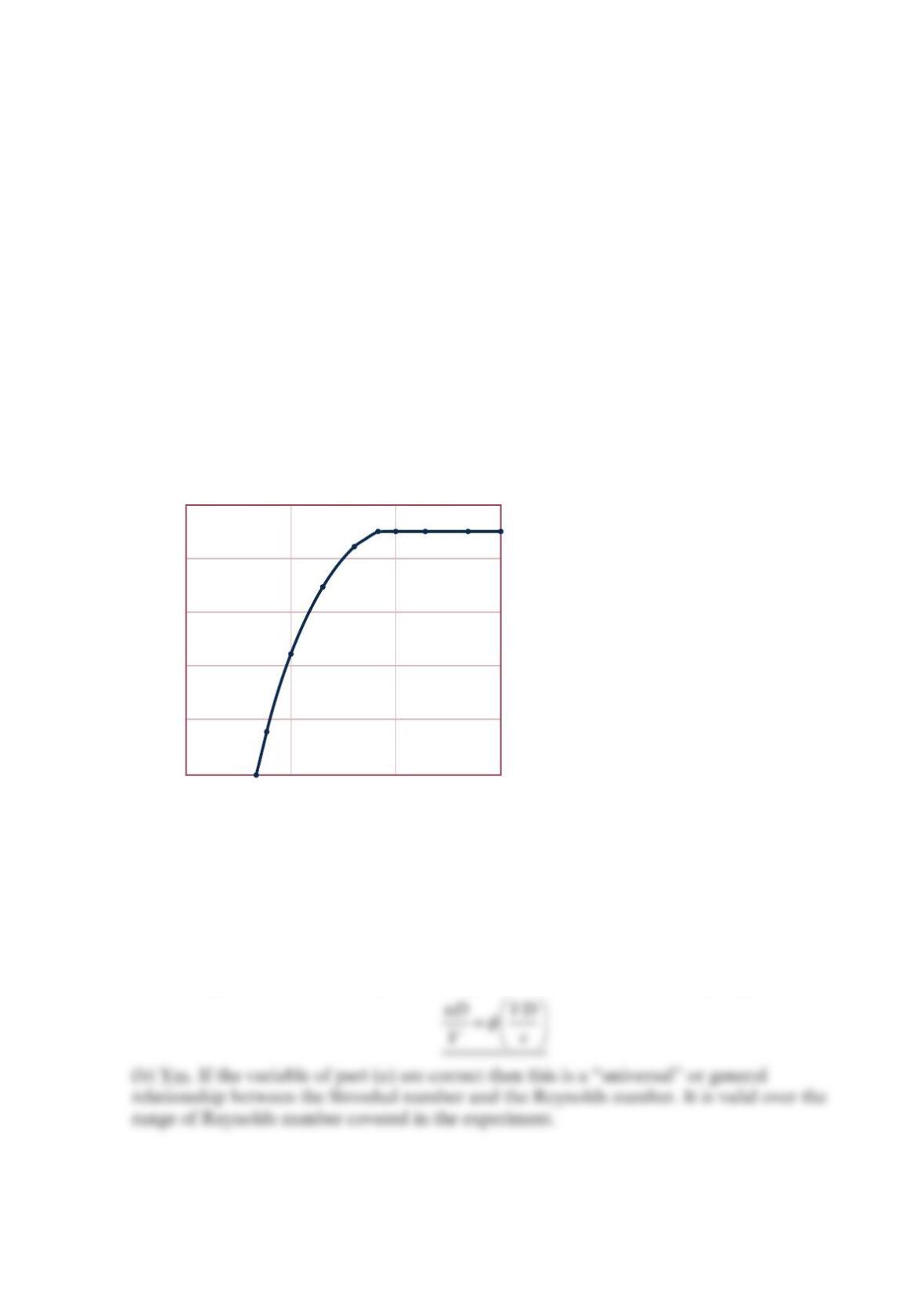
(b) For Froude number similarity
So that with =1
13
m
==
5
2
1(250 gpm) 0.410 gpm
13
m
Q
Note that this same result can be obtained from the second similarity requirements (which
corresponds to Froude number similarity) since
Geometric similarity requires that
=
m
m
ii
or
Problem 7.74
The Tacoma Narrows Bridge failure is a dramatic example of the possible serious effects of
wind-induced vibrations. As a fluid flows around a body, vortices may be created that are
shed periodically, creating an oscillating force on the body. If the frequency of the shedding
vortices coincides with the natural frequency of the body, large displacements of the body
can be induced as was the case with the Tacoma Narrows Bridge. To illustrate this type of
phenomenon, consider fluid flow past a circular cylinder. Assume the frequency, n, of the
shedding vortices behind the cylinder is a function of the cylinder diameter, D; the fluid
velocity, V; and the fluid kinematic viscosity, v. (a) Determine a suitable set of
dimensionless variables for this problem. One of the dimensionless variables should be the
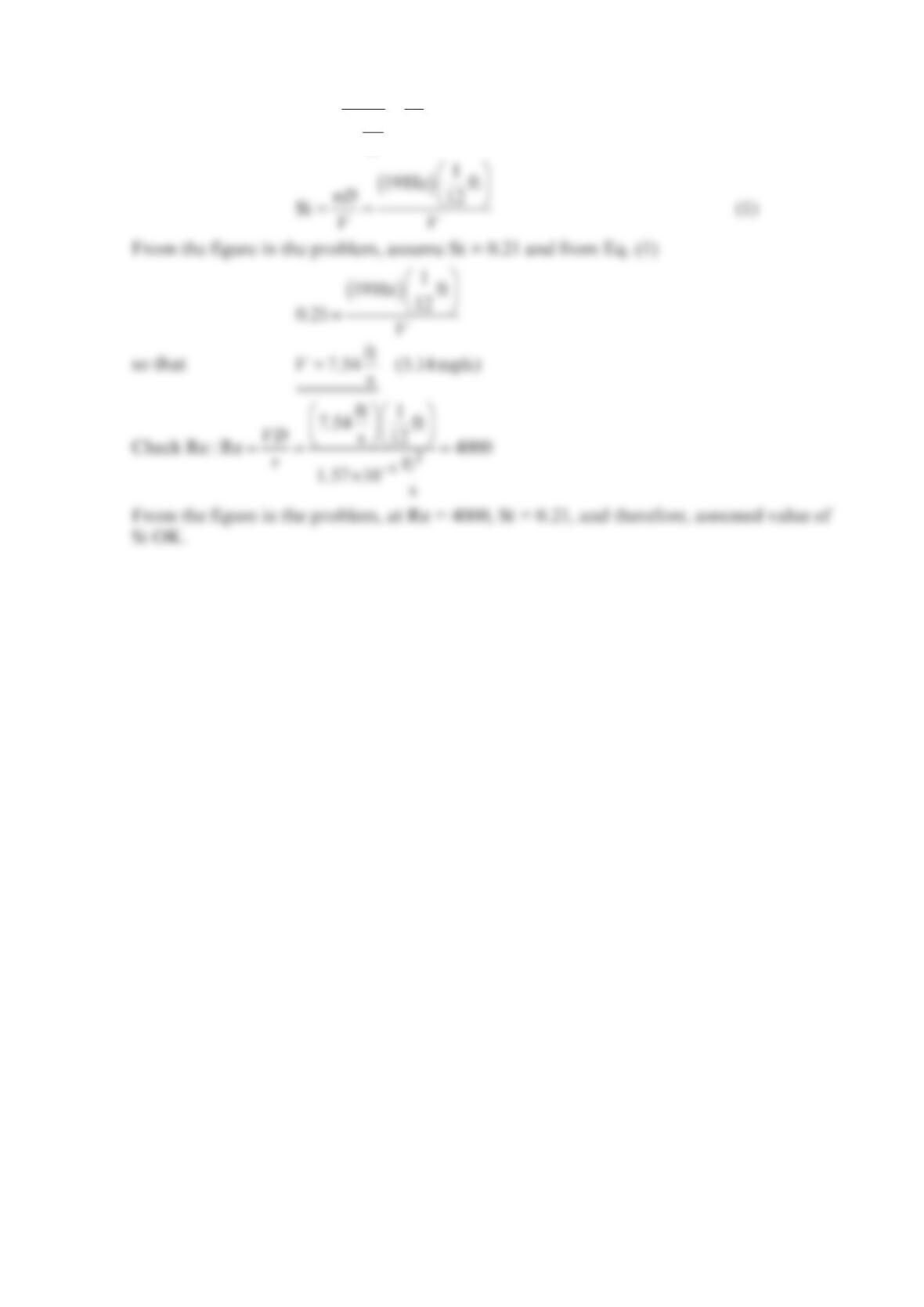
Strouhal number, nD/V. (b) Some results of experiments in which the shedding frequency of
the vortices (in Hz) was measured, using a particular cylinder and Newtonian,
incompressible fluid, are shown in the figure below. Is this a “universal curve” that can be
used to predict the shedding frequency for any cylinder placed in any fluid? Explain. (c) A
certain structural component in the form of a 1-in.-diameter, 12-ft-long rod acts as a
cantilever beam with a natural frequency of 19 Hz. Based on the data in the figure below,
estimate the wind speed that may cause the rod to oscillate at its natural frequency.
Hint: Use a trial-and-error solution.
Solution 7.74
(a) −−−
=
1121
(,,)nfDVv
n
TDLVLTvLT
From the pi theorem, 4 – 2 = 2 pi terms required, and a dimensional analysis yields
0.22
0.20
0.18
0.16
0.14
0.12
10 100 1,000 10,000
Re = VD/v
St = nD/ V
(c) For n = 19 Hz and ==
1in. 1 ft
in. 12
12 ft
D
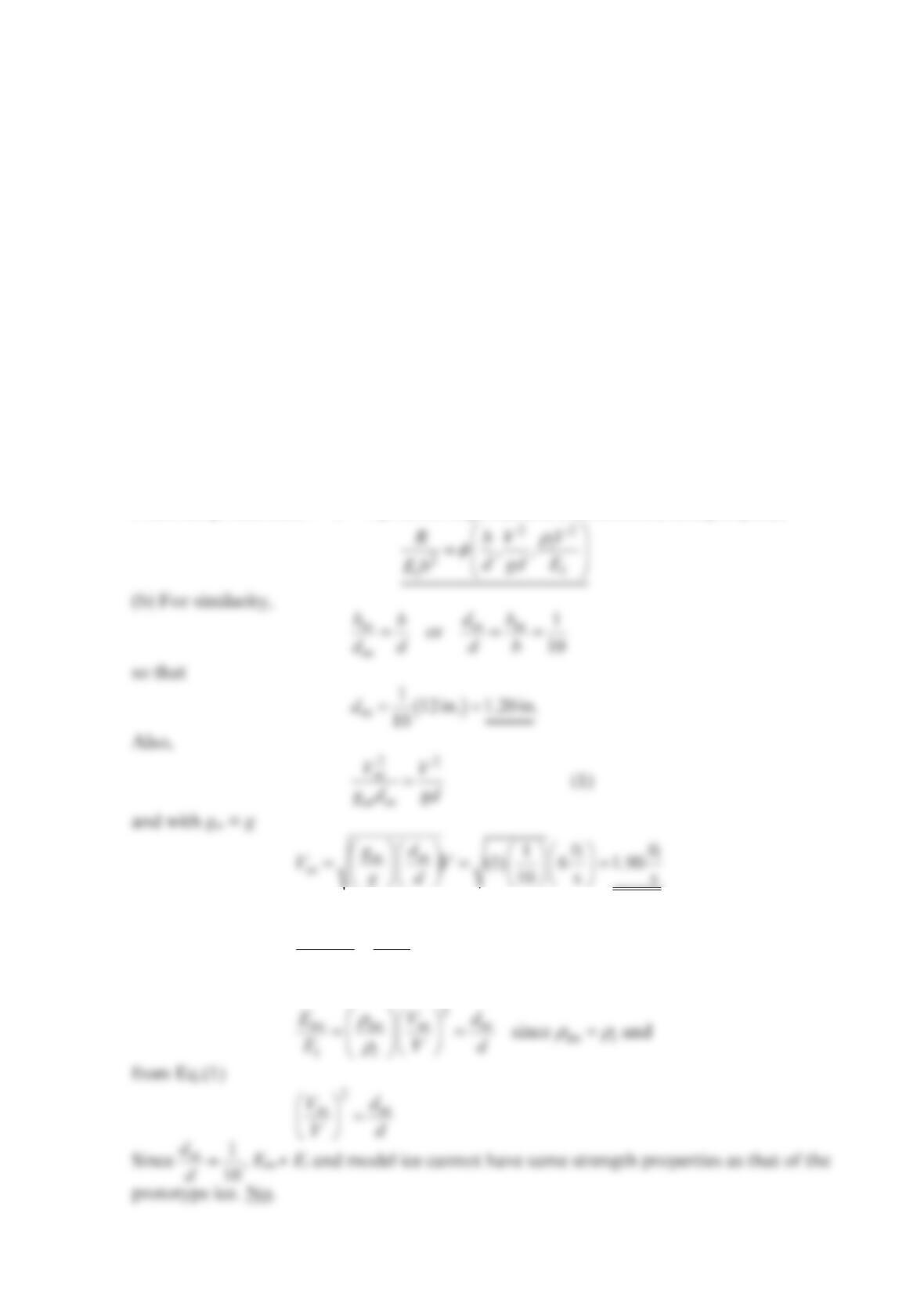
Problem 7.75
A model study is to be developed to determine the force exerted on bridge piers due to
floating chunks of ice in a river. The piers of interest have square cross sections. Assume
that the force, R, is a function of the pier width, b; the thickness of the ice, d; the velocity of
the ice, V; the acceleration of gravity, g; the density of the ice,
ρ
i; and a measure of the
strength of the ice, Ei, where Ei has the dimensions FL−2. (a) Based on these variables
determine a suitable set of dimensionless variables forth is problem. (b) The prototype
conditions of interest include an ice thickness of 12 in. and an ice velocity of 6 ft/s. What
model ice thickness and velocity would be required if the length scale is to be 1/10? (c) If the
model and prototype ice have the same density, can the model ice have the same strength
properties as that of the prototype ice? Explain.
Solution 7.75
(a)
()
ρ
ρ
−− − −
=
12 42 2
,, ,, ,
ii
ii
RfbdVg E
R
FbLd LV LT g LT FLT E FL
From the pi theorem, 7 – 3 = 4 pi terms required, and a dimensional analysis yields
(c) For similarity,
ρ
ρ
=
22
im m
im i
VV
EE
Thus,