Chapter 6
The Behavior of Proteins: Enzymes
1
SUMMARY
Section 6.1
Catalysts are substances that speed up the rate of a chemical reaction.
Section 6.2
Thermodynamics of a biochemical reaction refers to whether a reaction is
spontaneous or not. A spontaneous reaction has a negative Gibbs free energy or
G0.
Section 6.3
The rate of a chemical reaction is measured by the rate of appearance of the
Section 6.4
Before a reaction can be catalyzed, the enzyme and substrate must bind.
The substrate binds to the enzyme in a special pocket called the active site.
2 Chapter 6
Section 6.5
Michaelis and Menten developed a series of mathematical relationships to
explain the behavior of many non-allosteric enzymes.
The Michaelis-Menten equation describes several parameters, including the
maximal velocity, Vmax, and the Michaelis constant, KM.
Section 6.6
Chymotrypsin is an enzyme that cleaves peptides near amino acids with
aromatic side-chains. It can be studied by using a substrate analog containing p-
nitrophenylacetate.
Section 6.7
Inhibitors are compounds that bind to enzymes and reduce the rate of catalysis
Four principal types of inhibitors are competitive, non-competitive, uncompetitive,
and mixed inhibitors.
The Behavior of Proteins: Enzymes 3
LECTURE NOTES
Enzyme kinetics is generally one of the most difficult topics for students of
biochemistry. Great care must be taken to help students understand the important
points, without getting lost in the mathematical details. Two to three lectures should be
devoted to this chapter, dependent upon the depth of mathematical rigor the lecturer
LECTURE OUTLINE
I. Enzymes as catalysts
II. Kinetic and thermodynamic aspects of reactions
A. Standard free energy change (reviewed from chapter 1)
III. Enzyme Kinetics Equations
A. Rate constants
B. Concentration dependence
IV. Enzyme–substrate binding
A. Lock-and-key model
B. Induced-fit model
V. The Michaelis-Menten equation
A. E + S <—> ES —> E + P with rate constants
B. Description of Vinit vs. [S] curve
VI. Examples of enzyme-catalyzed reactions
A. Chymotrypsin
B. Aspartate transcarbamylase
4 Chapter 6
VII. Enzyme Inhibition
A. Reversible vs. irreversible
ANSWERS TO PROBLEMS
6.1 Enzymes Are Effective Biological Catalysts
1. Enzymes are many orders of magnitude more effective as catalysts than are
nonenzymatic catalysts.
2. Most enzymes are proteins, but some catalytic RNAs (ribozymes) are known.
6.2 Kinetics versus Thermodynamics
5. The reaction of glucose with oxygen is thermodynamically favored, as shown by
the negative free-energy change. The fact that glucose can be maintained in an
oxygen atmosphere is a reflection of the kinetic aspects of the reaction, requiring
overcoming an activation-energy barrier.
6. To the first question, most probably: local concentrations (mass-action concepts)
glycolysis.)
7. Heating a protein denatures it. Enzymatic activity depends on the correct three–
dimensional structure of the protein. The presence of bound substrate can make
the protein harder to denature.
8. The results do not prove that the mechanism is correct because results from
9. The presence of a catalyst affects the rate of a reaction. The standard free–
energy change is a thermodynamic property that does not depend on the
reaction rate. Consequently, the presence of the catalyst has no effect.
The Behavior of Proteins: Enzymes 5
6.3 Enzyme Kinetic Equations
13. The reaction is first order with respect to A, first order with respect to B, and
second order overall. The detailed mechanism of the reaction is likely to involve
one molecule each of A and B.
14. The easiest way to follow the rate of this reaction is to monitor the decrease in
6.4 Enzyme–Substrate Binding
17. In the lock-and-key model, the substrate fits into a comparatively rigid protein that
has an active site with a well-defined shape. In the induced-fit model, the enzyme
undergoes a conformational change on binding to the substrate. The active site
takes shape around the substrate.
18.
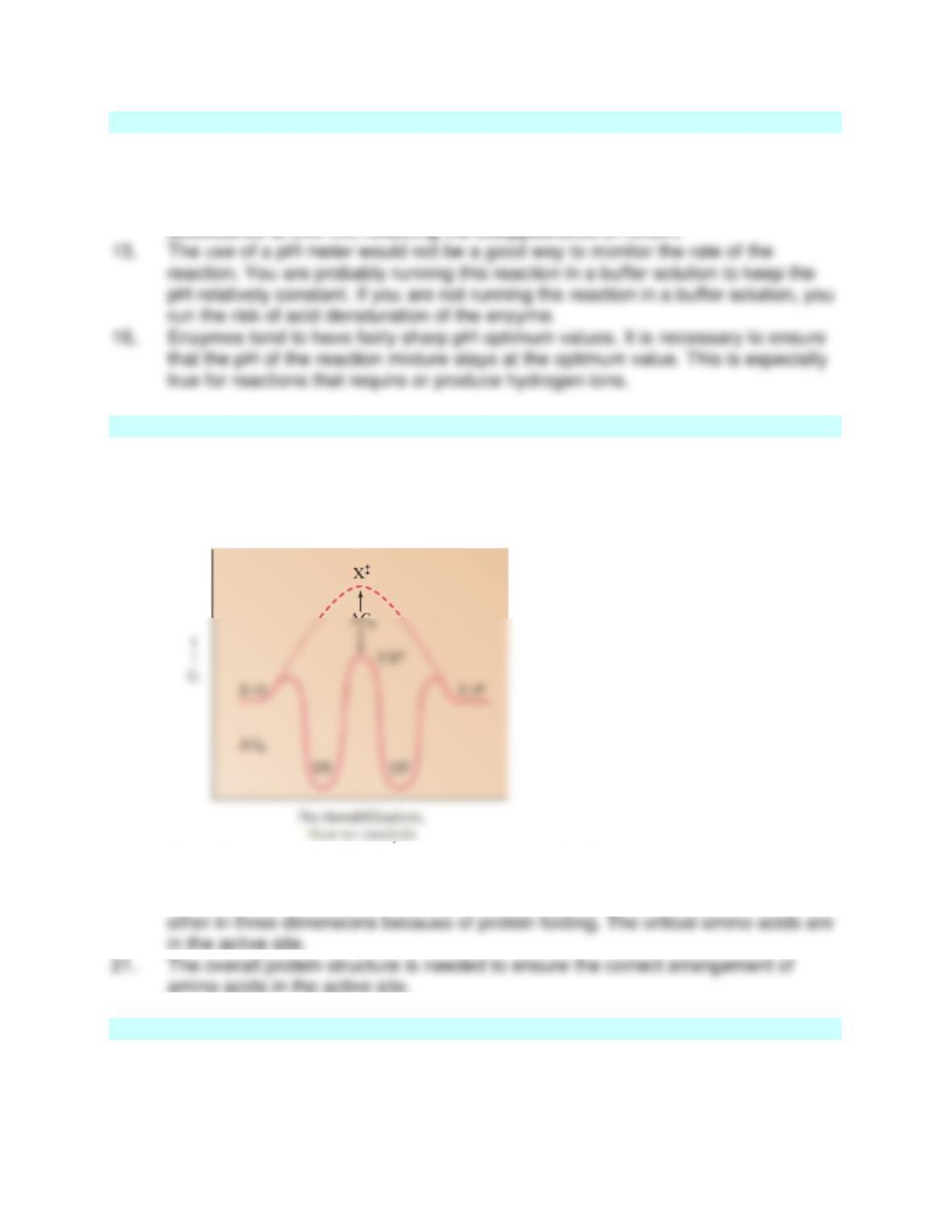
19. The ES complex would be in an ―energy trough,‖ with a consequentially large
activation energy to the transition state.
20. Amino acids that are far apart in the amino acid sequence can be close to each
6.5 The Michaelis–Menten Approach to Enzyme Kinetics
22. The reaction velocity remains the same with increasing enzyme concentration. It
is theoretically possible, but highly unlikely, for a reaction to be saturated with
enzyme.
6 Chapter 6
23. The steady-state assumption is that the concentration of the enzyme–substrate
24. Turnover number = Vmax/[ET].
25. Use Equation 6.12.
(a) V = 0.5Vmax
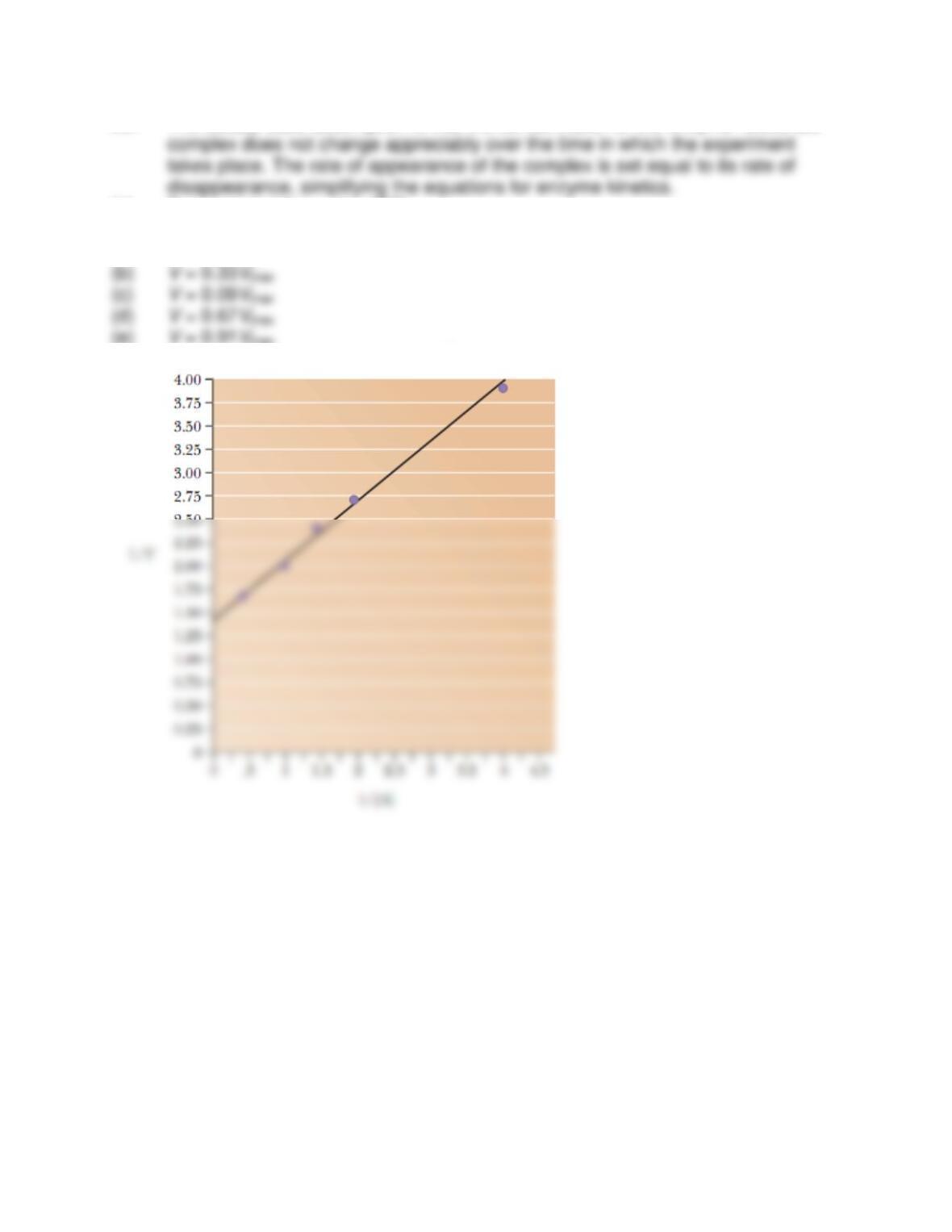
26. See graph: Vmax = 0.681 mM min–1, KM = 0.421 M.
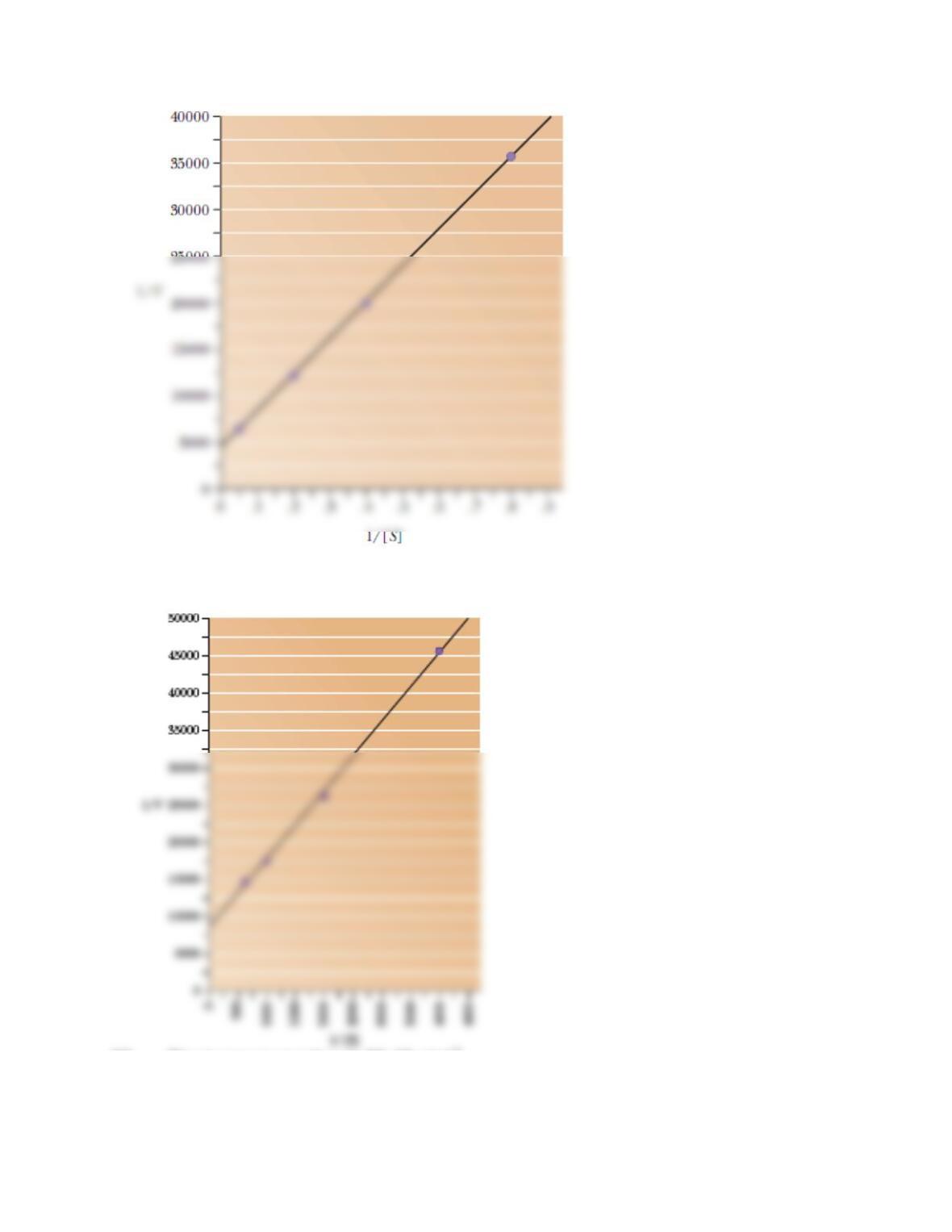
27. See graph: Vmax = 2.5 × 10⁻⁴ M sec–1, KM = 1.6 × 10⁸ M.
The Behavior of Proteins: Enzymes 7
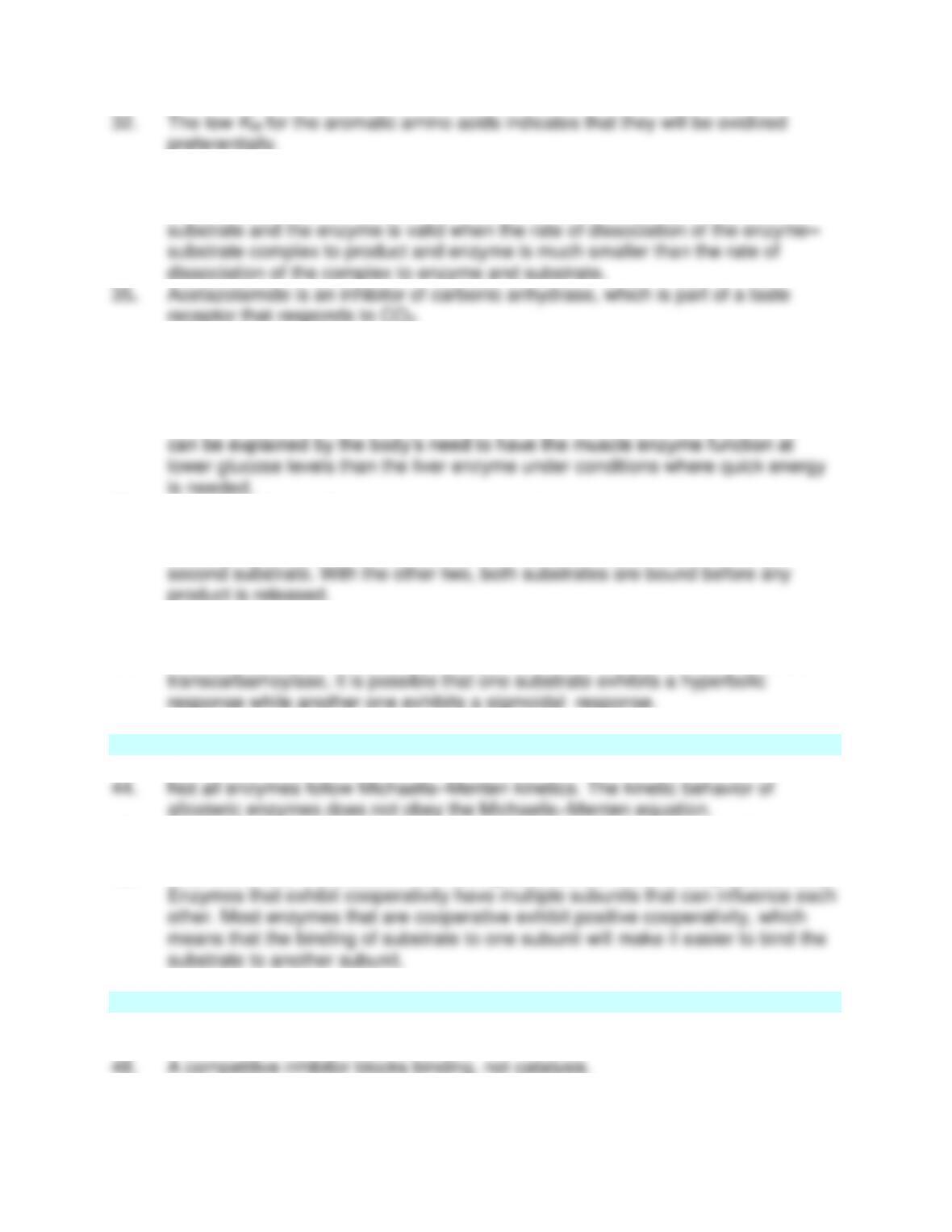
28. See graph: KM = 2.86 × 10⁻² M. Concentrations were not determined directly.
Absorbance values were used instead as a matter of convenience.
29. See graph: Vmax = 1.32 × 10⁻³ M min–1, KM = 1.23 × 10⁻³ M.
30. The turnover number is 20.43 min–1.
31. The number of moles of enzyme is 1.56 × 10⁻¹⁰. The turnover number is 10,700
sec–1.
8 Chapter 6
33. It is easier to detect deviations of individual points from a straight line than from a
curve.
34. The assumption that the KM is an indication of the binding affinity between the
36. Scientists were taking acetazolamide to help fight altitude sickness and noticed
their beer tasted terrible. They then studied carbonic anhydrase and found it was
a chemical sensor for CO2.
37. Hexokinase is found predominantly in the muscle and acts during glycolysis of
muscle glucose. Glucokinase is found in the liver. The higher Km of glucokinase
38. Under conditions of low substrate concentration.
39. Ordered, random, and ping-pong.
40. With a ping-pong mechanism, one product is released prior to the binding of the
41. Anytime there are multiple substrates, the trick to determining the KM of one of
them is to run the reaction with saturating concentrations of the other one.
42. You may or may not see the same response. As we have seen with aspartate
6.6 Examples of Enzyme-Catalyzed Reactions
43. See Figures 6.9 and 6.10.
45. The graph of rate against substrate concentration is sigmoidal for an allosteric
enzyme but hyperbolic for an enzyme that obeys the Michaelis–Menten equation.
46. If we remember the situation with hemoglobin, we can think of enzymes similarly.
6.7 Enzyme Inhibition
47. In the case of competitive inhibition, the value of KM increases, while the value of
KM remains unchanged in noncompetitive inhibition.
The Behavior of Proteins: Enzymes 9
49. A noncompetitive inhibitor does not change the affinity of the enzyme for its
substrate.
50. A competitive inhibitor binds to the active site of an enzyme, preventing binding
52. A Lineweaver–Burk plot is useful because it gives a straight line. It is easier to
determine how well points fit to a straight line than to a curve.
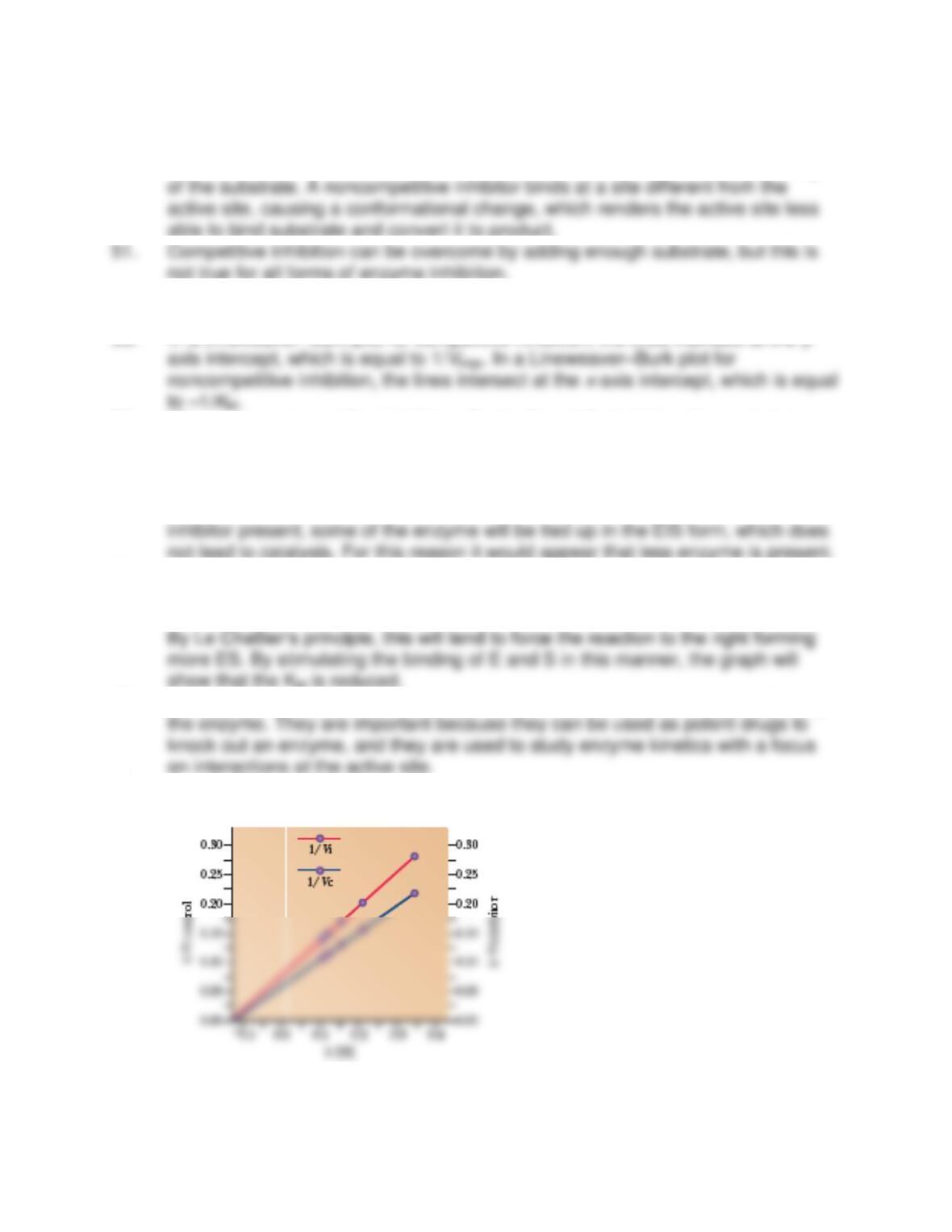
53. In a Lineweaver–Burk plot for competitive inhibition, the lines intersect at the y–
54. With pure noncompetitive inhibition, the binding of the inhibitor does not change
the affinity of the enzyme for substrate at all, and vice versa, thus the KM does
not change. With mixed inhibition, the substrate and inhibitor do affect each other
such that the KM for the substrate is different in the presence of inhibitor.
55. Because the inhibitor can bind to E or to ES equally well, anytime there is
56. The Lineweaver-Burk line for the enzyme plus inhibitor would angle the other
direction from the uninhibited compared to normal.
57. The binding of inhibitor to the ES complex to form EIS, removes some of the ES.
58. It is a substrate that binds irreversibly to the active site, permanently inactivating
59. Pure noncompetitive.
60. KM = 7.42 mM; Vmax = 15.9 mmol min–1; noncompetitive inhibition.
10 Chapter 6
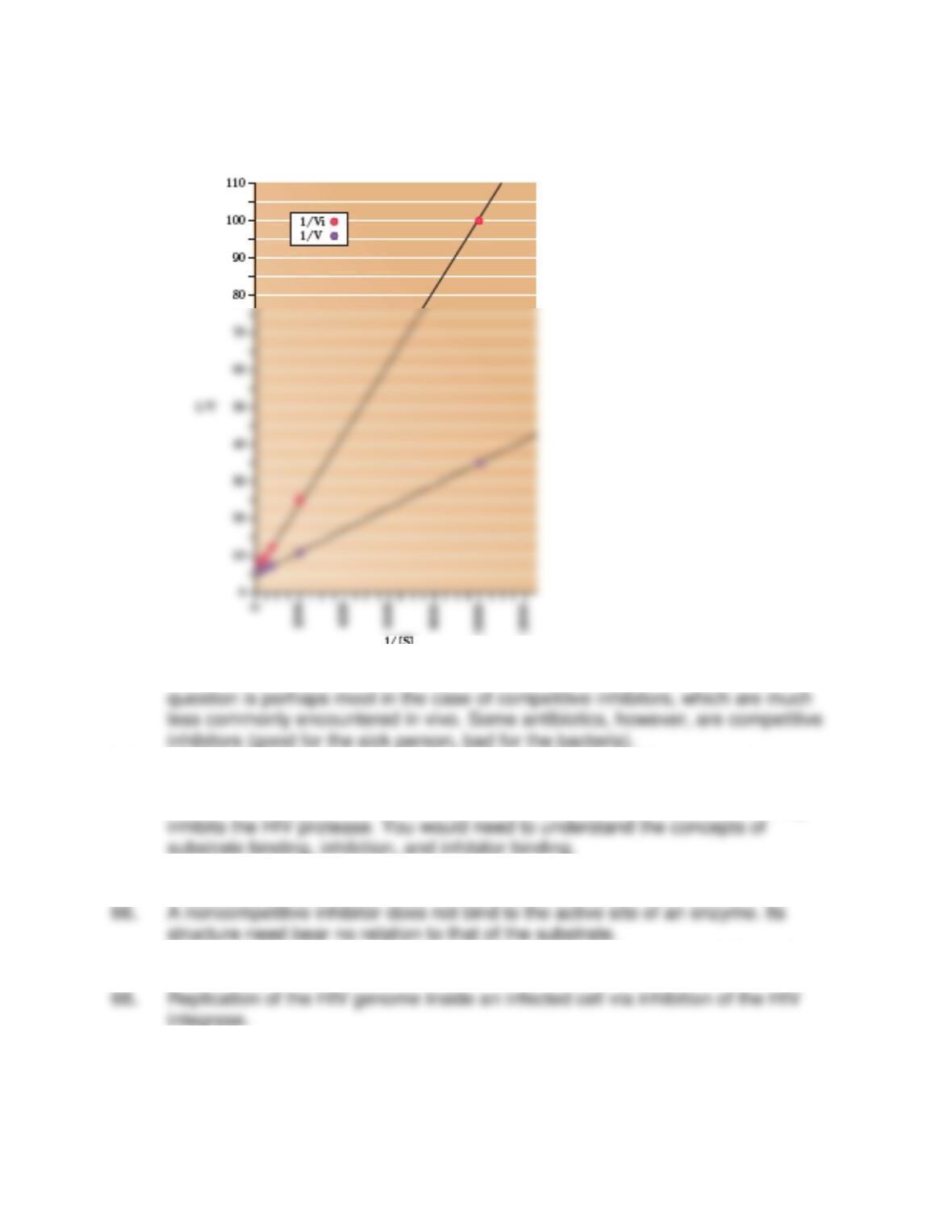
61. Competitive inhibition, KM = 6.5 × 10⁻⁴. The key point here is that the Vmax is the
same within the limits of error. Some of the concentrations are given to one
significant figure.
62. It is very good, in the case of noncompetitive inhibitors; much of metabolic control
depends on feedback inhibition by downstream noncompetitive inhibitors. The
63. Both the slope and the intercepts will change. The lines will intersect above the x–
axis at negative values of 1/[S].
64. Not all AIDS drugs are enzyme inhibitors, but an important class of such drugs
65. An irreversible inhibitor is bound by covalent bonds. Noncovalent interactions are
relatively weak and easily broken.
67. The production of new virus particles inside the infected cell via inhibition of the
HIV protease.