28-1
Reichard Maschinen, GmbH
Teaching Commentary
OVERVIEW
This case deals with cost analysis for assessing the economics of a product transition facing Reichard Maschinen, but it
also involves the broader spectrum of business issues related to the transition. At one level, the economics of the
situation need to be brought into focus; fixed costs, marginal costs, and sunk costs must be separated and evaluated for
their “relevance” to the decision. At another level, when the marketing and manufacturing issues are considered, the
The case is a very good classroom vehicle for illustrating several different layers of sophistication in terms of
relevant cost analysis. The following issues and concepts are likely to arise during classroom discussion.
1. The concept of eliminating applied fixed overhead in a short-run, relevant cost analysis.
This case teaches very well early in the required managerial accounting course in the first year of the MBA
program. This case can be comprehensively covered in one ninety-minute class period.
CASE ANALYSIS
Before actually going through the assignment questions in the case, the instructor may wish to refer students to
Exhibit 1 in the case, which shows the inventory related to steel rings. The important point here is that there is enough
ANSWERS TO ASSIGNMENT QUESTIONS
Question 1
This question asks for the differential cost to produce 100 plastic rings. The relevant cost calculations are
Question 2
This question asks for the incremental cost to produce the next 34,500 steel rings (see Table 1). The firm
28-2
The labor cost for manufacturing steel rings this
summer also involves some analysis. It can be argued
that the incremental cost of direct labor is only 30% of the
normal labor rate because of the company’s labor policy.
Question 3
This question asks for the differential cost of the
25,450 steel rings that already are in inventory at the end
Question 4
This question asks which ring is more profitable,
steel or plastic. Another layer of complexity is added
here because of the unequal lives of the steel and plastic
rings. If the plastic ring has about four times the life of
the steel ring, the market demand (in units) for the plastic
rings is likely to be significantly less than the demand that
currently exists for the steel rings. If the firm switches to
plastic rings but does not increase its market share, it can
expect to sell only 25% as many rings as it does now.
The relevant cost and profit calculations for the
Plastic rings vs. the 25,450 steel rings in stock.
When plastic rings are compared to the 25,450 steel rings
now in inventory, the steel rings are far more profitable
because their marginal cost is zero. Any revenue gained
that would fill the same customer demand is 8,625. Their
total profit contribution would be $26,565 ($308 x
8,625/100) if the rings were also sold for $340 per
week x 52 weeks), steel rings contribute $58.883.
Correspondingly, with a yearly volume of 8,970, the
plastic rings would contribute $27,628 ($308 x
8,970/100). This would suggest, using marginal
contribution criteria, that the steel rings are more
profitable, even in the longer run. But marginal
contribution analysis loses its usefulness when
considering the long term. What happens under a full
cost analysis?
Plastic rings vs. future steel rings using “full
cost analysis.” On a full cost basis, steel rings have a
28-3
rings once plastic become widespread. Students will
recognize that the price relationship that will evolve
between plastic rings and steel is a critical variable on
which the final decision will hinge. This and other
business issues are considered in detail in discussing
Questions 5 and 6.
It is important for students to realize that the
excess fixed overhead expenses will very likely not go
away—they will be transferred to other products, at least
in the short run. In the same sense, plastic ring
production will require only about 10% of the direct labor
Question 5
1. Stay with steel only.
Business as usual. The firm could tell its customers
right away that an “experimental” plastic ring is also
2. Move to plastic only—Get ready to make plastic
rings as soon as possible.
A. Right away—Stop producing steel rings now.
Throw away the existing inventory of raw
material. Sell from the existing inventory of
raw steel. Sell both steel and plastic over the
next one to two years until the supply of steel
rings is exhausted. Then make and sell plastic
only. (Comparative pricing of steel and plastic is
a big issue here.)
C. Later—Introduce plastic only after the full
Question 6
As discussed earlier, the financial analysis in
Table 2 yields the following conclusions:
1. For the next of 25,450 rings, steel rings are much
Steel rings are more profitable than plastic on a
marginal contribution basis but plastic rings are more
profitable than steel on a full cost basis.
The above inferences, based on incremental
2. Will the price of steel rings fall to one-fourth of the
price of plastic rings, or will plastic ring prices rise?
3. What effects will the decision in respect to plastic
rings have on the sale of machines?
28-4
5. Should the firm exert its leadership in markets other
than Belgium by being the first to introduce plastic
rings? How much “strategic” value is there in being
the “first mover” in other markets?
6. How long is it prudent to continue to try to sell a
likely to switch from steel to plastic.
Uncertainties regarding steel and plastic ring
prices. In the financial analysis shown in Table 2, we
assumed that the steel and plastic rings will sell for the
current prices ($325 and $340). Students are likely to
suggest several different scenarios for future prices of
plastic and steel rings.
1. Given that plastic has four times the wearing
properties as steel rings, one might argue that the
2. All of these factors suggest that, in the long run, the
market price for plastic rings will probably be the
3. Once customers are convinced that the plastic ring
does in fact last four times as long, will they pay
changeover is the concept of “barriers to switching.”
There are some businesses with high entry barriers and
low switching costs (“light bulbs”), and other businesses
where the entry barriers are low but switching costs for
the customers are high (“steel/plastic rings”).
The barriers to entry in the light bulbs business
are high because of the technology, the large capital
plastic ring market are probably low. However, there are
very high “barriers to switching” in this situation. There
is a great apparent difference between steel rings and
plastic rings. If plastic rings are used and there are
equipment problems, the company stands to lose far more
than what it saves on rings. With twenty-four rings per
year, the steel ring cost is $6 per month on a $6,000
machine. In other words, the potential for damage to
machines by using plastic rings may not be worth the
rings to customers but emphasize the “experimental”
nature of plastic. This might allow the firm potentially to
sell all their existing steel rings and the ones they can
will be in the future selling plastic rings? If we assume
that market forces will drive the profit margin of plastic
rings to that of steel rings now (18%), then the firm will
28-5
The instructor can further expand on this idea by referring
students to Table 3. Here, we have shown that steel rings
generate a much greater annual contribution than plastic
rings. As such, plastic rings are not nearly as attractive.
The students will see that, financially, Reichard
has the incentive to forestall the market’s move toward
RECOMMENDATIONS
At this stage of the analysis, the instructor should
turn to recommendations. What should the firm do?
There are a variety of “defensible” solutions to the case.
The following ones are those we like to make certain are
brought out in the classroom discussion.
1. Sell the 25,450 steel rings that are currently in stock.
If the firm can sell them for at least $77 per hundred
would be $77, which equals that from plastic rings.
3. Do not buy any more steel.
on steel if we are not selling plastic at the same time.
We can just tell customers they can try plastic, if they
want to take the risk.
Assuming Reichard converts its raw steel into
rings, how can they manage the market transition from
by quantity discounts in purchasing and cost efficiency
from long production runs. The resulting reduced
flexibility to respond to market changes has a very real
cost here, but it does not show up directly in the
accounting reports. The value of “flexibility” is real and
perhaps deserves as much attention, in many situations as
the value of “efficiency.”
TEACHING STRATEGY
for various decision options. The instructor’s job is to
keep the discussion moving and make sure all the twists
28-6
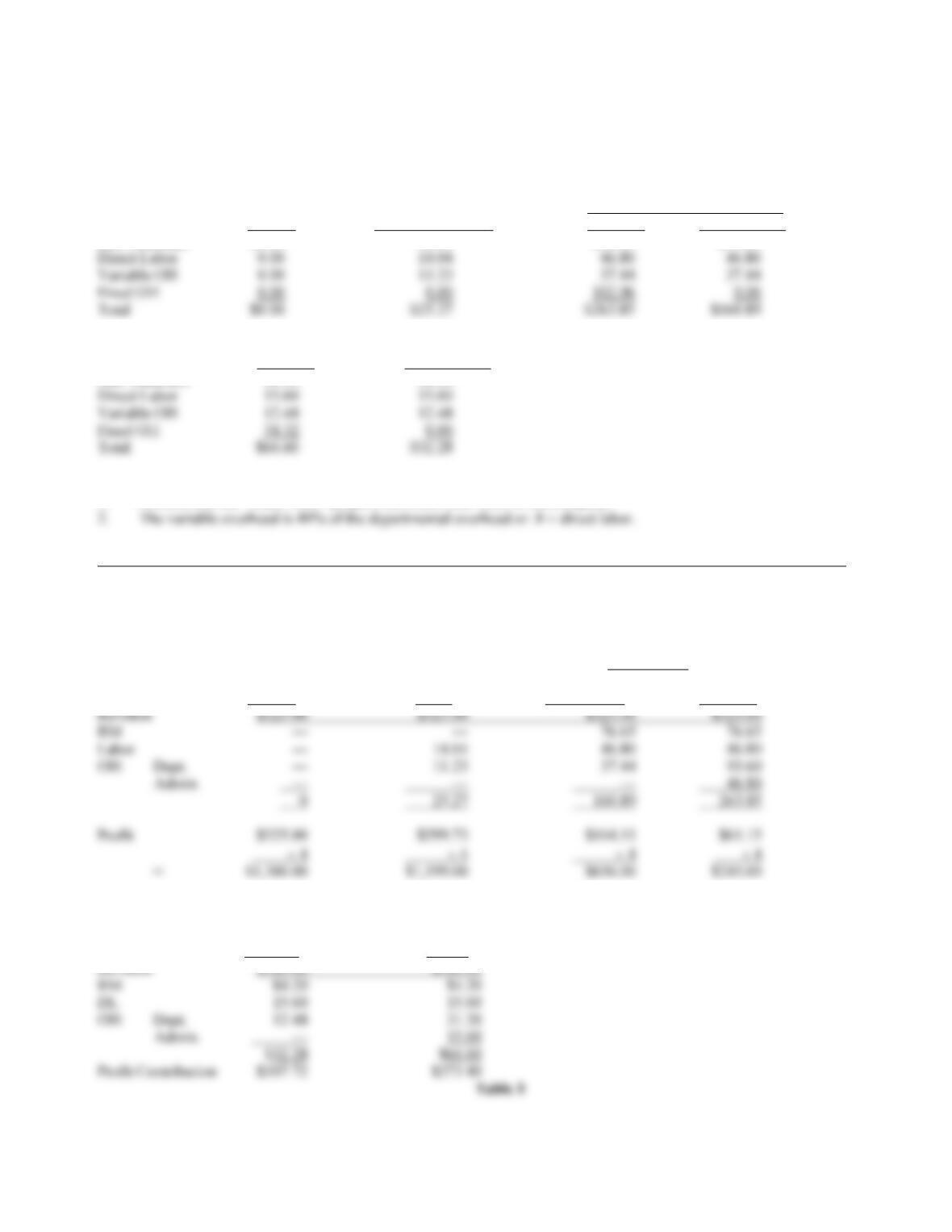
Table 1
Relevant Costs
(per 100 units)
Steel Rings
25,450 Rings Summer Production Future Rings
in stock (next 34,500 rings) Full Cost Variable Cost
Raw Materials $0.00 $0.00 $76.65 $76.65
Plastic Rings
Full Cost Variable Cost
Raw Materials $4.20 $4.20
Notes:
1. Assume that the “make work” projects have zero real value to the company.
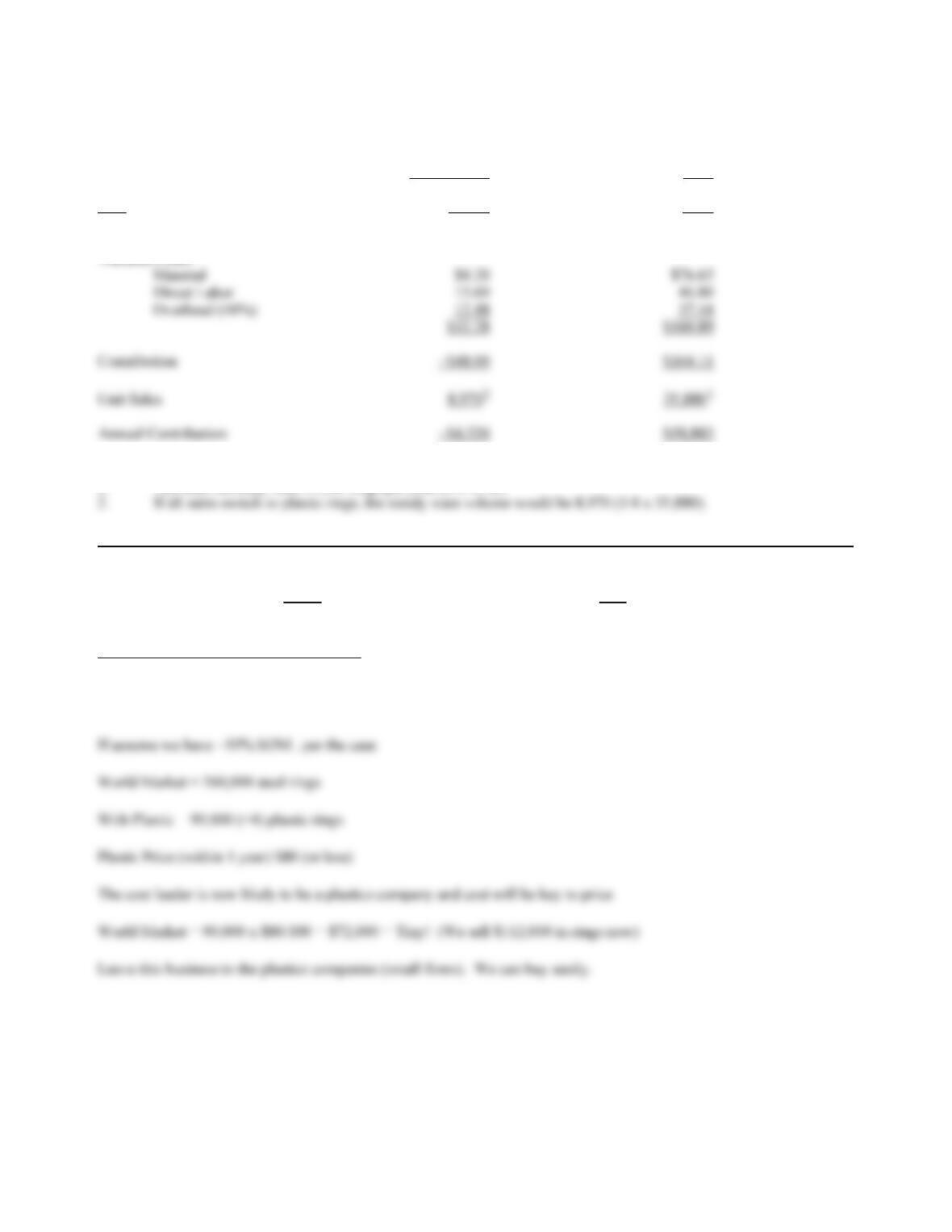
Table 2
Comparison of Incremental Profitability
Steel Rings
25,450 Next Future Rings
Rings 34,500
in stock Rings Contribution Full Cost
Plastic Rings
“Contribution” “Full Cost”
Analysis Profits
28-7
Annual Contribution of Plastic and Steel Rings
In the Future Now
Item Plastic Steel
Sales Price ~ $80.00 $325.00
Variable Costs:
Notes:
1. The firm currently sells 35,880 rings per year (690 x 52).
Table 4
Make Rings (A low value replacement part) vs. Buy Rings
How would you think about this problem?
We sell about 36,000 rings/year
IS THIS “GOOD THINKING?”