Chapter 6
Chapter 6
Section 6.1
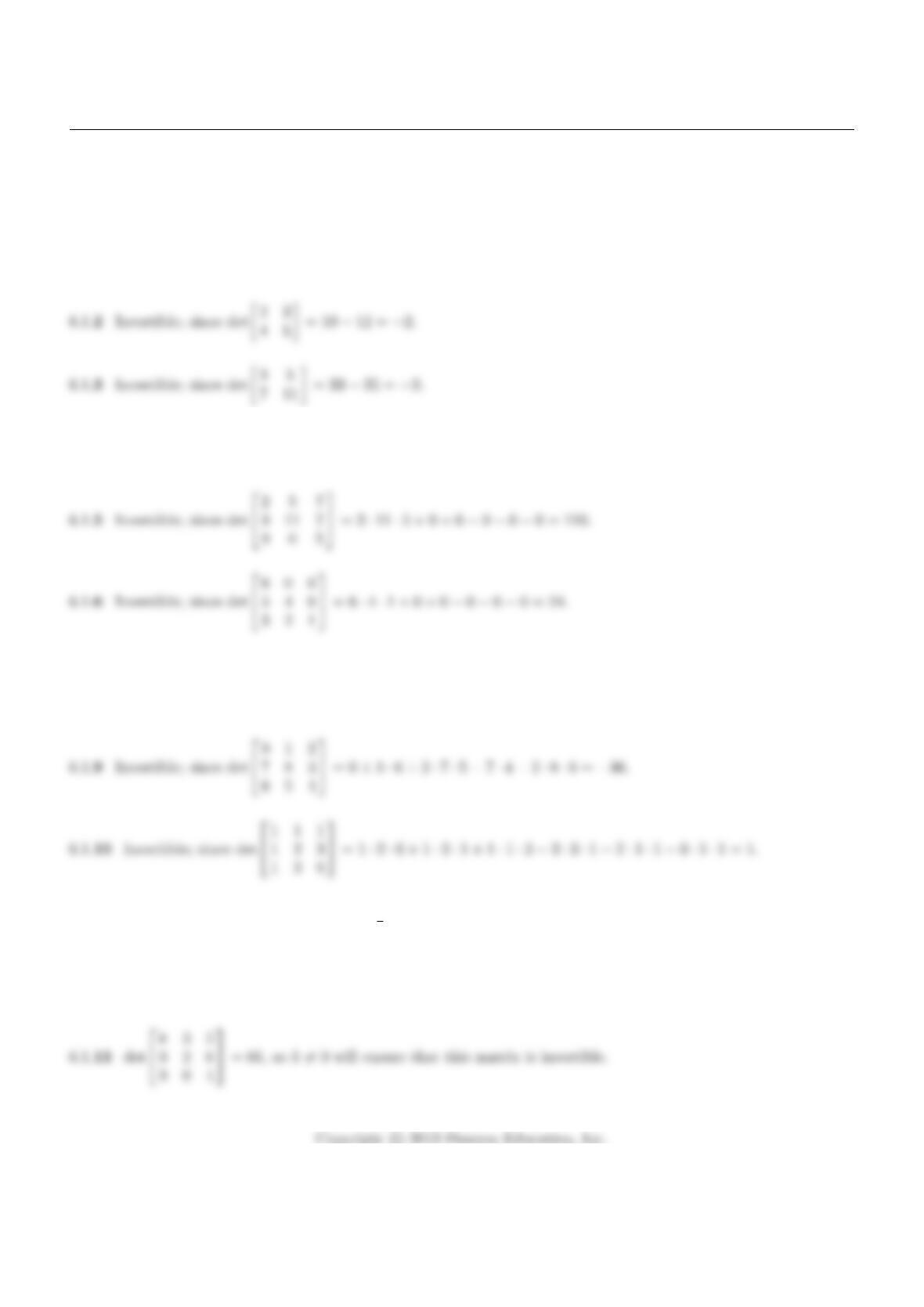
6.1.1Fails to be invertible; since det1 2
3 6 = 6 −6 = 0.
6.1.4Fails to be invertible; since det1 4
2 8 = 8 −8 = 0.
6.1.7This matrix is clearly not invertible, so the determinant must be zero.
6.1.8This matrix fails to be invertible, since the det(A) = 0.
6.1.11 detk2
3 4 6= 0 when 4k6= 6,or k6=3
2.
6.1.12 det1k
k46= 0 when k26= 4,or k6= 2,−2.
278
Section 6.1
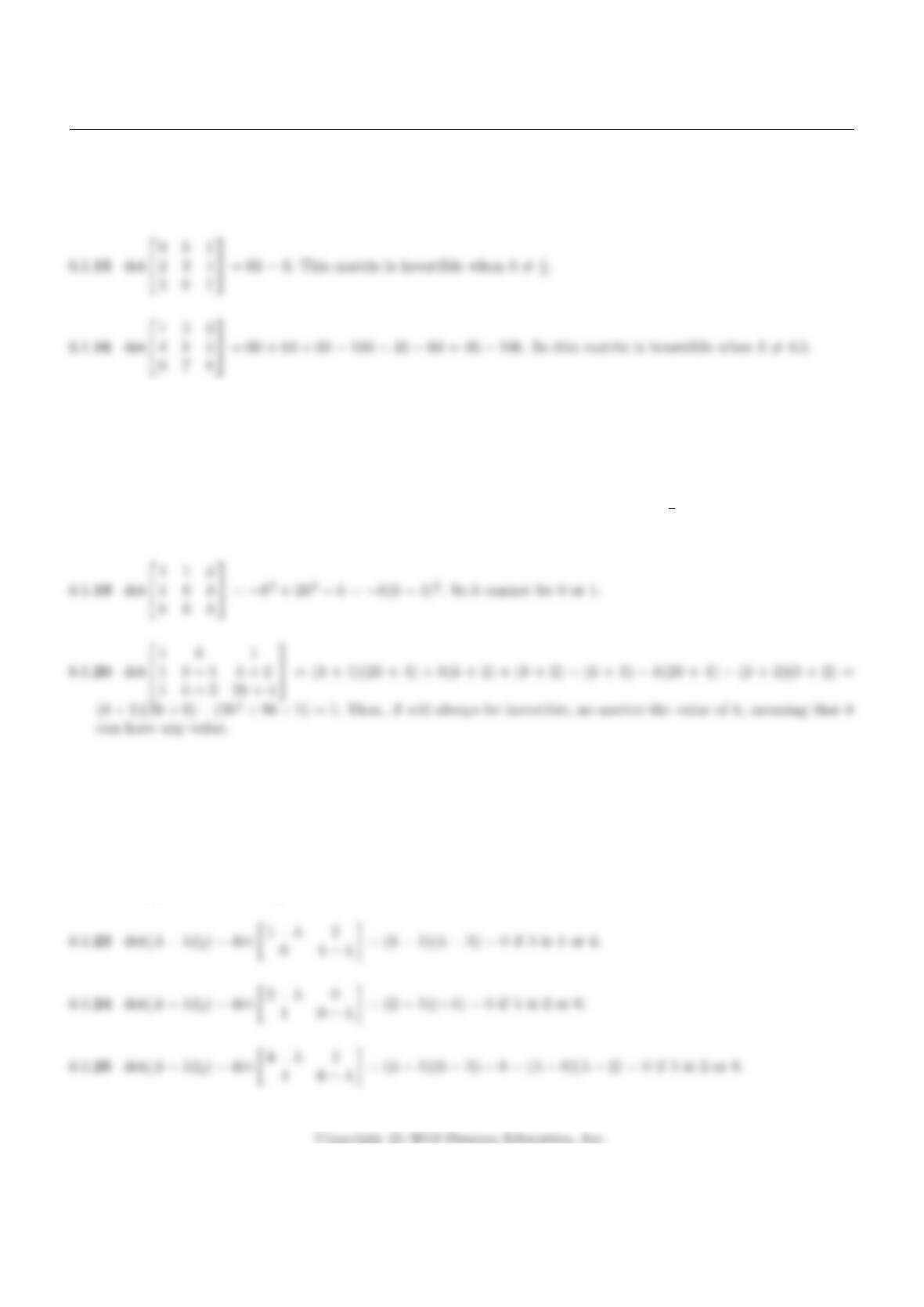
6.1.14 det
4 0 0
3k0
2 1 0
= 0,so the matrix will never be invertible, no matter which kis chosen.
6.1.17 det
1 1 1
1k−1
1k21
= 2k2−2 = 2(k2−1) = 2(k−1)(k+ 1).So kcannot be 1 or -1.
6.1.18 det
0 1 k
3 2k5
9 7 5
= 30 + 21k−18k2=−3(k−2)(6k+ 5).So kcannot be 2 or −5
6.
6.1.21 det
k1 1
1k1
1 1 k
=k3−3k+ 2 = (k−1)2(k+ 2).So kcannot be -2 or 1.
6.1.22 det
cos k1−sin k
0 2 0
sin k0 cos k
= 2 cos2k+ 2 sin2k= 2.So kcan have any value.
279
Chapter 6
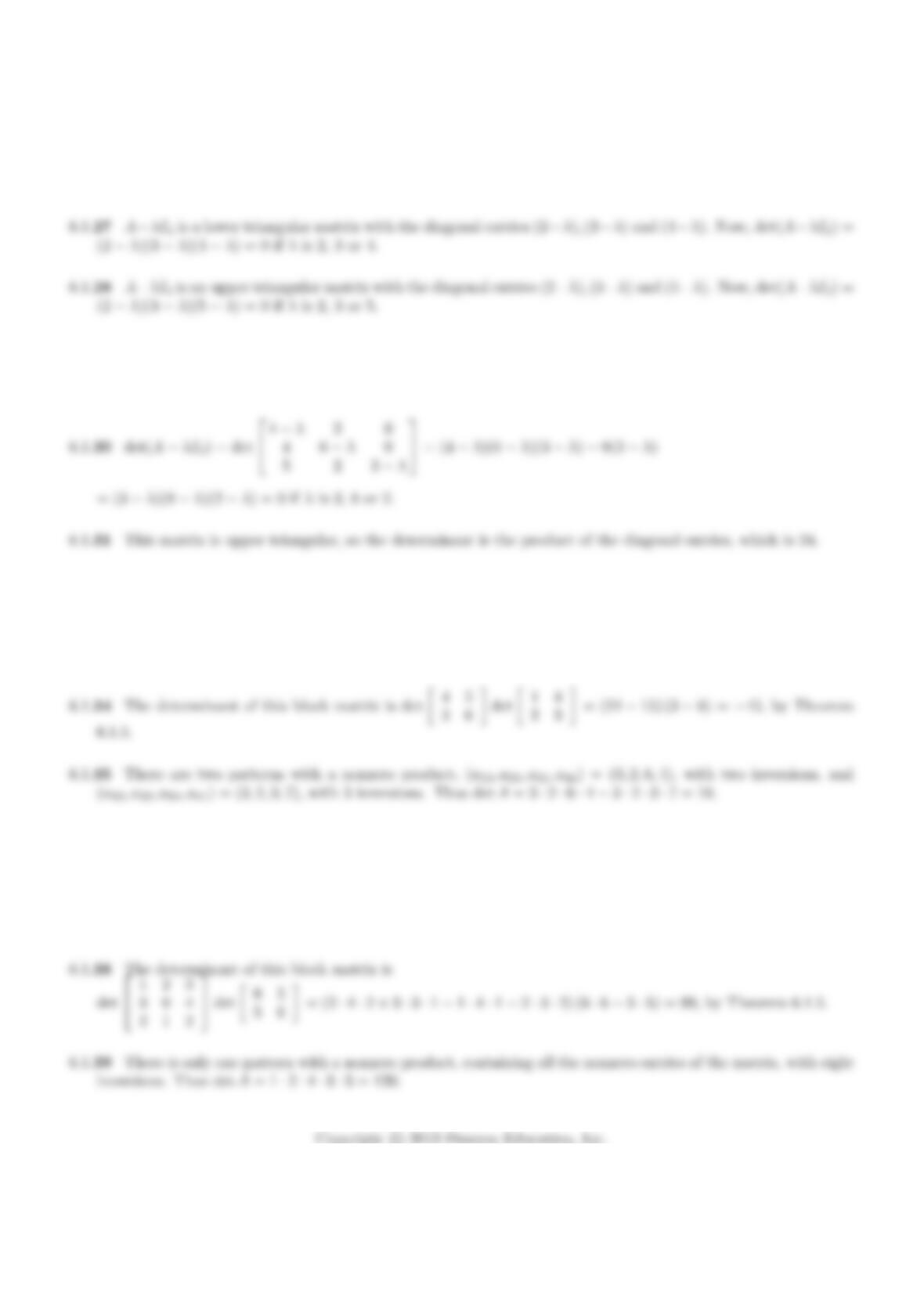
6.1.26 det(A−λI2) = det 4−λ2
2 7 −λ= (4 −λ)(7 −λ)−4 = (λ−8)(λ−3) = 0 if λis 3 or 8.
6.1.29 det(A−λI3) = det
3−λ5 6
0 4 −λ2
0 2 7 −λ
= (3 −λ)(λ−8)(λ−3) = 0 if λis 3 or 8.
6.1.32 This matrix is upper triangular, so the determinant is the product of the diagonal entries, which is 210.
6.1.33 The determinant of this block matrix is det 1 2
8 7 det 2 3
7 5 = (7 −16) (10 −21) = 99,by Theorem
6.1.5.
6.1.36 There is one pattern with a nonzero product, containing all the 1’s, with six inversions. Thus det A= 1.
6.1.37 The determinant of this block matrix is
det 5 4
6 7 det
5 6 7
0 1 2
0 0 1
= (35 −24) (5 ·1·1) = 55, by Theorem 6.1.5.
280
Section 6.1
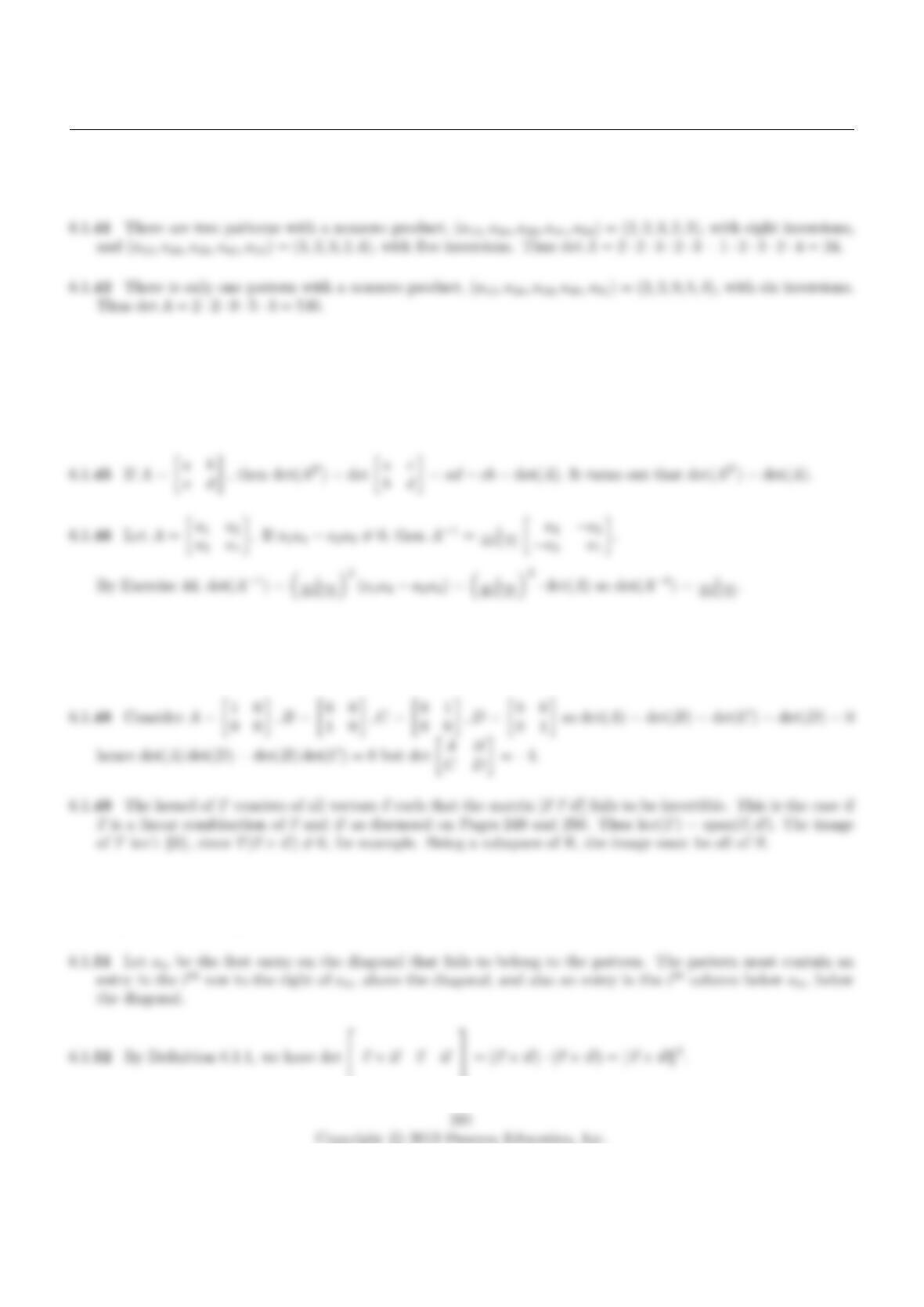
6.1.40 There is only one pattern with a nonzero product, containing all the nonzero entries of the matrix, with
seven inversions. Thus det A=−3·2·4·1·5 = −120.
6.1.43 For each pattern Pin A, consider the corresponding pattern Popp in −A, with all the nentries being opposites.
Then prod (Popp) = (−1)nprod(P) and sgn (Popp) = sgn (P), so that det(−A) = (−1)ndet A.
6.1.44 For each pattern Pin A, consider the corresponding pattern Pmin kA, with all the nentries being multiplied
by the scalar k. Then prod (Pm) = knprod(P) and sgn (Pm) = sgn (P), so that det(kA) = kndet A.
6.1.47 We have det(A) = (ah −cf)k+bef +cdg −aeg −bdh. Thus matrix Ais invertible for all kif (and only
if) the coefficient (ah −cf) of kis 0, while the sum bef +cdg −aeg −bdh is nonzero. A numerical example is
a=c=d=f=h=g= 1 and b=e= 2,but there are infinitely many other solutions as well.
6.1.50 Theorem 6.1.1 tells us that det[~u ~v ~w] = ~u ·(~v ×~w) = k~ukcos(θ)k~v ×~wk=k~ukcos(θ)k~vksin(α)k~wk=
cos(θ) sin(α),where θis the angle enclosed by vectors ~u and ~v ×~w, and αis the angle between ~v and ~w. Thus
det[~u ~v ~w] can be any number on the closed interval [−1,1].
Chapter 6
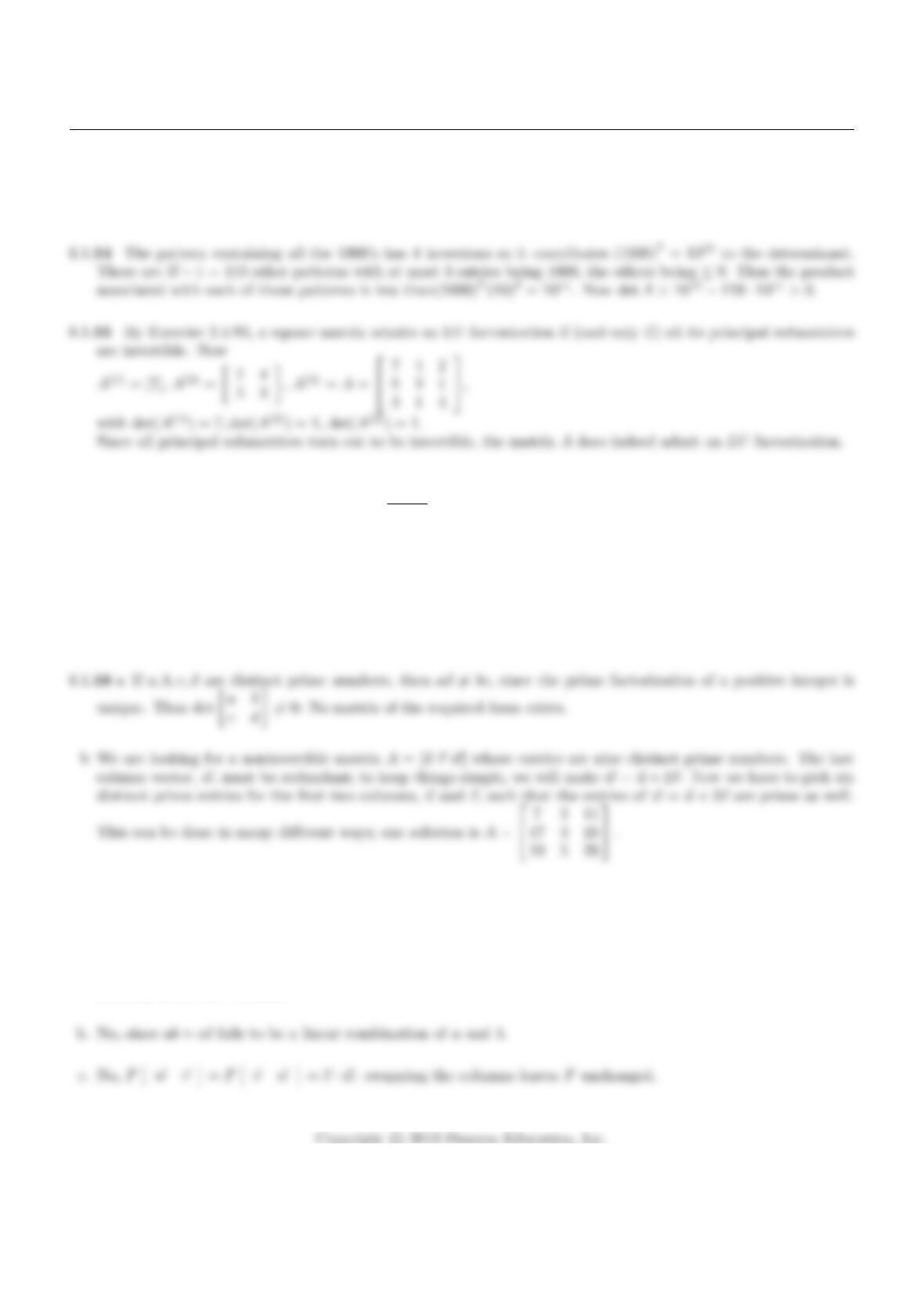
6.1.53 There is one pattern with a nonzero product, containing all the 1’s. We have n2inversions, since each of
the 1’s in the lower left block forms an inversion with each of the 1’s in the upper right block. Thus det A=
(−1)n2
= (−1)n.
6.1.56 There is only one pattern with a nonzero product, containing all the 1’s. The number of inversions is
(n−1) + (n−2) + … + 2 + 1 = Pn−1
k=1 k=(n−1)n
2. This number is even if either nor n−1 is divisible by 4, that
is, for n= 4,5,8,9,12,13, ….
a. det M4= det M5= 1,det M2= det M3= det M6= det M7=−1.
b. det Mn= (−1)n(n−1)/2
6.1.57 In a permutation matrix P, there is only one pattern with a nonzero product, containing all the 1’s. Depending
on the number of inversions in that pattern, we have det P= 1 or det P=−1.
6.1.59 Fa b
c d =a
c·b
d=ab +cd
a. Yes, Fis linear in both columns. To prove linearity in the second column, observe that ab +cd is a linear
combination of the variables band d, with the constant coefficients aand c. An analogous argument proves
linearity in the first column.
282
Section 6.1
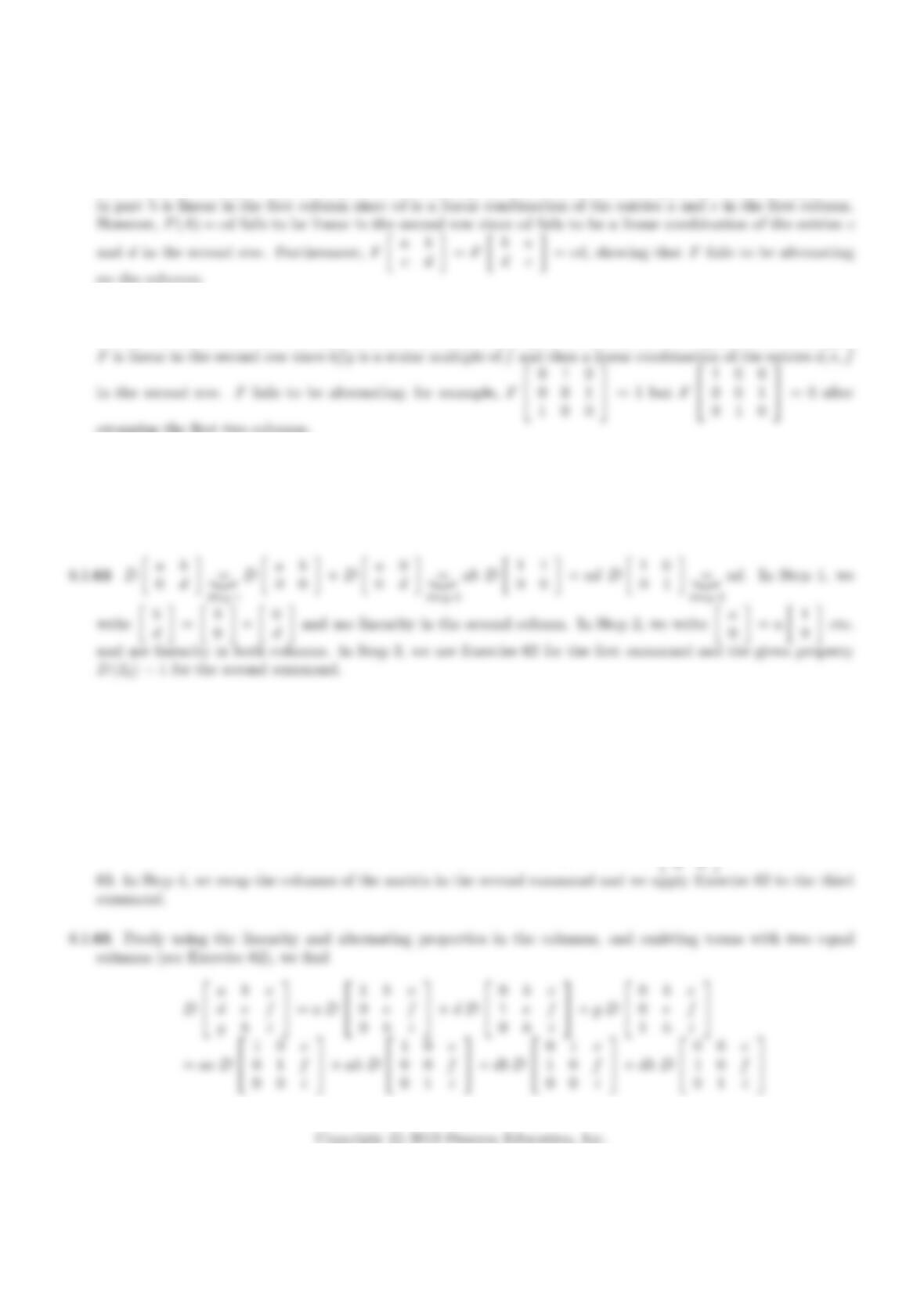
6.1.60 The functions in parts a, b, and d are linear in both columns; the functions in parts a, c, and d are linear in
both rows; and F(A) = −det Ain part d is alternating on the columns. For example, the function F(A) = cd
6.1.61 The function F(A) = bfg is linear in all three columns and in all three rows since the product bfg contains
exactly one factor from each row and from each column; it is the product associated with a pattern. For example,
6.1.62 If A=a a
c c , then D(A) = Da a
c c =
|{z}
swap
columns
−Da a
c c =−D(A), so that D(A) = 0.
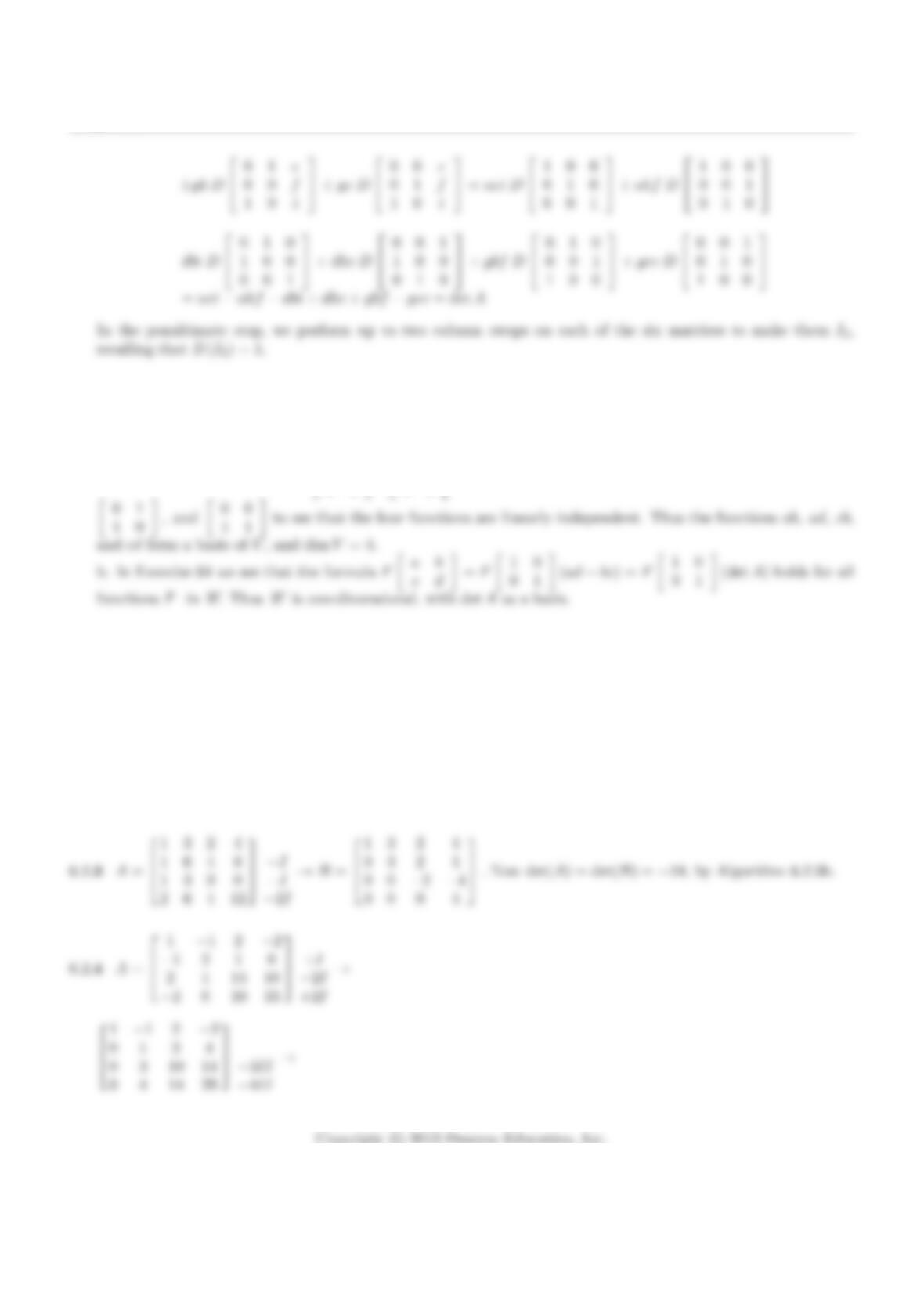
6.1.64 Writing a
c=a
0+0
cand repeatedly using linearity in the columns, we find
Da b
c d =Da b
0d+D0b
c d =
|{z}
Step 2
ad +D0b
c0+D0 0
c d
=ad +bc D 0 1
1 0 +cd D 0 0
1 1 =
|{z}
Step 4
ad −bc D 1 0
0 1 =ad −bc = det A
See the analogous computations in Exercise 63. In Step 2, we are using the result Da b
283
Chapter 6
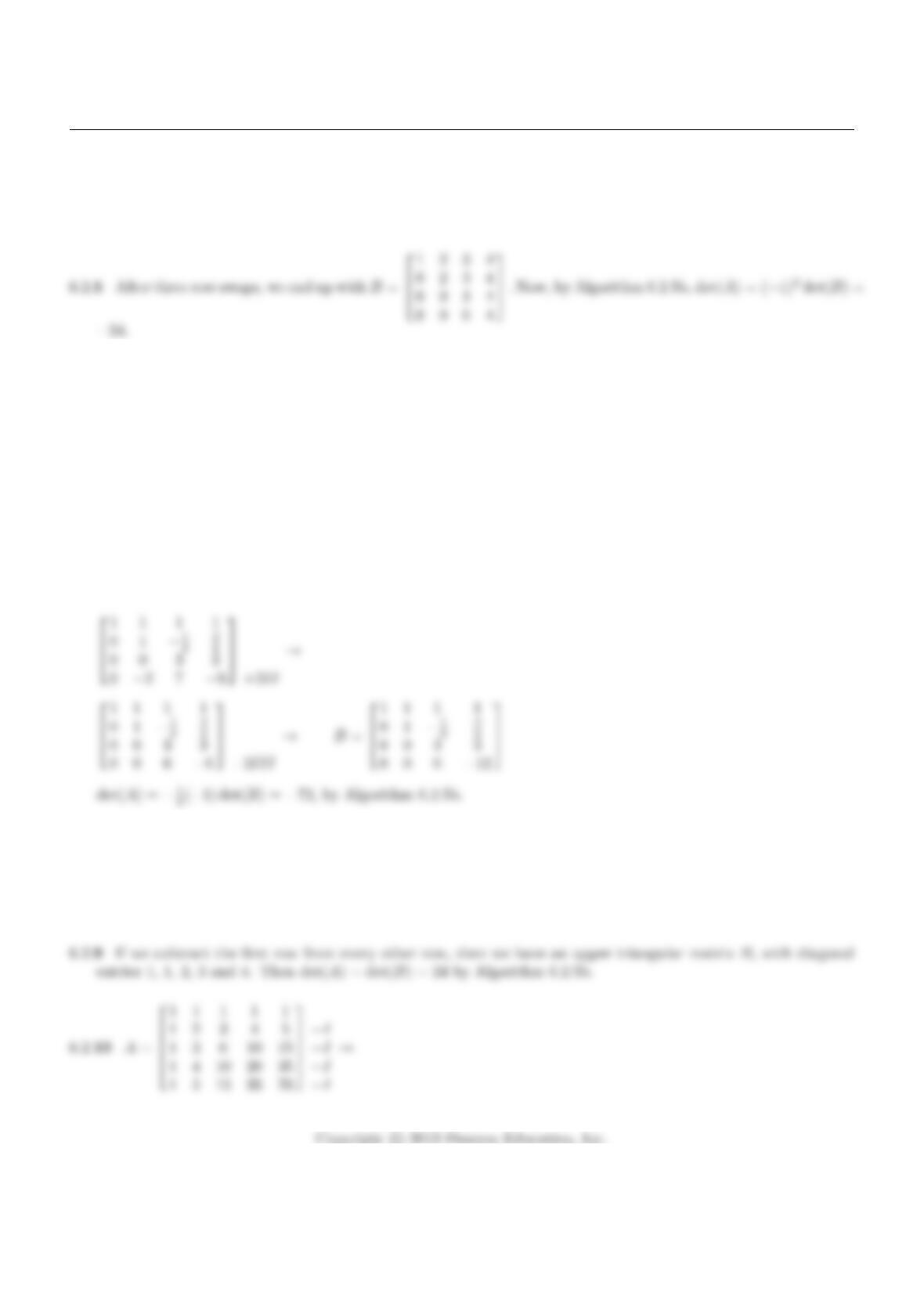
6.1.66 a. Proceeding as in Exercises 63 and 64, we can see that Fa b
c d =ab F 1 1
0 0 +ad F 1 0
0 1 +
cb F 0 1
1 0 +cd F 0 0
1 1 for all functions Fin V. Thus the functions ab, ad, cb, and cd span V. Apply
these functions to the matrices 1 1
0 0 ,1 0
0 1 ,
Section 6.2
6.2.1A=
111
133
225
−I
−2I
→B=
1 1 1
0 2 2
0 0 3
.Now det(A) = det(B) = 6,by Algorithm 6.2.5b.
6.2.2A=
1 2 3
1 6 8
−2−4 0
−I
+2I
→B=
1 2 3
0 4 5
0 0 6
.Now det(A) = det(B) = 24,by Algorithm 6.2.5b.
284
Section 6.2
1−1 2 −2
0134
0012
0 0 2 13
−2III
→B=
1−1 2 −2
0134
0012
0009
. Now det(A) = det(B) = 9,by Algorithm 6.2.5b.
6.2.6A=
1 1 1 1
1 1 4 4
1−1 2 −2
1−1 8 −8
−I
−I
−I
→
1111
0033
0−2 1 −3
0−2 7 −9
swap:
II ↔III →
1111
0−2 1 −3
0033
0−2 7 −9
÷ − 2→
6.2.7After two row swaps, we end up with an upper triangular matrix Bwith all 1’s along the diagonal. Now
det(A) = (−1)2det(B) = 1,by Algorithm 6.2.5b.
6.2.8After four row swaps, we end up with an upper triangular matrix Bwith all 1’s along the diagonal, except for
a 2 in the bottom right corner. Now det(A) = (−1)4det(B) = 2,by Algorithm 6.2.5b.
285
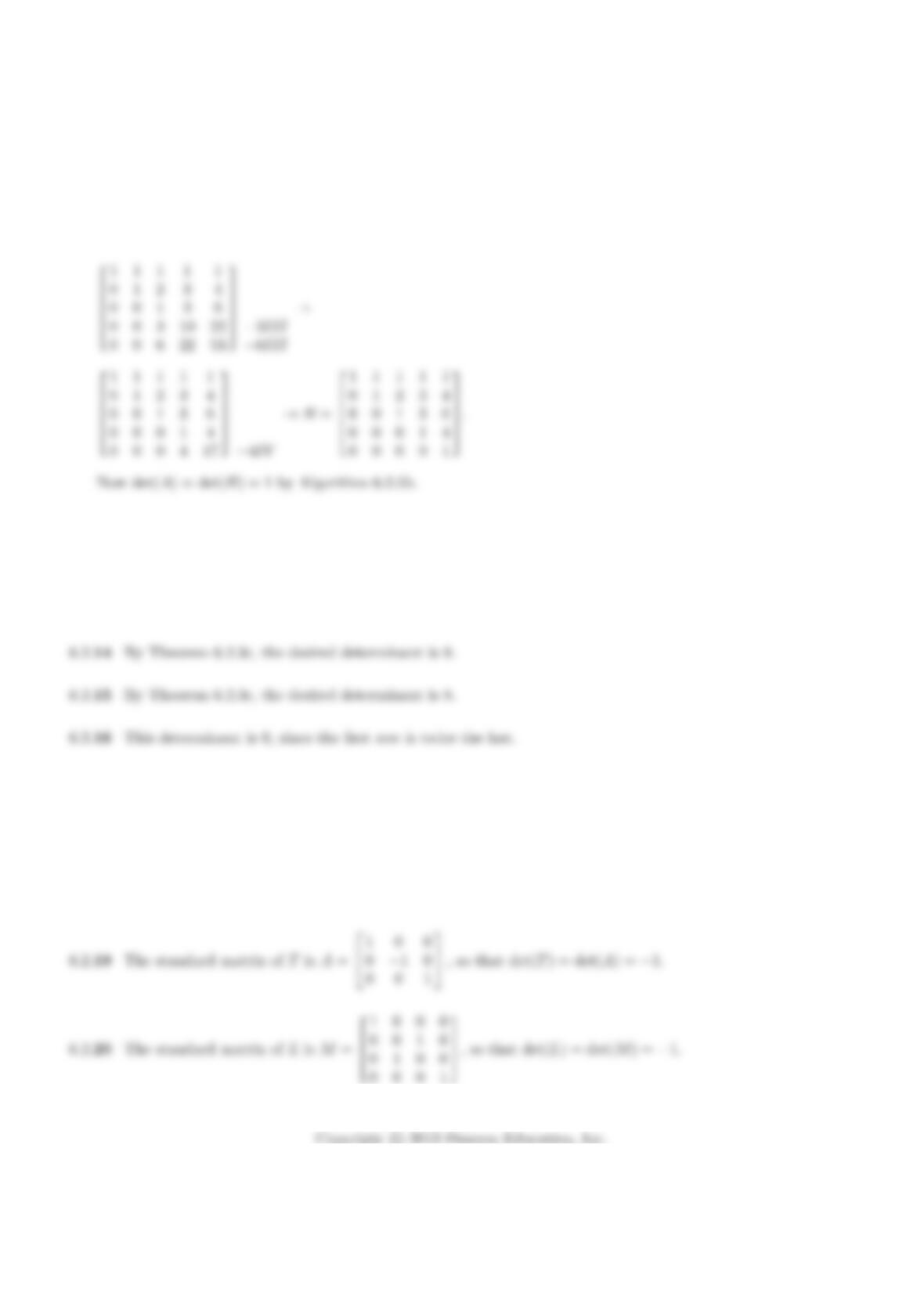
Chapter 6
1 1 1 1 1
0 1 2 3 4
0 2 5 9 14
0 3 9 19 34
0 4 14 34 69
−2II
−3II
−4II
→
6.2.11 By Theorem 6.2.3a, the desired determinant is (−9)(8) = −72.
6.2.12 By Theorem 6.2.3b, the desired determinant is −8.
6.2.13 By Theorem 6.2.3b, applied twice, since there are two row swaps, the desired determinant is (−1)(−1)(8) = 8.
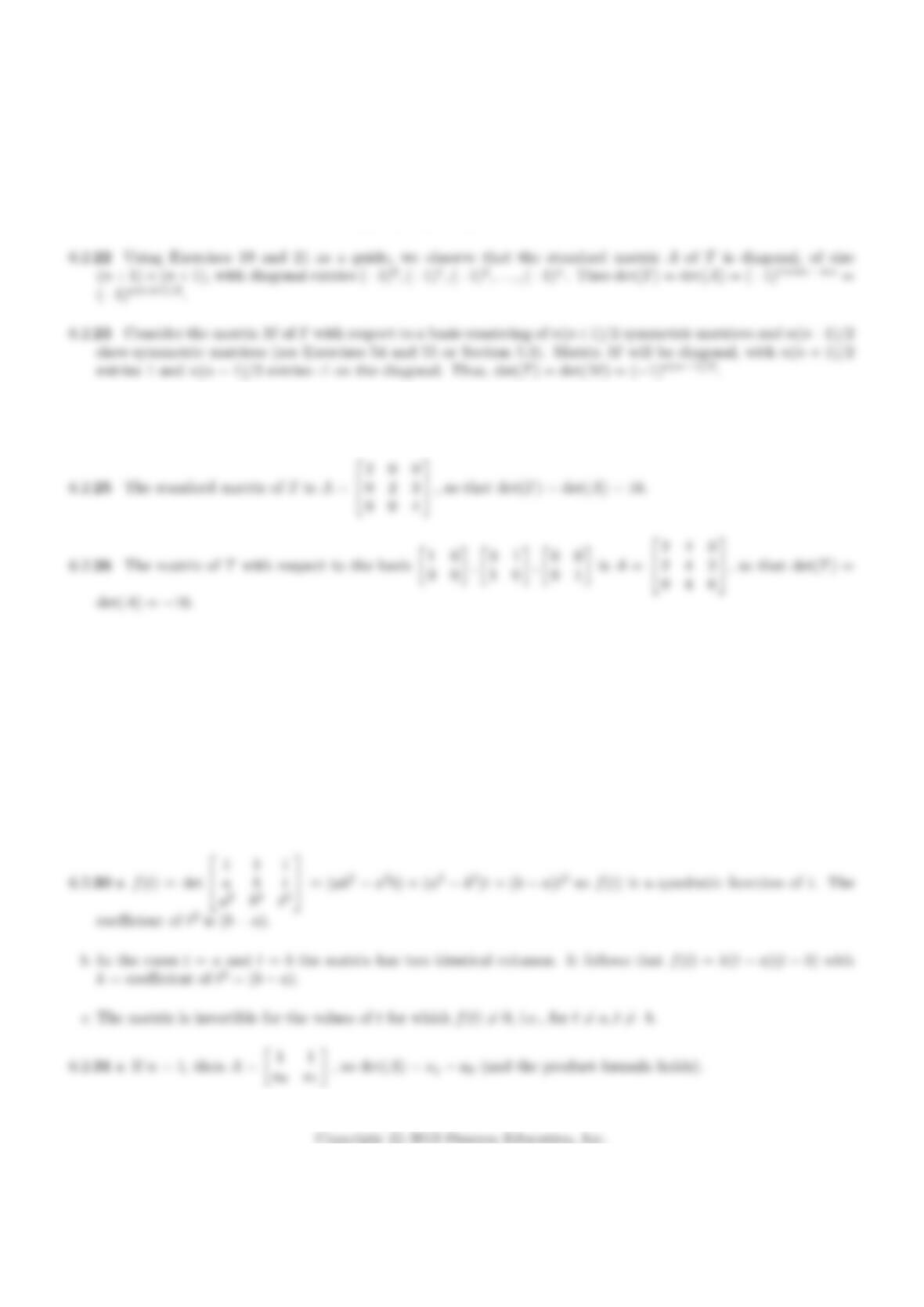
6.2.17 The standard matrix of Tis A=
2 3 0
0 2 6
0 0 2
,so that det(T) = det(A) = 8.
6.2.18 The standard matrix of Tis A=
1−2 4
0 3 −12
0 0 9
, so that det(T) = det(A) = 27.
286
Section 6.2
6.2.21 The standard matrix of Tis A=
1000
0−1 0 0
0010
000−1
,so that det(T) = det(A) = 1.
6.2.24 The standard matrix of Tis A=2−3
3 2 , so that det(T) = det(A) = 13.
6.2.27 The matrix of Twith respect to the basis cos(x),sin(x) is A=−b a
−a−b,so that det(T) = det(A) = a2+b2.
6.2.28 The matrix of Twith respect to the basis
−2
1
0
,
−3
0
1
is A=−6−10
5 6 , so that det(T) = det(A) = 14.
6.2.29 Expand down the first column, realizing that all but the first contribution are zero, since a21 = 0 and Ai1
has two equal rows for all i > 2.Therefore, det(Pn) = det(Pn−1).
Since det(P1) = 1, we can conclude that det(Pn) = 1,for all n.
287
Chapter 6
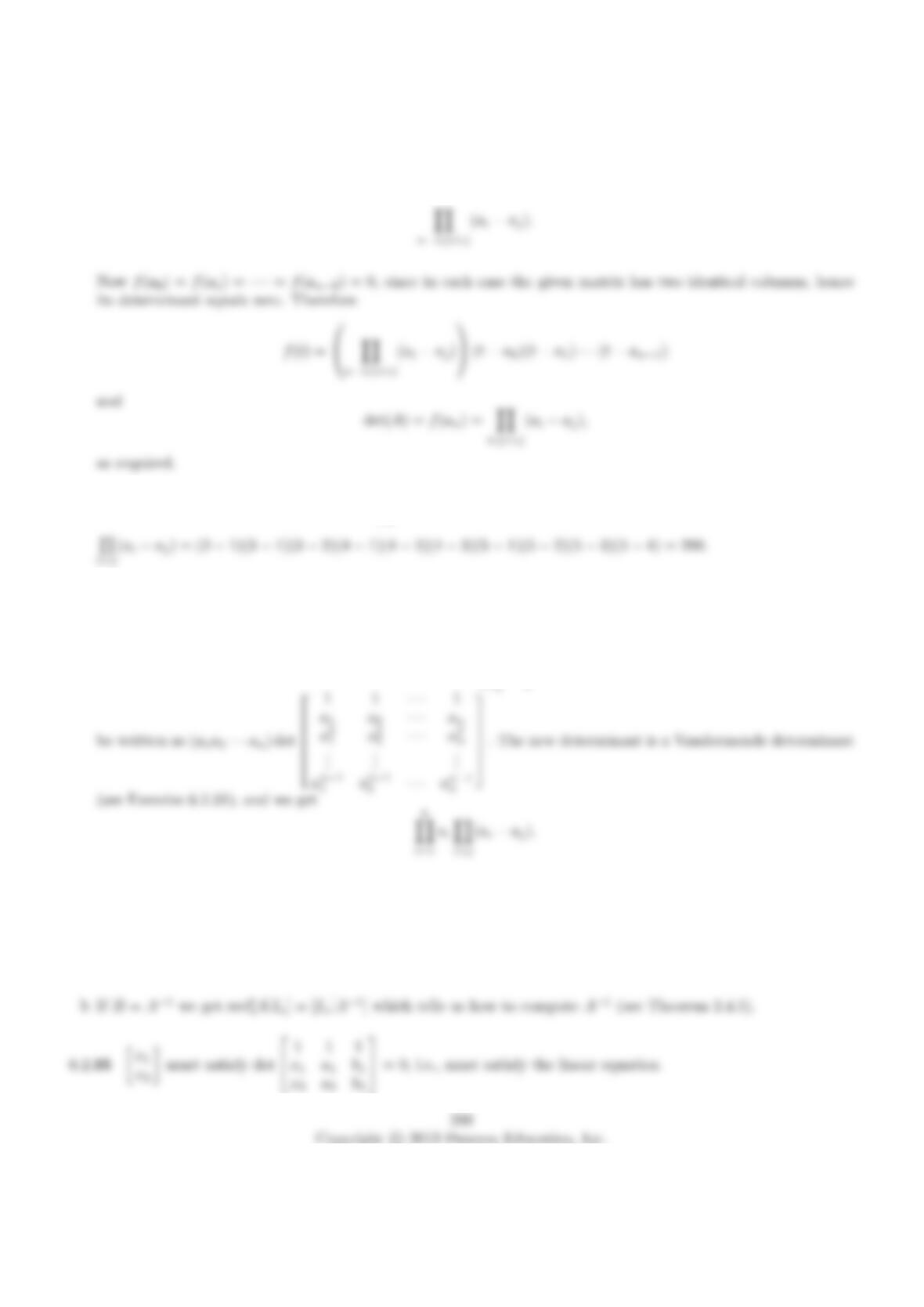
b Expanding the given determinant down the right-most column, we see that the coefficient kof tnis the n−1
Vandermonde determinant which we assume is
6.2.32 By Exercise 31, we need to compute Q
i>j
(ai−aj) where a0= 1, a1= 2, a2= 3, a3= 4, a4= 5 so
6.2.33 Think of the ith column of the given matrix as ai
1
ai
a2
i
.
.
.
an−1
,so, by Theorem 6.2.3a, the determinant can
6.2.34 a The hint pretty much gives it away. Since the columns of matrix B
−Inare in the kernel of [ InM], we
have [ InM]B
−In=B−M= 0, and M=B, as claimed.
Section 6.2
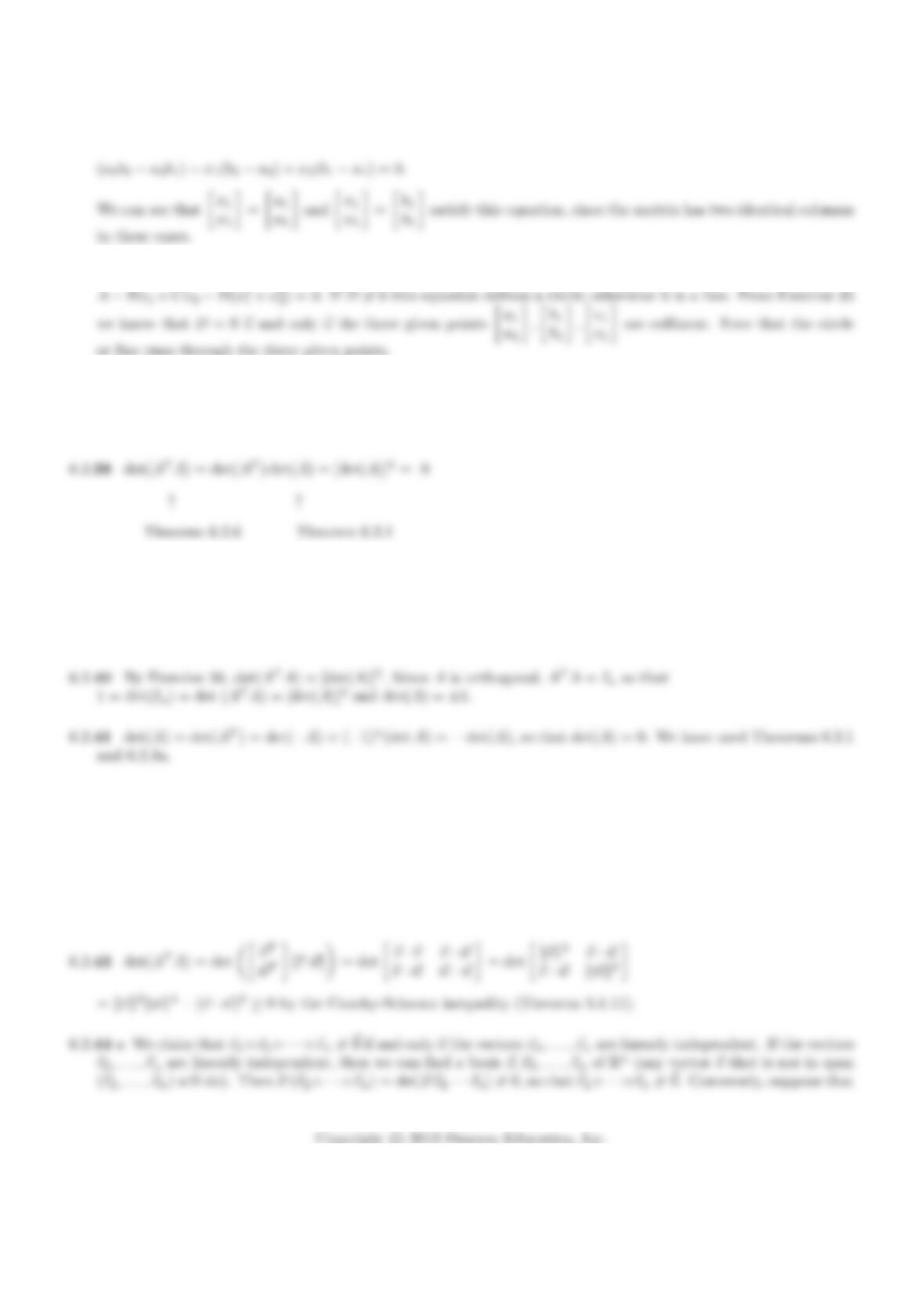
6.2.36 Expanding down the first column we see that the equation has the form
6.2.37 Applying Theorem 6.2.6 to the equation AA−1=Inwe see that det(A) det(A−1) = 1.The only way the
product of the two integers det(A) and det(A−1) can be 1 is that they are both 1 or both -1. Therefore, det(A) = 1
or det(A) = −1.
6.2.39 det(ATA) = det(AT) det(A) = [det(A)]2>0
↑ ↑
Theorem 6.2.6 Theorem 6.2.1
6.2.42 det ATA=
|{z}
Step 1
det (QR)TQR= det RTQTQR=
|{z}
Step 3
det RTImR
= det RTR=
|{z}
Step 5
det RTdet(R) =
|{z}
Step 6
(det R)2=
|{z}
Step 7
(Qm
i=1 rii)2>0.
In Step 1 we are using the definition of matrix A. Equation 3 holds since the column vectors of matrix Qare
orthonormal. In Steps 5 and 6 we are using Theorems 6.2.6 and 6.2.1, respectively. Finally, Equation 7 holds
since matrix Ris triangular.
289
Chapter 6
~v2×~v3×· · ·×~vn6= 0; say the ith component of this vector is nonzero. Then 0 6=~ei·(~v2×· · ·×~vn) = det[~ei~v2···~vn],
so that the vectors ~v2, . . . , ~vnare linearly independent (being columns of an invertible matrix).
d Compare the ith components of the two vectors:
det
1 1 1 1
~ei~v2~v3··· ~vn
1 1 1 1
and det
1 1 1 1
~ei~v3~v2··· ~vn
1 1 1 1
·
The two determinants differ by a factor of −1 by Theorem 6.2.3b, so that
~v2×~v3× · · · × ~vn=−~v3×~v2× · · · × ~vn.
6.2.45 f(x) is a linear function, so f′(x) is the coefficient of x(the slope). Expanding down the first column, we see
that the coefficient of xis −det
1 2 3 4
0 2 3 4
0 0 3 4
0 0 0 4
=−24,so f′(x) = −24.
6.2.48 A vector ~x is in the kernel of Tif (and only if) ~x is redundant in the list ~v1, ~v2, …, ~vn−1, ~x, meaning that ~x is
in the span of the vectors ~v1, …, ~vn−1. Thus
290
Section 6.2
6.2.49 For example, we can start with an upper triangular matrix Bwith det(B) = 13,such as B=
1 1 1
0 1 1
0 0 13
.
Adding the first row of Bto both the second and the third to make all entries nonzero, we end up with
A=
1 1 1
1 2 2
1 1 14
.Note that det(A) = det(B) = 13.
6.2.51 Notice that it takes nrow swaps (swap row iwith n+ifor each ibetween 1 and n) to turn Ainto I2n.So,
det(A) = (−1)ndet(I2n) = (−1)n.
6.2.52 a We build Bcolumn-by-column:
T1
0T0
1= d
−c −b
a=d−b
−c a .
d Any vector ~u in the image of Awill be of the form c1a
c+c2b
d. We note that Ba
c=d−b
−c a a
c=
ad −bc
−ca +ac =~
0. The same is true of Bb
d. Thus, anything in the image of Awill be in the kernel of B. Since
291
Chapter 6
6.2.54 f(t) = (det(A+tB))2−1 = det a1+tb1a2+tb2
a3+tb3a4+tb42
−1 assuming A=a1a2
a3a4,B=b1b2
b3b4.
Then the determinant above is a polynomial of degree ≤2 so its square is a polynomial of degree ≤4. Hence f(t)
is a polynomial of degree ≤4.
6.2.55 We start out with a preliminary remark: If a square matrix Ahas two equal rows, then D(A) = 0.Indeed,
if we swap the two equal rows and call the resulting matrix B, then B=A, so that D(A) = D(B) = −D(A),by
property b, and D(A) = 0 as claimed.
Next we need to understand how the elementary row operations affect D. Properties a and b tell us about how
row multiplications and row swaps, but we still need to think about row additions.
6.2.56 a We show first that Dis linear in the ith row.
292
Section 6.2
D
~v1
.
.
.
~x
.
.
.
~vn
↑
A
=1
det Mdet
~v1M
.
.
.
~xM
.
.
.
~vnM
↑
AM
6.2.57 Note that matrix A1is invertible, since det(A1)6= 0.Now
T~y
~x = [A1A2]~y
~x =A1~y +A2~x =~
0 when A1~y =−A2~x, or,
~y =−A−1
1A2~x. This shows that for every ~x there is a unique ~y (that is, ~y is a function of ~x); furthermore, this
function is linear, with matrix M=−A−1
1A2.
6.2.58 Using the approach of Exercise 57, we have A1=1 2
3 7 , A2=1 2
4 3 ,
6.2.59 det 0 0
0 0 = 0 = det 1 0
0 0 ,but these matrices fail to be similar.
293