Hydrostatic Water in Soils and Rocks Chapter 6
CHAPTER 6
HYDROSTATIC WATER IN SOILS AND ROCKS
6-1. The end of a clean glass tube is inserted in pure water. What is the height of capillary rise if
the tube is: (a) 0.15 mm, (b) 0.015 mm, and (c) 0.0015 mm in diameter?
SOLUTION:
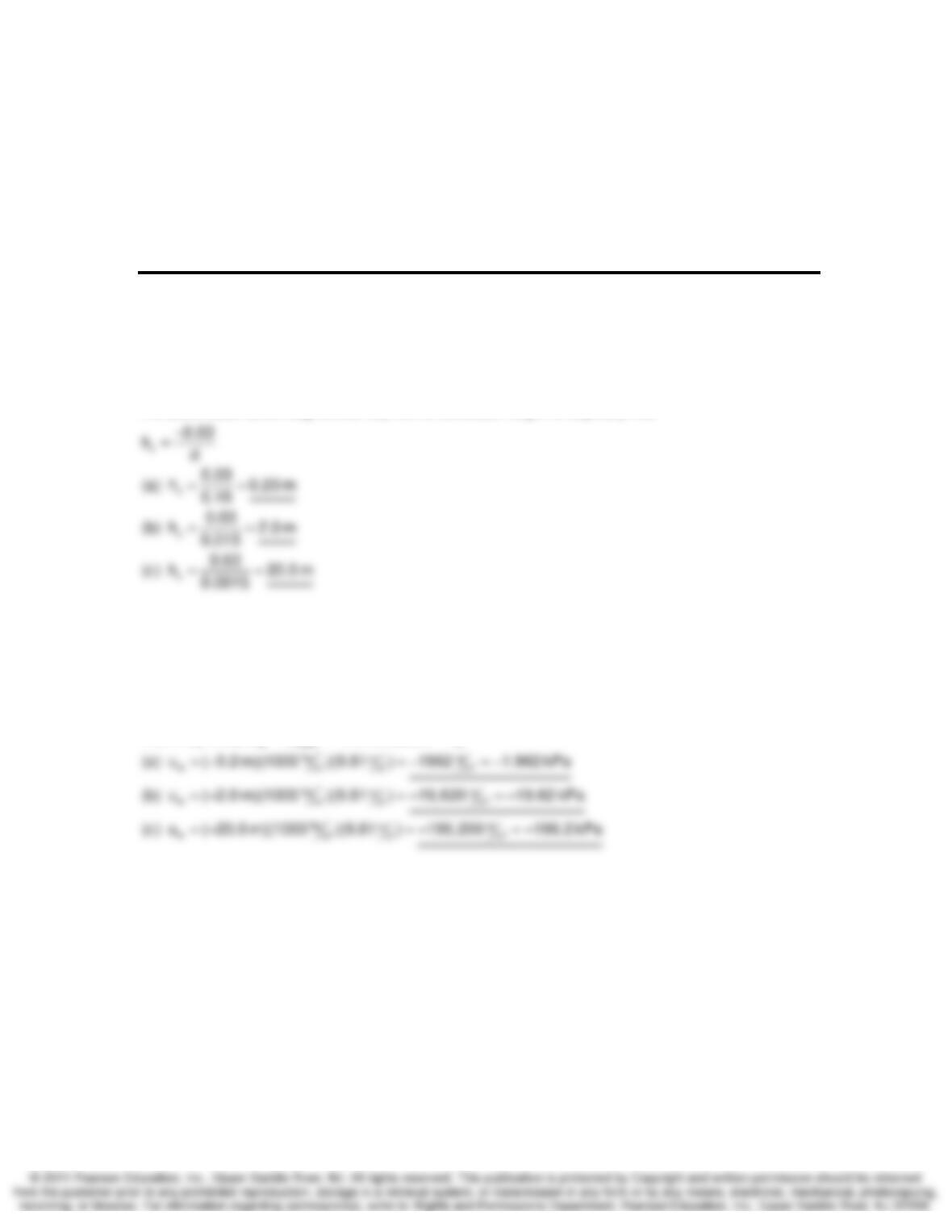
For pure water at 20 deg C, use Eq. 6.5 to calculate height of capillary rise
6-2. Calculate the maximum capillary pressure for the tubes in Problem 6.1.
SOLUTION:
ww c
From Eq. 6.6a, u z g In this case, z h
=ρ =
Hydrostatic Water in Soils and Rocks Chapter 6
6-3. Calculate the theoretical height of capillary rise and the capillary tension of the three soils
whose grain size distribution is shown in Fig. 2.6.
SOLUTION:
10
pore 10
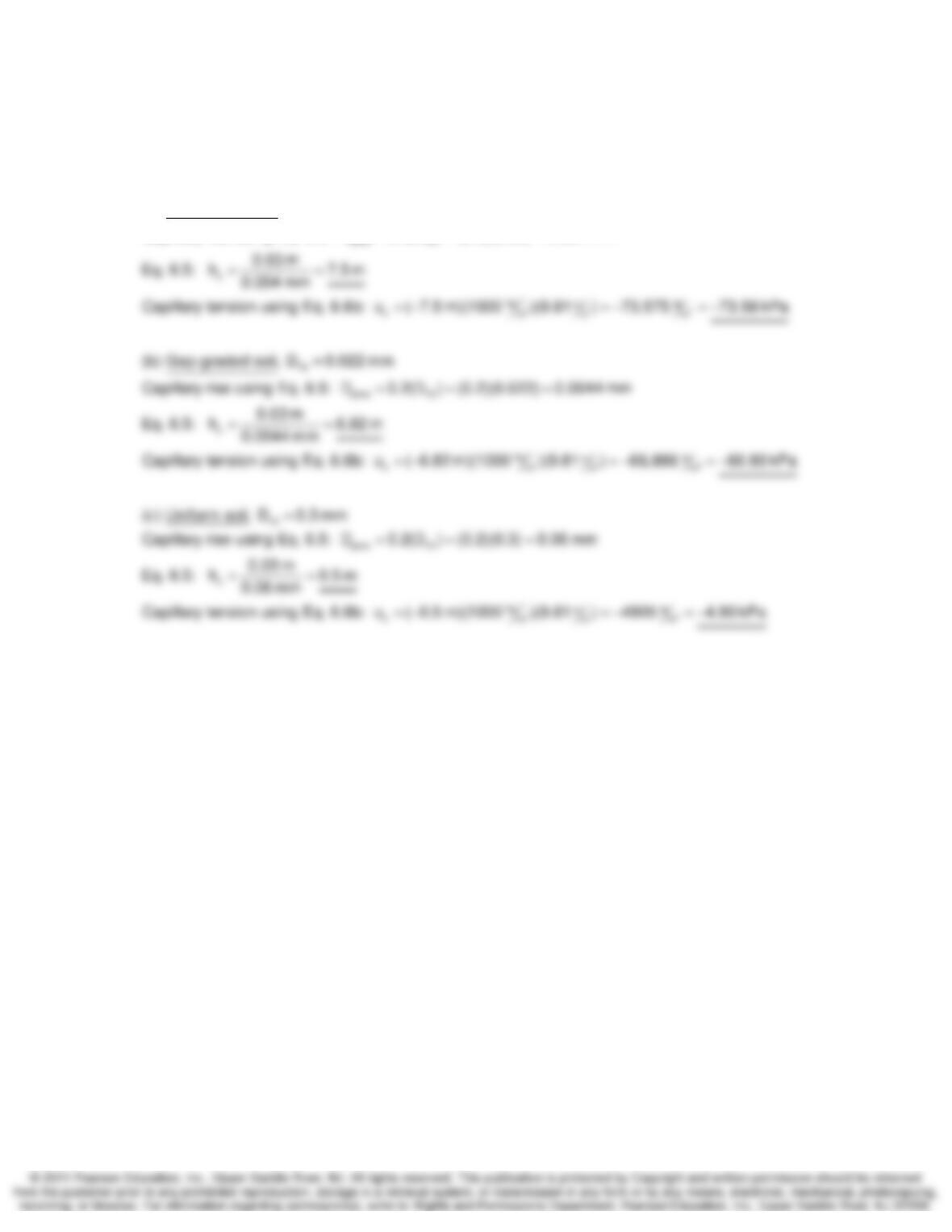
(a) Well-graded soil, D 0.02 mm
Capillary rise using Eq. 6.5: D 0.2(D ) (0.2)(0.02) 0.004 mm
=
== =
Hydrostatic Water in Soils and Rocks Chapter 6
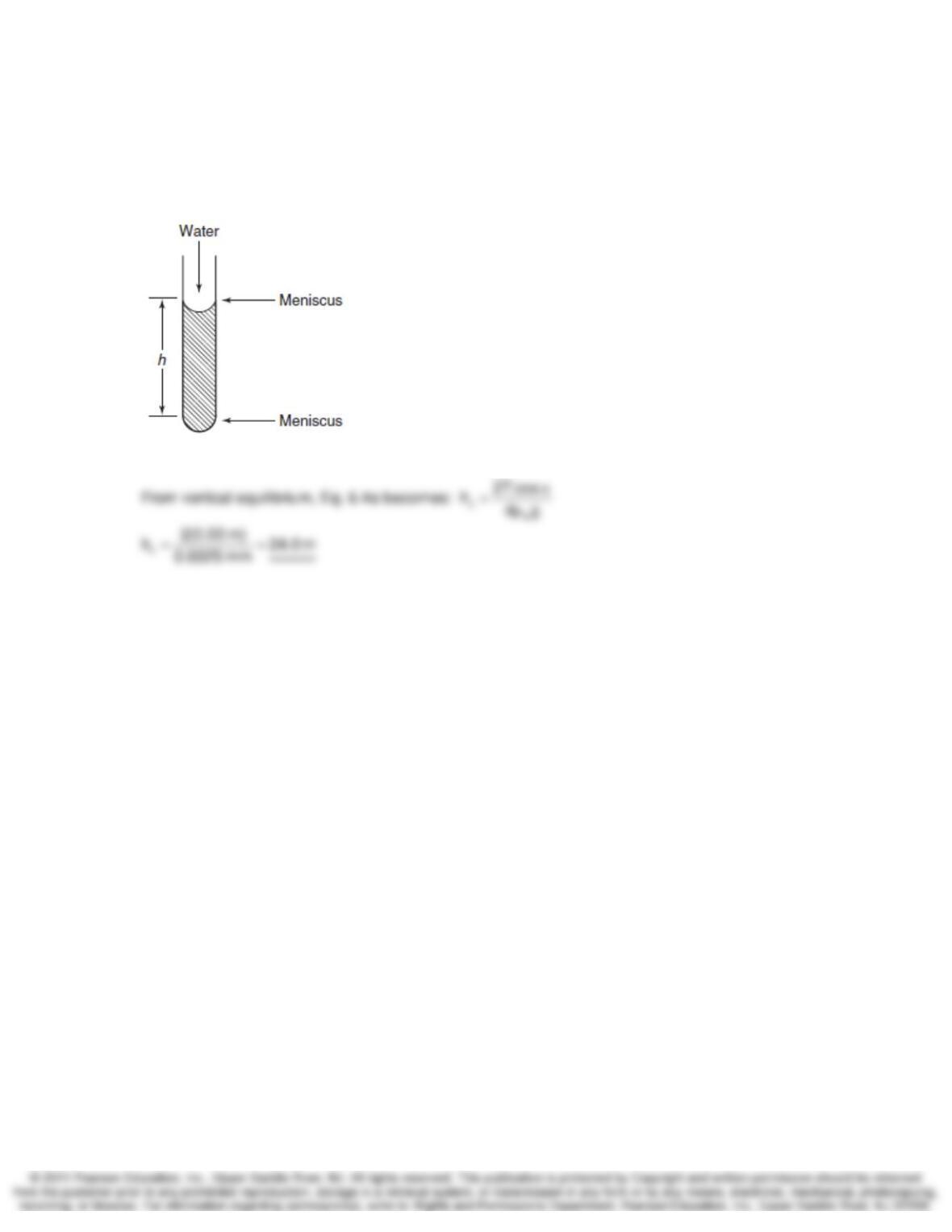
6-4. A tube, similar to that shown in Fig. 6.12, has a 0.0025-mm inside diameter and is open at
both ends. The tube is held vertically and water is added to the top end. What is the maximum
height h of the column of water that will be supported? [Hint: A meniscus will form at the top and
at the bottom of the column of water, as shown in Fig. P6.4.] (After Casagrande, 1938.)
SOLUTION:
Hydrostatic Water in Soils and Rocks Chapter 6
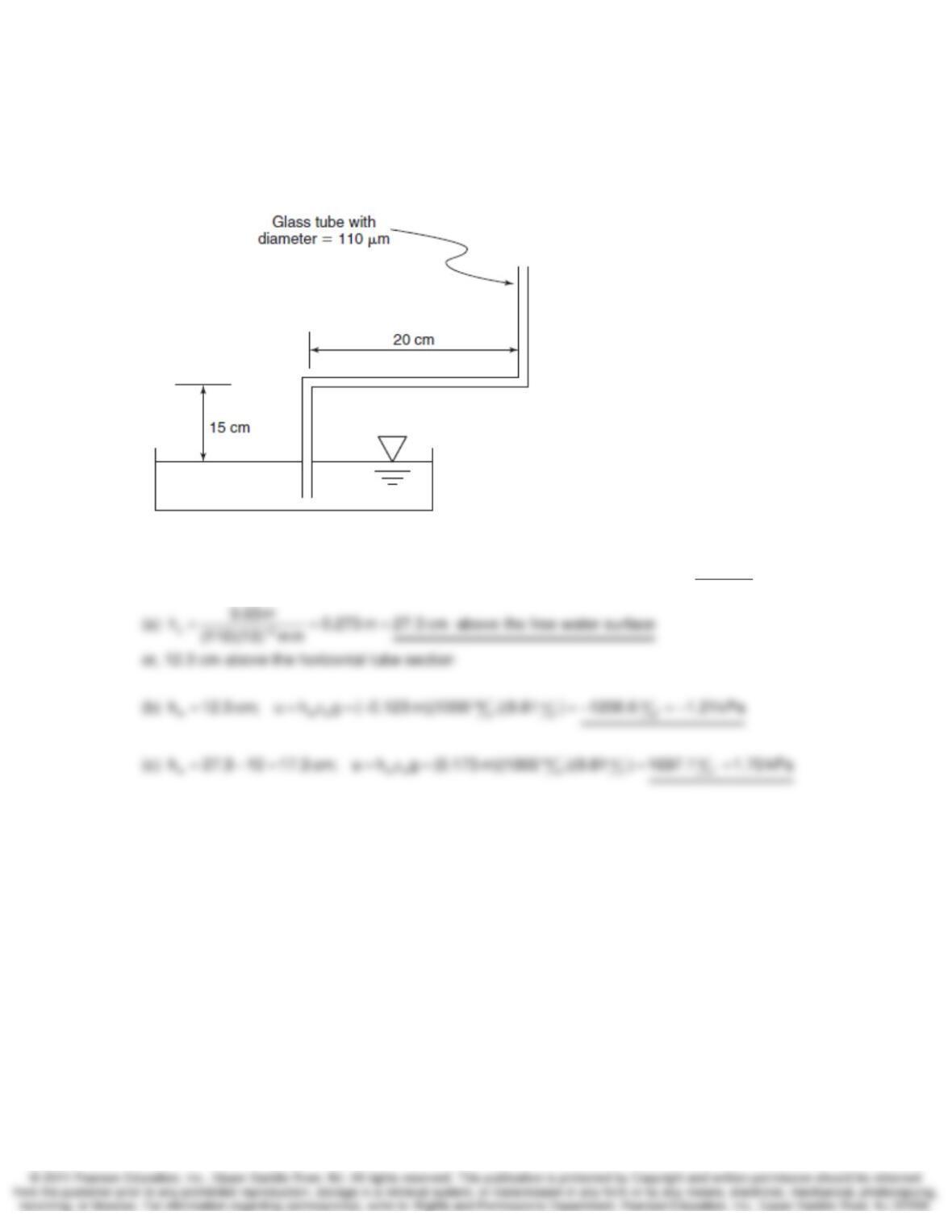
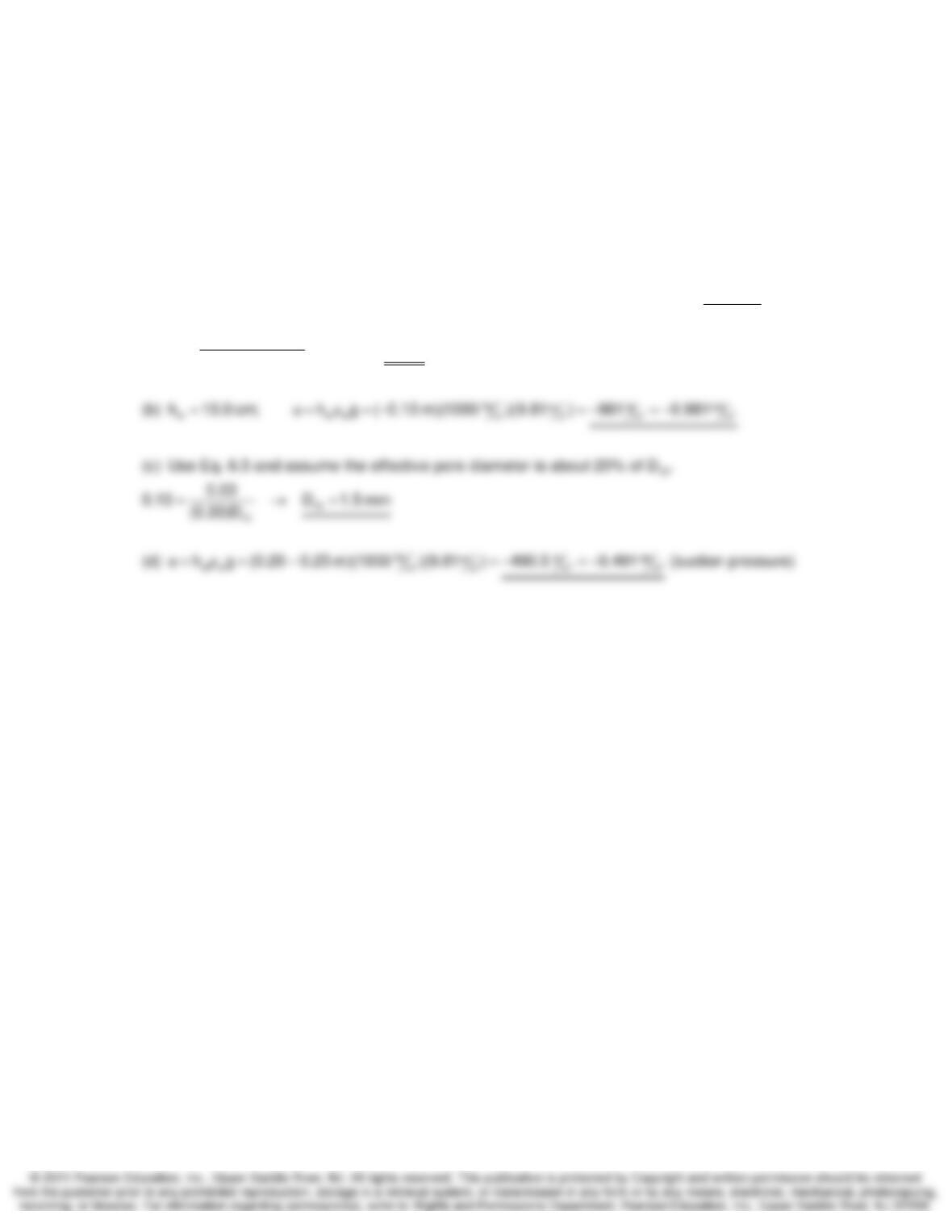
6-6. Figure P6.6 shows an angled, glass capillary tube with diameter 110 m. Other dimensions
are shown. (a) Where will the top of the capillary rise be? (b) What is the water pressure in the
horizontal section of the tube, in kPa? (c) What air pressure should be applied to the top opening
in the tube to cause the water level to be at 10 cm above the free water surface?
SOLUTION:
c
0.03 m
For pure water at 20 deg C, use Eq. 6.5 to calculate height of capillary rise; h dmm
−
=
Hydrostatic Water in Soils and Rocks Chapter 6
6-7. A glass tube with inside diameter 150 μm is placed in a water bath. (a) How high will the
water rise inside the tube? Give your answer in cm. (b) What will the water pressure be halfway
between the free water surface and the water level in the tube (i.e., at hc/2)? Give your answer in
kN/m2. (c) If the tube is intended to model soil void size, what would the effective grain size of the
soil be? (d) What air pressure (+ or -) would have to be applied to the tube to get the water in the
tube to rise 25 cm above the free water surface? Give your answer in kN/m2.
SOLUTION:
c
c3
0.03 m
For pure water at 20 deg C, use Eq. 6.5 to calculate height of capillary rise; h dmm
0.03m
(a) h 0.20 m 20 cm above the free water surface
(150)(10) mm
−
−
=
===
Hydrostatic Water in Soils and Rocks Chapter 6
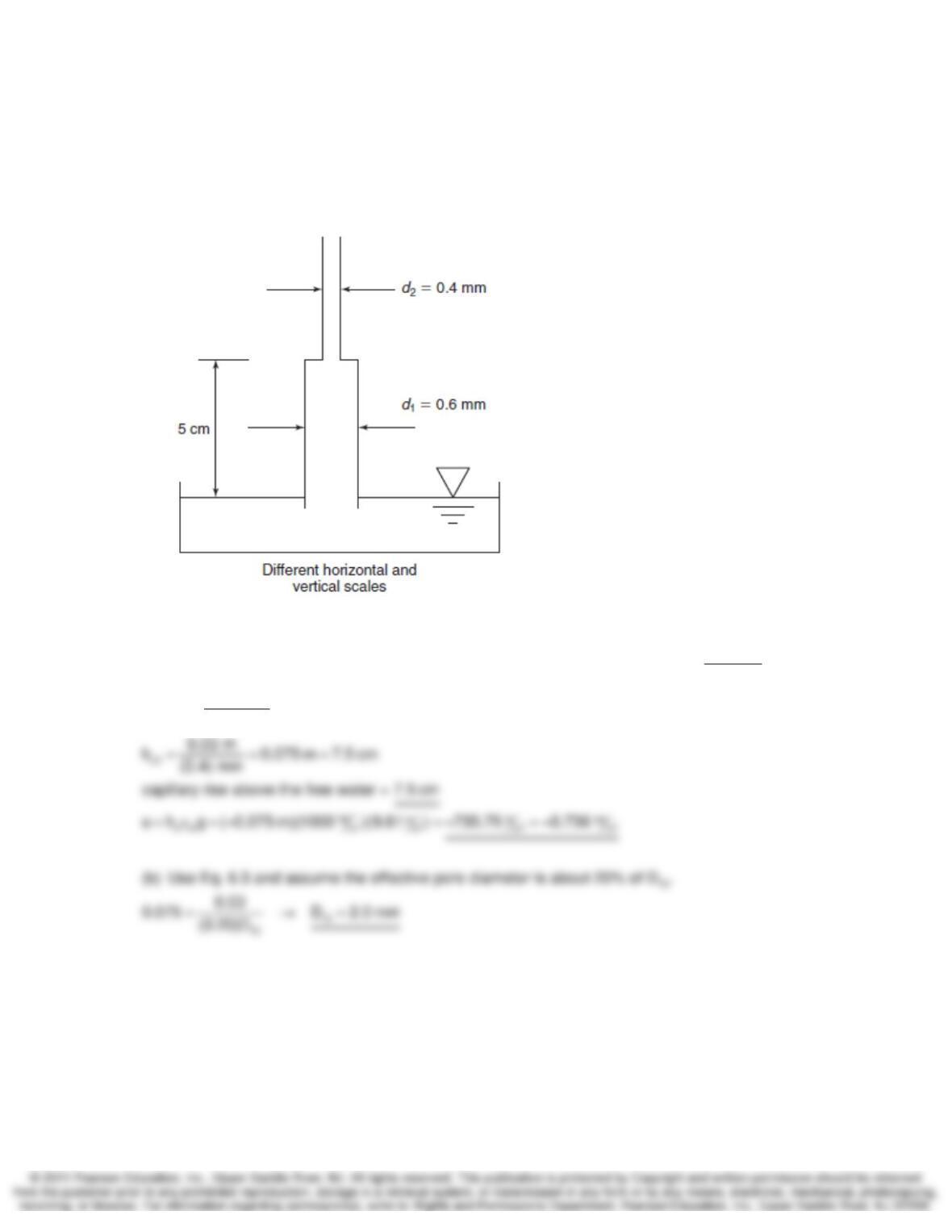
6.8. Figure P6.8 shows a tube with two sections, each with a different diameter, d1 and d2. The
tube is placed in the water bath as shown. (a) How high above the phreatic surface will the water
rise in the tube due to capillarity? What is the pore pressure at the surface of the capillary rise?
(b) If the capillary rise you found in part (a) occurred in a soil, what would you estimate as the
soil’s D10?
SOLUTION:
c
c1
0.03 m
For pure water at 20 deg C, use Eq. 6.5 to calculate height of capillary rise; h dmm
0.03 m
(a) h 0.05 m 5 cm
(0.6) mm
−
=
===
Hydrostatic Water in Soils and Rocks Chapter 6
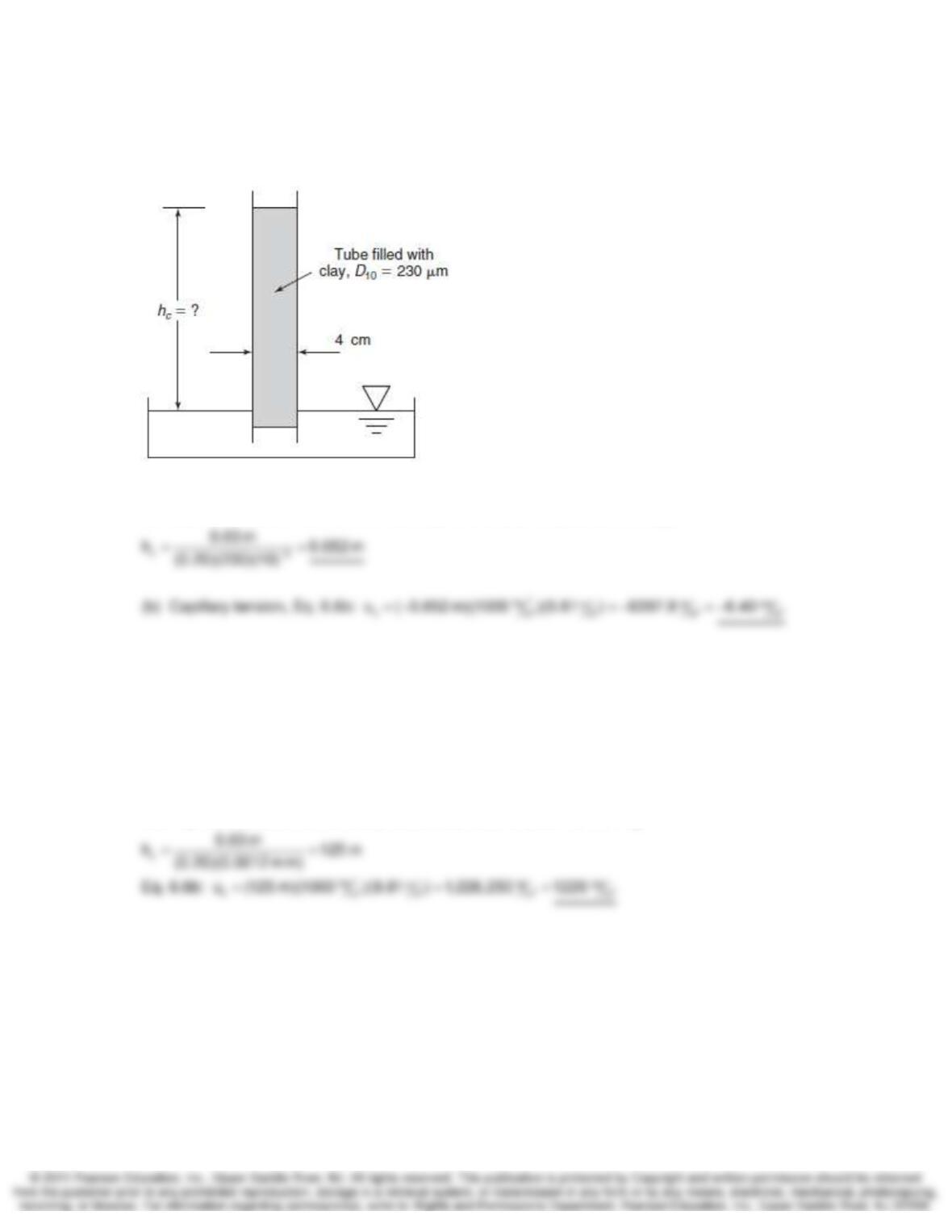
6-9. Figure P6.9 shows a long, thin tube which was filled with a clay and placed in a water bath.
The D10 for the clay is shown. (a) How high, hc, will the water rise in the tube? (b) What is the
capillary pressure at hc, in kN/m2?
SOLUTION
10
(a) Use Eq. 6.5 and assume the effective pore diameter is about 20% of D .
6-11. Assume that equations developed for height of capillary rise in constant-diameter tubes
can be applied. Calculate the net compressive stress on a soil pat at the shrinkage limit where the
average diameter of the surface pores is 0.0012 mm.
SOLUTION:
10
Use Eq. 6.5 and assume the effective pore diameter is about 20% of D .
Hydrostatic Water in Soils and Rocks Chapter 6
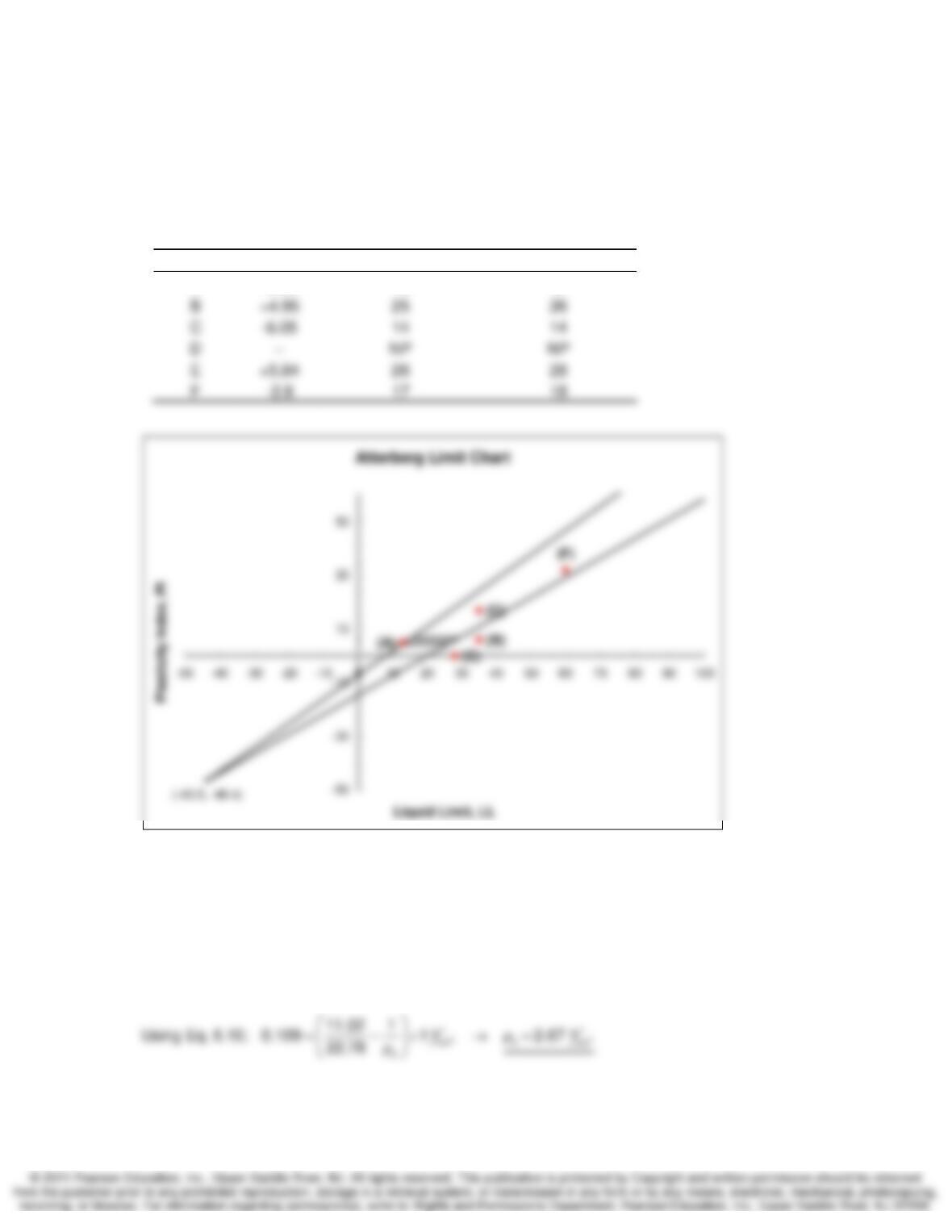
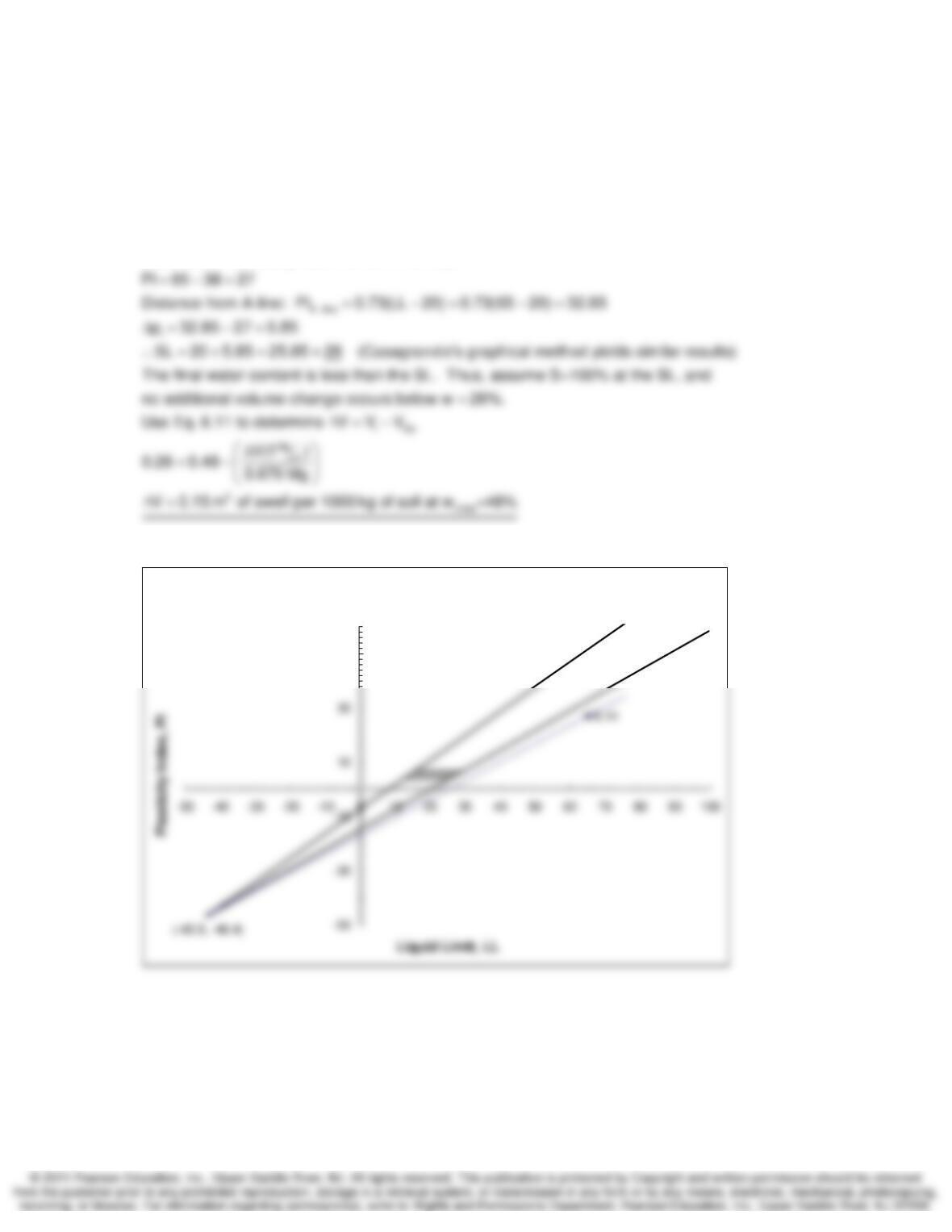
6-12. Estimate the shrinkage limits of the soils A–F in Problem 2.58.
SOLUTION:
Estimate the Shrinkage Limit (SL) using the two approximate approaches described in the text:
1) Eq. 6.12 based on vertical distance from the A-Line and 2) Casagrande’s graphical method
using hinge point (-43.5, -46.4), as illustrated in Fig. 6.14 (see diagram below).
Soil Δpi (1) SL = 20 ± Δpi (2) SL – graphical
A -9.89 10 8
6-13. During a shrinkage limit test on a silty clay, the volume of the dry soil pat was found to be
11.02 cm3 and its dry mass was 22.78 g. If the shrinkage limit was 10.9, what is the density of the
soil solids?
SOLUTION:
Hydrostatic Water in Soils and Rocks Chapter 6
6-14. Estimate the volume change of an organic silty clay with LL = 65 and PL = 38, when its
water content is reduced from 48% to 18%.
SOLUTION:
t
wst sss
i
Perform calculations for 1 Mg of soil; i.e., M 1Mg (initial)
M (0.48)M ; M 1 (0.48)M M M 0.676 Mg
Estimate the SL using Eq. 6.12, SL 20 p
=
===+→=
=±Δ
Atterberg Limit Chart
50
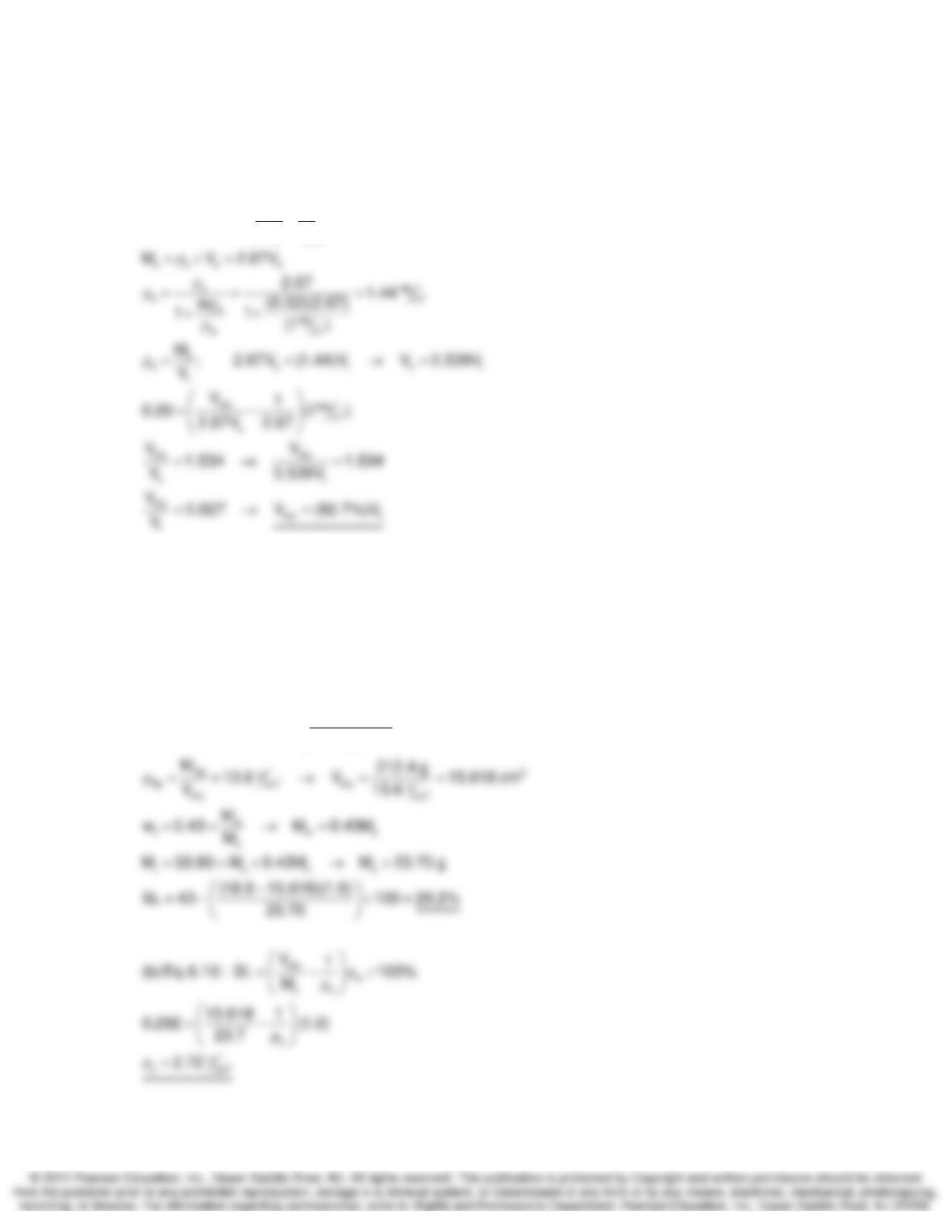
Hydrostatic Water in Soils and Rocks Chapter 6
6-16. A saturated sample of clay with an SL of 20 has a natural water content of 32%. What
would its dry volume be as a percentage of its original volume if
ρ
s is 2.67?
SOLUTION:
dry
w
ss
V1
Eq. 6.10: SL 100%
M
⎛⎞
=−ρ×
⎜⎟
ρ
⎝⎠
6-17. A sample of clayey silt is mixed at about its LL of 43. It is placed carefully in a small
porcelain dish with a volume of 18.9 cm3 and weighs 33.89 g. After oven drying, the soil pat
displaces 212.4 g of mercury. (a) Determine the SL of the soil sample. (b) Estimate the
ρ
s of the
soil.
SOLUTION:
idryw
i
s
(V V )
(a) Eq. 6.11: SL w 100%
M
−ρ
⎛⎞
=− ×
⎜⎟
⎝⎠
Hydrostatic Water in Soils and Rocks Chapter 6
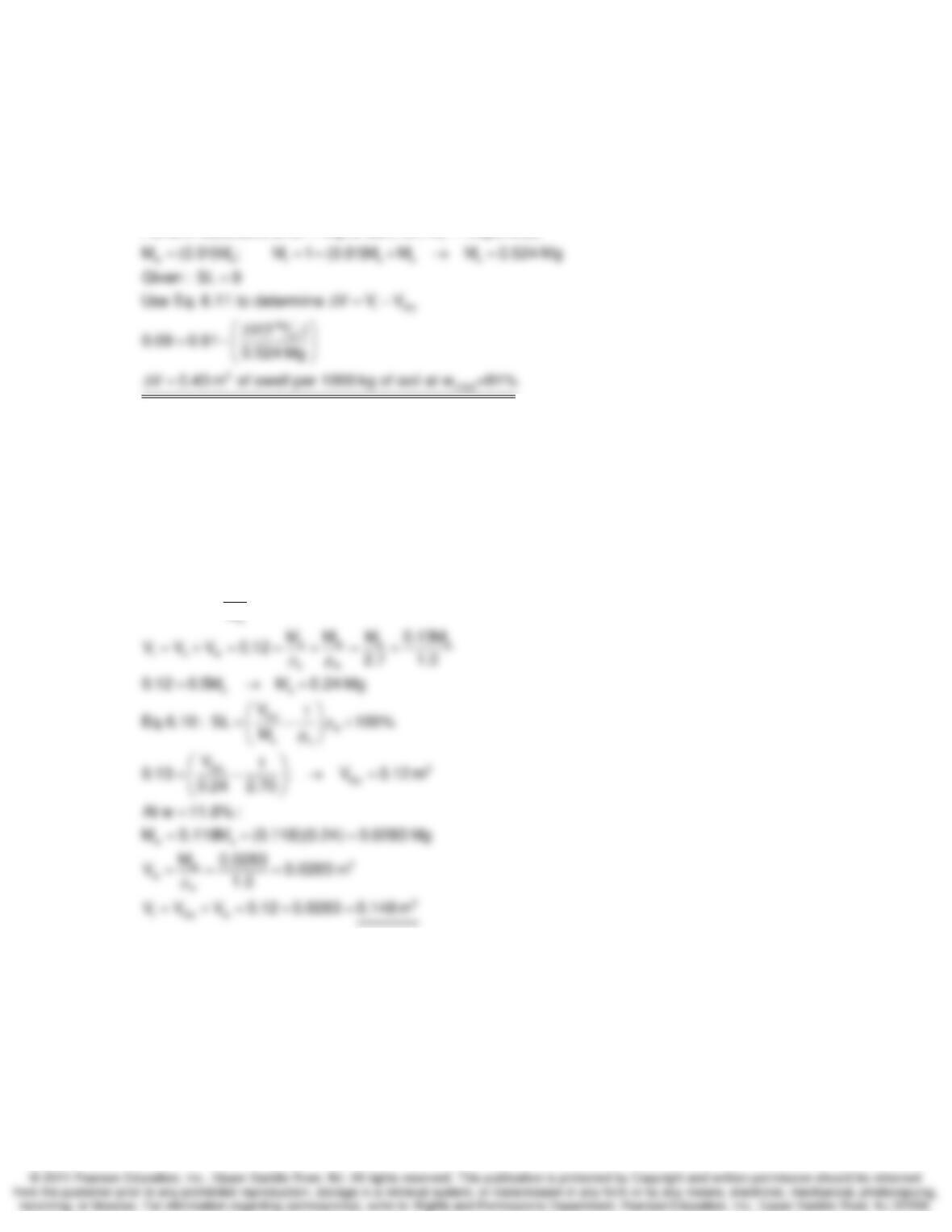
6-18. The LL of a bentonitic clay is 442 and the PL is 69. The SL was determined to be about 9.
Calculate the expected volumetric decrease when a sample of this bentonite is dried, if its natural
water content was 91%.
SOLUTION:
Perform calculations for 1 Mg of soil; i.e., M 1Mg (initial)
=
6-19. The shrinkage limit of a 0.12 m3 sample of a clay is 13 and its natural water content is 29%.
Assume the density of the soil solids is 2.70 Mg/m3, and estimate the volume of the sample when
the water content is 11.8%.
SOLUTION:
w
ws
M
SL 0.13 M 0.13M
M
== → =