PROBLEM 6-15
(a) The expected cash flows to meet the asset retirement obligation repre-
sent a deferred annuity. Developing a fair value estimate requires
determining the present value of the annuity of expected cash flows
to be paid in three years and then determine the present value of that
amount today.
Cash Flow Probability
Estimate X Assessment = Expected Cash Flow
$15,000 10% $ 1,500
The value today of the annuity payments to commence in ten years is:
Alternatively, the present value of the deferred annuity can be computed
as follows:
(b) This fair value estimate is based on unobservable inputs—Murphy’s
own data on the expected future cash flows associated with the
obligation to restore the site. This fair value estimate is considered
Level 3, as discussed in Chapter 2.
FINANCIAL REPORTING PROBLEM
(a) 1. Long-lived assets, goodwill
For impairment of goodwill and long-lived assets, fair value is deter-
(b) (1) The following rates are disclosed in the accompanying notes:
Debt
Weighted-Average Effective Interest Rate
FINANCIAL REPORTING PROBLEM (Continued)
Benefit Plans
Pension Benefits
Other Retiree
Benefits
United States
2011
2010
2011
2010
Discount rate
5.3%
Stock-Based Compensation
Assumptions
2011
2010
2009
used in Stock Option Valuation
(2) There are different rates for various reasons:
1. The maturity dates—short-term vs. long-term.
2. The security or lack of security for debts—mortgages and col–
lateral vs. unsecured loans.
FINANCIAL STATEMENT ANALYSIS CASE
(a) Cash inflows of $375,000 less cash outflows of $125,000 = Net cash
flows of $250,000.
(c) The estimate of future cash flows is very useful. It provides an under–
standing of whether the value of gas and oil properties is increasing
ACCOUNTING, ANALYSIS, AND PRINCIPLES
Accounting
(a) The present value of the note is presumably equal to the fair-value of
the inventory. The note has 20 semi-annual periods to maturity.
Analysis
If interest rates increase, the fair-value of the note will decline. This is
because the remaining cash flows are being discounted at a higher rate.
That is, the present value of the future cash flows is less at a higher
discount rate.
Principles
Fair-value versus historical cost potentially involves a trade-off between
the primary qualities of relevance and faithful representation. The fair-
PROFESSIONAL RESEARCH
Search strings: “present value”, present and value, Present value $, “best
estimate”, “estimated cash flow”, “expected cash flow”, “fresh-start
measurement”, “interest methods of allocation”
2000).
(b) See Appendix B: APPLICATIONS OF PRESENT VALUE IN FASB
STATEMENTS AND APB OPINIONS, CON7, Par. 119
119. . . . The accompanying table is presented to assist readers in
Some examples are:
• Debt payable and related premium or discount
• Asset acquired by incurring liabilities in a business combination—“An
asset acquired by incurring liabilities is recorded at cost—that is, at
the present value of the amounts to be paid” (paragraph 67(b)).
PROFESSIONAL RESEARCH (Continued)
• FASB Statement No. 106, Employers’ Accounting for Postretirement
Benefits Other Than Pensions . . . Effective settlement rate—“. . . as
(c) 1. CON7, Glossary of terms: Best estimate: The single most-likely
amount in a range of possible estimated amounts; in statistics, the
estimated mode. In the past, accounting pronouncements have used
2. CON7, Glossary of terms: Estimated Cash Flow and Expected Cash
Flow: In the past, accounting pronouncements have used the terms
3. CON7, Glossary of terms: Fresh-Start Measurements: Measurements
in periods following initial recognition that establishes a new
carrying amount unrelated to previous amounts and accounting
PROFESSIONAL RESEARCH (Continued)
4. CON7, Glossary of terms: Interest Methods of Allocation: Reporting
conventions that use present value techniques in the absence of a
Note to instructor: The concepts statements are not in the codification.
Thus, the references to previous FASB standards
above do not have codification sections indicated.
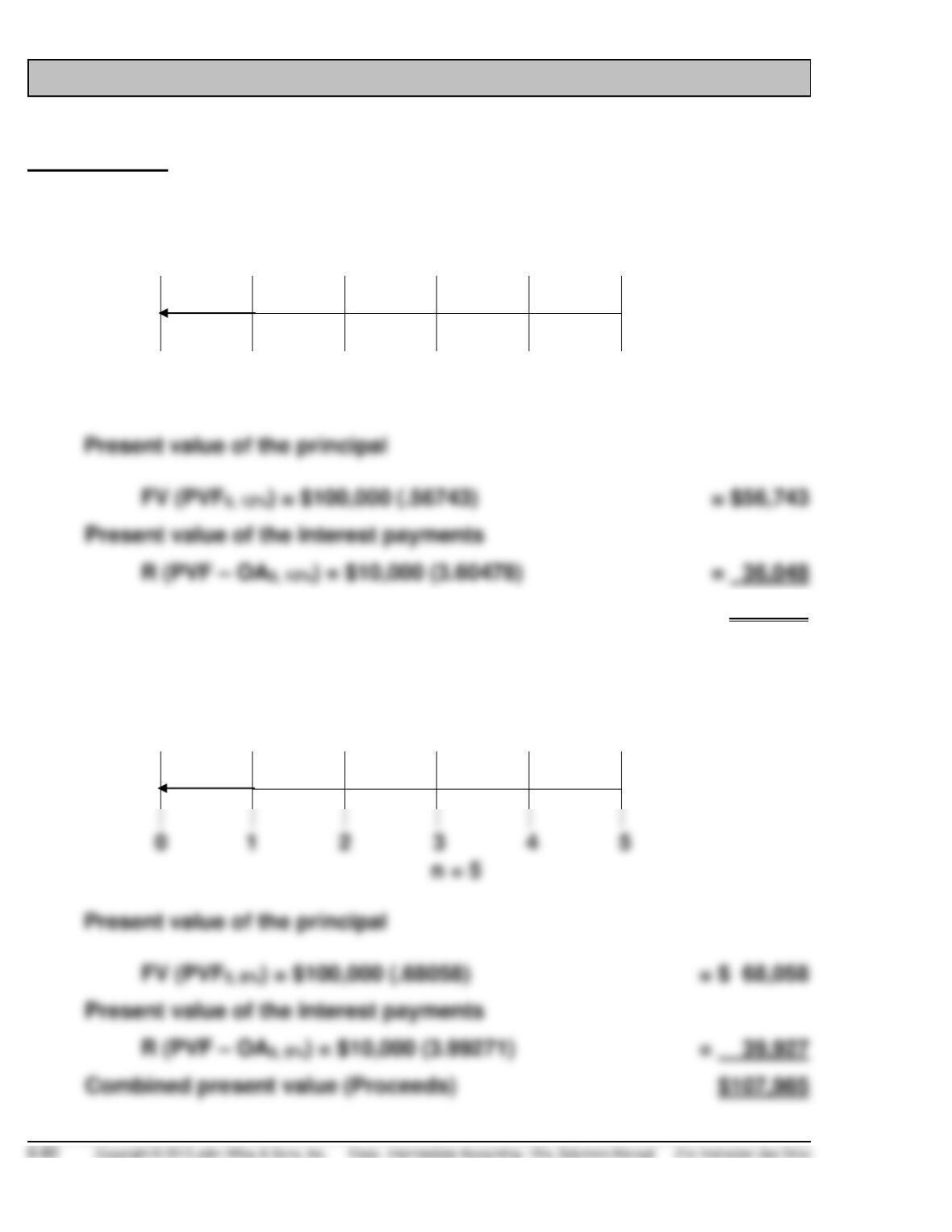
PROFESSIONAL SIMULATION
Measurement
i = 12%
Principal
$100,000
Interest
PV – OA = ? $10,000 $10,000 $10,000 $10,000 $10,000
0 1 2 3 4 5
n = 5
FV (PVF5, 12%) = $100,000 (.56743)
Present value of the interest payments
Combined present value (purchase price)
$92,791
i = 8%
Principal
$100,000
Interest
PV – OA = ? $10,000 $10,000 $10,000 $10,000 $10,000
FV (PVF5, 8%) = $100,000 (.68058)
Present value of the interest payments
Combined present value (Proceeds)
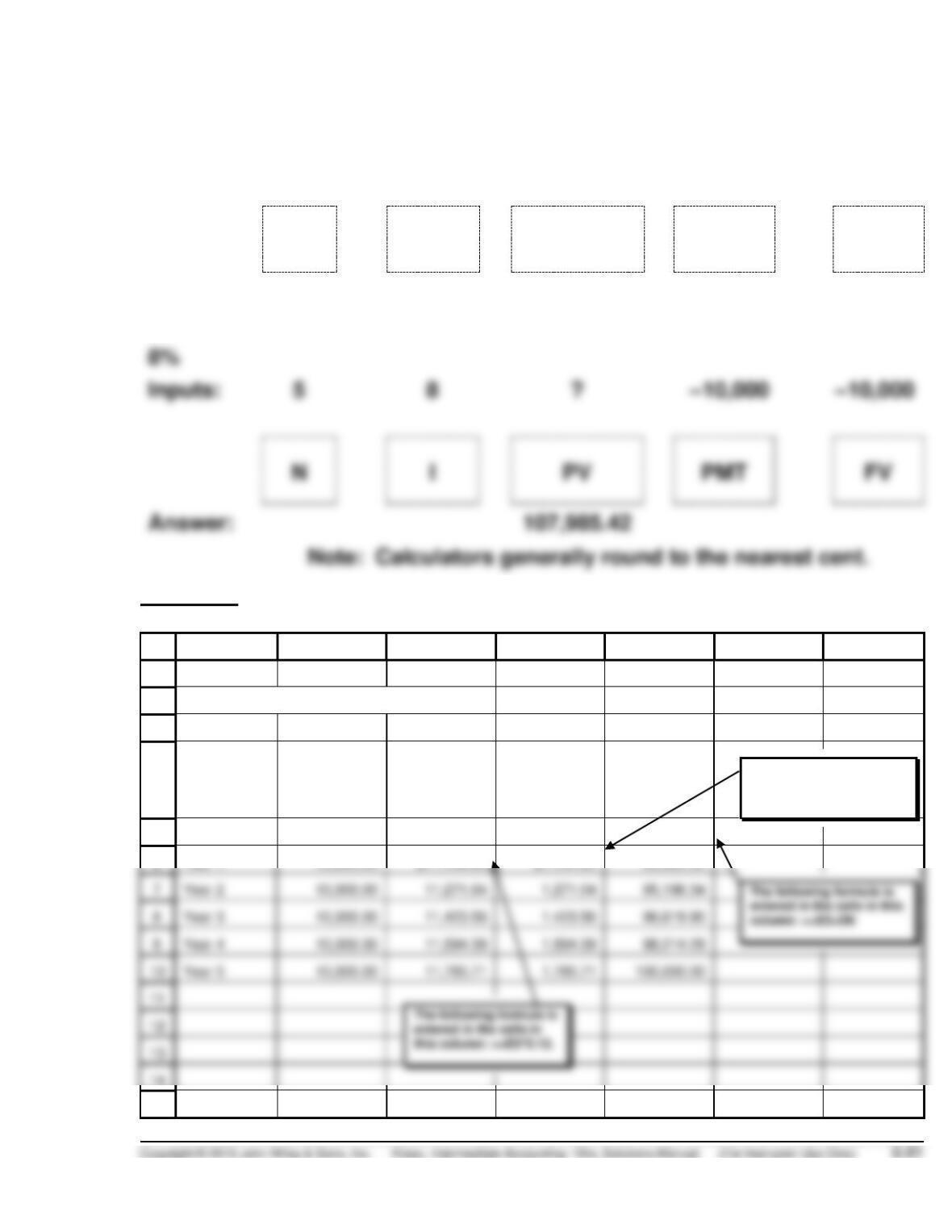
PROFESSIONAL SIMULATION (Continued)
12%
Inputs:
5
12
?
–10,000
–10,000
N
I
PV
PMT
FV
Answer:
92,790.45
Answer:
Valuation
A
B
C
D
E
F
G
1
2
Bond Amortization Schedule
3
4
Date
Cash Interest
Interest
Expense
Bond Discount
Amortization
Carrying
Value of
Bonds
5
Year 0
$92,790.45
6
Year 1
10,000.00
$11,134.85
$1,134.85
93,925.30
7
Year 2
10,000.00
11,271.04
1,271.04
95,196.34
Year 5
10,000.00
11,785.71
1,785.71
100,000.00
14
The following formula is
entered in the cells in
this column: =+E5*0.12.
column: =+E5+D6
15
The following formula is
entered in the cells in this
column: =+C6-B6.