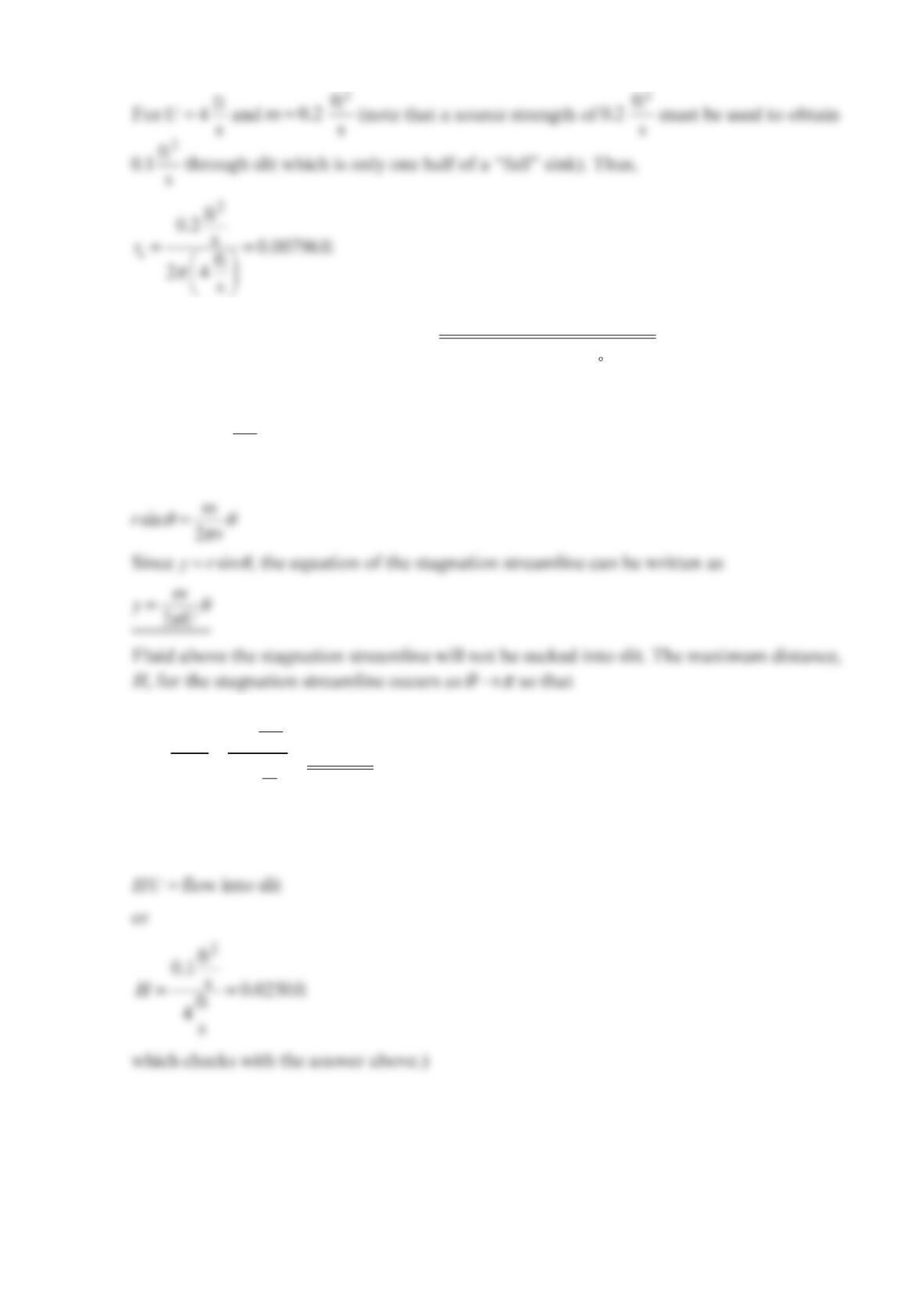
and the stagnation point is on the wall to the righ0.0079 t of 6
t
ft sli .
The value of
ψ
at the stagnation point (r = 0.00796 ft, 0
θ
=) is zero [Eq. (1)] so that the
equation of the stagnation streamline is:
0sin
2
m
Ur
θ
θ
π
=−
or
2
ft
0.2 s0.0250 ft
ft
224
s
m
HU
π
π
== =
(Note: All the fluid below the stagnation streamline must pass through the slit. Thus, from
conservation of mass
Problem 6.43
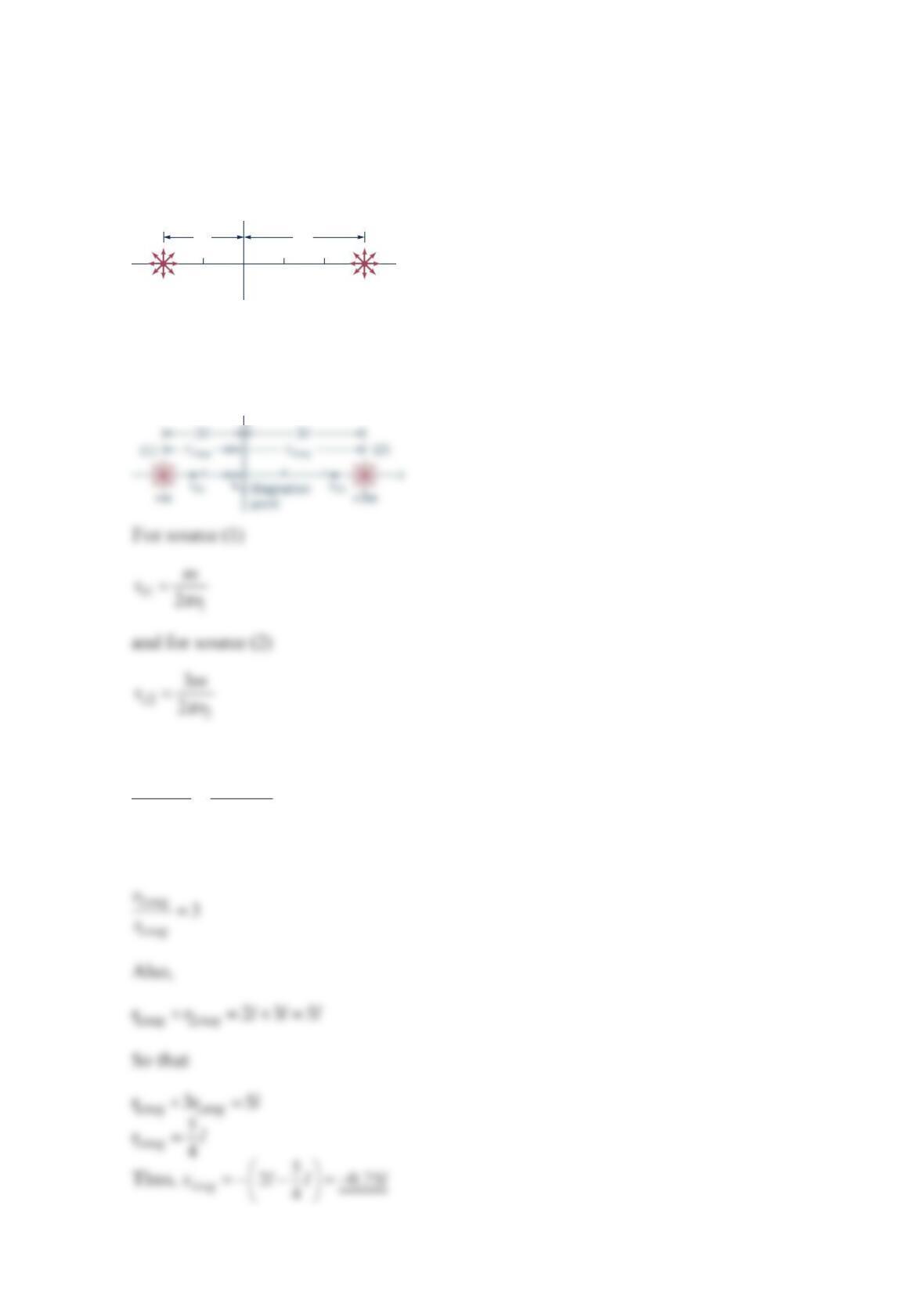
Two sources, one of strength m and the other with strength 3
m
, are located on the x axis as
shown in the figure below. Determine the location of the stagnation point in the flow
produced by these sources.
Solution 6.43
Since the flow from each source is in the radial direction, it is only along the x-axis that the
two radial components can cancel and create a stagnation point.
The stagnation point occurs where 12rr
v
v= so that
12
3
22
stag stag
mm
rr
ππ
=
and
2ℓ3ℓ
+
m
+3
m
x
y
y
Problem 6.44
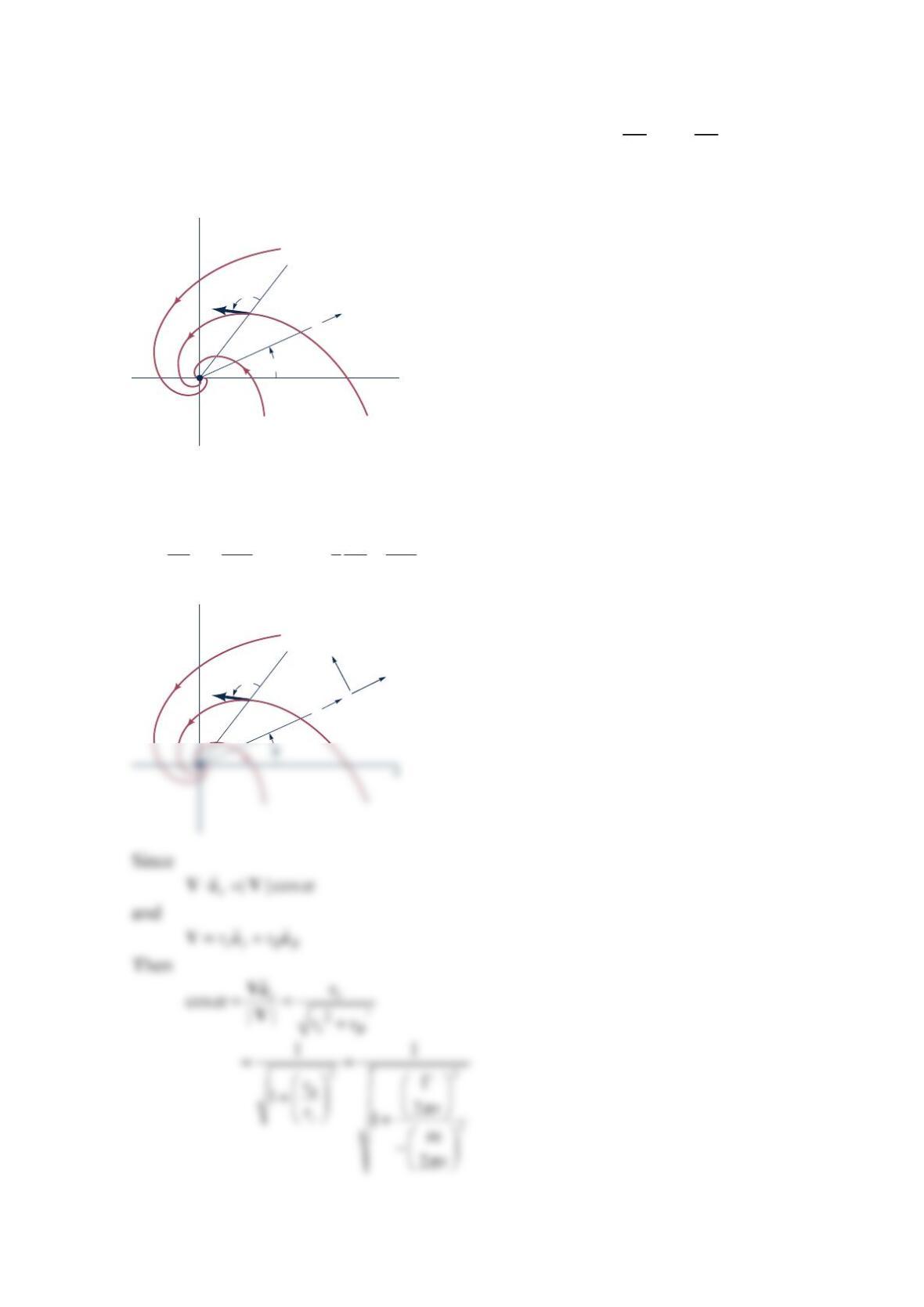
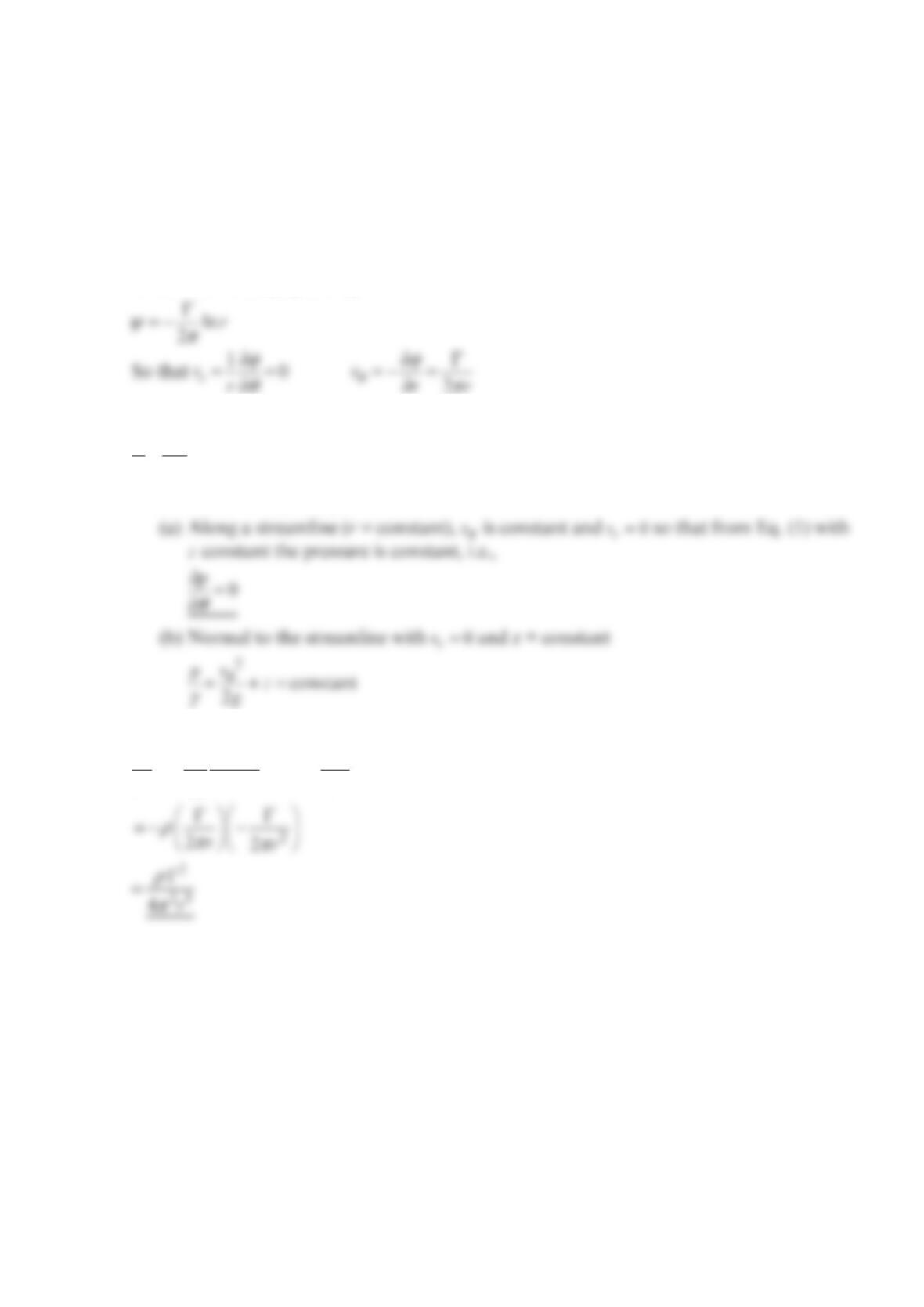
The velocity potential for a spiral vortex flow is given by ln
22
mr
φθ
ππ
Γ
=−
, where
Γ
and m are constants. Show that the angle,
α
, between the velocity vector and the radial di-
rection is constant throughout the flow field (see the figure below).
Solution 6.44
For the velocity potential given,
r2
m
vrr
φ
π
∂
==−
∂ 1
2
vrr
θ
φ
θπ
∂Γ
==
∂
y
r
x
V
θ
α
y
r
V
α
e
ˆ
θ
e
r
ˆ
Problem 6.45
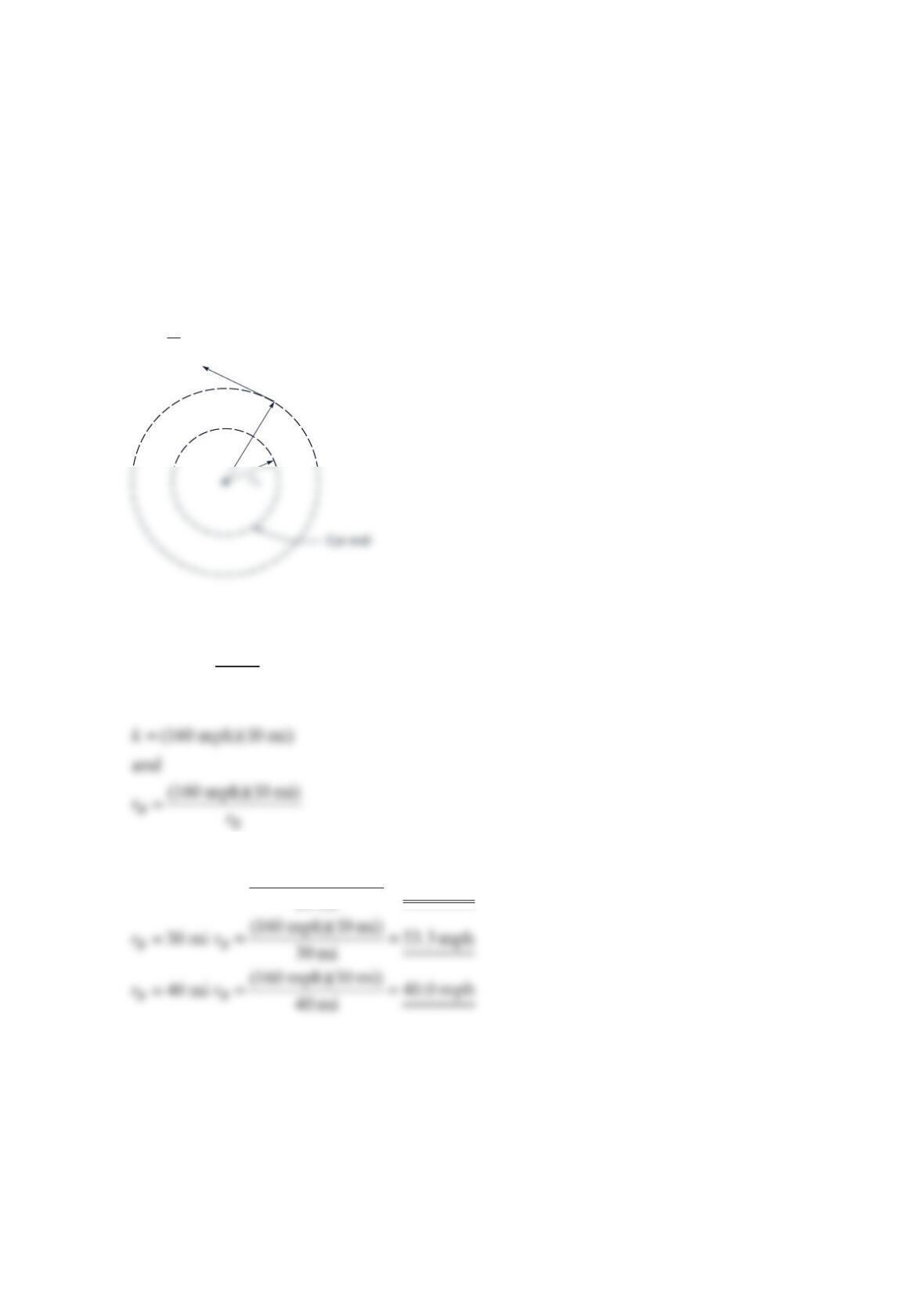
For a free vortex, determine an expression for the pressure gradient (a) along a streamline,
and (b) normal to a streamline. Assume that the streamline is in a horizontal plane, and
express your answer in terms of the circulation.
Solution 6.45
For a free vortex [Eq. (6.91)]:
Since the free vortex represents an irrotational flow field, the Bernoulli equation
2
constant
2
pV z
g
γ
++= (1)
is valid between any two points.
So that
2
()
2
vv
pv
rgr r
θθ
θ
γρ
∂∂
∂=− =−
∂∂ ∂
Problem 6.46
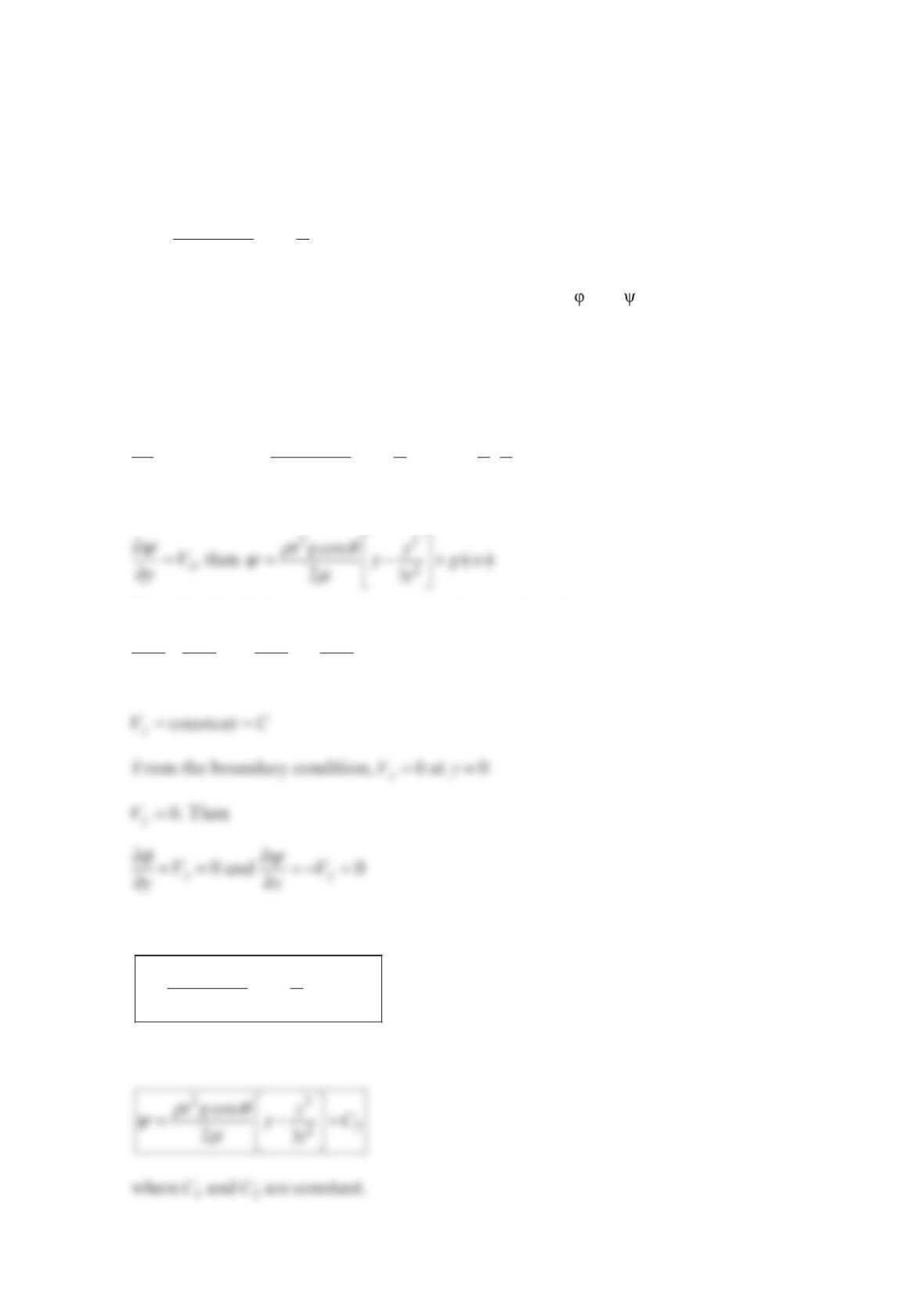
Consider a category five hurricane that has a maximum wind speed of
1
60 mph at the eye
wall,
1
0m
i
from the center of the hurricane. If the flow in the hurricane outside of the hur-
ricane’s eye is approximated as a free vortex, determine the wind speeds at locations 20 m
i
,
30 mi , and 40 m
i
from the center of the storm.
Solution 6.46
For free vortex
k
vr
θ
=
Thus, at the eye wall
1
60 mph =10 mi
k
So that
For,
20 mi
B
r= (160 mph)(10 mi) 80.0 mph
20 mi
v
θ
==
v
r
B
V
θ
Problem 6.47
Consider the flow of a liquid of viscosity
µ
and density
ρ
down an inclined plate making an
angle
θ
with the horizontal. The film thickness is
t
and is constant. The fluid velocity paral-
lel to the plate is given by
2
2cos 1
2
x
tg y
Vt
ρθ
µ
=−
,
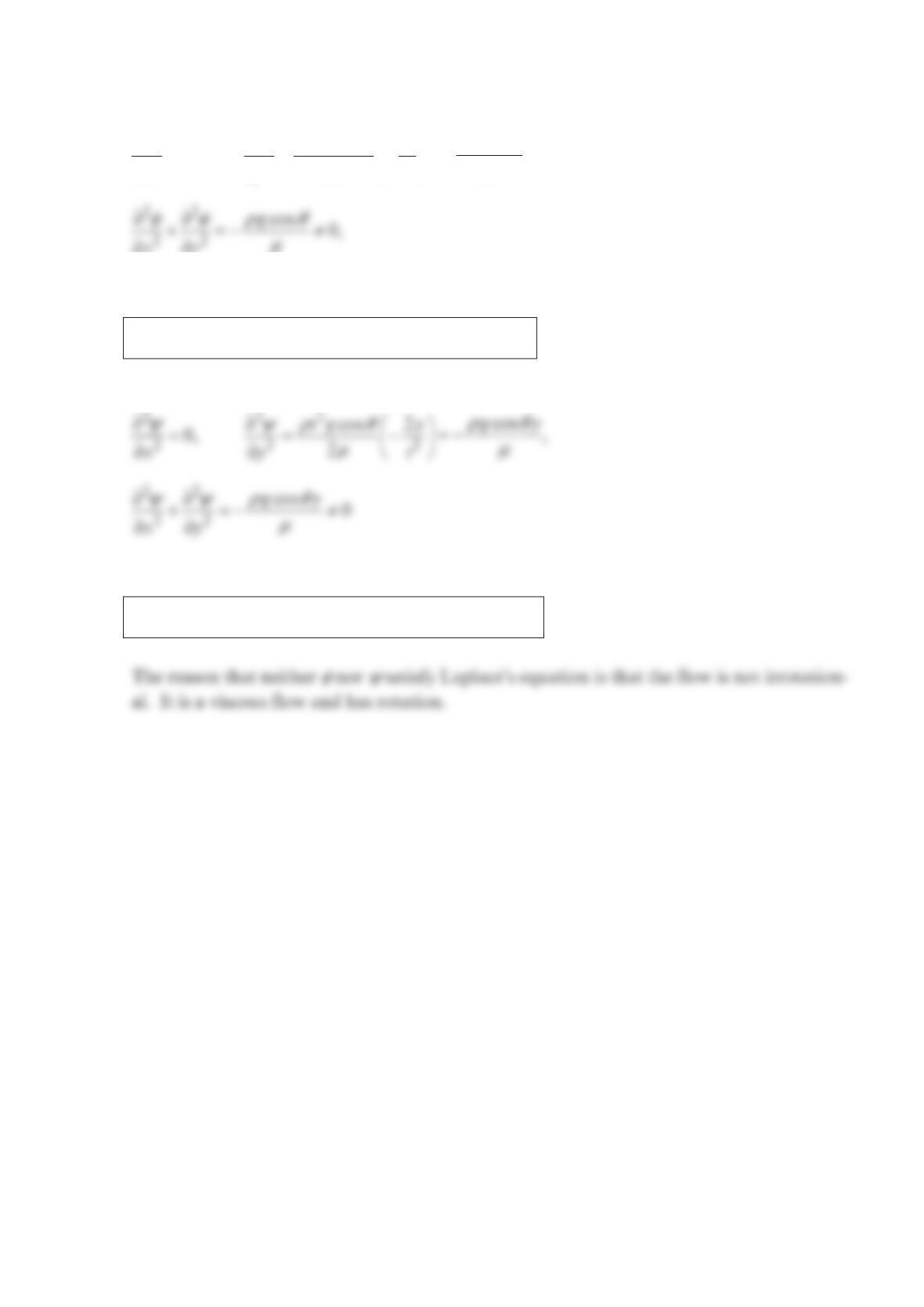
where y is the coordinate normal to the plate. Calculate and for this flow and show that
neither satisfies Laplace’s equation. Why not?
Solution 6.47
Since
x
V
x
φ
∂=
∂, then
2
2cos 1(
2
tg y xf
t
ρθ
φµ
=−+
)y
Since
Since the density is constant, the continuity equation gives
0
y
xV
V
xy
∂
∂+=
∂∂ , 0
yx
VV
y
x
∂∂
=− =
∂∂
,
or
ψ
Then
2
2
1
cos 1
2
tg y xC
t
ρθ
φµ
=−+
And
ψ
Then
2
20
x
φ
∂=
∂
,
22
22
cos 2
2
tg
yt
φρ θ
µ
∂
=−
∂
cosg
ρθ
µ
=
−,
xy
∂∂ ,
and
φ
does not satisfy Laplace’s equation for this flow.
Next,
∂
and
ψ
does not satisfy Laplace’s equation for this flow.
Problem 6.48
A horizontal oil-hearing stratum is m3 high and, after hydraulic fracturing (“fracking”),
provides a volume flowrate of
3
m
1000 hr
Q=
. The flow moves radially inward and is collected
by a vertical porous pipe having an outer radius of 1.0 m . The Laplace equation for the po-
tential flow model of the oil is
22 2
2222
11
0
rrrr
φφ φ
θ
∂∂ ∂
++ =
∂∂ ∂
.
Find
φ
.
Solution 6.48
Start with
22 2
2222
11
0
rrrr
φφ φ
θ
∂∂ ∂
++ =
∂∂ ∂
or
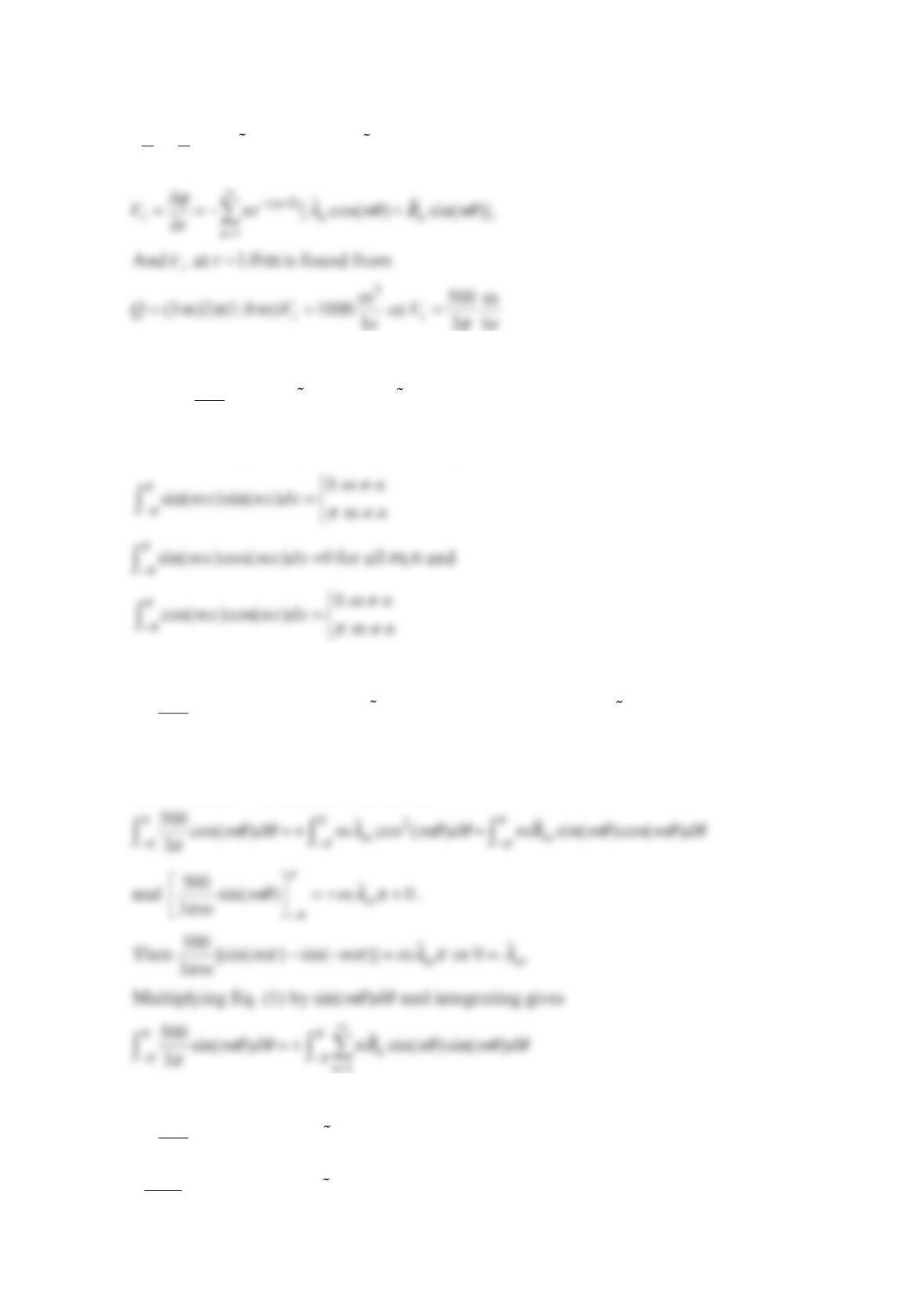
Use separation of variables with
φ
θ
=
θ
Substituting gives
Then
2(dP )
θ
2
2(P
d
λ
θ
+)
θ
0=,
2
2(dR
r)r
2
(dR
r
dr +)r2(R
dr
λ
−)r0=,
(P)
θ
cos( ) sin( )AB
λθ λθ
=+
, and (
R
)rCr Dr
λ
λ
−
=+
One boundary condition is 0
r
V
→ as
r
→
∞ and gives
r
→
R
Then
(
φ
,)r
θ
0
cos( ) sin( )
kk
nn
n
Ar n Br n
θθ
∞−−
=
=+
,
Which is negative because flow is inward.
Then
1
500 [ cos( ) sin( )]
3n
n
nA n Bn n
θθ
π
∞
=
−
=− +
(1)
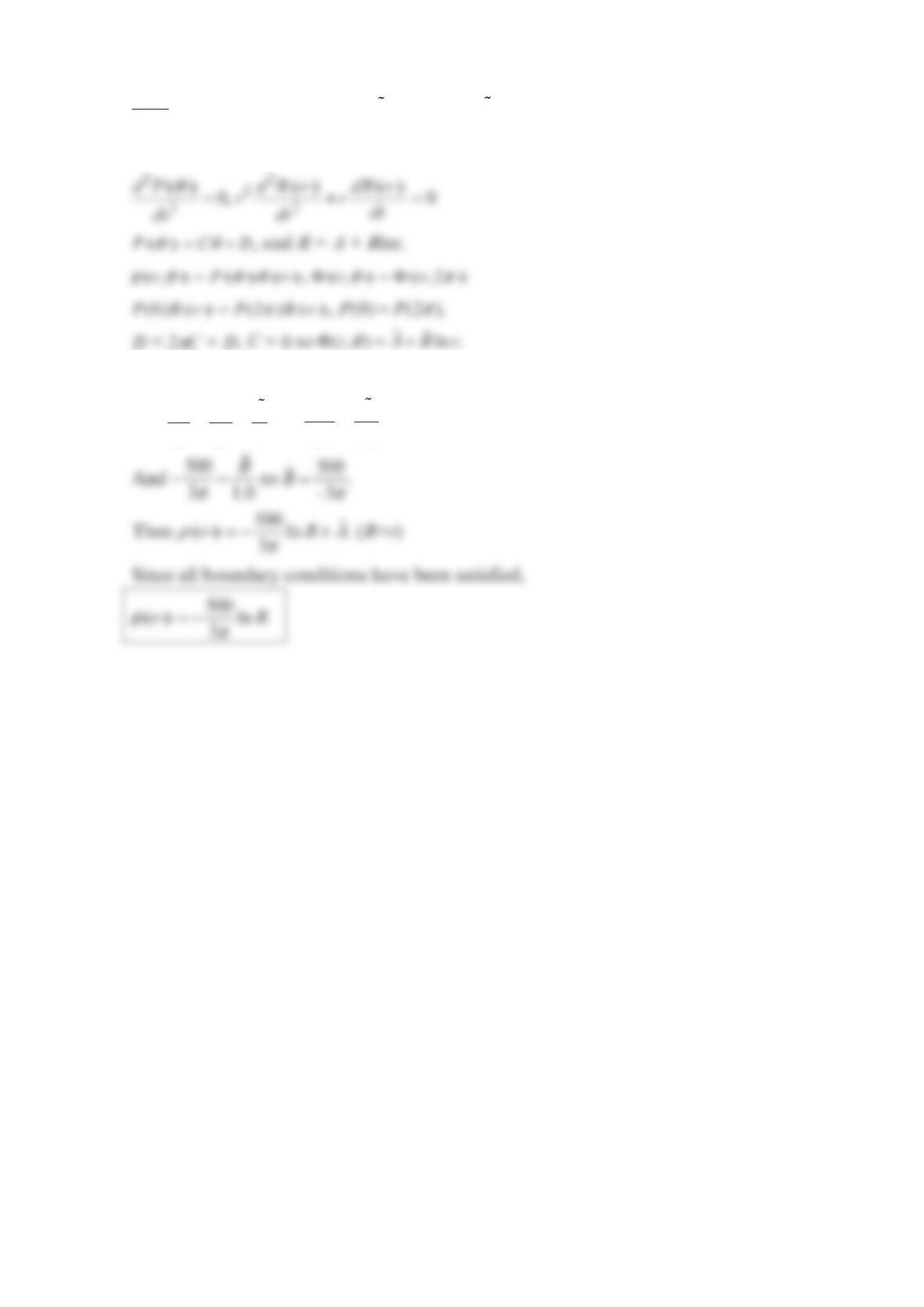
Use the orthogonality property of the trig functions where
Multiplying Eq. (1) by
c
os( )md
θ
θ
and integrating gives
11
500 cos( ) cos( )cos( ) sin( )cos( )
3nn
nn
md nA n md nB n md
ππ π
ππ π
θθ θ θθ θ θ
θ
π
∞∞
−− −
==
=+ +
Note that
n
m=
where
1m≤≤
∞
in discrete intervals so
Again note that
n
m= where
1m≤≤
∞
in discrete intervals so
2
500 sin( ) sin ( )
3n
md mB md
ππ
ππ
θθ θ
θ
π
−−
=+
, and
500 cos( )]
3mmBm
m
ππ
θπ
π
−
−
=+
500 [cos( ) cos( )]
3m
mmmB
m
ππ
π
π
−=−
, and 0m
B=
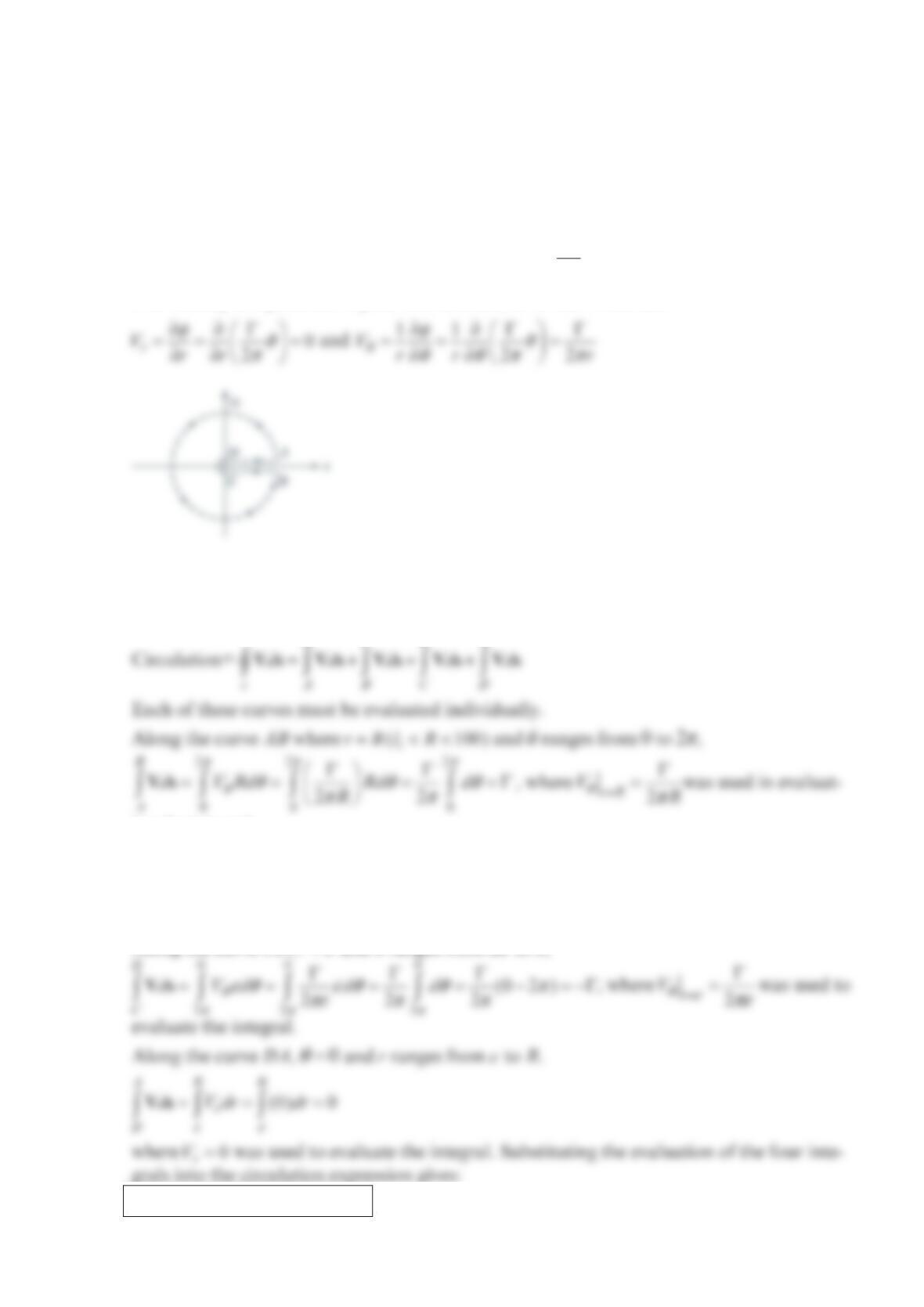
Now let us check the case for
0
λ
=
Now
r
dB
V
rdrr
φφ
∂
===
∂, 500
31.0
B
π
=
−=
at 1.0r=
−
Problem 6.49
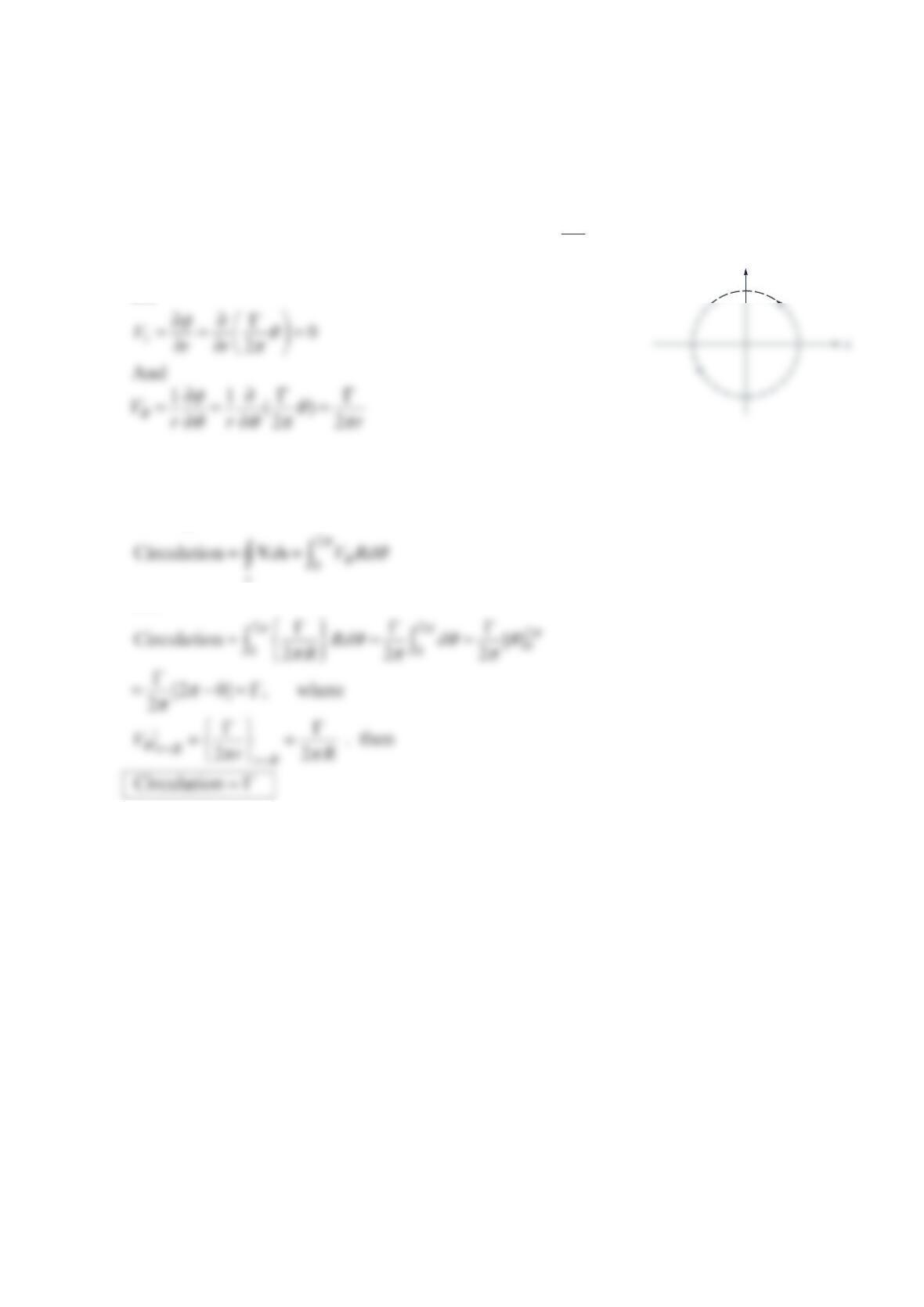
Show that the circulation of a free vortex for any closed path that does not enclose the
origin is zero.
Solution 6.49
The velocity potential for a free vortex is given by 2
φθ
π
Γ
=
The velocity components, in polar coordinates, for a free vortex are
A closed curve
C
, not enclosing the origin, is defined as shown in the sketch, in order to
more easily evaluate the integrals in the circulation expression.The circulation about the
closed curve
C
is given by
θ
π
BC D A
ing the integral.
Along the curve BC where 2
θπ
= and r ranges from
R
to ( 1
)
ε
ε
<< ,
(0) 0
C
r
BR R
d V dr dr
εε
== =
Vs where 0
r
V
= was used.
Along the curve
C
D,
r
ε
= and
θ
ranges from 2
π
to
θ
,
Circulation 0 0 0=Γ+ −Γ+ =
Problem 6.50
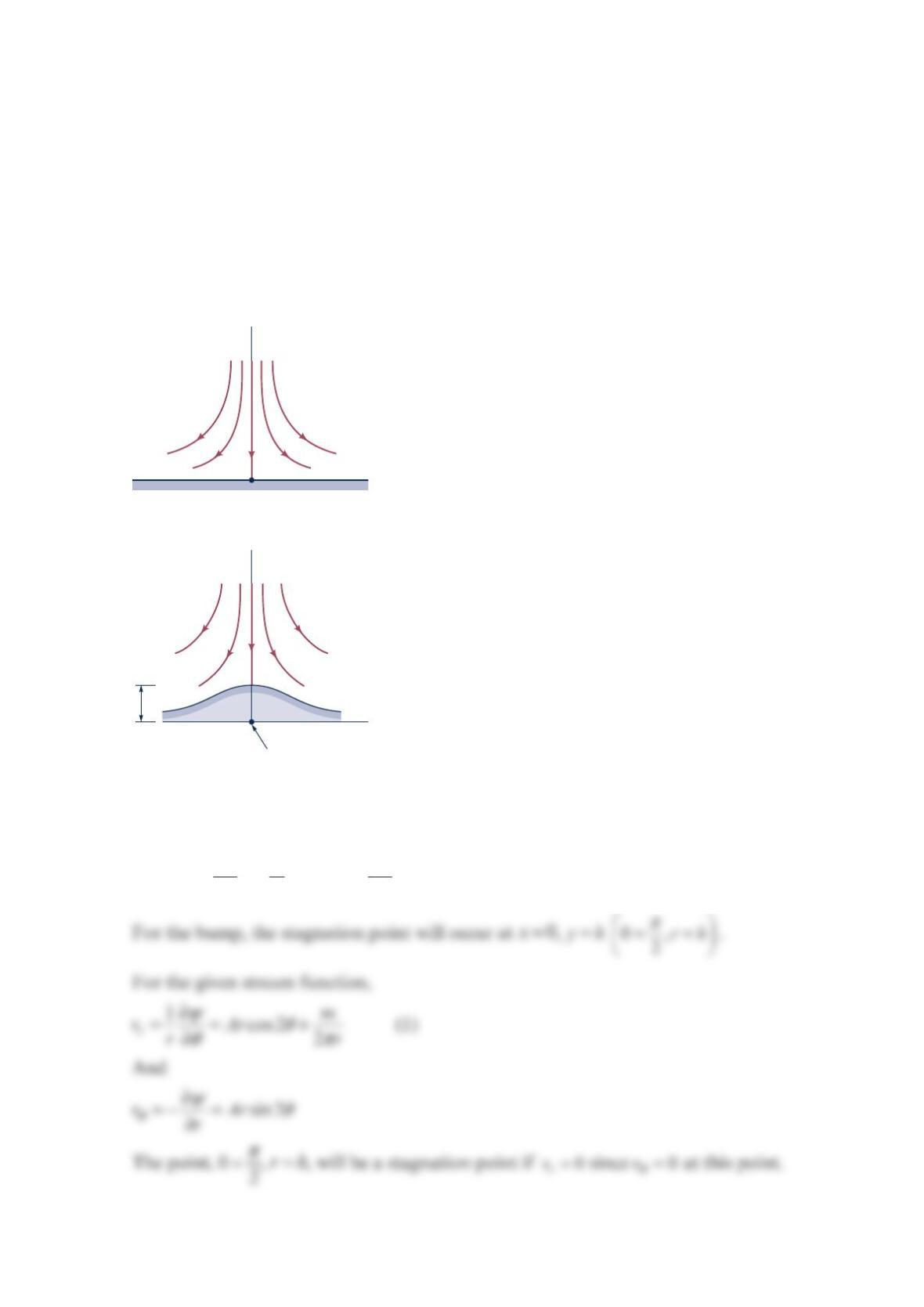
Show that the circulation of a free vortex for any closed path that encloses the origin is
Γ
.
Solution 6.50
The velocity potential for a free vortex is given by ()
2
φ
θ
π
Γ
=
The velocity components, in polar coordinates, for a free vortex
are
A closed curve
C
with radius
R
(
0
)
R<<∞ is defined as shown above, a circle with its center
located at the origin. This curve was chosen in order to simplify the integral in the circula-
tion expression, which is
and
iy
Problem 6.51
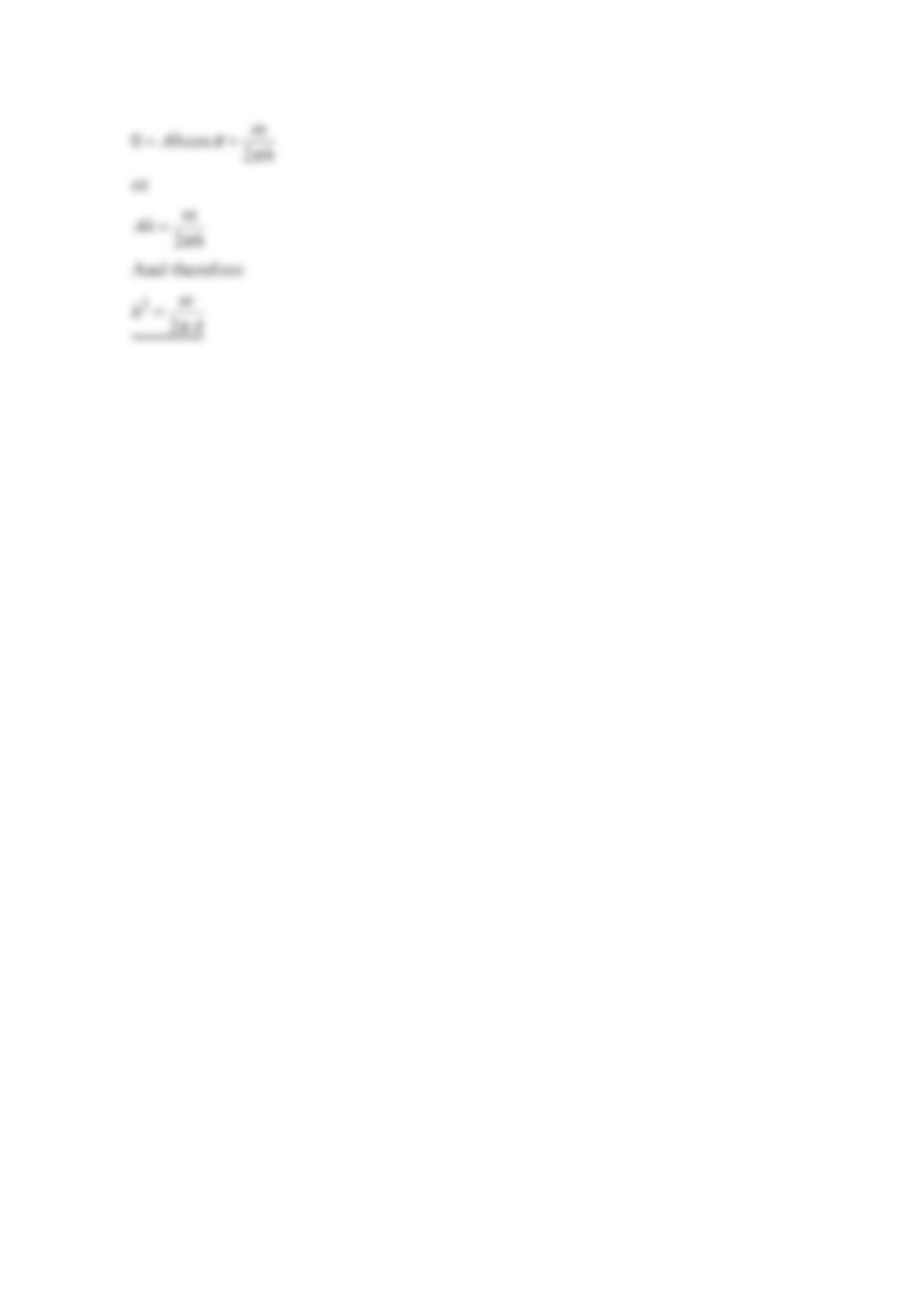
Potential flow against a flat plate (the figure below (a)) can be described with the stream
function
Axy
ψ
=
where A is a constant. This type of flow is commonly called a stagnation point flow since it
can be used to describe the flow in the vicinity of the stagnation point at
O
. By adding a
source of strength m at
O
, stagnation point flow against a flat plate with a“bump” is ob-
tained as illustrated in the figure below(b). Determine the relationship between the bump
height, h, the constant, A, and the source strength, m.
Solution 6.51
2sin 2
22 2
mA m
Axy r
ψ
θθ
θ
ππ
=+ = +
y
x
O
(
a
)
y
x
(
b
)
Source
h
Thus, from Eq. (1)
Problem 6.52
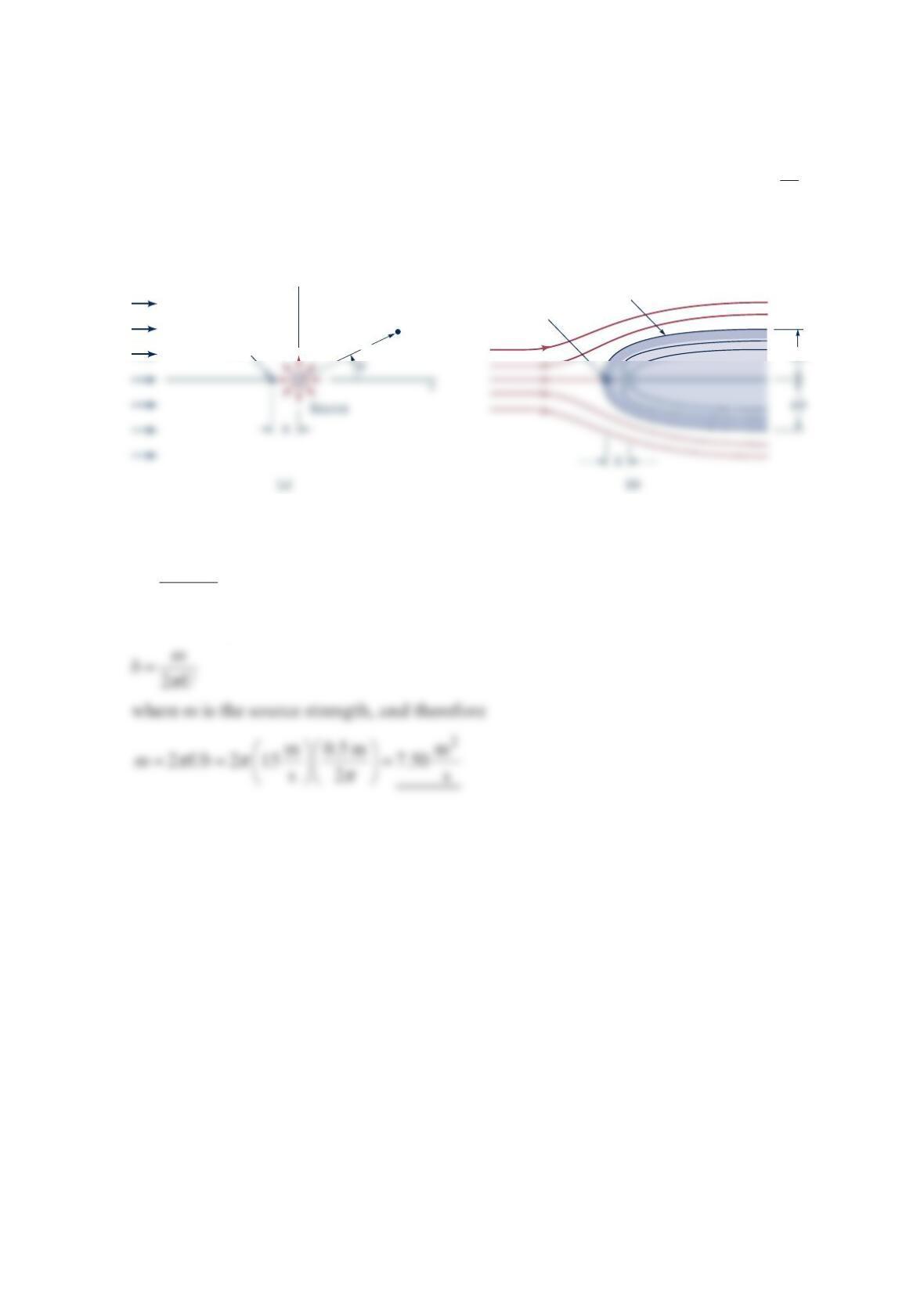
The combination of a uniform flow and a source can be used to describe flow around a
streamlined body called a half-body. Assume that a certain body has the shape of a half-
body with a thickness of 0.5
m
. If this body is placed in an airstream moving at 15 m
s, what
source strength is required to simulate flow around the body?
Solution 6.52
The width of half-body 2b
π
=
so that
(0.5 m)
2
b
π
=
From the equation
b
U
Stagnation
point
y
r
b
Stagnation point
= bU
ψπ
π
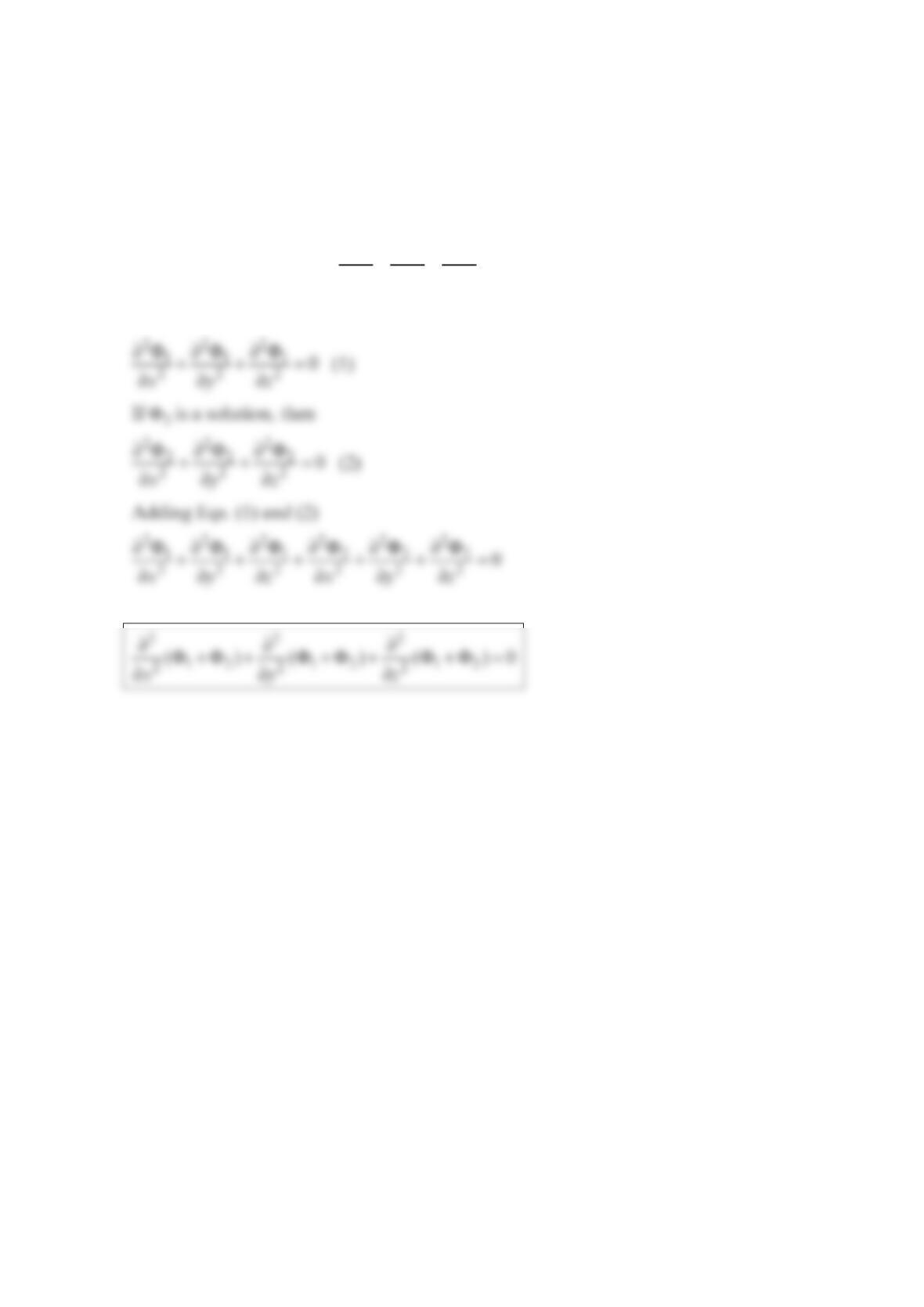
Problem 6.53
Show that if 1
Φ
and 2
Φ
are both solutions of Laplace’s equation, the sum 12
(
)Φ+Φ is also a
solution.
Solution 6.53
Laplace’s equation in
Φ
is
222
222
0
xyz
∂Φ ∂Φ ∂Φ
++=
∂∂∂
If 1
Φ
is a solution, then
And
Therefore the sum 12
(
)Φ+Φ is also a solution of Laplace’s equation.
Φ
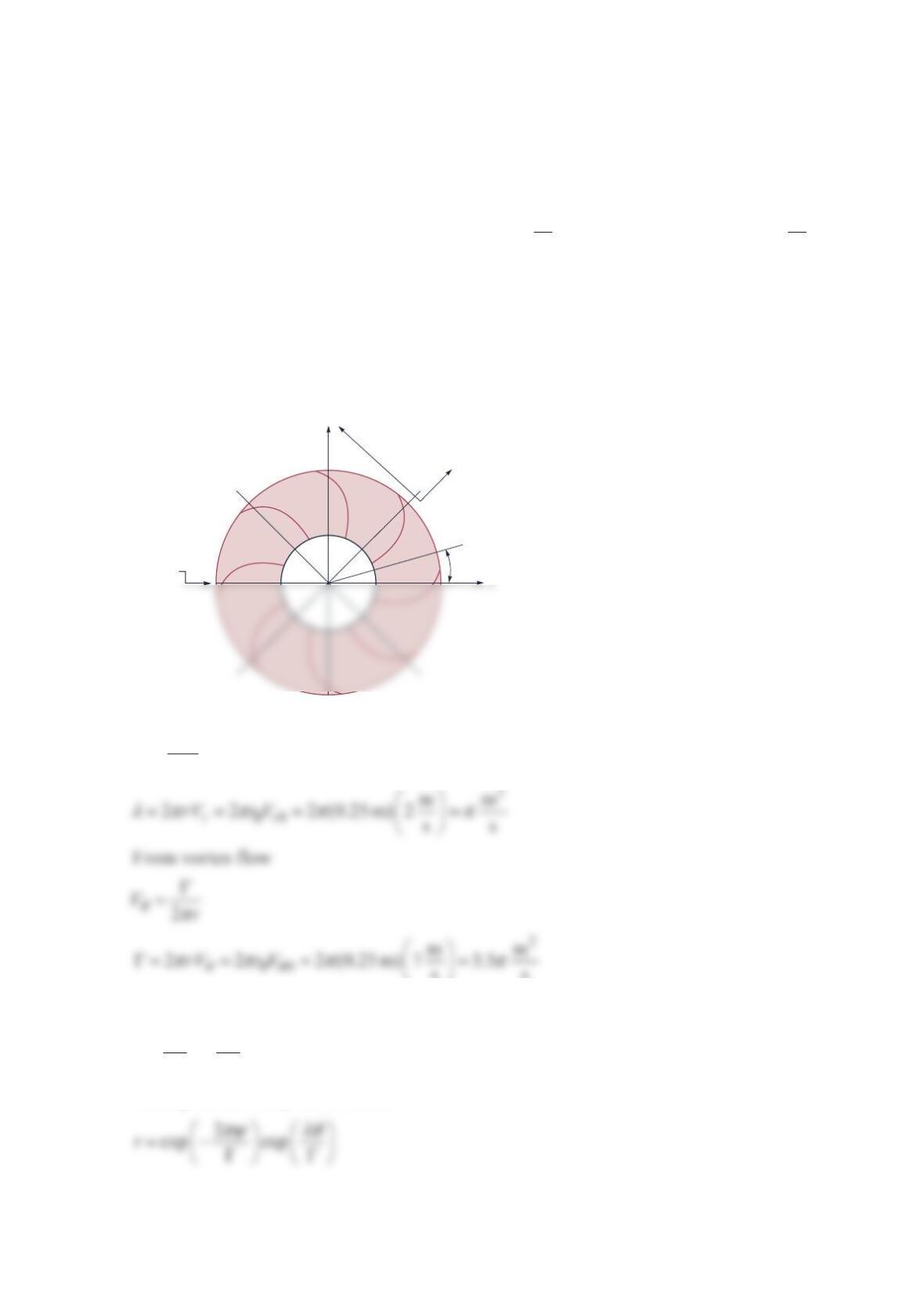
Problem 6.54
The flow in the impeller of a centrifugal pump is modeled by the superposition of a source
and a free vortex. The impeller has an outer diameter of 0.5
m
and an inner diameter of
0.3
m
. At the outlet from the impeller, the flowing water has the following velocity compo-
nents, relative to the impeller: radial component 2 m
s and tangential component 7 m
s.
(a) Find the strength of the source and the vortex required to model this flow.
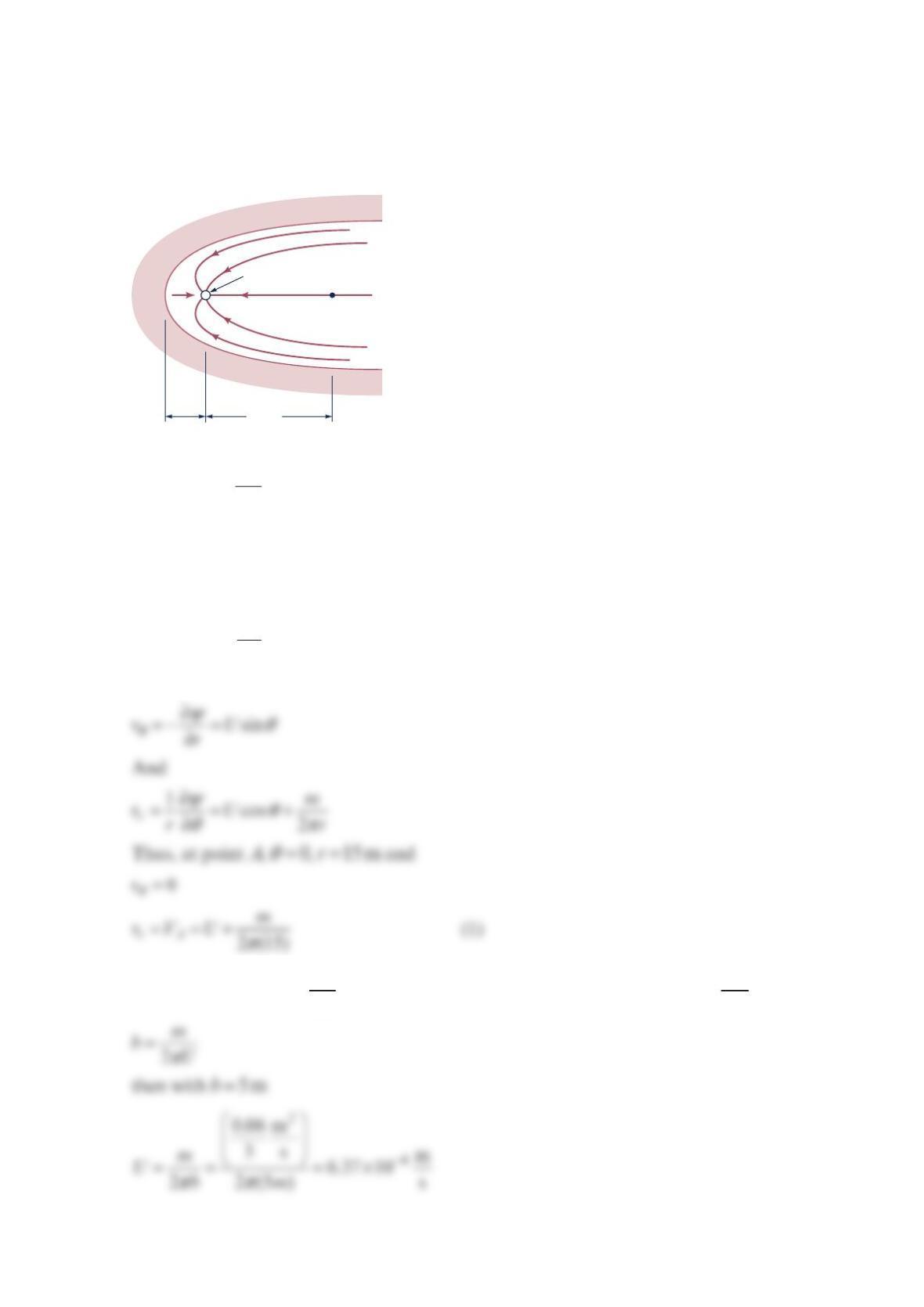
(b) Assume that the impeller blades are shaped like the streamlines and plot an impeller
blade shape.
(c) Find the radial and tangential components of velocity at the inlet to the impeller.
Solution 6.54
(a) From source flow
2
r
V
r
λ
π
=
ss
(b) From the equation
ln
22
r
λ
ψ
θ
ππ
Γ
=−
The equation of any streamline is
y
V
r
V
θ
θ
Outlet “O”
V
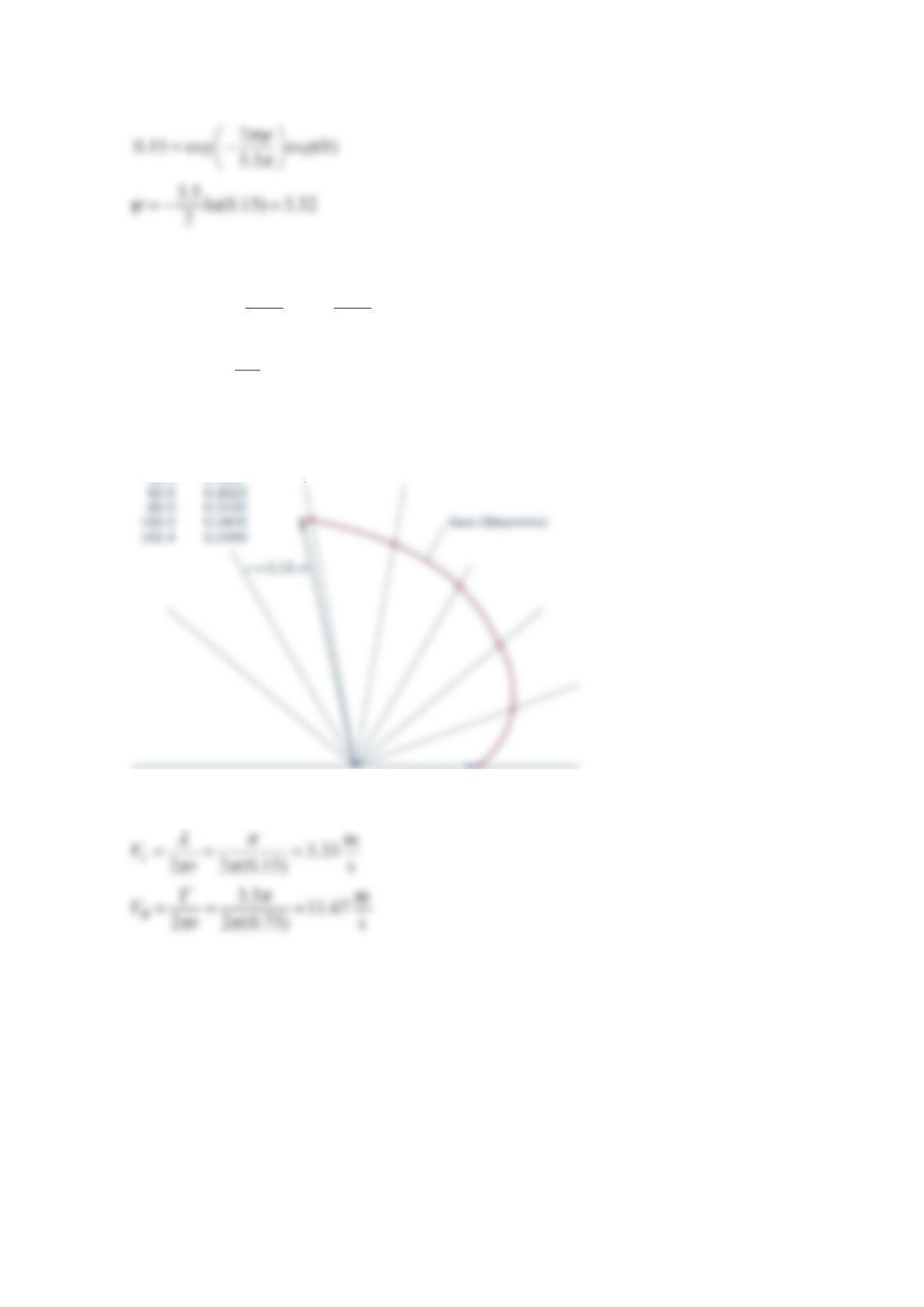
Consider the streamline with 0.1m
i
rr==
at
0
θ
=
The equation of this streamline is
2
exp 3.32 exp
3.5 3.5
r
ππ
θ
ππ
=−
0.15exp 3.5
r
θ
=
(c) At inlet ( i ) 0.15 m
i
r=
theta
(deg)
r
(meters)
0.0
20.0
0.1500
0.1657
r
= 0.15 m
Problem 6.55
One end of a pond has a shoreline that resembles a half-body as shown in the figure below.
A vertical porous pipe is located
near the end of the pond so that water can be pumped out. When water is pumped at the
rate of 0.008
3
m
s through a 3-m-long pipe, what will be the velocity at point
A
?
Hint: Consider the flow inside a half-body.
Solution 6.55
For a half-body,
sin 2
m
Ur
ψ
θ
θ
π
=+
So that
For a flowrate of 0.06
3
m
sin in a 3-m long pipe, the source strength is 0.06/3
2
m
s
. Since
A
Pipe
5 m 15 m
A