Problem 6.70
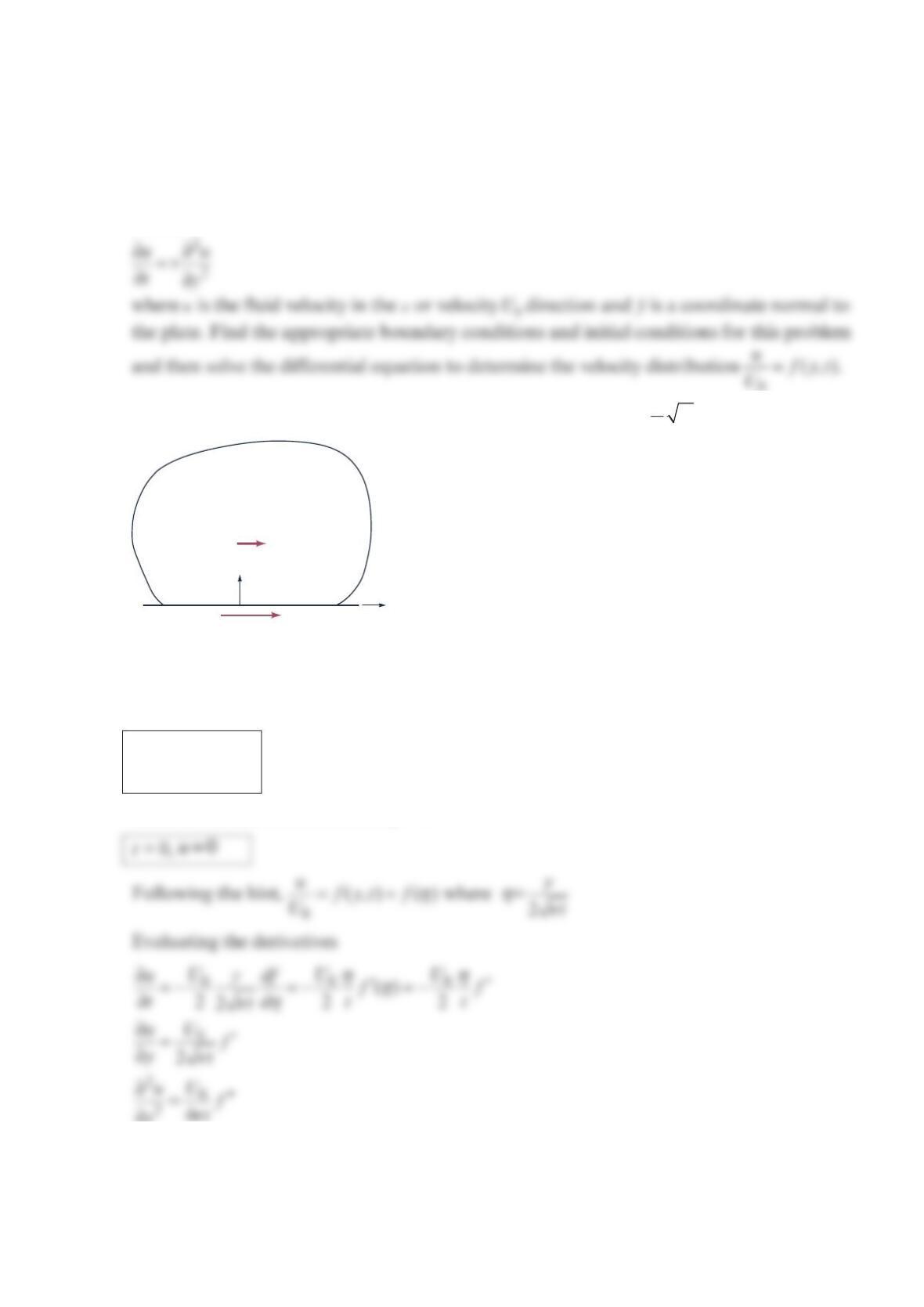
“Stokes’s first problem” involves the instantaneous acceleration at time 0t= of a flat plate
to a constant velocity 0
U while in contact with a “semi-infinite,” static fluid as shown in the
figure below. For a constant fluid density and viscosity, the simplified Navier–Stokes equa-
tion is
Hint: Assume that
f
is a function of a single variable
η
where 2
y
vt
η
= .
Solution 6.70
There are two boundary conditions for
0
t>
0
y
=, 0
uU=
y
=
∞
, 0u=
There is one initial condition for 0
y
>
y
∂
“Semi-infinite” fluid
Plate
t ≤ 0, u = 0
U
0
u
(
y, t
)
y
x
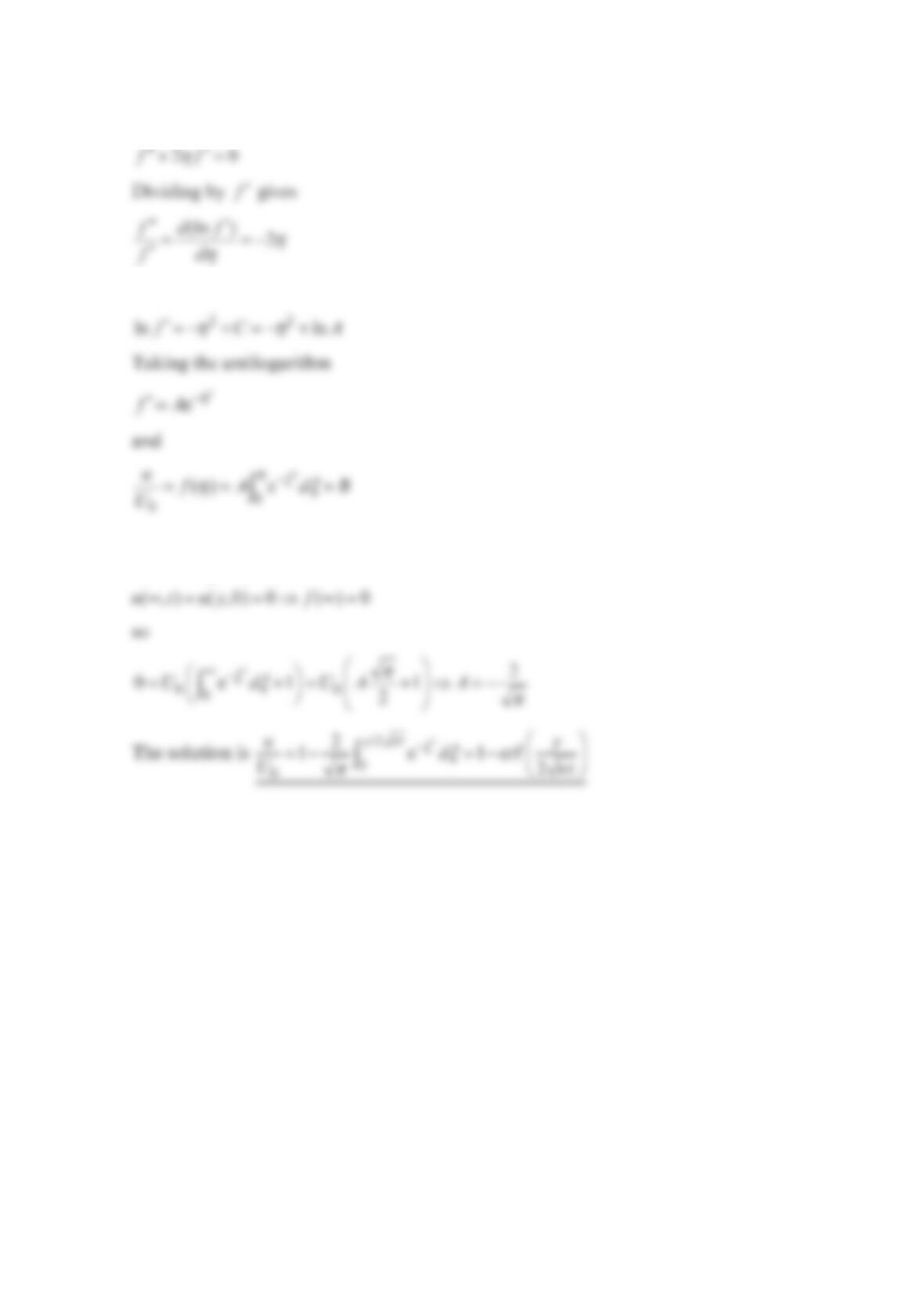
Substituting into the differential equation, collecting terms and assuming 0t≠ so that t may
be cancelled gives
Integrating gives
The boundary conditions give
0
(0, ) (0) 1
utU f
==
Problem 6.71
Oil (SAE 30) at 15.6 °C flows steadily between fixed, horizontal, parallel plates. The pres-
sure drop per unit length along the channel is kPa
3
0m, and the distance between the plates is
4mm. The flow is laminar. Determine: (a) the volume rate of flow (per meter of width),
(b) the magnitude and direction of the shearing stress acting on the bottom plate, and
(c) the velocity along the centerline of the channel.
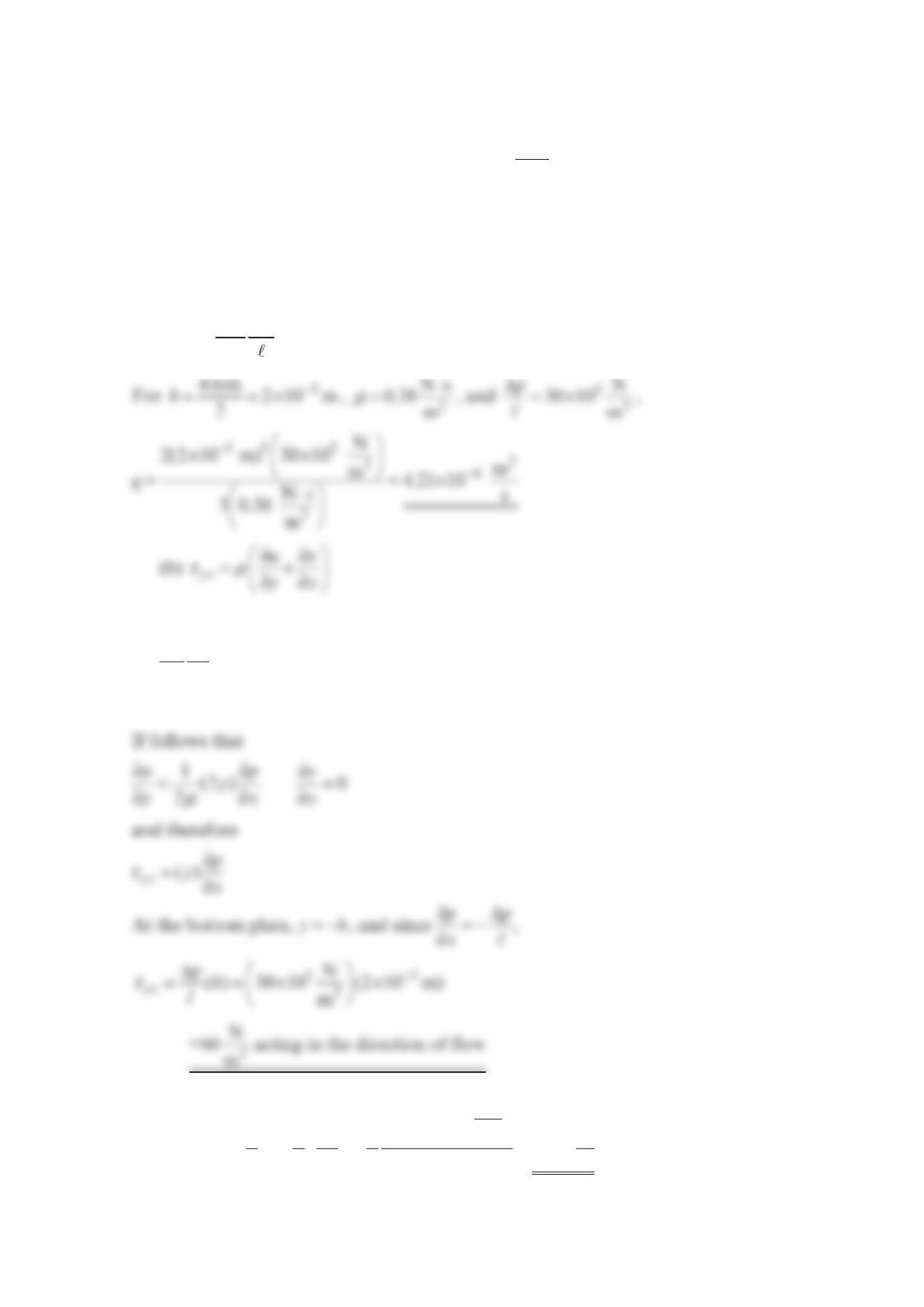
Solution 6.71
(a)
3
2
3
hp
q
µ
Δ
=
Since
22
1()
2
p
uyh
x
µ
∂
=−
∂
and 0v=
(c)
2
4
max 3
m
4.21 10 s
33 3 m
0.158
222 2 s
(2)(2 10 m)
q
uVh
−
−
×
== = =
×
Problem 6.72
Two fixed, horizontal, parallel plates are spaced 0.4 in. apart. A viscous liquid
(3
2
lb s
810 ft
µ
−⋅
=× , 0.
9
SG =) flows between the plates with a mean velocity of ft
0.5 s. The
flow is laminar. Determine the pressure drop per unit length in the direction of flow. What
is the maximum velocity in the channel?
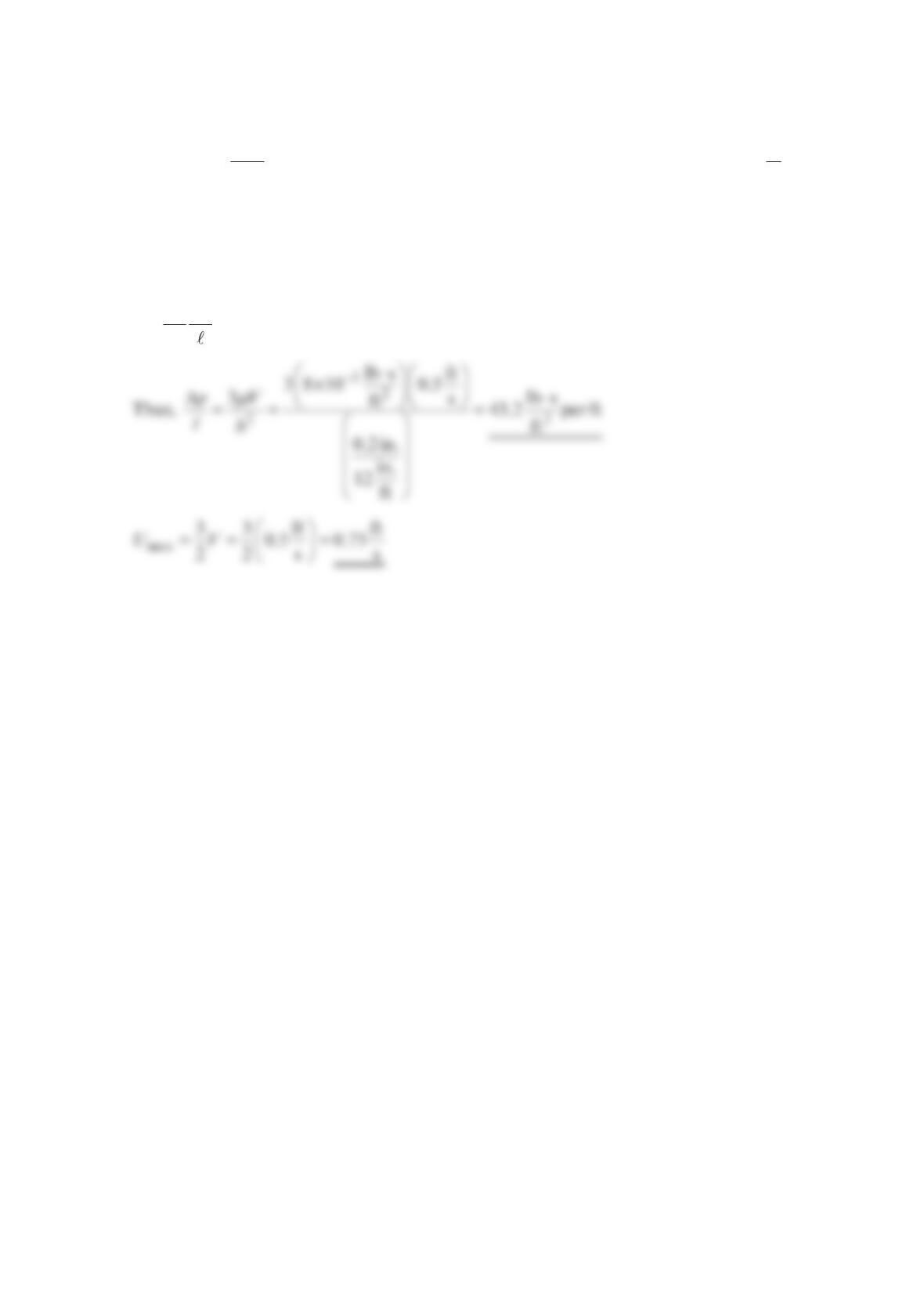
Solution 6.72
2
3
hp
V
µ
Δ
=
Problem 6.73
A liquid of constant density
ρ
and constant viscosity
µ
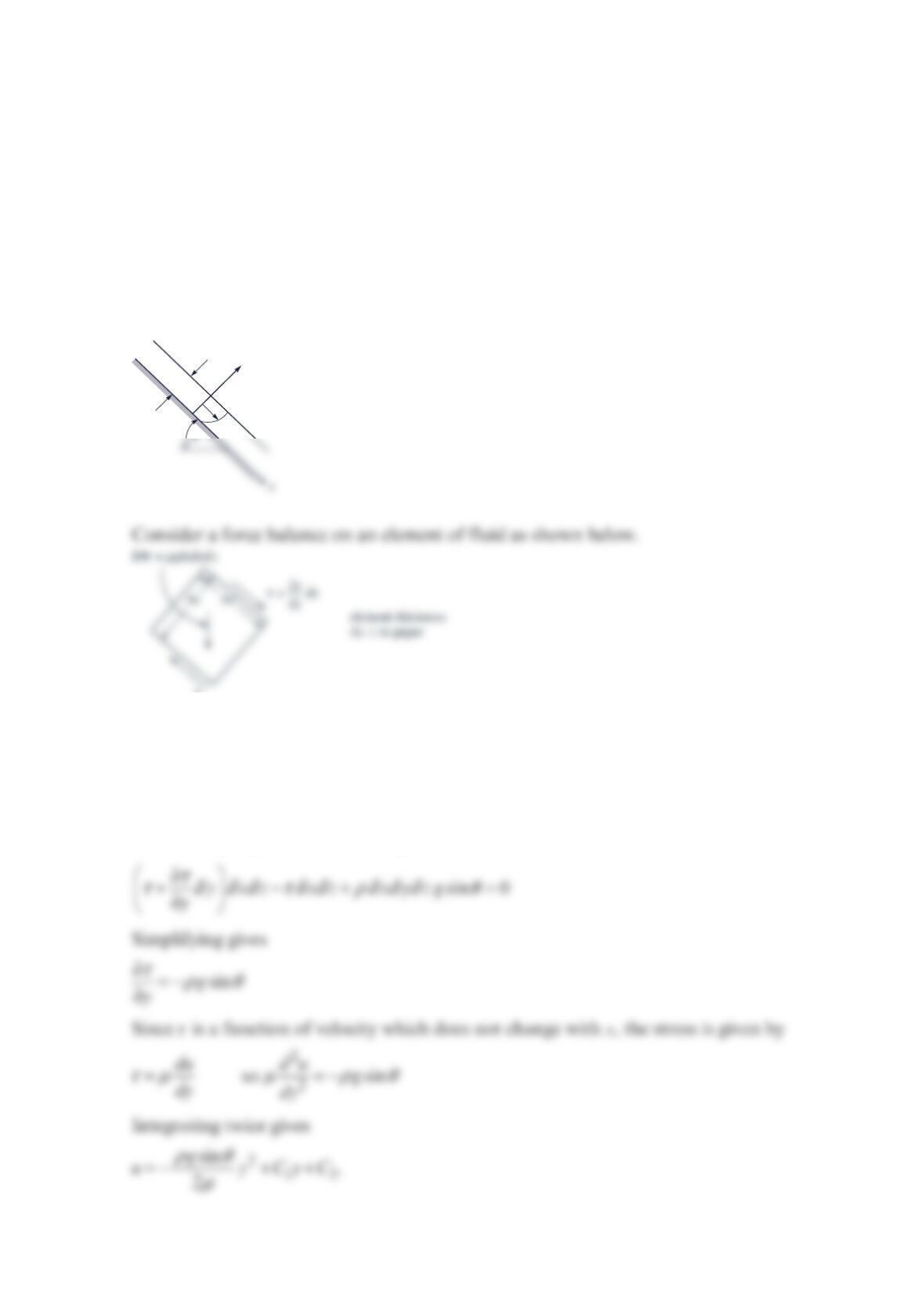
flows down a wide, long inclined flat
plate. The plate makes an angle
θ
with the horizontal. The velocity components do not
change in the direction of the plate, and the fluid depth, h, normal to the plate is constant.
There is negligible shear stress by the air on the fluid. Find the velocity profile (
)
uy, where u
is the velocity parallel to the plate and y is measured perpendicular to the plate. Write an
expression for the volume flowrate per unit width of the plate.
Solution 6.73
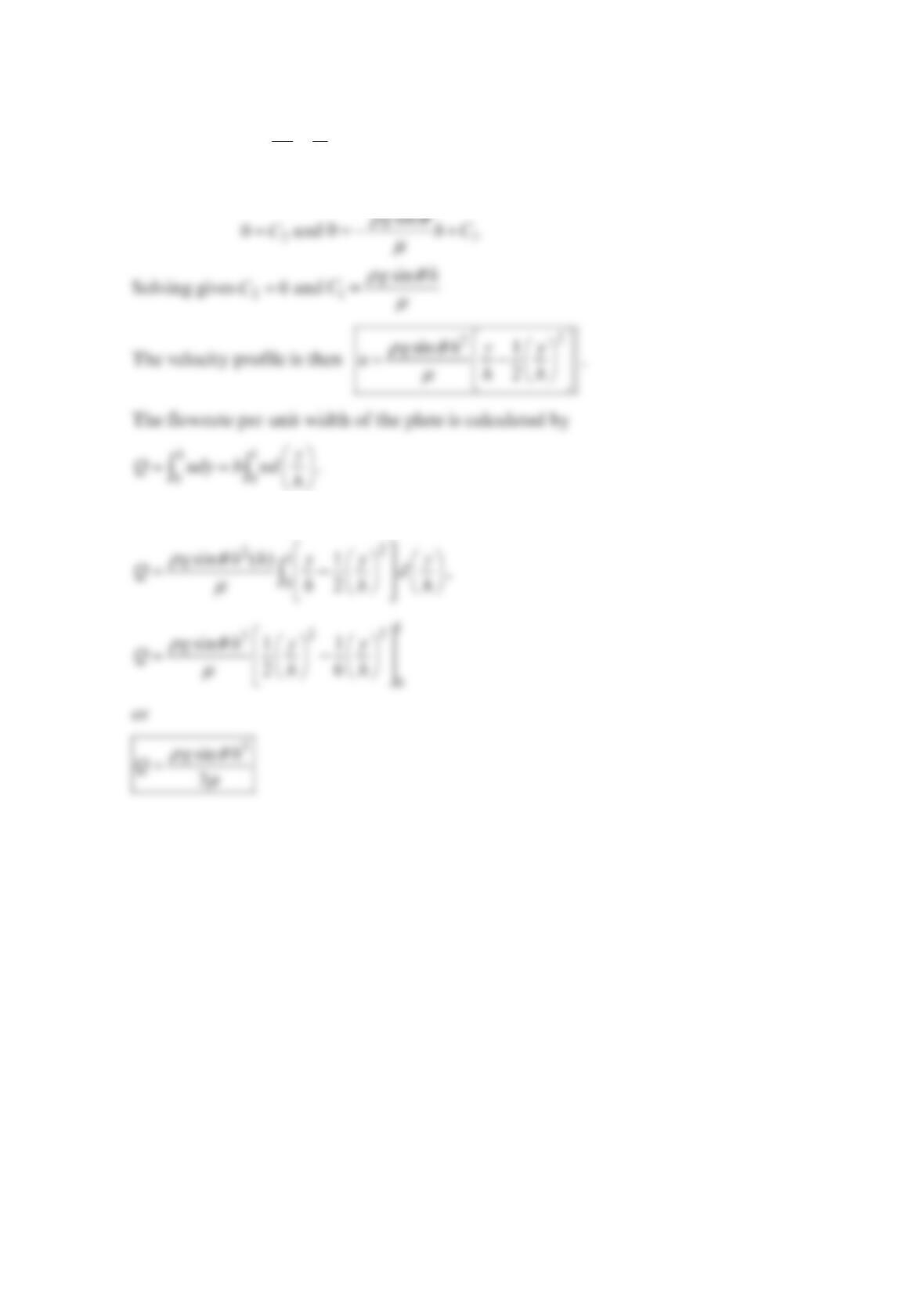
Since the velocities do not change in the plate direction, there is no acceleration in this di-
rection (or in any other direction). The motion is determined by the balance between the
gravity force and shear stresses in the x-direction,
stress gravity 0FF
δδ
+=
Substituting expressions for each gives
hy
τ
The boundary conditions are
0u= at 0
y
= and 0
du
dy
τ
µ
==
at
y
h=.
These conditions give
Substituting for
u
gives
Problem 6.74
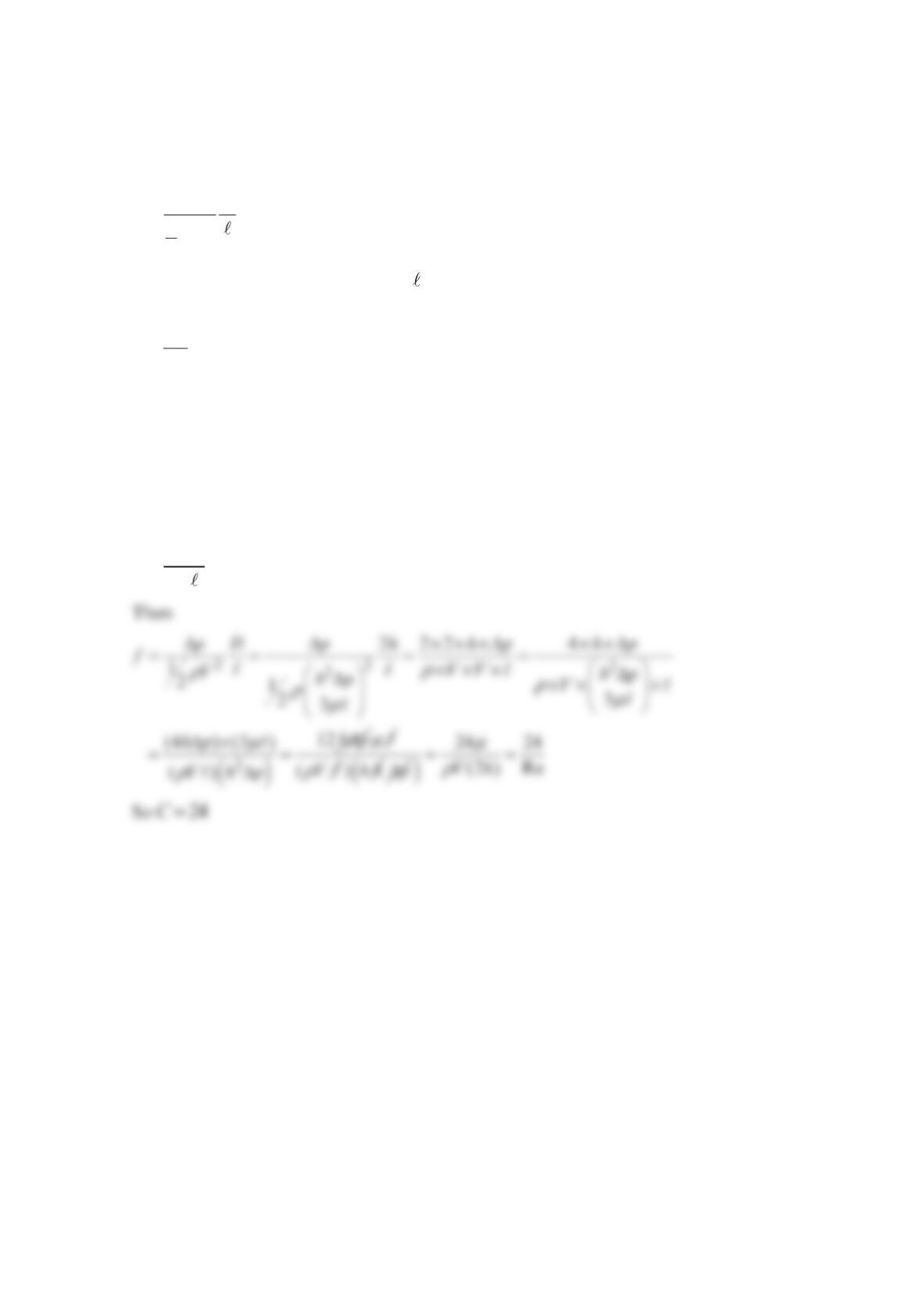
We will see in Chapter 8 that the pressure drop in fully developed pipe flow is sometimes
computed with the aid of a friction factor, defined by
2
1
2
p
D
f
V
ρ
Δ
=
where
V
is the average velocity and is the length of pipe over which
p
Δ
occurs. For laminar
fully developed flow,
f
can be evaluated from
Re
C
f=
where
C
is a constant and Re is the Reynolds number, given by Re / .VD
ρµ
= Find the
constant
C
for a parallel plate channel. Take D as 2
.
h
Solution 6.74
From Eq. (6.137), for flow between parallel plates
2
3
hp
V
µ
Δ
=
p
Problem 6.75
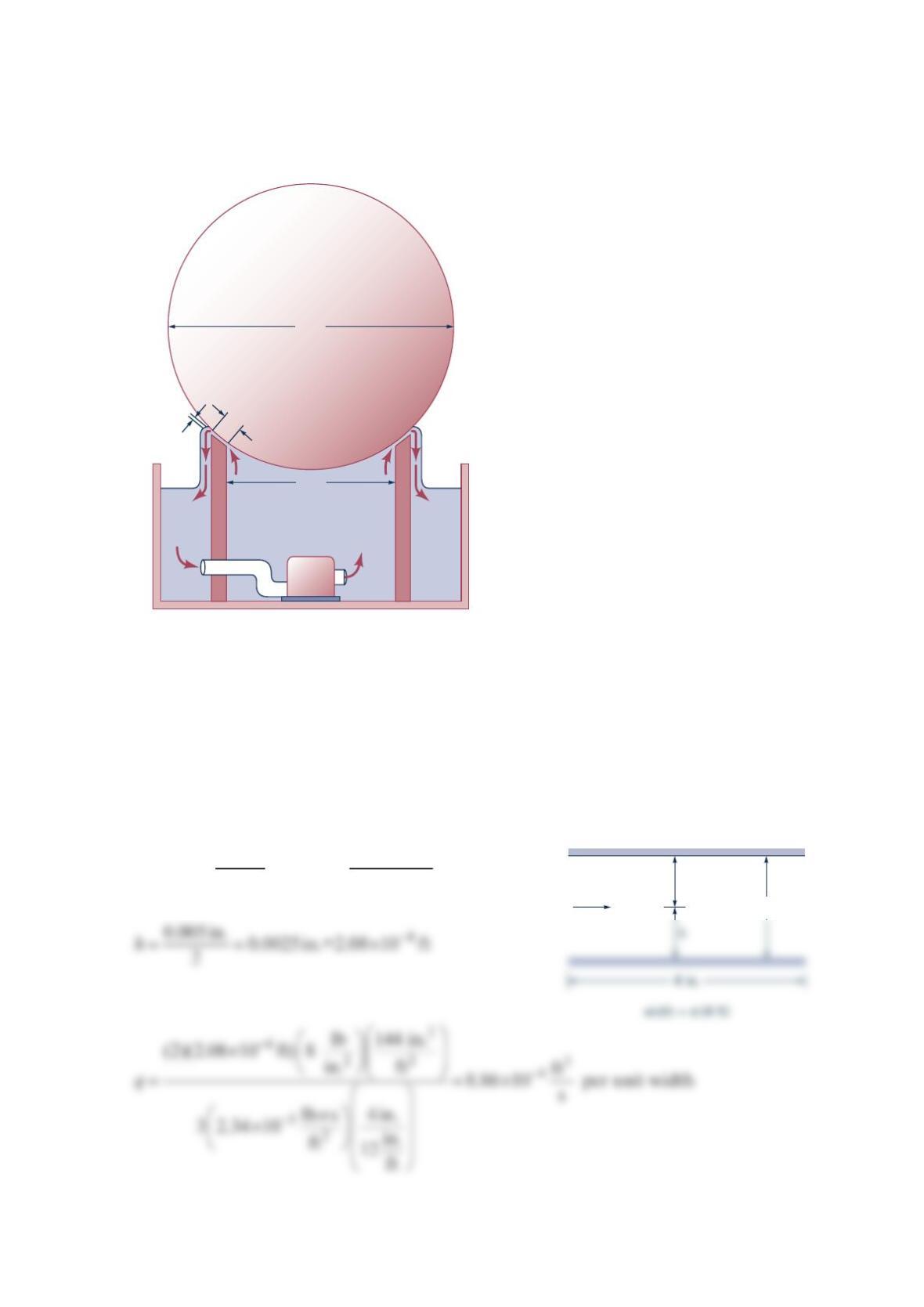
A massive, precisely machined, 6-ft-diameter granite sphere rests on a 4-ft-diameter cylin-
drical pedestal as shown in the figure below.
When the pump is turned on and the water pressure within the pedestal reaches
8
psi, the
sphere rises off the pedestal, creating a 0.005-in. gap through which the water flows. The
sphere can then be rotated about any axis with minimal friction. (a) Estimate the pump
flowrate, 0
Q, required to accomplish this. Assume the flow in the gap between the sphere
and the pedestal is essentially viscous flow between fixed, parallel plates. (b) Describe what
would happen if the pump flowrate were increased to 0
2
Q.
Solution 6.75
(a)
3
2
3
hp
ql
µ
Δ
= where flowrate
unit width
q=(1)
0.005 in.
4 in.
6 ft
4 ft
p
= 8 psi
Pump
0.005 in.
8 psi 0 psi
h
Q
0
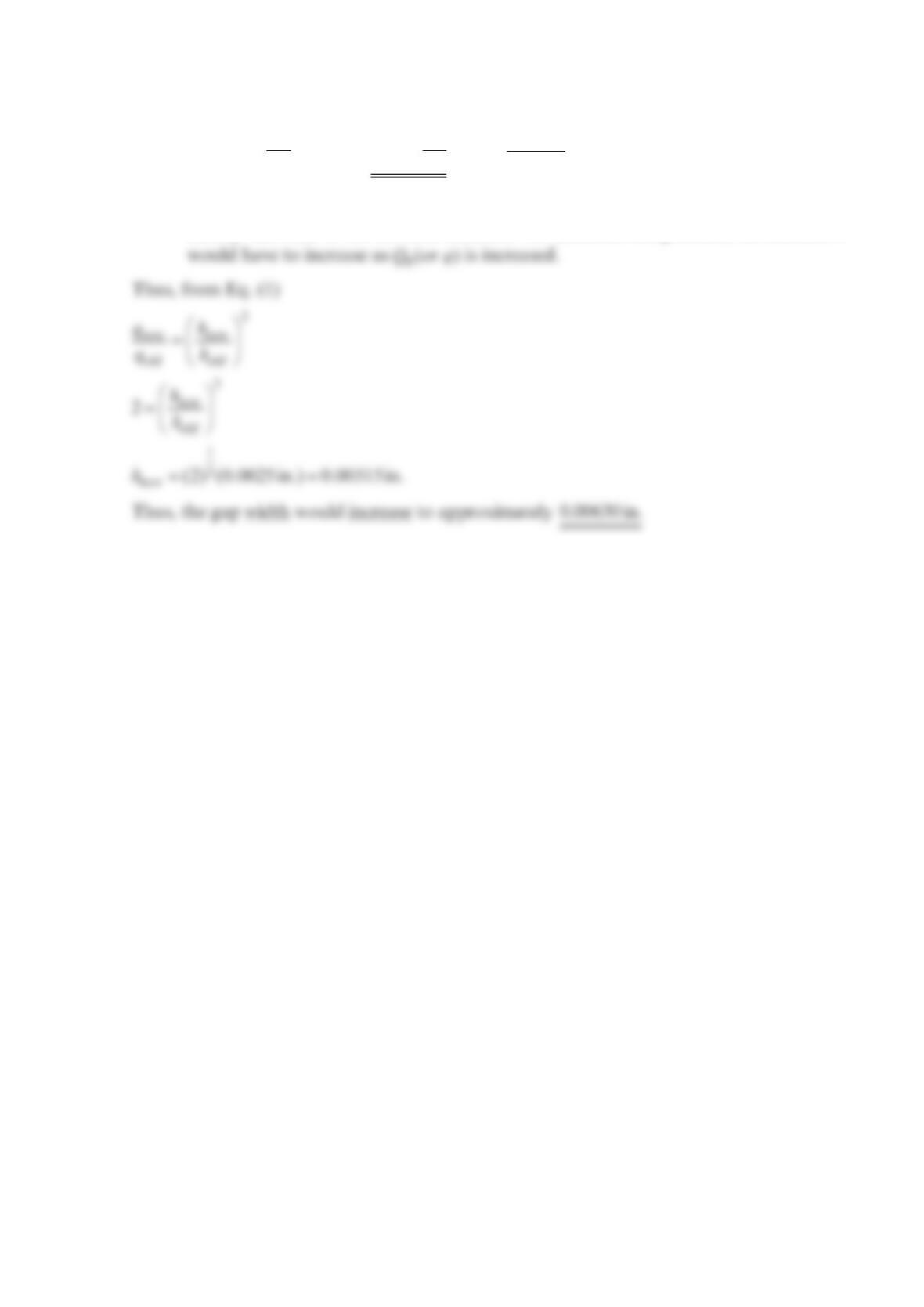
Thus,
23
4
0
ft ft
8.86 10 (4 ft) = 0.0111
ss
Q
π
−
=×
gallons
(
4.98 )
min
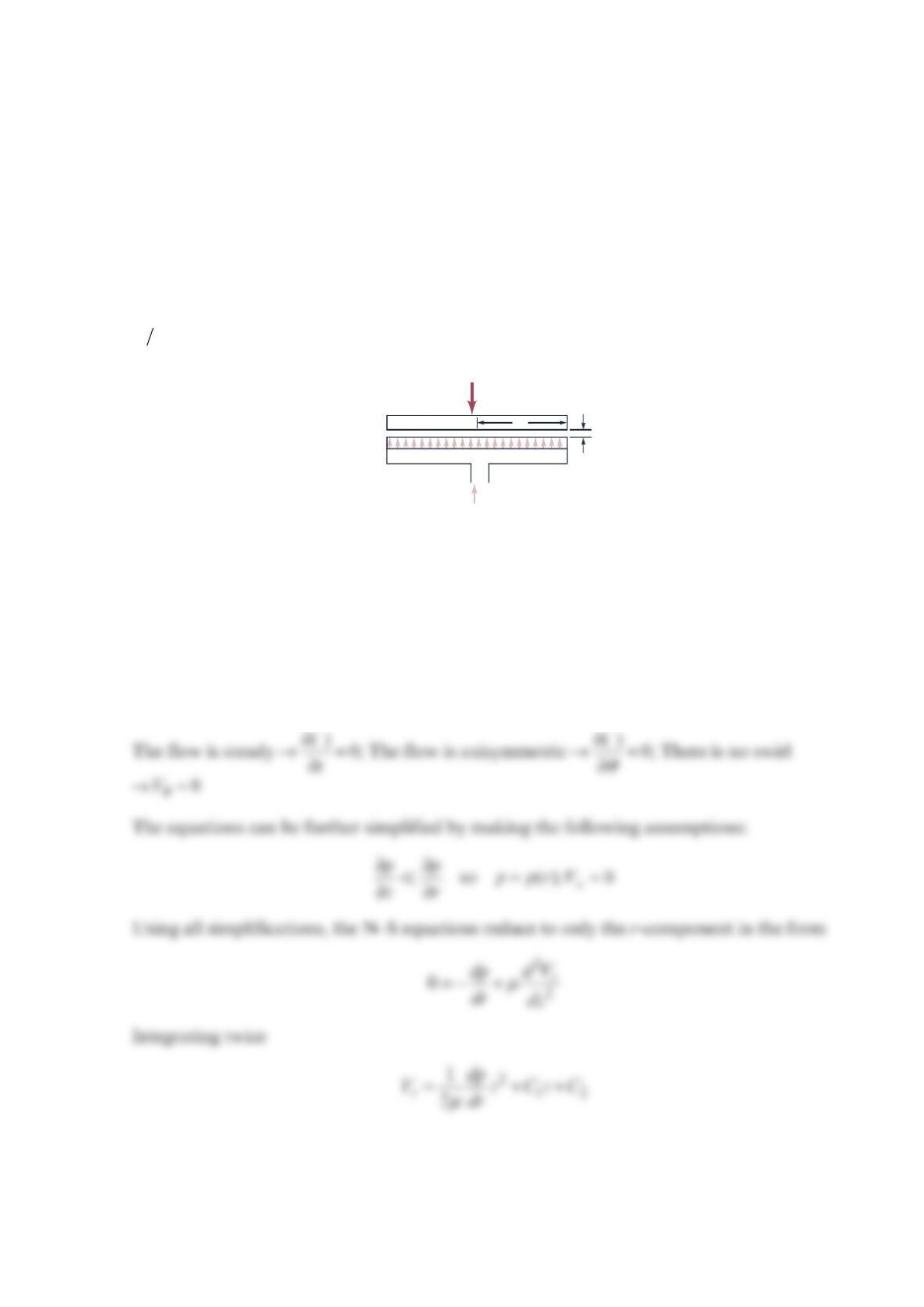
(b) Since
8
psi supports the sphere, it is expected that this pressure remains approxi-
mately. the same as the flowrate increases. To maintain this pressure, the distance h
Problem 6.76
The bearing shown in the figure below consists of two parallel discs of radius h separated
from each other by a small distance h
()
hR. Thelower disc is made of a porous material,
and an incompressible, viscous fluid is pumped through it and into the gap, filling the space
between the discs completely. The pores of the lower disc are closely spaced, so that the ve-
locity of the fluid as it leaves the surface of the porous disc may be regarded as a uniform
value 0
w, that is, small compared to the mean radial velocity. Find the radial velocity
u
and
the load L that the bearing can support as a function of 0
w,
µ
, R, and h. The inertia terms
are negligible, the circumferential velocity is zero ( 0
V
θ
=), and angular symmetry exists
(0
θ
∂
∂=
).
Solution 6.76
Set up a cylindrical polar coordinate system with the z coordinate being the axis of the in-
flow pipe, the r coordinate radially outward, and
θ
the rotational coordinate.
The governing equations for the flow are the Navier–Stokes Equations in cylindrical coor-
dinates, which can be found in Chapter 6. The following simplifications apply for the given
flow:
Flow
h
R
L
V
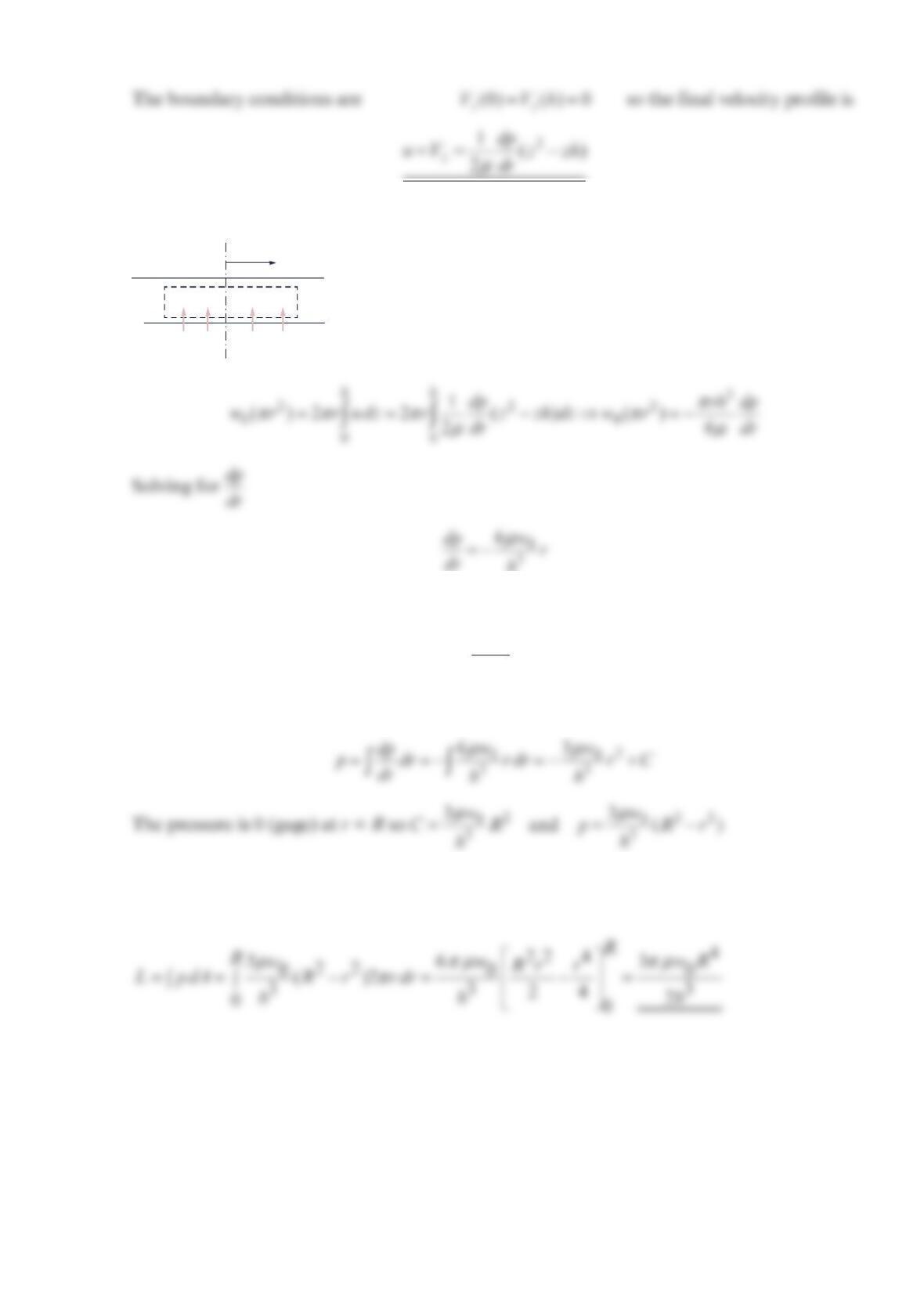
Now apply the integral continuity equation to the control volume shown
Substituting into the velocity profile
2
0
3
3()
r
wr
uV xhx
h
== −
Now we can find the pressure
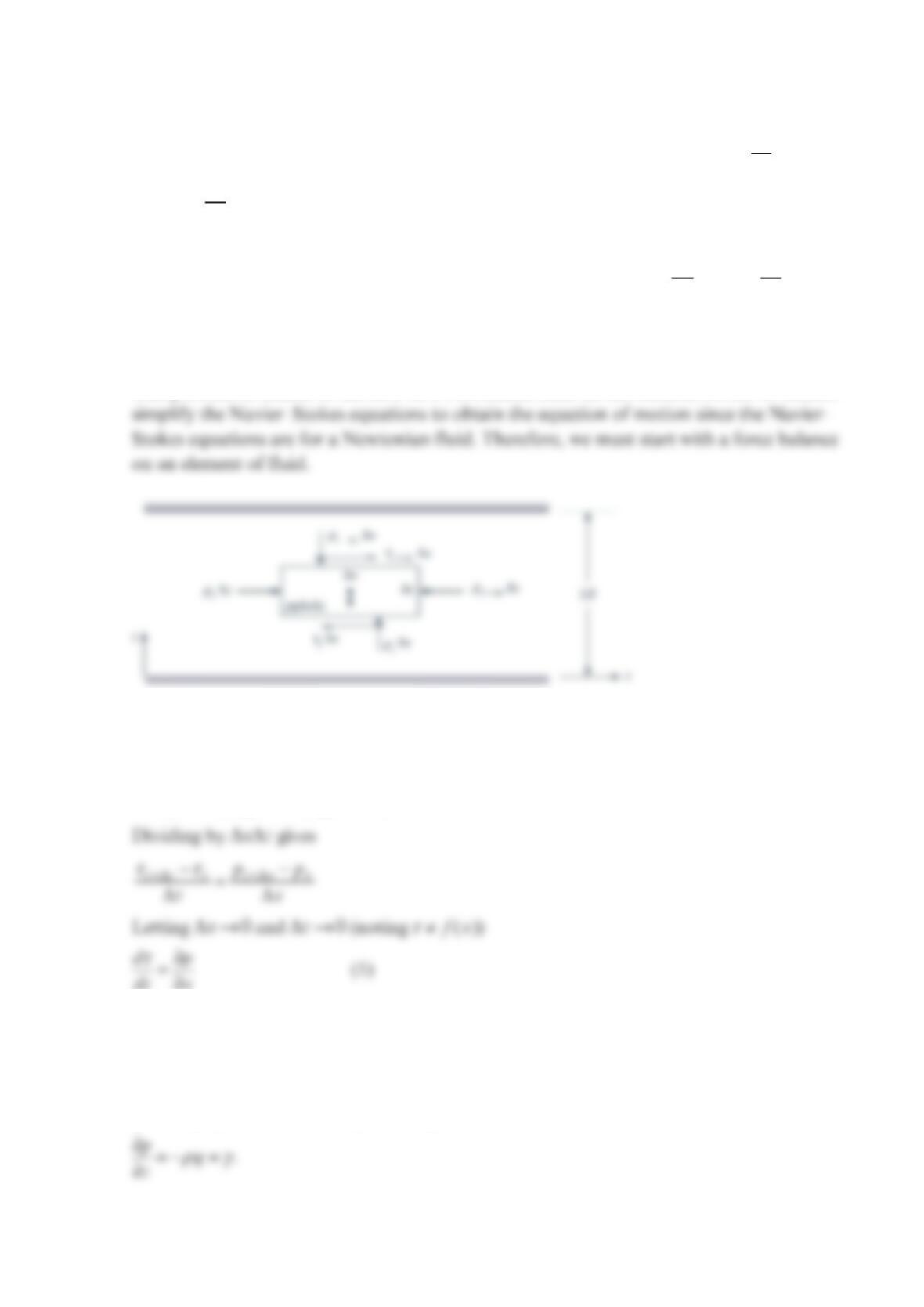
The load that is supported by the bearing is equal to the total pressure force on the bearing
disc
r
w
0
Problem 6.77
A Bingham plastic is a fluid in which the stress
τ
is related to the rate of strain du
dy by
0
du
dy
τ
τ
µ
=+ ,
where 0
τ
and
µ
are constants. Consider the flow of a Bingham plastic between two fixed,
horizontal, infinitely wide, flat plates. For fully developed flow with 0
du
dx = and dp
dx =
constant, find (
)
uy.
Solution 6.77
This problem is similar to the flow of a Newtonian fluid. In this case, however, we cannot
The element of fluid has a depth of one (1) unit. A force balance in the x-direction gives
F0
x
+
→=
Or 0
xxxzzz
p
zp z x x
ττ
+Δ +Δ
Δ− Δ+ Δ− Δ =
A force balance in the –zdirection gives
0
z
F
+
↑=
Or 0
zzz
p
xp x gxz
ρ
+Δ
Δ− Δ− ΔΔ=
Dividing by xz
Δ
Δ and letting 0z
Δ
→ gives
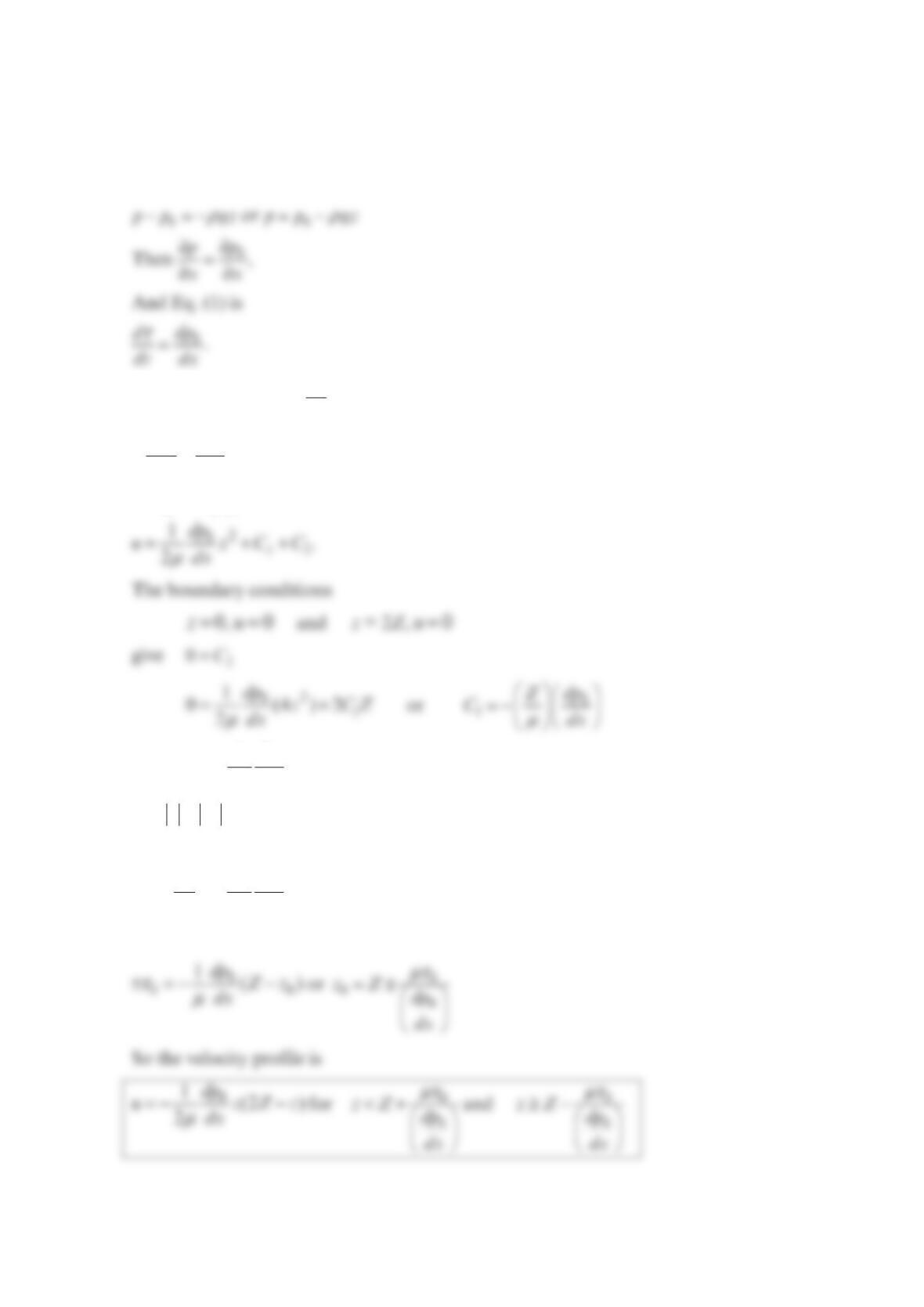
Let the pressure at 0z= be 0
p
and integrate from 0z= to z = 2Z
With 2Z, the plate separation
00
Pz
Pdp g dz
ρ
=−
Substituting 0
du
dz
τ
τ
µ
=+ gives
20
2
dp
du
dx
dz
µ
=
Integrating gives
Then 0
1(2
)
2
dp
uzZz
dx
µ
=− − . (2)
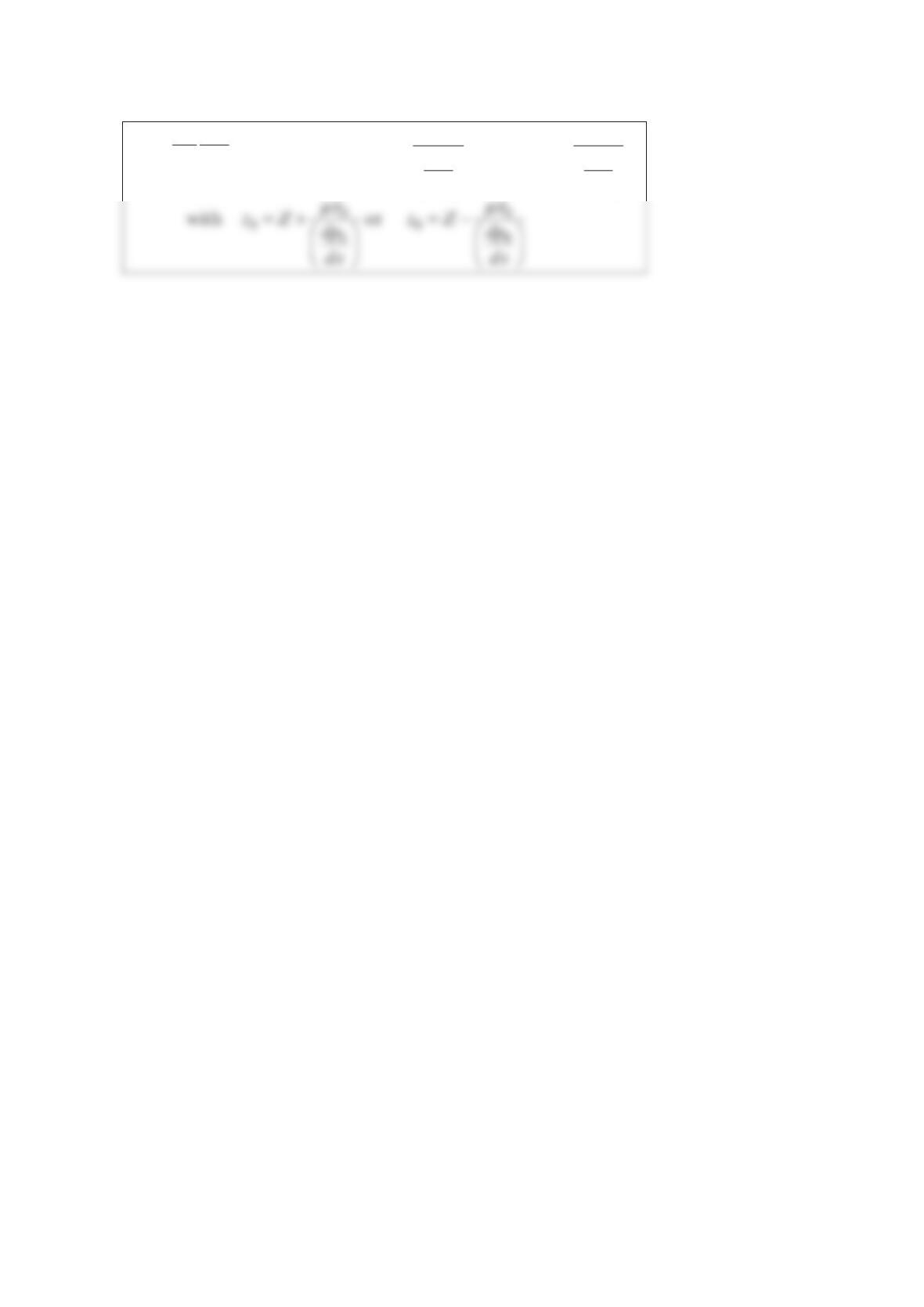
For 0
ττ
>. Denote the value of z at which 0
τ
τ
=± by 0
z
Then
0
1(2 2 )
2
dp
du Zz
dz dx
τµ
µ
==− −
or
p
p
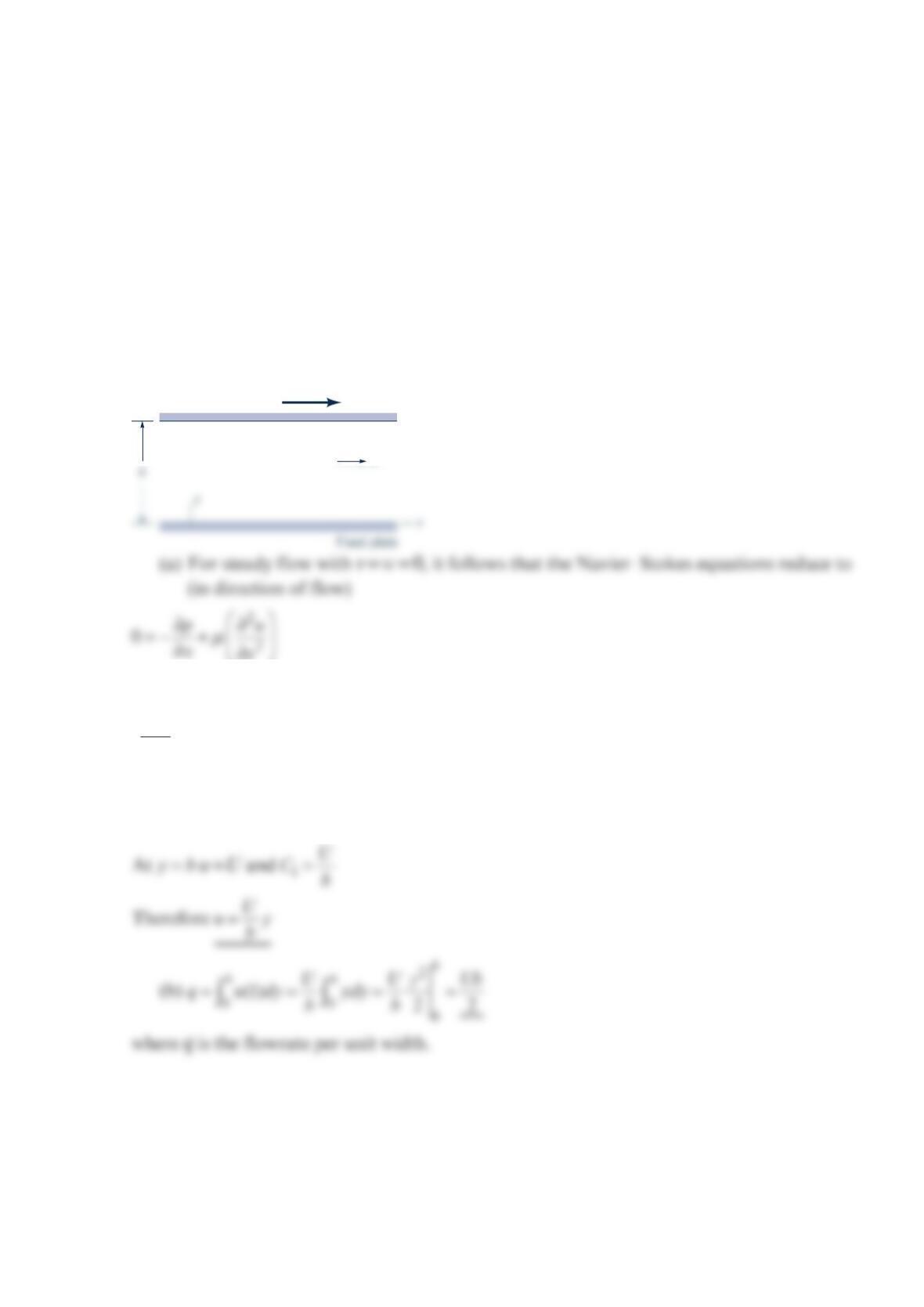
When 0
zz=,
000
1(2 )
2
dp
uzZz
dx
µ
=− − for 0
0
zZ dp
dx
µ
τ
>+
and 0
0
zZ dp
dx
µ
τ
<−
µ
µ
Problem 6.78
Two horizontal, infinite, parallel plates are spaced a distance
b
apart. A viscous liquid is
contained between the plates. The bottom plate is fixed, and the upper plate moves parallel
to the bottom plate with a velocity
U
. Because of the no-slip boundary condition, the liquid
motion is caused by the liquid being dragged along by the moving boundary. There is no
pressure gradient in the direction of flow. Note that this is a so-called simple Couette flow.
(a) Start with the Navier–Stokes equations and determine the velocity distribution between
the plates. (b) Determine an expression for the flowrate passing between the plates (for a
unit width). Express your answer in terms of
b
and
U
.
Solution 6.78
Thus, for zero pressure gradient
2
20
u
y
∂=
∂
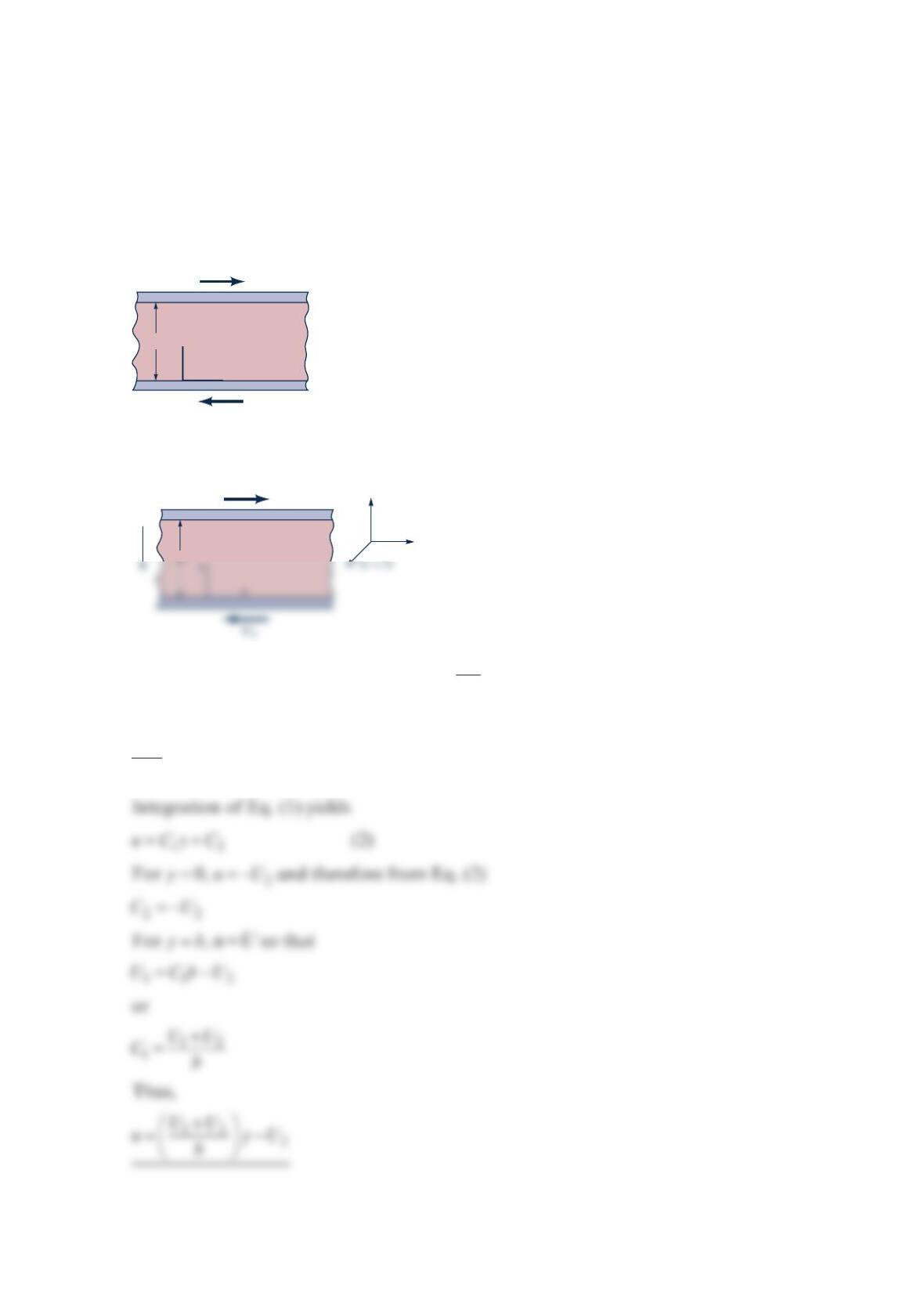
So that 12
uCyC=+
At 0
y
= 0u= and it follows that 20
C
=. Similarly,
y
u
U
y
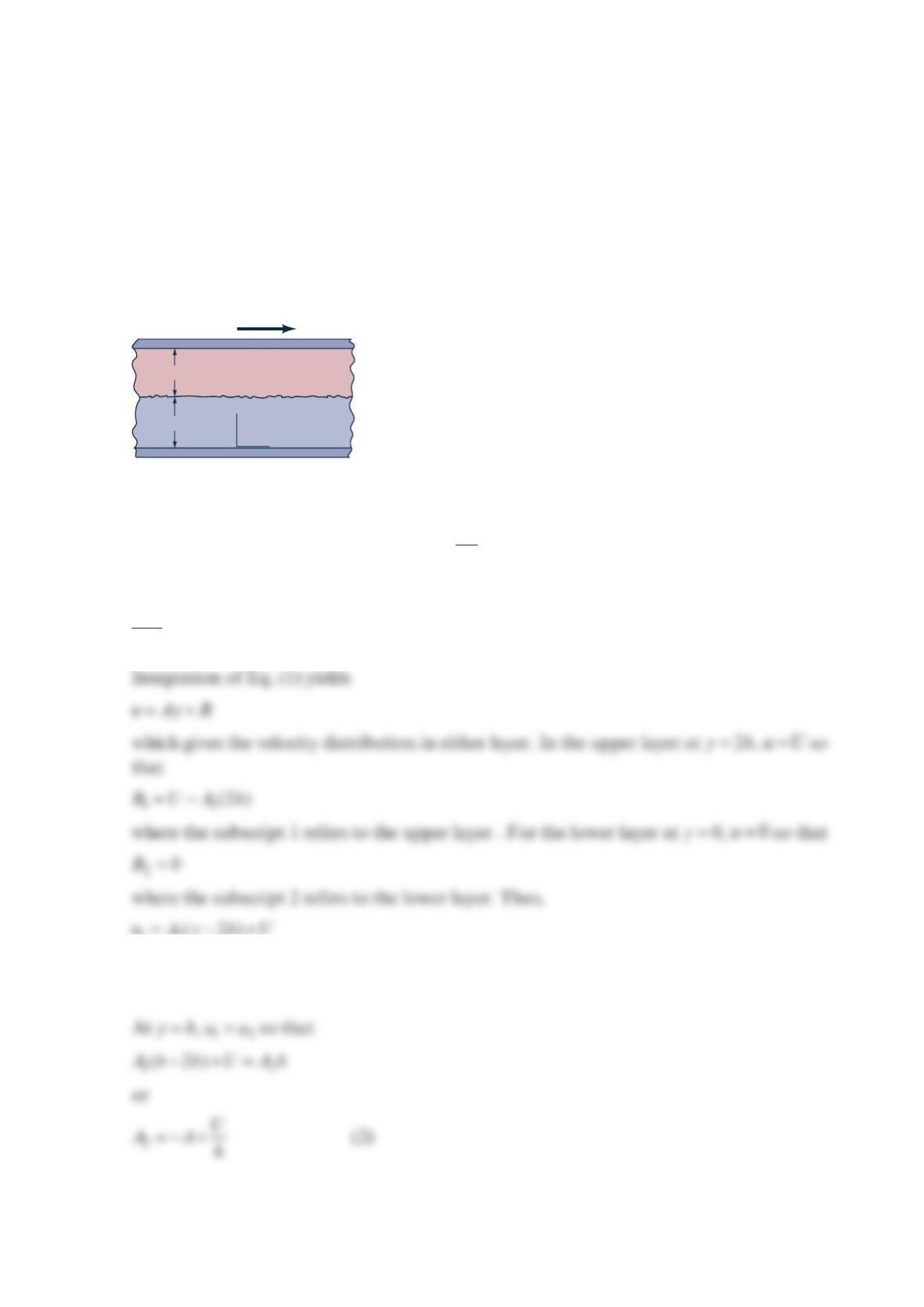
Problem 6.79
An incompressible, viscous fluid is placed between horizontal, infinite, parallel plates as is
shown in the figure below. The two plates move in opposite directions with constant veloci-
ties, 1
U and 2
U, as shown. The pressure gradient in the x direction is zero, and the only body
force is due to the fluid weight. Use the Navier–Stokes equations to derive an expression for
the velocity distribution between the plates. Assume laminar flow.
Solution 6.79
For the specified conditions, 0v=,
0
w=, 0
P
x
∂=
∂, and 0
x
g=, so that the –xcomponent of
the Navier–Stokes equations reduces to
2
20
du
dy = (1)
b
x
y
U
1
U
2
g
U
1
u
v
= 0
Problem 6.80
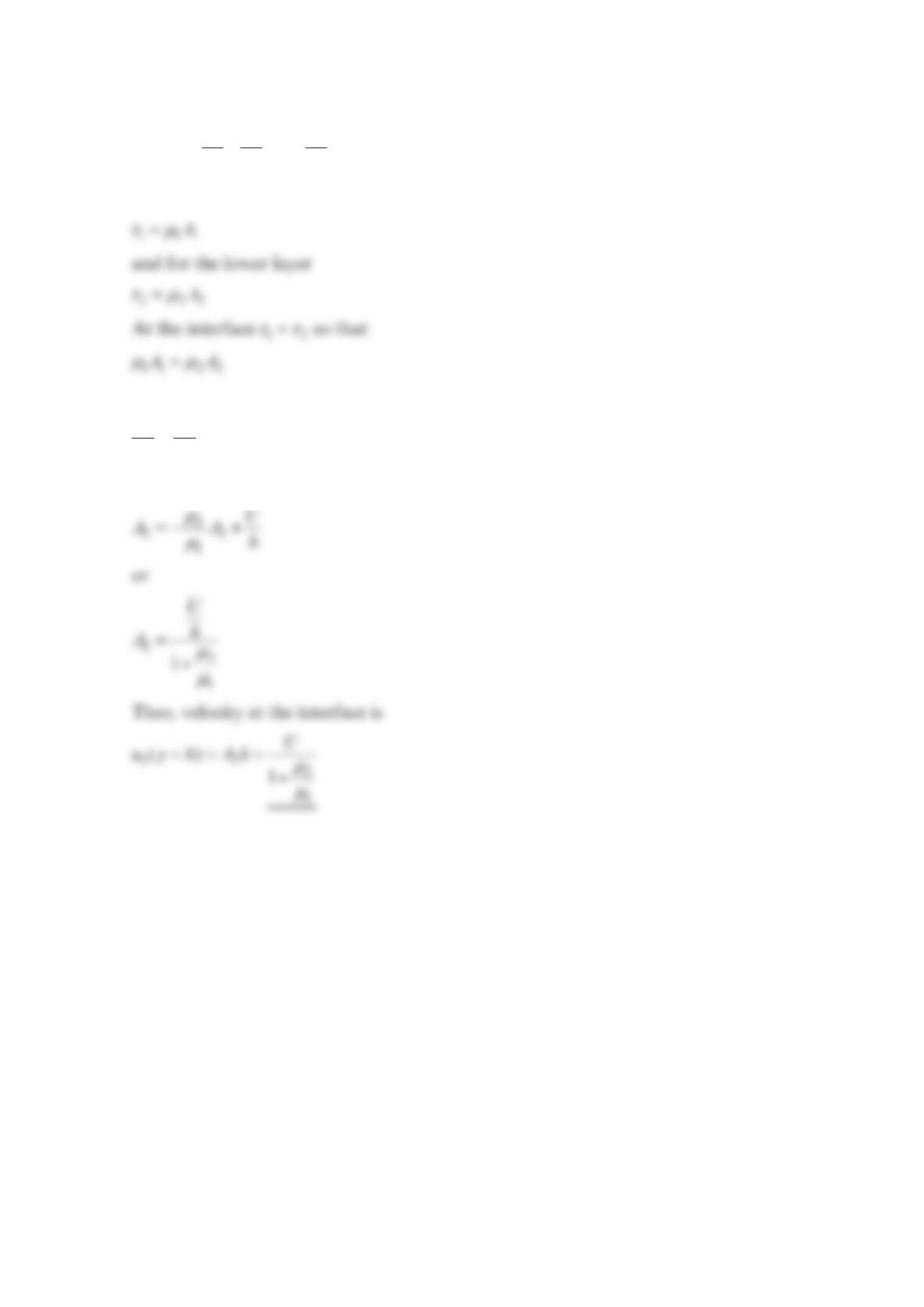
Two immiscible, incompressible, viscous fluids having the same densities but different vis-
cosities are contained between two infinite, horizontal, parallel plates (the figure below).
The bottom plate is fixed, and the upper plate moves with a constant velocity
U
. Determine
the velocity at the interface. Express your answer in terms of
U
, 1
µ
, and 2
µ
. The motion of
the fluid is caused entirely by the movement of the upper plate; that is, there is no pressure
gradient in the x direction. The fluid velocity and shearing stress are continuous across the
interface between the two fluids. Assume laminar flow.
Solution 6.80
For the specified conditions, 0v=,
0
w=, 0
p
x
∂=
∂, and 0
x
g=, so that the x-component of the
Navier–Stokes equations for either the upper or lower lager reduces to
2
20
du
dy = (1)
11
And
22
uAy=
h
hy
x
U
, 1
ρμ
, 2
ρμ
Fixed
plate
Since the velocity distribution is linear in each layer the shearing stress
xy
uv du
y
xdy
τµ µ
∂∂
=+=
∂∂
is constant throughout each layer. For the upper layer
or
12
21
A
A
µ
µ
= (3)
Substitution of Eq. (3) into Eq. (2) yields
µ
µ
µ
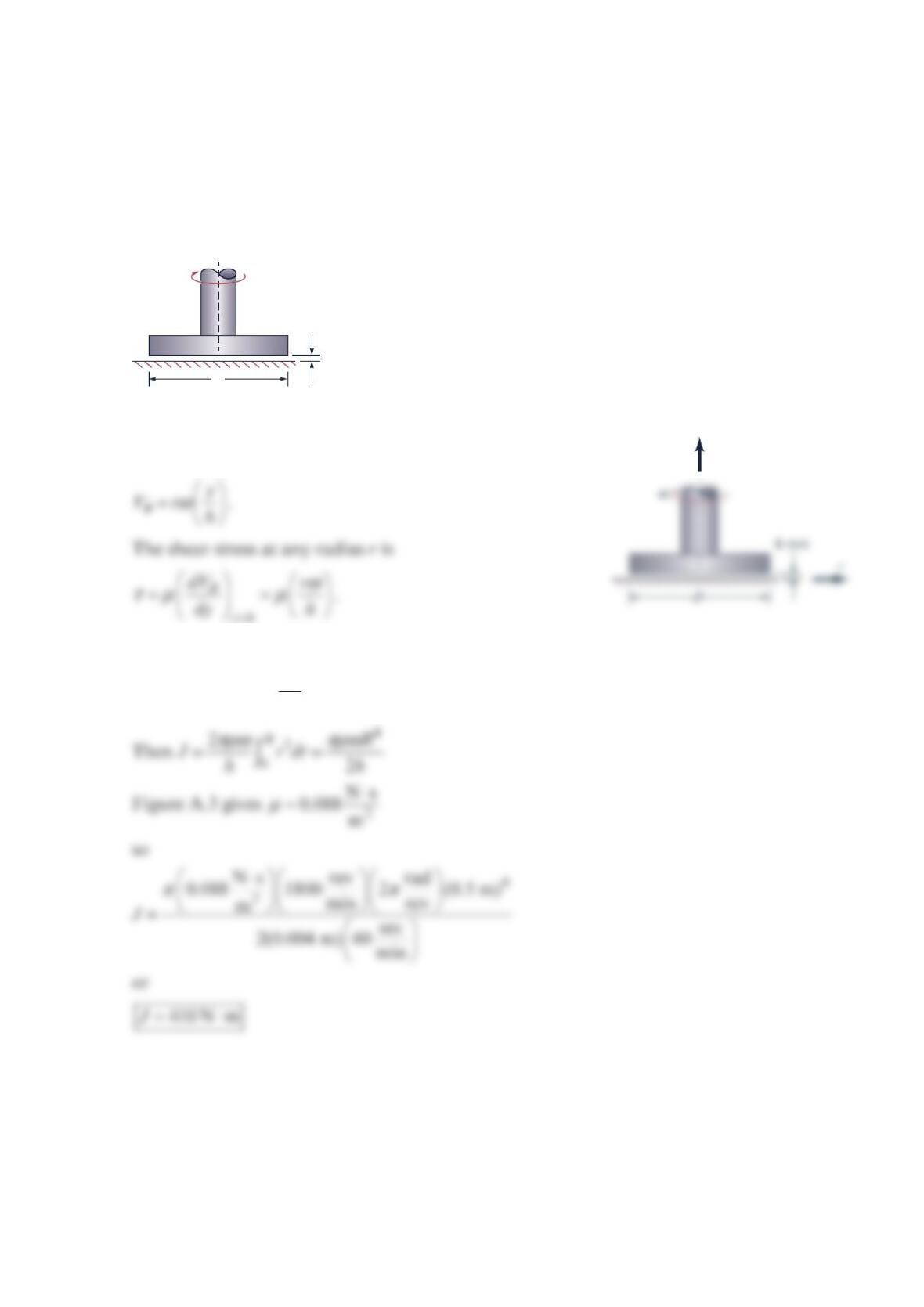
Problem 6.81
The disc shown in the figure below has a diameter 1 m
D
= and a rotational speed of
1
800 rpm. It is positioned 4 mm from a solid boundary. The gap is filled with 15 °C SAE
10
W
oil. Find the torque required to overcome the frictional resistance of the oil on the disc.
Assume that the circumferential velocity (
V
θ
) is linear across the gap at the each radius r.
Solution 6.81
At any radius r, the velocity
V
θ
is
The torque due to the shear stress at radius r is
() (2 )
r
dJ dA r r rdr
h
ω
τµπ
==
4 mm
D
ω
y
(1) (2)
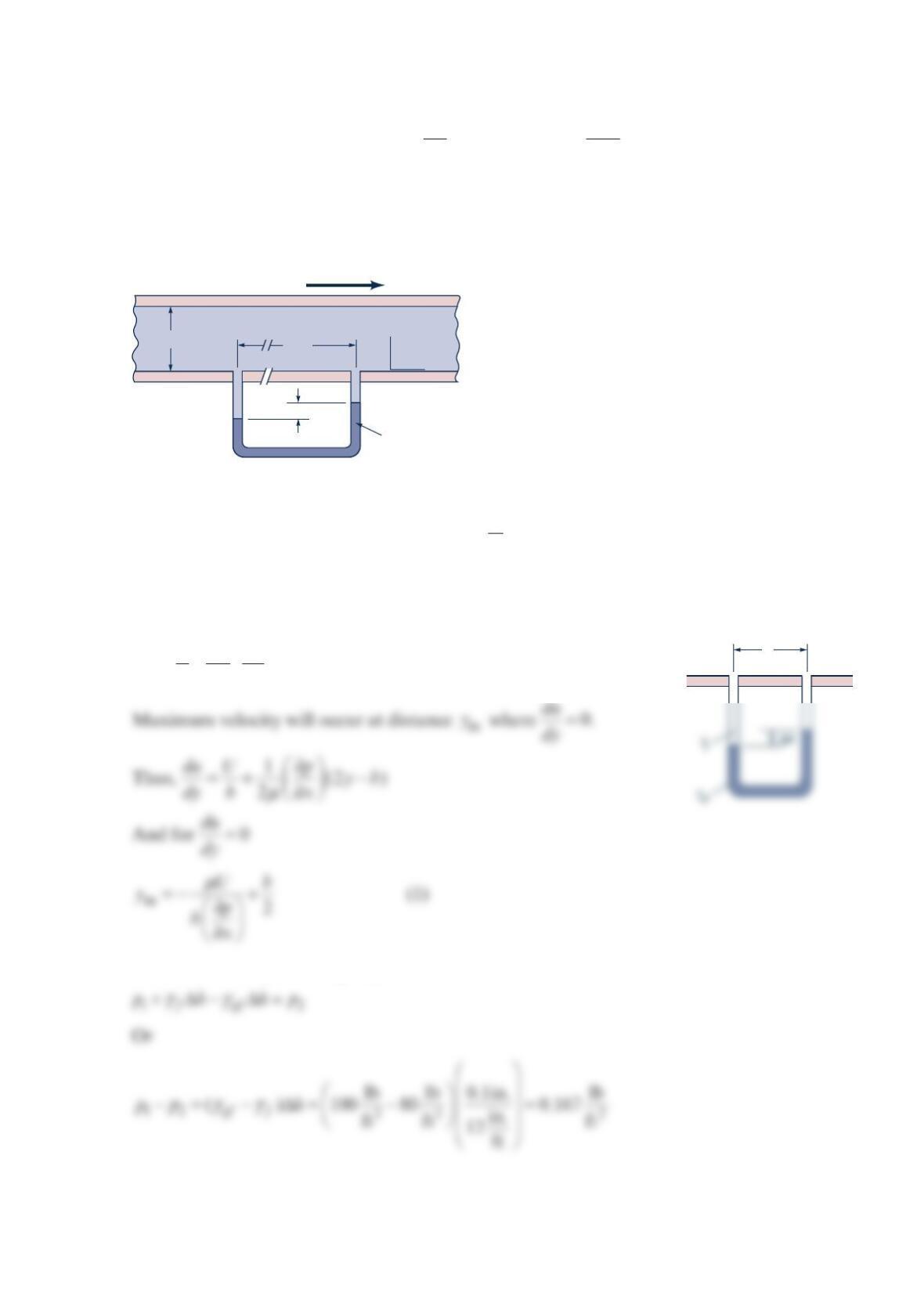
ℓ
Problem 6.82
A viscous fluid (specific weight = 3
lb
8
0 ft ; viscosity = 2
lb s
0.03 ft
⋅) is contained between two
infinite, horizontal parallel plates as shown in the figure below. The fluid moves between
the plates under the action of a pressure gradient, and the upper plate moves with a velocity
U
while the bottom plate is fixed. A U-tube manometer
connected between two points along the bottom indicates a differential reading of 0.1 in. If
the upper plate moves with a velocity of ft
0.02 s, at what distance from the bottom plate
does the maximum velocity in the gap between the two plates occur? Assume laminar flow.
Solution 6.82
2
1()
2
y
p
uU y by
bx
µ
∂
=+ −
∂
For manometer (see the figure),
0.1 in.
6 in.
y
x
1.0 in.
U
= 0.02 ft/s
= 100 lb/ft
3
Fixed
plate
γ
y