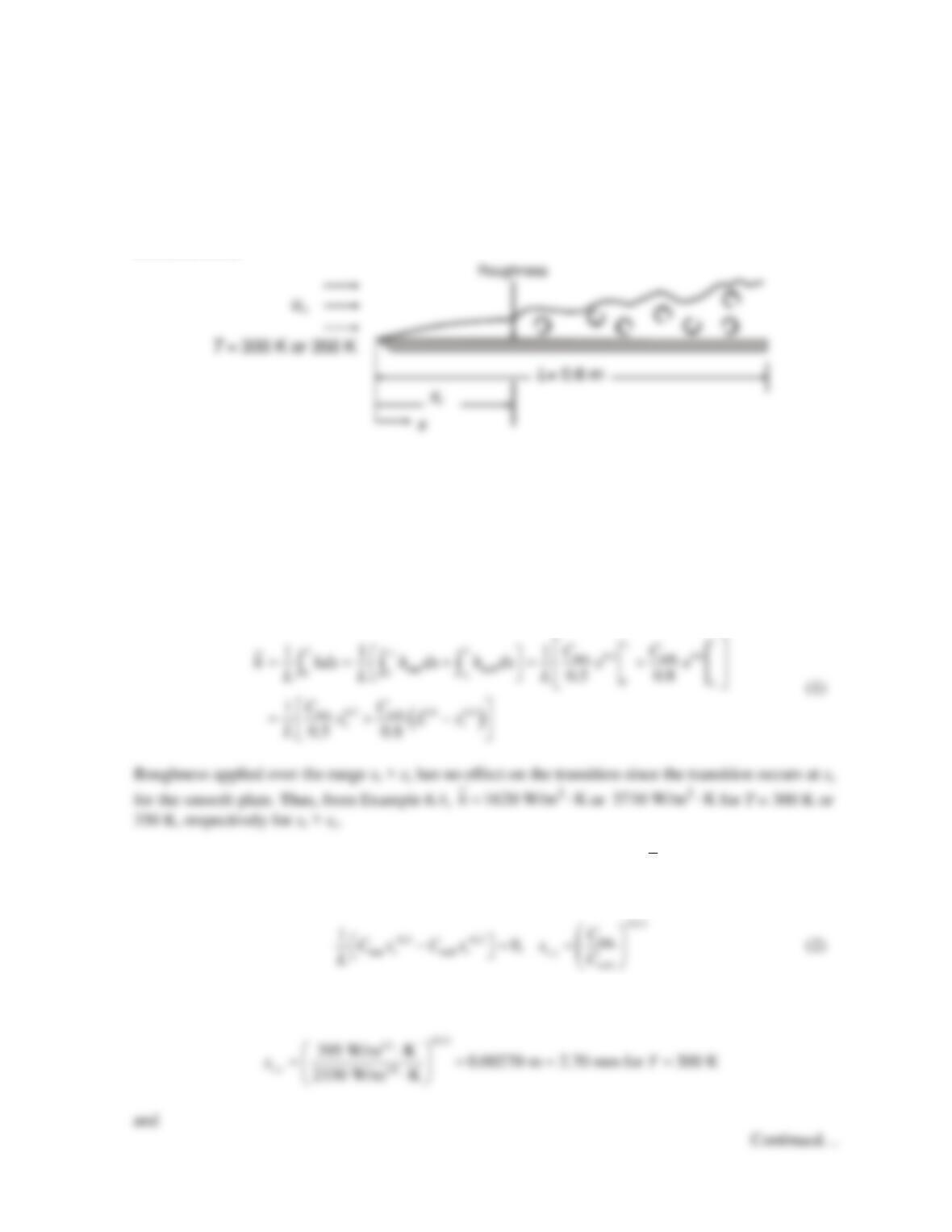
PROBLEM 6.17
KNOWN: Velocity and temperature of water flowing over a flat plate. Length of plate. Variation of
local convection coefficient with x for laminar and turbulent flow.
FIND: Minimum and maximum average convection coefficient for roughness applied over the range
xr ≤ x ≤ L. Temperature at which extreme values of average convection coefficient occur and
corresponding values of xr.
SCHEMATIC:
ASSUMPTIONS: (1) Steady–state conditions, (2) Constant properties, (3) Transition occurs at a
critical Reynolds number of 5 × 10⁵ for the smooth plate, (4) Incompressible flow.
PROPERTIES: Table A.6, Liquid water (T = 300 K):
ρ
= vf
-1 = 997 kg/m3,
m
= 855 × 10-6 N⋅s/m2;
Liquid water (T = 350 K):
ρ
= vf
-1 = 974 kg/m3,
m
= 3655 × 10-6 N⋅s/m2.
ANALYSIS: The smooth plate transition location, xc, was found in Example 6.4 to be 0.43 m and
0.19 m, for T = 300 K and 350 K, respectively. For roughness applied over the range 0 ≤ xr ≤ xc,
transition occurs at xr. From Eq. 6.14,
The critical locations xr,c that give rise to minimum or maximum values of
h
can be found by
differentiating Eq. (1) and setting the result to zero:
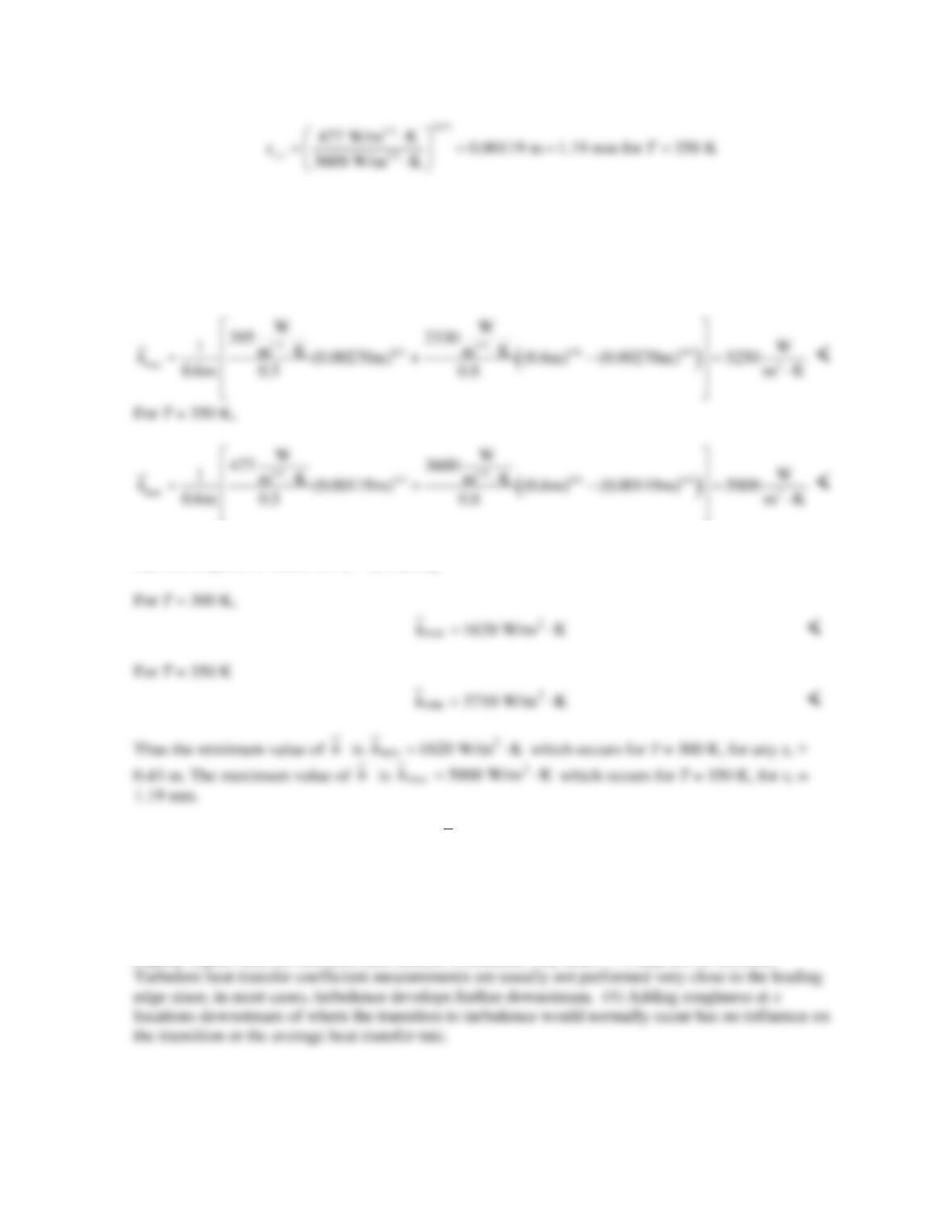
Evaluating xr,c for the two temperatures yields:
PROBLEM 6.17 (Cont.)
These values are both less than their respective turbulence transition locations, xc, therefore Eq. (1)
holds at these locations. Substituting these values into Eq. (1), the average heat transfer coefficients for
roughness applied at these locations can be calculated.
For T = 300 K,
The subscript max is used above to indicate that these are the maximum values, since they are larger
than the respective values for xr > xc, namely:
COMMENTS: (1) The maximum value of
h
exists when transition occurs very close to the leading
edge of the plate. It does not occur exactly at the leading edge because the laminar heat transfer
coefficient equation yields a slightly higher value than the turbulent heat transfer coefficient equation
very near x = 0. (2) Turbulent heat transfer coefficients are usually (but not always) larger than laminar
heat transfer coefficients. Therefore, tripping the transition to turbulence at or near the leading edge
results in enhanced heat transfer. (3) The conclusion that the laminar heat transfer coefficient is
slightly higher than the turbulent heat transfer coefficient very near x = 0 may not be accurate.
PROBLEM 6.18
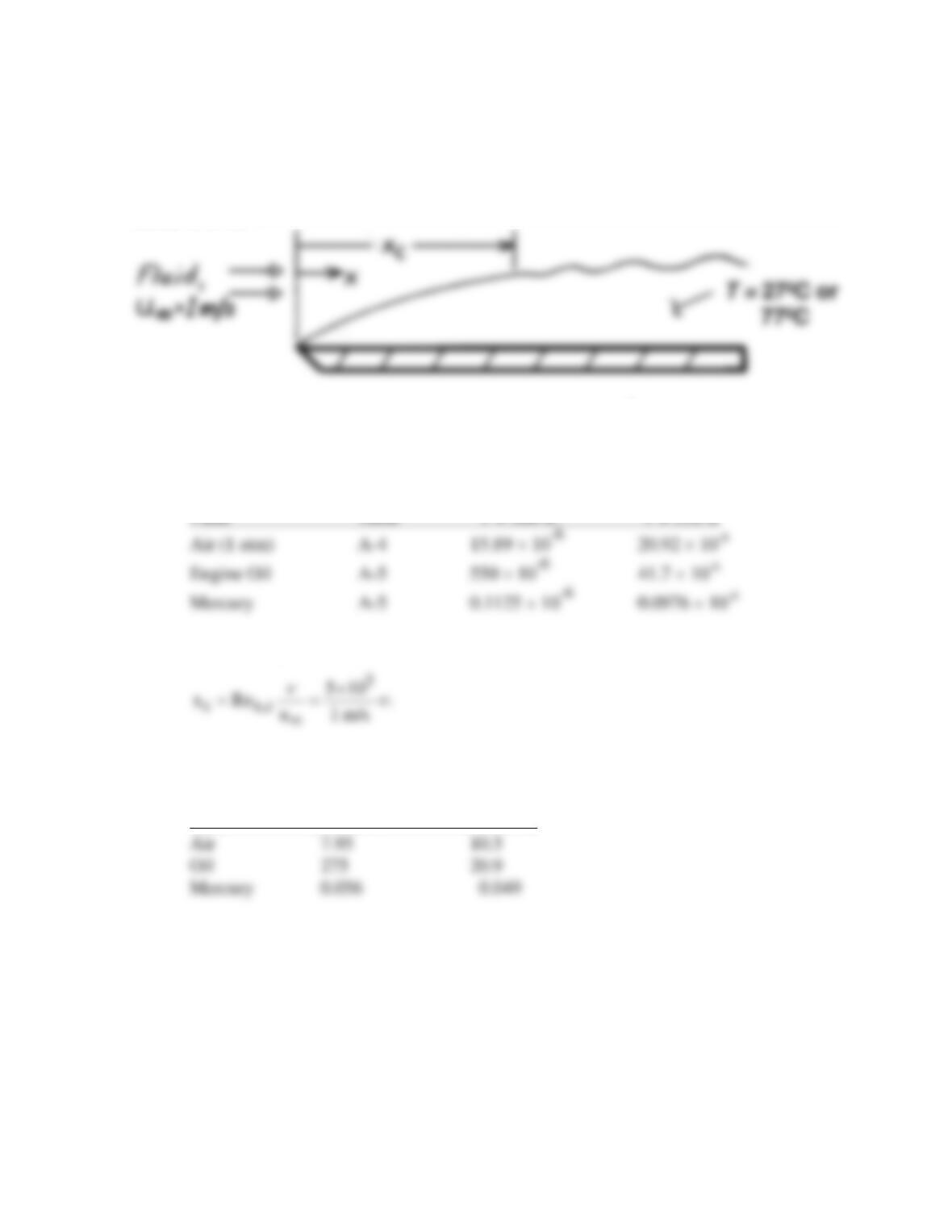
KNOWN: Transition Reynolds number. Velocity and temperature of atmospheric air, engine
oil, and mercury flow over a flat plate.
FIND: Distance from leading edge at which transition occurs for each fluid.
SCHEMATIC:
ASSUMPTIONS: Transition Reynolds number is
Re .
x,c= ×5 105
PROPERTIES: For the fluids at T = 300 K and 350 K:
ν
(m2/s)
Fluid Table T = 300 K T = 350 K
ANALYSIS: The point of transition is
Substituting appropriate viscosities, find
xc(m)
Fluid T = 300 K T = 350 K <
COMMENTS: (1) Note the great disparity in transition length for the different fluids. Due to
the effect which viscous forces have on attenuating the instabilities which bring about
transition, the distance required to achieve transition increases with increasing
ν
. (2) Note the
temperature-dependence of the transition length, in particular for engine oil. (3) As shown in
Example 6.4, the variation of the transition location can have a significant effect on the
average heat transfer coefficient associated with convection to or from the plate.
PROBLEM 6.19
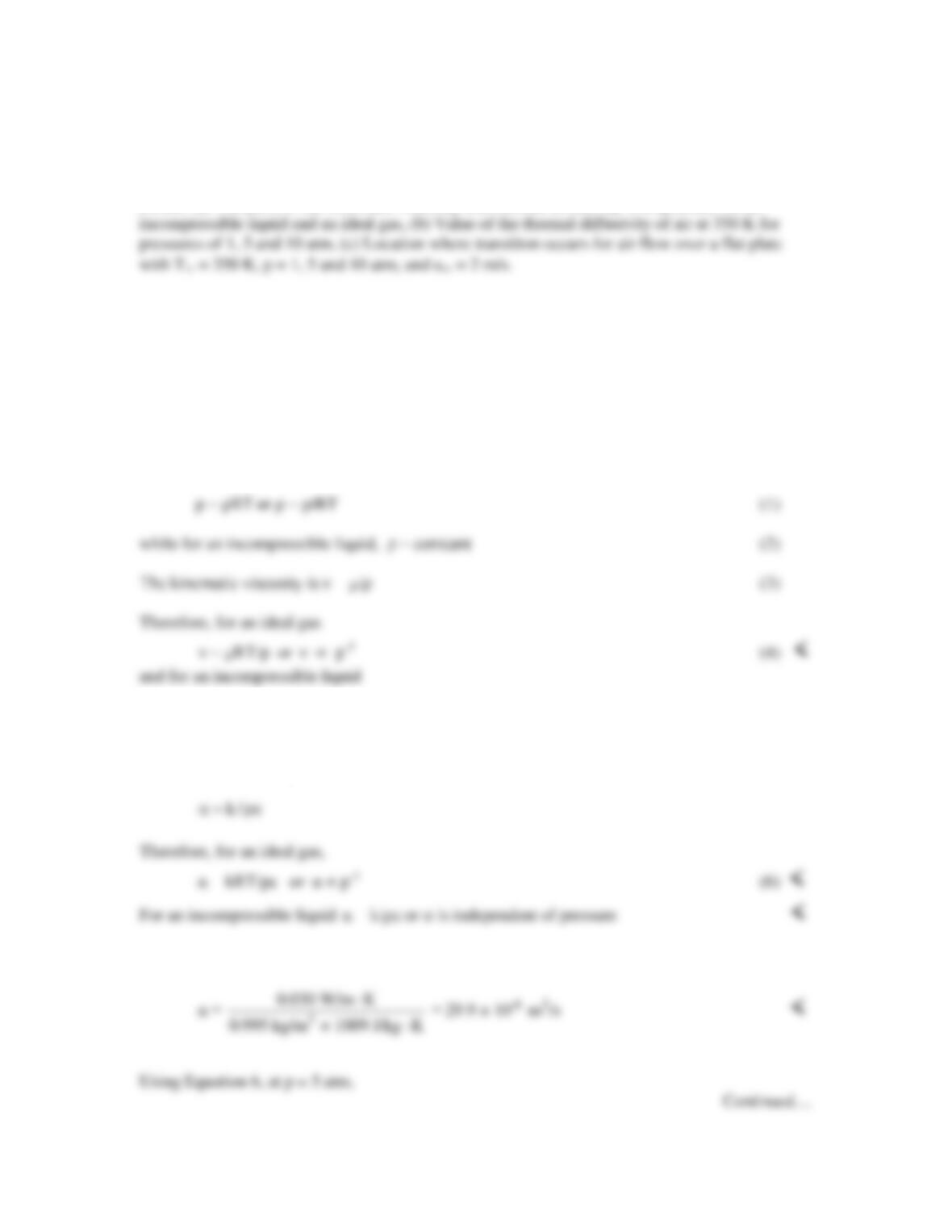
KNOWN: Pressure dependence of the dynamic viscosity, thermal conductivity and specific heat.
FIND: (a) Variation of the kinematic viscosity and thermal diffusivity with pressure for an
ASSUMPTIONS: (1) Steady-state conditions, (2) Constant properties, (3) Transition at Rex,c = 5
× 105, (4) Ideal gas behavior.
PROPERTIES: Table A.4, air (350 K): m = 208.2 × 10⁻⁷ N⋅s/m2, k = 0.030 W/m⋅K, cp = 1009
J/kg⋅K, ρ = 0.995 kg/m3.
ANALYSIS:
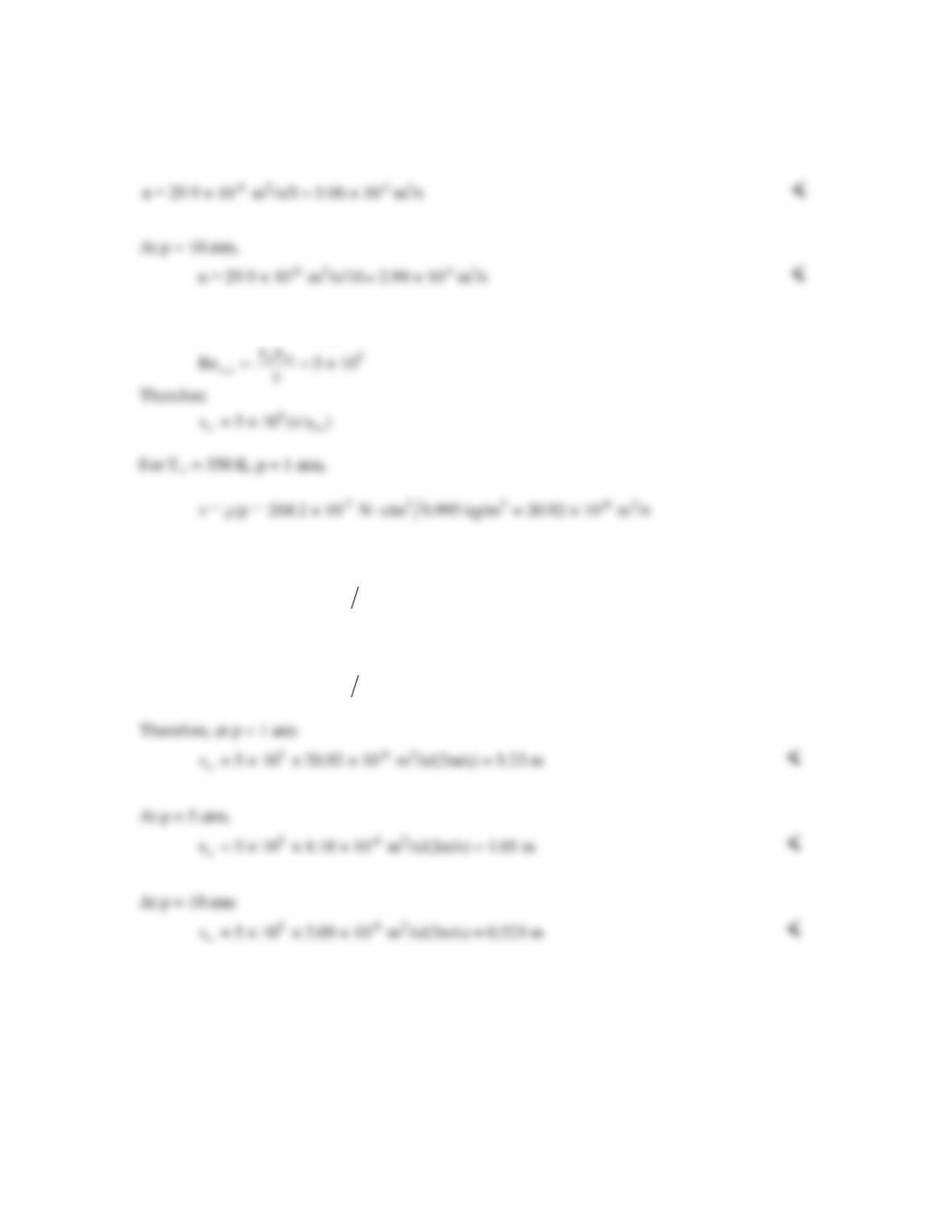
(a) For an ideal gas
ν = μ/ρ
or ν is independent of pressure. <
The thermal diffusivity is
(b) For T = 350 K, p = 1 atm, the thermal diffusivity of air is
PROBLEM 6.19 ( Cont.)
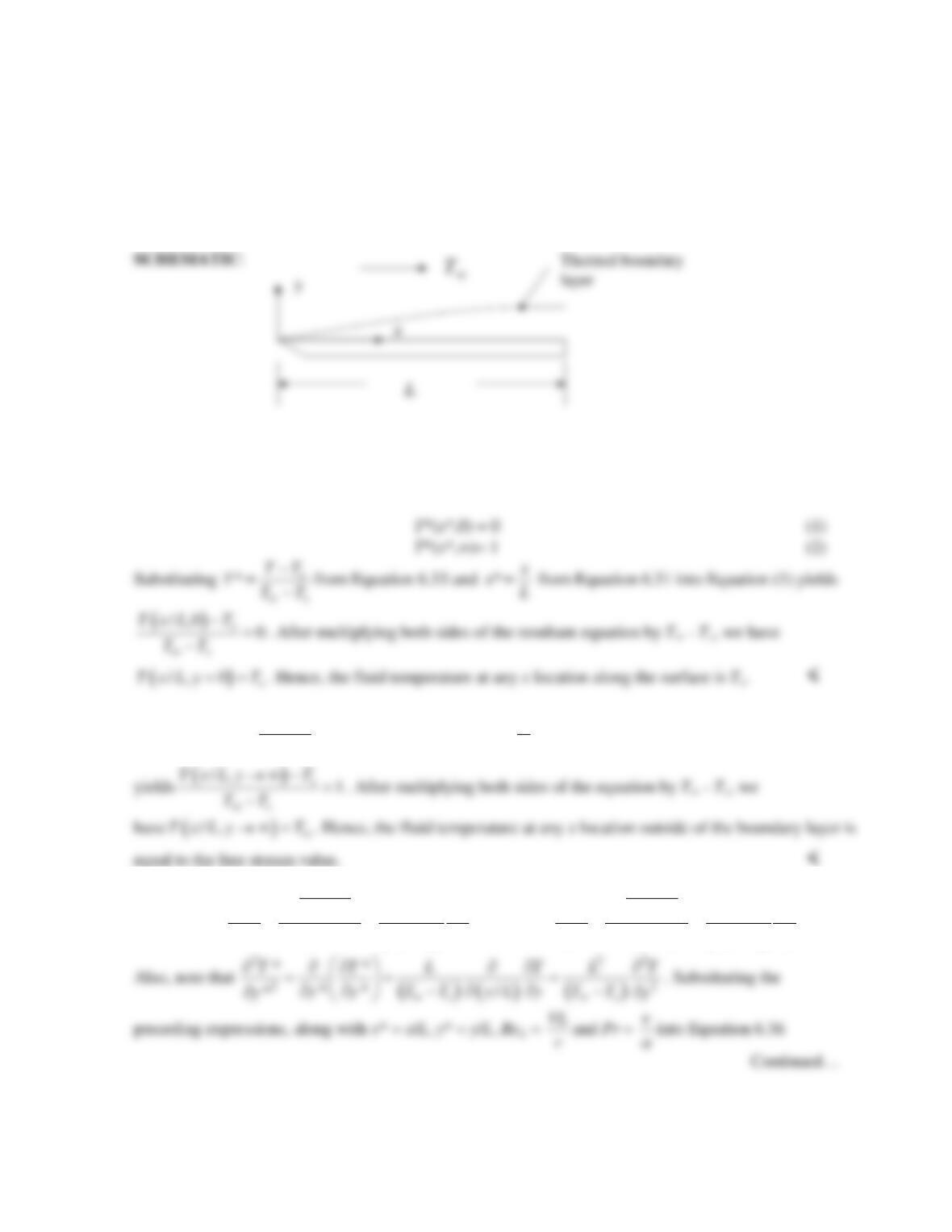
(c) For transition over a flat plate,
Using Equation 4, at p = 5 atm
-6 2 -6 2
ν = 20.92 × 10 m /s 5 = 4.18 × 10 m /s
At p = 10 atm,
-6 2 -6 2
ν = 20.92 × 10 m /s 10 = 2.09 × 10 m /s
COMMENT: Note the strong dependence of the transition length upon the pressure for the gas
(the transition length is independent of pressure for the incompressible liquid).
PROBLEM 6.20
KNOWN: Nondimensional form of the thermal boundary layer equation and boundary conditions,
expressions for x*, y*, u*, v* and T*. Laminar, incompressible flow with negligible viscous
dissipation.
FIND: Expressions for (a) the thermal boundary conditions and (b) energy equation in dimensional
form.
ASSUMPTIONS: (1) Steady–state conditions, (2) Constant properties.
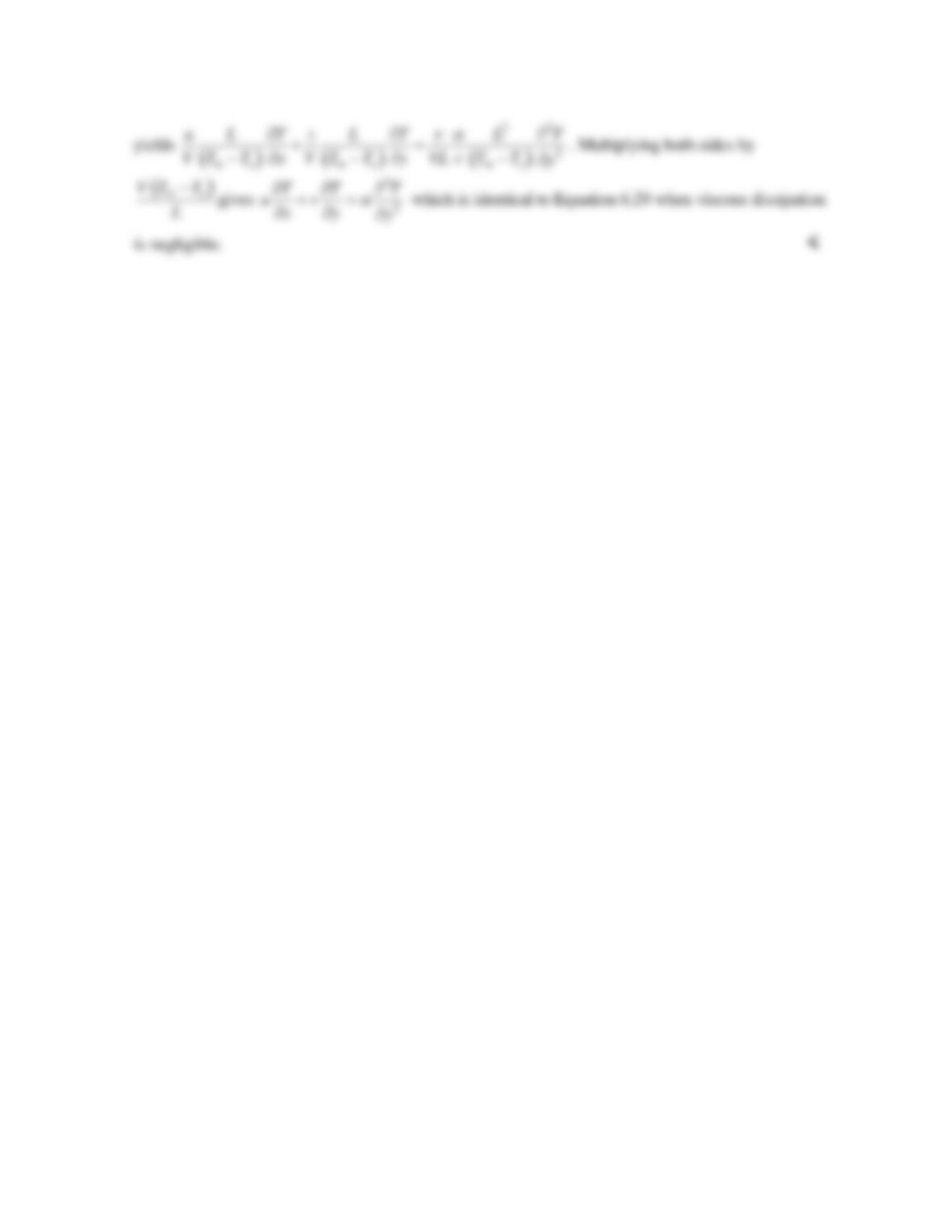
ANALYSIS: (a) From Equation 6.39, the thermal boundary conditions in nondimensional form are
*
s
s
TT
∞
−
=−
*x
xL
=
Substituting
*
s
s
TT
TTT
∞
−
=−
from Equation 6.33 and
*x
xL
=
from Equation 6.31 into Equation (2)
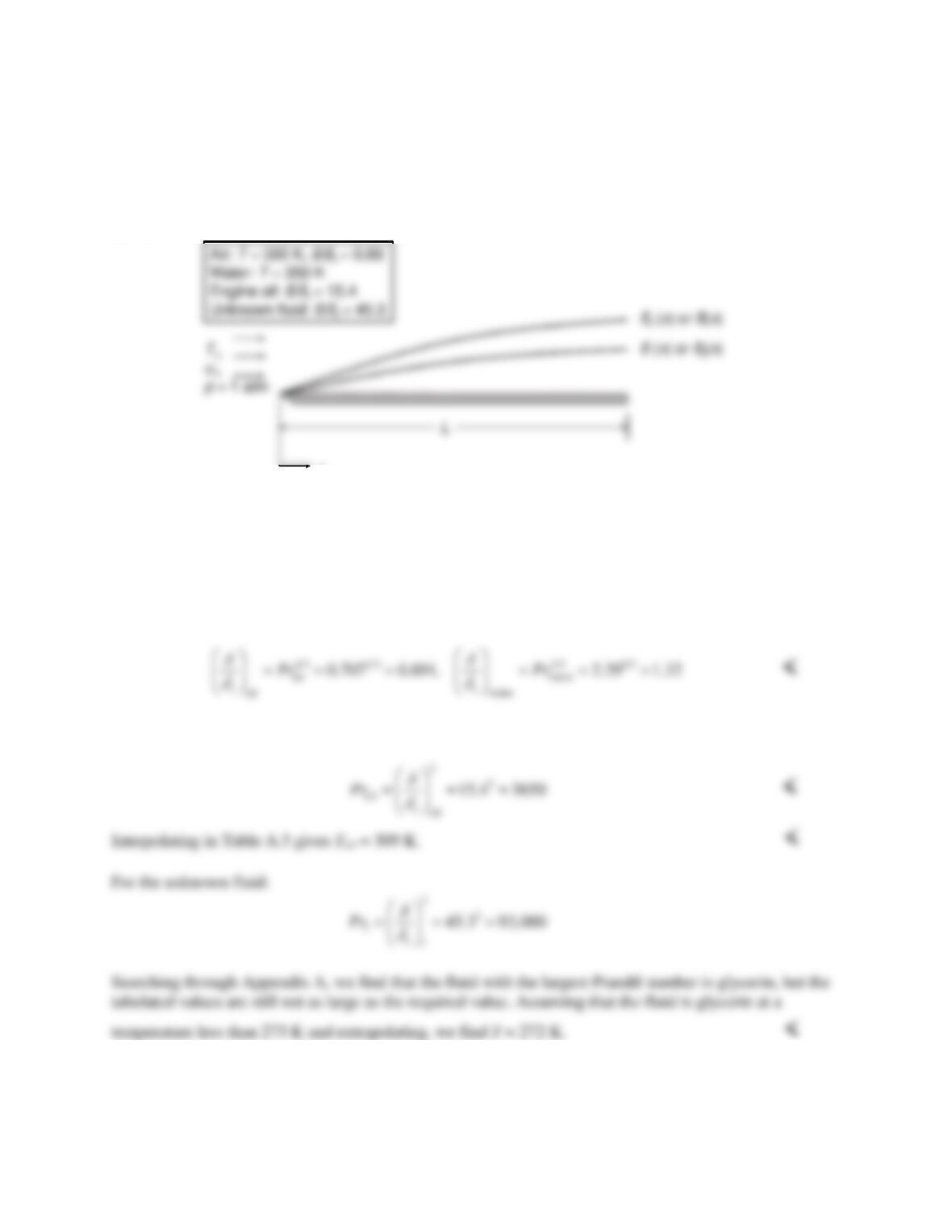
(b) Note that
( )
*
* (/)
s
s
s
TT
TT
T LT
x xL T T x
∞
∞
−
∂
−
∂∂
= =
∂ ∂ −∂
. Likewise,
( )
( )
*
*/
s
s
s
TT
TT
T LT
y yL T T y
∞
∞
−
∂
−
∂∂
= =
∂ ∂ −∂
.
PROBLEM 6.20 (Cont.)
COMMENTS: (1) Equations 6.36 and 6.39 are nondimensional forms of Equations 6.29 and the
boundary conditions. When converted to their nondimensional forms, the resulting equations explicitly
illustrate the importance of the Reynolds and Prandtl numbers in describing the thermal boundary
layer. (2) For a flat plate subject to parallel flow, the Reynolds number is usually expressed as ReL =
ρ
u∞L/
m
, or u∞L/
ν
since u∞ = V.
PROBLEM 6.21
KNOWN: Laminar boundary layer flow over a flat plate. Atmospheric pressure. Type of fluid, and/or
temperature, and/or
δ
/
δ
t.
FIND: Missing information for type of fluid, and/or temperature, and or
δ
/
δ
t.
SCHEMATIC:
x
ASSUMPTIONS: (1) Steady-state, (2) Laminar boundary layer flow, (3) Properties are constant at the
specified temperature.
PROPERTIES: Table A-4, Air, (T = 300 K): Pr = 0.707. Table A-6, Water, (T = 350 K): Pr = 2.29.
ANALYSIS: For air at 300 K and water at 350 K, the Prandtl number can be found in Appendix A, and
the ratio of boundary layer thicknesses is
For engine oil, the Prandtl number can be found from the given boundary layer thickness ratio:
COMMENTS: Most gases have Pr < 1, and therefore
δ
<
δ
t. Most liquids have Pr > 1, and therefore
δ
>
δ
t. Liquid metals are an exception to this trend. Their Prandtl numbers are very small, and consequently
δ
«
δ
t for liquid metals.
PROBLEM 6.22
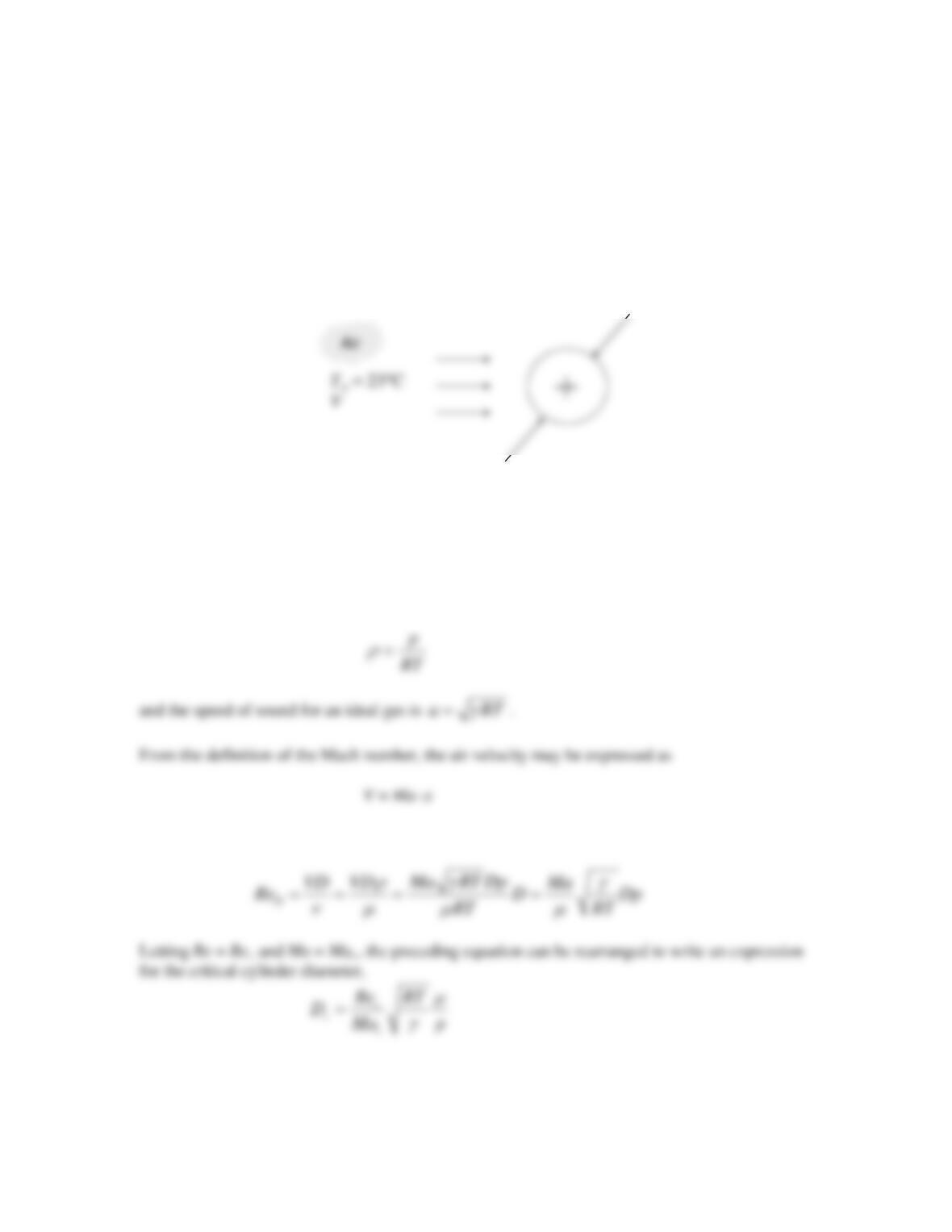
KNOWN: Critical Reynolds number for a cylinder in cross flow. Critical Mach number.
FIND: Critical cylinder diameter below which, if the flow of air at atmospheric pressure and
temperature is turbulent, compressibility effects may be important.
SCHEMATIC:
ASSUMPTIONS: (1) Steady–state conditions. (2) Air behaves as an ideal gas.
PROPERTIES: Table A.4, air (T = 300 K): M = 28.97 kg/kmol, cp = 1.007 kJ/kg∙K,
m
= 184.6
× 10-7 N∙s/m2.
ANALYSIS: The density of an ideal gas may be found from the equation of state,
Substituting the preceding equations into the definition of the Reynolds number yields
Before evaluating the critical cylinder diameter, we note that the gas constant for air is
Continued…
PROBLEM 6.22 (Cont.)
and the specific heat at constant volume, cv, is
Therefore, the ratio of specific heats for air is
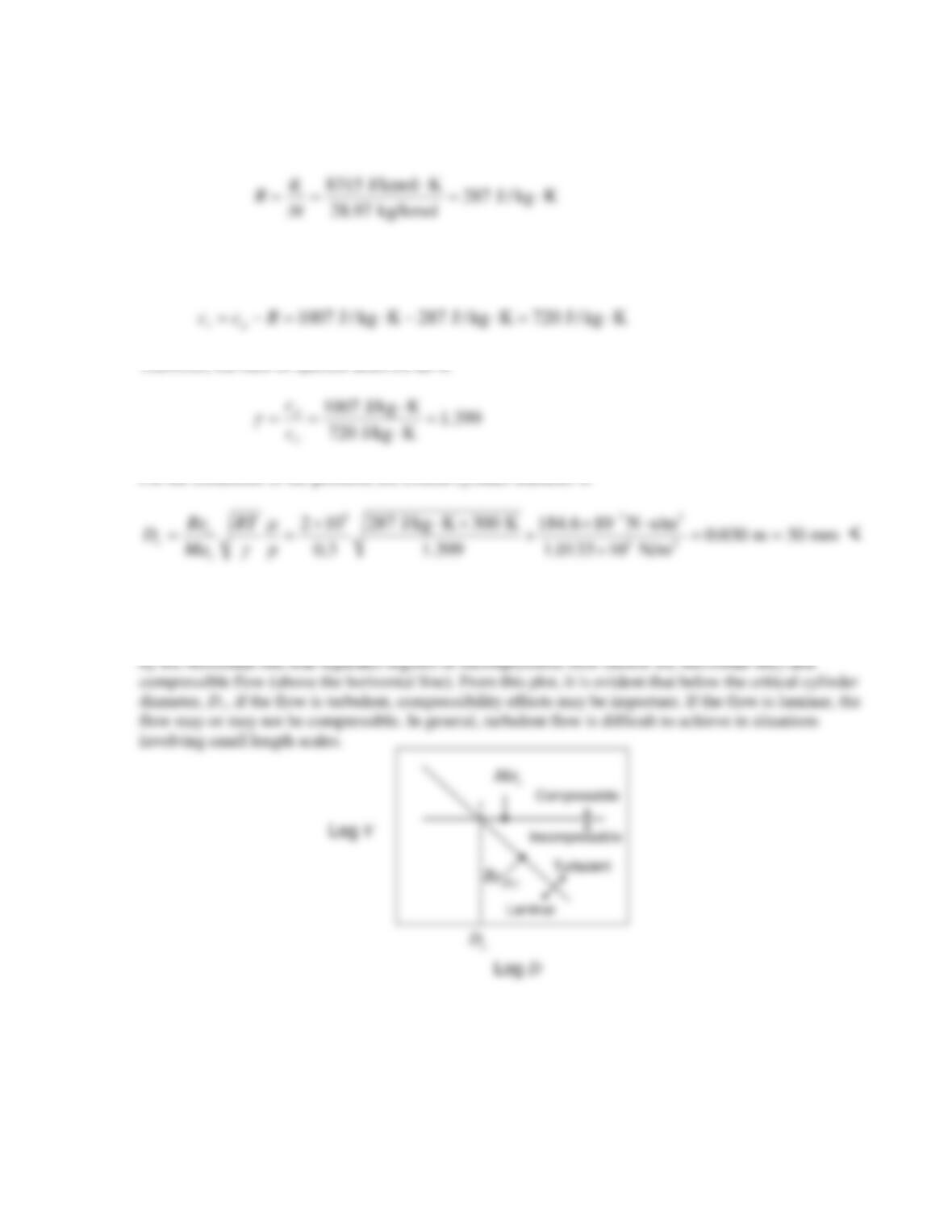
For the conditions of the problem, the critical cylinder diameter is
COMMENTS: (1) The expression for the critical Reynolds number (ReD,c = 2 × 10⁵) is plotted using
log-log scales in the figure below. Laminar flow occurs to the left of the sloped line, while turbulent flow
occurs to the right of the sloped line. The velocity associated with the critical Mach number is identified
(2) The value of the critical Reynolds number is geometry-dependent. Care must be taken to
apply the correct value of the critical Reynolds number in any calculation involving convection
heat transfer.
PROBLEM 6.23
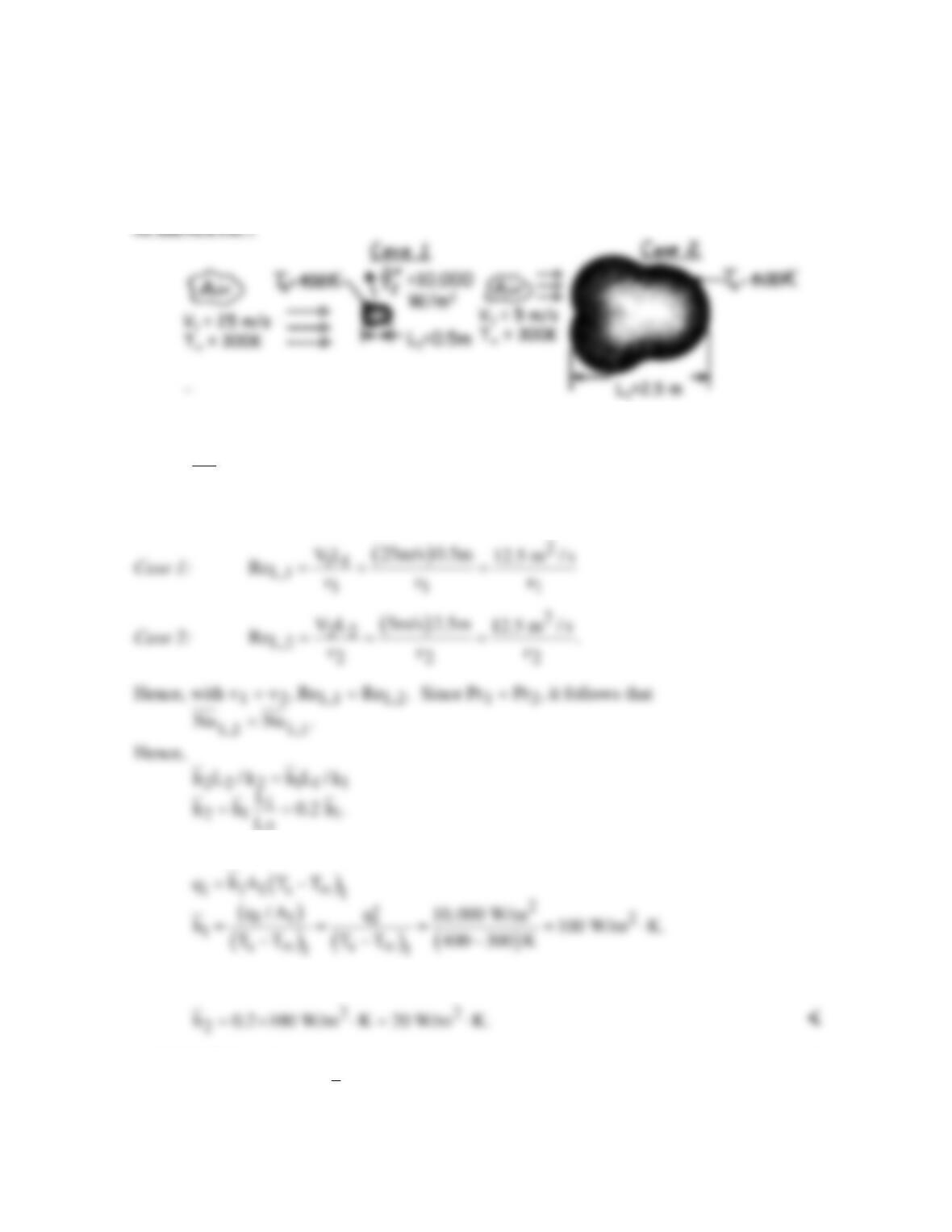
KNOWN: Characteristic length, surface temperature and average heat flux for an object
placed in an airstream of prescribed temperature and velocity.
FIND: Average convection coefficient if characteristic length of object is increased by a
factor of five and air velocity is decreased by a factor of five.
ASSUMPTIONS: (1) Steady-state conditions, (2) Constant properties.
ANALYSIS: For a particular geometry,
( )
LL
Nu f Re , Pr .=
The Reynolds numbers for each case are
2
For Case 1, using the rate equation, the convection coefficient is
Hence, it follows that for Case 2
COMMENTS: If ReL,2 were not equal to ReL,1, it would be necessary to know the specific
form of f(ReL, Pr) before
h2
could be determined.
PROBLEM 6.24
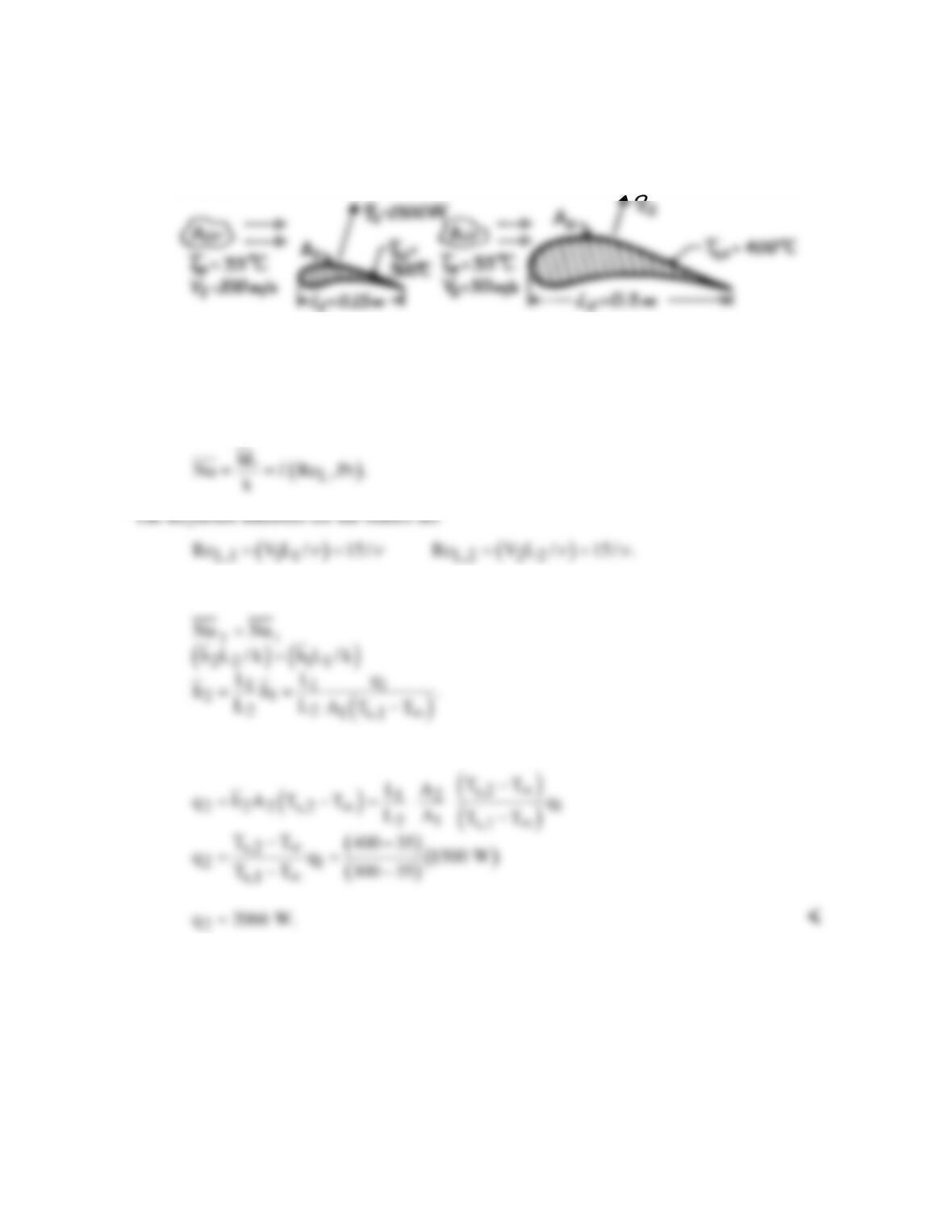
KNOWN: Heat transfer rate from a turbine blade for prescribed operating conditions.
FIND: Heat transfer rate from a larger blade operating under different conditions.
SCHEMATIC:
ASSUMPTIONS: (1) Steady-state conditions, (2) Constant properties, (3) Surface area A is
directly proportional to characteristic length L, (4) Negligible radiation, (5) Blade shapes are
geometrically similar.
ANALYSIS: For a prescribed geometry,
Hence, with constant properties,
L,1 L,2
Re Re .=
Also,
Pr Pr .
1 2
=
Therefore,
Hence, the heat rate for the second blade is
COMMENTS: The slight variation of ν from Case 1 to Case 2 would cause ReL,2 to differ
from ReL,1. However, for the prescribed conditions, this non-constant property effect is
small.
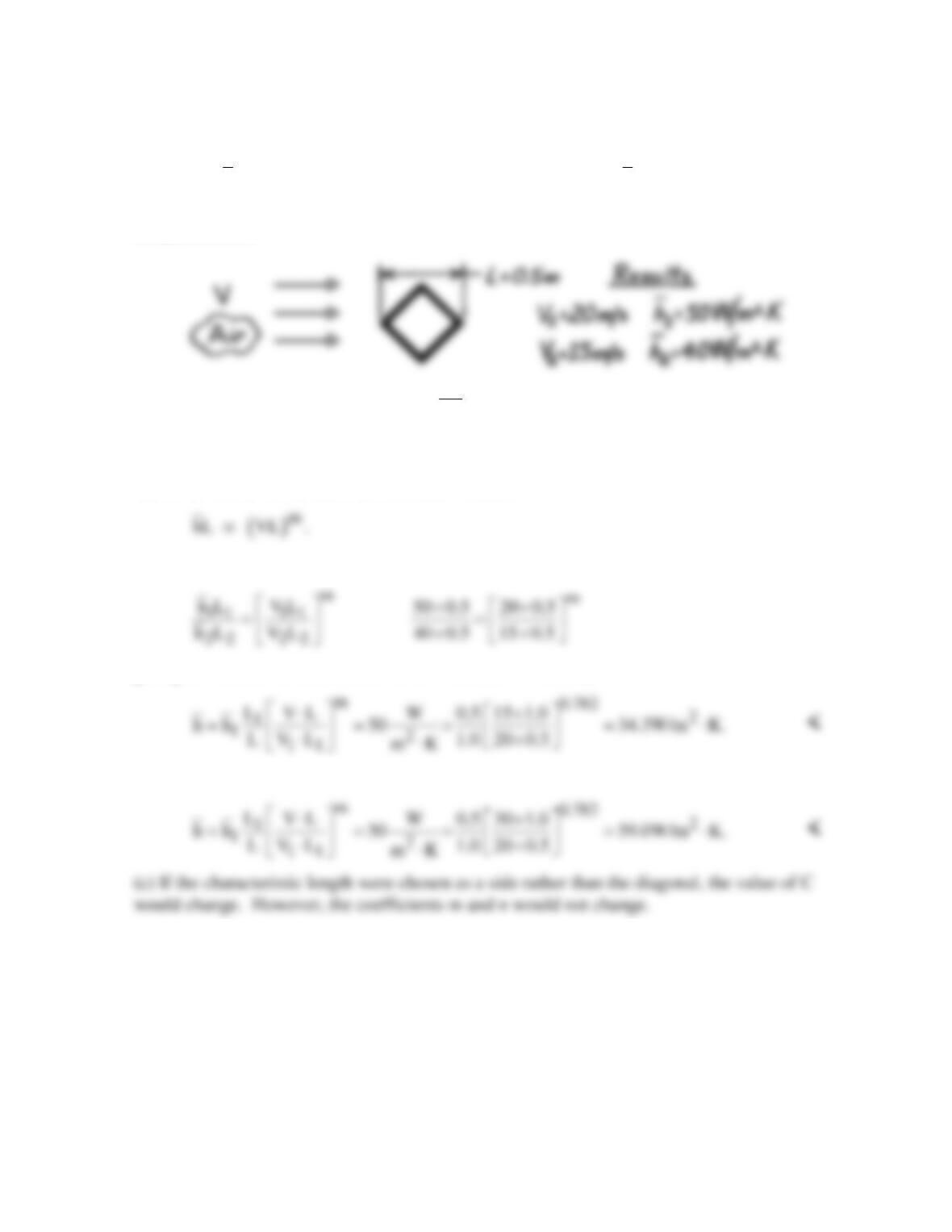
PROBLEM 6.25
KNOWN: Experimental measurements of the heat transfer coefficient for a square bar in
cross flow.
FIND: (a)
h
for the condition when L = 1m and V = 15m/s, (b)
h
for the condition when L
= 1m and V = 30m/s, (c) Effect of defining a side as the characteristic length.
SCHEMATIC:
ASSUMPTIONS: (1) Functional form
mn
Nu CRe Pr=
applies with C, m, n being
constants, (2) Constant properties.
ANALYSIS: (a) For the experiments and the condition L = 1m and V = 15m/s, it follows
that Pr as well as C, m, and n are constants. Hence
Using the experimental results, find m. Substituting values
giving m = 0.782. It follows then for L = 1m and V = 15m/s,
(b) For the condition L = 1m and V = 30m/s, find
COMMENTS: The foregoing Nusselt number relation is used frequently in heat transfer
analysis, providing appropriate scaling for the effects of length, velocity, and fluid properties
on the heat transfer coefficient.
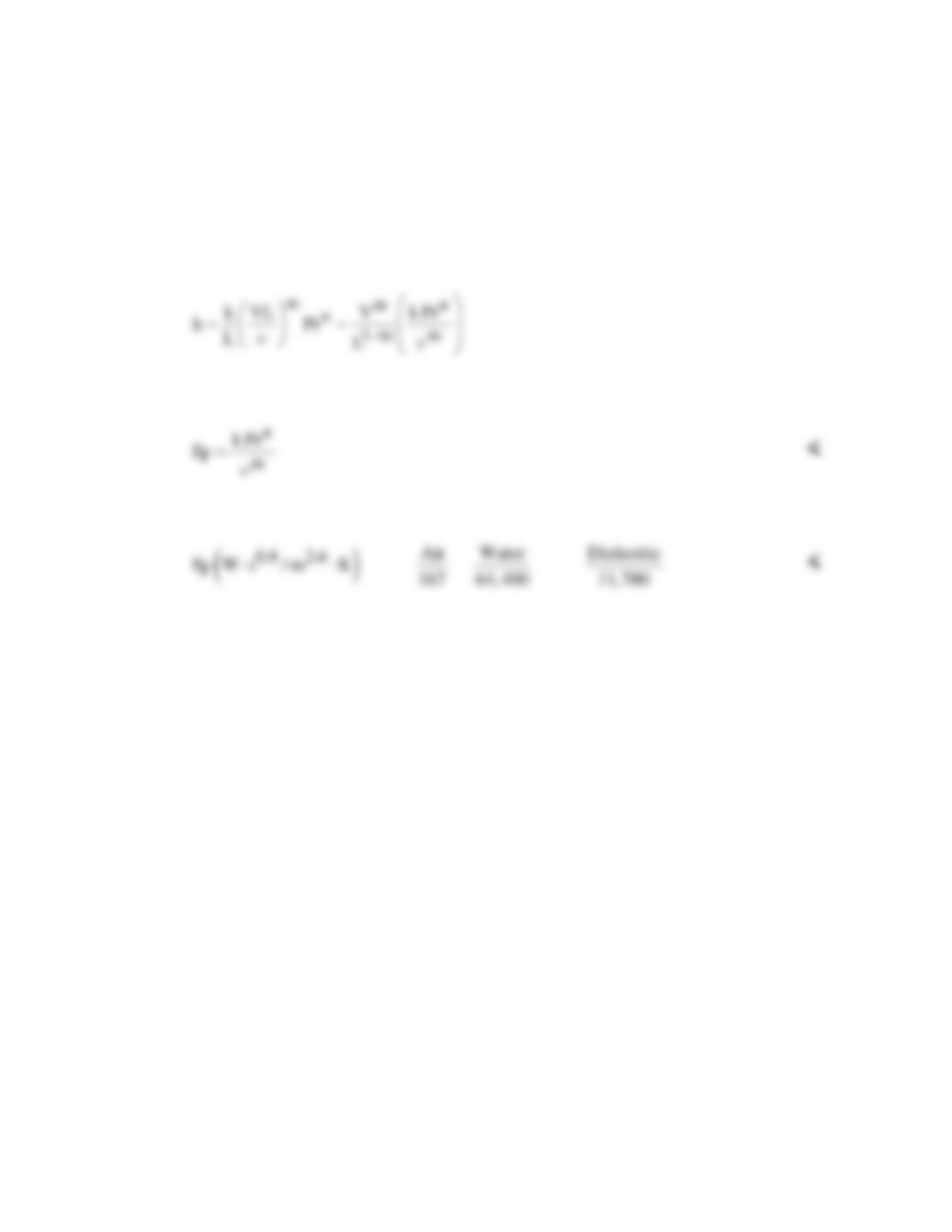
PROBLEM 6.26
KNOWN: Form of the Nusselt number correlation for forced convection and fluid properties.
FIND: Expression for figure of merit FF and values for air, water and a dielectric liquid.
PROPERTIES: Prescribed. Air: k = 0.026 W/m⋅K, ν = 1.6 × 10⁻⁵ m2/s, Pr = 0.71. Water: k =
0.600 W/m⋅K, ν = 10-6 m2/s, Pr = 5.0. Dielectric liquid: k = 0.064 W/m⋅K, ν = 10-6 m2/s, Pr = 25
ANALYSIS: With
mn
LL
Nu ~ Re Pr ,
the convection coefficient may be expressed as
The figure of merit is therefore
and for the three fluids, with m = 0.80 and n = 0.33,
Water is clearly the superior heat transfer fluid, while air is the least effective.
COMMENTS: The figure of merit indicates that heat transfer is enhanced by fluids of large k, large
Pr and small ν.
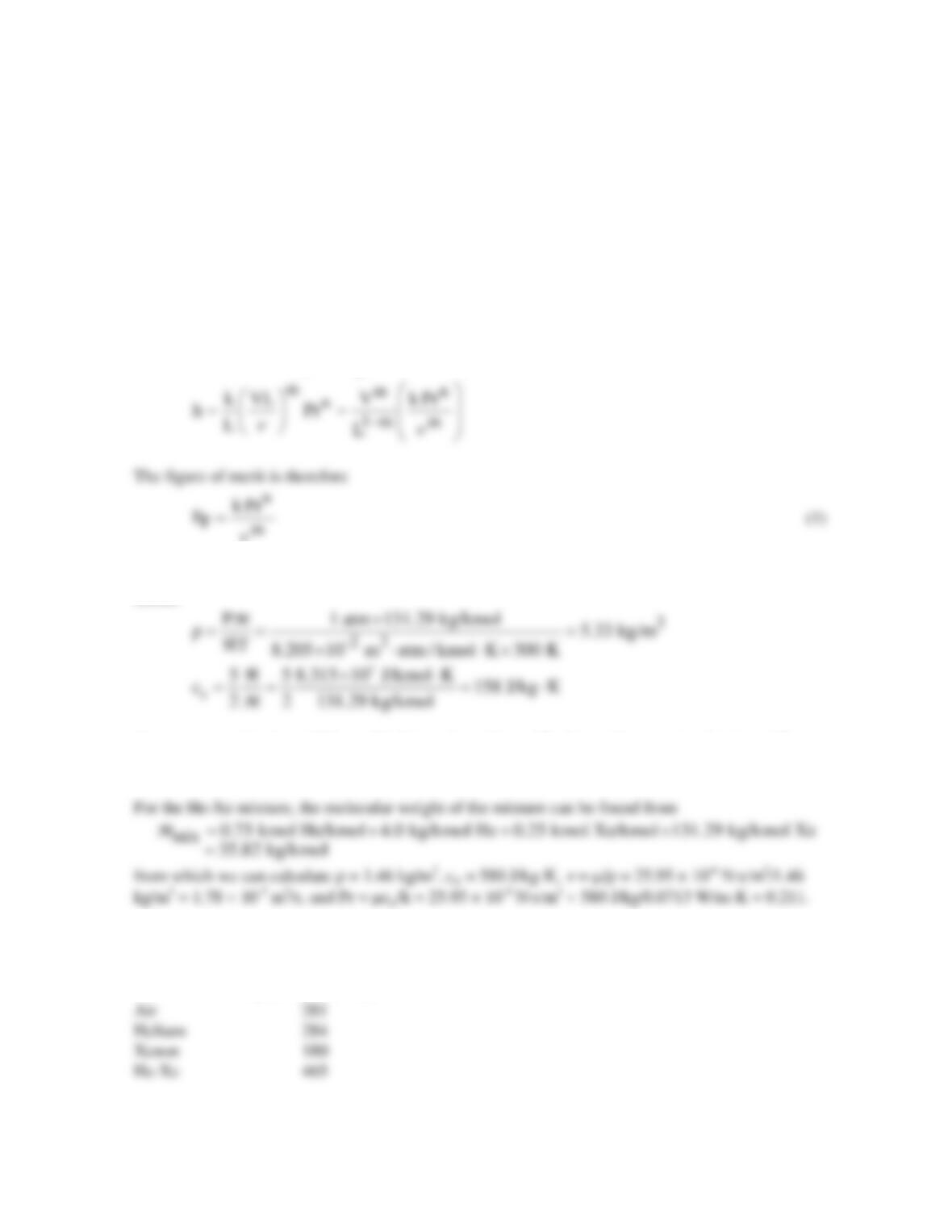
PROBLEM 6.27
KNOWN: Form of the Nusselt number correlation for forced convection and fluid properties.
Properties of xenon and He-Xe mixture. Temperature and pressure. Expression for specific heat for
monatomic gases.
FIND: Figures of merit for air, pure helium, pure xenon, and He-Xe mixture containing 0.75 mole
fraction of helium.
PROPERTIES: Table A-4, Air (300 K): k = 0.0263 W/m⋅K,
ν
= 15.89 × 10⁻⁶ m2/s, Pr = 0.707.
Table A-4, Helium (300 K): k = 0.152 W/m⋅K,
ν
= 122 × 10-6 m2/s, Pr = 0.680. Pure xenon (given):
k = 0.006 W/m⋅K, m = 24.14 × 10⁻⁶ N∙s/m2. He-Xe mixture (given): k = 0.0713 W/m·K, m = 25.95 ×
10-6 N·s/m2.
ANALYSIS: With
mn
LL
Nu ~ Re Pr ,
the convection coefficient may be expressed as
ν
For xenon and the He-Xe mixture, we must find the density and specific heat. Proceeding for pure
xenon:
Thus
ν
= m/ρ = 24.14 × 10⁻⁶ N∙s/m2/5.33 kg/m3 = 4.53 × 10⁻⁶ m2/s and Pr = mcp/k = 24.14 × 10⁻⁶
N∙s/m2 × 158 J/kg/0.006 W/m·K = 0.636.
Finally, for the four fluids, with m = 0.85 and n = 0.33, we can calculate the figure of merit from
Equation (1):
FF (W·s0.85/m2.7·K) <
COMMENTS: The effectiveness of the He–Xe mixture is much higher than that of pure He, pure
Xe, or air. By blending He and Xe, the high thermal conductivity of helium and the high density of
xenon are both exploited in a manner that leads to a high figure of merit.
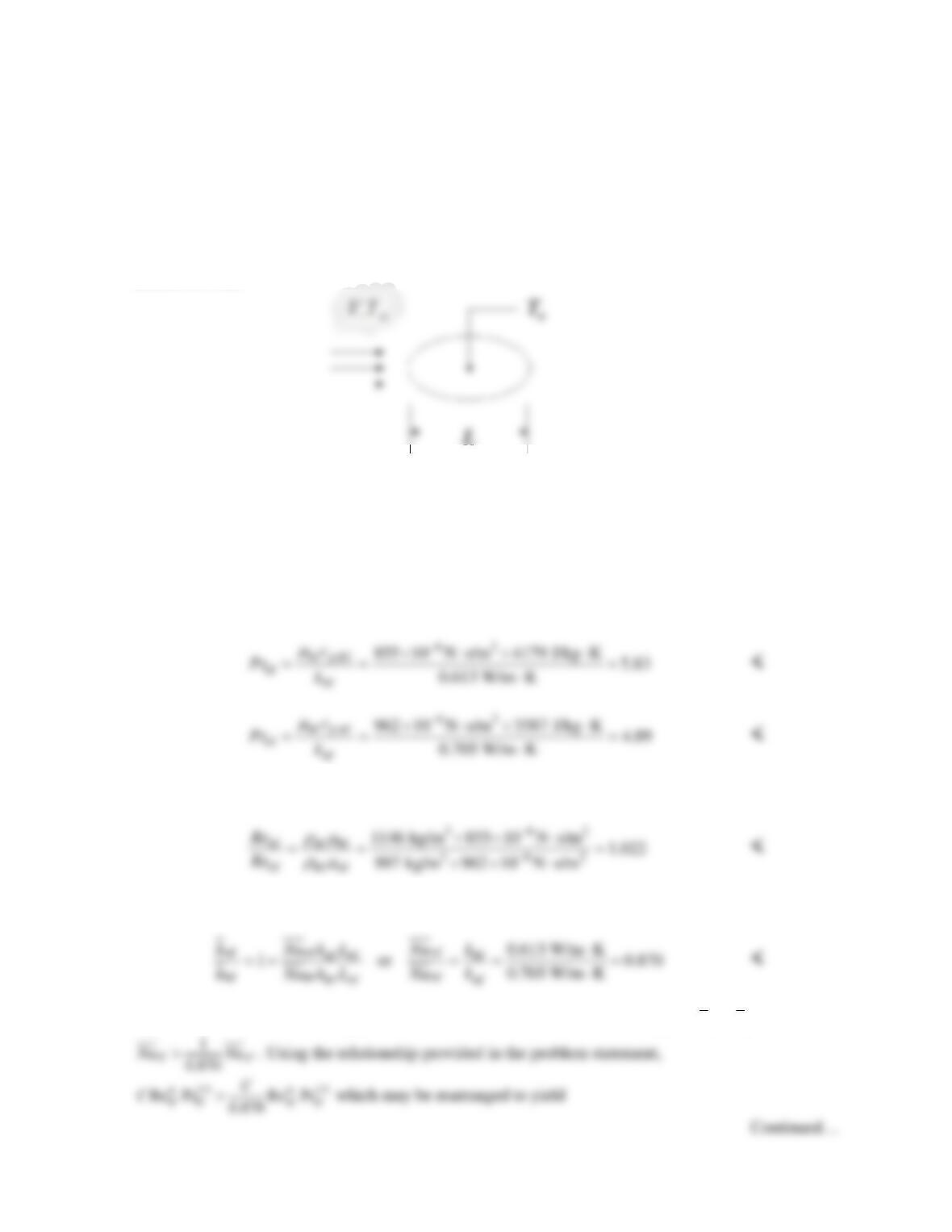
PROBLEM 6.28
KNOWN: Base fluid (water) and nanofluid properties. Fixed surface and ambient temperatures, fixed
characteristic velocity. Fixed geometry. Form of Nusselt number correlation.
FIND: (a) Prandtl numbers of the base fluid and nanofluid. (b) Ratio of Reynolds numbers of the two
fluids and ratio of Nusselt numbers necessary to provide the same convection heat transfer
coefficients. (c) Whether the base fluid can provide greater convection heat transfer rates than the
nanofluid.
SCHEMATIC:
ASSUMPTIONS: (1) Steady–state conditions, (2) Constant properties, (3) Negligible viscous
dissipation.
PROPERTIES: Table A.6 (T = 300 K): Water; kbf = 0.613 W/m⋅K,
ρ
bf = 997 kg/m3, cp,bf = 4.179
kJ/kg⋅K,
m
bf = 855 × 10-6 N⋅s/m2. Example 2.2: Nanofluid, knf = 0.705 W/m⋅K,
ρ
nf = 1146 kg/m3, cp,nf =
3.587 kJ/kg⋅K,
m
nf = 962 × 10-6 N⋅s/m2.
ANALYSIS: (a) The Prandtl numbers for the water and nanofluid are:
(b) For a given velocity and characteristic length,
For the same convection heat transfer coefficients,
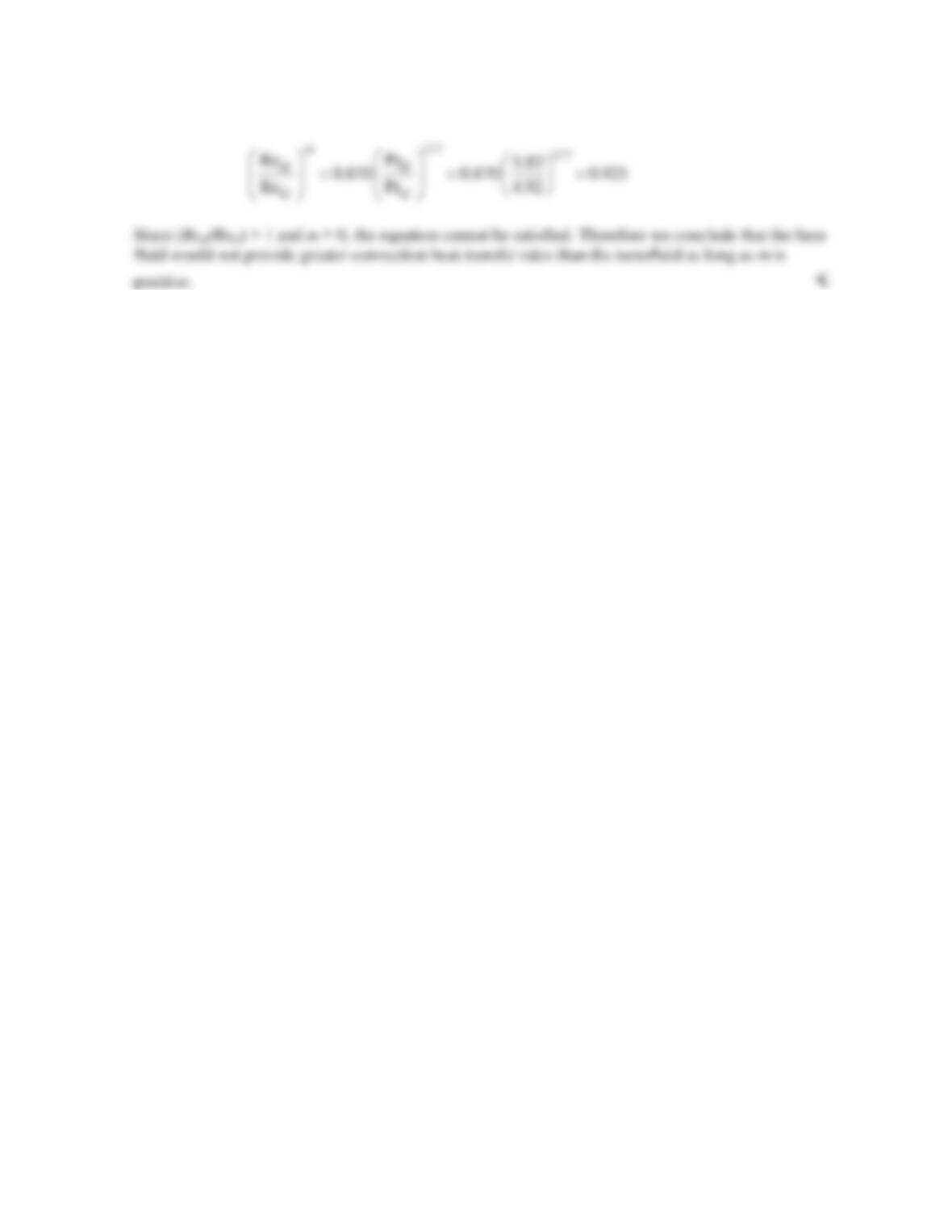
(c) For the base fluid to have a greater convection heat transfer rate would require
bf nf
hh>
, or
PROBLEM 6.28 (Cont.)
COMMENTS: (1) The conclusion regarding the relative efficacy of the nanofluid to the base fluid is
valid only for situations involving unconstrained boundary layers. (2) For internal flow situations,
such as will be discussed in Chapter 8, one cannot draw a general conclusion that the nanofluid would
outperform the base fluid. In fact, in common instances, the base fluid would outperform the
nanofluid.
PROBLEM 6.29
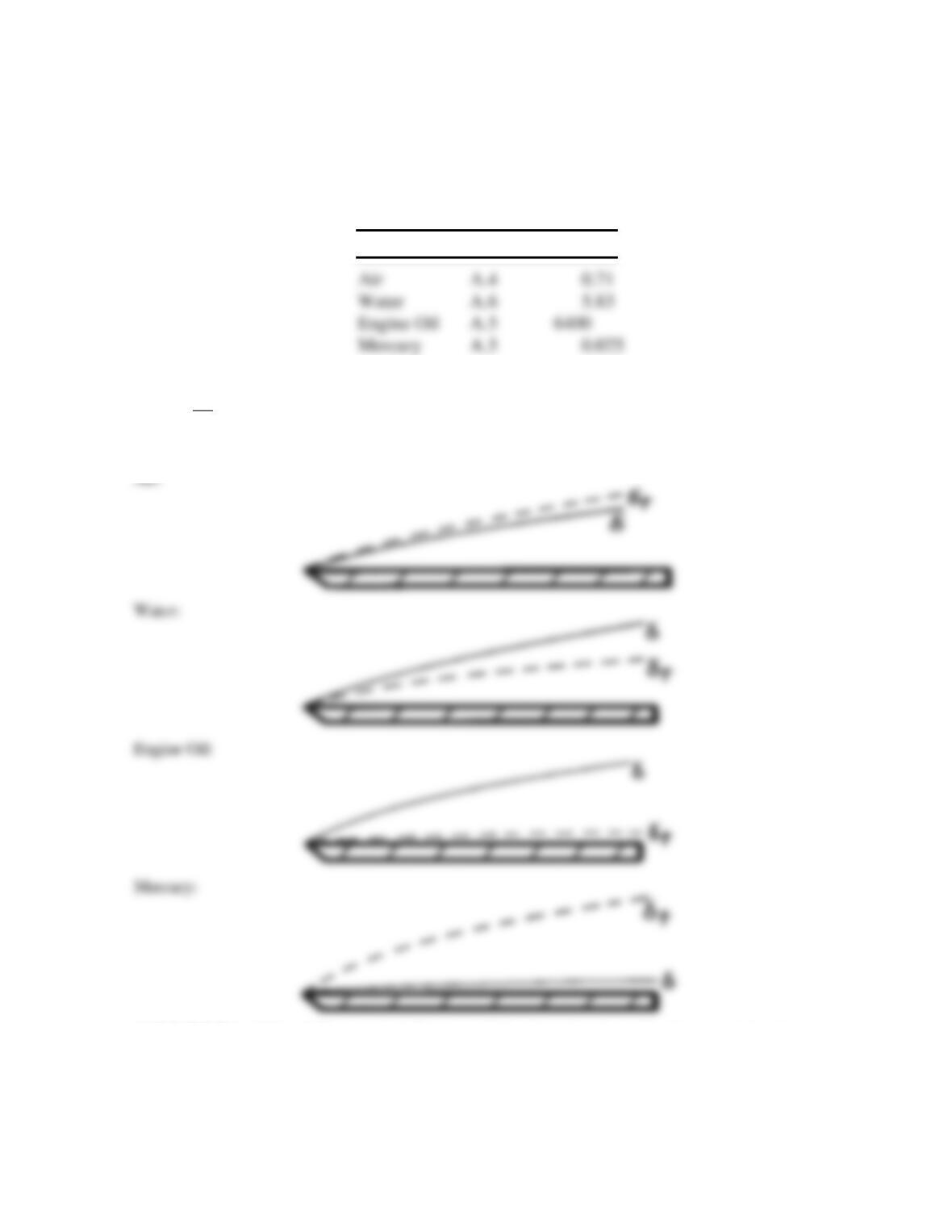
KNOWN: Air, water, engine oil or mercury at 300K in laminar, parallel flow over a flat plate.
FIND: Sketch of velocity and thermal boundary layer thickness.
ASSUMPTIONS: (1) Laminar flow.
PROPERTIES: For the fluids at 300K:
Fluid Table Pr
ANALYSIS: For laminar, boundary layer flow over a flat plate.
n
t
~ Pr
δ
δ
where n > 0. Hence, the boundary layers appear as shown below.
COMMENTS: Although Pr strongly influences relative boundary layer development in laminar
flow, its influence is weak for turbulent flow.
PROBLEM 6.30
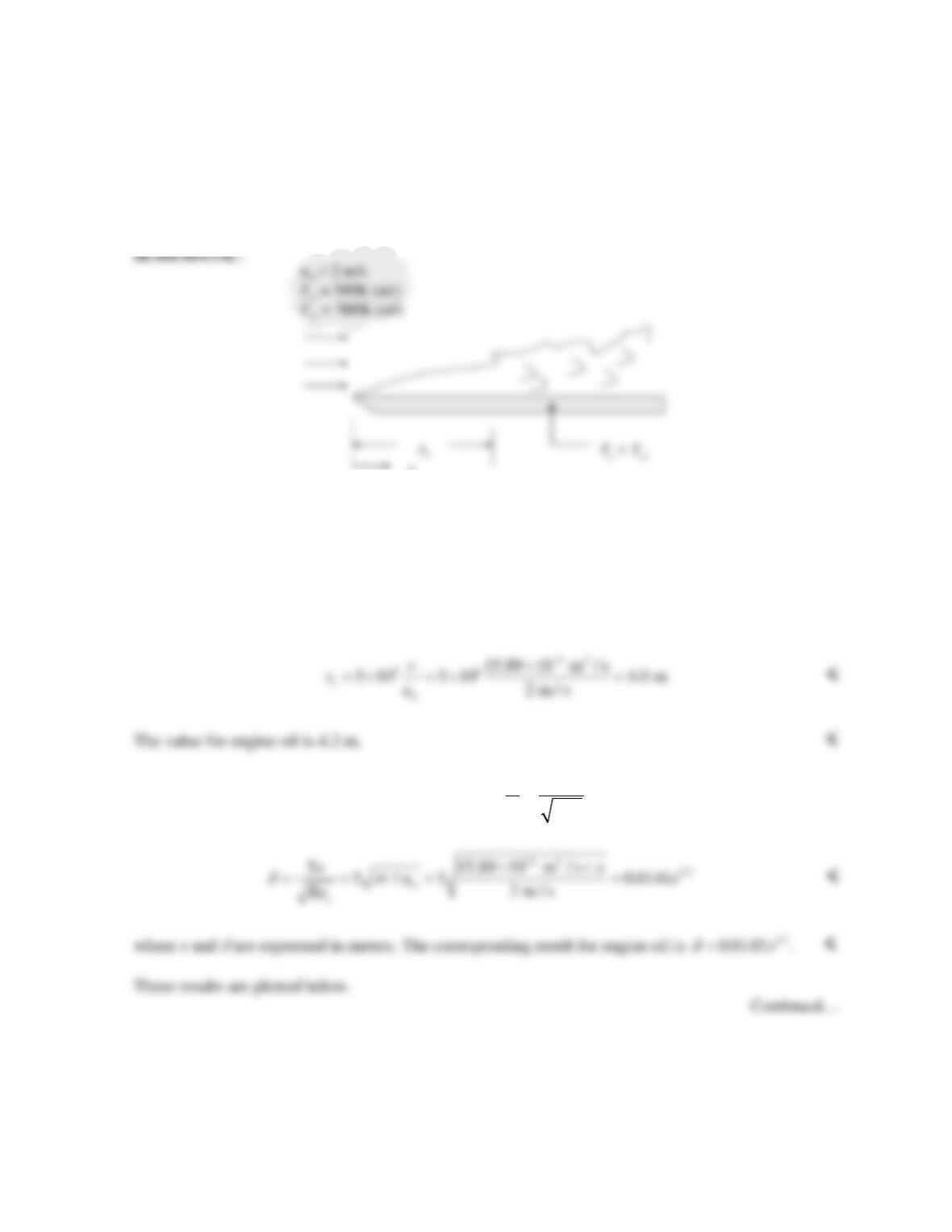
KNOWN: Flow over a flat plate. Velocity and temperature of two fluids. Variation of boundary
layer thickness with x for laminar flow.
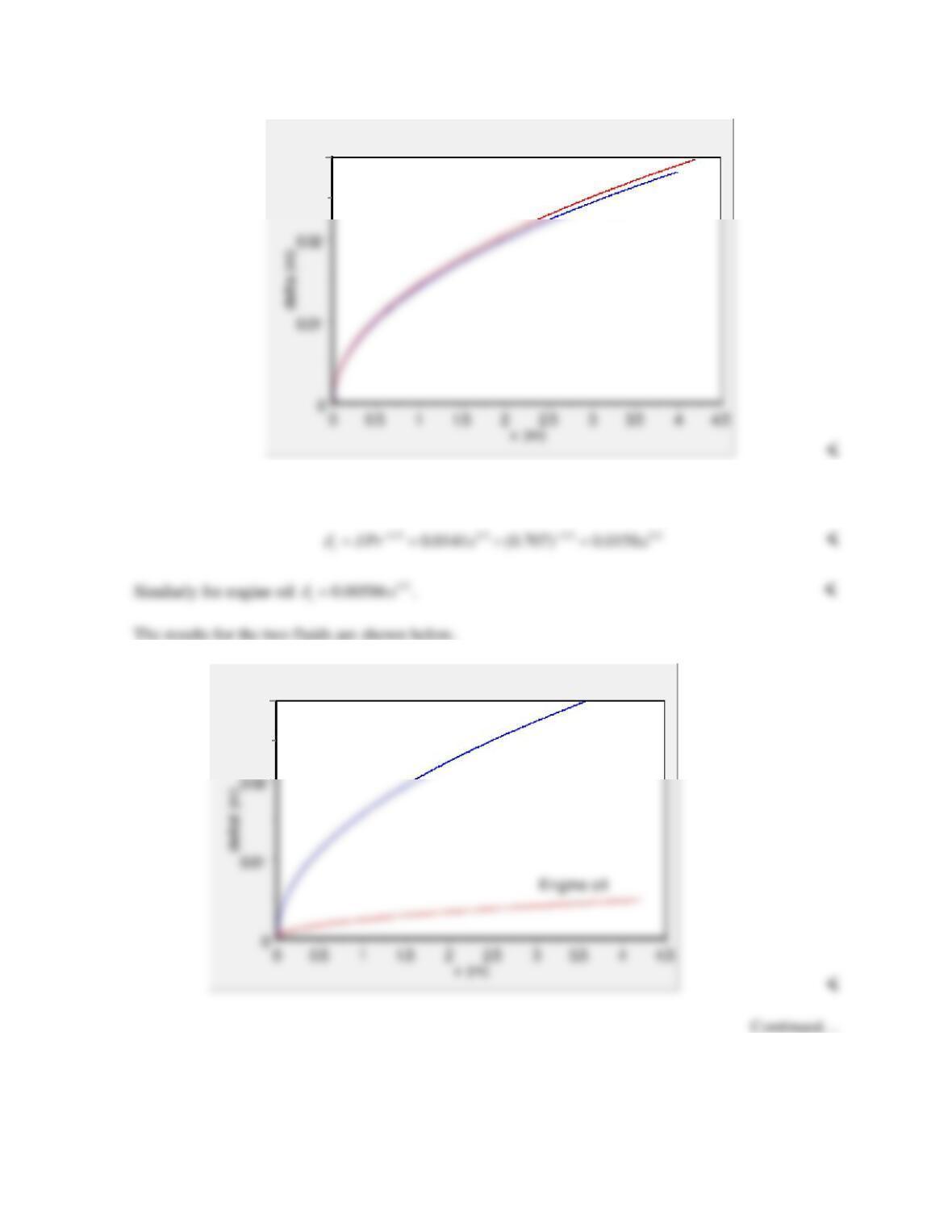
FIND: (a) Location where transition to turbulence occurs for each fluid, (b) Plot of velocity boundary
layer thickness for 0 ≤ x ≤ xc for each fluid, (c) Plot of thermal boundary layer thickness over the same
range. Which fluid has the largest local temperature gradient at the surface, Nusselt number, and heat
transfer coefficient.
ASSUMPTIONS: (1) Steady–state conditions, (2) Incompressible flow, (3) Transition occurs at a
critical Reynolds number of 5 × 10⁵.
PROPERTIES: Table A.4, Air (T = 300 K):
ν
= 15.89 × 10⁻⁶ m2/s, k = 0.0263 W/m⋅K, Pr = 0.707.
Table A.5, Engine Oil (T = 380 K):
ν
= 16.9 × 10⁻⁶ m2/s, k = 0.136 W/m⋅K, Pr = 233.
ANALYSIS: (a) Transition occurs at Rex,c = u∞x/
ν
= 5 × 10⁵. Therefore, for air
(b) The velocity boundary layer thickness is given by
5
x
xRe
δ
=
. Thus, for air
x
PROBLEM 6.30 (Cont.)
0.03
(c) From Eq. 6.55 with n = 1/3,
δ
t =
δ⋅
Pr–1/3. Thus, for air
Engine oil
0.03
Engine oil
Air
Air