Chapter 6
We will evaluate the determinant of Bby expanding across the ith row (where iis neither pnor q).
6.2.61 We follow the hint: In0
−C A A B
C D =A B
−CA +AC −CB +AD
=A B
0AD −CB .So, det In0
−C A A B
C D = det(A) det(AD −CB).
6.2.62 a We compute In0
−CA−1InA B
C D =A B
0−CA−1B+D. Since the matrix In0
−CA−1Inis invert-
ible (its determinant is 1),the product A B
6.2.63 Let Mnbe the number of multiplications required to compute the determinant of an n×nmatrix by Laplace
expansion. We will use induction on nto prove that Mn> n!,for n≥3.
6.2.64 To compute det(A) for an n×nmatrix Aby Laplace expansion, det(A) = a11 det(A11)−a21 det(A21) + ···+
(−1)n+1an1det(An1),we first need to compute the nminors, which requires nLn−1operations; then we compute
the nproducts ai1det(Ai1); and finally we have to do n−1 additions. Altogether,
294
Section 6.2
6.2.65 a. Using Laplace expansion along the first row, we find dn= det (Mn) = det (Mn−1)−det −1∗
0Mn−2=
6.2.66 a. Using Laplace expansion along the first row, we find dn= det (Mn) = det (Mn−1)−det 1∗
0Mn−2=
det (Mn−1)−det (Mn−2) = dn−1−dn−2.
6.2.67 Let kbe the number of pattern entries to the left and above aij . Then the number of pattern entries to
the right and above aij is i−1−k, since there are i−1 rows above aij , each of which contains exactly one
6.2.68 Using Exercise 67 and the terminology introduced in the proof of Theorem 6.2.10, we have
sgnP = (−1)#(inversions in P)= (−1)#(inversions involving aij )(−1)#(inversions not involving aij )
= (−1)i+j(−1)#(inversions in Pij )= (−1)i+jsgn (Pij ).
6.2.69 a. The integers 0, 1, 2, 4, 5, 8, 9, and 10 are in G.
6.2.70 a.
f0f1f2f3f4f5f6f7f8
0 1 1 2 3 5 8 13 21
295
Chapter 6
Section 6.3
6.3.1By Theorem 2.4.10, the area equals |det 3 8
7 2 |=| − 50|= 50.
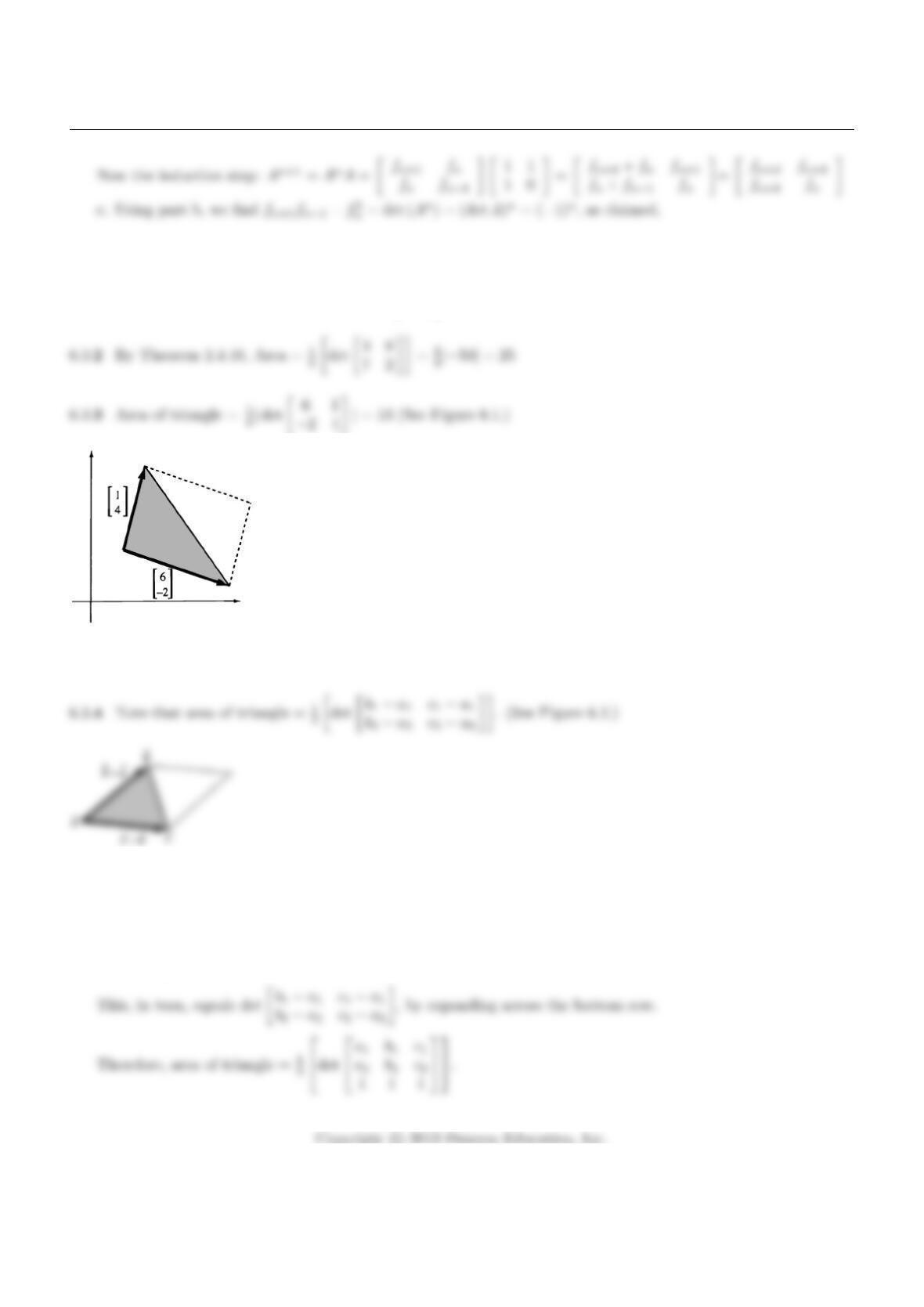
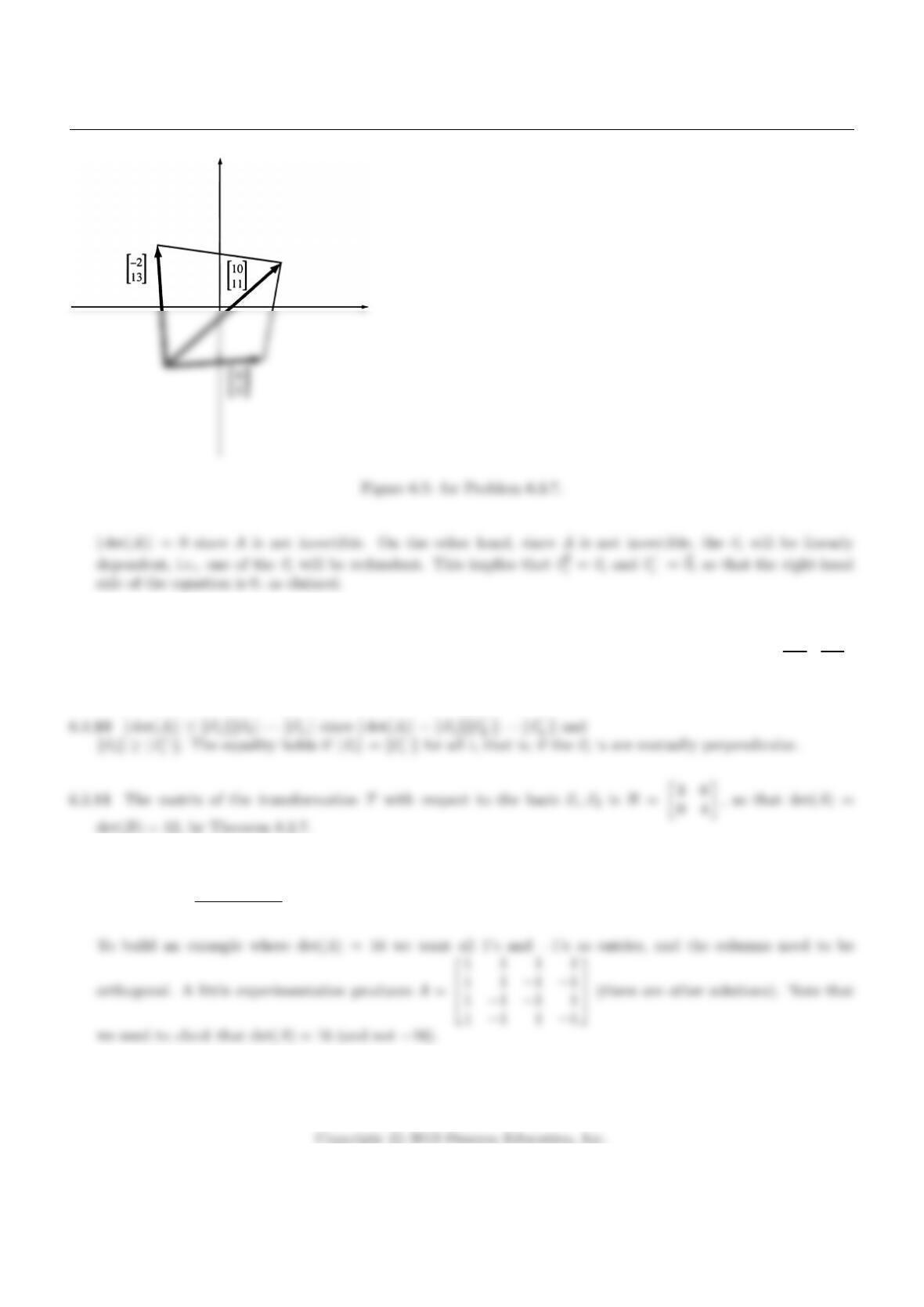
Figure 6.1: for Problem 6.3.3.
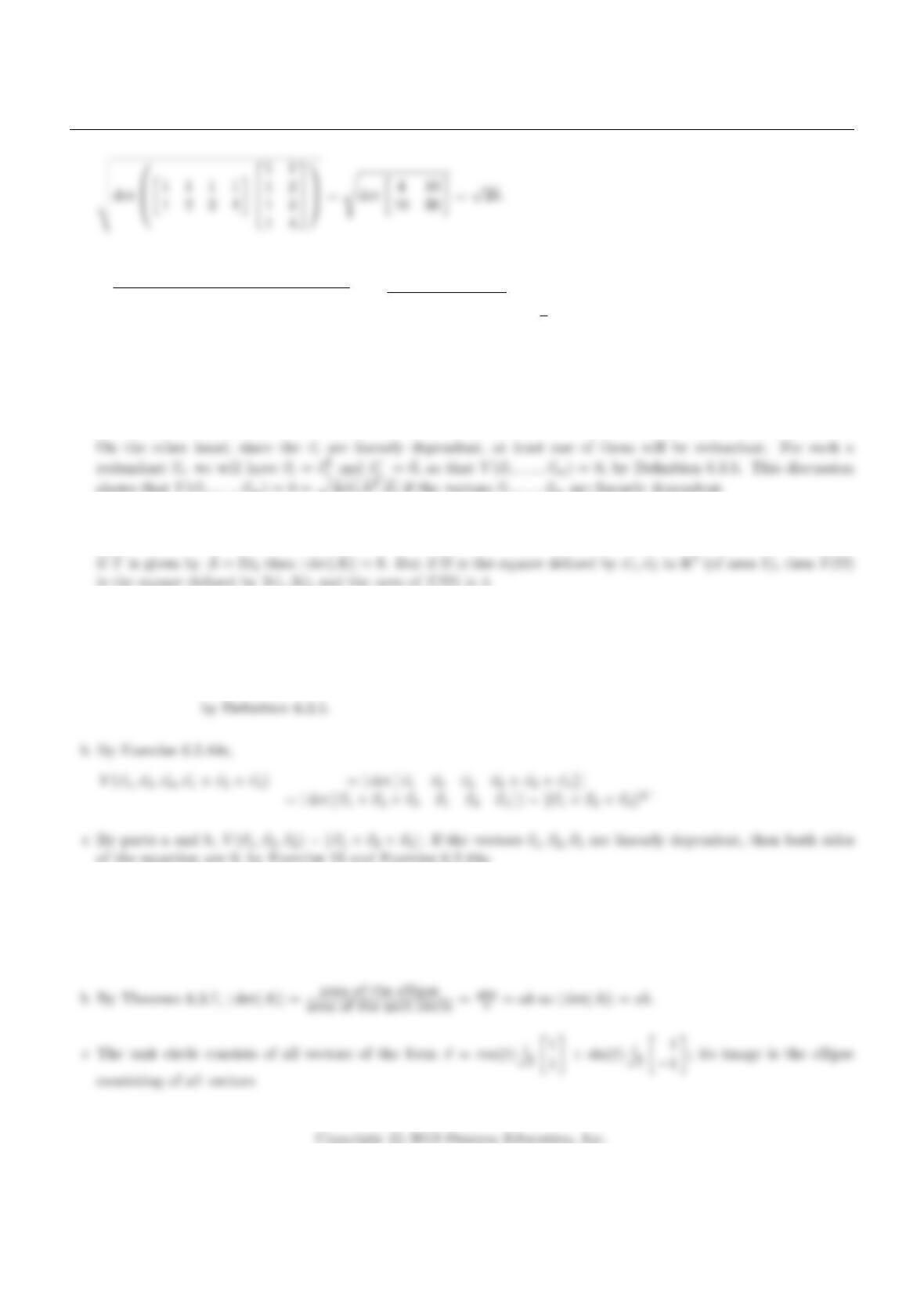
Figure 6.2: for Problem 6.3.4.
On the other hand, det
a1b1c1
a2b2c2
1 1 1
= det
a1b1−a1c1−a1
a2b2−a2c2−a2
1 0 0
,by subtracting the first column from the
second and third.
296
Section 6.3
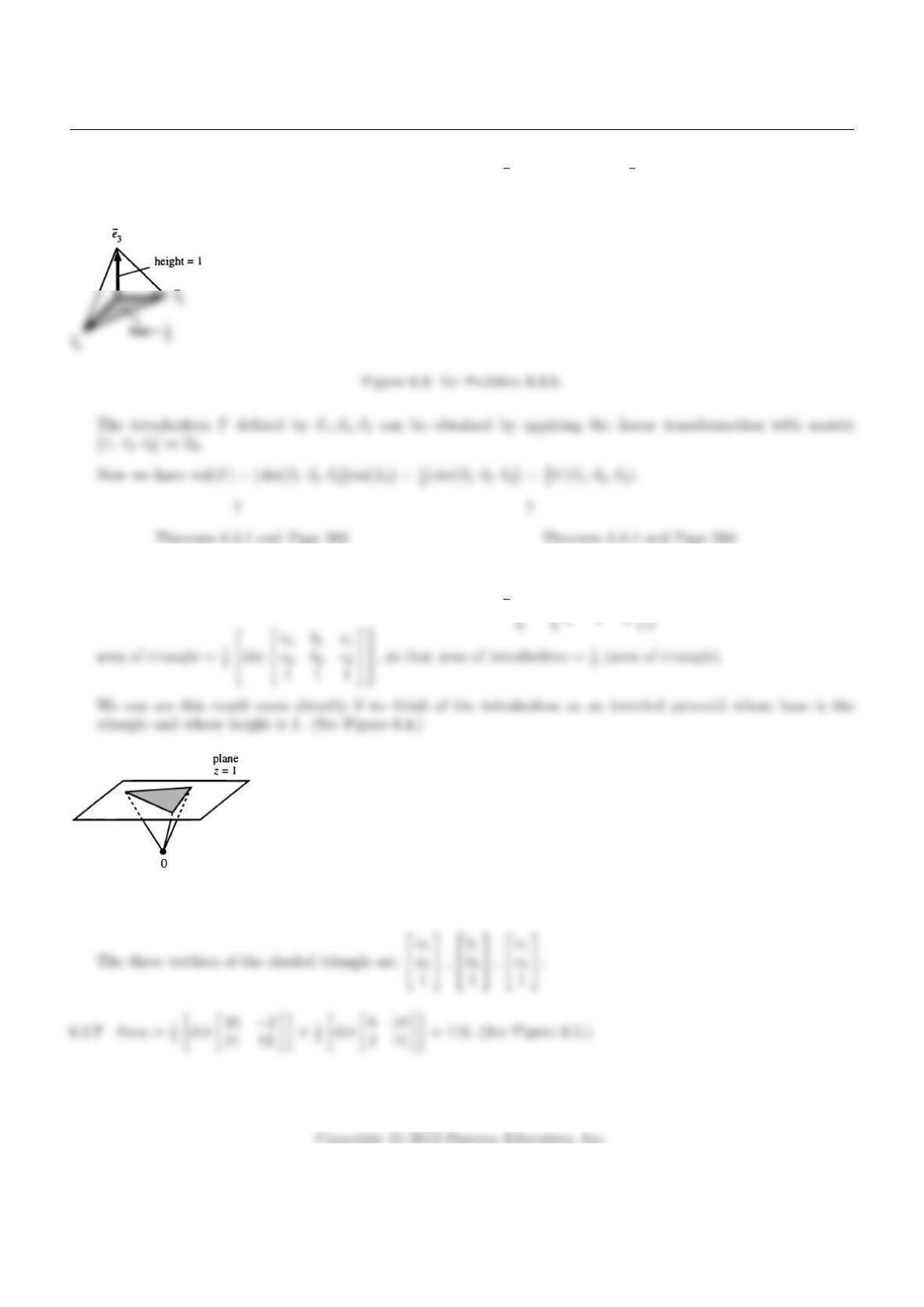
6.3.5The volume of the tetrahedron T0defined by ~e1, ~e2, ~e3is 1
3(base)(height) = 1
6.
Here we are using the formula for the volume of a pyramid. (See Figure 6.3.)
6.3.6From Exercise 5 we know that volume of tetrahedron = 1
6
det
a1b1c1
a2b2c2
, and Exercise 4 tells us that
Figure 6.4: for Problem 6.3.6.
6.3.8We need to show that both sides of the equation in Theorem 6.3.3 give zero.
297
Chapter 6
6.3.9Using linearity in the second column, we find that det ~v1~v2= det h~v1~vk
2+~v⊥
2 i= det h~v1~vk
2i
|{z }
noninvertible
+ det ~v1~v⊥
2= det ~v1~v⊥
2. Thus the two determinants are equal.
6.3.12 Denote the columns by ~v1,~v2,~v3,~v4. By Theorem 6.3.3 and Exercise 6.3.8 we know that |det(A)| ≤
k~v1kk~v2k k~v3kk~v4k; equality holds if the columns are orthogonal. Since the entries of the ~viare 0, 1, and −1, we
have k~vik ≤ √1 + 1 + 1 + 1 = 2. Therefore, |det A| ≤ 16.
6.3.13 By Theorem 6.3.6, the desired 2-volume is
298
Section 6.3
6.3.14 By Theorem 6.3.6, the desired 3-volume is
v
u
u
u
u
tdet
1 0 0 0
1 1 1 1
1 2 3 4
1 1 1
0 1 2
0 1 3
0 1 4
=v
u
u
u
tdet
111
1 4 10
1 10 30
=√6.
6.3.15 If ~v1, ~v2, . . . , ~vmare linearly dependent and if A= [~v1···~vm],then det(ATA) = 0 since ATAand Ahave
equal and nonzero kernels (by Theorem 5.4.2), hence ATAfails to be invertible.
6.3.16 False
6.3.17 a Let ~w =~v1×~v2×~v3.Note that ~w is orthogonal to ~v1, ~v2and ~v3,by Exercise 6.2.44c. Then V(~v1, ~v2, ~v3, ~w) =
V(~v1, ~v2, ~v3)k~w⊥k=V(~v1, ~v2, ~v3)k~wk.
↑
6.3.18 a (See Figure 6.6.)p0
0qcos(t)
sin(t)=p·cos(t)
q·sin(t), the ellipse with semi-axis ±p
0and ±0
q.
(area of the ellipse) = |det(A)|(area of the unit circle) = pqπ
299
Chapter 6
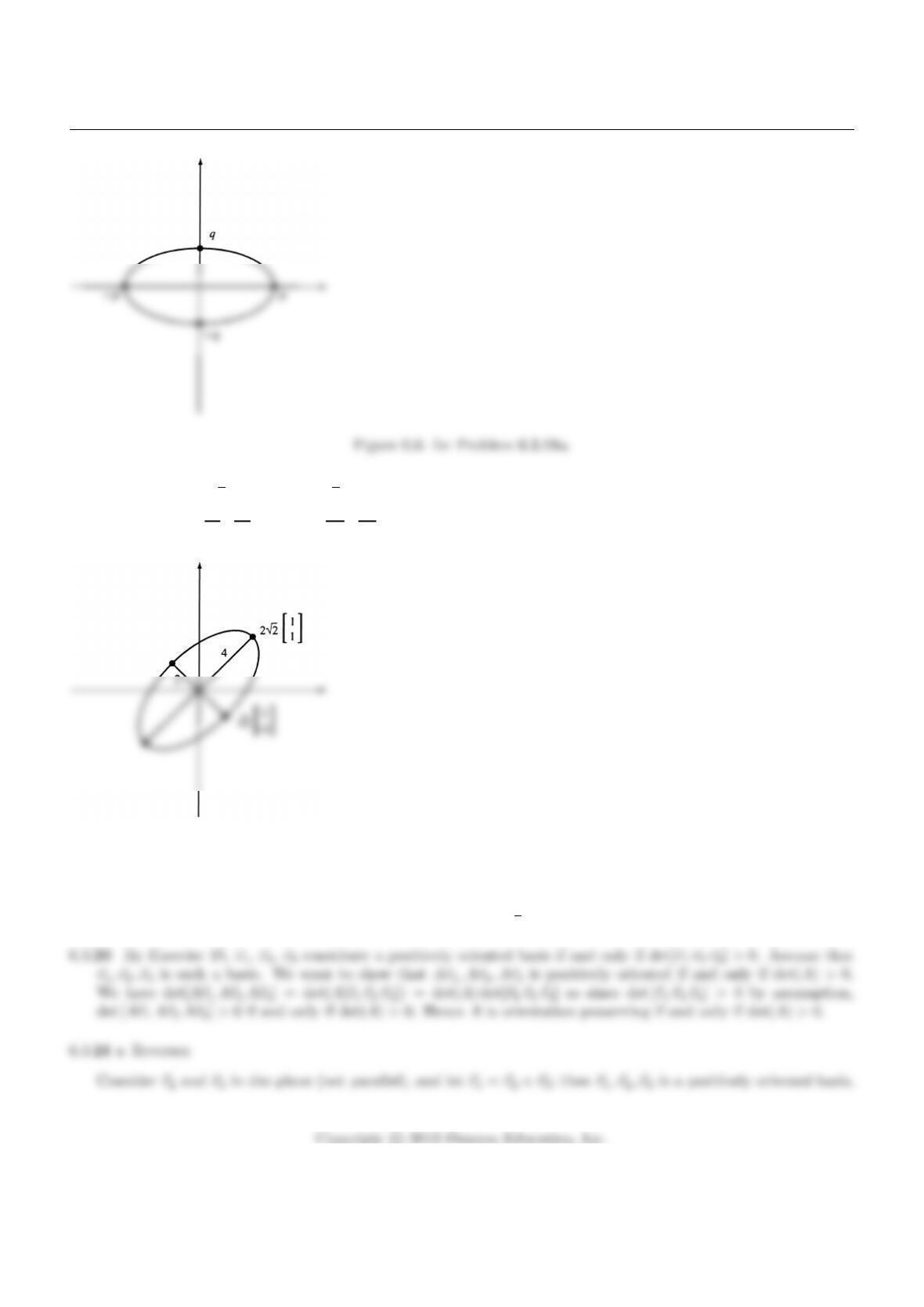
T(~x) = cos(t) 2√21
1
|{z }
+ sin(t)√21
−1
|{z }
semi-major axis semi-minor axis
.(See Figure 6.7.)
Figure 6.7: for Problem 6.3.18c.
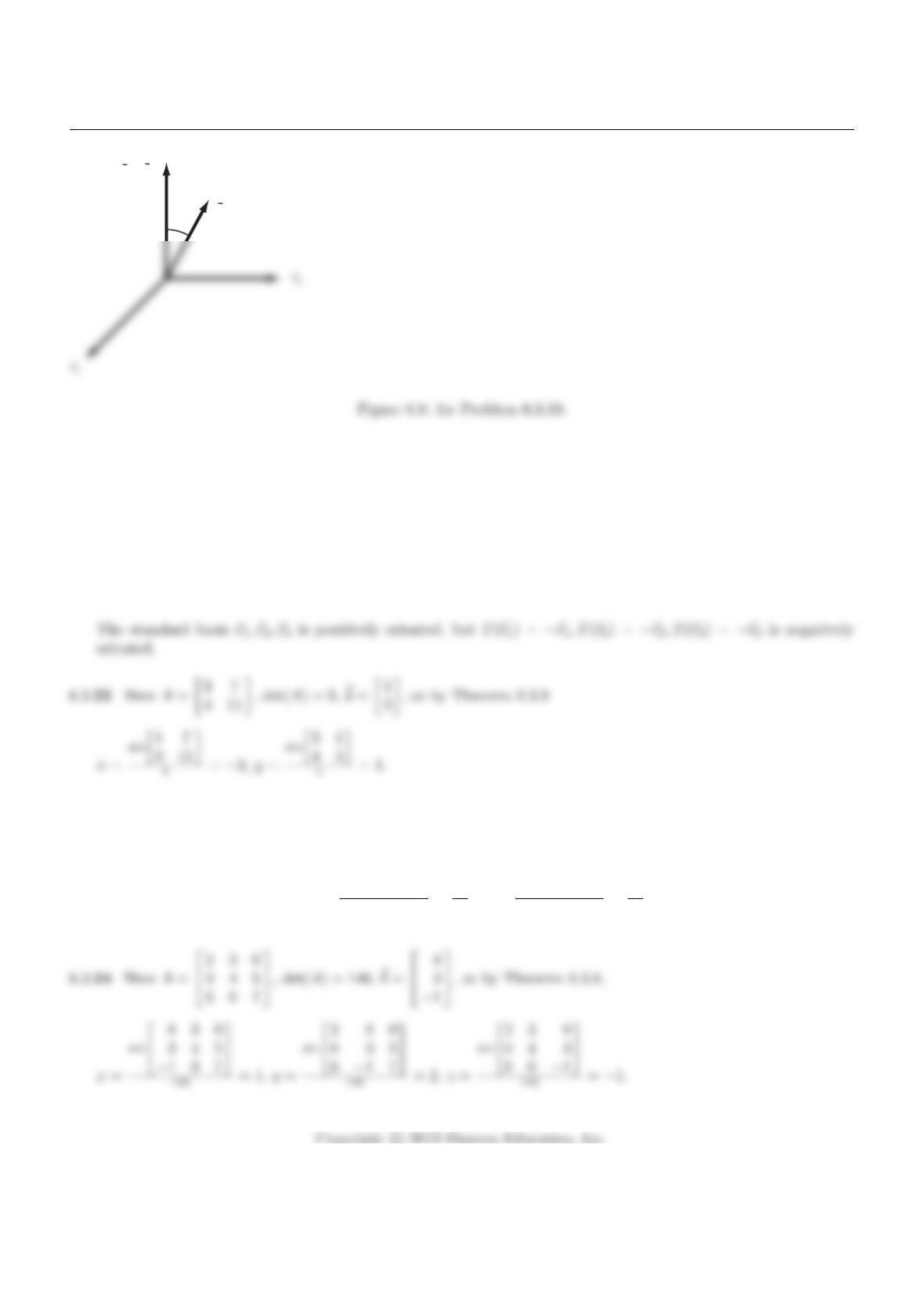
6.3.19 det[~v1~v2~v3] = ~v1·(~v2×~v3) = k~v1kk~v2×~v3kcos θwhere θis the angle between ~v1and ~v2×~v3so det[~v1~v2~v3]>0
if and only if cos θ > 0,i.e., if and only if θis acute (0 ≤θ≤π
2).(See Figure 6.8.)
300
Section 6.3
v1
v2v3
θ
×
but T(~v1) = −~v1, T (~v2) = ~v2, T (~v3) = ~v3is negatively oriented.
b Preserves
Consider ~v2and ~v3orthogonal to the line (not parallel), and let ~v1=~v2×~v3; then ~v1, ~v2, ~v3is a positively oriented
basis, and T(~v1) = ~v1, T (~v2) = −~v2, T (~v3) = −~v3is positively oriented as well.
c Reverses
6.3.23 Here A=5−3
−6 7 ,det(A) = 17,~
b=1
0,so by Theorem 6.3.8
x1=
det 1−3
0 7
17 =7
17, x2=
det 5 1
−6 0
17 =6
17.
301
Chapter 6
6.3.25 By Theorem 6.3.9, the ijth entry of adj(A) is given by (−1)i+jdet(Aji), so since
6.3.26 By Theorem 6.3.9, A−1=1
det(A)adj(A), so if det(A) = 1, A−1= adj(A). If Ahas integer entries then
(−1)i+jdet(Aji) will be an integer for all 1 ≤i, j ≤n, hence adj(A) will have integer entries. Therefore, A−1
will also have integer entries.
6.3.27 By Theorem 6.3.8, using A=a−b
b a ,det(A) = a2+b2,~
b=1
0,we get
6.3.28 Here A=s a
m−h,det(A) = −sh −ma,~
b=I◦+G
Ms+M◦so, by Theorem 6.3.8
6.3.29 By Theorem 6.3.8,
dx1=
det
0R1−(1 −α)
0 1 −α−(1 −α)2
−R2de2−R2−(1−α)2
α
302
Section 6.3
6.3.30 Using the procedure outlined in Exercise 25, we find adj(A) =
18 0 0
−12 6 0
−2−5 3
.
6.3.33 Using the procedure outlined in Exercise 25, we find that adj(A) =
24 0 0 0
0 12 0 0
0 0 8 0
0 0 0 6
.Note that the matrix
adj(A) is diagonal, and the ith diagonal entry of adj(A) is the product of all ajj where j6=i.
6.3.36 adj(adjA) = adj(det(A)A−1)
= det(det(A)A−1)(det(A)A−1)−1= (det A)ndet(A−1)(det(A)A−1)−1
= (det A)n−1(det(A)A−1)−1= (det A)n−11
det(A)(A−1)−1
= (det A)n−2A.
6.3.39 Yes, let Sbe an invertible matrix such that AS =SB, or SB−1=A−1S. Multiplying both sides by
det(A) = det(B),we find that S(det(B)B−1) = (det(A)A−1)S, or, S(adjB) = (adjA)S, as claimed.
303
Chapter 6
6.3.42 By Theorem 6.3.9, adj(A) = 0 if (and only if) all the minors Aji of Aare zero. By Exercise 41, this is the
case if (and only if) rank(A)≤n−2.
6.3.43 A direct computation shows that A(adjA) = (adjA)A= (det A)(In) for all square matrices. Thus we have
A(adjA) = (adjA)A= 0 for noninvertible matrices, as claimed.
Let’s write B= adj(A),and let’s verify the equation AB = (det A)(In) for the diagonal entries; the verification
for the off-diagonal entries is analogous. The ith diagonal entry of AB is
6.3.44 The equation A(adjA) = 0 from Exercise 43 means that im(adjA) is a subspace of ker(A). Thus rank(adjA) =
dim(im(adjA)) ≤dim(kerA) = n−rank(A) = n−(n−1) = 1,implying that rank(adjA)≤1. Since adj(A)6= 0,
by Exercise 42, we can conclude that rank(adjA) = 1.
6.3.45 Let A=a b
c d .We want AT= adj(A),or a c
b d =d−b
−c a .So, a=dand b=−c. Thus, the
equation AT= adj(A) holds for all matrices of the form a b
−b a .
304
Section 6.3
6.3.47 Note that 1
2det x1x2
y1y2is the area of the triangle OP1P2,where Odenotes the origin. This is likewise
true for one-half the second matrix. See Theorem 2.4.10. However, because of the reversal in orientation,
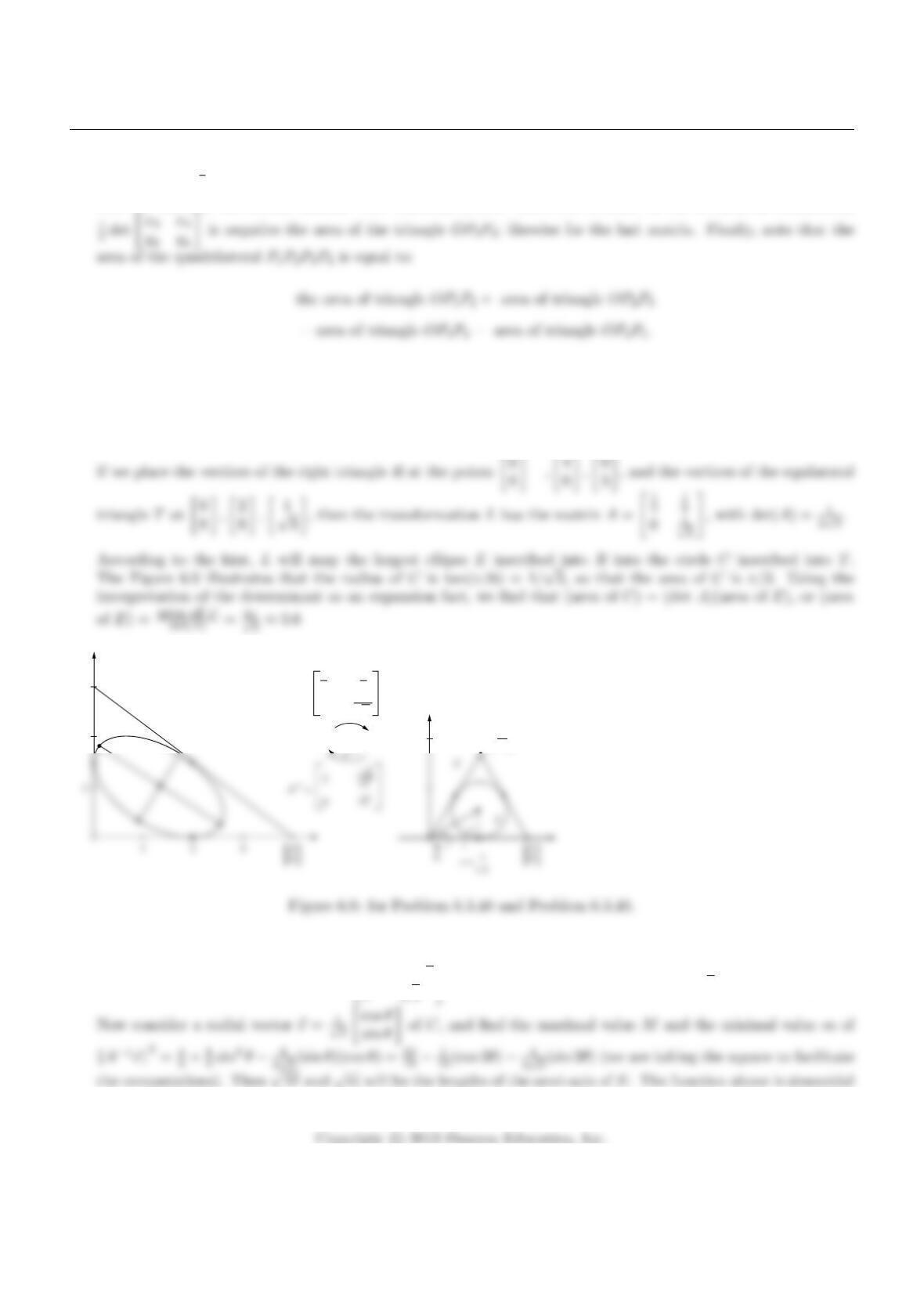
6.3.48 In what follows, we will freely use the fact that an invertible linear transformation Lfrom R2to R2maps an
ellipse into an ellipse (see Exercise 2.2.52).
Now consider a linear transformation Lthat transforms our 3-4-5 right triangle Rinto an equilateral triangle T.
R
2
0
3
[
[
[
[
√3
1
A =
L
0
1
21
3
1
√3
6.3.49 We will use the terminology introduced in the solution of Exercise 48 throughout. Note that the trans-
formation L−1,with matrix A−1=2−2/√3
0√3, maps the circle C(with radius 1/√3) into the ellipse E.
305
Chapter 6
18 ≈0.79.
True or False
Ch 6.TF.1T, by Theorem 6.2.3a, applied to the columns.
Ch 6.TF.2T, by Theorem 6.2.6.
Ch 6.TF.6F; We have det(4A) = 44det(A), by Theorem 6.2.3a.
Ch 6.TF.7F; Let A=B=I5, for example
Ch 6.TF.8T; We have det(−A) = (−1)6det(A) = det(A), by Theorem 6.2.3a.
Ch 6.TF.12 F. There is only one pattern with a nonzero product, containing all the 1’s. Since there are three
inversions in this pattern, det A=−1.
Ch 6.TF.13 T. Without computing its exact value, we will show that the determinant is positive. The pattern that
contains all the entries 100 has a product of 1004= 108, with two inversions. Each of the other 4! −1 = 23
Ch 6.TF.14 F; The correct formula is det(A−1) = 1
det(AT),by Theorems 6.2.1 and 6.2.8.
True or False
Ch 6.TF.17 T, by Theorem 6.2.7.
Ch 6.TF.21 F; Note that det
1 1 0
0 1 1
1 0 1
= 2.
Ch 6.TF.22 T, by Theorem 6.3.9.
Ch 6.TF.26 F; Let A= 2I2, for example
Ch 6.TF.27 T; Let A=
1 1 1 1
1 1 −1−1
1−1 1 −1
1−1−1 1
. The column vectors of Aare orthogonal and they all have length 2.
Ch 6.TF.31 F; Note that det(S−1AS) = det(A) but det(2A) = 23(det A) = 8(det A).
Ch 6.TF.32 F; Note that det(STAS) = (det S)2(det A) and det(−A) = −(det A) have opposite signs.
307
Chapter 6
Ch 6.TF.35 F; Let A=I2and B=−I2, for example.
Ch 6.TF.38 T; Note that det(A) and det(A−1) are both integers, and (det A)(det A−1) = 1. This leaves only the
possibilities det(A) = det(A−1) = 1 and det(A) = det(A−1) = −1.
Ch 6.TF.42 F; Let A=
2 1 1
1 2 1
1 5 2
, for example
Ch 6.TF.43 T; Let A=a b
c d . If a6= 0, let B=0 0
0 1 ; if b6= 0, let B=0 0
1 0 ; if c6= 0, let B=0 1
0 0 ,
Ch 6.TF.45 T; A(adjA) = A(det(A)A−1) = det(A)In= det(A)A−1A= adj(A)A.
Ch 6.TF.46 T; Laplace expansion along the second row gives det(A) = −kdet
1 2 4
8 9 7
0 0 5
+C= 35k+C, for some
308
True or False
309