Problem 6.29
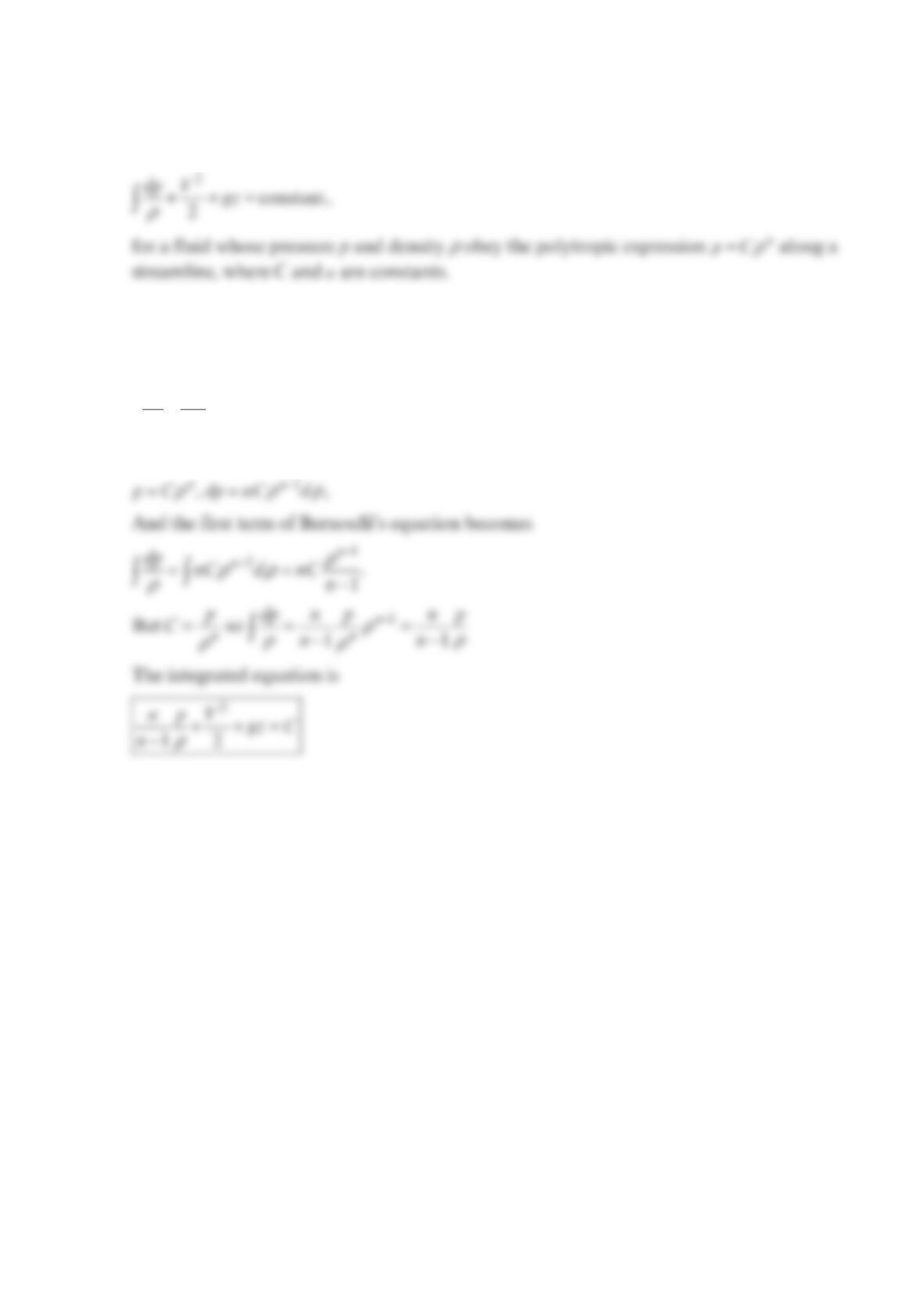
Integrate Bernoulli’s equation for compressible flow,
Solution 6.29
The equation is
2
2
dp V gz C
ρ
++=
From the given pressure–density relationship
Problem 6.30
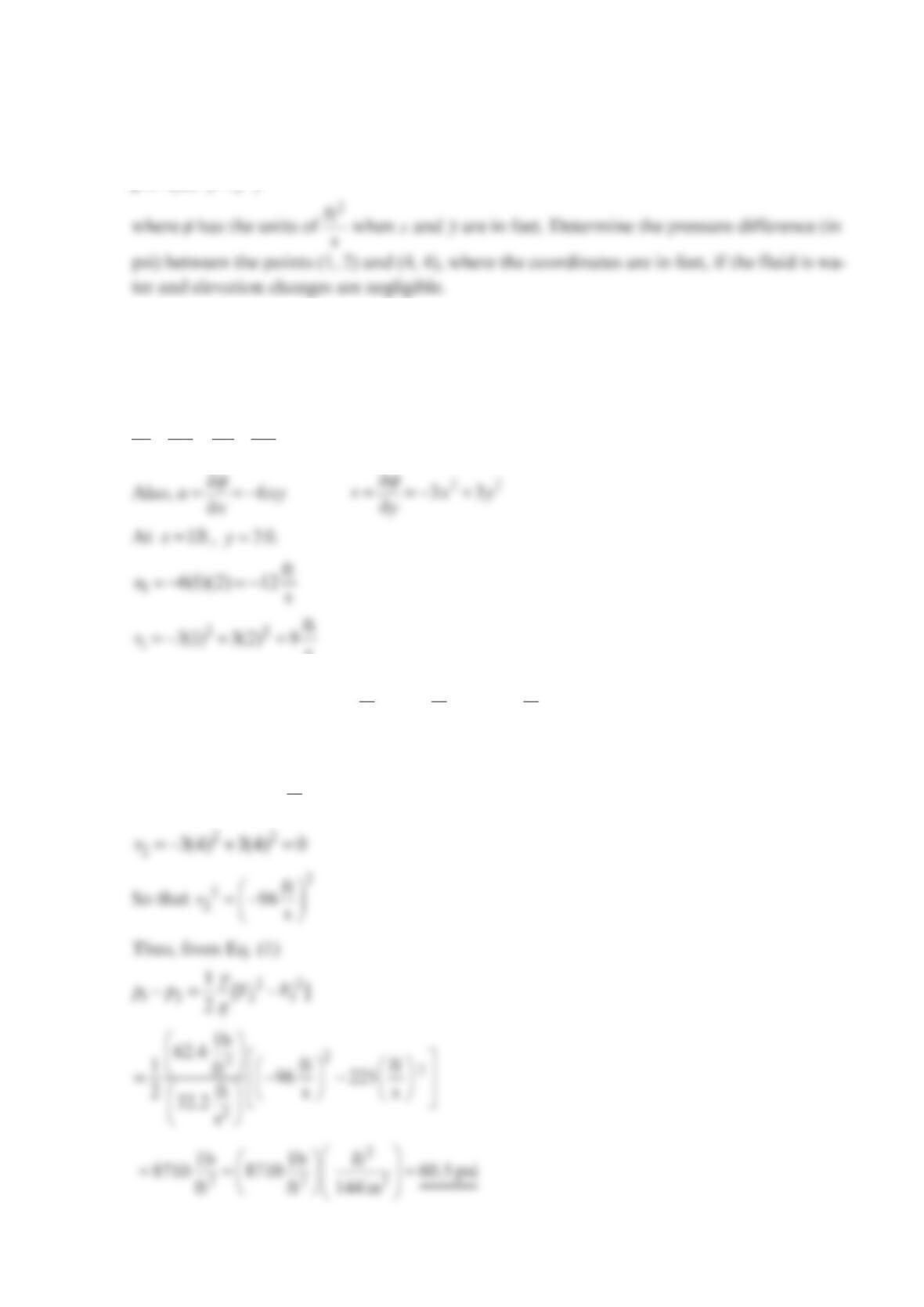
The velocity potential for a certain inviscid flow field is
23
(3 )xy y
φ
=− −
Solution 6.30
Since the flow field is described by a velocity potential the flow is irrotational and the Ber-
noulli equation can be applied between any two points. Thus,
22
11 2 2
22
p
VpV
gg
γγ
+=+ (1)
So that
22 2
222
111
ft ft ft
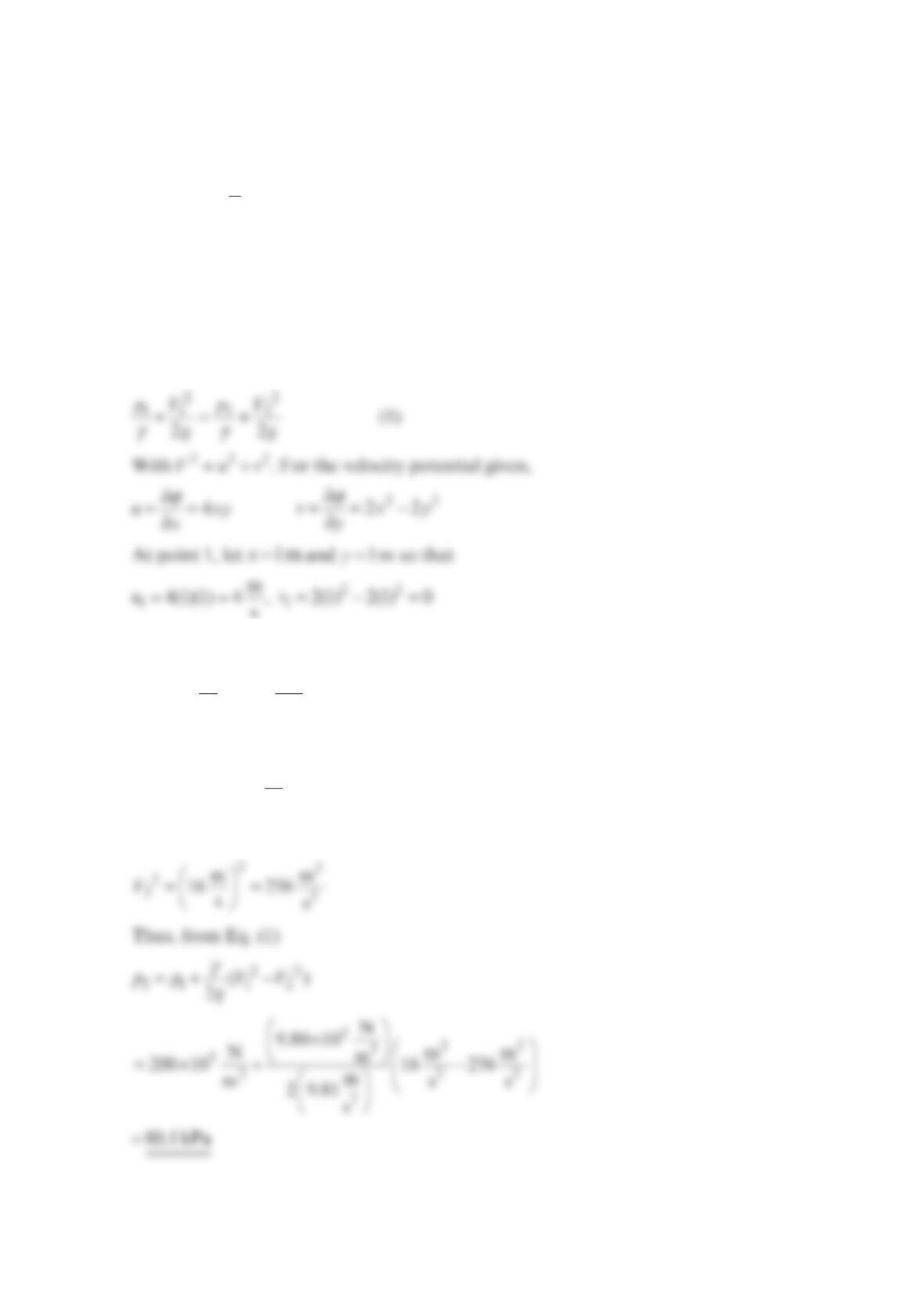
12 9 225
ss s
Vuv
=+=− + =
at 4ftx=, 4fty=
2
ft
6(4)(4) 96 s
u=− =−
Problem 6.31
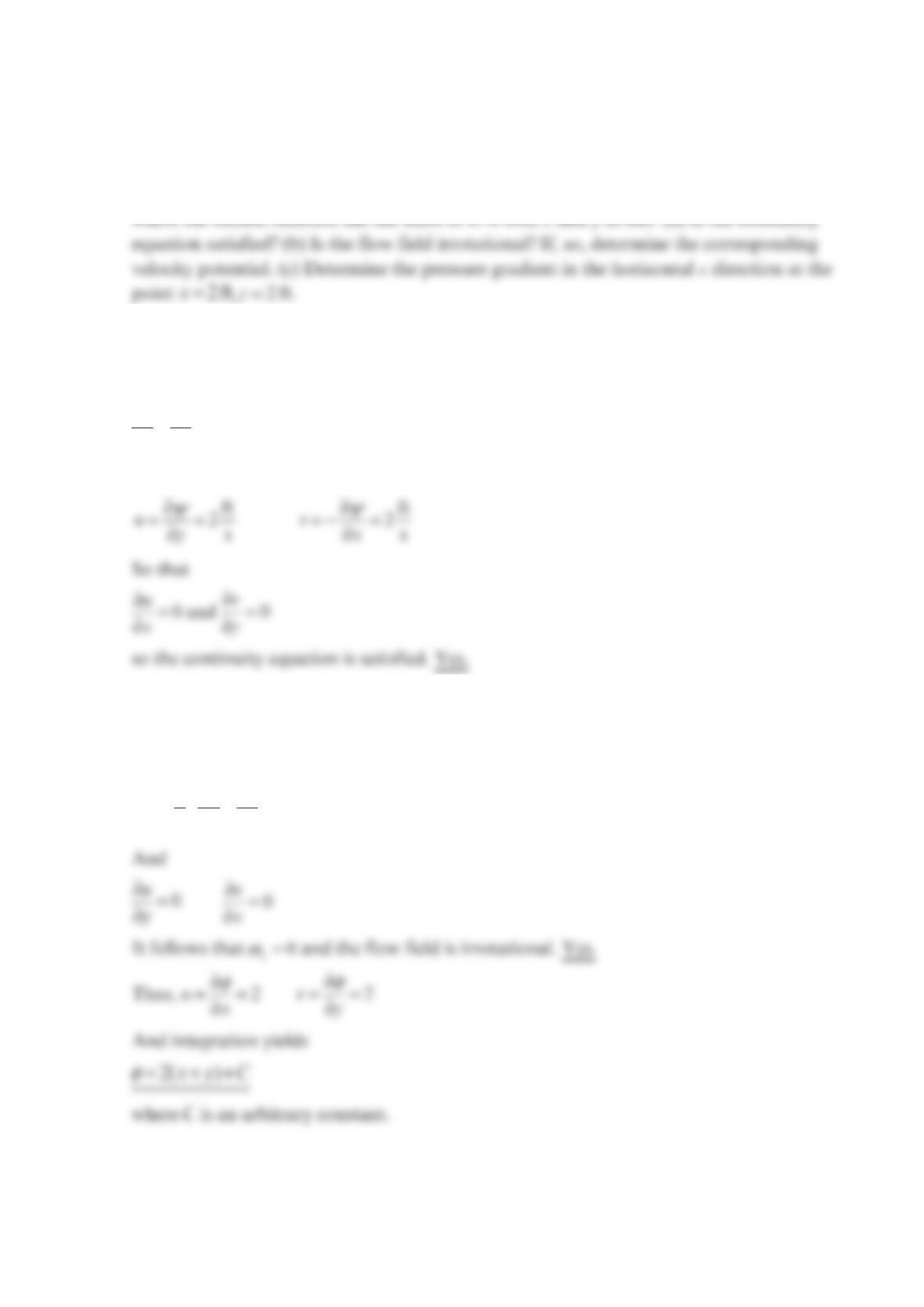
The stream function for a two-dimensional, nonviscous, incompressible flow field is given
by the expression
2( )xy
ψ
=− −
Solution 6.31
(a) To satisfy the continuity equation,
0
uv
xy
∂∂
+=
∂∂
For the stream function given,
(Note: when a flow field is defined by a stream function the continuity equation is always
identically satisfied.)
(b) Since
1
2
z
vu
xy
ω
∂∂
=−
∂∂
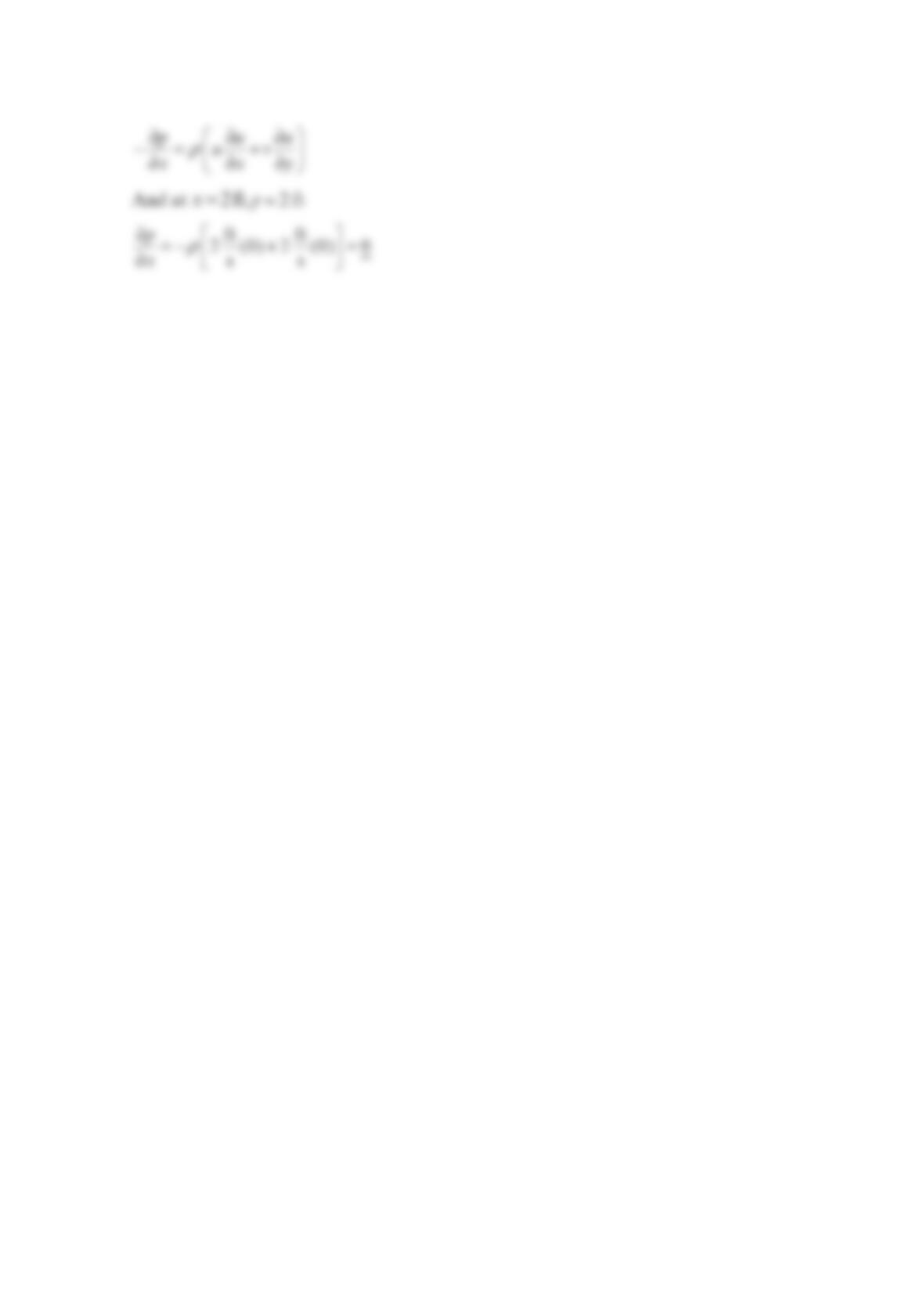
(c) With the x-axis horizontal, 0
x
g=, and
Problem 6.32
The velocity potential for a certain inviscid, incompressible flow field is given by the equa-
tion
23
2
23
xy y
φ
=−
where
φ
has the units of m2/s when x and
y
are in meters. Determine the pressure at the
point 2
m
x= ,2m
y
= if the pressure at 1
m
x= ,1m
y
= is 200 kP
a
. Elevation changes can be
neglected, and the fluid is water.
Solution 6.32
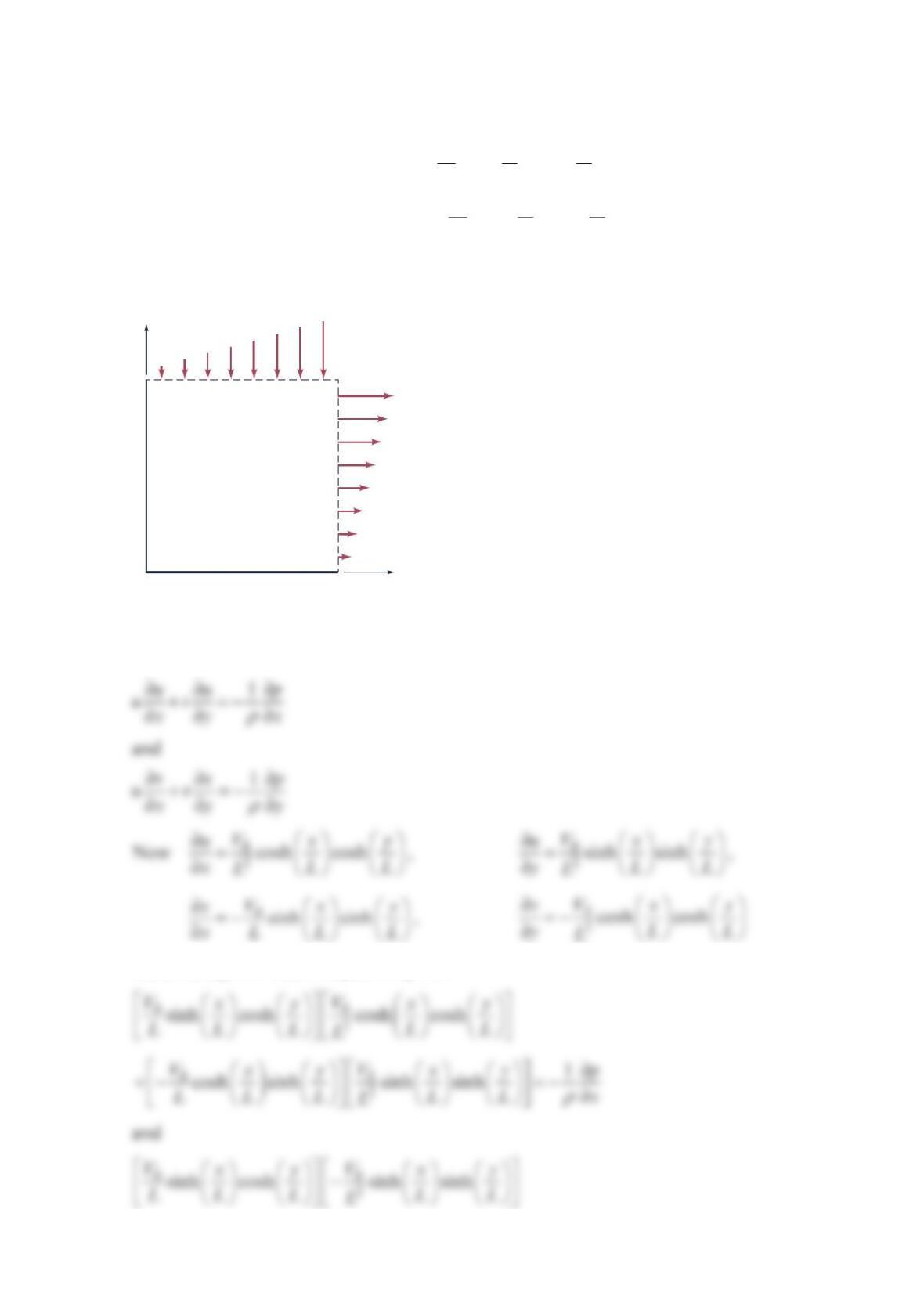
Since the flow is irrotational,
And
22
2
12
mm
416
ss
V
= =
At point 2, 2
m
x= and 2 m
y
= so that
2
m
4(2)(2) 16 s
u==, 22
22(2) 2(2) 0v=−=
And
y
Problem 6.33
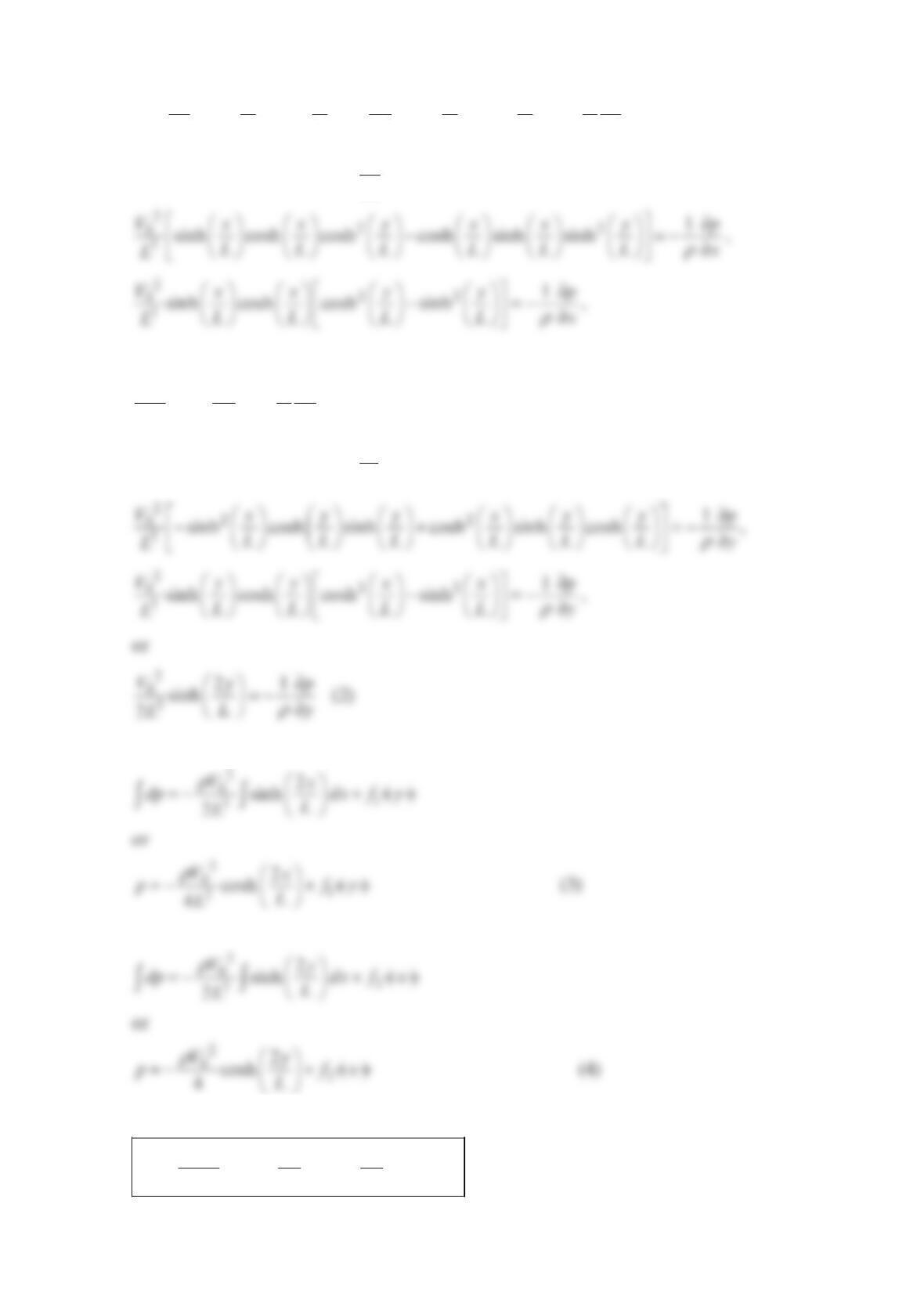
Consider the two-dimensional air flow around the corner, as shown in the figure below. The
x– and y-direction velocities are 0sinh cosh
vxy
uLL L
=
and 0cosh sinh
vxy
vLL L
=−
,
respectively. Assume constant density, steady flow, negligible gravity, and inviscid flow.
Find ( , )
p
xy.
Solution 6.33
Euler’s equation in Cartesian coordinates for two-dimensional flow are
Substituting into Euler’s equation gives.
x
L
00L
y
v
(
x,
L
)
u
(
L
, y
)
00
2
1
cosh sinh cosh cosh
VV
xy x y p
LL L L L y
L
ρ
∂
+− − =−
∂
Simplifying the equation for
p
x
∂
∂ gives
or
2
0
3
21
sinh
2
Vxp
Lx
L
ρ
∂
=−
∂
(1)
Simplifying the equation for
p
y
∂
∂ gives
Integrating Eqs. (1) and (2) gives
and
Equations (3) and (4) give
2
022
cosh cosh .
4
Vxy
p
const
LL
ρ
=− +
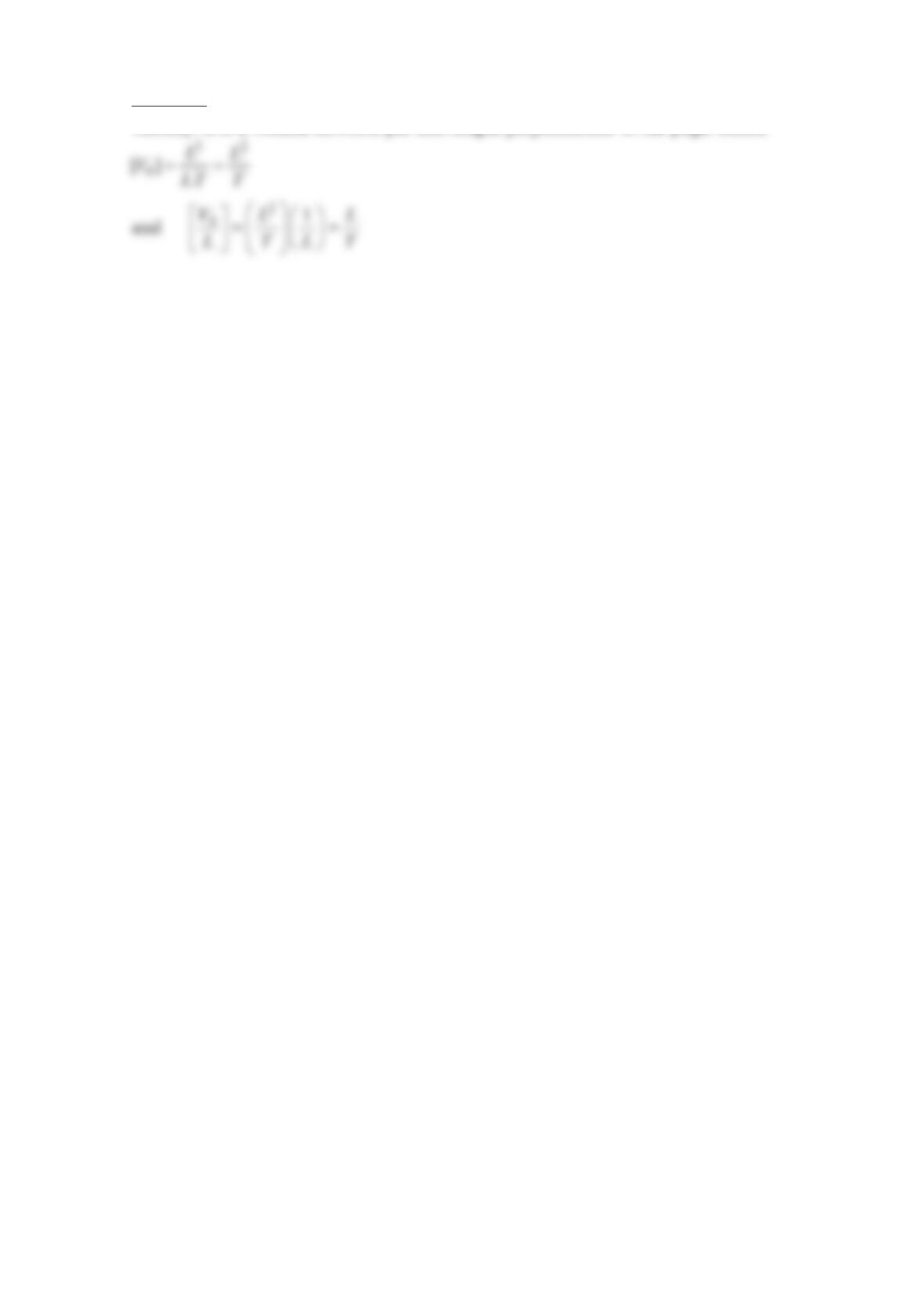
Comment. The term 0
V
was not defined in the problem statement, but it could not be a
velocity. It is a volume flowrate per unit length perpendicular to the page. Hence
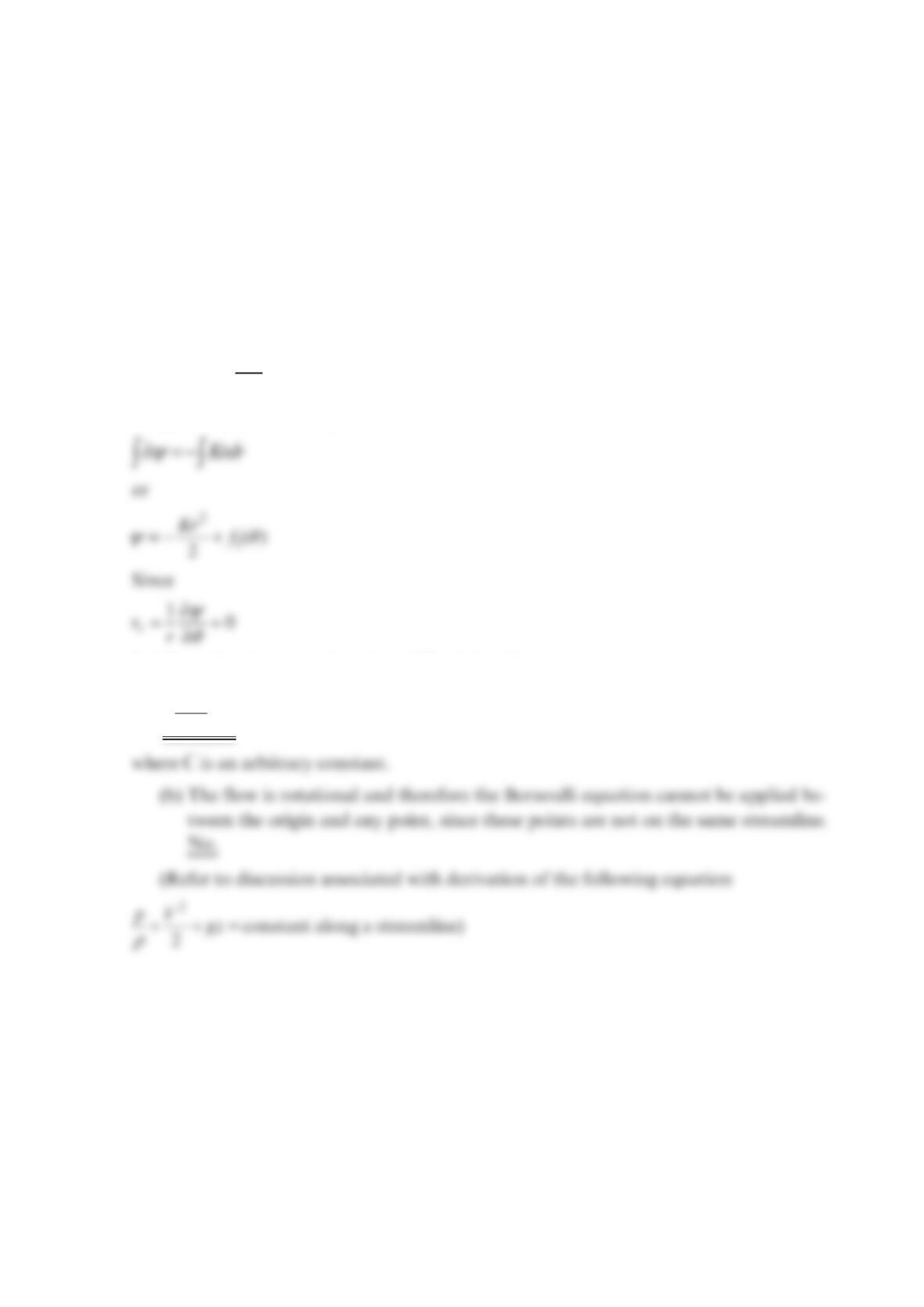
Problem 6.34
The streamlines for an incompressible, inviscid, two-dimensional flow field are all concen-
tric circles, and the velocity varies directly with the distance from the common center of the
streamlines; that is
vKr
θ
=
where K is a constant. (a) For this rotational flow, determine, if possible, the stream
function. (b) Can the pressure difference between the origin and any other point be
determined from the Bernoulli equation? Explain.
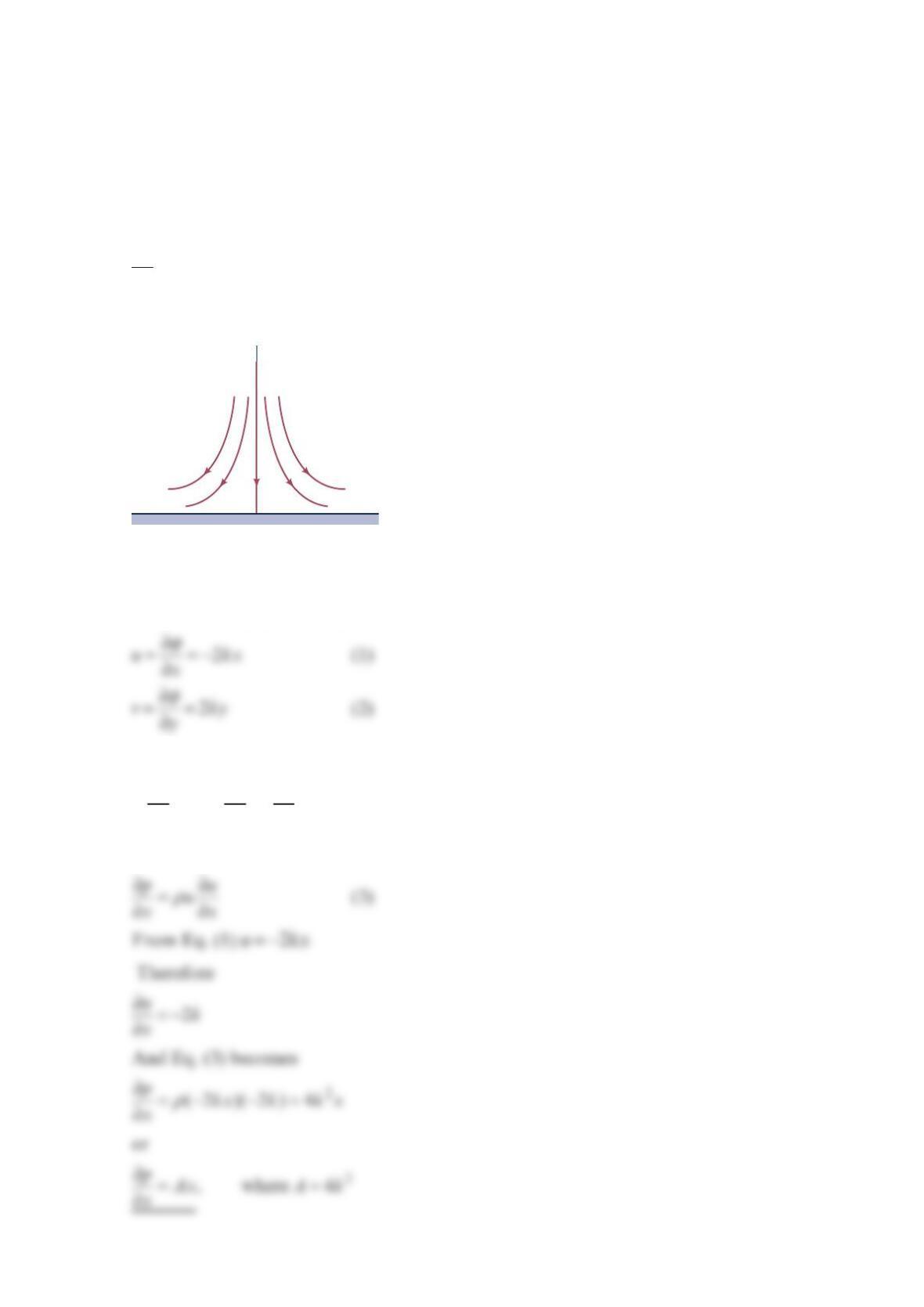
Solution 6.34
(a) vKr
r
θ
ψ
∂
=− =
∂ (1)
Integrate Eq. (1) with respect to r to obtain
It follows that
ψ
is not a function of
θ
and therefore
2
2
Kr
C
ψ
=− +
ψ
Problem 6.35
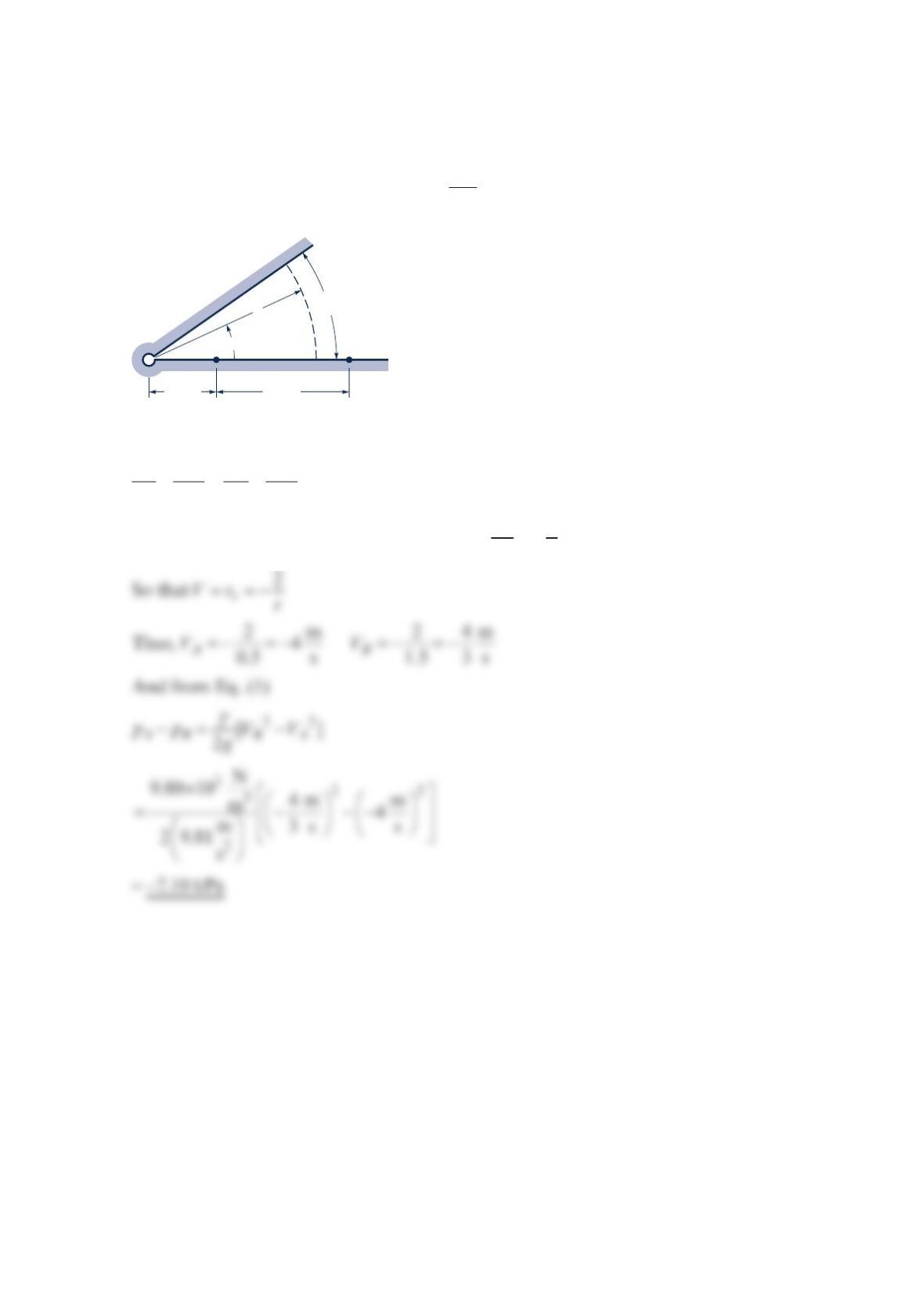
The velocity potential 22
()kx y
φ
=− − (constantk=)
may be used to represent the flow against an infinite plane boundary, as illustrated in the
figure below. For flow in the vicinity of a stagnation point, it is frequently assumed that the
pressure gradient along the surface is of the form
p
Ax
x
∂=
∂
where A is a constant. Use the given velocity potential to show that this is true.
Solution 6.35
For the velocity potential given
and the stagnation point occurs at the origin. For this steady, two-dimensional flow
p
uu
uv
xxy
ρ
∂∂∂
−= +
∂∂∂
and along the surface ( 0
y
=) 0v= so that
p
y
x
Problem 6.36
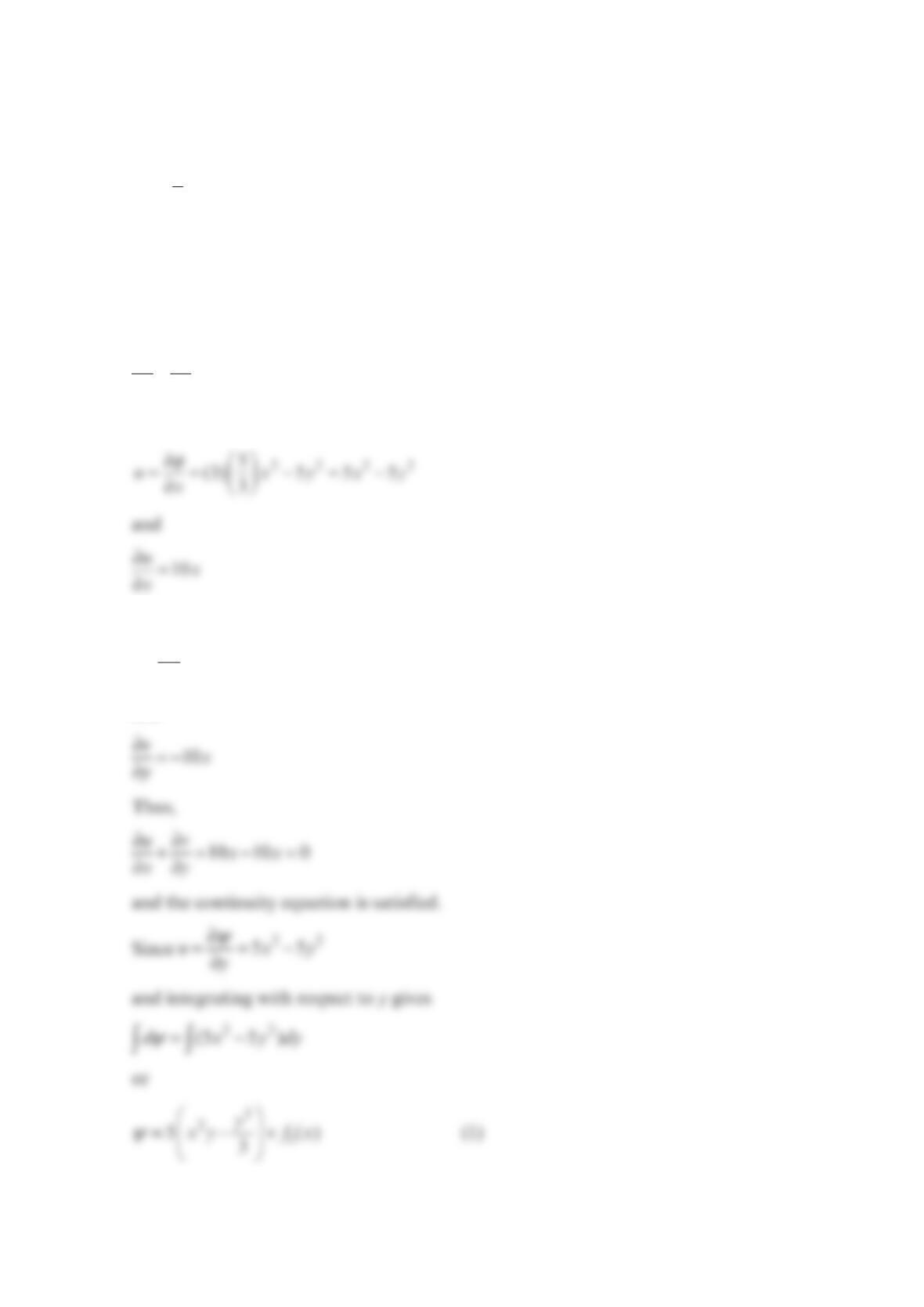
Water is flowing between wedge-shaped walls into a small opening as shown in the figure
below. The velocity potential with units
2
m
s for this flow is 2 lnr
φ
=− with r in meters. De-
termine the pressure differential between points A and B.
Solution 6.36
22
22
AA BB
p
VpV
gg
γγ
+=+ (1)
Along the horizontal surface, 0
v
θ
=, and 2
r
v
rr
φ
∂
==−
∂
0.5 m 1.0 m
__
6
r
AB
θ
π
Problem 6.37
The velocity potential for a given two-dimensional flow field is
32
55
3xxy
φ
=−
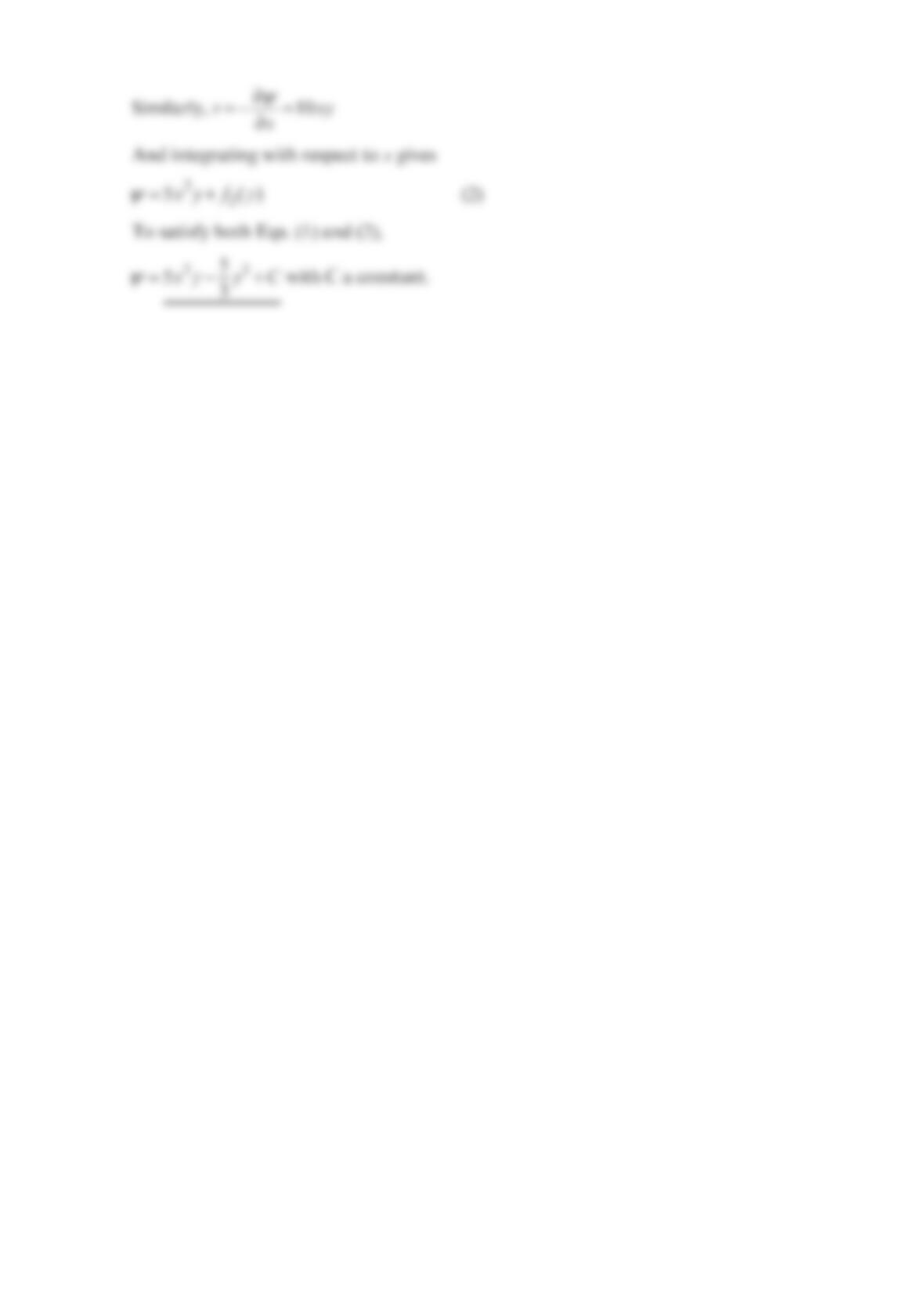
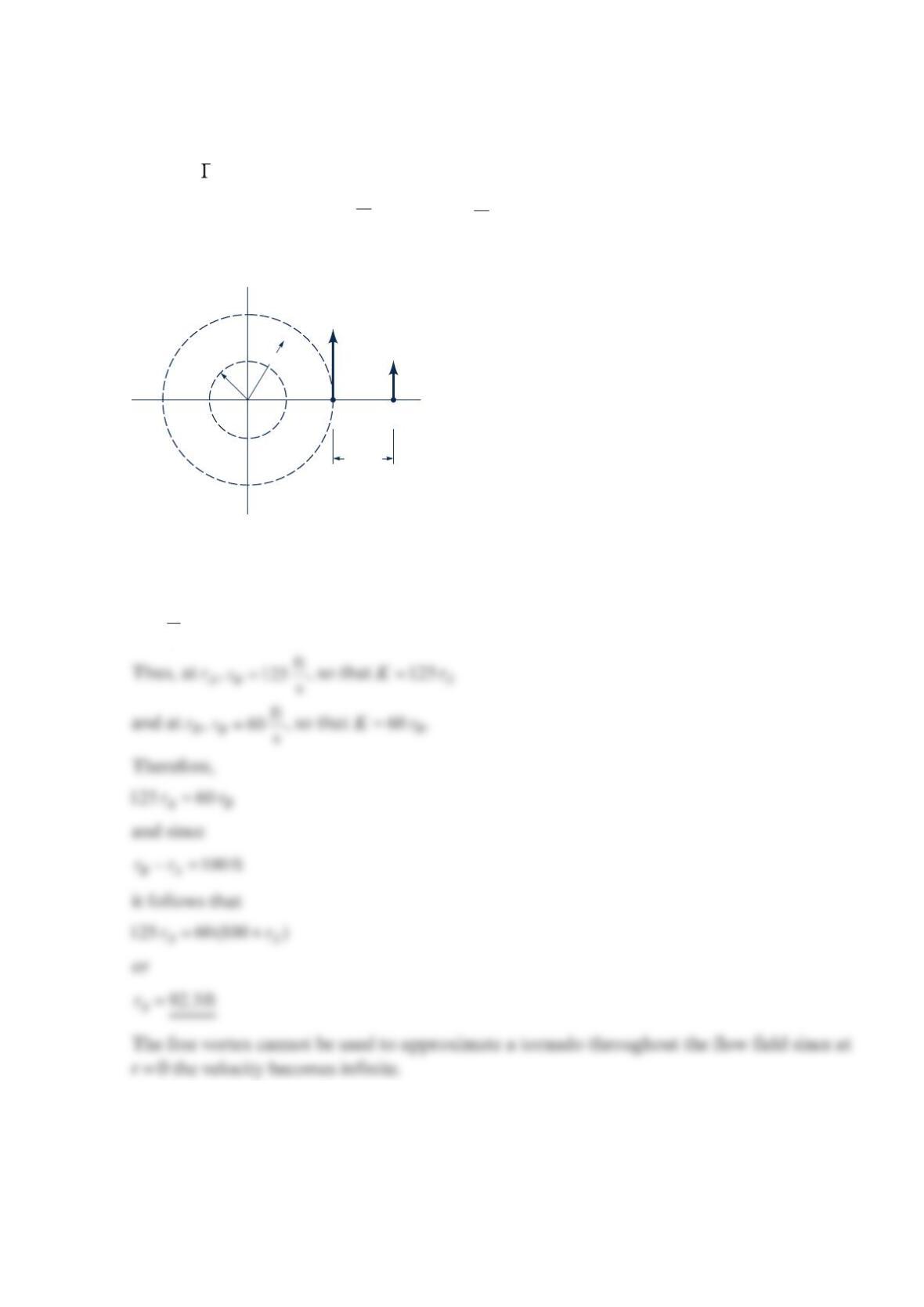
Show that the continuity equation is satisfied and determine the corresponding stream
function.
Solution 6.37
To satisfy the continuity equation,
0
uv
xy
∂∂
+=
∂∂
For the given velocity potential,
Similarly,
10vx
y
y
φ
∂
==−
∂
and
y
y
ψ
Problem 6.38
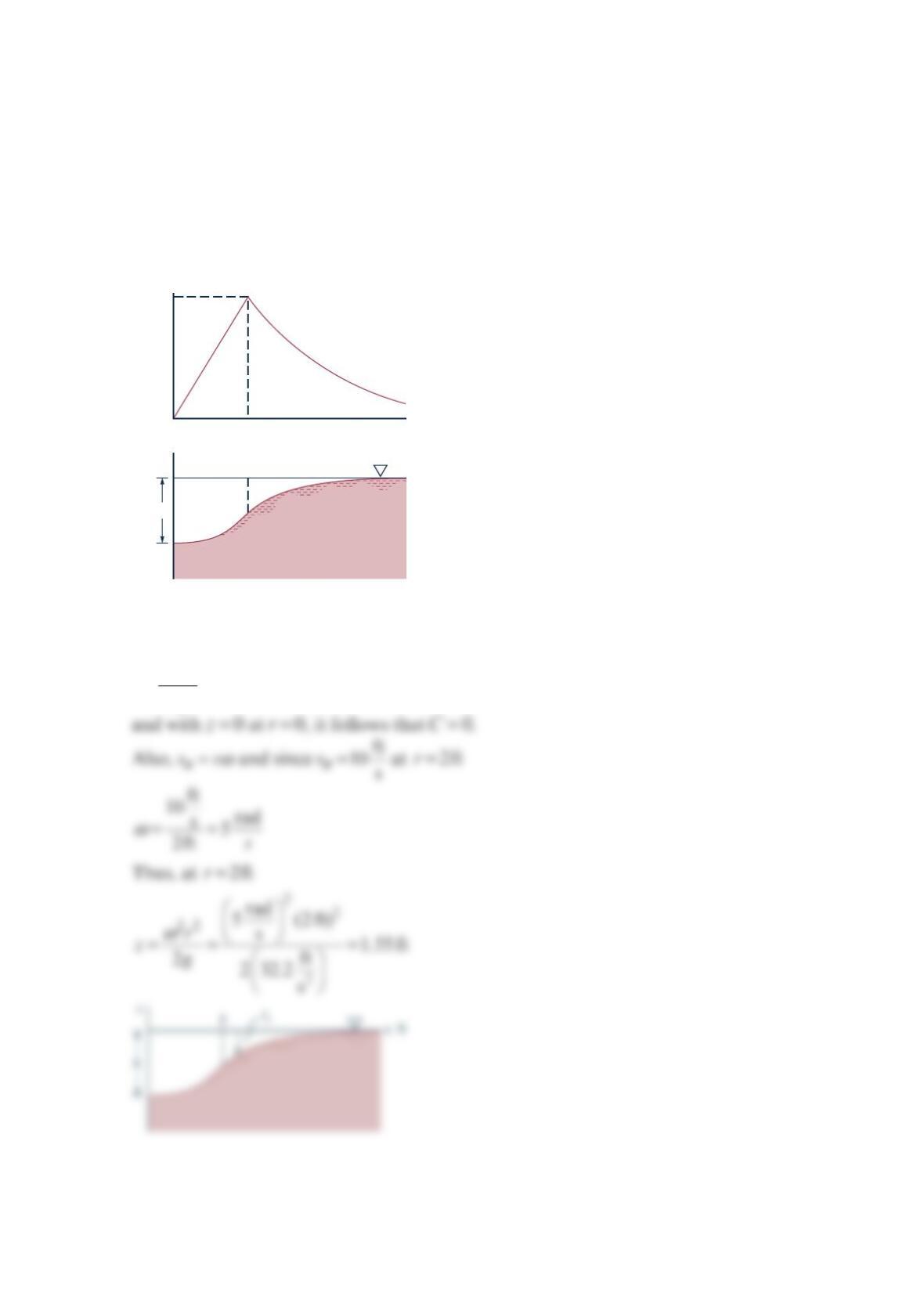
As illustrated in the figure below, a tornado can be approximated by a free vortex of
strength for c
rR>, where c
R
is the radius of the core. Velocity measurements at points
A
and B indicate that ft
125 s
A
V
= and ft
60 s
B
V
=. Determine the distance from point
A
to the
center of the tornado. Why can the free vortex model not be used to approximate the tor-
nado throughout the flow field (
0
r≥ ) ?
Solution 6.38
For a free vortex
k
vr
θ
=
y
x
BA
100 ft
r
Rc
r
K
r
K
Problem 6.39
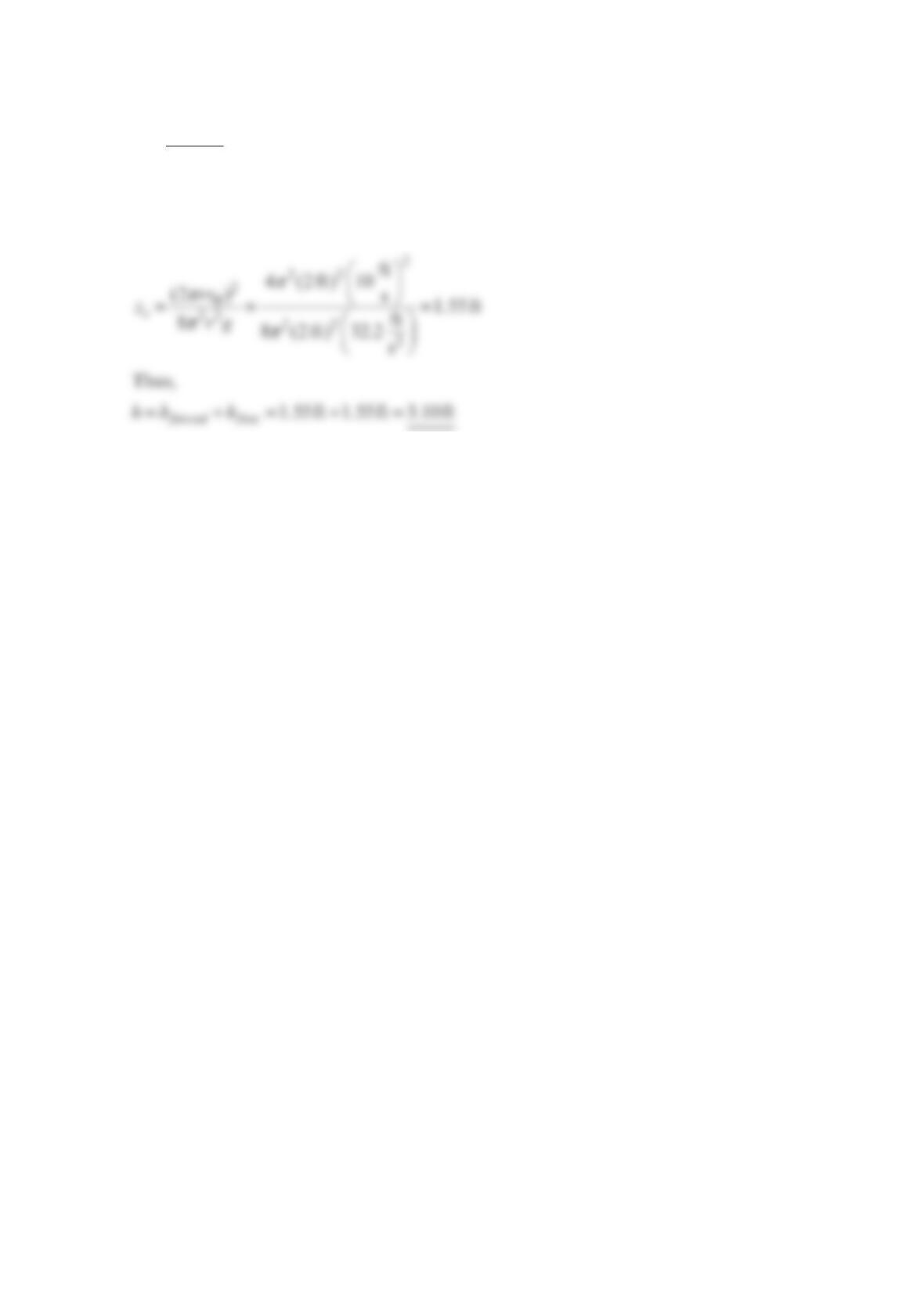
The motion of a liquid in an open tank is that of a combined vortex consisting of a forced
vortex for 02ftr≤≤ and a free vortex for 2f
t
r> . The velocity profile and the correspond-
ing shape of the free surface are shown in the figure below. The free surface at the center of
the tank is a depth h below the free surface at r=∞. Determine the value of h. Note that
forced free
h
hh=+
, where forced
h
and free
h
are the corresponding depths for the forced vortex
and the free vortex, respectively.
Solution 6.39
For forced vortex
22
2
r
z
C
g
ω
=+
10
02
2
r, ft
r, ft
z
h
, ft/sv
θ
For free vortex
2
22
8
s
zrg
π
Γ
=
where 2rv
θ
π
Γ
=
So that
Problem 6.40
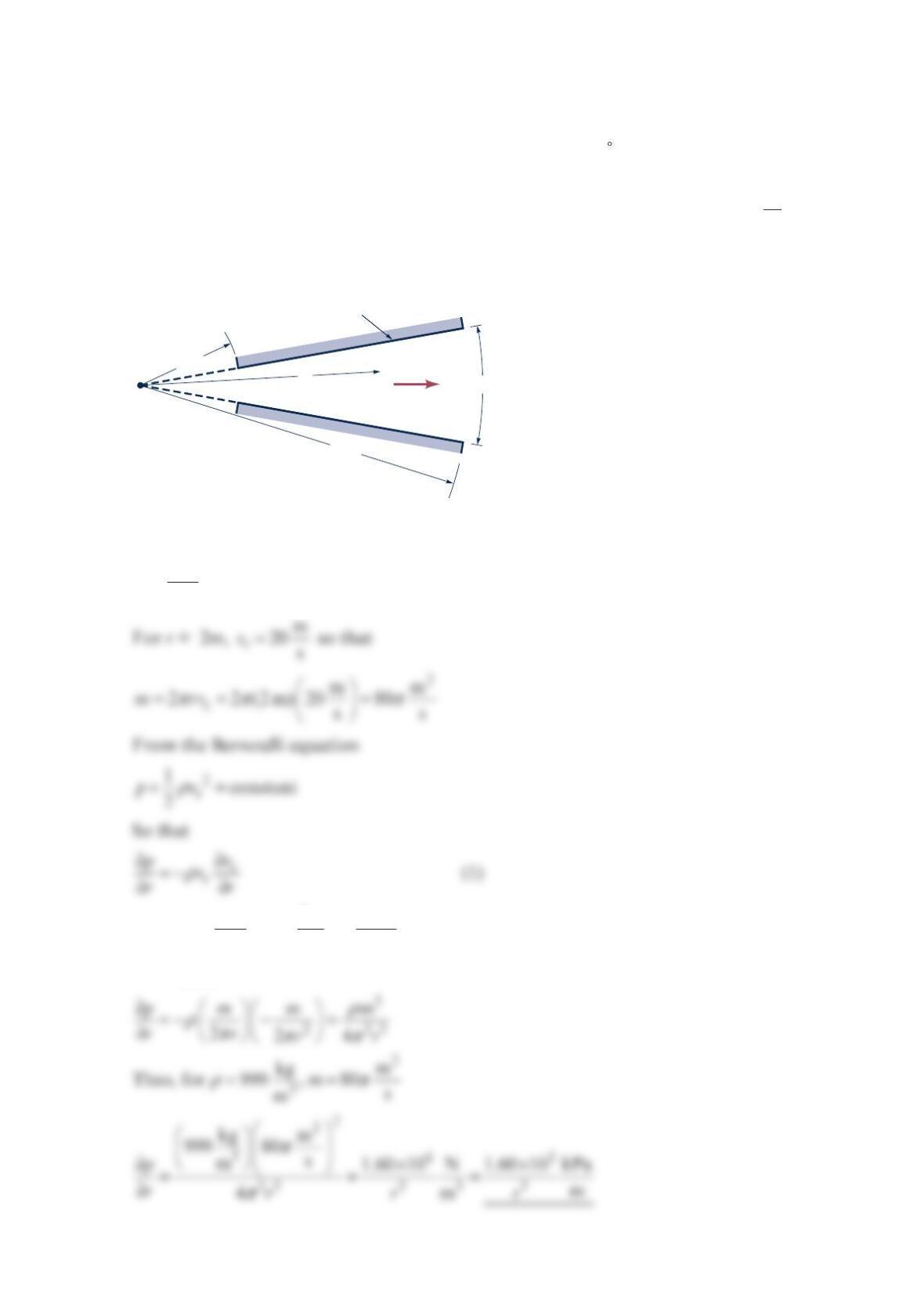
Water flows through a two-dimensional diffuser having a
2
0 expansion angle as shown in
the figure below. Assume that the flow in the diffuser can be treated as a radial flow
emanating from a source at the origin O. (a) If the velocity at the entrance is 20 m
s,
determine an expression for the pressure gradient along the diffuser walls. (b) What is the
pressure rise between the entrance and exit?
Solution 6.40
(a) For radial flow
r2
m
vr
π
=
Since r2
m
vr
π
= then r
2
2
vm
rr
π
∂=−
∂
and Eq. (1) can be written as
2 m
7 m
Entrance
Exit
Flow
O
r20°
Diffuser wall
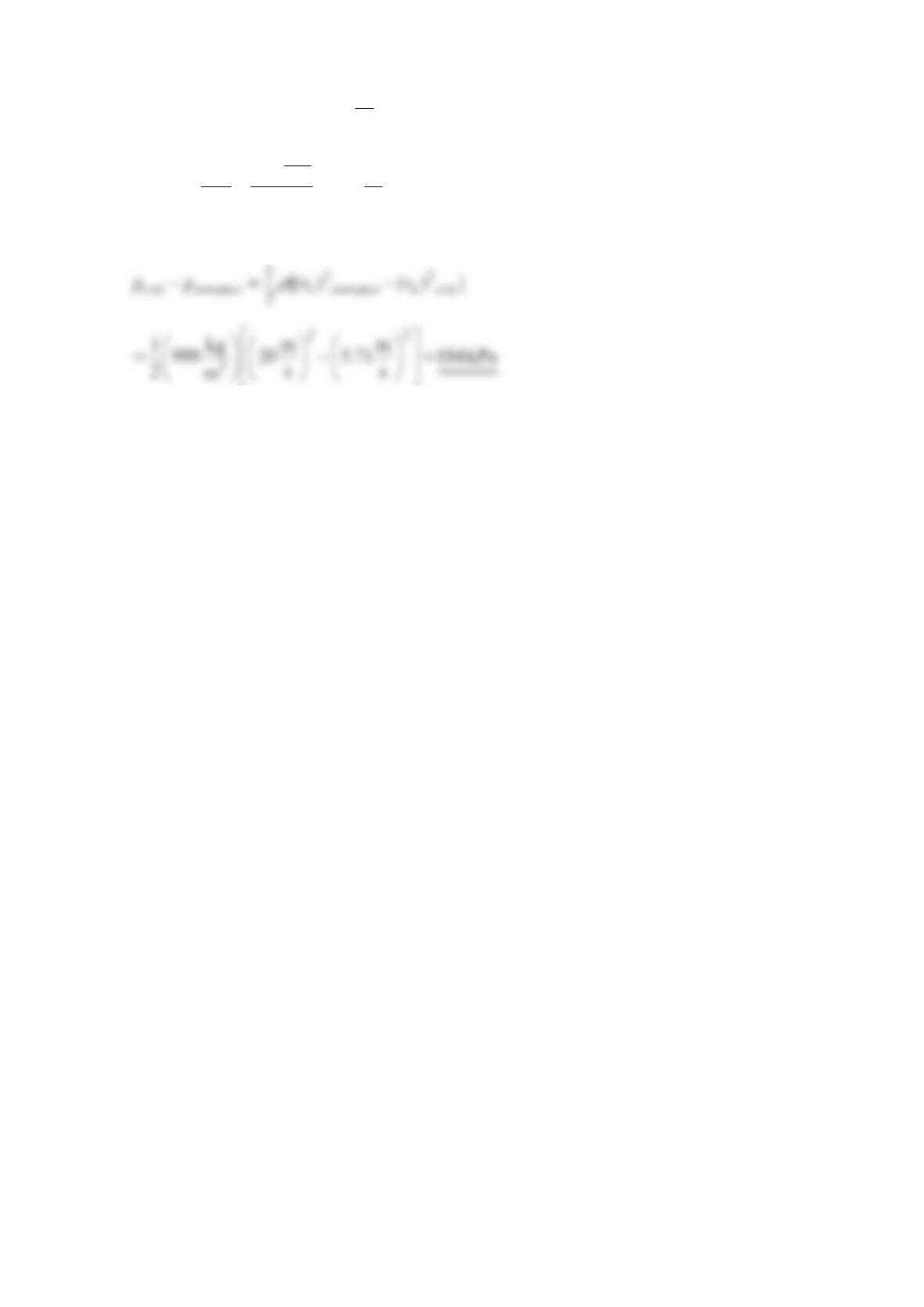
(b) Since r
m
(
)20
s
entrance
v= and
2
r
m
80 m
s
(
)5.71
22(7) s
exit
m
vrm
π
ππ
= = =
Then from the Bernoulli equation
Problem 6.41
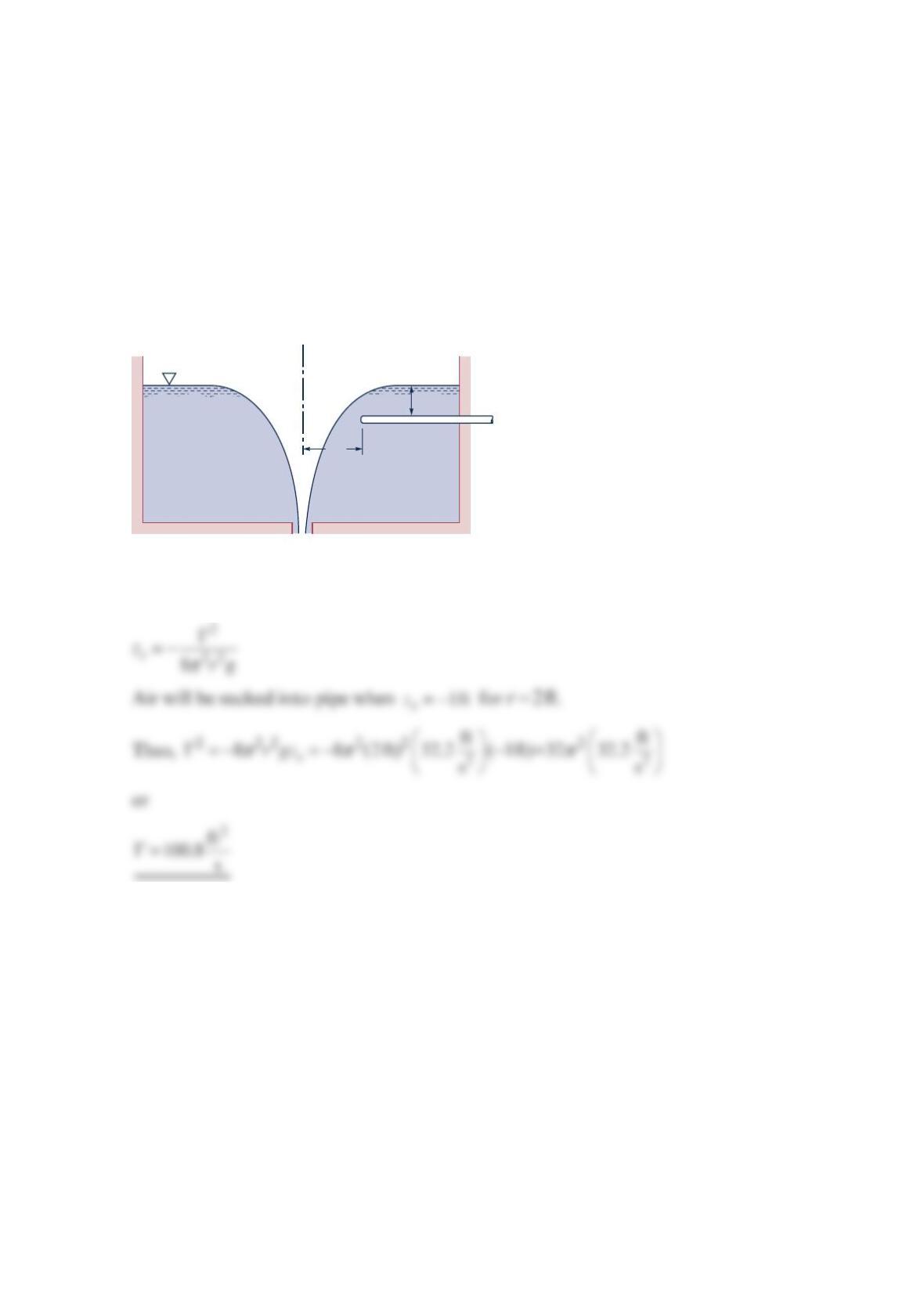
When water discharges from a tank through an opening in its bottom, a vortex may form
with a curved surface profile, as shown in the figure below. Assume that the velocity
distribution in the vortex is the same as that for a free vortex. At the same time, the water is
being discharged from the tank at point A, it is desired to discharge a small quantity of
water through the pipe B. As the discharge through A is increased, the strength of the
vortex, as indicated by its circulation, is increased. Determine the maximum strength that
the vortex can have in order that no air is sucked in at B. Express your answer in terms of
the circulation. Assume that the fluid level in the tank at a large distance from the opening
at A remains constant and viscous effects are negligible.
Solution 6.41
For free vortex (from Example 6.6):
B
A
2 ft
1 ft
Problem 6.42
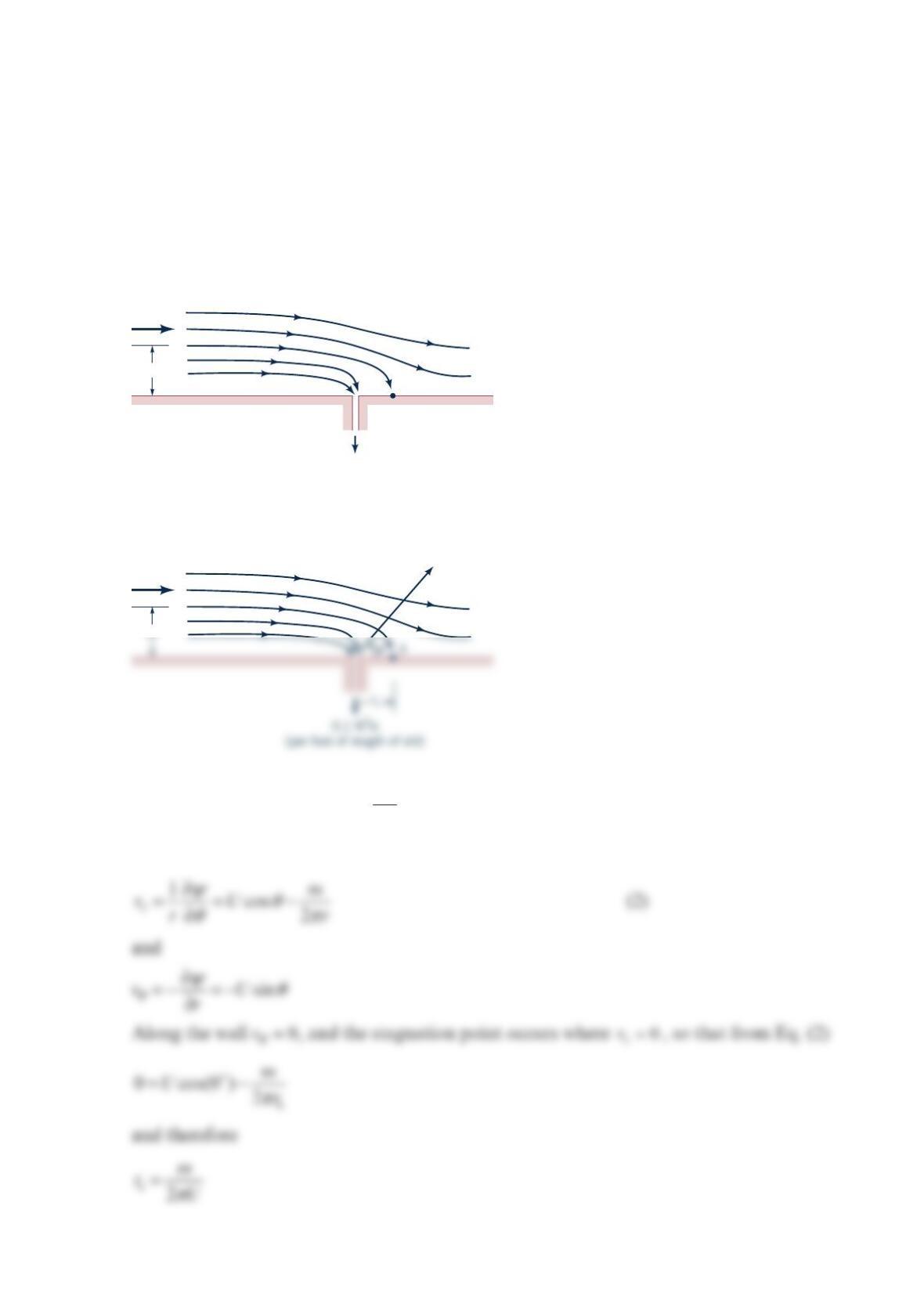
Water flows over a flat surface at 4 ft/s, as shown in the figure below. A pump draws off
water through a narrow slit at a volume rate of 0.1 ft3/s per foot length of the slit. Assume
that the fluid is incompressible and inviscid and can be represented by the combination of a
uniform flow and a sink. Locate the stagnation point on the wall (point A) and determine
the equation for the stagnation streamline. How far above the surface, H, must the fluid be
so that it does not get sucked into the slit?
Solution 6.42
uniform sink
flow
sin 2
m
Ur
ψψ ψ
θ
θ
π
=+=− (1)
Thus,
A
0.1 ft3/s
(per foot of length of slit)
4 ft/s
H
4 ft/s
H
V