SOLUTIONS TO EXERCISES
EXERCISE 6-1 (5–10 minutes)
(a)
(b)
Rate of Interest
Number of Periods
1.
a.
9%
9
b.
3%
20
c.
5%
9%
25
5%
c.
3%
EXERCISE 6-2 (5–10 minutes)
(a)
Simple interest of $1,600 per year X 8
$12,800
Principal
20,000
Total withdrawn
$32,800
EXERCISE 6-3 (10–15 minutes)
(a)
$7,000 X 1.46933 = $10,285.
(b)
$7,000 X .43393 = $3,038.
(c)
$7,000 X 31.77248 = $222,407.
EXERCISE 6-4 (15–20 minutes)
(a)
Future value of an ordinary
annuity of $4,000 a period
(b)
Present value of an ordinary
annuity of $2,500 for 30
(c)
Future value of an ordinary
annuity of $2,000 a period
for 15 periods at 10%
$63,544.96
($2,000 X 31.77248)
Factor (1 + 10)
X 1.10
(d)
Present value of an ordinary
annuity of $1,000 for 6
EXERCISE 6-5 (10–15 minutes)
(a)
$30,000 X 4.96764 = $149,029.
EXERCISE 6-6 (15–20 minutes)
(a)
Future value of $12,000 @ 10% for 10 years
($12,000 X 2.59374) =
$31,125
(b)
Future value of an ordinary annuity of $600,000
at 10% for 15 years ($600,000 X 31.77248)
(c)
$70,000 discounted at 8% for 10 years:
$70,000 X .46319 =
Accept the bonus of $40,000 now.
EXERCISE 6-7 (12–17 minutes)
(a)
$50,000 X .31524
=
$15,762
+ $5,000 X 8.55948
=
42,797
$58,559
(b)
$50,000 X .23939
=
+ $5,000 X 7.60608
=
38,030
(c)
$50,000 X .18270
=
$ 9,135
+ $5,000 X 6.81086
=
34,054
$43,189
EXERCISE 6-8 (10–15 minutes)
(a)
Present value of an ordinary annuity of 1
for 4 periods @ 8%
3.31213
Annual withdrawal
X $20,000
Required fund balance on June 30, 2017
$66,243
(b)
Fund balance at June 30, 2017
Future value of an ordinary annuity at 8%
EXERCISE 6-9 (10 minutes)
The rate of interest is determined by dividing the future value by the
present value and then finding the factor in the FVF table with n = 2 that
approximates that number:
EXERCISE 6-10 (10–15 minutes)
(a) The number of interest periods is calculated by first dividing the
future value of $1,000,000 by $92,296, which is 10.83471—the value
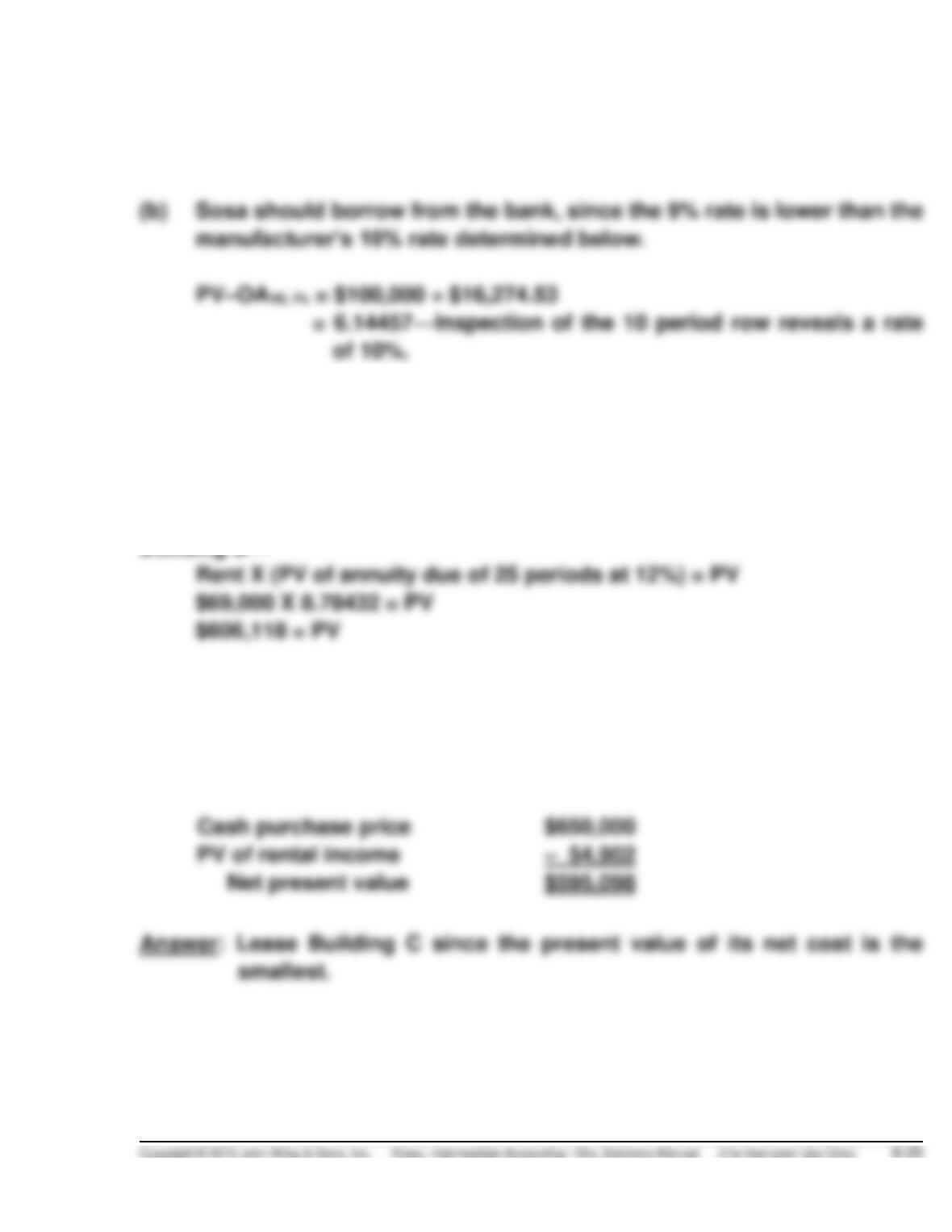
(b) The unknown interest rate is calculated by first dividing the future
value of $1,000,000 by the present investment of $182,696, which is
EXERCISE 6-11 (10–15 minutes)
(a) Total interest = Total payments—Amount owed today
$162,745 (10 X $16,274.53) – $100,000 = $62,745.
EXERCISE 6-12 (10–15 minutes)
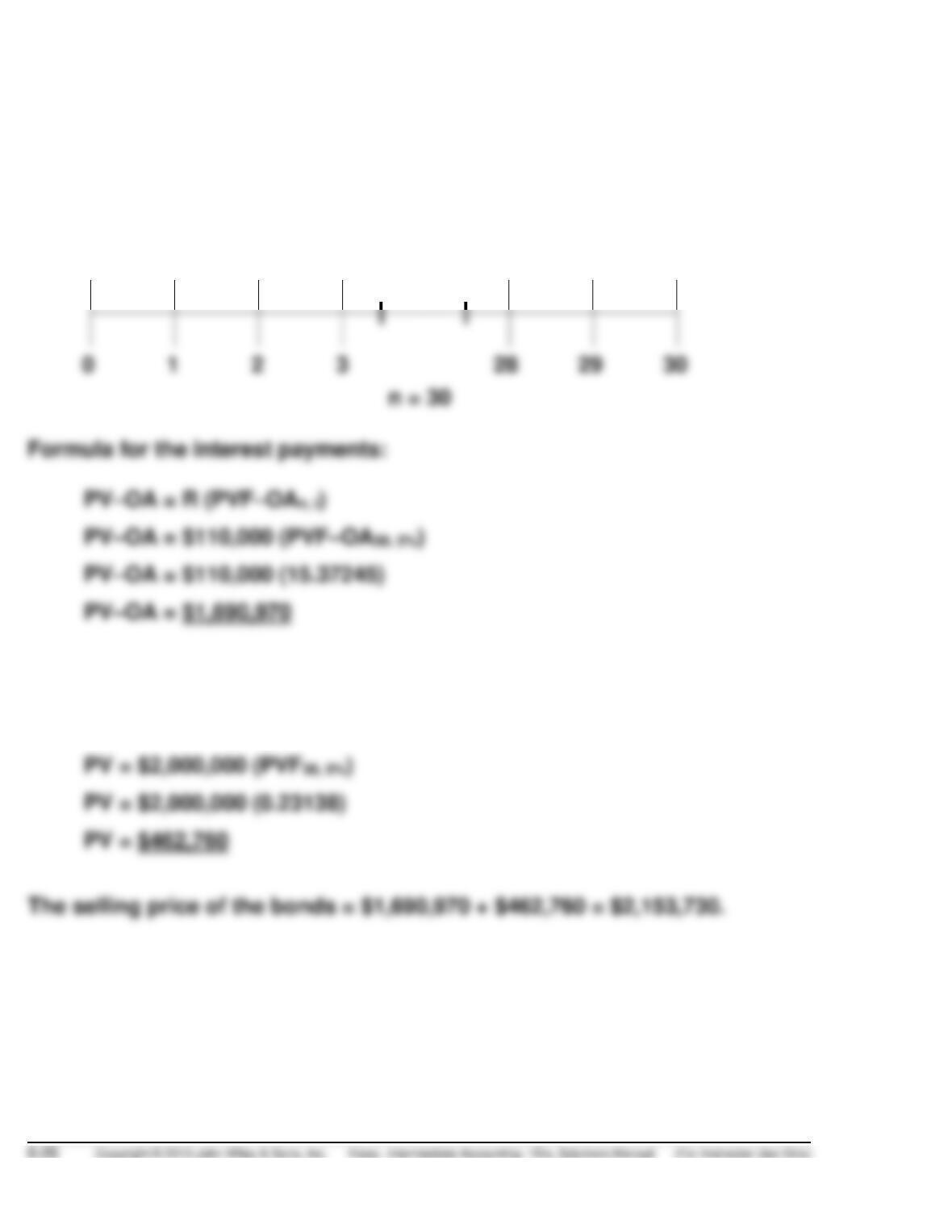
Building A—PV = $600,000.
Building B—
Building C—
Rent X (PV of ordinary annuity of 25 periods at 12%) = PV
$7,000 X 7.84314 = PV
$54,902 = PV
EXERCISE 6-13 (15–20 minutes)
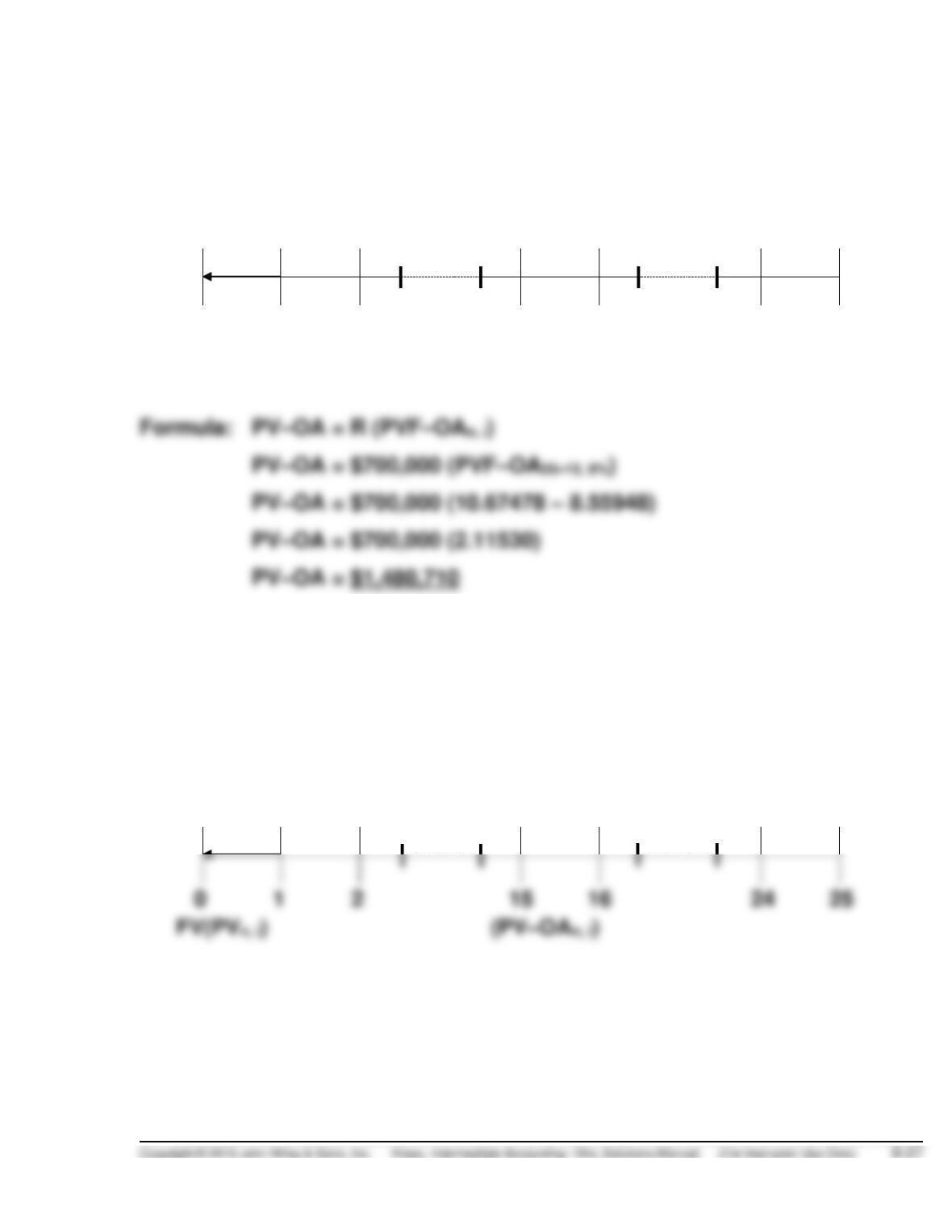
Time diagram:
George Hincapie, Inc.
PV = ? i = 5%
PV–OA = ? Principal
$2,000,000
interest
$110,000 $110,000 $110,000 $110,000 $110,000 $110,000
Formula for the principal:
PV = FV (PVFn, i)
EXERCISE 6-14 (15–20 minutes)
Time diagram:
i = 8%
R =
PV–OA = ? $700,000 $700,000 $700,000
0 1 2 15 16 24 25
n = 15 n = 10
OR
Time diagram:
i = 8%
R =
PV–OA = ? $700,000 $700,000 $700,000
EXERCISE 6-14 (Continued)
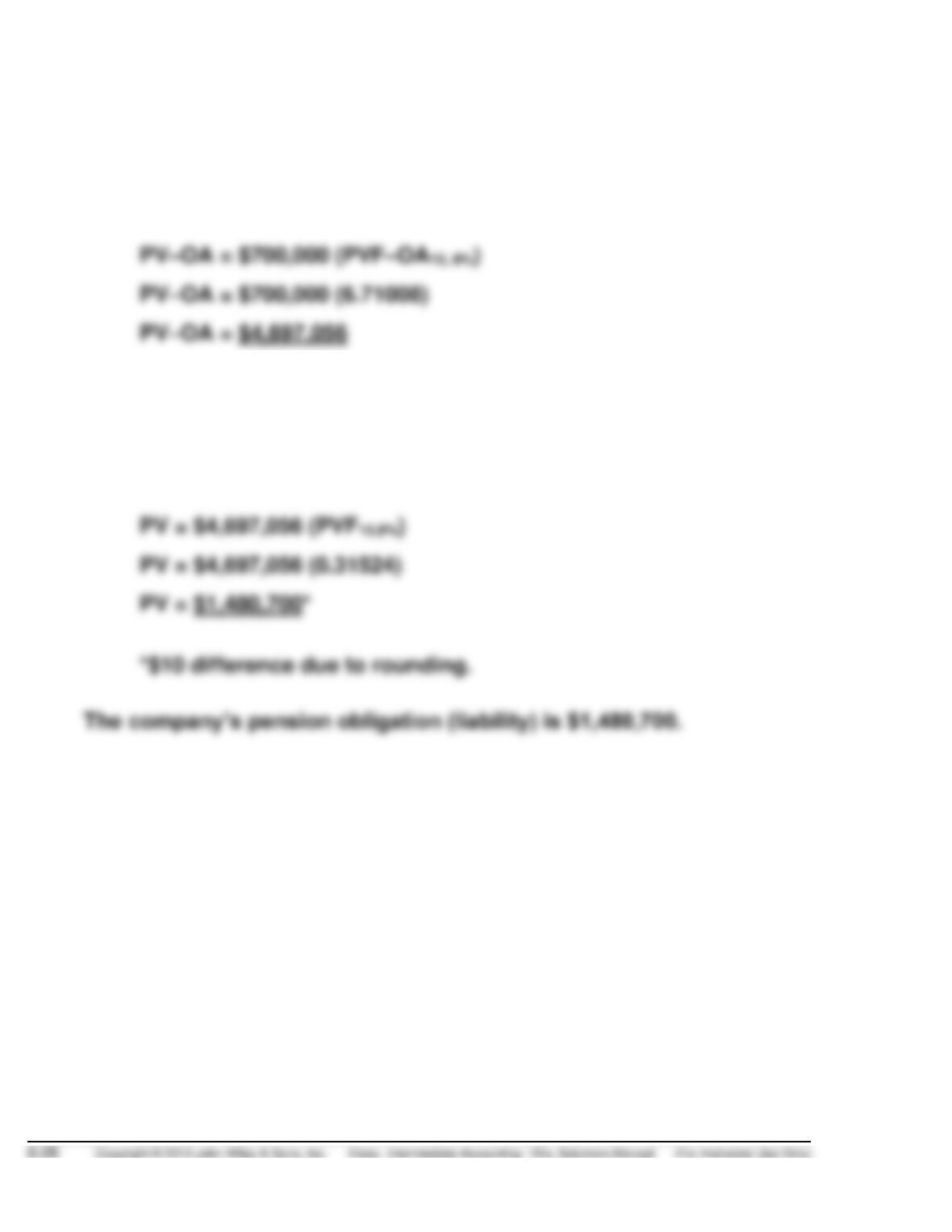
(i) Present value of the expected annual pension payments at the end of
the 10th year:
PV–OA = R (PVF–OAn, i)
(ii) Present value of the expected annual pension payments at the
beginning of the current year:
PV = FV (PVFn, i)
EXERCISE 6-15 (15–20 minutes)
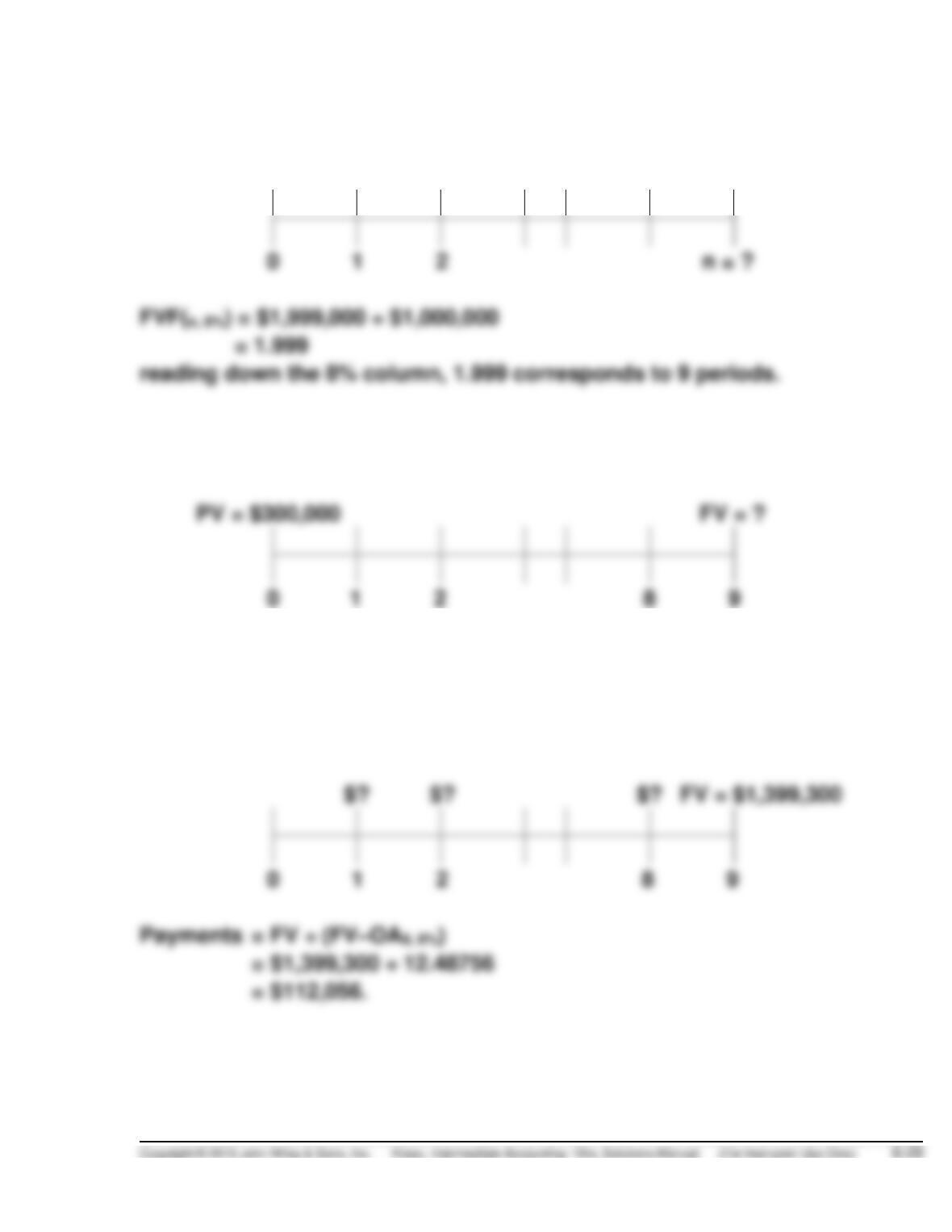
(a)
i = 8%
PV = $1,000,000 FV = $1,999,000
(b) By setting aside $300,000 now, Andrew can gradually build the fund
to an amount to establish the foundation.
FV = $300,000 (FVF9, 8%)
= $300,000 (1.999)
= $599,700—Thus, the amount needed from the annuity:
$1,999,000 – $599,700 = $1,399,300.
EXERCISE 6-16 (10–15 minutes)
Amount to be repaid on March 1, 2022.
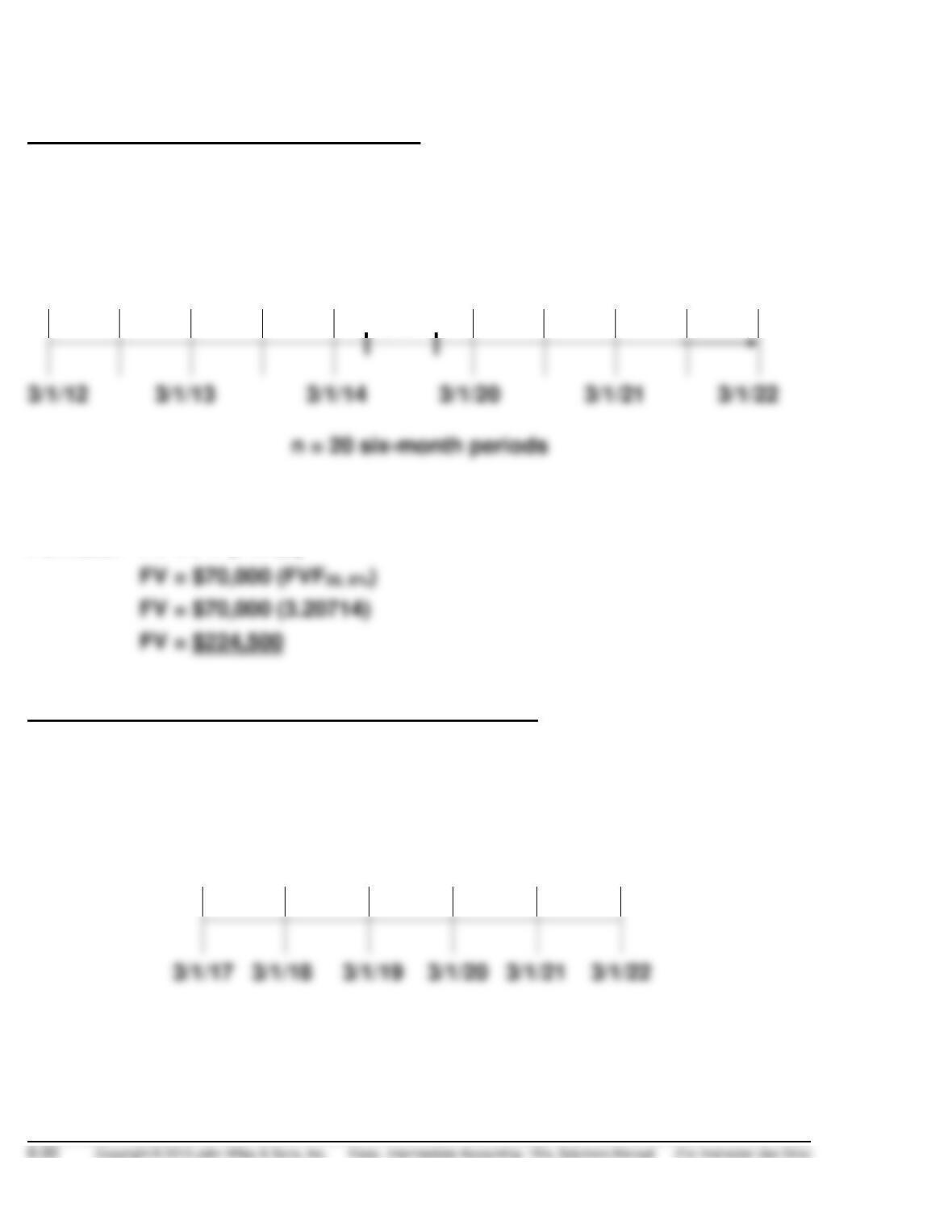
Time diagram:
i = 6% per six months
PV = $70,000 FV = ?
Formula: FV = PV (FVFn, i)
Amount of annual contribution to retirement fund.
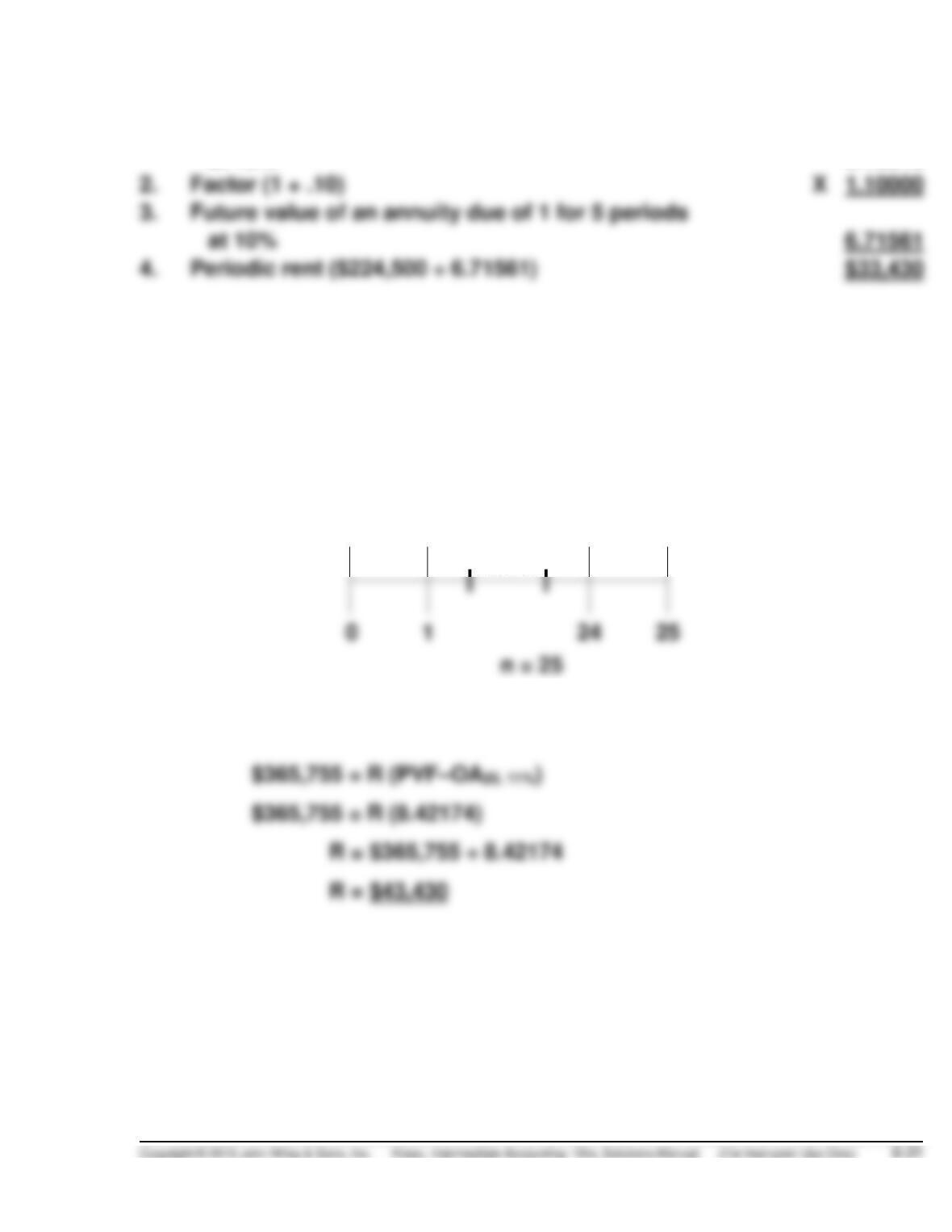
Time diagram:
i = 10%
R R R R R FV–AD =
R = ? ? ? ? ? $224,500
EXERCISE 6-16 (Continued)
1.
Future value of ordinary annuity of 1 for 5 periods
at 10%
6.10510
2.
Factor (1 + .10)
3.
Future value of an annuity due of 1 for 5 periods
at 10%
EXERCISE 6-17 (10–15 minutes)
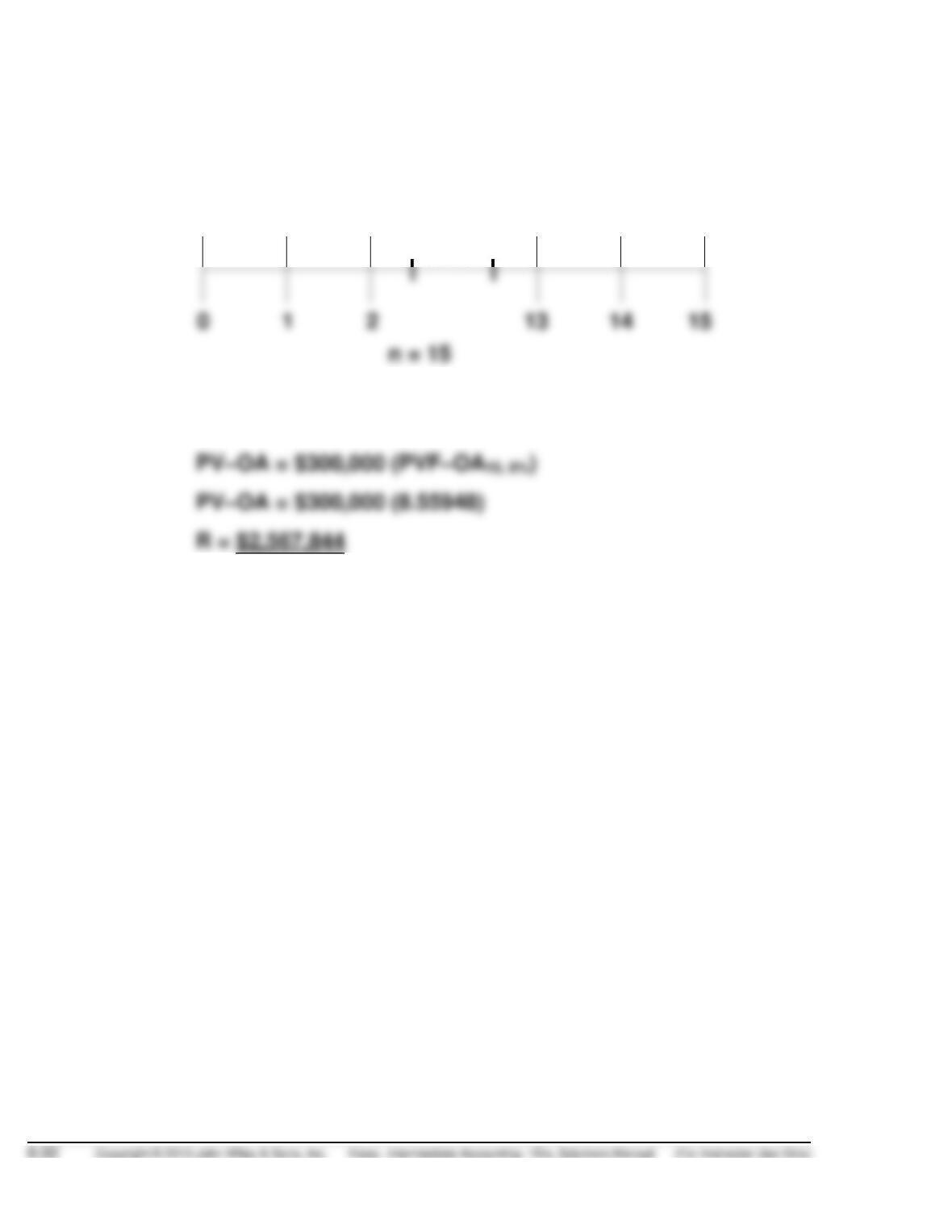
Time diagram:
i = 11%
R R R
PV–OA = $365,755 ? ? ?
Formula: PV–OA = R (PV–OAn, i)
EXERCISE 6-18 (10–15 minutes)
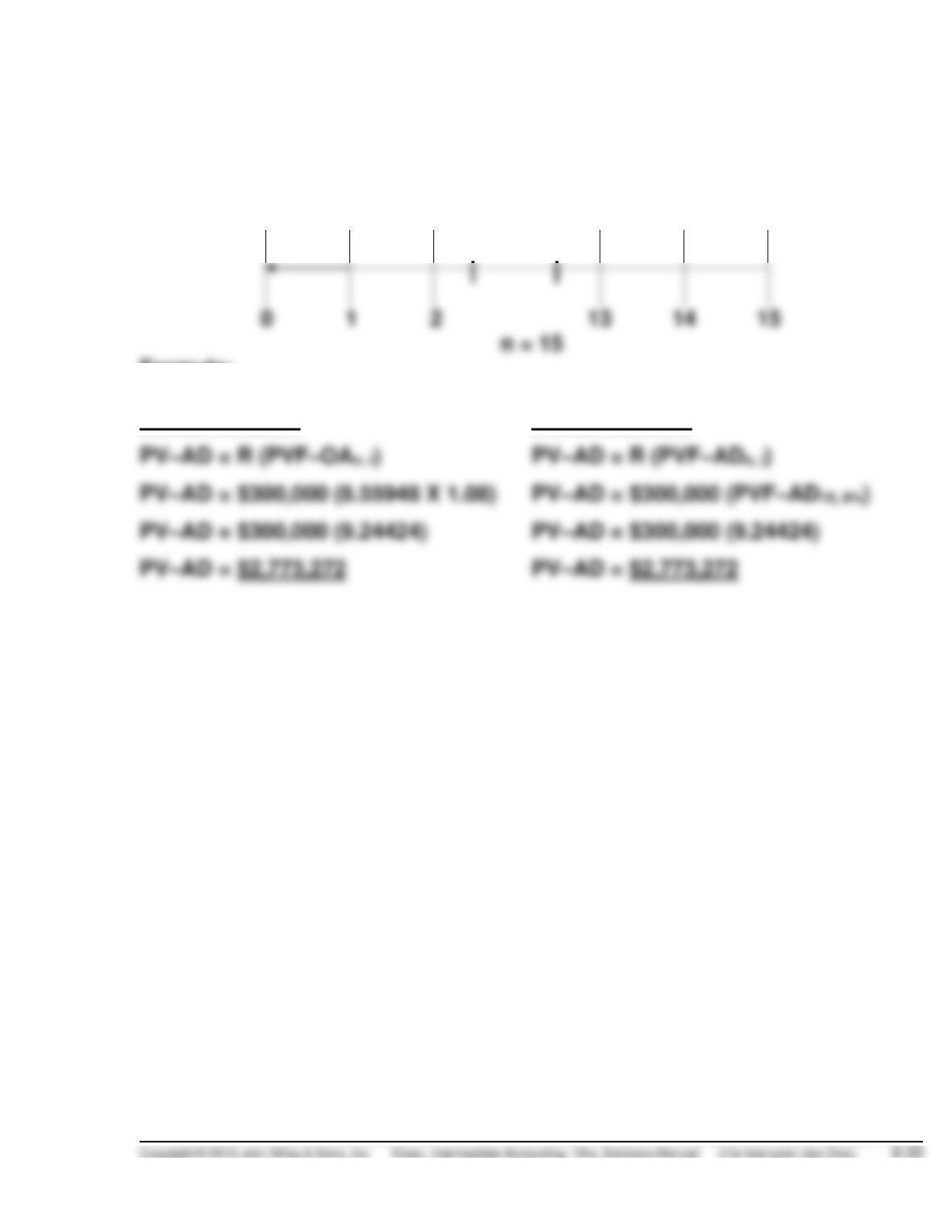
Time diagram:
i = 8%
PV–OA = ? $300,000 $300,000 $300,000 $300,000 $300,000
Formula: PV–OA = R (PVF–OAn, i)
The recommended method of payment would be the 15 annual payments of
$300,000, since the present value of those payments ($2,567,844) is less
than the alternative immediate cash payment of $2,600,000.
EXERCISE 6-19 (10–15 minutes)
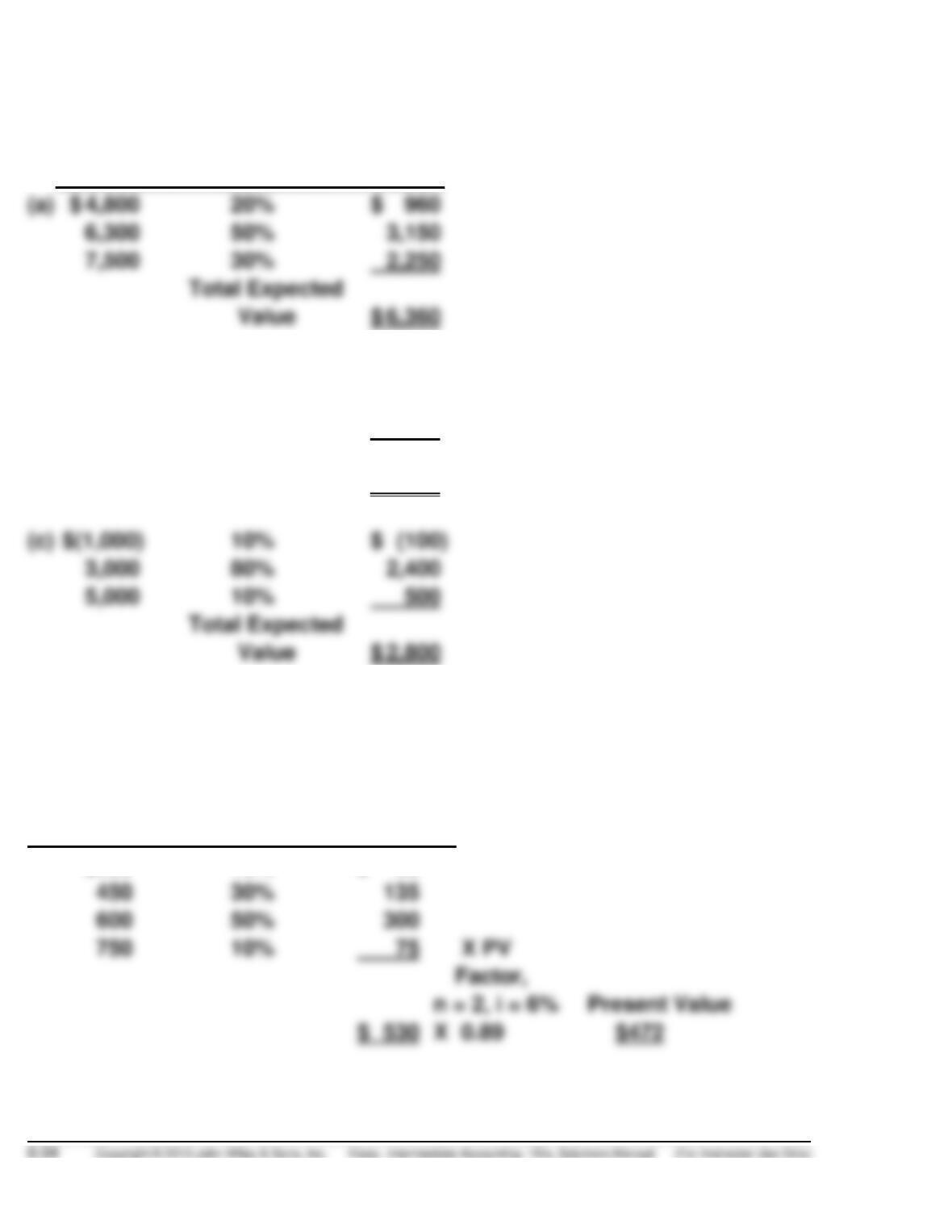
Time diagram:
i = 8%
PV–AD = ?
R =
$300,000 $300,000 $300,000 $300,000 $300,000
Formula:
Using Table 6-4 Using Table 6-5
The recommended method of payment would be the immediate cash
payment of $2,600,000, since that amount is less than the present value of
the 15 annual payments of $300,000 ($2,773,272).
EXERCISE 6-20 (15–20 minutes)
Expected
Cash Flow Probability Cash
Estimate X Assessment = Flow
(b) $ 5,400 30% $ 1,620
7,200 50% 3,600
8,400 20% 1,680
Total Expected
Value $ 6,900
EXERCISE 6-21 (10–15 minutes)
Estimated
Cash Probability Expected
Outflow X Assessment = Cash Flow
$200 10% $ 20
EXERCISE 6-22 (15–20 minutes)
(a) This exercise determines the present value of an ordinary annuity or
expected cash flows as a fair value estimate.
Cash flow Probability Expected
Estimate X Assessment = Cash Flow
(b) This fair value is based on unobservable inputs—Killroy’s own data on
the expected future cash flows associated with the trade name. This
fair value estimate is considered Level 3, as discussed in Chapter 2.
TIME AND PURPOSE OF PROBLEMS
Problem 6-1 (Time 15–20 minutes)
Purpose—to present an opportunity for the student to determine how to use the present value tables in
various situations. Each of the situations presented emphasizes either a present value of 1 or a present
value of an ordinary annuity situation. Two of the situations will be more difficult for the student because
a noninterest-bearing note and bonds are involved.
Problem 6-2 (Time 15–20 minutes)
Purpose—to present an opportunity for the student to determine solutions to four present and future
Problem 6-3 (Time 20–30 minutes)
Purpose—to present the student with an opportunity to determine the present value of the costs of
competing contracts. The student is required to decide which contract to accept.
Problem 6-4 (Time 20–30 minutes)
Problem 6-5 (Time 20–25 minutes)
Purpose—to provide the student with an opportunity to determine which of four insurance options results
Problem 6-6 (Time 25–30 minutes)
Purpose—to present an opportunity for the student to determine the present value of a series of
Problem 6-7 (Time 30–35 minutes)
Purpose—to present the student an opportunity to use time value concepts in business situations.
Some of the situations are fairly complex and will require the student to think a great deal before
answering the question. For example, in one situation a student must discount a note and in another
must find the proper interest rate to use in a purchase transaction.
Problem 6-8 (Time 20–30 minutes)
Time and Purpose of Problems (Continued)
Problem 6-9 (Time 30–35 minutes)
Problem 6-10 (Time 30–35 minutes)
Purpose—to present the student with the opportunity to assess whether a company should purchase or
lease. The computations for this problem are relatively complicated.
Problem 6-11 (Time 25–30 minutes)
Problem 6-12 (Time 20–25 minutes)
Purpose—to provide the student an opportunity to explore the ethical issues inherent in applying time
value of money concepts to retirement plan decisions.
Problem 6-13 (Time 20–25 minutes)
Problem 6-14 (Time 20–25 minutes)
Purpose—to present the student an opportunity to compute expected cash flows and then apply
present value techniques to determine the fair value of an asset.
Problems 6-15 (Time 20–25 minutes)
SOLUTIONS TO PROBLEMS
PROBLEM 6-1
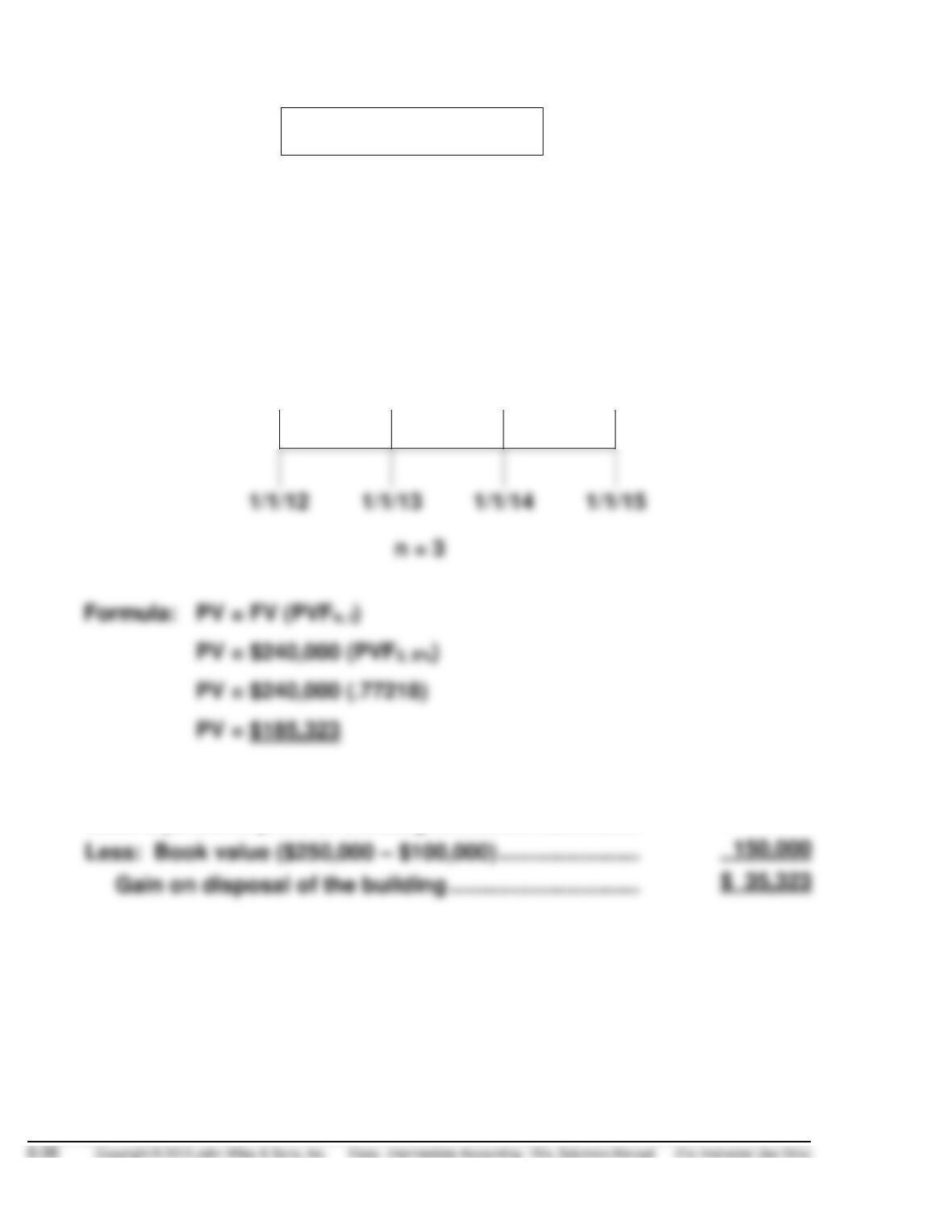
(a) Given no established value for the building, the fair market value of
the note would be estimated to value the building.
Time diagram:
i = 9%
PV = ? FV = $240,000
Cash equivalent price of building …………………………….
$185,323
PROBLEM 6-1 (Continued)
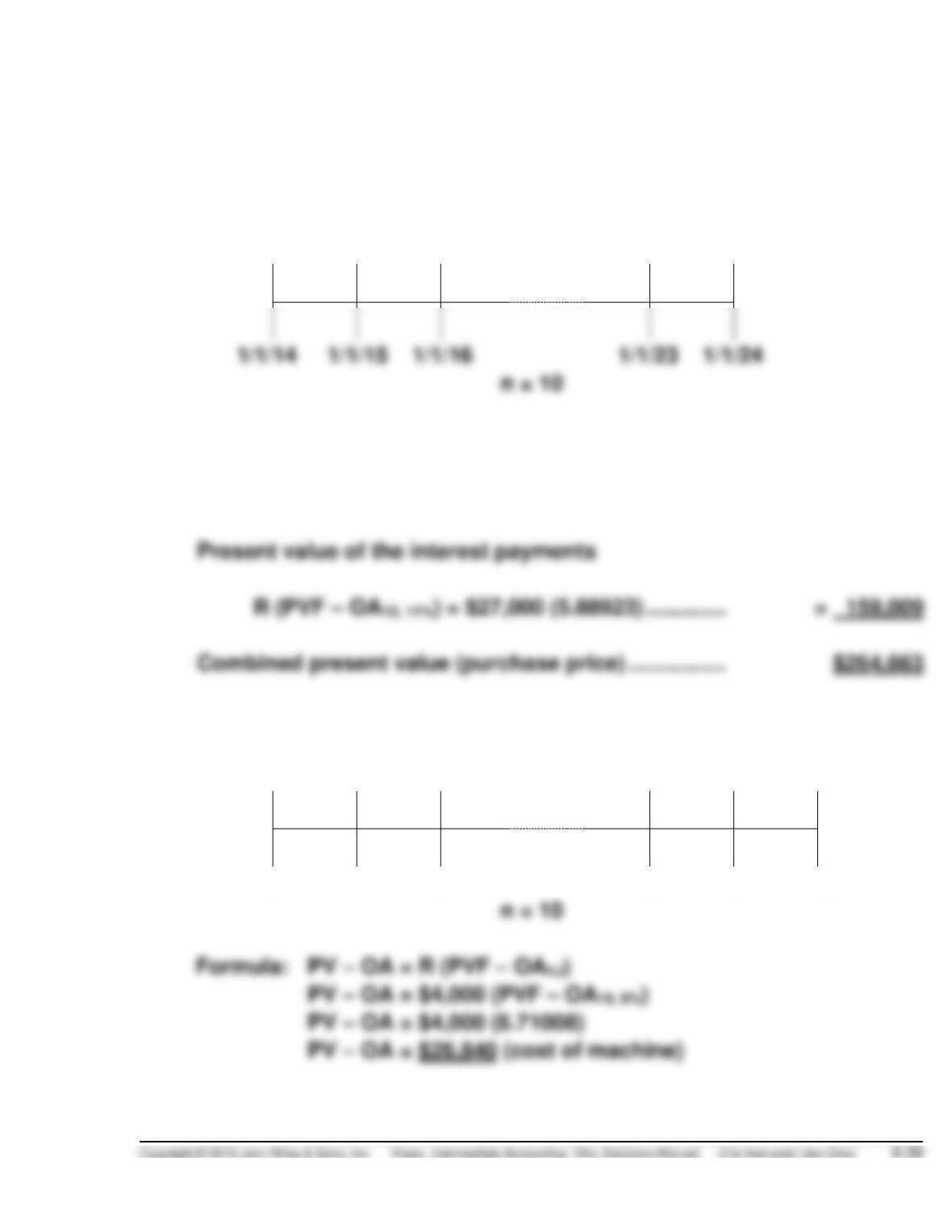
(b) Time diagram:
i = 11%
Principal
$300,000
Interest
PV – OA = ? $27,000 $27,000 $27,000 $27,000
Present value of the principal
FV (PVF10, 11%) = $300,000 (.35218) ………………..
= $105,654
Present value of the interest payments
Combined present value (purchase price) …………….
(c) Time diagram:
i = 8%
PV – OA = ? $4,000 $4,000 $4,000 $4,000 $4,000
0 1 2 8 9 10
PROBLEM 6-1 (Continued)
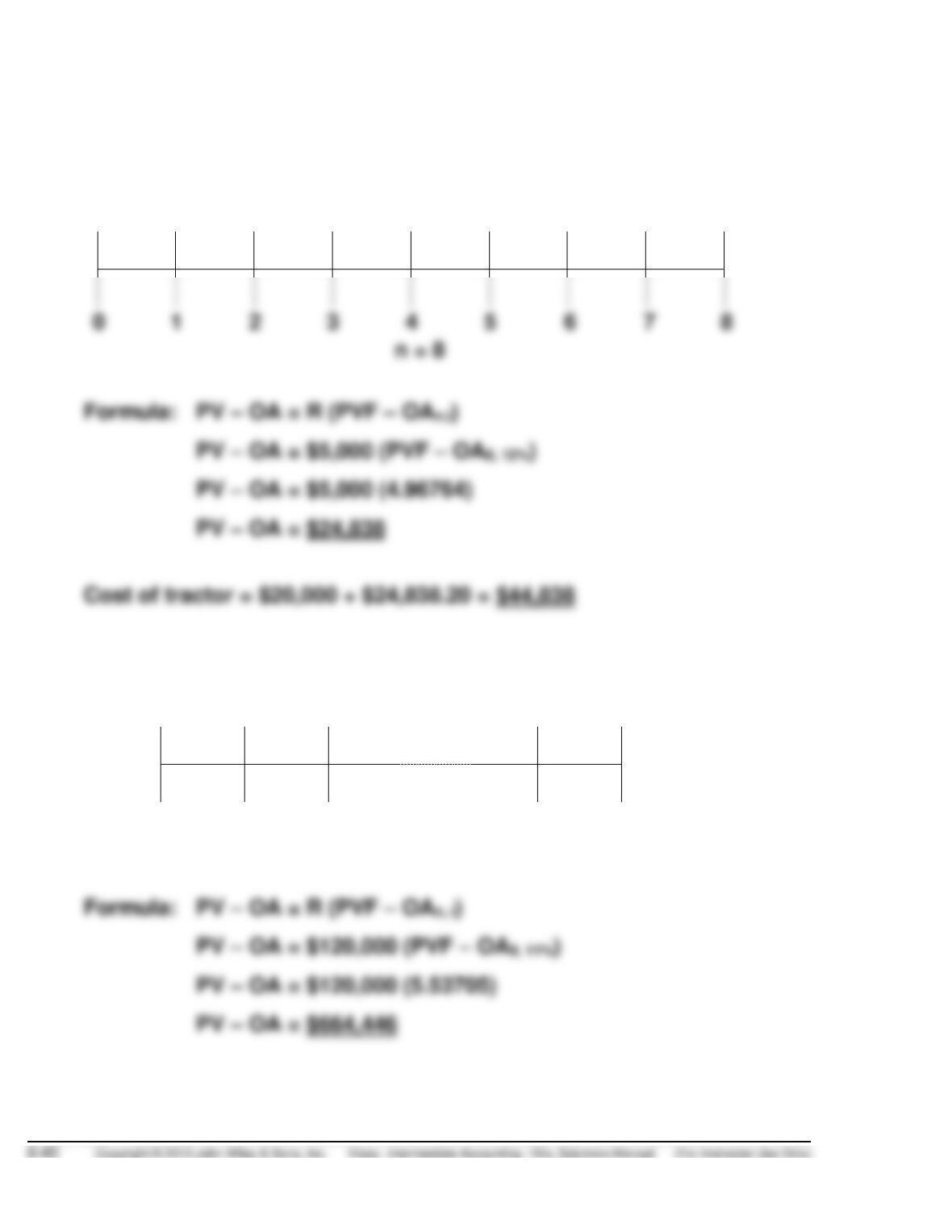
(d) Time diagram:
i = 12%
PV – OA = ?
$20,000 $5,000 $5,000 $5,000 $5,000 $5,000 $5,000 $5,000 $5,000
(e) Time diagram:
i = 11%
PV – OA = ? $120,000 $120,000 $120,000 $120,000
0 1 2 8 9
n = 9