P6-11 (continued)
1. (continued)
PEREZ COMPANY
Comparative Balance Sheets
(Horizontal Analysis)
December 31, 2009, 2010, and 2011
Base-Year-to-Date
Increase (Decrease)
December 31
2009 to 2010 2009 to 2011
2011 2010 2009 Amount % Amount
%
Cash
Receivables (net)
$ 15,500
11,000
$ 12,650
9,350
$ 9,300
6,600
$ 3,350
2,750
36.0
41.7
$ 6,200
4,400
66.7
66.7
P6-11 (continued)
2. PEREZ COMPANY
Comparative Income Statements
(Vertical Analysis)
For Years Ended December 31, 2010 and 2011
2011 2010
Amount % Amount %
Sales
Sales returns
$ 407,000
(7,000)
101.8
(1.8)
$ 361,500
(11,500)
103.3
(3.3)
*Rounded up to balance
PEREZ COMPANY
Comparative Balance Sheets
(Vertical Analysis)
December 31, 2010 and 2011
2011 2010
Amount % Amount %
Cash
Receivables (net)
$ 15,500
11,000
4.4
3.1
$ 12,650
9,350
4.2
3.1
P6-12
1. a. Dividend yield 5.88%
$17
$5) 5,000$7,000/($3 +
÷
b. Price/earnings times4.13
7,000$28,800
$17 =
÷
h. Inventory turnover times5.95
27,000)/2$(32,000
$175,500 =
+
365 ÷ 5.95 = 61 days
i. Receivables turnover times9.79
19,500)/2$(18,000
0.68x$270,000 =
+
365 ÷ 9.79 = 37 days
P6-12 (continued)
1. (continued)
2. A potential investor might compare the results from these ratios in 2010 with the
results from the same ratios of previous periods for the same company. The
P6-13 (AICPA adapted solution)
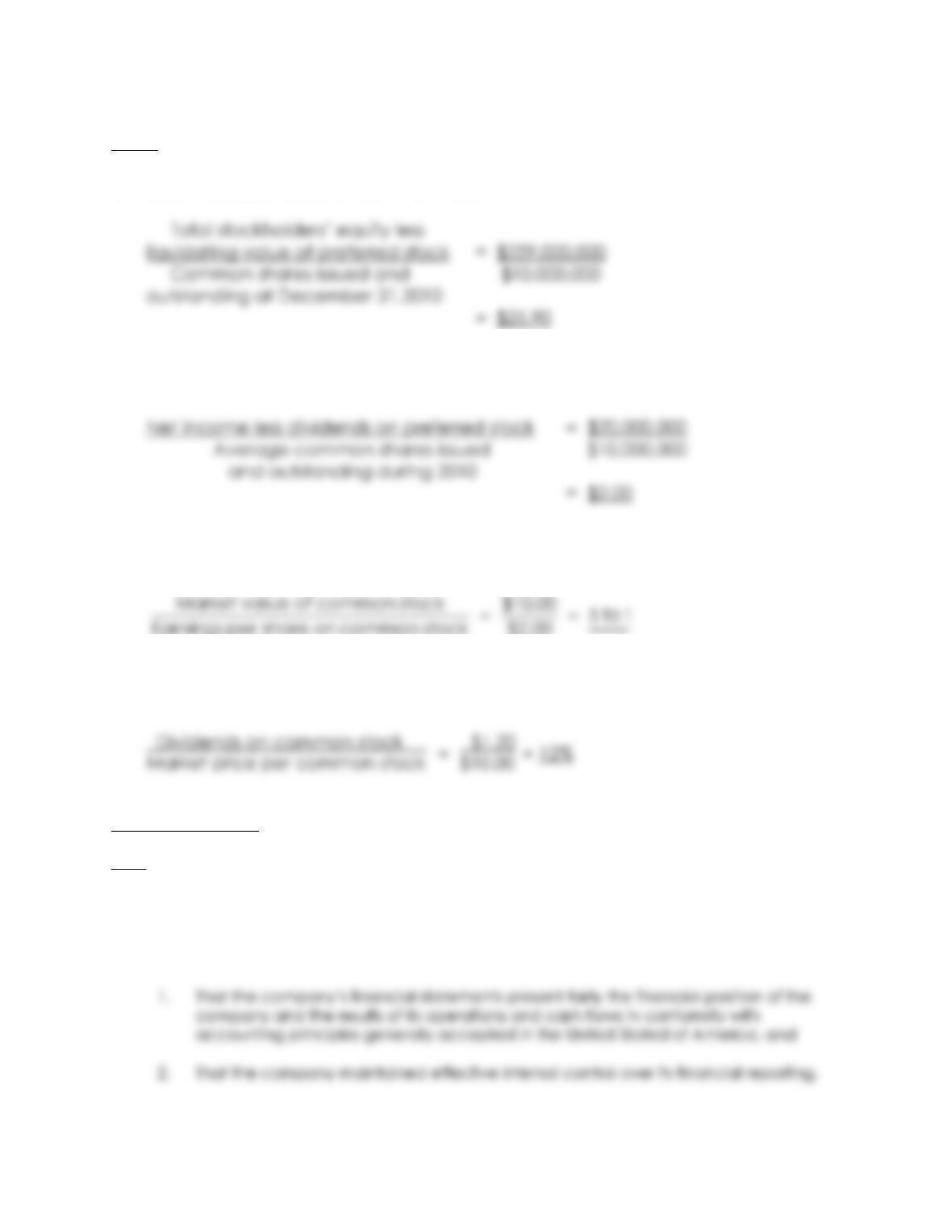
1. Current (working capital) ratio
2. Quick (acid-test) ratio
3. Number of days’ sales in average receivables
4. Inventory turnover
6-58
P6-13 (continued)
5. Book value per share of common stock
6. Earnings per share on common stock
7. Price-earnings ratio on common stock
8. Dividend-yield ratio on common stock
ANSWERS TO CASES
C6-1
In an audit, the certified public accountant conducts an examination of the company’s
internal control over its financial reporting, as well as its accounting system, records, and
financial statements in accordance with generally accepted auditing standards. Based
on this examination, the auditor issues an audit report which expresses two opinions:
C6-1 (continued)
An unqualified audit report consists of five paragraphs. The first paragraph, known as the
introductory paragraph, lists the financial statements that were audited, indicates that
management’s assessment of internal control was audited, declares that the
management is responsible for the financial statements and related internal control, and
C6-2 (CMA adapted solution)
Note to Instructor: This case is slightly more advanced than the text explanation, but is
useful for class discussion. The solution is slightly modified based on new requirements.
2. Five subject areas or topics that have been recommended for inclusion in the
management report include the following:
• management’s responsibility for the financial statements and other financial
6-60
C6-2 (continued)
3. Since the management report includes a discussion of its design, maintenance, and any
deficiencies in the company’s internal control system, the auditor must express opinions on
C6-3 (CMA adapted solution)
Note to Instructor: This case is slightly more advanced than the text explanation, but is
useful for class discussion. The solution is slightly modified for new requirements.
1. The SEC is an independent federal agency that receives its authority from federal
2. a. The SEC supports fair securities markets by regulating brokers, exchanges, and the
publicly held companies themselves. The Commission monitors the trading practices
and financial condition of brokers. The Commission oversees the activities and trading
3. The SEC requires publicly held companies to file audited financial statements and other
disclosures in accordance with its regulations. The Commission relies primarily on the
C6-4
1. An operating segment is a component of a company:
(a) that engages in business activities to earn revenues and incur expenses,
(b) whose operating results are regularly reviewed by the company’s chief operating
6-61
C6-4 (continued)
2. There are three basic tests to be applied to operating segments to determine if they are
significant enough to be separately reportable. If a segment meets any one of the tests it
is significant and is a reportable segment.
The first test is based upon revenue. If an operating segment’s reported revenues from
sales to external customers and intersegment sales are equal to 10 percent or more of the
3. A company must disclose the following information about its reportable operating
segments:
(a) Information about profit (or loss). The company must report its profit (or loss) for each
reportable segment. It must also disclose certain amounts it used to compute each
segment’s profit (or loss). These amounts are the segment’s: (1) revenues (separated
6-62
C6-5 (AICPA adapted solution)
1. Sales and other revenues should be recognized for interim financial statement purposes in
the same manner as revenues are recognized for annual reporting purposes. This means
normally at the point of sale or, in the case of services, at completion of the earnings
2. For interim reporting purposes, product costs (costs directly attributable to the production
of goods or services) should be matched with the product and associated revenues in the
same manner as for annual reporting purposes.
arbitrary assignment of costs between interim periods.
The AICPA Accounting Principles Board allowed for some variances from the normal
method of determining cost of goods sold and valuation of inventories at interim dates,
but these methods are allowable only at interim dates and must be fully disclosed in a
note to the financial statements. Some companies use the gross profit method of
estimating cost of goods sold and ending inventory at interim dates instead of taking a
complete physical inventory. This is an allowable procedure at interim dates, but the
company must disclose the method used and any significant variances that subsequently
result from reconciliation of the results obtained using the gross profit method and the
results obtained after taking the annual physical inventory.
C6-5 (continued)
2. (continued)
Finally, if a company uses a standard costing system to compute cost of goods sold and
3. The AICPA Accounting Principles Board stated that the provision for income taxes shown in
interim financial statements must be based upon the effective tax rate expected for the
entire annual period for ordinary earnings. The effective tax rate is, in accordance with
previous APB Opinions, based on earnings for financial statement purposes as opposed to
taxable income which may consider timing differences. This effective tax rate is the
C6-6 (AICPA adapted solution)
1. Financial reporting for operating segments of a business enterprise involves reporting
financial information on a less-than-total-enterprise basis. These segments are defined
based on a “management approach” along organizational lines, such as divisions,
2. The reasons for requiring financial data to be reported by operating segments include the
following:
C6-6 (continued)
2. (continued)
In addition to being useful and desirable, such information is practical to compute.
3. The possible disadvantages of requiring financial data to be reported by operating
segments include the following:
They could be misinterpreted due to the public’s general lack of appreciation of the
limitations of the somewhat arbitrary bases for most allocations of common costs.
6-65
C6-7 (AICPA adapted solution)
Note to Instructor: This case is slightly advanced for students but provides a good basis for
class discussion.
1. If a corporation’s activity could be expected to be the same in all quarters, there would
be no problems in using quarterly statements to predict annual results, providing one
recognized that the normal activities of any corporation could be disrupted by unforeseen
events such as strikes, fires, floods, actions of governmental authorities, and unusual
2. Repairs and Maintenance of Factory Machinery is an example of an item which may show
substantial variations that are not proportionate to either sales or production. In fact, it
would not be unusual for many repair and maintenance projects to be performed during
3. Such quarterly statements do give management opportunities to manipulate the results of
operations for a quarter; for instance, through the timing of expenses. Management can
C6-8
1. The company’s operating segments are Africa, Eurasia, European Union, Latin America,
North America, Pacific, Bottling Investments, and Corporate (p. 125).
C6-8 (continued)
4. The net operating revenues of the Latin America operating segment were $3,244M for
2007. The total amount of the net operating revenues of the various operating segments
was $28,857M for 2007 (p. 130). This is the same amount as reported on the company’s
consolidated statement of income for 2007 (p. 66).
C6-9
Note to Instructor: This case does not have a definitive answer. From a financial reporting
perspective, GAAP is identified and summarized. From an ethical perspective, various
issues are raised for discussion purposes.
From a financial reporting perspective, for interim reporting purposes expenses that are
not directly associated with product sales are matched against revenues in various ways.
From an ethical perspective, the issue is when to report the repair and maintenance
expense, given that all the costs are incurred in the first quarter. Allocation of the expense
to incorrect interim periods will cause the net income of each interim period to be under-