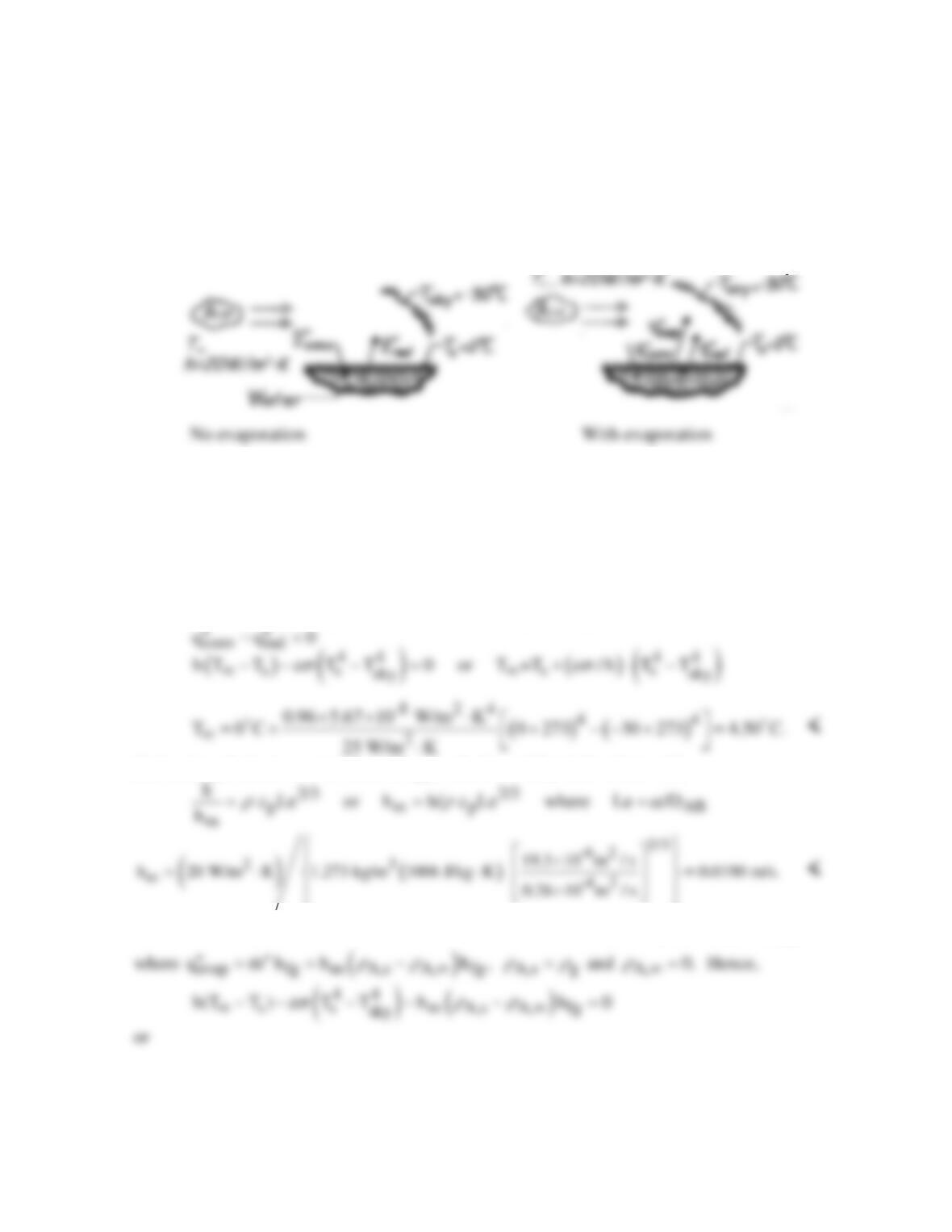
PROBLEM 6.62
KNOWN: Water freezing under conditions for which the air temperature exceeds 0°C.
FIND: (a) Lowest air temperature, T∞, before freezing occurs, neglecting evaporation, (b)
The mass transfer coefficient, hm, for the evaporation process, (c) Lowest air temperature, T∞,
before freezing occurs, including evaporation.
SCHEMATIC:
ASSUMPTIONS: (1) Steady-state conditions, (2) Water insulated from ground, (3) Water
surface has e = 1, (4) Heat–mass transfer analogy applies, (5) Ambient air is dry.
PROPERTIES: Table A-4, Air (Tf ≈ 2.5°C ≈ 276K, 1 atm): ρ = 1.2734 kg/m3, cp = 1006
J/kg⋅K, α = 19.3 × 10⁻⁶m2/s; Table A-6, Water vapor (273.15K): hfg = 2502 kJ/kg, ρg = 1/vg
= 4.847 × 10⁻³kg/m3; Table A-8, Water vapor – air (298K):
D m s.
AB 2
= × −
0 26 10 4
. /
ANALYSIS: (a) Neglecting evaporation and performing an energy balance,
(b) Invoking the heat-mass transfer analogy in the form of Eq. 6.60 with n = 1/3,
(c) Including evaporation effects and performing an energy balance gives
conv rad evap
q qq 0
′′ ′′ ′′
−− =
Continued…
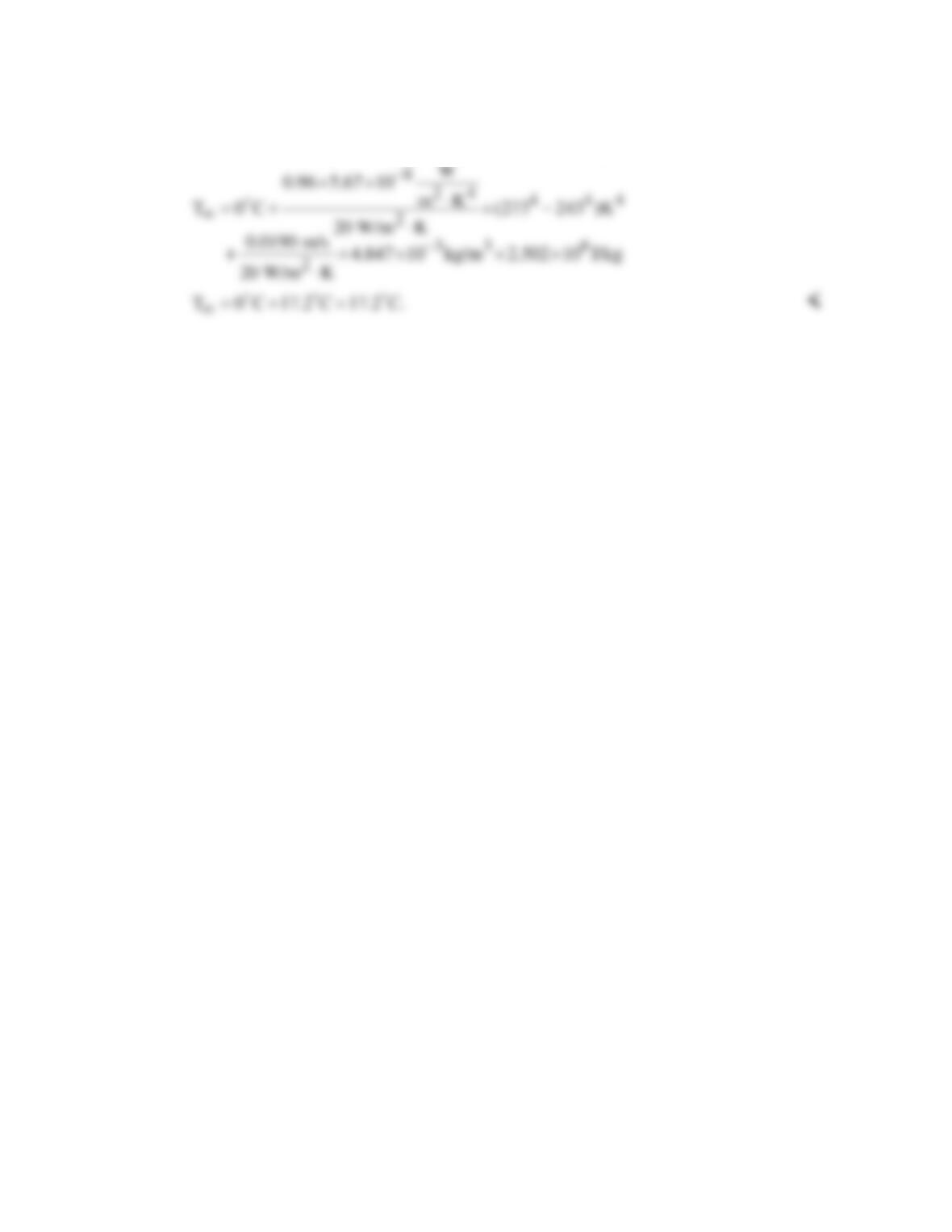
PROBLEM 6.62 (cont.)
( )
()
( )
( )
44
s s m A,s fg
sky
T T /h T T h /h 0 h
es ρ
∞
=+ −+ −
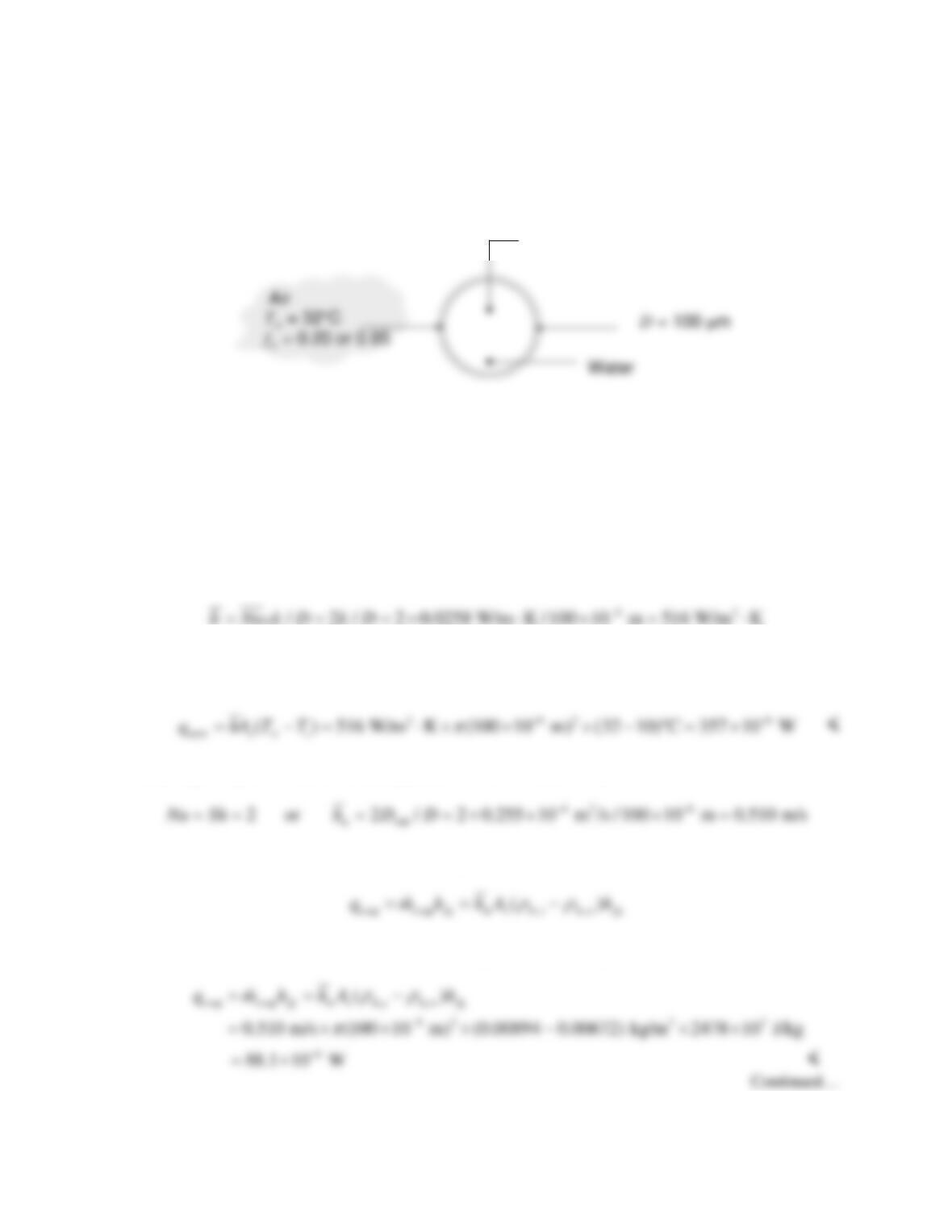
PROBLEM 6.63
KNOWN: Initial temperature and droplet diameter of water mist. Expression for Nusselt number.
Temperature and relative humidity of air stream.
FIND: (a) Initial convection heat transfer rate, evaporative heat loss rate, and rate of change of
droplet temperature, (b) Steady–state droplet temperature.
SCHEMATIC:
Ti= 10°C
ASSUMPTIONS: (1) The properties of the air-water vapor mixture can be approximated by pure air
properties, (2) Air properties and DAB evaluated at Tam = (Ts + T∞)/2.
PROPERTIES: Table A-4, Air (T = 294 K): k = 0.0258 W/m⋅K; Table A-8, H2O in Air (T = 294 K):
DAB = 0.26 × 10⁻⁴ m2/s (294/298)3/2 = 0.255 × 10⁻⁴ m2/s; Table A-6, Water (T = 283 K):
ρ
A,sat(Ts) =
1/111.8 m3/kg = 0.00894 kg/m3, hfg = 2478 kJ/kg,
ρ
w = 1000 kg/m3, cp,w = 4193 J/kg⋅K; (T = 305 K):
ρ
A,sat(T∞) = 1/29.74 m3/kg = 0.0336 kg/m3.
ANALYSIS: (a) The convection heat transfer coefficient is
D
At the initial time, when the droplet temperature is Ti = 10°C, the convection heat transfer rate to the
droplet is given by
Referring to Eq. 6.59, since Nu is independent of Pr, n = 0, and we have
Thus the rate of evaporative heat loss can be expressed as
For
φ
∞ = 0.20,
ρ
A,∞ =
φ
∞
ρ
A,sat(T∞) = 0.2 × 0.0336 kg/m3 = 0.00672 kg/m3. Thus,
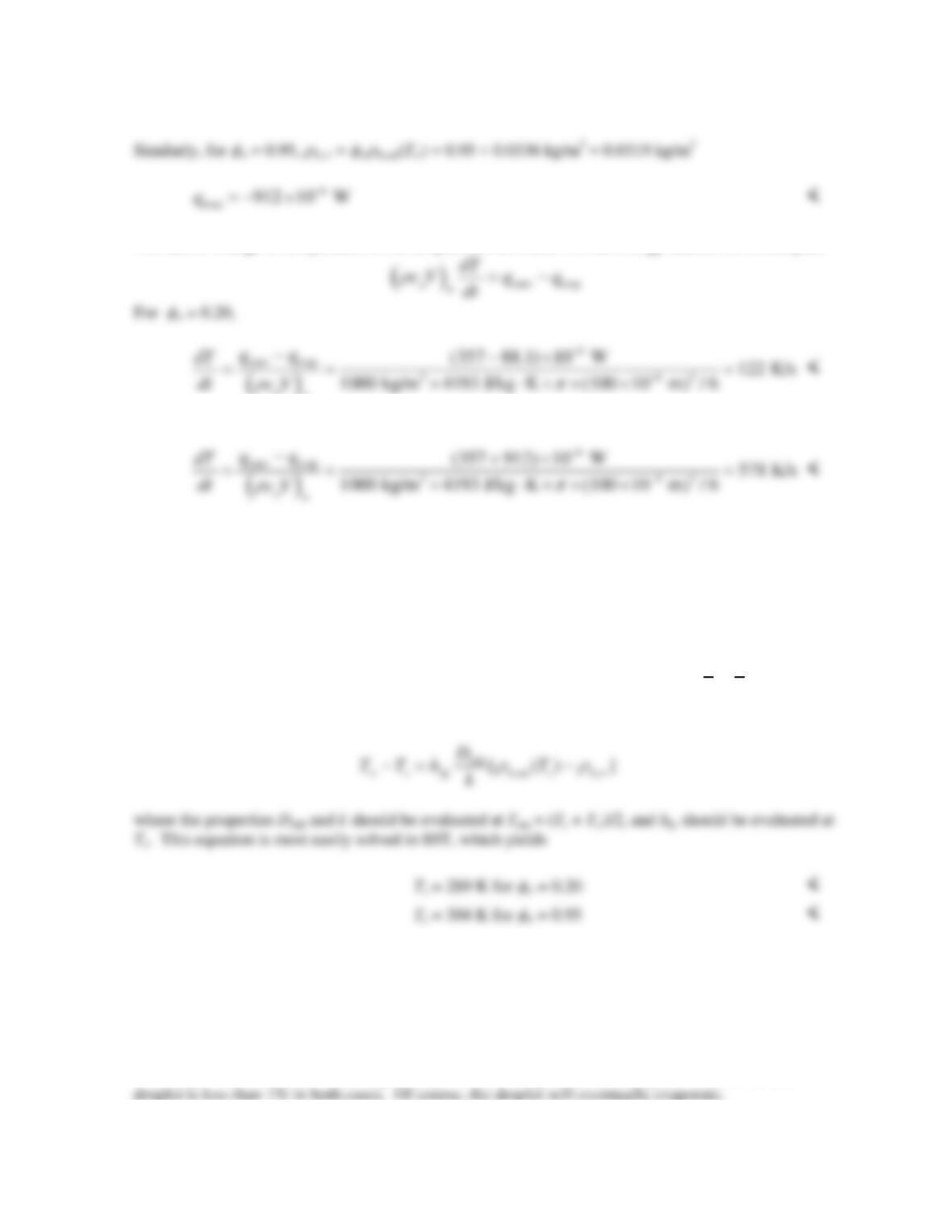
PROBLEM 6.63 (Cont.)
The rate of change of temperature of the droplet can be found from an energy balance on the droplet:
pw
And for
φ
∞ = 0.95,
pw
For
φ
∞ = 0.20, the evaporative heat loss is positive; the droplet is evaporating. Convection from the
warm air is warming the droplet, while evaporation is cooling it. The net effect is to warm the droplet.
For
φ
∞ = 0.95, the evaporative heat loss is negative; water from the humid environment is condensing
on the droplet. Both convection and condensation cause warming of the droplet, so the rate of
temperature increase is higher in this case. Eventually, the droplet will become warm enough so that
condensation ceases and evaporation will begin. <
(b) At steady–state, an energy balance requires qconv = qevap. Eq. 6.64 applies, with
AB
//
m
hhD k=
.
Thus, the following implicit equation must be solved for Ts:
COMMENTS: (1) As expected, the steady–state droplet temperature is lower for the low humidity
conditions. (2) The steady–state temperature does not depend on the droplet diameter because the areas
for convection and evaporation are the same and the heat and mass transfer coefficients have the same
dependence on diameter. (3) Based on the initial rate of temperature increase, it appears that the
droplet will take less than 1 s to reach its steady–state temperature. A complete analysis of the
transient problem shows that the steady-state temperature is reached in approximately 0.17 and 0.15 s
for the
φ
∞ = 0.20 and 0.95 cases, respectively. In this time period, the change in diameter of the
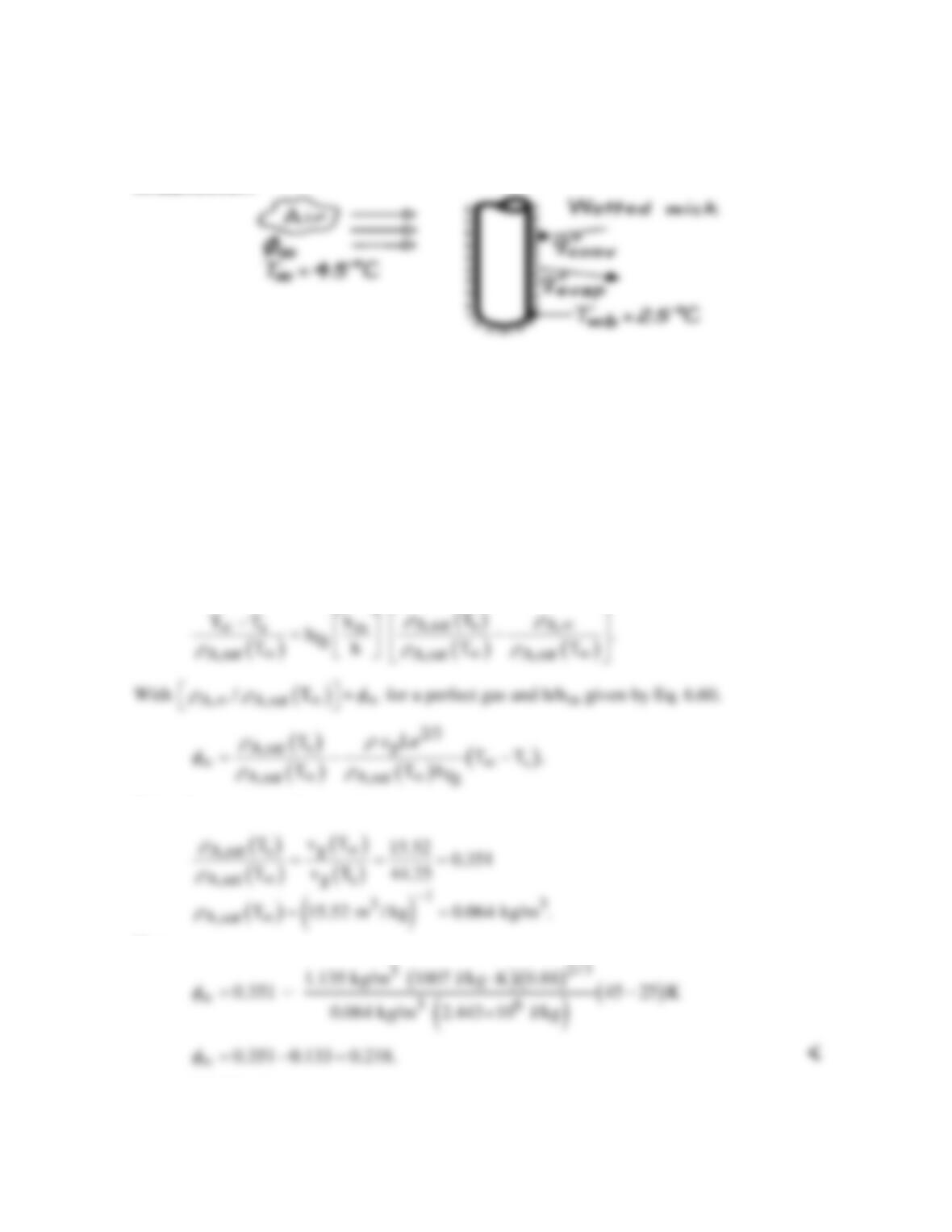
PROBLEM 6.64
KNOWN: Wet and dry bulb temperatures.
FIND: Relative humidity of air.
SCHEMATIC:
ASSUMPTIONS: (1) Perfect gas behavior for vapor, (2) Steady-state conditions, (3)
Negligible radiation, (4) Negligible conduction along thermometer.
PROPERTIES: Table A-4, Air (308K, 1 atm): ρ = 1.135 kg/m3, cp = 1007 J/kg⋅K, α = 23.7
× 10-6m2/s; Table A-6, Saturated water vapor (298K): vg = 44.25 m3/kg, hfg = 2443 kJ/kg;
(318K): vg = 15.52 m3/kg; Table A-8, Air-vapor (1 atm, 298K): DAB = 0.26 × 10⁻⁴m2/s,
DAB (308K) = 0.26 × 10⁻⁴m2/s × (308/298)3/2 = 0.27 × 10⁻⁴m2/s, Le = α/DAB = 0.88.
ANALYSIS: From an energy balance on the wick, Eq. 6.64 follows from Eq. 6.61. Dividing
Eq. 6.64 by ρA,sat(T∞),
Using the property values, evaluate
Hence,
COMMENTS: Note that latent heat must be evaluated at the surface temperature
(evaporation occurs at the surface).
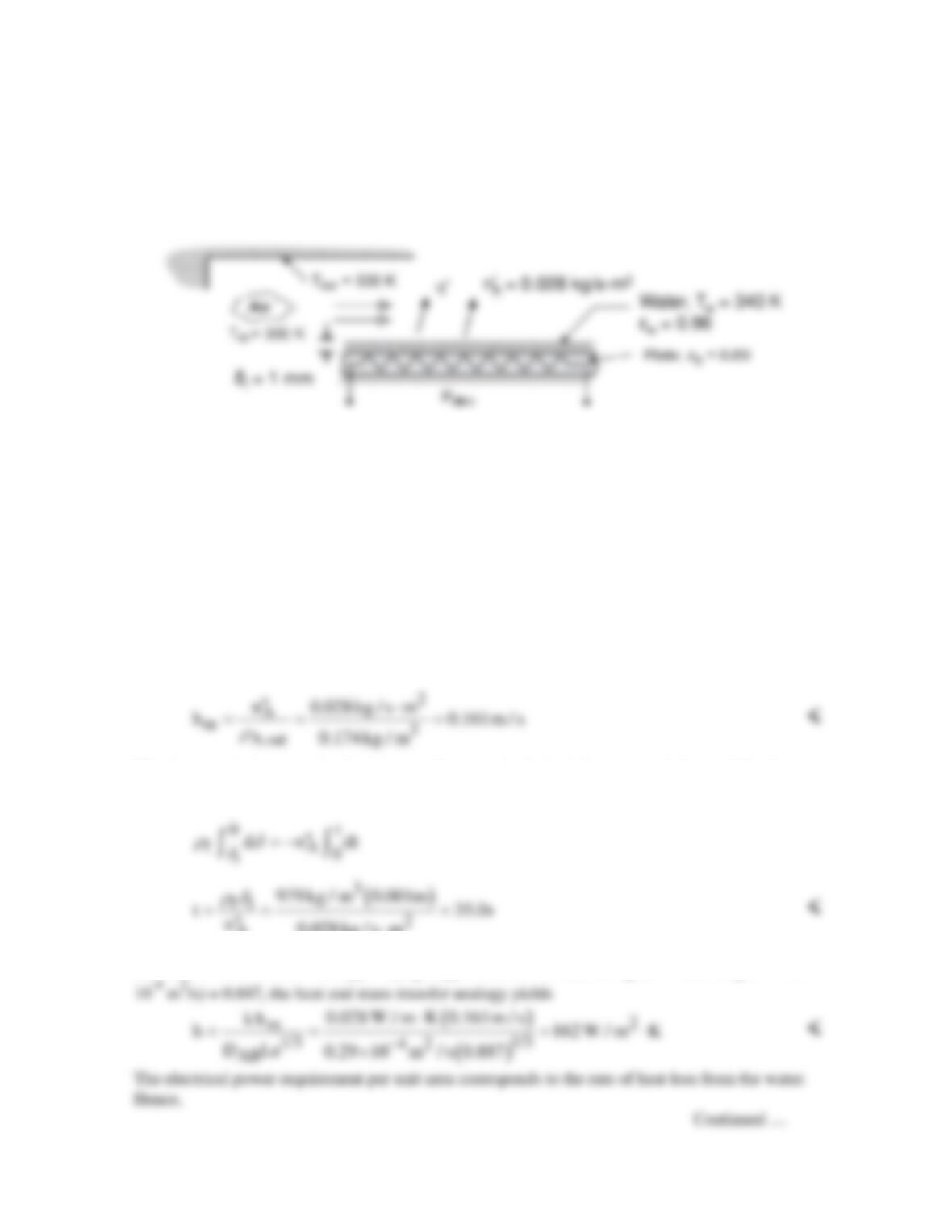
PROBLEM 6.65
KNOWN: Thickness, temperature and evaporative flux of a water layer. Temperature of air flow
and surroundings.
FIND: (a) Convection mass transfer coefficient and time to completely evaporate the water, (b)
Convection heat transfer coefficient, (c) Heater power requirement per surface area, (d) Temperature
of dry surface if heater power is maintained.
SCHEMATIC:
ASSUMPTIONS: (1) Steady-state, (2) Applicability of heat and mass transfer analogy with n = 1/3,
(3) Radiation exchange at surface of water may be approximated as exchange between a small surface
and large surroundings, (4) Air is dry (ρA,∞ = 0).
PROPERTIES: Table A-6, Water (Tw = 340K): ρf = 979 kg/m3,
13
A,sat g
v 0.174 kg / m ,
ρ
−
= =
fg
h 2342 kJ / kg.=
Prescribed, Air: ρ = 1.08 kg/m3, cp = 1008 J/kg⋅K, k = 0.028 W/m⋅K. Vapor/Air:
DAB = 0.29 × 10⁻⁴ m2/s.
ANALYSIS: (a) The convection mass transfer coefficient may be determined from the rate equation
( )
A m A,s A,
hn,
ρρ
∞
= −
′′
where
( )
A,s A,sat w A,
T and 0.
ρρ ρ
∞
= =
Hence,
The time required to completely evaporate the water is obtained from a mass balance of the form
Af
n d / dt,
ρd
′′
−=
in which case
A
(b) With n = 1/3 and Le = α/DAB = k/ρcp DAB = 0.028 W/m⋅K/(1.08 kg/m3 × 1008 J/kg⋅K × 0.29 ×
PROBLEM 6.65 (Cont.)
(c) After complete evaporation, the steady–state temperature of the plate is determined from the
requirement that
COMMENTS: The evaporative heat flux is the dominant contributor to heat transfer from the water
layer, with convection of sensible energy being an order of magnitude smaller and radiation exchange
being negligible. Without evaporation (a dry surface), convection dominates and is approximately an
order of magnitude larger than radiation.
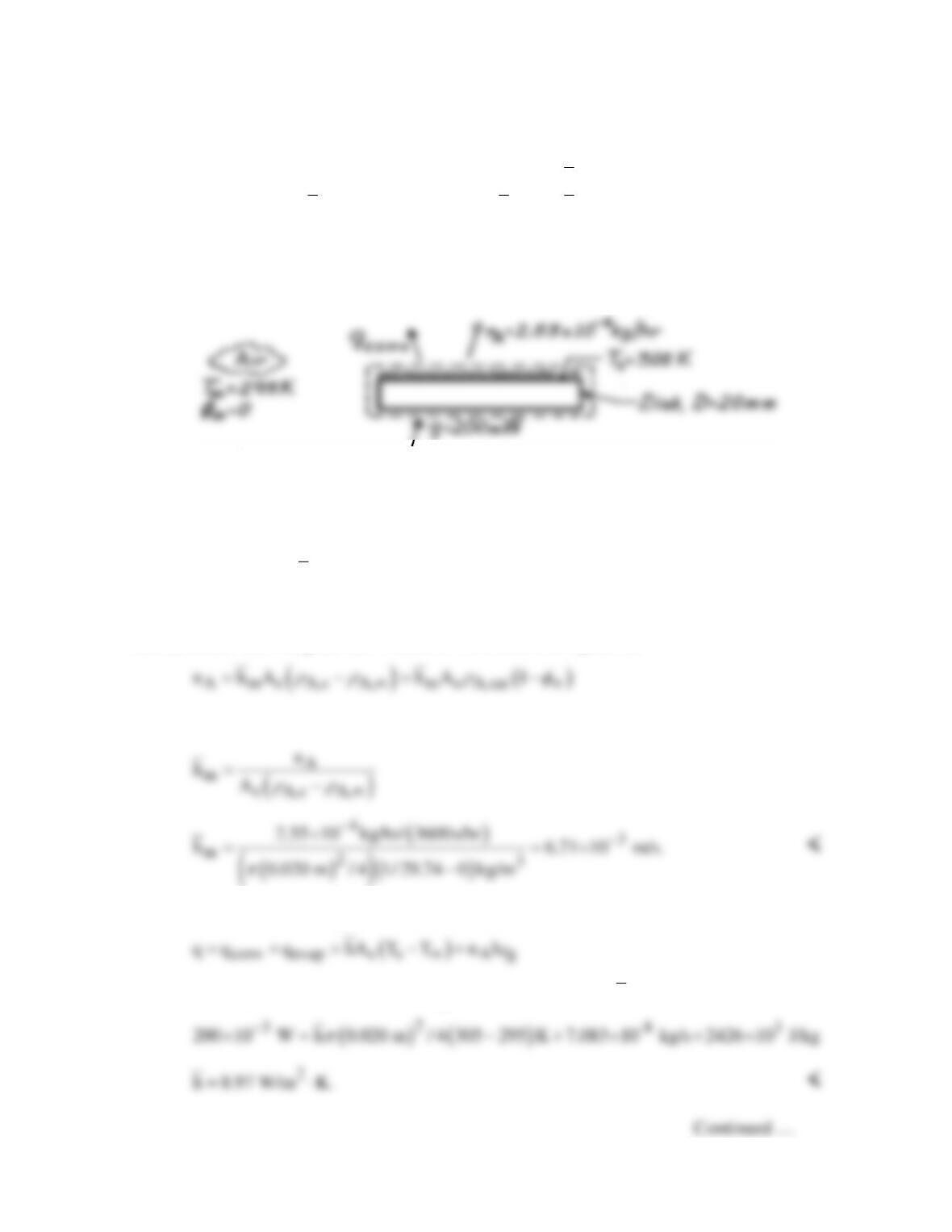
PROBLEM 6.66
KNOWN: Heater power required to maintain water film at prescribed temperature in dry
ambient air and evaporation rate.
FIND: (a) Average mass transfer convection coefficient
m
h,
(b) Average heat transfer
convection coefficient
h,
(c) Whether values of
m
h
and
h
satisfy the heat-mass analogy, and
(d) Effect on evaporation rate and disc temperature if relative humidity of the ambient air were
increased from 0 to 0.5 but with heater power maintained at the same value.
SCHEMATIC:
ASSUMPTIONS: (1) Water film and disc are at same temperature; (2) Mass and heat
transfer coefficient are independent of ambient air relative humidity, (3) Constant properties.
PROPERTIES: Table A-6, Saturated water (305 K): vg = 29.74 m3/kg, hfg = 2426 × 103
J/kg; Table A-4, Air
( )
T 300 K, 1 atm :=
k = 0.0263 W/m⋅K, α = 22.5 × 10⁻⁶ m2/s, Table A-
8, Air-water vapor (300 K, 1 atm): DAB = 0.26 × 10⁻⁴ m2/s.
ANALYSIS: (a) Using the mass transfer convection rate equation,
and evaluating ρA,s = ρA,sat (305 K) = 1/vg (305 K) with φ∞ ~ ρA,∞ = 0, find
(b) Perform an overall energy balance on the disc,
and substituting numerical values with hfg evaluated at Ts, find
h:
PROBLEM 6.66 (Cont.)
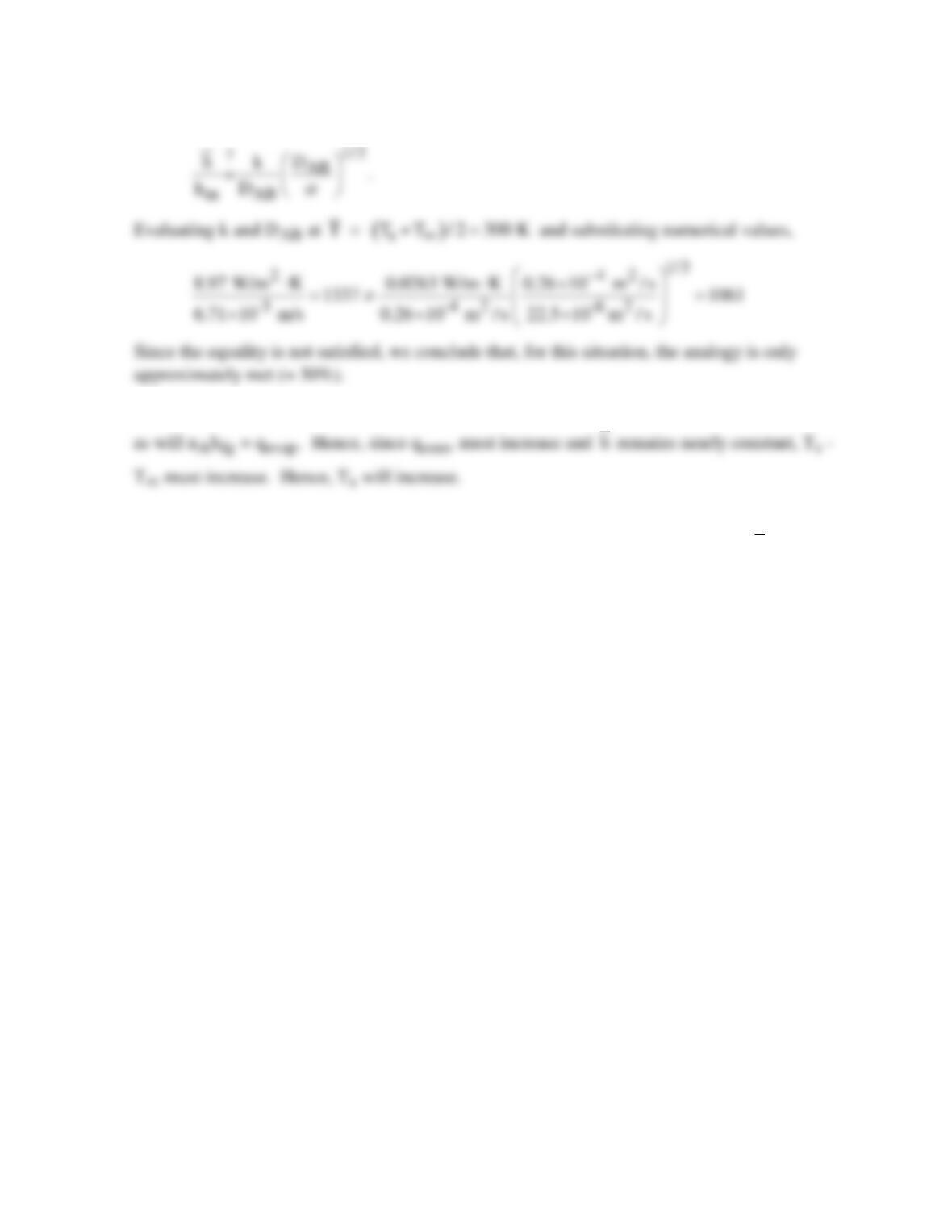
(c) The heat-mass transfer analogy, Eq. 6.67, requires that
(d) If φ∞ = 0.5 instead of 0.0 and q is unchanged, nA will decrease by nearly a factor of two,
COMMENTS: Note that in part (d), with an increase in Ts, hfg decreases, but only slightly,
and ρA,sat increases. From a trial–and-error solution assuming constant values for
m
h
and h,
the disc temperature is 315 K for φ∞ = 0.5.
PROBLEM 6.67
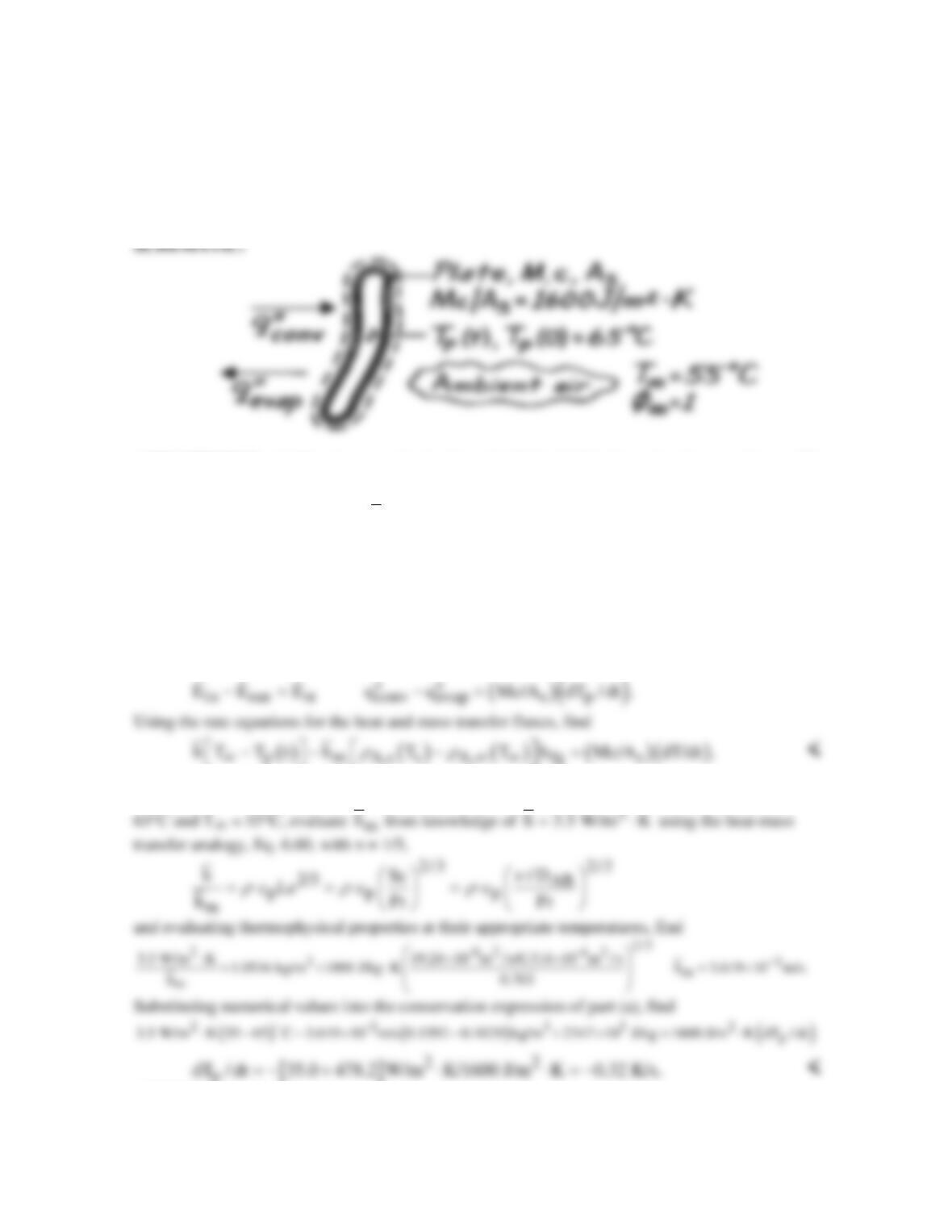
KNOWN: Initial plate temperature Tp (0) and saturated air temperature (T∞) in a dishwasher at the
start of the dry cycle. Thermal mass per unit area of the plate Mc/As = 1600 J/m2⋅K.
FIND: (a) Differential equation to predict plate temperature as a function of time during the dry
cycle and (b) Rate of change in plate temperature at the start of the dry cycle assuming the average
convection heat transfer coefficient is 3.5 W/m2⋅K.
ASSUMPTIONS: (1) Plate is spacewise isothermal, (2) Negligible thermal resistance of water film
on plate, (3) Heat–mass transfer analogy applies.
PROPERTIES: Table A-4, Air (
T
=(55 + 65)°C/2 = 333 K, 1 atm): ρ = 1.0516 kg/m3, cp = 1008
J/kg⋅K, Pr = 0.703, ν = 19.24× 10⁻⁶ m2/s; Table A-6, Saturated water vapor, (Ts = 65°C = 338 K): ρA
= 1/vg = 0.1592 kg/m3, hfg = 2347 kJ/kg; (Ts = 55°C = 328 K): ρA = 1/vg = 0.1029 kg/m3; Table A-
8, Air–water vapor (Ts = 65°C = 338 K, 1 atm): DAB = 0.26 × 10⁻⁴ m2/s (338/298)3/2 = 0.314 × 10⁻⁴
m2/s.
ANALYSIS: (a) Perform an energy balance on a rate basis on the plate,
(b) To evaluate the change in plate temperature at t = 0, the start of the drying process when Tp (0) =
COMMENTS: This rate of temperature change will not be sustained for long, since, as the plate
cools, the rate of evaporation (which dominates the cooling process) will diminish.
PROBLEM 6S.1
KNOWN: Two-dimensional flow conditions for which v = 0 and T = T(y).
FIND: (a) Verify that u = u(y), (b) Derive the x-momentum equation, (c) Derive the energy equation.
SCHEMATIC:
ASSUMPTIONS: (1) Steady-state conditions, (2) Incompressible fluid with constant properties, (3)
Negligible body forces, (4) v = 0, (5) T = T(y) or ∂T/∂x = 0, (6) Thermal energy generation occurs
only by viscous dissipation.
ANALYSIS: (a) From the mass continuity equation, it follows from the prescribed conditions that
∂u/∂x = 0. Hence u = u(y).
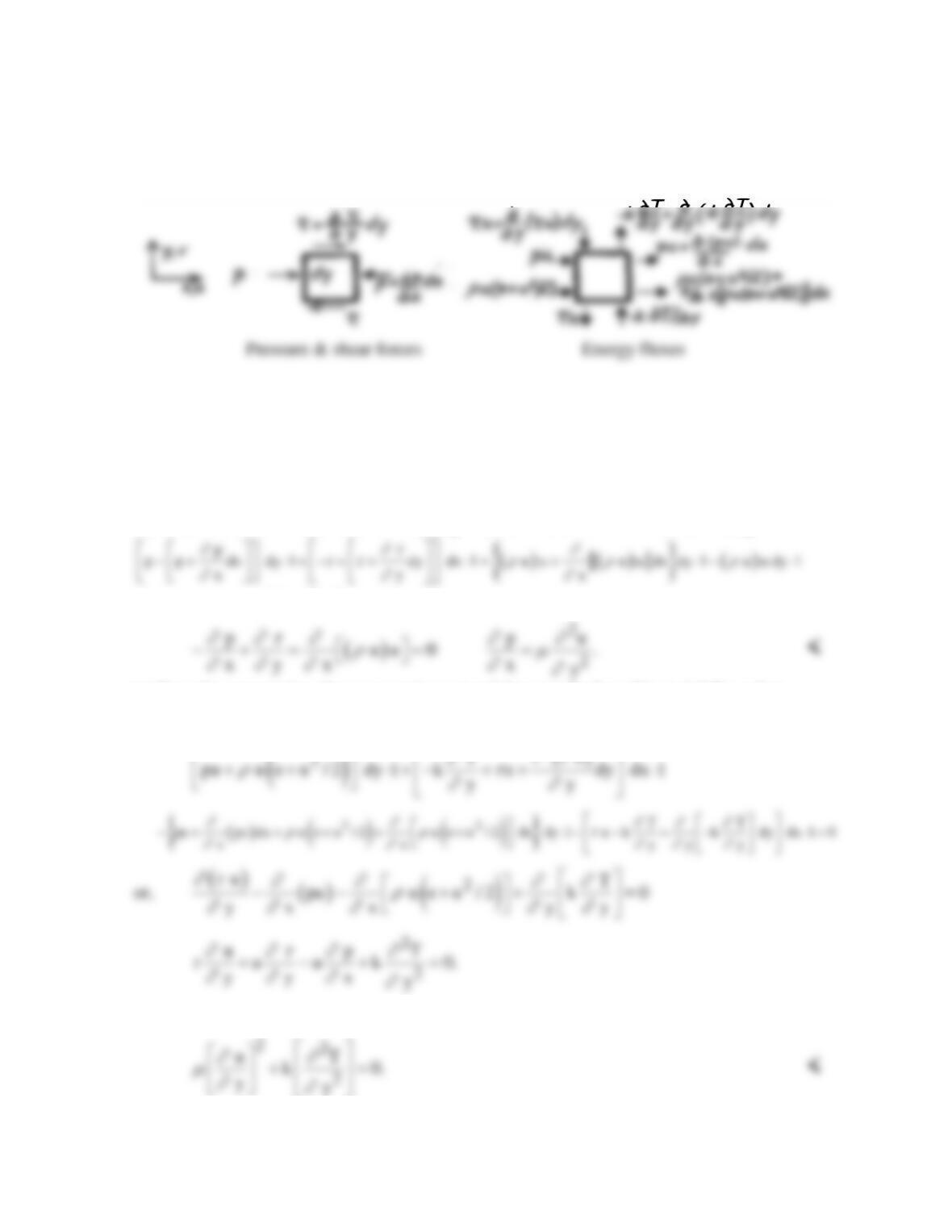
(b) From Newton’s second law of motion,
x
FΣ=
(Rate of increase of fluid momentum)x,
Hence, with
( )
u/ y ,
τ µ∂ ∂
=
it follows that
(c) From the conservation of energy requirement and the prescribed conditions, it follows that
in out
E E 0, or−=
Noting that the second and third terms cancel from the momentum equation,
PROBLEM 6S.2
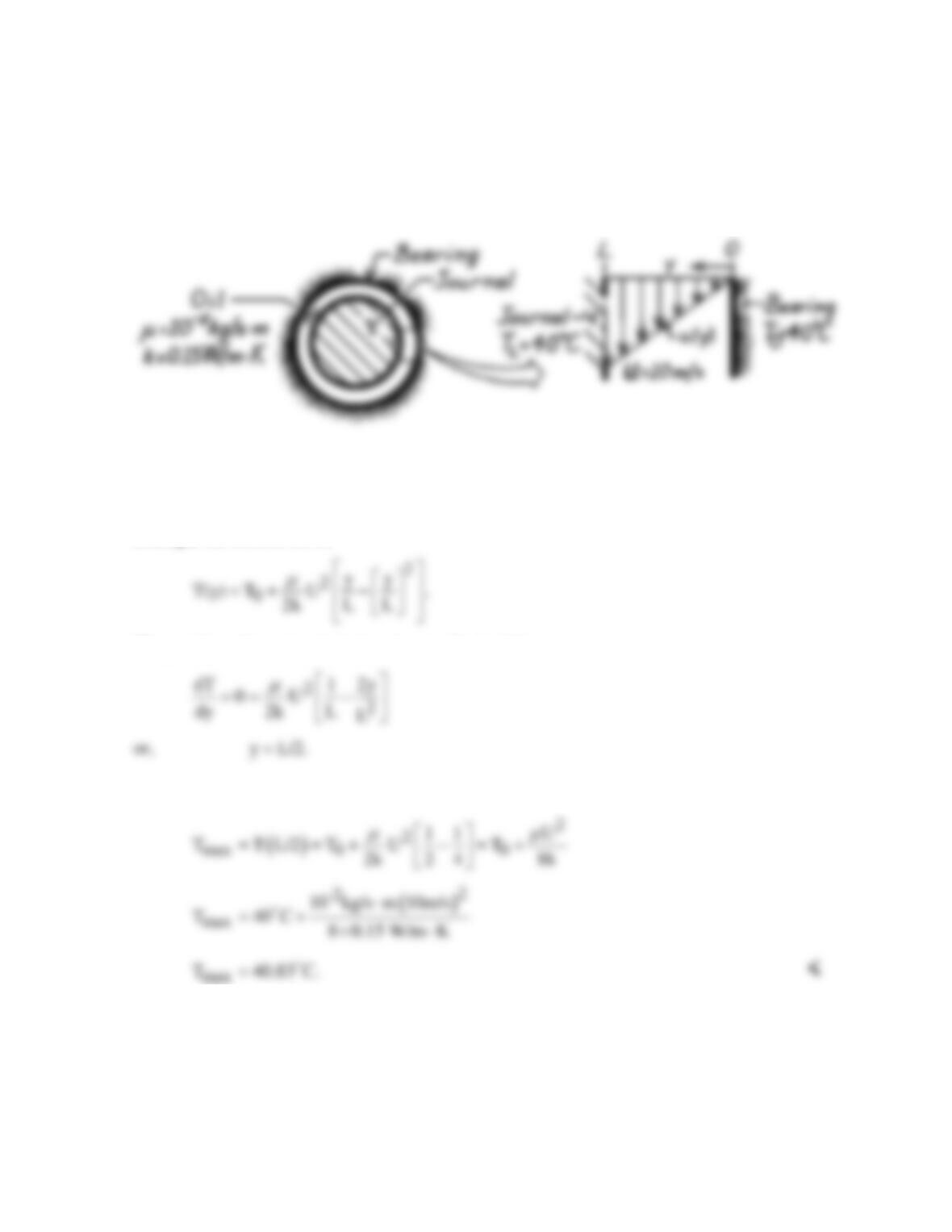
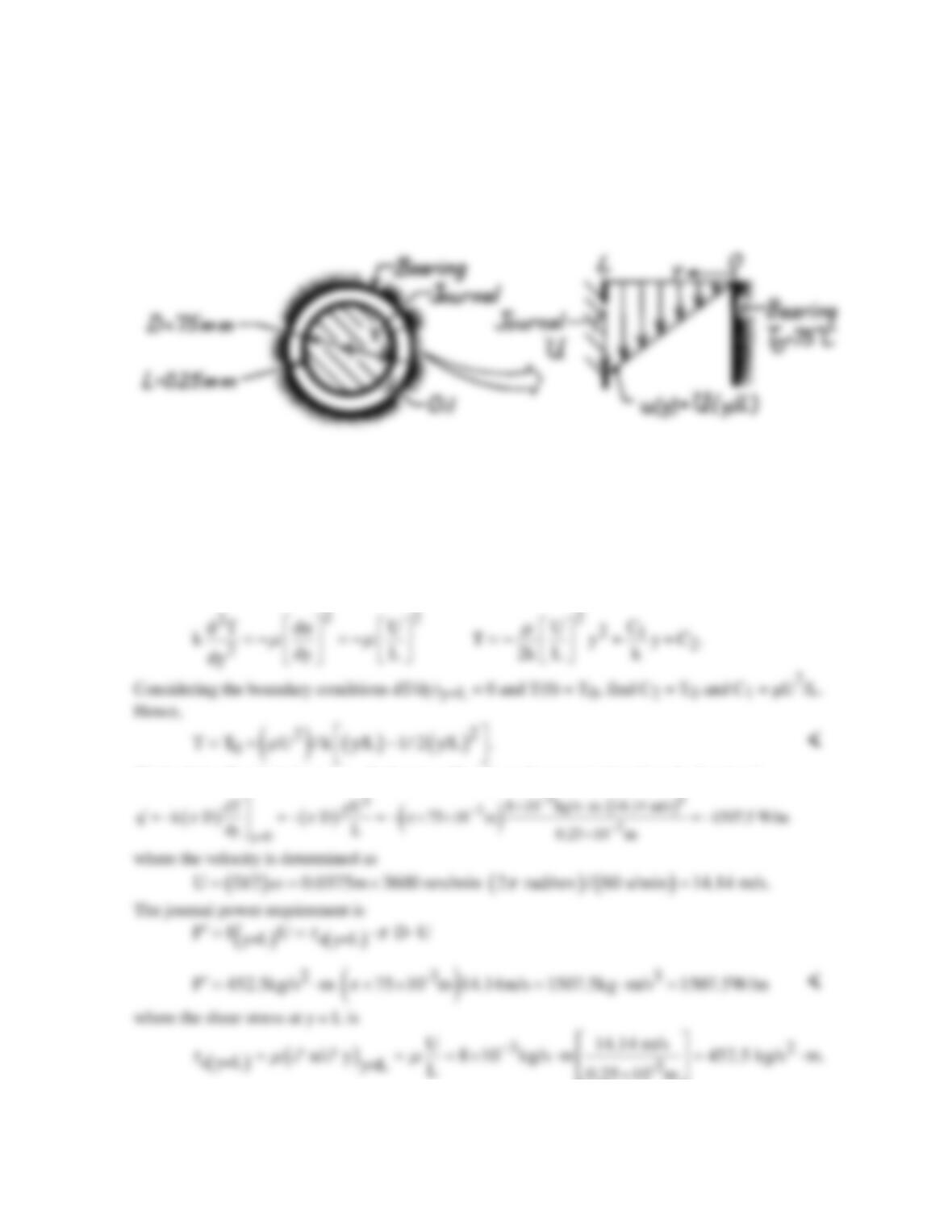
KNOWN: Oil properties, journal and bearing temperatures, and journal speed for a lightly
loaded journal bearing.
FIND: Maximum oil temperature.
SCHEMATIC:
ASSUMPTIONS: (1) Steady-state conditions, (2) Incompressible fluid with constant
properties, (3) Clearance is much less than journal radius and flow is Couette.
ANALYSIS: The temperature distribution corresponds to the result obtained in the text
Example on Couette flow,
The position of maximum temperature is obtained from
The temperature is a maximum at this point since
22
d T/dy 0.<
Hence,
COMMENTS: Note that Tmax increases with increasing µ and U, decreases with
increasing k, and is independent of L.
PROBLEM 6S.3
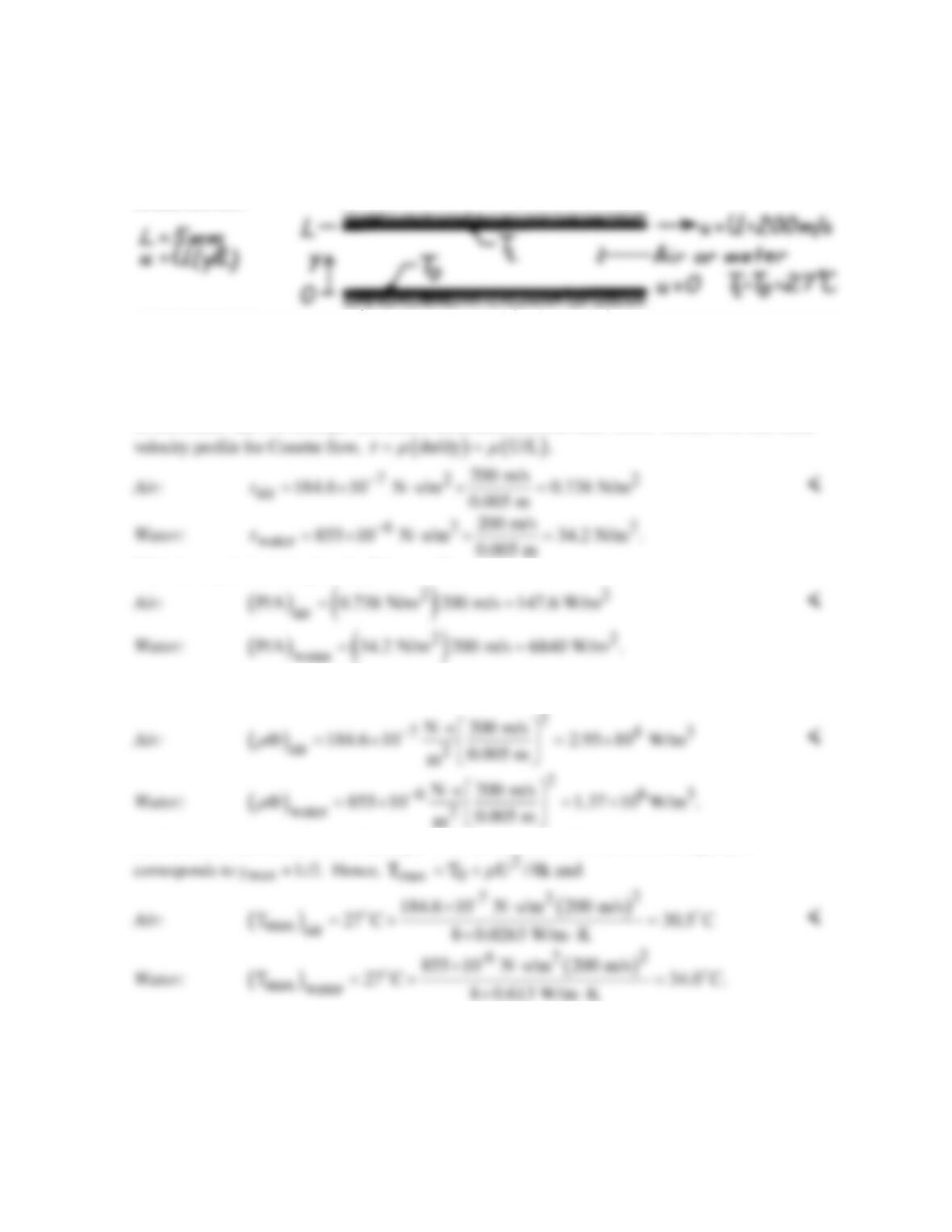
KNOWN: Diameter, clearance, rotational speed and fluid properties of a lightly loaded journal
bearing. Temperature of bearing.
FIND: (a) Temperature distribution in the fluid, (b) Rate of heat transfer from bearing and operating
power.
SCHEMATIC:
ASSUMPTIONS: (1) Steady-state conditions, (2) Incompressible fluid with constant properties, (3)
Couette flow.
PROPERTIES: Oil (Given): ρ = 800 kg/m3, ν = 10–5m2/s, k = 0.13 W/m⋅K; µ = ρν = 8 × 10⁻³
kg/s⋅m.
ANALYSIS: (a) For Couette flow, the velocity distribution is linear, u(y) = U(y/L), and the energy
equation and general form of the temperature distribution are
(b) Applying Fourier’s law at y = 0, the rate of heat transfer per unit length to the bearing is
×
COMMENTS: Note that
q P,
′′
=
which is consistent with the energy conservation requirement.
PROBLEM 6S.4
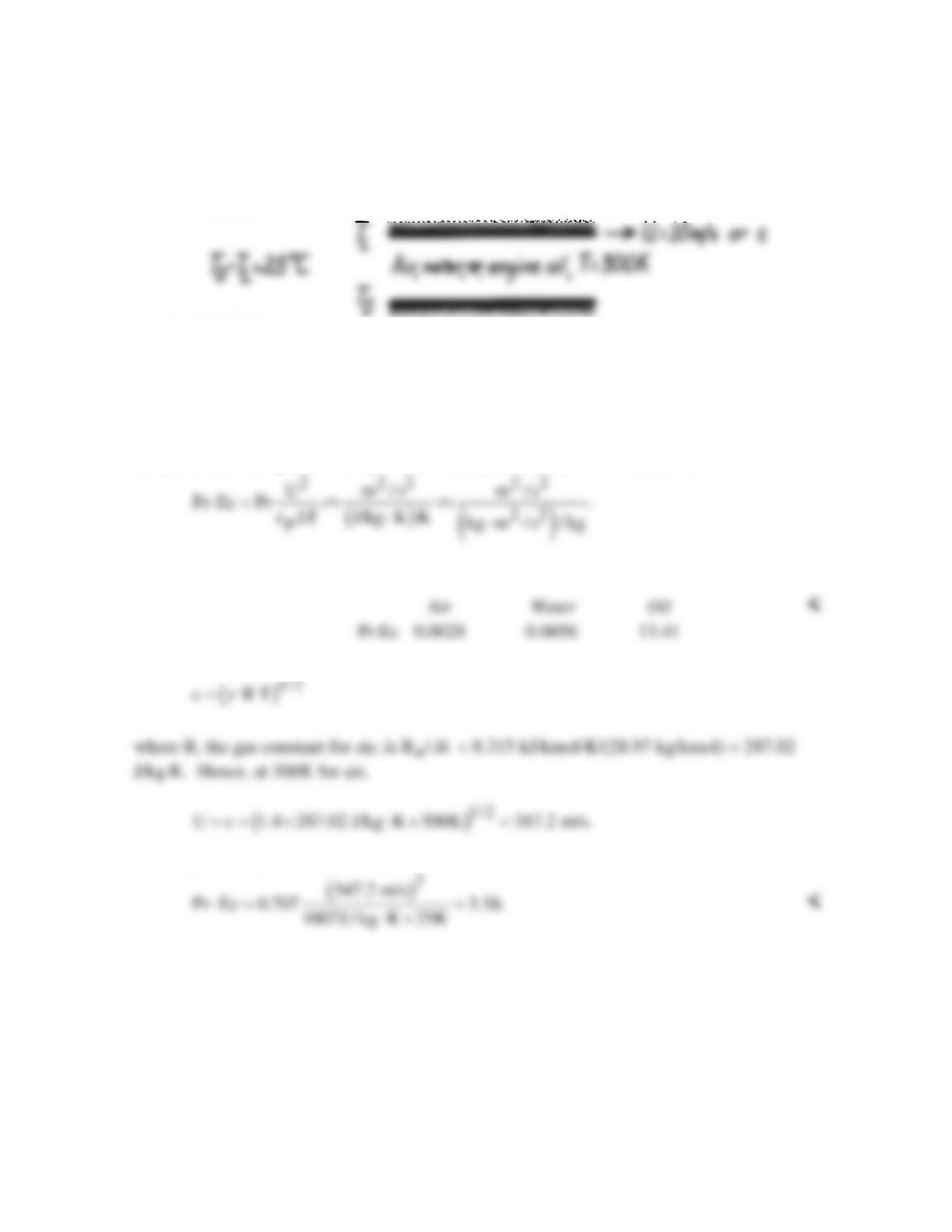
KNOWN: Conditions associated with the Couette flow of air or water.
FIND: (a) Force and power requirements per unit surface area, (b) Viscous dissipation, (c) Maximum
fluid temperature.
SCHEMATIC:
ASSUMPTIONS: (1) Fully-developed Couette flow, (2) Incompressible fluid with constant
properties.
PROPERTIES: Table A-4, Air (300K): µ = 184.6 × 10⁻⁷N⋅s/m2, k = 26.3 × 10⁻³W/m⋅K; Table A-6,
Water (300K): µ = 855 × 10-6N⋅s/m2, k = 0.613 W/m⋅K.
ANALYSIS: (a) The force per unit area is associated with the shear stress. Hence, with the linear
With the required power given by P/A =
τ
⋅U,
(b) The viscous dissipation is
( ) ( )
22
du/dy U/L .
µµ µ
Φ= =
Hence,
(c) From the solution to Part 4 of Example 6S.1, the location of the maximum temperature
COMMENTS: (1) The viscous dissipation associated with the entire fluid layer,
( )
LA ,
µ
Φ
must
equal the power, P. (2) Although
µ µ
Φ Φ
bgbg
water air water air
k k>> >>, .
Hence,
max,water max,air
T T.≈
PROBLEM 6S.5
KNOWN: Velocity and temperature difference of plates maintaining Couette flow. Mean
temperature of air, water or oil between the plates.
FIND: (a) Pr⋅Ec product for each fluid, (b) Pr⋅Ec product for air with plate at sonic velocity.
SCHEMATIC:
ASSUMPTIONS: (1) Steady-state conditions, (2) Couette flow, (3) Air is at 1 atm.
PROPERTIES: Table A-4, Air (300K, 1atm), cp = 1007 J/kg⋅K, Pr = 0.707, γ = 1.4, R=
287.02 J/kg⋅K; Table A-6, Water (300K): cp = 4179 J/kg⋅K, Pr = 5.83; Table A-5, Engine oil
(300K), cp = 1909 J/kg⋅K, Pr = 6400.
ANALYSIS: The product of the Prandtl and Eckert numbers is dimensionless,
Substituting numerical values, find
(b) For an ideal gas, the speed of sound is
For sonic velocities, it follows that
COMMENTS: From the above results it follows that viscous dissipation effects must be
considered in the high speed flow of gases and in oil flows at moderate speeds. For Pr⋅Ec to
be less than 0.1 in air with ∆T = 25°C, U should be
<
~60 m/s.