PROBLEM 6S.6
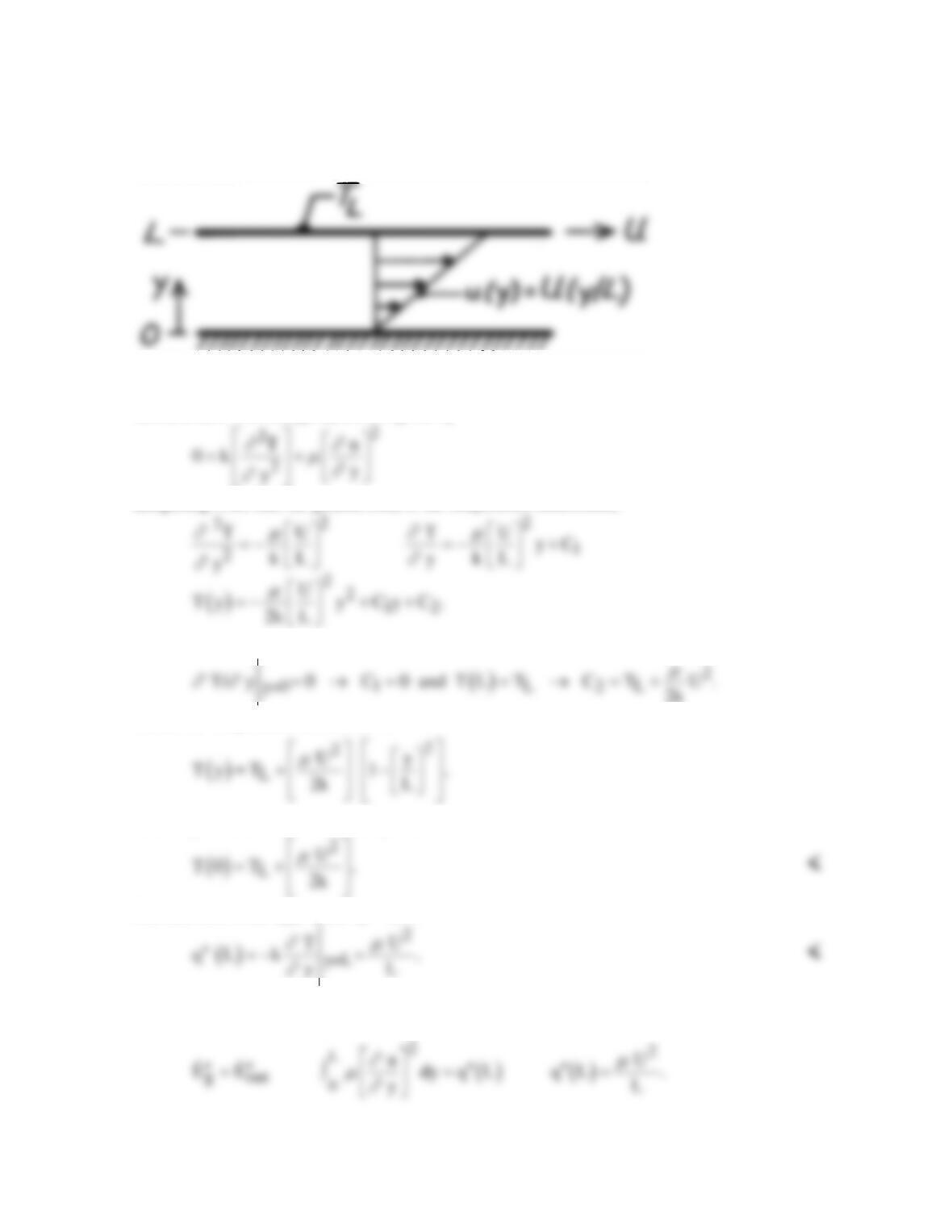
KNOWN: Couette flow with moving plate isothermal and stationary plate insulated.
FIND: Temperature of stationary plate and heat flux at the moving plate.
SCHEMATIC:
ASSUMPTIONS: (1) Steady-state conditions, (2) Incompressible fluid with constant properties, (3)
Couette flow.
ANALYSIS: The energy equation is given by
Integrating twice find the general form of the temperature distribution,
Consider the boundary conditions to evaluate the constants,
Hence, the temperature distribution is
The temperature of the lower plate (y = 0) is
The heat flux to the upper plate (y = L) is
COMMENTS: The heat flux at the top surface may also be obtained by integrating the viscous
dissipation over the fluid layer height. For a control volume about a unit area of the fluid layer,
PROBLEM 6S.7
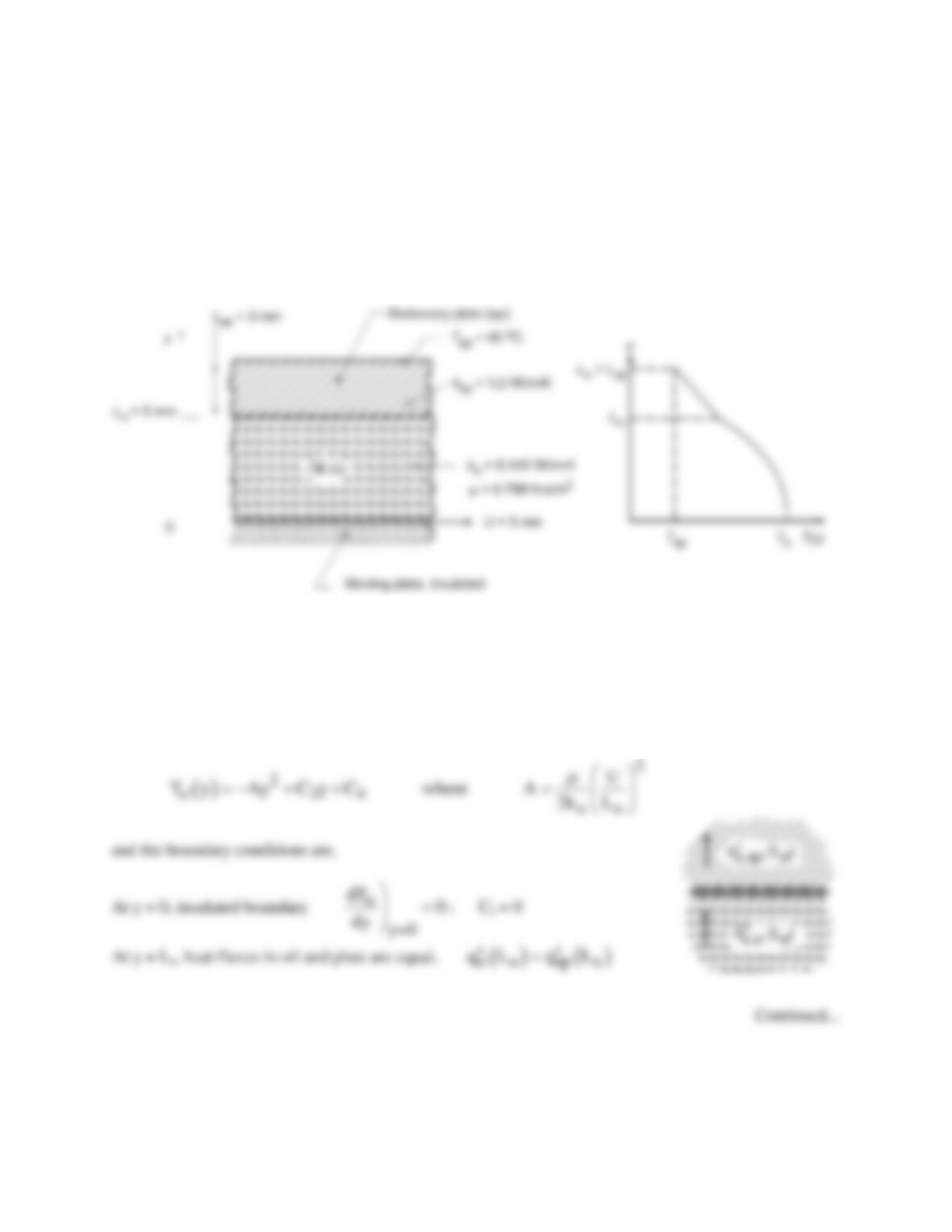
KNOWN: Couette flow with heat transfer. Lower (insulated) plate moves with speed U and upper plate
is stationary with prescribed thermal conductivity and thickness. Outer surface of upper plate maintained
at constant temperature, Tsp = 40°C.
FIND: (a) On T-y coordinates, sketch the temperature distribution in the oil and the stationary plate, and
(b) An expression for the temperature at the lower surface of the oil film, T(0) = To, in terms of the plate
speed U, the stationary plate parameters (Tsp, ksp, Lsp) and the oil parameters (µ, ko, Lo). Determine this
temperature for the prescribed conditions.
SCHEMATIC:
ASSUMPTIONS: (1) Steady-state conditions, (2) Fully developed Couette flow and (3) Incompressible
fluid with constant properties.
ANALYSIS: (a) The temperature distribution is shown above with these key features: linear in plate,
parabolic in oil film, discontinuity in slope at plate–oil interface, and zero gradient at lower plate surface.
(b) From Example 6S.1, the general solution to the conservation equations for the temperature
distribution in the oil film is
PROBLEM 6S.7 (Cont.)
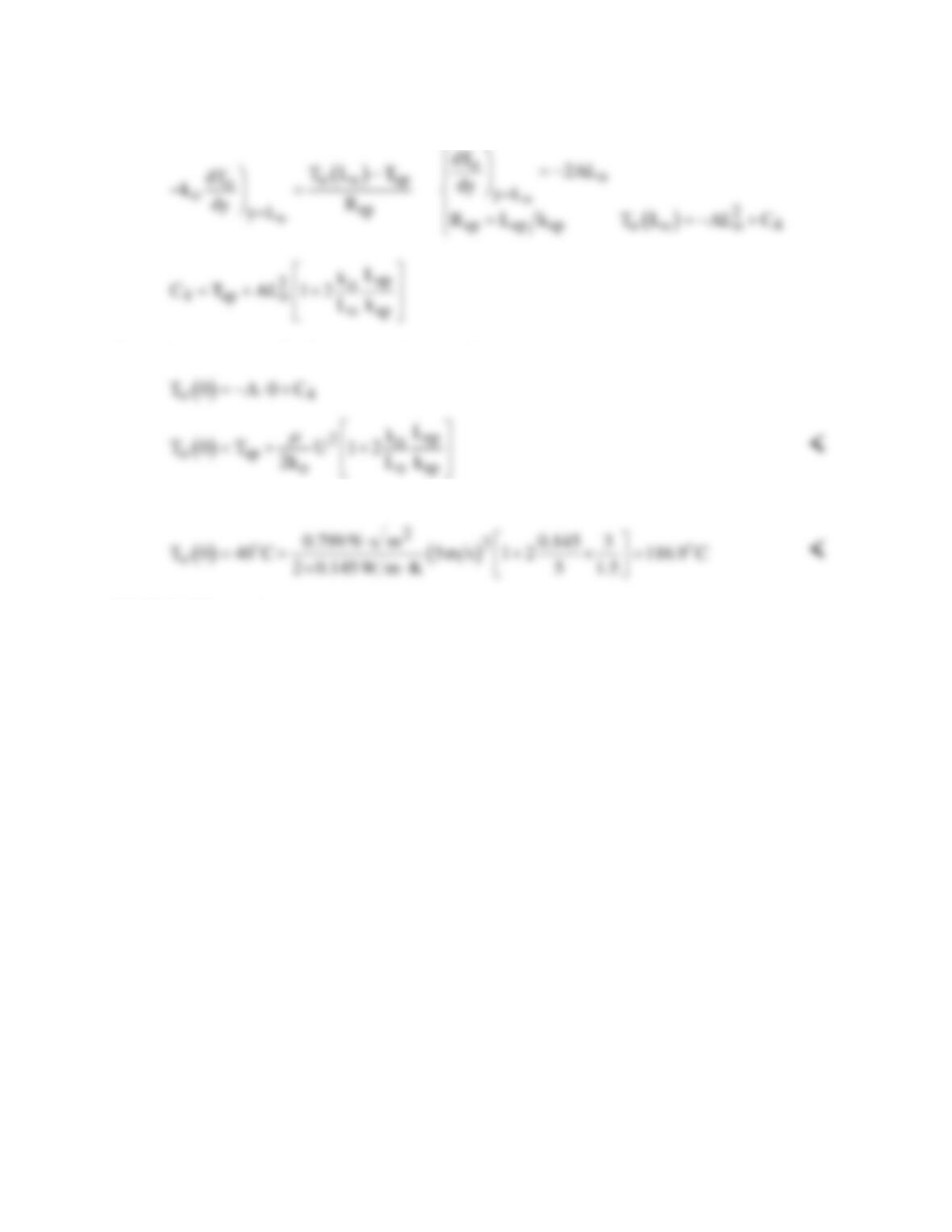
Hence, the temperature distribution at the lower surface is
Substituting numerical values, find
COMMENTS: (1) Give a physical explanation about why the maximum temperature occurs at the
lower surface.
(2) Sketch the temperature distribution if the upper plate moved with a speed U while the lower plate is
stationary and all other conditions remain the same.
PROBLEM 6S.8
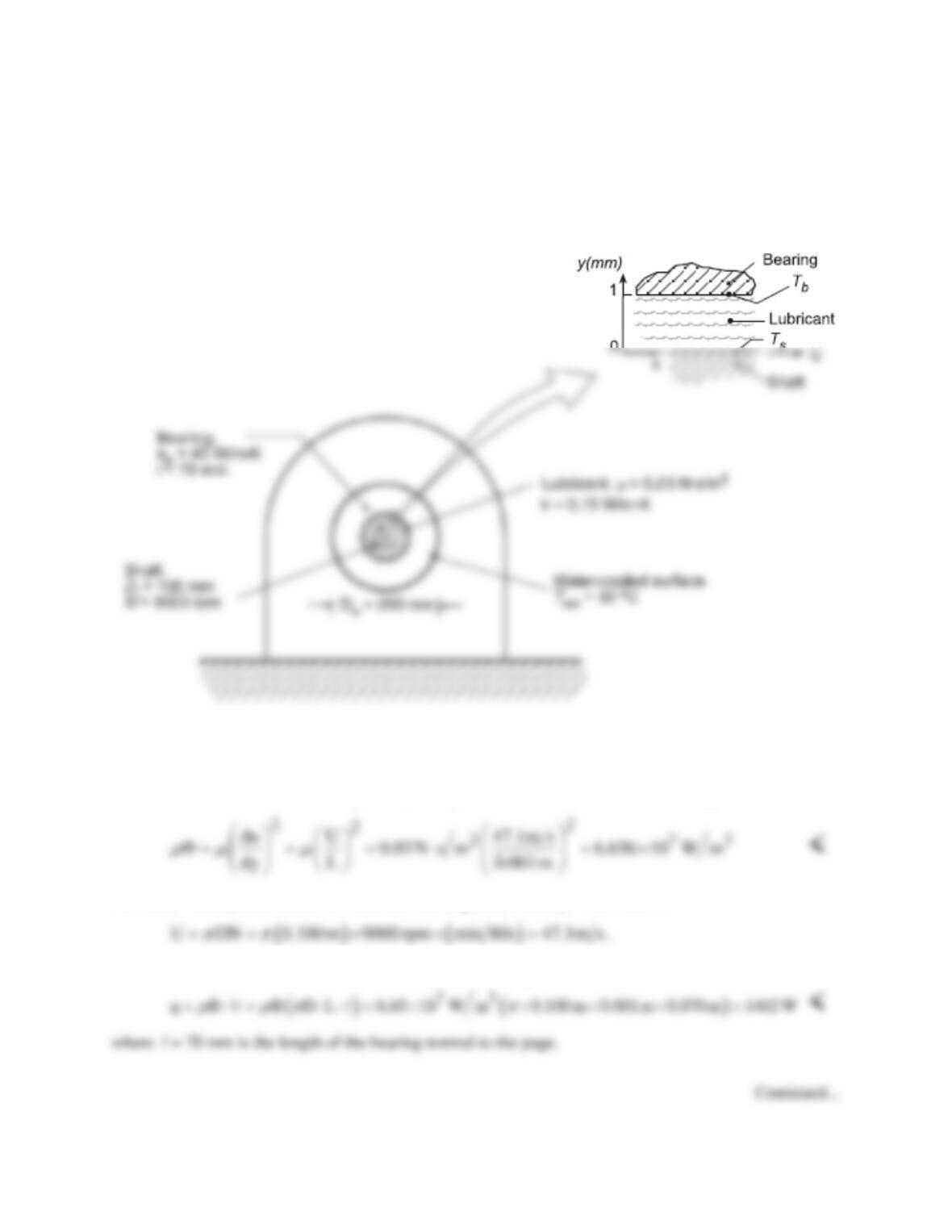
KNOWN: Shaft of diameter 100 mm rotating at 9000 rpm in a journal bearing of 70 mm length.
Uniform gap of 1 mm separates the shaft and bearing filled with lubricant. Outer surface of bearing is
water-cooled and maintained at Twc = 30°C.
FIND: (a) Viscous dissipation in the lubricant, µΦ(W/m3), (b) Heat transfer rate from the lubricant,
assuming no heat lost through the shaft, and (c) Temperatures of the bearing and shaft, Tb and Ts.
SCHEMATIC:
ASSUMPTIONS: (1) Steady-state conditions, (2) Fully developed Couette flow, (3) Incompressible
fluid with constant properties, and (4) Negligible heat lost through the shaft.
ANALYSIS: (a) The viscous dissipation, µΦ, Eq. 6S.20, for Couette flow from Example 6S.1, is
where the velocity distribution is linear and the tangential velocity of the shaft is
(b) The heat transfer rate from the lubricant volume ∀ through the bearing is
PROBLEM 6S.8 (Cont.)
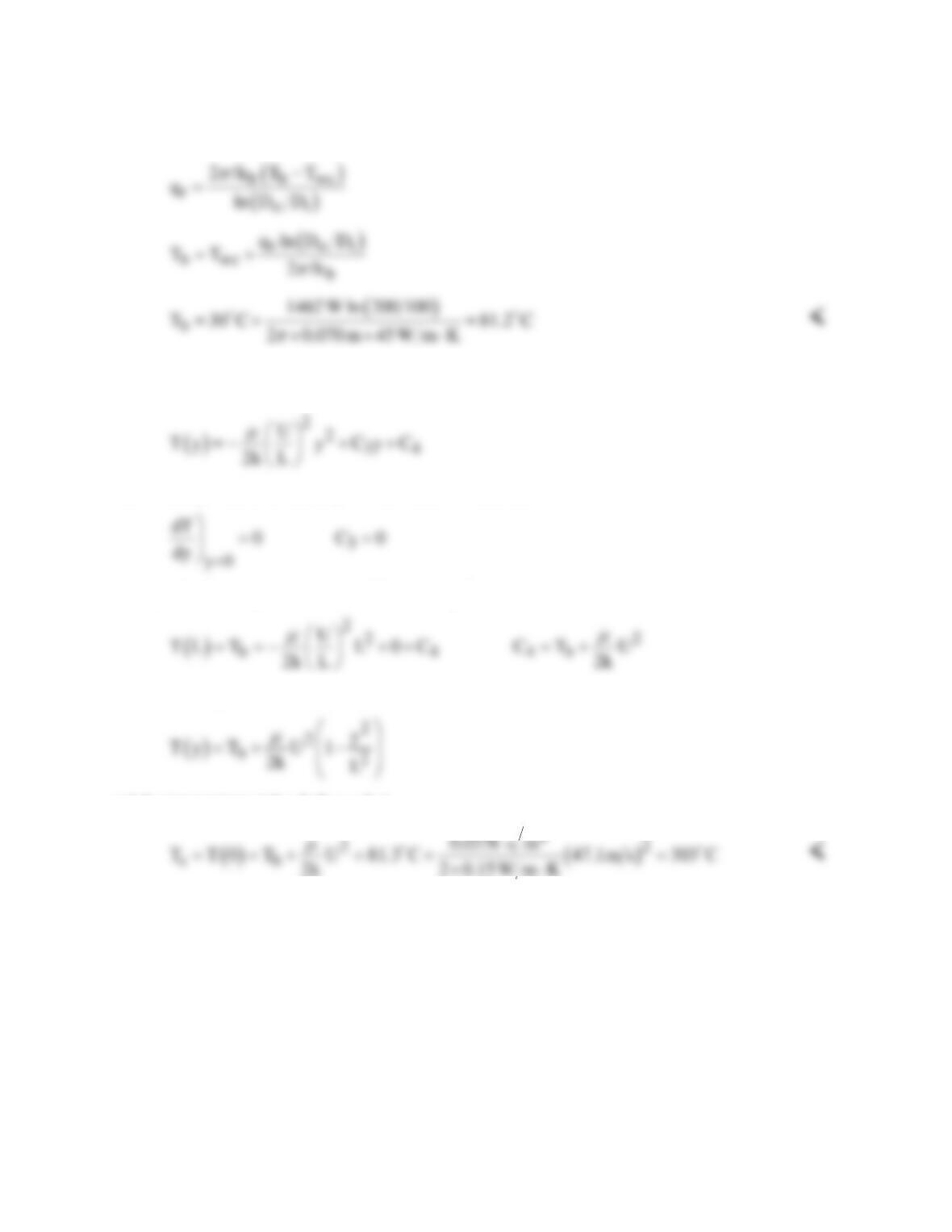
(c) From Fourier’s law, the heat rate through the bearing material of inner and outer diameters, Di and Do,
and thermal conductivity kb is, from Eq. (3.32),
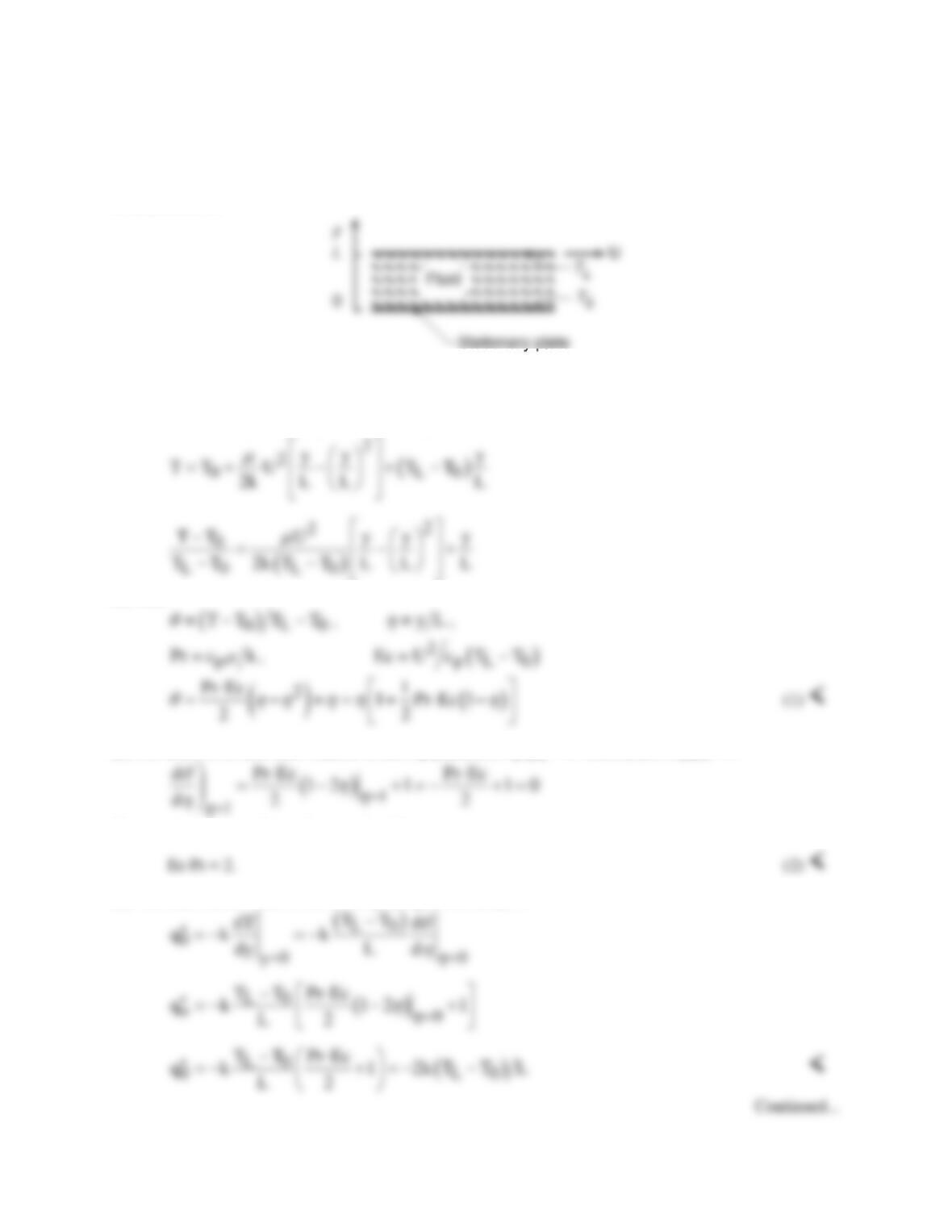
To determine the temperature of the shaft, T(0) = Ts, first the temperature distribution must be found
beginning with the general solution, Example 6S.1,
The boundary conditions are, at y = 0, the surface is adiabatic
and at y = L, the temperature is that of the bearing, Tb
Hence, the temperature distribution is
and the temperature at the shaft, y = 0, is
PROBLEM 6S.9
KNOWN: Couette flow with heat transfer.
FIND: (a) Dimensionless form of temperature distribution, (b) Conditions for which top plate is
adiabatic, (c) Expression for heat transfer to lower plate when top plate is adiabatic.
SCHEMATIC:
ASSUMPTIONS: (1) Steady-state conditions, (2) incompressible fluid with constant properties, (3)
Negligible body forces, (4) Couette flow.
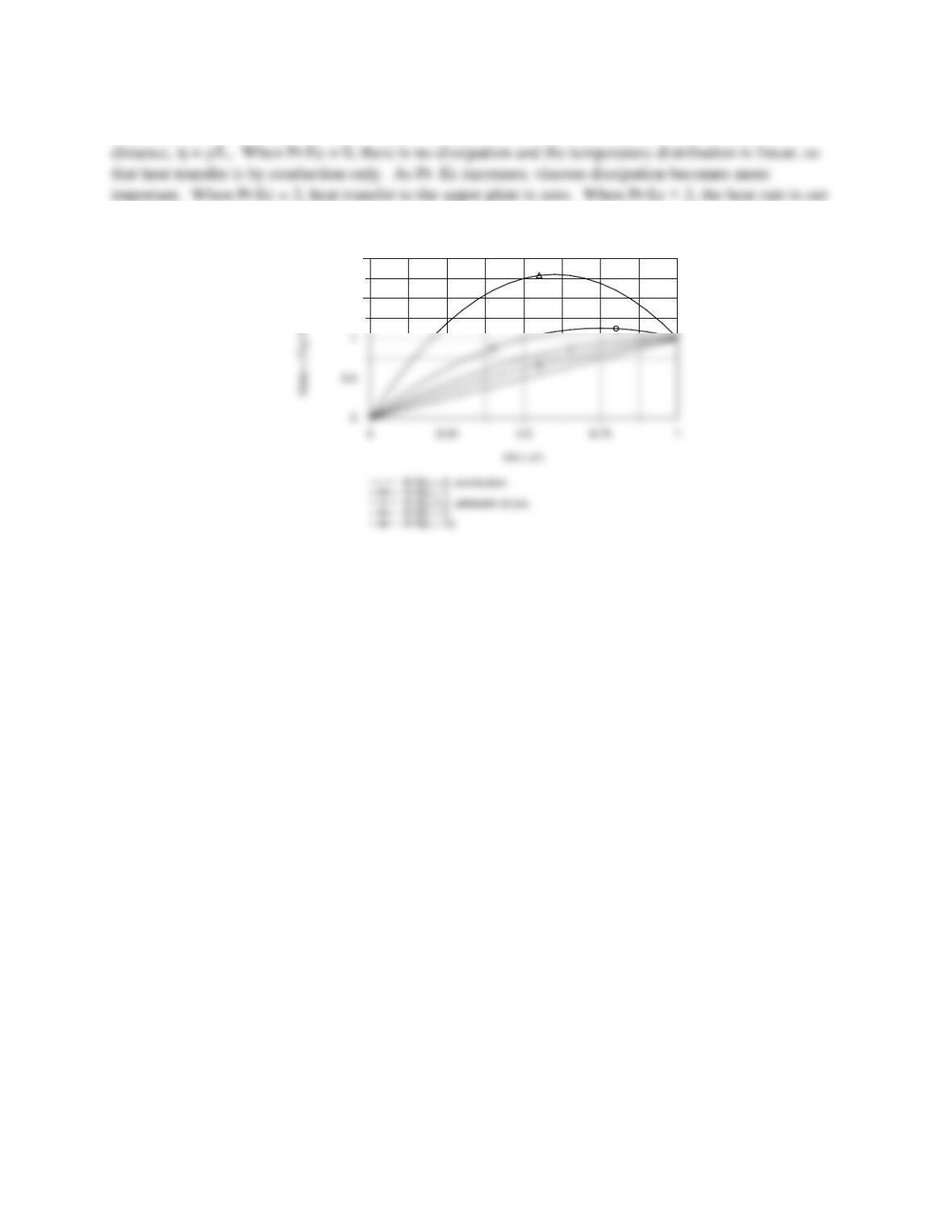
ANALYSIS: (a) From Example 6.4, the temperature distribution is
or, with
(b) For there to be zero heat transfer at the top plate, (dT/dy)y=L = 0. Hence, (dθ/dη)η=1 = 0.
There is no heat transfer at the top plate if,
(c) The heat transfer rate to the lower plate (per unit area) is
PROBLEM 6S.9 (Cont.)
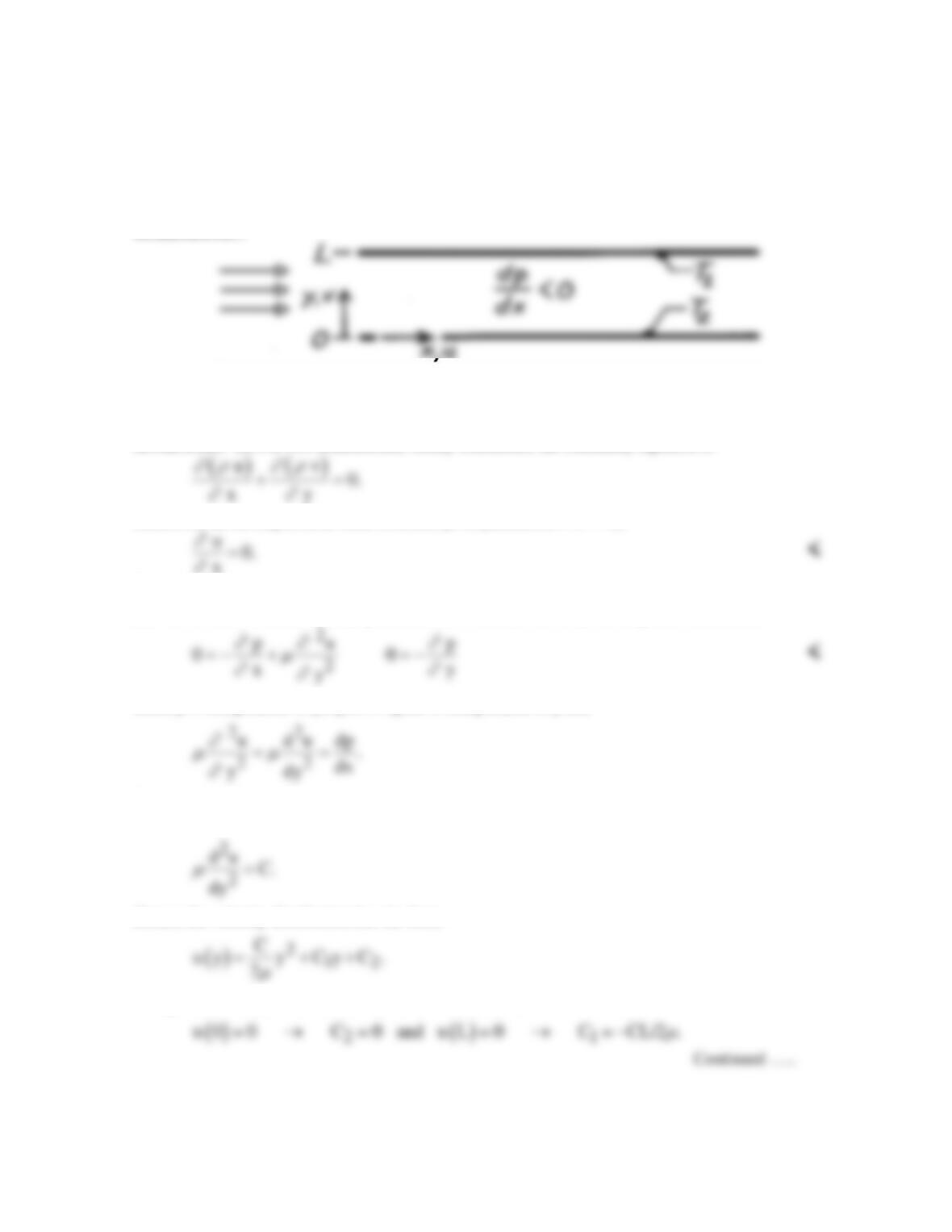
(d) Using Eq. (1), the dimensionless temperature distribution is plotted as a function of dimensionless
of the oil film at both surfaces.
1.5
2
PROBLEM 6S.10
KNOWN: Steady, incompressible, laminar flow between infinite parallel plates at different
temperatures.
FIND: (a) Form of continuity equation, (b) Form of momentum equations and velocity profile.
Relationship of pressure gradient to maximum velocity, (c) Form of energy equation and temperature
distribution. Heat flux at top surface.
SCHEMATIC:
ASSUMPTIONS: (1) Two-dimensional flow (no variations in z) between infinite, parallel plates, (2)
Negligible body forces, (3) No internal energy generation, (4) Incompressible fluid with constant
properties.
ANALYSIS: (a) For two–dimensional, steady conditions, the continuity equation is
Hence, for an incompressible fluid (constant r) in parallel flow (v = 0),
The flow is fully developed in the sense that, irrespective of y, u is independent of x.
(b) With the above result and the prescribed conditions, the momentum equations reduce to
Since p is independent of y, ∂p/∂x = dp/dx is independent of y and
Since the left-hand side can, at most, depend only on y and the right-hand side is independent of y,
both sides must equal the same constant C. That is,
Hence, the velocity distribution has the form
Using the boundary conditions to evaluate the constants,
PROBLEM 6S.10 (Cont.)
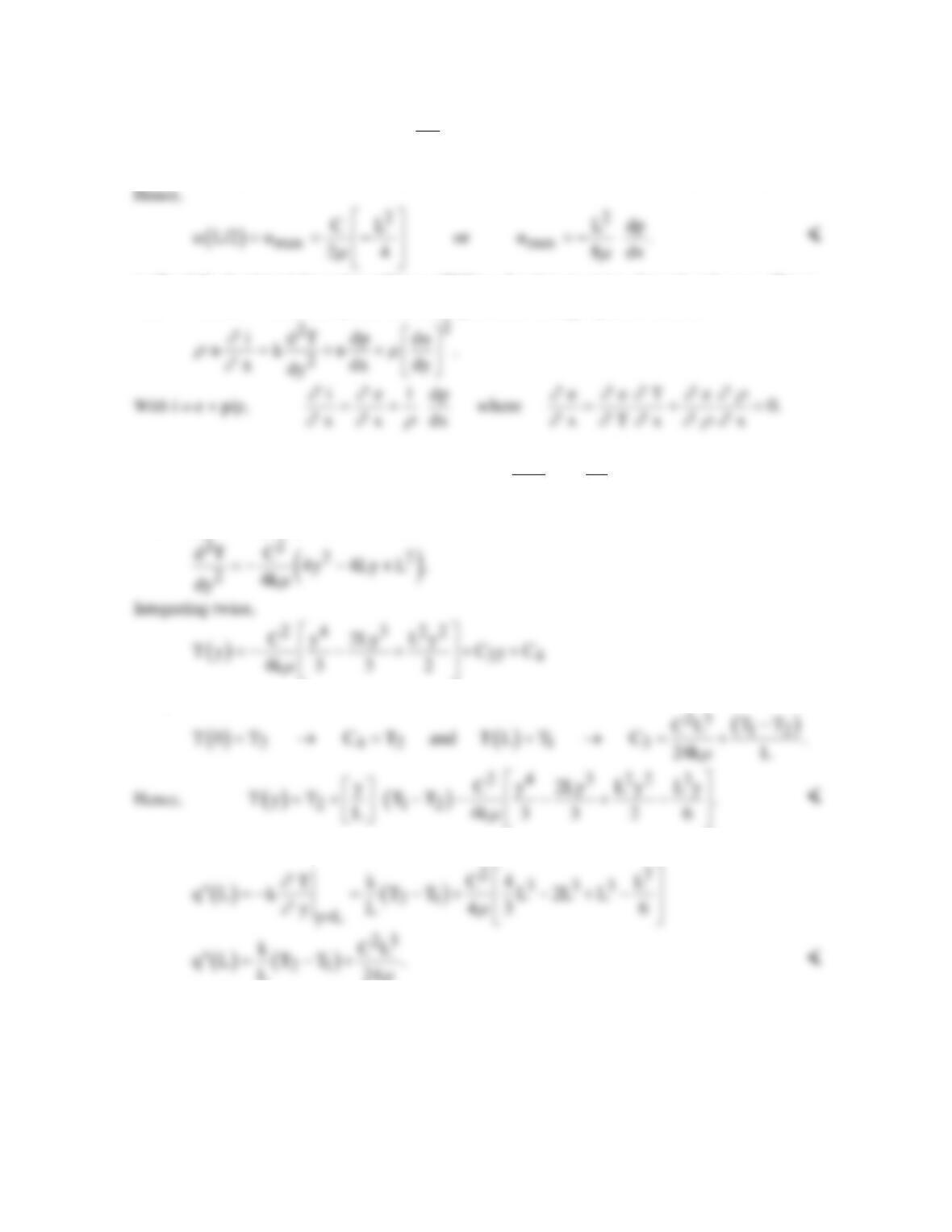
The velocity profile is
( )
()
2
C
u y y Ly .
2
µ
= −
The profile is symmetric about the midplane, in which case the maximum velocity exists at y = L/2.
(c) For fully developed thermal conditions, (∂T/∂x) = 0 and temperature depends only on y. Hence
with v = 0, ∂u/∂x = 0, and the prescribed assumptions, the energy equation becomes
Hence, the energy equation becomes
2
2
2
d T du
0k .
dy
dy
µ
= +
<
With du/dy = (C/2µ) (2y – L), it follows that
Using the boundary conditions to evaluate the constants,
From Fourier’s law,
L 24
µ
COMMENTS: The third and second terms on the right-hand sides of the temperature distribution
and heat flux, respectively, represents the effects of viscous dissipation. If C is large (due to large µ
or umax), viscous dissipation is significant. If C is small, conduction effects dominate.
PROBLEM 6S.11
KNOWN: Steady, incompressible flow of binary mixture between infinite parallel plates
with different species concentrations.
FIND: Form of species continuity equation and concentration distribution. Species flux at
upper surface.
SCHEMATIC:
ASSUMPTIONS: (1) Two-dimensional flow, (2) No chemical reactions, (3) Constant
properties.
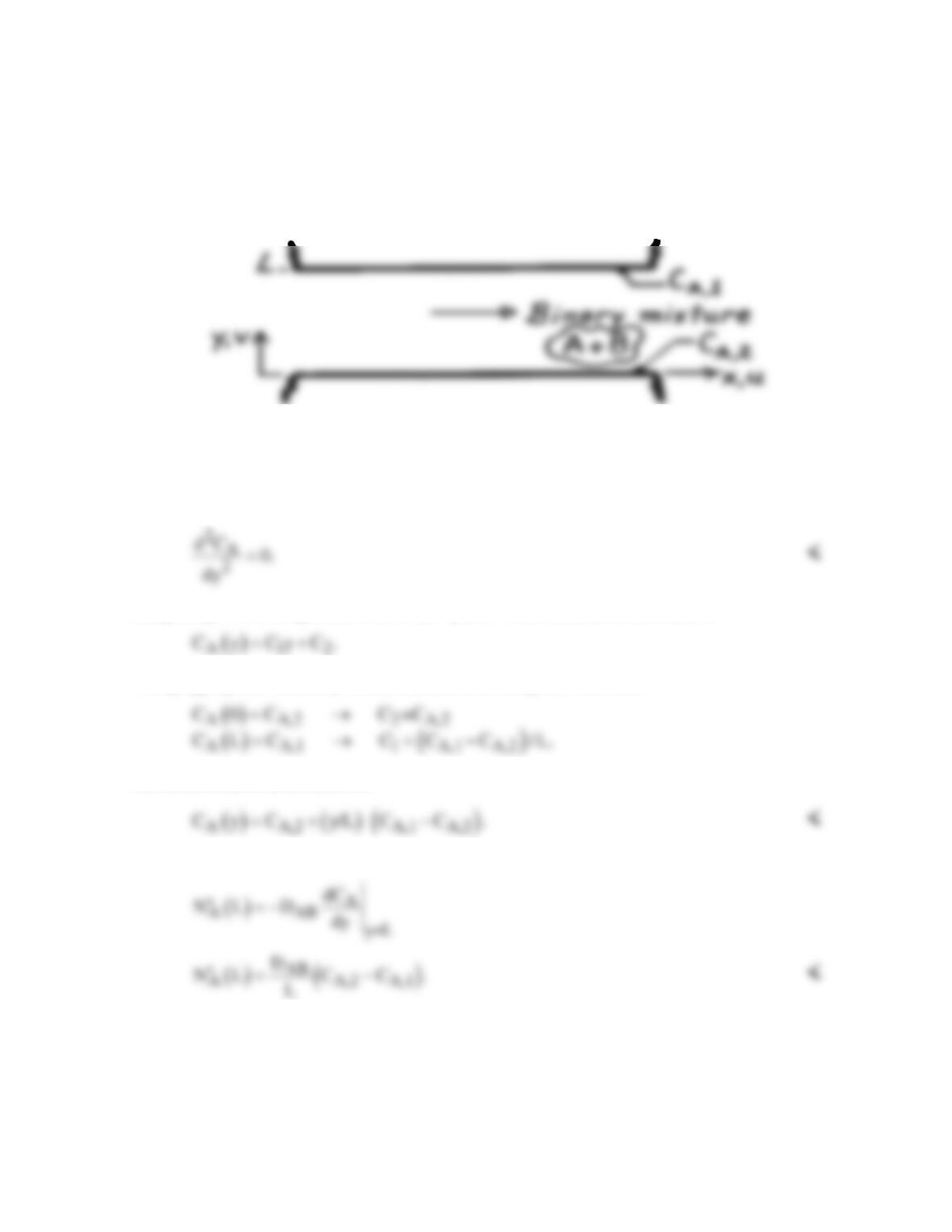
ANALYSIS: For fully developed conditions, ∂CA/∂x = 0. Hence with v = 0, the species
conservation equation reduces to
Integrating twice, the general form of the species concentration distribution is
Using appropriate boundary conditions and evaluating the constants,
the concentration distribution is
From Fick’s law, the species flux is
COMMENTS: An analogy between heat and mass transfer exists if viscous dissipation is
negligible. The energy equation is then d2T/dy2 = 0. Hence, both heat and species transfer
are influenced only by diffusion. Expressions for T(y) and
( )
qL
′′
are analogous to those for
CA(y) and
( )
A
N L.
′′
PROBLEM 6S.12
KNOWN: Flow conditions between two parallel plates, across which vapor transfer occurs.
FIND: (a) Variation of vapor molar concentration between the plates and mass rate of water
production per unit area, (b) Heat required to sustain the process.
SCHEMATIC:
ASSUMPTIONS: (1) Steady-state conditions, (2) Fully developed, incompressible flow with
constant properties, (3) Negligible body forces, (4) No chemical reactions, (5) All work
interactions, including viscous dissipation, are negligible.
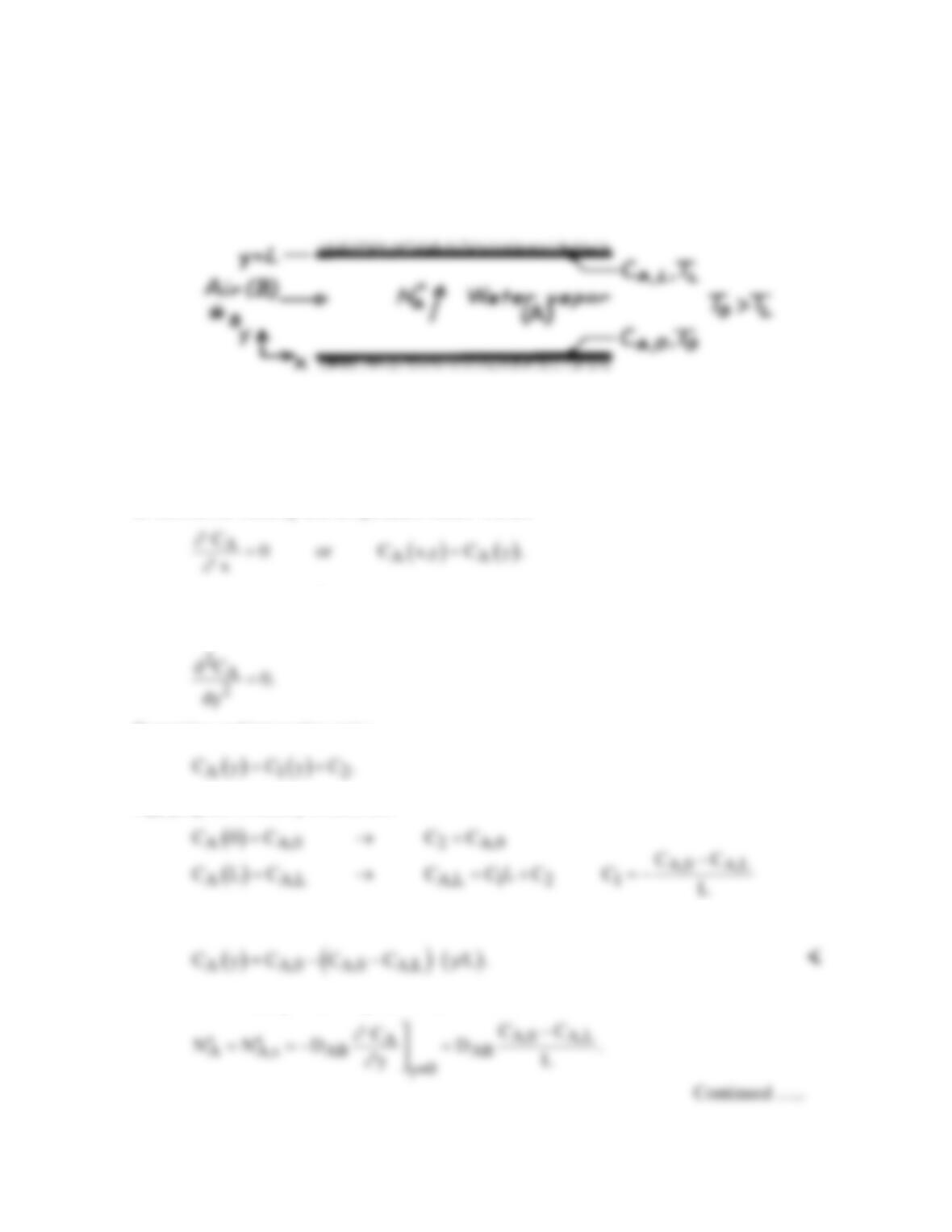
ANALYSIS: (a) The flow will be fully developed in terms of the vapor concentration field,
as well as the velocity and temperature fields. Hence
Also, with ∂CA/∂t = 0,
A
N 0,=
v = 0 and constant DAB, the species conservation equation
reduces to
Separating and integrating twice,
Applying the boundary conditions,
find the species concentration distribution,
From Fick’s law, Eq. 6.7, the species transfer rate is
PROBLEM 6S.12 (Cont.)
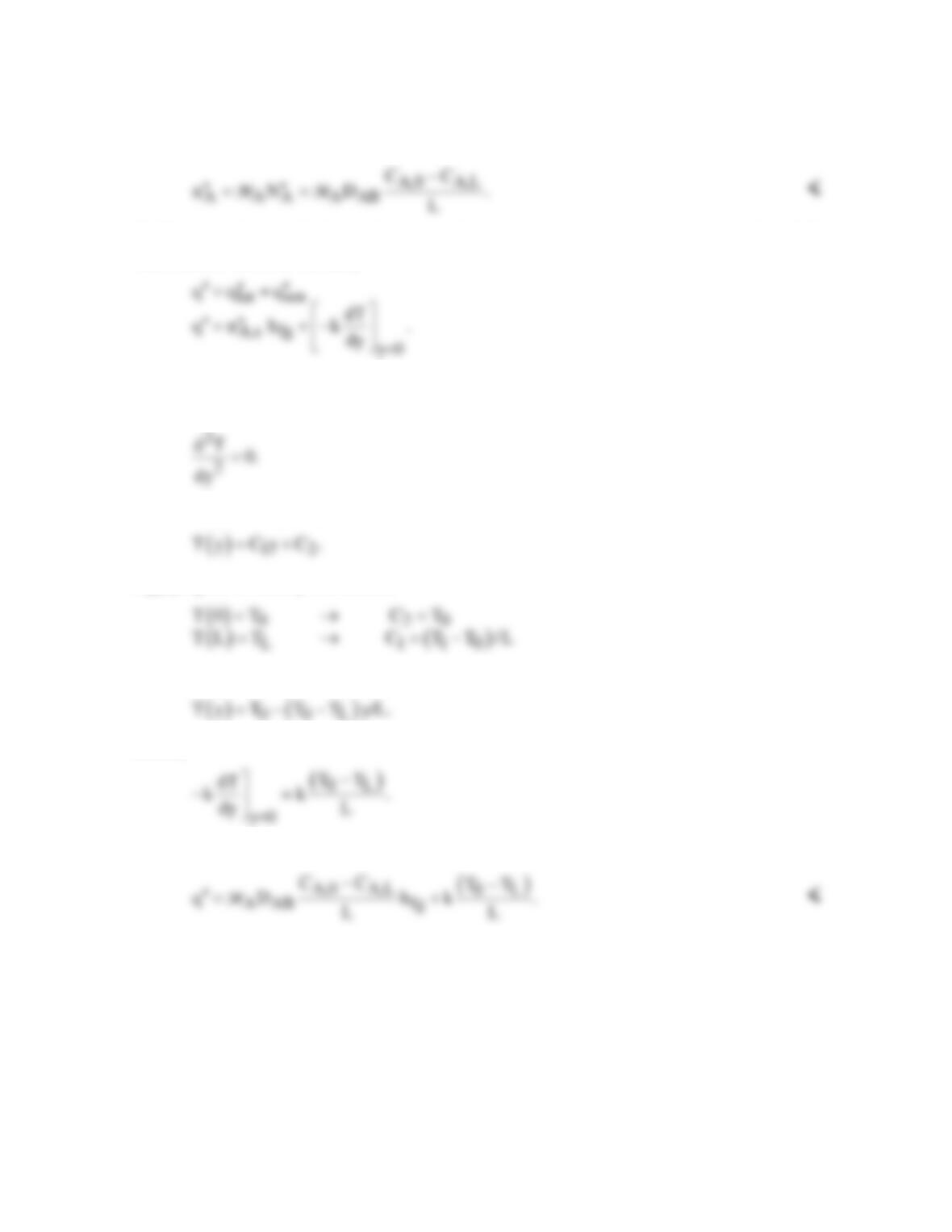
Multiplying by the molecular weight of water vapor, MA, the mass rate of water production
per unit area is
(b) Heat must be supplied to the bottom surface in an amount equal to the latent and sensible
heat transfer from the surface,
The temperature distribution may be obtained by solving the energy equation, which, for the
prescribed conditions, reduces to
Separating and integrating twice,
Applying the boundary conditions,
find the temperature distribution,
Hence,
Accordingly,
COMMENTS: Despite the existence of the flow, species and energy transfer across the air
are uninfluenced by advection and transfer is only by diffusion. If the flow were not fully
developed, advection would have a significant influence on the species concentration and
temperature fields and hence on the rate of species and energy transfer. The foregoing results
would, of course, apply in the case of no air flow. The physical condition is an example of
Poiseuille flow with heat and mass transfer.
PROBLEM 6S.13
KNOWN: The conservation equations, Eqs. 6S.24 and 6S.31.
FIND: (a) Describe physical significance of terms in these equations, (b) Identify
approximations and special conditions used to reduce these equations to the boundary layer
equations, Eqs. 6.29 and 6.30, (c) Identify the conditions under which these two boundary
layer equations have the same form and, hence, an analogy will exist.
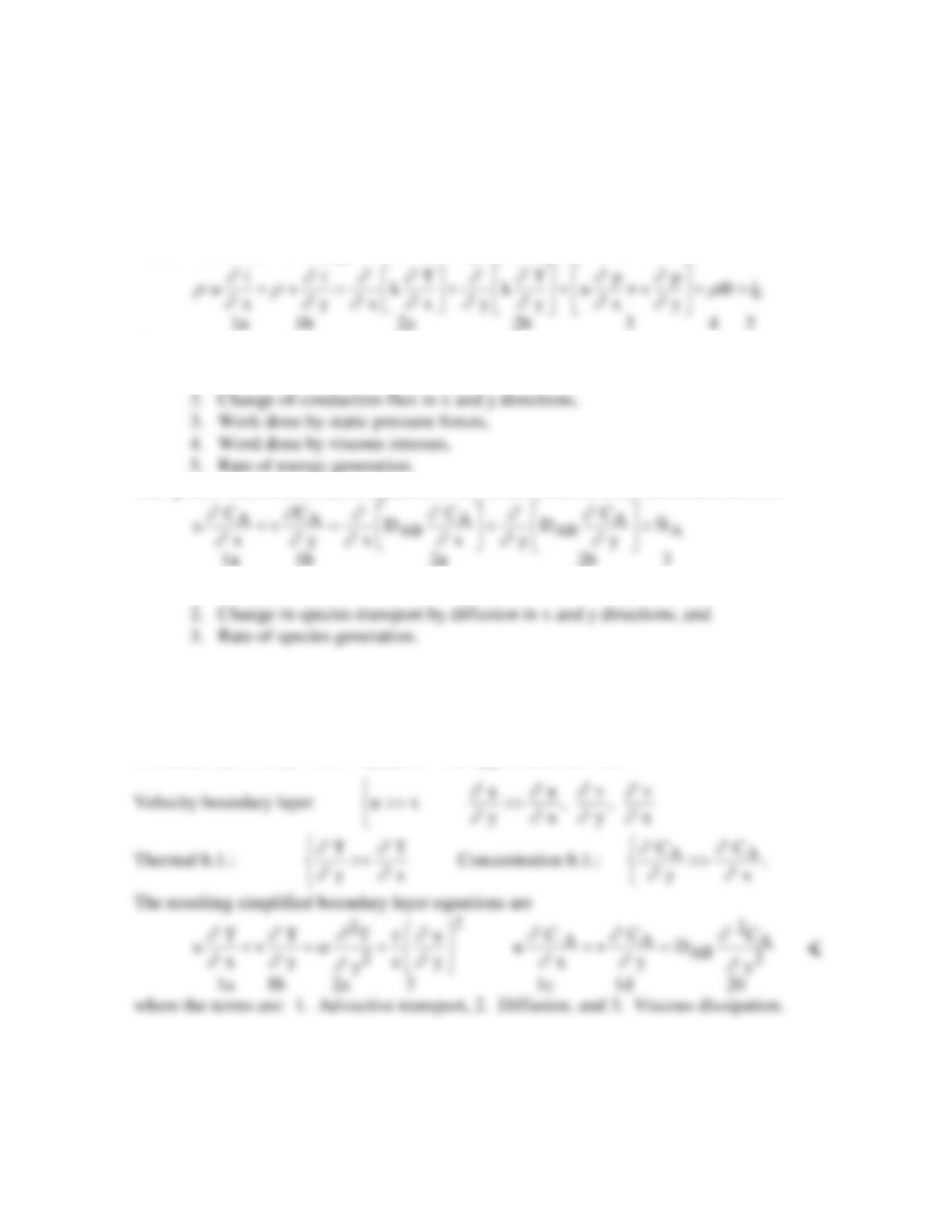
ANALYSIS: (a) The energy conservation equation, Eq. 6S.24, has the form
The terms, as identified, have the following physical significance:
1. Change of enthalpy (thermal + flow work) advected in x and y directions, <
The species mass conservation equation for a constant total concentration has the form
1. Change in species transport due to advection in x and y directions, <
(b) The special conditions used to reduce the above equations to the boundary layer equations
are: constant properties, incompressible flow, non-reacting species
( )
A
N 0,=
without
internal heat generation
( )
q 0,=
species diffusion has negligible effect on the thermal
boundary layer, u(
∂
p/
∂
x) is negligible. The approximations are,
(c) When viscous dissipation effects are negligible, the two boundary layer equations have
identical form. If the boundary conditions for each equation are of the same form, an analogy
between heat and mass (species) transfer exists.
PROBLEM 6S.14
KNOWN: Thickness and inclination of a liquid film. Mass density of gas in solution at free surface
of liquid.
FIND: (a) Liquid momentum equation and velocity distribution for the x-direction. Maximum
velocity, (b) Continuity equation and density distribution of the gas in the liquid, (c) Expression for
the local Sherwood number, (d) Total gas absorption rate for the film, (e) Mass rate of NH3 removal
by a water film for prescribed conditions.
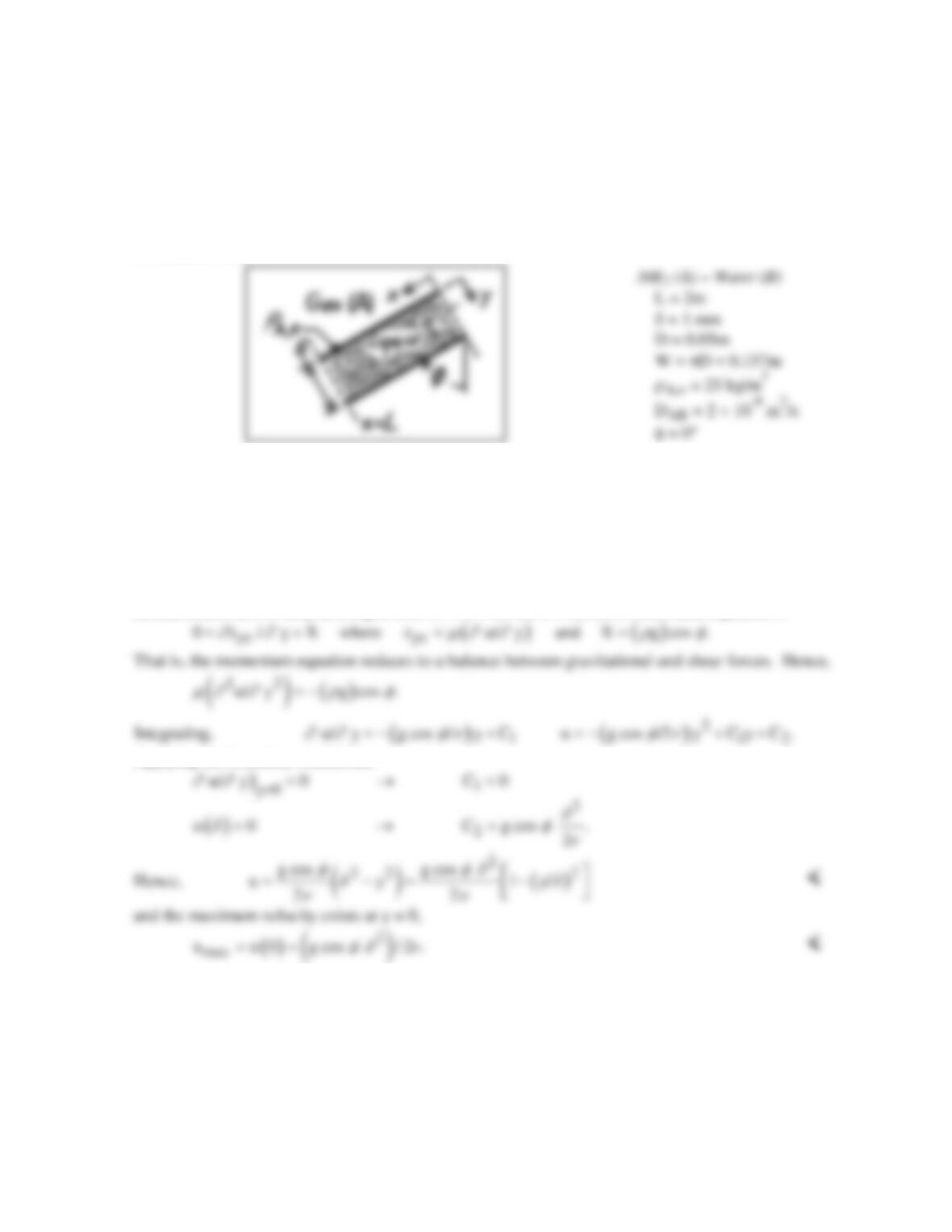
SCHEMATIC:
ASSUMPTIONS: (1) Steady-state conditions, (2) The film is in fully developed, laminar flow, (3)
Negligible shear stress at the liquid–gas interface, (4) Constant properties, (5) Negligible gas
concentration at x = 0 and y = δ, (6) No chemical reactions in the liquid, (7) Total mass density is
constant, (8) Liquid may be approximated as semi-infinite to gas transport.
PROPERTIES: Table A-6, Water, liquid (300K): rf = 1/vf = 997 kg/m3, µ = 855 × 10–6 N⋅s/m2, ν
= µ/rf = 0.855 × 10⁻⁶m2/s.
ANALYSIS: (a) For fully developed flow (v = w = 0, ∂u/∂x = 0), the x-momentum equation is
Applying the boundary conditions,
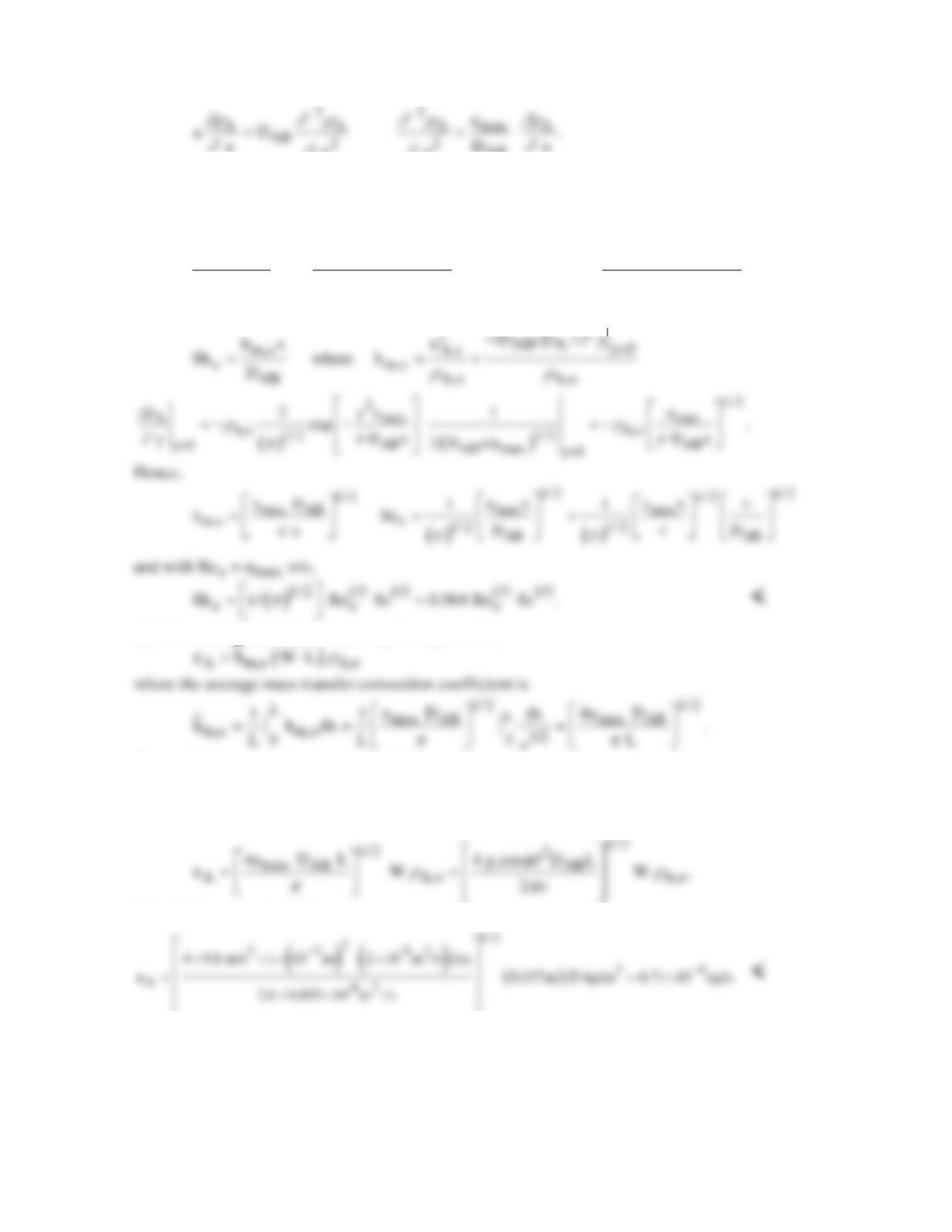
(b) Species transport within the liquid is influenced by diffusion in the y-direction and advection in
the x-direction. Hence, the species continuity equation with u assumed equal to umax throughout the
region of gas penetration is
Continued …..
PROBLEM 6S.14 (Cont.)
AB
x D x
y y
∂∂
∂∂
Appropriate boundary conditions are: rA(x,0) = rA,o and rA(x,∞) = 0 and the entrance condition is:
rA(0,y) = 0. The problem is therefore analogous to transient conduction in a semi–infinite medium
due to a sudden change in surface temperature. From Section 5.7, the solution is then
( ) ( )
A A,o
A A,o
1/2 1/ 2
A,o AB max AB max
yy
erf erfc
02 D x/u 2 D x/u
rr rr
r
−= =
−
<
(c) The Sherwood number is defined as
(d) The total gas absorption rate may be expressed as
Hence, the absorption rate per unit width is
( )
1/2
A max AB A,o
n / W 4u D L / .
pr
=
<
(e) From the foregoing results, it follows that the ammonia absorption rate is
Substituting numerical values,
COMMENTS: Note that rA,o ≠ rA,∞, where rA,∞ is the mass density of the gas phase. The value
of rA,o depends upon the pressure of the gas and the solubility of the gas in the liquid.