6.3 Richardson Extrapolation
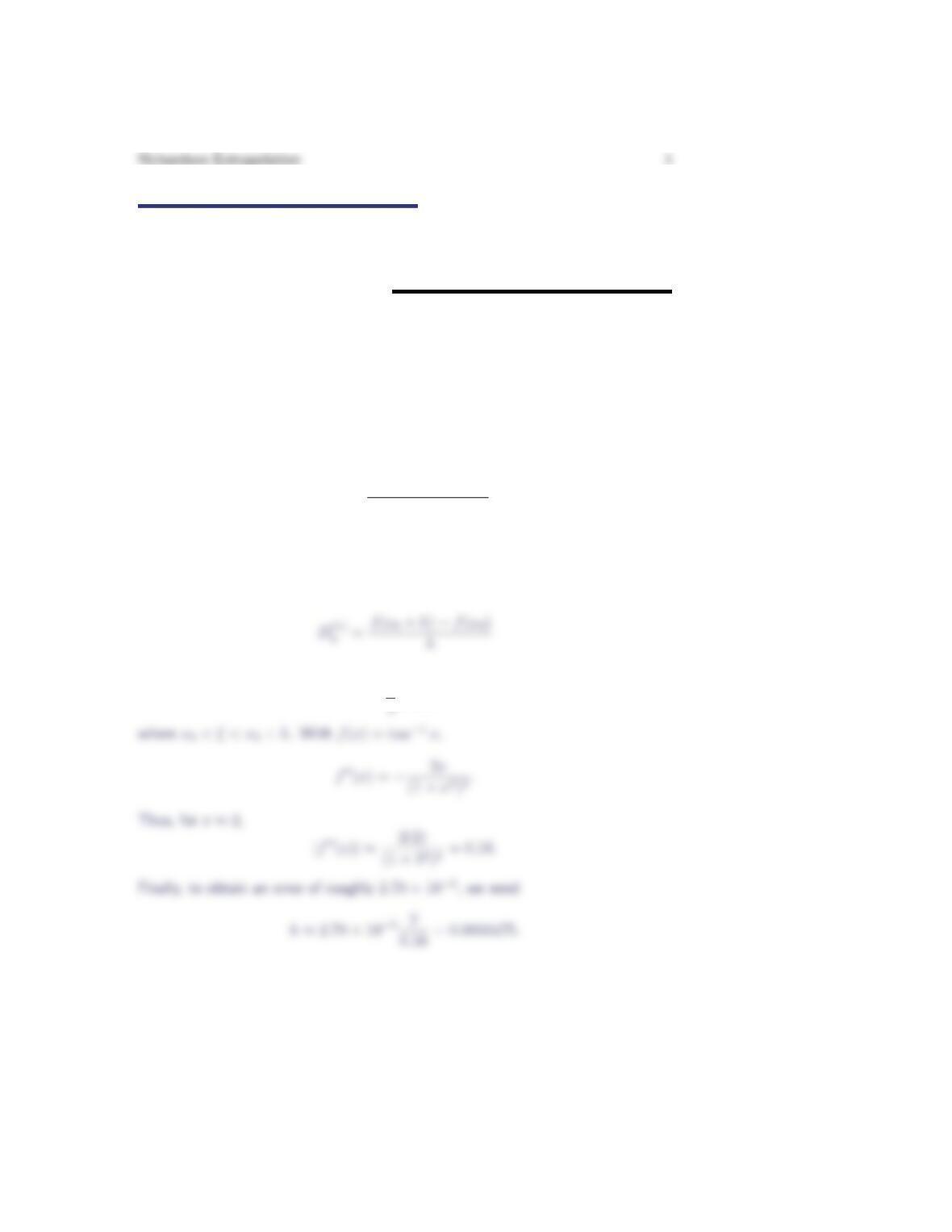
1. In the last example, extrapolation was used to obtain an approximation to
the first derivative of f(x) = tan−1xat x0= 2 with an error of 2.78 ×10⁻⁵.
The smallest step size used in the construction of the extrapolation table was
h= 0.125. Starting approximations for the extrapolation table were obtained
from the first-order forward difference formula
D(1)
h=f(x0+h)−f(x0)
h.
What step size would be needed in the first-order forward difference formula to
obtain the same accuracy, 2.78 ×10⁻⁵, as the final extrapolated value?
The error term associated with
is
−h
2. In the first example, extrapolation was used to obtain an approximation to
the first derivative of f(x) = ln xat x0= 2 with an error of 1.20 ×10⁻⁹.
The smallest step size used in the construction of the extrapolation table was
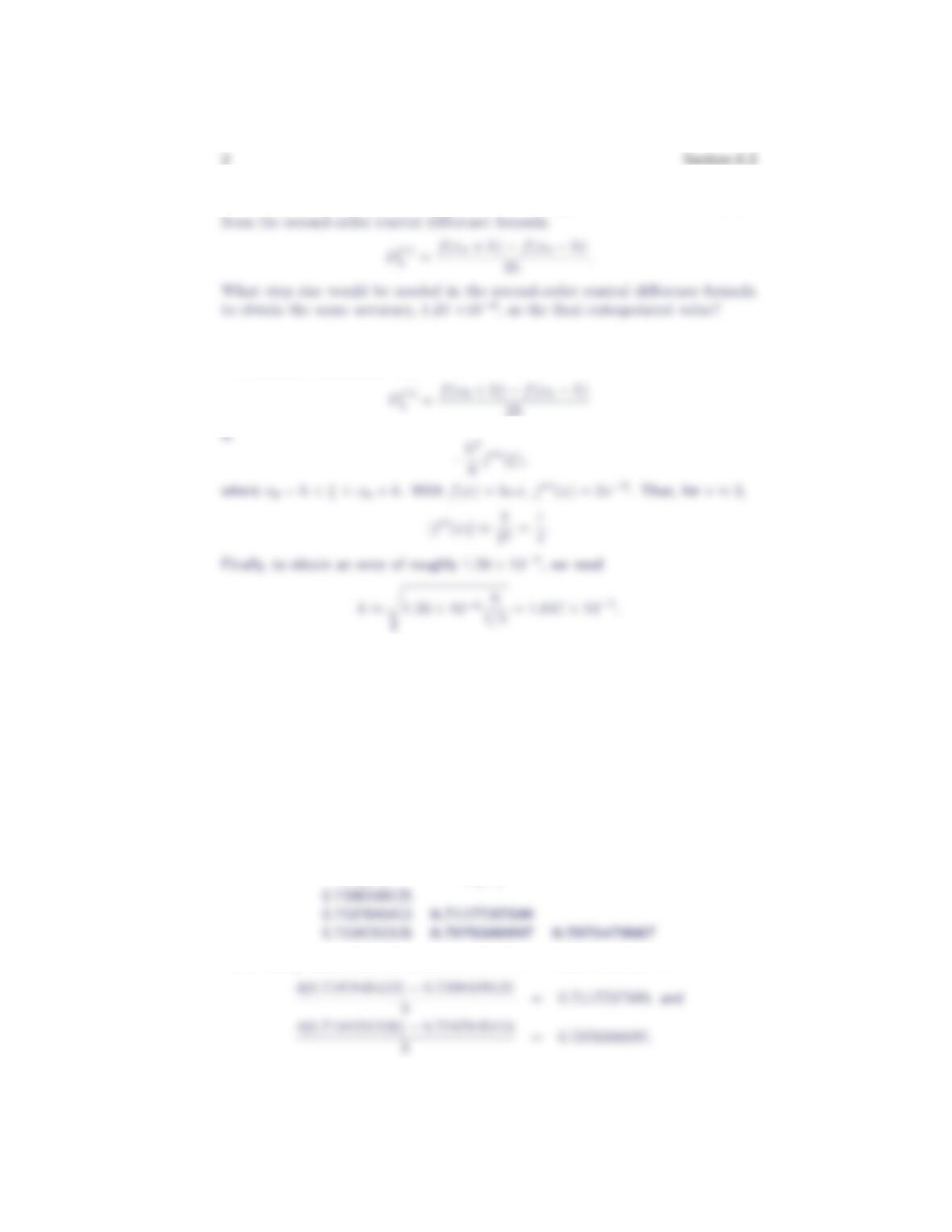
h= 0.025. Starting approximations for the extrapolation table were obtained
The error term associated with
In Exercises 3 – 7, fill in the missing values from the given extrapolation table.
The order of approximation associated with each column is indicated above the
column, and with each new row, his reduced by a factor of two.
3. O(h2)O(h3)
0.7398169125
0.7187845413 ?
0.7104251526 ? ?
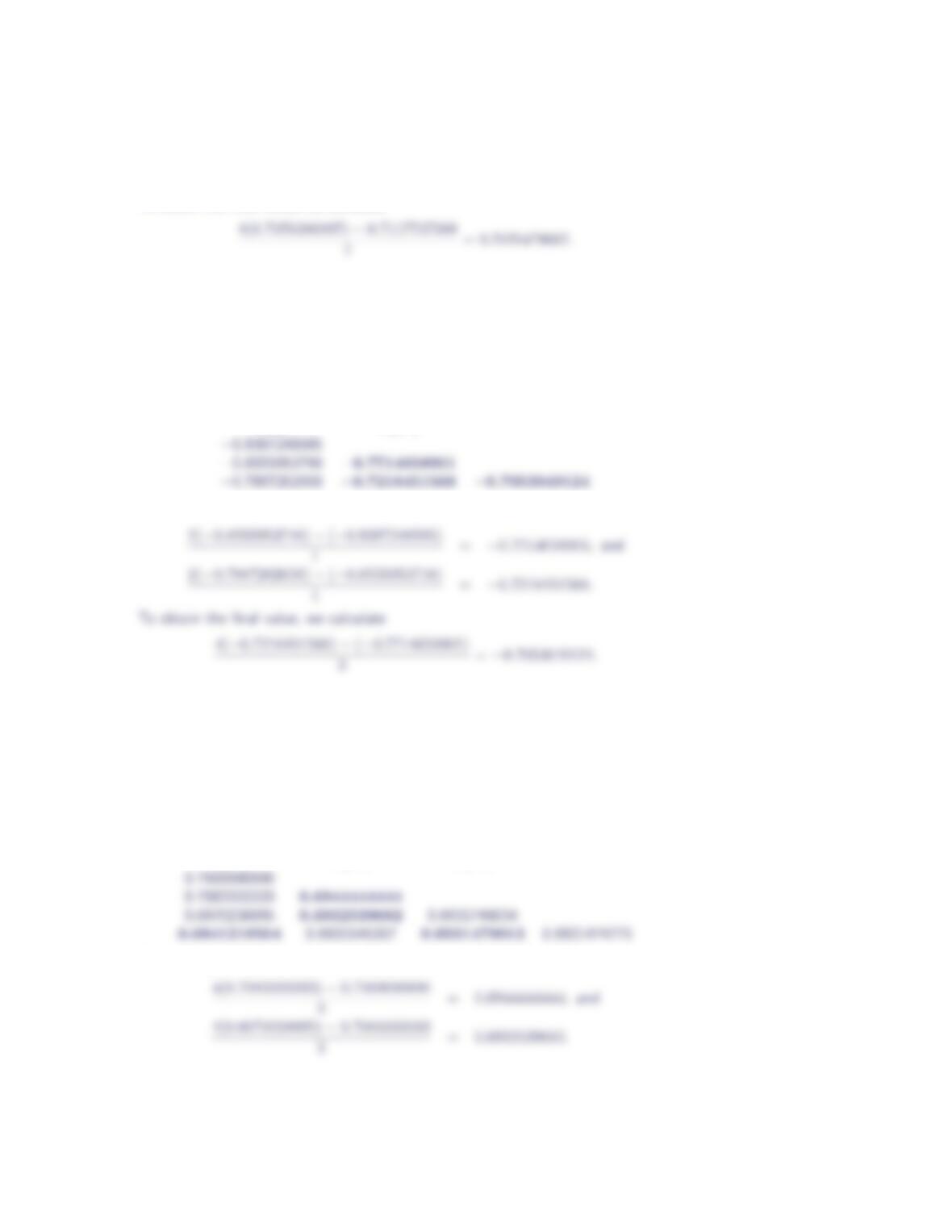
The complete extrapolation table is
O(h2)O(h3)
The missing values from the second column were calculated as follows:
Richardson Extrapolation 3
To obtain the final value, we calculate
4. O(h)O(h2)
−0.9397248595
−0.8555953748 ?
−0.7887202658 ? ?
The complete extrapolation table is
O(h)O(h2)
The missing values from the second column were calculated as follows:
5. O(h2)O(h4)O(h6)
0.7500000000
0.7083333333 ?
0.6970238095 ? 0.6931746034
? 0.6931545307 ? 0.6931474775
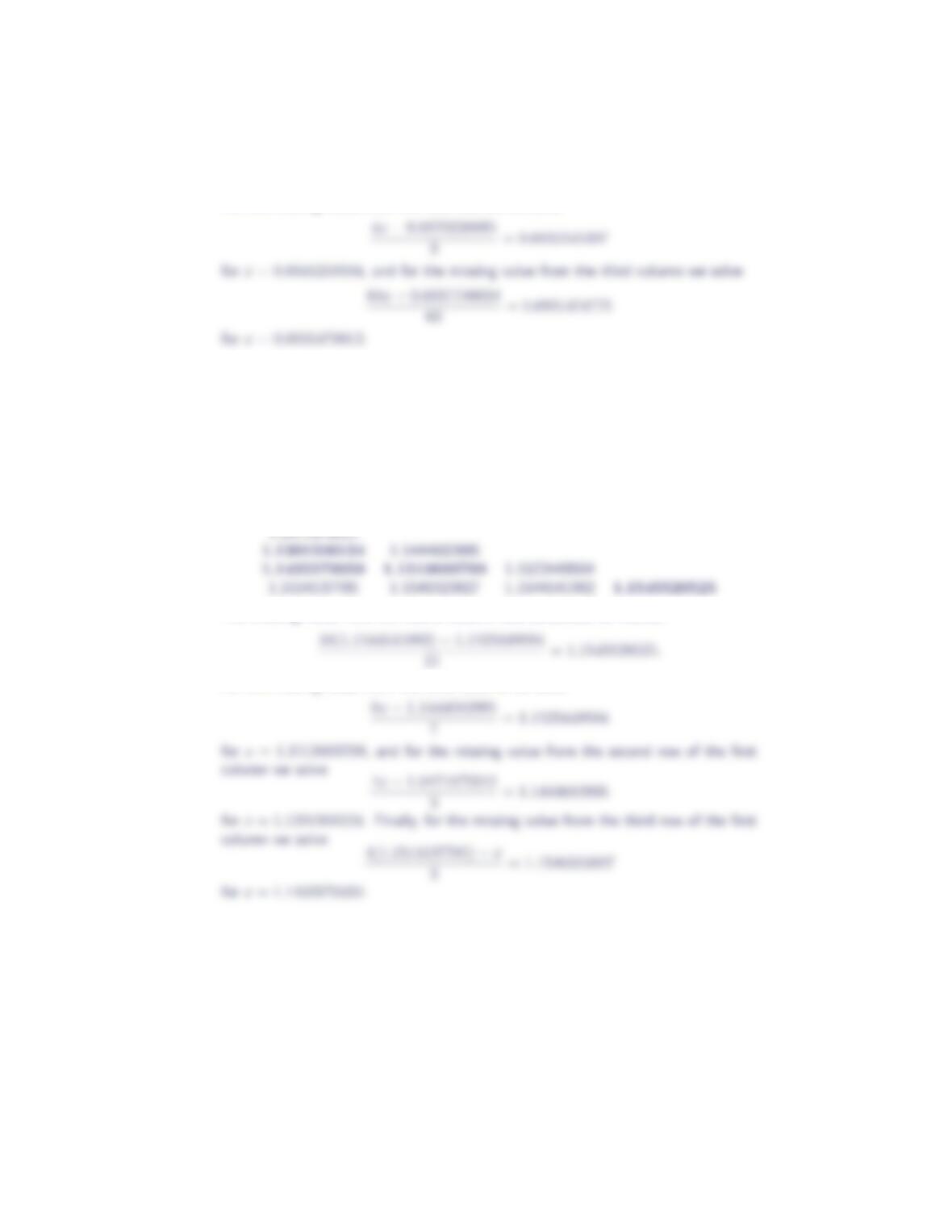
The complete extrapolation table is
O(h2)O(h4)O(h6)
The missing values from the second column were calculated as follows:
4Section 6.3
For the missing value from the first column we solve
6. O(h2)O(h3)O(h4)
1.0471975512
? 1.1444682995
? ? 1.1523449594
1.1514137785 1.1540323927 1.1544141092 ?
The complete extrapolation table is
O(h2)O(h3)O(h4)
The missing value from the fourth column was calculated as follows:
For the missing value from the third column we solve
7. O(h)O(h2)O(h3)
?
0.6065306597 0.8451818783
0.7788007831 0.9510709063 ?
? ? 0.9979003940 0.9995479864
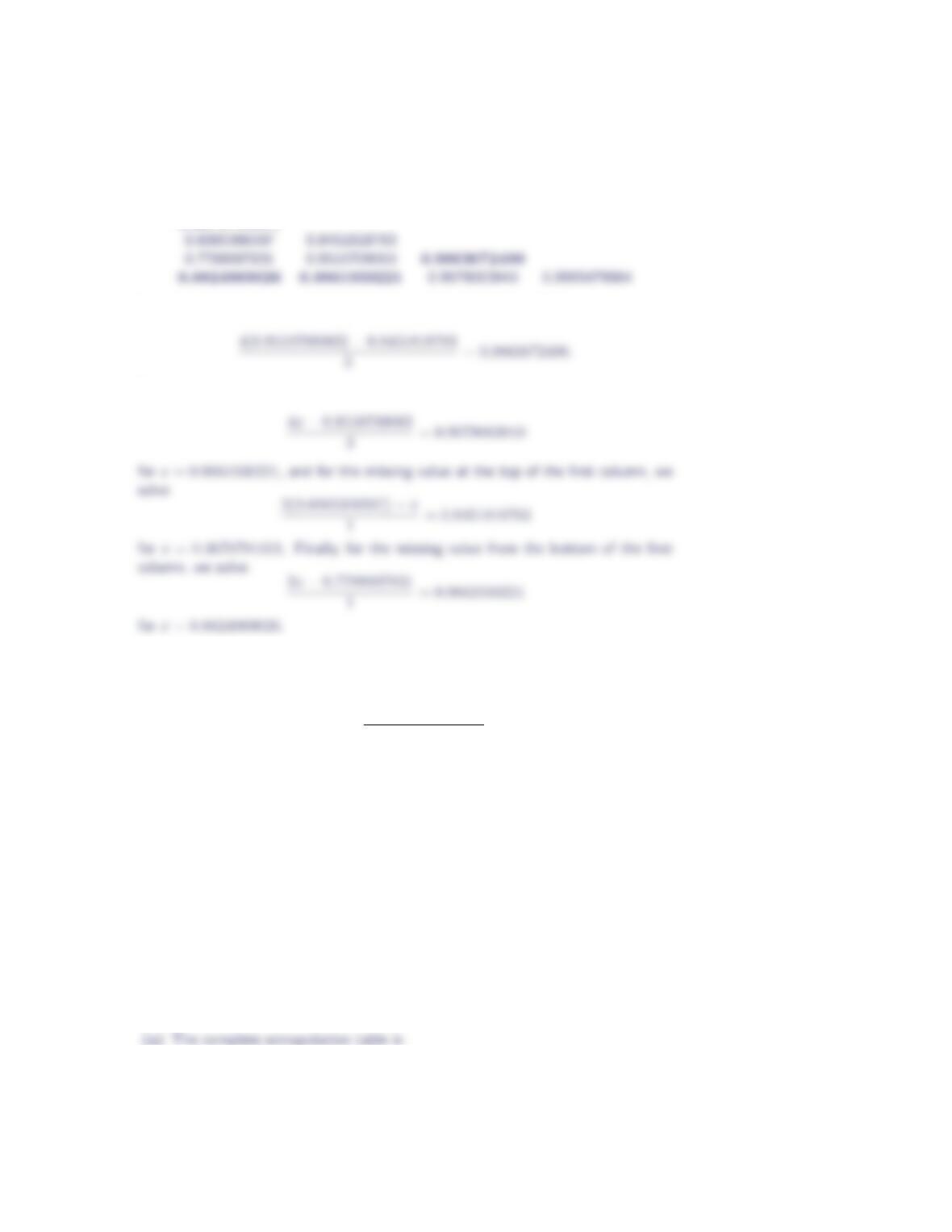
The complete extrapolation table is
Richardson Extrapolation 5
O(h)O(h2)O(h3)
0.3678794411
The missing value from the third column was calculated as follows:
For the missing value from the second column, we solve
8. Let Ddenote the true derivative of a function, and let Dhdenote the first-order
backward difference approximation to the derivative; i.e.,
Dh=f(x0)−f(x0−h)
h.
It can be shown that
D=Dh+k1h+k2h2+k3h3+o(h3),
where k1,k2and k3are constants independent of h. Let f(x) = ln(x2+ 1) and
x0= 2.
(a) Starting from h= 1, approximate the value of the first derivative of fat
x0by applying extrapolation to Dh. Use four rows in your extrapolation
table.
(b) What is the error in the final approximation?
(c) What step size would be needed in the first-order backward difference for-
mula to obtain the same accuracy as the final extrapolated value?
6Section 6.3
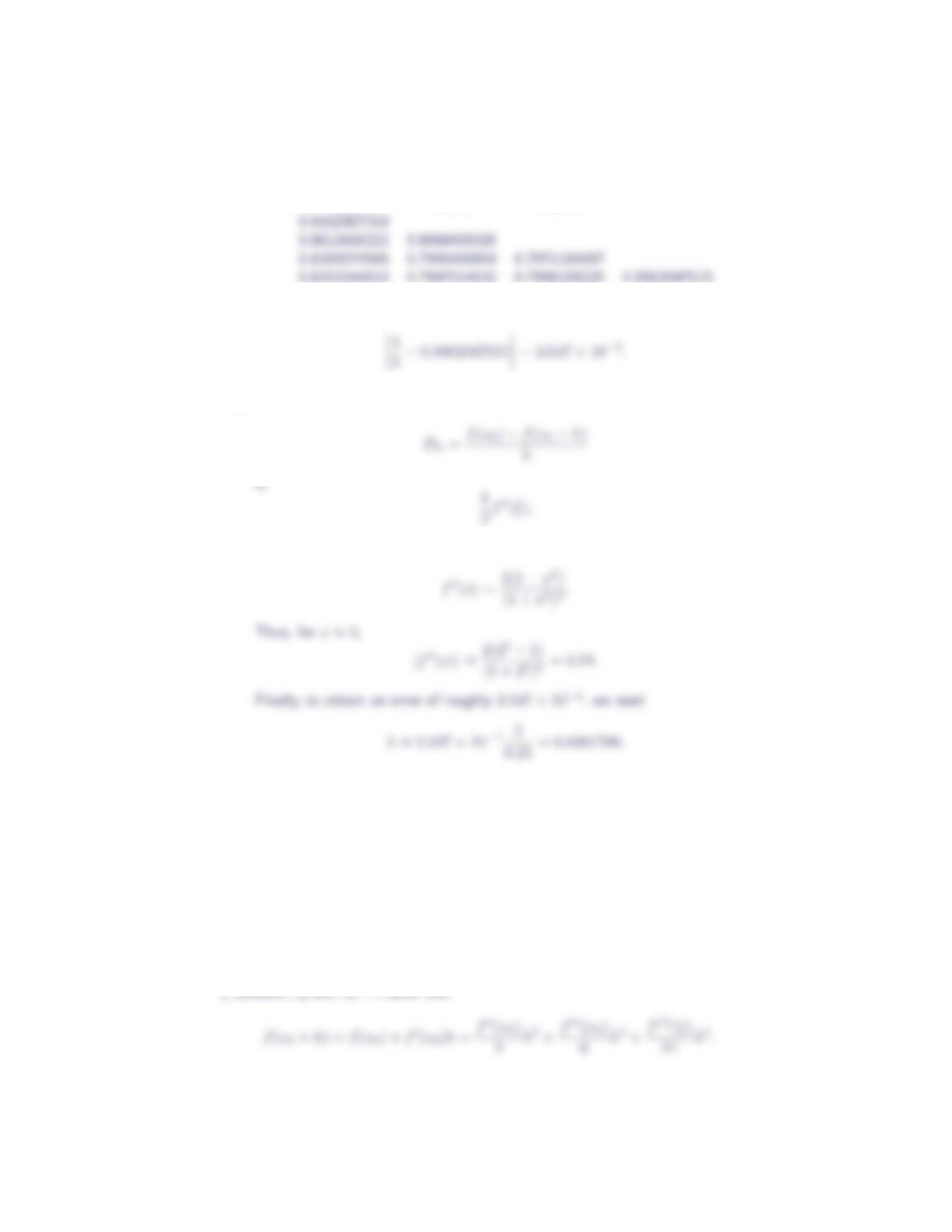
O(h)O(h2)O(h3)
(b) The error in the final extrapolated value is
(c) The error term associated with
where x0−h < ξ < x0. With f(x) = ln(x2+ 1),
9. Assuming that fhas four continuous derivatives, show that
D=D(1)
h+k1h+k2h2+k3h3+o(h3),
where Ddenotes the true derivative of a function, D(1)
hdenotes the first-order
forward difference approximation to the derivative and k1,k2and k3are con-
stants independent of h. (Hint: Use Taylor’s theorem to expand f(x0+h) about
the point x=x0.)
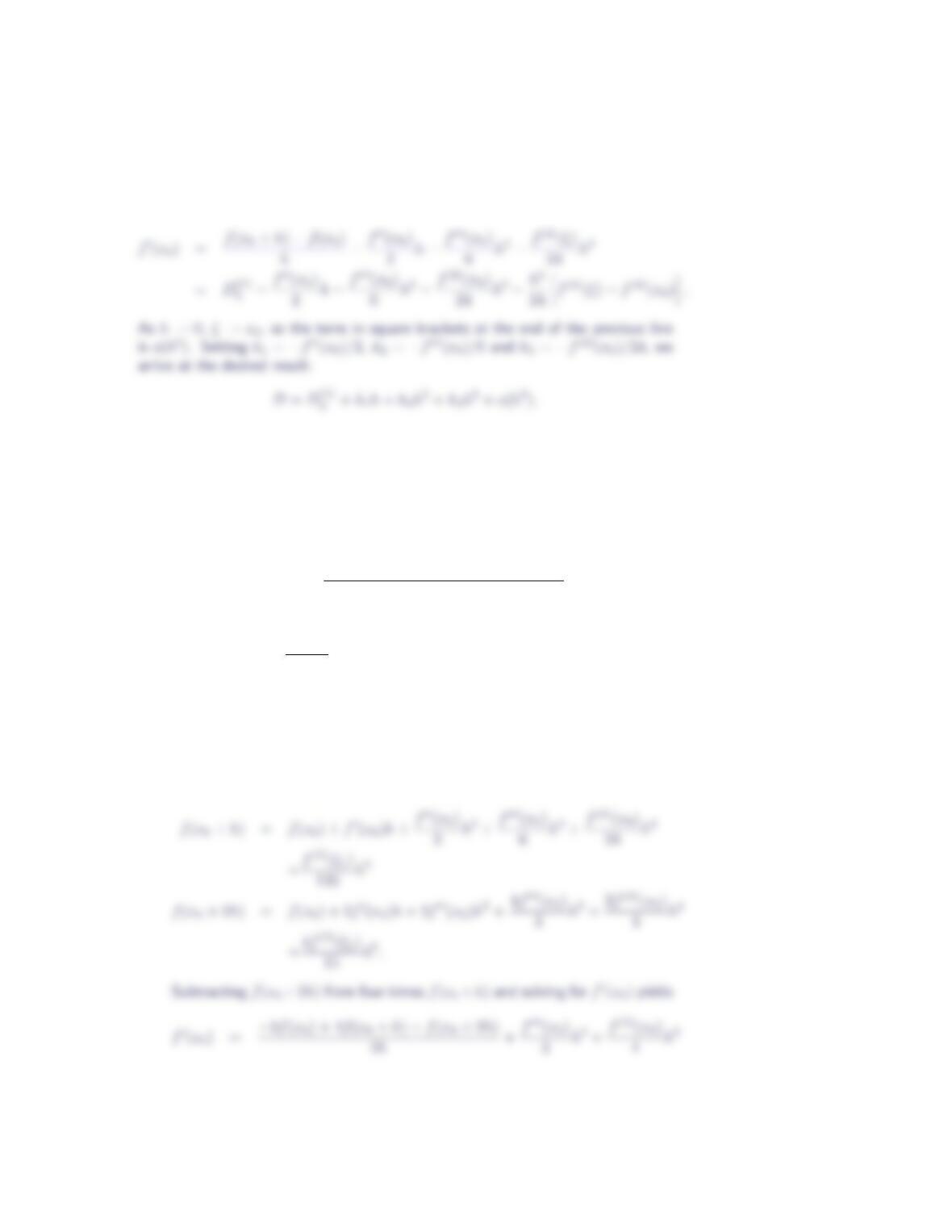
Suppose fhas four continuous derivatives. Then, by Taylor’s Theorem, there exists
Richardson Extrapolation 7
Solving for f0(x0)gives
10. (a) Show that
D=Dh+k1h2+k2h3+k3h4+o(h4),
where Ddenotes the true derivative of a function, Dhdenotes the second-
order forward difference approximation to the derivative
Dh=−3f(x0)+4f(x0+h)−f(x0+ 2h)
2h
and k1,k2and k3are constants independent of h. (Hint: Use Taylor’s
theorem to expand f(x0+h) and f(x0+ 2h) about the point x=x0.)
(b) Let f(x) = x/ 3
√x2+ 4 and x0=−1. Starting from h= 1, approximate
the value of the derivative of fat x0by applying extrapolation to Dh.
Use four rows in your extrapolation table. What is the error in the final
extrapolated value?
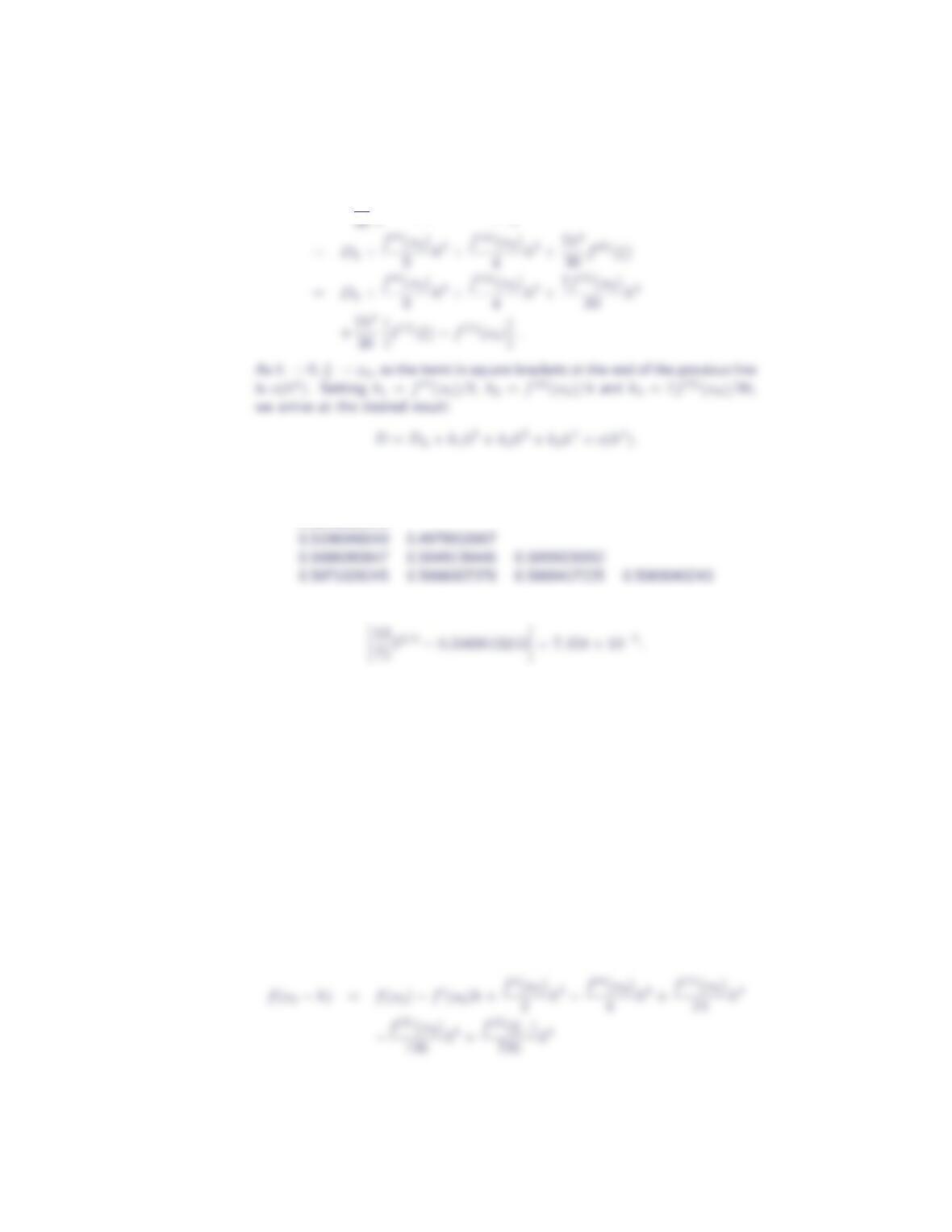
(a) Suppose fhas five continuous derivatives. Then, by Taylor’s Theorem, there
exist ξ1between x0and x0+hand ξ2between x0and x0+ 2hsuch that
8Section 6.3
−h4
(b) The complete extrapolation table is
O(h2)O(h3)O(h4)
0.5848035476
The error in the final extrapolated value is
11. (a) Show that
D=Dh+k1h2+k2h4+k3h6+o(h6),
where Ddenotes the true second derivative of a function, Dhdenotes the
second-order central difference approximation to the second derivative and
k1,k2and k3are constants independent of h. (Hint: Use Taylor’s theorem
to expand f(x0+h) and f(x0−h) about the point x=x0.)
(b) Let f(x) = x2exand x0= 0. Starting from h= 0.5, approximate the
value of the second derivative of fat x0by applying extrapolation to Dh.
Use three rows in your extrapolation table. What is the error in the final
extrapolated value?
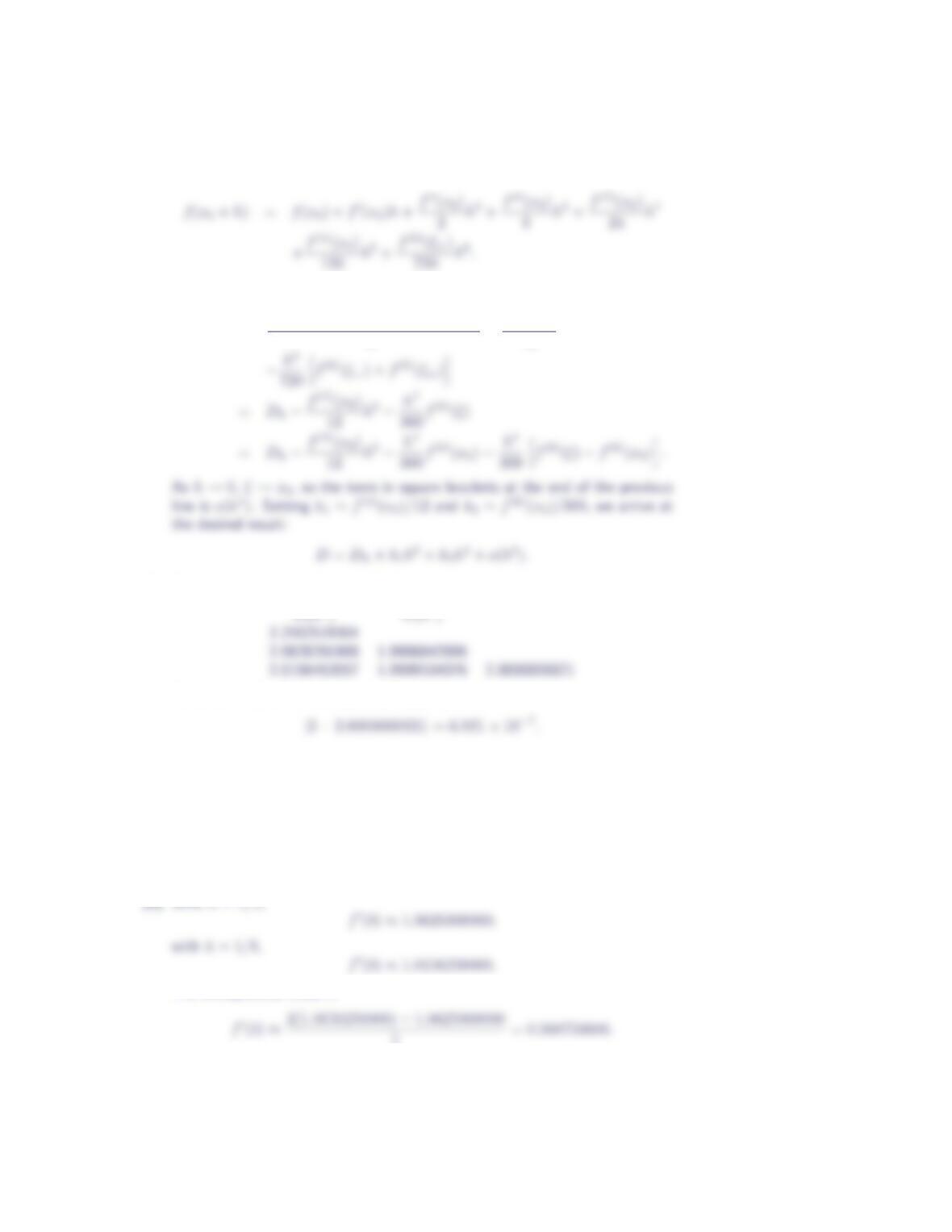
(a) Suppose fhas six continuous derivatives. Then, by Taylor’s Theorem, there
exist ξ−between x0and x0−hand ξ+between x0and x0+hsuch that
Richardson Extrapolation 9
Adding these two expressions and solving for f00 (x0)yields
f00 (x0) = f(x0−h)−2f(x0) + f(x0+h)
h2−f(4)(x0)
12 h2
(b) The complete extrapolation table is
The error in the final extrapolated value is
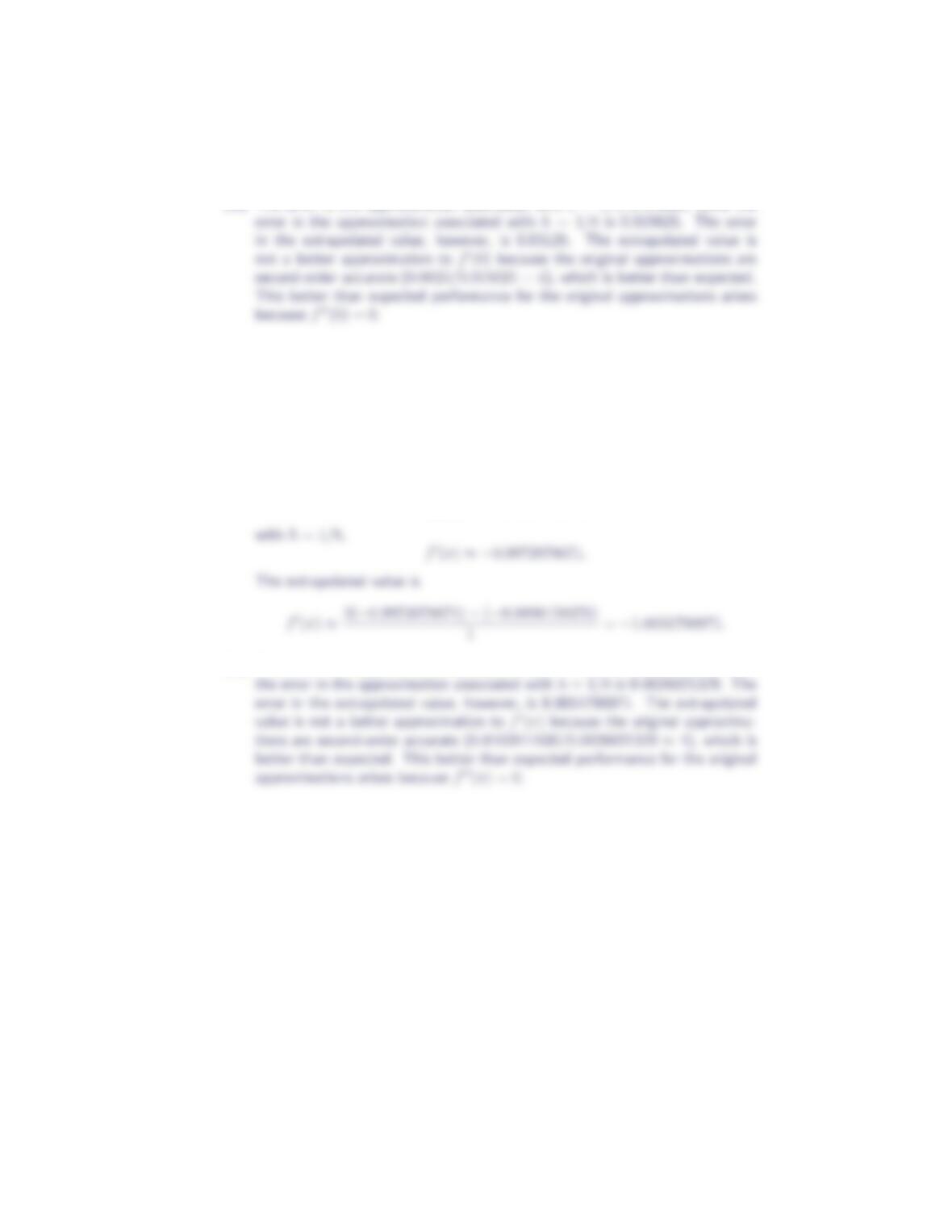
12. (a) Approximate the derivative of f(x) = 1 + x+x3at x0= 0 using the first-
order forward difference formula. Take h= 1/4 and h= 1/8, and then
extrapolate from these two values.
(b) What is the error associated with each of the approximations computed in
part (a)? Explain any unusual behavior in the errors.
The extrapolated value is
1= 0.968750000.
10 Section 6.3
(b) The error in the approximation associated with h= 1/4is 0.0625, while the
13. (a) Approximate the derivative of f(x) = sin xat x0=πusing the first-
order forward difference formula. Take h= 1/4 and h= 1/8, and then
extrapolate from these two values.
(b) What is the error associated with each of the approximations computed in
part (a)? Explain any unusual behavior in the errors.
(a) With h= 1/4,
f0(pi)≈ −0.9896158370;
(b) The error in the approximation associated with h= 1/4is 0.0103841630, while