Chapter 6
Variable Costing and Segment Reporting:
Tools for Management
Solutions to Questions
6-1 Absorption and variable costing differ in
how they handle fixed manufacturing overhead.
6-2 Selling and administrative expenses are
treated as period costs under both variable
costing and absorption costing.
as part of that period’s cost of goods sold.
6-4 Absorption costing advocates argue that
absorption costing does a better job of matching
costs with revenues than variable costing. They
argue that all manufacturing costs must be
the products? These costs are incurred to have
the capacity to make products during a
absorption and variable costing. When
production equals sales, inventories do not
increase or decrease and therefore under
absorption costing fixed manufacturing overhead
cost cannot be deferred in inventory or released
period. In contrast, all of the fixed
manufacturing overhead cost of the current
period is immediately expensed under variable
costing.
6-8 If fixed manufacturing overhead cost is
expenses and causing net operating income to
increase.
6-11 A segment is any part or activity of an
organization about which a manager seeks cost,
revenue, or profit data. Examples of segments
include departments, operations, sales
territories, divisions, and product lines.
6-13 A traceable cost of a segment is a cost
that arises specifically because of the existence
of that segment. If the segment were
eliminated, the cost would disappear. A common
and the costs of supplies used by the
department. Examples of common costs would
particularly those in which fixed costs don’t
change. The segment margin is useful in
assessing the overall profitability of a segment.
6-15 If common costs were allocated to
segments, then the costs of segments would be
segment would be reallocated to the remaining
segments—making them appear less profitable.
6-16 There are often limits to how far down
Exercise 6-1 (15 minutes)
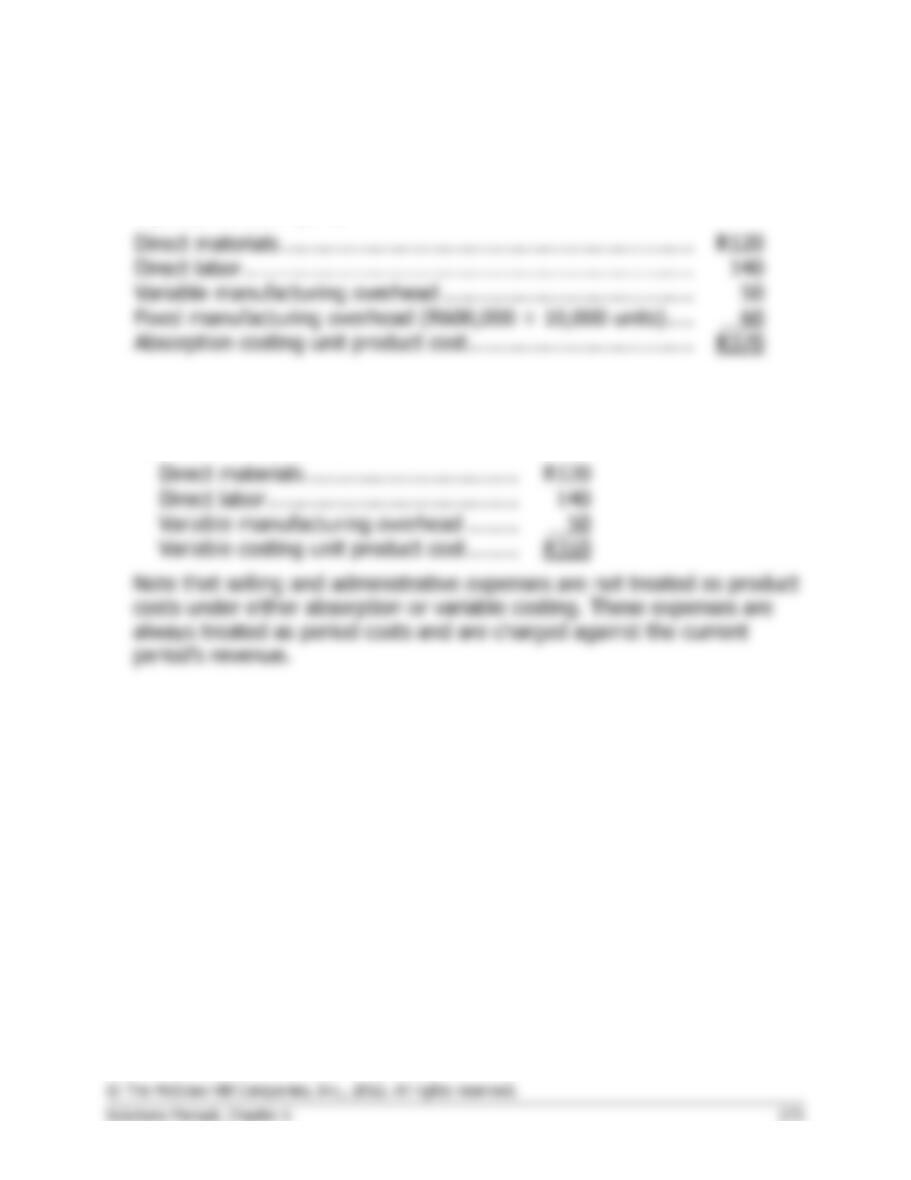
1. Under absorption costing, all manufacturing costs (variable and fixed)
are included in product costs. (All currency values are in thousands of
rupees, denoted by R.)
Absorption costing unit product cost ………………………………
2. Under variable costing, only the variable manufacturing costs are
included in product costs. (All currency values are in thousands of
rupees, denoted by R.)
Direct materials …………………………….
Exercise 6-2 (20 minutes)
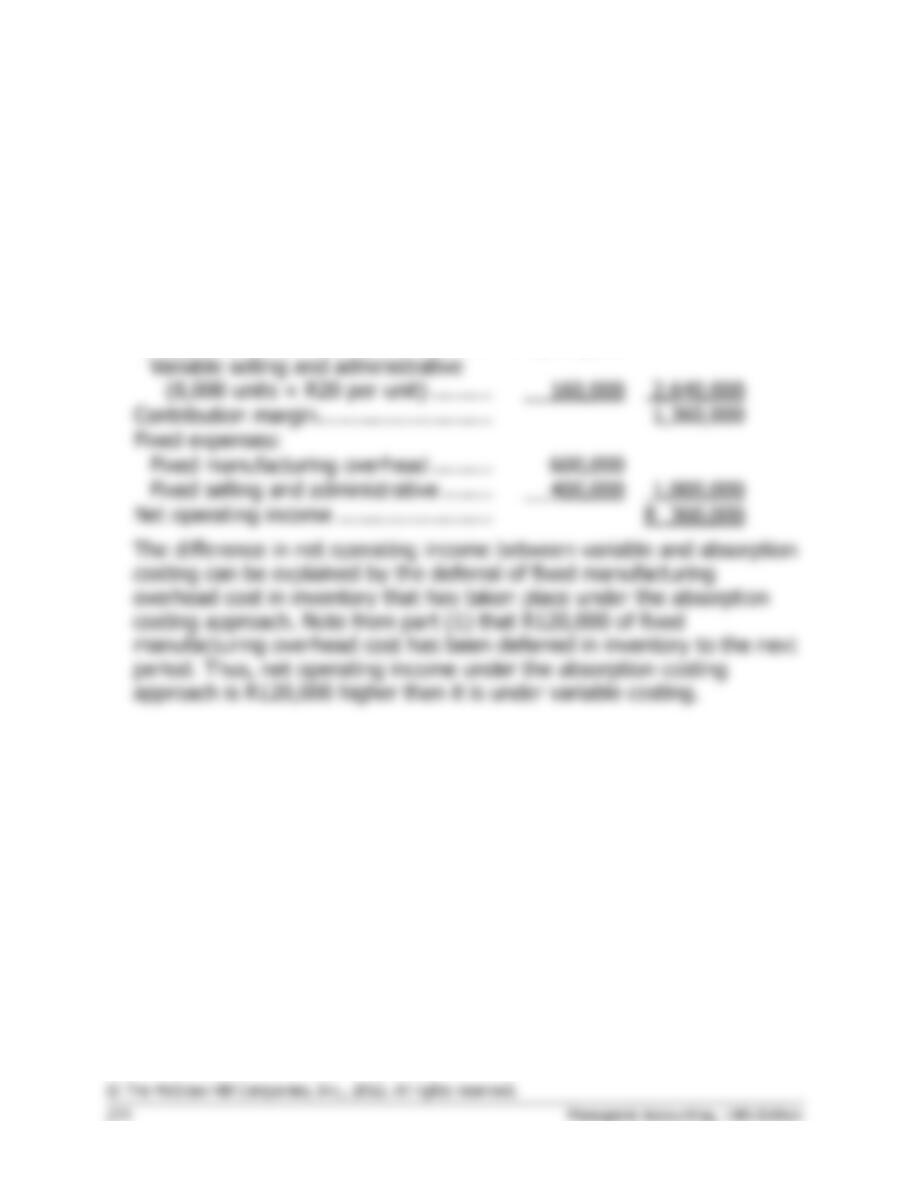
1. 2,000 units in ending inventory × R60 fixed manufacturing overhead per
unit = R120,000.
2. The variable costing income statement appears below:
Sales ………………………………………….
R4,000,000
Variable expenses:
Variable cost of goods sold
(8,000 units × R310 per unit) ……..
R2,480,000
Contribution margin ……………………….
Fixed manufacturing overhead ……….
Net operating income …………………….
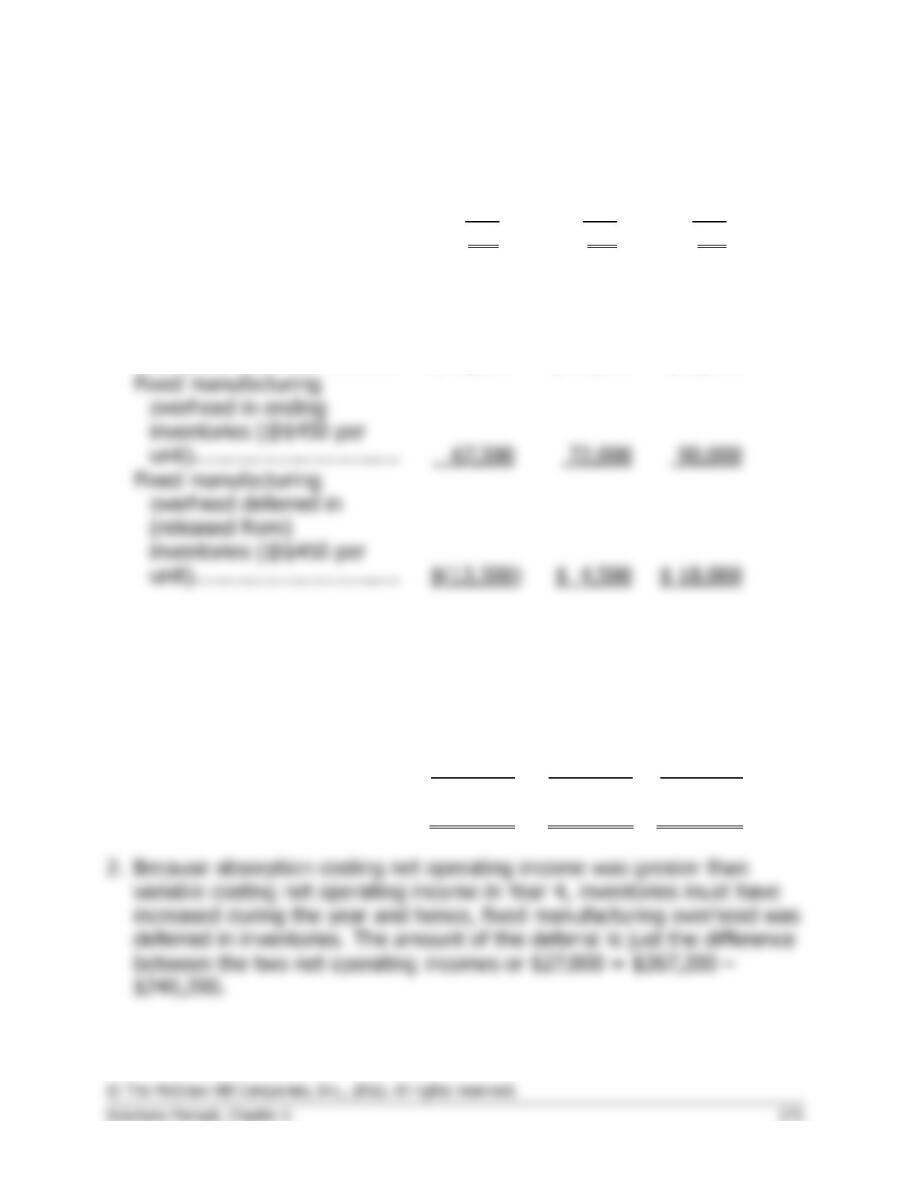
Exercise 6-3 (20 minutes)
1.
Year 1
Year 2
Year 3
Beginning inventories ……….
180
150
160
Ending inventories ……………
150
160
200
Change in inventories ……….
(30)
10
40
Fixed manufacturing
overhead in beginning
inventories (@$450 per
unit) …………………………...
$ 81,000
$ 67,500
$72,000
Variable costing net
operating income …………..
$292,400
$269,200
$251,800
Add (deduct) fixed
manufacturing overhead
cost deferred in (released
from) inventory under
absorption costing …………
(13,500)
4,500
18,000
Absorption costing net
operating income …………..
$278,900
$273,700
$269,800
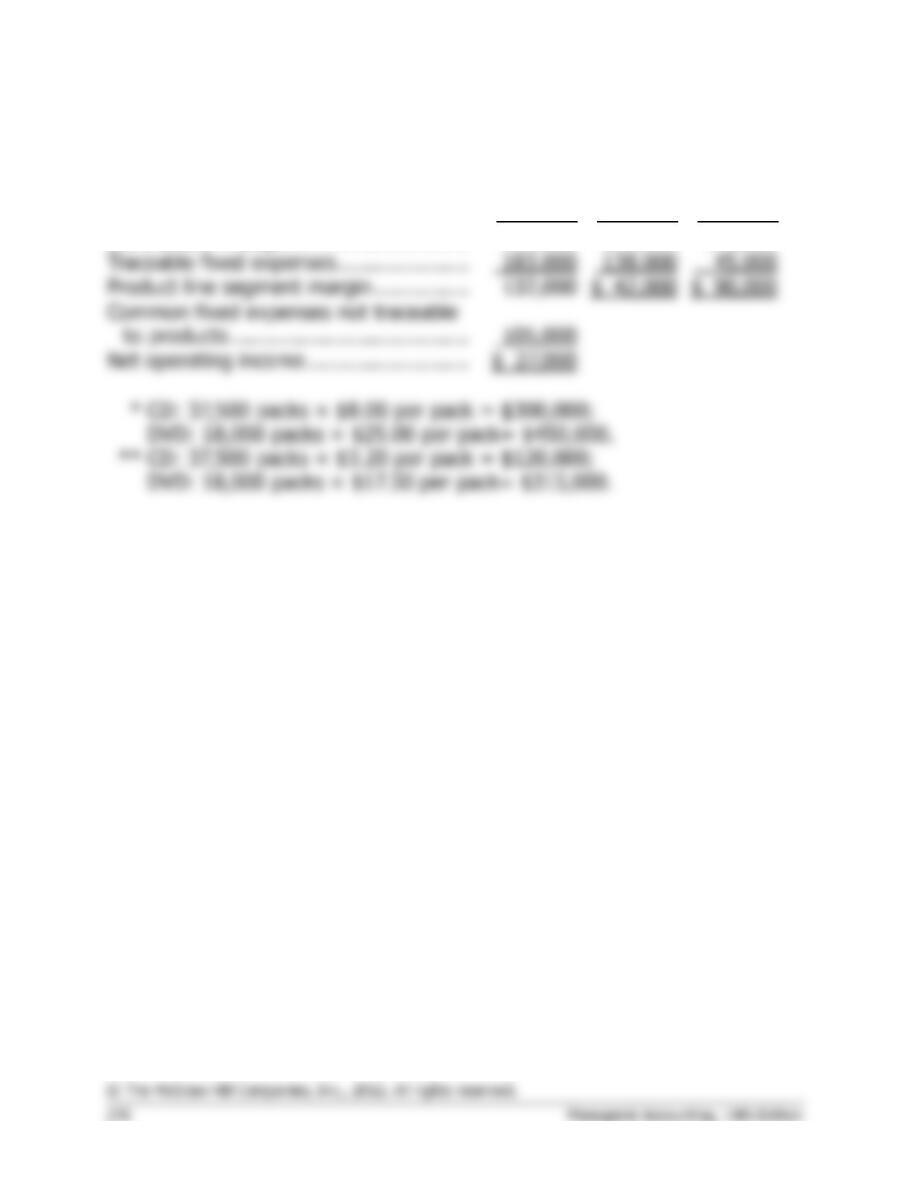
Exercise 6-4 (10 minutes)
Total
CD
DVD
Sales* …………………………………………
$750,000
$300,000
$450,000
Variable expenses** ………………………
435,000
120,000
315,000
Contribution margin ……………………….
315,000
180,000
135,000
105,000
Net operating income ……………………..
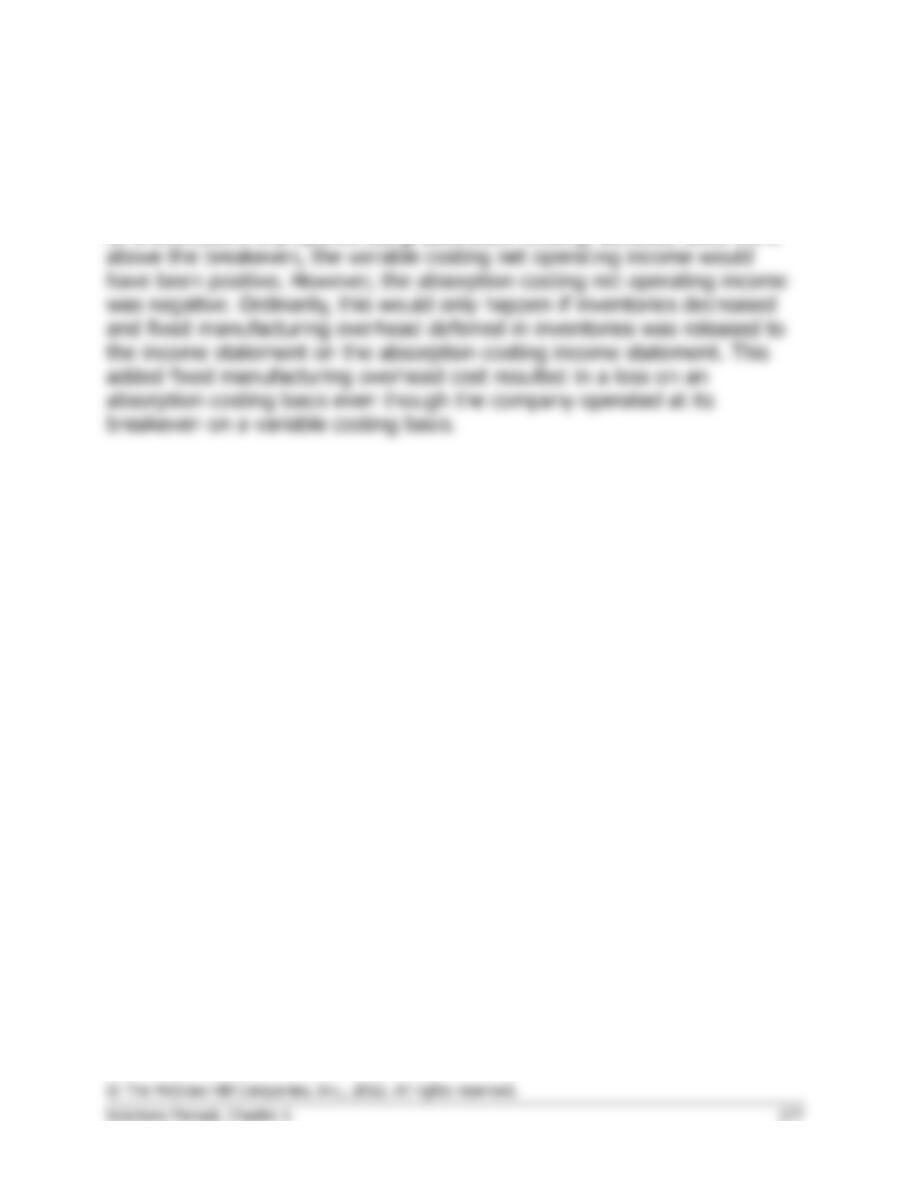
Exercise 6-5 (10 minutes)
Sales were above the company’s break-even sales and yet the company
sustained a loss. The apparent contradiction is explained by the fact that
the CVP analysis is based on variable costing, whereas the income reported
to shareholders is prepared using absorption costing. Because sales were
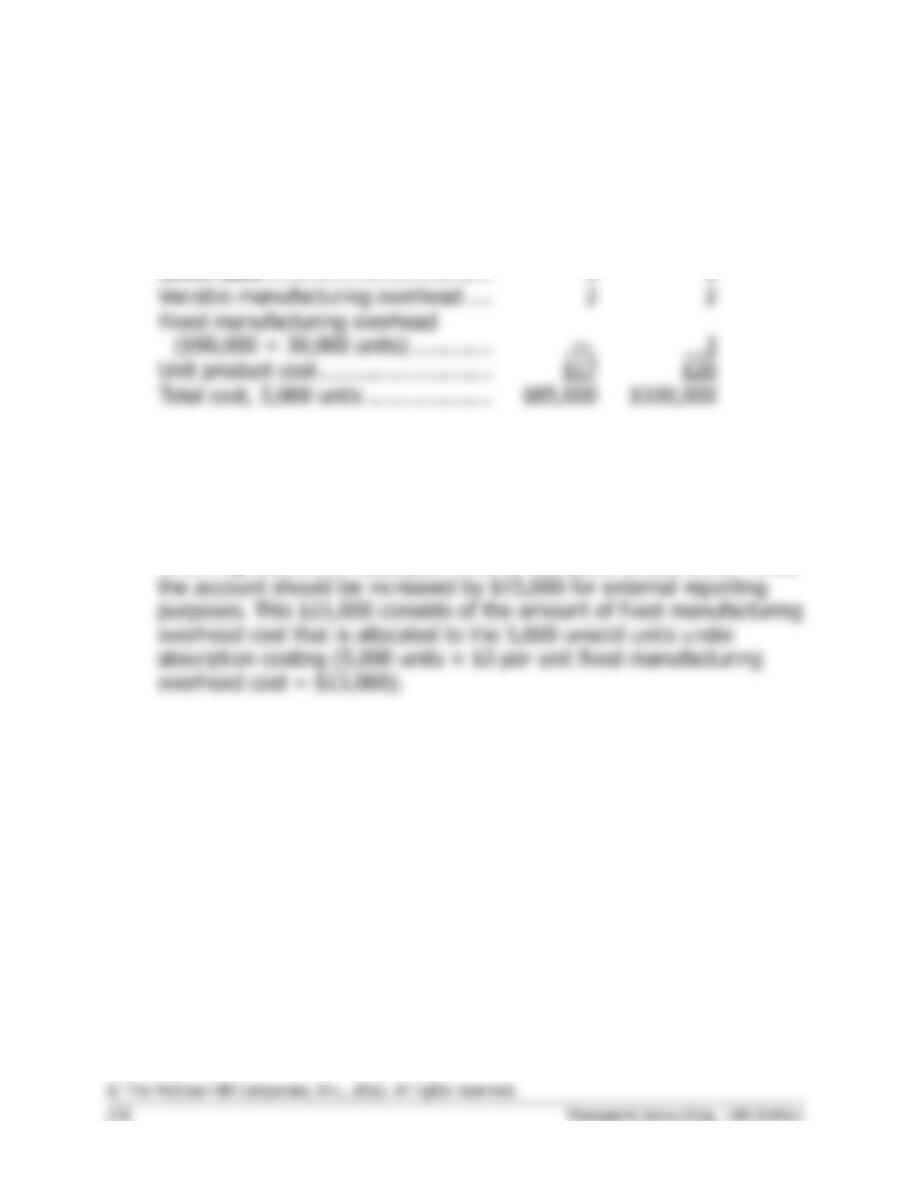
Exercise 6-6 (20 minutes)
1. The company is using variable costing. The computations are:
Variable
Costing
Absorption
Costing
Direct materials …………………………
$10
$10
Unit product cost ……………………….
$17
$20
2. a. No, $85,000 is not the correct figure to use, because variable costing
is not generally accepted for external reporting purposes or for tax
purposes.
b. The finished goods inventory account should be stated at $100,000,
which represents the absorption cost of the 5,000 unsold units. Thus,
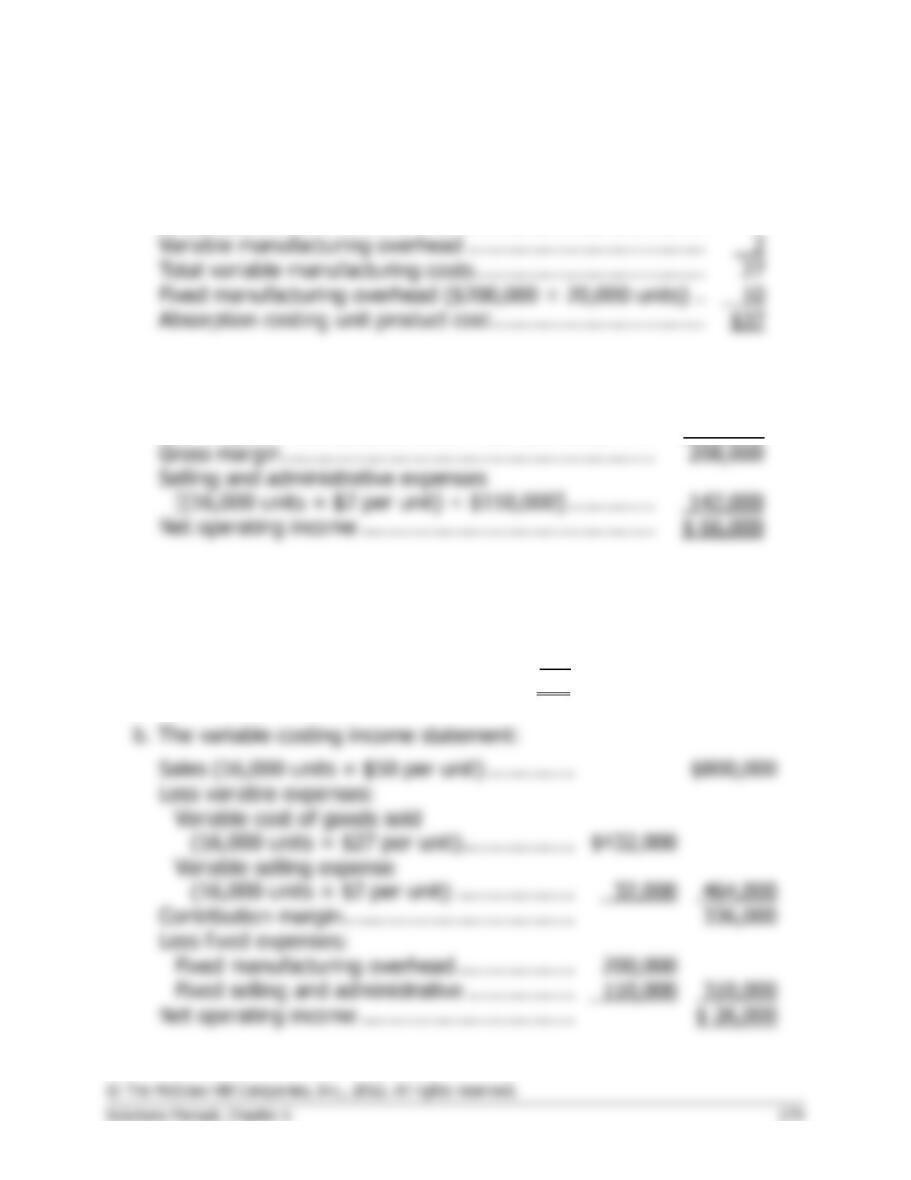
Exercise 6-7 (30 minutes)
1. a. The unit product cost under absorption costing would be:
Direct materials ……………………………………………………….
$18
Direct labor ……………………………………………………….……
7
Variable manufacturing overhead ………………………………..
2
Total variable manufacturing costs ……………………………….
Fixed manufacturing overhead ($200,000 ÷ 20,000 units) ..
Absorption costing unit product cost …………………………….
$37
b. The absorption costing income statement:
Sales (16,000 units × $50 per unit) ………………………
$800,000
Cost of goods sold (16,000 units × $37 per unit) ……..
592,000
Gross margin ……………………………………………………
142,000
Net operating income …………………………..……………
$ 66,000
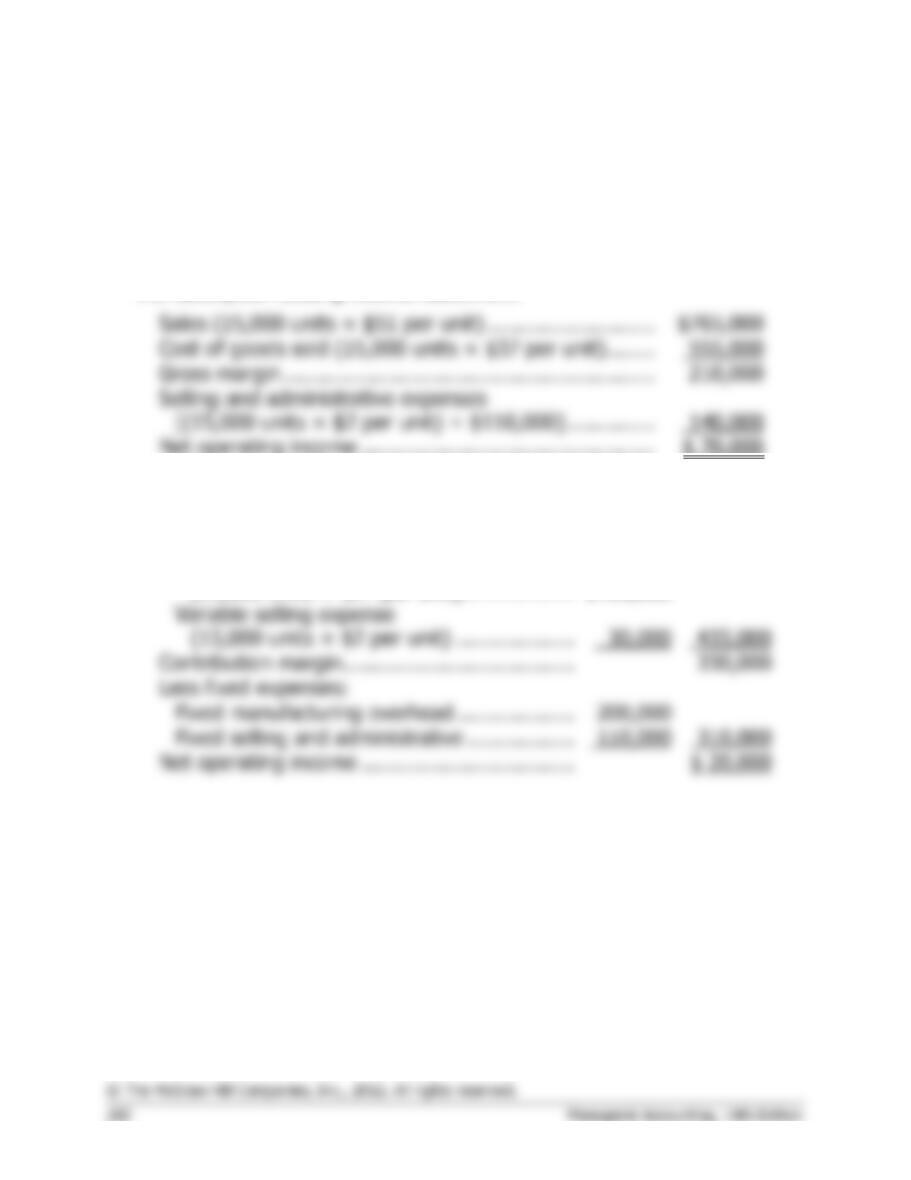
2. a. The unit product cost under variable costing would be:
Direct materials …………………………..
$18
Direct labor ………………………………..
7
Variable manufacturing overhead ……
2
Variable costing unit product cost ……
$27
Sales (16,000 units × $50 per unit) …………..
Less variable expenses:
Contribution margin ……………………………….
336,000
Less fixed expenses:
Net operating income …………………………....
Exercise 6-7 (continued)
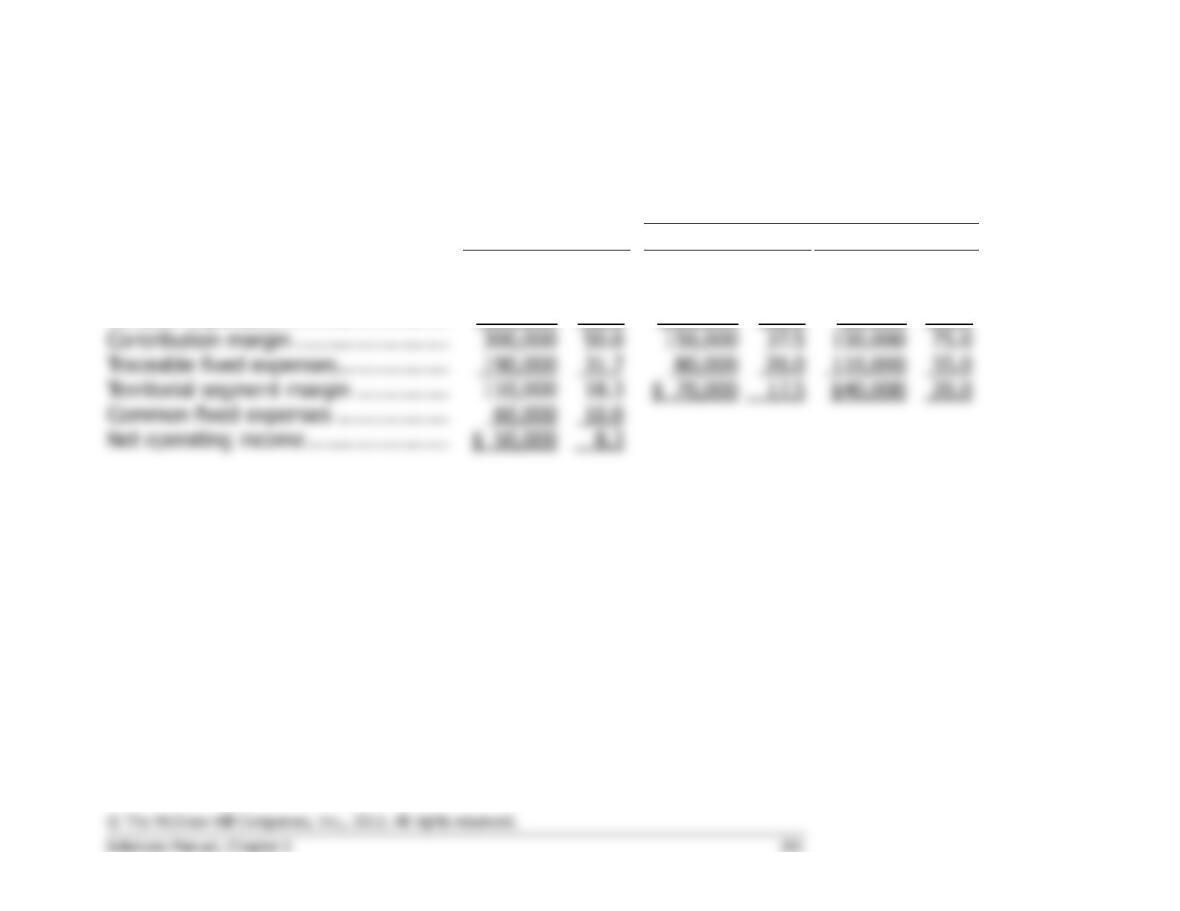
3. The price increase appears to be a good idea from an absorption costing
perspective because it increases net operating income by $4,000, but a
variable costing income statement reveals that the price increase would
actually decrease net operating income by $6,000. The income
statements are shown below:
The absorption costing income statement:
Sales (15,000 units × $51 per unit) ………………………
Cost of goods sold (15,000 units × $37 per unit) ……..
555,000
Gross margin ……………………………………………………
Net operating income …………………………..……………
$ 70,000
The variable costing income statement:
Sales (15,000 units × $51 per unit) …………..
$765,000
Less variable expenses:
Variable cost of goods sold
(15,000 units × $27 per unit) ………………
$405,000
Net operating income …………………………....
Exercise 6-8 (10 minutes)
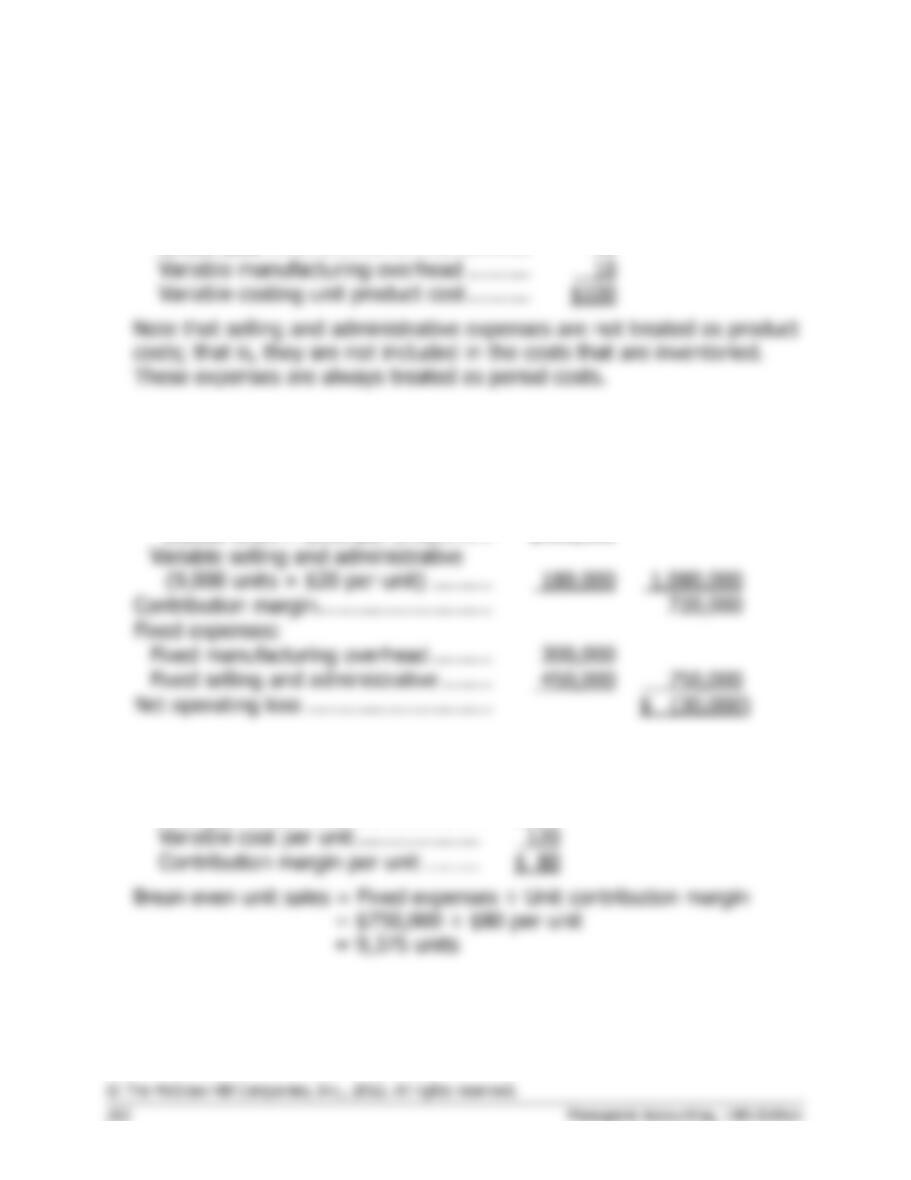
The completed segmented income statement should appear as follows:
Divisions
Total Company
East
West
Amount
%
Amount
%
Amount
%
Sales ………………………………………..
$600,000
100.0
$400,000
100.0
$200,000
100.0
Variable expenses ……………………….
300,000
50.0
250,000
62.5
50,000
25.0
Contribution margin …………………….
150,000
Traceable fixed expenses ………………
190,000
20.0
110,000
55.0
Net operating income …………………..
Exercise 6-9 (30 minutes)
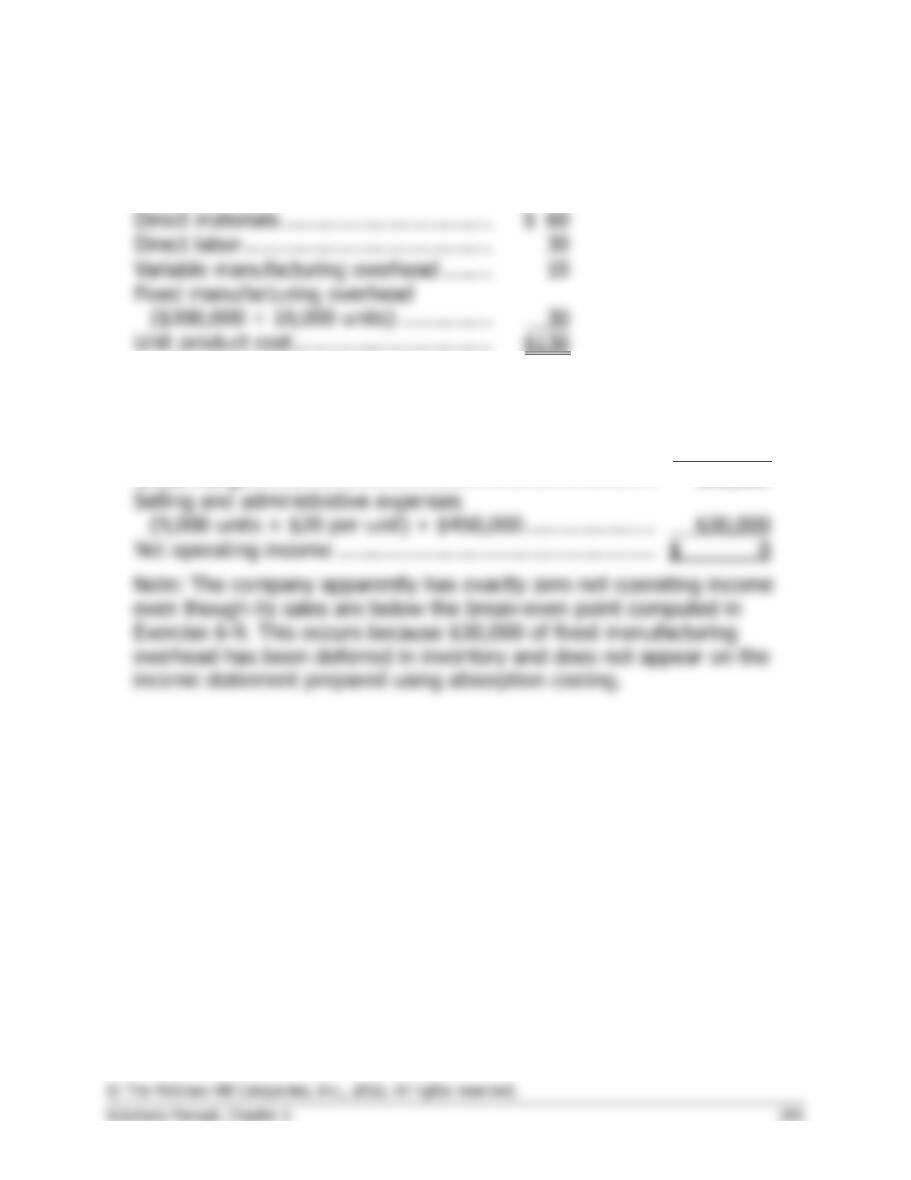
1. Under variable costing, only the variable manufacturing costs are
included in product costs.
Direct materials ………………………………
$ 60
Direct labor ……………………………………
30
Variable manufacturing overhead ……….
Variable costing unit product cost ……….
2. The variable costing income statement appears below:
Sales ………………………………………….
$1,800,000
Variable expenses:
Variable cost of goods sold
(9,000 units × $100 per unit) ………
$900,000
Contribution margin ……………………….
Fixed expenses:
Net operating loss …………………………
$ (30,000)
3. The break-even point in units sold can be computed using the
contribution margin per unit as follows:
Selling price per unit …………………
$200
Variable cost per unit ………………..
Exercise 6-10 (20 minutes)
1. Under absorption costing, all manufacturing costs (variable and fixed)
are included in product costs.
Direct materials …………………………….
Direct labor ………………………………….
Variable manufacturing overhead ……..
Unit product cost …………………………..
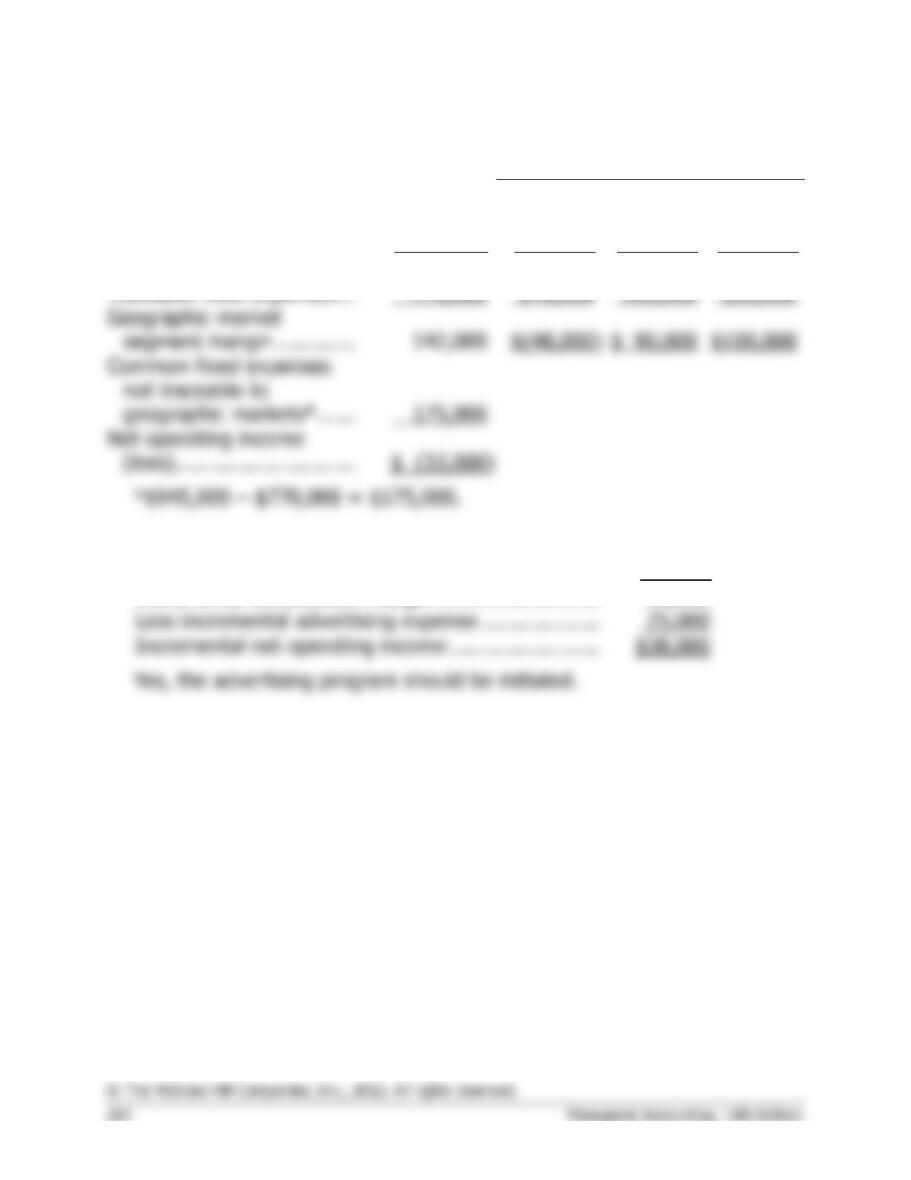
2. The absorption costing income statement appears below:
Sales (9,000 units × $200 per unit) ………………………….
$1,800,000
Cost of goods sold (9,000 units × $130 per unit) …………
1,170,000
Gross margin ……………………………………………………….
630,000
630,000
Net operating income …………………………..……………….
Exercise 6-11 (20 minutes)
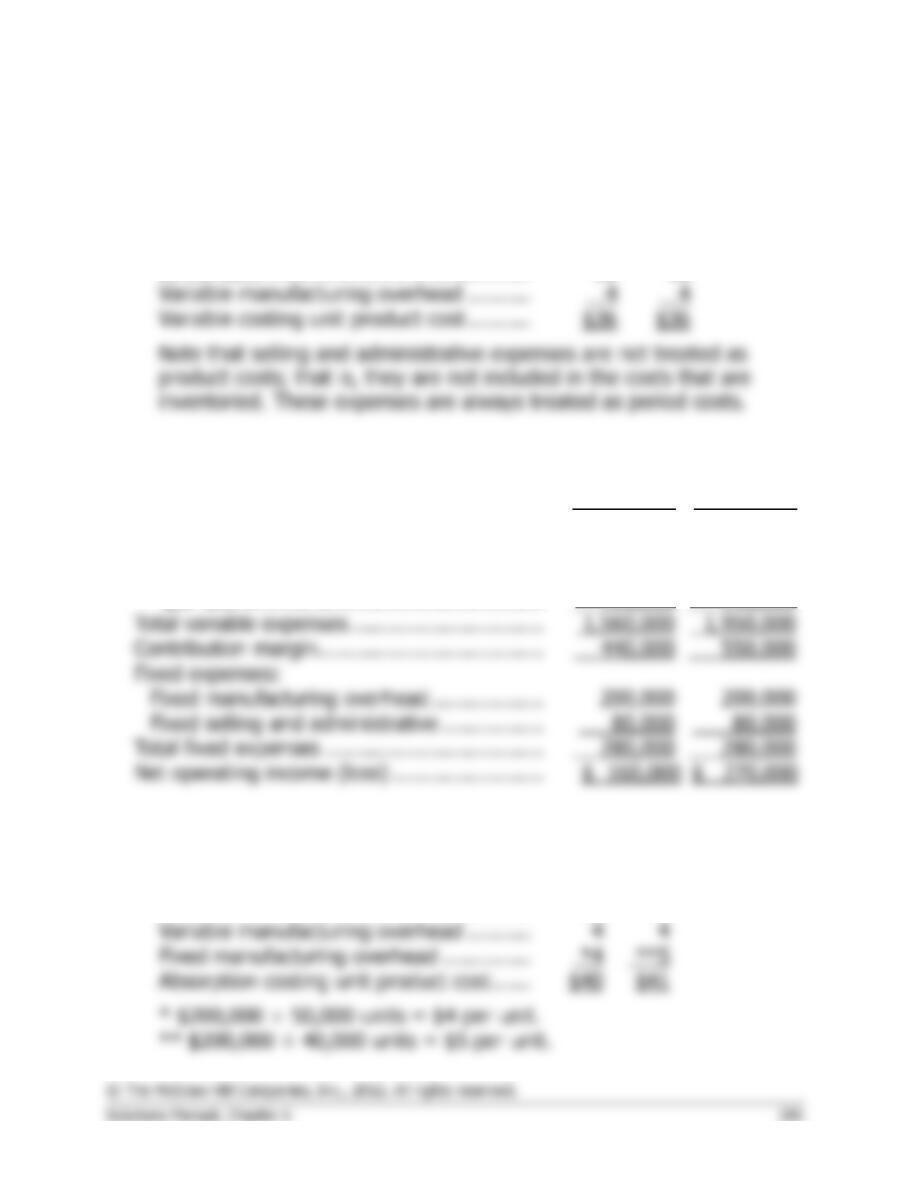
1.
Total
Geographic Market
Company
South
Central
North
Sales …………………………..
$1,500,000
$400,000
$600,000
$500,000
Variable expenses ………….
588,000
208,000
180,000
200,000
Contribution margin ……….
912,000
192,000
420,000
300,000
Traceable fixed expenses …
200,000
$ 90,000
$100,000
2.
Incremental sales ($600,000 × 15%) ……………….
$90,000
Contribution margin ratio ($420,000 ÷ $600,000) .
× 70%
Incremental contribution margin ……………………..
63,000
Less incremental advertising expense ……………….
25,000
Incremental net operating income ……………………
$38,000
Exercise 6-12 (30 minutes)
1 a. Under variable costing, only the variable manufacturing costs are
included in product costs.
Year 1
Year 2
Direct materials ………………………………
$20
$20
Direct labor ……………………………………
12
12
Variable manufacturing overhead ……….
Variable costing unit product cost ……….
1 b.
Year 1
Year 2
Sales …………………………………………………
$2,000,000
$2,500,000
Variable expenses:
Variable cost of goods sold @ $36 per unit
1,440,000
1,800,000
Variable selling and administrative @ $3
per unit …………………………………………
120,000
150,000
Total variable expenses ………………………….
Contribution margin ………………………………
Fixed expenses:
200,000
Total fixed expenses ……………………………..
280,000
Net operating income (loss) ……………………
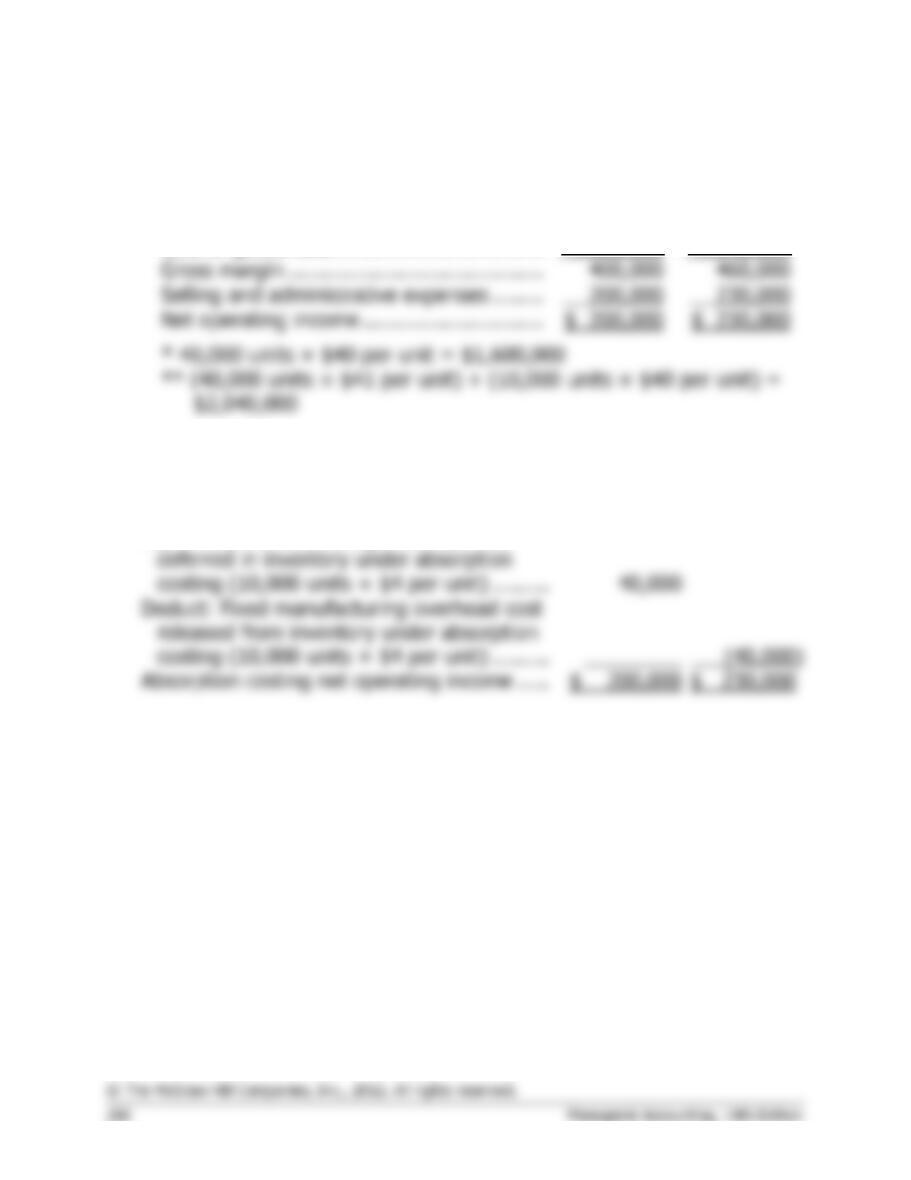
2 a. The unit product costs under absorption costing:
Year 1
Year 2
Direct materials ………………………………
$20
$20
Direct labor ……………………………………
12
12
Variable manufacturing overhead ……….
Fixed manufacturing overhead …………..
Absorption costing unit product cost ……
$40
$41
* $200,000 ÷ 50,000 units = $4 per unit.
Exercise 6-12 (continued)
2 b. The absorption costing income statements appears below:
Year 1
Year 2
Sales ……………………………………………..
$2,000,000
$2,500,000
Cost of goods sold…………………………….
*1,600,000
**2,040,000
Gross margin …………………………………..
Selling and administrative expenses ……..
Net operating income ………………………..
* 40,000 units × $40 per unit = $1,600,000
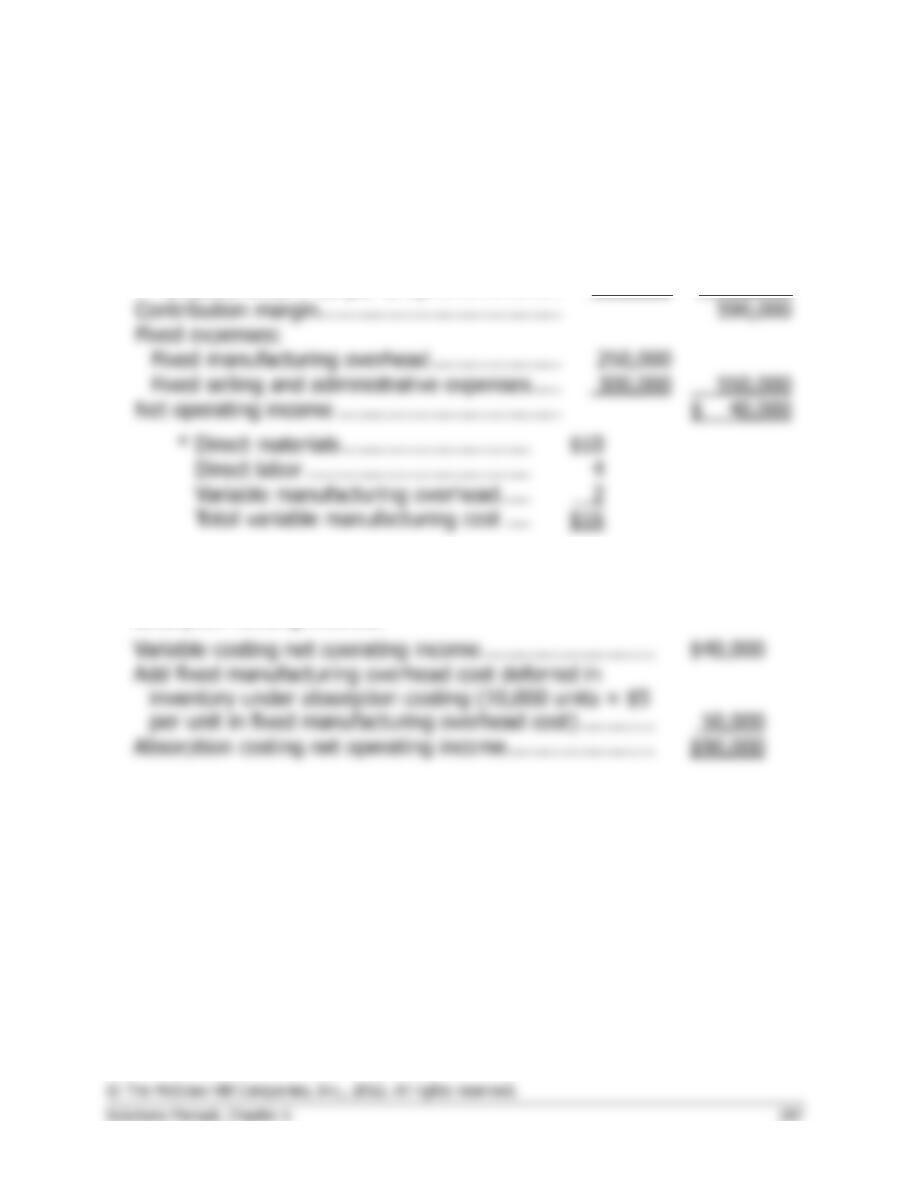
3. The net operating incomes are reconciled as follows:
Year 1
Year 2
Variable costing net operating income (loss)
$ 160,000
$ 270,000
Absorption costing net operating income …..
$ 230,000
Add: Fixed manufacturing overhead cost
Exercise 6-13 (20 minutes)
1.
Sales (40,000 units × $33.75 per unit) ………..
$1,350,000
Variable expenses:
Variable cost of goods sold
(40,000 units × $16 per unit*) ………………
$640,000
Variable selling and administrative expenses
(40,000 units × $3 per unit) …………………
120,000
760,000
Contribution margin …………………………………
Fixed expenses:
Net operating income ………………………………
$ 40,000
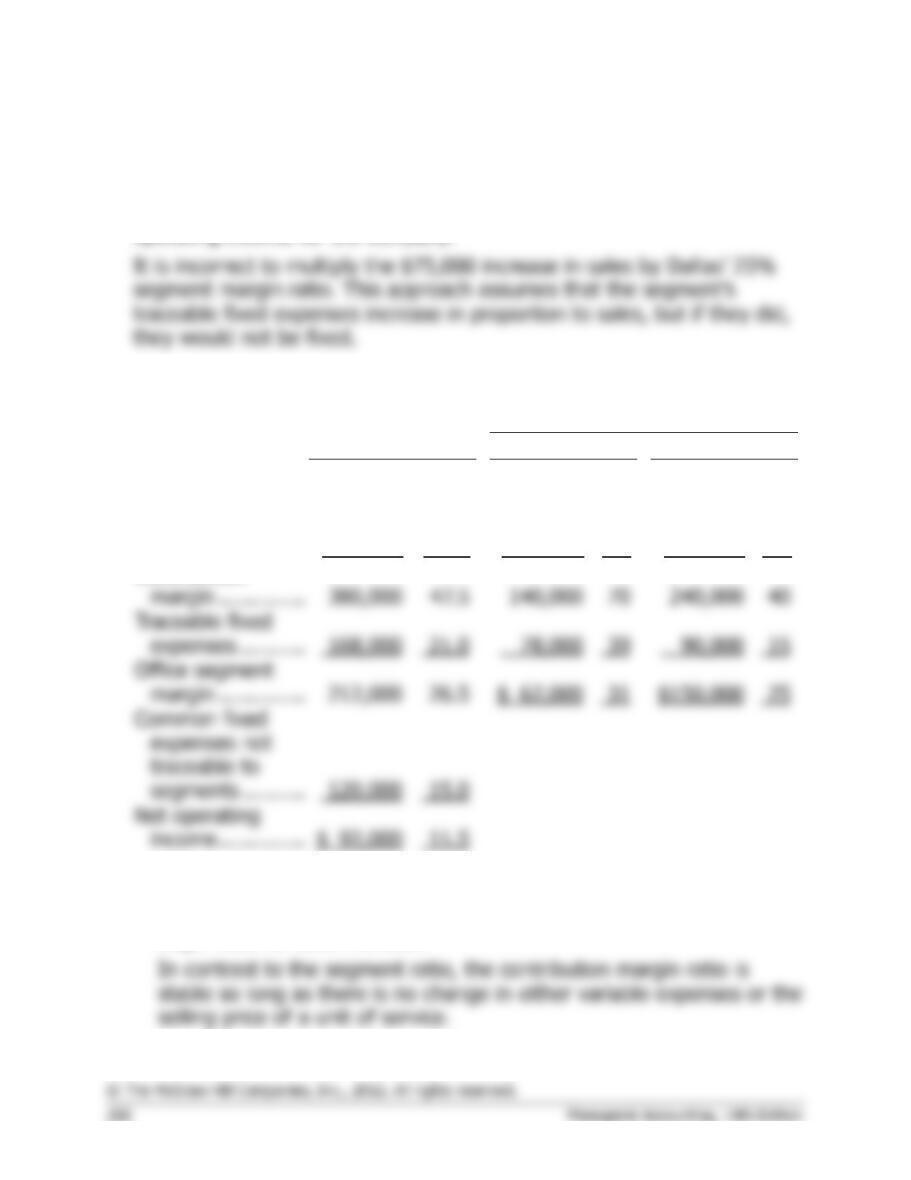
*
Direct materials …………………………
Direct labor ………………………………
Variable manufacturing overhead …..
Total variable manufacturing cost ….
2. The difference in net operating income can be explained by the $50,000
in fixed manufacturing overhead deferred in inventory under the
absorption costing method:
Variable costing net operating income ……………………….
$40,000
Absorption costing net operating income ……………………
$90,000
Exercise 6-14 (20 minutes)
1. $75,000 × 40% CM ratio = $30,000 increased contribution margin in
Dallas. Because the fixed costs in the office and in the company as a
whole will not change, the entire $30,000 would result in increased net
operating income for the company.
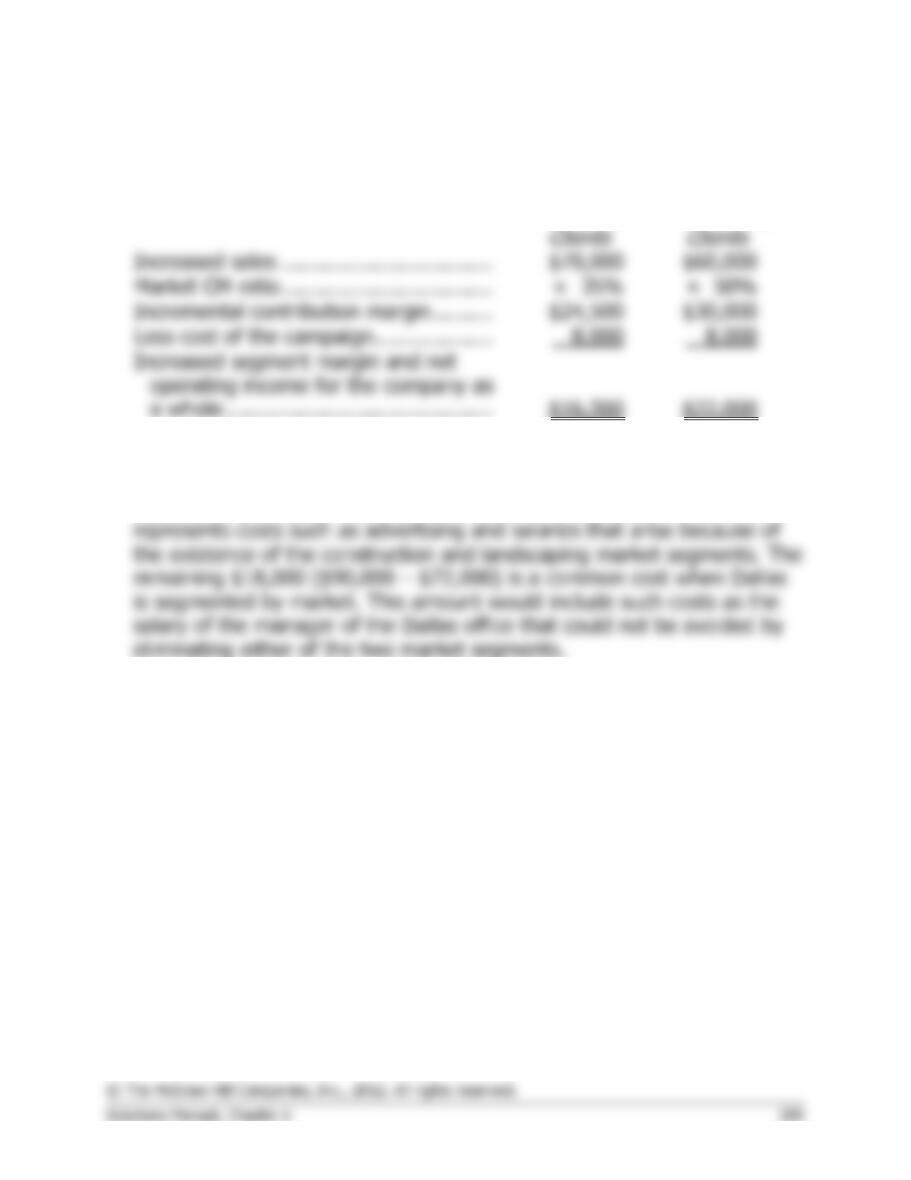
2. a. The segmented income statement follows:
Segments
Total Company
Houston
Dallas
Amount
%
Amount
%
Amount
%
Sales …………………..
$800,000
100.0
$200,000
100
$600,000
100
Variable
expenses ……………
420,000
52.5
60,000
30
360,000
60
Traceable fixed
expenses ……………
168,000
21.0
78,000
39
90,000
15
Office segment
$ 62,000
$150,000
11.5
Contribution
b. The segment margin ratio rises and falls as sales rise and fall due to
the presence of fixed costs. The fixed expenses are spread over a
larger base as sales increase.
Exercise 6-15 (15 minutes)
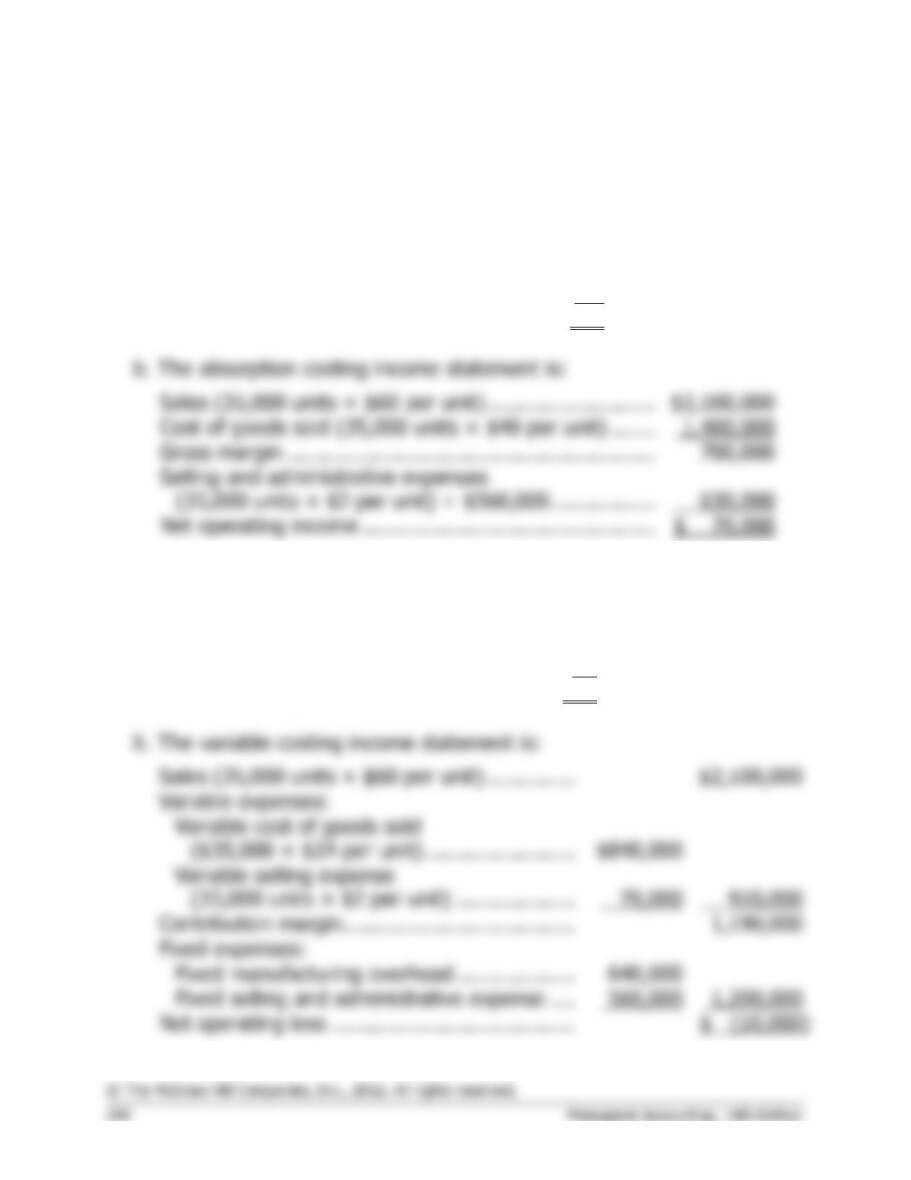
1. The company should focus its campaign on Landscaping Clients. The
computations are:
Less cost of the campaign ……………….
Construction
Landscaping
2. The $90,000 in traceable fixed expenses in the previous exercise is now
partly traceable and partly common. When we segment Dallas by
market, only $72,000 remains a traceable fixed expense. This amount
Problem 6-16 (45 minutes)
1. a. The unit product cost under absorption costing is:
Direct materials ………………………………
$15
Direct labor ……………………………………
7
Variable manufacturing overhead ……….
2
Fixed manufacturing overhead
(640,000 ÷ 40,000 units) ……………….
16
Absorption costing unit product cost ……
$40
Sales (35,000 units × $60 per unit) ………………………
Cost of goods sold (35,000 units × $40 per unit) …….
Gross margin …………………………………………………..
Selling and administrative expenses
Net operating income ………………………………………..
2. a. The unit product cost under variable costing is:
Direct materials ………………………………
$15
Direct labor ……………………………………
7
Variable manufacturing overhead ……….
2
Variable costing unit product cost ……….
$24
Sales (35,000 units × $60 per unit) …………..
Variable expenses:
Contribution margin ……………………………….
Fixed expenses:
Net operating loss …………………………………