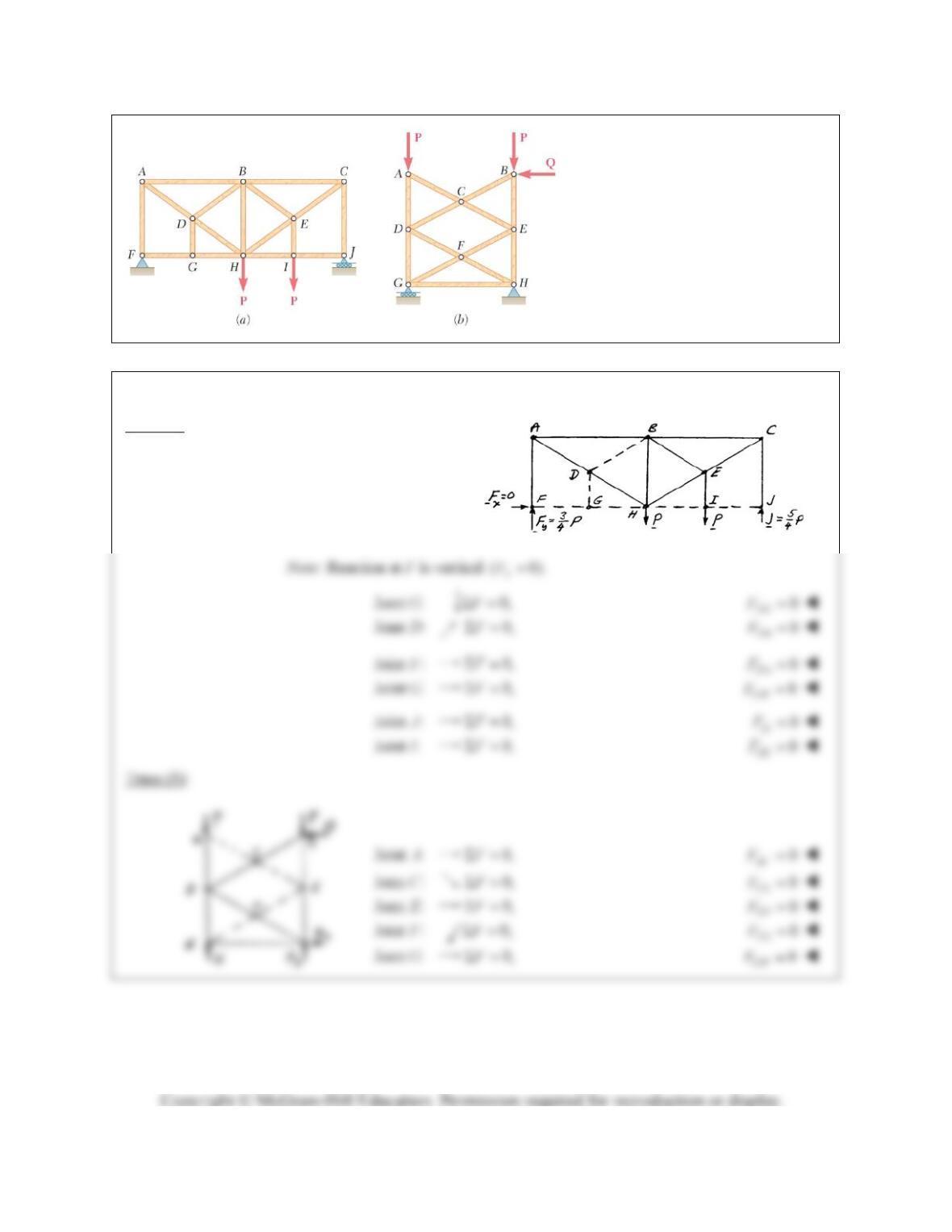
PROBLEM 6.33
For the given loading, determine the
zero-force members in each of the
two trusses shown.
SOLUTION
Truss (a):
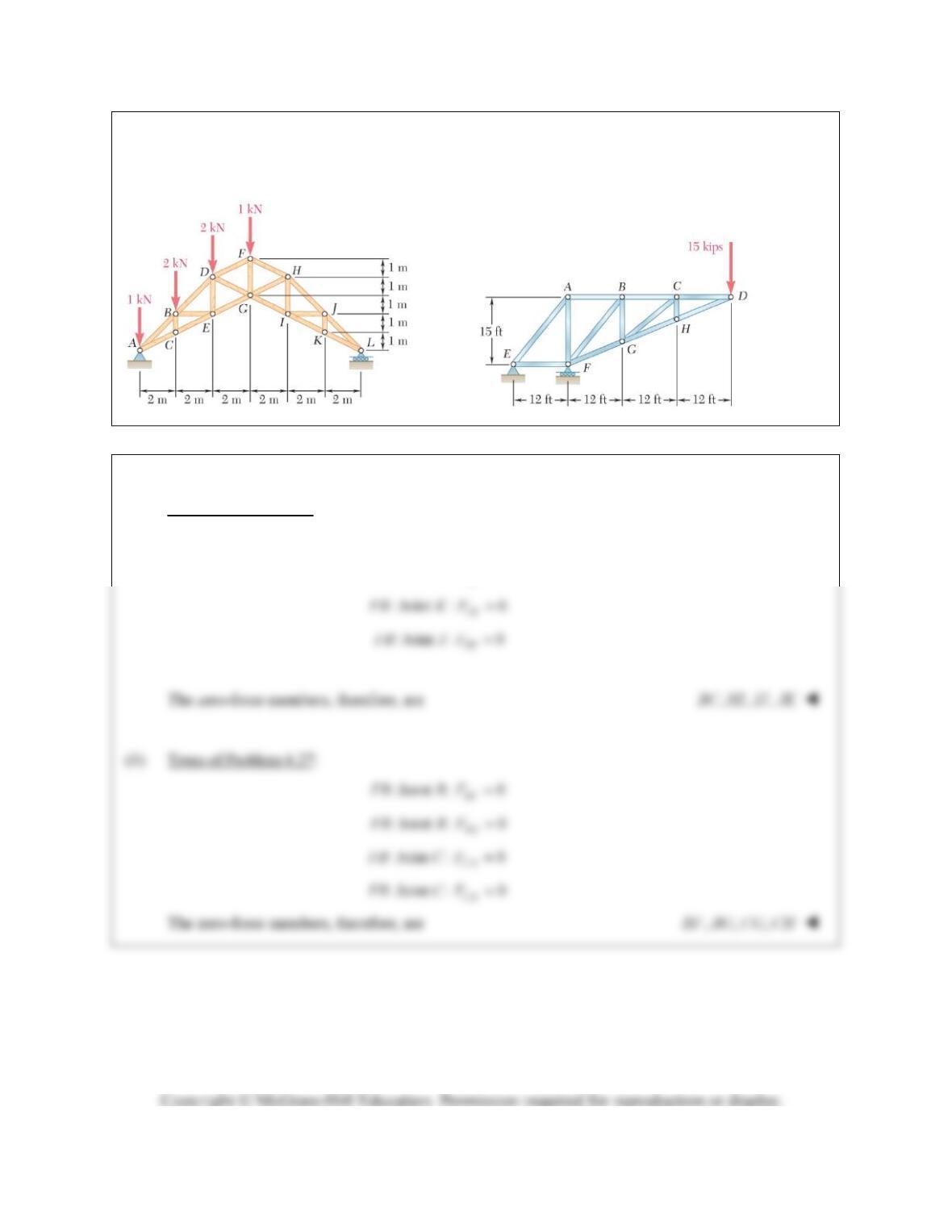
PROBLEM 6.34
Determine the zero-force members in the truss of (a) Problem 6.21, (b) Problem 6.27.
SOLUTION
(a) Truss of Problem 6.21:
:Joint : 0
BC
FB C F
:Joint : 0
IJ
FB J F
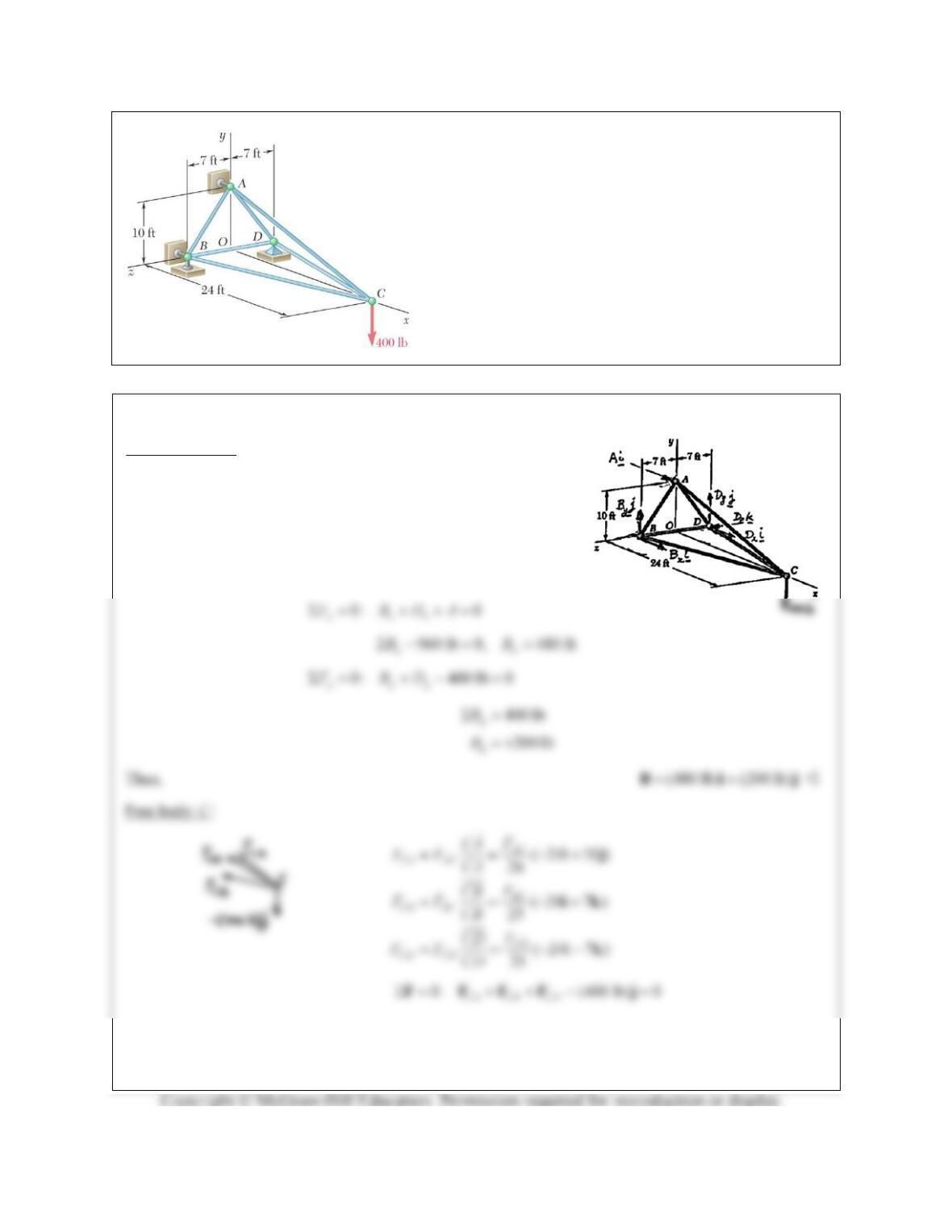
PROBLEM 6.35*
The truss shown consists of six members and is supported
by a short link at A, two short links at B, and a ball and
socket at D. Determine the force in each of the members
for the given loading.
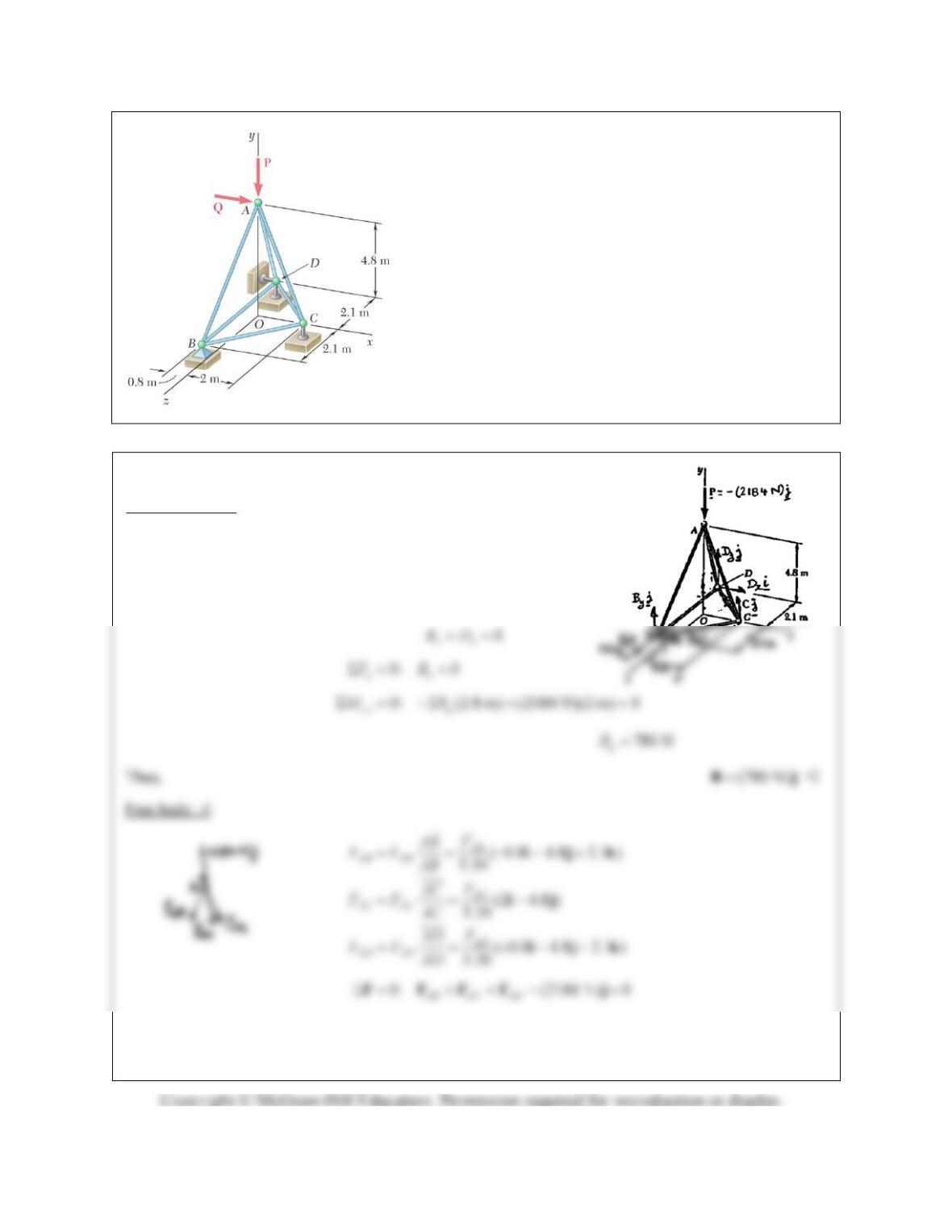
SOLUTION
Free body: Truss:
From symmetry:
and
xx yy
DB DB
0: (10 ft) (400 lb)(24 ft) 0
z
MA
960 lbA
PROBLEM 6.35* (Continued)
Substituting for
,,,
CA CB CD
FFF
and equating to zero the coefficients of
,, :ijk
i: 24 24 ()0
26 25
AC BC CD
FFF (1)
j: 10 400 lb 0
26
AC
F
1040 lb
AC
FT
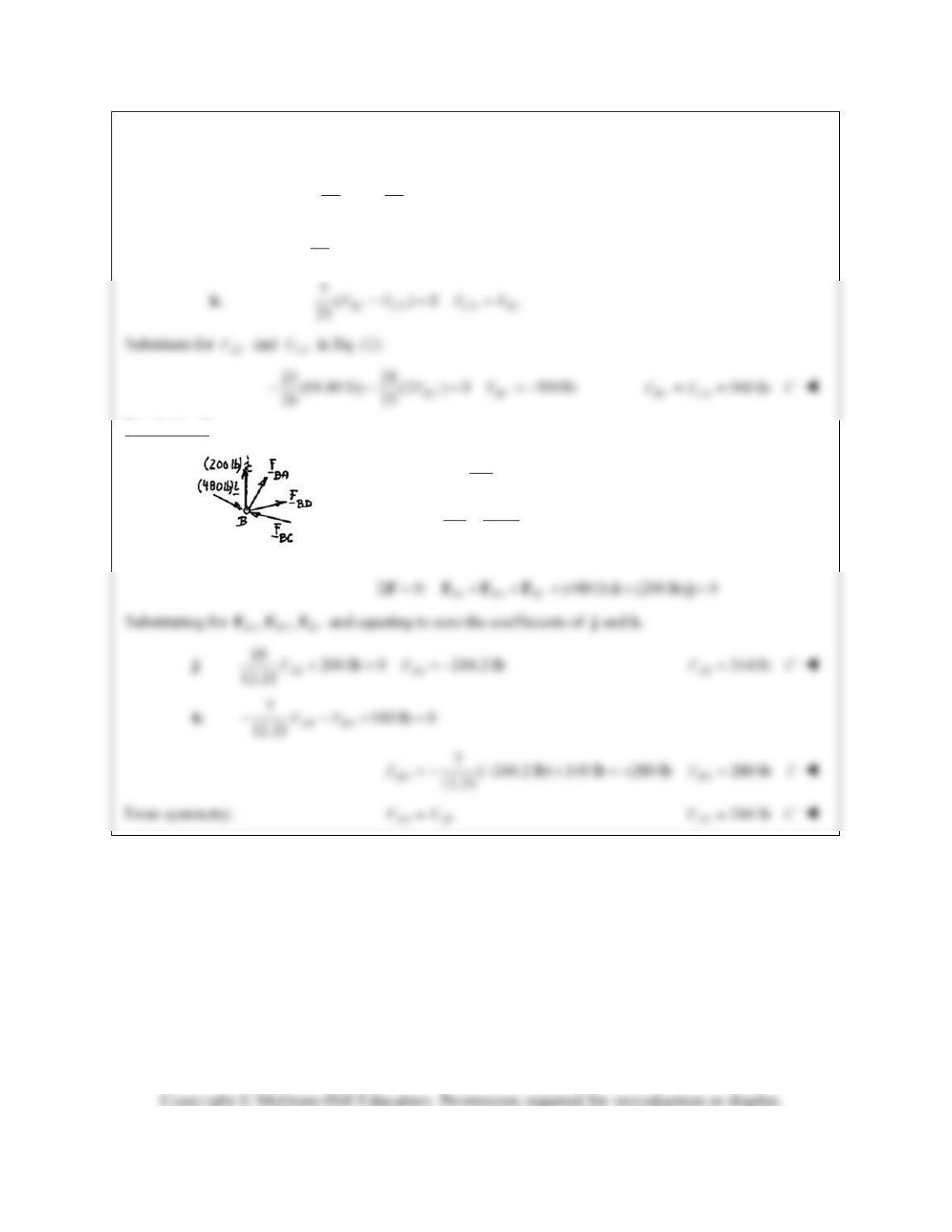
Free body: B:
(500 lb) (480 lb) (140 lb)
(10 7 )
12.21
BC
AB
BA AB
BD BD
CB
FCB
F
BA
FF
BA
FF
ik
jk
k
PROBLEM 6.36*
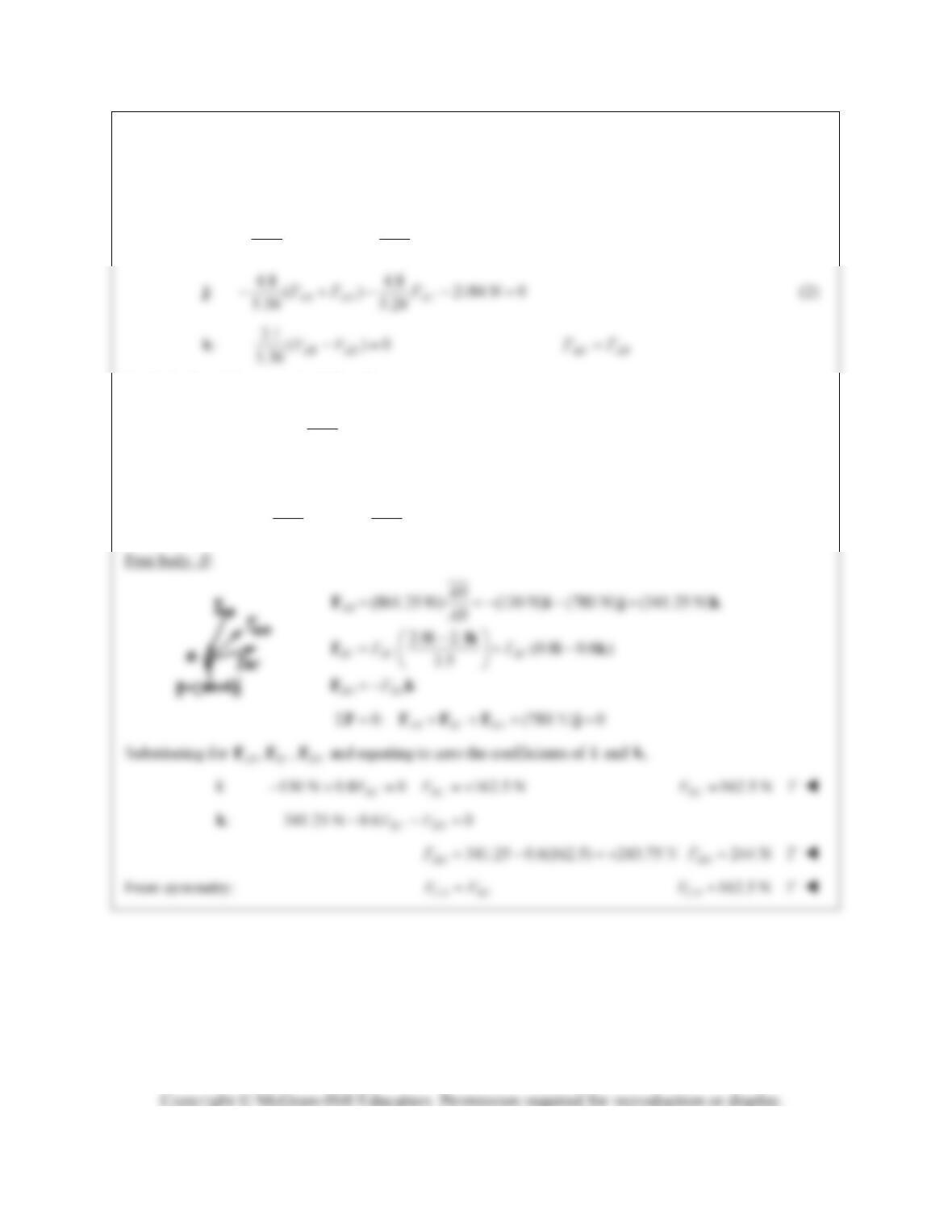
The truss shown consists of six members and is supported by
a ball and socket at B, a short link at C, and two short links at
D. Determine the force in each of the members for
P (2184 N)j and Q 0.
SOLUTION
Free body: Truss:
From symmetry:
and
xx yy
DB DB
0: 2 0
xx
FB
PROBLEM 6.36* (Continued)
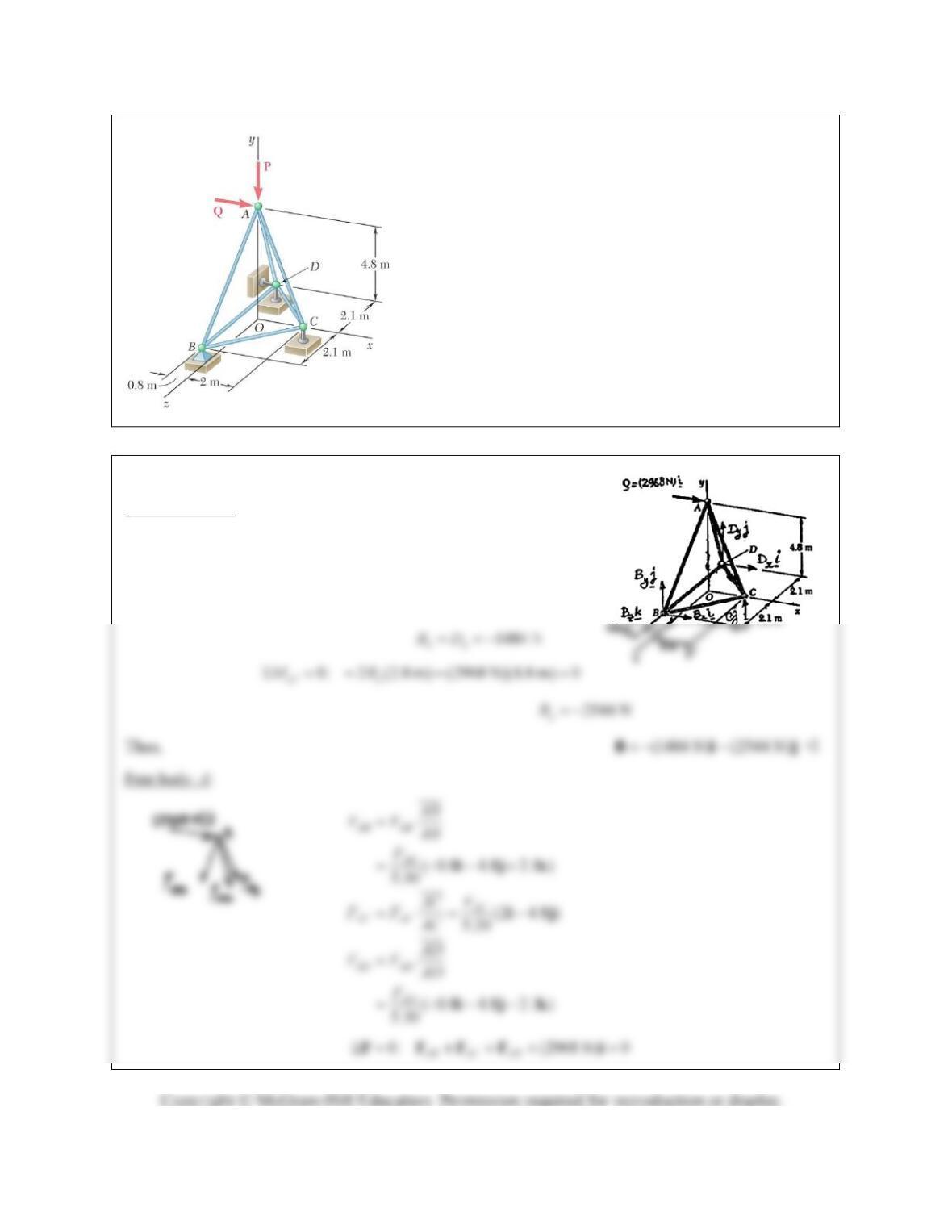
Substituting for
,,,
AB AC AD
FFF
and equating to zero the coefficients of
,, :ijk
i: 0.8 2
() 0
5.30 5.20
AB AD AC
FF F (1)
Multiply Eq. (1) by –6 and add Eq. (2):
16.8 2184 N 0, 676 N
5.20
AC AC
FF
676 N
AC
FC
Substitute for
AC
F
and
AD
F
in Eq. (1):
0.8 2
2(676N)0,861.25N
5.30 5.20
AB AB
FF
861 N
AB AD
FF C
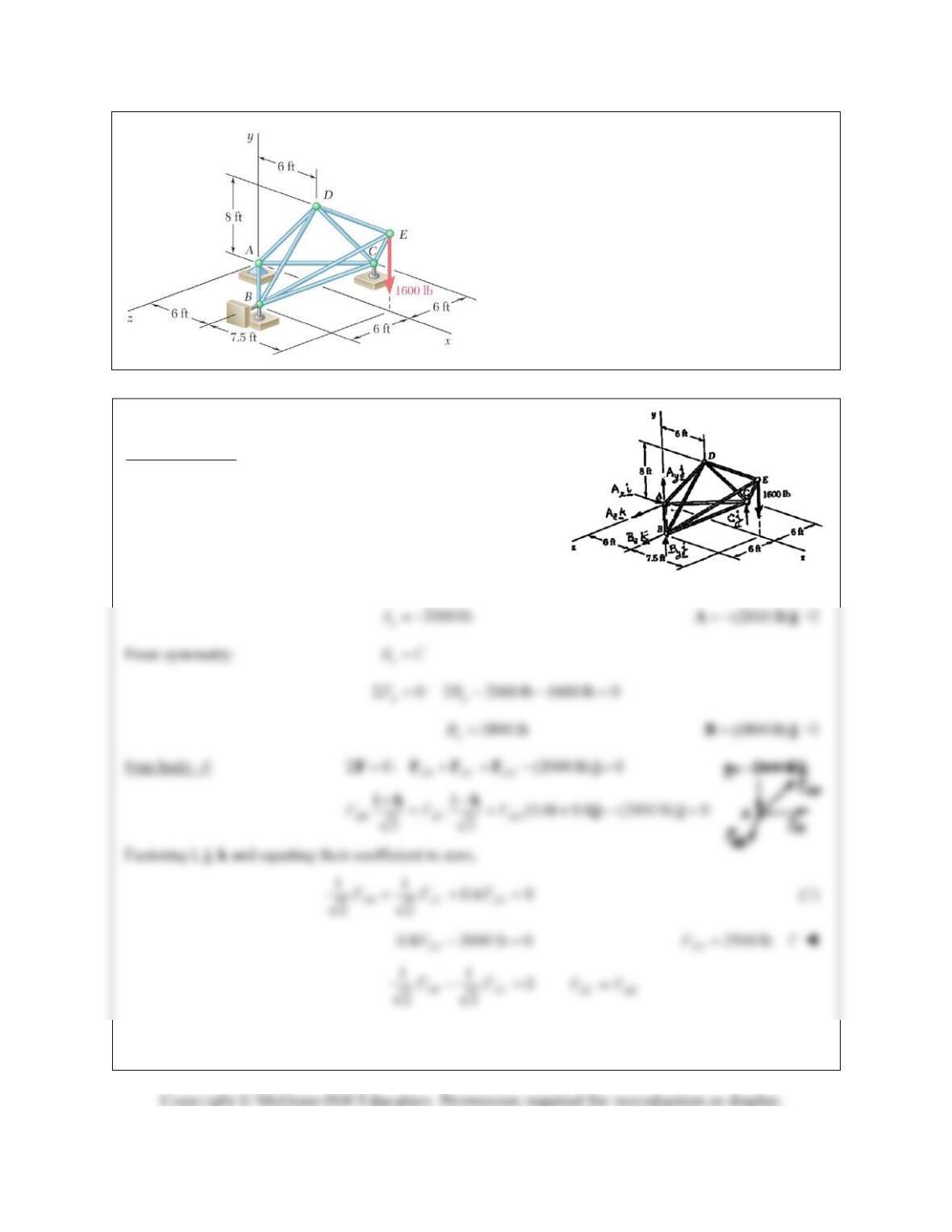
PROBLEM 6.37*
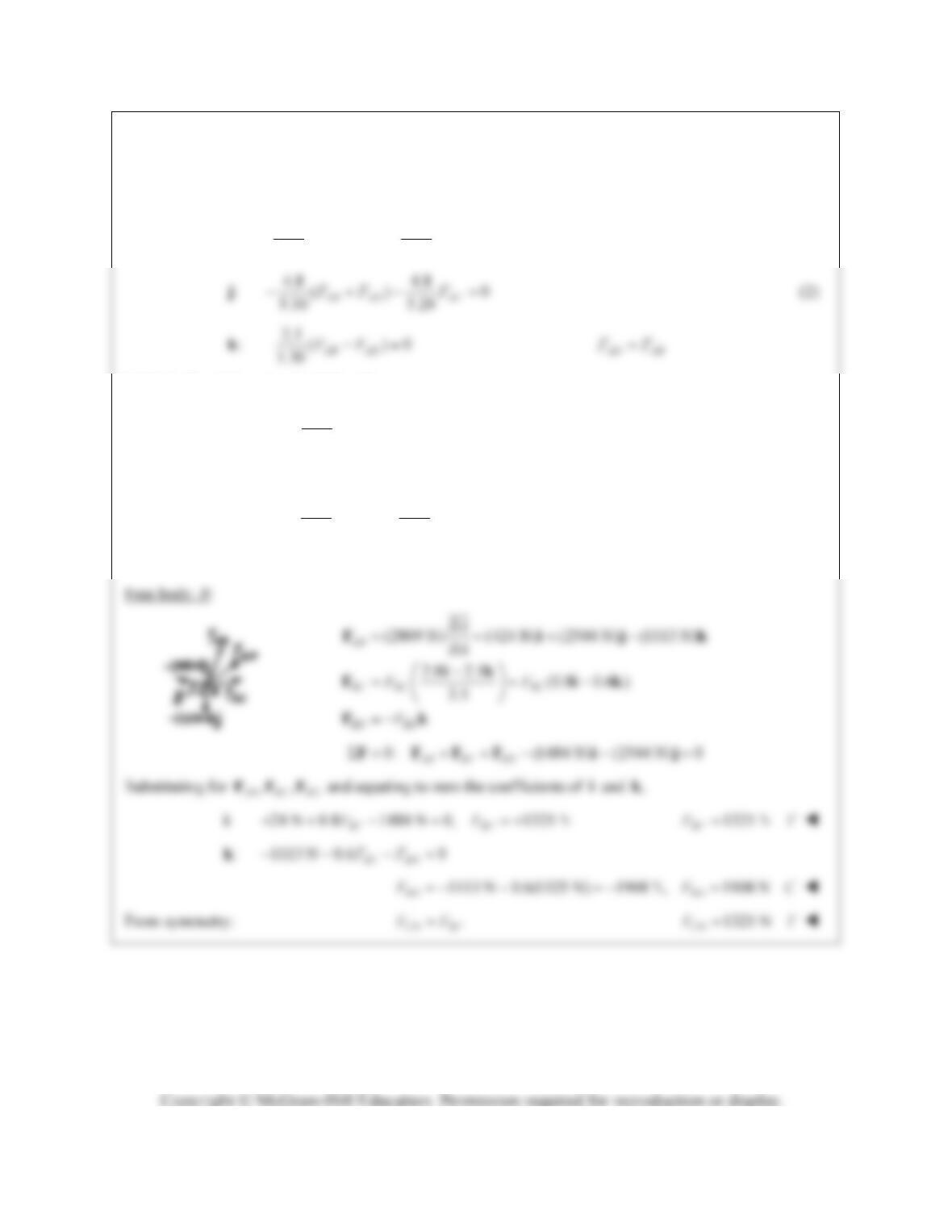
The truss shown consists of six members and is supported by
a ball and socket at B, a short link at C, and two short links at
D. Determine the force in each of the members for P 0 and
Q (2968 N)i.
SOLUTION
Free body: Truss:
From symmetry:
and
xx yy
DB DB
0: 2 2968 N 0
xx
FB
PROBLEM 6.37* (Continued)
Substituting for
,,,
AB AC AD
FFF
and equating to zero the coefficients of
,, ,ijk
i: 0.8 2
( ) 2968 N 0
5.30 5.20
AB AD AC
FF F (1)
Multiply Eq. (1) by –6 and add Eq. (2):
16.8 6(2968 N) 0, 5512 N
5.20
AC AC
FF
5510 N
AC
FC
Substitute for
AC
F
and
AD
F
in Eq. (2):
4.8 4.8
2 ( 5512 N) 0, 2809 N
5.30 5.20
AB AB
FF
2810 N
AB AD
FF T
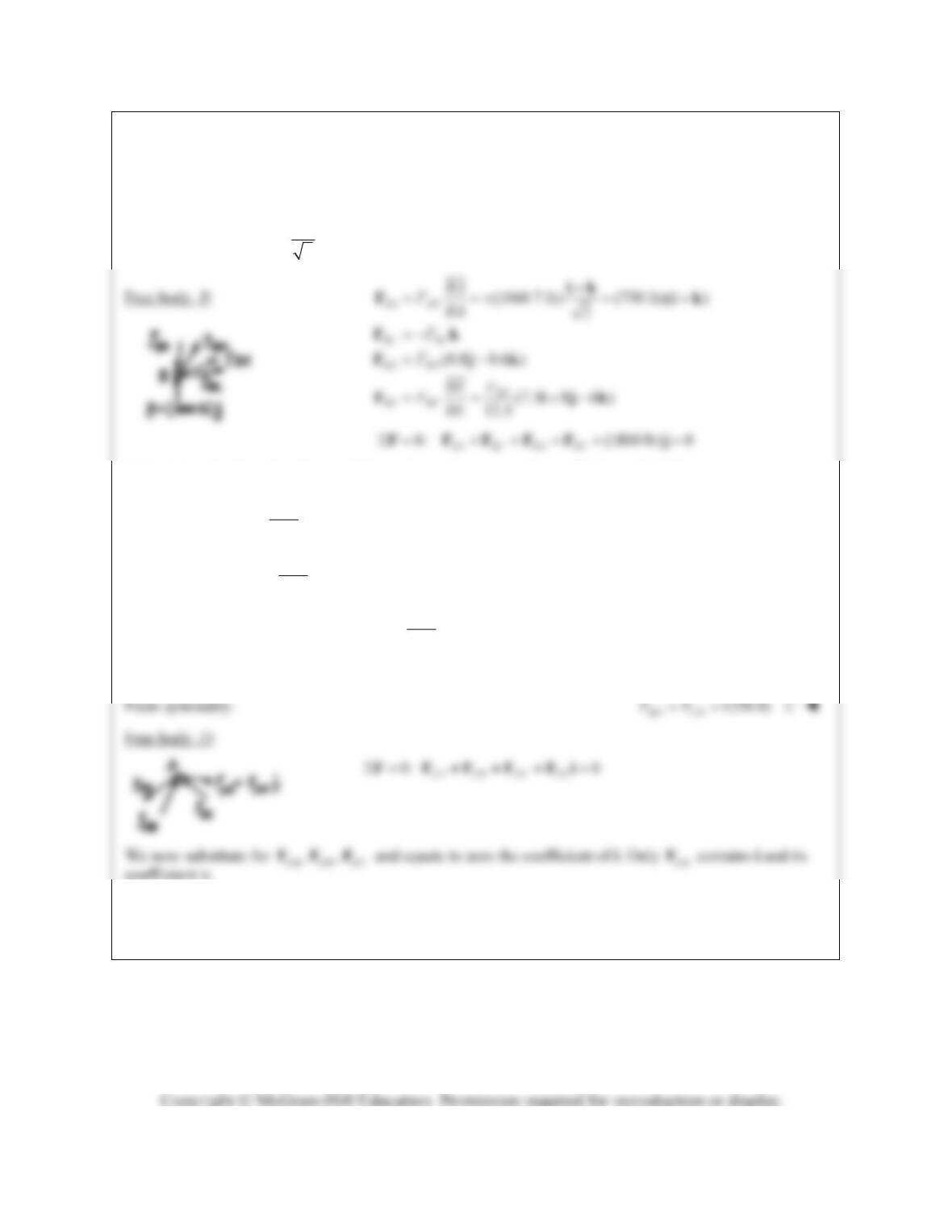
PROBLEM 6.38*
The truss shown consists of nine members and is
supported by a ball and socket at A, two short
links at B, and a short link at C. Determine the
force in each of the members for the given
loading.
SOLUTION
Free body: Truss:
From symmetry:
0
zz
AB
0: 0
xx
FA
0: (6 ft) (1600 lb)(7.5 ft) 0
BC y
MA
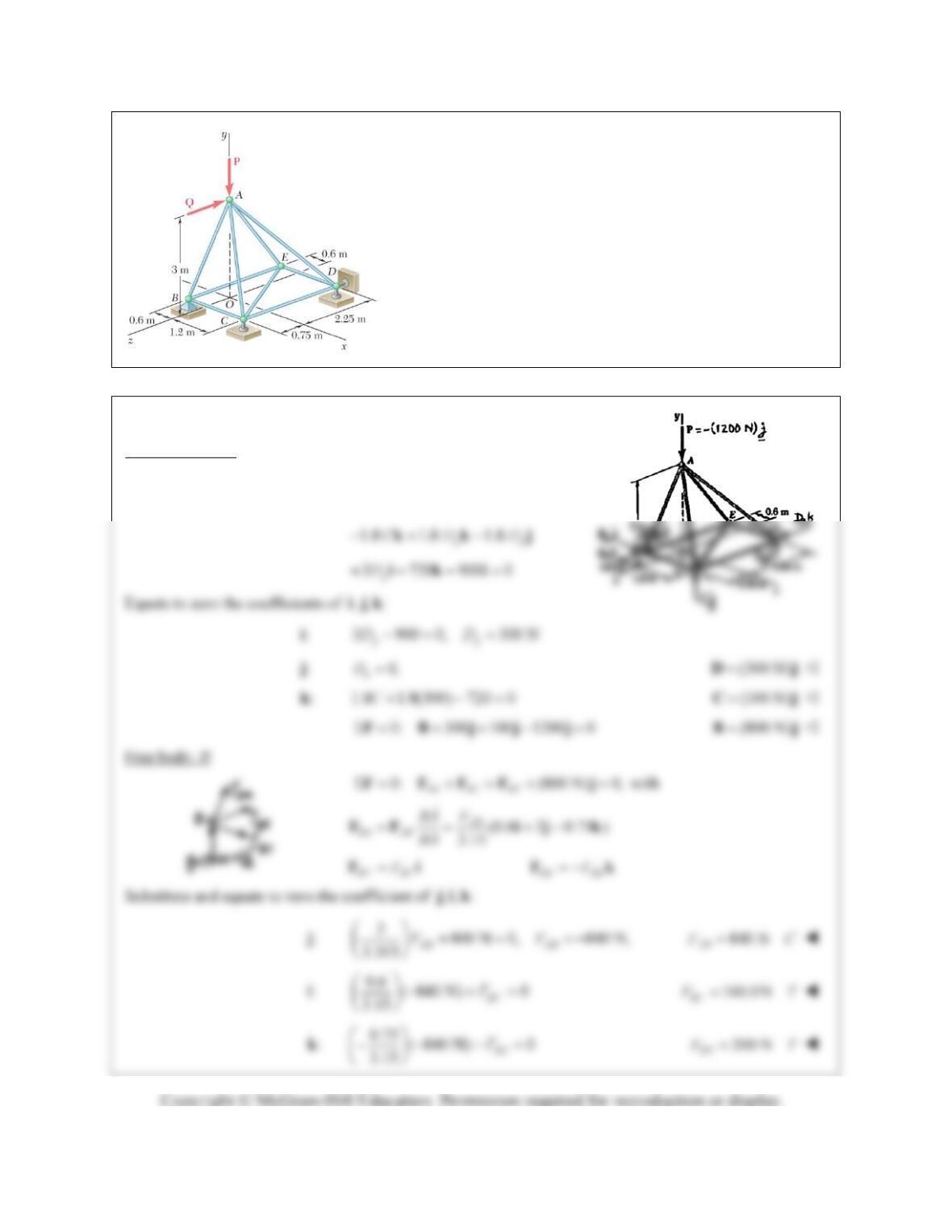
PROBLEM 6.38* (Continued)
Substitute for
AD
F
and
AC
F
into Eq. (1):
20.6(2500 lb) 0, 1060.7 lb,
2
AB AB
FF
1061 lb
AB AC
FF C
Substituting for
,,,and
BA BC BD BE
FFF F
and equating to zero the coefficients of
,, ,ijk
i:
7.5
750lb 0, 1250lb
12.5
BE BE
FF
1250 lb
BE
FC
j:
8
0.8 ( 1250 lb) 1800 lb 0
12.5
BD
F
1250 lb
BD
FC
k: 6
750lb 0.6( 1250lb) ( 1250lb) 0
12.5
BC
F
2100 lb
BC
FT
0.6 0.6(2500 lb) 1500 lb
AD
F
i:
1500 lb 0
DE
F
1500 lb
DE
FT
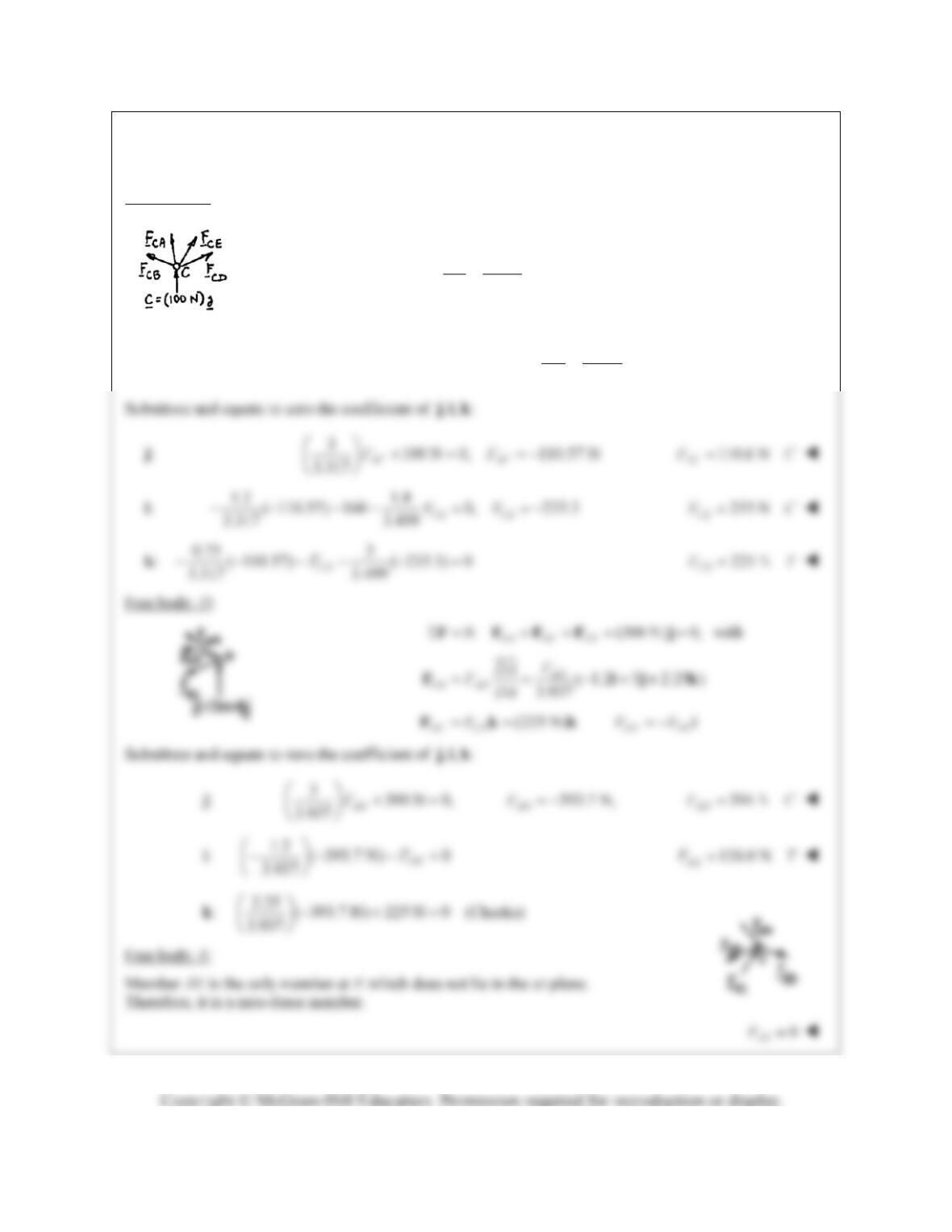
PROBLEM 6.39*
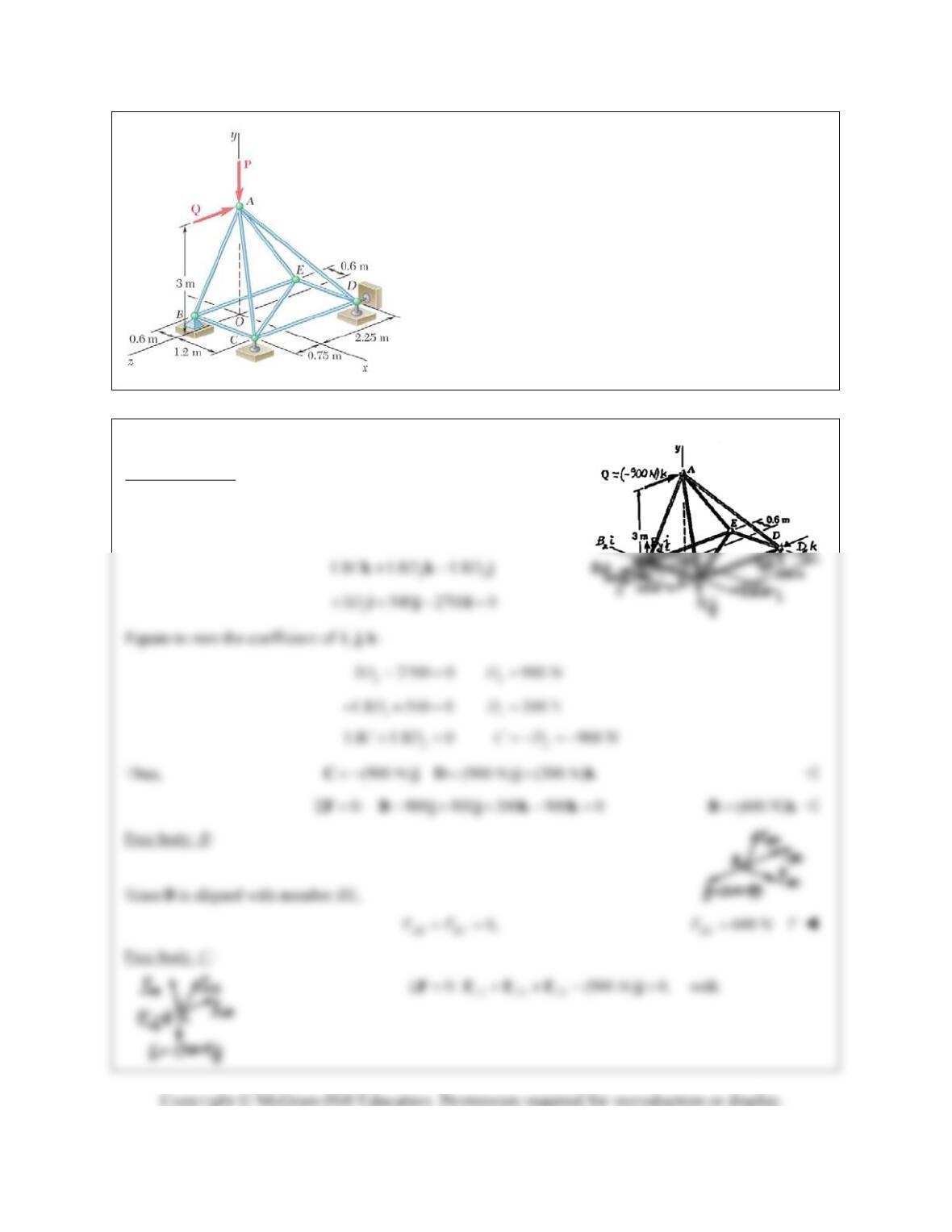
The truss shown consists of nine members and is supported by a
ball and socket at B, a short link at C, and two short links at D.
(a) Check that this truss is a simple truss, that it is completely
constrained, and that the reactions at its supports are statically
determinate. (b) Determine the force in each member for
P (1200 N)j and Q 0.
SOLUTION
Free body: Truss:
0: 1.8 (1.8 3 ) ( )
By
CDD Mijikjk
(0.6 0.75 ) ( 1200 ) 0 ik j
PROBLEM 6.39* (Continued)
Free body: C:
0: (100 N) 0,
CA CB CD CE
FFFFF j
with
( 1.2 3 0.75 )
3.317
AC
CA AC
F
CA
FCA
Fijk
(160 N)
CB
F i
(1.8 3)
3, 499
CE
CD CD CE CE
F
CE
FCE
FkFF ik
PROBLEM 6.40*
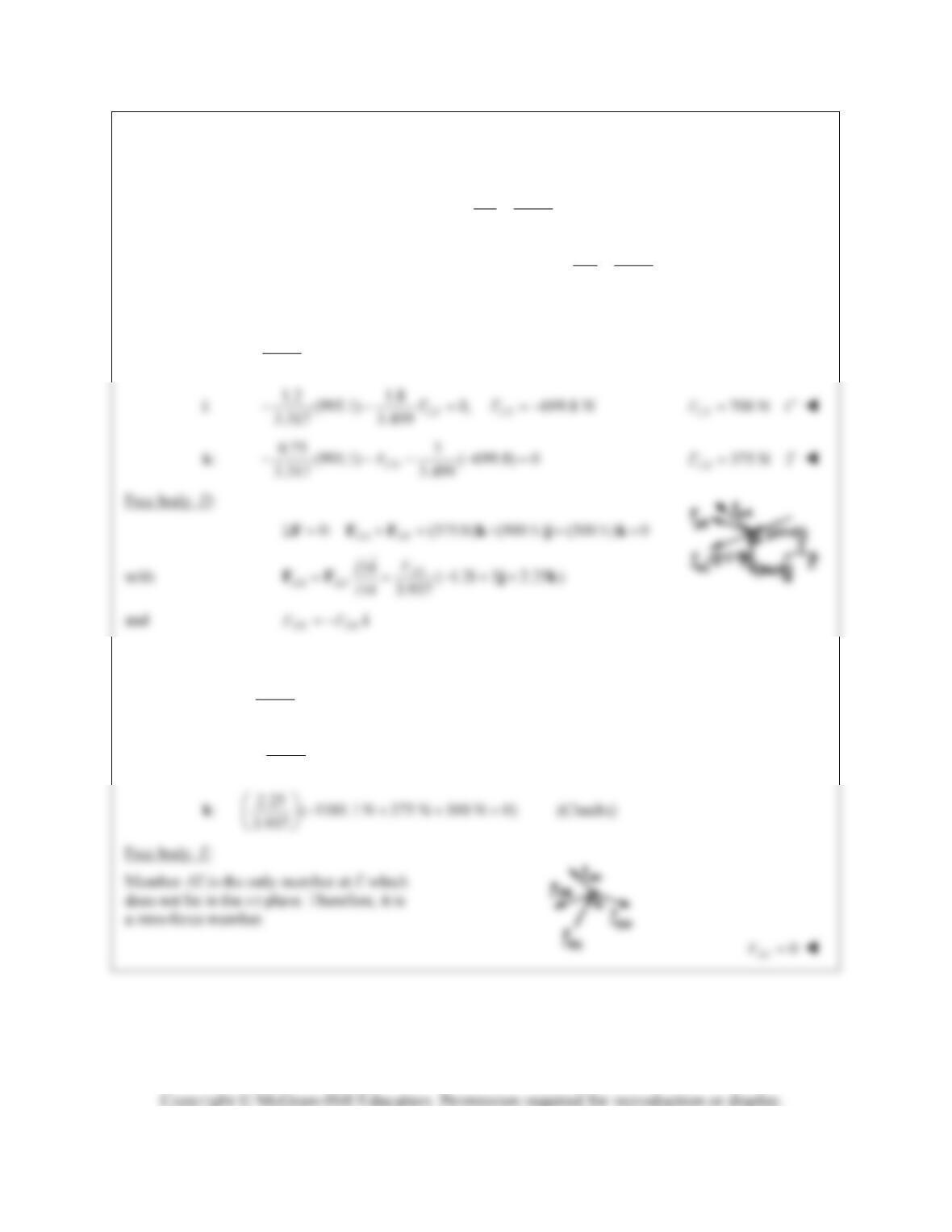
Solve Problem 6.39 for P 0 and Q (900 N)k.
PROBLEM 6.39* The truss shown consists of nine
members and is supported by a ball and socket at B, a short
link at C, and two short links at D. (a) Check that this truss
is a simple truss, that it is completely constrained, and that
the reactions at its supports are statically determinate. (b)
Determine the force in each member for P (1200 N)j
and Q 0.
SOLUTION
Free body: Truss:
0: 1.8 (1.8 3 ) ( )
Byz
CDD Mijikjk
(0.6 3 0.75 ) ( 900N) 0 ij k k
PROBLEM 6.40* (Continued)
( 1.2 3 0.75 )
3.317
AC
CA AC
F
CA
FCA
Fijk
(1.8 3)
3.499
CE
CD CD CE CE
F
CE
FF
CE
FkF ik
Substitute and equate to zero the coefficient of
,, :jik
j:
3900 N 0,
3.317
AC
F
995.1 N
AC
F
995 N
AC
FT
Substitute and equate to zero the coefficient
,, :jik
j:
3900 N 0, 1181.1 N
3.937
AD AD
FF
1181 N
AD
FC
i:
1.2 ( 1181.1 N) 0
3.937
DE
F
360 N
DE
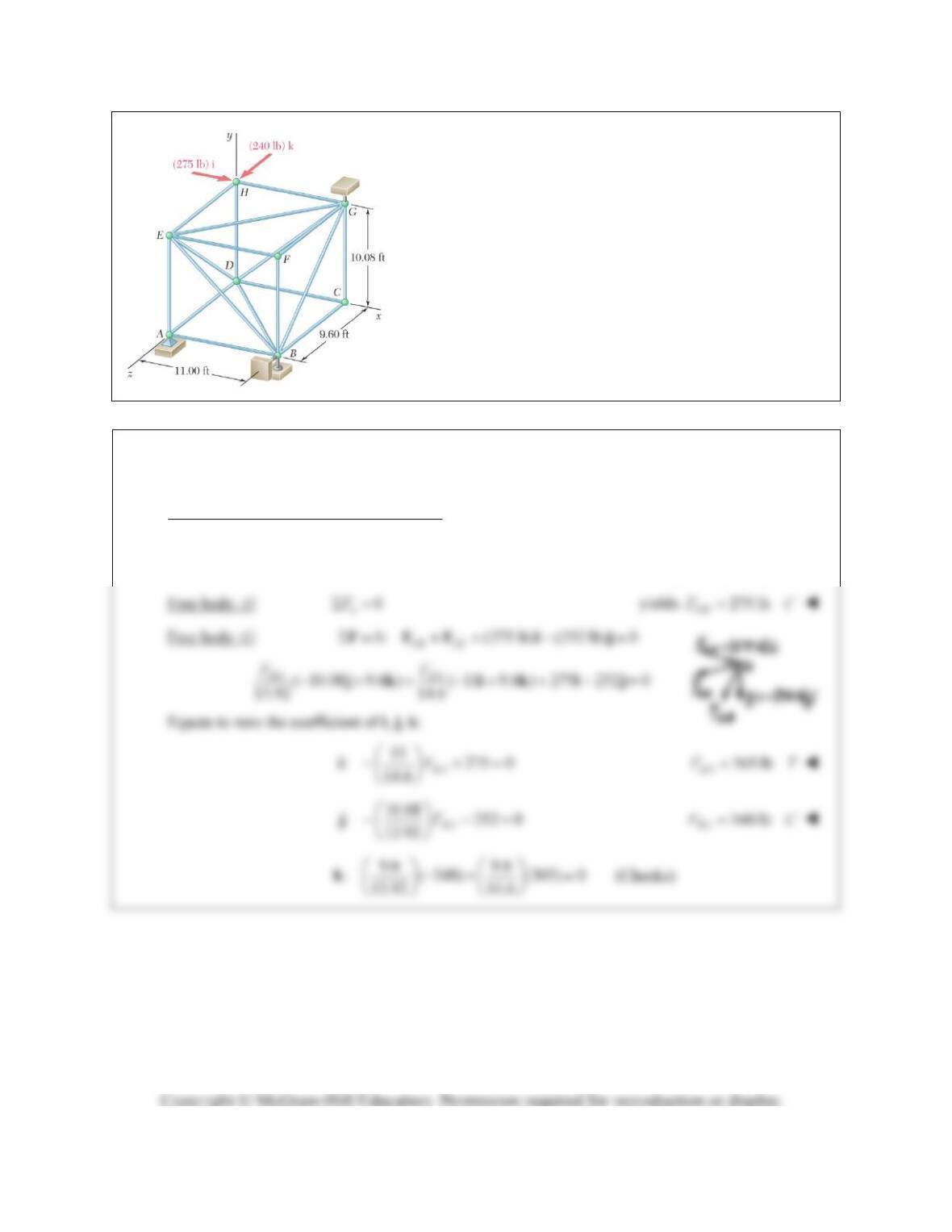
FT
PROBLEM 6.41*
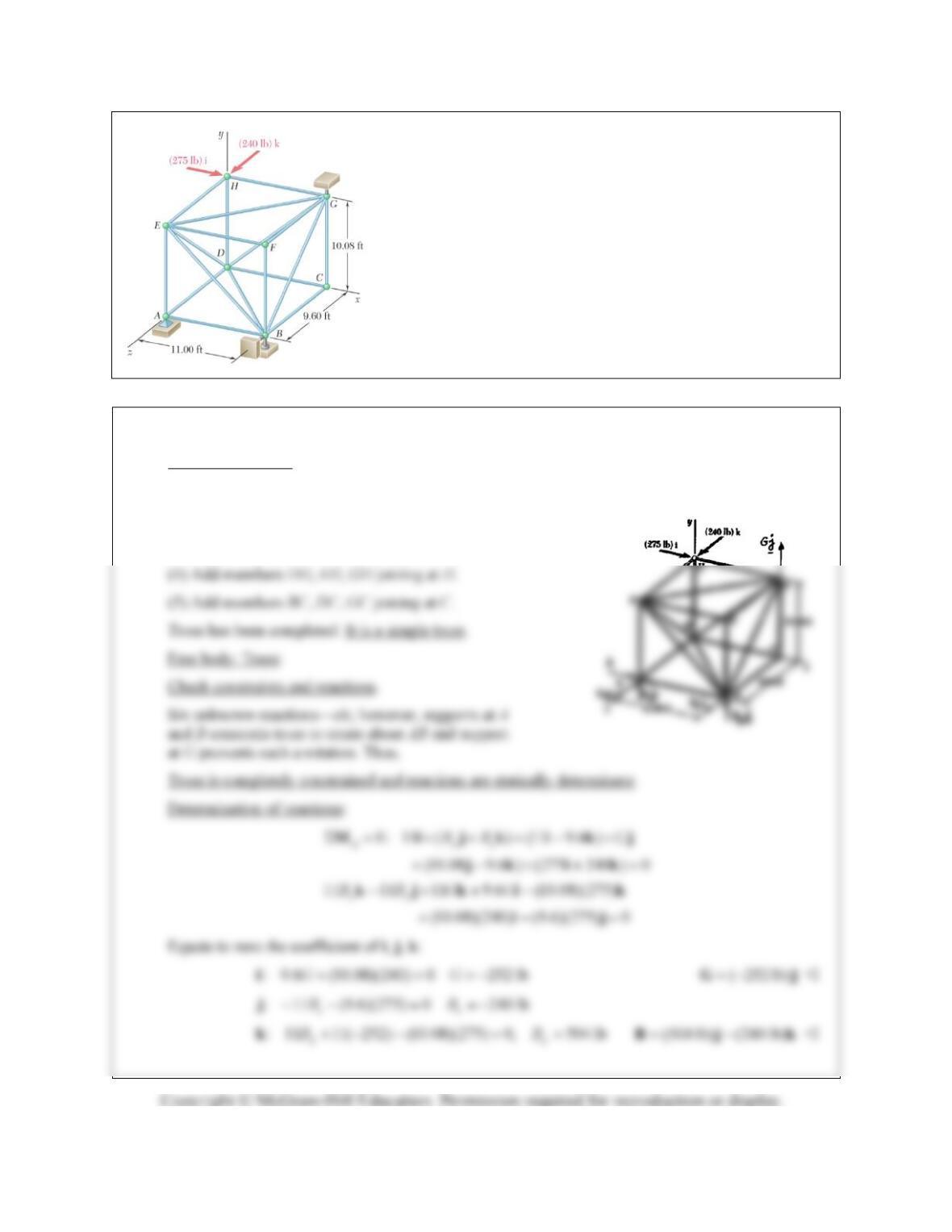
The truss shown consists of 18 members and is supported by a
ball and socket at A, two short links at B, and one short link at G.
(a) Check that this truss is a simple truss, that it is completely
constrained, and that the reactions at its supports are statically
determinate. (b) For the given loading, determine the force in each
of the six members joined at E.
SOLUTION
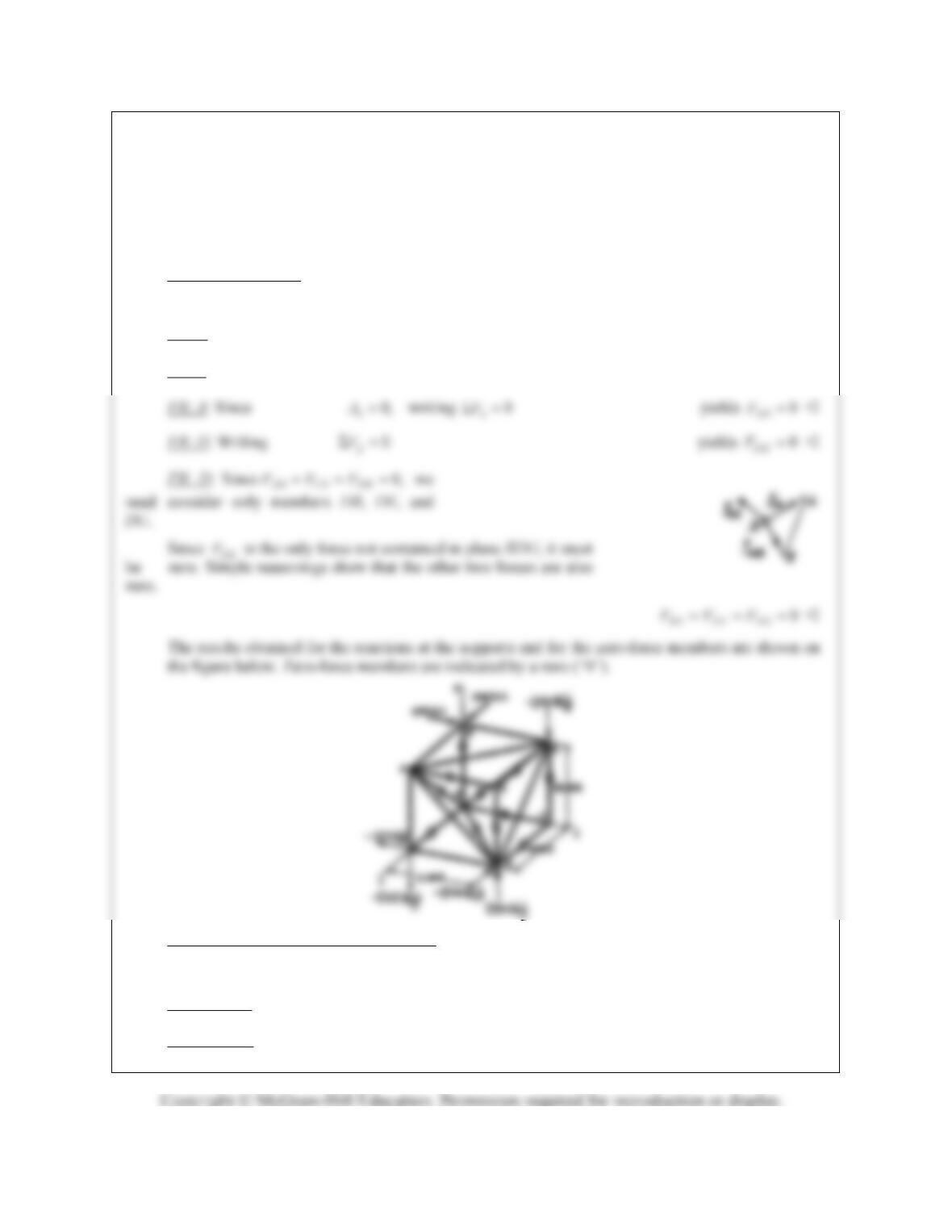
(a) Check simple truss.
(1) Start with tetrahedron BEFG.
(2) Add members BD, ED, GD joining at D.
(3) Add members BA, DA, EA joining at A.
PROBLEM 6.41* (Continued)
0: (504 lb) (240 lb) (252 lb)
(275 lb) (240 lb) 0
FA j k j
ik
(275 lb) (252 lb) Aij
Zero-force members.
The determination of these members will facilitate our solution.
FB: C: Writing
0, 0, 0
xyz
FFF
yields
0
BC CD CG
FFF
FB: F: Writing
0, 0, 0
xyz
FFF
yields
0
BF EF FG
FFF
(b) Force in each of the members joined at E.
We already found that
0
DE EF
FF
Free body: A:
0
y
F
yields
252 lb
AE
FT
Free body: H:
0
z
F
yields
240 lb
EH
FC
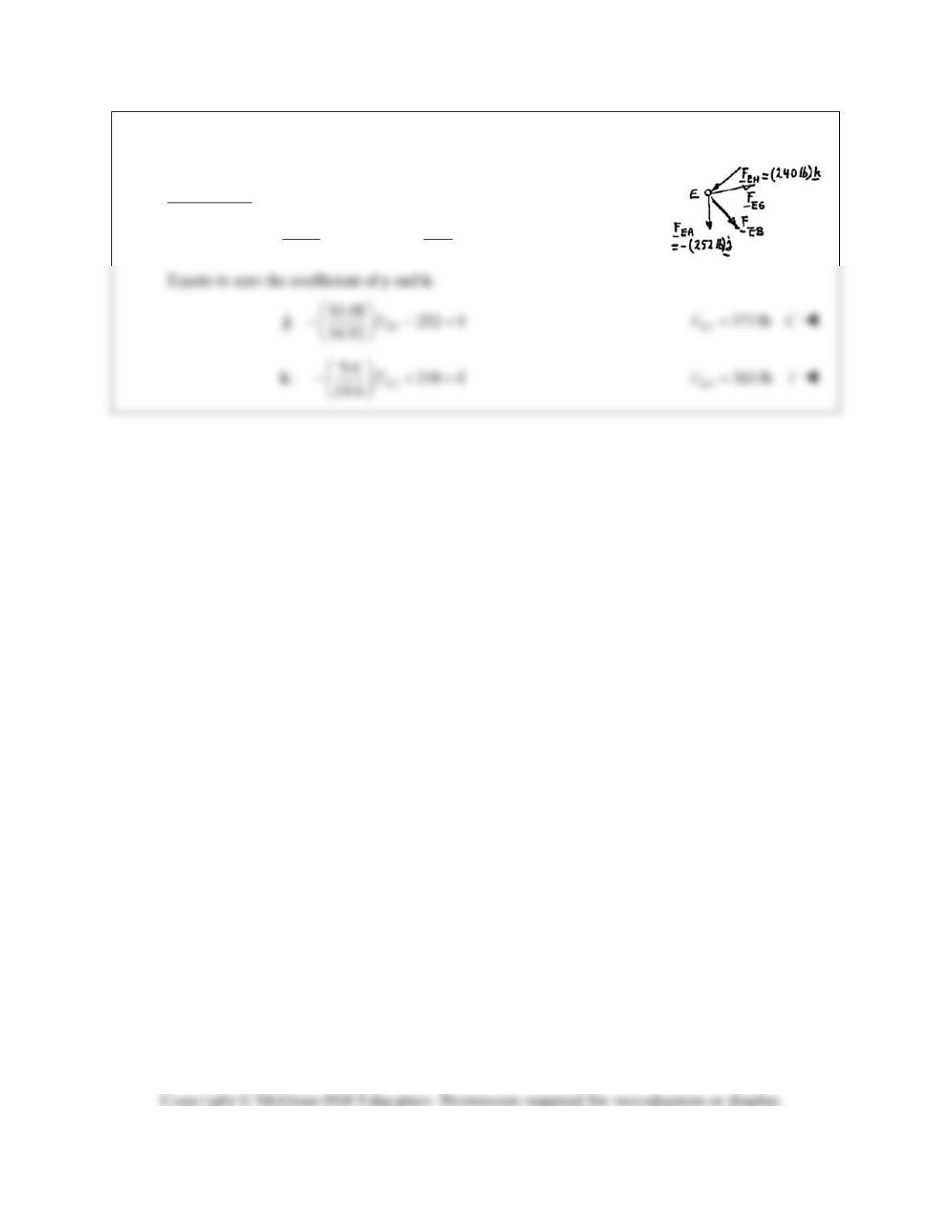
PROBLEM 6.41* (Continued)
Free body: E:
0: (240 lb) (252 lb) 0
EB EG
FFF k j
(11 10.08 ) (11 9.6 ) 240 252 0
14.92 14.6
EG
BE
F
F ij ikkj
PROBLEM 6.42*
The truss shown consists of 18 members and is supported by a
ball and socket at A, two short links at B, and one short link at
G. (a) Check that this truss is a simple truss, that it is
completely constrained, and that the reactions at its supports
are statically determinate. (b) For the given loading,
determine the force in each of the six members joined at G.
SOLUTION
See solution to Problem 6.41 for part (a) and for reactions and zero-force members.
(b) Force in each of the members joined at G.
We already know that
0
CG DG FG
FFF
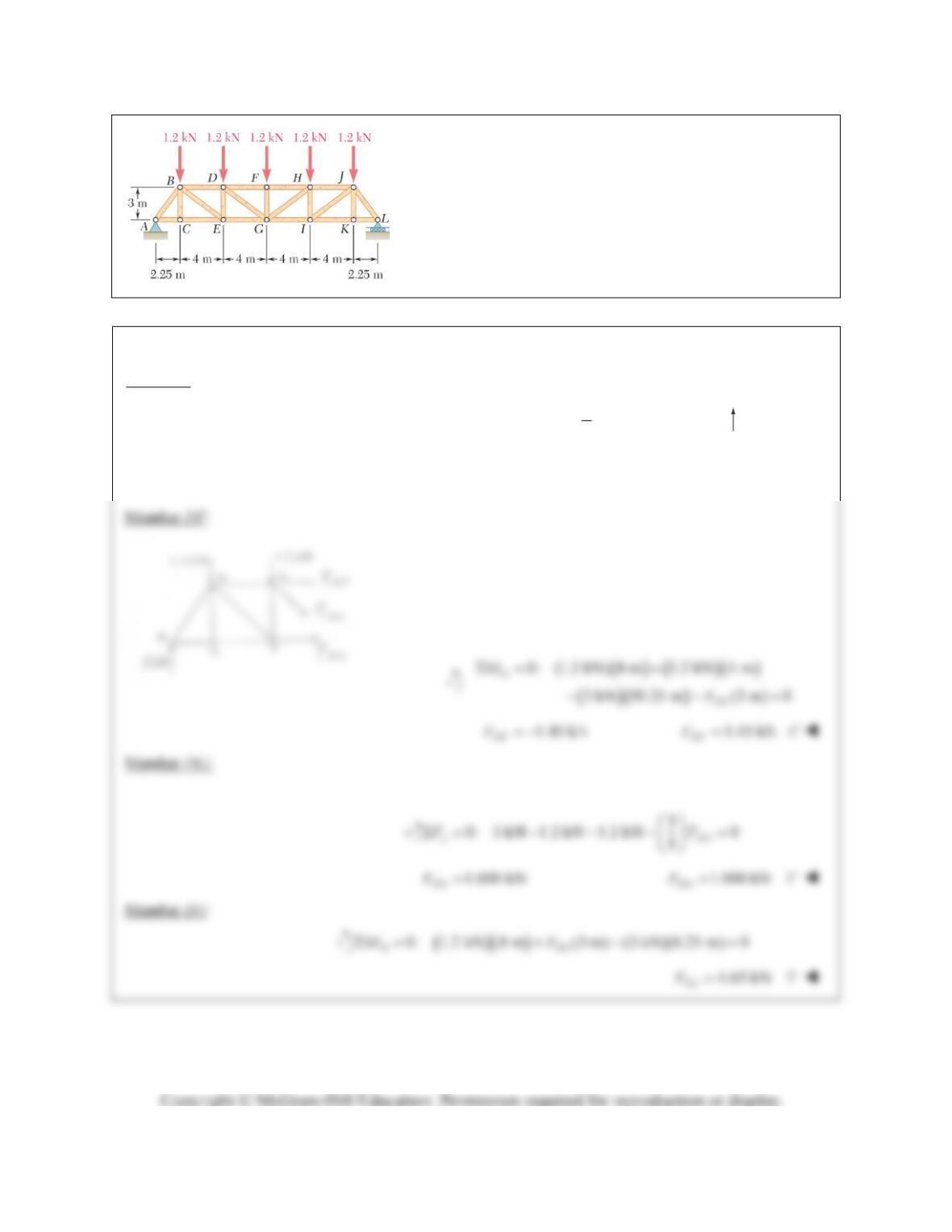
PROBLEM 6.43
A Mansard roof truss is loaded as shown. Determine the force in
members DF, DG, and EG.
SOLUTION
Reactions:
Because of the symmetry of the truss and loadings,
1
0, (1.2 kN) 5 3 kN
2
xy
AAL
We pass a section through DF, DG, and EG and use the free body shown:
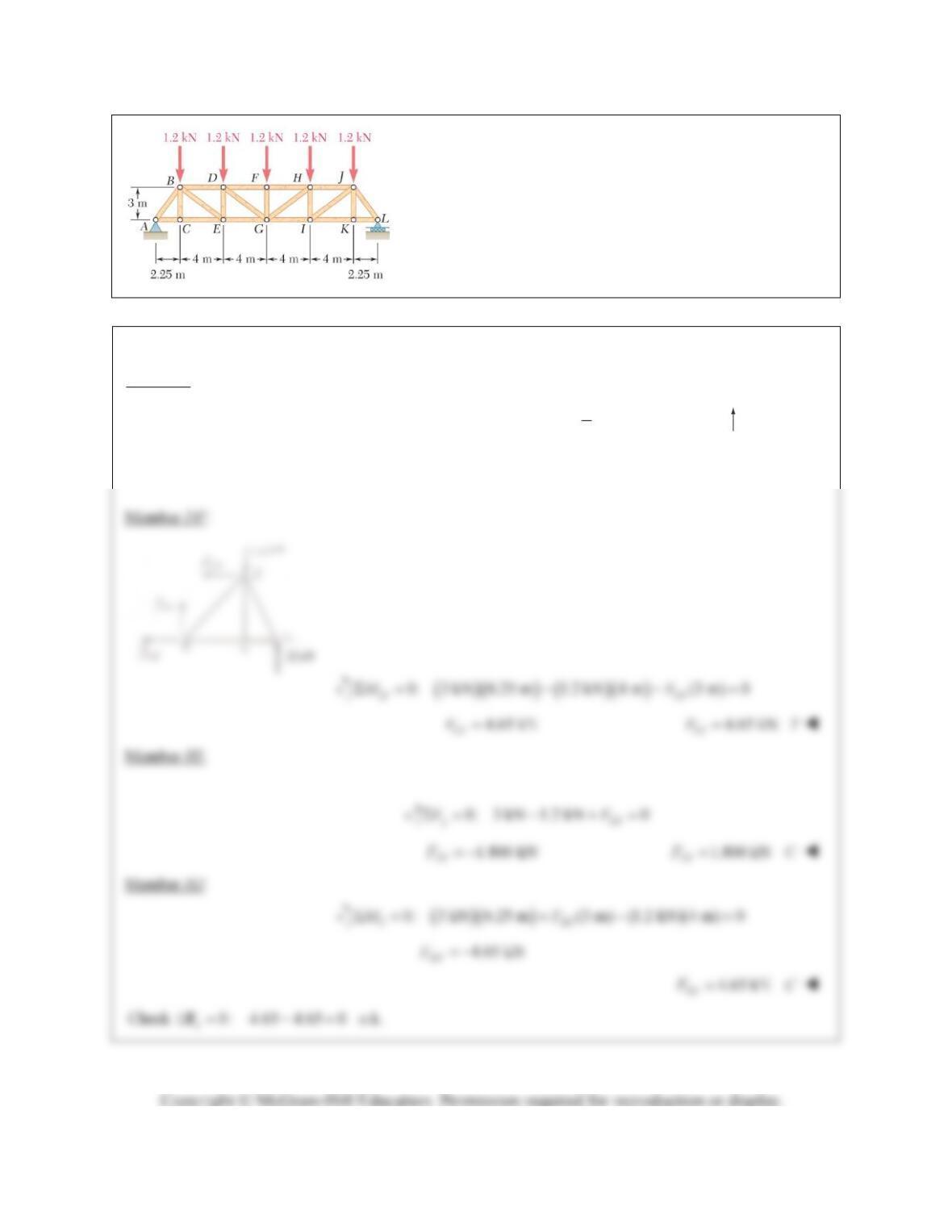
PROBLEM 6.44
A Mansard roof truss is loaded as shown. Determine the force in
members GI, HI, and HJ.
SOLUTION
Reactions:
Because of the symmetry of the truss and loadings,
1
0, (1.2 kN) 5 3 kN
2
xy
AAL
We pass a section through GI, HI, and HJ and use the free body shown: