CHAPTER 6
INTEREST RATES AND BOND VALUTION
Answers to Concepts Review and Critical Thinking Questions
1. No. As interest rates fluctuate, the value of a Treasury security will fluctuate. Long-term Treasury
securities have substantial interest rate risk.
4. Prices and yields move in opposite directions. Since the bid price must be lower, the bid yield must be
higher.
5. There are two benefits. First, the company can take advantage of interest rate declines by calling in an
issue and replacing it with a lower coupon issue. Second, a company might wish to eliminate a
covenant for some reason. Calling the issue does this. The cost to the company is a higher coupon. A
put provision is desirable from an investor’s standpoint, so it helps the company by reducing the
coupon rate on the bond. The cost to the company is that it may have to buy back the bond at an
unattractive price.
7. Yes. Some investors have obligations that are denominated in dollars; i.e., they are nominal. Their
primary concern is that an investment provides the needed nominal dollar amounts. Pension funds, for
example, often must plan for pension payments many years in the future. If those payments are fixed
in dollar terms, then it is the nominal return on an investment that is important.
10. Bond ratings have a subjective factor to them. Split ratings reflect a difference of opinion among credit
agencies.
11. As a general constitutional principle, the federal government cannot tax the states without their consent
if doing so would interfere with state government functions. At one time, this principle was thought
to provide for the tax-exempt status of municipal interest payments. However, modern court rulings
make it clear that Congress can revoke the municipal exemption, so the only basis now appears to be
historical precedent. The fact that the states and the federal government do not tax each other’s
securities is referred to as “reciprocal immunity.”
14. A 100-year bond looks like a share of preferred stock. In particular, it is a loan with a life that almost
certainly exceeds the life of the lender, assuming that the lender is an individual. With a junk bond,
the credit risk can be so high that the borrower is almost certain to default, meaning that the creditors
are very likely to end up as part owners of the business. In both cases, the “equity in disguise” has a
significant tax advantage.
15. a. The bond price is the present value when discounting the future cash flows from a bond; YTM is
the interest rate used in discounting the future cash flows (coupon payments and principal) back
to their present values.
b. If the coupon rate is higher than the required return on a bond, the bond will sell at a premium,
since it provides periodic income in the form of coupon payments in excess of that required by
investors on other similar bonds. If the coupon rate is lower than the required return on a bond,
Solutions to Questions and Problems
NOTE: All end-of-chapter problems were solved using a spreadsheet. Many problems require multiple
steps. Due to space and readability constraints, when these intermediate steps are included in this solutions
manual, rounding may appear to have occurred. However, the final answer for each problem is found
without rounding during any step in the problem.
Basic
1. The yield to maturity is the required rate of return on a bond expressed as a nominal annual interest
2. Price and yield move in opposite directions; if interest rates rise, the price of the bond will fall. This is
because the fixed coupon payments determined by the fixed coupon rate are not as valuable when
interest rates rise–hence, the price of the bond decreases.
3. The price of any bond is the PV of the interest payment, plus the PV of the par value. Notice this
problem assumes an annual coupon. The price of the bond will be:
which stands for Present Value Interest Factor
PVIFAR,t = ({1 – [1/(1 + R)]t } / R)
which stands for Present Value Interest Factor of an Annuity
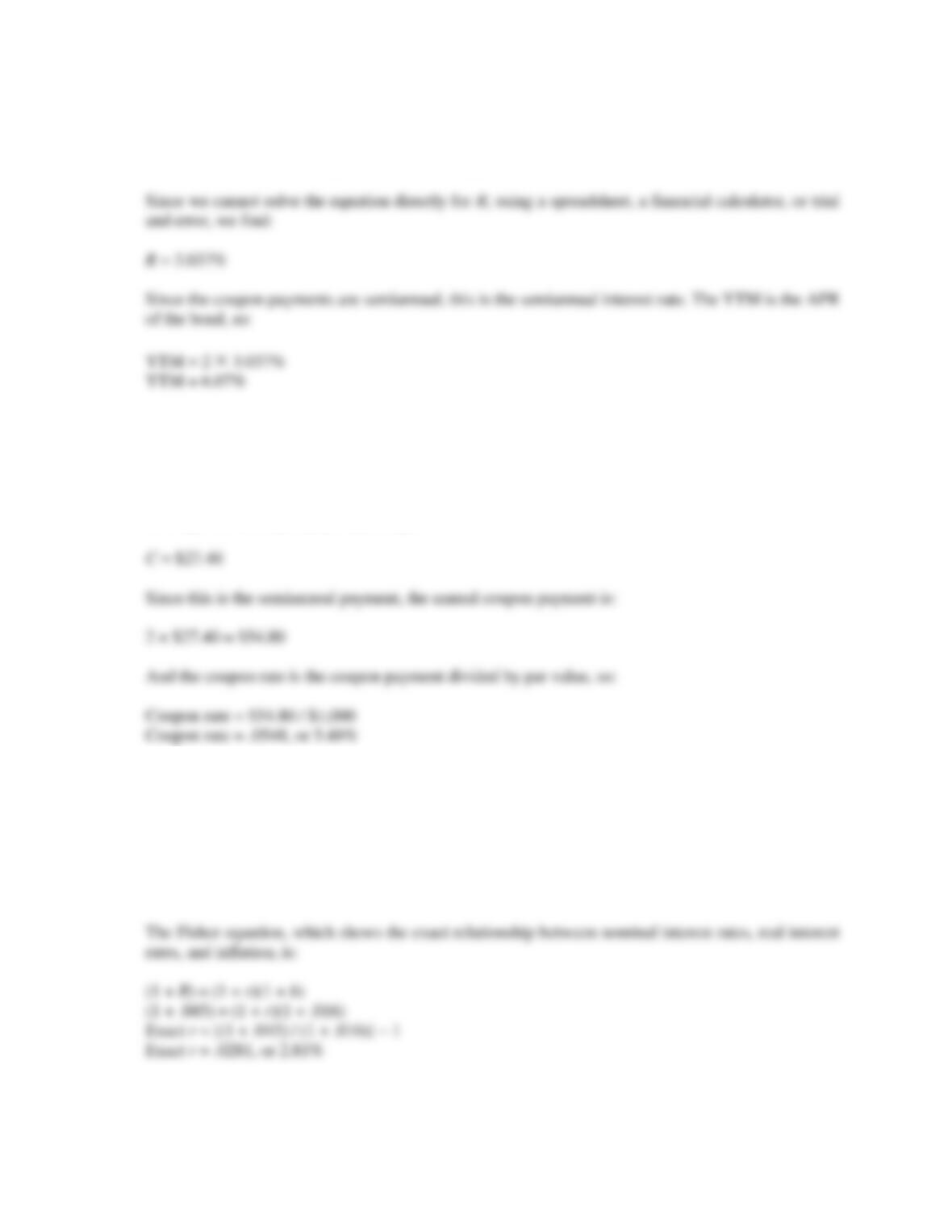
4. Here, we need to find the YTM of a bond. The equation for the bond price is:
P = $961.50 = $70(PVIFAR%,9) + $1,000(PVIFR%,9)
Notice the equation cannot be solved directly for R. Using a spreadsheet, a financial calculator, or trial
and error, we find:
5. Here we need to find the coupon rate of the bond. All we need to do is to set up the bond pricing
equation and solve for the coupon payment as follows:
P = $963 = C(PVIFA6.14%,12) + $1,000(PVIF6.14%,12)
Solving for the coupon payment, we get:
6. To find the price of this bond, we need to realize that the maturity of the bond is 14 years. The bond
was issued one year ago, with 15 years to maturity, so there are 14 years left on the bond. Also, the
coupons are semiannual, so we need to use the semiannual interest rate and the number of semiannual
periods. The price of the bond is:
P = $30.50(PVIFA2.65%,28) + $1,000(PVIF2.65%,28)
P = $1,078.37
7. Here, we are finding the YTM of a semiannual coupon bond. The bond price equation is:
P = $940 = $27(PVIFAR%,26) + $1,000(PVIFR%,26)
8. Here, we need to find the coupon rate of the bond. All we need to do is to set up the bond pricing
equation and solve for the coupon payment as follows:
P = $945 = C(PVIFA3.1%,21) + $1,000(PVIF3.1%,21)
Solving for the coupon payment, we get:
9. The approximate relationship between nominal interest rates (R), real interest rates (r), and inflation
(h), is:
R = r + h
Approximate r = .045 – .016
Approximate r =.0285, or 2.85%
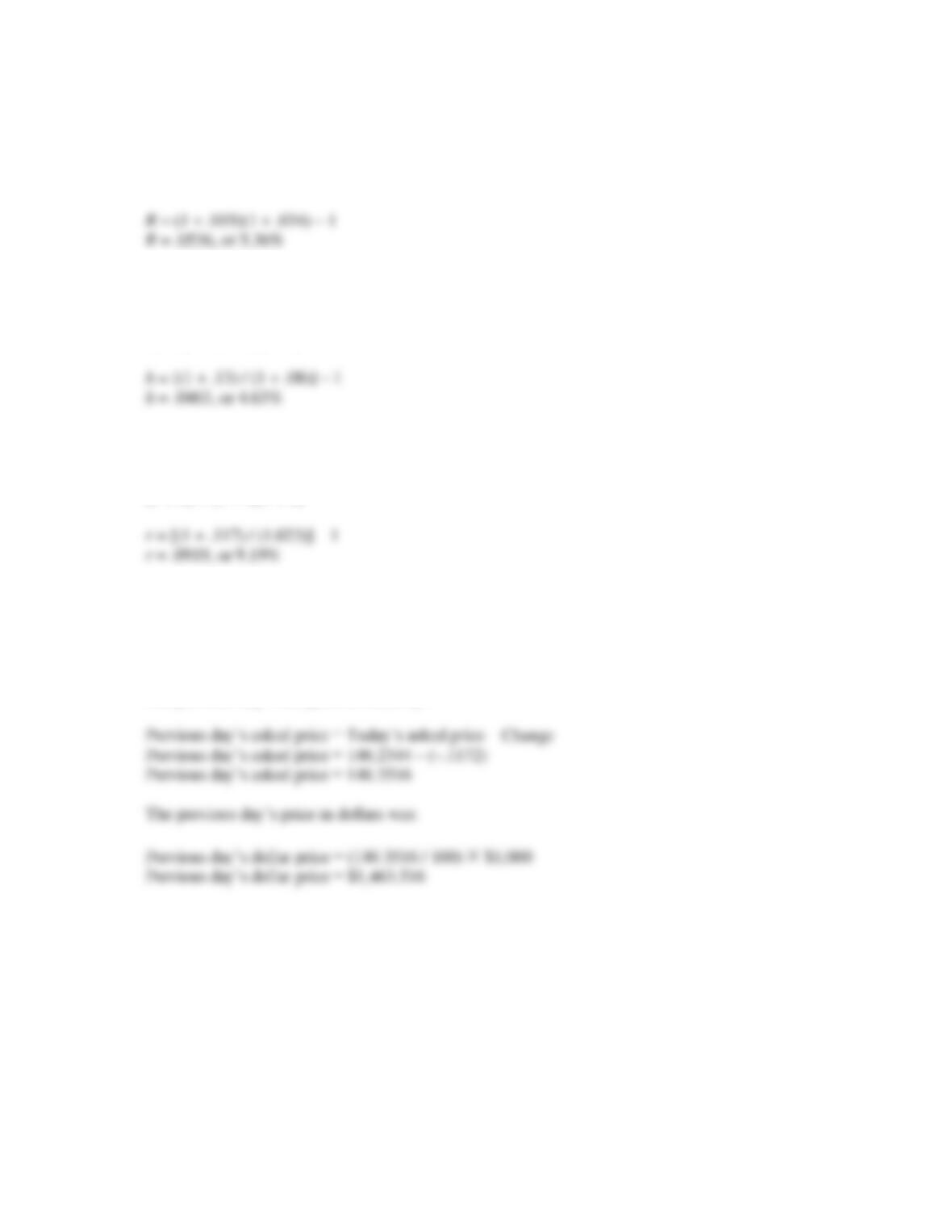
10. The Fisher equation, which shows the exact relationship between nominal interest rates, real interest
rates, and inflation, is:
(1 + R) = (1 + r)(1 + h)
11. The Fisher equation, which shows the exact relationship between nominal interest rates, real interest
rates, and inflation, is:
(1 + R) = (1 + r)(1 + h)
12. The Fisher equation, which shows the exact relationship between nominal interest rates, real interest
rates, and inflation, is:
(1 + R) = (1 + r)(1 + h)
13. The coupon rate, located in the second column of the quote is 6.125%. The bid price is:
Bid price = 146.1719%
$1,000
Bid price = $1,461.719
The previous day’s ask price is found by:
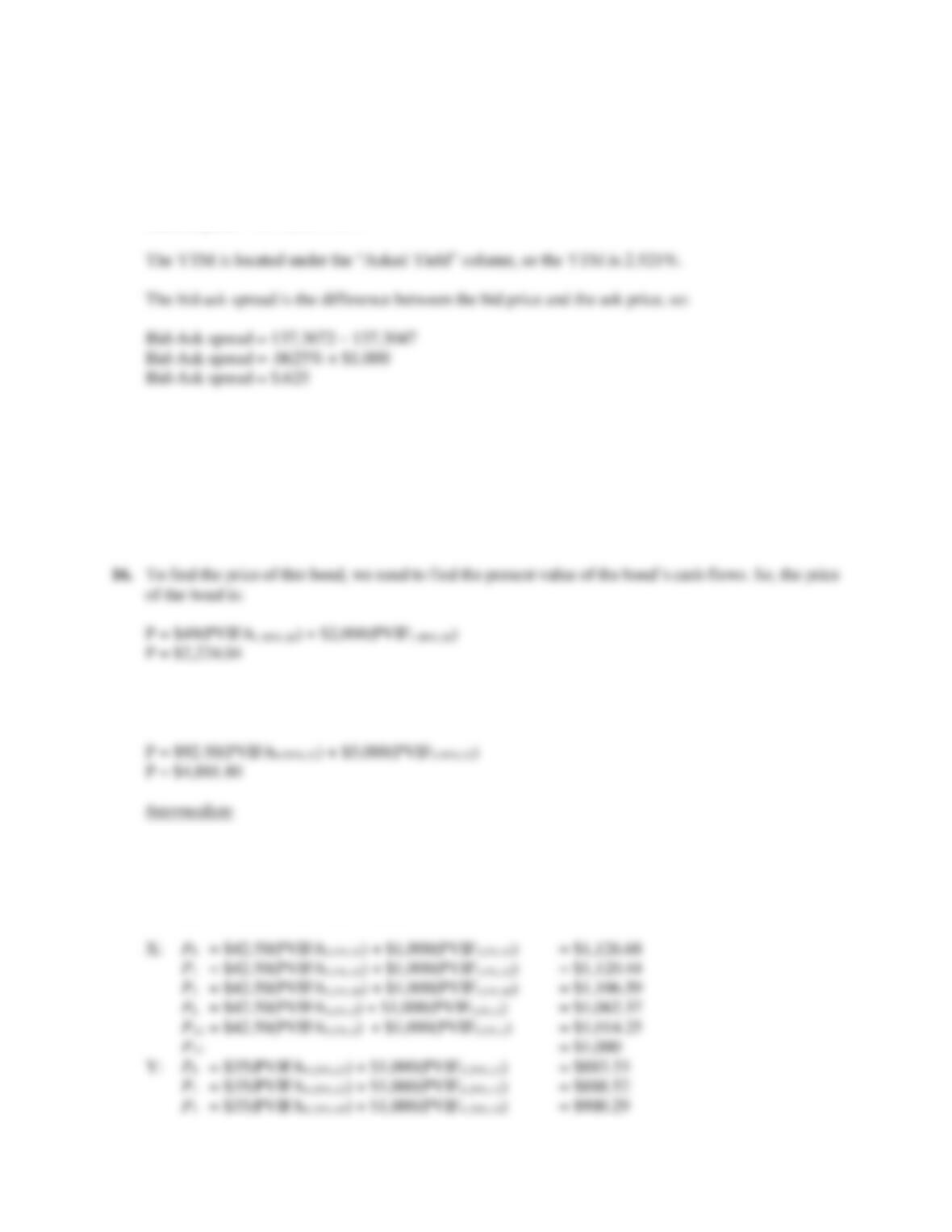
14. This is a premium bond because it sells for more than 100 percent of face value. The current yield is
based on the asked price, so the current yield is:
Current yield = Annual coupon payment / Price
Current yield = $47.50 / $1,373.672
Current yield = .0346, or 3.46%
15. To find the price of a zero coupon bond, we need to find the value of the future cash flows. With a
zero coupon bond, the only cash flow is the par value at maturity. We find the present value assuming
semiannual compounding to keep the YTM of a zero coupon bond equivalent to the YTM of a coupon
bond, so:
P = $10,000(PVIF2.45%,34)
P = $4,391.30
17. To find the price of this bond, we need to find the present value of the bond’s cash flows. So, the price
of the bond is:
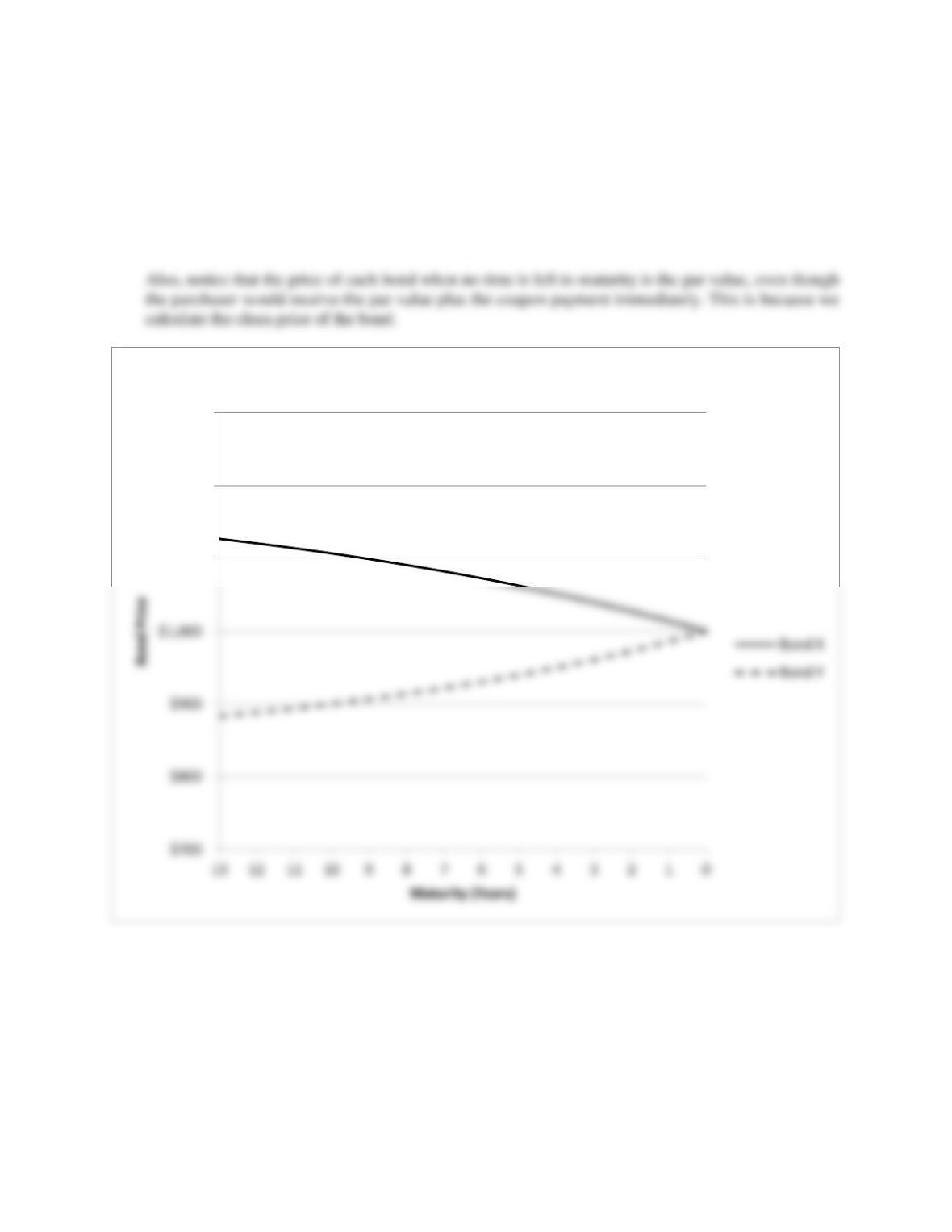
18. Here, we are finding the price of annual coupon bonds for various maturity lengths. The bond price
equation is:
P = C(PVIFAR%,t) + $1,000(PVIFR%,t)
P8 = $35(PVIFA4.25%,5) + $1,000(PVIF4.25%,5) = $939.92
P12 = $35(PVIFA4.25%,1) + $1,000(PVIF4.25%,1) = $985.90
P13 = $1,000
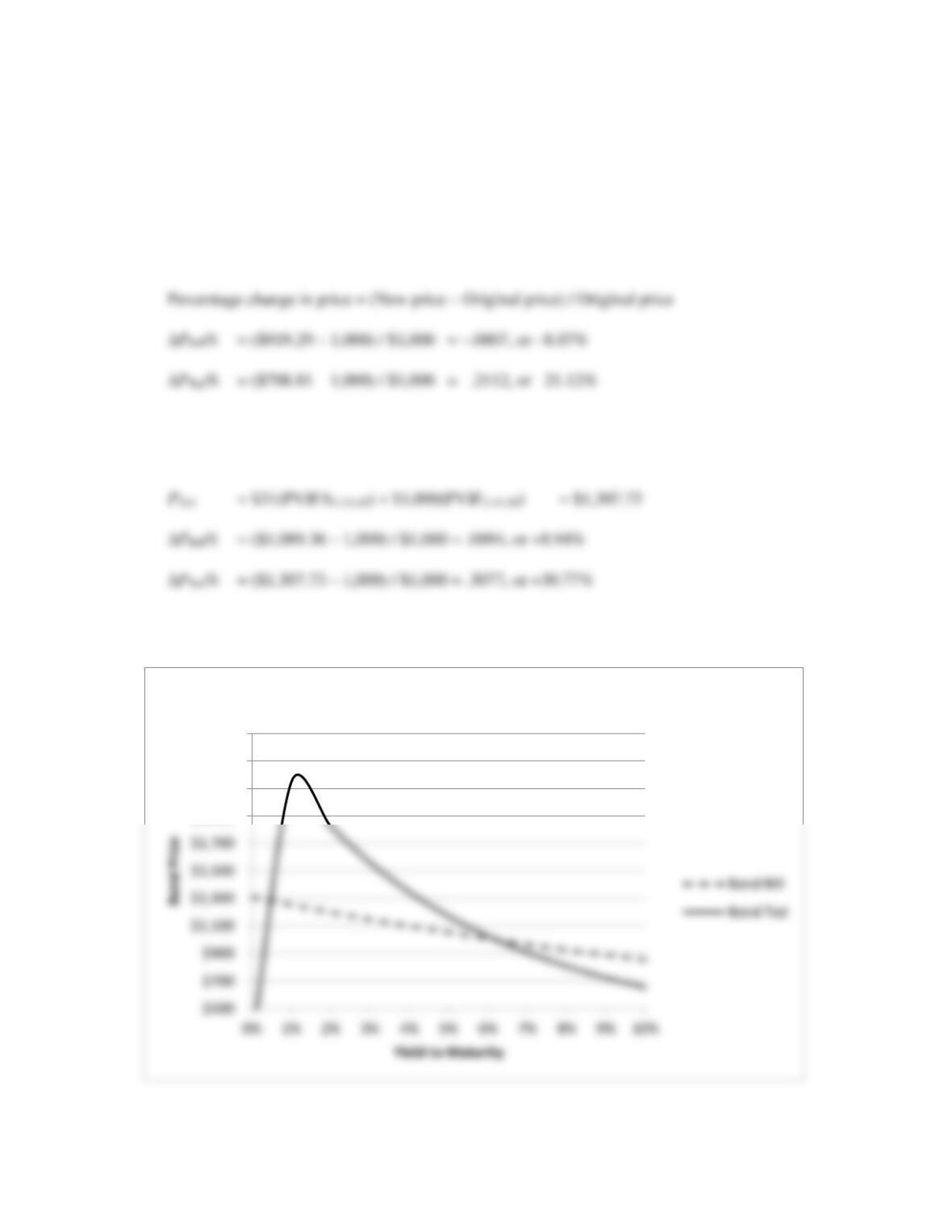
All else held equal, the premium over par value for a premium bond declines as maturity approaches,
and the discount from par value for a discount bond declines as maturity approaches. This is called
“pull to par.” In both cases, the largest percentage price changes occur at the shortest maturity lengths.
$1,100
$1,200
$1,300
Maturity and Bond Price
19. Any bond that sells at par has a YTM equal to the coupon rate. Both bonds sell at par, so the initial
YTM on both bonds is the coupon rate, 6.2 percent. If the YTM suddenly rises to 8.2 percent:
PBill = $31(PVIFA4.1%,10) + $1,000(PVIF4.1%,10) = $919.29
PTed = $31(PVIFA4.1%,50) + $1,000(PVIF4.1%,50) = $788.81
The percentage change in price is calculated as:
If the YTM suddenly falls to 4.2 percent:
PBill = $31(PVIFA2.1%,10) + $1,000(PVIF2.1%,10) = $1,089.36
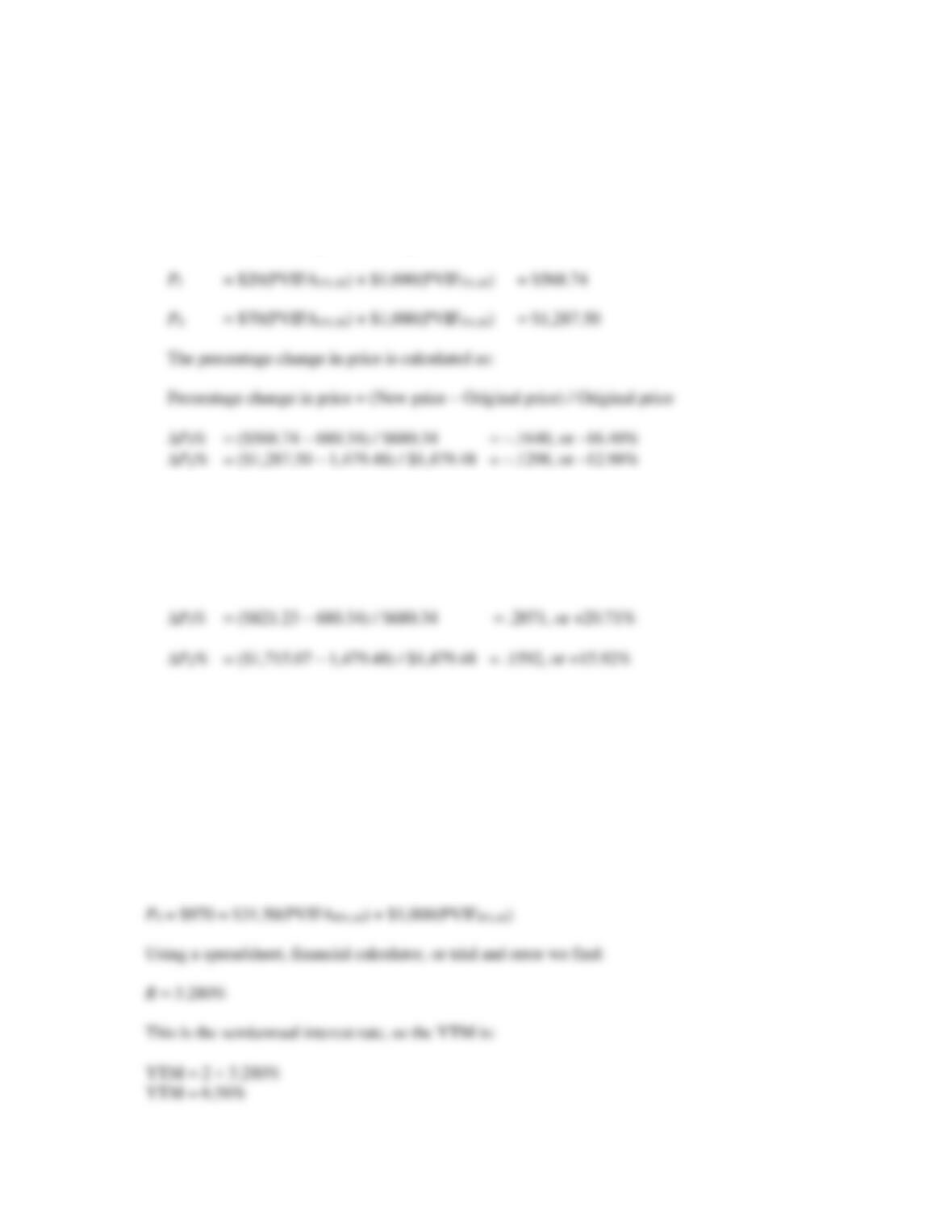
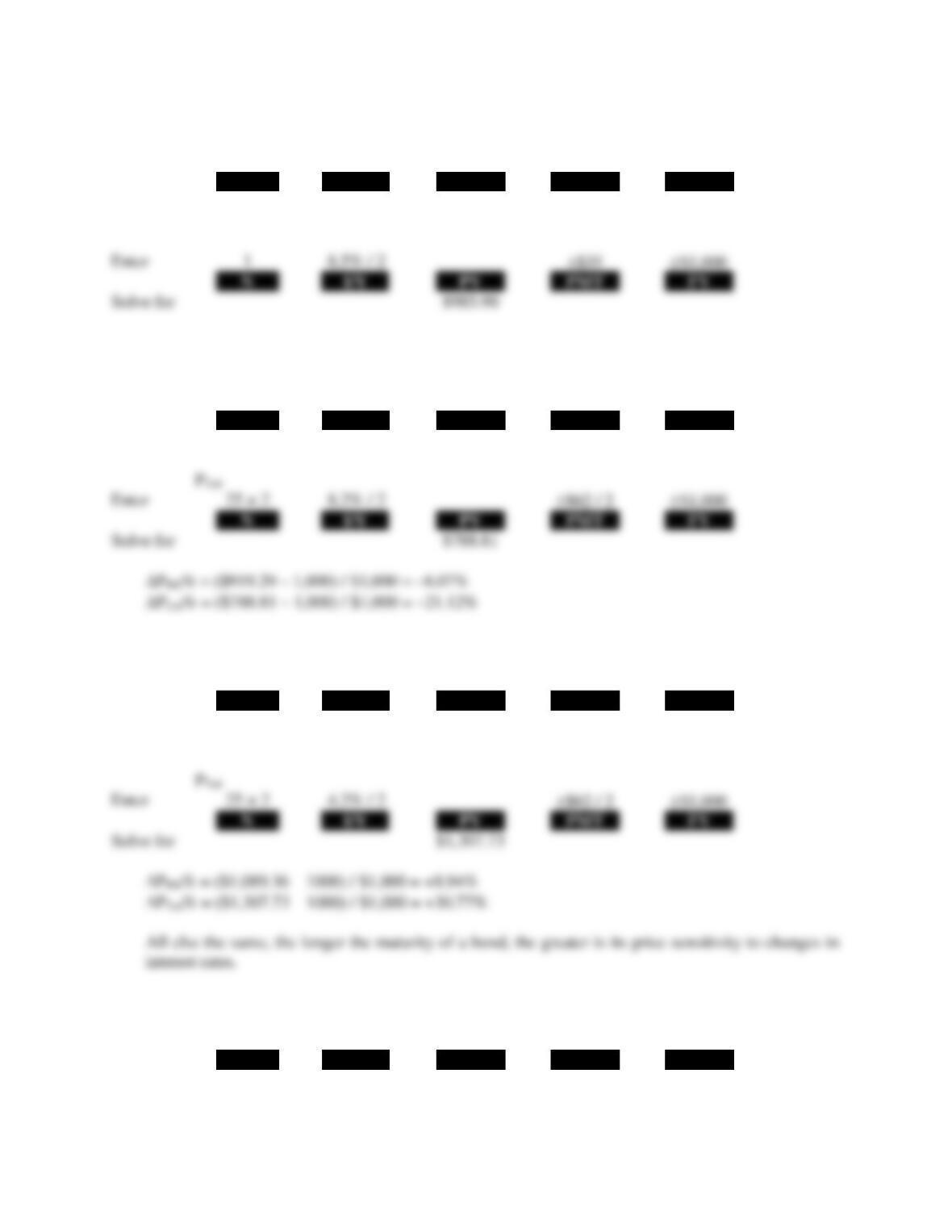
All else the same, the longer the maturity of a bond, the greater is its price sensitivity to changes in
interest rates.
$1,900
$2,100
$2,300
$2,500
YTM and Bond Price
20. Initially, at a YTM of 8 percent, the prices of the two bonds are:
PJ = $20(PVIFA4%,26) + $1,000(PVIF4%,26) = $680.34
PS = $70(PVIFA4%,26) + $1,000(PVIF4%,26) = $1,479.48
If the YTM rises from 8 percent to 10 percent:
If the YTM declines from 8 percent to 6 percent:
PJ = $20(PVIFA3%,26) + $1,000(PVIF3%,26) = $821.23
PS = $70(PVIFA3%,26) + $1,000(PVIF3%,26) = $1,715.07
All else the same, the lower the coupon rate on a bond, the greater is its price sensitivity to changes in
interest rates.
21. The current yield is:
Current yield = Annual coupon payment / Price
Current yield = $63 / $970
Current yield =.0649, or 6.49%
The bond price equation for this bond is:
The effective annual yield is the same as the EAR, so using the EAR equation from the previous
chapter:
22. The company should set the coupon rate on its new bonds equal to the required return of the existing
bonds. The required return can be observed in the market by finding the YTM on outstanding bonds
of the company. So, the YTM on the bonds currently sold in the market is:
P = $1,074 = $28(PVIFAR%,50) + $1,000(PVIFR%,50)
23. Accrued interest is the coupon payment for the period times the fraction of the period that has passed
since the last coupon payment. Since we have a semiannual coupon bond, the coupon payment per six
months is one-half of the annual coupon payment. There are five months until the next coupon
payment, so one month has passed since the last coupon payment. The accrued interest for the bond
is:
Accrued interest = $57/2 × 1/6
Accrued interest = $4.75
24. Accrued interest is the coupon payment for the period times the fraction of the period that has passed
since the last coupon payment. Since we have a semiannual coupon bond, the coupon payment per six
months is one-half of the annual coupon payment. There are two months until the next coupon
payment, so four months have passed since the last coupon payment. The accrued interest for the bond
is:
Accrued interest = $59/2 × 4/6
Accrued interest = $19.67
25. The bond has 15 years to maturity, so the bond price equation is:
P = $916.45 = $42.50(PVIFAR%,30) + $1,000(PVIFR%,30)
Using a spreadsheet, financial calculator, or trial and error, we find:
26. a. The coupon bonds have coupon rate of 6.8 percent which matches the 6.8 percent required return,
so they will sell at par. The number of bonds that must be sold is the amount needed divided by
the bond price, so:
Number of coupon bonds to sell = $35,000,000 / $1,000
Number of coupon bonds to sell = 35,000
b. The repayment of the coupon bond will be the par value plus the last coupon payment times the
number of bonds issued. So:
Coupon bonds repayment = 35,000($1,000) + 35,000($1,000)(.068 / 2)
Coupon bonds repayment = $36,190,000
c. The total coupon payment for the coupon bonds will be the number bonds times the coupon
payment. For the cash flow of the coupon bonds, we need to account for the tax deductibility of
the interest payments. To do this, we will multiply the total coupon payment times one minus the
tax rate. So:
P1 = $1,000 / 1.03438
P1 = $280.69
The Year 1 interest deduction per bond will be this price minus the price at the beginning of the
year, which we found in part b, so:
Notice the cash flow for the zeroes is a cash inflow. This is because of the tax deductibility of the
imputed interest expense. That is, the company gets to write off the interest expense for the year,
even though the company did not have a cash flow for the interest expense. This reduces the
company’s tax liability, which is a cash inflow.
During the life of the bond, the zero generates cash inflows to the firm in the form of the interest
tax shield of debt. We should note an important point here: If you find the PV of the cash flows
from the coupon bond and the zero coupon bond, they will be the same. This is because of the
much larger repayment amount for the zeroes.
27. The maturity is indeterminate. A bond selling at par can have any length of maturity.
28. The bond asked price is 104.3850, so the dollar price is:
Using a spreadsheet, financial calculator, or trial and error, we find:
R = 2.659%
29. The coupon rate of the bond is 6.125 percent and the bond matures in 20 years. The bond coupon
payments are semiannual, so the asked price is:
P = $30.625(PVIFA1.935%,40) + $1,000(PVIF1.935%,40)
P = $1,311.98
30. Here, we need to find the coupon rate of the bond. The price of the bond is:
Dollar price = 103.8235% × $1,000
Dollar price = $1,038.235
So the bond price equation is:
31. Here we need to find the yield to maturity. The dollar price of the bond is:
Dollar price = 96.153% × $2,000
Dollar price = $1,923.06
So, the bond price equation is:
P = $1,923.06 = $54(PVIFAR%,8) + $2,000(PVIFR%,8)
32. The bond price equation is:
P = $71.25(PVIFA3.01%,10) + $2,000(PVIF3.01%,10)
P = $2,094.21
The current yield is the annual coupon payment divided by the bond price, so:
33. Here, we need to find the coupon rate of the bond. The dollar price of the bond is:
Dollar price = 94.735% × $2,000
Dollar price = $1,894.70
Now, we need to do is to set up the bond pricing equation and solve for the coupon payment as follows:
P = $1,894.70 = C(PVIFA3.425%,24) + $2,000(PVIF3.425%,24)
Challenge
34. To find the capital gains yield and the current yield, we need to find the price of the bond. The current
price of Bond P and the price of Bond P in one year is:
P: P0 = $85(PVIFA7%,5) + $1,000(PVIF7%,5) = $1,061.50
P1 = $85(PVIFA7%,4) + $1,000(PVIF7%,4) = $1,050.81
D: P0 = $55(PVIFA7%,5) + $1,000(PVIF7%,5) = $938.50
P1 = $55(PVIFA7%,4) + $1,000(PVIF7%,4) = $949.19
Current yield = $55 / $938.50 = .0586, or 5.86%
Capital gains yield = ($949.19 – 938.50) / $938.50 = +.0114, or +1.14%
35. a. The rate of return you expect to earn if you purchase a bond and hold it until maturity is the YTM.
The bond price equation for this bond is:
P0 = $875 = $70(PVIFAR%,10) + $1,000(PVIF R%,10)
b. To find our HPY, we need to find the price of the bond in two years. The price of the bond in two
years, at the new interest rate, will be:
P2 = $70(PVIFA7.94%,8) + $1,000(PVIF7.94%,8) = $945.70
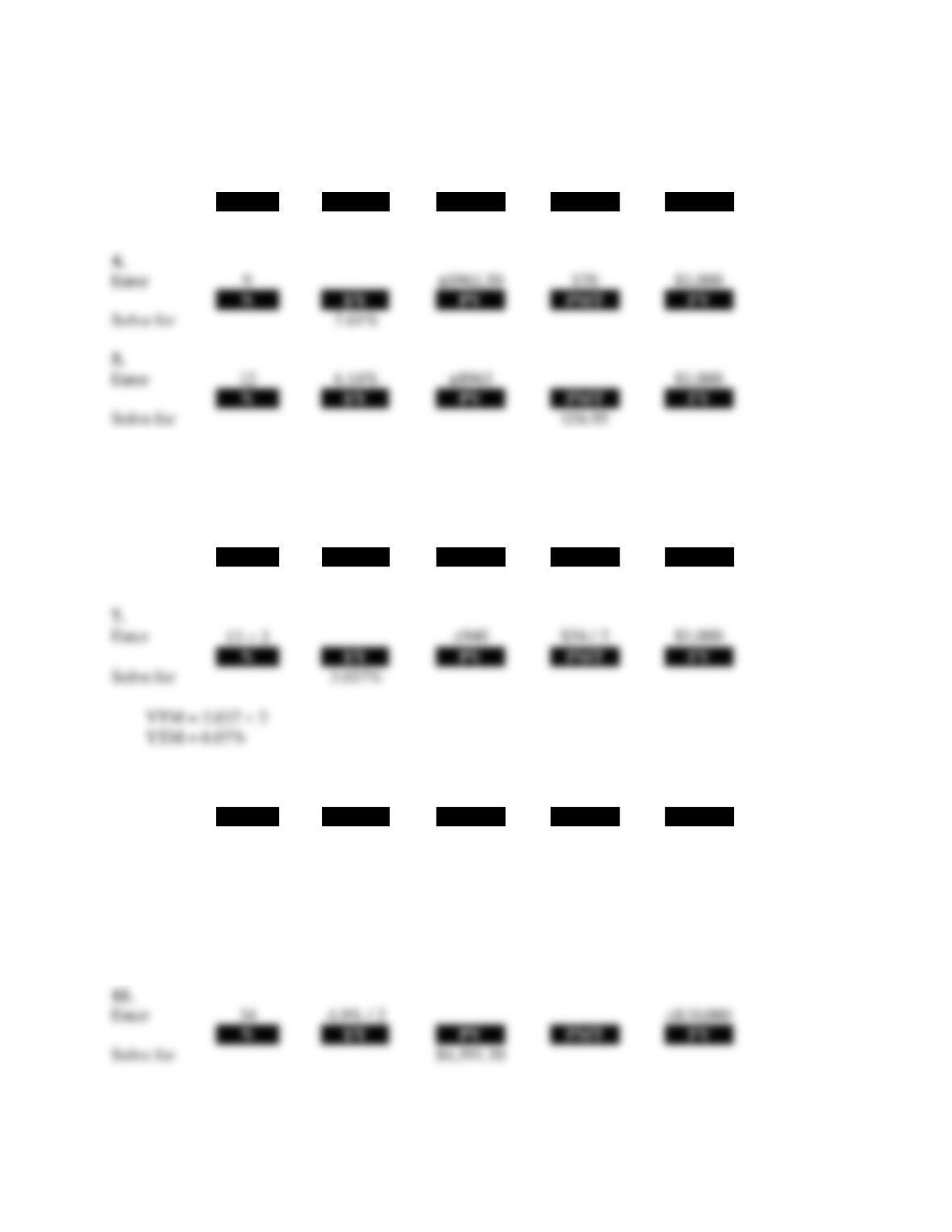
Calculator Solutions
3.
Enter
9
8.4%
$70
$1,000
N
I/Y
PV
PMT
FV
Solve for
$913.98
Coupon rate = $56.95 / $1,000
Coupon rate = .0570, or 5.70%
6.
Enter
14 2
5.3% / 2
$61 / 2
$1,000
N
I/Y
PV
PMT
FV
Solve for
$1,078.37
7.
Enter
13 2
$54 / 2
$1,000
N
I/Y
PV
PMT
FV
Solve for
8.
Enter
10.5 2
6.2% / 2
±$945
$1,000
N
I/Y
PV
PMT
FV
Solve for
$27.40
Annual coupon = $27.40 2
Annual coupon = $54.80
Coupon rate = $54.80 / $1,000
Coupon rate = .0548, or 5.48%
Enter
Solve for
4.
Enter
$1,000
N
I/Y
PV
PMT
FV
Solve for
5.
Enter
$1,000
N
I/Y
PV
PMT
FV
Solve for
16.
Enter
26
3.8% / 2
±$49 / 2
±$2,000
N
I/Y
PV
PMT
FV
Solve for
$2,224.04
Enter
12
7% / 2
$42.50
$1,000
N
I/Y
PV
PMT
FV
Solve for
$1,120.44
Enter
10
7% / 2
$42.50
$1,000
N
I/Y
PV
PMT
FV
Solve for
$1,106.59
Enter
7% / 2
$42.50
$1,000
N
I/Y
PV
PMT
FV
Solve for
$1,062.37
Enter
7% / 2
$42.50
$1,000
N
I/Y
PV
PMT
FV
Solve for
$1,014.25
Bond Y
Enter
13
8.5% / 2
$35
$1,000
N
I/Y
PV
PMT
FV
Solve for
$883.33
Enter
12
8.5% / 2
$35
$1,000
N
I/Y
PV
PMT
FV
Solve for
$888.52
Enter
10
8.5% / 2
$35
$1,000
N
I/Y
PV
PMT
FV
Solve for
$900.29
17.
Enter
32
3.9% / 2
±$5,000
N
I/Y
PV
PMT
FV
Solve for
$4,881.80
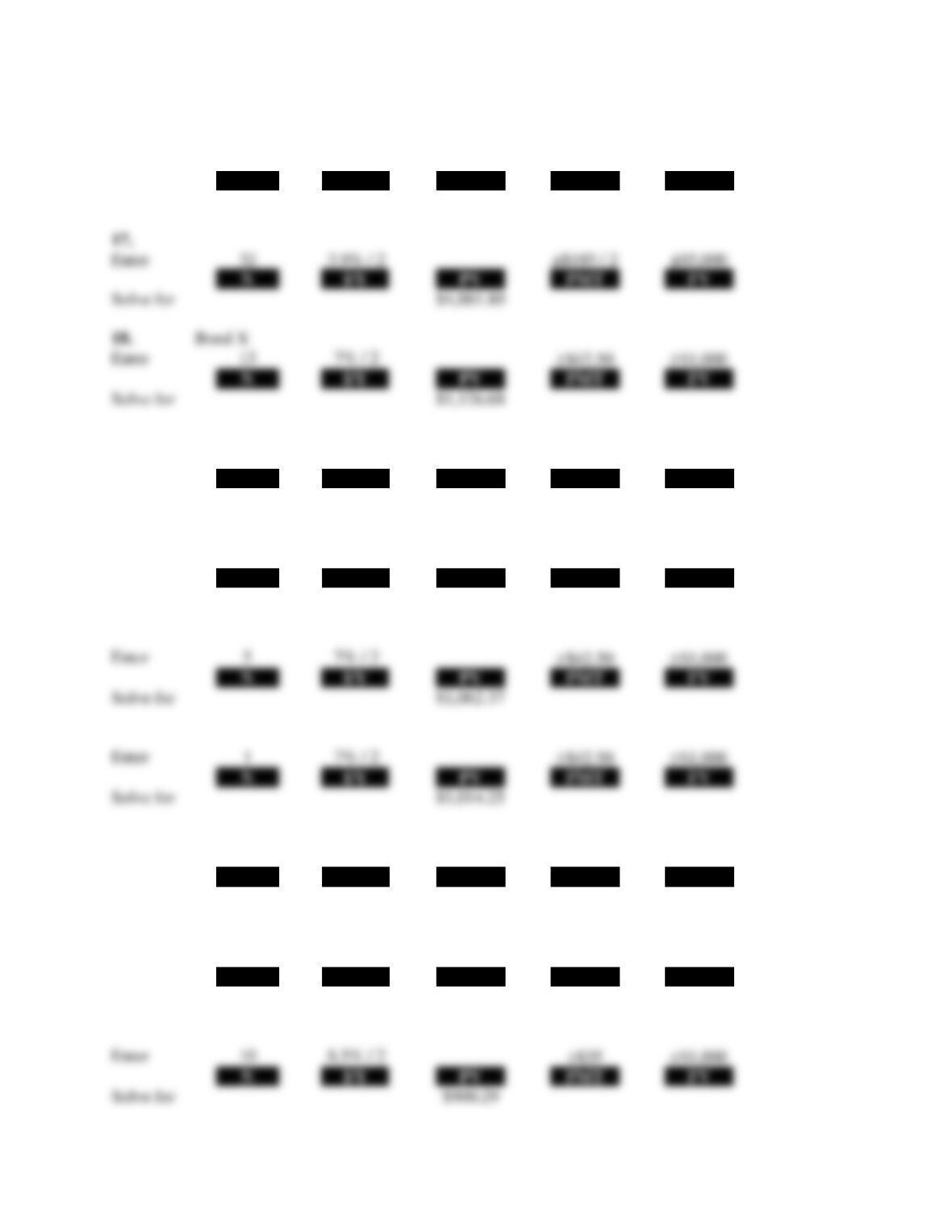
18.
Bond X
Enter
13
7% / 2
$42.50
$1,000
N
I/Y
PV
PMT
FV
Solve for
$1,126.68
Enter
5
8.5% / 2
$35
$1,000
N
I/Y
PV
PMT
FV
Solve for
$939.92
19. If both bonds sell at par, the initial YTM on both bonds is the coupon rate, 6.2 percent. If the YTM
suddenly rises to 8.2 percent:
PBill
Enter
5× 2
8.2% / 2
$62 / 2
$1,000
N
I/Y
PV
PMT
FV
Solve for
$919.29
PTed
Enter
8.2% / 2
$62 / 2
$1,000
N
I/Y
PV
PMT
FV
Solve for
$788.81
If the YTM suddenly falls to 4.2 percent:
PBill
Enter
5 × 2
4.2% / 2
$62 / 2
$1,000
N
I/Y
PV
PMT
FV
Solve for
$1,089.36
PTed
Enter
25 × 2
4.2% / 2
$62 / 2
$1,000
N
I/Y
PV
PMT
FV
Solve for
20. Initially, at a YTM of 8 percent, the prices of the two bonds are:
PJ
Enter
13 × 2
4%
$40 / 2
$1,000
N
I/Y
PV
PMT
FV
Solve for
$680.34
Enter
1
8.5% / 2
$35
$1,000
N
I/Y
PV
PMT
FV
Solve for
$985.90
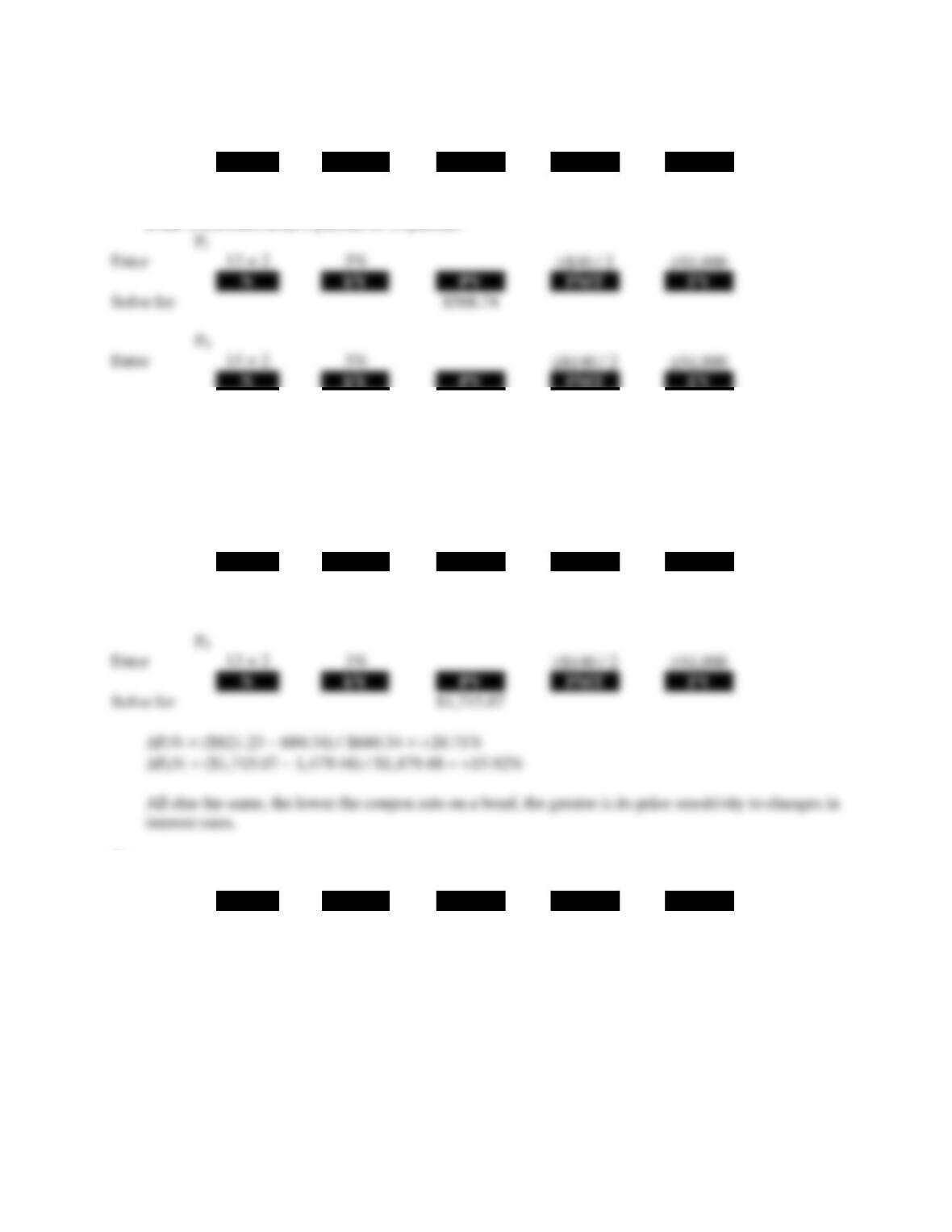
PS
Enter
13 × 2
4%
$140 / 2
$1,000
N
I/Y
PV
PMT
FV
Solve for
$1,479.48
If the YTM rises from 8 percent to 10 percent:
N
I/Y
PV
PMT
FV
Solve for
$1,287.50
PJ% = ($568.74 – 680.34) / $680.34 = –16.40%
PS% = ($1,287.50 – 1,479.48) / $1,479.48 = –12.98%
If the YTM declines from 8 percent to 6 percent:
PJ
Enter
13 × 2
3%
$40 / 2
$1,000
N
I/Y
PV
PMT
FV
Solve for
$821.23
PS
Enter
13 × 2
3%
$140 / 2
$1,000
N
I/Y
PV
PMT
FV
Solve for
21.
Enter
22 2
±$970
$63 / 2
$1,000
N
I/Y
PV
PMT
FV
Solve for
3.280%
YTM = 2 3.280%
YTM = 6.56%
Enter
13 × 2
5%
$40 / 2
$1,000
N
I/Y
PV
PMT
FV
Solve for
$568.74
Enter
13 × 2
5%
$1,000
Effective annual yield:
Enter
6.56%
2
NOM
EFF
C/Y
Solve for
6.67%
22. The company should set the coupon rate on its new bonds equal to the required return; the required
return can be observed in the market by finding the YTM on outstanding bonds of the company.
25.
Enter
15 × 2
±$916.45
$85 / 2
$1,000
N
I/Y
PV
PMT
FV
Solve for
4.780%
Solve for
$262.53
N
I/Y
PV
PMT
FV
Solve for
$280.69
YTM = 2 4.780%
YTM = 9.56%
28.
Enter
11 × 2
±$1,043.850
$58.50 / 2
$1,000
N
I/Y
PV
PMT
FV
Solve for
2.659%
YTM = 2 2.659%
YTM = 5.32%
Solve for
2.537%
29.
Enter
20 × 2
3.87% / 2
$61.25 / 2
$1,000
N
I/Y
PV
PMT
FV
Solve for
$1,311.98
31.
Enter
4 × 2
±$1,923.06
$54
$2,000
N
I/Y
PV
PMT
FV
Solve for
3.254%
32.
Enter
5 × 2
N
I/Y
PV
PMT
FV
Solve for
Enter
±$1,894.70
$2,000
N
I/Y
PV
PMT
FV
Solve for
$61.99
YTM = 2 3.254%
YTM = 6.51%
Enter
2.18% / 2
N
I/Y
PV
PMT
FV
Solve for
34.
Bond P
P0
Enter
5
7%
$85
$1,000
N
I/Y
PV
PMT
FV
Solve for
$1,061.50
Bond D
P0
Enter
5
7%
$55
$1,000
N
I/Y
PV
PMT
FV
Solve for
$938.50
P1
Enter
4
7%
$55
$1,000
N
I/Y
PV
PMT
FV
Solve for
$949.19
35.
a.
Enter
10
±$875
$70
$1,000
N
I/Y
PV
PMT
FV
Solve for
8.94%
This is the rate of return you expect to earn on your investment when you purchase the bond.
Enter
4
7%
$85
$1,000
N
I/Y
PV
PMT
FV
Solve for
b.
Enter
8
7.94%
$70
$1,000
N
I/Y
PV
PMT
FV
Solve for
$945.70
Enter
Solve for