6.8 Isobutane: Tc408.1 K⋅:= Zc0.282:= CP2.78 J
gm K⋅
⋅:=
P14000 kPa⋅:=
P22000 kPa⋅:= molwt 58.123 gm
mol
⋅:= Vc262.7 cm3
mol
⋅:=
Eq. (3.63) for volume of a saturated liquid may be used for the volume of a
compressed liquid if the effect of pressure on liquid volume is neglected.
(The elements are denoted by subscripts 1, 2, & 3
Assume that changes in T and V are negligible during throtling. Then Eq.
(6.8) is integrated to yield:
Chapter 6 – Section A – Mathcad Solutions
6.7 At constant temperature Eqs. (6.25) and (6.26) can be written:
dS β− V⋅dP⋅=and dH 1 βT⋅−
()
V⋅dP⋅=
For an estimate, assume properties independent
of pressure.
144
P21500 bar⋅:=
β250 10 6−
⋅K1−
⋅:= κ 45 10 6−
⋅bar 1−
⋅:= V11003 cm3
kg
⋅:=
By Eq. (3.5), V2V1exp κ− P2P1
−
()
⋅
⎡
⎣
⎤
⎦
⋅:= V2937.574 cm3
kg
=
Vave
V1V2
+
2
:= Vave 970.287 cm3
kg
=By Eqs. (6.28) & (6.29),
We use the additional values of T and V to estimate the volume expansivity:
Assuming properties independent of pressure,
Eq. (6.29) may be integrated to give
6.9 T 298.15 K⋅:= P11 bar⋅:=
145
.187
.000
.048
.094
.038
⎛
⎜
⎜
⎜
⎜
⎜
⎜
⎜
⎞
⎟
⎟
⎟
⎟
⎟
⎟
61.39
48.98
34.99
89.63
34.00
⎛
⎜
⎜
⎜
⎜
⎜
⎜
⎜
⎞
⎟
⎟
⎟
⎟
⎟
⎟
308.3
150.9
132.9
373.5
126.2
⎛
⎜
⎜
⎜
⎜
⎜
⎜
⎜
⎞
⎟
⎟
⎟
⎟
⎟
⎟
40
75
60
70
50
⎛
⎜
⎜
⎜
⎜
⎜
⎜
⎜
⎞
⎟
⎟
⎟
⎟
⎟
⎟
300
175
175
400
150
⎛
⎜
⎜
⎜
⎜
⎜
⎜
⎜
⎞
⎟
⎟
⎟
⎟
⎟
⎟
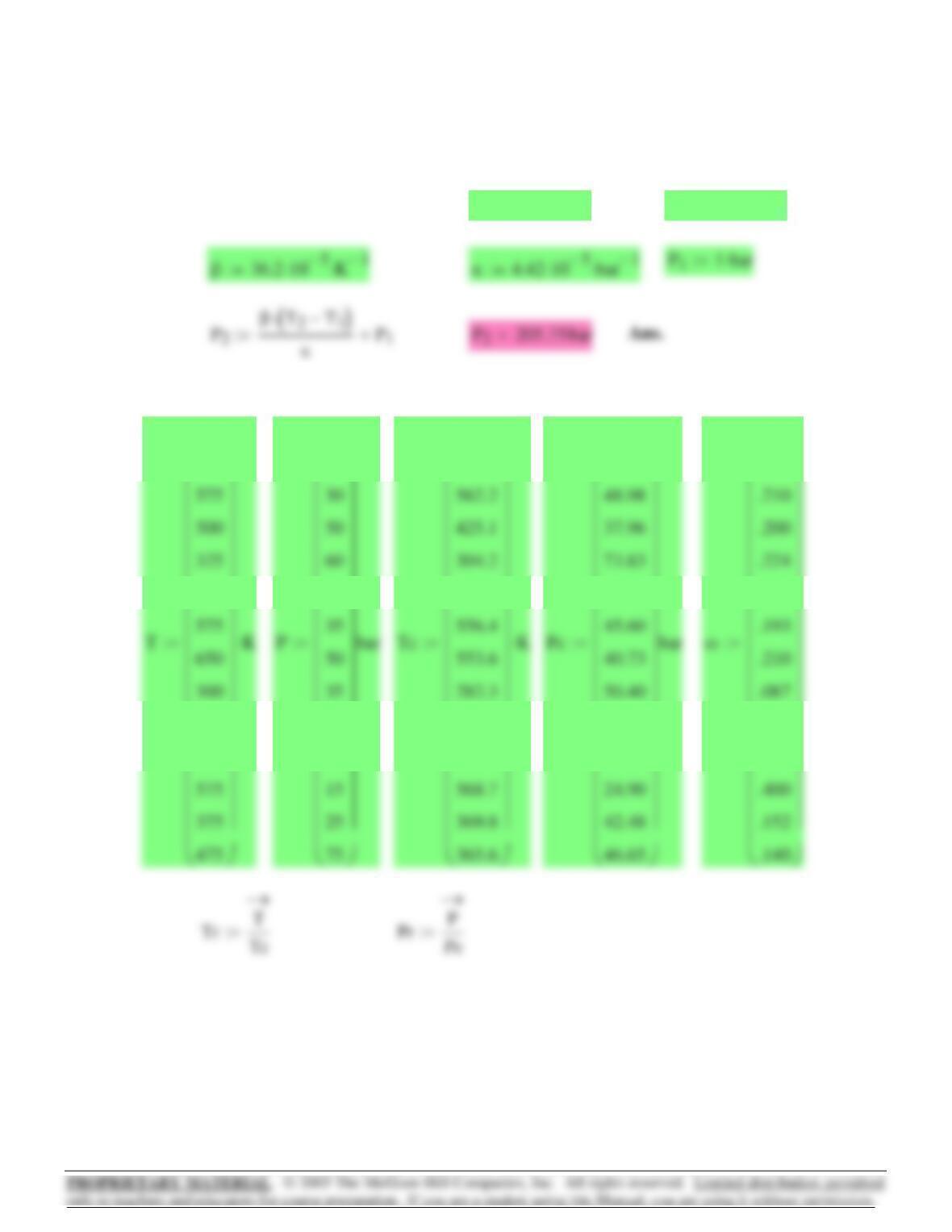
Vectors containing T, P, Tc, Pc, and ω for Parts (a) through (n):6.14 — 6.16
T2323.15 K⋅:=T1298.15 K⋅:=β T2T1
−
()
⋅κP2P1
−
()
⋅− 0=
For a constant-volume change, by Eq. (3.5),6.10
146
Eq. (6.65b)
Iiln Zβiqi
,
()
βi
+
Zβiqi
,
()
⎛
⎜
⎝
⎞
⎠
:=
i114..:=
Zβq,
()
Find z():=
Eq. (3.52)
z1β+ qβ⋅ zβ−
zz β+
()
⋅
⋅−=Given
z1:=
Guess:
Eq. (3.54)
qΨ
ΩTr1.5
⋅
⎛
⎜
⎝
⎞
⎠
→
⎯
⎯⎯
⎯
:=
Eq. (3.53)
βΩ
Pr
Tr
⋅
⎛
⎜
⎝
⎞
⎠
→
⎯
⎯
⎯
:=
Ψ0.42748:=Ω 0.08664:=
Redlich/Kwong equation: 6.14
147
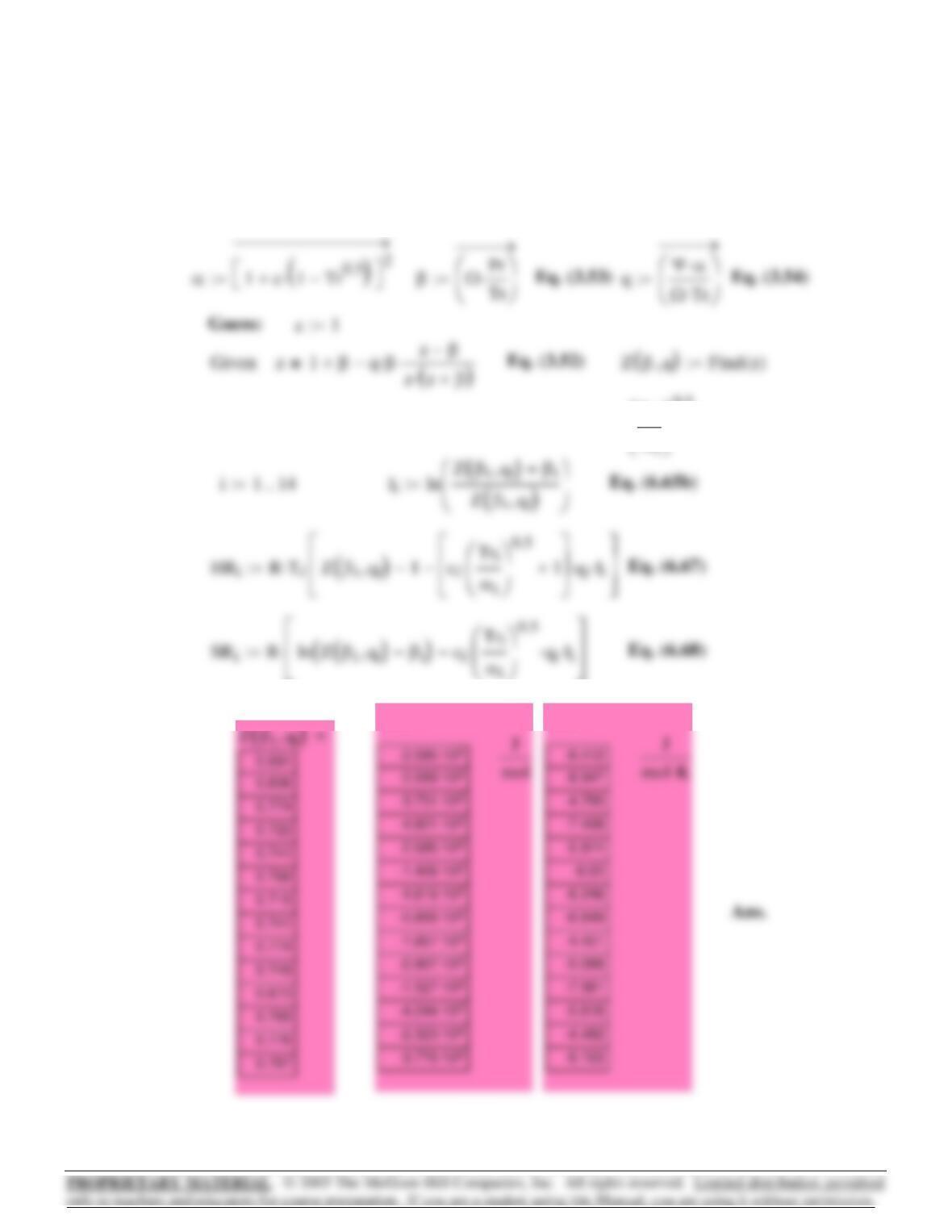
=HRi
=
⎜
⎜
⎝
⎠
⎣
⎦
The derivative in the following equations equals: ci
−Tri
αi
⎛
⎜
⎞
0.5
⋅
⎯
⎯
⎯
⎯
⎯
⎯
c 0.480 1.574 ω⋅+ 0.176 ω2
⋅−
()
→
⎯
⎯⎯⎯⎯⎯⎯⎯⎯⎯⎯
⎯
:=Ψ 0.42748:=Ω 0.08664:=
Soave/Redlich/Kwong equation:6.15
148
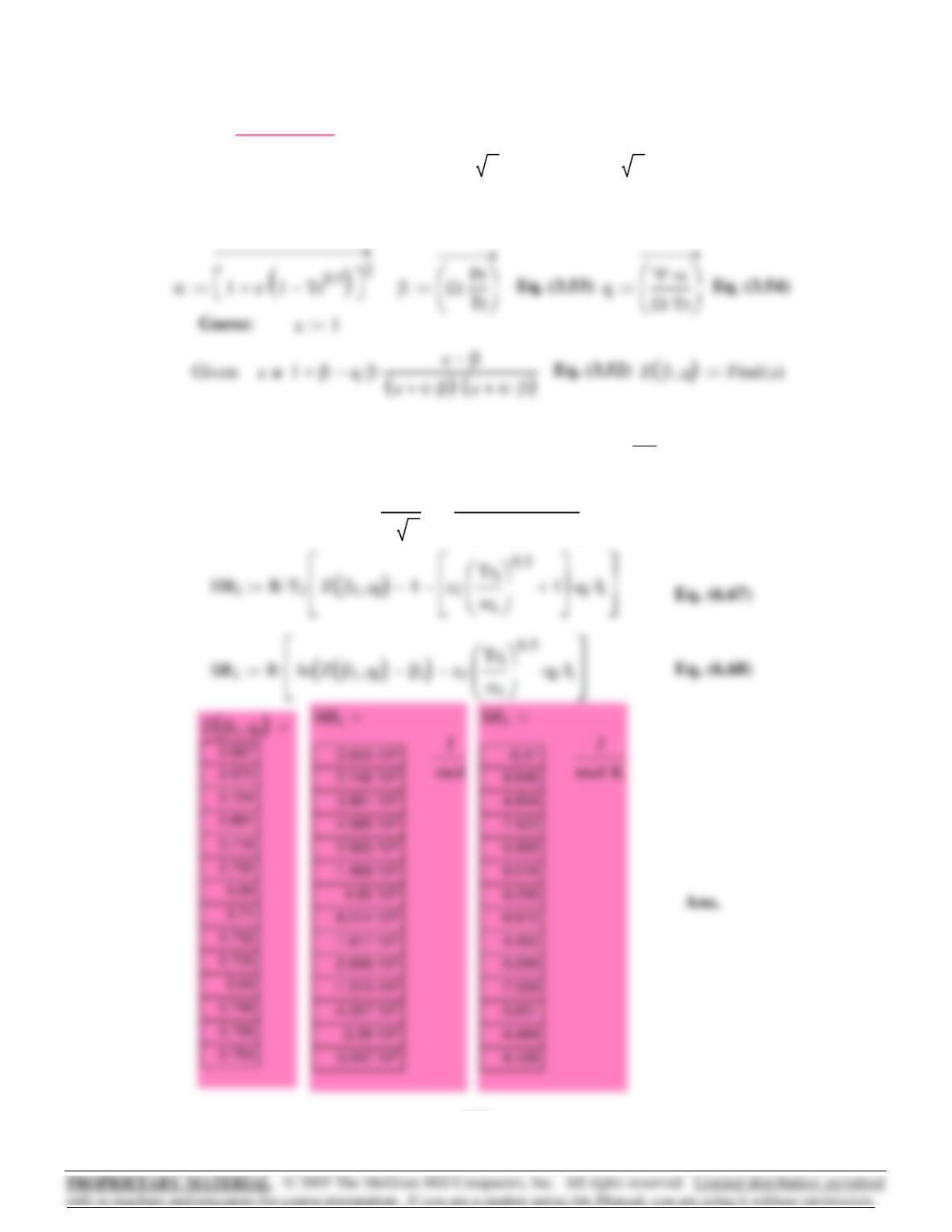
Eq. (6.65b)
Ii
1
22
⋅ln Zβiqi
,
()
σβ
i
⋅+
Zβiqi
,
()
εβ
i
⋅+
⎛
⎜
⎝
⎞
⎠
⋅:=
i114..:=
The derivative in the following equations equals: ci
−Tri
αi
⎛
⎜
⎝
⎞
⎠
0.5
⋅
⎯
⎯
⎯
⎯
⎯
⎯
6.16 Peng/Robinson equation: σ12+:= ε 12−:=
Ω0.07779:= Ψ 0.45724:= c 0.37464 1.54226 ω⋅+ 0.26992 ω2
⋅−
()
→
⎯
⎯⎯⎯⎯⎯⎯⎯⎯⎯⎯⎯⎯⎯
⎯
:=
149
⎜
⎜
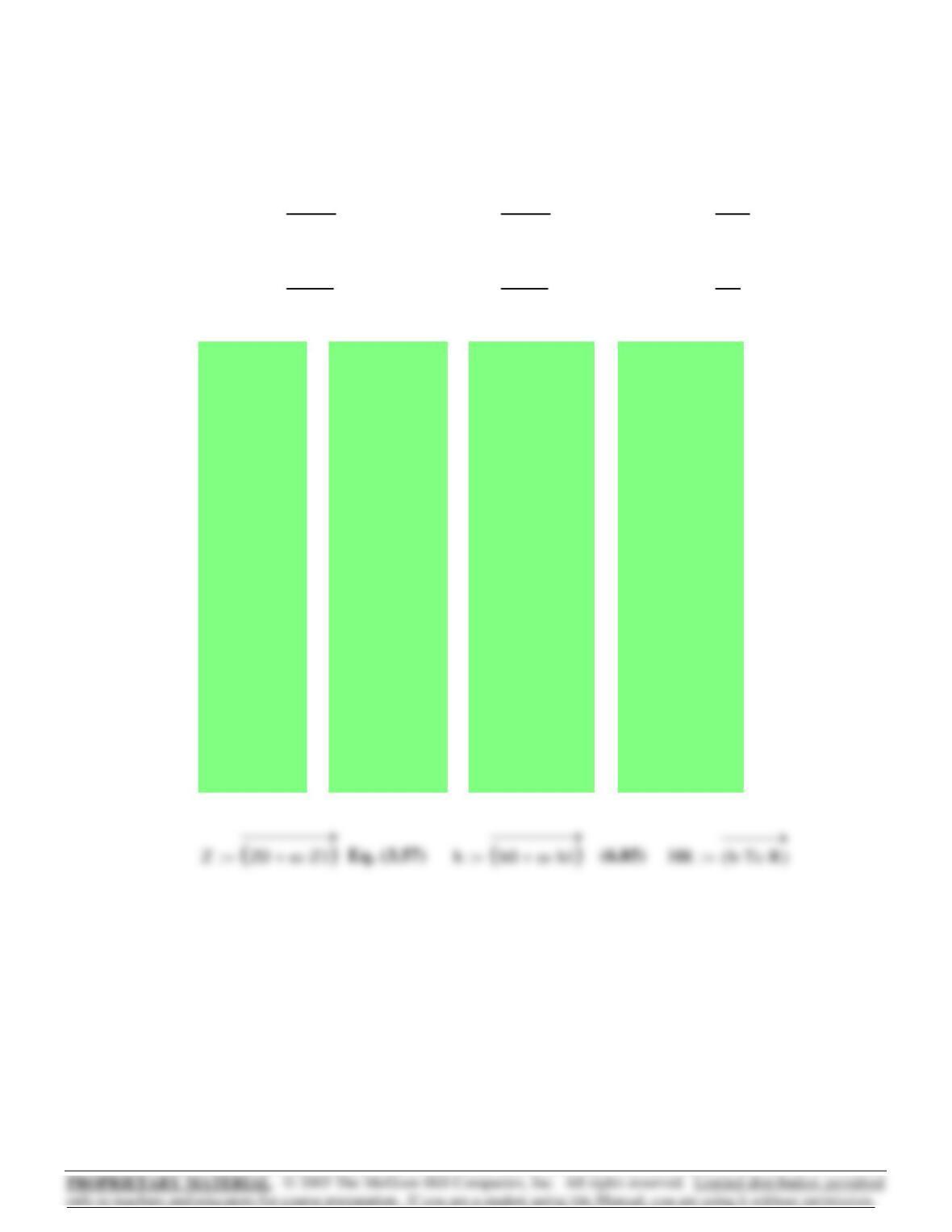
h1
1.003−
.471−
.591−
.437−
.635−
.184−
.751−
.444−
.550−
.598−
.405−
.631−
.604−
.211−
⎛
⎜
⎜
⎜
⎜
⎜
⎜
⎜
⎜
⎜
⎜
⎜
⎜
⎜
⎜
⎜
⎜
⎜
⎜
⎜
⎝
⎞
⎟
⎟
⎟
⎟
⎟
⎟
⎟
⎟
⎟
⎟
⎟
⎟
⎟
⎟
⎟
⎟
⎟
⎠
:=h0
.950−
1.709−
.705−
1.319−
.993−
1.265−
.962−
1.200−
.770−
.875−
1.466−
.723−
.701−
1.216−
⎛
⎜
⎜
⎜
⎜
⎜
⎜
⎜
⎜
⎜
⎜
⎜
⎜
⎜
⎜
⎜
⎜
⎜
⎜
⎜
⎝
⎞
⎟
⎟
⎟
⎟
⎟
⎟
⎟
⎟
⎟
⎟
⎟
⎟
⎟
⎟
⎟
⎟
⎟
⎠
:=Z1
.093−
.155
.024−
.118
.008
.165
.019−
.102
.001−
.007
.144
.034−
.032−
.154
⎛
⎜
⎜
⎜
⎜
⎜
⎜
⎜
⎜
⎜
⎜
⎜
⎜
⎜
⎜
⎜
⎜
⎜
⎜
⎜
⎝
⎞
⎟
⎟
⎟
⎟
⎟
⎟
⎟
⎟
⎟
⎟
⎟
⎟
⎟
⎟
⎟
⎟
⎟
⎠
:=Z0
.686
.590
.774
.675
.725
.744
.705
.699
.770
.742
.651
.767
.776
.746
⎛
⎜
⎜
⎜
⎜
⎜
⎜
⎜
⎜
⎜
⎜
⎜
⎜
⎜
⎜
⎜
⎜
⎜
⎜
⎜
⎝
⎞
⎟
⎟
⎟
⎟
⎟
⎟
⎟
⎟
⎟
⎟
⎟
⎟
⎟
⎟
⎟
⎟
⎟
⎠
:=
SR
R
s equals
SR()
1
R
s1 equals
SR()
0
R
s0 equals
HR
RTc
h equals
HR()
1
RTc
h1 equals
HR()
0
RTc
h0 equals
Lee/Kesler Correlation — By linear interpolation in Tables E.1–E.12:
150

s0
.711−
1.110−
.497−
.829−
.631−
.710−
.674−
.750−
.517−
.587−
.917−
.511−
.491−
.688−
⎛
⎜
⎜
⎜
⎜
⎜
⎜
⎜
⎜
⎜
⎜
⎜
⎜
⎜
⎜
⎜
⎜
⎜
⎜
⎜
⎝
⎞
⎟
⎟
⎟
⎟
⎟
⎟
⎟
⎟
⎟
⎟
⎟
⎟
⎟
⎟
⎟
⎟
⎟
⎠
:= s1
.961−
.492−
.549−
.443−
.590−
.276−
.700−
.441−
.509−
.555−
.429−
.589−
.563−
.287−
⎛
⎜
⎜
⎜
⎜
⎜
⎜
⎜
⎜
⎜
⎜
⎜
⎜
⎜
⎜
⎜
⎜
⎜
⎜
⎜
⎝
⎞
⎟
⎟
⎟
⎟
⎟
⎟
⎟
⎟
⎟
⎟
⎟
⎟
⎟
⎟
⎟
⎟
⎟
⎠
:= ss0ωs1⋅+
()
→
⎯
⎯⎯
⎯
:= SR s R⋅()
→
⎯
⎯
:= Eq. (6.86)
151
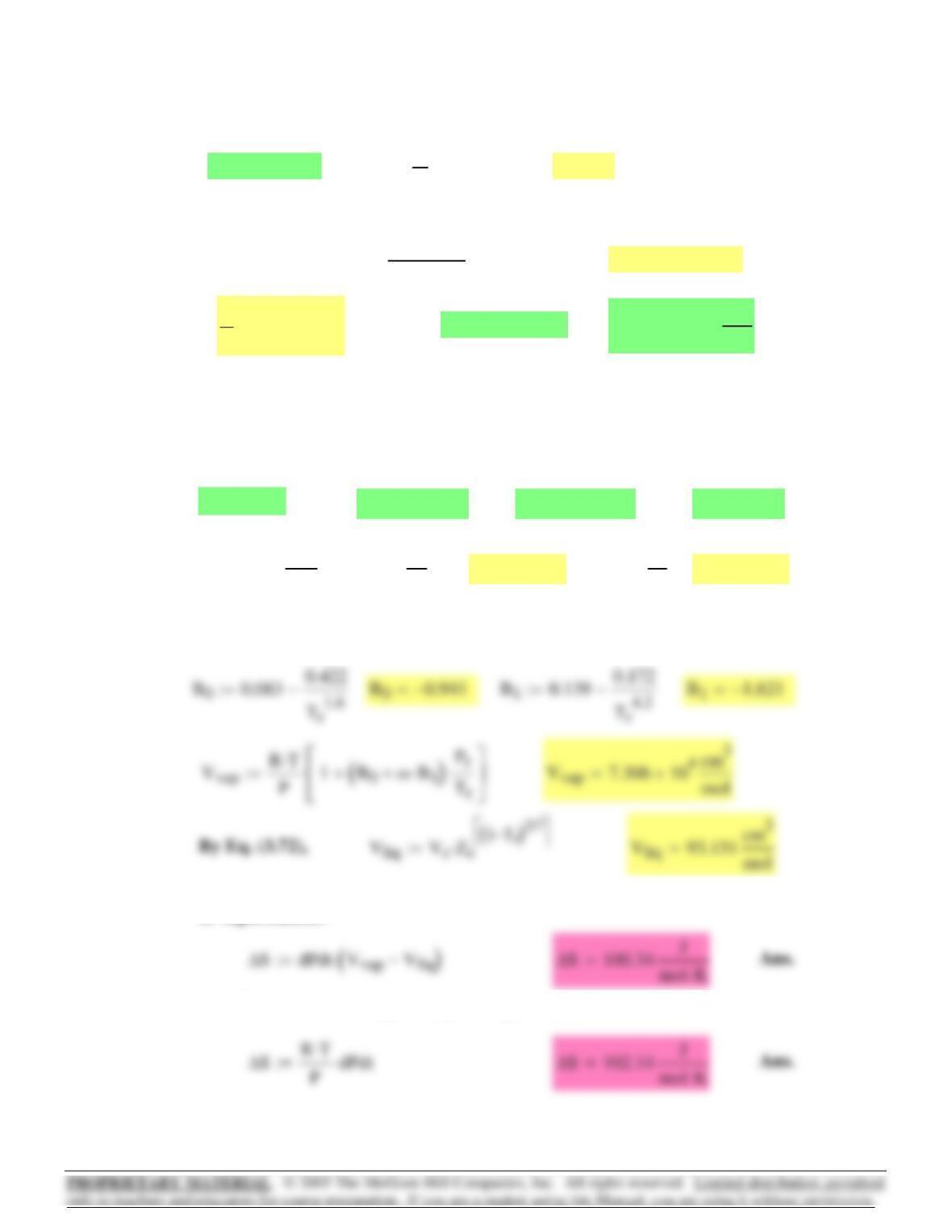
Pr0.007=
By Eqs. (3.65), (3.66), (3.61), & (3.63)
Solve Eq. (6.72) for the latent heat and divide by T to get the entropy change
of vaporization:
(b) Here for the entropy change of vaporization:
6.17 T 323.15 K⋅:= tT
K273.15−:= t50=
The pressure is the vapor pressure given by the Antoine equation:
Pt( ) exp 13.8858 2788.51
t 220.79+
−
⎛
⎜
⎝
⎞
⎠
:= P50( ) 36.166=
t
Pt()
d
d
1.375=P 36.166 kPa⋅:= dPdt 1.375 kPa
K
⋅:=
(a) The entropy change of vaporization is equal to the latent heat divided by
the temperature. For the Clapeyron equation, Eq. (6.69), we need the
volume change of vaporization. For this we estimate the liquid volume by
Eq. (3.63) and the vapor volume by the generalized virial correlation. For
benzene:
ω0.210:= Tc562.2 K⋅:= Pc48.98 bar⋅:= Zc0.271:=
Vc259 cm3
mol
⋅:= Tr
T
Tc
:= Tr0.575=Pr
P
Pc
:=
152
Data, Table F.4: H11156.3 BTU
lbm
⋅:= H21533.4 BTU
lbm
⋅:=
S11.7320 BTU
lbmrankine⋅
⋅:= S21.9977 BTU
lbmrankine⋅
⋅:=
∆HH
2H1
−:= ∆SS
2S1
−:=
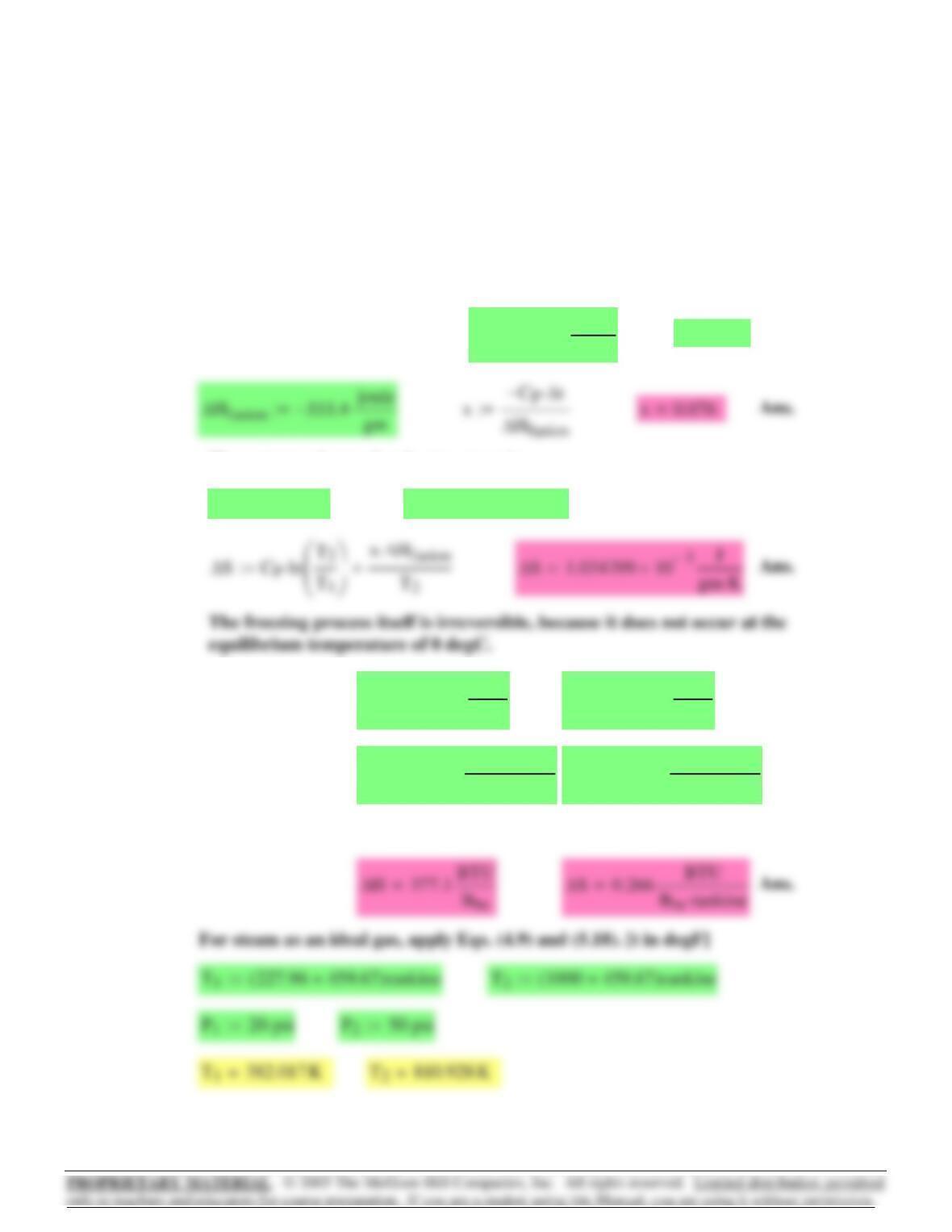
6.20 The process may be assumed to occur adiabatically and at constant
pressure. It is therefore isenthalpic, and may for calculational purposes be
considered to occur in two steps:
(1) Heating of the water from -6 degC to the final equilibrium temperature
of 0 degC.
(2) Freezing of a fraction x of the water at the equilibrium T.
Enthalpy changes for these two steps sum to zero:
CP∆t⋅x∆Hfusion
⋅+ 0=CP4.226 J
gm K⋅
⋅:= ∆t6K⋅:=
The entropy change for the two steps is:
T2273.15 K⋅:= T1273.15 6−()K⋅:=
6.21
153
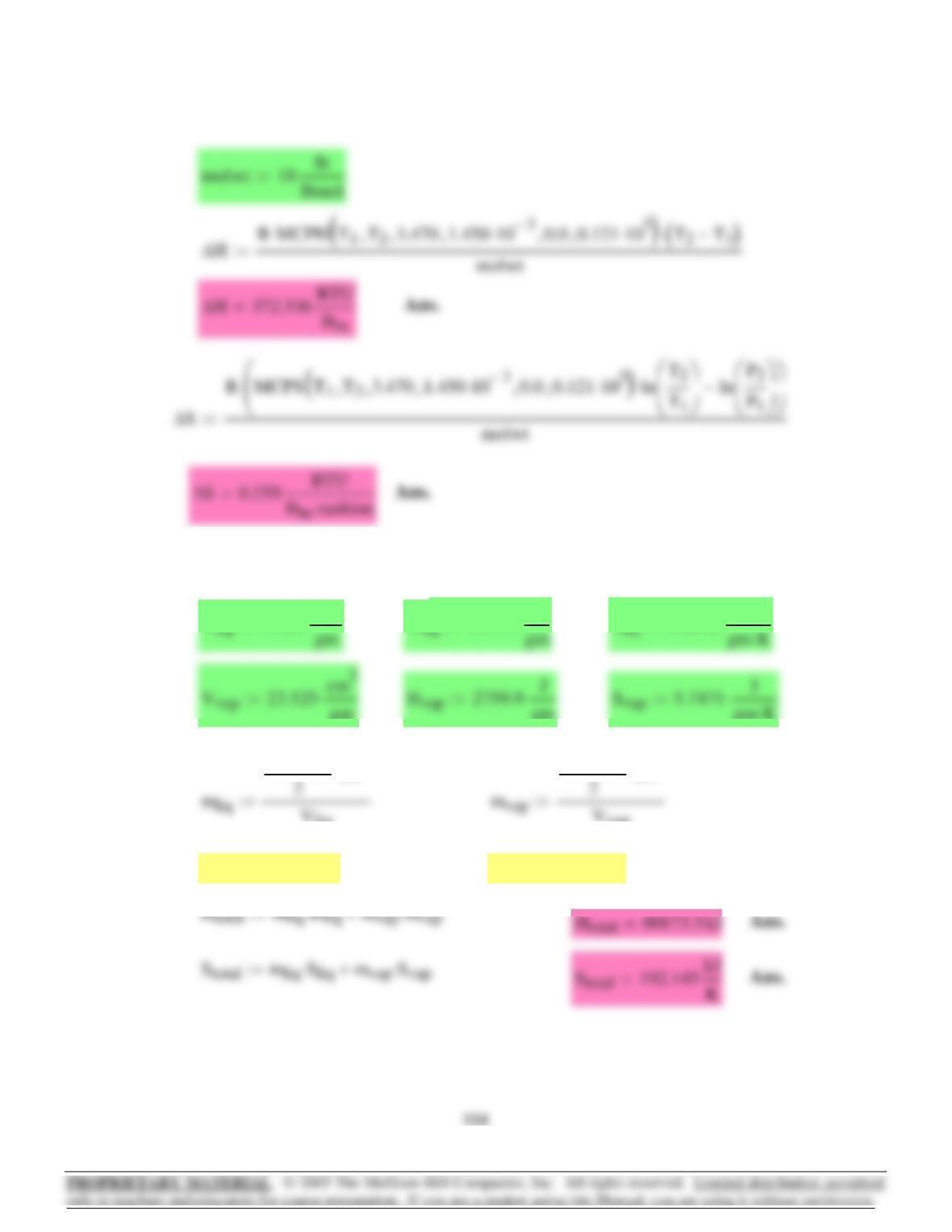
mvap 3.188 kg=mliq 54.191 kg=
0.15 106
⋅
⋅
0.15 106
⋅
⋅
gm
Sliq 3.2076 J
⋅:=Hliq 1317.1 J
⋅:=Vliq 1.384 cm3
⋅:=
Data, Table F.2 at 8000 kPa:
6.22
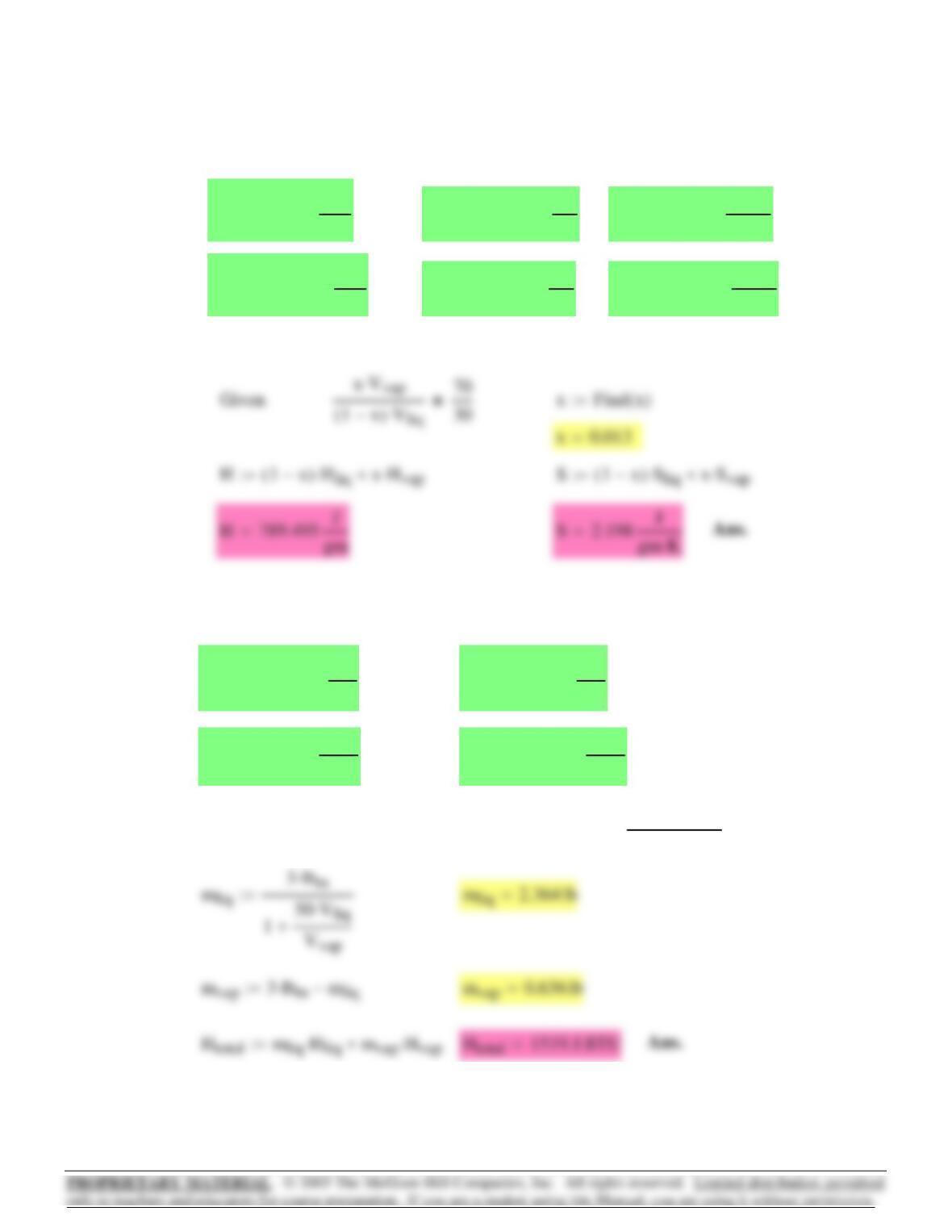
6.24 Data, Table F.3 at 350 degF:
Vliq 0.01799 ft3
lbm
⋅:= Vvap 3.342 ft3
lbm
⋅:=
Hliq 321.76 BTU
lbm
⋅:= Hvap 1192.3 BTU
lbm
⋅:=
mliq mvap
+3lb
m
⋅=mvap Vvap
⋅50 mliq
⋅Vliq
⋅=mliq
50 mliq
⋅Vliq
⋅
Vvap
+3lb
m
⋅=
6.23 Data, Table F.2 at 1000 kPa:
Vliq 1.127 cm3
gm
⋅:= Hliq 762.605 J
gm
⋅:= Sliq 2.1382 J
gm K⋅
⋅:=
Vvap 194.29 cm3
gm
⋅:= Hvap 2776.2 J
gm
⋅:= Svap 6.5828 J
gm K⋅
⋅:=
Let x = fraction of mass that is vapor (quality) x 0.5:= (Guess)
155

6.26 Vtotal mtotal Vliq
⋅mvap ∆Vlv
⋅+=
Table F.1,
150 degC:
Vtotal 0.15 m3
⋅:= Vvap 392.4 cm3
gm
⋅:=
Table F.1,
30 degC: Vliq 1.004 cm3
gm
⋅:= ∆Vlv 32930 cm3
gm
⋅:=
mtotal
Vtotal
Vvap
:= mvap
Vtotal mtotal Vliq
⋅−
∆Vlv
:=
6.25 V1
0.025
cm3
gm
⋅:= Data, Table F.1 at 230 degC:
Vliq 1.209 cm3
gm
⋅:= Hliq 990.3 J
gm
⋅:= Sliq 2.6102 J
gm K⋅
⋅:=
Vvap 71.45 cm3
gm
⋅:= Hvap 2802.0 J
gm
⋅:= Svap 6.2107 J
gm K⋅
⋅:=
156
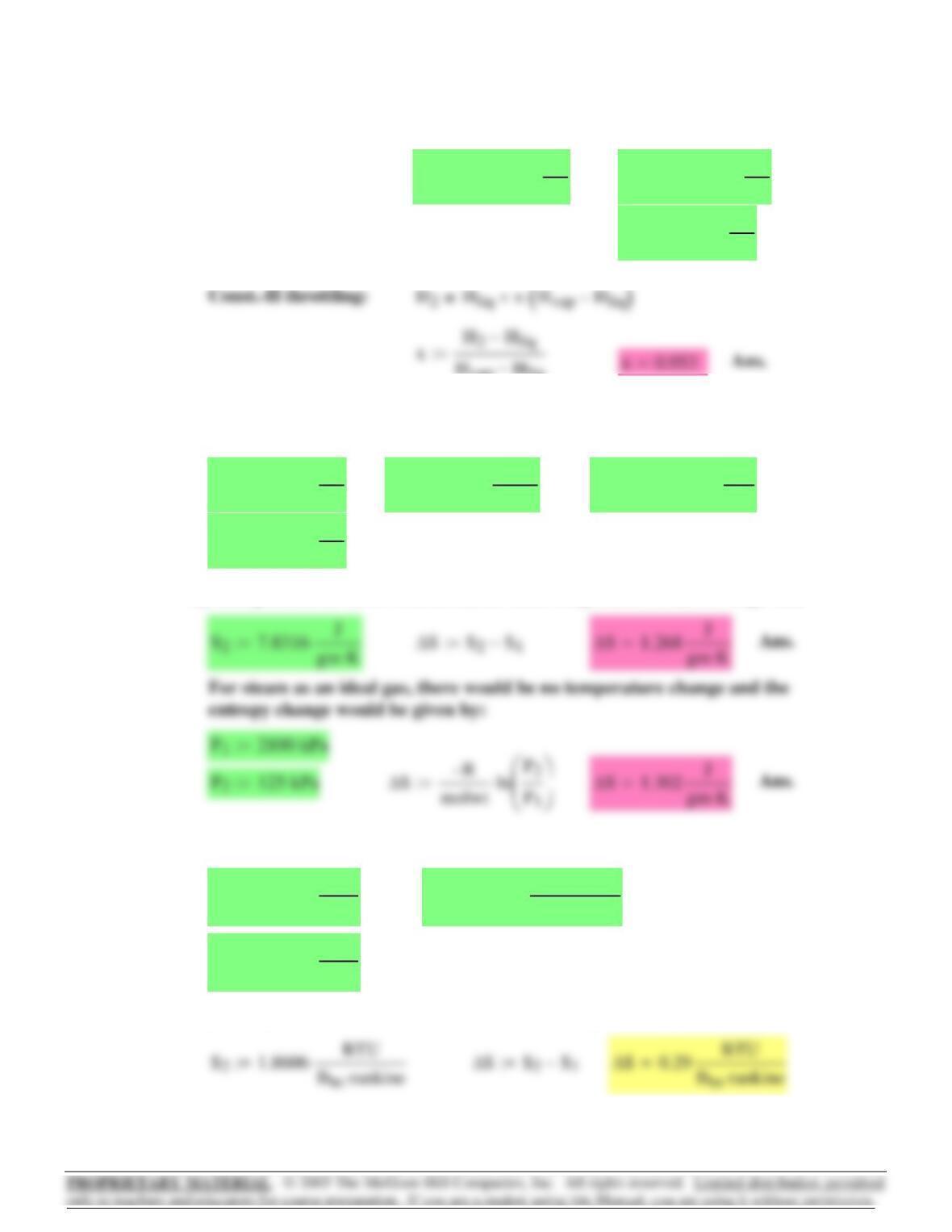
6.29 Data, Table F.4 at 300(psia) and 500 degF:
H11257.7 BTU
lbm
⋅:= S11.5703 BTU
lbmrankine⋅
⋅:=
H21257.7 BTU
lbm
⋅:= Final state is at this enthalpy and a pressure of
20(psia).
By interpolation at these conditions, the final temperature is 438.87 degF and
6.27 Table F.2, 1100 kPa: Hliq 781.124 J
gm
⋅:= Hvap 2779.7 J
gm
⋅:=
Interpolate @101.325 kPa & 105 degC: H22686.1 J
gm
⋅:=
6.28 Data, Table F.2 at 2100 kPa and 260 degC, by interpolation:
H12923.5 J
gm
⋅:= S16.5640 J
gm K⋅
⋅:= molwt 18.015 gm
mol
:=
H22923.5 J
gm
⋅:= Final state is at this enthalpy and a pressure of 125
kPa.
By interpolation at these conditions, the final temperature is 224.80 degC and
157
6.31 Vapor pressures of water from Table F.1:
At 25 degC: Psat 3.166 kPa⋅:=
For steam as an ideal gas, there would be no temperature change and the
entropy change would be given by:
6.30 Data, Table F.2 at 500 kPa and 300 degC
S17.4614 J
gm K⋅
⋅:= The final state is at this entropy and a pressure of
50 kPa. This is a state of wet steam, for which
Sliq 1.0912 J
gm K⋅
⋅:= Svap 7.5947 J
gm K⋅
⋅:=
Hliq 340.564 J
gm
⋅:= Hvap 2646.9 J
gm
⋅:=
158
6.33 Vtotal 0.25 m3
⋅:=
Data, Table F.2, sat. vapor at 1500 kPa:
V1131.66 cm3
gm
⋅:= U12592.4 J
gm
⋅:= mass Vtotal
V1
:=
Of this total mass, 25% condenses making the quality 0.75 x 0.75:=
Since the total volume and mass don’t change,
we have for the final state:
6.32 Process occurs at constant total volume:
Vtotal 0.014 0.021+()m
3
⋅:=
Data, Table F.1 at 100 degC: Uliq 419.0 J
gm
⋅:= Uvap 2506.5 J
gm
⋅:=
Vliq 1.044 cm3
gm
⋅:= Vvap 1673.0 cm3
gm
⋅:=
mliq
0.021 m3
⋅
Vliq
:= mvap
0.014 m3
⋅
Vvap
:= mass mliq mvap
+:=
159

Since the total volume and the total mass do not change during the process,
the initial and final specific volumes are the same. The final state is
therefore the state for which the specific volume of saturated vapor is
98.326 cu cm/gm. By interpolation in Table F.1, we find t = 213.0 degC and
U1540.421 J
gm
=
U1Uliq xU
vap Uliq
−
()
⋅+:=
x 0.058=V198.326 cm3
gm
=V1Vliq xV
vap Vliq
−
()
⋅+:=
xmvap
mtotal
:=mtotal mliq mvap
+:=mvap
1.98 m3
⋅
Vvap
:=
mliq
0.02 m3
⋅
Vliq
:=Uvap 2506.5 J
gm
⋅:=
Since the liquid volume is much smaller than the vapor volume, we make a
preliminary calculation to estimate:
Vvap
V1
x
:= Vvap 175.547 cm3
gm
=
This value occurs at a pressure a bit above 1100 kPa. Evaluate x at 1100
and 1150 kPa by (A). Interpolate on x to find P = 1114.5 kPa and
Uliq 782.41 J
gm
⋅:= Uvap 2584.9 J
gm
⋅:=
6.34 Table F.2,101.325 kPa: Vliq 1.044 cm3
gm
⋅:= Vvap 1673.0 cm3
gm
⋅:=
Uliq 418.959 J
gm
⋅:=
160
(b) Constant-entropy expansion to 150 kPa. The final state is wet steam:
Sliq 1.4336 J
gm K⋅
⋅:= Svap 7.2234 J
gm K⋅
⋅:=
Uliq 444.224 J
gm
⋅:= Uvap 2513.4 J
gm
⋅:=
6.35 Data, Table F.2 at 800 kPa and 350 degC:
V1354.34 cm3
gm
⋅:= U12878.9 J
gm
⋅:= Vtotal 0.4 m3
⋅:=
The final state at 200 degC has the same specific volume as the initial
state, and this occurs for superheated steam at a pressure between 575 and
600 kPa. By interpolation, we find P = 596.4 kPa and
6.36 Data, Table F.2 at 800 kPa and 200 degC:
U12629.9 J
gm
⋅:= S16.8148 J
gm K⋅
⋅:= mass 1 kg⋅:=
(a) Isothermal expansion to 150 kPa and 200 degC
U22656.3 J
gm
⋅:= S27.6439 J
gm K⋅
⋅:= T 473.15 K⋅:=
161

For process: QU
3U2
−=WU
2U1
−=
x10.9:= U1Uliq x1Uvap Uliq
−
()
⋅+:= U12.439 103
×J
gm
=
S1Sliq x1Svap Sliq
−
()
⋅+:= S15.861 103
×m2
s2K
=
6.37 Data, Table F.2 at 2000 kPa:
x 0.94:= Hvap 2797.2 J
gm
⋅:= Hliq 908.589 J
gm
⋅:=
6.38 First step: Q12 0=W12 U2U1
−=
Second step: W23 0=Q23 U3U2
−=
162
S17.0548 J
gm K⋅
⋅:=
6.40 (a) Table F.2, 3000 kPa and 450 degC:
H13344.6 J
gm
⋅:= S17.0854 J
gm K⋅
⋅:=
Table F.2, interpolate 235 kPa and 140 degC:
Since step 1 is isentropic,
S2S1
=Sliq x2Svap Sliq
−
()
⋅+=x2
S1Sliq
−
Svap Sliq
−
:= x20.798=
U2Uliq x2Uvap Uliq
−
()
⋅+:= U22.159 103
×J
gm
=
V2Vliq x2Vvap Vliq
−
()
⋅+:= V2369.135 cm3
gm
=
V3V2
=and the final state is sat. vapor with this specific volume.
Interpolate to find that this V occurs at T = 509.23 degC and
6.39 Table F.2, 400 kPa &
175 degC:
U12605.8 J
gm
⋅:=
163