1
BSTR/445
Business Model and Competitive Strategy of IKEA in
India
TEACHING NOTE
ABSTRACT
The Netherlands-based Swedish company IKEA, was the largest furniture retailer in the world
with its presence in 44 countries around the globe – in countries like the US, the UK, Russia, the
Euro region, Japan, China, Australia, etc. However, it did not enter the Indian market till 2013,
though the company had had its presence in the country since the 1980s as a sourcing destination
for its global stores. After years of lobbying, and negotiating with and convincing the Indian
TEACHING OBJECTIVES AND TARGET AUDIENCE
This case study will help the students to:
1. Understand issues and challenges related to IKEA’s business model and its competitive
strategy
2. Understand issues and challenges related to IKEA’s globalization and strategy in a key
emerging market.
Management /Competitive Strategy course.
TEACHING APPROACH AND STRATEGY
This case study can be used to explain the changing dynamics of the Indian furniture retail market
in detail. It can be used to deliver the concepts of market entry strategies and the importance of
pricing and localization and personalization to gain customers. At the same time, it can also be
2
QUESTIONS FOR DISCUSSION
1. Describe the key elements of IKEA’s globally successful business model. What are the
sources of IKEA’s competitive advantage?
2. Analyze the reasons for IKEA’s delayed entry into the Indian market.
3. Discuss the market entry strategy of IKEA for the Indian market. What are the advantages and
disadvantages of adopting the wholly-owned subsidiary route in entering the market?
ANALYSIS
1. Describe the key elements of IKEA’s globally successful business model. What are the sources
of IKEA’s competitive advantage?
IKEA has relied on an innovative business model to disrupt the competitive furniture business.
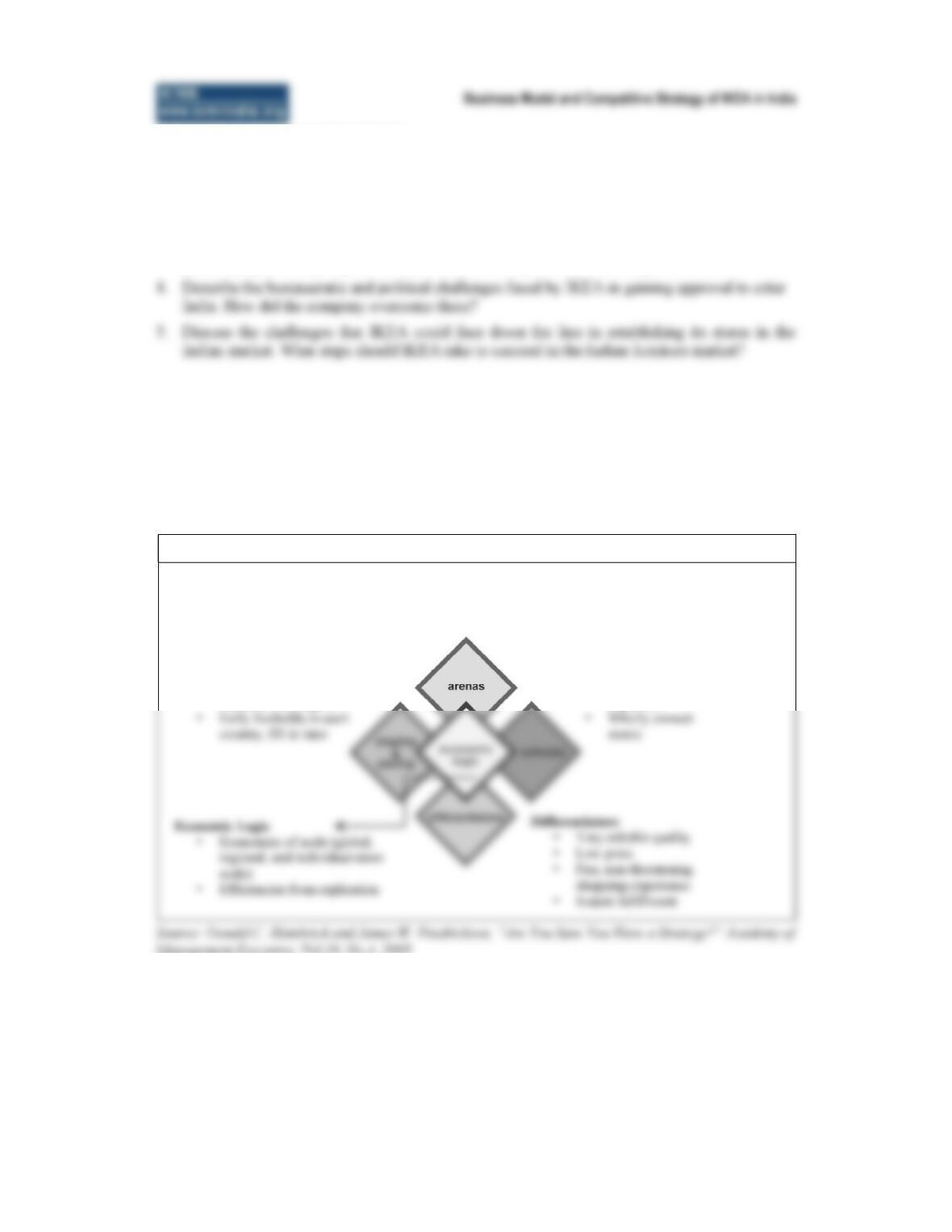
This business model is in total alignment with its strategy (See Figure I for IKEA’s strategy).
Figure I
IKEA’s Strategy
Arenas
•Inexpensive contemporary furniture
•Young white-collar customers
•Worldwide
Staging
•Rapid international
expansion, by region
Vehicles
•Organic
expansion
Management Executive, Vol.19, No.4, 2005.
Over the past decades, IKEA has tasted remarkable success with its strategy which is
explained with the help of Hambrick and Fredrickson’s strategy diamond. In the case of IKEA
we see that all the five elements of strategy as shown in the Figure I, complements and
reinforces each other. The fundamental logic of IKEA’s business model is creating value with
all the activities it was engaged in as shown above. The strategic ‘fit’ is a source of
competitive advantage for IKEA as it is hard to replicate by competitors. The key aspects of
IKEA’s strategy are:
Business Model and Competitive Strategy of IKEA in India
Wide range of contemporary furnitures and furnishings (Scandinavian style)
Inexpensive furniture targeting mostly young and white-collar customers.
Scope of business is global – markets with characteristics that would supports IKEA’s
unique business model
Maintaining control over product design – core competency in designing.
Rapid international expansion, but one region at a time.
Leverages economies of scale and efficiencies of replication – more of standardization
(around 70%), with stong hold over suppliers because of volume of purchase.
IKEA’s competitive strategy was a hybrid one, with on one hand driving down the costs, while
on the other hand providing certain things that are way above what customers come to expect
from a retailer. A hybrid strategy seeks simultaneously to achieve differentiation and a price
lower than that of competitors. Here the success of the strategy depends on the ability of the
firm to deliver enhanced benefits to the customer at low prices, while earning sufficient
margins for reinvestment to maintain and develop the bases of differentiation.
2. Analyze the reasons for IKEA’s delayed entry into the Indian market.
IKEA is considered to be a poster child of globalization. The Netherlands-based Swedish
company, was the largest furniture retailer in the world with a presence in 44 countries around
the globe – in countries like the US, the UK, Russia, the EU region, Japan, China, Australia,
etc. However, it did not enter into the Indian market till 2013, though the company had had a
Business Model and Competitive Strategy of IKEA in India
There are various factors that a company evaluate to understand the attractiveness of a market.
The process of market entry requires a firm to select attractive and profitable national markets,
and decide how to enter them. The selection of national markets entails analyzing the macro
level factors and in terms of competitive and market conditions prevalent in the market. A
PESTEL analysis of the country market can be useful here, before the industry and market-
specific conditions are evaluated.
Some factors that require particular attention in gauging the attractiveness of a country market are:
Macro-economic conditions (GDP, disposable income, stability of the country’s currency,
Macro-environment refers to the conditions that exist in the whole economy rather than in a
particular region. There are many factors in the macro-environment that impact a business.
Examples of the factors that constitute the macro-environment include changes in inflation,
gross domestic product (GDP), cultural beliefs, fiscal and monetary policies, employment,
technological changes, etc. The macro-environment surrounding any business will affect its
functioning and impact the decisions of its managers. Managers need to analyze and monitor
these macro-environmental factors in order to successfully run their businesses. Broadly, there
are six macro-environmental factors which a firm must monitor, viz. demographic, economic,
fragmented, price-sensitive, and the company also had to encounter many political and
regulatory hurdles. The taste and preferences of the consumers were also markedly different and
IKEA was not very familiar with the consumer characteristics. Moreover, the company might
not have been convinced that its internal strengths could be leveraged in a country like India.
However, IKEA was closely studying the market and it was not for long that IKEA could
Business Model and Competitive Strategy of IKEA in India
5
FDI rules. However, IKEA had to wait another year, hitting many roadblocks on the way,
before it was able to obtain the Indian government’s approval to establish its stores. The
company also had negotiate hard with the regulators and even make some adjustments in its
global store model to fit the Indian FDI and sourcing outlines and Indian consumer
preferences.
3. Discuss the market entry strategy of IKEA for the Indian market. What are the advantages and
disadvantages of adopting the wholly-owned subsidiary route in entering the market?
Once a particular national market has been selected for entry, a firm need to choose, which all
value-creating activities are to be located in that market. India already served IKEA as a low–
cost sourcing destination since the 1980s. Every year, the company sourced around US$600
million worth of goods (textiles, rugs, lighting, ceramics, and carpets) from 70 suppliers and
Advantage Disadvantage
Full control of resources and capabilities. Substantial investment in and commitment to host
country leading to economic and financial
exposure.
Facilitates integration and coordination of
activities across national boundaries.
Going it alone in a host market whose cultural
norms and social structures are very different from
the existing markets may be fraught with risks.
Adapted from • Johnson, G., Whittington, R., Angwin, D., Regner, P., Scholes, K., & Pyle, S. (2013).
Exploring strategy: text and cases. Pearson.
IKEA had significant experience in internationalization so it preferred adopting the wholly
owned-subsidiary route when the opportunity was presented to it as the Indian government
allowed 100% FDI in single brand retail in 2012. For some time in the previous years the
Business Model and Competitive Strategy of IKEA in India
4. Describe the bureaucratic and political challenges faced by IKEA in gaining approval to enter
India. How did the company overcome these?
IKEA faced significant bureaucratic and political challenges in gaining approval to enter India.
In the initial phase its efforts to enter the market were frustrated by the country’s FDI norms.
Till 2011, FDI in multi-brand retail was not allowed by the Indian government and FDI in
But the struggle was not over for IKEA as the process was marred by bureaucratic delays and
it had to comply with various stringent regulations, and get approvals from various
government bodies in order to start operations in India. Such bureaucratic delays and red tape
are the hazards of operating in emerging markets in India where markets are not sufficiently
evolved. Some of these requirements put significant pressure on IKEA as these ran contrary to
IKEA’s strategy and business model.
Sourcing norm – The requirement of 30% sourcing of goods from India’s micro, small,
and medium enterprises (MSMEs).
The management of IKEA engaged in dialogue with the stakeholders and also lobbied the
government to address these concerns.
IKEA expressed its concerns with the mandatory 30% sourcing of its goods from Indian
MSMEs. It told the government that it was already sourcing a huge amount of its products
from India (US$600 million per annum, by engaging with 70 suppliers and 1450 sub-
suppliers) but the mandatory sourcing clause put some burden on the company and its
business model. It sought a 10-year window (instead of one year) to comply with the
sourcing rules. IKEA also expressed concerns that if it procured from MSMEs (firms with
Business Model and Competitive Strategy of IKEA in India
7
with Indian suppliers in the plastics, steel, lighting and natural fiber categories as well. It
invited all its suppliers to its Gurgaon office and discussed its plans for the future and how
it could help the supplier in its efforts to double its sourcing from Indian suppliers.
Regarding concerns about IKEA’s entry into India, the company highlighted how it was
already sourcing a huge amount of its products from India (US$600 million per annum, by
engaging with 70 suppliers and 1450 sub-suppliers). IKEA highlighted the total
investment (€ 1.5 billion) that the retailer was planning for India and how these will lead
to new employment. It said that IKEA’s presence in India will help improve availability of
high quality, low-price products, increase sourcing of goods from India and increase the
competitiveness of Indian enterprise through access to global designs, technologies, skill
development, and global best practices. It also committed that it would continue to
increase its sourcing in India from both existing and new suppliers building on long–term
relations and shared values.
5. Discuss the challenges that IKEA could face down the line in establishing its stores in the
Indian market. What steps should IKEA take to succeed in the Indian furniture market?
With much of the political and regulatory hurdles behind it, IKEA was now faced with some
additional challenges going forward. Some of these challenges are related to the Indian market
which was much different from IKEA existing markets.
India was home to rich traditional handicrafts and artistic work of wood. Indian art and
design had earned a worldwide reputation for themselves for their quality, exceptional
designs, and luxurious trends lent elegance to the Indian furniture segment. Will the flat-
bed designs of IKEA appeal to the customers?
Business Model and Competitive Strategy of IKEA in India
8
usage required its stores to be supplied with either wind power or energy from solar
panels. Its stores in Germany, France, Sweden, and at forty more places used either power
from their own wind turbines or from solar panels. The possibility of Indian real estate
developers meeting such stringent energy requirements was also doubtful.
The retailer is also not immune to further bureaucratic trouble as India is also known for
arbitrary decisions and inadequate enforcements of law. The bureaucracy is also marred by
corruption, while IKEA is committed to ethical practices with strict anti-corruption policy.
Juvencio Maeztu (IKEA’s Country Manager for India) had said that the retailer has understood
that the market is different and the customer’s tastes and preferences are significantly different,
and he said that IKEA was prepared to “slightly tweak” its model in India, keeping in mind the
Indian consumers and the dynamics of the Indian retail industry. IKEA’s success or failure
would depend on how this tweaking is done. India is fast emerging as a very attractive market
and IKEA may be tempted to make too many changes to capture the market. IKEA had always
maintained a high level of standardization of tis products and the IKEA concept. It is very
important that IKEA does not make too many changes that could lead to breakdown of its
business model in India.
However, it is good to see that IKEA is not in a hurry to open its stores in India. It is prepared
to invest significant time and efforts into fine tuning the India strategy. It would not be until
2017 that the first store would be launched in India. As IKEA is a private company and due to
its unique structure (case Exhibit III) this is made possible. IKEA’s ownership structure stood
for independence, long-term approach, and continuity. IKEA’s representatives were visiting
Business Model and Competitive Strategy of IKEA in India
Suggested Readings:
Deresky, H. (2013), International Management: Managing Across Borders and Cultures, Text
and Cases (8th Edition), Pearson.
Johnson, G., Whittington, R., Angwin, D., Regner, P., Scholes, K., & Pyle, S. (2013).
Exploring strategy: text and cases. Pearson.
Hambrick, D. C., & Fredrickson, J. W. (2001). Are you sure you have a strategy?. The
Academy of Management Executive, 15(4), 48-59.
References:
1. “After long wait, IKEA in no rush for quick launch of stores,” www.moneycontrol.com,
June 2, 2013
6. Rajesh Roy, “Indian Clears IKEA’s $1.95 Billion Investment Plan,” http://online.wsj.com,
May 2, 2013
7. “One size doesn’t fit all: IKEA goes local for India, China”,
http://in.reuters.com/article/2013/03/07/ikea-expansion-india-china–
idINDEE92603L20130307, March 7, 2013
8. “A Review of the World Furniture Summit 2012,” www.furniturenews.net, January 11,
2013
9. Jason Burke, “Food fight complicates Ikea‘s entry into India”, www.guardian.co.uk,
December 28, 2012
Business Model and Competitive Strategy of IKEA in India
10
2012
26. “Welcome Inside – IKEA Group Yearly Summary FY12,” www.ikea.com, 2012
27. “IKEA Tempe Opens for Business,” www.dynamicbusiness.com.au, November 3, 2011
28. Tuhina Anand, “IKEA, Carrefour welcome FDI,” www.mxmindia.com, November 2011
29. Nidhi Dutt, “Ikea makes steps in India’s growth market,” www.bbc.co.uk, September 21,
2010
30. Taruna Sondarva, “ Furniture Market in India: Boom Time Ahead,” www.ikonmarket.com,
February 2010
31. “Welcome Inside – Yearly Summary FY09,” http://www.ikea.com, 2010
36. “Corporate Awards and Recognition”, http://info.ikea-usa.com/centennial/pdfs/9-
IKEA%20Awards%20and%20Achievements.pdf
37. “Global Furniture Industry Overview 2013”, www.businessvibes.com/blog/global-
furniture-industry–overview-2013
38. “Indian Furniture Industry,” www.indianmirror.com/indian-industries/furniture.html
39. “Our Business Idea”,
www.ikea.com/ms/en_CA/about_ikea/the_ikea_way/our_business_idea/index.html