Accounting Information Systems, 10e 1
SOLUTIONS FOR CHAPTER 6
Each end-of-chapter question in the Solutions Manual is tagged to correspond with AACSB, AICPA
and CISA standards, allowing professors to more easily manage the task of reporting outcomes to these
professional and accrediting bodies. Please see the corresponding spreadsheet file for the tagging
information.
Discussion Questions
DQ 6-1 What is the relationship between business intelligence (BI) and enterprise
systems, especially ERP systems?
ANS. BI software is an extension of or add-on to an enterprise system, not a completely
new installation or upgrade. In ERP systems, they are usually modules. BI is
DQ 6-2 What is a model? How is modeling a database or information system useful and
important from a business or accounting perspective?
ANS. Models are abstractions or simplifications of very complex phenomena; in our
domain we model business processes. Appropriate models help us understand
2 Solutions for Chapter 6
DQ 6-3 Discuss how you determine the placement of primary keys in relational tables to
link the tables to each other.
ANS. 1. Assign a primary key to every table.
DQ 6-4 How can primary keys and the linking of tables in a relational database affect
controls?
ANS. Technology Application 6-1 points out two ways the primary keys and linking
tables together help an organization achieve its internal control objectives. First,
DQ 6-5 Several steps are required when designing a database. List and describe the main
steps of this process.
ANS. The three main steps are:
• Prepare the conceptual model
o Identify the entities
o Identify the relationships between the entities
Accounting Information Systems, 10e 3
DQ 6-6 Refer to Figure 6.12. To implement a many-to-many (M:N) relationship between
two relations, the figure demonstrates creating a new relation with a composite
key made up of the primary keys (Client_No and Employee_No) of the relations to
be linked. As an alternative, you might be tempted to simply add the fields
Employee_No to the Client relation, and Client_No to the Employee relation.
Discuss the reporting problems that might occur with that alternative strategy.
ANS. The problem begins when there is a true (M:N) environment. A simple example of
DQ 6-7 Although today’s enterprise systems incorporate many of the REA concepts, many
organizations continue to use legacy systems. Why do you believe this is true?
(Although the obvious answer is in the chapter, you may want to look to other
sources to support to your answer.)
4 Solutions for Chapter 6
ANS. A major issue is the cost of converting to new systems. Companies must look at
the incremental cost and incremental benefits. If the legacy system is providing 95
DQ 6-8 Although SQL is the de facto standard database language, there are many
variations of the language. Using the Internet (or other sources), answer the
following questions. What is a de facto standard? Provide examples (other than
SQL) of such standards. How does SQL (the primary database language) being a
de facto standard affect you, in your role of an information user?
ANS. When Googling de facto standard (in August 2006), the results included the
following entry from Webopedia:
Accounting Information Systems, 10e 5
Short Problems
Note to instructor: There will be some variation in the solutions from your students to the
following short problems. Each solution below represents only one of the possible correct
solutions. Since all four short problems relate to inventory ordering, you can refer to Chapter 12
for more examples of solutions.
SP 6-1 ANS. Using Microsoft Visio, the model should look like this:
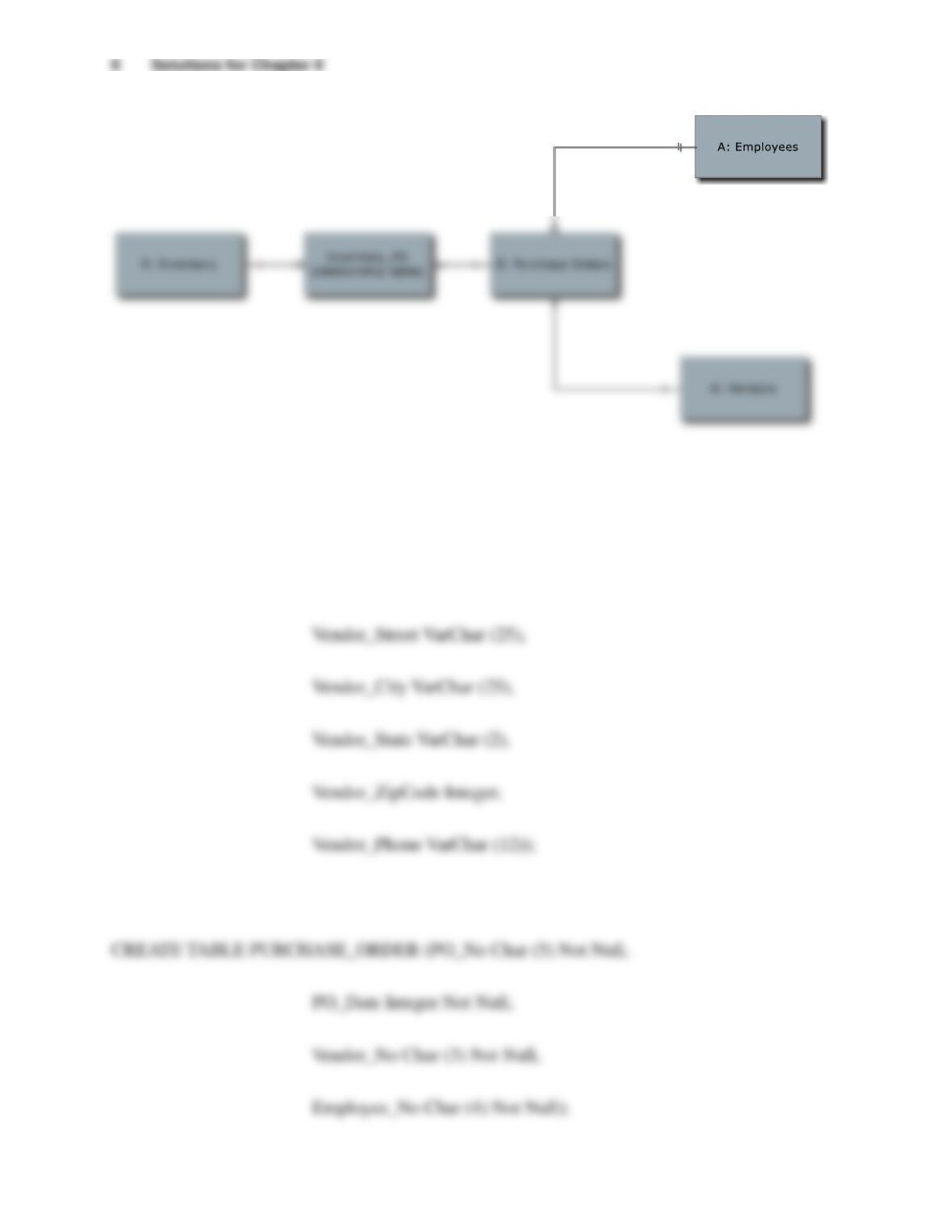
SP 6-2 ANS. Using Microsoft Visio, the model should look like the following diagram. Note
that the M:N relationship between Inventory and Purchase Orders requires the
addition of a relationship table.
SP 6-3 ANS.
CREATE TABLE VENDORS (Vendor_No Char (3) Not Null,
Vendor_Name VarChar (25) Not Null,
Accounting Information Systems, 10e 7
SP 6-4 ANS. Note that this solution uses the tables as created and populated in the solution to SP
6-3 above.
SELECT PO_No, PO_Date, Vendor_Name
FROM VENDORS, PURCHASE_ORDER

8 Solutions for Chapter 6
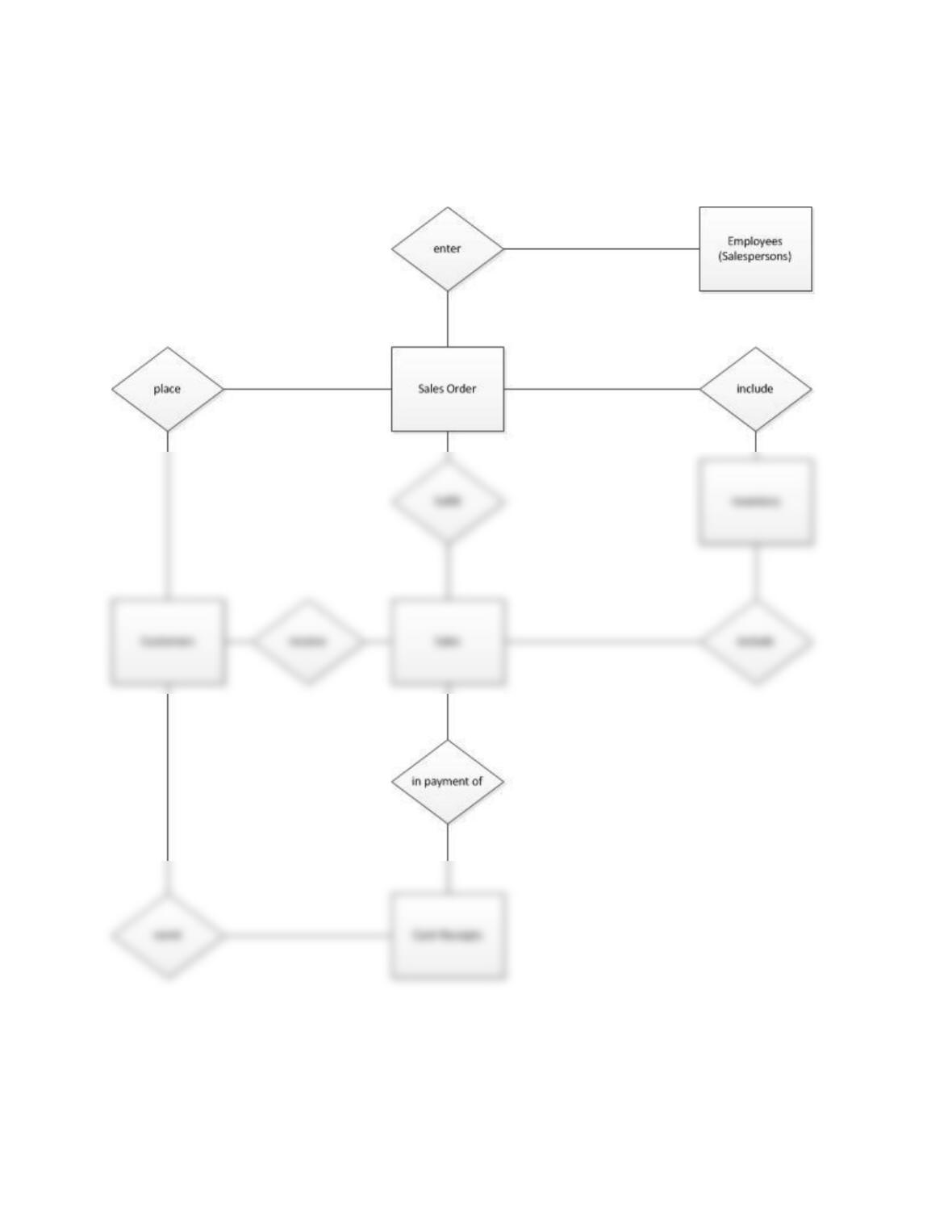
SP6-5 ANS. Students should classify the entities in this situation into the following REA
categories:
Resources
Events
Agents
Locations
Accounting Information Systems, 10e 9
Using Microsoft Visio, the redrawn REA diagram should resemble the following
figure:
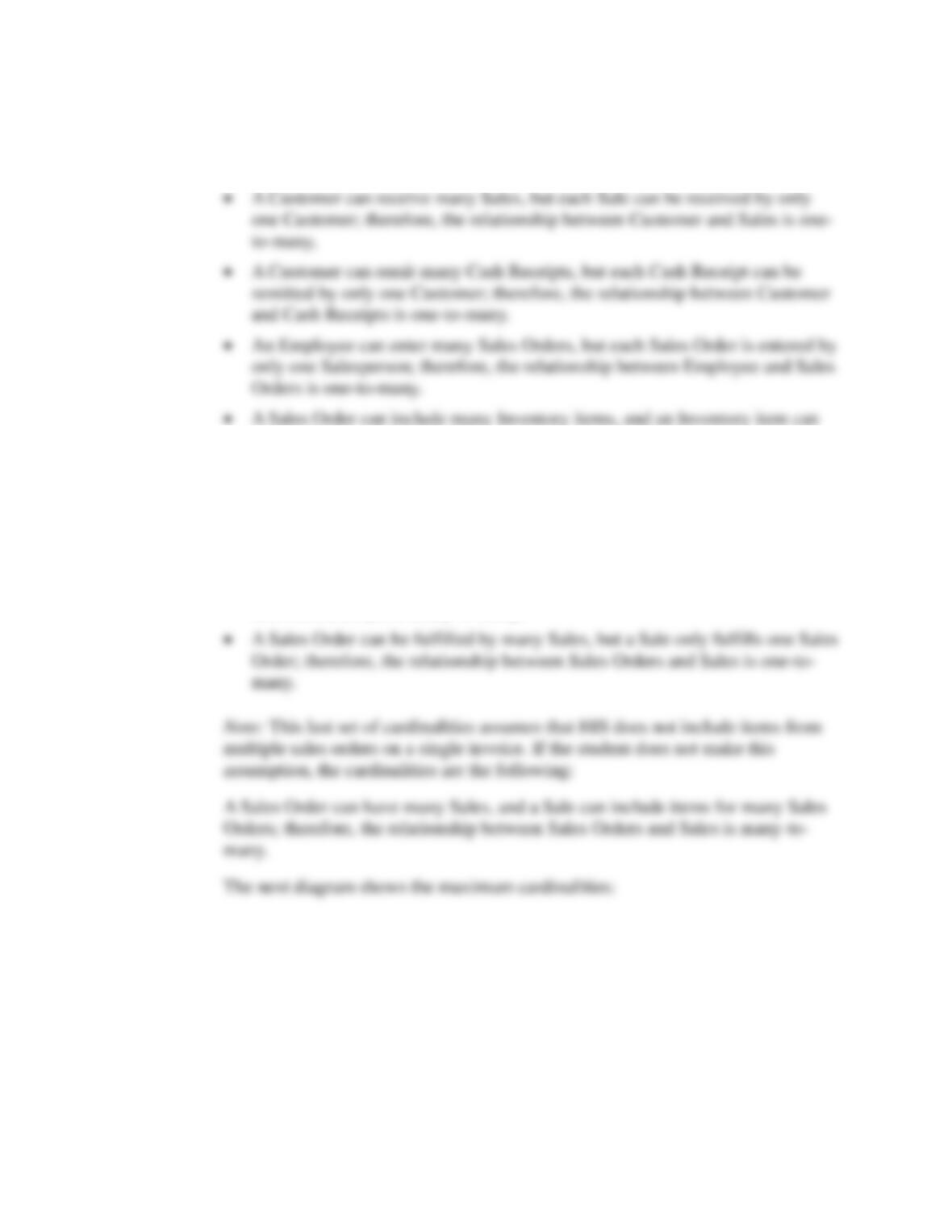
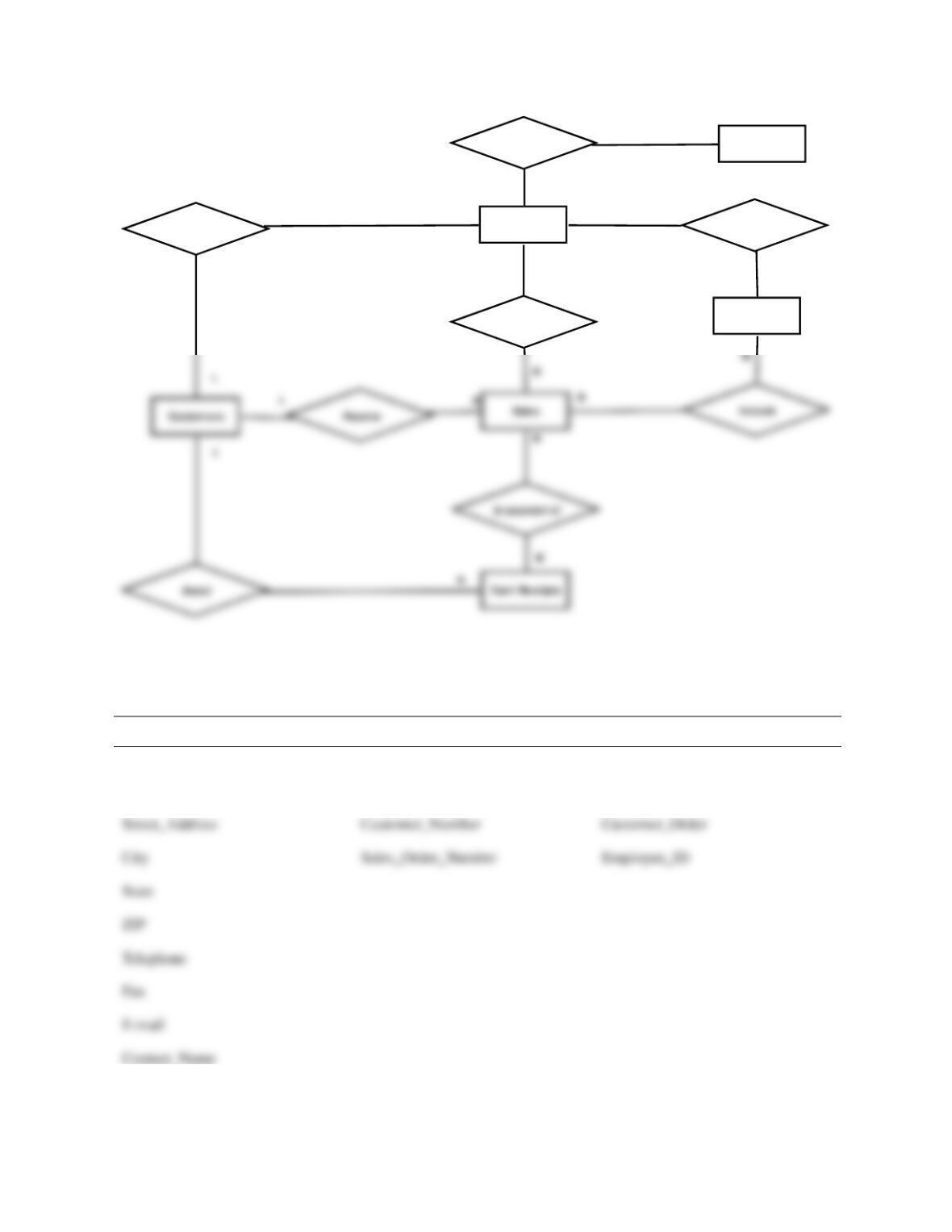
SP 6-6 ANS. Student responses should show the following maximum cardinalities:
10 Solutions for Chapter 6
• A Customer can place many Sales Orders, but each Sales Order can be placed
by only one Customer; therefore, the relationship between Customer and Sales
Order is one-to-many.
be included on many Sales Orders; therefore, the relationship between Sales
Order and Inventory is many-to-many.
• A Sale can include many Inventory items, and an Inventory item can be
included on many Sales; therefore, the relationship between Sales and
Inventory is many-to-many.
• A Sale can result in the payment of many Cash Receipts, and a Cash Receipt
can be in payment of many Sales; therefore, the relationship between Sales
and Cash Receipts is many-to-many.
Accounting Information Systems, 10e 11
Employees
(Salespersons)
Enter
Sales Orders Include
Inventory
Fulfill
Place
1
N
N
M
1
N
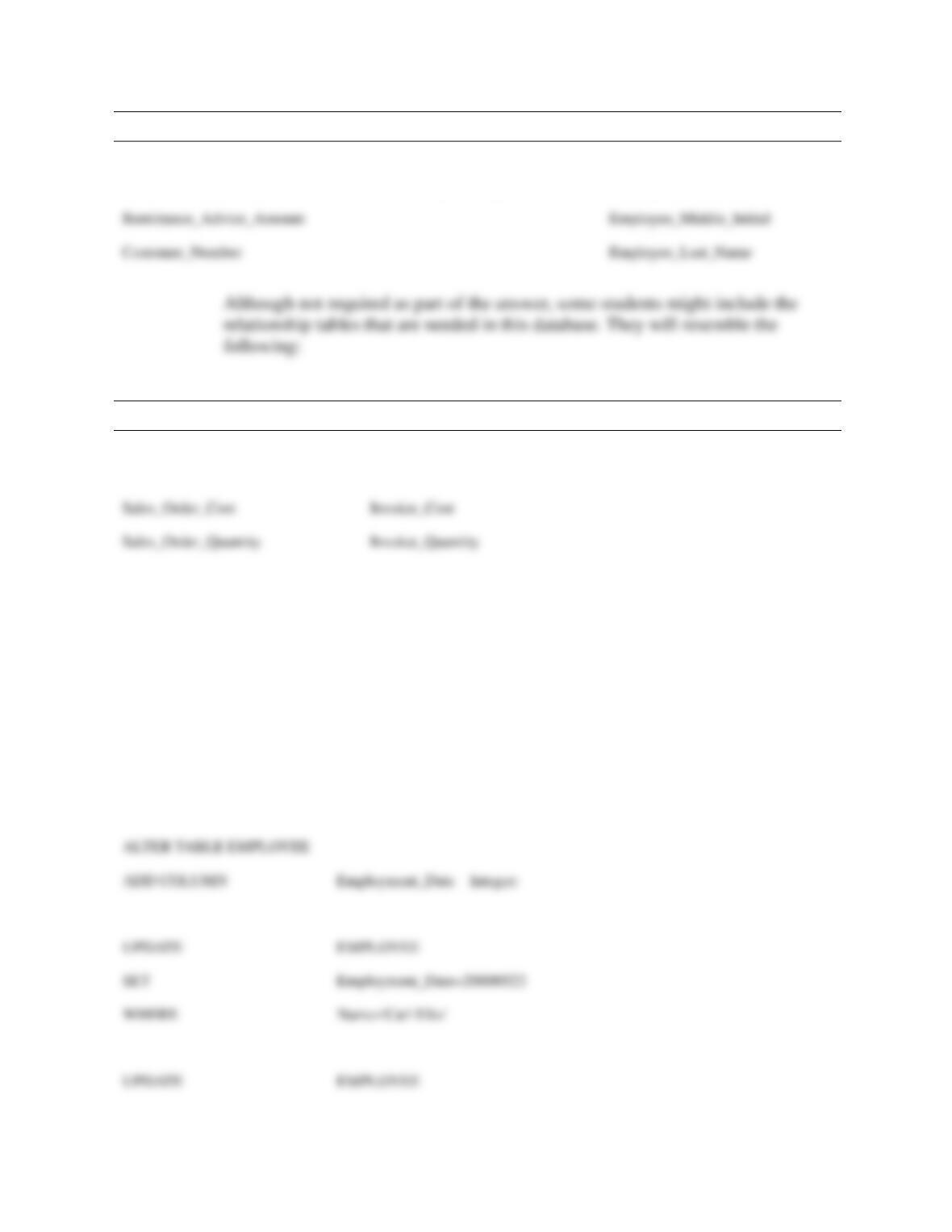
SP 6-7 ANS. Student answers will vary, but the following suggested answer is provided as a
grading guide:
Customers
Sales
Sales Orders
Customer_Number (PK)
Invoice_Number (PK)
Sales_Order_Number (PK)
Customer_Name
Invoice_Date
Sales_Order_Date
Street_Address
Customer_Number
Customer_Order
City
Sales_Order_Number
Employee_ID
Telephone
Fax
E-mail
12 Solutions for Chapter 6
Cash Receipts
Inventory
Employees
Remittance_Advice_Number (PK)
Inventory_Item_ID (PK)
Employee_ID (PK)
Remittance_Advice_Date
Inventory_Description
Employee_First_Name
Sales Orders – Inventory
Sales – Inventory
Cash Receipts – Sales
Sales_Order_Number (CPK)
Invoice_Number (CPK)
Remittance_Advice_Number (CPK)
Inventory_Item_ID (CPK)
Inventory_Item_ID (CPK)
Invoice_Number (CPK)
Sales_Order_Cost
Invoice_Cost
Sales_Order_Quantity
Invoice_Quantity
Problems
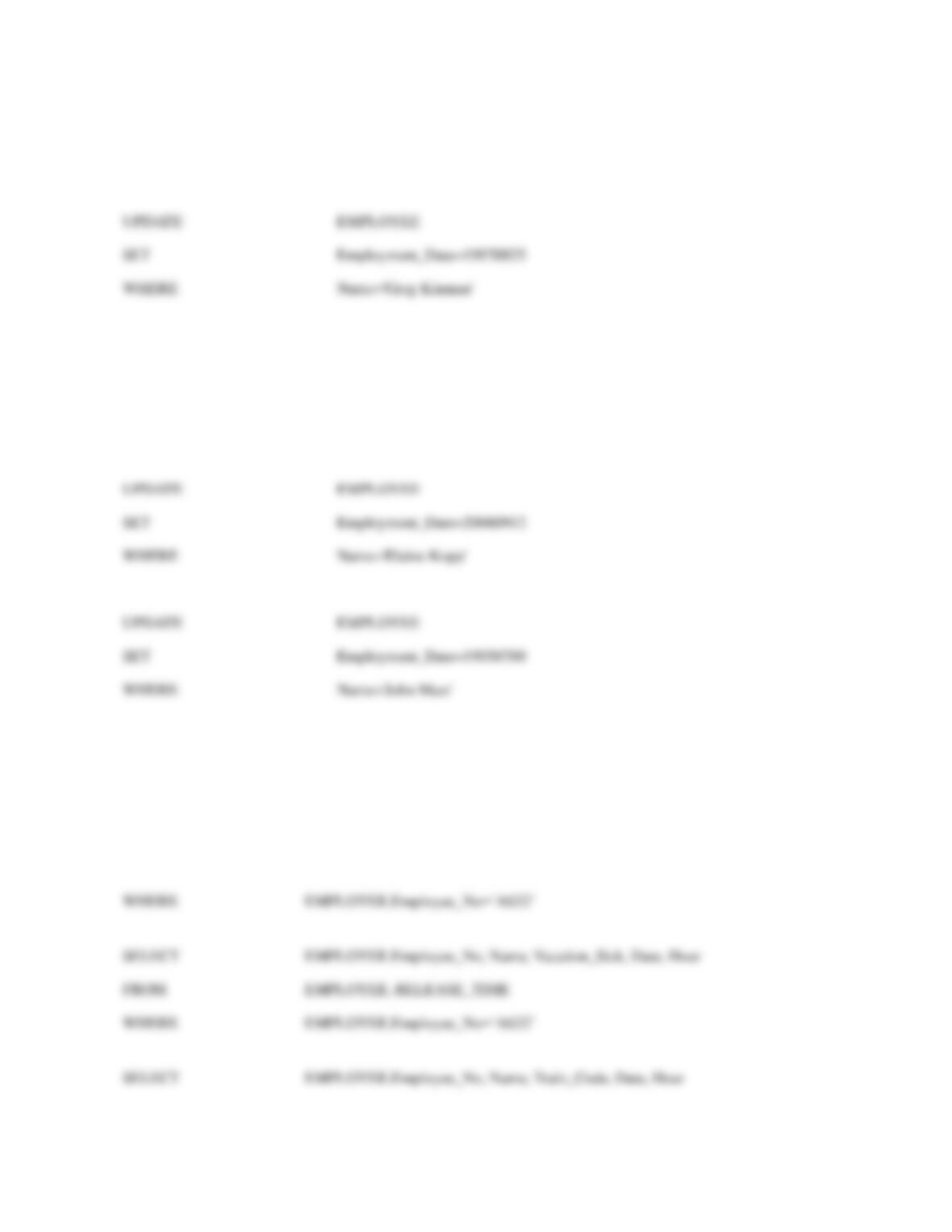
P 6-1 ANS. While there may be some variation in the solutions from your students, they
should be close to the following. The first SQL command adds the new column.
The next set of six SQL commands updates the table with the dates provided.
Note that in the WHERE statement any attribute that uniquely identifies that row
can be used—for example, Employee_No.
UPDATE
EMPLOYEE
Remittance_Advice_Amount
Employee_Middle_Initial
Customer_Number
Employee_Last_Name
Accounting Information Systems, 10e 13
SET
WHERE
UPDATE
SET
WHERE
Employment_Date=20010103
Name=’Janet Robins‘
EMPLOYEE
Employment_Date=20040801
Name=’Christy Bazie‘
P 6-2 ANS. Your students will develop a variety of answers to this question. Here are
solutions that use three queries:
SELECT
EMPLOYEE.Employee_No, Name, Client_No, Date, Hours
FROM
EMPLOYEE, WORK_COMPLETED
14 Solutions for Chapter 6
P 6-3 ANS. Student submissions for this problem will vary depending on which database
product you have them use to complete the tasks. You can have students submit
P 6-4 ANS. The exact format of answers will vary depending on the database product that is
used. The submission for part c should resemble the figure in the chapter. If your
P 6-5 ANS. The answers that students develop for this problem will vary depending on which
spreadsheet software tool they use and on their individual abilities with the
software. Their answers should include an answer of 72 total hours billed for Fleet
Services.
P 6-6 ANS. Your students’ solutions will vary depending on which database software tool they
use. You can use the table specifications included in the answer to DQ 6-3 as a
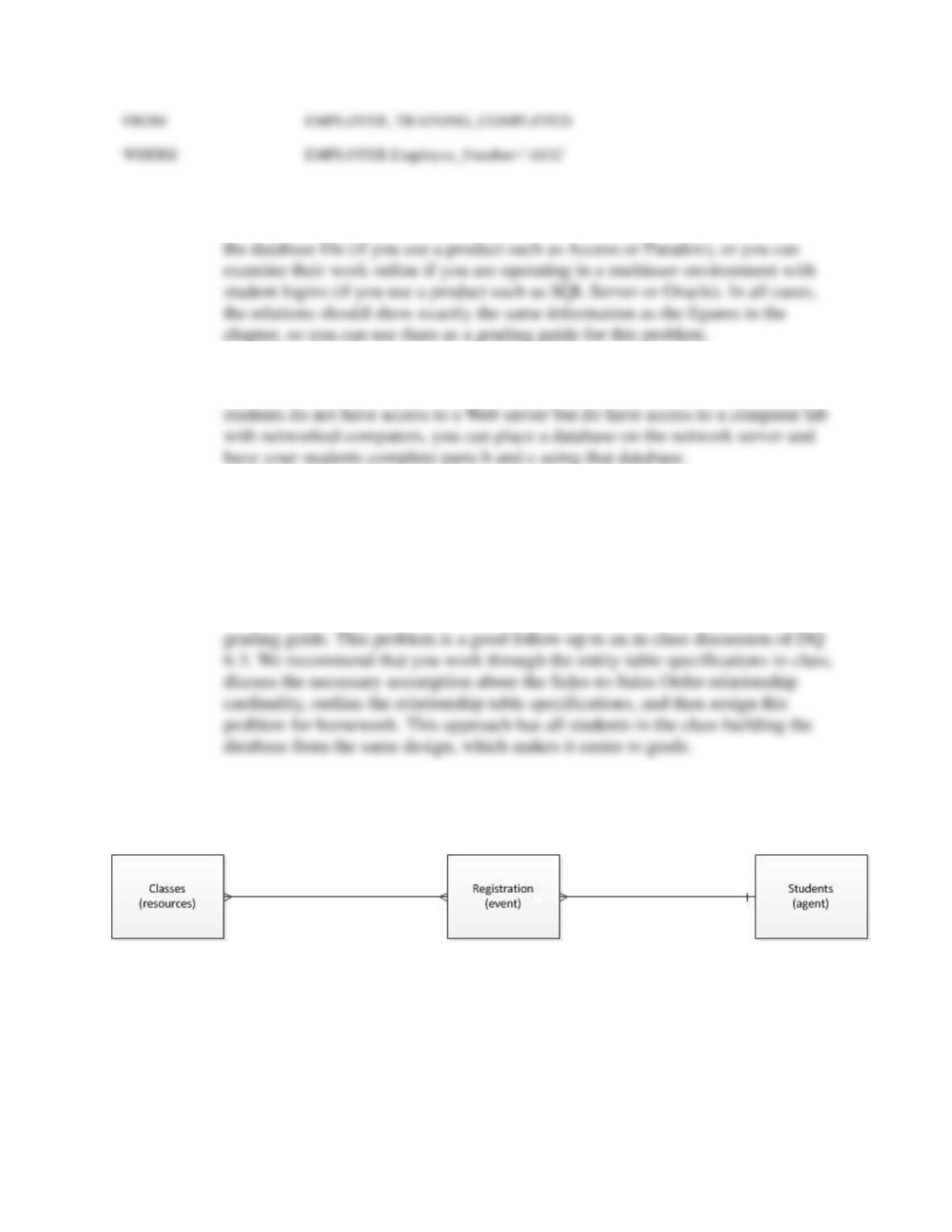
P 6-7 ANS. Using Microsoft Visio, the maximum cardinalities for the E-R diagram should be:
Accounting Information Systems, 10e 15