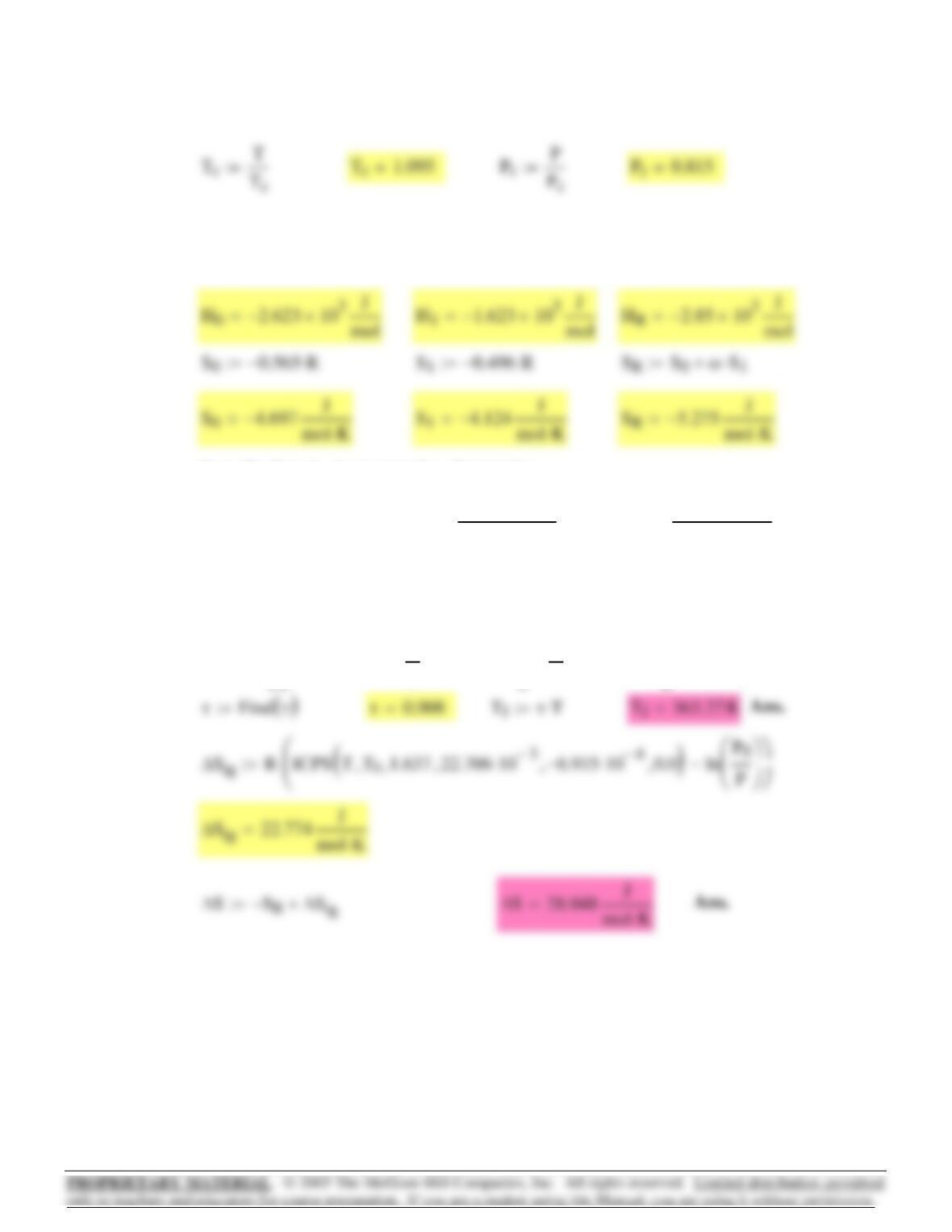
A 1.637:= B22.706 10 3−
⋅
K
:= C6.915−10 6−
⋅
K2
:=
Solve energy balance for final T. See Eq. (4.7).
τ1:= (guess) Given
HRRAT⋅τ1−
()
⋅B
2T2
⋅τ
21−
()
⋅+
⎡
⎢
⎣
⎤
⎥
⎦
C
3T3
⋅τ
31−
()
⋅+
⎡
⎢
⎣
⎤
⎥
⎦
⋅=
Step (1): Use the Lee/Kesler correlation, interpolate.
H00.863−R⋅Tc
⋅:= H10.534−R⋅Tc
⋅:= HRH0ωH1
⋅+:=
Step (2): For the heat capacity of propylene,
184
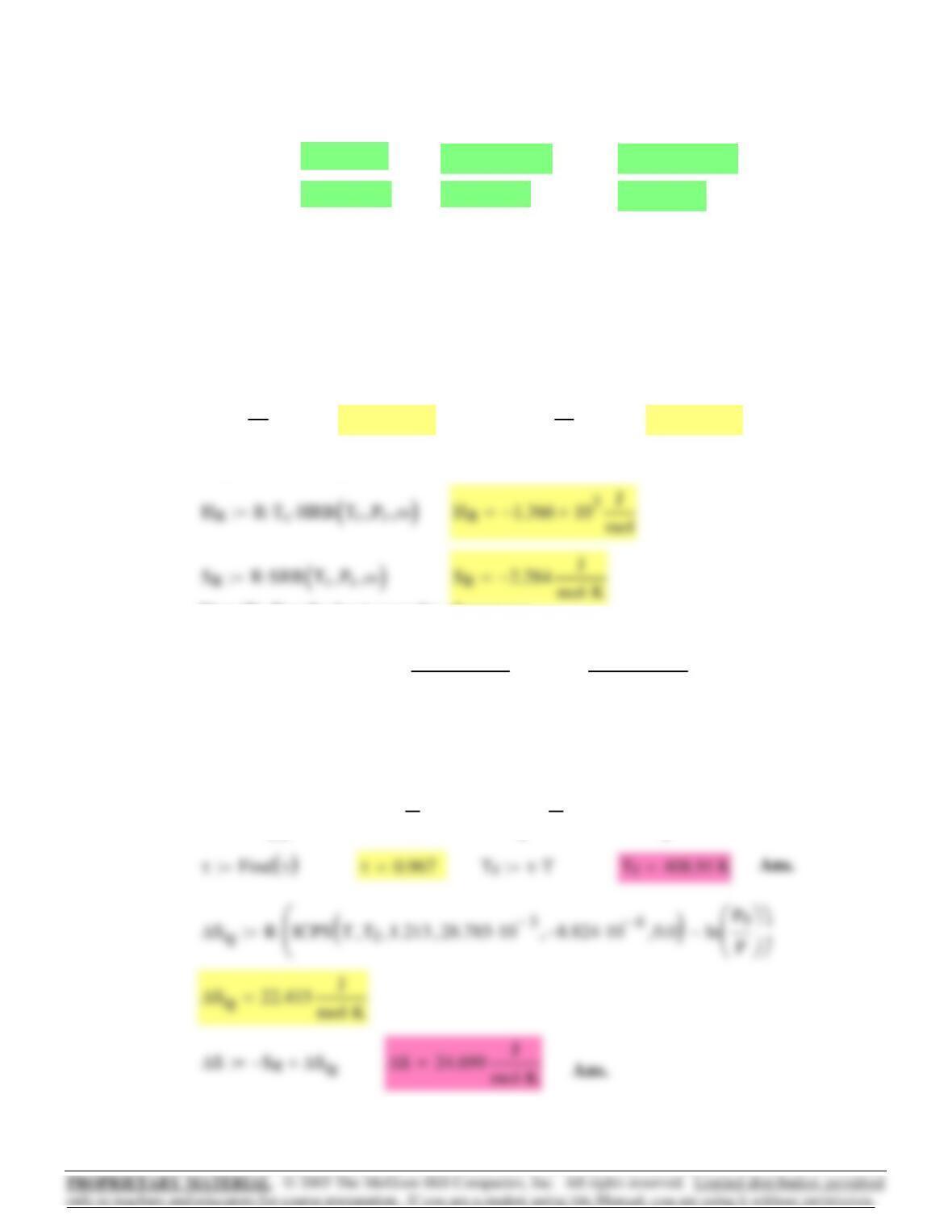
A 1.213:= B28.785 10 3−
⋅
K
:= C8.824−10 6−
⋅
K2
:=
Solve energy balance for final T. See Eq. (4.7).
τ1:= (guess) Given
HRRAT⋅τ1−
()
⋅B
2T2
⋅τ
21−
()
⋅+
⎡
⎢
⎣
⎤
⎥
⎦
C
3T3
⋅τ
31−
()
⋅+
⎡
⎢
⎣
⎤
⎥
⎦
⋅=
6.57 Propane: ω0.152:= Tc369.8 K⋅:= Pc42.48 bar⋅:=
T 423 K⋅:= P 22 bar⋅:= P01 bar⋅:=
The throttling process, occurring at constant enthalpy, may be split into
two steps:
(1) Transform into an ideal gas at the initial conditions, evaluating property
changes from a generalized correlation.
(2) Change T and P in the ideal-gas state to the
final conditions, evaluating property changes by equations for an ideal gas.
Property changes for the two steps sum to the property change for the
process. For the initial conditions:
Tr
T
Tc
:= Tr1.144=Pr
P
Pc
:= Pr0.518=
Step (1): Use the generalized virial correlation
Step (2): For the heat capacity of propane,
185
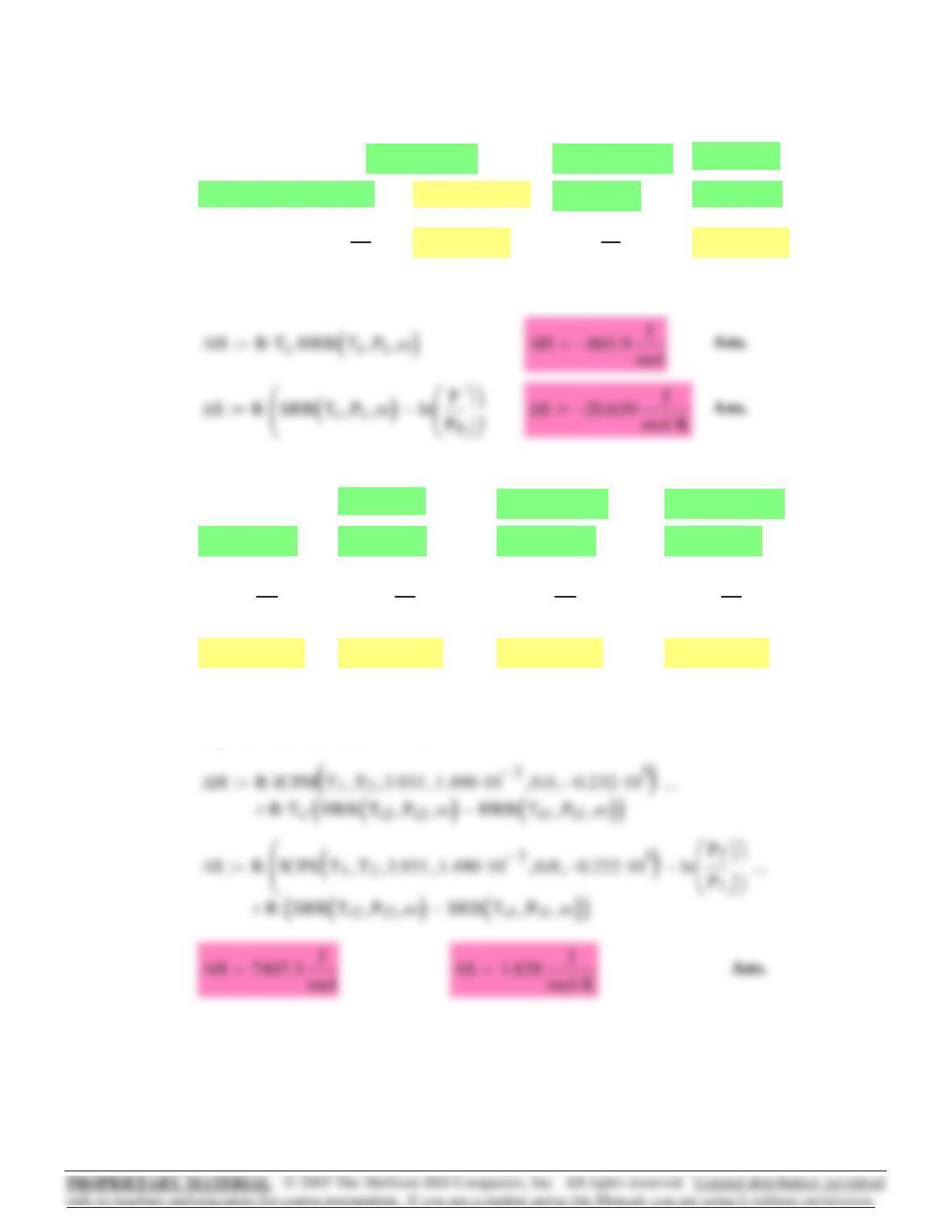
ω0.094:= Tc373.5 K⋅:= Pc89.63 bar⋅:=
T1400 K⋅:= P15 bar⋅:= T2600 K⋅:= P225 bar⋅:=
Tr1
T1
Tc
:= Pr1
P1
Pc
:= Tr2
T2
Tc
:= Pr2
P2
Pc
:=
Tr1 1.071=Pr1 0.056=Tr2 1.606=Pr2 0.279=
Use generalized virial-coefficient correlation for both sets of conditions.
Eqs. (6.91) & (6.92) are written
6.58 For propane: Tc369.8 K⋅:= Pc42.48 bar⋅:= ω 0.152:=
T 100 273.15+()K⋅:= T 373.15 K=P01 bar⋅:= P 10 bar⋅:=
Tr
T
Tc
:= Tr1.009=Pr
P
Pc
:= Pr0.235=
Assume ideal gas at initial conditions. Use virial correlation at final conditions.
6.59 H2S:
186
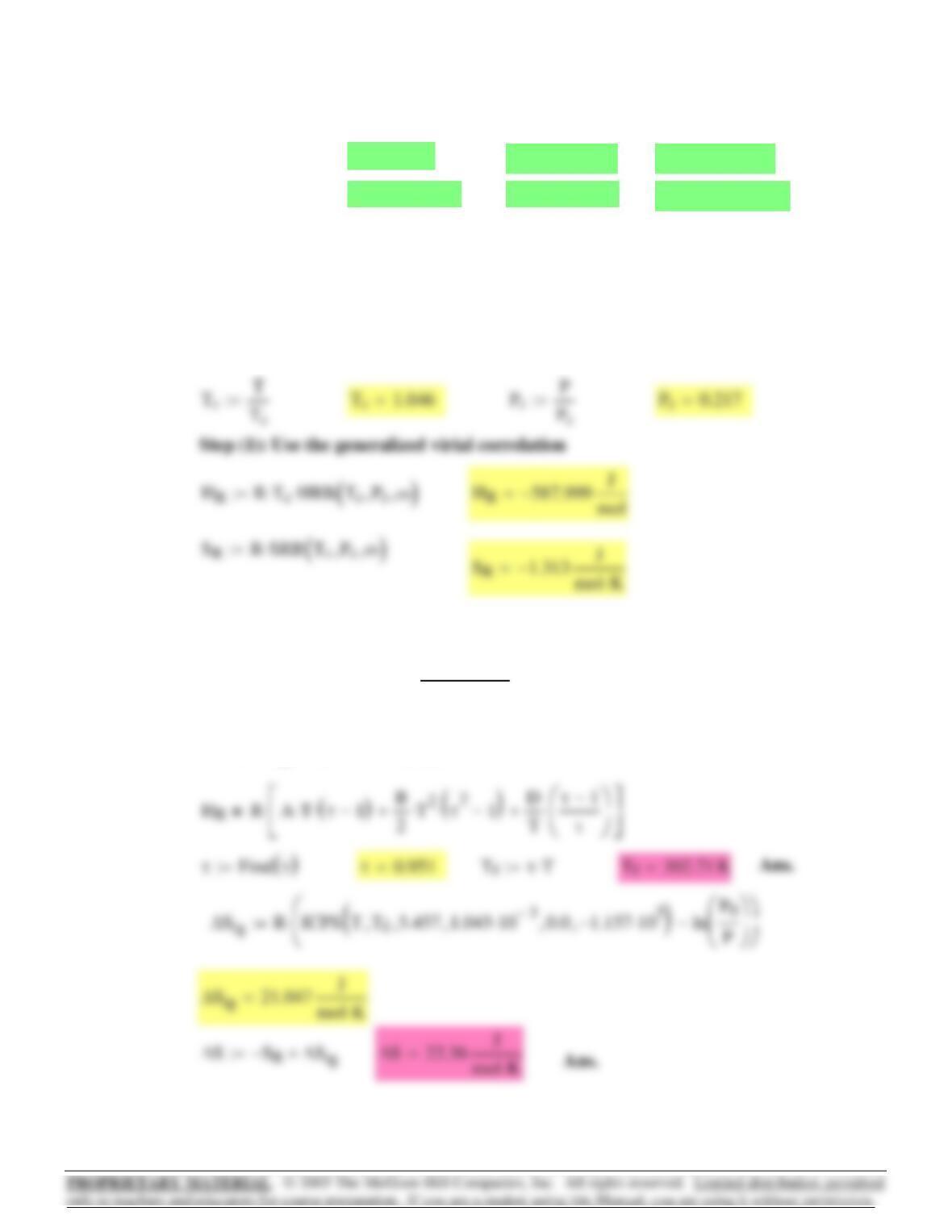
A 5.457:= B1.045 10 3−
⋅
K
:= D 1.157−105
⋅K2
⋅:=
Solve energy balance for final T. See Eq. (4.7).
τ1:= (guess) Given
6.60 Carbon dioxide: ω0.224:= Tc304.2 K⋅:= Pc73.83 bar⋅:=
T 318.15 K⋅:= P 1600 kPa⋅:= P0101.33 kPa⋅:=
Throttling process, constant enthalpy, may be split into two steps:
(1) Transform to ideal gas at initial conditions, generalized correlation
for property changes.
(2) Change T and P of ideal gas to final T & P.
Property changes by equations for an ideal gas.
Assume ideal gas at final T & P. Sum property changes for the process.
For the initial T & P:
Step (2): For the heat capacity of carbon dioxide,
187

(b) Ethylene: ω0.087:= Tc282.3 K⋅:= Pc50.40 bar⋅:=
Tr0
T0
Tc
:= Tr0 1.85317=Pr0
P0
Pc
:= Pr0 0.75397=
At final conditions as calculated in (a)
Tr
T
Tc
:= Tr1.12699=Pr
P
Pc
:= Pr0.02381=
Use virial-coefficient correlation.
The entropy change is now given by Eq. (6.92):
τ0.5:= (guess) Given
6.61 T0523.15 K⋅:= P03800 kPa⋅:= P 120 kPa⋅:=
∆S0J
mol K⋅
⋅:= For the heat capacity of ethylene:
A 1.424:= B14.394 10 3−
⋅
K
:= C4.392−10 6−
⋅
K2
:=
(a) For the entropy change of an ideal gas, combine Eqs. (5.14) & (5.15)
with D = 0:
τ0.4:= (guess) Given
∆SRAlnτ
()
⋅BT
0
⋅CT
02
⋅τ1+
2
⎛
⎜
⎝
⎞
⎠
⋅+
⎡
⎢
⎣
⎤
⎥
⎦τ1−
()
⋅+ ln P
P0
⎛
⎜
⎝
⎞
⎠
−
⎡
⎢
⎣
⎤
⎥
⎦
⋅=
188
∆S0J
mol K⋅
⋅:= For the heat capacity of ethane:
A 1.131:= B19.225 10 3−
⋅
K
:= C5.561−10 6−
⋅
K2
:=
(a) For the entropy change of an ideal gas, combine Eqs. (5.14) & (5.15)
with D = 0:
τ0.4:= (guess) Given
∆SRAlnτ
()
⋅BT
0
⋅CT
02
⋅τ1+
2
⎛
⎜
⎝
⎞
⎠
⋅+
⎡
⎢
⎣
⎤
⎥
⎦τ1−
()
⋅+ ln P
P0
⎛
⎜
⎝
⎞
⎠
−
SRB τT0
⋅
Tc
Pr
,ω,
⎛
⎜
⎝
⎞
⎠SRB Tr0 Pr0
,ω,
()
−+
…
⎡
⎢
⎢
⎢
⎢
⎣
⎤
⎥
⎥
⎥
⎥
⎦
⋅=
The work is given by Eq. (6.91):
∆Hig R ICPH T0T,1.424,14.394 10 3−
⋅, 4.392−10 6−
⋅, 0.0,
()
⋅:=
6.62 T0493.15 K⋅:= P030 bar⋅:= P 2.6 bar⋅:=
189
⎜
⎢
⎥
⎜
Use virial-coefficient correlation.
The entropy change is now given by Eq. (6.83):
τ0.5:= (guess) Given
∆SRAlnτ
()
⋅BT
0
⋅CT
02
⋅τ1+
2
⎛
⎜
⎝
⎞
⎠
⋅+
⎡
⎢
⎣
⎤
⎥
⎦τ1−
()
⋅+ ln P
P0
⎛
⎜
⎝
⎞
⎠
−
SRB τT0
⋅
Pr
,ω,
⎛
⎜
⎞
,ω,
()
−+
…
⎡
⎢
⎢
⎢
⎢
⎤
⎥
⎥
⎥
⎥
⋅=
The work is given by Eq. (6.91):
∆Hig R ICPH T0T,1.131,19.225 10 3−
⋅, 5.561−10 6−
⋅, 0.0,
()
⋅:=
(b) Ethane: ω0.100:= Tc305.3 K⋅:= Pc48.72 bar⋅:=
Tr0
T0
Tc
:= Tr0 1.6153=Pr0
P0
Pc
:= Pr0 0.61576=
At final conditions as calculated in (a)
190

HRB00.05679−:=
The entropy change is given by Eq. (6.92) combined with Eq. (5.15) with D = 0:
(guess) τ0.4:=
Given ∆SRAlnτ
()
⋅BT
0
⋅CT
02
⋅τ1+
2
⎛
⎜
⎝
⎞
⎠
⋅+
⎡
⎢
⎣
⎤
⎥
⎦τ1−
()
⋅+ ln P
P0
⎛
⎜
⎝
⎞
⎠
−
SRB T0τ⋅
Tc
Pr
,ω,
⎛
⎜
⎝
⎞
⎠SRB Tr0 Pr0
,ω,
()
−+
…
⎡
⎢
⎢
⎢
⎢
⎣
⎤
⎥
⎥
⎥
⎥
⎦
⋅=
The work is given by Eq. (6.91):
∆Hig R ICPH T0T,1.935,36.915 10 3−
⋅, 11.402−10 6−
⋅, 0.0,
()
⋅:=
6.63 n-Butane: ω0.200:= Tc425.1 K⋅:= Pc37.96 bar⋅:=
T0323.15 K⋅:= P01 bar⋅:= P 7.8 bar⋅:=
∆S0J
mol K⋅
⋅:= For the heat capacity of n-butane:
A 1.935:= B36.915 10 3−
⋅
K
:= C11.402−10 6−
⋅
K2
:=
Tr0
T0
Tc
:= Tr0 0.76017=Pr0
P0
Pc
:= Pr0 0.02634=
Pr
P
Pc
:= Pr0.205=
HRB Tr0 Pr0
,ω,
()
0.05679−=
191

For the compressed liquid at
325 K and 8000 kPa, apply
Eqs. (6.28) and (6.29) with
P18000 kPa⋅:=
T 325 K⋅:= β460 10 6−
⋅K1−
⋅:=
For sat. vapor at 8000 kPa, from Table F.2:
6.64 The maximum work results when the 1 kg of steam is reduced in a
completely reversible process to the conditions of the surroundings,
where it is liquid at 300 K (26.85 degC). This is the ideal work.
From Table F.2 for the initial state of superheated steam:
H13344.6 kJ
kg
⋅:= S17.0854 kJ
kg K⋅
⋅:=
From Table F.1, the state of sat. liquid at 300 K is essentially correct:
6.65 Sat. liquid at 325 K (51.85 degC), Table F.1:
Hliq 217.0 kJ
kg
⋅:= Sliq 0.7274 kJ
kg K⋅
⋅:= Vliq 1.013 cm3
gm
⋅:=
Psat 12.87 kPa⋅:=
192
6.67 For sat. liquid water at 20 degC, Table F.1:
H183.86 kJ
kg
⋅:= S10.2963 kJ
kg K⋅
⋅:=
For sat. liquid water at 0 degC, Table F.1:
H00.04−kJ
kg
⋅:= S00.0000 kJ
kg K⋅
⋅:=
For ice at at 0 degC:
H2H0333.4 kJ
kg
⋅−:= S2S0
333.4
273.15
kJ
kg K⋅
⋅−:=
Work as a fraction of heat added:
The heat not converted to work ends up in the surroundings.
6.66 Treat the furnace as a heat reservoir, for which
Qdot 2536−kJ
kg
⋅10⋅kg
sec
⋅:= T 600 273.15+()K⋅:= T 873.15 K=
193
S20.0 kJ
kg K⋅
⋅:= Q’ 2000−kJ
kg
⋅:= Tσ273.15 K⋅:=
The system consists of two parts: the apparatus and the heat reservoir at
elevated temperature, and in the equation for ideal work, terms must be
included for each part.
Wideal ∆Happaratus.reservoir Tσ∆Sapparatus.reservoir
⋅−=
H2333.44−kJ
kg
=S21.221−kJ
kg K⋅
=
Tσ293.15 K⋅:= mdot 0.5 kg
sec
⋅:= ηt0.32:=
By Eqs. (5.26) and (5.28):
6.68 This is a variation on Example 5.6., pp. 175-177, where all property values
are given. We approach it here from the point of view that if the process
is completely reversible then the ideal work is zero. We use the notation of
Example 5.6:
H12676.0 kJ
kg
⋅:= S17.3554 kJ
kg K⋅
⋅:= H20.0 kJ
kg
⋅:=
194

6.70 From Table F.3 at 430 degF (sat. liq. and vapor):
Vliq 0.01909 ft3
lbm
⋅:= Vvap 1.3496 ft3
lbm
⋅:= Vtank 80 ft3
⋅:=
Uliq 406.70 BTU
lbm
⋅:= Uvap 1118.0 BTU
lbm
⋅:= mliq 4180 lbm
⋅:=
VOLliq mliq Vliq
⋅:= VOLliq 79.796 ft3
=
6.69 From Table F.4 at 200(psi):
H11222.6 BTU
lbm
⋅:= S11.5737 BTU
lbmrankine⋅
⋅:= (at 420 degF)
(Sat. liq.
and vapor)
Hliq 355.51 BTU
lbm
⋅:= Hvap 1198.3 BTU
lbm
⋅:=
Sliq 0.5438 BTU
lbmrankine⋅
⋅:= Svap 1.5454 BTU
lbmrankine⋅
⋅:= x 0.96:=
H2Hliq xH
vap Hliq
−
()
⋅+:= S2Sliq xS
vap Sliq
−
()
⋅+:=
H21.165 103
×BTU
lbm
=S21.505 BTU
lbmrankine⋅
=
Neglecting kinetic- and potential-energy changes,
on the basis of 1 pound mass of steam after mixing, Eq. (2.30) yields for
195

Property values below are for sat. liq. and vap. at 420 degF
From Table F.3 we see that the enthalpy of saturated vapor changes
from 1203.9 to 1203.1(Btu/lb) as the temperature drops from 430 to 420
degF. This change is so small that use of an average value for H of
1203.5(Btu/lb) is fully justified. Then
m2U2
⋅m1U1
⋅−
0
m
mH
⌠
⎮
⌡d+0=
Integration gives:
dm
tUt
⋅
()
Hdm⋅+ 0=
(Subscript t denotes the contents of the tank.
H and m refer to the exit stream.)
By Eq. (2.29) multiplied through by dt, we can write,
196
6.72 This problem is similar to Example 6.8, where it is shown that
Q∆mtHt
⋅
()
H∆mt
⋅−=
Here, the symbols with subscript t refer to the contents of the tank,
whereas H refers to the entering stream.
We illustrate here development of a simple expression for the first term on
the right. The1500 kg of liquid initially in the tank is unchanged during the
process. Similarly, the vapor initially in the tank that does NOT condense
is unchanged. The only two enthalpy changes within the tank result from:
1. Addition of 1000 kg of liquid water. This contributes an enthalpy change of
2. Condensation of y kg of sat. vapor to sat. liq.
This contributes an enthalpy change of
6.71 The steam remaining in the tank is assumed to have expanded isentropically.
Data from Table F.2 at 4500 kPa and 400 degC:
S16.7093 J
gm K⋅
⋅:= V164.721 cm3
gm
⋅:= Vtank 50 m3
⋅:=
197

0.1640
0.06628
0.03126
⎛
⎜
⎜
⎜
⎜
⎞
⎟
⎟
⎟
⎟
kg
1.396
3.600
7.775
⎛
⎜
⎜
⎜
⎜
⎞
⎟
⎟
⎟
⎟
80
90
100
⎛
⎜
⎜
⎜
⎜
⎞
⎟
⎟
⎟
⎟
Data for saturated nitrogen vapor:
mtank 30 kg⋅:=T1295 K⋅:=C 0.43 kJ
kg K⋅
⋅:=
Hin 120.8−kJ
kg
⋅:=Vtank 0.5 m3
⋅:=
Given:6.73
QH
liq ∆mt
⋅y∆Hlv
⋅− H∆mt
⋅−=
Whence
∆mtVt
⋅
()
Vliq ∆mt
⋅y∆Vlv
⋅−=0=
Similarly,
198

Vs lspline T V,():=Us lspline T U,():=
Fit tabulated data with cubic spline:
U
56.006
62.579
63.325
⎛
⎜
⎜
⎜
⎜
⎞
⎟
⎟
⎟
⎟
kJ
kg
=
Calculate internal-energy values for saturated vapor nitrogen at the given
values of T:
(A)
mvap Uvap
⋅Hin mvap
⋅− Q=mtank C⋅Tvap T1
−
()
⋅=
Subscript t denotes the contents of the tank; H and m refer to the inlet
stream. Since the tank is initially evacuated, integration gives
dn
tUt
⋅
()
Hdm⋅− dQ=
By Eq. (2.29) multiplied through by dt,
78.9
⎛
⎞
199
which is later solved for m2
m2HU
liq.2
−
Vtank
m2
Vliq.2
−
∆Vlv.2
∆Ulv.2
⋅−
⎛
⎜
⎜
⎜
⎝
⎞
⎟
⎠
⋅m1HU
1
−
()
⋅=
Eliminating x2 from these equations gives
V2
Vtank
m2
=V2Vliq.2 x2∆Vlv.2
⋅+=
U2Uliq.2 x2∆Ulv.2
⋅+=
Also
m2HU
2
−
()
⋅m1HU
1
−
()
⋅=
Whence
m2U2H−
()
⋅m1U1H−
()
⋅− Q=0=
The result of Part (a) of Pb. 3.15 applies, with m replacing n:6.74
Uvap Tvap
()
Hin
−mtank C⋅T1Tvap
−
()
⋅Vvap Tvap
()
⋅
Vtank
=
Given
200
From Table F.2 at 400 kPa and 240 degC
U2H=
Whence
n1Q=0=
The result of Part (a) of Pb. 3.15 applies, with 6.75
Data from Table F.2 @ 800 kPa:
U1Uliq.1 x1∆Ulv.1
⋅+:=x1
V1Vliq.1
−
∆Vlv.1
:=
201