Problem 6-16 (continued)
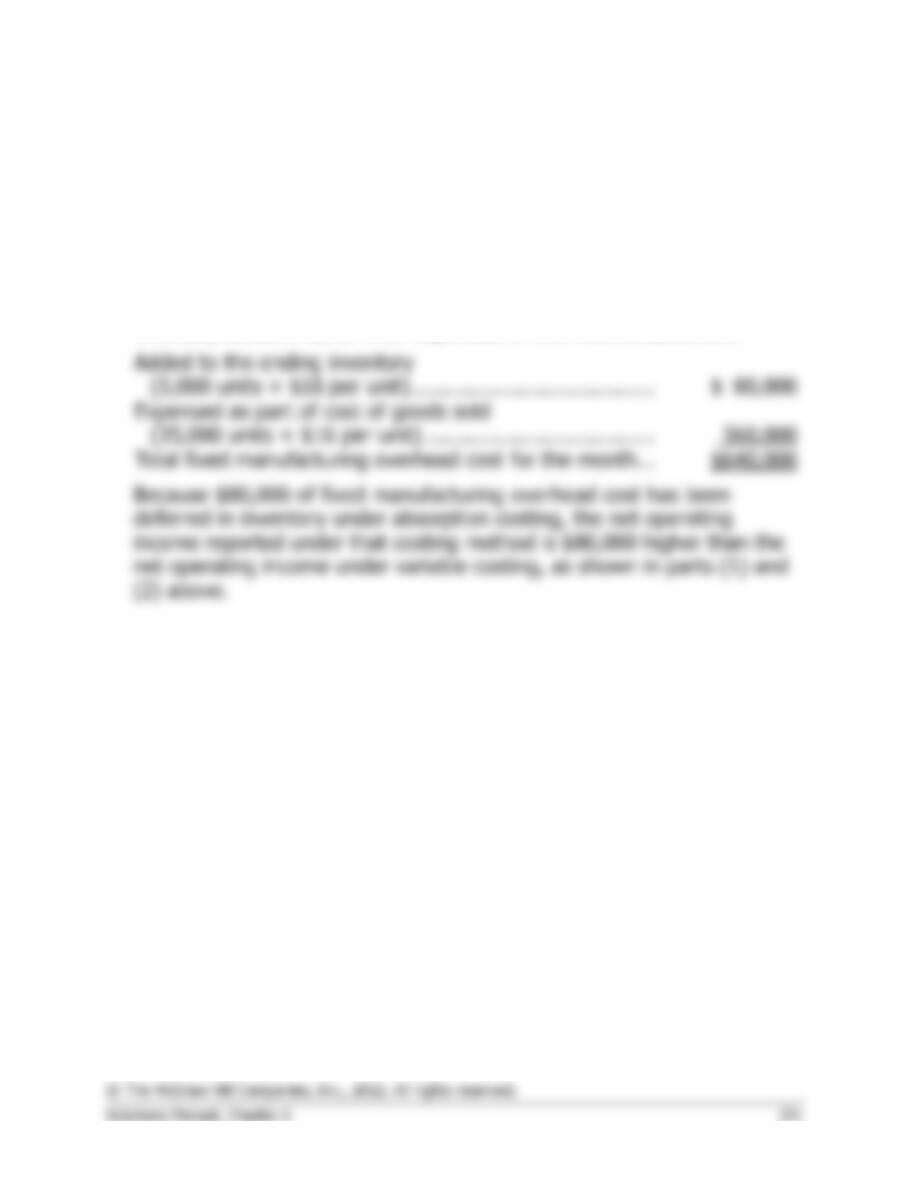
3. The difference in the ending inventory relates to a difference in the
handling of fixed manufacturing overhead costs. Under variable costing,
these costs have been expensed in full as period costs. Under
absorption costing, these costs have been added to units of product at
the rate of $16 per unit ($640,000 ÷ 40,000 units produced = $16 per
unit). Thus, under absorption costing a portion of the $640,000 fixed
manufacturing overhead cost of the month has been added to the
inventory account rather than expensed on the income statement:
Problem 6-17 (45 minutes)
1. The break-even point in units sold can be computed using the
contribution margin per unit as follows:
Selling price per unit …………………
$56
Variable cost per unit ………………..
48
Contribution margin per unit ………
$ 8
Break-even unit sales = Fixed expenses ÷ Unit contribution margin
= $480,000 ÷ $8 per unit
= 60,000 units
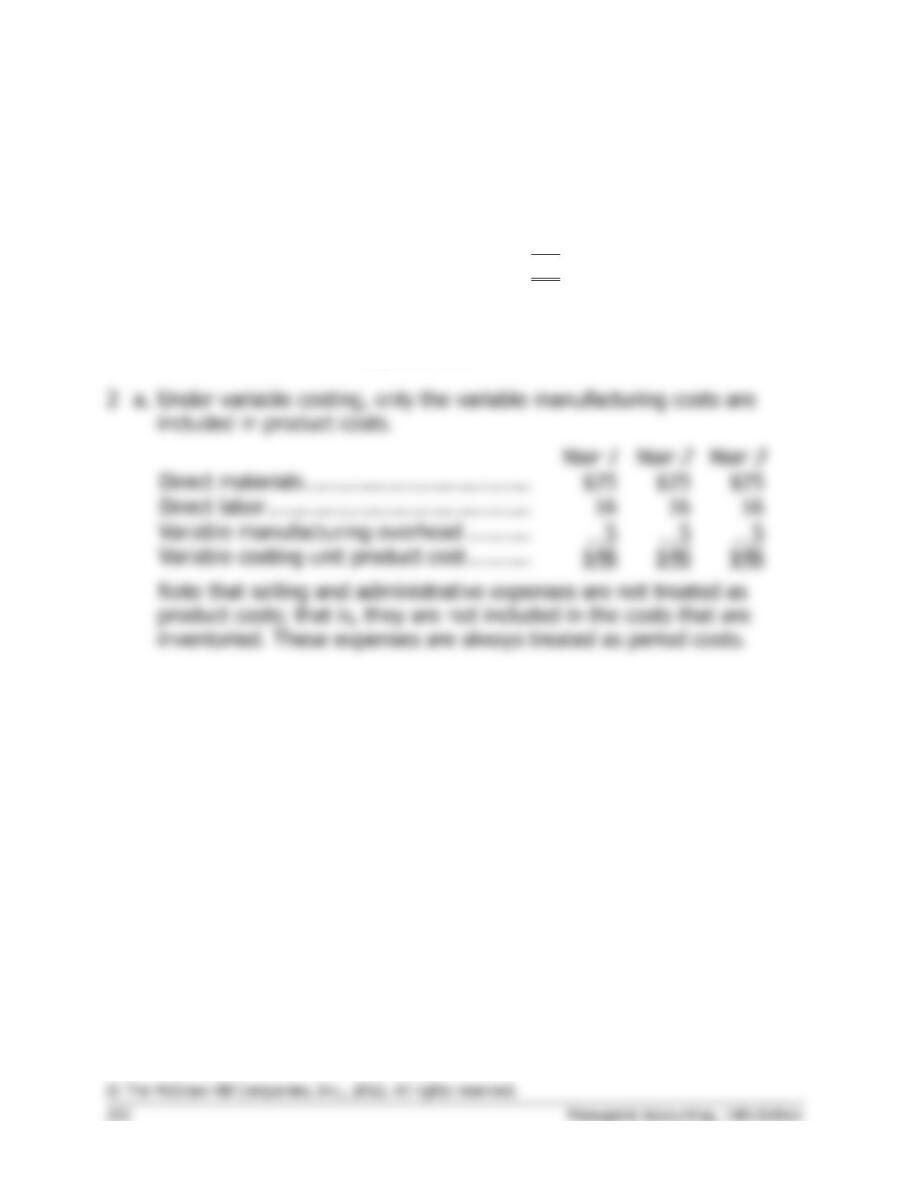
Direct materials ………………………………
Direct labor ……………………………………
Variable manufacturing overhead ……….
5
Variable costing unit product cost ……….
Problem 6-17 (continued)
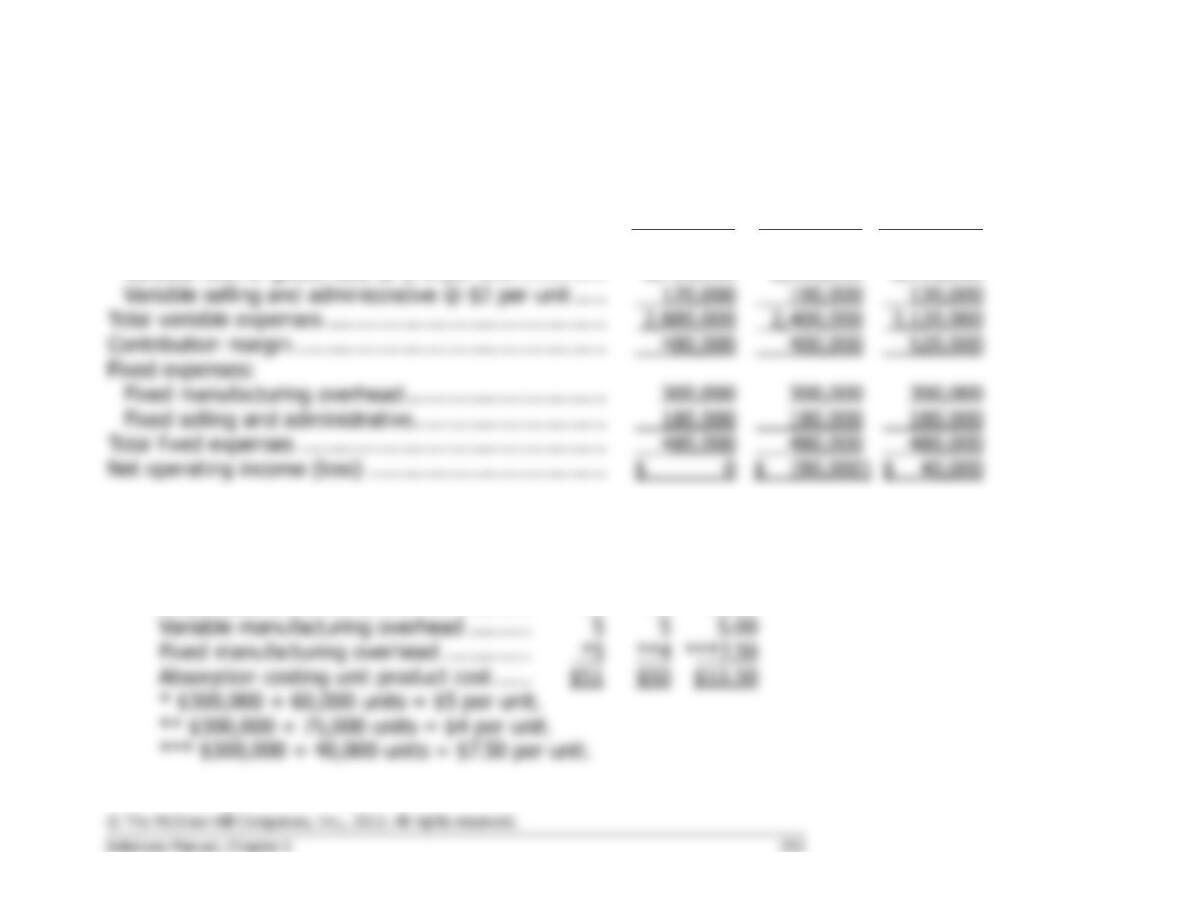
2 b. The variable costing income statements appear below:
Year 1
Year 2
Year 3
Sales ………………………………………………………………
$3,360,000
$2,800,000
$3,640,000
Variable expenses:
Variable cost of goods sold @ $46 per unit …………..
2,760,000
2,300,000
2,990,000
Variable selling and administrative @ $2 per unit …..
Total variable expenses ………………………………………
Contribution margin …………………………..………………
Fixed expenses:
Fixed manufacturing overhead …………………………..
Fixed selling and administrative ………………………….
Total fixed expenses ………………………………………….
Net operating income (loss) ………………………………..
3 a. The unit product costs under absorption costing:
Year 1
Year 2
Year 3
Direct materials ………………………………
$25
$25
$25.00
Direct labor ……………………………………
16
16
16.00
Variable manufacturing overhead ……….
Fixed manufacturing overhead …………..
***7.50
Absorption costing unit product cost ……
$51
* $300,000 ÷ 60,000 units = $5 per unit.
Problem 6-17 (continued)
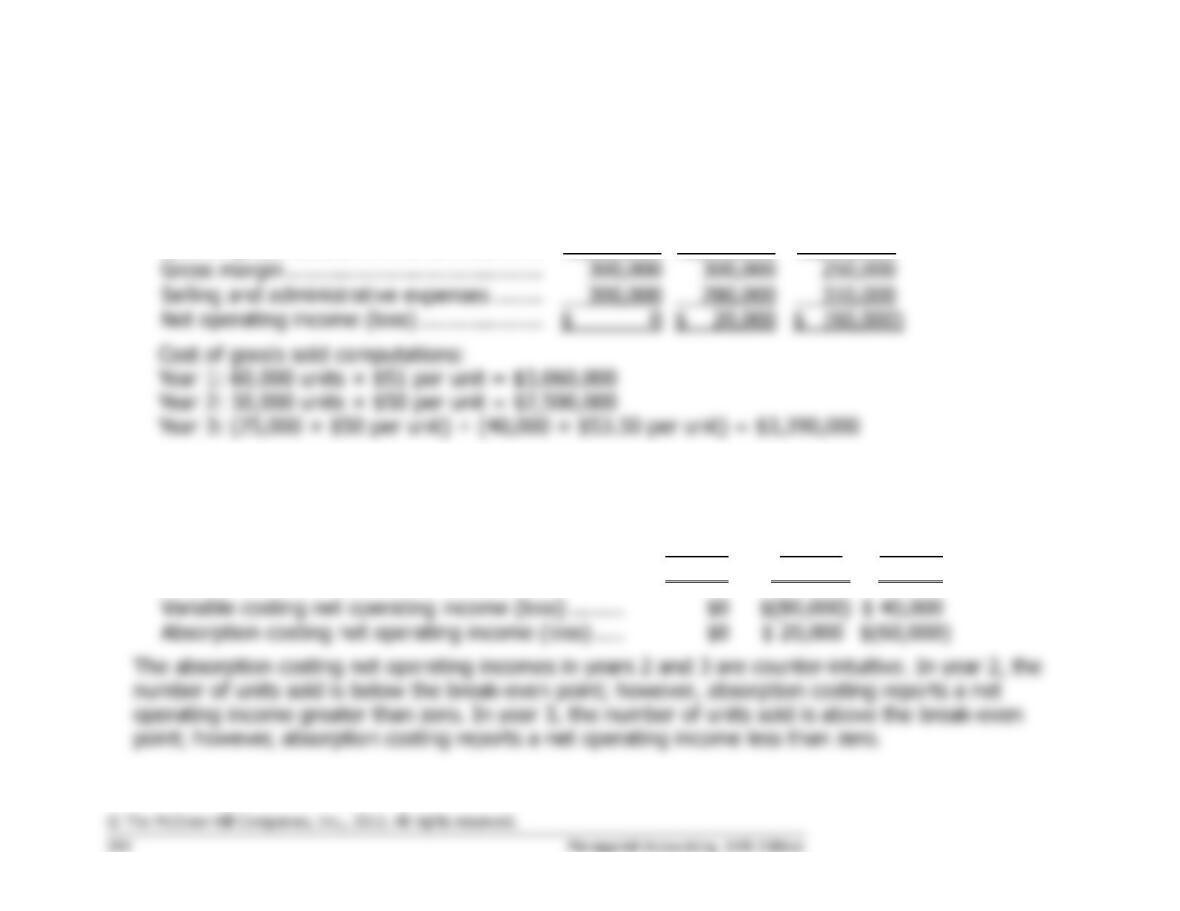
3 b. The absorption costing income statements appears below:
Year 1
Year 2
Year 3
Sales ……………………………………………..
$3,360,000
$2,800,000
$3,640,000
Cost of goods sold…………………………….
3,060,000
2,500,000
3,390,000
Gross margin …………………………………..
Selling and administrative expenses ……..
Net operating income (loss) ………………..
4.
Year 1
Year 2
Year 3
Units sold …………………………………………………..
60,000
50,000
65,000
Break-even point in units ……………………………….
60,000
60,000
60,000
Units above (below) break-even point ………………
0
(10,000)
5,000
Variable costing net operating income (loss) ………
Absorption costing net operating income (loss) …..
Problem 6-18 (30 minutes)
1. The unit product cost under the variable costing is computed as follows:
Direct materials ………………………………
$ 8
Direct labor ……………………………………
10
Variable manufacturing overhead ……….
2
Variable costing unit product cost ……….
$20
With this figure, the variable costing income statements can be
prepared:
Sales …………………………………………………
Variable expenses:
Total variable expenses ………………………….
Contribution margin ………………………………
Fixed expenses:
Total fixed expenses ……………………………..
Net operating income (loss) ……………………
2. The reconciliation of absorption and variable costing follows:
Year 1
Year 2
Variable costing net operating income (loss)
$(60,000)
$210,000
Absorption costing net operating income …..
Add (deduct) fixed manufacturing overhead
Problem 6-19 (30 minutes)
1.
Sales Territory
Total Company
Central
Eastern
Amount
%
Amount
%
Amount
%
Sales ………………………………………..
$900,000
100.0
$400,000
100
$500,000
100
Variable expenses ………………………..
408,000
45.3
208,000
52
200,000
40
Territorial segment margin …………….
$ 32,000
$170,000
34
Common fixed expenses* ……………..
175,000
19.4
Net operating income …………………..
3.0
*465,000 – $290,000 = $175,000
Product Line
Central Territory
Awls
Pows
Amount
%
Amount
%
Amount
%
Sales ………………………………………..
$400,000
100.0
$100,000
100
$300,000
100
Variable expenses ………………………..
208,000
52.0
25,000
25
183,000
61
Contribution margin ……………………..
Traceable fixed expenses ………………
114,000
28.5
60,000
60
54,000
18
Sales territory segment margin ………
$ 32,000
8.0
*$160,000 – $114,000 = $46,000
Problem 6-19 (continued)
2. Two points should be brought to the attention of management. First,
compared to the Eastern territory, the Central territory has a low
3. Again, two points should be brought to the attention of management.
First, the Central territory has a poor sales mix. Note that the territory
sells very little of the Awls product, which has a high contribution
Problem 6-20 (45 minutes)
1.
a. and b.
Absorption
Costing
Variable
Costing
Direct materials ………………………………
$ 86
$86
Variable manufacturing overhead ……….
Unit product cost …………………………….
$90
2. Absorption costing income statement:
Sales (3,200 units × $250 per unit) ………………….
$800,000
Cost of goods sold (3,200 units × $150 per unit) …
Gross margin ……………………………………………….
Net operating income ……………………………………
3. Variable costing income statement:
Sales (3,200 units × $250 per unit) ………
$800,000
Variable expenses:
Variable cost of goods sold (3,200 units
× $90 per unit) …………………………..
288,000
Contribution margin …………………………..
Fixed expenses:
240,000
Net operating loss …………………………….
Problem 6-20 (continued)
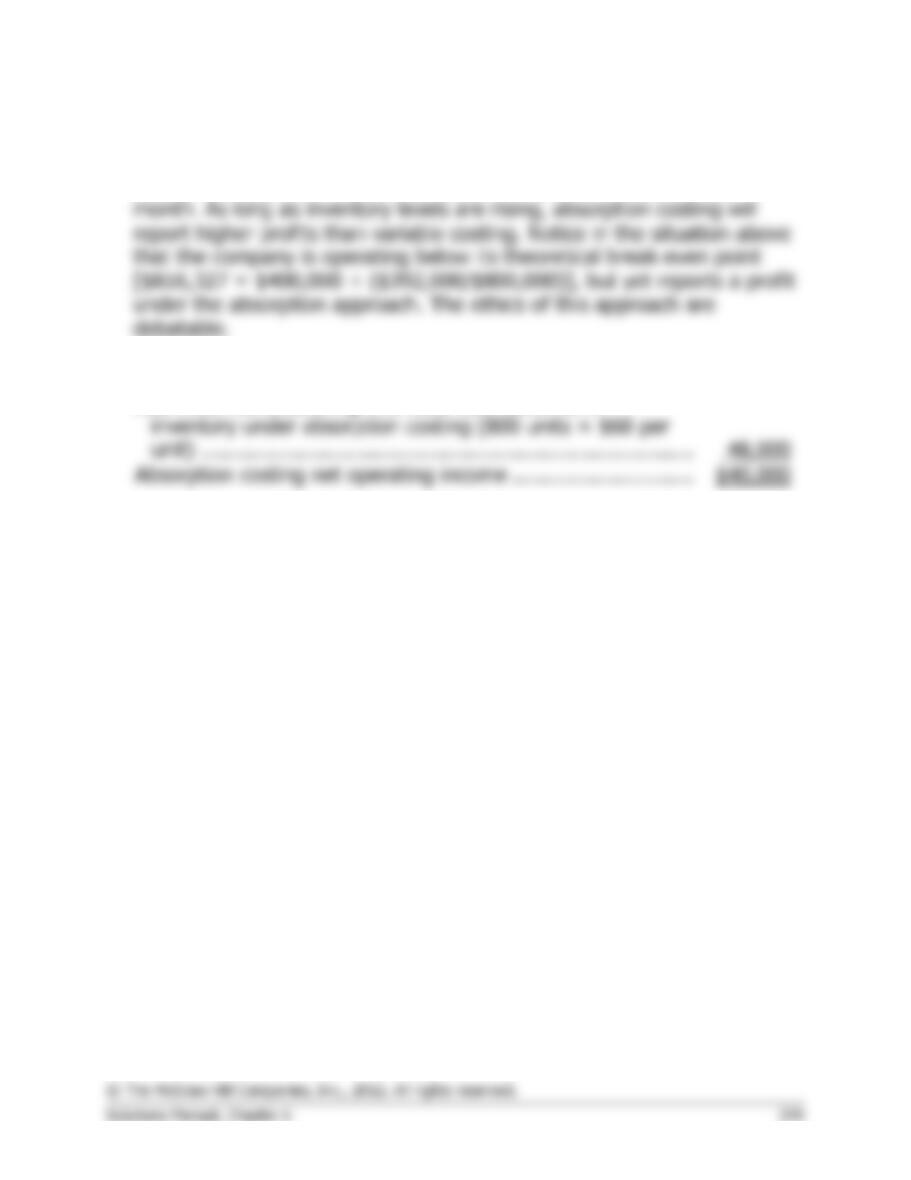
4. A manager may prefer to take the statement prepared under the
absorption approach in part (2), because it shows a profit for the
5.
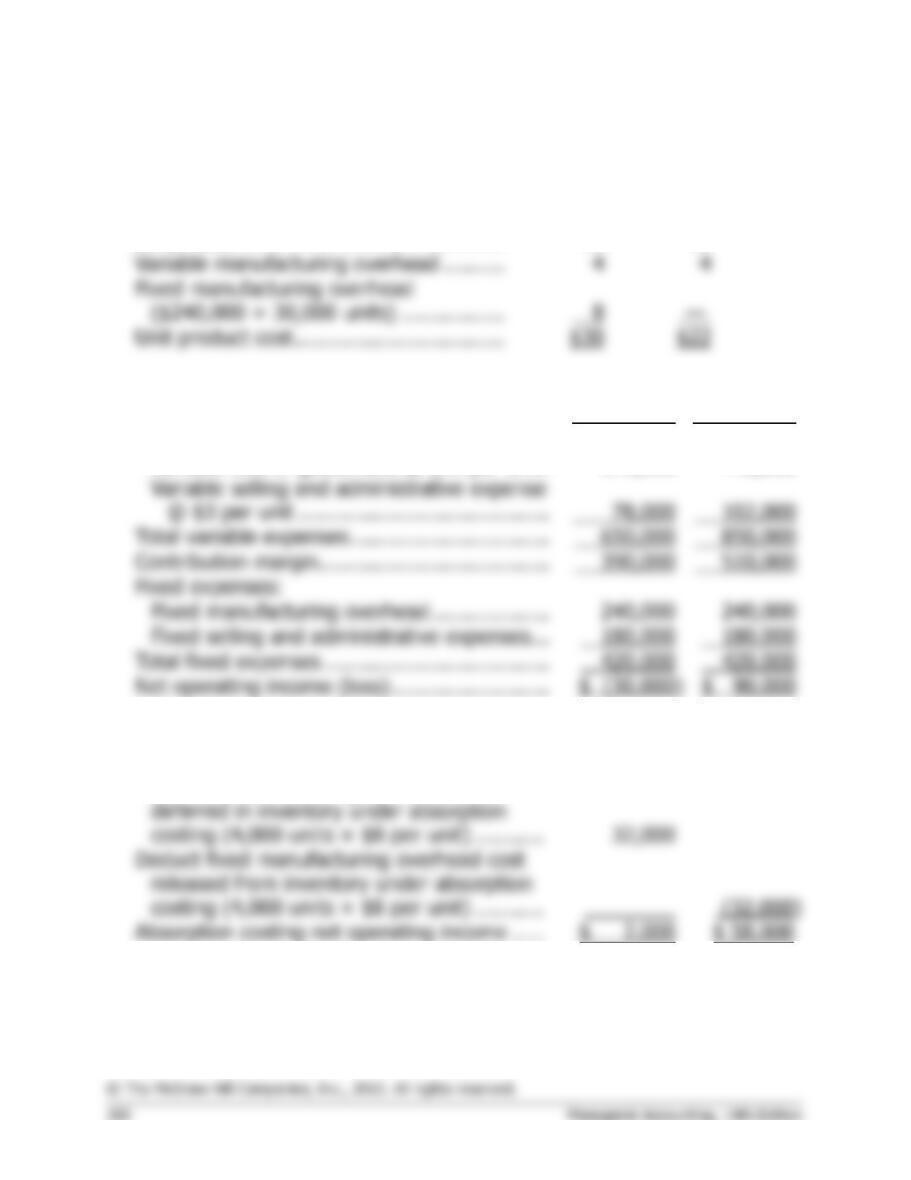
Variable costing net operating loss ………………………………..
$ (8,000)
Absorption costing net operating income ………………………..
Add fixed manufacturing overhead cost deferred in
Problem 6-21 (45 minutes)
1.
a. and b.
Absorption
Costing
Variable
Costing
Direct materials ………………………………
$ 6
$ 6
Direct labor ……………………………………
12
12
Variable manufacturing overhead ……….
Unit product cost …………………………….
2.
May
June
Sales ………………………………………………….
$1,040,000
$1,360,000
Variable expenses:
Variable cost of goods sold @ $22 per unit .
572,000
748,000
Total variable expenses …………………………..
Contribution margin …………………………..…..
Fixed expenses:
Total fixed expenses ………………………………
Net operating income (loss) …………………….
3.
May
June
Variable costing net operating income (loss)
$ (30,000)
$ 90,000
Absorption costing net operating income …..
$ 58,000
Add fixed manufacturing overhead cost
Problem 6-21 (continued)
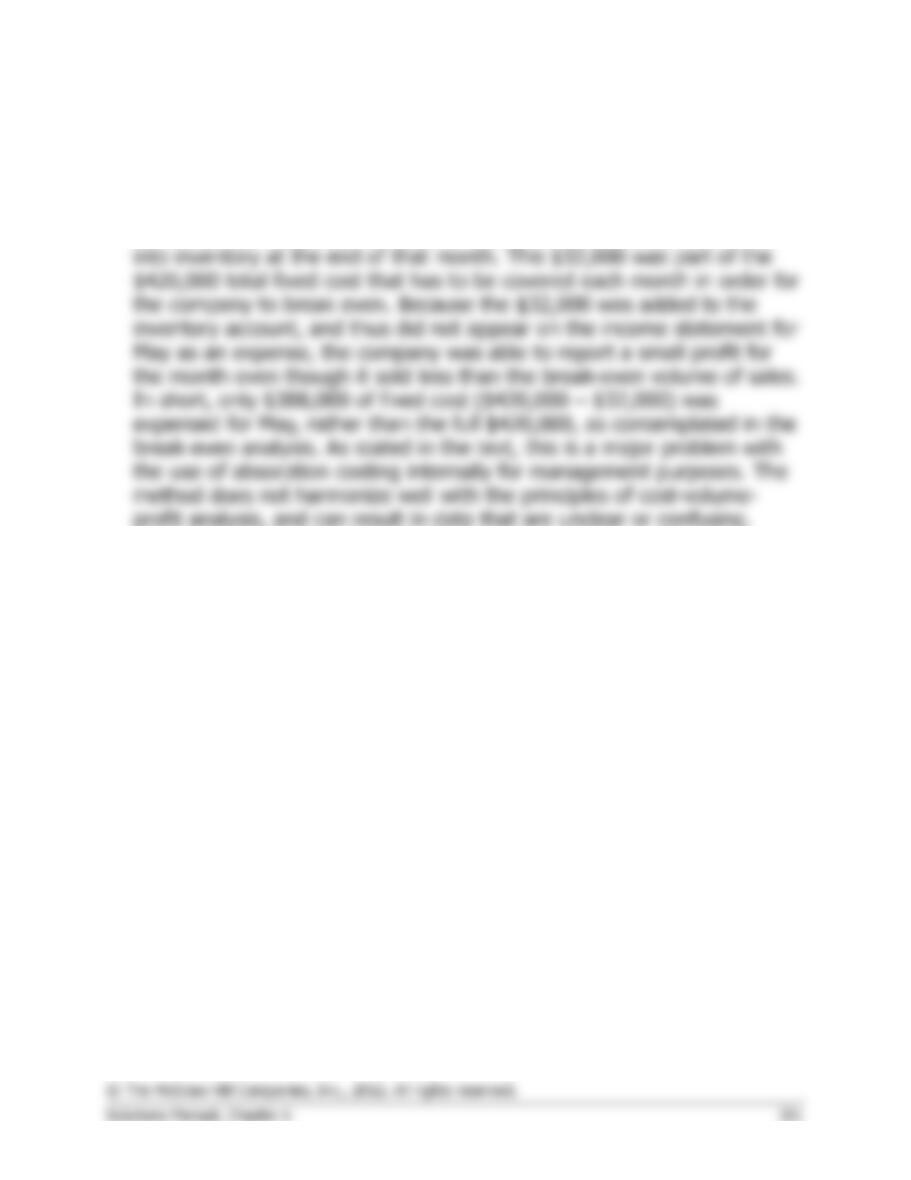
4. As shown in the reconciliation in part (3) above, $32,000 of fixed
manufacturing overhead cost was deferred in inventory under
absorption costing at the end of May, because $8 of fixed manufacturing
overhead cost “attached” to each of the 4,000 unsold units that went
Problem 6-22 (60 minutes)
1.
a.
Absorption costing unit product cost is:
Direct materials …………………………………….
$1.00
Direct labor ………………………………………….
0.80
Variable manufacturing overhead ……………..
0.20
Fixed manufacturing overhead
($75,000 ÷ 50,000 units) ……………………..
1.50
Absorption costing unit product cost ………….
$3.50
The absorption costing income statement is:
Sales (40,000 units) ………………………………………….
Cost of goods sold (40,000 units × $3.50 per unit) ….
Gross margin …………………………..………………………
Net operating income ………………………………………..
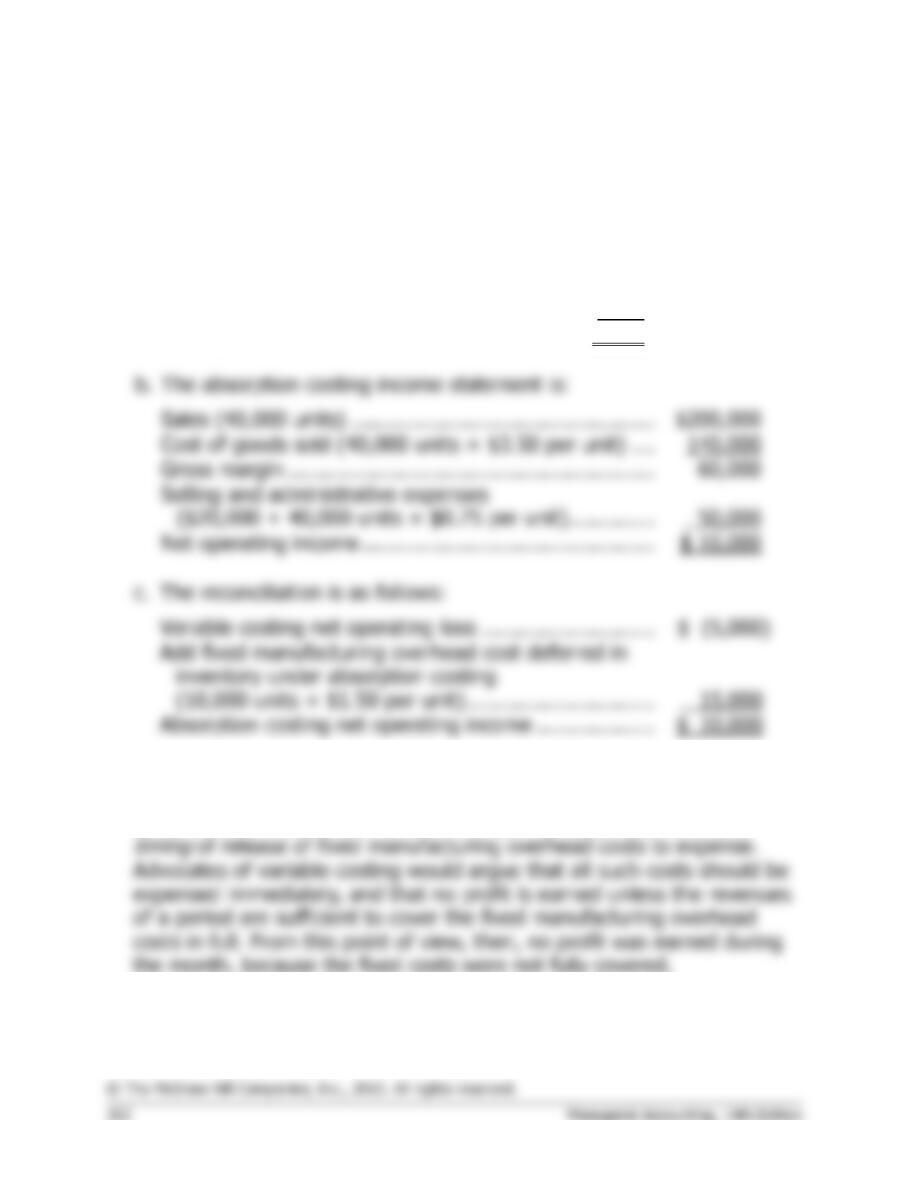
The reconciliation is as follows:
Variable costing net operating loss ……………………….
15,000
Absorption costing net operating income ……………….
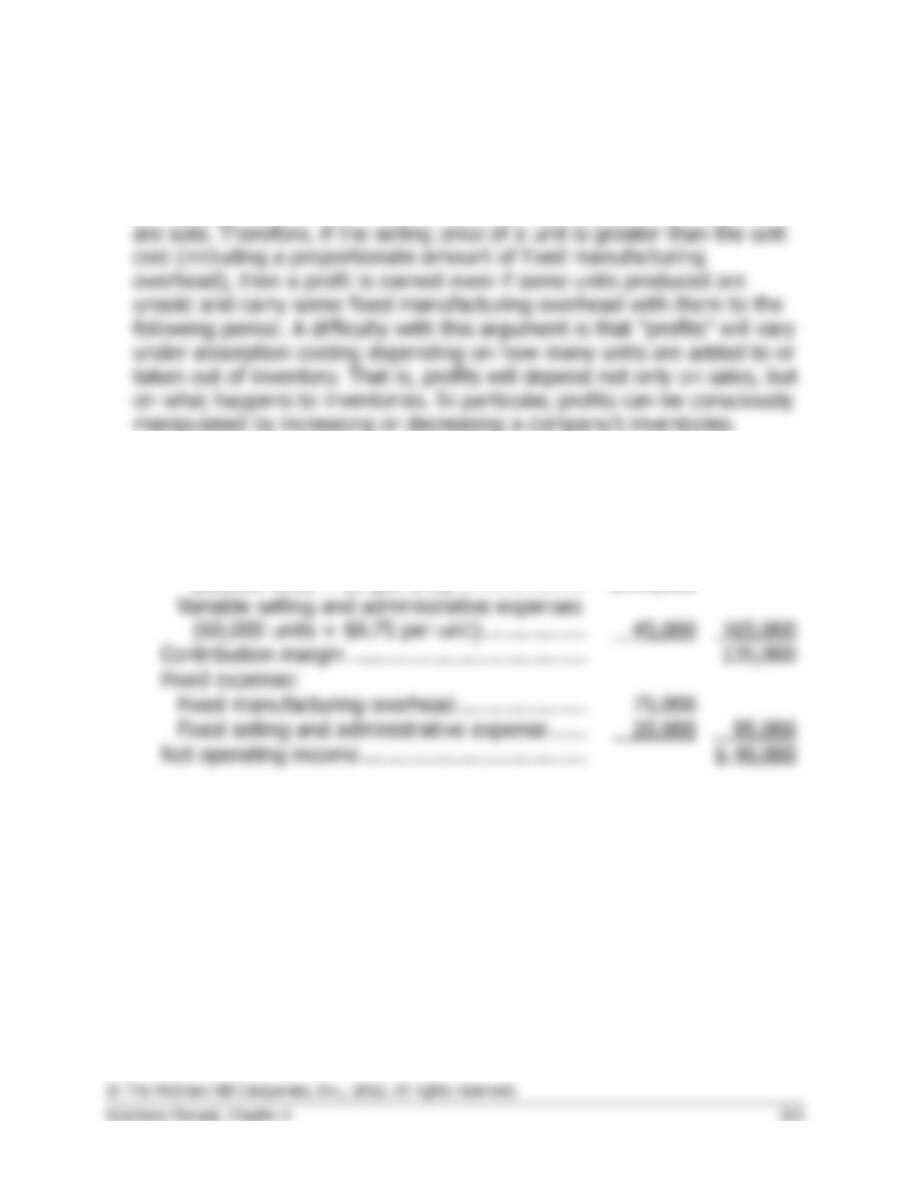
2. Under absorption costing, the company did earn a profit for the month.
However, before the question can really be answered, one must first
define what is meant by a “profit.” The central issue here relates to
Problem 6-22 (continued)
Advocates of absorption costing would argue, however, that fixed
manufacturing overhead costs attach to units of product as they are
produced, and that such costs do not become expense until the units
3.
a.
The variable costing income statement is:
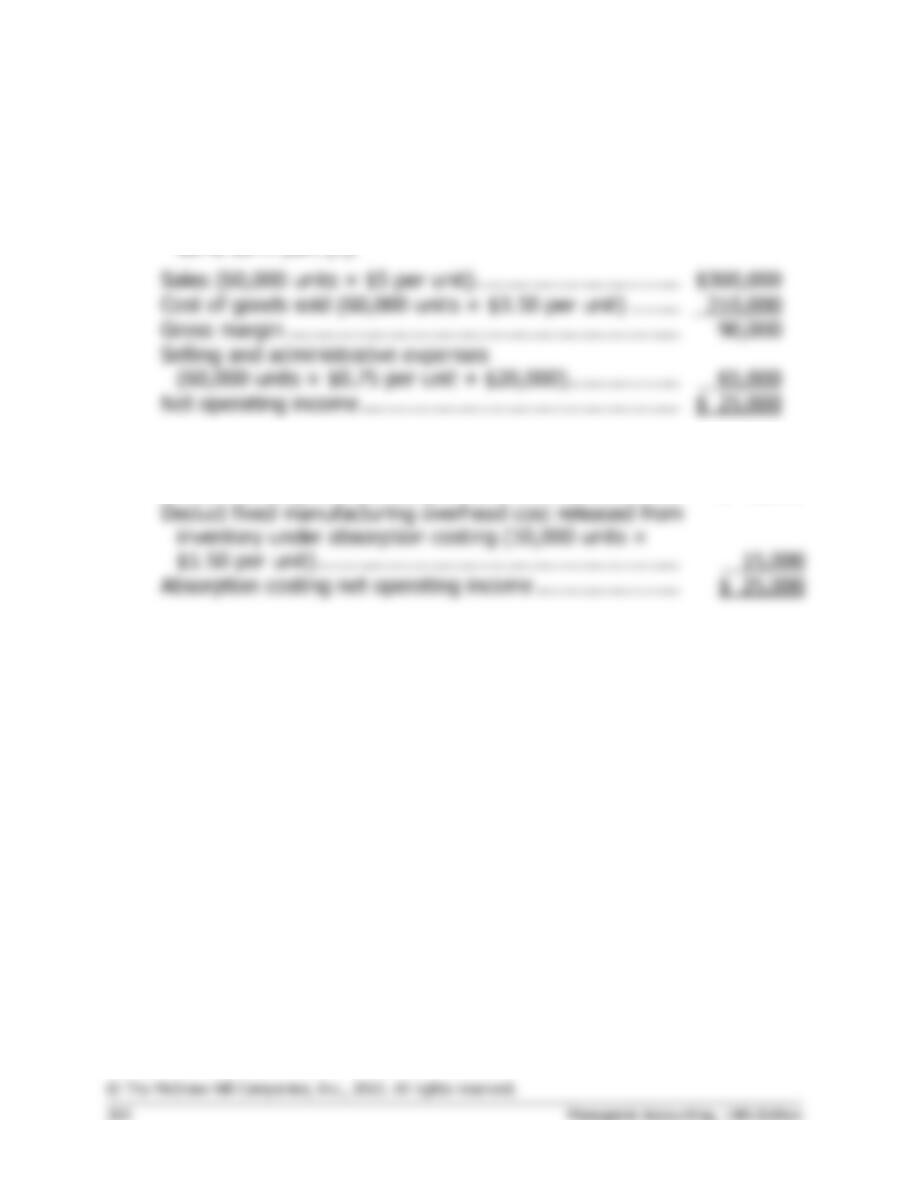
Sales (60,000 units × $5 per unit) ………………
$300,000
Variable expenses:
Variable cost of goods sold
(60,000 units × $2 per unit) …………………
$120,000
Net operating income ………………………………
Problem 6-22 (continued)
b.
The absorption costing income statement would be constructed as
follows:
The absorption costing unit product cost will remain at $3.50, the
same as in part (1).
Sales (60,000 units × $5 per unit) …………………………...
Cost of goods sold (60,000 units × $3.50 per unit) ……..
Gross margin …………………………..………………………….
Net operating income ……………………………………………
c.
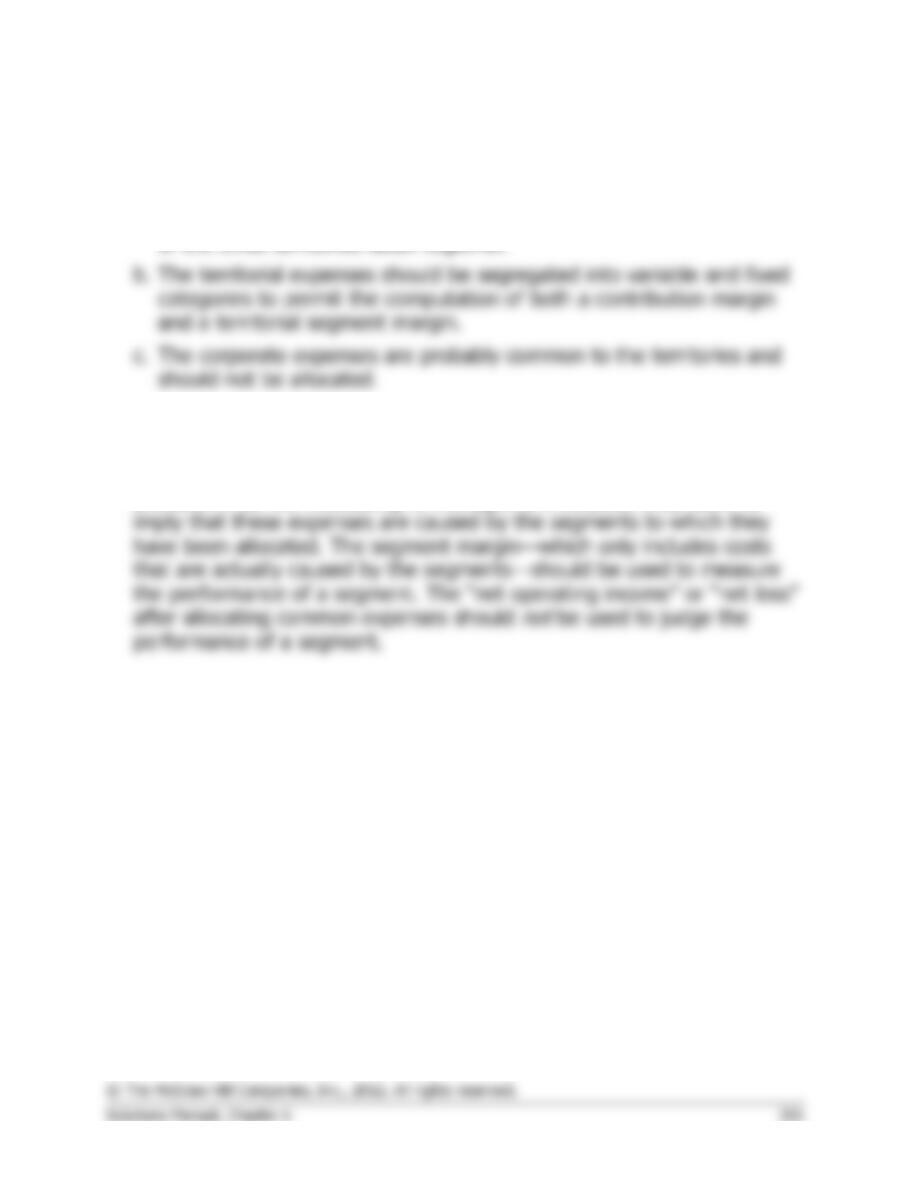
The reconciliation is as follows:
Variable costing net operating income ………………………
$ 40,000
Absorption costing net operating income …………………..
$ 25,000
Problem 6-23 (60 minutes)
1. The disadvantages or weaknesses of the company’s version of a
segmented income statement are as follows:
a. The company should include a column showing the combined results
of the three territories taken together.
2. Corporate advertising expenses have apparently been allocated on the
basis of sales dollars; the general administrative expenses have
apparently been allocated evenly among the three territories. Such
allocations can be misleading to management because they seem to
Problem 6-23 (continued)
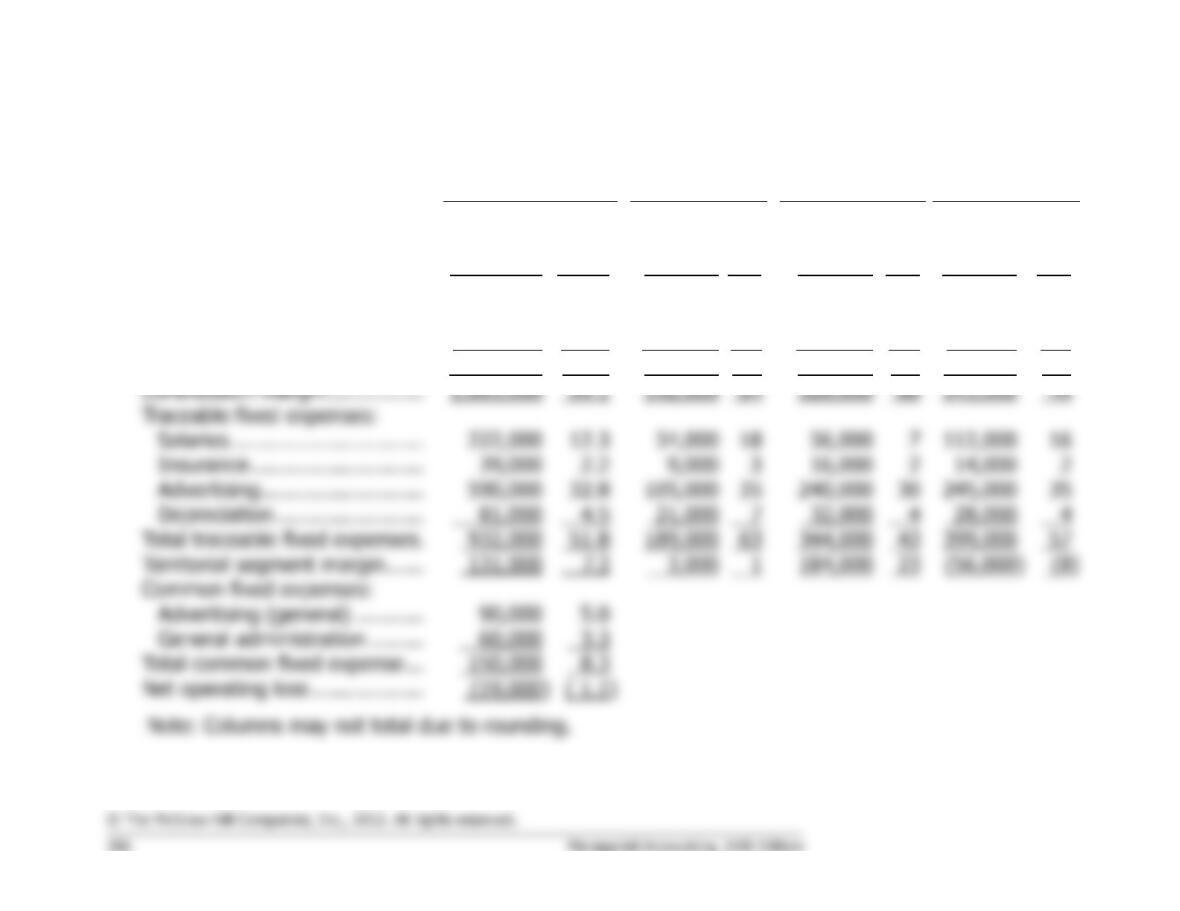
3.
Total
Southern
Europe
Middle Europe
Northern
Europe
Amount
in €s
%
Amount
in €s
%
Amount
in €s
%
Amount
in €s
%
Sales …………………………..…..
1,800,000
100.0
300,000
100
800,000
100
700,000
100
Variable expenses:
Cost of goods sold ……………
648,000
36.0
93,000
31
240,000
30
315,000
45
Shipping expense …………….
89,000
4.9
15,000
5
32,000
4
42,000
6
Total variable expenses ………..
737,000
40.9
108,000
36
272,000
34
357,000
51
Contribution margin…………….
1,063,000
192,000
528,000
343,000
Traceable fixed expenses:
Salaries ………………………….
222,000
12.3
54,000
18
112,000
16
Insurance ……………………….
9,000
3
Advertising ……………………..
32.8
105,000
240,000
245,000
Depreciation ……………………
81,000
4.5
21,000
7
4
28,000
4
Total traceable fixed expenses .
932,000
189,000
344,000
399,000
Territorial segment margin ……
131,000
3,000
184,000
Common fixed expenses:
Advertising (general) ………..
General administration ………
60,000
3.3
Net operating loss ………………