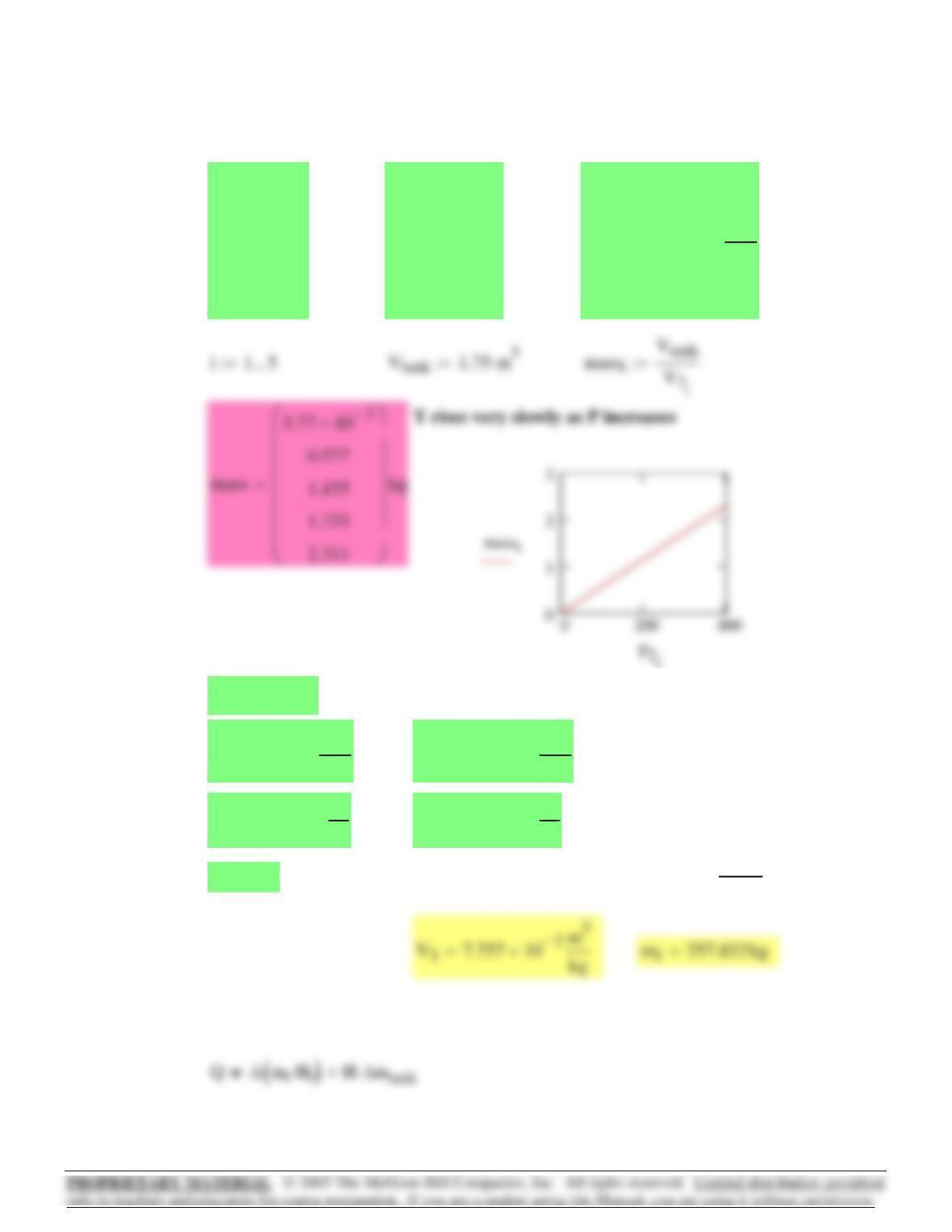
The process is the same as that of Example 6.8, except that the stream
flows out rather than in. The energy balance is the same, except for a sign:
m1
Vtank
V1
:=V1Vliq x1Vvap Vliq
−
()
⋅+:=x10.1:=
Hvap 2802.3 kJ
kg
⋅:=Hliq 1008.4 kJ
kg
⋅:=
Vvap 66.626 cm3
gm
⋅:=Vliq 1.216 cm3
gm
⋅:=
Data from Table F.2 @ 3000 kPa:
Vtank 2m
3
⋅:=
6.76
⎜
V2
303316
3032.17
1515.61
1010.08
757.34
⎛
⎜
⎜
⎜
⎜
⎜
⎝
⎞
⎟
⎟
⎟
⎠
cm3
gm
⋅:=t2
384.09
384.82
385.57
386.31
387.08
⎛
⎜
⎜
⎜
⎜
⎜
⎝
⎞
⎟
⎟
⎟
⎠
:=
P2
1
100
200
300
400
⎛
⎜
⎜
⎜
⎜
⎜
⎝
⎞
⎟
⎟
⎟
⎠
:=
202
H3mdot3
⋅H1mdot1
⋅− H2mdot2
⋅− 0=
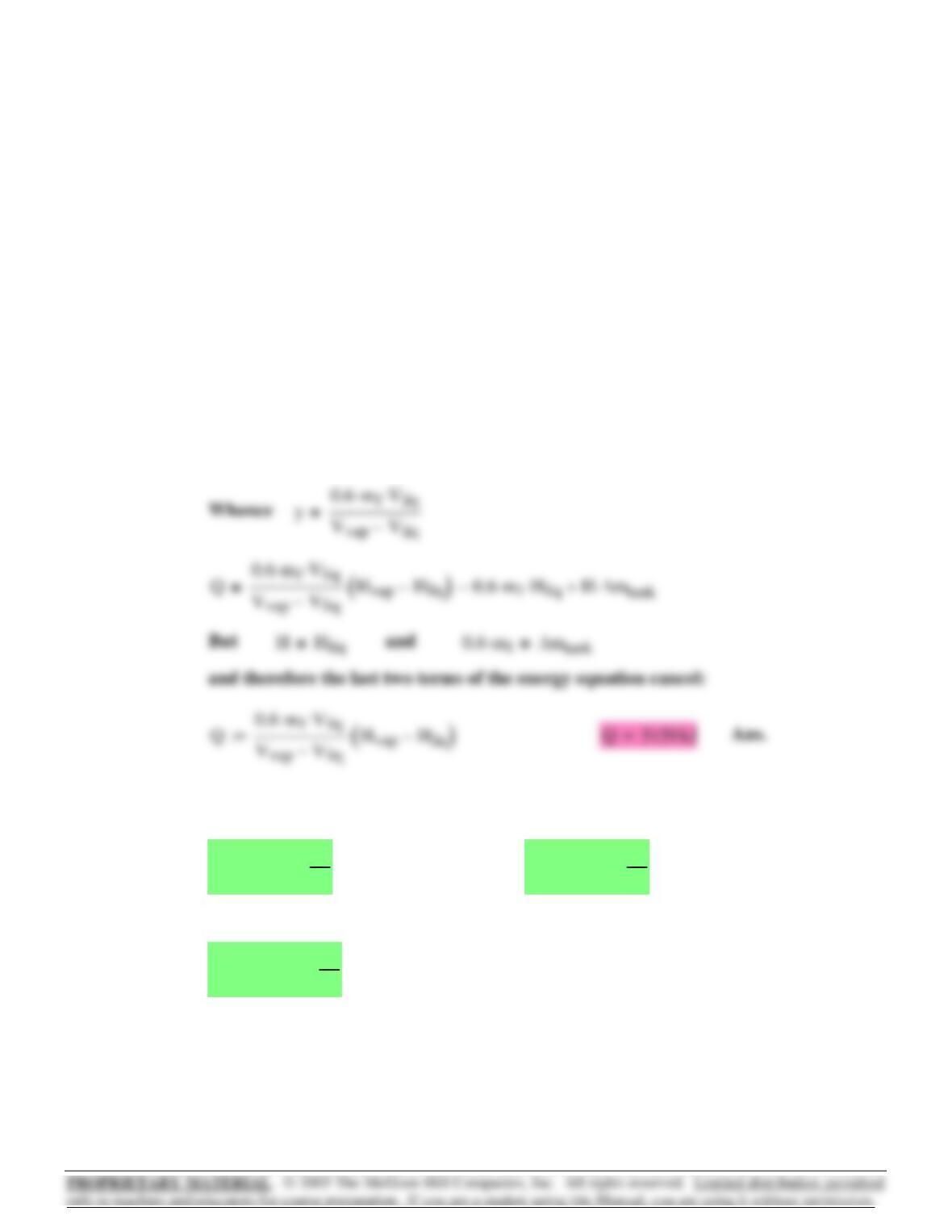
By Eq. (2.30), neglecting kinetic and potential energies and setting the
heat and work terms equal to zero:
H22737.6 kJ
kg
⋅:=
Data from Table F.2 for sat. vapor @ 400 kPa:
(85 degC)
H3355.9 kJ
kg
⋅:=
(24 degC)
H1100.6 kJ
kg
⋅:=
Data from Table F.1 for sat. liq.:6.77
where subscript t denotes conditions in the tank, and H is the enthalpy of
the stream flowing out of the tank. The only changes affecting the
enthalpy of the contents of the tank are:
1. Evaporation of y kg of sat. liq.:
yH
vap Hliq
−
()
⋅
2. Exit of 0.6 m1
⋅kg⋅of liquid from the tank:
0.6−m1
⋅Hliq
⋅
Thus
∆mtHt
⋅
()
yH
vap Hliq
−
()
⋅0.6 m1
⋅Hliq
⋅−=
Similarly, since the volume of the tank is constant, we can write,
∆mtVt
⋅
()
yV
vap Vliq
−
()
⋅0.6 m1
⋅Vliq
⋅−=0=
203
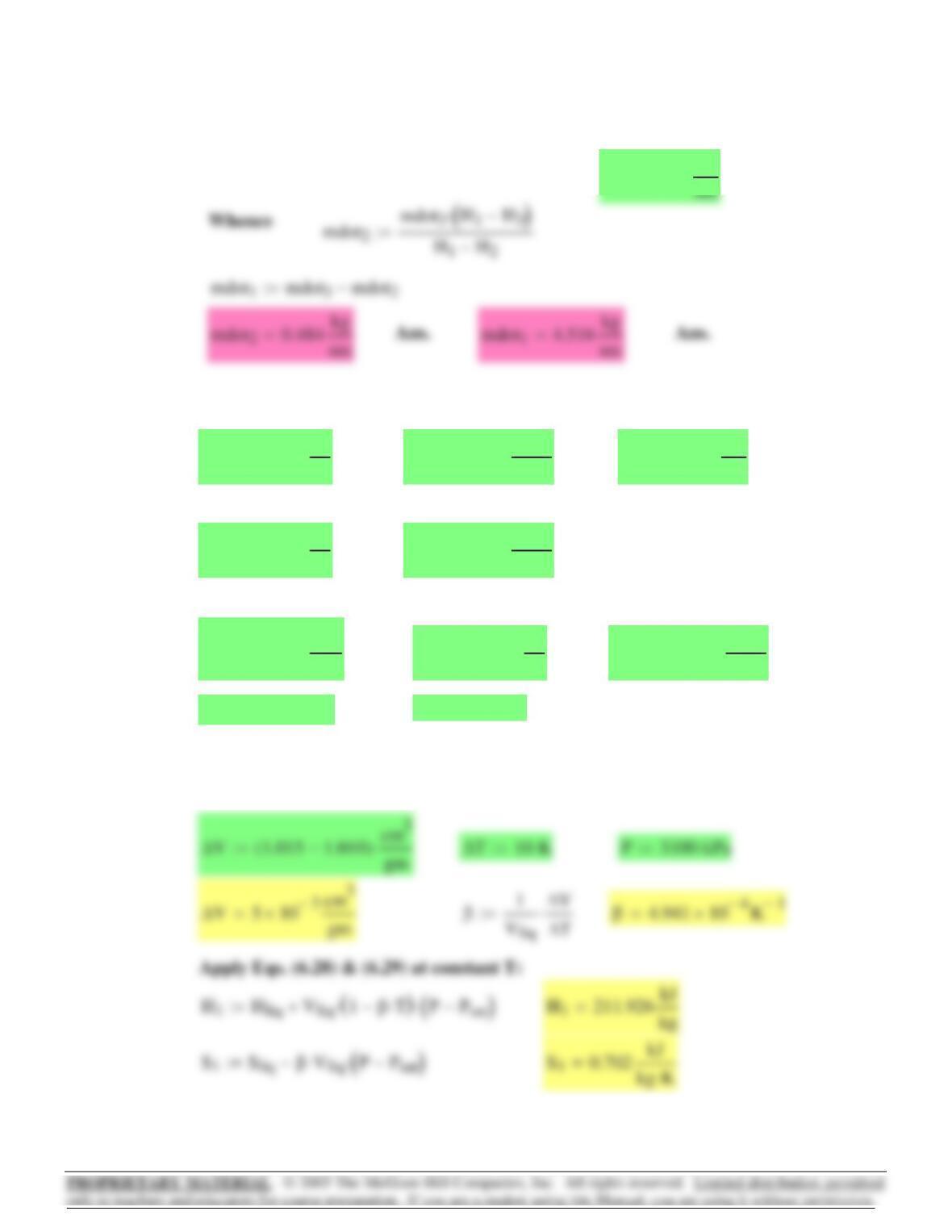
Table F.1, sat. liq. @ 50 degC:
Vliq 1.012 cm3
gm
⋅:= Hliq 209.3 kJ
kg
⋅:= Sliq 0.7035 kJ
kg K⋅
⋅:=
Psat 12.34 kPa⋅:= T 323.15 K⋅:=
Find changes in H and S caused by pressure increase from 12.34 to 3100
kPa. First estimate the volume expansivity from sat. liq, data at 45 and 55
degC:
Also mdot1mdot3mdot2
−=mdot35kg
⋅:=
6.78 Data from Table F.2 for sat. vapor @ 2900 kPa:
H32802.2 kJ
kg
⋅:= S36.1969 kJ
kg K⋅
⋅:= mdot315 kg
sec
⋅:=
Table F.2, superheated vap., 3000 kPa, 375 degC:
H23175.6 kJ
kg
⋅:= S26.8385 kJ
kg K⋅
⋅:=
204
S36.8859 kJ
kg K⋅
⋅:=
Table F.2, superheated vap. @ 700 kPa, 280 degC:
H13017.7 kJ
kg
⋅:= S17.2250 kJ
kg K⋅
⋅:= mdot150 kg
sec
⋅:=
Table F.1, sat. liq. @ 40 degC:
Hliq 167.5 kJ
kg
⋅:= Sliq 0.5721 kJ
kg K⋅
⋅:=
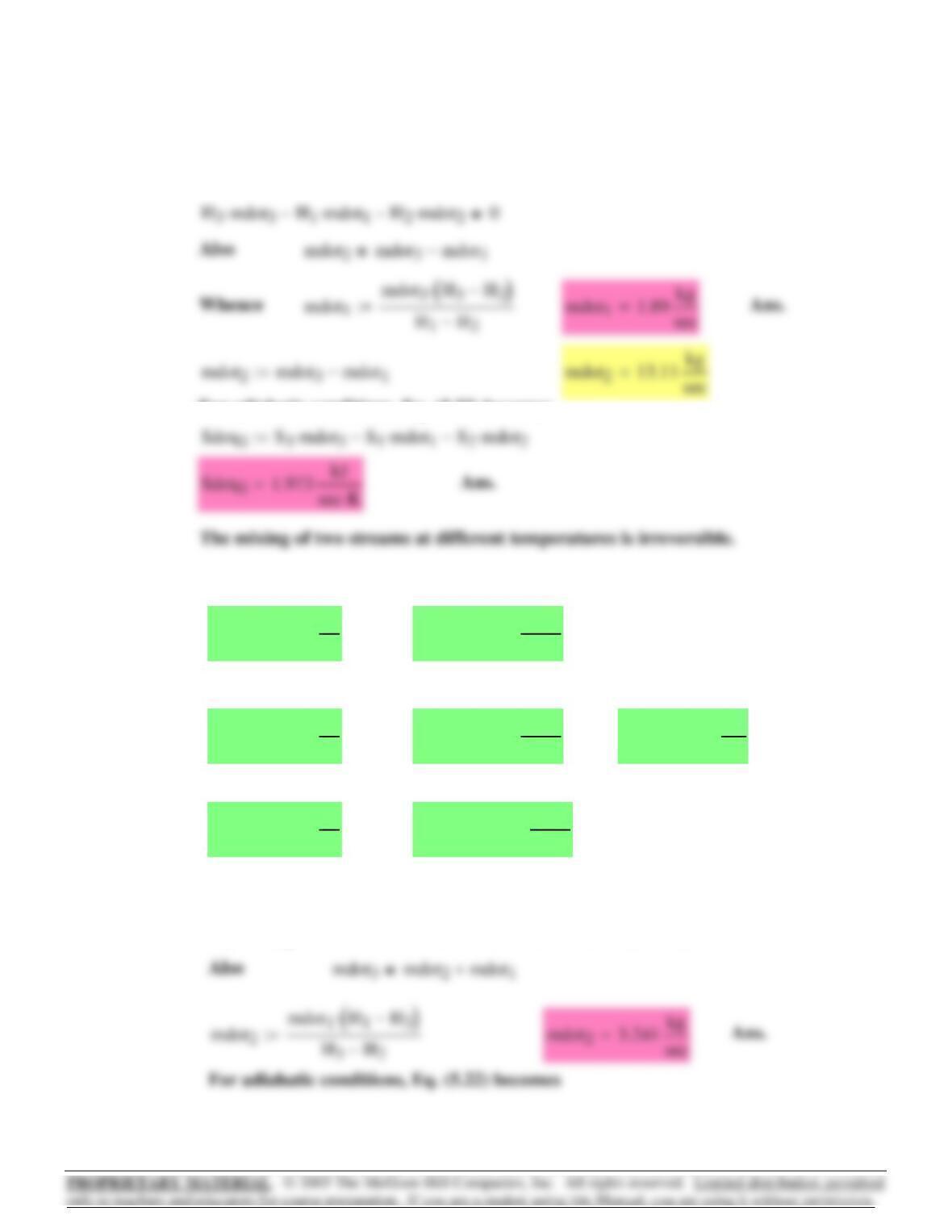
By Eq. (2.30), neglecting kinetic and potential energies and setting the heat
and work terms equal to zero:
H2Hliq
:= H3mdot3
⋅H1mdot1
⋅− H2mdot2
⋅− 0=
By Eq. (2.30), neglecting kinetic and potential energies and setting the heat
and work terms equal to zero:
For adiabatic conditions, Eq. (5.22) becomes
6.79 Table F.2, superheated vap. @ 700 kPa, 200 degC:
H32844.2 kJ
kg
⋅:=
205
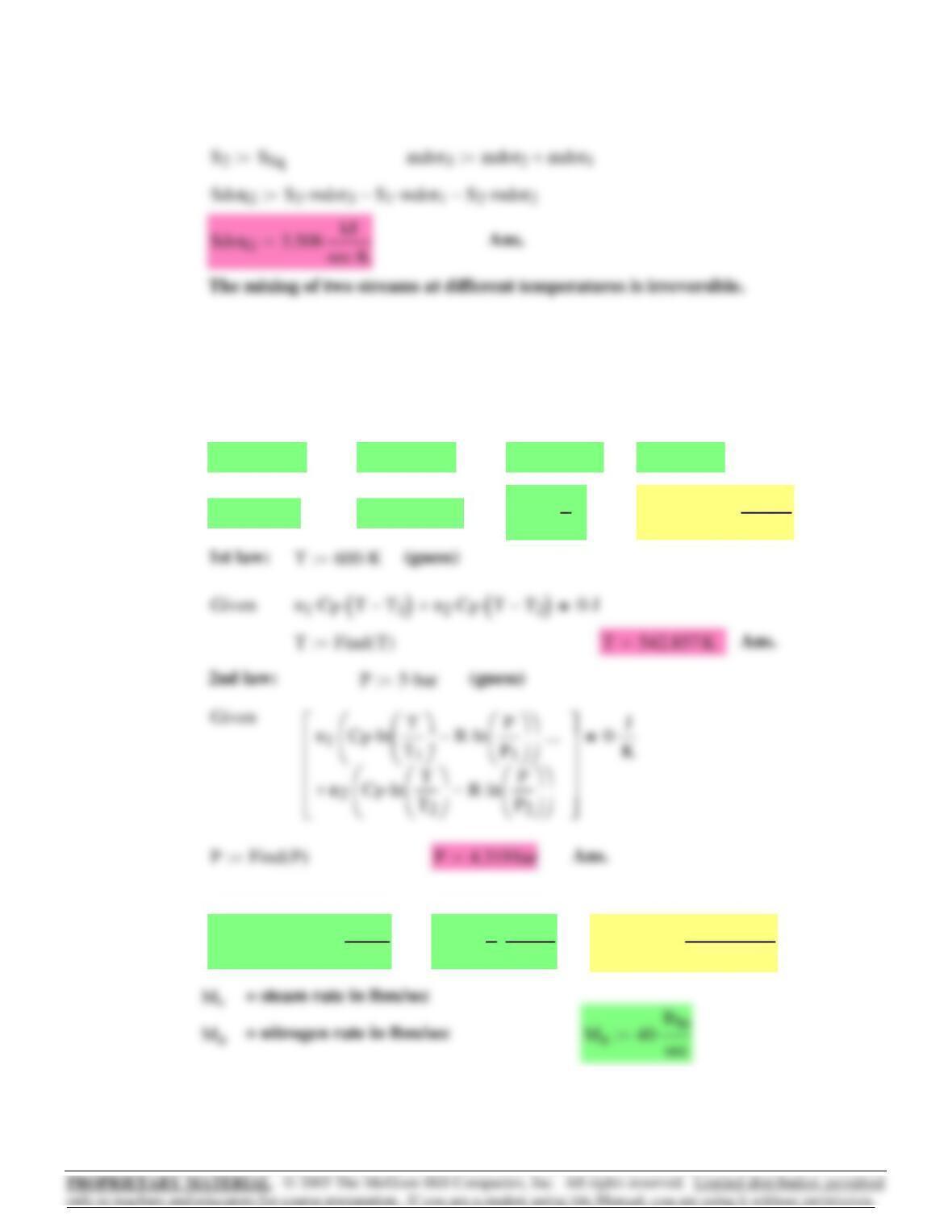
6.81 molwt 28.014 lb
lbmol
⋅:= CP
7
2
R
molwt
⋅:= CP0.248 BTU
lbmrankine⋅
=
6.80 Basis: 1 mol air at 12 bar and 900 K (1)
+ 2.5 mol air at 2 bar and 400 K (2)
= 3.5 mol air at T and P.
T1900 K⋅:= T2400 K⋅:= P112 bar⋅:= P22 bar⋅:=
n11 mol⋅:= n22.5 mol⋅:= CP
7
2R:= CP29.099 J
mol K⋅
=
206
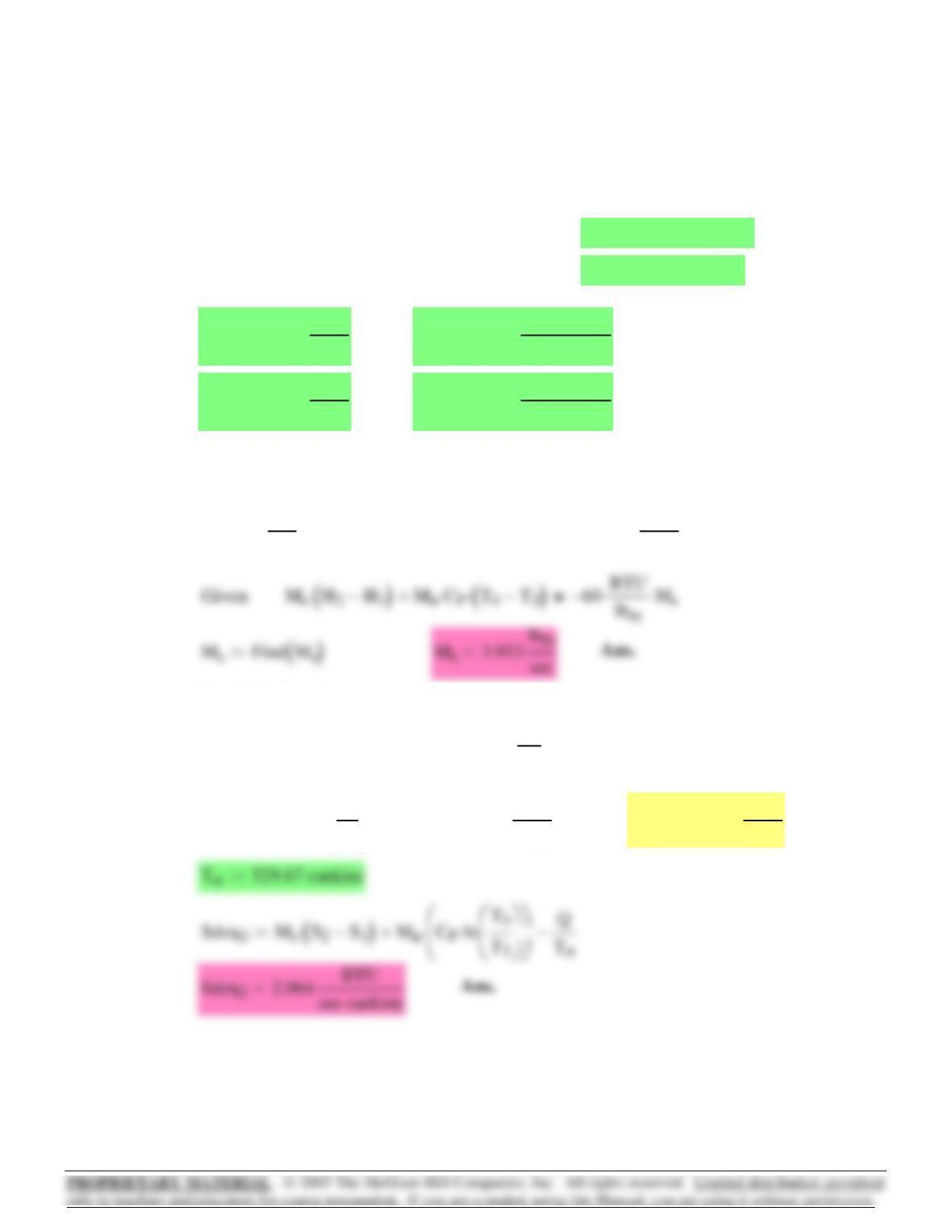
Q 235.967−BTU
sec
=Q60−BTU
lbm
⋅Ms
⋅:=S4S3
−CPln T4
T3
⎛
⎜
⎝
⎞
⎠
⋅=
SdotGMsS2S1
−
()
⋅MnS4S3
−
()
⋅+ Q
Tσ
−=
Eq. (5.22) here becomes
Q60−BTU
lbm
⋅Ms
⋅=
(guess)
Ms3lbm
sec
⋅:=
Eq. (2.30) applies with negligible kinetic and potential energies and with the
work term equal to zero and with the heat transfer rate given by
(Table F.4)
S21.8158 BTU
lbmrankine⋅
⋅:=H21192.6 BTU
lbm
⋅:=
(Table F.3)
S10.3121 BTU
lbmrankine⋅
⋅:=H1180.17 BTU
lbm
⋅:=
T4784.67 rankine⋅:=
(4) = nitrogen out at 325 degF
T31209.67 rankine⋅:=
(3) = nitrogen in at 750 degF
(2) = exit steam at 1 atm and 300 degF
(1) = sat. liq. water @ 212 degF entering
207
⎜
⎜
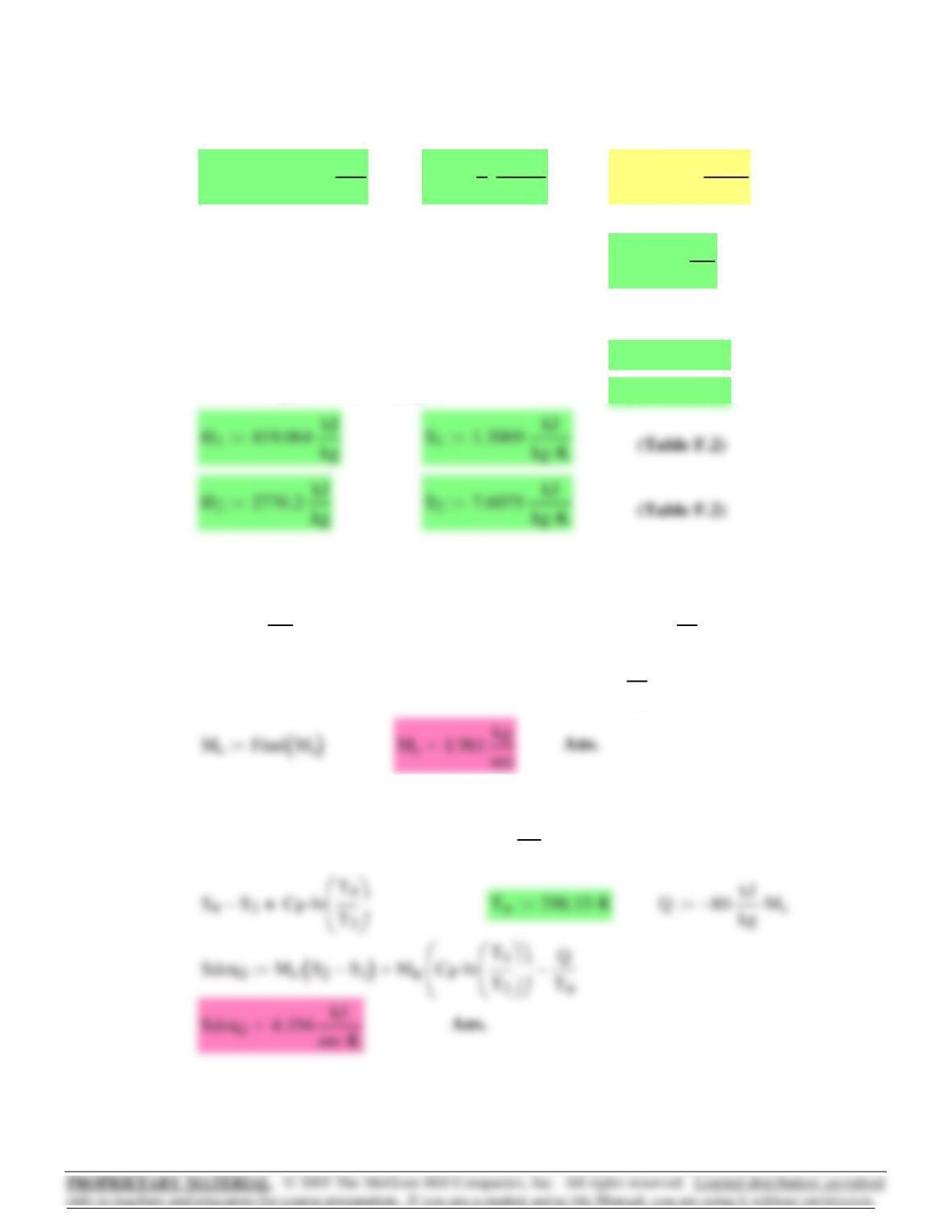
By Eq. (2.30), neglecting kinetic and potential energies and setting
the work term to zero and with the heat transfer rate given by
Ms1kg
sec
⋅:= (guess) Q80−kJ
kg
⋅Ms
⋅=
Given MsH2H1
−
()
⋅MnCP
⋅T4T3
−
()
⋅+ 80−kJ
kg
⋅Ms
⋅=
Eq. (5.22) here becomes
SdotGMsS2S1
−
()
⋅MnS4S3
−
()
⋅+ Q
Tσ
−=
6.82 molwt 28.014 gm
mol
⋅:= CP
7
2
R
molwt
⋅:= CP1.039 J
gm K⋅
=
Ms = steam rate in kg/sec
Mn= nitrogen rate in kg/sec Mn20 kg
sec
⋅:=
(1) = sat. liq. water @ 101.33 kPa entering
(2) = exit steam at 101.33 kPa and 150 degC
(3) = nitrogen in @ 400 degC T3673.15 K⋅:=
(4) = nitrogen out at 170 degC T4443.15 K⋅:=
208
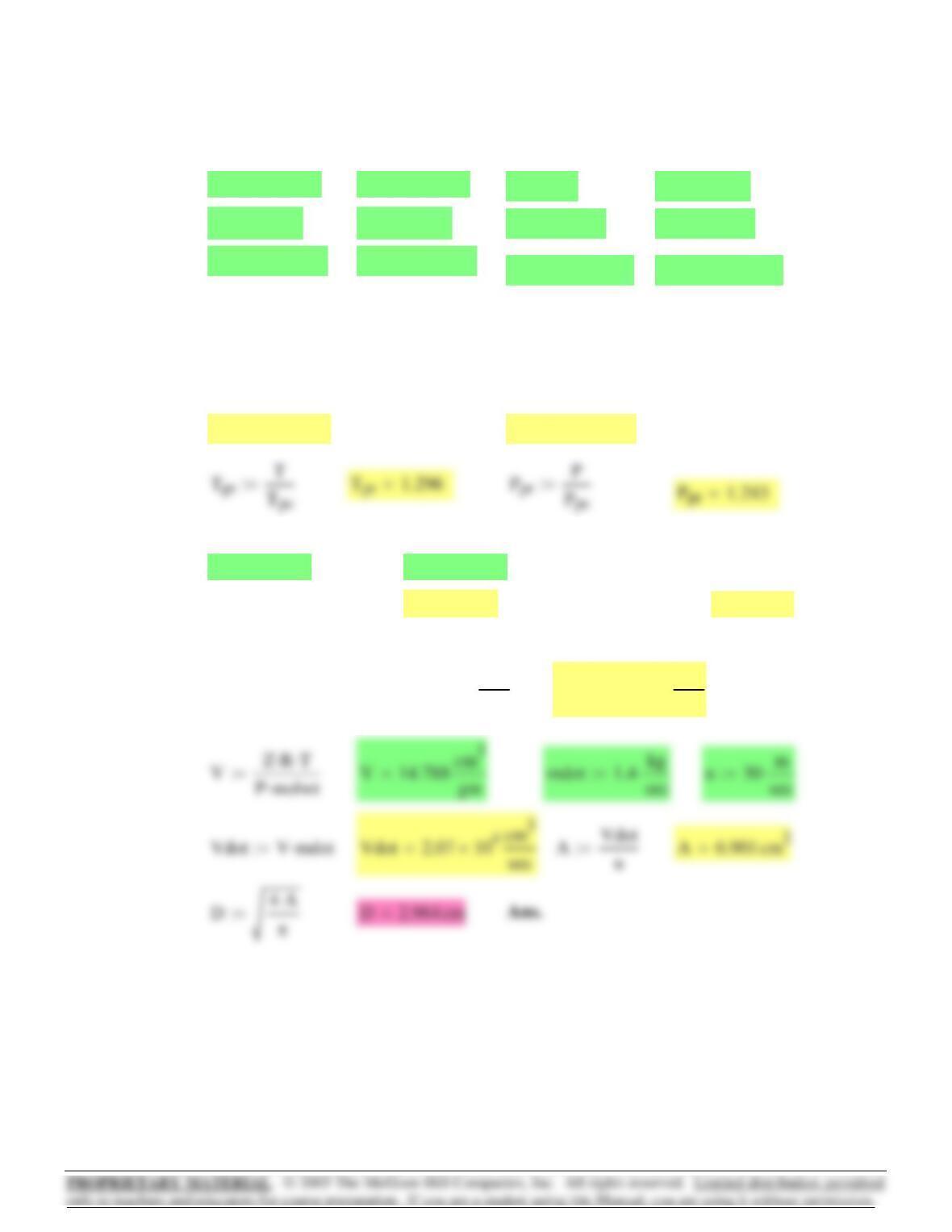
By interpolation in Tables E.3 and E.4:
Z0 0.8010:= Z1 0.1100:=
ωy1ω1
⋅y2ω2
⋅+:= ω 0.082=ZZ0ωZ1⋅+:= Z 0.81=
For the molar mass of the mixture, we have:
molwt y116.043⋅y244.097⋅+
()
gm
mol
⋅:= molwt 30.07 gm
mol
=
6.86 Methane = 1; propane = 2
T 363.15 K⋅:= P 5500 kPa⋅:= y10.5:= y21y
1
−:=
ω10.012:= ω20.152:= Zc1 0.286:= Zc2 0.276:=
Tc1 190.6 K⋅:= Tc2 369.8 K⋅:= Pc1 45.99 bar⋅:= Pc2 42.48 bar⋅:=
The elevated pressure here requires use of either an equation of state or
the Lee/Kesler correlation with pseudocritical parameters. We choose the
latter.
Tpc y1Tc1
⋅y2Tc2
⋅+:= Ppc y1Pc1
⋅y2Pc2
⋅+:=
Tpc 280.2 K=Ppc 44.235 bar=
209
.190
⎛
⎞
42.77
⎛
⎞
425.2
⎛
⎞
20
⎛
⎞
500
⎛
⎞
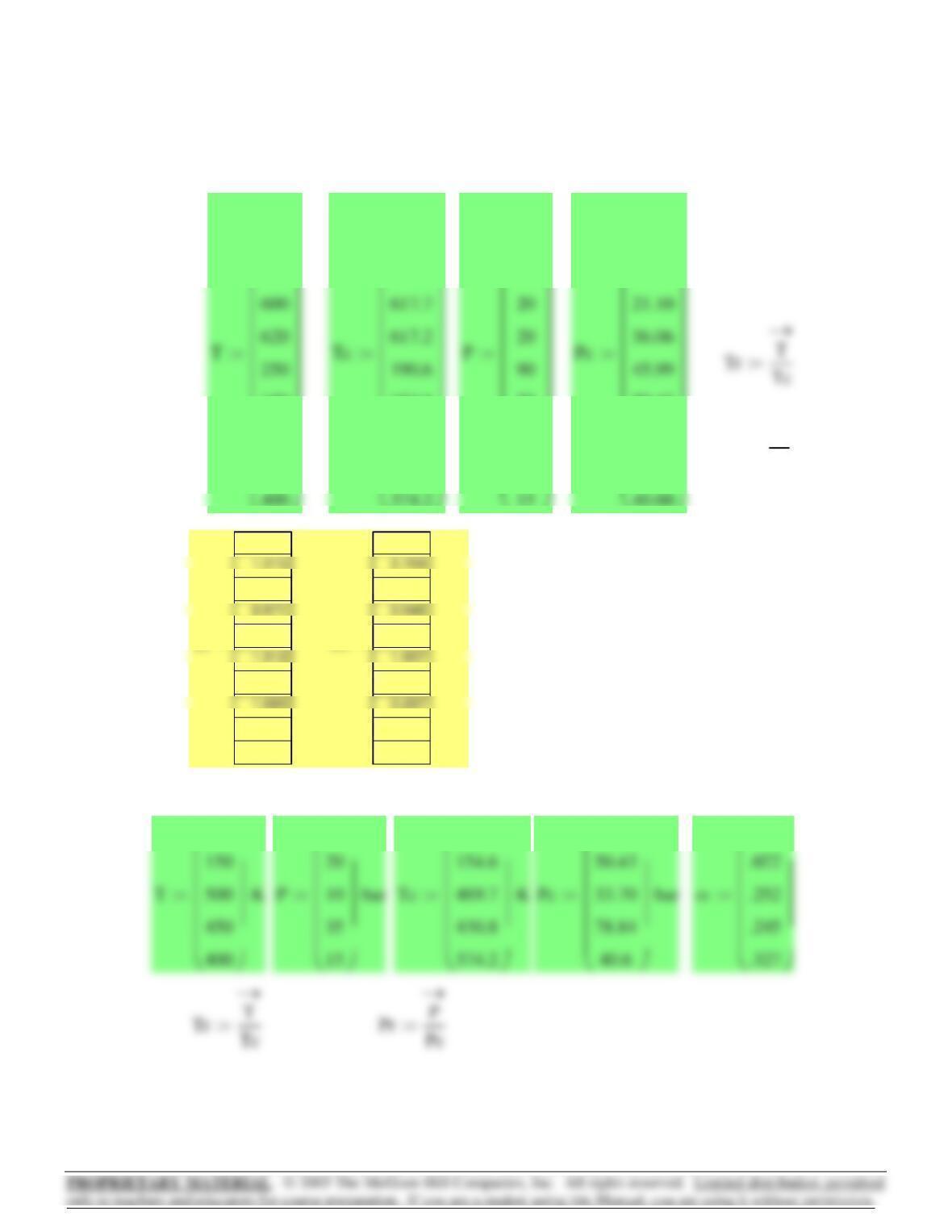
Parts (a), (g), (h), (i), and (j) — By virial equation:
Pr
0.468
0.759
0.555
0.397
0.444
0.369
=
Tr
1.176
0.815
1.005
0.97
1.045
1.069
=
Pr P
Pc
→
⎯
:=
⎯
42.77
73.83
79.00
50.43
33.70
78.84
⎛
⎜
⎜
⎜
⎜
⎜
⎜
⎜
⎝
⎞
⎟
⎟
⎟
⎟
⎟
⎟
⎠
20
200
60
20
10
35
⎛
⎜
⎜
⎜
⎜
⎜
⎜
⎜
⎝
⎞
⎟
⎟
⎟
⎟
⎟
⎟
⎠
425.2
304.2
552.0
154.6
469.7
430.8
⎛
⎜
⎜
⎜
⎜
⎜
⎜
⎜
⎝
⎞
⎟
⎟
⎟
⎟
⎟
⎟
⎠
500
400
450
150
500
450
⎛
⎜
⎜
⎜
⎜
⎜
⎜
⎜
⎝
⎞
⎟
⎟
⎟
⎟
⎟
⎟
⎠
Vectors containing T, P, Tc, and Pc for the calculation of Tr and Pr:6.87
210
⎯
⎯
⎜
⎜
⎜
⎜
⎜
VR R Tc
Pc
⋅B0 ωB1⋅+
()
⋅
⎡
⎢
⎣
⎤
⎥
⎦
→
⎯
⎯⎯⎯⎯⎯⎯⎯
:=
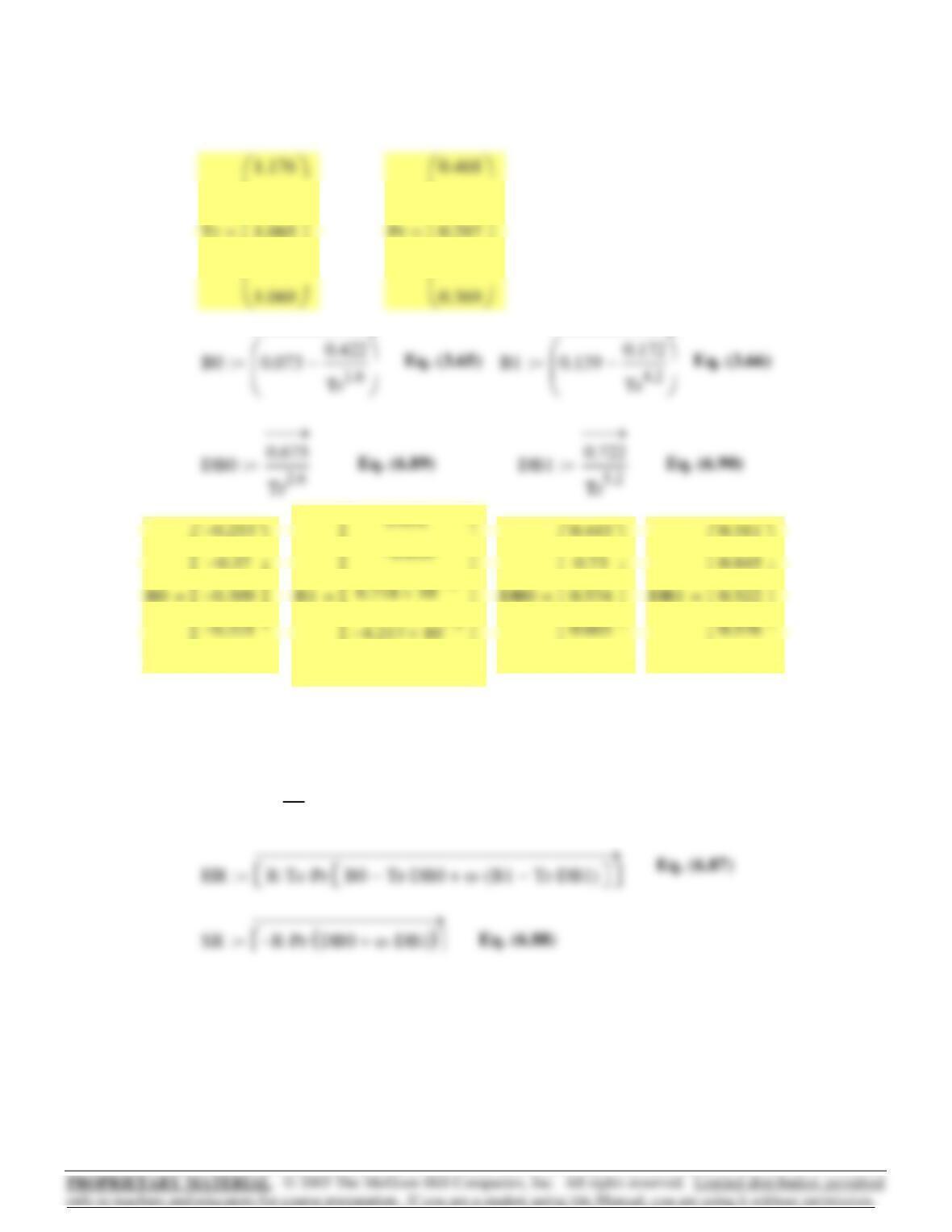
Combine Eqs. (3.61) + (3.62), (3.63), and (6.40) and the definitions of Tr and
Pr to get:
⎜
⎜
⎜
0.51
⎛
⎜
⎜
⎜
⎝
⎞
⎟
⎟
⎠
0.568
⎛
⎜
⎜
⎜
⎝
⎞
⎟
⎟
⎠
9.009 10 3−
×
⎜
⎜
⎜
⎜
⎜
⎝
⎟
⎟
⎟
⎠
0.306−
⎛
⎜
⎜
⎜
⎝
⎞
⎟
⎟
⎠
⎯
⎯
⎯
⎯
→
⎯
⎯⎯⎯⎯
⎯
→
⎯
⎯⎯⎯⎯
⎯
0.397
0.444
⎜
⎜
⎜
⎜
⎟
⎟
⎟
0.97
1.045
⎜
⎜
⎜
⎜
⎟
⎟
⎟
211
⎯
⎯
⎯
⎯
.224
.111
.012
⎛
⎜
⎜
⎝
⎞
⎠
304.2
552.0
190.6
⎛
⎜
⎜
⎝
⎞
⎠
200
60
90
⎛
⎜
⎜
⎝
⎞
⎠
400
450
250
⎛
⎜
⎜
⎝
⎞
⎠
5.274−
0.557−
0.289−
⎛
⎜
⎜
⎜
⎜
⎜
⎝
⎞
⎟
⎟
⎟
⎠
:=
4.381−
0.473−
0.824−
⎛
⎜
⎜
⎜
⎜
⎜
⎝
⎞
⎟
⎟
⎟
⎠
:=
⎜
⎜
⎜
⎜
0.233−
0.596−
0.169−
⎛
⎜
⎜
⎝
⎞
⎟
⎠
2.008−
0.671−
1.486−
⎛
⎜
⎜
⎝
⎞
⎟
⎠
0.208
.036−
0.138
⎛
⎜
⎜
⎝
⎞
⎟
⎠
.663
.783
.707
⎛
⎜
⎜
⎝
⎞
⎟
⎠
HR
RTc
h equals
HR()
1
RTc
h1 equals
HR()
0
RTc
h0 equalsDEFINE:
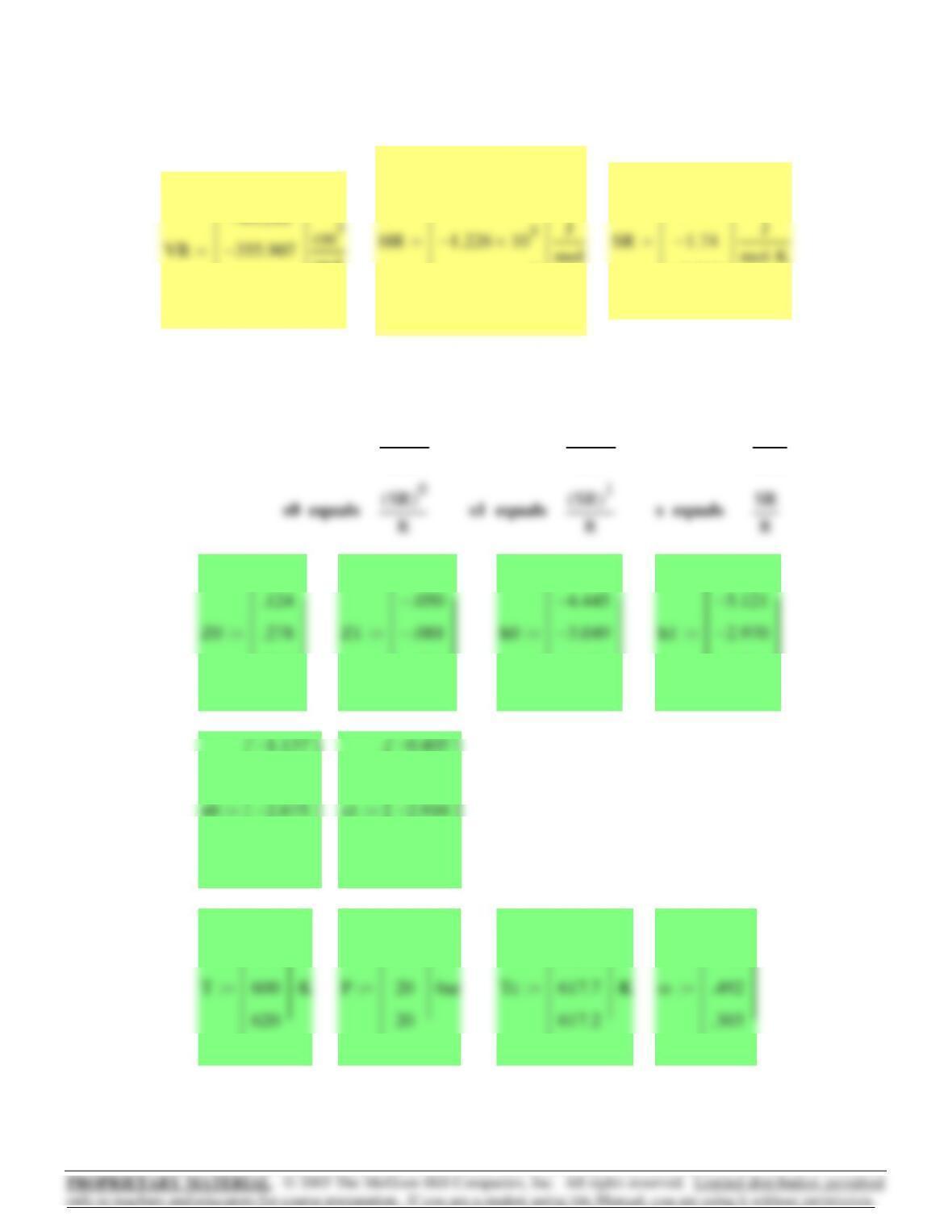
By linear interpolation in Tables E.1–E.12:
Parts (b), (c), (d), (e), and (f) — By Lee/Kesler correlation:
200.647−
146.1−
232.454−
⎛
⎜
⎜
⎜
⎝
⎞
⎟
⎠
mol
1.952−
2.469−
2.745−
2.256−
⎛
⎜
⎜
⎜
⎝
⎞
⎟
⎠
1.377−103
×
559.501−
1.746−103
×
1.251−103
×
⎛
⎜
⎜
⎜
⎜
⎜
⎝
⎞
⎟
⎟
⎟
⎠
212
553.6
132.9
⎛
⎜
⎜
⎞
⎟
562.2
304.2
⎛
⎜
⎜
⎞
⎟
60
100
⎛
⎜
⎜
⎞
⎟
650
300
⎛
⎜
⎜
⎞
⎟
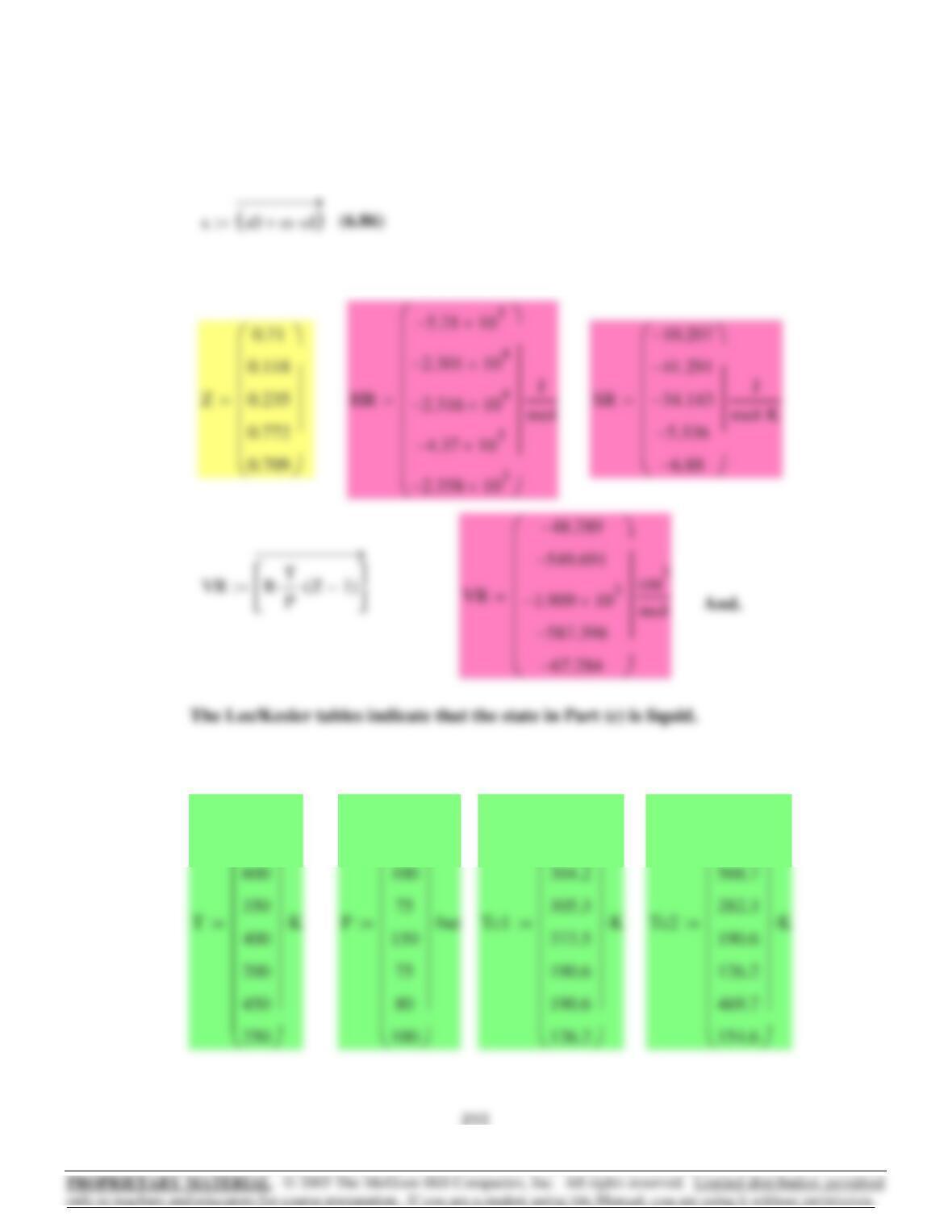
Vectors containing T, P, Tc1, Tc2, Pc1, Pc2, ω1, and ω2 for Parts (a) throu
g
h (h
)
6.88
⎜
⎯
⎯
⎜
⎜
⎜
SR s R⋅()
→
⎯
⎯
:=HR h Tc⋅R⋅()
→
⎯
⎯
⎯
:=
⎯
⎯
Eq. (6.85)
hh0ωh1⋅+
()
→
⎯
⎯
⎯
⎯
⎯
:=
Eq. (3.57)
ZZ0ωZ1⋅+
()
→
⎯
⎯
⎯
⎯
⎯
:=
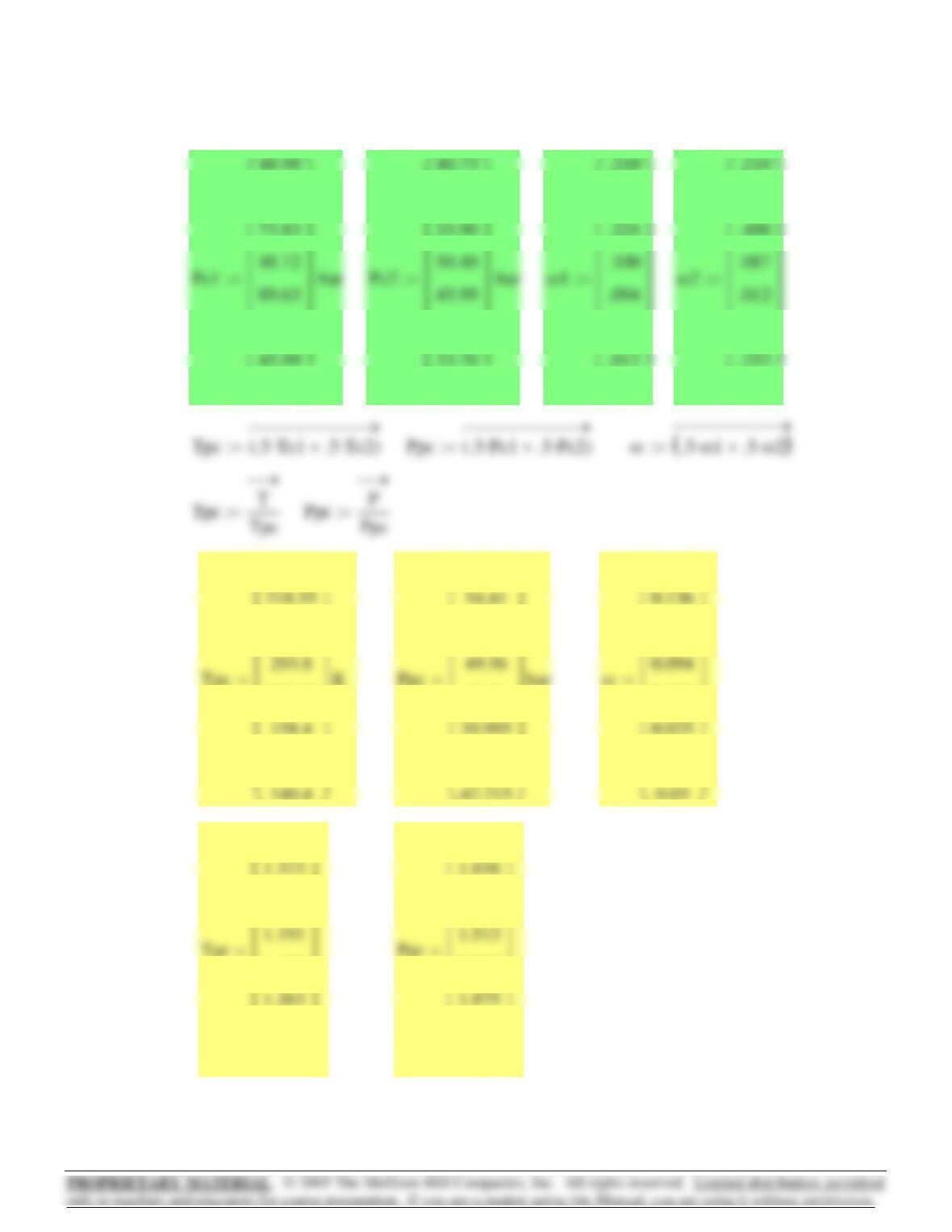
73.83
45.99
34.00
⎛
⎜
⎜
⎜
⎜
⎜
⎝
⎞
⎟
⎟
⎟
⎠
34.99
34.00
50.43
⎛
⎜
⎜
⎜
⎜
⎜
⎝
⎞
⎟
⎟
⎟
⎠
.224
.012
.038
⎛
⎜
⎜
⎜
⎜
⎜
⎝
⎞
⎟
⎟
⎟
⎠
.048
.038
.022
⎛
⎜
⎜
⎜
⎜
⎜
⎝
⎞
⎟
⎟
⎟
⎠
557.9
436.45
282.05
330.15
⎜
⎜
⎜
⎛
⎜
⎜
⎜
⎜
⎜
⎜
⎜
⎝
⎞
⎟
⎟
⎟
⎟
⎟
⎟
⎠
44.855
49.365
67.81
39.845
⎛
⎜
⎜
⎜
⎜
⎜
⎜
⎜
⎝
⎞
⎟
⎟
⎟
⎟
⎟
⎟
⎠
0.21
0.312
0.053
0.132
⎛
⎜
⎜
⎜
⎜
⎜
⎜
⎜
⎝
⎞
⎟
⎟
⎟
⎟
⎟
⎟
⎠
1.165
1.375
1.418
1.363
1.781
⎛
⎜
⎜
⎜
⎜
⎜
⎜
⎜
⎜
⎝
⎞
⎟
⎟
⎟
⎟
⎟
⎟
⎠
1.338
2.026
2.212
2.008
2.369
⎛
⎜
⎜
⎜
⎜
⎜
⎜
⎜
⎜
⎝
⎞
⎟
⎟
⎟
⎟
⎟
⎟
⎠
214
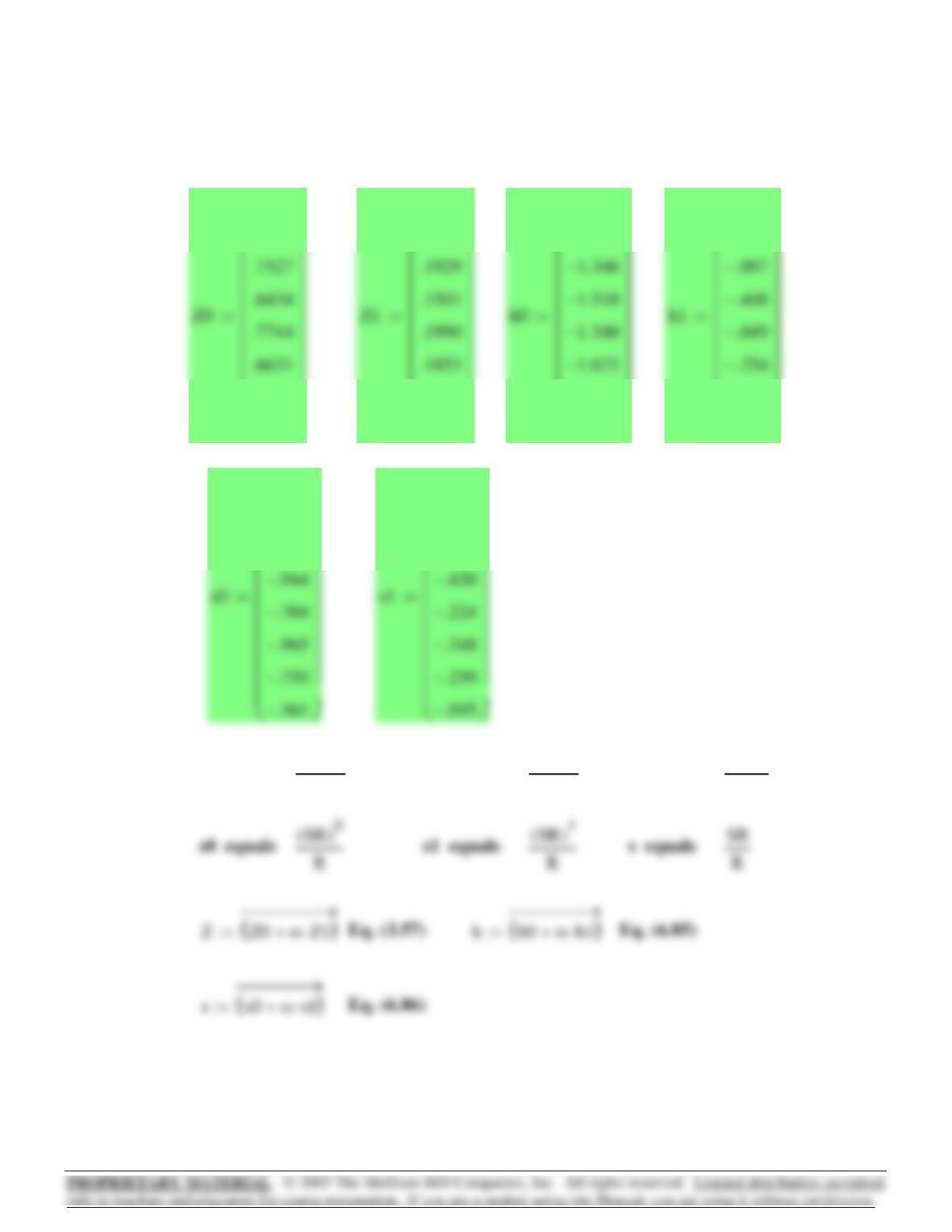
HR
RTpc
h equals
HR()
1
RTpc
h1 equals
HR()
0
RTpc
h0 equals
⎜
⎜
.466−
.235−
.242−
⎛
⎜
⎜
⎜
⎞
⎟
⎟
.890−
.658−
.729−
⎛
⎜
⎜
⎜
⎞
⎟
⎟
.461−
.116−
.110−
0.172
⎛
⎜
⎜
⎜
⎜
⎜
⎝
⎞
⎟
⎟
⎟
⎠
1.395−
1.217−
1.372−
0.820−
⎛
⎜
⎜
⎜
⎜
⎜
⎝
⎞
⎟
⎟
⎟
⎠
.1219
.1749
.1933
.1839
⎛
⎜
⎜
⎜
⎜
⎜
⎝
⎞
⎟
⎟
⎟
⎠
.6543
.7706
.7436
.9168
⎛
⎜
⎜
⎜
⎜
⎜
⎝
⎞
⎟
⎟
⎟
⎠
Lee/Kesler Correlation — By linear interpolation in Tables E.1–E.12:
215
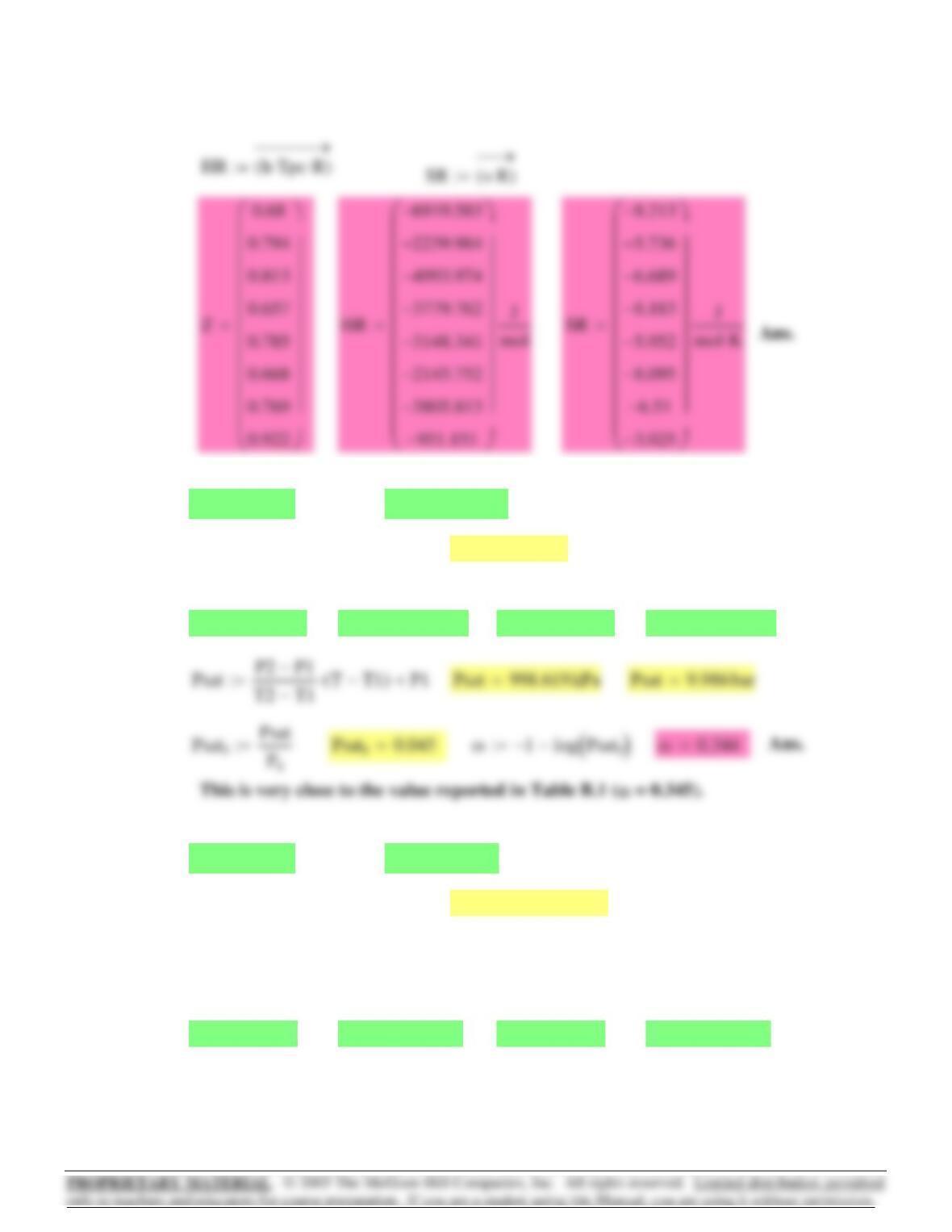
6.96 Tc374.2K:= Pc40.60bar:=
At Tr = 0.7: T 0.7 Tc
⋅:= T 471.492 rankine=
T T 459.67rankine−:= T 11.822 degF=
Find Psat in Table 9.1 at T = 11.822 F
T1 10degF:= P1 26.617psi:= T2 15degF:= P2 29.726psi:=
6.95 Tc647.1K:= Pc220.55bar:=
At Tr = 0.7: T 0.7 Tc
⋅:= T 452.97 K=
Find Psat in the Saturated Steam Tables at T = 452.97 K
T1 451.15K:= P1 957.36kPa:= T2 453.15K:= P2 1002.7kPa:=
216
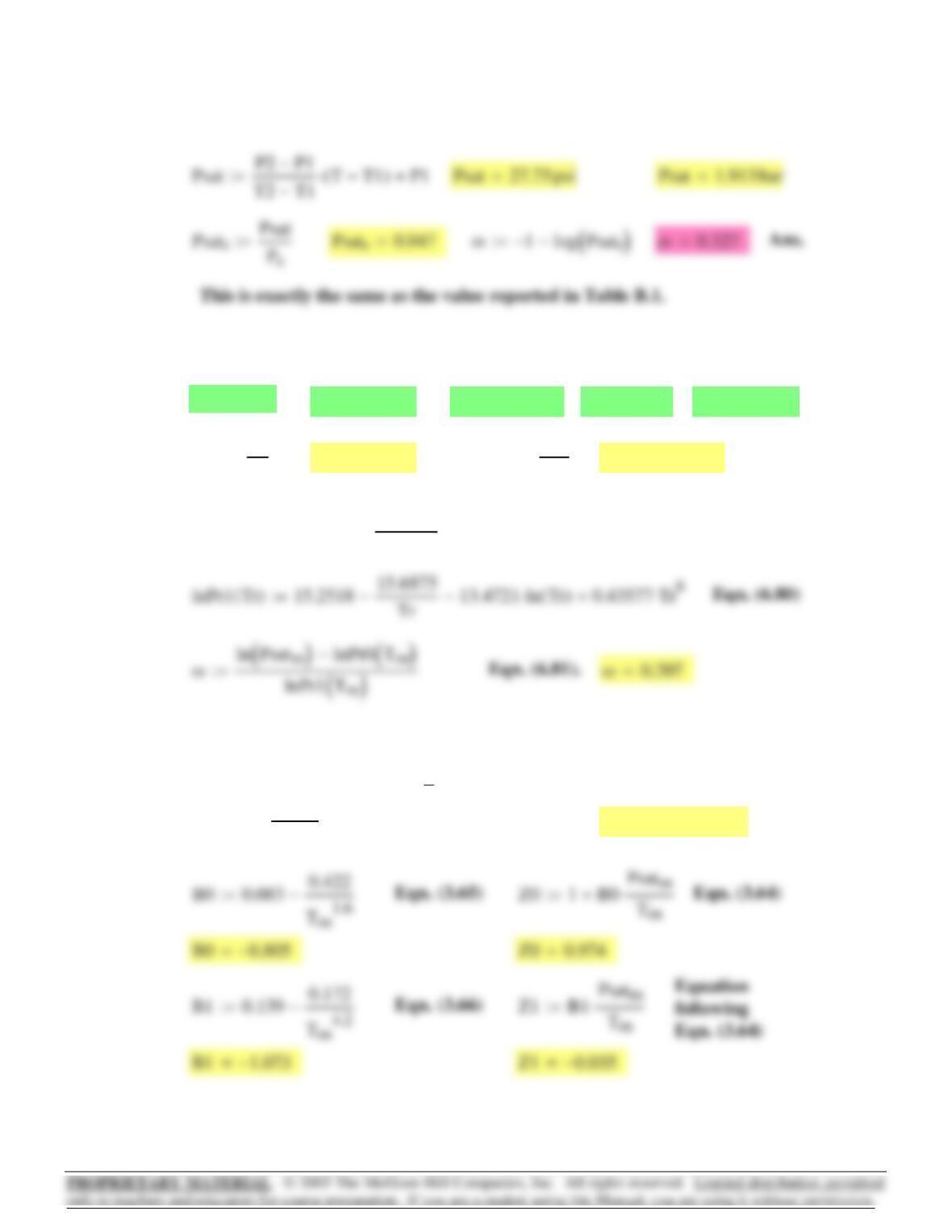
lnPsatr Tr( ) lnPr0 Tr() ωlnPr1 Tr()⋅+:= Eqn. (6.78)
Zsatliq
Psatrn
Trn
Zc
11T
rn
−
()
2
7
+
⎡
⎢
⎣
⎤
⎥
⎦
⋅:= Eqn. (3.73) Zsatliq 0.00334=
6.101 For benzene
a) ω0.210:= Tc562.2K:= Pc48.98bar:= Zc0.271:= Tn353.2K:=
Trn
Tn
Tc
:= Trn 0.628=Psatrn 1atm
Pc
:= Psatrn 0.021=
lnPr0 Tr( ) 5.92714 6.09648
Tr
−1.28862 ln Tr()⋅− 0.169347 Tr6
⋅+:= Eqn. (6.79)
217
a) At Tr = 0.7 T 0.7Tc
:= T 212.94 K=
Ttr
Tt
Tc
:= Ttr 0.712=Ptr
Pt
Pc
:= Ptr 0.07=
Zsatvap Z0 ωZ1⋅+:= Eqn. (3.57) Zsatvap 0.966=
∆Zlv Zsatvap Zsatliq
−:= ∆Zlv 0.963=
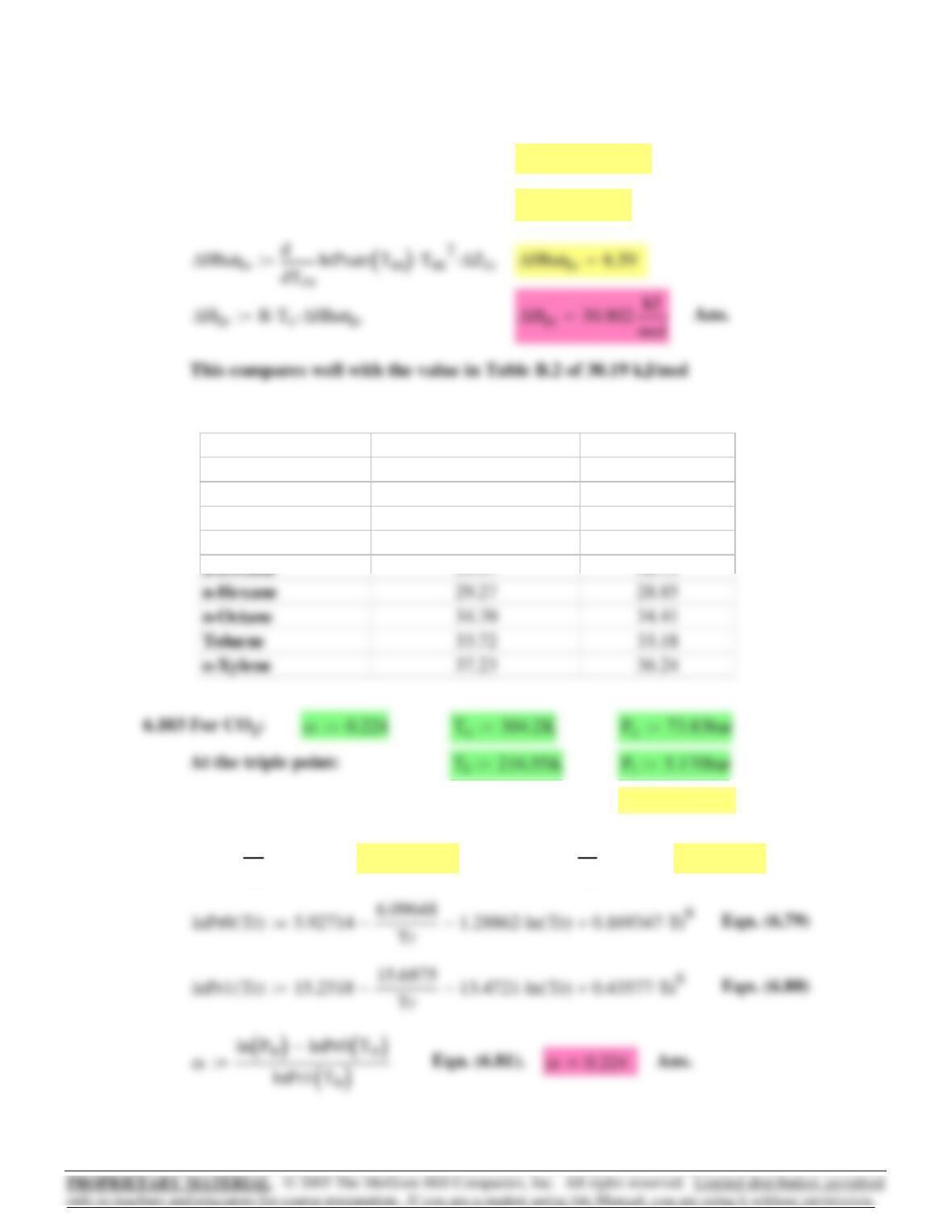
The results for the other species are given in the table below.
Estimated Value (kJ/mol) Table B.2 (kJ/mol)
Benzene 30.80 30.72
iso-Butane 21.39 21.30
Carbon tetrachloride 29.81 29.82
Cyclohexane 30.03 29.97
218
This is exactly the same value as given in Table B.1
b) Psatr
1atm
Pc
:= Psatr0.014=Guess: Trn 0.7:=
219