CHAPTER 6
1. What are the major types of differences between U.S. GAAP and IFRS? Give an
example of each.
The main difference between U.S. GAAP and IFRS:
Concepts and approaches: For example, IFRS allow revaluation of nonfinancial assets
Acceptable methods: For example, IFRS prohibit LIFO inventory accounting
2. What is the convergence project and what are its goals for 2012 and beyond?
JOINT FASB/IASB CONVERGENCE PROJECTS
PROJECT GOALS FOR 2012
General hedge accounting Target IFRS Issue: second quarter
Financial instruments impairment Reexposure: FASB/IASB draft, second quarter
3. When a company adopts IFRS, why are three years of financial data affected?
The core principle of IFRS 1 is for the entity to apply the same accounting principles in
4. What are some important decisions that must be made when a company
transitions to IFRS?
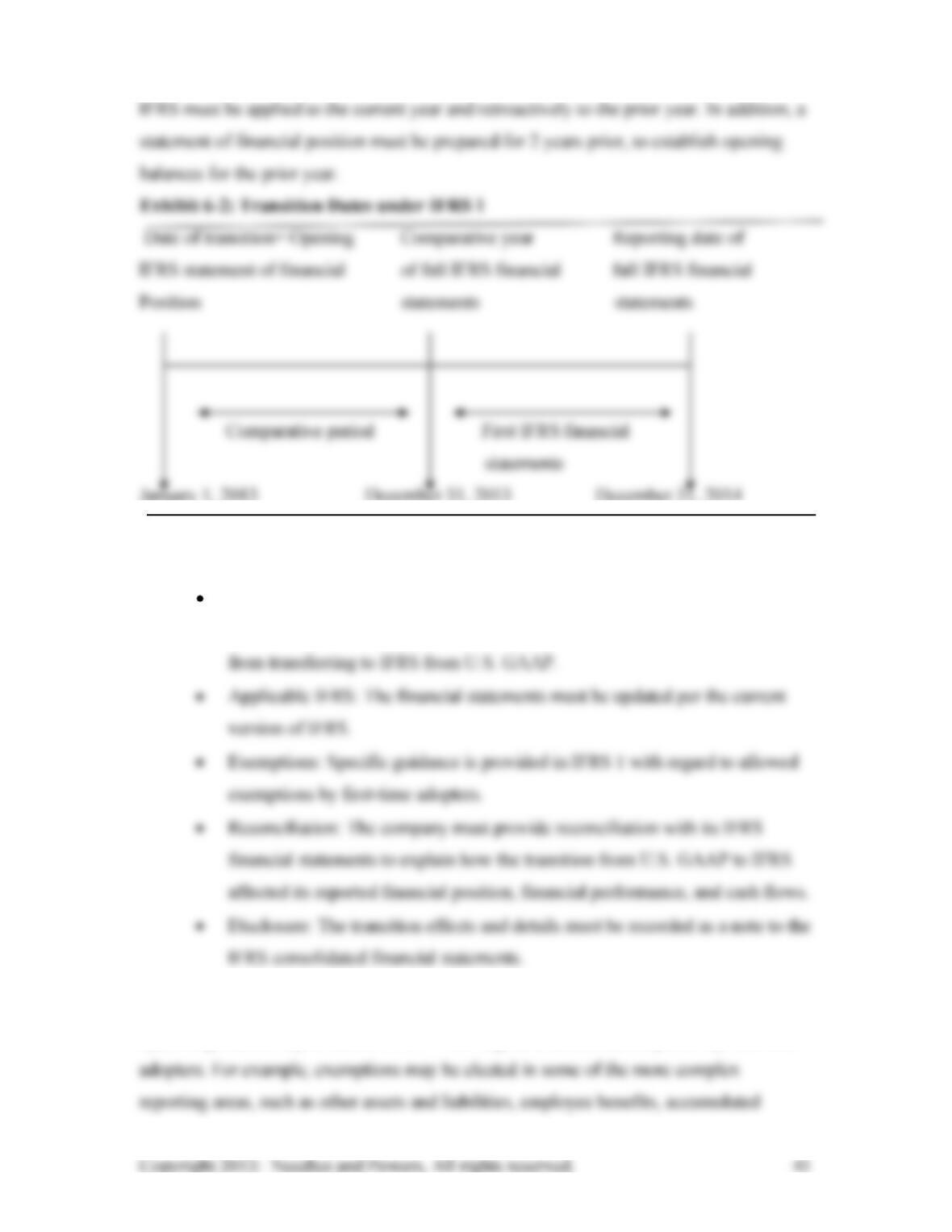
Transition date: The transition date to IFRS is the date when an entity is
required to disclose full comparative information of changes that occurred
5. Do companies that adopt IFRS have to follow all the standards in the first year?
What are some possible exceptions?
Specific guidance is provided in IFRS 1 with regard to allowed exemptions by first-time
6.What steps need to be followed in establishing the initial statement of financial
position?
Step 1: Identify all assets and liabilities required under the IFRS.
7.Why is a coordinated effort by a project management team for the conversion to
IFRS required rather than just an effort by the accounting team?
Conversion to IFRS requires a company-wide effort, going beyond just the accounting
successful conversion include the
following:
Establishment of a project management team that has direction, comprehensive
planning, execution tactics, and monitoring
8. Why may IFRS for SMEs have an important impact of financial reporting in the
U.S.?
IFRS for SMEs are potentially very attractive for the 20 million U.S. private companies,
9. What changes will likely take place in accounting education as a result of IFRS?
Adapting to IFRS requires attention and study for U.S. accounting, audit, and tax
10. Research question: Choose one topic listed in Exhibit 6-1 that is being jointly
studied for convergence by the IASB and the FASB. Go to the websites listed in
Appendix D. Find references to the topic on at least five sites and summarize the
current status of the joint effort in to pages, using a statement of the issues that need
to be resolved with regard to the topic.
NO SUGGESTED SOLUTION
11. Class or group discussion: What do you think will be the most challenging
obstacle for a company moving to adopt IFRS?
The most challenging obstacles: The cost of transition and the essential accounting
differences between U.S GAAP and IFRS:
12. Case: JRC, Inc. is a multinational U.S. public company that operates in more
than ten countries. Based on the belief that the SEC is likely to require a move
to IFRS, The CEO has decided to form an IFRS Planning Task Force to address
you, the CFO, to
prepare a short memorandum to him that delineates broadly the financial
reporting transition to IFRS (under IFRS 1) and also recommend what other
divisions of the company should be represented in the task force.
When a company issues comparative financial statements, IFRS must be applied to the
current year and retroactively to the prior year. While the IASB makes some allowances
under IFRS 1 to facilitate the transition process.