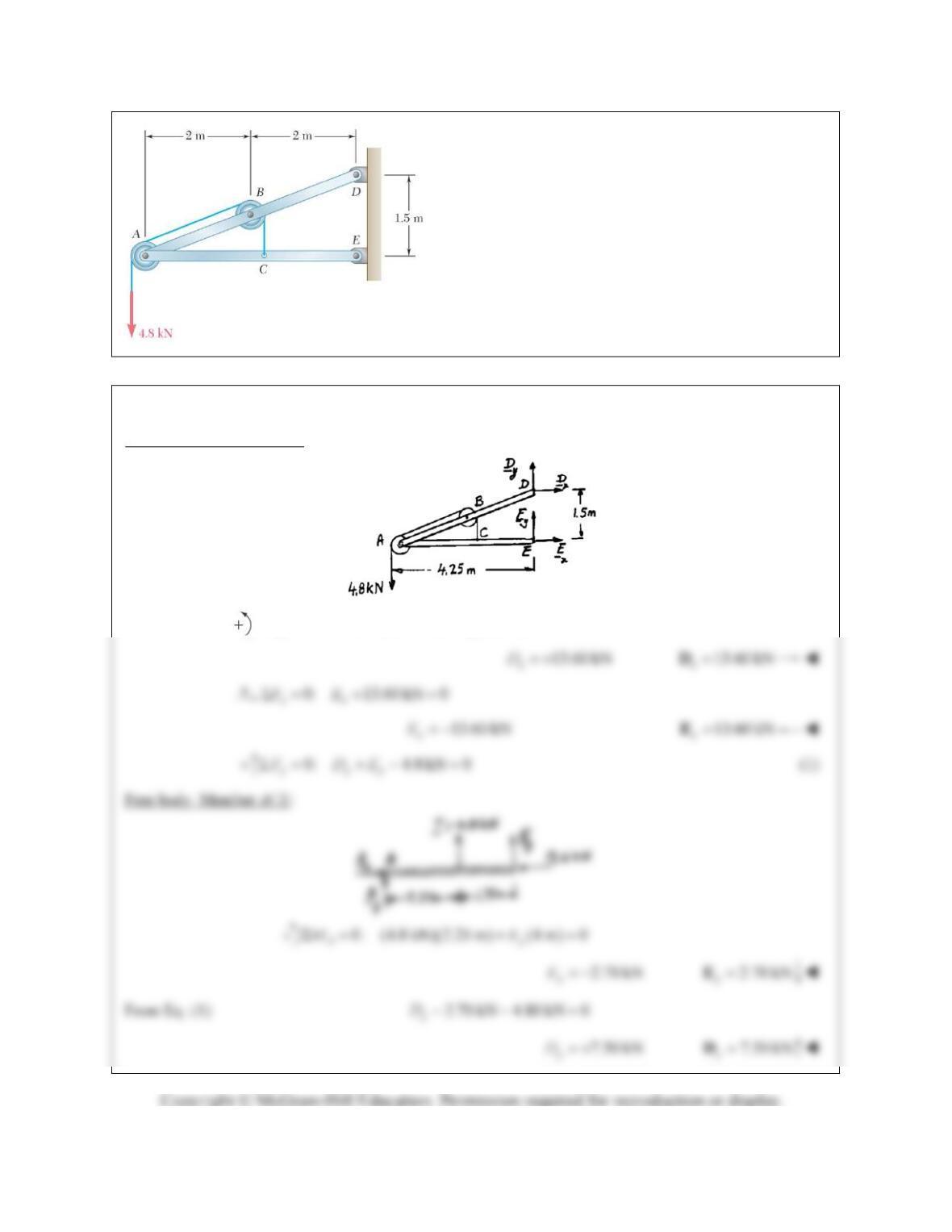
PROBLEM 6.91
Knowing that each pulley has a radius of 250 mm,
determine the components of the reactions at D and E.
SOLUTION
Free body: Entire assembly:
0: (4.8 kN)(4.25 m) (1.5 m) 0
Ex
MD
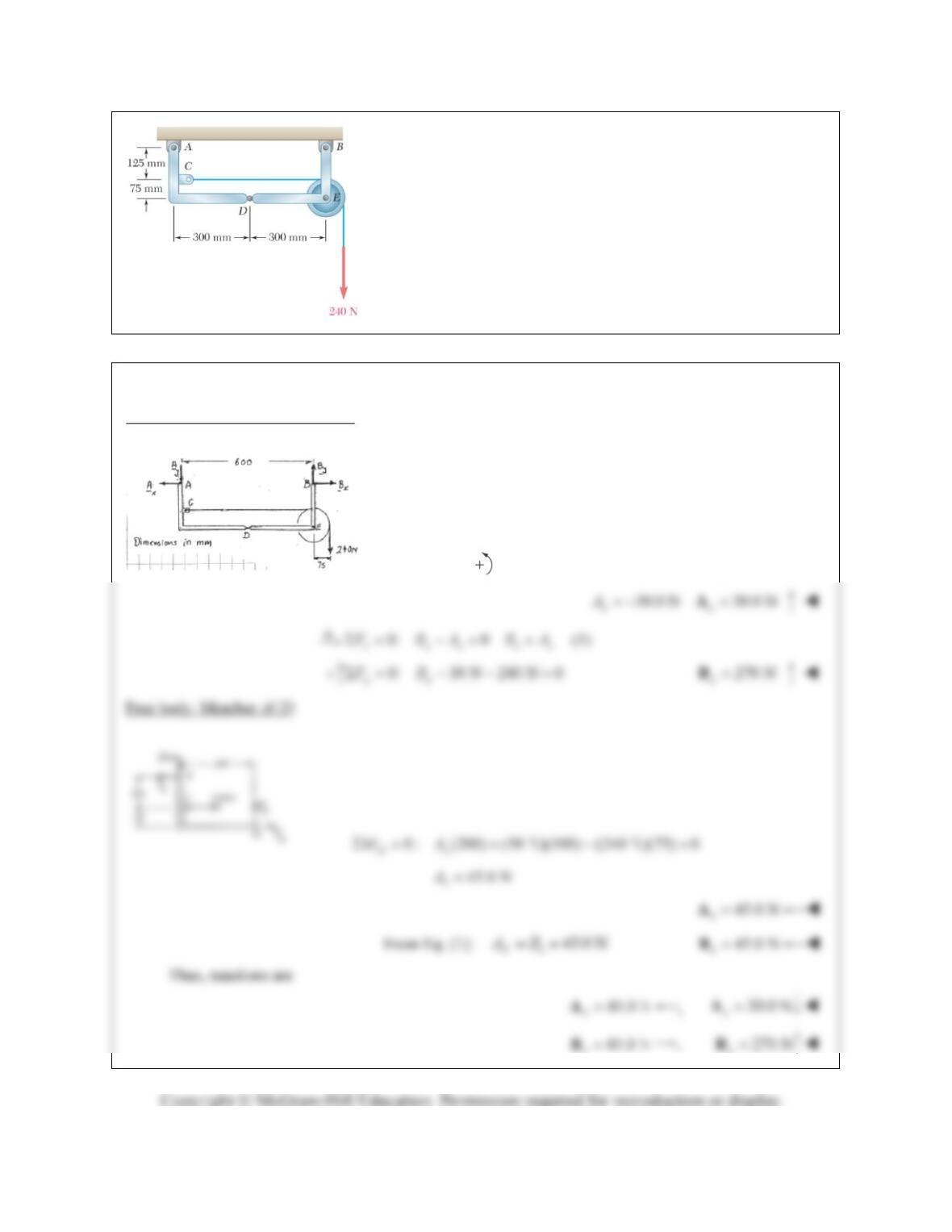
PROBLEM 6.92
Knowing that the pulley has a radius of 75 mm, determine the
components of the reactions at A and B.
SOLUTION
Free body: Entire frame and pulley:
0: (240 N)(75 mm) (600 mm) 0
By
MA
x
y
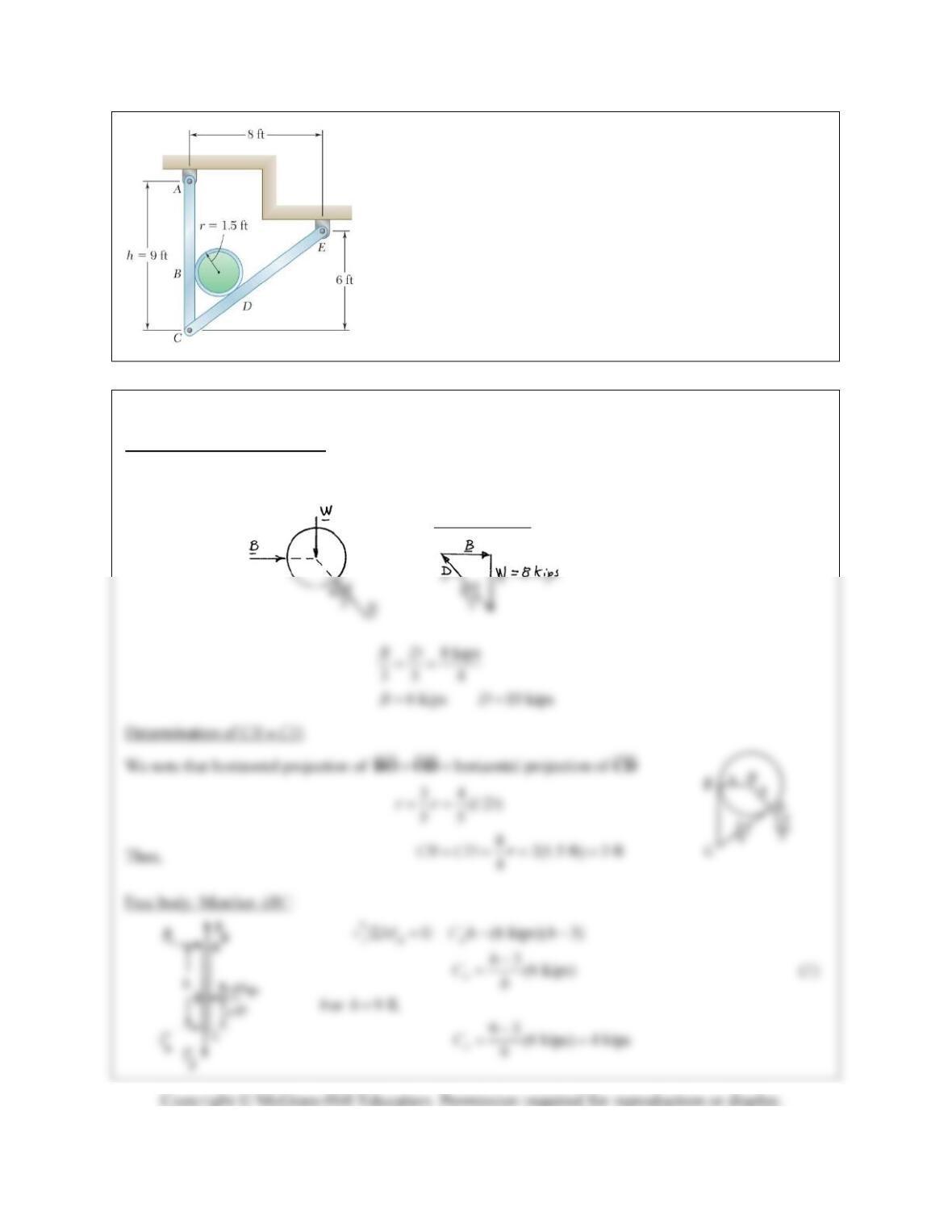
PROBLEM 6.93
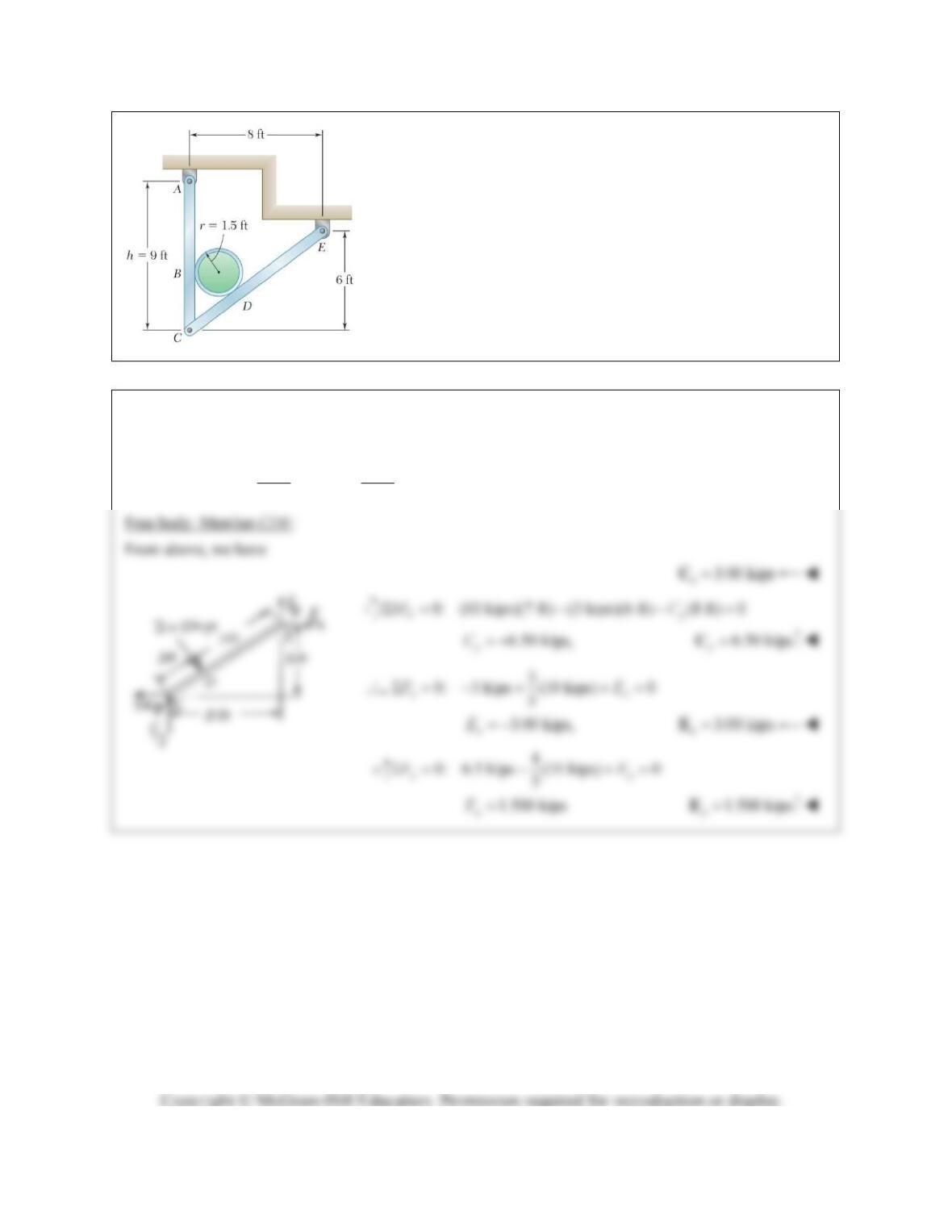
A 3-ft-diameter pipe is supported every 16 ft by a small frame like
that shown. Knowing that the combined weight of the pipe and its
contents is 500 lb/ft and assuming frictionless surfaces, determine
the components (a) of the reaction at E, (b) of the force exerted at C
on member CDE.
SOLUTION
Free body: 16-ft length of pipe:
(500 lb/ft)(16 ft) 8 kipsW
Force Triangle
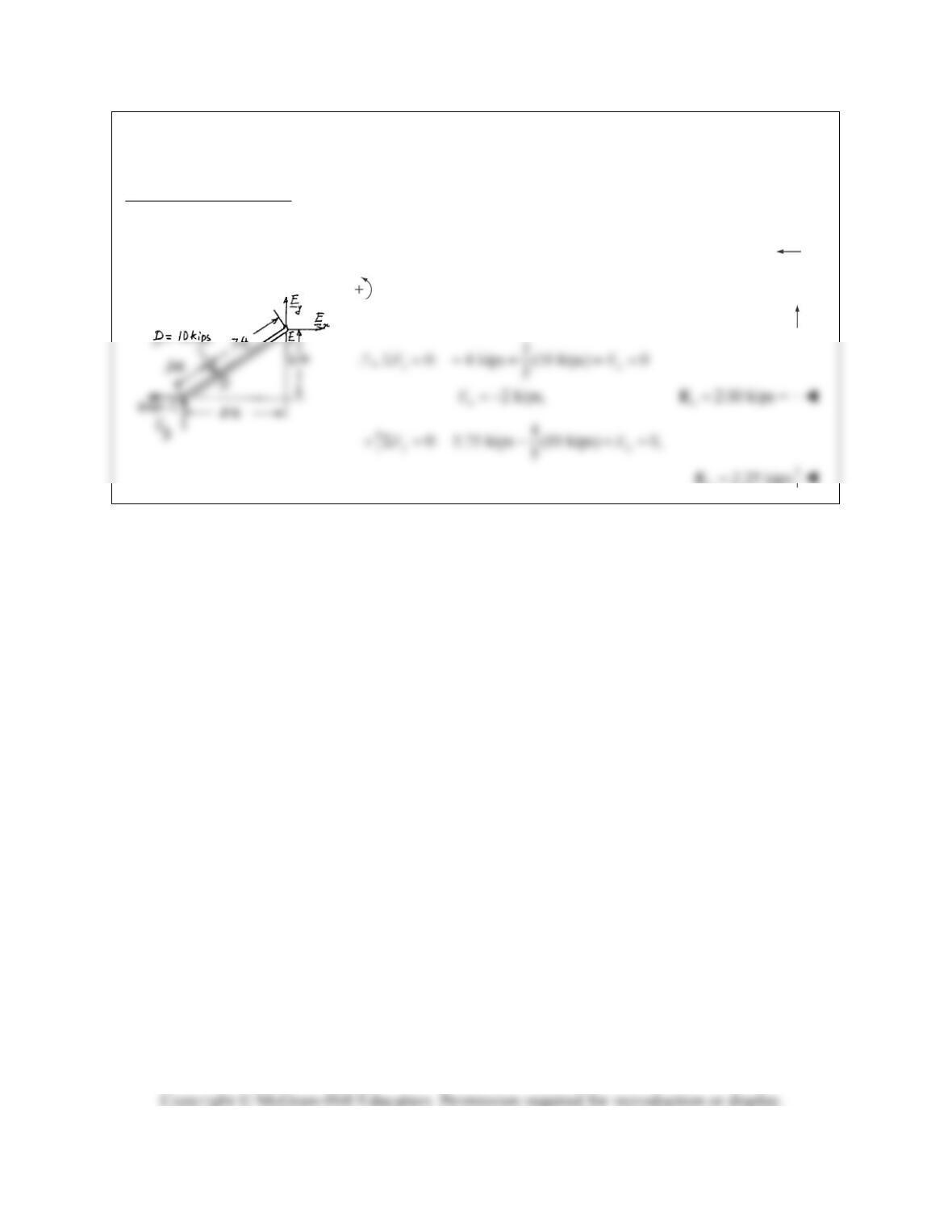
PROBLEM 6.93 (Continued)
Free body: Member CDE:
From above, we have
4.00 kips
x
C
0: (10 kips)(7 ft) (4 kips)(6 ft) (8 ft) 0
Ey
MC
5.75 kips,
y
C
5.75 kips
y
C
y
PROBLEM 6.94
Solve Problem 6.93 for a frame where h 6 ft.
PROBLEM 6.93
A 3-ft-diameter pipe is supported every 16 ft by
a small frame like that shown. Knowing that the combined weight
of the pipe and its contents is 500 lb/ft and assuming frictionless
surfaces, determine the components (a) of the reaction at E, (b) of
the force exerted at C on member CDE.
SOLUTION
See solution of Problem 6.91 for derivation of Eq. (1).
For
363
6 ft, C (6 kips) 3 kips
6
x
h
hh
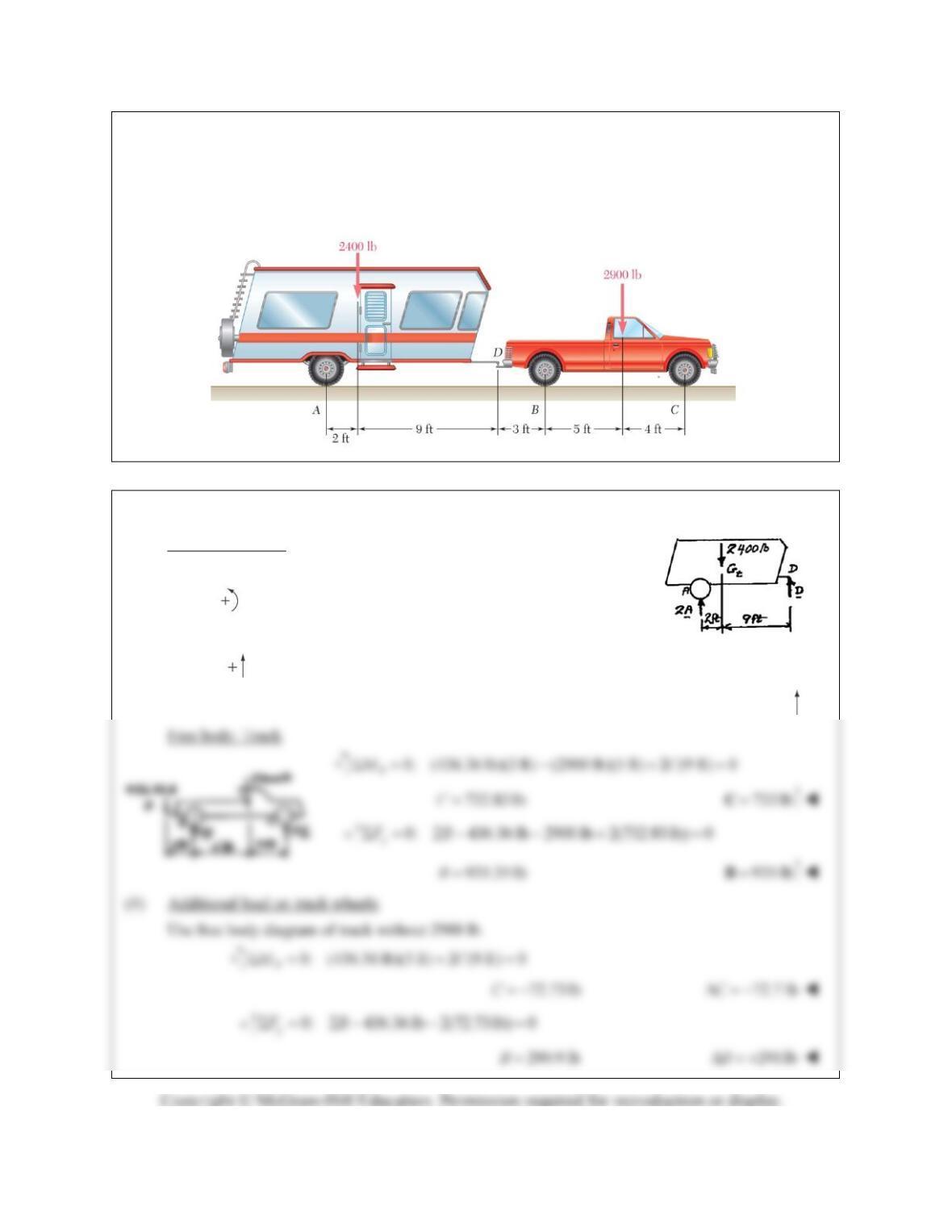
PROBLEM 6.95
A trailer weighing 2400 lb is attached to a 2900-lb pickup truck by a ball-and-socket truck hitch at D.
Determine (a) the reactions at each of the six wheels when the truck and trailer are at rest, (b) the
additional load on each of the truck wheels due to the trailer.
SOLUTION
(a) Free body: Trailer:
(We shall denote by A, B, C the reaction at one wheel.)
0: (2400 lb)(2 ft) (11 ft) 0
A
MD
436.36 lbD
0: 2 2400 lb 436.36 lb 0
y
FA
981.82 lbA
982 lbA
PROBLEM 6.96
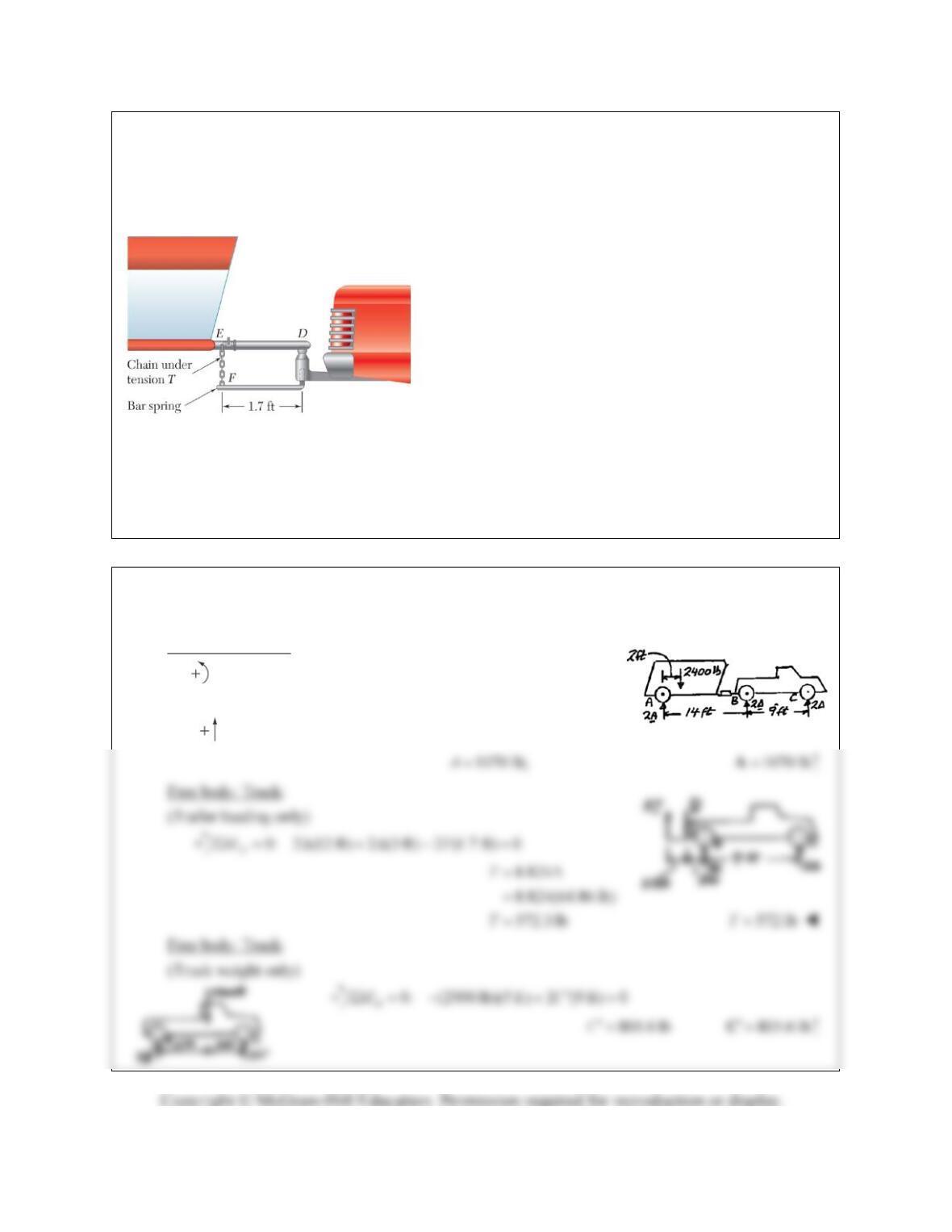
In order to obtain a better weight distribution over the
four wheels of the pickup truck of Problem 6.95, a
compensating hitch of the type shown is used to attach
the trailer to the truck. The hitch consists of two bar
springs (only one is shown in the figure) that fit into
bearings inside a support rigidly attached to the truck.
The springs are also connected by chains to the trailer
frame, and specially designed hooks make it possible to
place both chains in tension. (a) Determine the tension T
required in each of the two chains if the additional load
due to the trailer is to be evenly distributed over the four
wheels of the truck. (b) What are the resulting reactions at
each of the six wheels of the trailer-truck combination?
PROBLEM 6.95
A trailer weighing 2400 lb is attached
to a 2900-lb pickup truck by a ball-and-socket truck hitch
at D. Determine (a) the reactions at each of the six wheels
when the truck and trailer are at rest, (b) the additional
load on each of the truck wheels due to the trailer.
SOLUTION
(a) We small first find the additional reaction
at each wheel due to the trailer.
Free body diagram: (Same
at each truck wheel)
0: (2400 lb)(2 ft) 2 (14 ft) 2 (23 ft) 0
A
M
64.86 lb
0: 2 2400 lb 4(64.86 lb) 0;
y
FA
PROBLEM 6.96 (Continued)
0: 2 2900 lb 2(805.6 lb) 0
y
FB
644.4 lbB
644.4 lb
B
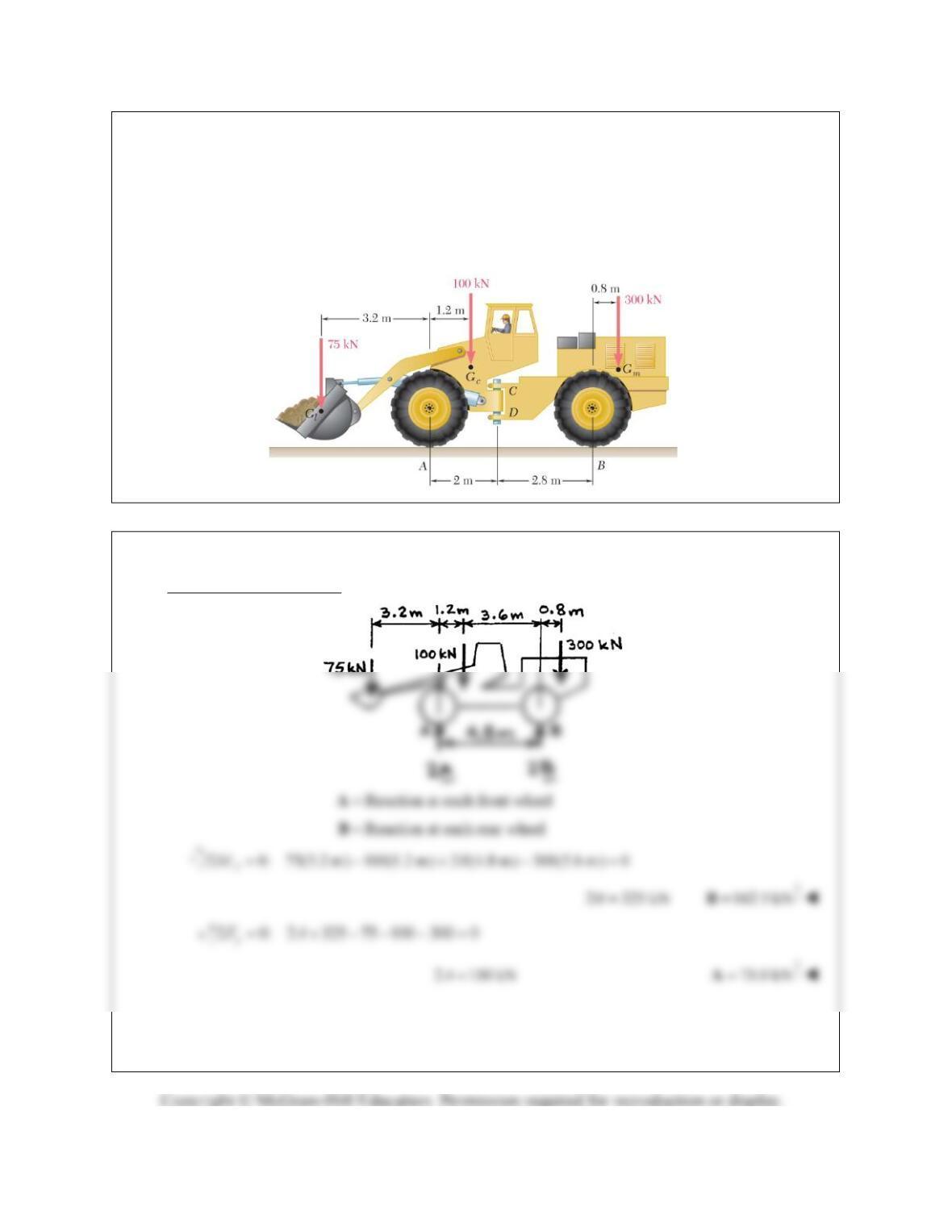
Actual reactions:
PROBLEM 6.97
The cab and motor units of the front-end loader shown are connected by a vertical pin located 2 m behind
the cab wheels. The distance from C to D is 1 m. The center of gravity of the 300-kN motor unit is
located at G
m
, while the centers of gravity of the 100-kN cab and 75-kN load are located, respectively, at
G
c
and G
l
. Knowing that the machine is at rest with its brakes released, determine (a) the reactions at each
of the four wheels, (b) the forces exerted on the motor unit at C and D.
SOLUTION
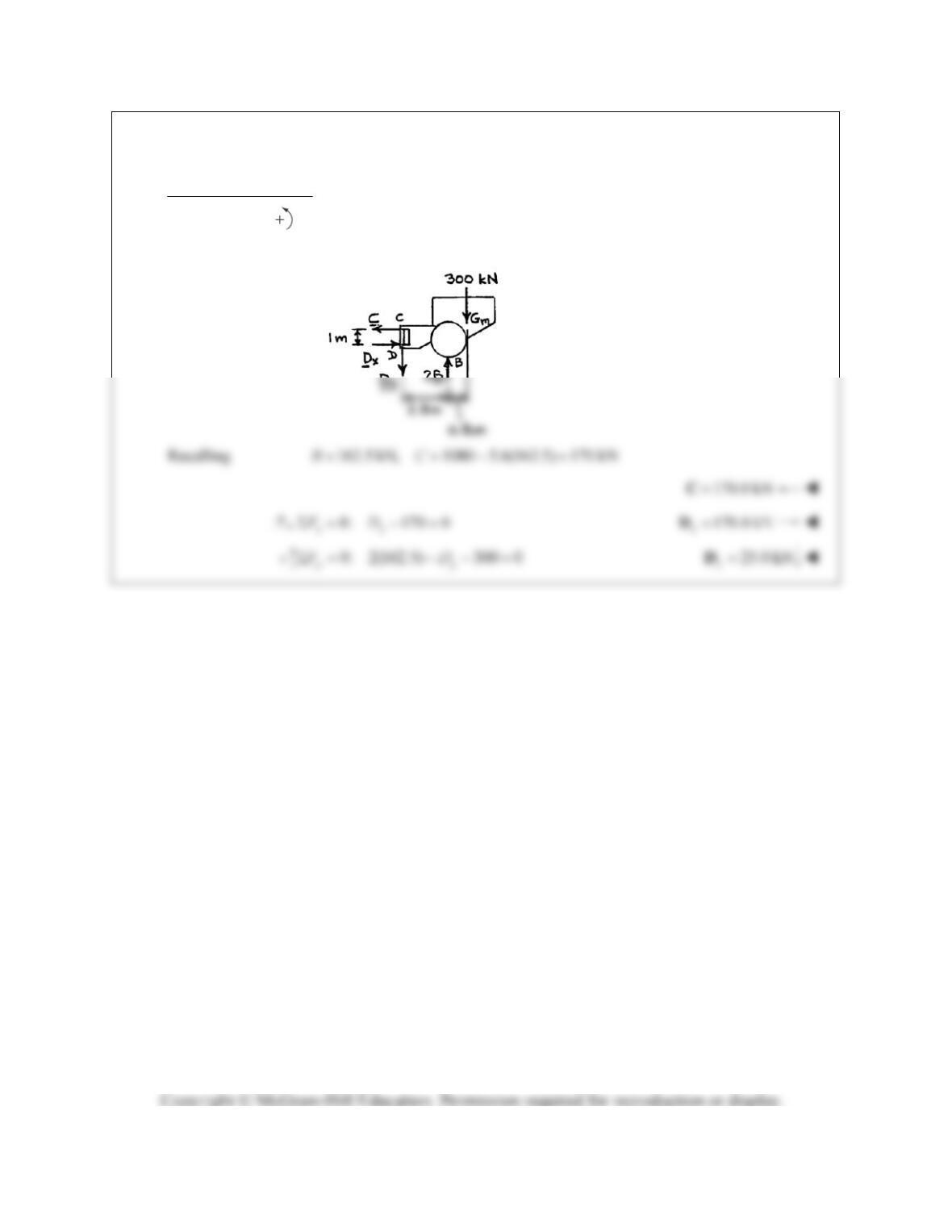
(a) Free body: Entire machine:
PROBLEM 6.97 (Continued)
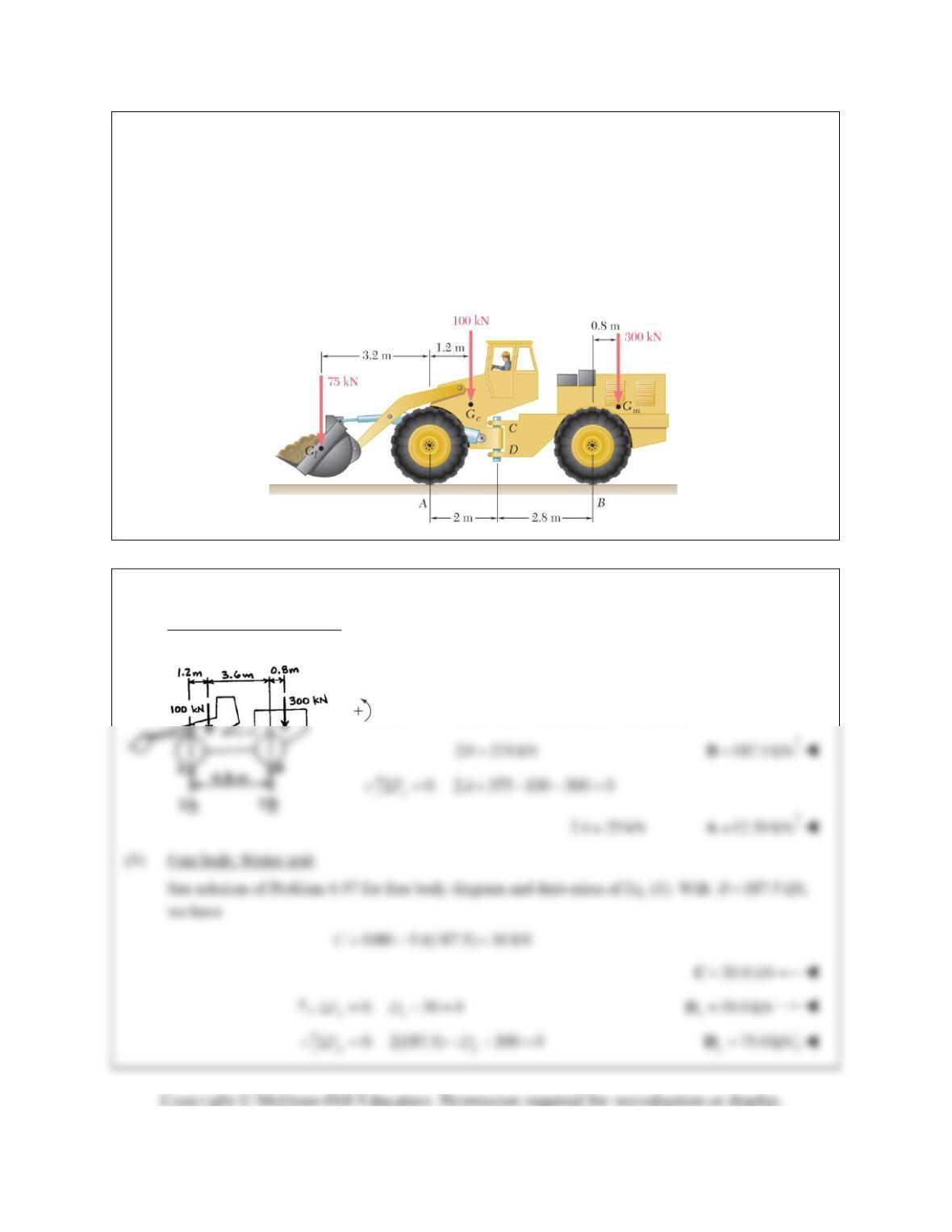
(b) Free body: Motor unit:
0: (1 m) 2 (2.8 m) 300(3.6 m) 0
D
MC B
1080 5.6CB (1)
PROBLEM 6.98
Solve Problem 6.97 assuming that the 75-kN load has been removed.
PROBLEM 6.97
The cab and motor units of the front-end loader shown are connected by a vertical pin
located 2 m behind the cab wheels. The distance from C to D is 1 m. The center of gravity of the 300-kN
motor unit is located at G
m
, while the centers of gravity of the 100-kN cab and 75-kN load are located,
respectively, at G
c
and G
l
. Knowing that the machine is at rest with its brakes released, determine (a) the
reactions at each of the four wheels, (b) the forces exerted on the motor unit at C and D.
SOLUTION
(a) Free body: Entire machine:
A
Reaction at each front wheel
B
Reaction at each rear wheel
0: 2 (4.8 m) 100(1.2 m) 300(5.6 m) 0
A
MB
PROBLEM 6.99
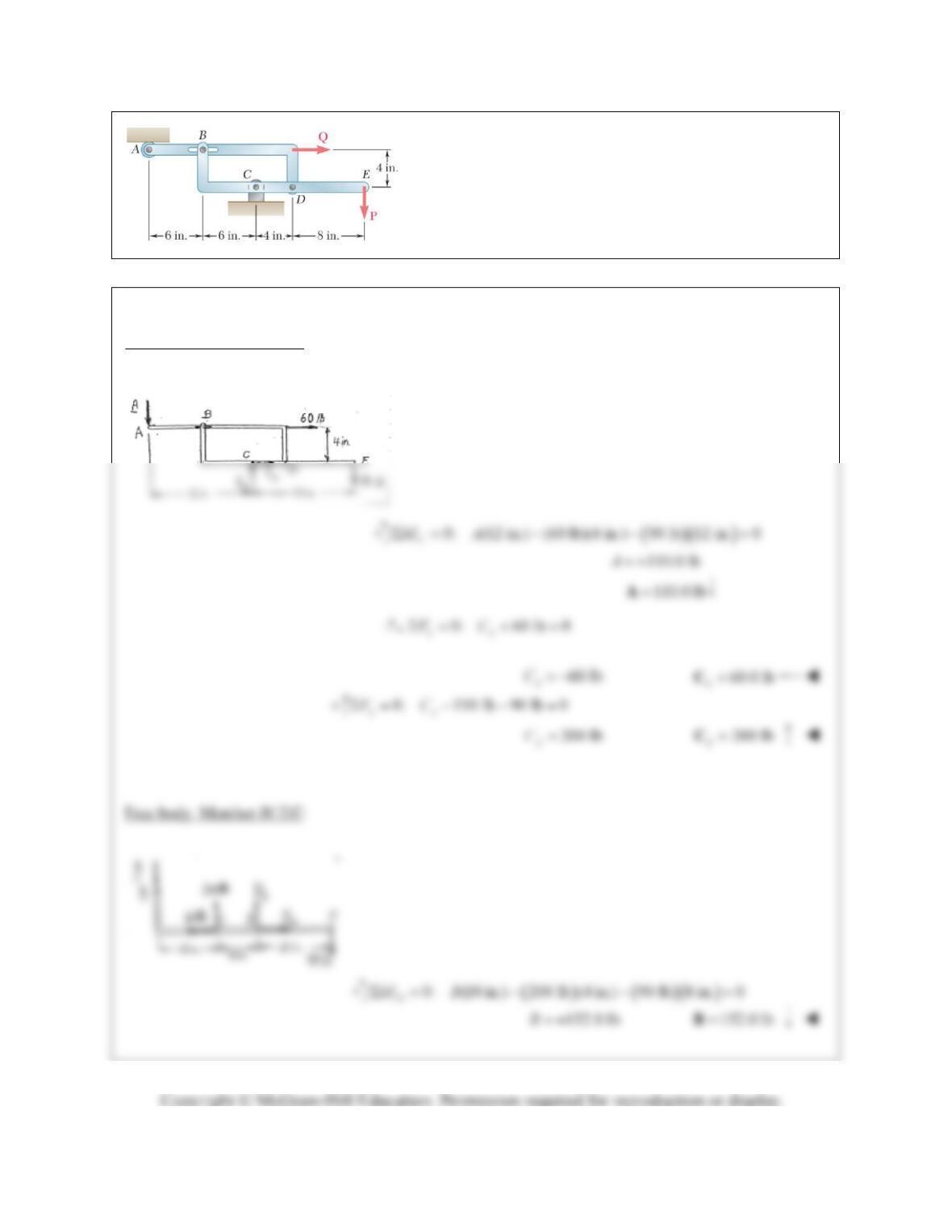
Knowing that P = 90 lb and Q = 60 lb, determine the
components of all forces acting on member BCDE of the
assembly shown.
SOLUTION
Free body: Entire assembly:
PROBLEM 6.99 (Continued)
0: 60 lb 0
xx
FD
60.0 lb
x
D 60.0 lb
D
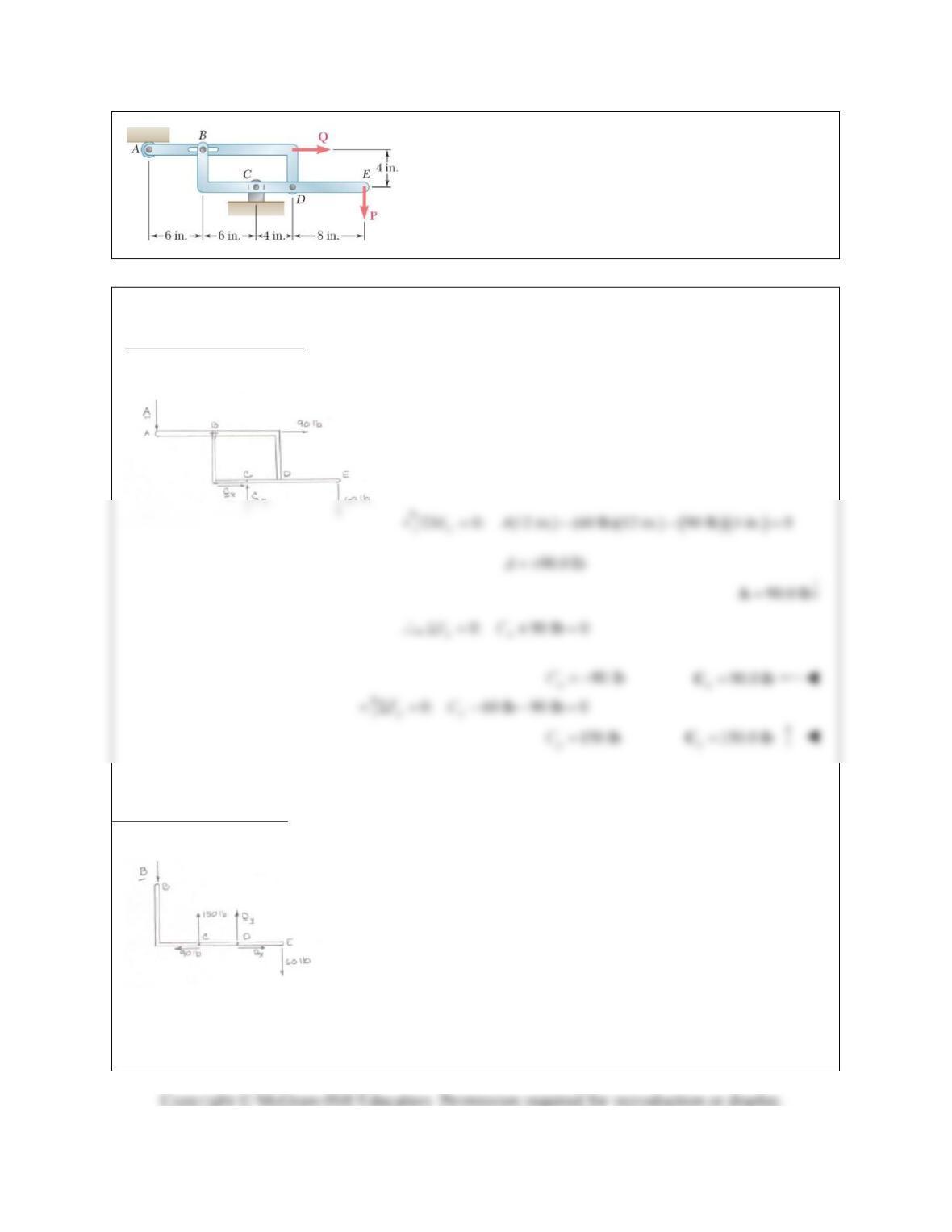
PROBLEM 6.100
Knowing that P = 60 lb and Q = 90 lb, determine the
components of all forces acting on member BCDE of the
assembly shown.
SOLUTION
Free body: Entire assembly:
Free body: Member BCDE:
PROBLEM 6.100 (Continued)
0: (10 in.) 150 lb (4 in.) 60 lb 8 in. 0
D
MB
108.0 lbB
108.0 lbB
PROBLEM 6.101
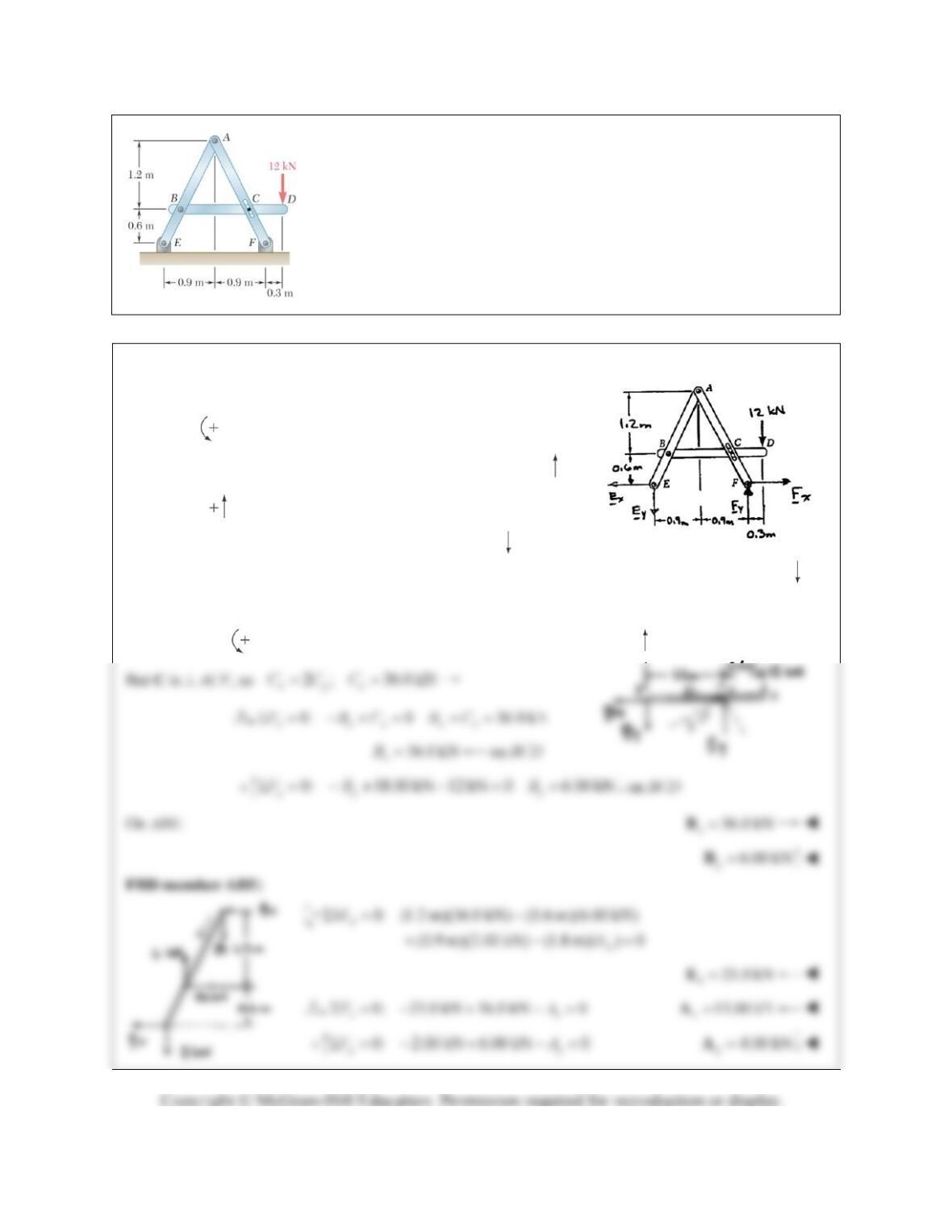
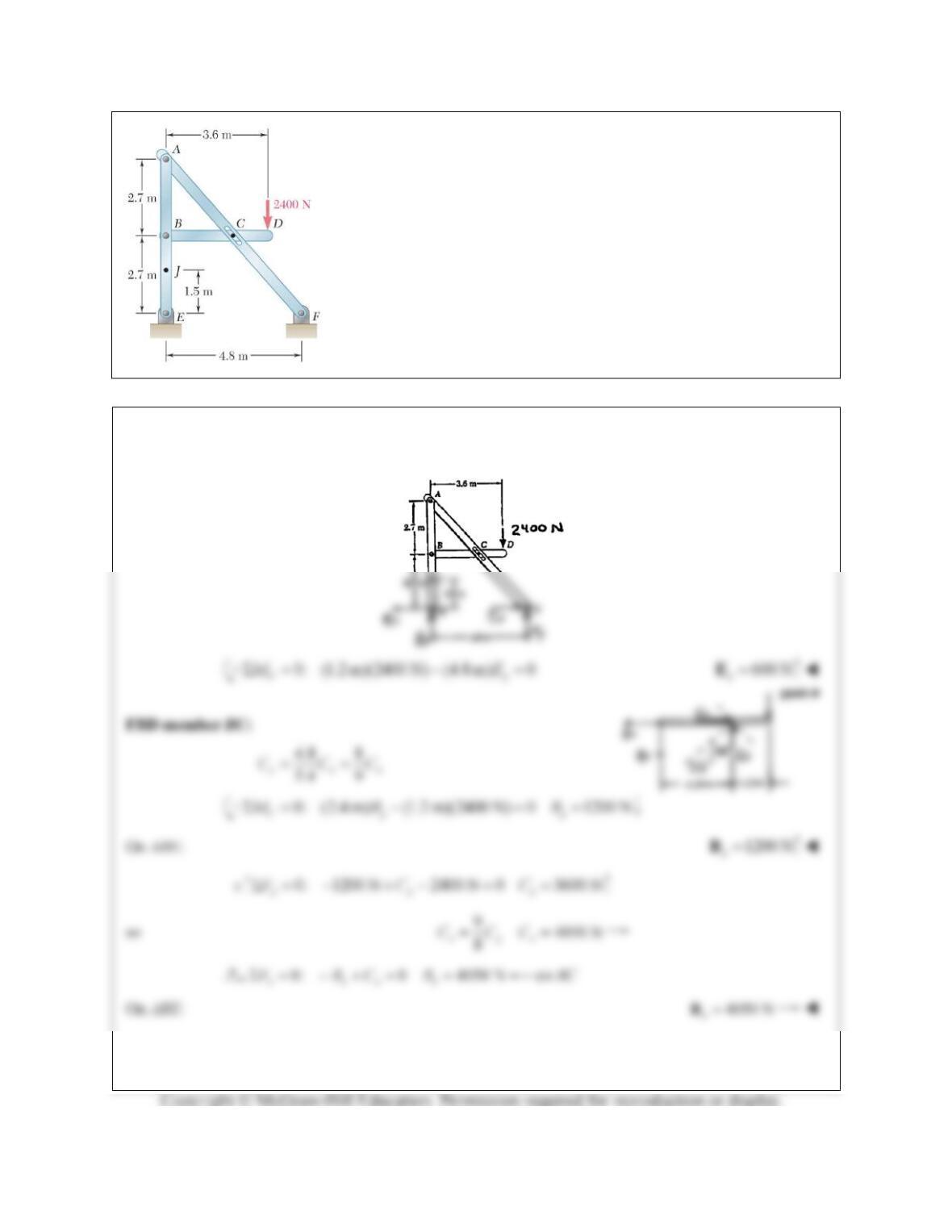
For the frame and loading shown, determine the components of all forces
acting on member ABE.
SOLUTION
FBD Frame:
0: (1.8 m) (2.1 m)(12 kN) 0
Ey
MF
14.00 kN
y
F
0: 14.00 kN 12 kN 0
yy
FE
2kN
y
E
2.00 kN
y
E
FBD member
BCD
:
0: (1.2 m) (12 kN)(1.8 m) 0 18.00 kN
By y
MC C
PROBLEM 6.102
For the frame and loading shown, determine the components of all
forces acting on member ABE.
SOLUTION
FBD Frame:
PROBLEM 6.102 (Continued)
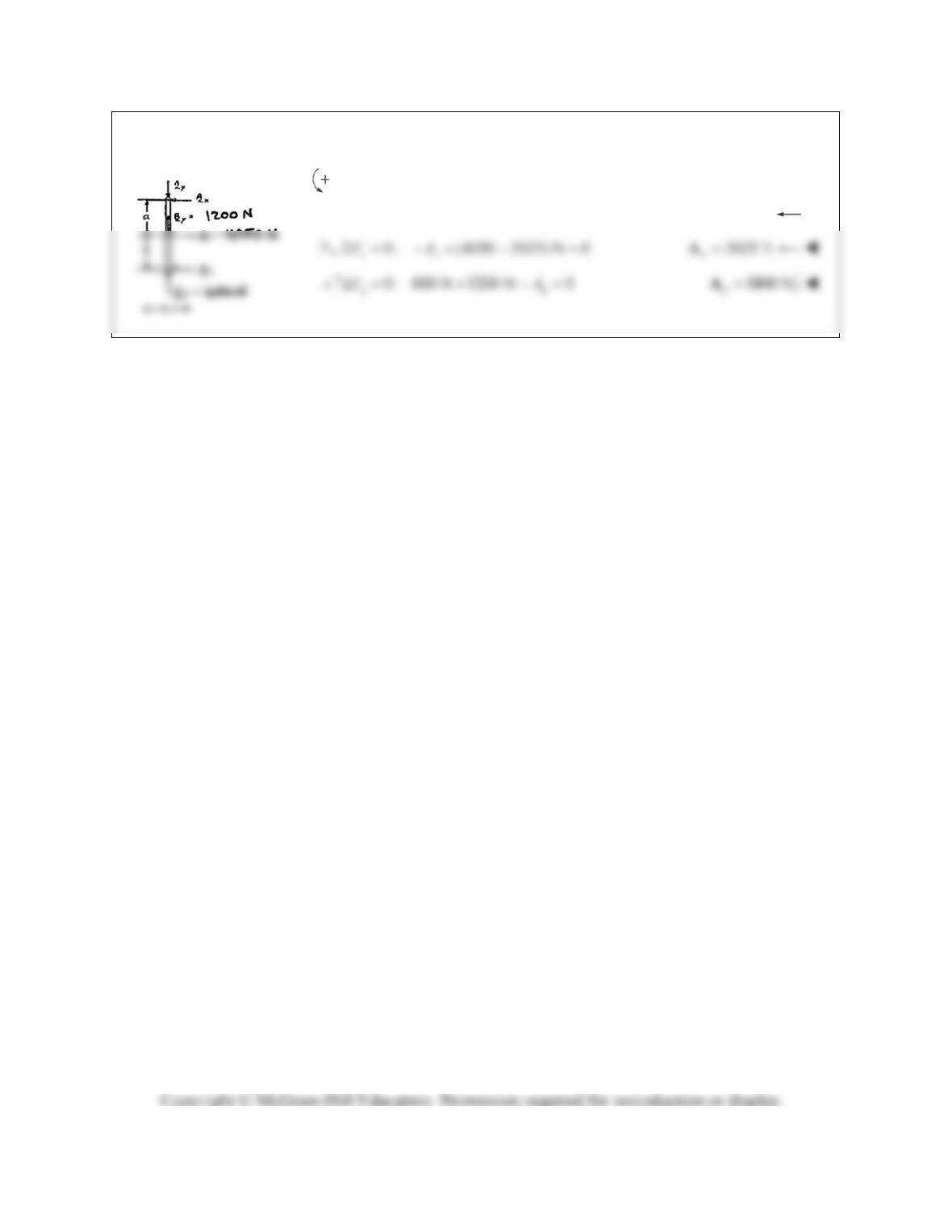
FBD member
AB0E
:
0: (4050 N) 2 0
Ax
Ma aE
2025 N
x
E
2025 N
x
E
PROBLEM 6.103
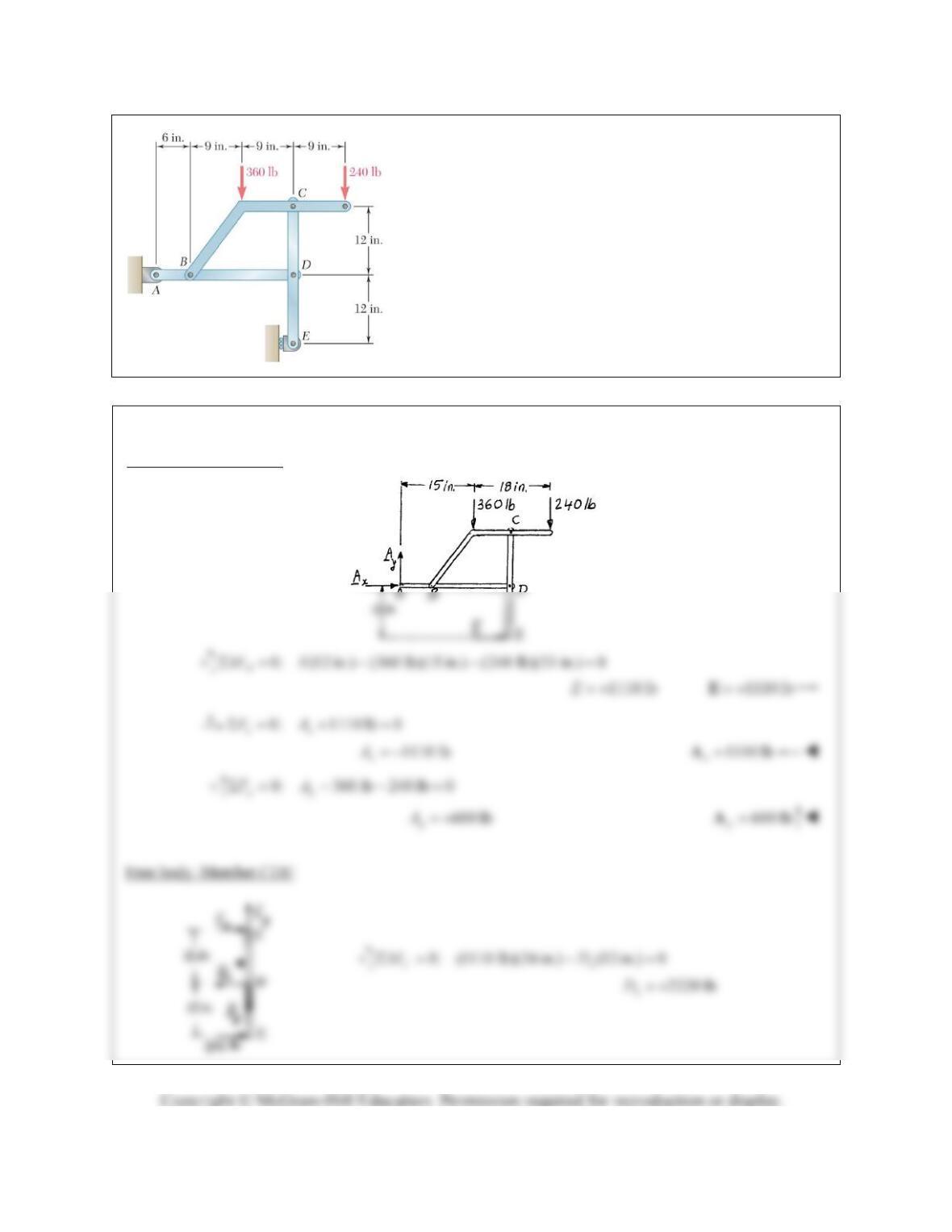
For the frame and loading shown, determine the components of
all forces acting on member ABD.
SOLUTION
Free body: Entire frame:
PROBLEM 6.103 (Continued)
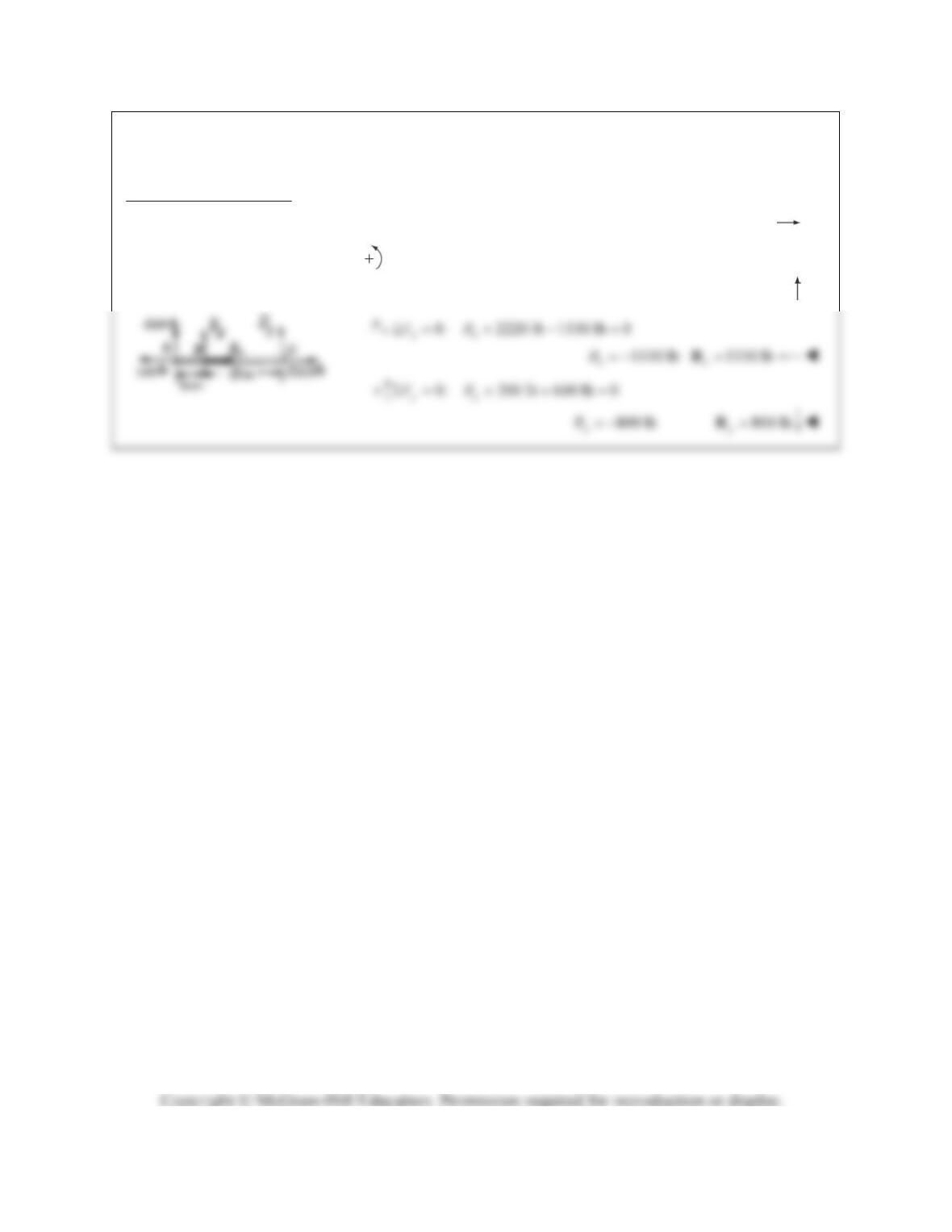
Free body: Member ABD:
From above:
2220 lb
x
D
0: (18 in.) (600 lb)(6 in.) 0
By
MD
200 lb
y
D
200 lb
y
D