P6-28A, cont.
Requirement 2
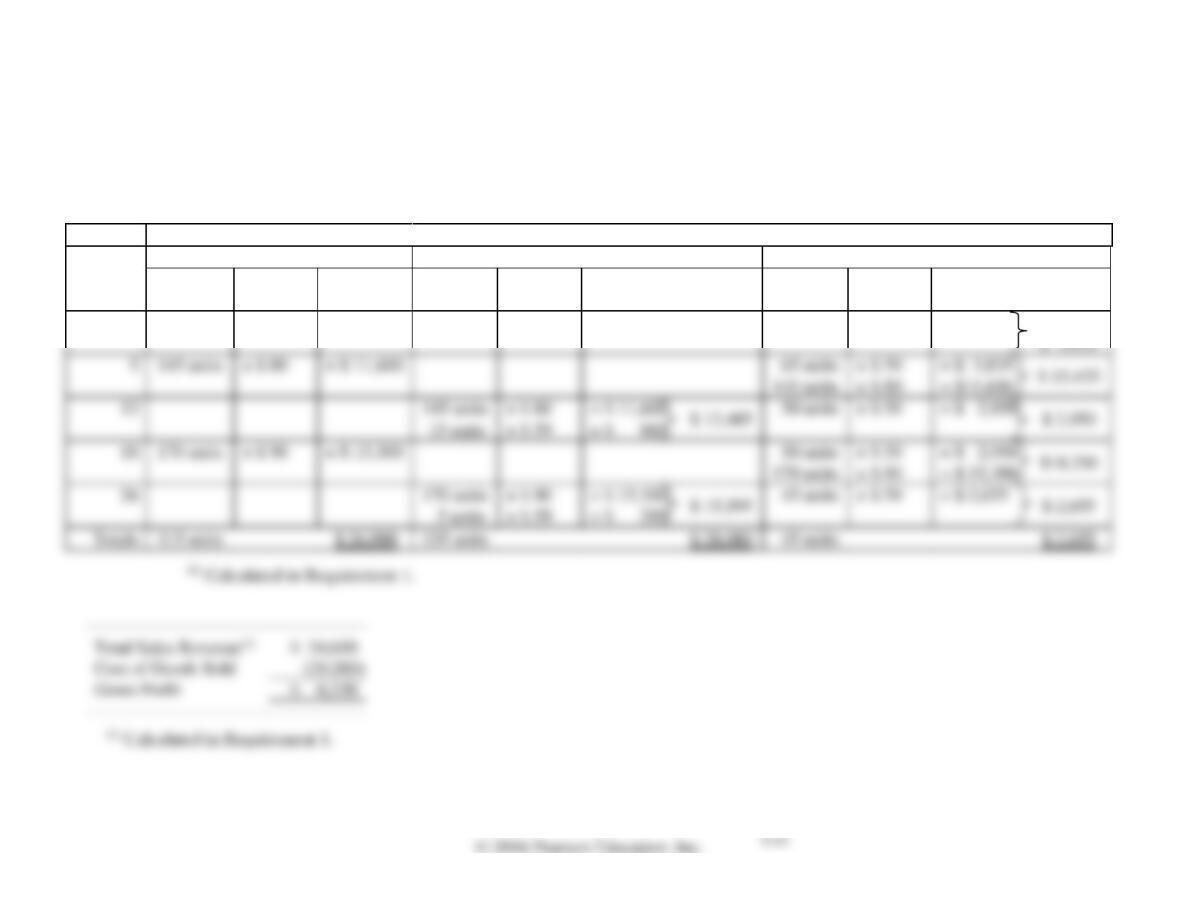
Using LIFO, cost of goods sold is $28,080, ending merchandise inventory is $2,655, and gross profit is $6,530.
Perpetual Inventory Record: LIFO
Purchases
Cost of Goods Sold
Inventory on Hand
Date
Quantity
Unit
Cost
Total Cost
Quantity
Unit
Cost
Total Cost
Quantity
Unit
Cost
Total Cost
Jan. 1
65 units
× $ 59 (b)
= $ 3,835
145 units
× $ 80
= $ 11,600
65 units
× $ 59
= $ 3,835
145 units
× $ 80
145 units
× $ 80
= $ 11,600
50 units
× $ 59
= $ 2,950
15 units
× $ 59
170 units
× $ 90
= $ 15,300
50 units
× $ 59
= $ 2,950
170 units
× $ 90
= $ 15,300
45 units
× $ 59
= $ 2,655
5 units
= $ 295
315 units
$ 26,900
335 units
$ 28,080
45 units
Gross Profit
6-62
P6-28A, cont.
Requirement 3
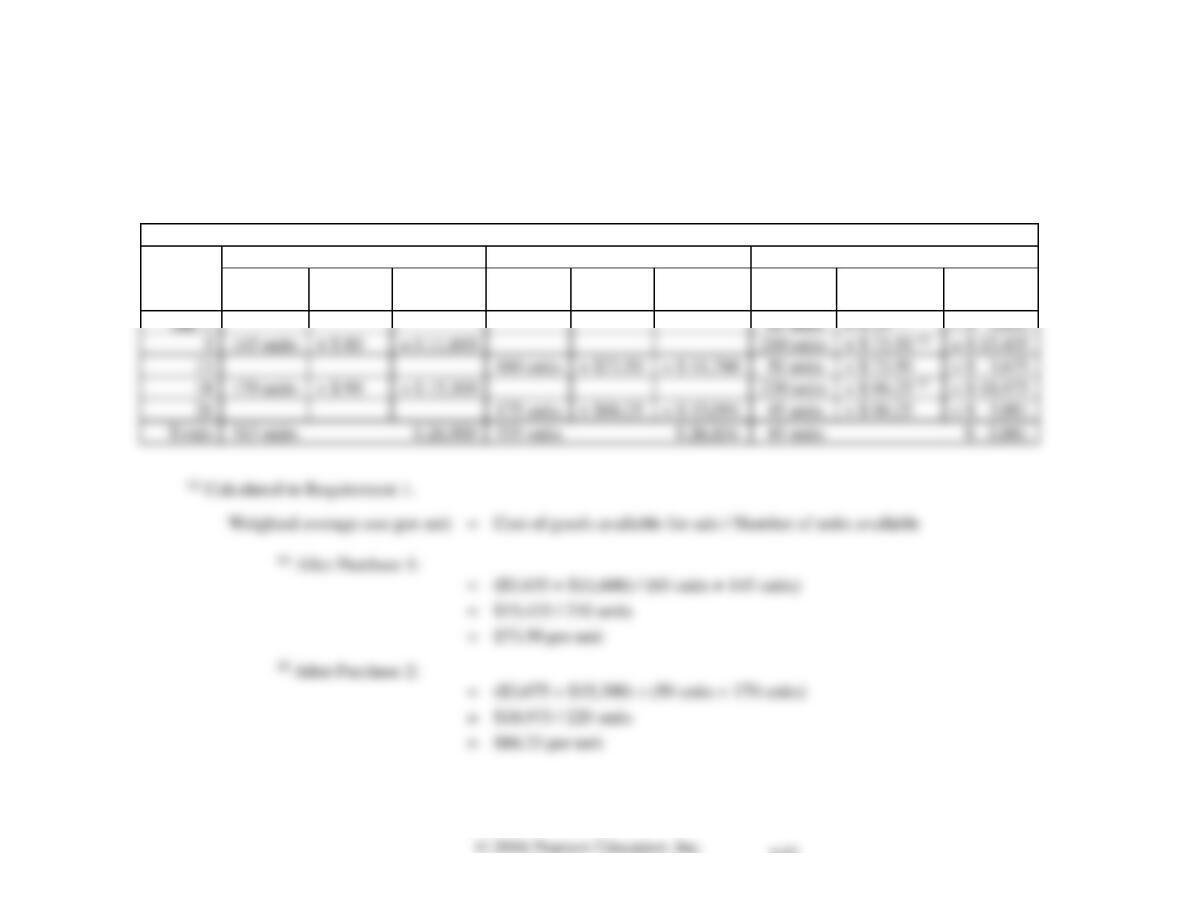
Using weighted-average, cost of goods sold is $26,854, ending merchandise inventory is $3,881, and gross profit is $7,756.
Perpetual Inventory Record: Weighted-Average
Purchases
Cost of Goods Sold
Inventory on Hand
Date
Quantity
Unit
Cost
Total Cost
Quantity
Unit
Cost
Total Cost
Quantity
Unit
Cost
Total Cost
65 units
= $ 3,835
145 units
× $ 80
= $ 11,600
210 units
= $ 15,435
160 units
× $73.50
= $ 11,760
50 units
× $ 73.50
= $ 3,675
170 units
× $ 90
= $ 15,300
220 units
= $ 18,975
175 units
× $86.25
= $ 15,094
45 units
× $ 86.25
= $ 3,881
315 units
$ 26,900
335 units
$ 26,854
45 units
$ 3,881
=
Cost of goods available for sale / Number of units available
=
=
$15,435 / 210 units
=
$73.50 per unit
=
($3,675 + $15,300) ÷ (50 units + 170 units)
=
$18,975 / 220 units
=
$86.25 per unit
P6-28A, cont.
Requirement 3, cont.
Requirement 4
If the business wanted to pay the least amount of income taxes possible, they would choose LIFO.
P6-29A Accounting for inventory using the perpetual inventory system—FIFO, LIFO, and
weighted-average, and comparing FIFO, LIFO, and weighted-average
Learning Objectives 2, 3
5. FIFO GP $4,850
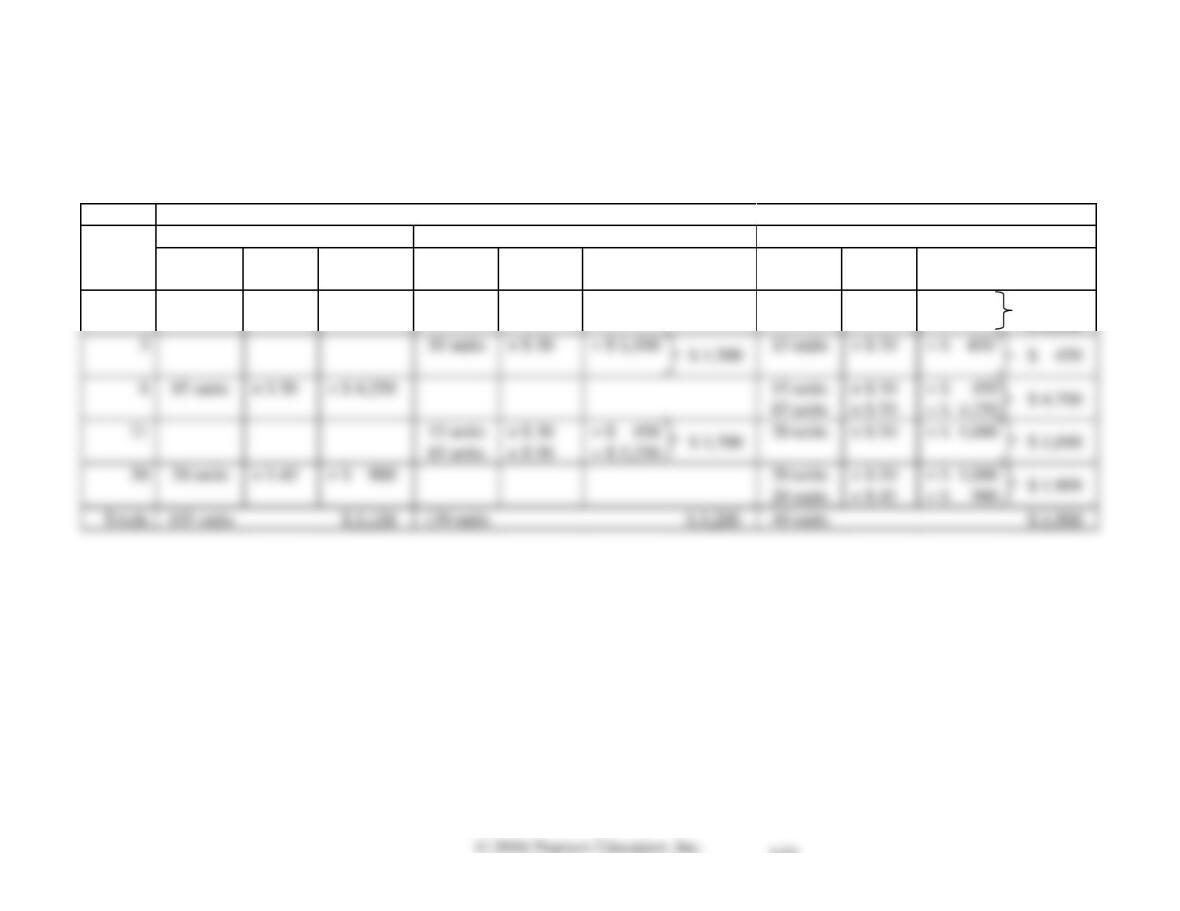
Iron Man began August with 65 units of iron inventory that cost $30 each. During
August, the company completed the following inventory transactions:
Requirements
1. Prepare a perpetual inventory record for the merchandise inventory using the FIFO inventory costing
method.
6-64
SOLUTION
Requirement 1
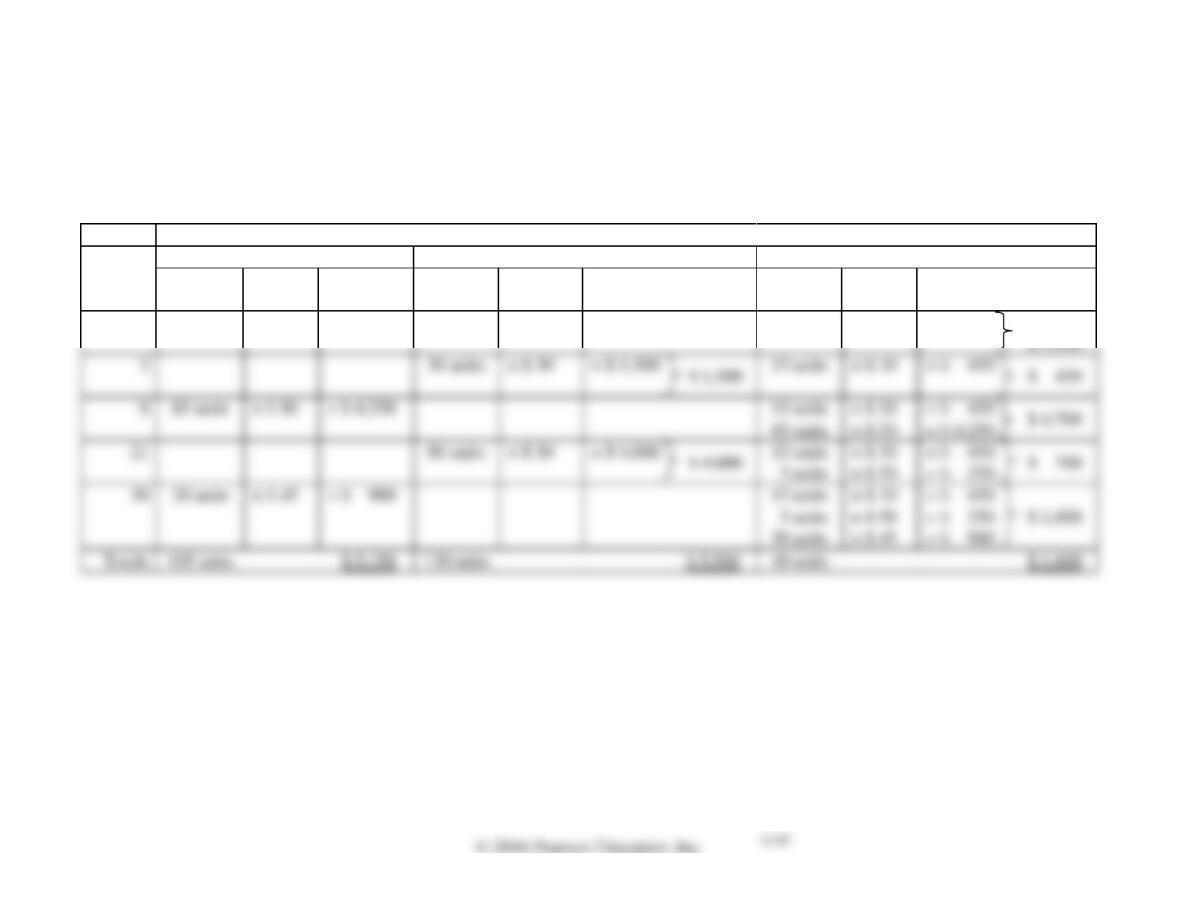
Perpetual Inventory Record: FIFO
Purchases
Cost of Goods Sold
Inventory on Hand
Date
Quantity
Unit
Cost
Total Cost
Quantity
Unit
Cost
Total Cost
Quantity
Unit
Cost
Total Cost
Aug. 1
65 units
× $ 30
= $ 1,950
$ 1,950
× $ 30
= $ 1,500
× $ 30
= $ 450
85 units
× $ 50
= $ 4,250
× $ 30
× $ 50
= $ 4,250
× $ 30
= $ 450
× $ 50
= $ 1,000
= $ 900
130 units
$ 1,900
P6-29A, cont.
Requirement 2
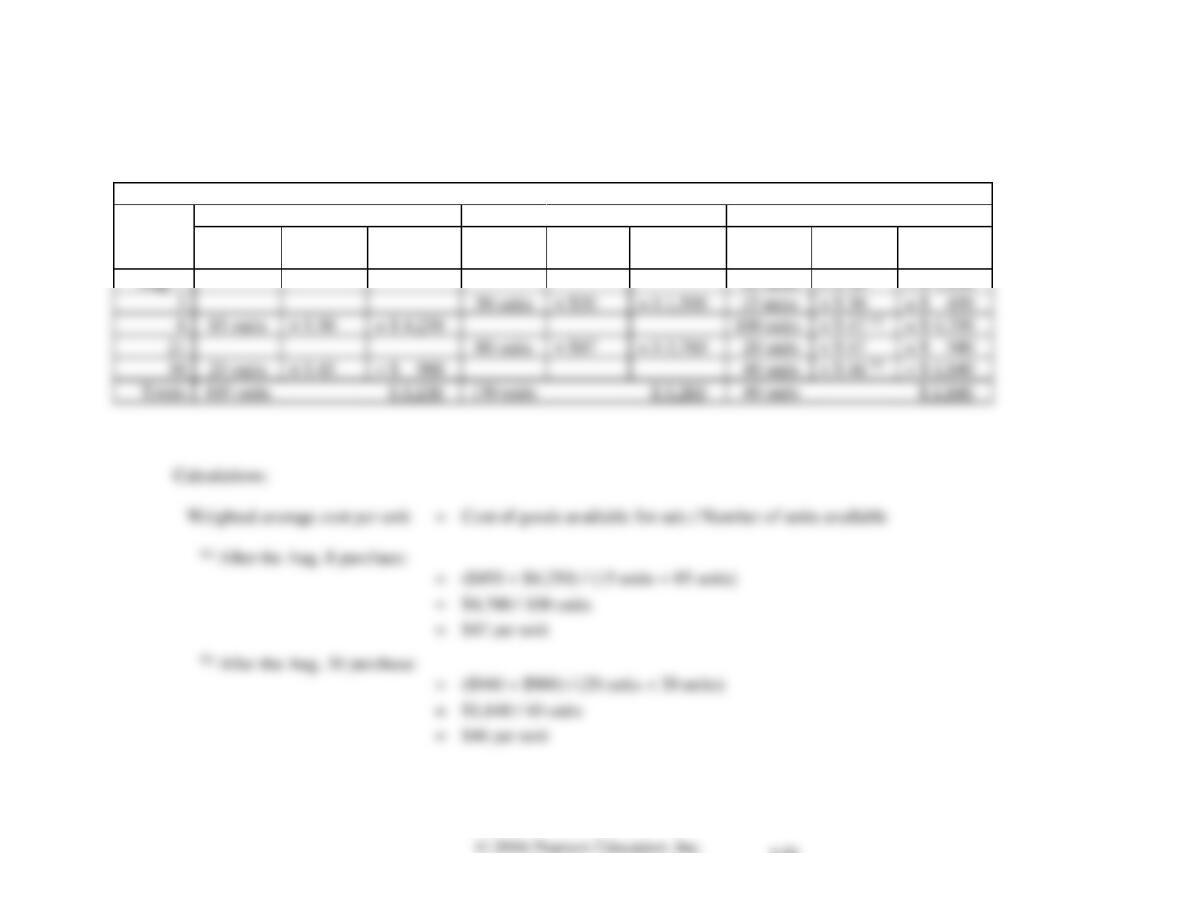
Perpetual Inventory Record: LIFO
Purchases
Cost of Goods Sold
Inventory on Hand
Date
Quantity
Unit
Cost
Total Cost
Quantity
Unit
Cost
Total Cost
Quantity
Unit
Cost
Total Cost
Aug. 1
65 units
× $ 30
= $ 1,950
× $ 30
= $ 1,500
× $ 30
= $ 450
× $ 50
= $ 4,250
× $ 30
= $ 450
= $ 4,250
21
× $ 50
= $ 4,000
× $ 30
= $ 450
30
× $ 45
= $ 900
× $ 30
= $ 450
× $ 50
= $ 250
× $ 45
= $ 900
130 units
6-66
P6-29A, cont.
Requirement 3
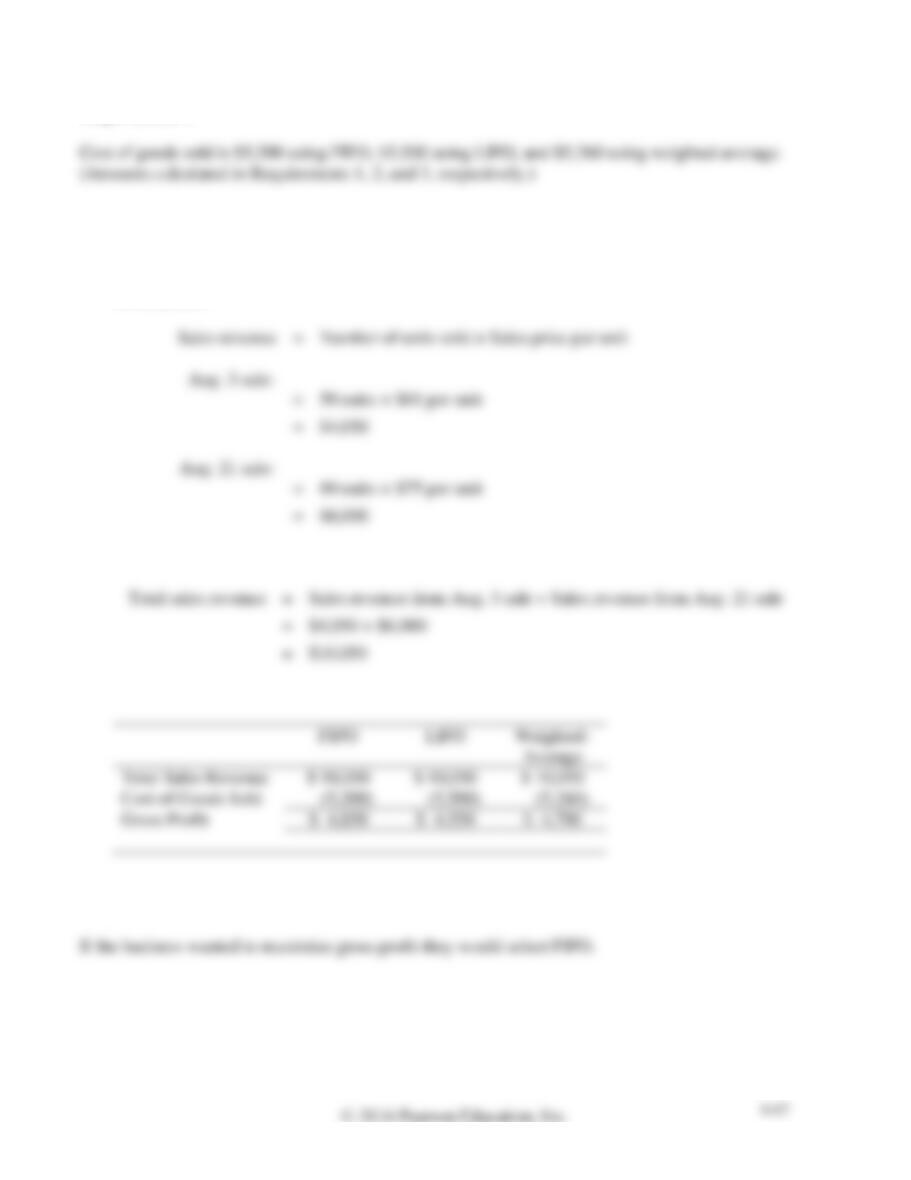
Perpetual Inventory Record: Weighted-Average
Purchases
Cost of Goods Sold
Inventory on Hand
Date
Quantity
Unit
Cost
Total Cost
Quantity
Unit
Cost
Total Cost
Quantity
Unit
Cost
Total Cost
Aug. 1
65 units
× $ 30
= $ 1,950
3
× $30
= $ 1,500
× $ 30
= $ 450
8
× $ 50
= $ 4,250
100 units
= $ 4,700
× $47
= $ 3,760
20 units
× $ 47
= $ 940
× $ 45
= $ 900
40 units
= $ 1,840
105 units
$ 5,150
130 units
$ 5,260
40 units
$ 1,840
=
Cost of goods available for sale / Number of units available
=
=
$4,700 / 100 units
=
$47 per unit
=
=
$1,840 / 40 units
=
$46 per unit
P6-29A, cont.
Requirement 4
Requirement 5
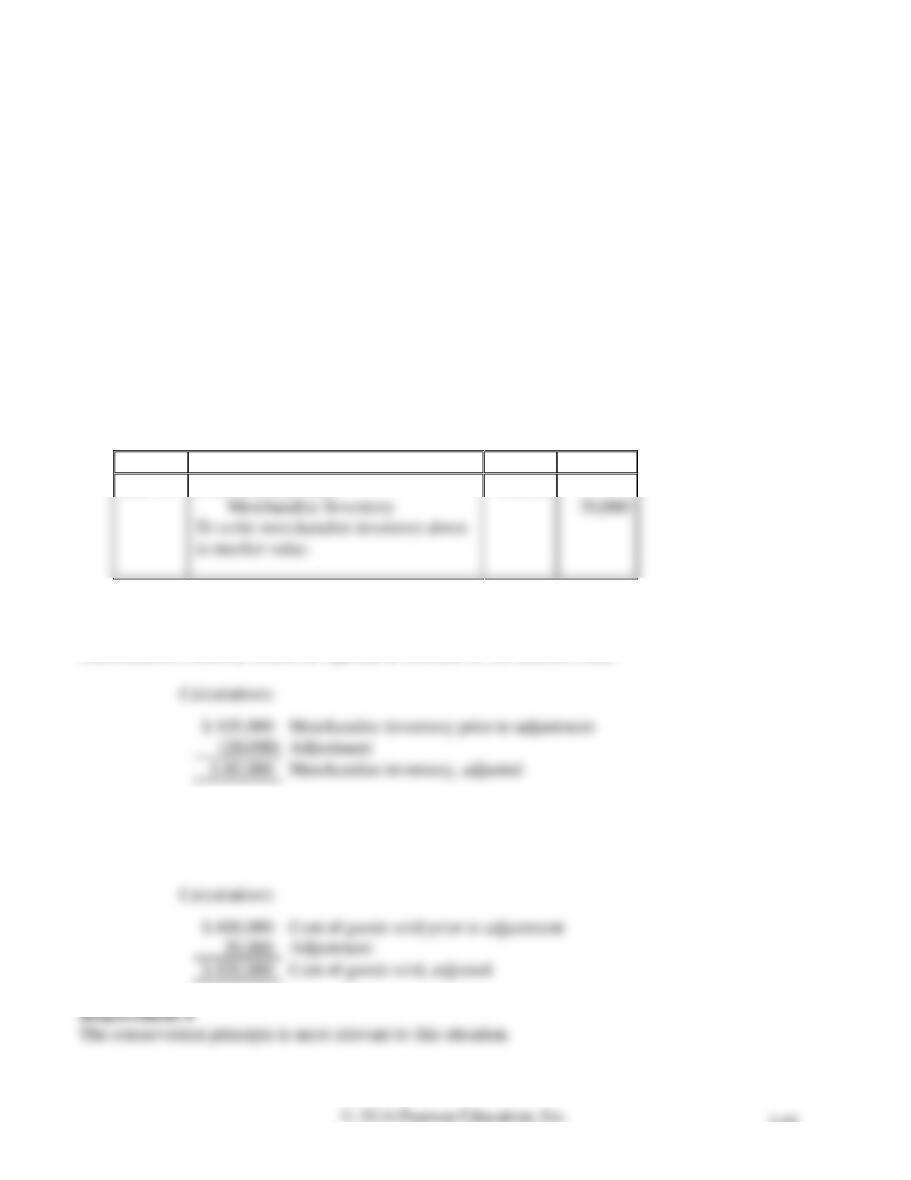
Gross profit is $4,850 using FIFO, $4,550 using LIFO, and $4,790 using weighted-average.
Calculations:
Requirement 6
6-68
P6-30A Accounting principles for inventory and applying the lower-of-cost- or-market rule
Learning Objectives 1, 4
3. CoGS $420,000
Some of E and S Electronics’s merchandise is gathering dust. It is now December 31, 2016, and the
current replacement cost of the ending merchandise inventory is $20,000 below the business’s cost of
the goods, which was $105,000. Before any adjustments at the end of the period, the company’s Cost of
Goods Sold account has a balance of $400,000.
Requirements
1. Journalize any required entries.
2. At what amount should the company report merchandise inventory on the balance sheet?
3. At what amount should the company report cost of goods sold on the income statement?
4. Which accounting principle or concept is most relevant to this situation?
SOLUTION
Requirement 1
Date
Accounts and Explanation
Debit
Credit
Dec. 31
Cost of Goods Sold
20,000
Requirement 2
Merchandise inventory should be reported at $85,000 on the balance sheet.
Requirement 3
Cost of goods sold should be reported at $420,000 on the income statement.
P6-31A Correcting inventory errors over a three-year period and computing inventory turnover
and days’ sales in inventory
Learning Objectives 5, 6
2. 2017, overstated $7,000
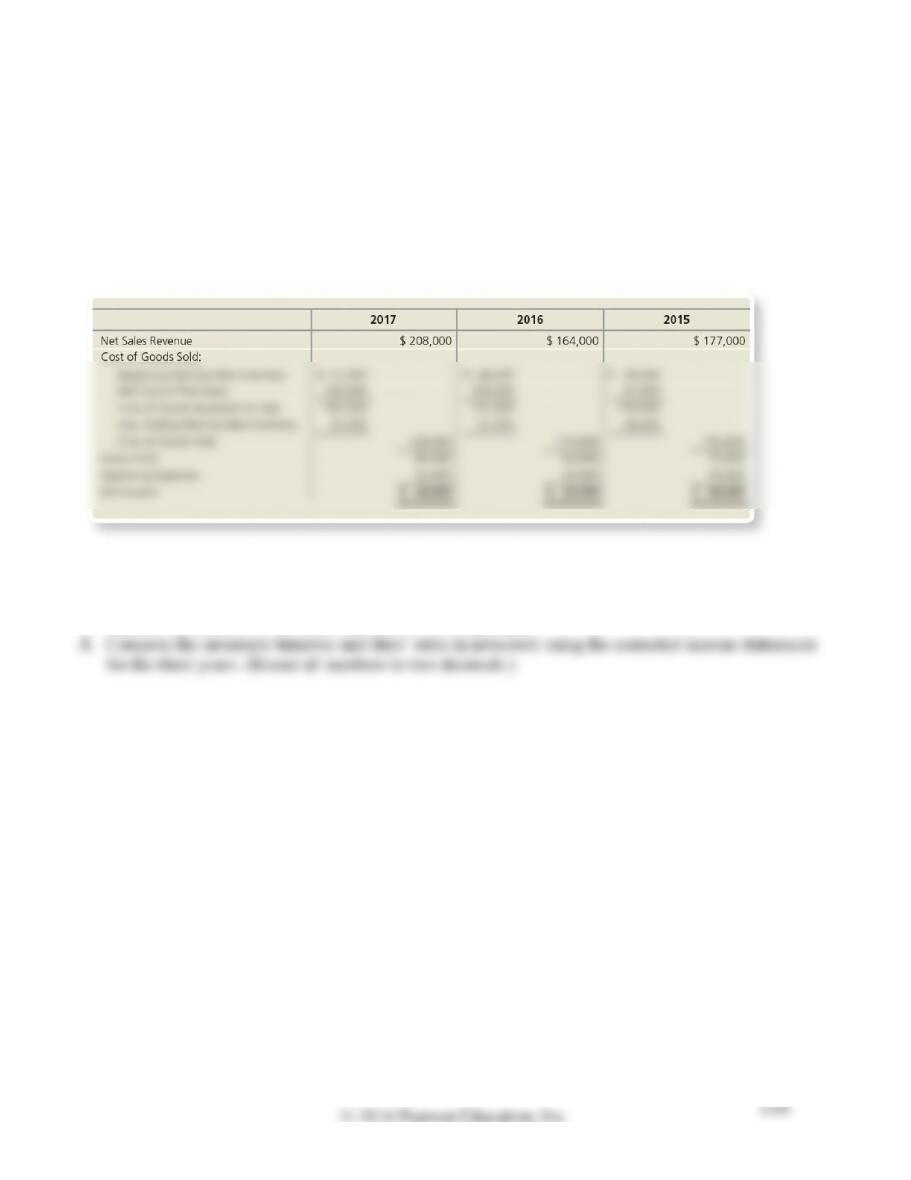
Lake Air Carpets’s books show the following data. In early 2018, auditors found that the ending
merchandise inventory for 2015 was understated by $6,000 and that the ending merchandise inventory
for 2017 was overstated by $7,000. The ending merchandise inventory at December 31, 2016, was
correct.
Requirements
1. Prepare corrected income statements for the three years.
2. State whether each year’s net income—before your corrections—is understated or overstated, and
indicate the amount of the understatement or overstatement.
6-70
SOLUTION
Requirement 1
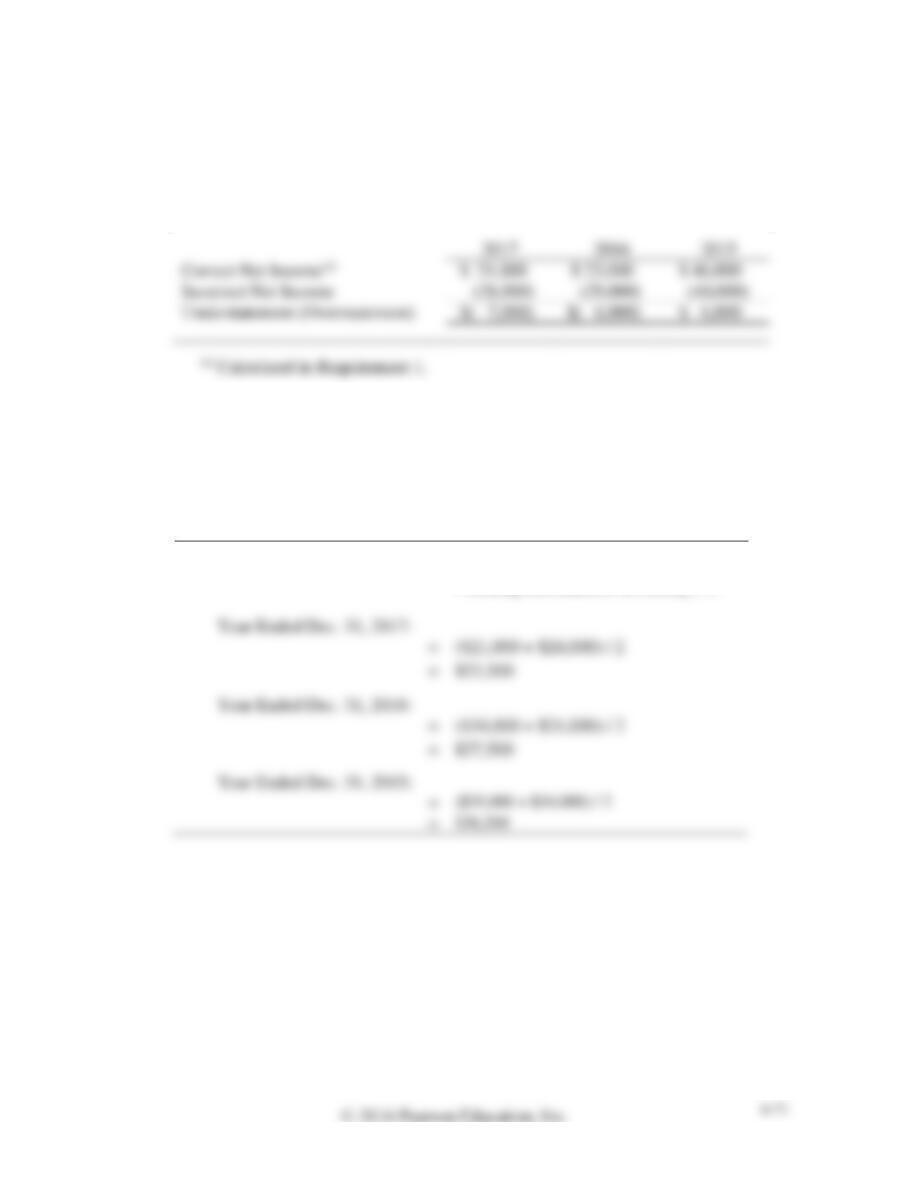
Corrected income statements:
LAKE AIR CARPETS
Income Statements
Years Ended December 31,
2017, 2016, and 2015
2017
2016
2015
Net Sales Revenue
Cost of Goods Sold:
$ 21,000
$ 39,000
140,000
103,000
91,000
161,000
137,000
130,000
21,000
Gross Profit
Operating Expenses
35,000
Net Income
2017
2015
Incorrect Merchandise Inventory
$ 33,000
$ 28,000
Understatement (Overstatement)
(7,000)
6,000
Correct Merchandise Inventory
P6-31A, cont.
Requirement 2
Before correction, net income is overstated by $7,000 in 2017, overstated by $6,000 in 2016, and
understated by $6,000 in 2015.
Calculations:
2017
2016
2015
$ 21,000
$ 23,000
$ 46,000
Incorrect Net Income
(28,000)
(29,000)
(40,000)
Understatement (Overstatement)
$( 7,000)
$( 6,000)
$ 6,000
Requirement 3
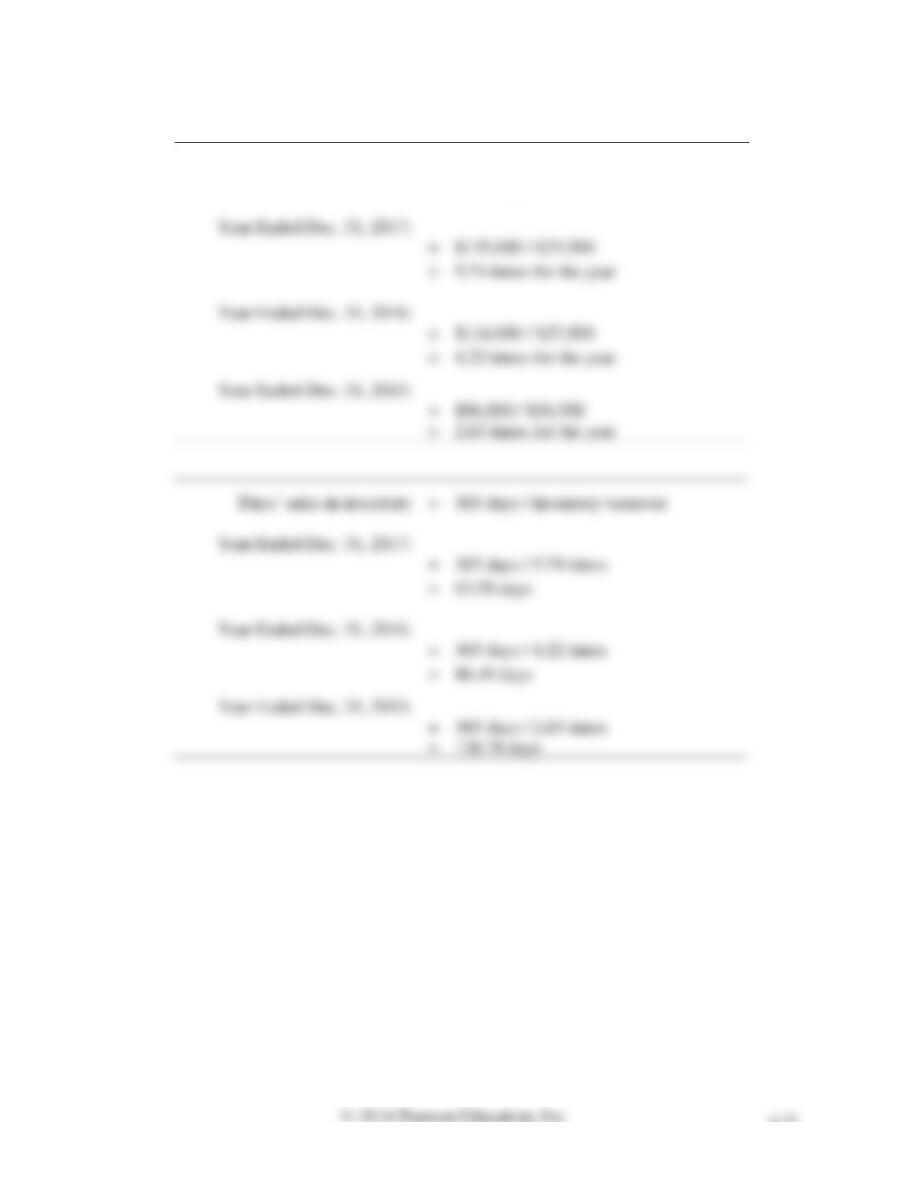
Inventory turnover is 5.74 times in 2017, 4.22 times in 2016, and 2.63 in 2015. Days’ sales in inventory
is 63.59 days in 2017, 86.49 days in 2016, and 138.78 days in 2015.
Calculations:
Average merchandise inventory
=
(Beginning merchandise inventory
+ Ending merchandise inventory) / 2
Year Ended Dec. 31, 2017:
=
($21,000 + $26,000) / 2
=
$23,500
Year Ended Dec. 31, 2016:
=
($34,000 + $21,000) / 2
=
$27,500
Year Ended Dec. 31, 2015:
6-72
P6-31A, cont.
Requirement 3, cont.
Inventory turnover
=
Cost of goods sold
/ Average merchandise inventory
Year Ended Dec. 31, 2017:
=
$135,000 / $23,500
=
5.74 times for the year
Year Ended Dec. 31, 2016:
=
$116,000 / $27,500
=
4.22 times for the year
Year Ended Dec. 31, 2015:
$96,000 / $36,500
2.63 times for the year
=
365 days / Inventory turnover
Year Ended Dec. 31, 2017:
=
365 days / 5.74 times
=
63.59 days
Year Ended Dec. 31, 2016:
=
365 days / 4.22 times
=
86.49 days
Year Ended Dec. 31, 2015:
365 days / 2.63 times
138.78 days
P6A-32A Accounting for inventory using the periodic inventory system— FIFO, LIFO, and
weighted-average, and comparing FIFO, LIFO, and weighted-average
Learning Objectives 3, 7
Appendix 6A
1. LIFO Ending Merch. Inv., $7,800
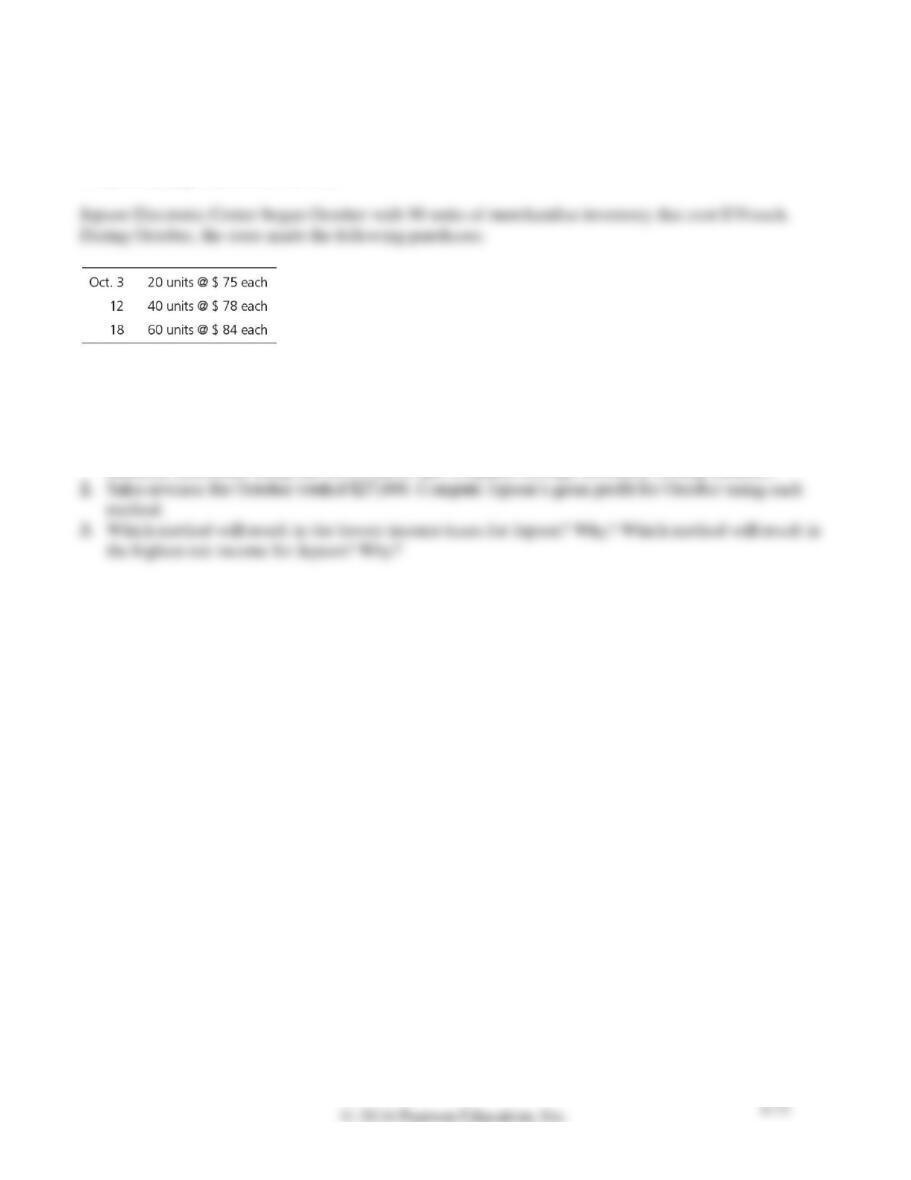
Jepson uses the periodic inventory system, and the physical count at October 31 indicates that 110 units
of merchandise inventory are on hand.
Requirements
1. Determine the ending merchandise inventory and cost of goods sold amounts for the October
financial statements using the FIFO, LIFO, and weighted-average inventory costing methods.
6-74
SOLUTION
Requirement 1
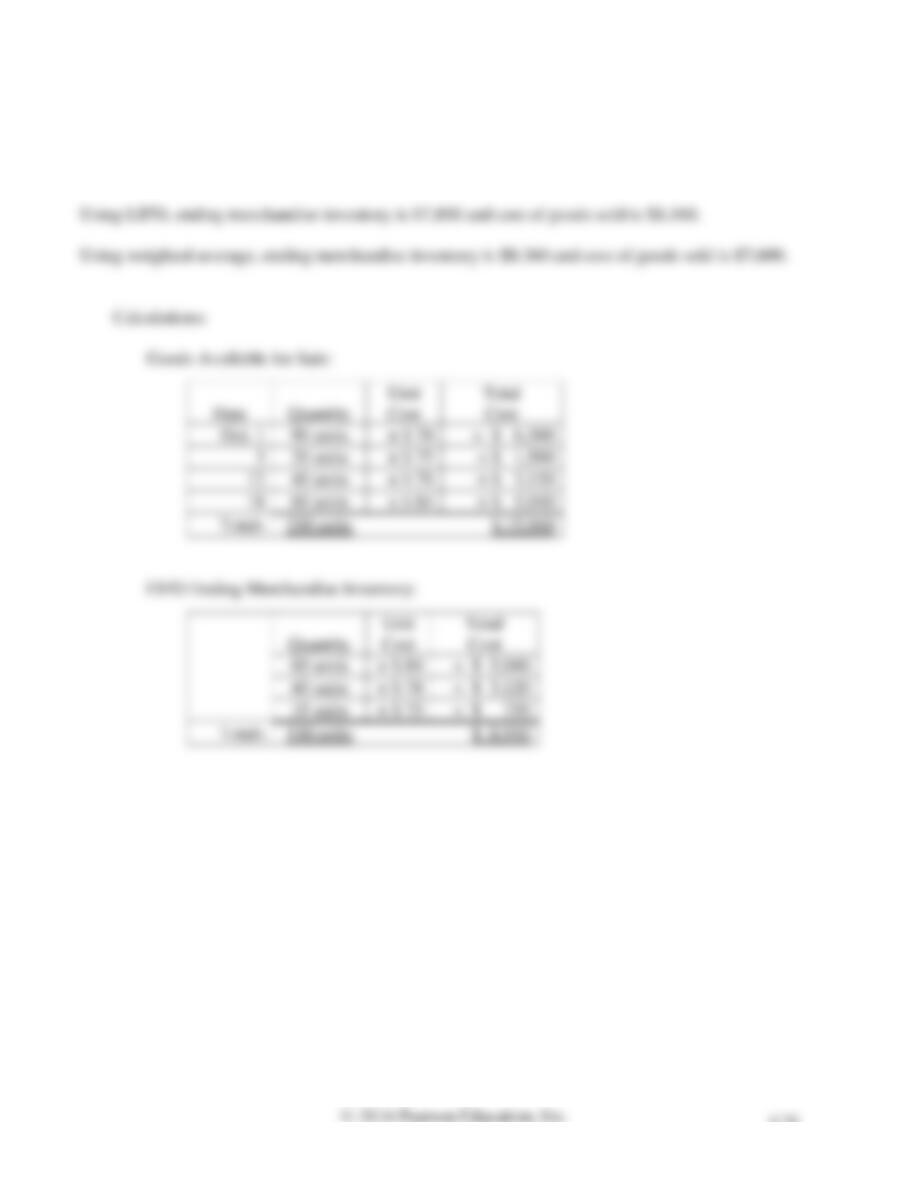
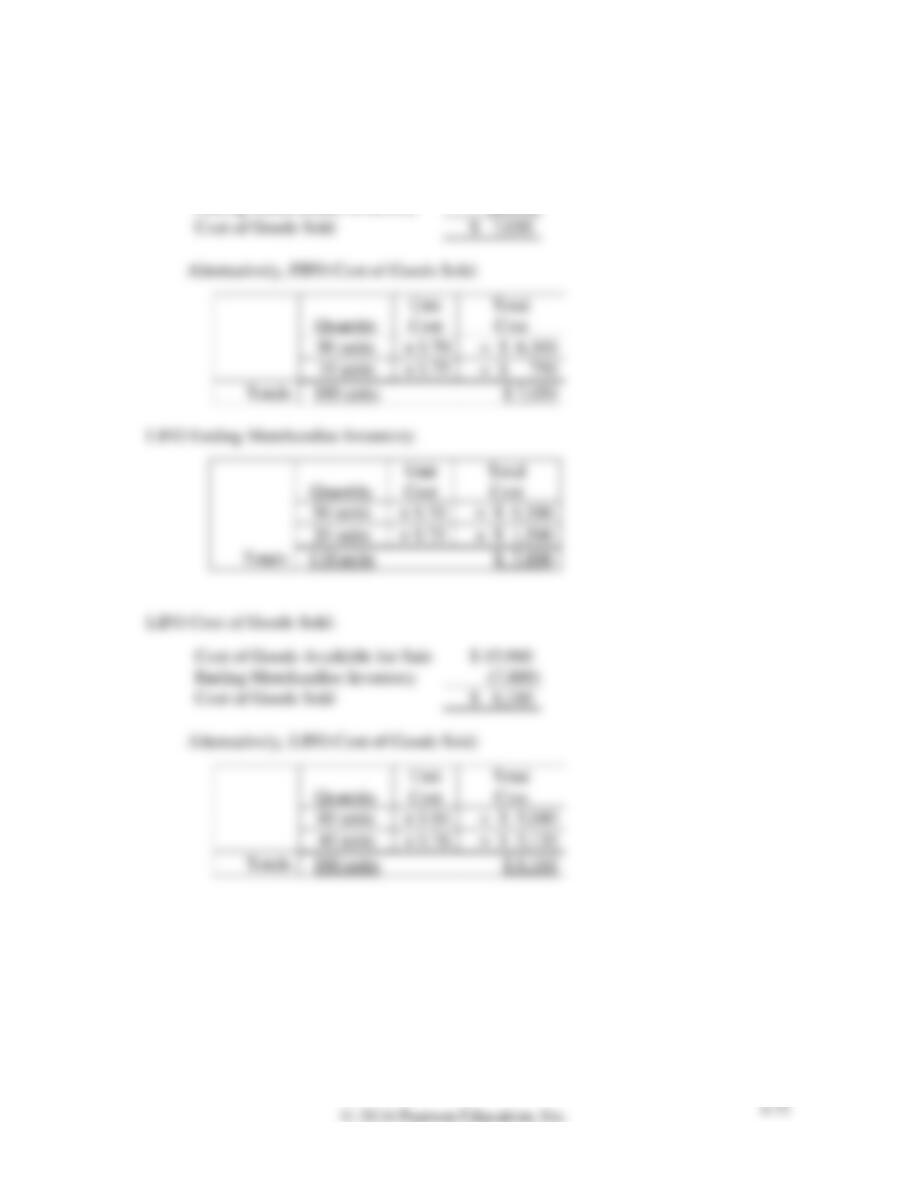
Using FIFO, ending merchandise inventory is $8,910 and cost of goods sold is $7,050.
P6A-32A, cont.
Requirement 1, cont.
FIFO Cost of Goods Sold:
Cost of Goods Available for Sale
$ 15,960
Ending Merchandise Inventory
(8,910)
Cost of Goods Sold
Cost of Goods Available for Sale
$ 15,960
Ending Merchandise Inventory
(7,800)
Cost of Goods Sold
6-76
P6A-32A, cont.
Requirement 1, cont.
Weighted-average
cost per unit
=
15,960 cost of goods available for sale
/ 210 units available for sale
=
$76 per unit
Weighted-Average Ending
Merchandise Inventory
=
110 units × $76 per unit
=
$8,360
Cost of Goods Available for Sale
Ending Merchandise Inventory
(8,360)
Cost of Goods Sold
=
100 units sold × $76 per unit
=
$7,600
Requirement 2
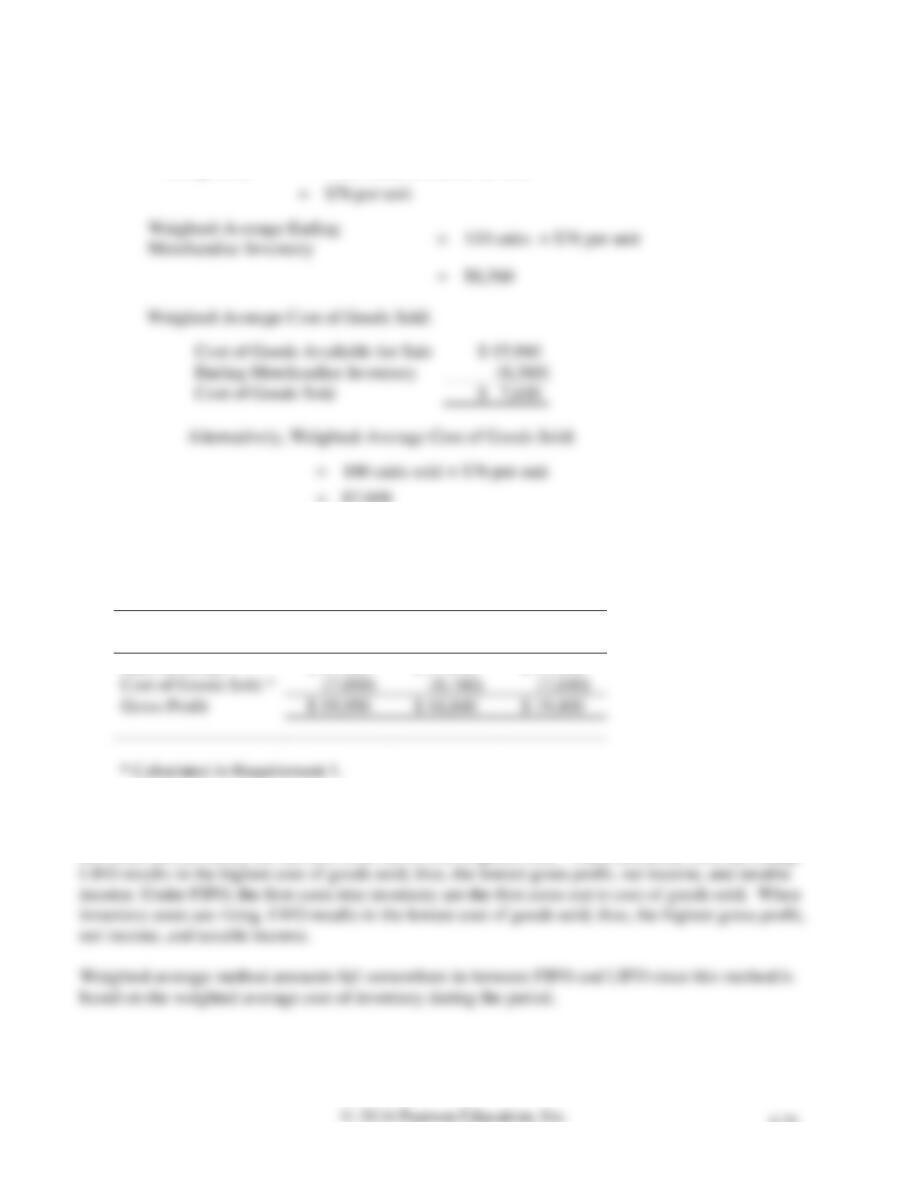
Gross profit is $19,950 using FIFO, $18,840 using LIFO, and $19,400 using weighted-average.
Calculations:
FIFO
LIFO
Weighted-
Average
Sales Revenue
$ 27,000
$ 27,000
$ 27,000
Cost of Goods Sold *
Gross Profit
$ 19,950
$ 18,840
$ 19,400
Requirement 3
LIFO results in the lowest income taxes and FIFO results in the highest net income. Under LIFO, the
last costs into inventory are the first costs out to cost of goods sold. When inventory costs are rising,
Problems (Group B)
For all problems, assume the perpetual inventory system is used unless stated otherwise.
P6-33B Accounting for inventory using the perpetual inventory system—FIFO, LIFO, and
weighted-average
Learning Objectives 2, 3
2. Ending Merch. Inv., $4,550
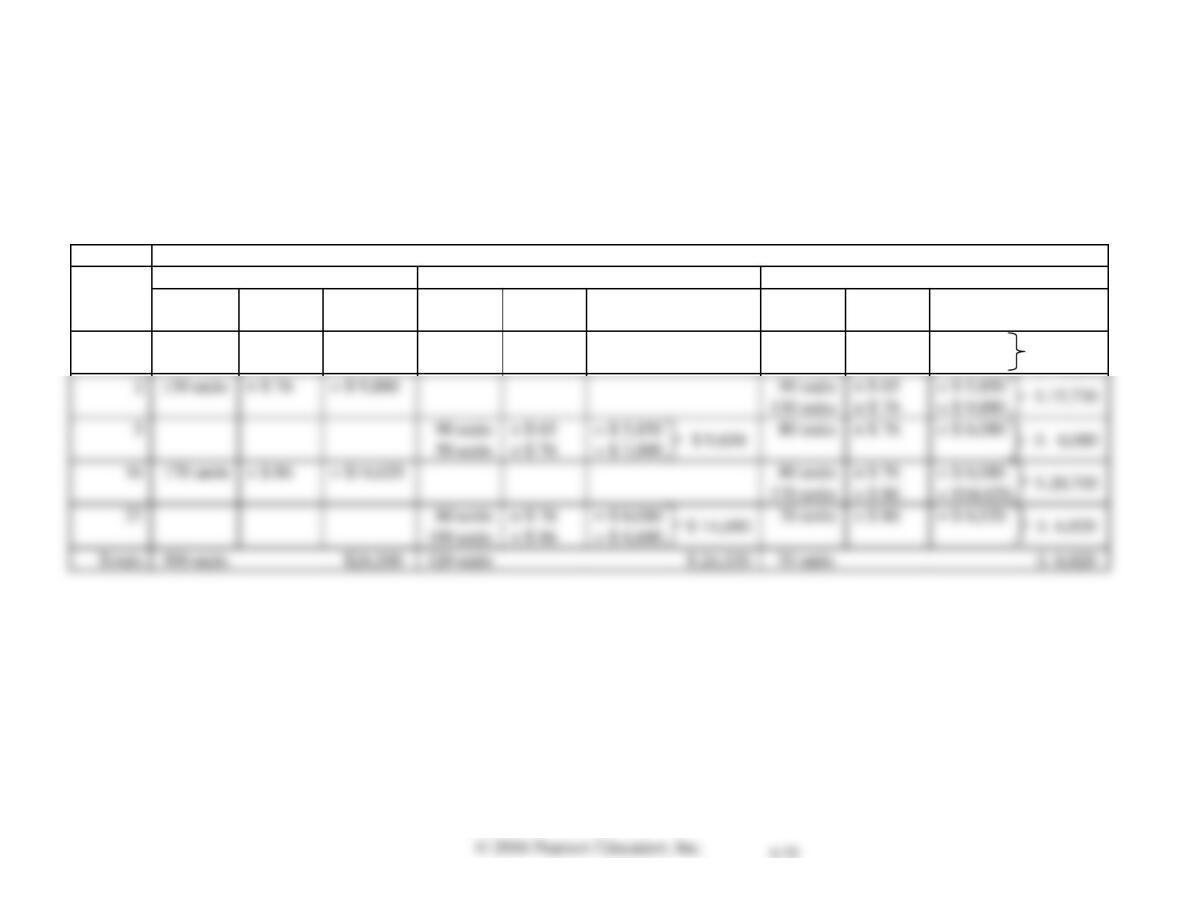
Fit World began January with merchandise inventory of 90 crates of vitamins that cost a total of $5,850.
During the month, Fit World purchased and sold merchandise on account as follows:
Requirements
1. Prepare a perpetual inventory record, using the FIFO inventory costing method, and determine the
company’s cost of goods sold, ending merchandise inventory, and gross profit.
SOLUTION
Requirement 1
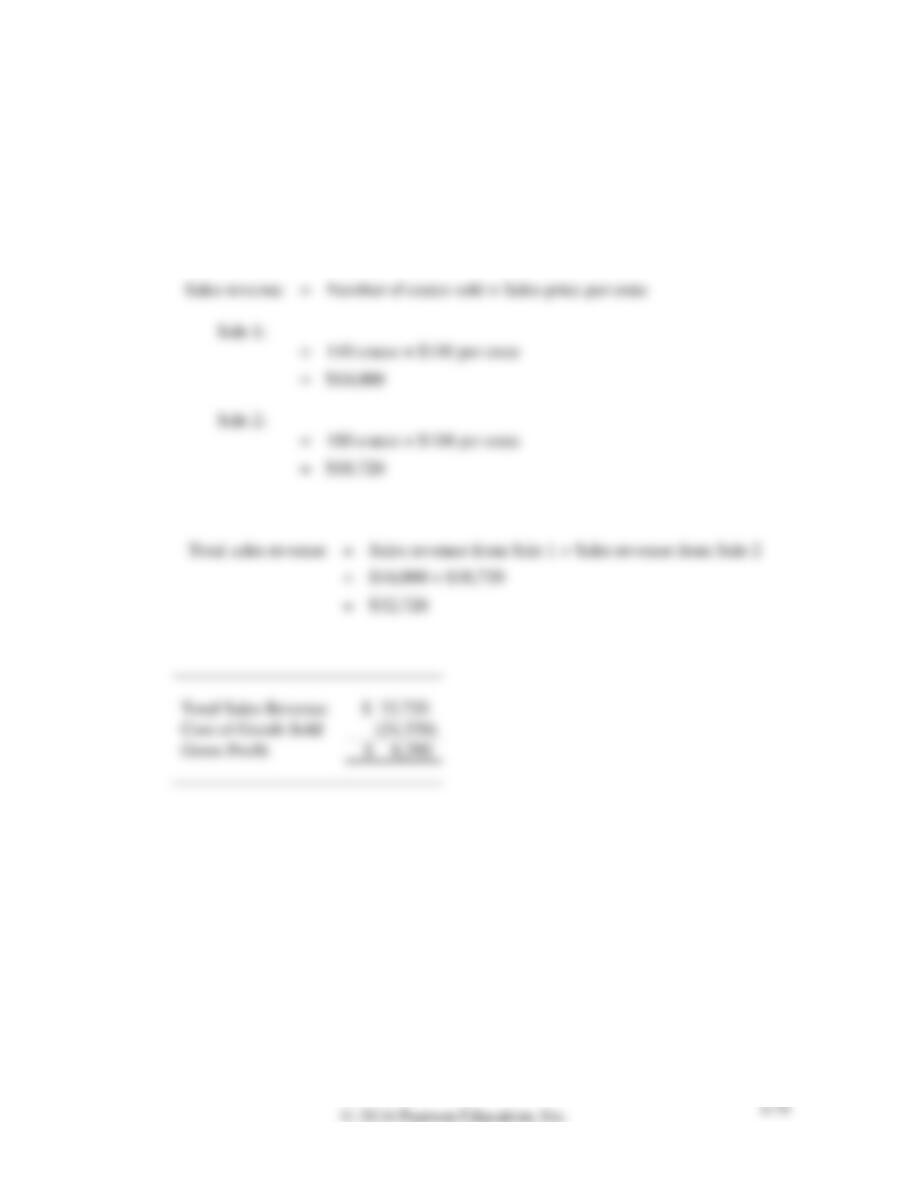
Using FIFO, cost of goods sold is $24,330, ending merchandise inventory is $6,020, and gross profit is $8,390.
Perpetual Inventory Record: FIFO
Purchases
Cost of Goods Sold
Inventory on Hand
Date
Quantity
Unit
Cost
Total Cost
Quantity
Unit
Cost
Total Cost
Quantity
Unit
Cost
Total Cost
Jan. 1
90 units
× $ 65 (a)
= $ 5,850
$ 5,850
130 units
90 units
130 units
90 units
80 units
50 units
170 units
80 units
70 units
100 units
300 units
$24,500
320 units
$ 24,330
70 units
P6-33B, cont.
Requirement 1, cont.
Calculations:
(a) Jan. 1 inventory unit cost
=
Total cost / Total number of units
=
$5,850 / 90 units
=
$65 per unit
=
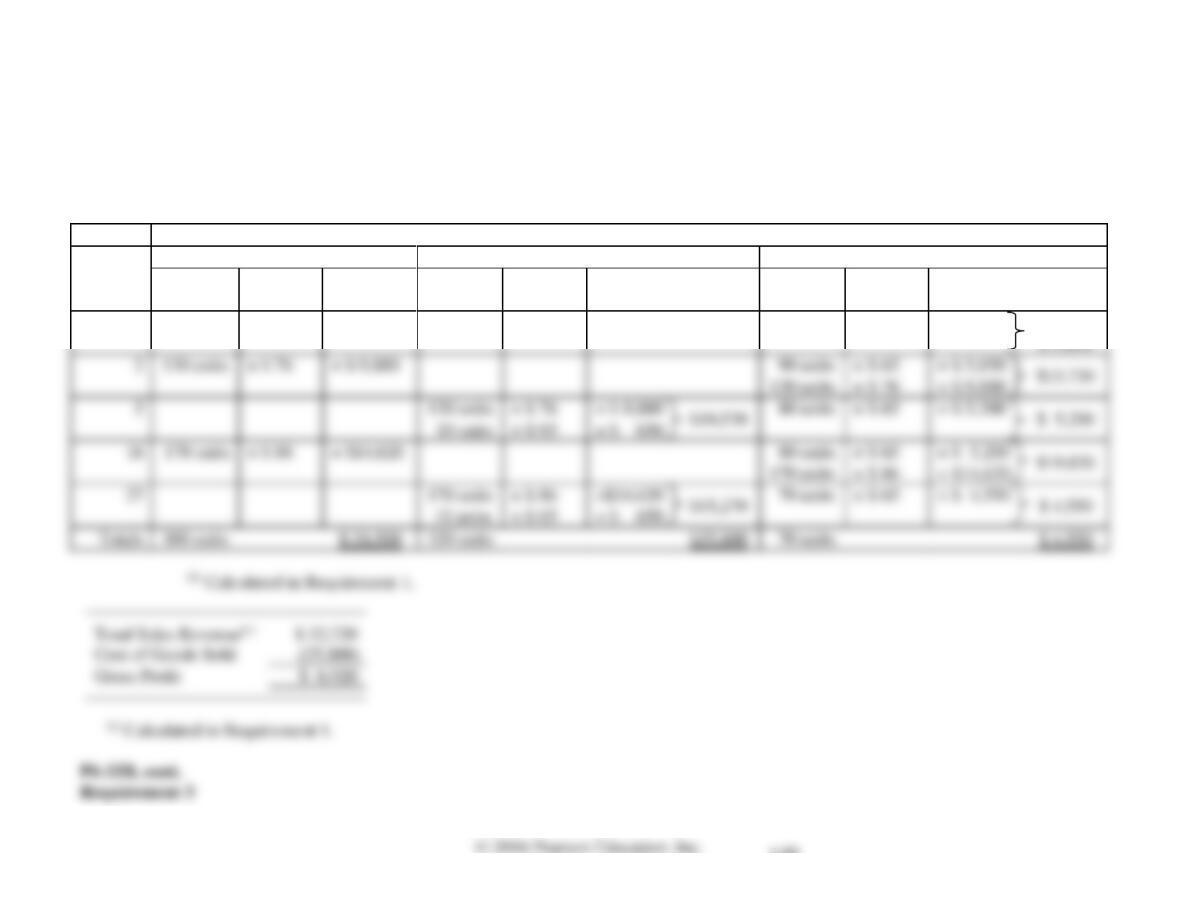
Number of crates sold × Sales price per crate
Sale 1:
=
140 crates × $100 per crate
=
$14,000
Sale 2:
=
180 crates × $104 per crate
=
$18,720
=
Sales revenue from Sale 1 + Sales revenue from Sale 2
=
$14,000 + $18,720
=
$32,720
Total Sales Revenue
Cost of Goods Sold
(24,330)
Gross Profit
6-80
P6-33B, cont.
Requirement 2
Using LIFO, cost of goods sold is $25,800, ending merchandise inventory is $4,550, and gross profit is $6,920.
Perpetual Inventory Record: LIFO
Purchases
Cost of Goods Sold
Inventory on Hand
Date
Quantity
Unit
Cost
Total Cost
Quantity
Unit
Cost
Total Cost
Quantity
Unit
Cost
Total Cost
Jan. 1
90 units
× $ 65 (b)
= $ 5,850
130 units
90 units
130 units
130 units
80 units
10 units
170 units
80 units
170 units
70 units
10 units
300 units
320 units
$25,800
70 units
Cost of Goods Sold
(25,800)
Gross Profit