
(c) Tc647.1 K⋅:= Pc220.55 bar⋅:= ω 0.345:=
Tr1
T1
Tc
:= Pr1
P1
Pc
:= Tr2
T2
Tc
:= Pr2
P2
Pc
:=
Tr1 1.11752=Pr1 0.13602=Tr2 0.63846=Pr2 0.01066=
The generalized virial-coefficient correlation is suitable here
∆H∆Hig
RT
c
⋅HRB Tr2 Pr2
,ω,
()
HRB Tr1 Pr1
,ω,
()
−
()
⋅
molwt
+:=
(b) T1450 273.15+()K⋅:= T2140 273.15+()K⋅:=
T1723.15 K=T2413.15 K=
P13000 kPa⋅:= P2235 kPa⋅:=
Eqs. (6.95) & (6.96) for an ideal gas: molwt 18 gm
mol
:=
∆Hig
R ICPH T1T2
,3.470,1.450 10 3−
⋅, 0.0,0.121 105
⋅,
()
⋅
molwt
:=
∆Sig
R ICPS T1T2
,3.470,1.450 10 3−
⋅, 0.0,0.121 105
⋅,
()
ln P2
P1
⎛
⎜
⎝
⎞
⎠
−
⎛
⎜
⎝
⎞
⎠
⋅
molwt
:=
164

6.42 Table F.4, sat.vapor, 300(psi):
T1417.35 459.67+( ) rankine⋅:= H11202.9 BTU
lbm
⋅:=
Superheated steam at 300(psi) & 900 degF
H21473.6 BTU
lbm
⋅:= S21.7591 BTU
lbmrankine⋅
⋅:= S3S2
:=
6.41 Data, Table F.2 superheated steam at 550 kPa and 200 degC:
Step 1–2: Const.-V heating to 800 kPa. At the initial specific volume
and this P, interpolation gives t = 401.74 degC, and
U22963.1 J
gm
⋅:= S27.5782 J
gm K⋅
⋅:= Q12 U2U1
−:=
Q12 322.5 J
gm
=
Step 2–3: Isentropic expansion to initial T.
Q23 0=S3S2
=S37.5782 J
gm K⋅
⋅:=
Step 3–1: Constant-T compression to initial P.
T 473.15 K⋅:= Q31 TS
1S3
−
()
⋅:= Q31 268.465−J
gm
=
For the cycle, the internal energy change = 0.
165
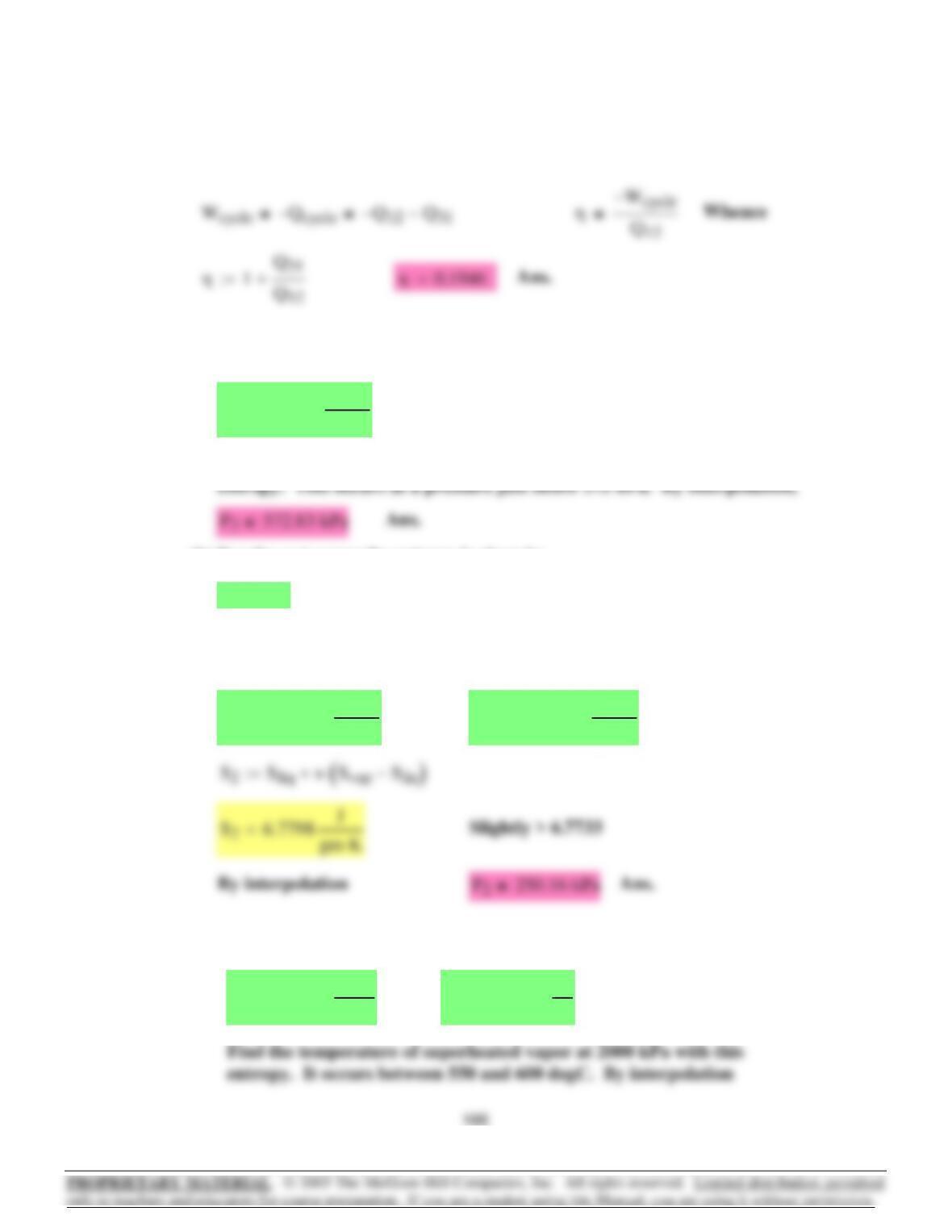
x 0.95:= S2Sliq xS
vap Sliq
−
()
⋅+=
So we must find the presure for which this equation is satisfied. This
occurs at a pressure just above 250 kPa. At 250 kPa:
Sliq 1.6071 J
gm K⋅
⋅:= Svap 7.0520 J
gm K⋅
⋅:=
6.44 (a) Table F.2 at the final conditions of saturated vapor at 50 kPa:
S27.5947 kJ
kg K⋅
⋅:= H22646.0 kJ
kg
⋅:= S1S2
:=
For the cycle, the internal energy change = 0.
6.43 Data, Table F.2, superheated steam at 4000 kPa and 400 degC:
S16.7733 J
gm K⋅
⋅:= For both parts of the problem: S2S1
:=
(a) So we are looking for the pressure at which saturated vapor has the given
(b) For the wet vapor the entropy is given by
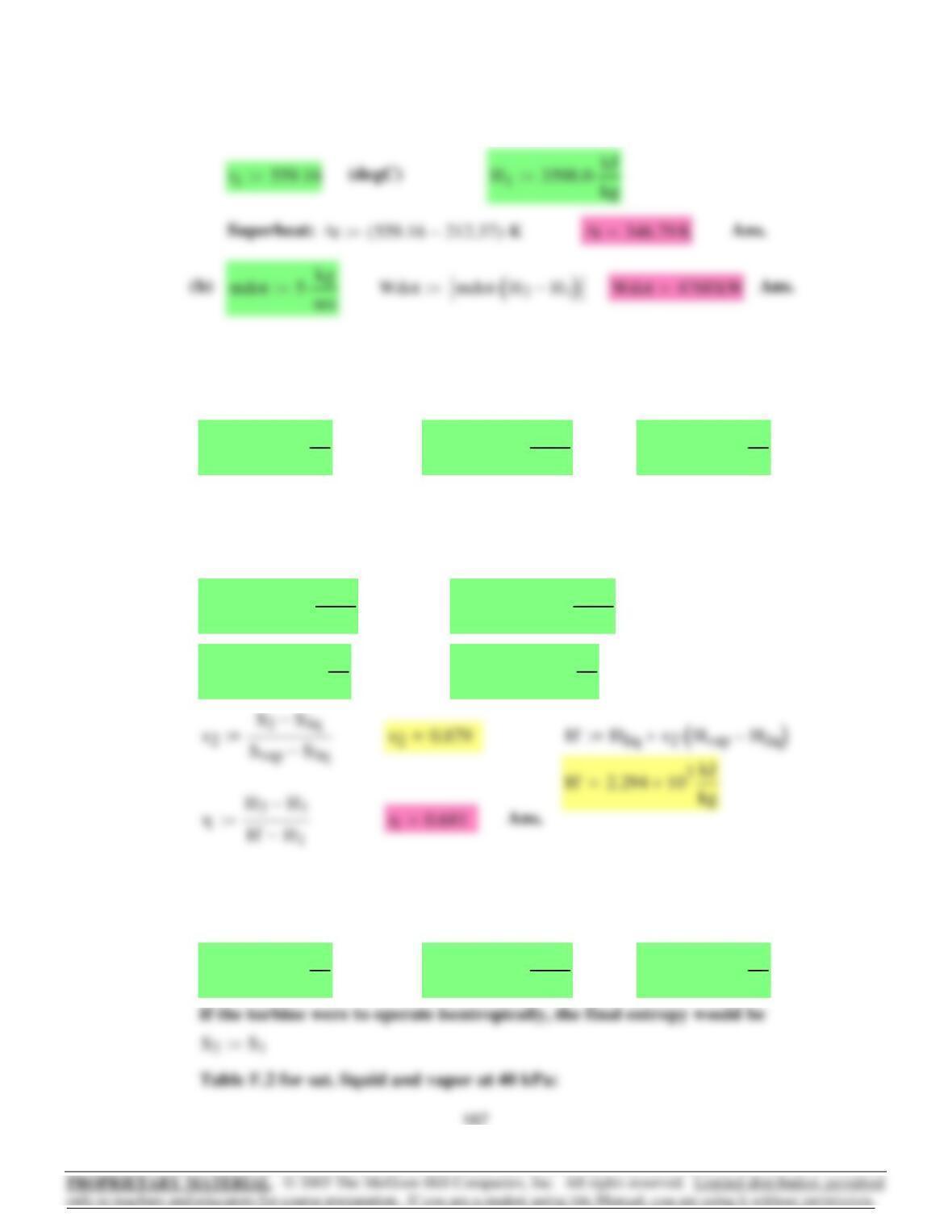
Sliq 0.6493 kJ
kg K⋅
⋅:= Svap 8.1511 kJ
kg K⋅
⋅:=
Hliq 191.832 kJ
kg
⋅:= Hvap 2584.8 kJ
kg
⋅:=
6.46 Table F.2 for superheated vapor at the initial conditions, 1300 kPa and 400
degC, and for the final condition of 40 kPa and 100 degC:
H13259.7 kJ
kg
⋅:= S17.3404 kJ
kg K⋅
⋅:= H22683.8 kJ
kg
⋅:=
6.45 Table F.2 for superheated vapor at the initial conditions, 1350 kPa and 375
degC, and for the final condition of sat. vapor at 10 kPa:
H13205.4 kJ
kg
⋅:= S17.2410 kJ
kg K⋅
⋅:= H22584.8 kJ
kg
⋅:=
If the turbine were to operate isentropically, the final entropy would be
S2S1
:=
Table F.2 for sat. liquid and vapor at 10 kPa:
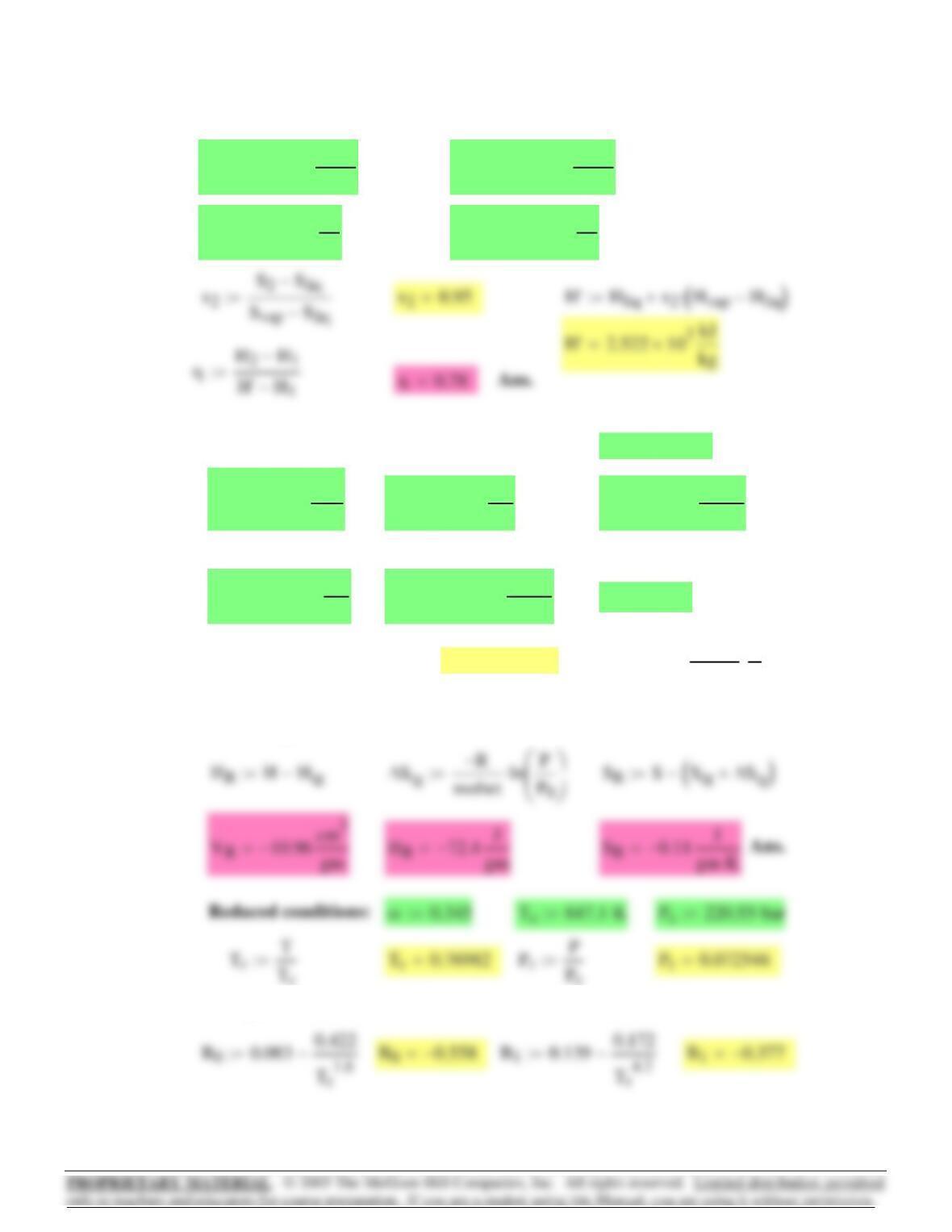
VRVR
molwt
T
P
⋅−:=
The enthalpy of an ideal gas is independent of pressure, but the entropy
DOES depend on P:
The generalized virial-coefficient correlation is suitable here
Sliq 1.0261 kJ
kg K⋅
⋅:= Svap 7.6709 kJ
kg K⋅
⋅:=
Hliq 317.16 kJ
kg
⋅:= Hvap 2636.9 kJ
kg
⋅:=
6.47 Table F.2 at 1600 kPa and 225 degC: P 1600 kPa⋅:=
V 132.85 cm3
gm
⋅:= H 2856.3 J
gm
⋅:= S 6.5503 J
gm K⋅
⋅:=
Table F.2 (ideal-gas values, 1 kPa and 225 degC)
Hig 2928.7 J
gm
⋅:= Sig 10.0681 J
gm K⋅
⋅:= P01 kPa⋅:=
T 225 273.15+()K⋅:= T 498.15 K=
168
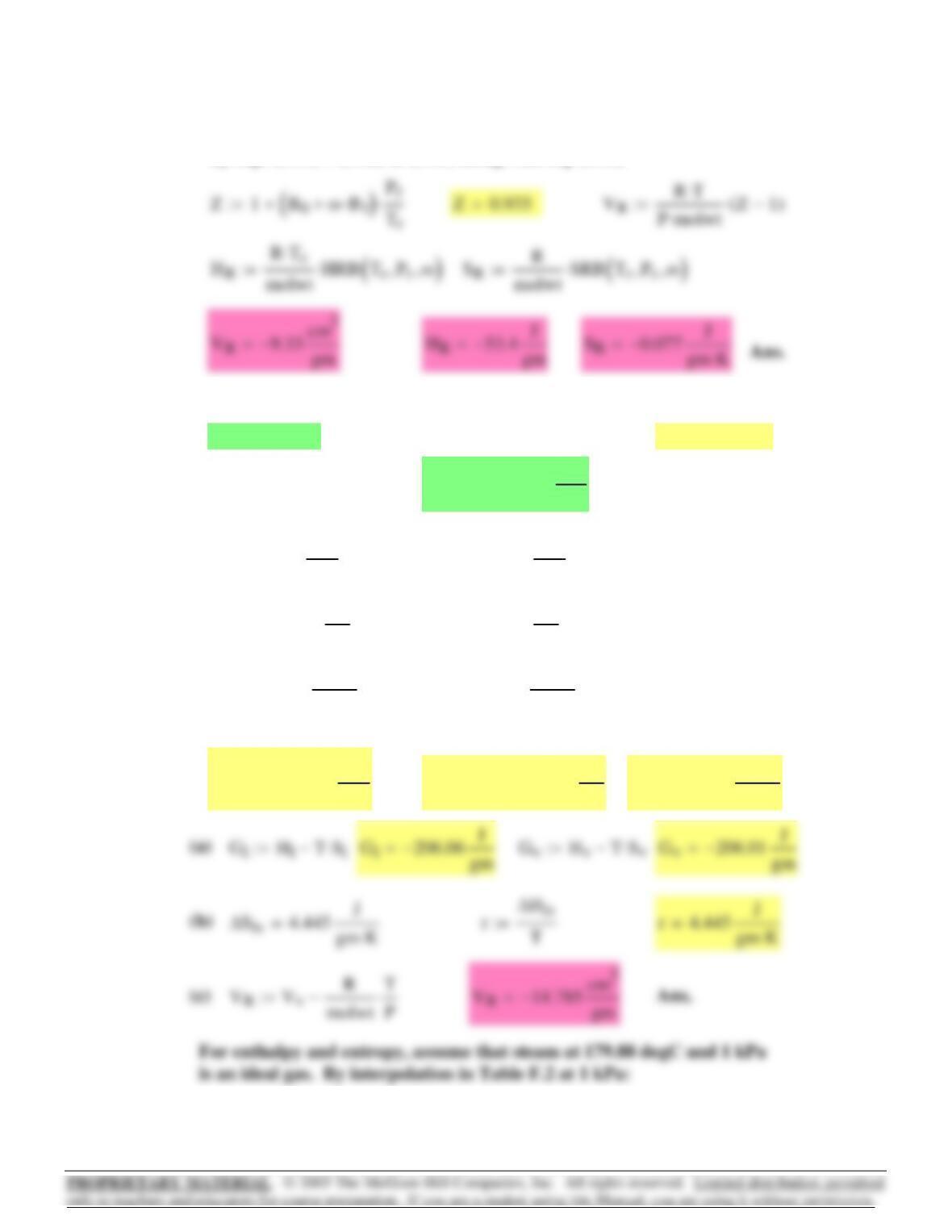
∆Hlv HvHl
−:=
Sl2.1382 J
gm K⋅
⋅:= Sv6.5828 J
gm K⋅
⋅:= ∆Slv SvSl
−:=
∆Vlv 193.163 cm3
gm
= ∆Hlv 2.014 103
×J
gm
= ∆Slv 4.445 J
gm K⋅
=
By Eqs. (3.61) + (3.62) & (3.63) along with Eq. (6.40)
6.48 P 1000 kPa⋅:= T 179.88 273.15+()K⋅:= T 453.03 K=
(Table F.2) molwt 18.015 gm
mol
:=
Vl1.127 cm3
gm
⋅:= Vv194.29 cm3
gm
⋅:= ∆Vlv VvVl
−:=
Hl762.605 J
gm
⋅:= Hv2776.2 J
gm
⋅:=
169
dPdT P−
T2Slope⋅K⋅:= dPdT 22.984 kPa
K
=
The generalized virial-coefficient correlation is suitable here
By Eqs. (3.61) + (3.62) & (3.63) along with Eq. (6.40)
Hig 2841.1 J
gm
⋅:= Sig 9.8834 J
gm K⋅
⋅:= P01 kPa⋅:=
The enthalpy of an ideal gas is independent of pressure; the entropy
DOES depend on P:
(d) Assume ln P vs. 1/T linear and fit three data pts @ 975, 1000, & 1050 kPa.
Data: pp
975
1000
1050
⎛
⎜
⎜
⎜
⎝
⎞
⎟
⎠
kPa⋅:= t
178.79
179.88
182.02
⎛
⎜
⎜
⎜
⎝
⎞
⎟
⎠
:= (degC) i13..:=
xi
1
ti273.15+
:= yiln ppi
kPa
⎛
⎜
⎝
⎞
⎠
:= Slope slope x y,():= Slope 4717−=
170

∆Slv SvSl
−:=
∆Vlv 2.996 ft3
lbm
= ∆Hlv 863.45 BTU
lbm
=
(a) GlHlTS
l
⋅−:= GvHvTS
v
⋅−:=
For enthalpy and entropy, assume that steam at 358.43 degF and 1 psi is
an ideal gas. By interpolation in Table F.4 at 1 psi:
6.49 T 358.43 459.67+( ) rankine⋅:= T 818.1 rankine=P 150 psi⋅:=
(Table F.4) molwt 18.015 gm
mol
:=
Vl0.0181 ft3
lbm
⋅:= Vv3.014 ft3
lbm
⋅:= ∆Vlv VvVl
−:=
Hl330.65 BTU
lbm
⋅:= Hv1194.1 BTU
lbm
⋅:= ∆Hlv HvHl
−:=
Sl0.5141 BTU
lbmrankine⋅
⋅:= Sv1.5695 BTU
lbmrankine⋅
⋅:=
171
Reduced conditions: ω0.345:= Tc647.1 K⋅:= Pc220.55 bar⋅:=
Tr
T
Tc
:= Tr0.7024=Pr
P
Pc
:= Pr0.0469=
The enthalpy of an ideal gas is independent of pressure; the entropy DOES
depend on P:
(d) Assume ln P vs. 1/T linear and fit threedata points (@ 145, 150, & 155
psia)
Data: pp
145
150
155
⎛
⎜
⎜
⎜
⎝
⎞
⎟
⎠
psi⋅:= t
355.77
358.43
361.02
⎛
⎜
⎜
⎜
⎝
⎞
⎟
⎠
:= (degF) i13..:=
172
HR0 2.496−R⋅Tc
⋅:= HR1 0.586−R⋅Tc
⋅:=
HR0 7.674−103
×J
mol
=HR1 1.802−103
×J
mol
=
By Eqs. (3.61) + (3.62) & (3.63) along with Eq. (6.40)
6.50 For propane: Tc369.8 K⋅:= Pc42.48 bar⋅:= ω 0.152:=
T 195 273.15+()K⋅:= T 468.15 K=P 135 bar⋅:= P01 bar⋅:=
173
6.52 For propane: ω0.152:=
Tc369.8 K⋅:= Pc42.48 bar⋅:= Zc0.276:= Vc200.0 cm3
mol
⋅:=
If the final state is a two-phase mixture, it must exist at its saturation
temperature at 1 bar. This temperature is found from the vapor pressure
equation:
6.51 For propane: Tc369.8 K⋅:= Pc42.48 bar⋅:= ω 0.152:=
T 70 273.15+()K⋅:= T 343.15 K=P0101.33 kPa⋅:= P 1500 kPa⋅:=
Assume propane an ideal gas at the initial conditions. Use
generalized virial correlation at final conditions.
174
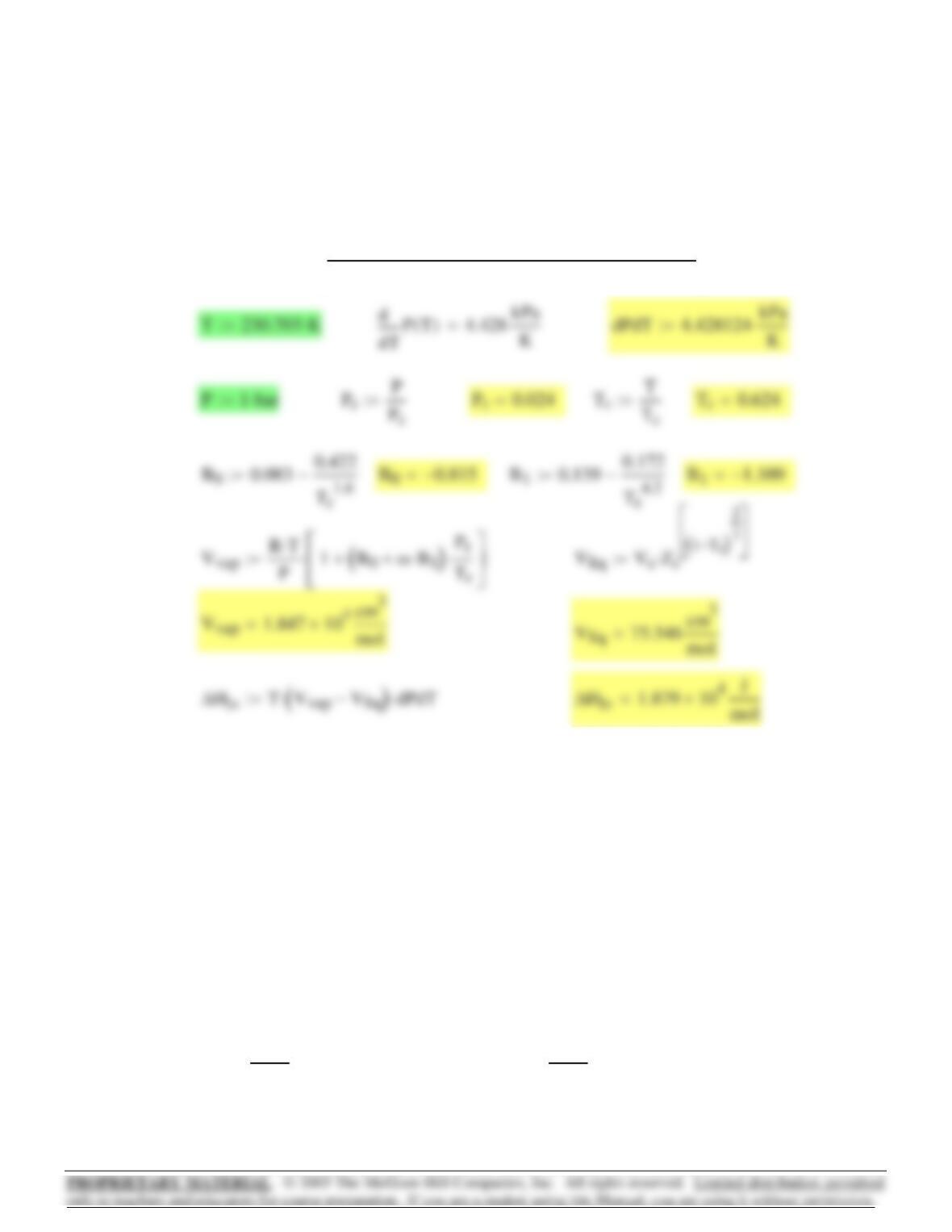
r1
HR
RT
c
⋅
⎛
⎜
⎝
⎞
⎠
1
=
and
r0
HR
RT
c
⋅
⎛
⎜
⎝
⎞
⎠
0
=
For Step (1), use the generalized correlation of Tables E.7 & E.8, and let
The sum of the enthalpy changes for these steps is set equal to zero, and
the resulting equation is solved for the fraction of the stream that is liquid.
ENERGY BALANCE: For the throttling process there is no enthalpy
change. The calculational path from the initial state to the final is made up
of the following steps:
(1) Transform the initial gas into an ideal gas at the initial T & P.
(2) Carry out the temperature and pressure changes to the final T & P in
the ideal-gas state.
(3) Transform the ideal gas into a real gas at the final T & P.
(4) Partially condense the gas at the final T & P.
PT() P
cexp AτT()⋅BτT()
()
1.5
⋅+ CτT()
()
3
⋅+ DτT()
()
6
⋅+
1τT()−
⎡
⎢
⎣
⎤
⎥
⎦
⋅:=
The latent heat of vaporization at the final conditions will be needed for an
energy balance. It is found by the Clapeyron equation. We proceed
exactly as in Pb. 6.17.
175
6.53 For 1,3-butadiene: ω0.190:= Tc425.2 K⋅:=
Pc42.77 bar⋅:= Zc0.267:= Vc220.4 cm3
mol
⋅:= Tn268.7 K⋅:=
T1370 K⋅:= P1200 bar⋅:=
Tr
T1
Tc
:= Tr1.001=Pr
P1
Pc
:= Pr4.708=
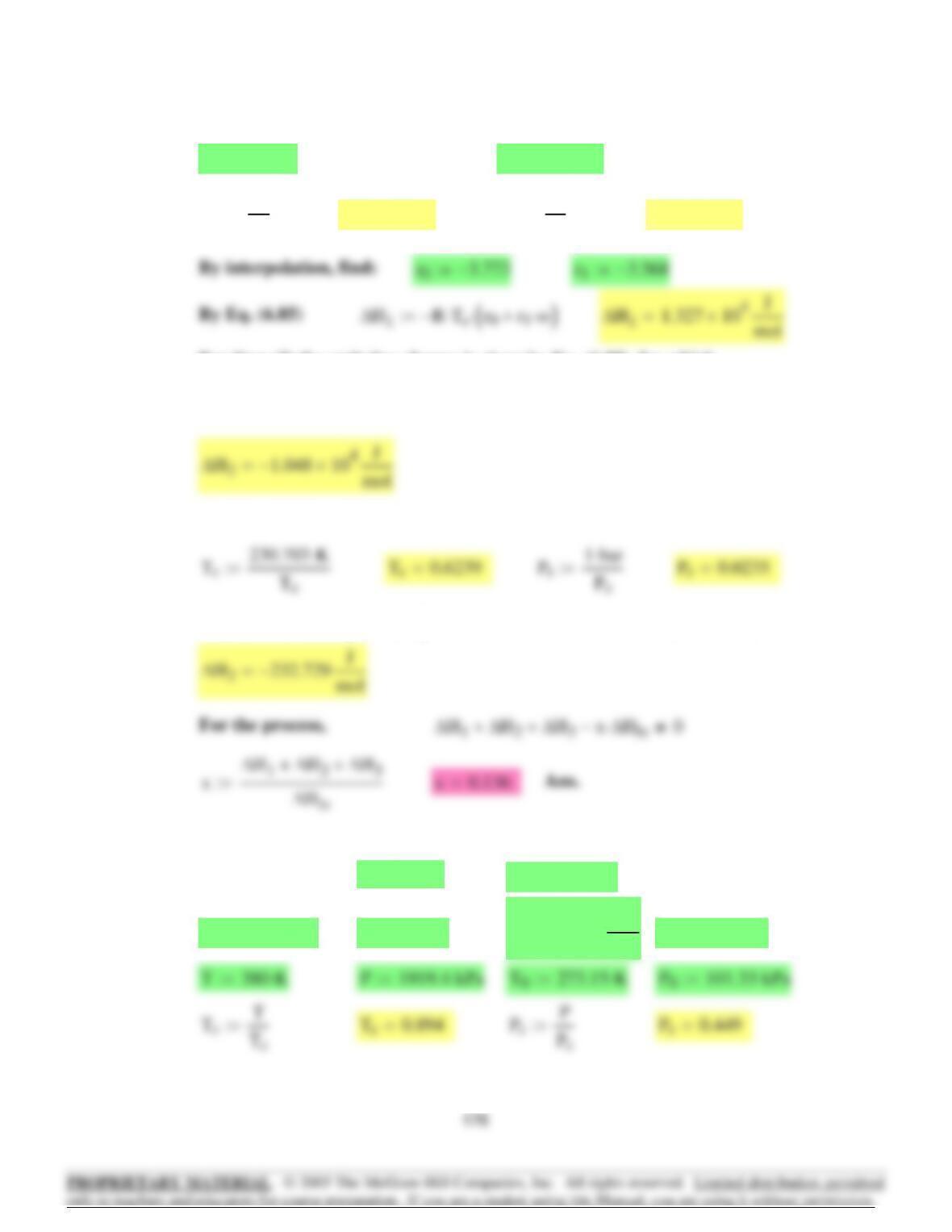
For Step (2) the enthalpy change is given by Eq. (6.95), for which
∆H2R ICPH T1T,1.213,28.785 10 3−
⋅, 8.824−10 6−
⋅, 0.0,
()()
⋅:=
For Step (3) the enthalpy change is given by Eq. (6.87), for which
∆H3RT
c
⋅HRB TrPr
,ω,
()
⋅:= For Step (4), ∆H4x−∆Hlv
⋅=
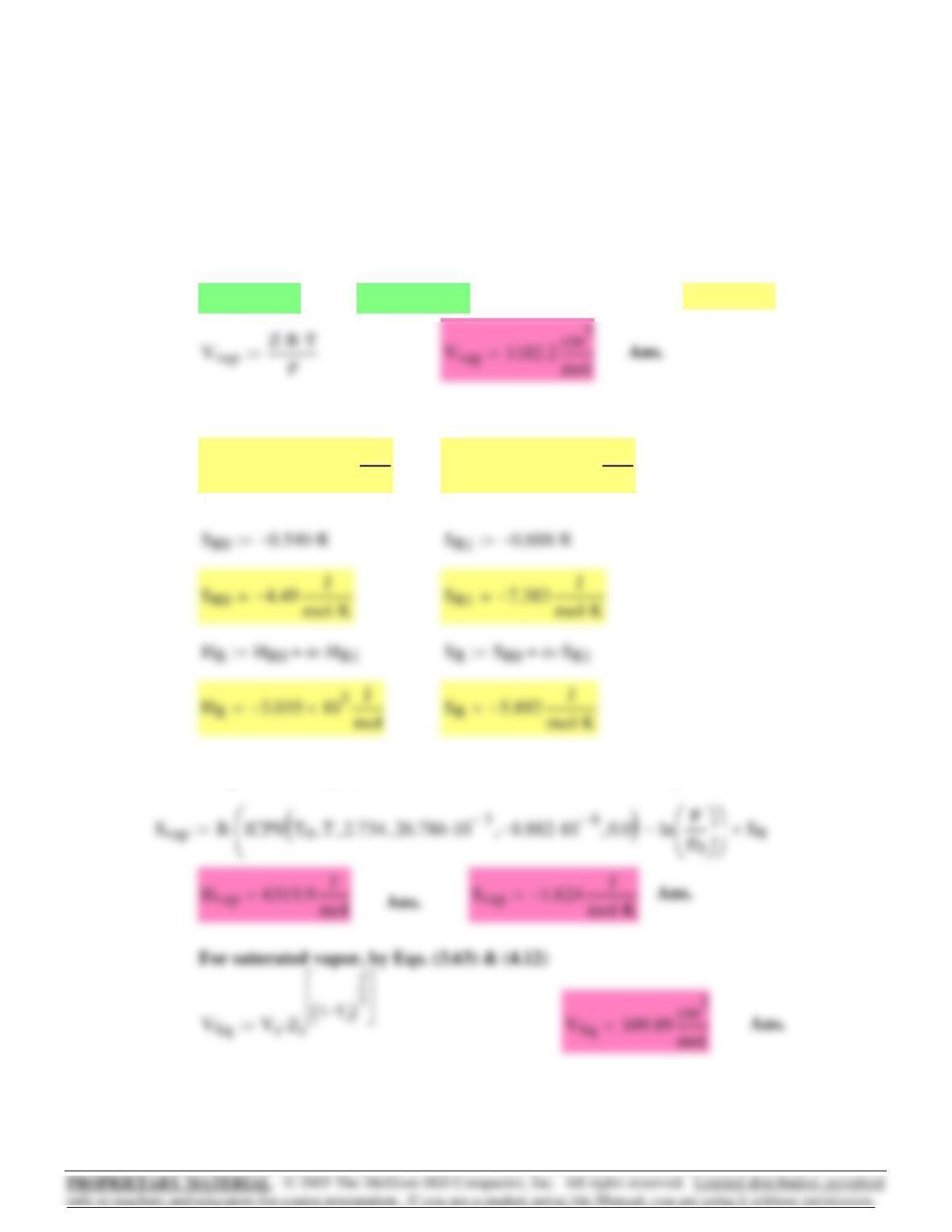
Hvap R ICPH T0T,2.734,26.786 10 3−
⋅, 8.882−10 6−
⋅, 0.0,
()
⋅HR
+:=
HR1 3.153−103
×J
mol
=HR0 2.436−103
×J
mol
=
HR1 0.892−R⋅Tc
⋅:=HR0 0.689−R⋅Tc
⋅:=
Z 0.718=ZZ
0ωZ1
⋅+:=Z10.1366−:=Z00.7442:=
Use Lee/Kesler correlation. HOWEVER, the values for a saturated vapor lie
on the very edge of the vapor region, and some adjacent numbers are for the
liquid phase. These must NOT be used for interpolation. Rather,
EXTRAPOLATIONS must be made from the vapor side. There may be
some choice in how this is done, but the following values are as good as any:
177
P 1435 kPa⋅:= T0273.15 K⋅:= P0101.33 kPa⋅:=
Tr
T
Tc
:= Tr0.87=Pr
P
Pc
:= Pr0.378=
Use Lee/Kesler correlation. HOWEVER, the values for a saturated vapor lie
on the very edge of the vapor region, and some adjacent numbers are for the
liquid phase. These must NOT be used for interpolation. Rather,
EXTRAPOLATIONS must be made from the vapor side. There may be
some choice in how this is done, but the following values are as good as any:
∆HnRT
n
⋅
1.092 ln Pc
bar
⎛
⎜
⎝
⎞
⎠1.013−
⎛
⎜
⎝
⎞
⎠
⋅
0.930 Tn
Tc
−
⎡
⎢
⎢
⎢
⎢
⎣
⎤
⎥
⎥
⎥
⎥
⎦
⋅:= ∆Hn22449 J
mol
=
⎜
6.54 For n-butane: ω0.200:= Tc425.1 K⋅:=
Pc37.96 bar⋅:= Zc0.274:= Vc255 cm3
mol
⋅:= Tn272.7 K⋅:=
T 370 K⋅:=
178
∆H 15295.2 J
mol
=∆H∆Hn
1T
r
−
1Tn
Tc
−
⎛
⎜
⎜
⎜
⎞
⎟
0.38
⋅:=
By Eq. (4.13)
⎢
⎥
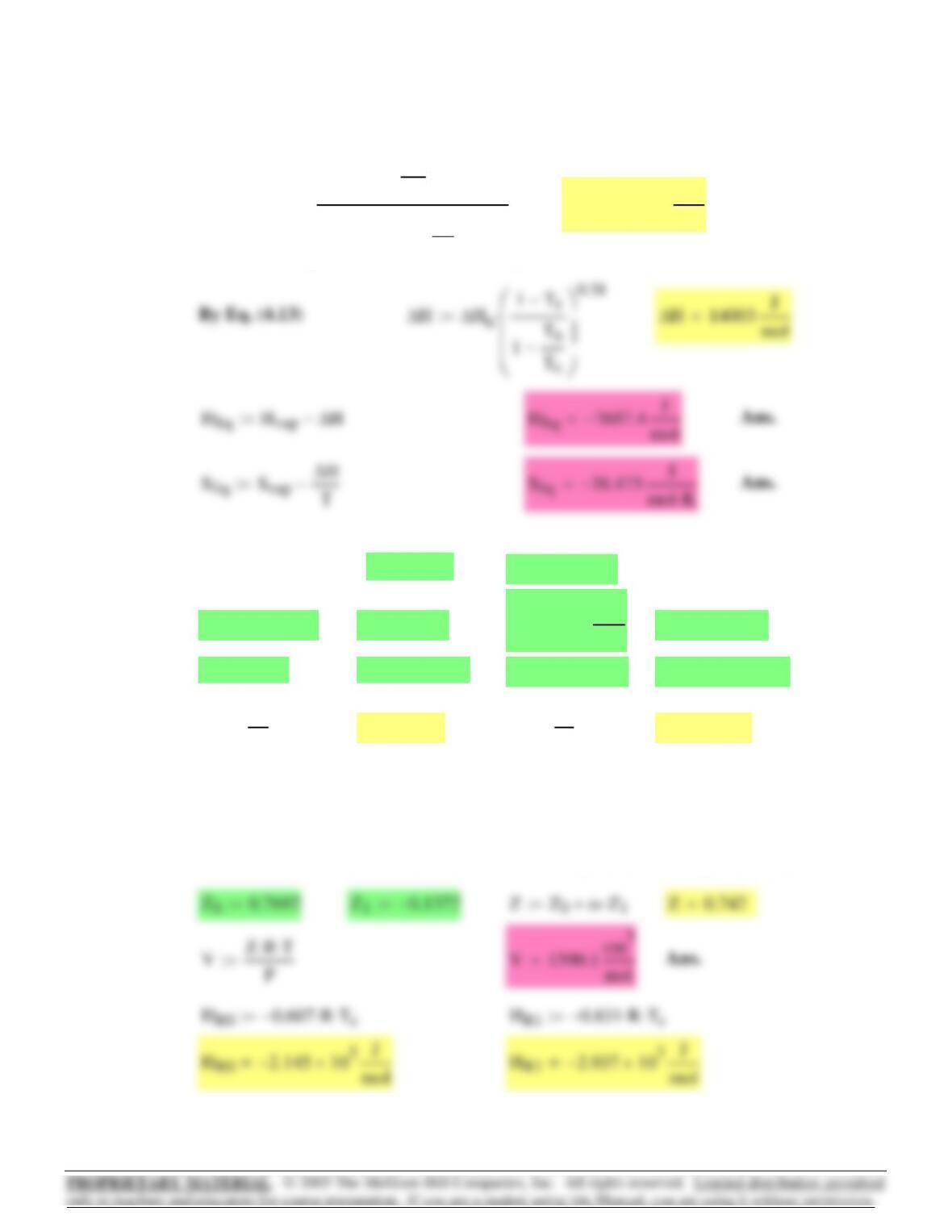
Svap R ICPS T0T,1.935,36.915 10 3−
⋅, 11.402−10 6−
⋅, 0.0,
()
ln P
P0
⎛
⎜
⎝
⎞
⎠
−
⎛
⎜
⎝
⎞
⎠
⋅SR
+:=
Hvap R ICPH T0T,1.935,36.915 10 3−
⋅, 11.402−10 6−
⋅, 0.0,
()
⋅HR
+:=
SR1 0.835−R⋅:=SR0 0.485−R⋅:=
179
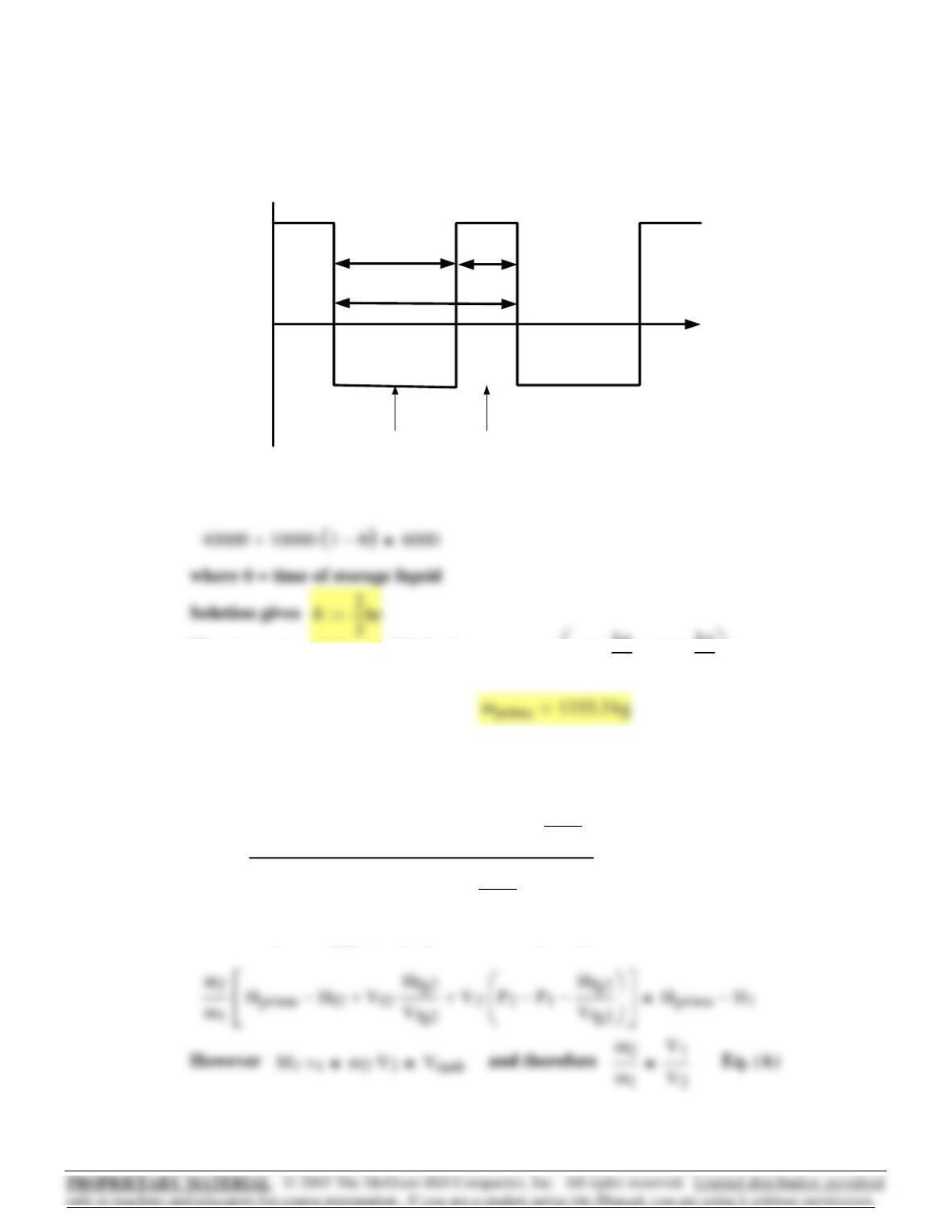
We can replace Vtank by m2V2, and rearrange to get
m2
m1Hprime H1
−
()
⋅Vtank P2P1
−Hfg2
Vfg2
−
⎛
⎜
⎝
⎞
⎠
⋅−
Hprime Hf2
−Vf2
Hfg2
Vfg2
⋅+
=
We consider this storage leg, and for this process of steam addition to
a tank the equation developed in Problem 6-74 is applicable:
mprime 6000 kg
hr 4000 kg
hr
−
⎛
⎜
⎝
⎞
⎠θ⋅:=
The steam stored during this leg is:
This situation is also represented by the equation:
Demand
(kg/hr)
6,000
2/3 hr 1/3 hr
1 hr
4,000 kg/hr
10,000 kg/hr
net storage
of steam
net depletion
of steam
time
Under the stated conditions the worst possible cycling of demand can be
represented as follows:
6.55
180
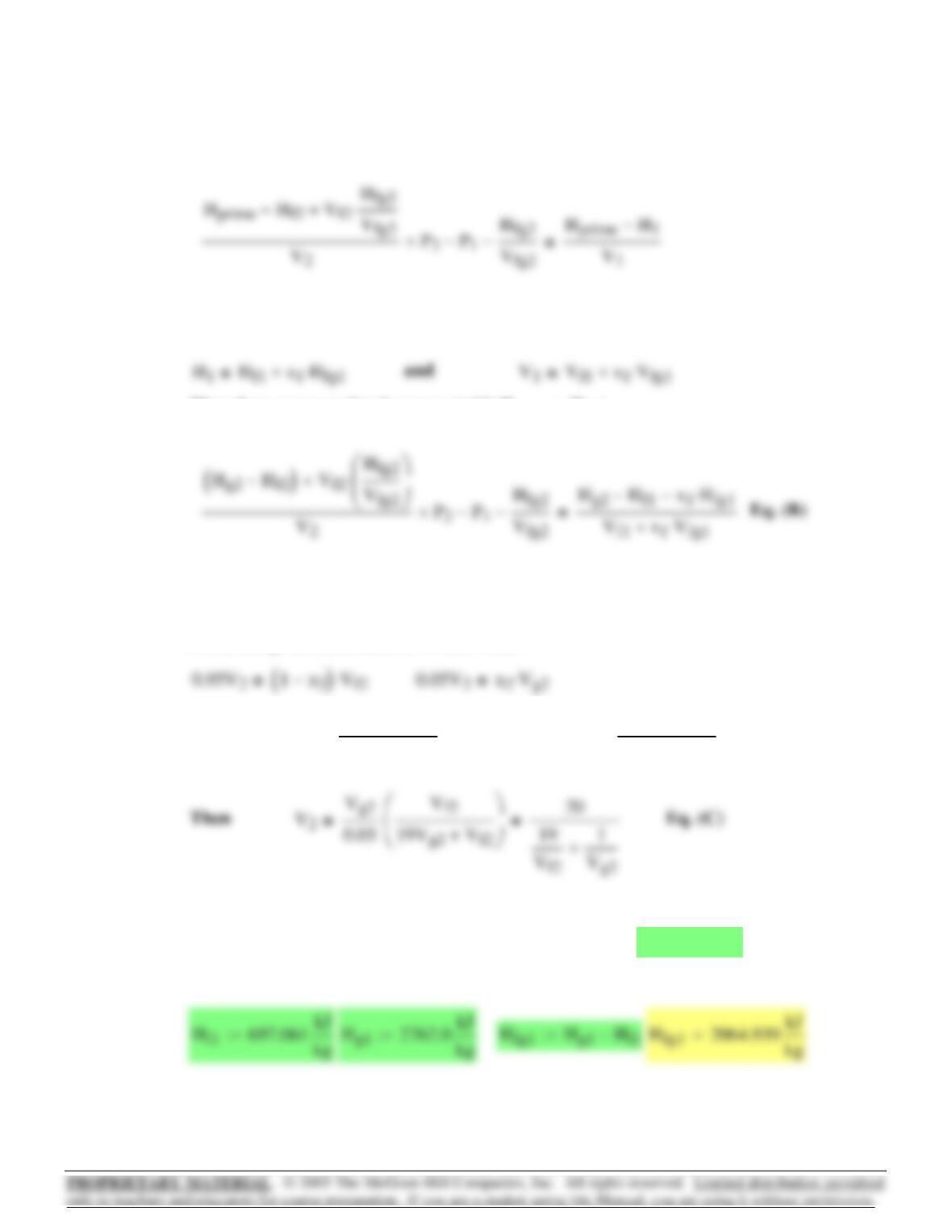
We find from the steam tables
P1700kPa:=
Initial state in accumulator is wet steam at 700 kPa.
Now we need property values:
x2
Vf2
19Vg2 Vf2
+
=
or
19 1x
2
−
()
Vf2
⋅
x2Vg2
⋅
=
therefore
From the given information we can write:
In this equation only x1 is unknown and we can solve for it as follows. First
we need V2:
Therefore our equation becomes (with Hprime = Hg2)
In this equation we can determine from the given information everything
except Hprime and Vprime. These quantities are expressed by
Making this substitution and rearranging we get
181
Given
Hg2 Hf2
−
()
Vf2
Hfg2
Vfg2
⎛
⎜
⎝
⎞
⎠
⋅+
V2
P2
+P1
−Hfg2
Vfg2
−Hg2 Hf1
−x1Hfg1
⋅−
Vf1 x1Vfg1
⋅+
=
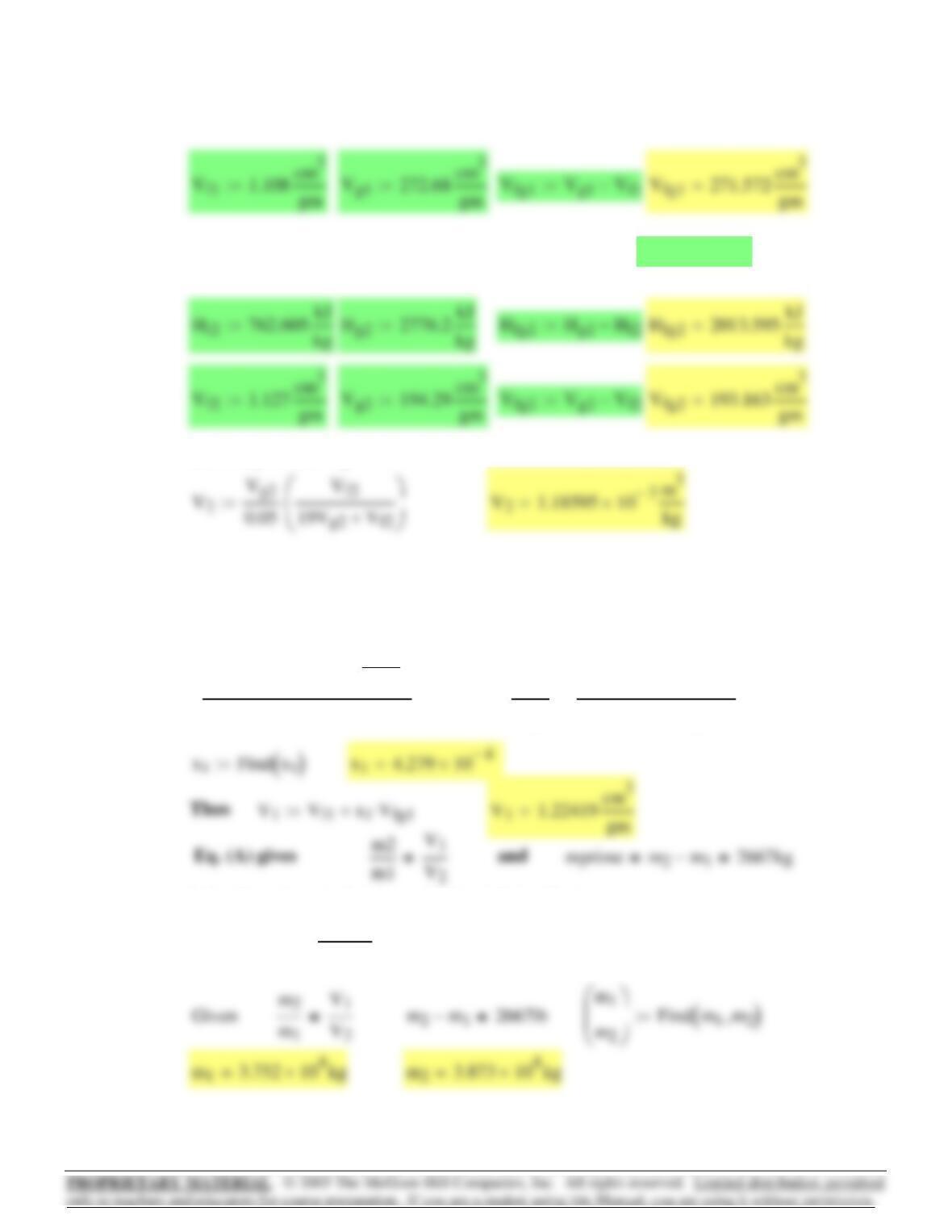
Solve for m1 and m2 using a Mathcad Solve Block:
Guess: m1
mprime
2
:= m2m1
:=
Final state in accumulator is wet steam at 1000 kPa. P21000kPa:=
From the steam tables
Solve Eq. (C) for V2
Next solve Eq. (B) for x1Guess: x10.1:=
182

The throttling process, occurring at constant enthalpy, may be split into two
steps:
(1) Transform into an ideal gas at the initial conditions, evaluating property
changes from a generalized correlation.
(2) Change T and P in the ideal-gas state to the
final conditions, evaluating property changes by equations for an ideal gas.
Property changes for the two steps sum to the property change for the
process. For the initial conditions:
P01 bar⋅:=P 38 bar⋅:=T 400.15 K⋅:=
Pc46.65 bar⋅:=Tc365.6 K⋅:=ω 0.140:=
Propylene:6.56
m1
m2
⎛
⎜
⎝
⎞
⎠Find m1m2
,
()
:=m2m1
−2667lb=
m2
m1
Hprime Hf1
−
Hprime Hf2
−
=
Given
m2
m1
Hprime U1
−
Hprime U2
−
=Hprime Uf1
−
Hprime Uf2
−
=Hprime Hf1
−
Hprime Hf2
−
=
One can work this problem very simply and almost correctly by ignoring the
vapor present. By first equation of problem 3-15
Note that just to store 1333.3 kg of saturated vapor at 1000 kPa would
require a volume of:
183