Chapter 6
Merchandise Inventory
Review Questions
1. Which principle states that businesses should use the same accounting methods and procedures from
period to period?
2. What does the disclosure principle require?
The disclosure principle requires that a company must report enough information in its financial
statements for outsiders to make knowledgeable decisions about the company.
3. Discuss the materiality concept. Is the dollar amount that is material the same for a company that has
annual sales of $10,000 compared with a company that has annual sales of $1,000,000?
The materiality concept states that a company must perform strictly proper accounting only for
4. What is the goal of conservatism?
5. Discuss some measures that should be taken to maintain control over merchandise inventory.
Maintaining goods controls over merchandise inventory is very important for a merchandiser. Good
6. Under a perpetual inventory system, what are the four inventory costing methods and how does each
method determine ending merchandise inventory and cost of goods sold?
The four inventory costing methods are specific identification, FIFO (First-In, First-Out), LIFO
(Last-In, First-Out), and weighted-average. The specific identification method uses the specific cost
7. When using a perpetual inventory system and the weighted-average inventory costing method, when
does the business compute a new weighted-average cost per unit?
8. During periods of rising costs, which inventory costing method produces the highest gross profit?
During periods of rising costs, the FIFO inventory costing method produces the highest gross profit.
9. What does the lower-of-cost-or-market (LCM) rule require?
10. What account is debited when recording the adjusting entry to write down merchandise inventory
under the LCM rule?
11. What is the effect on cost of goods sold, gross profit, and net income if ending merchandise
inventory is understated?
12. When does an inventory error cancel out, and why?
One period’s ending merchandise inventory becomes the next period’s beginning merchandise
13. How is inventory turnover calculated, and what does it measure?
Inventory turnover measures how rapidly merchandise inventory is sold during a period (the number
14. How is days’ sales in inventory calculated, and what does it measure?
Days’ sales in inventory measures the average number of days merchandise inventory is held by a
company. Days’ sales in inventory = 365 days / Inventory turnover.
15A. When using the periodic inventory system, which inventory costing method(s)
always produces the same result as when using the perpetual inventory system?
16A. When using the periodic inventory system and weighted-average inventory costing method,
when is the weighted-average cost per unit computed?
When using the periodic inventory system and weighted-average inventory costing method, the
6-4
Short Exercises
For all short exercises, assume the perpetual inventory system is used unless stated otherwise.
S6-1 Determining inventory accounting principles
Learning Objective 1
Ward Hardware used the FIFO inventory costing method in 2017. Ward plans to continue using the
FIFO method in future years. Which accounting principle is most relevant to Ward’s decision?
SOLUTION
S6-2 Determining inventory costing methods
Learning Objective 2
Ward Hardware does not expect costs to change dramatically and wants to use an inventory costing
method that averages cost changes.
Requirements
1. Which inventory costing method would best meet Ward’s goal?
2. Assume Ward wanted to expense out the newer purchases of goods instead. Which inventory costing
method would best meet that need?
SOLUTION
Requirement 1
Use the following information to answer Short Exercises S6-3 through S6-6.
Montana Cycles started July with 25 bicycles that cost $36 each. On July 16, Montana bought 35
bicycles at $60 each. On July 31, Montana sold 33 bicycles for $105 each.
S6-3 Preparing a perpetual inventory record and journal entries—Specific identification
Learning Objective 2
Requirements
1. Prepare Montana Cycle’s perpetual inventory record assuming the company uses the specific
identification inventory costing method. Assume that Montana sold 20 bicycles that cost $36 each
and 13 bicycles that cost $60 each.
2. Journalize the July 16 purchase of merchandise inventory on account and the July 31 sale of
merchandise inventory on account.
SOLUTION
Requirement 1
Perpetual Inventory Record: Specific Identification
Purchases
Cost of Goods Sold
Inventory on Hand
Date
Quantity
Unit
Cost
Total Cost
Quantity
Unit
Cost
Total Cost
Quantity
Unit
Cost
Total Cost
16
35 units
× $ 60
= $ 2,100
25 units
× $ 36
= $ 900
35 units
31
20 units
× $ 36
= $ 720
5 units
× $ 36
= $ 180
13 units
22 units
6-6
S6-3, cont.
Requirement 2
Date
Accounts and Explanation
Debit
Credit
Jul. 16
Merchandise Inventory
2,100
Accounts Payable
2,100
Purchased inventory on account.
Accounts Receivable
Sales Revenue
Sale on account.
Cost of Goods Sold
Recorded the cost of goods sold.
S6-4 Preparing a perpetual inventory record and journal entries—FIFO
Learning Objective 2
Requirements
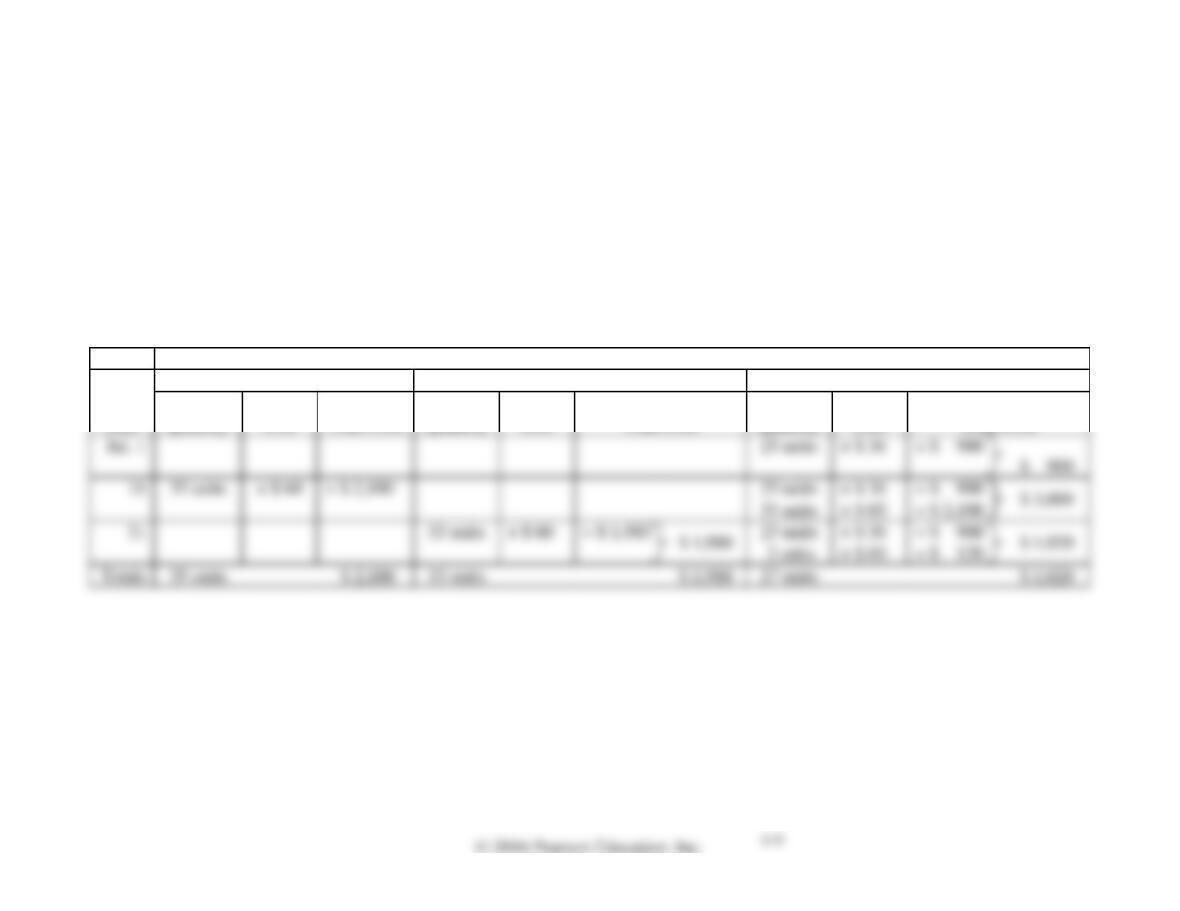
1. Prepare Montana Cycle’s perpetual inventory record assuming the company uses the FIFO inventory costing method.
2. Journalize the July 16 purchase of merchandise inventory on account and the July 31 sale of merchandise inventory on account.
SOLUTION
Requirement 1
Perpetual Inventory Record: FIFO
Purchases
Cost of Goods Sold
Inventory on Hand
Date
Quantity
Unit
Cost
Total Cost
Quantity
Unit
Cost
Total Cost
Quantity
Unit
Cost
Total Cost
16
35 units
31
Totals
35 units
S6-4, cont.
Requirement 2
Date
Accounts and Explanation
Debit
Credit
Jul. 16
Merchandise Inventory
2,100
Accounts Payable
2,100
Purchased inventory on account.
Accounts Receivable
Sales Revenue
Sale on account.
Cost of Goods Sold
Recorded the cost of goods sold.
Calculations:
S6-5 Preparing a perpetual inventory record and journal entries—LIFO
Learning Objective 2
Requirements
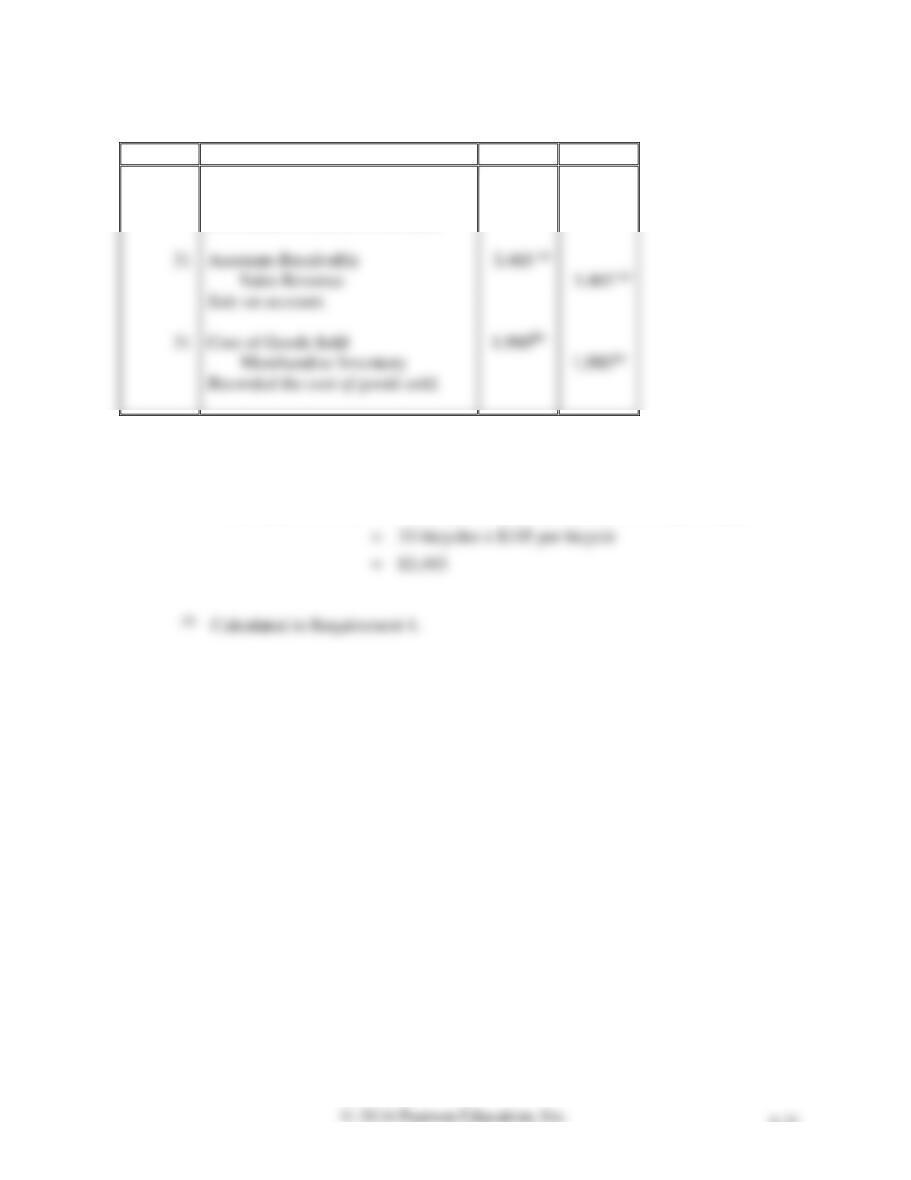
1. Prepare Montana Cycle’s perpetual inventory record assuming the company uses the LIFO inventory costing method.
2. Journalize the July 16 purchase of merchandise inventory on account and the July 31 sale of merchandise inventory on account.
SOLUTION
Requirement 1
Perpetual Inventory Record: LIFO
Purchases
Cost of Goods Sold
Inventory on Hand
Date
Quantity
Unit
Cost
Total Cost
Quantity
Unit
Cost
Total Cost
Quantity
Unit
Cost
Total Cost
16
35 units
31
Totals
35 units
6-10
S6-5, cont.
Requirement 2
Date
Accounts and Explanation
Debit
Credit
Jul. 16
Merchandise Inventory
2,100
Accounts Payable
2,100
Purchased inventory on account.
Accounts Receivable
Sales Revenue
Sale on account.
Cost of Goods Sold
Merchandise Inventory
Recorded the cost of goods sold.
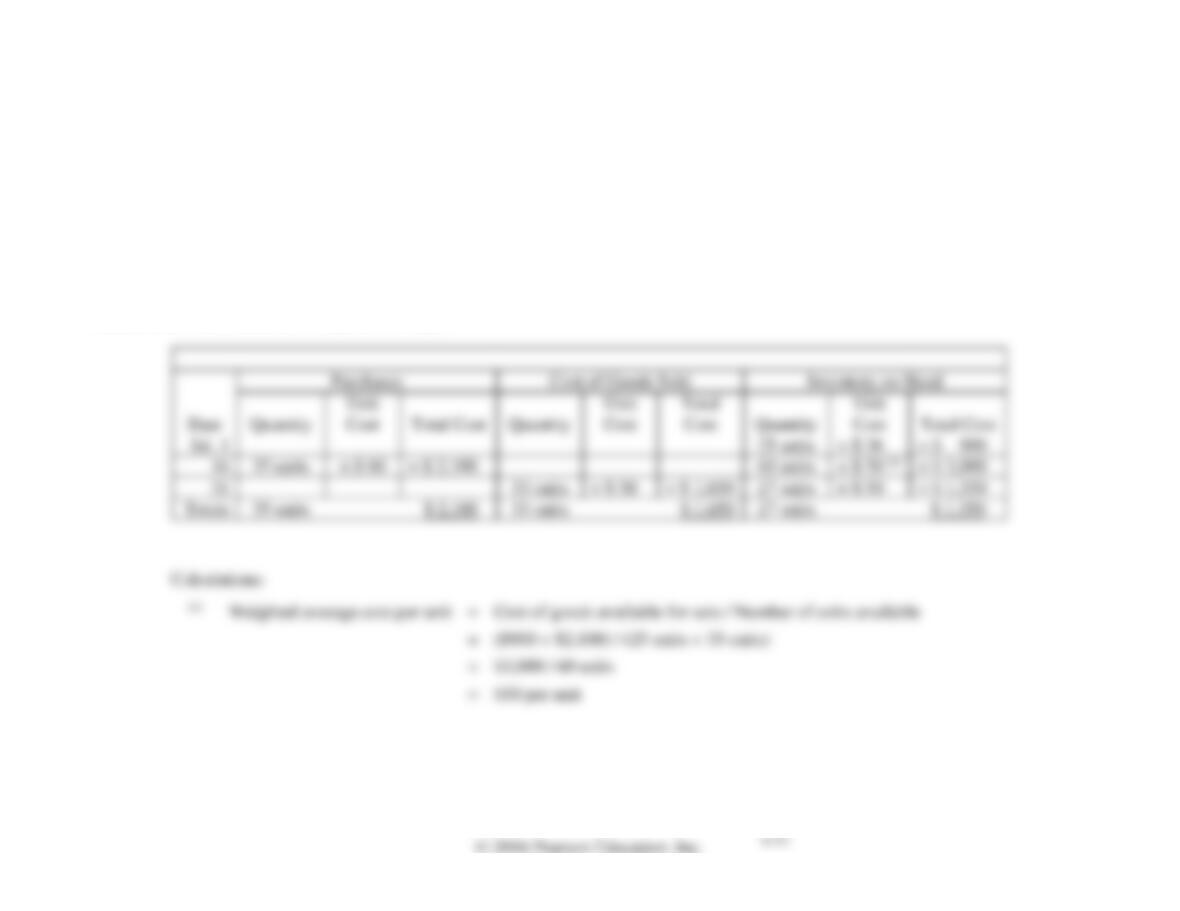
Calculations:
(a)
Total sales revenue
=
Number of bicycles sold x Sales price per bicycle
=
33 bicycles x $105 per bicycle
=
$3,465
(b)
Calculated in Requirement 1.
S6-6 Preparing a perpetual inventory record and journal entries—Weighted-average
Learning Objective 2
Requirements
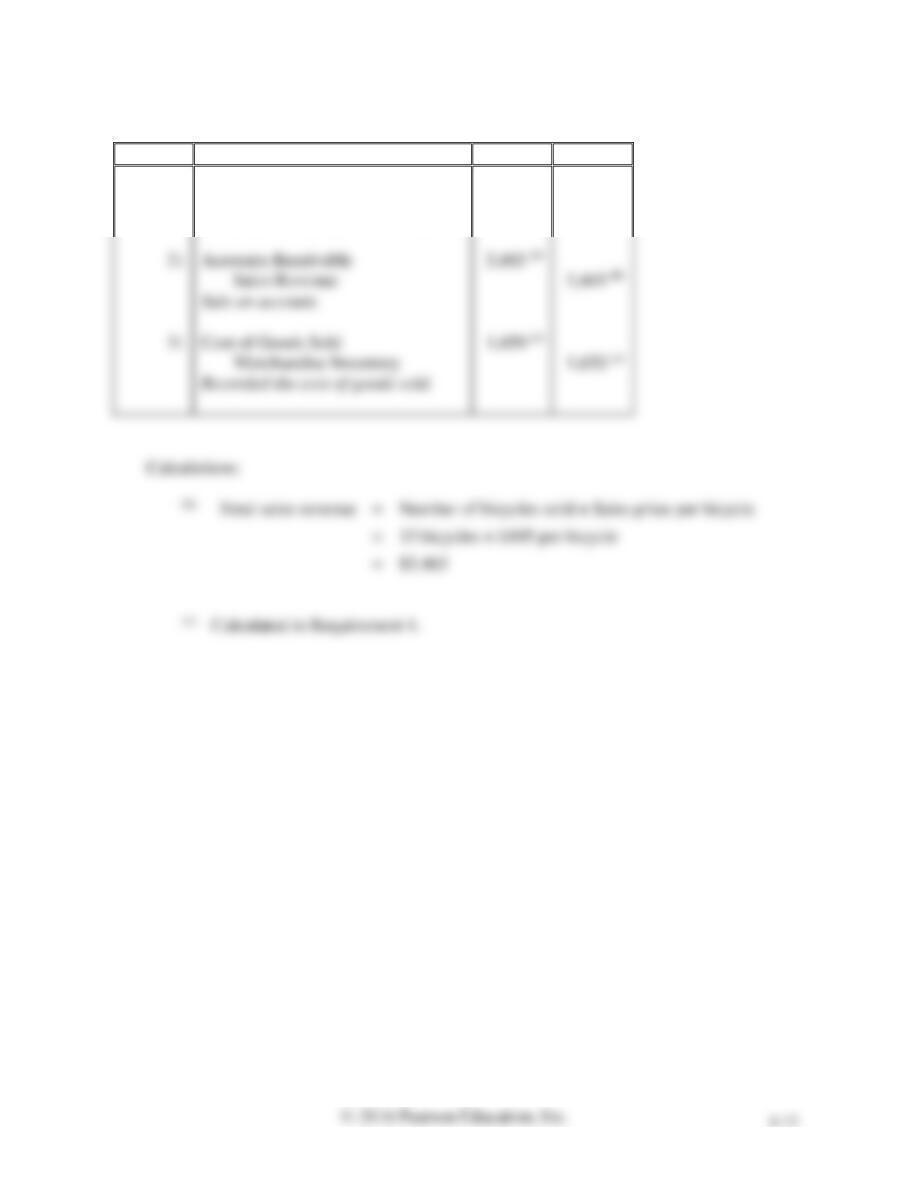
1. Prepare Montana Cycle’s perpetual inventory record assuming the company uses the weighted-average inventory costing method.
2. Journalize the July 16 purchase of merchandise inventory on account and the July 31 sale of merchandise inventory on account.
SOLUTION
Requirement 1
Perpetual Inventory Record: Weighted-Average
S6-6, cont.
Requirement 2
Date
Accounts and Explanation
Debit
Credit
Jul. 16
Merchandise Inventory
2,100
Accounts Payable
2,100
Purchased inventory on account.
Accounts Receivable
Sales Revenue
Sale on account.
Cost of Goods Sold
Recorded the cost of goods sold.
Note: Short Exercises S6-4, S6-5, and S6-6 must be completed before attempting Short Exercise S6-7.
S6-7 Comparing Cost of Goods Sold under FIFO, LIFO, and Weighted-average
Learning Objective 3
Refer to Short Exercises S6-4 through S6-6. After completing those exercises, answer the following
questions:
Requirements
1. Which inventory costing method produced the lowest cost of goods sold?
2. Which inventory costing method produced the highest cost of goods sold?
3. If costs had been declining instead of rising, which inventory costing method would have produced
the highest cost of goods sold?
SOLUTION
Requirement 1
S6-8 Applying the lower-of-cost-or-market rule
Learning Objective 4
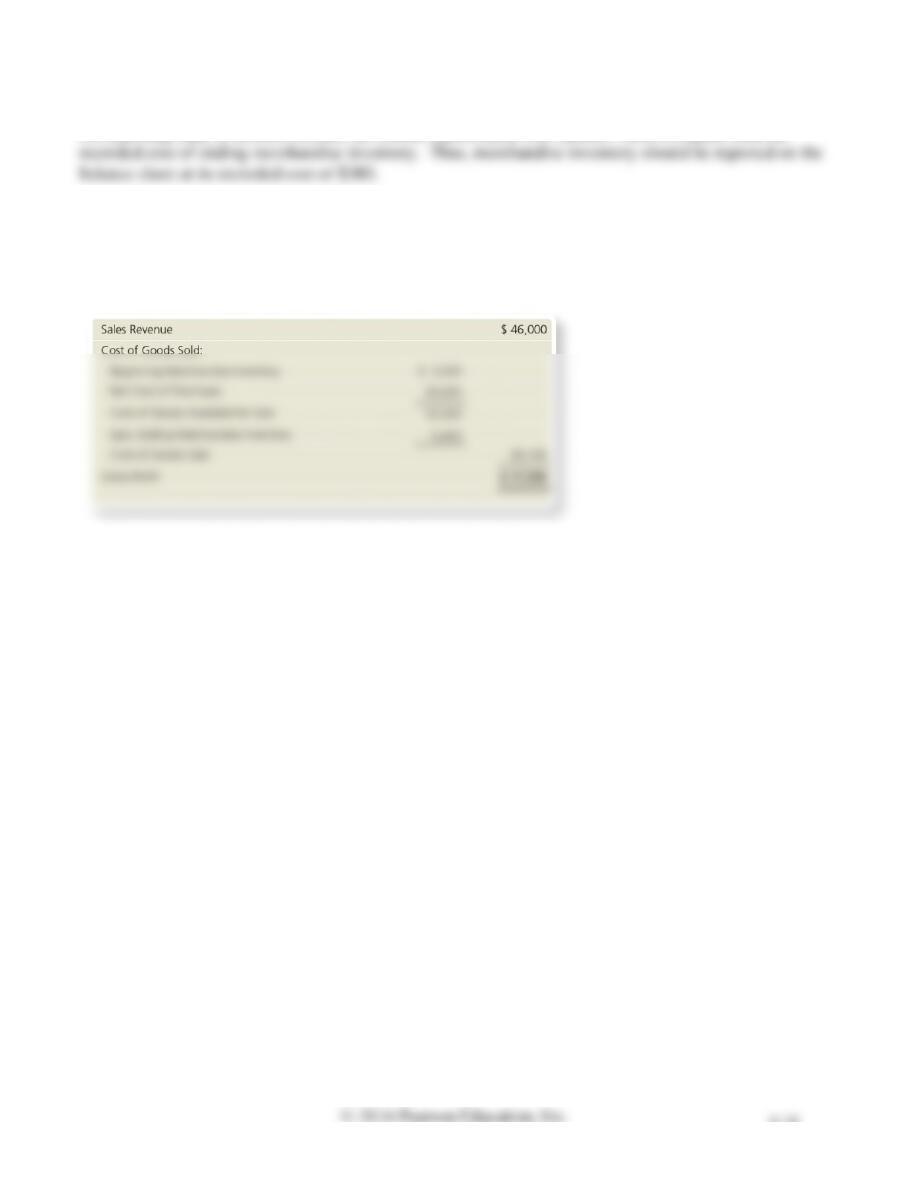
Assume that a Mega Burger restaurant has the following perpetual inventory record for hamburger
patties:
6-14
SOLUTION
No adjusting entry is needed because the current replacement cost (market value) is higher than the
S6-9 Determining the effect of an inventory error
Learning Objective 5
Mountain Pool Supplies’s merchandise inventory data for the year ended December 31, 2017, follow:
Requirements
1. Assume that the ending merchandise inventory was accidentally overstated by
$1,300. What are the correct amounts for cost of goods sold and gross profit?
2. How would the inventory error affect Mountain Pool Supplies’s cost of goods sold and gross profit
for the year ended December 31, 2018, if the error is not corrected in 2017?
SOLUTION
Requirement 1
For the year ended December 31, 2017, the correct amounts for cost of goods sold and gross profit are
$29,400 and $16,600, respectively.
If ending inventory is overstated by $1,300,
then cost of goods sold is understated by $1,300.
$ 28,100
Incorrect cost of goods sold
Understatement
Correct cost of goods sold
If cost of goods sold is understated by $1,300,
then gross profit is overstated by $1,300.
$ 17,900
Incorrect gross profit
(1,300)
Overstatement
Correct gross profit
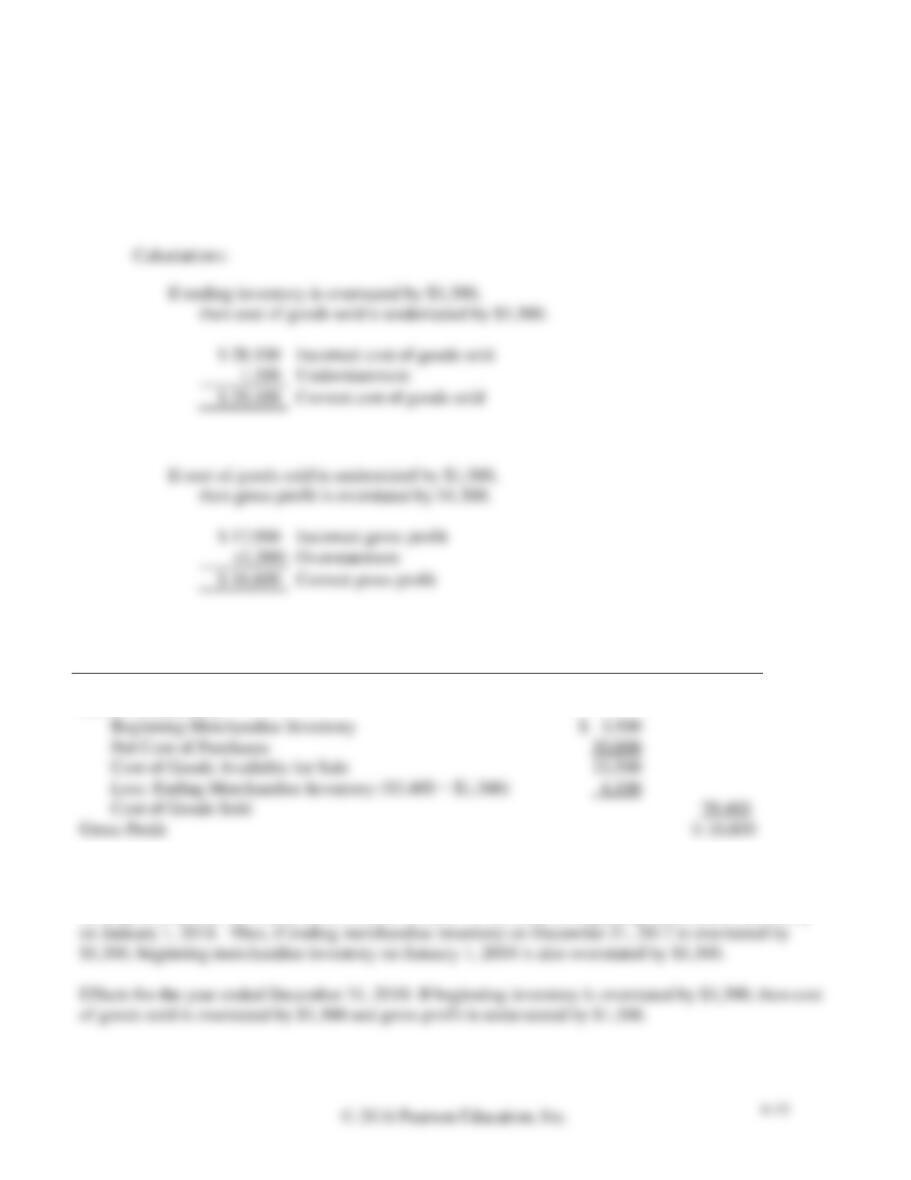
This can be proved as follows:
Sales Revenue
$ 46,000
Cost of Goods Sold:
$ 3,500
Gross Profit
$ 16,600
Requirement 2
Ending merchandise inventory on December 31, 2017 is the same as beginning merchandise inventory
6-16
S6-10 Computing the rate of inventory turnover and days’ sales in inventory
Learning Objective 6
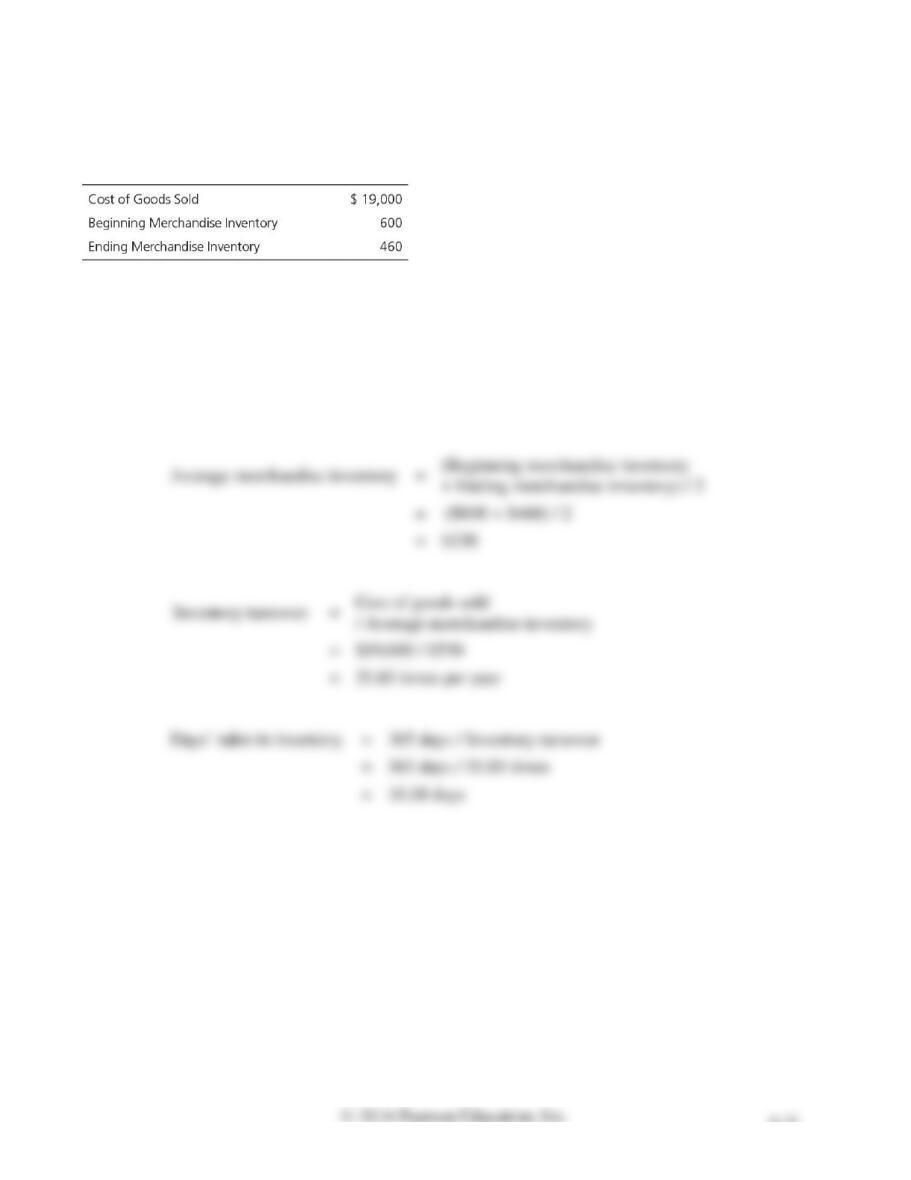
Clear Communications reported the following figures in its annual financial statements:
Compute the rate of inventory turnover and days’ sales in inventory for Clear Communications. (Round
to two decimal places.)
SOLUTION
Inventory turnover is 35.85 times and days’ sales in inventory is 10.18 days.
Calculations:

Use the following information to answer Short Exercises S6A-11 through S6A-13.
The periodic inventory records of Cambridge Prosthetics indicate the following for the month of July:
At July 31, Cambridge counts nine units of merchandise inventory on hand.
S6A-11 Computing periodic inventory amounts—FIFO
Learning Objective 7
Appendix 6A
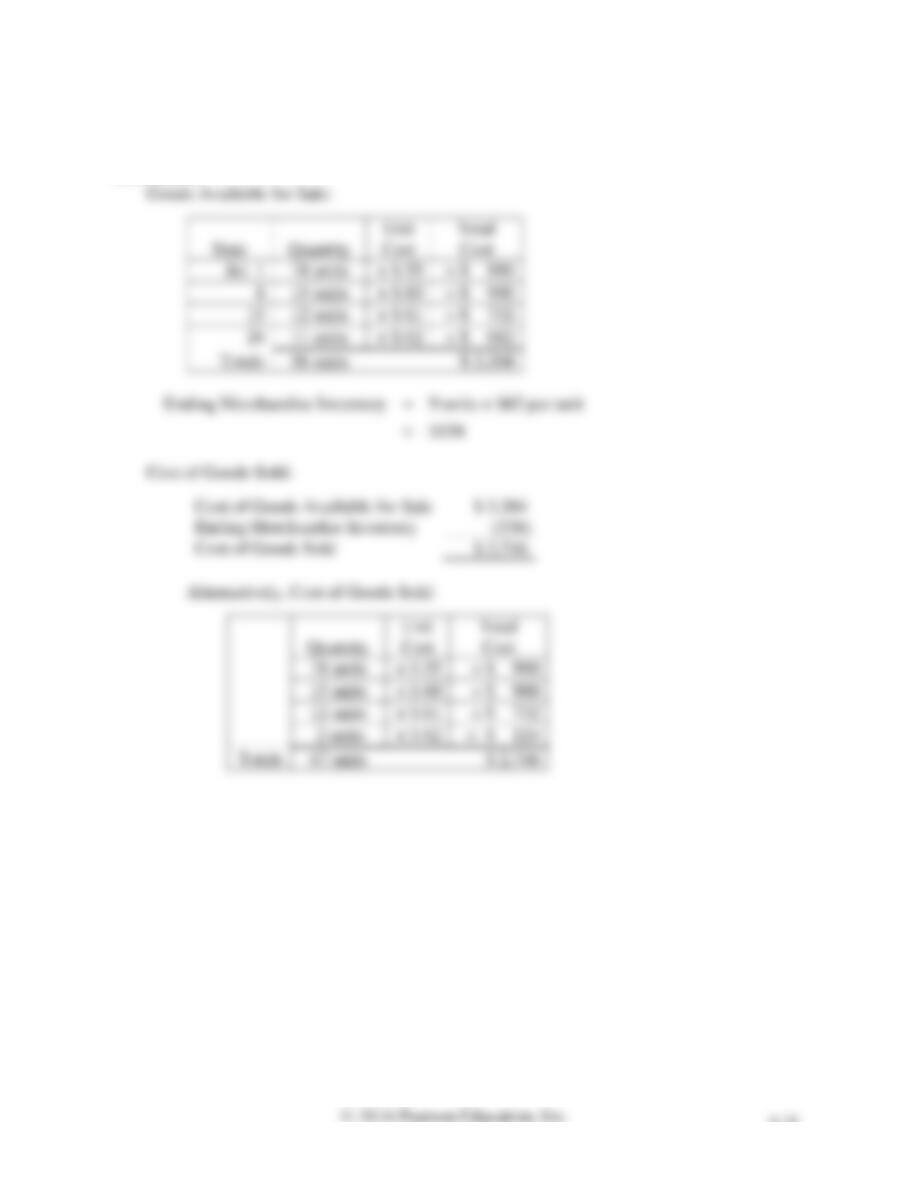
Compute ending merchandise inventory and cost of goods sold for Cambridge using the FIFO inventory
costing method.
6-18
SOLUTION
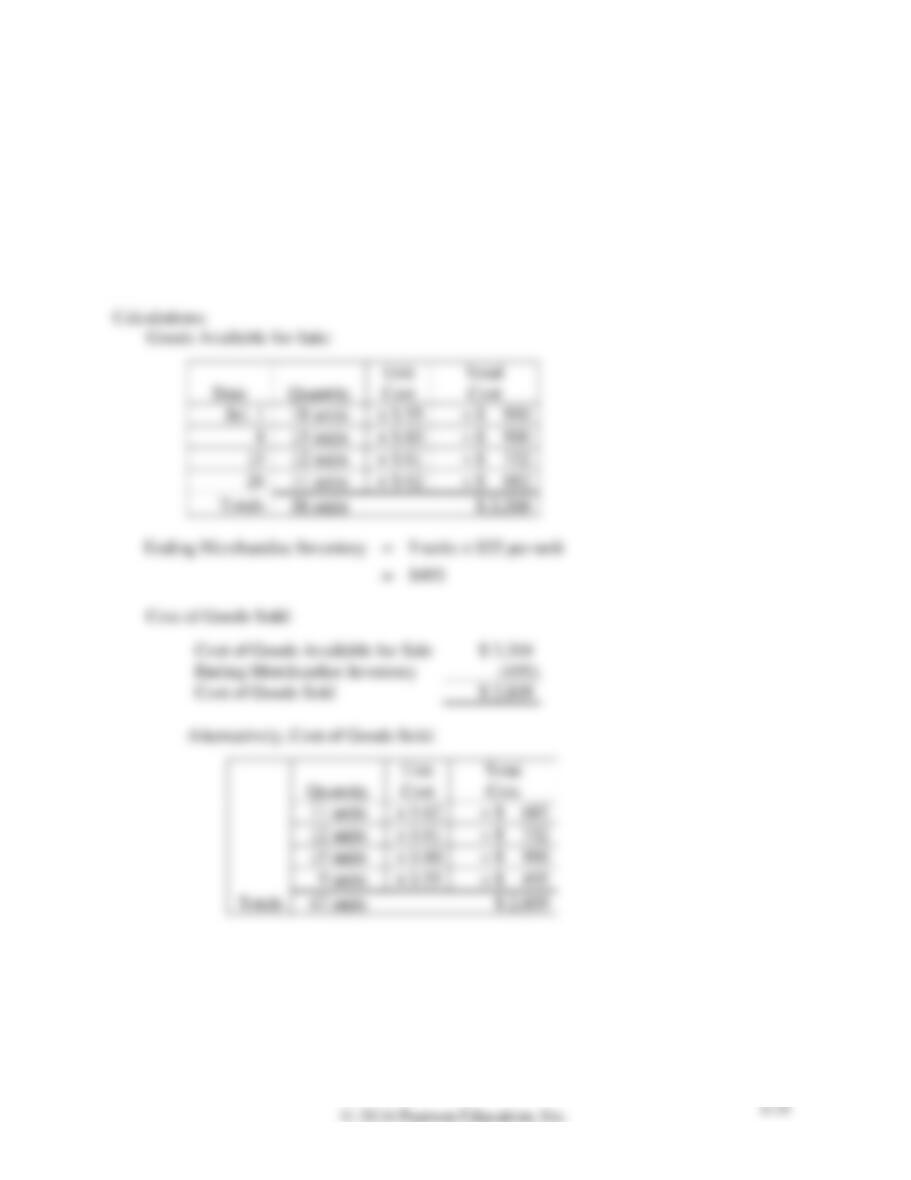
Using FIFO, ending merchandise inventory is $558 and cost of goods sold is $2,746.
Calculations:
S6A-12 Computing periodic inventory amounts—LIFO
Learning Objective 7
Appendix 6A
Compute ending merchandise inventory and cost of goods sold for Cambridge using the LIFO inventory
costing method.
SOLUTION
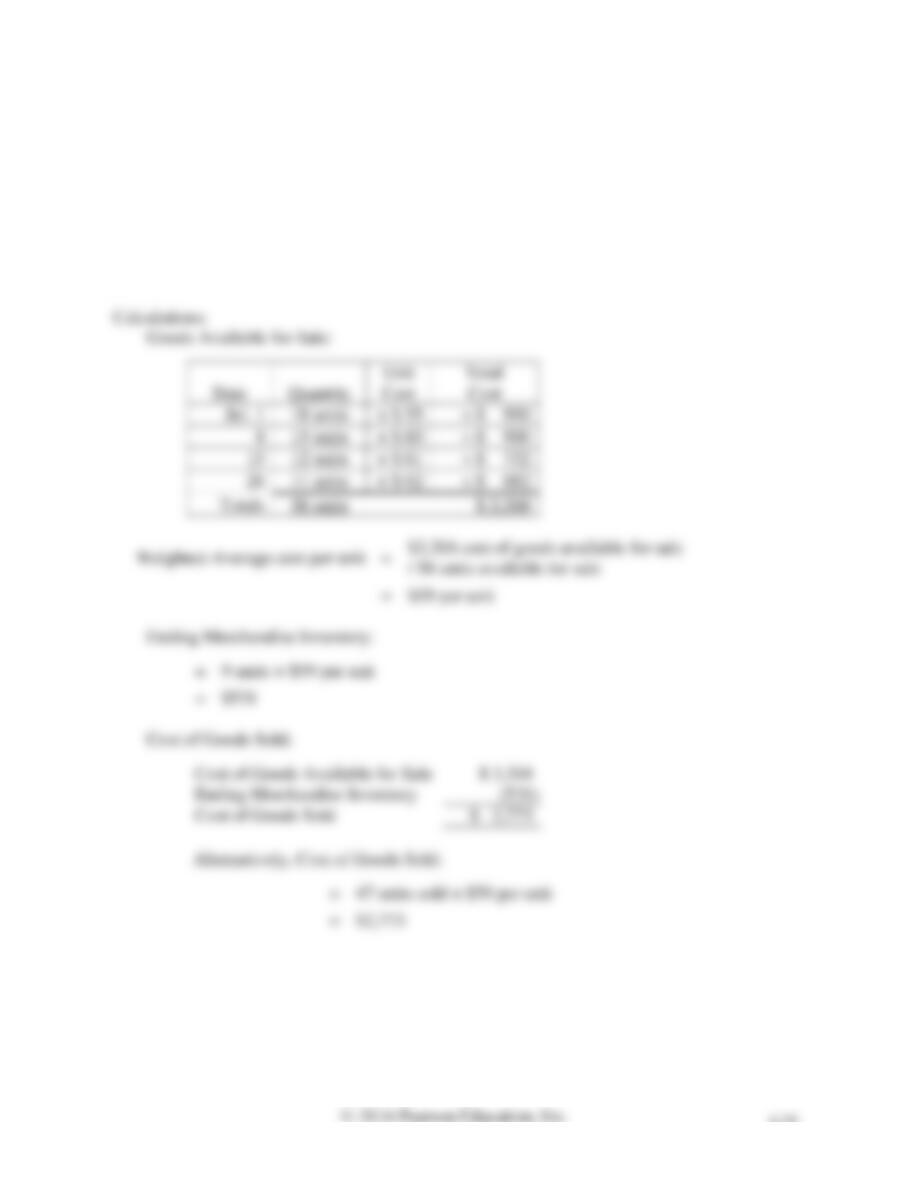
Using LIFO, ending merchandise inventory is $495 and cost of goods sold is $2,809.
6-20
S6A-13 Computing periodic inventory amounts—Weighted-average
Learning Objective 7
Appendix 6A
Compute ending merchandise inventory and cost of goods sold for Cambridge using the weighted-
average inventory costing method.
SOLUTION
Using weighted-average, ending merchandise inventory is $531 and cost of goods sold is $2,773.