Newton-Cotes Quadrature 1
6.4 Newton-Cotes Quadrature
1. Approximate the value of each of the following integrals using the trapezoidal
rule. Verify that the theoretical error bound holds in each case.
(a) R2
1
1
xdx (b) R1
0e−xdx (c) R1
0
1
1+x2dx (d) R1
0tan−1xdx.
Recall that the trapezoidal rule gives
Moreover, the theoretical error bound associated with the trapezoidal rule is
The error in this approximation is
(b) With f(x) = e−x,a= 0 and b= 1,
The error in this approximation is
2Section 6.4
(c) With f(x) = 1
(d) With f(x) = tan−1x,a= 0 and b= 1,
2. Repeat Exercise 1 using Simpson’s rule rather than the trapezoidal rule.
Recall that Simpson’s rule gives
(a) With f(x) = 1
Newton-Cotes Quadrature 3
which is smaller than the theoretical error bound
(b) With f(x) = e−x,a= 0 and b= 1,
(c) With f(x) = 1
1+x2,a= 0 and b= 1,
(d) With f(x) = tan−1x,a= 0 and b= 1,
The error in this approximation is
3. Repeat Exercise 1 using the midpoint rule rather than the trapezoidal rule.
Recall that the midpoint rule gives
(a) With f(x) = 1
(b) With f(x) = e−x,a= 0 and b= 1,
(c) With f(x) = 1
1+x2,a= 0 and b= 1,
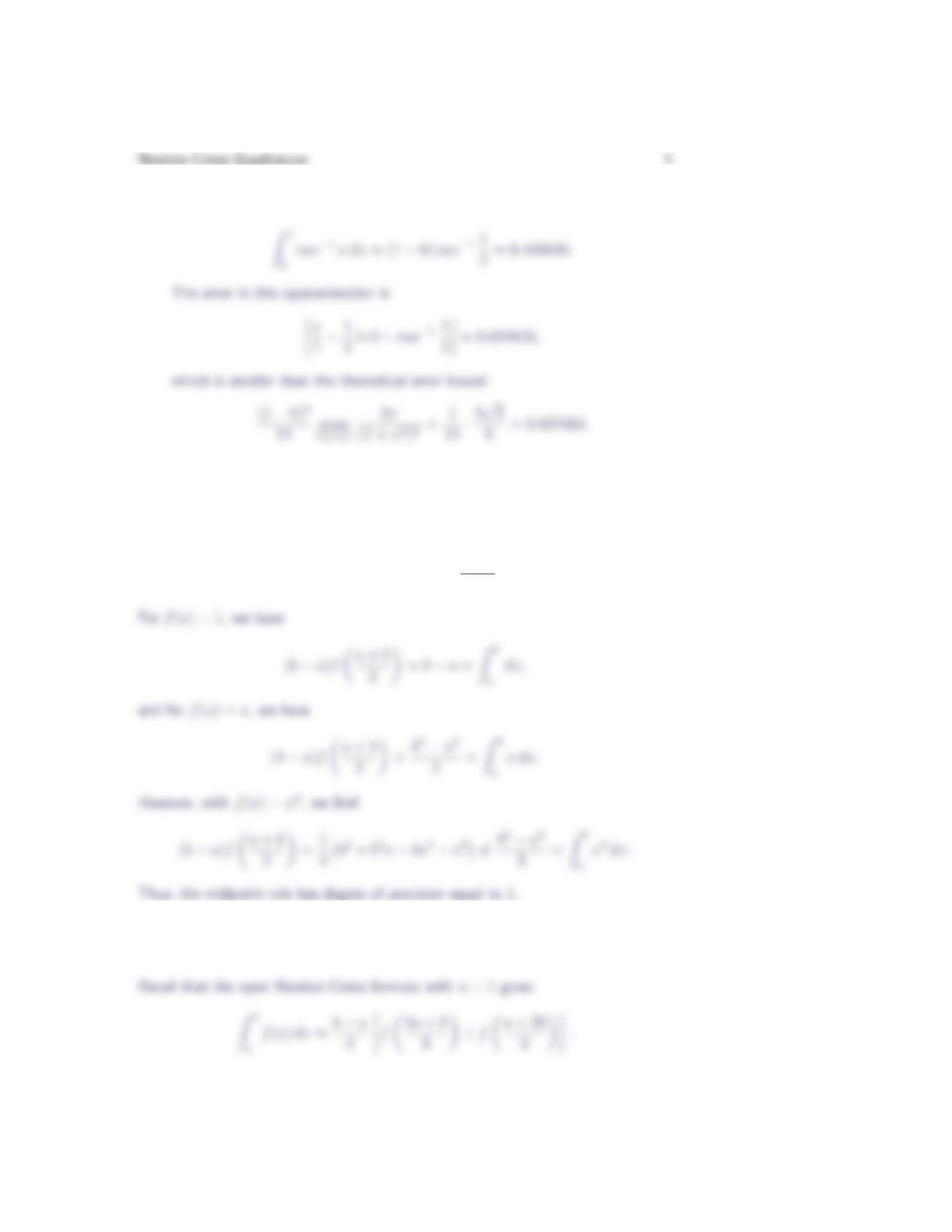
(d) With f(x) = tan−1x,a= 0 and b= 1,
4. Verify directly that the midpoint rule has degree of precision equal to 1.
Recall that the midpoint rule gives
Zb
a
f(x)dx ≈(b−a)fa+b
2.
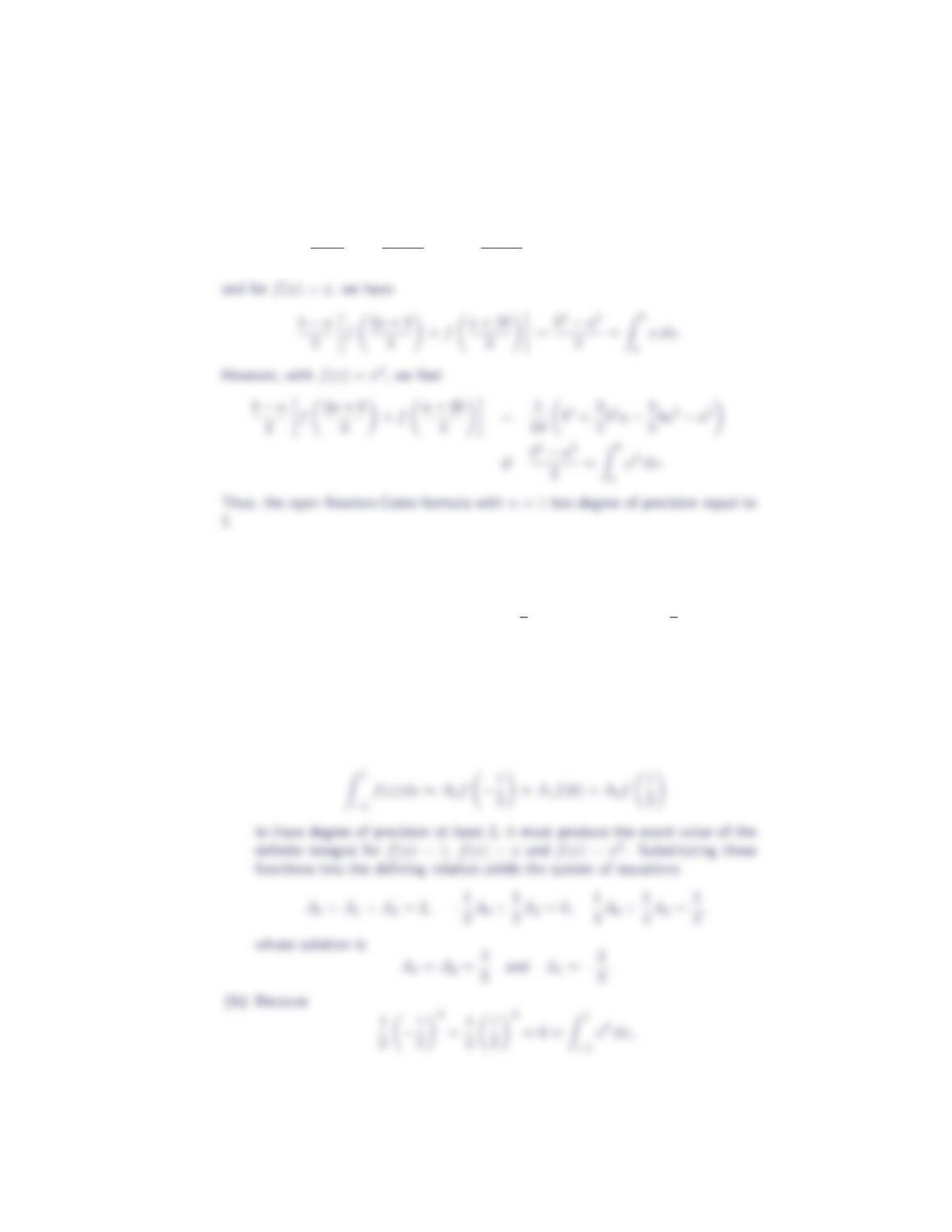
5. Verify directly that the open Newton-Cotes formula with n= 1 has degree of
precision equal to 1.
6Section 6.4
For f(x) = 1, we have
b−a
2f2a+b
3+fa+ 2b
3=b−a=Zb
a
dx,
6. (a) Determine values for the coefficients A0,A1and A2so that the quadrature
formula
I(f) = Z1
−1
f(x)dx =A0f−1
2+A1f(0) + A2f1
2
has degree of precision at least 2.
(b) Once the values of A0,A1and A2have been computed, determine the
overall degree of precision for the quadrature rule.
(a) For the quadrature formula
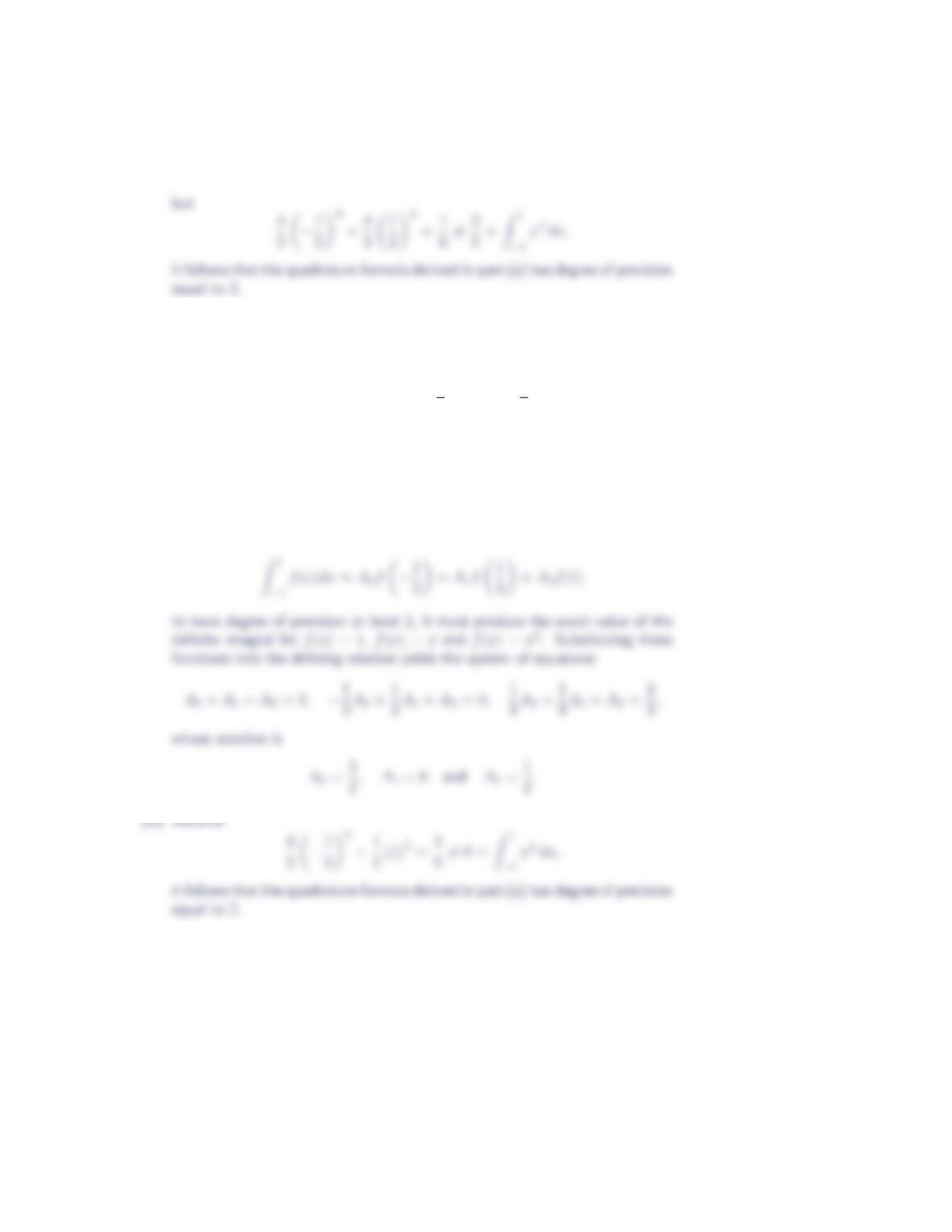
Newton-Cotes Quadrature 7
7. (a) Determine values for the coefficients A0,A1and A2so that the quadrature
formula
I(f) = Z1
−1
f(x)dx =A0f−1
3+A1f1
3+A2f(1)
has degree of precision at least 2.
(b) Once the values of A0,A1and A2have been computed, determine the
overall degree of precision for the quadrature rule.
(a) For the quadrature formula
8. (a) Determine values for the coefficients A0,A1and x1so that the quadrature
formula
I(f) = Z1
−1
f(x)dx =A0f(−1) + A1f(x1)
has degree of precision at least 2.
8Section 6.4
(b) Once the values of A0,A1and x1have been computed, determine the
overall degree of precision for the quadrature rule.
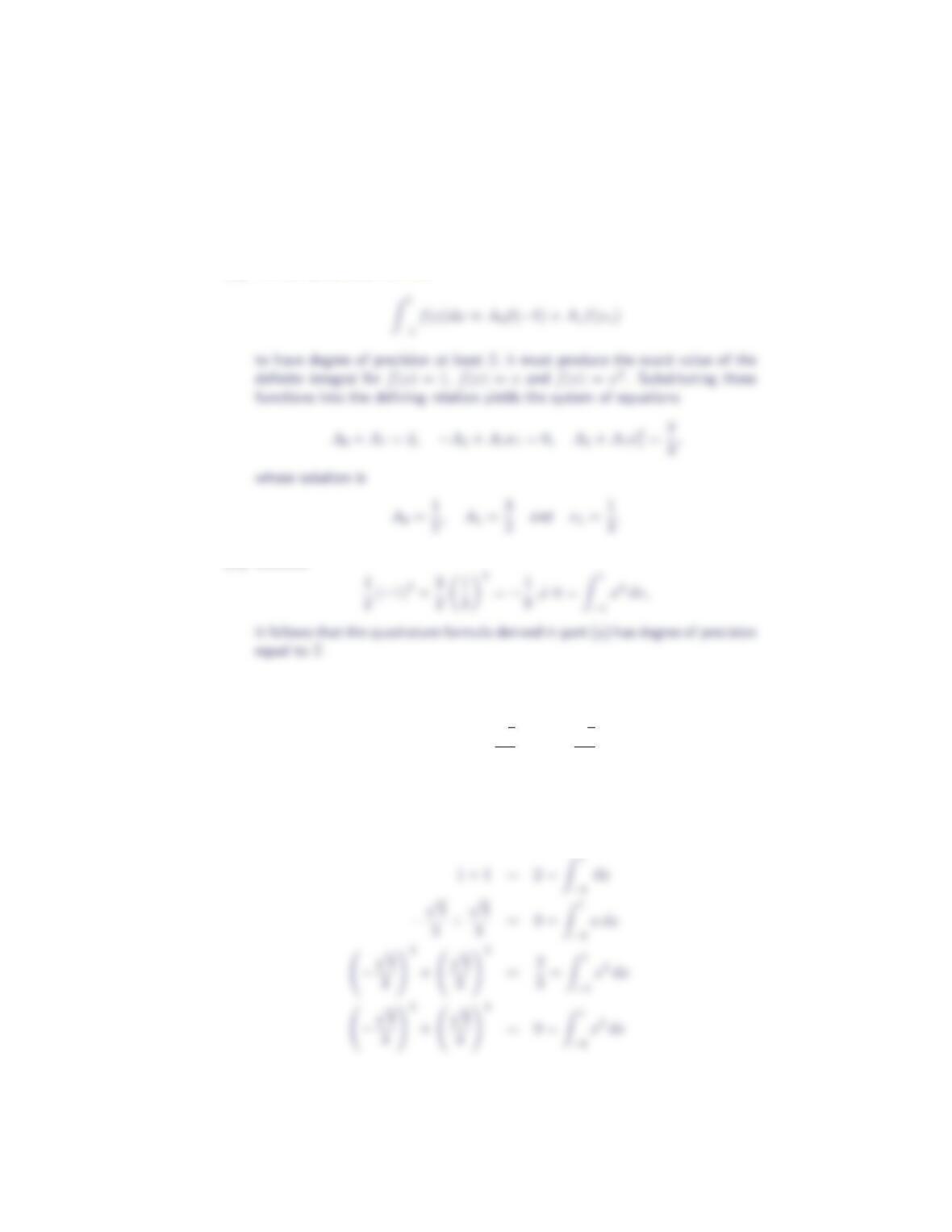
(a) For the quadrature formula
(b) Because
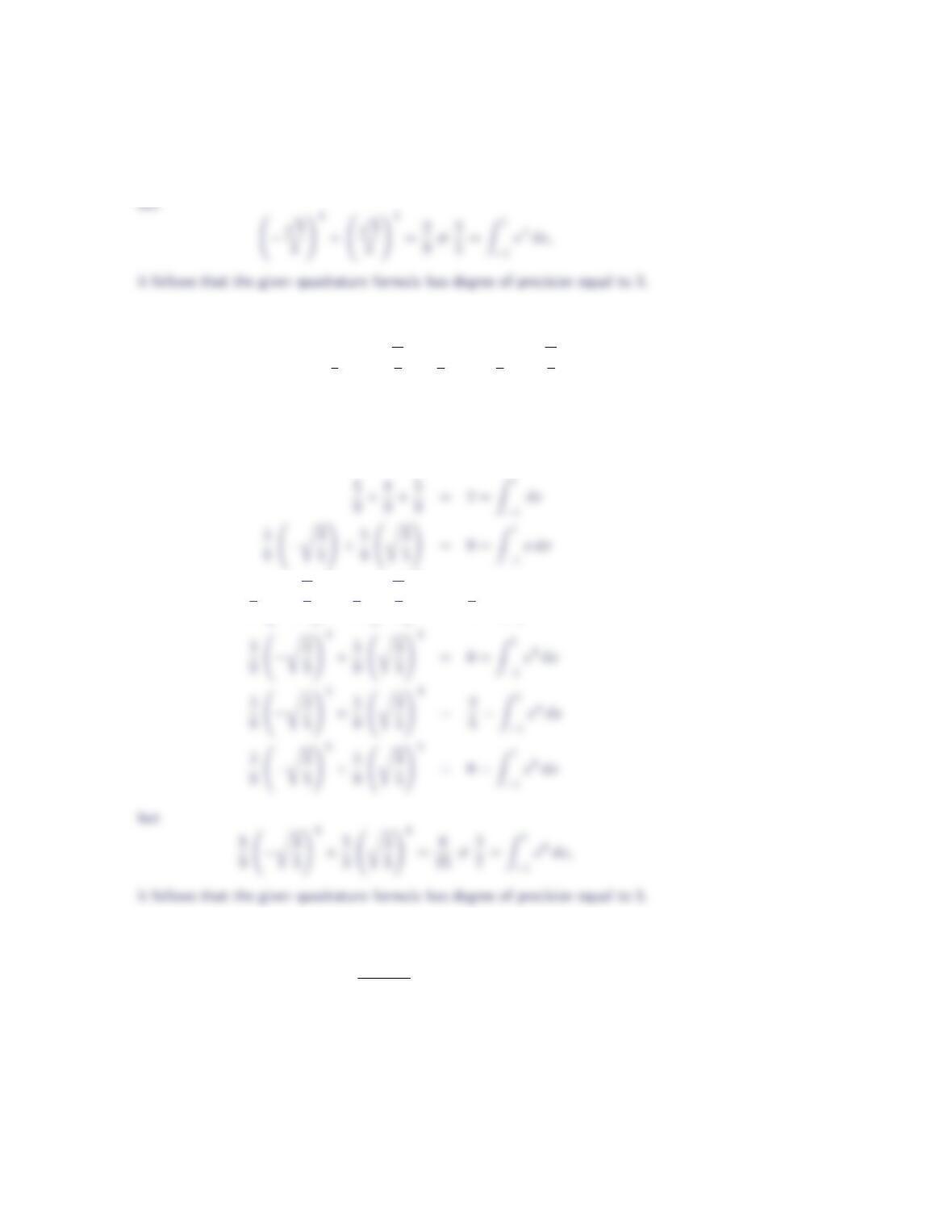
9. Consider the quadrature rule
Z1
−1
f(x)dx ≈f −√3
3!+f √3
3!.
Determine the degree of precision of this formula.
Because
Newton-Cotes Quadrature 9
10. Consider the quadrature rule
Z1
−1
f(x)dx ≈5
9f −r3
5!+8
9f(0) + 5
9f r3
5!.
Determine the degree of precision of this formula.
Because
5
9 −r3
5!2
+5
9 r3
5!2
=2
3=Z1
−1
x2dx
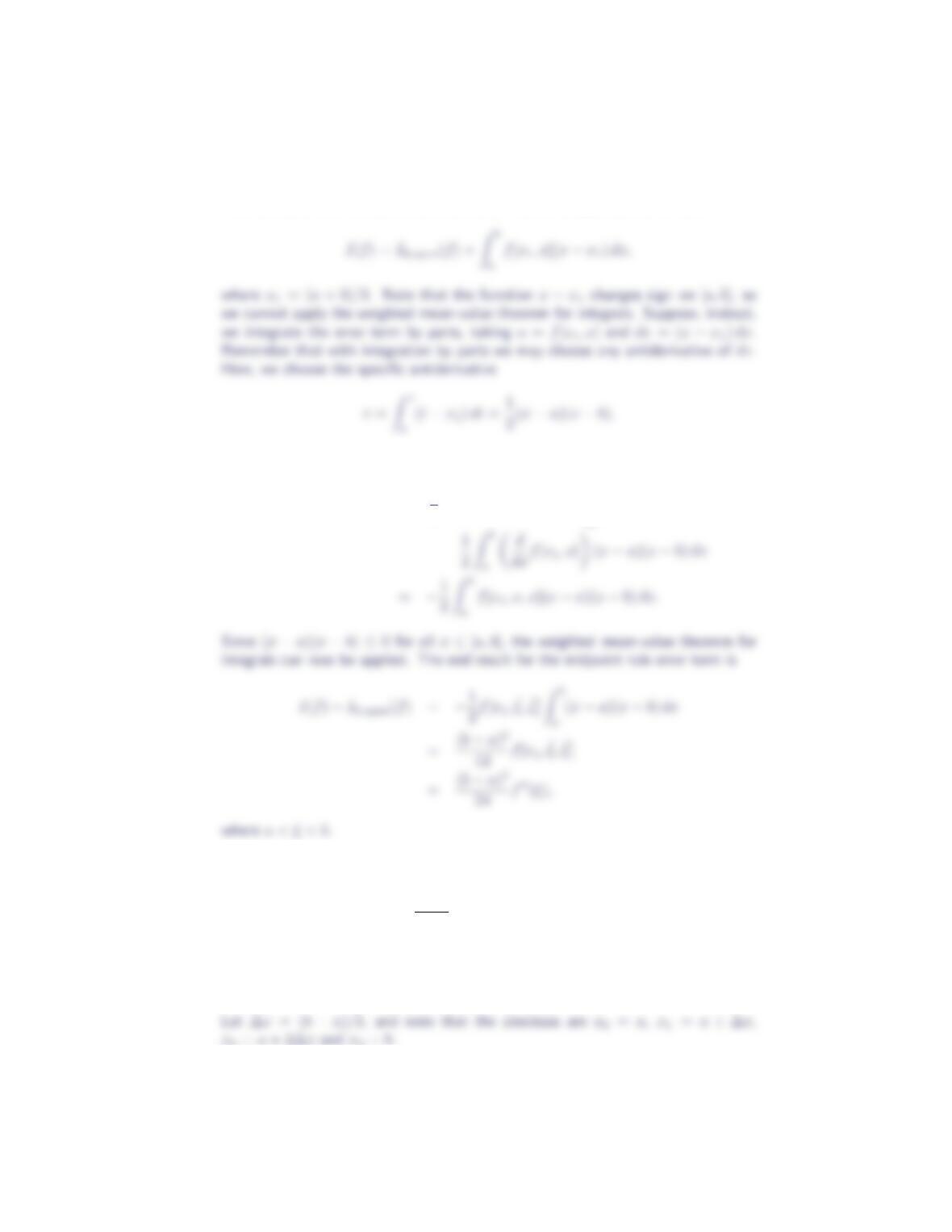
11. Derive the error term for the midpoint rule:
(b−a)3
24 f00(ξ),
where a < ξ < b.
10 Section 6.4
From interpolation theory and the derivation of the midpoint rule, we have
Then,
I(f)−I0,open(f) = 1
2(x−a)(x−b)f[x1, x]
b
a−
12. (a) Derive the closed Newton-Cotes formula with n= 3
I(f)≈I3,closed(f) = b−a
8[f(a)+3f(a+ ∆x)+3f(a+ 2∆x) + f(b)].
(b) Verify that this formula has degree of precision equal to 3.
(c) Derive the error term associated with this quadrature rule.
Newton-Cotes Quadrature 11
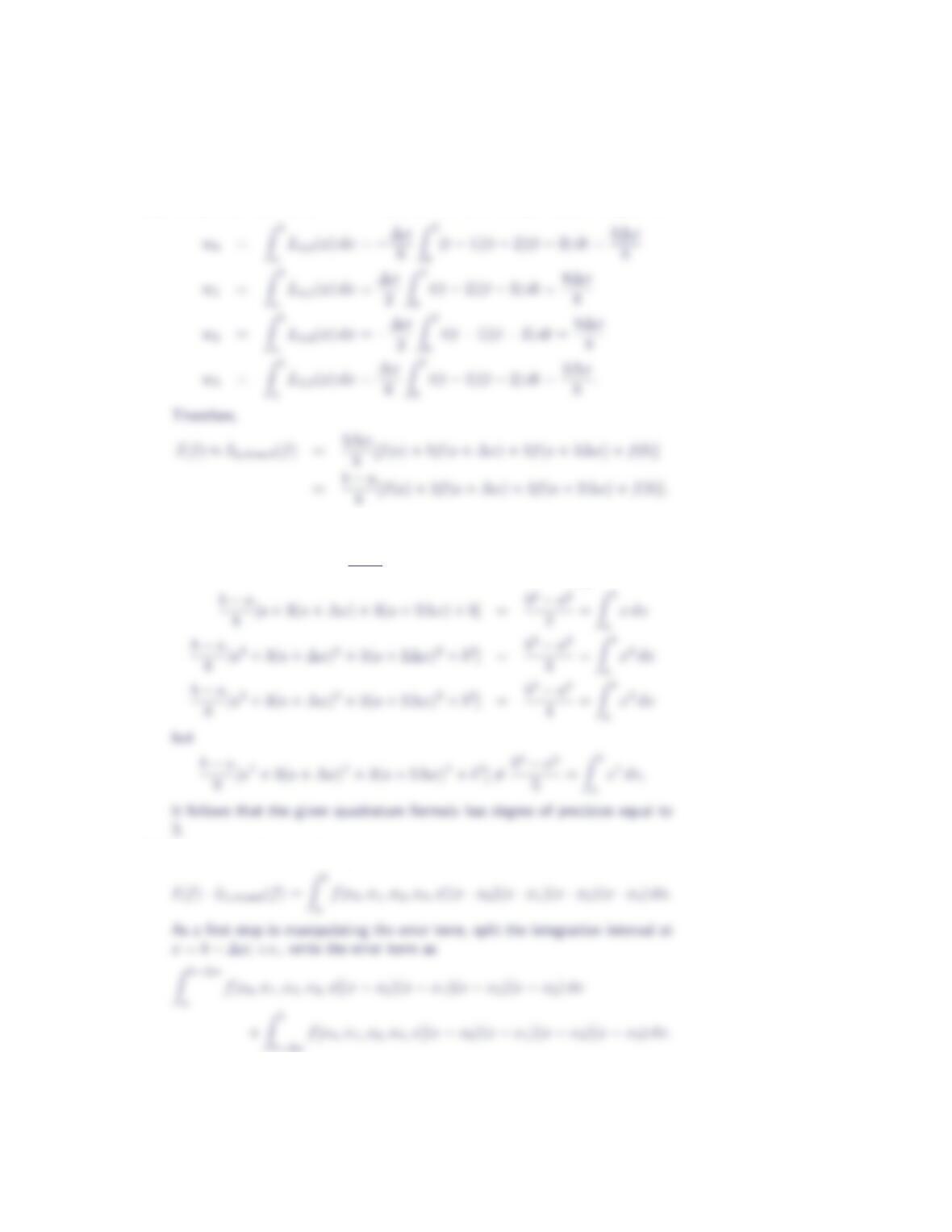
(a) Using the substitution x=a+t∆x, we find that the quadrature weights are
(b) Because
b−a
8[1+3+3+1] = b−a=Zb
a
dx
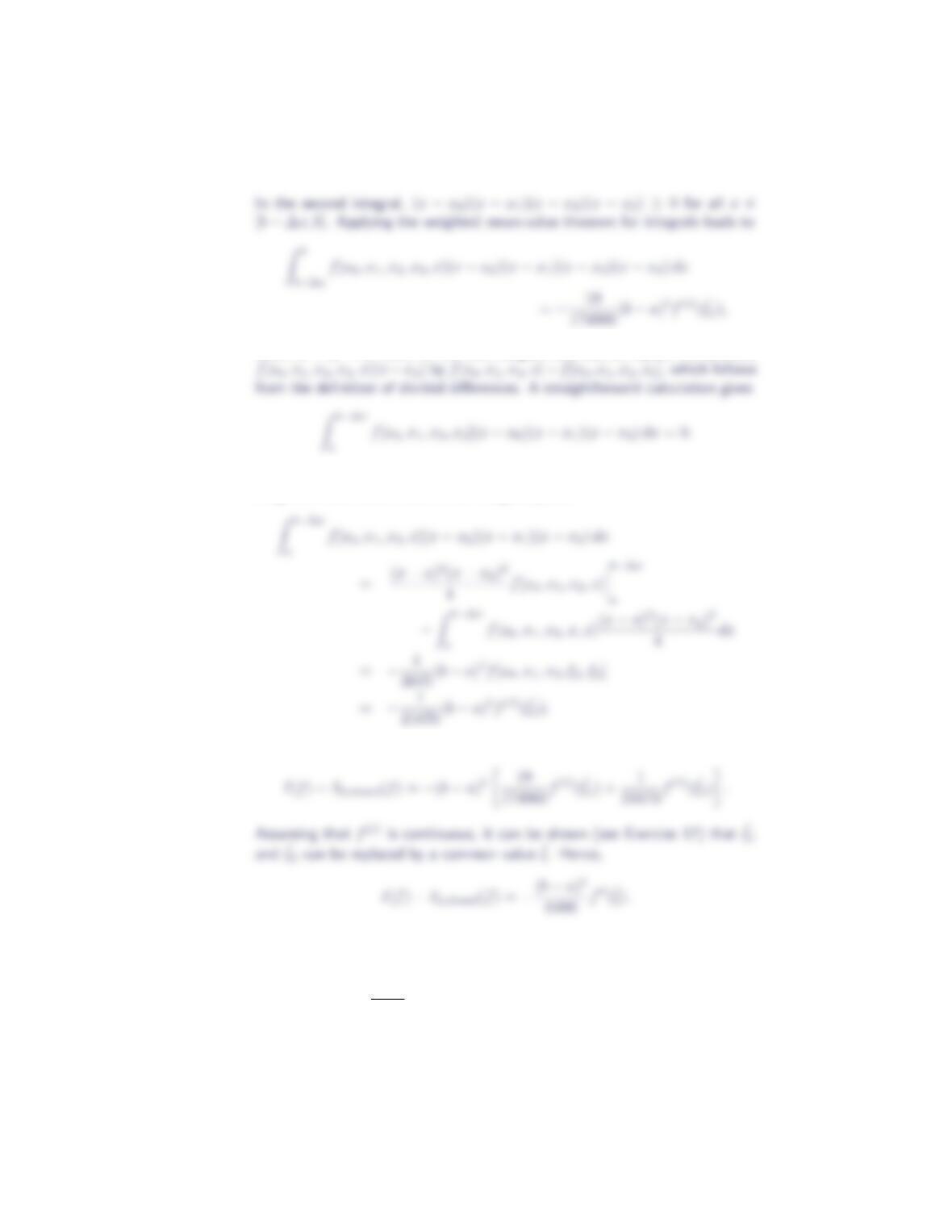
(c) The error in I3,closed(f)is given by
12 Section 6.4
where a < ˆ
ξ1< b. Next, in the first integral from above, replace the product
For the remaining integral, an integration by parts and application of the
weighted mean-value theorem for integrals yields
Bringing all of these pieces together, we find
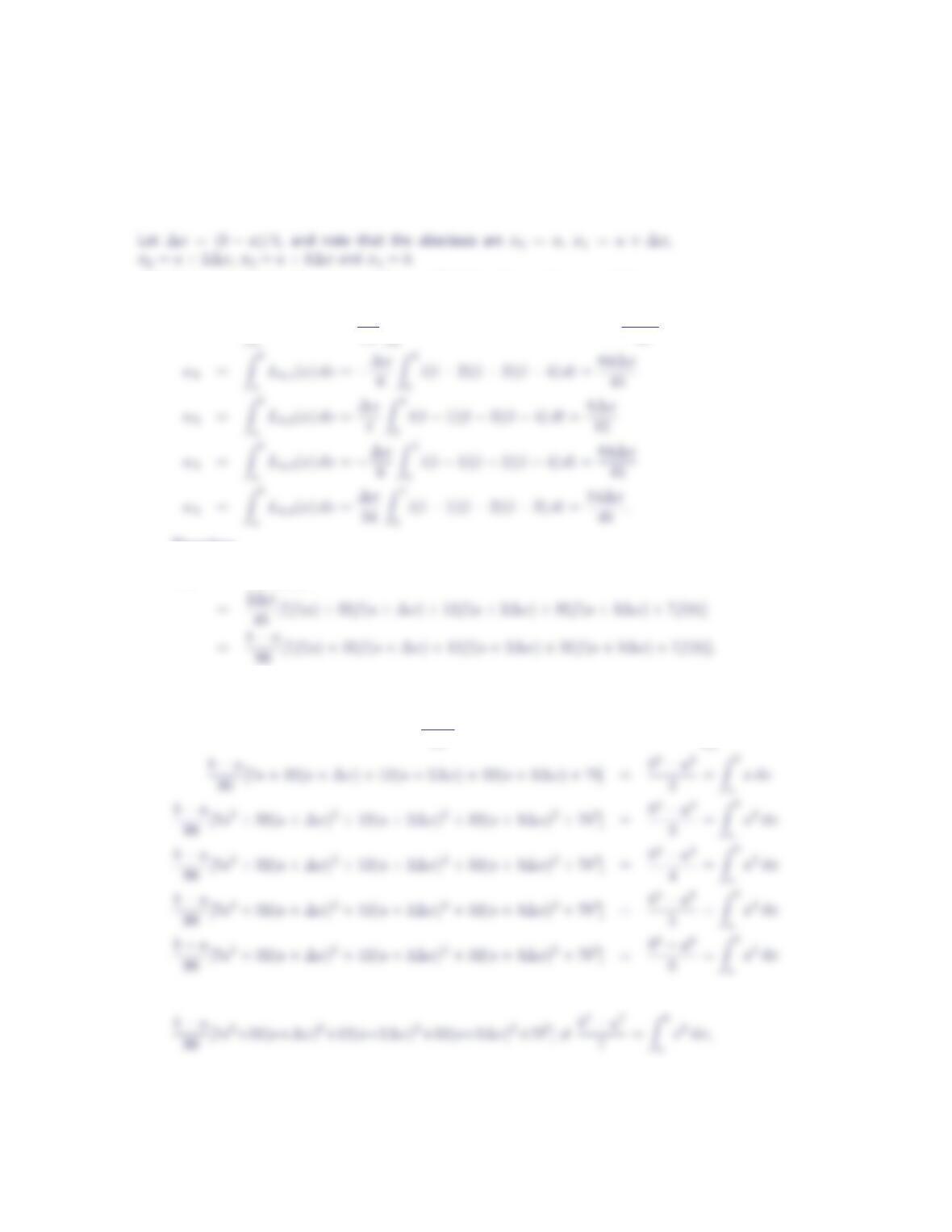
13. (a) Derive the closed Newton-Cotes formula with n= 4
I(f)≈I4,closed(f) = b−a
90 [7f(a)+32f(a+∆x)+12f(a+2∆x)+32f(a+3∆x)+7f(b)].
(b) Verify that this formula has degree of precision equal to 5.
Newton-Cotes Quadrature 13
(c) Derive the error term associated with this quadrature rule.
(a) Using the substitution x=a+t∆x, we find that the quadrature weights are
w0=Zb
L4,0(x)dx =∆x
24 Z4
(t−1)(t−2)(t−3)(t−4) dt =14∆x
45
Therefore,
I(f)≈I4,closed(f)
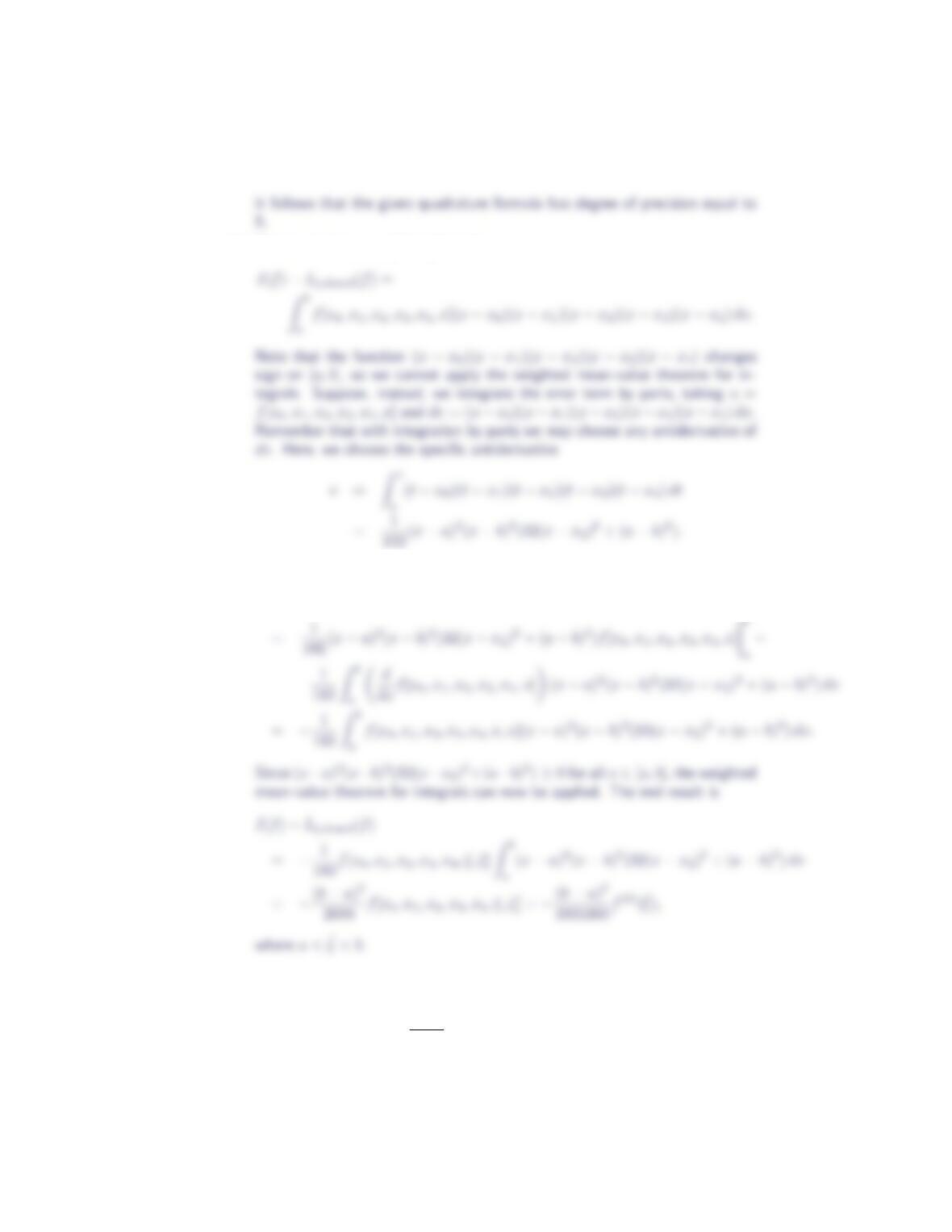
(b) Because
b−a
90 [7+32+12+32+7] = b−a=Zb
dx
but
14 Section 6.4
(c) The error in I4,closed(f)is given by
Then,
I(f)−I4,closed(f)
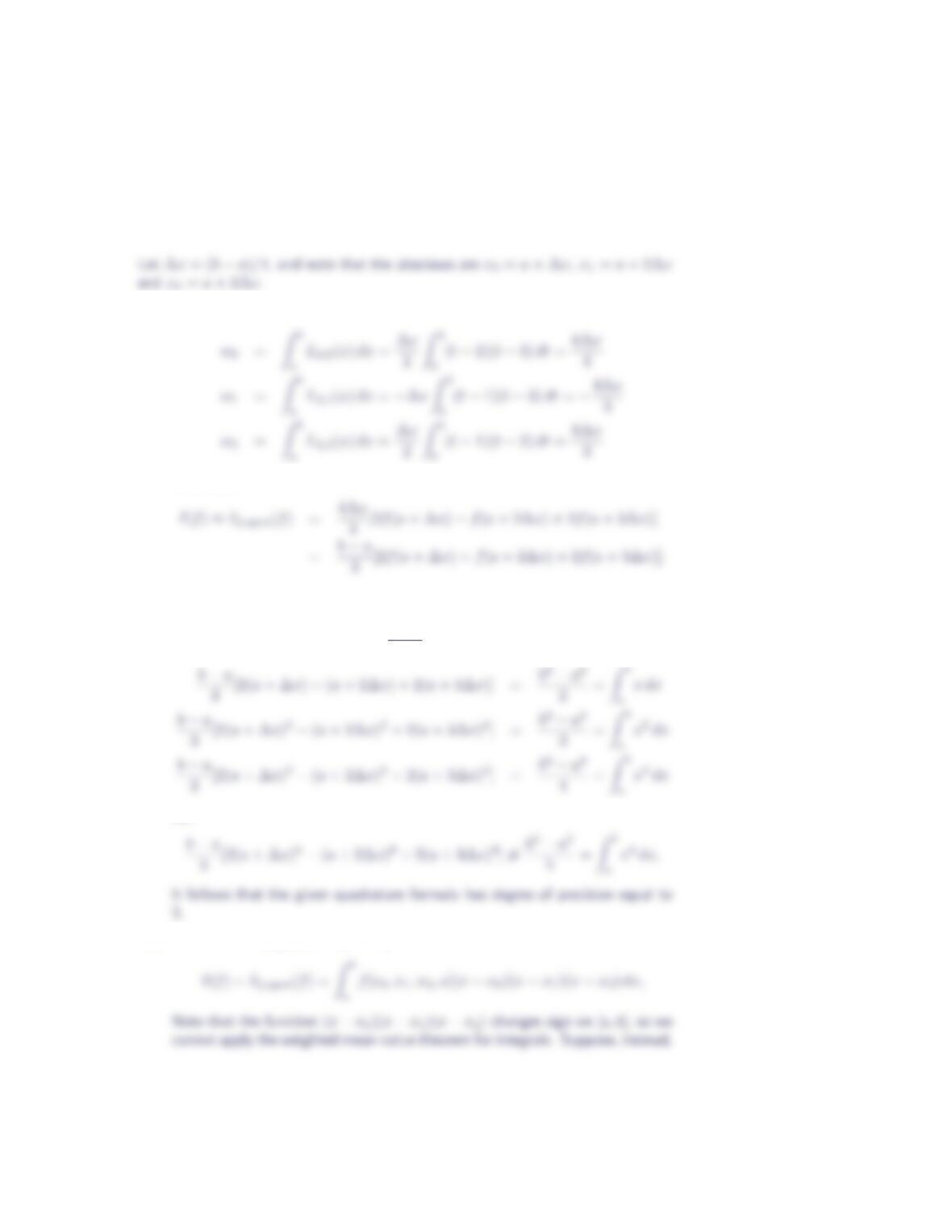
14. (a) Derive the open Newton-Cotes formula with n= 2
I(f)≈I2,open(f) = b−a
3[2f(a+ ∆x)−f(a+ 2∆x)+2f(a+ 3∆x)].
Newton-Cotes Quadrature 15
(b) Verify that this formula has degree of precision equal to 3.
(c) Derive the error term associated with this quadrature rule.
(a) Using the substitution x=a+t∆x, we find that the quadrature weights are
Therefore,
(b) Because
b−a
3[2 −1 + 2] = b−a=Zb
a
dx
but
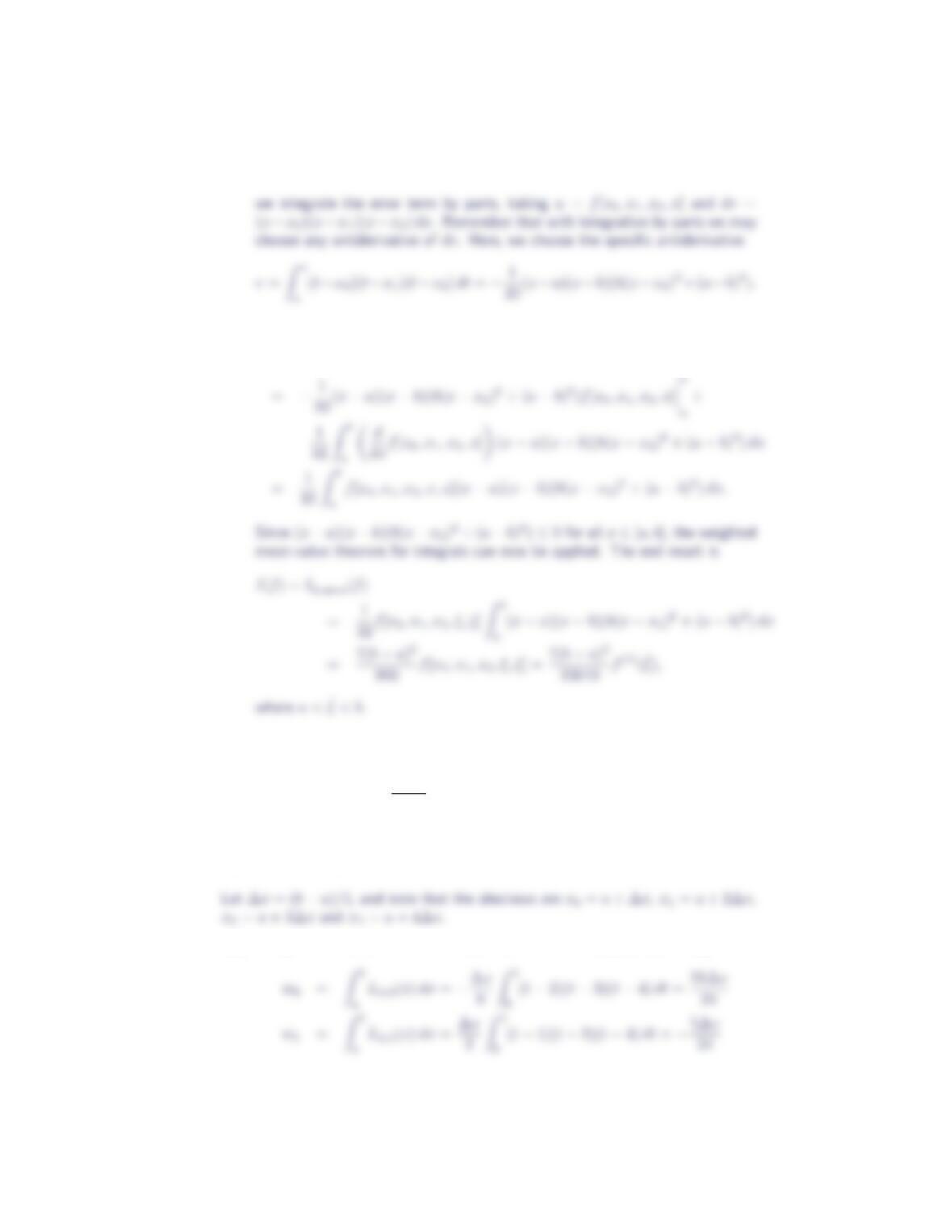
(c) The error in I2,open(f)is given by
16 Section 6.4
Then,
I(f)−I2,open(f)
15. (a) Derive the open Newton-Cotes formula with n= 3
I(f)≈I3,open(f) = b−a
24 [11f(a+∆x)+f(a+2∆x)+f(a+3∆x)+11f(a+4∆x)].
(b) Verify that this formula has degree of precision equal to 3.
(c) Derive the error term associated with this quadrature rule.
(a) Using the substitution x=a+t∆x, we find that the quadrature weights are
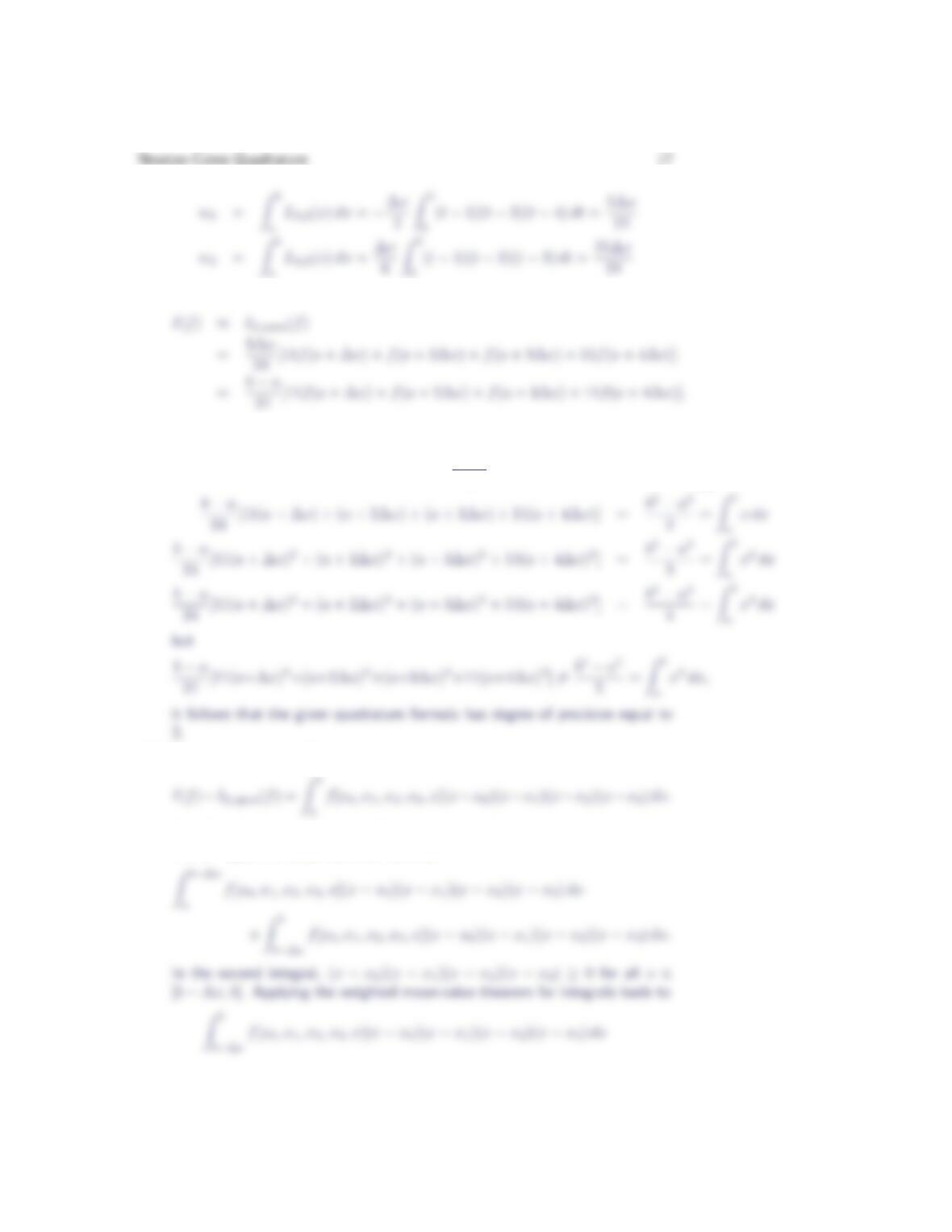
Therefore,
(b) Because
b−a
24 [11 + 1 + 1 + 11] = b−a=Zb
a
dx
(c) The error in I3,open(f)is given by
As a first step in manipulating the error term, split the integration interval at
x=b−∆x;i.e., write the error term as
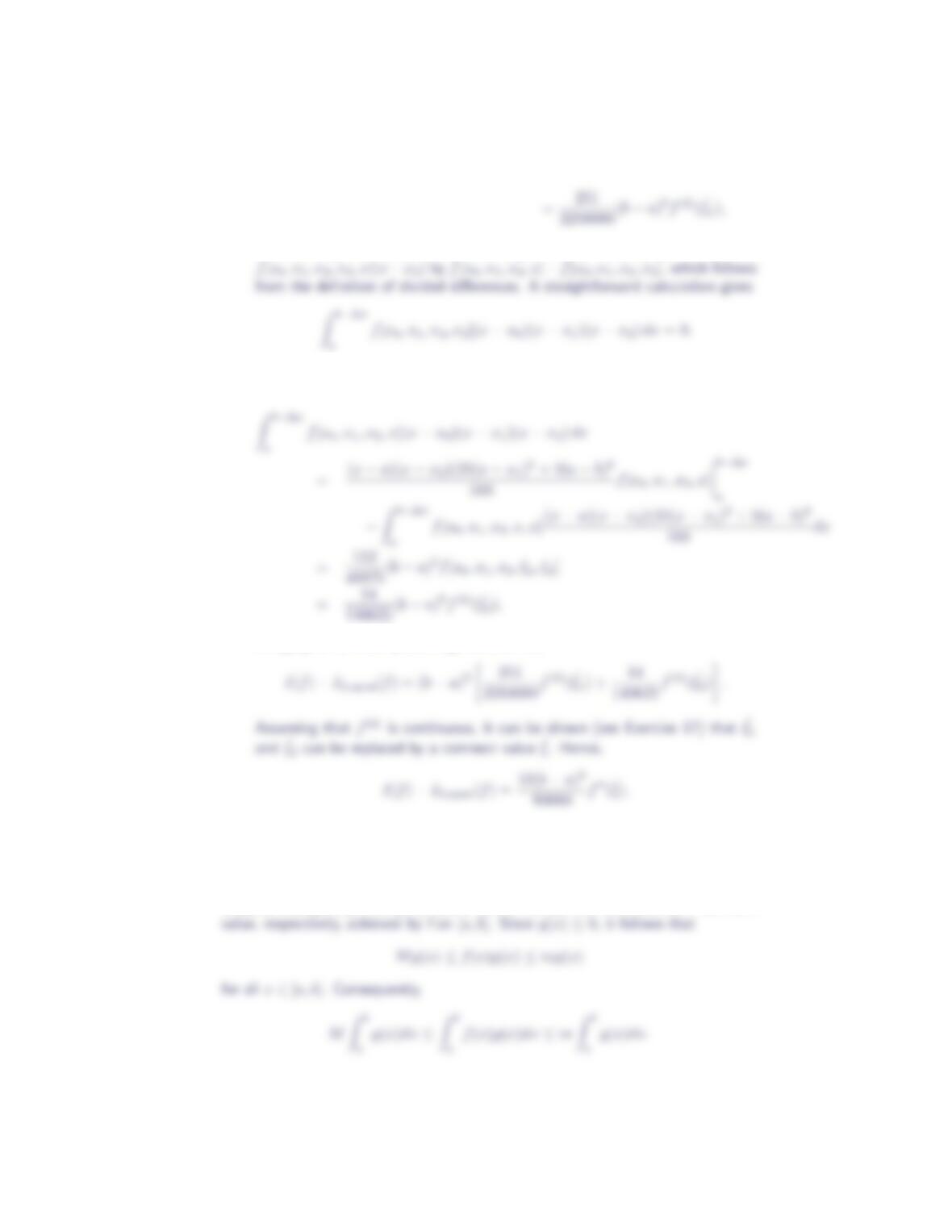
18 Section 6.4
where a < ˆ
ξ1< b. Next, in the first integral from above, replace the product
For the remaining integral, an integration by parts and application of the
weighted mean-value theorem for integrals yields
Bringing all of these pieces together, we find
16. Prove the weighted mean-value theorem for integrals when g(x)≤0 for all
x∈[a, b].
Suppose that g(x)≤0on [a, b]. Let mand Mdenote the minimum and maximum
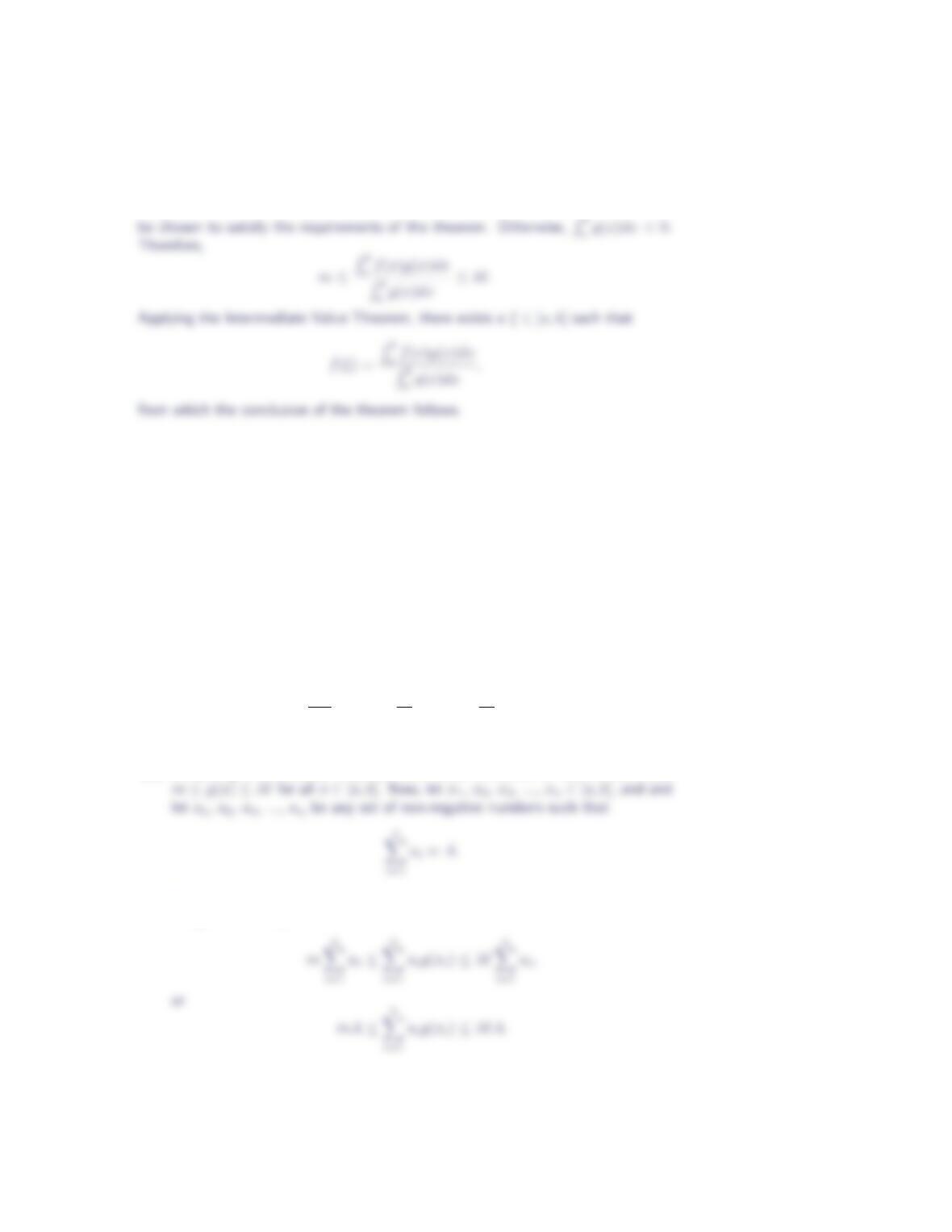
Newton-Cotes Quadrature 19
If Rb
ag(x)dx = 0, then Rb
af(x)g(x)dx must also equal 0, so any ξ∈[a, b]can
17. (a) Let gbe a continuous function on [a, b] and let a1,a2,a3, …, anbe any set
of non-negative numbers such that
n
X
i=1
ai=A.
Show that for any set of points x1,x2,x3, …, xn∈[a, b], there exists a
ξ∈[a, b] such that n
X
i=1
aig(xi) = Ag(ξ).
(b) Use the result of part (a) to show that, provided f00 is continuous, there
exists a ξ∈[a, b] such that
5
324f00(ξ1) + 1
81f00(ξ2) = 1
36f00(ξ).
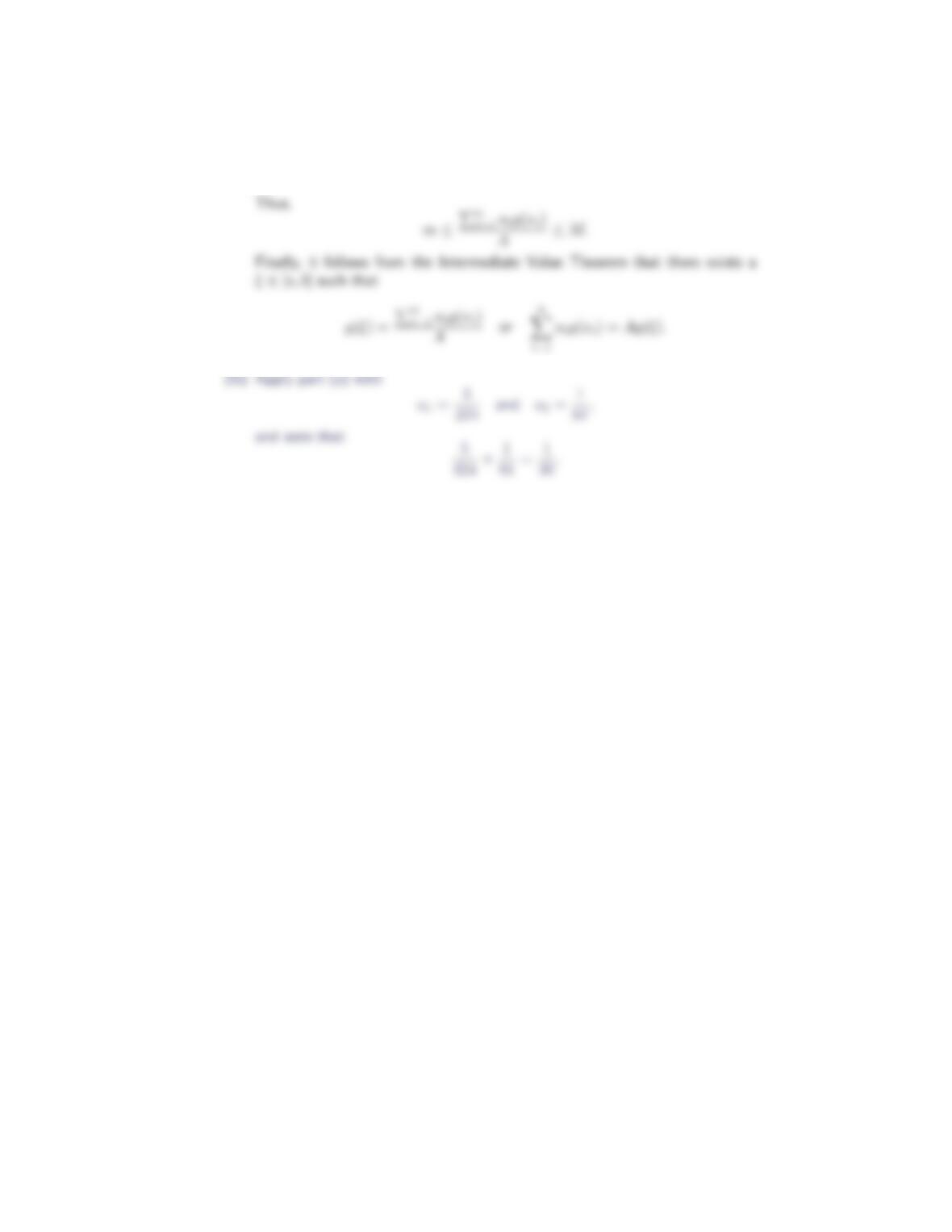
(a) Because gis continuous on [a, b], there exists constants mand Msuch that
Then, for each i,m≤g(xi)≤M; moreover, mai≤aig(xi)≤M ai. Sum-
ming over inow yields
20 Section 6.4