Chap. 6 Shallow Foundations
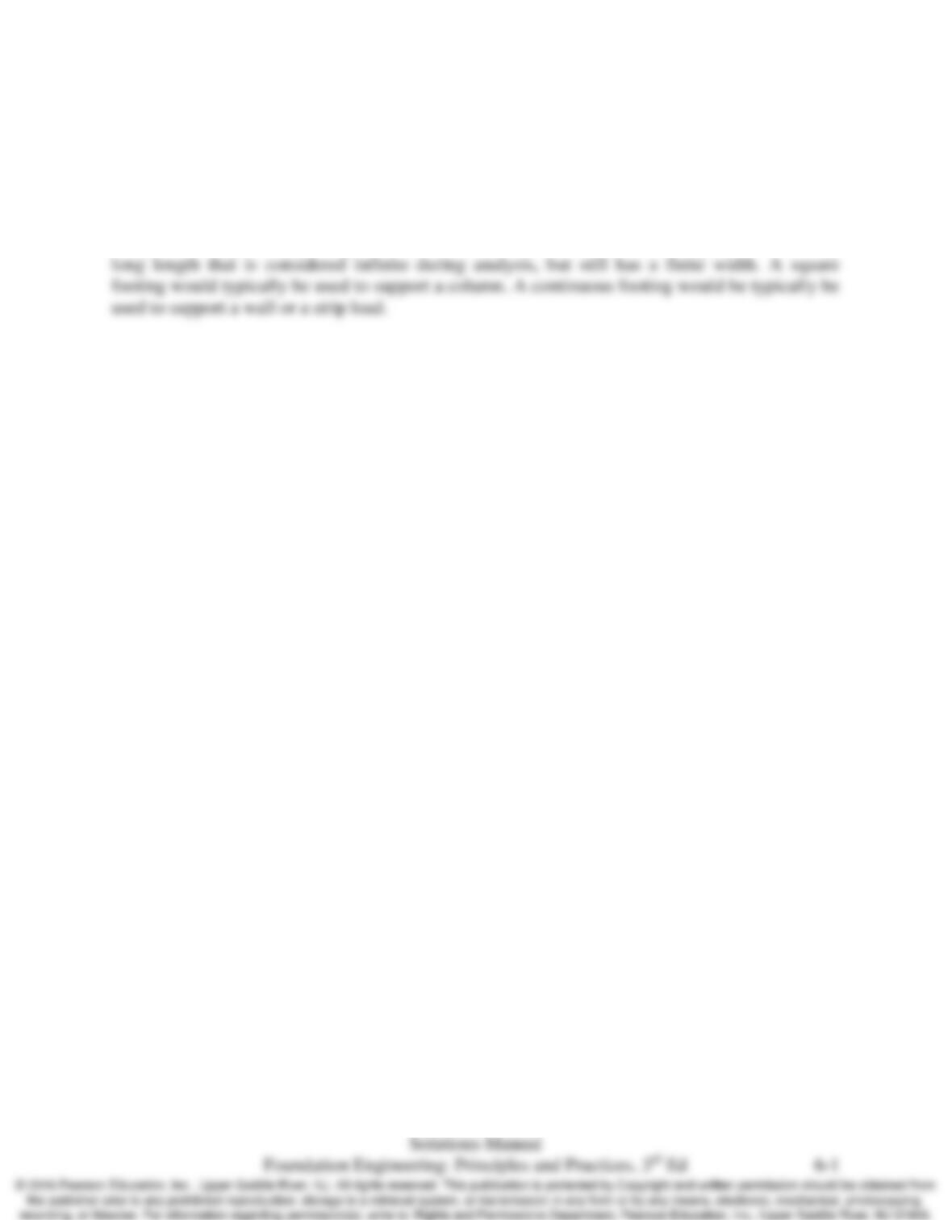
6.1 What is the difference between a square footing and a continuous footing, and when would each
type be used?
Solution
A square footing has equal length and width dimensions. A continuous footing has an extremely
Chap. 6 Shallow Foundations
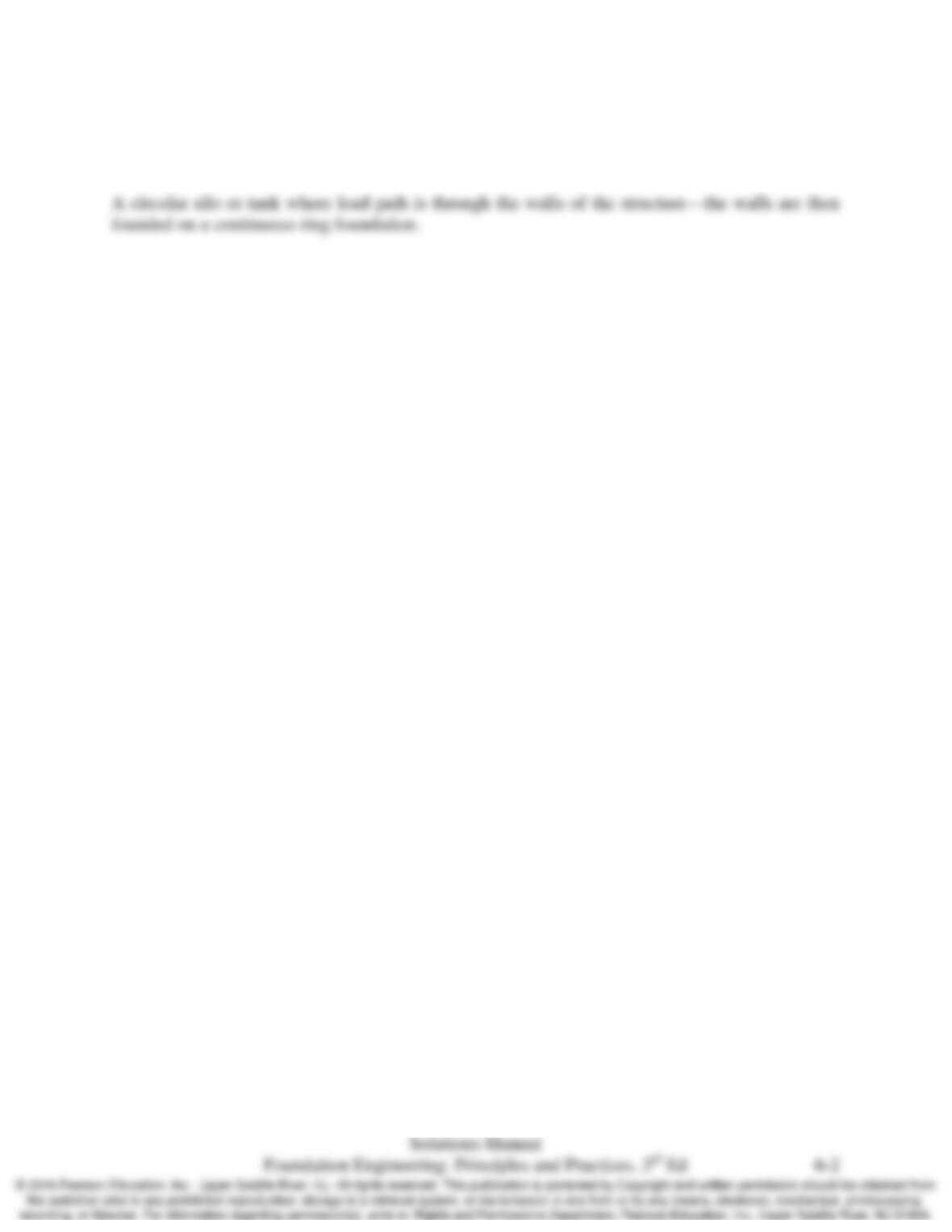
6.2 Describe a structure for which a ring footing would be appropriate.
Solution
Chap. 6 Shallow Foundations
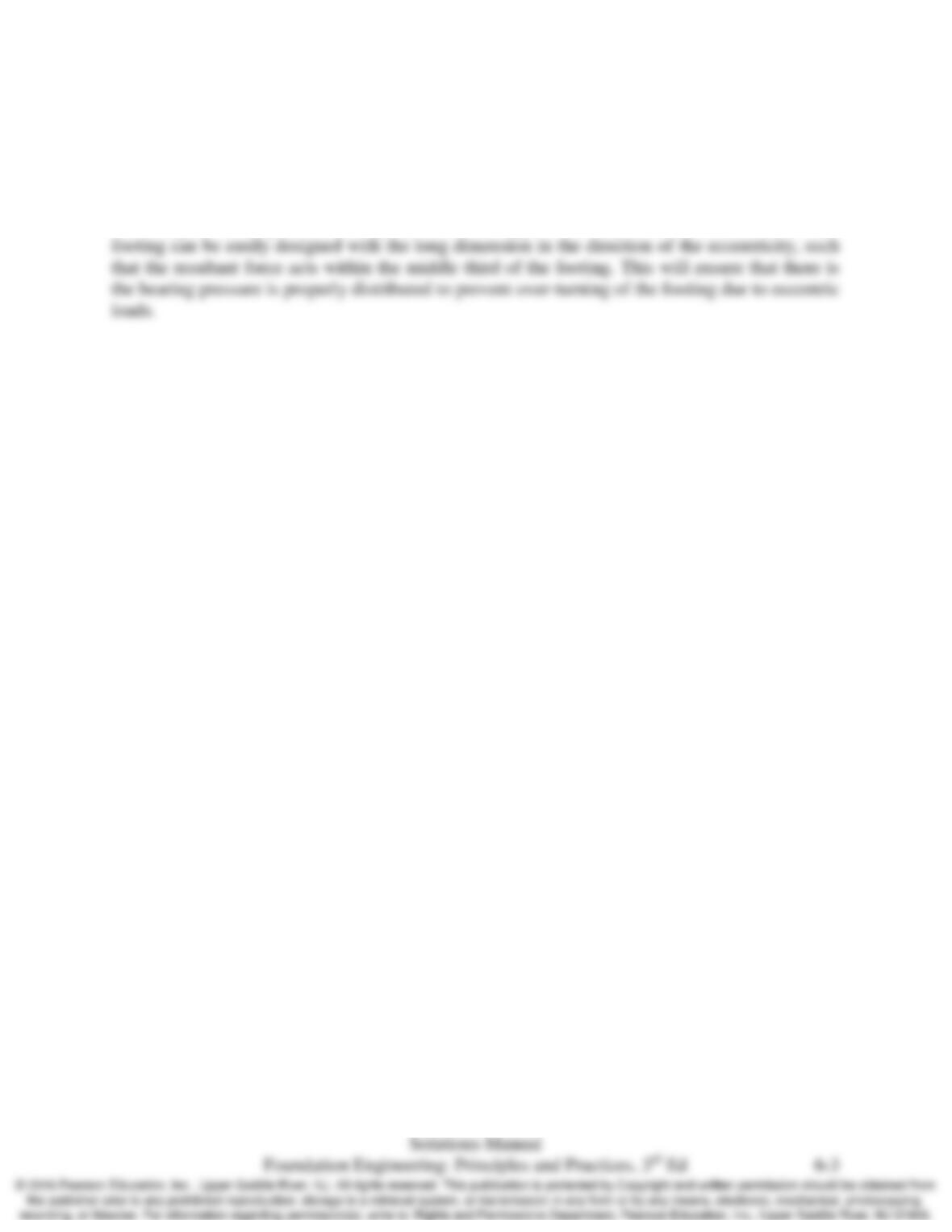
6.3 Describe why a rectangular footing might be a good choice for a footing supporting a column
with a moment load in one direction.
Solution
A rectangular footing would be a good choice to support one–way eccentric loads because the
Chap. 6 Shallow Foundations
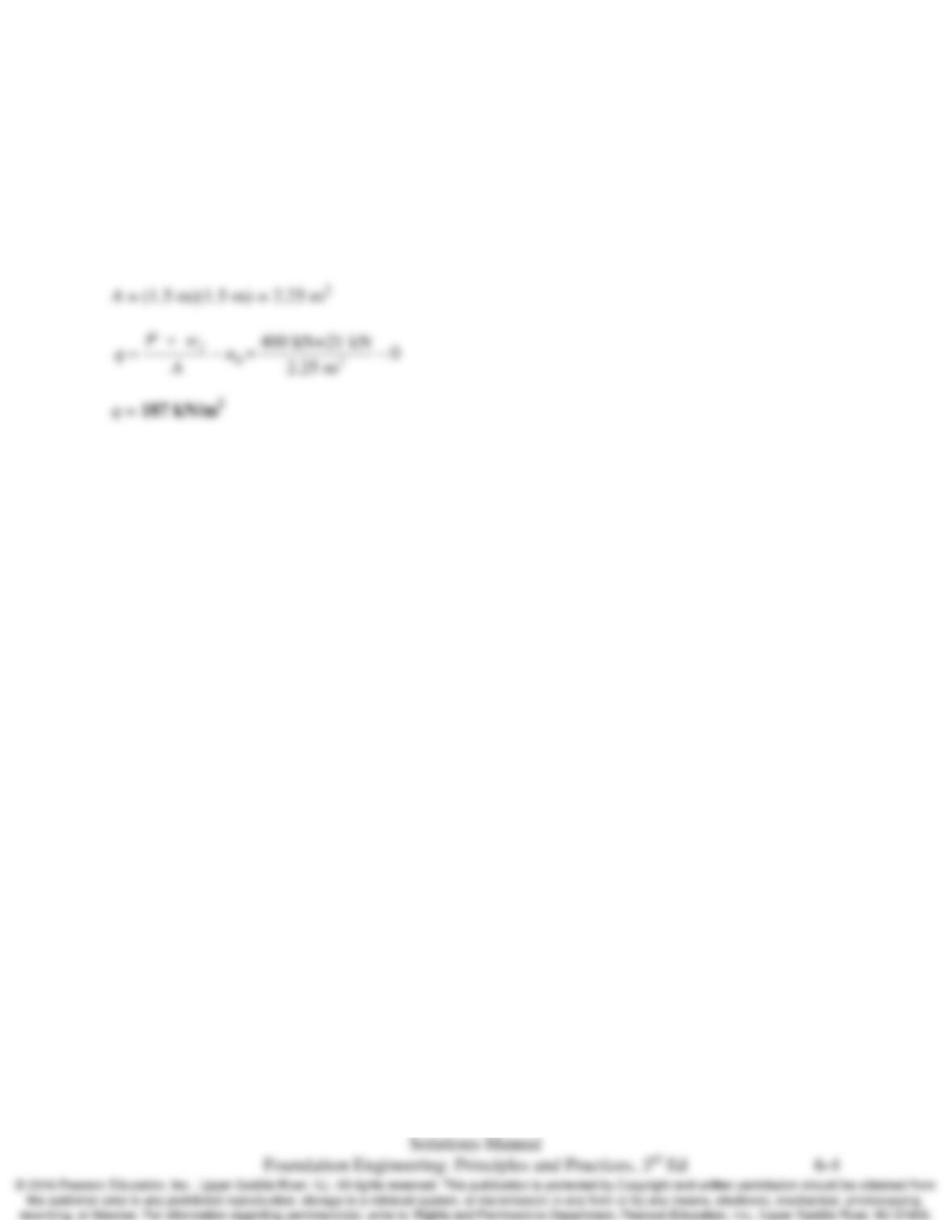
6.4 A 400 kN vertical downward column load acts at the centroid of a 1.5–m square footing. The
bottom of this footing is 0.4 m below the ground surface and the top is flush with the ground
surface. The groundwater table is at a depth of 3 m below the ground surface. Compute the
bearing pressure.
Solution
Wf = (1.5 m)(1.5 m)(0.4 m)(23.6 kN/m3) = 21.24 kN
Chap. 6 Shallow Foundations
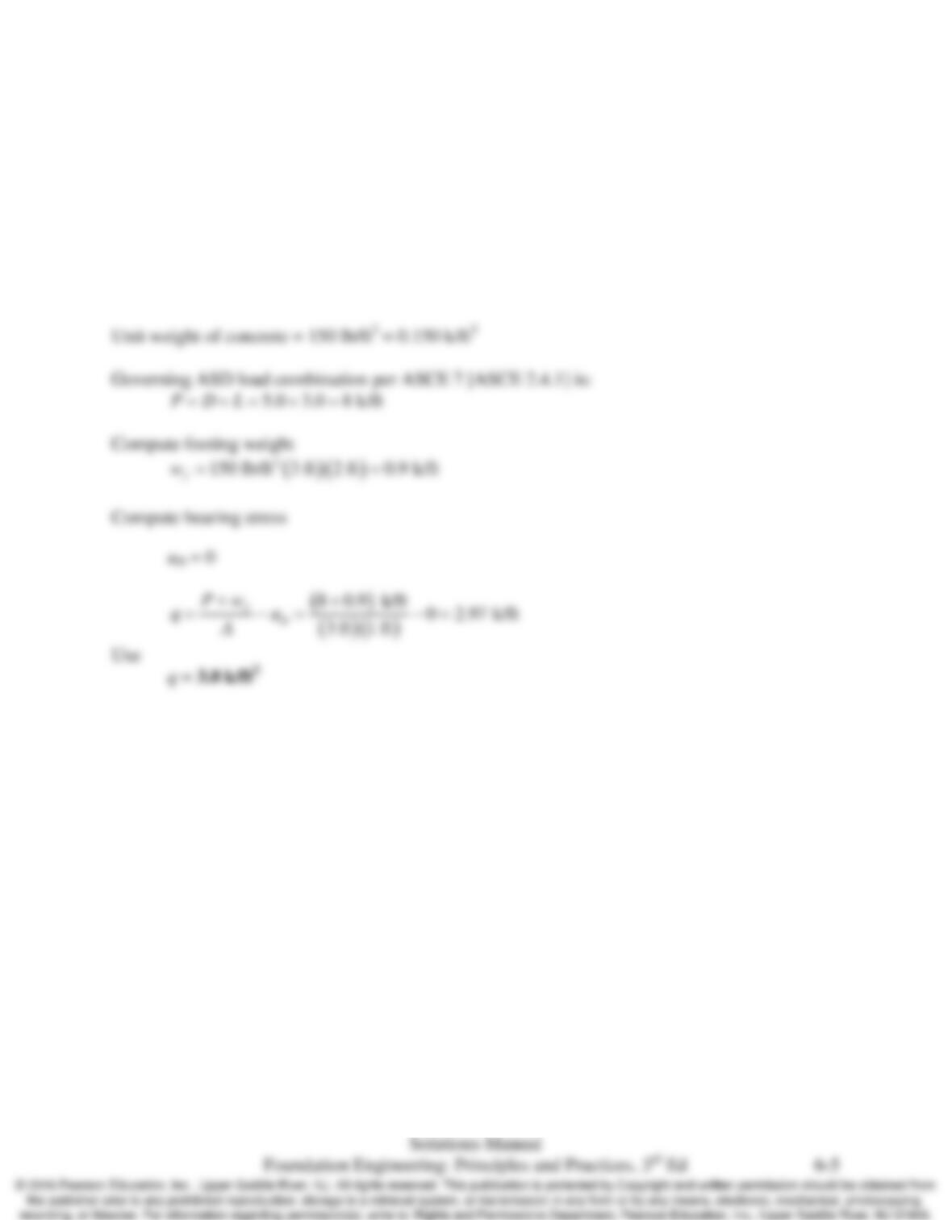
6.5 A bearing wall carries a dead load of 5.0 k/ft and a live load of 3.0 k/ft. It is supported on a 3 ft
wide, 2 ft deep continuous footing. The top of this footing is flush with the ground surface and
the groundwater table is at a depth of 35 ft below the ground surface. Compute the bearing
pressure for ultimate limit state design using the ASD method.
Solution
Note that both P and Wf are now in forces per unit length and that their appropriate unit should
be k/ft.
Chap. 6 Shallow Foundations
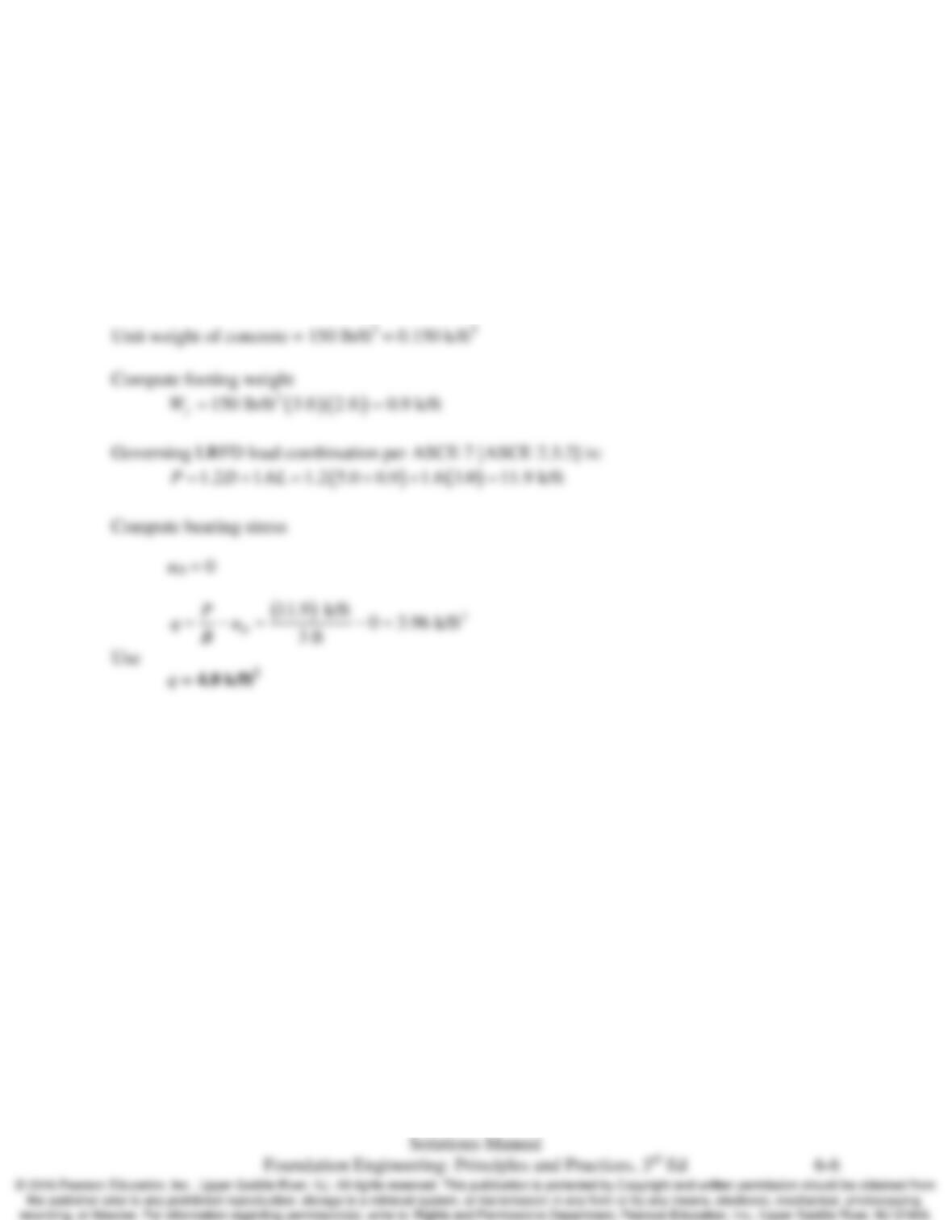
6.6 A bearing wall carries a dead load of 5.0 k/ft and a live load of 3.0 k/ft. It is supported on a 3 ft
wide, 2 ft deep continuous footing. The top of this footing is flush with the ground surface and
the groundwater table is at a depth of 35 ft below the ground surface. Compute the bearing
pressure for ultimate limit state design using the LRFD method with ASCE-7 load combinations.
Solution
Note that both P and Wf are now in forces per unit length and that their appropriate unit should
be k/ft.
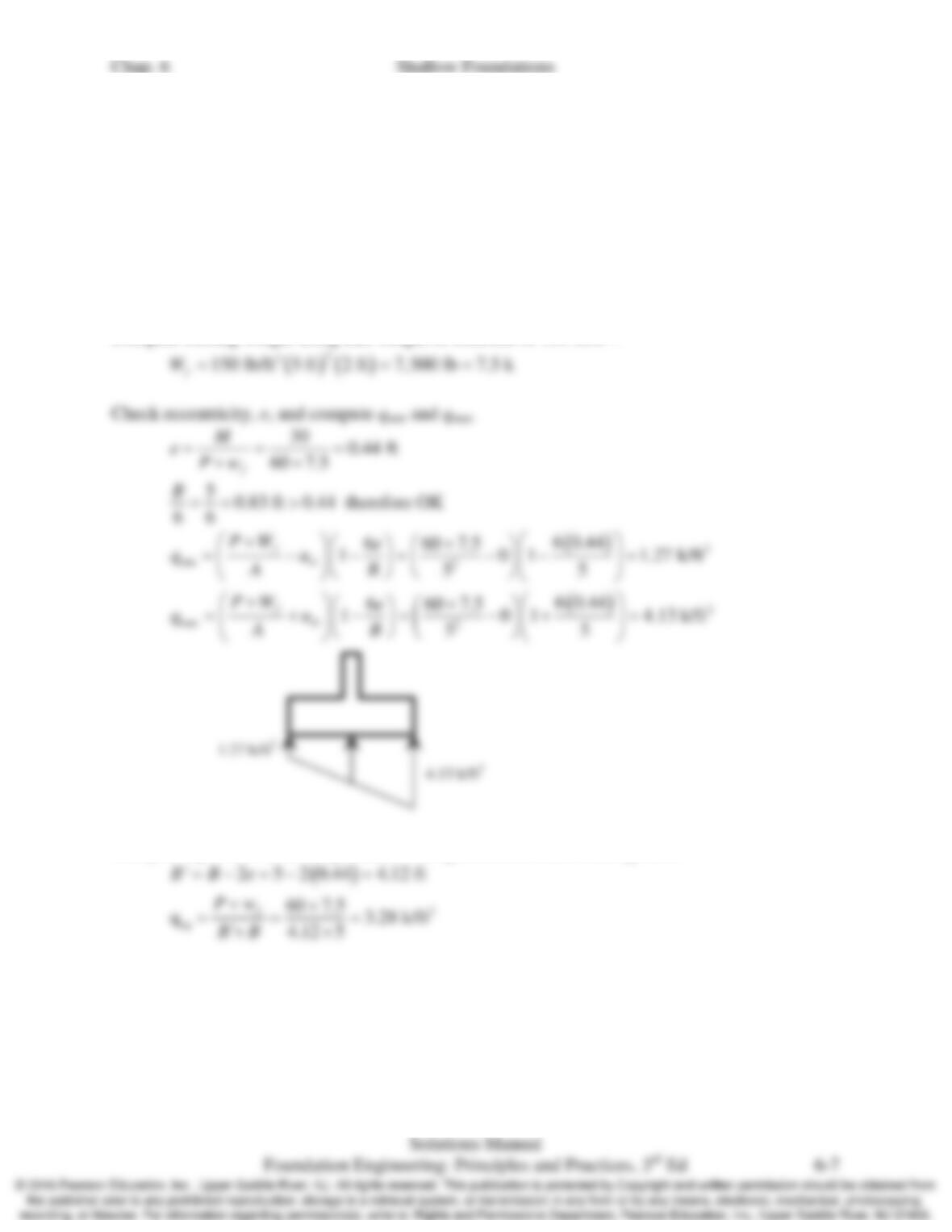
6.7 A 5–ft square, 2–ft deep spread footing is subjected to a concentric vertical load of 60 k and an
overturning moment of 30 ft–k. The overturning moment acts parallel to one of the sides of the
footing, and the top of the footing is flush with the ground surface and the groundwater table is at
a depth of 20 ft below the ground surface. Determine whether the resultant force acts within the
middle third of the footing, compute the minimum and maximum bearing pressures and show the
distribution of bearing pressure in a sketch. Determine the size of the equivalent uniformly
loaded footing and compute the equivalent bearing pressure.
Solution
Compute footing weight using unit weight of concrete of 150 lb/ft3.
Compute equivalent uniformly loaded footing dimensions and bearing stress
Chap. 6 Shallow Foundations
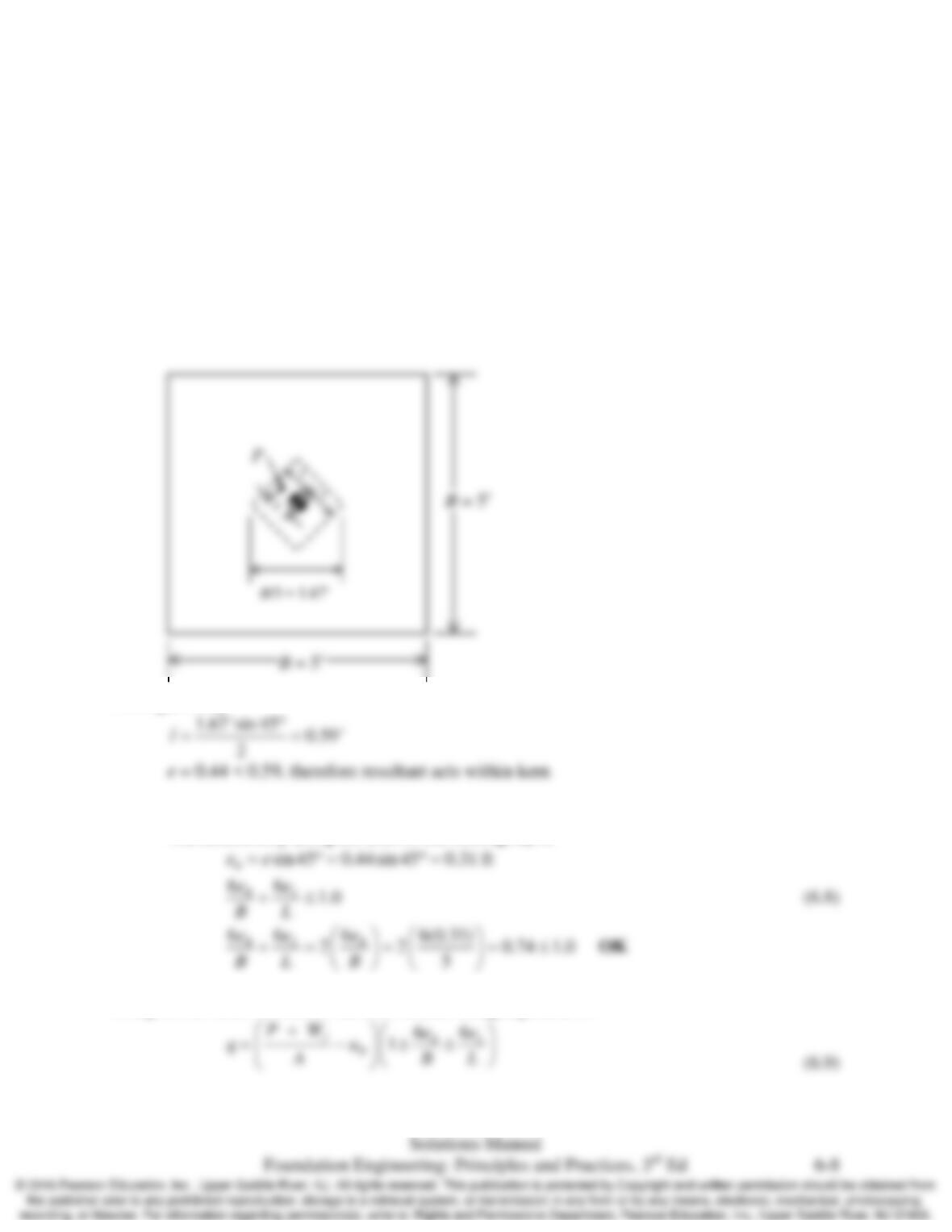
6.8 Consider the footing and loads in Problem 6.7, except that the overturning moment now acts at a
45° angle from the side of the footing (i.e., it acts diagonally across the top of the footing).
Determine whether the resultant force acts within the kern. If it does, then compute the bearing
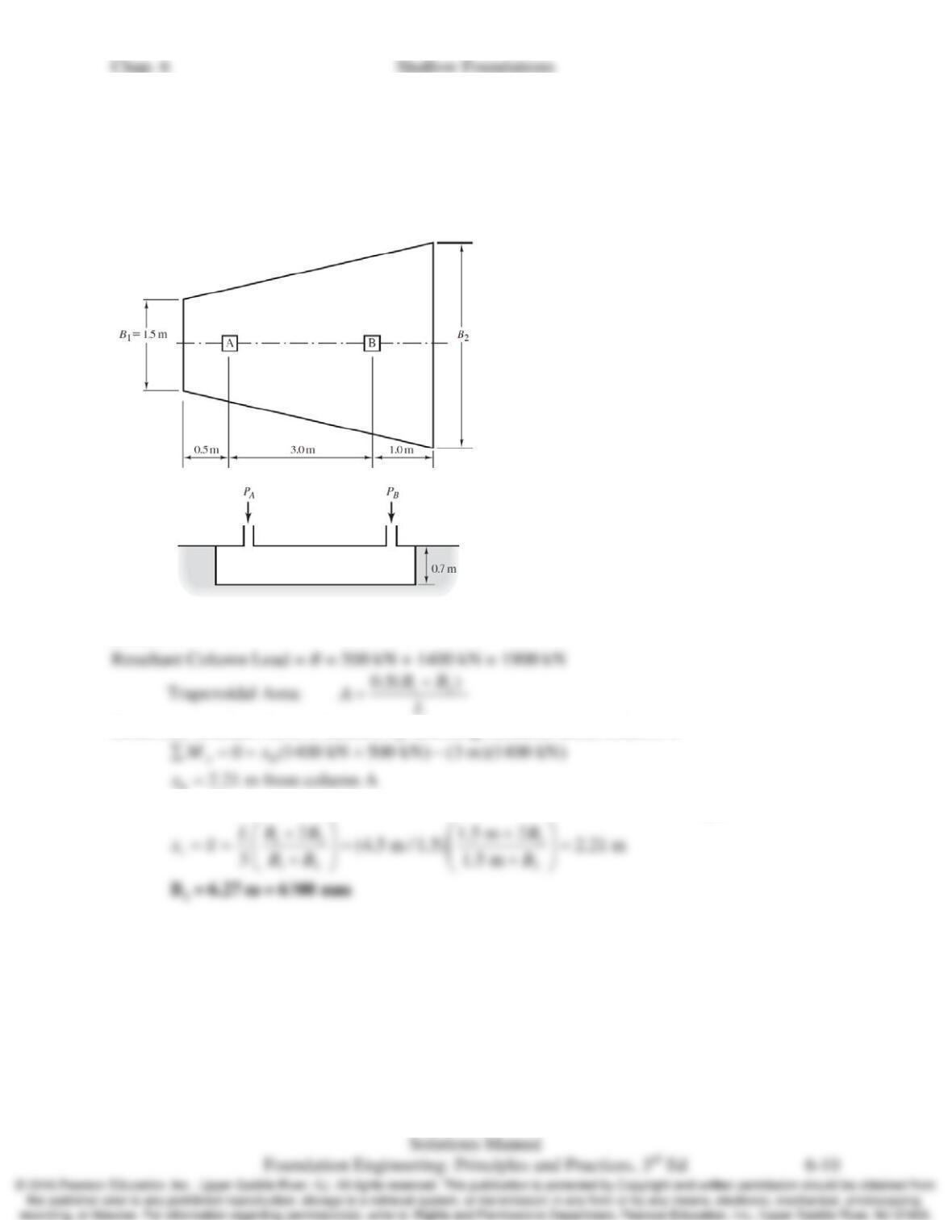
pressure at each corner of the footing and show the pressure distribution in a sketch similar to
Figure 6.17. Determine the size of the equivalent uniformly loaded footing and compute the
equivalent bearing pressure.
Solution
The eccentricity of 0.44ʹ computed in Problem 6.7 is still correct but now acts at a 45º and the
resultant is located at the point P show below.
From geometry
Or we can check Equation 6.8.
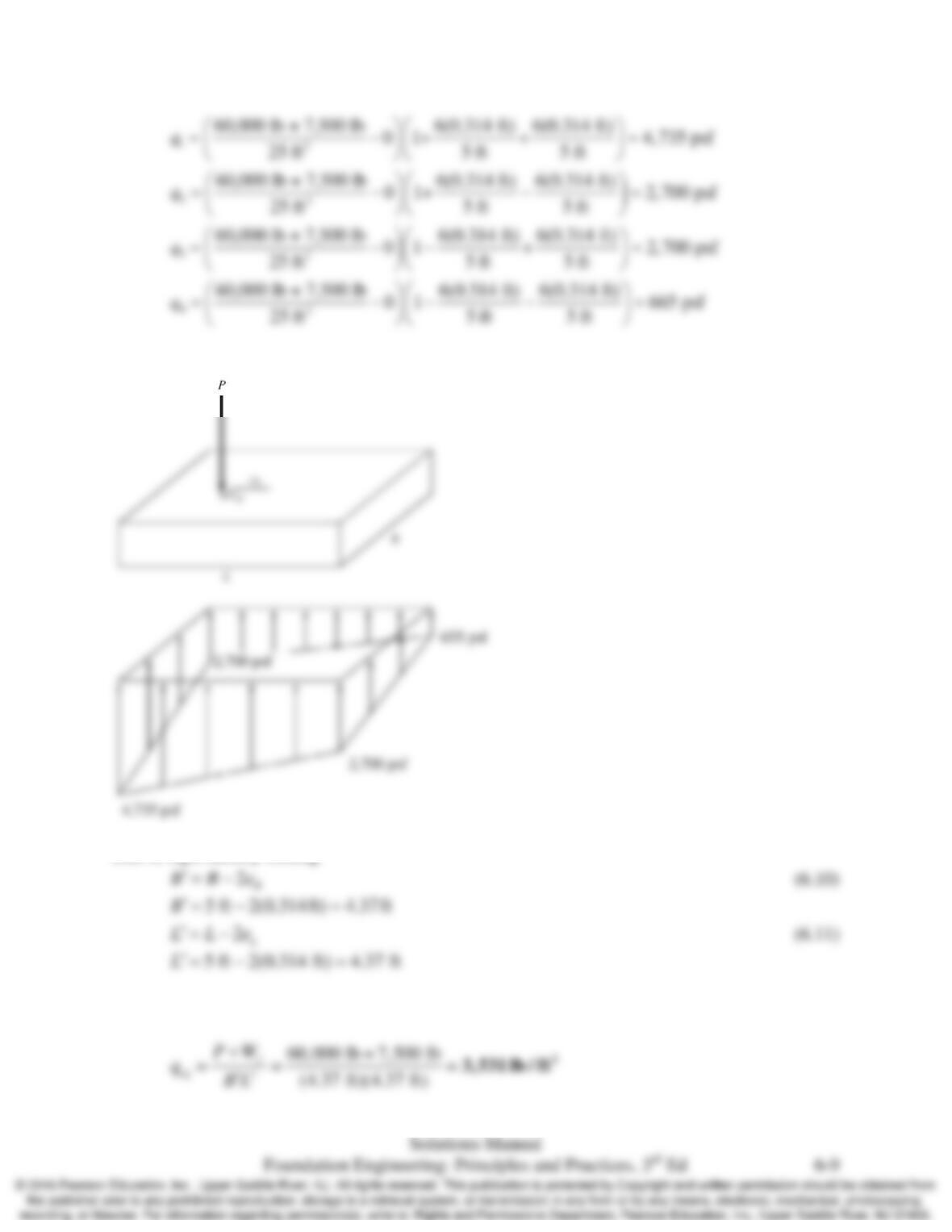
The eccentricity along the axes of the footing, eB, is
Compute the stress at each of the four corners using Equation 6.9
Chap. 6 Shallow Foundations
The distribution of stress is as shown below.
Size of equivalently footing
Equivalent Bearing Pressure for two-way eccentric loading
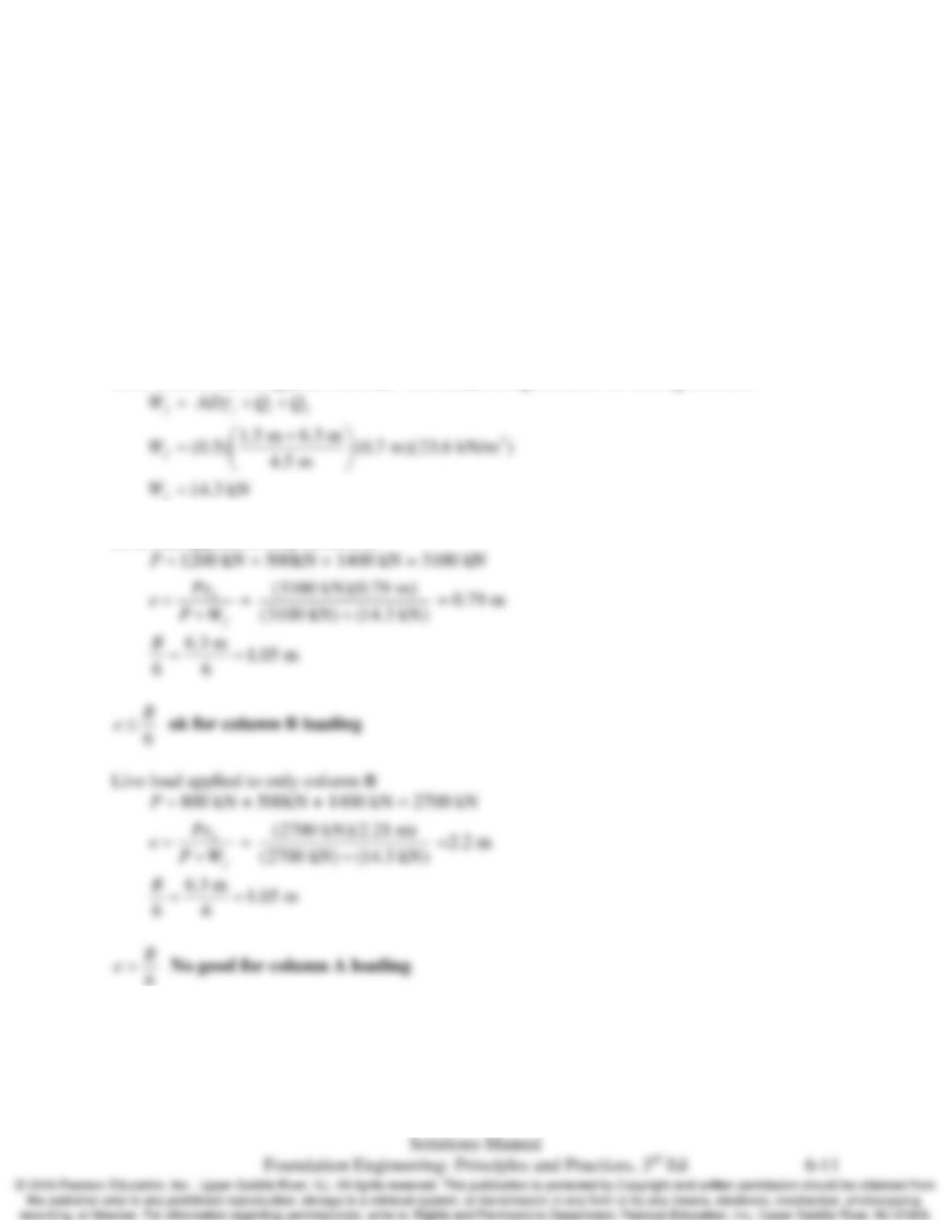
6.9 The two columns in Figure 6.19 are to be supported on a combined footing. The vertical dead
loads on Columns A and B are 500 and 1400 kN, respectively. Using the ASD method for
ultimate limit state design, determine the required dimension B2 so the resultant of the column
loads acts through the centroid of the footing and express your answer as a multiple of 100 mm.
Solution
Determine resultant force R location by summing moments about column A
R
Set resultant force location equal to centroid location to achieve uniform bearing pressure.
Chap. 6 Shallow Foundations
6.10 In addition to the dead loads described in Problem 6.9, Columns A and B in Figure 6.19 also can
carry vertical live loads of up to 800 and 1200 k, respectively. The live loads vary with time, and
thus may be present some days and absent other days. In addition, the live load on each column
is independent of that on the other column (i.e., one could be carrying the full live load while the
other has zero live load). Using the ASD method for ultimate limit state design and the
dimensions obtained in Problem 6.9, and the worst possible combination of live loads, determine
if the bearing pressure distribution always meets the eccentricity requirements described in this
chapter. The groundwater table is at a depth of 10 m.
Solution
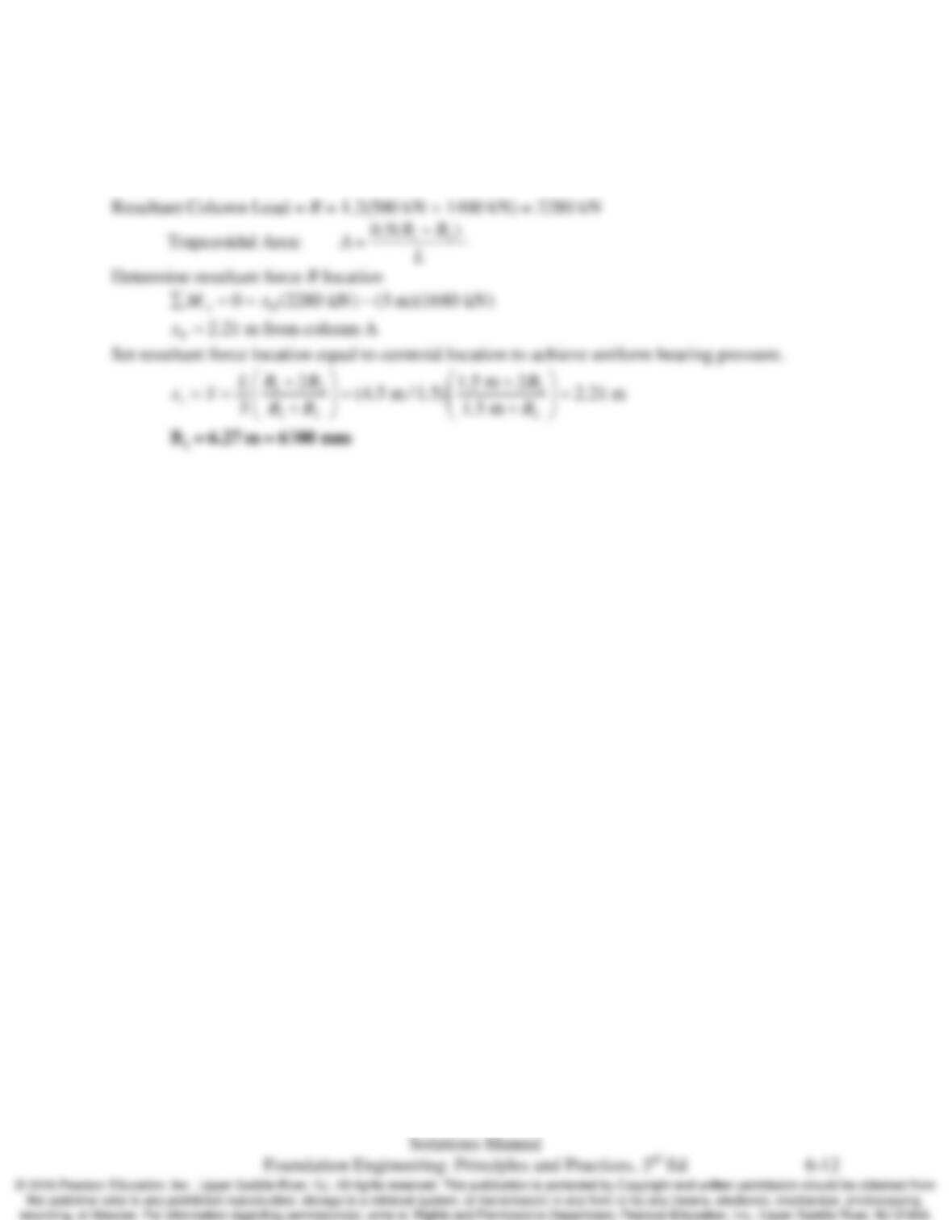
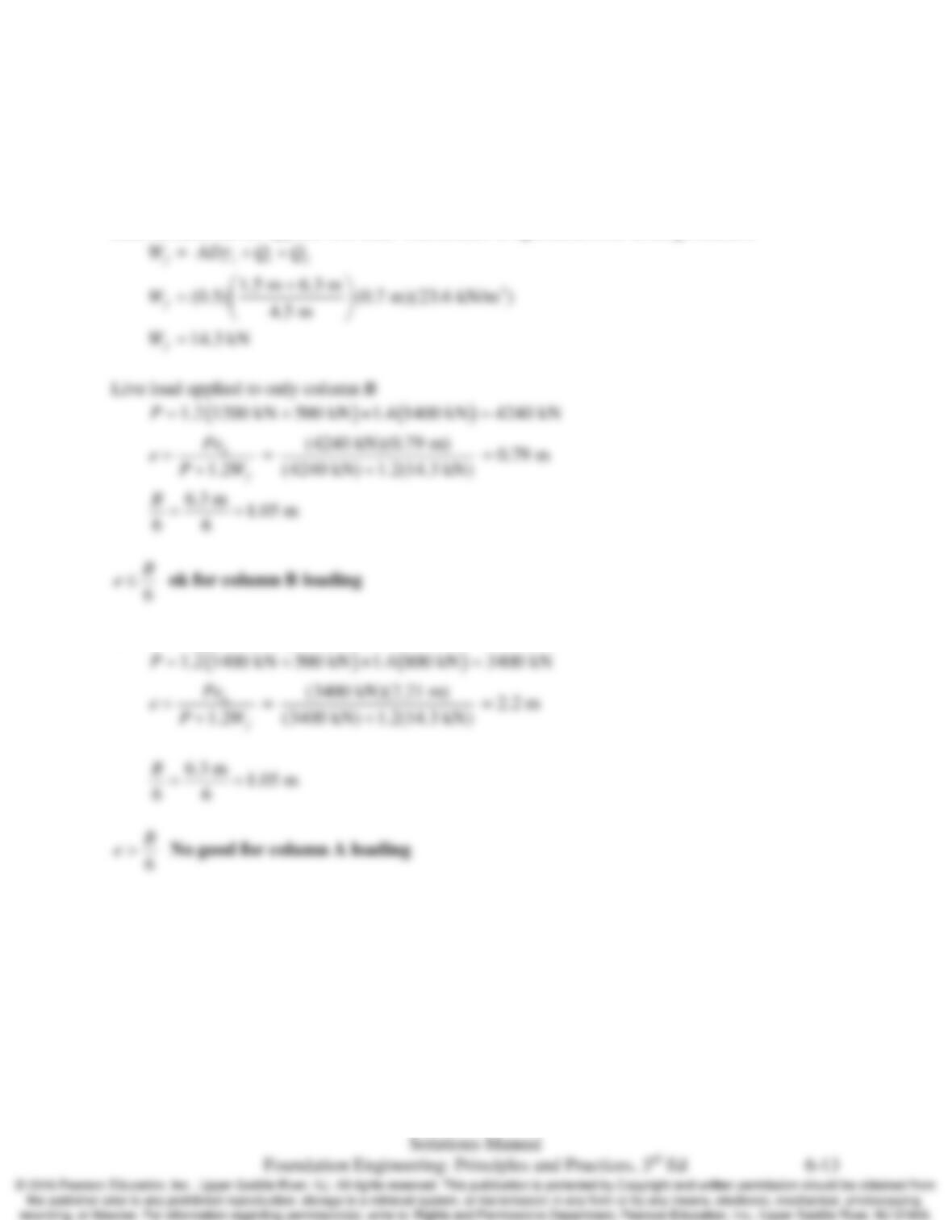
The worst case scenario occurs when there is only a live load applied to one column while the
other column has no applied live load. This creates a significant over turning moment.
Live load applied to only column B
Chap. 6 Shallow Foundations
6.11 Repeat problem 6.9 using the LRFD method with ASCE-7 load combinations.
Solution
Chap. 6 Shallow Foundations
6.12 Repeat problem 6.10 using the LRFD method with ASCE-7 load combinations.
Solution
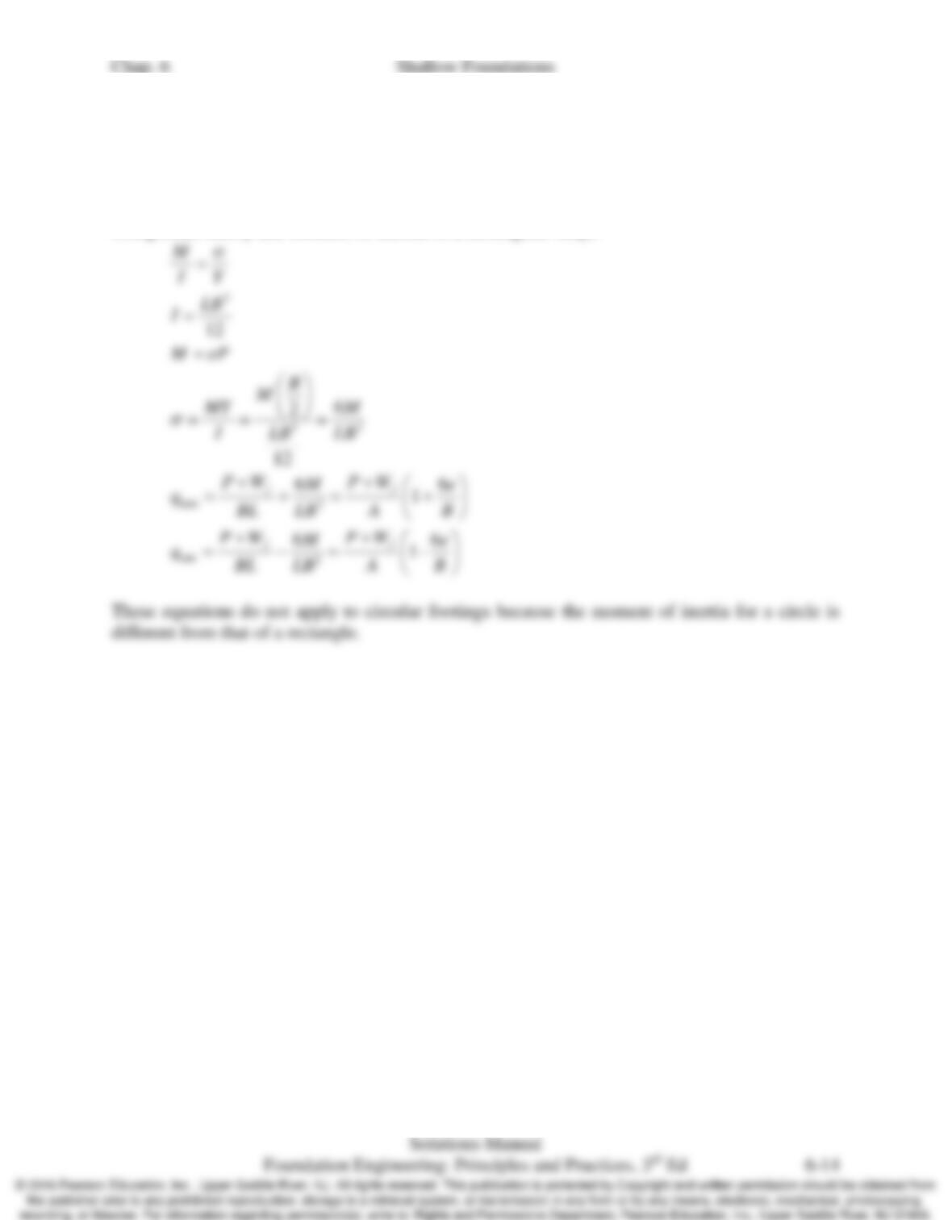
The worst case scenario occurs when there is only a live load applied to one column while the
other column has no applied live load. This creates a significant over turning moment.
Live load applied to only column A
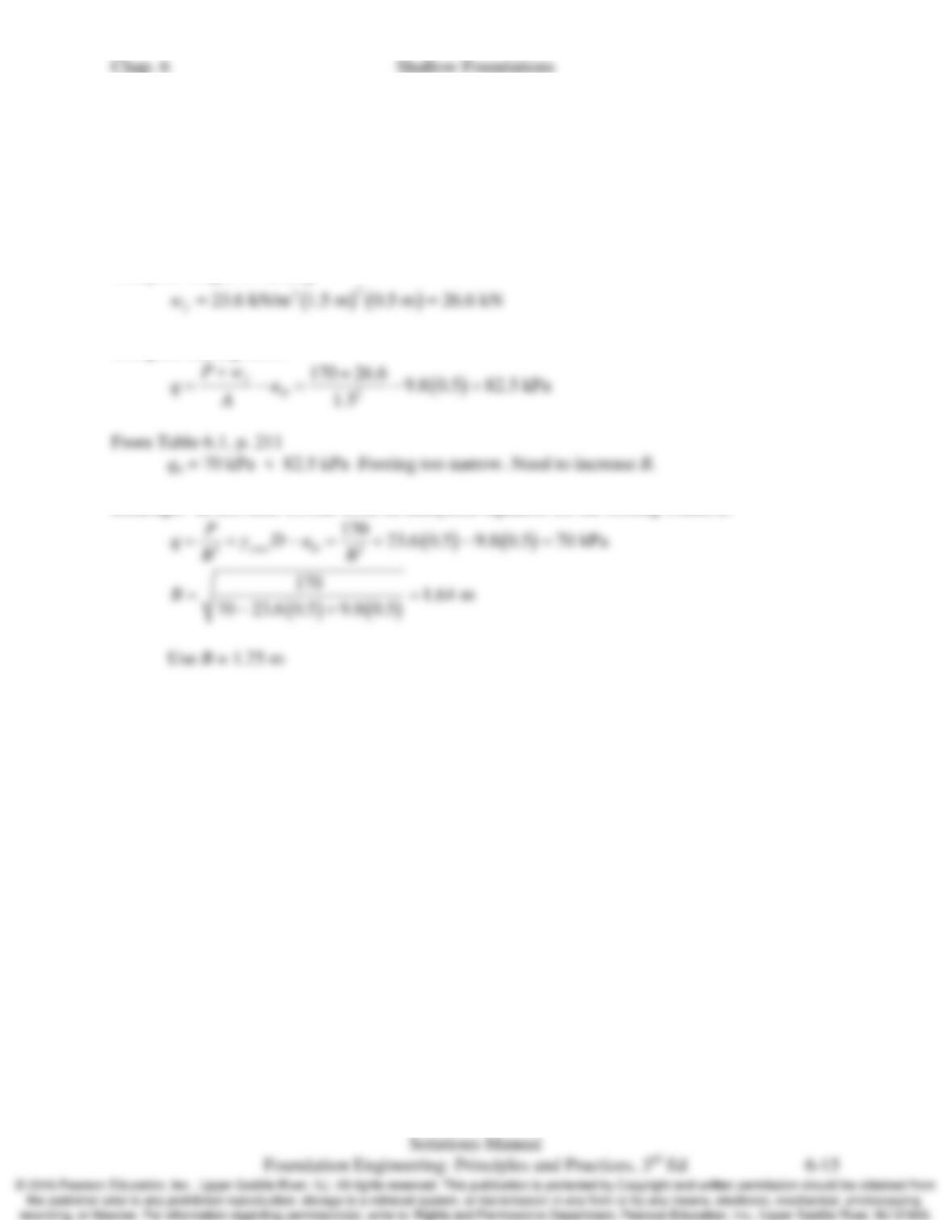
6.13 Derive Equations 6.5 and 6.6. Would these equations also apply to circular spread footings?
Why or why not?
Solution
Using beam theory and moment of inertial of a rectangular shape
6.14 A 1.5 m square footing is founded on a clay soil at a depth of 0.5 m. The ground water is at the
ground surface. The footing is loaded at its centroid and carries a design load of 170 kN. Does
this footing meet the presumptive allowable bearing pressure of the International Building Code?
If not, design the footing such that it does meet these requirements.
Solution
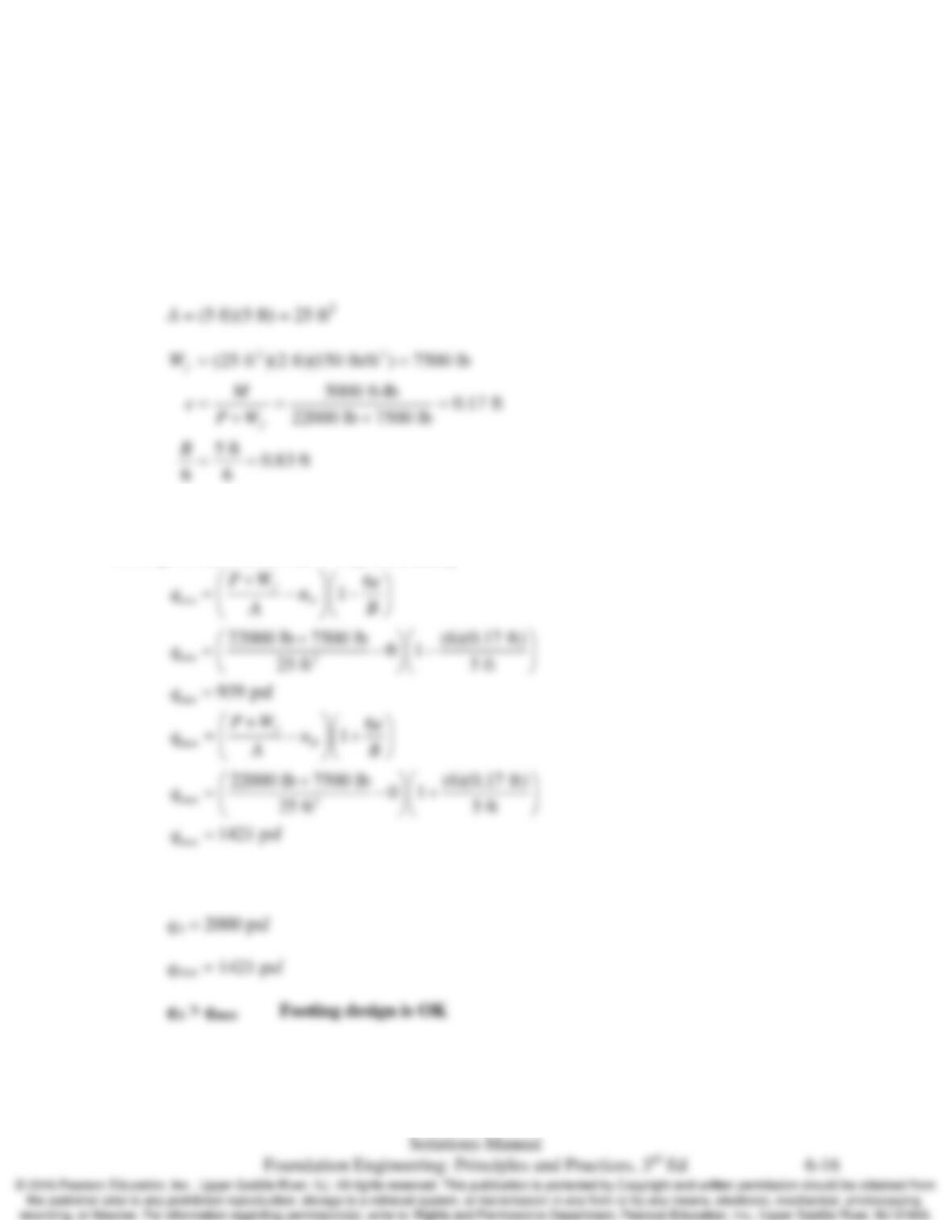
Compute weight of footing
Compute bearing stress
Redesign: In this case we can write an analytical equation for the footing width, B.
Chap. 6 Shallow Foundations
6.15 A footing is carrying a design column load of 22 k and a moment of 5 k–ft in one direction. The
footing will be founded on sand at a depth of 2 ft. The water table is 3 ft below the ground
surface. Design the footing width for a square footing that will carry the design loads and meet
the presumptive allowable bearing pressure per the International building code.
Solution
Proposed square footing design: B = L = 4 ft
e < B/6; therefore the resultant is in the middle third. OK
Use Eq. 6.5 and 6.6 for one – way eccentricity
Refer to Table 6.1 for presumptive allowable bearing pressure on sand