
87
PART II
STRATEGIC CHOICES

88
C H A P T E R 6
BUSINESS STRATEGY
Introduction
Note that we use both Porters generic strategies and the Strategy Clock (Section 6.3). Our view
is that Porters generic strategies are widely used in teaching and to speak important issues of
hard choices and relative cost. On the question of stuck-in-the-middle, regarding which
Illustration 6.1
easyCouncils: a not so easy low-cost strategy
This case is designed to show that competitive strategy concepts can be relevant in the public
sector too.
1. What are the advantages and disadvantages of this approach to low-cost council services?
The advantages are clearly in cost: this will save local taxpayers money. However, the shift
from a paternalistic bureaucratic model appears also to offer more flexibility and user-
2. In what sense do borough councils compete?
Borough councils and other local authorities or at least the political parties seeking to run
them compete for votes: the Conservative Party won control of Barnett on a winning

Johnson, Whittington, Scholes, Angwin and Regnér, Exploring Strategy, 10th edition,
Instructors Manual on the Web
Illustration 6.2
Volvos different Indian buses
This is a case of a remarkably successful differentiation strategy, in what seemed to be very
unpromising circumstances.
1. Rank the elements of Passeys strategy for Volvo in order of importance. Could any have
been dispensed with?
Passeys strategy for Volvo included a superior product, post-sale services, free training,
2. How sustainable is Volvos luxury bus strategy?
The question of sustainability can be addressed by reference back to the VRIN factors in
Chapter 3. Volvo clearly has a valuable product, one that starts as rare to the point of
Illustration 6.3
McCafés versus Starbucks
This illustration allows a more dynamic and interactive approach to strategy than, for example,
the somewhat static categories of Porters generic strategies. It reinforces that differentiation
and cost advantages have to be continuously defended and reinvented. Richard DAvenis
approach to interactive strategy is insightful here (Section 6.4.1).
1. Plot the moves of McDonalds and Starbucks on the axes of price and perceived quality, as
in Figure 6.7.
McDonalds started with a much cheaper and poorer quality positioning in the coffee
market than Starbucks: its cost leadership strategy (based on inferior coffee and cheap
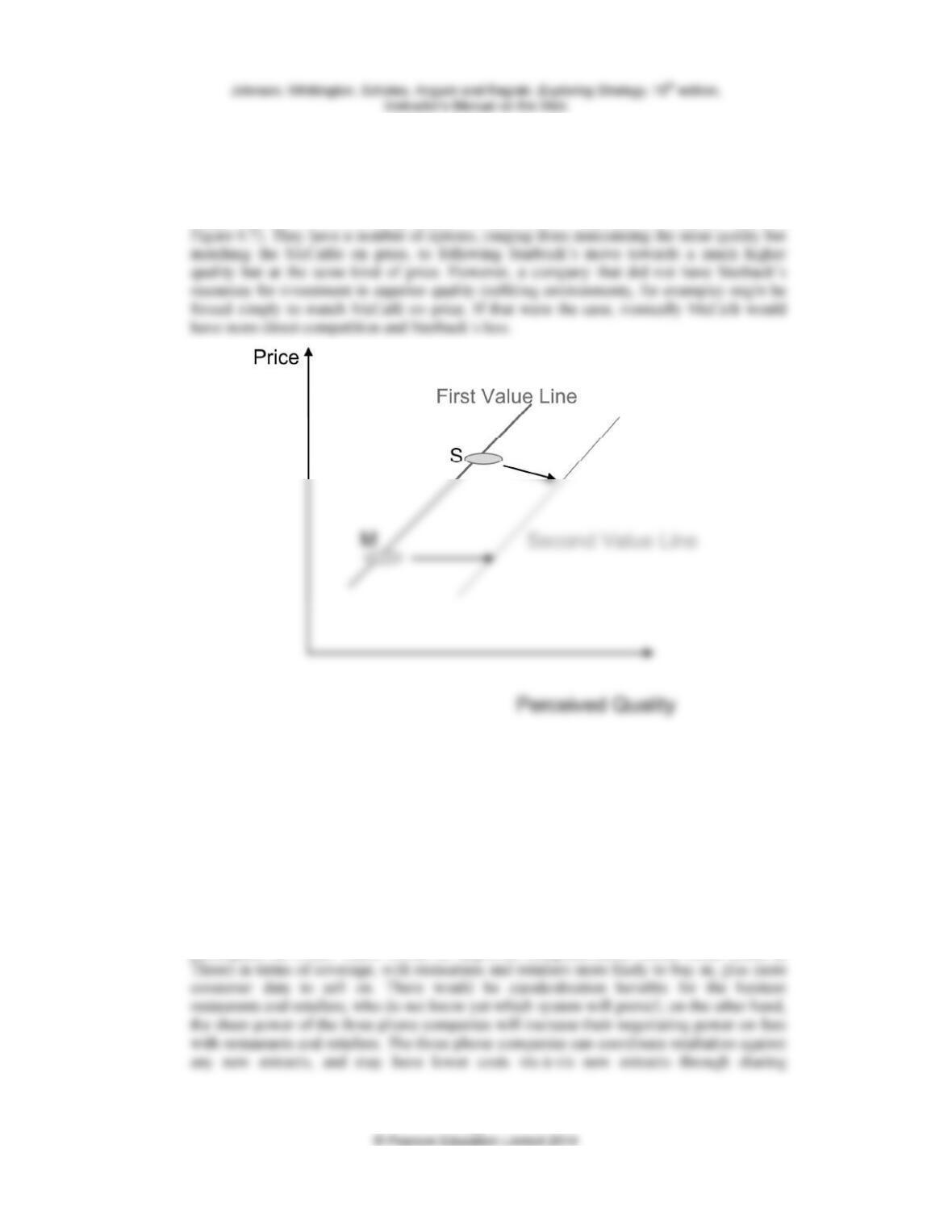
90
2. What should be done by a company with a similar original position to Starbucks, but
operating in a market where McCafé has not yet arrived (e.g. Costa Coffee in the United
Kingdom)?
For companies with equivalent positions as Starbucks, such as Costa Coffee in the United
Kingdom, there is a real risk of getting left behind the new value line (as company U does in
Illustration 6.4
Mobile payment systems: cooperating to pay
Students often have a rather romantically positive view of alliances. The predicament of Three
shows some of the potential downsides of cooperation, at least for excluded rivals.
1. In terms of Figure 6.9, what are the benefits to the Project Oscar partners of collaboration?
Benefits of Project Oscar: in terms of Figure 6.9, there might be many benefits to
participants in Oscar. There would be improved competitiveness versus rivals (such as

91
substitute rather than rival).
2. What options are available now to the excluded Three?
Options for Three: it looks as if Three is too small to go-it-alone. This is liable to be a
winner-takes-all market, with one or two systems emerging as predominant. Three might
Illustration 6.5
War gaming in South Africa
1. War games can be used to guide new product introductions, pricing changes and new
market entries. Can you think of other business situations where they could be useful?
War game situations: war gaming might be particularly useful in merger and acquisition
situations. Thus, acquirers might want to understand the likely moves of rival potential
2. Are there any limits or dangers to comparing business strategy to war?
Limit of war analogy: war analogies are often used in strategy (battles for market share,
fights for technology leadership, contested M&A bids and so on). There is a danger that
Key Debate
To be different or the same?
The emphasis on conformity in institutional theory (see also Section 5.4.2) provides a useful
counter to the perspectives favouring differentiation, as in this chapter and in the resource-based

Students may well vary in responding to the questions. With regard to universities, in the UK at
least but to a large extent internationally as well, there does seem to be increasing homogeneity.
Universities are converging in terms of degree length, subject matter, teaching methods and
accommodation and student support. In the UK, this is attributable not only to government
funding and regulation but also relates both to students risk aversion with regard to a large,
uncertain and hard-to-reverse investment, and to their desire for international mobility during
Video assignment
Cisco
Cisco is an IT network and communications corporation founded in the USA in 1984 which has
now grown into a global giant with turnover in excess of $46bn. As a Chief Technical Officer,
Iain Kennedy is in a good position to assess Ciscos business strategy and how it deals with
competitive threats. The video extract is quite short and students will need to have a good grasp
of the underlying concepts generic strategy (see Section 6.3, Figure 6.2 and Figure 6.6);
hyper-competition (Section 6.4.2) and cooperative strategy (Section 6.4.3). Answers can be
informed by the examples given by Iain Kennedy at Cisco but students should draw on their
knowledge of the IT sector generally to answer the questions. There is a lot of useful
information in the annual Cisco company report (see http://www.cisco.com/web/about/ac49/
ac20/about_cisco_annual_reports.html).
1. It is worth starting with a brief review of the generic strategy models Porters framework
(Figure 6.2) and the Strategy Clock (Figure 6.6) and asking students where they think Cisco
fits. The most likely conclusion is that they are following a differentiation strategy whether
that is in Porters framework or in the Strategy Clock. There is no information about pricing

93
2. Iain Kennedy, without stating it explicitly, is discussing the IT sector in general (and
Ciscos network solutions business in particular) in terms that are typical of hyper-
competitive markets. A key success factor in such a market is innovation Kennedy refers
Assignment 6.1
Business strategy in the public and charity sectors
Students may well have reservations about the relevance of business strategy in the not-for-
profit sectors, and it is worthwhile pushing them on this. Public services are always
manipulating the variables of cost and quality, just as in Porters or DAvenis frameworks.
Assignment 6.2
Applying generic strategies or the Strategy Clock
This assignment reveals one of the advantages of the Strategy Clock; it is a lot easier to access
price information than cost information. It is best for students to consider a set of firms in the
Assignment 6.3
Differentiation
The purpose of this assignment is to establish whether students are able to explain the concept
of differentiation, not only in terms of being different or by citing the importance of zone 1 in
Figure 6.6 but rather in terms of, for example:
That differentiation means providing both products and services valued by customers/users,
and doing this in ways that are difficult to imitate.
Assignment 6.4
Hypercompetition in context
This assignment invites students to examine a particular industry that might not normally be
associated with hypercompetition and to consider the extent to which the conditions of
hypercompetition may be becoming more and more evident. Financial services is given as an
example here. Others could be accountancy, car manufacturing, insurance and so on.
The main points that might be drawn out could include
the extent to which cycles of competition seem to be speeding up, with shorter and shorter
life cycles of products and services;
95
Assignment 6.5
Cooperation rather than competition
Students should draw on the general principles explained in Sections 6.4.3 and 6.4.4, which
point to the circumstances in which cooperative strategies make sense. Figure 6.9 should be
particularly helpful. For example:
Buyerseller collaboration is a key element of Formula 1, where manufacturers see motor
racing as a way of developing their own technologies.
Collaboration of buyers of pharmaceutical goods to increase buying power.
Integrative assignment 6.6
Game theory and international strategy
Chapter 8 refers to the issues of interdependence and retaliation that are very relevant to game
theory. For example, Yips competitive drivers of internationalisation (Section 8.2) refer to the
need to coordinate strategy globally in order to defend against the attacks of other globally
coordinated competitors: it is important to respond to their moves in a coherent rather than
96
to expect certain kinds of response in order to discourage unwanted moves: for example, a
price war launched by a competitor in one geographical market could be always countered
by launching price wars in two geographical markets.
Signalling Repetition makes signals important. For example, any initial intrusion into an
important geographical market should be countered very firmly at once as a warning against
further incursions, there or elsewhere.
Case Example
The IKEA approach
Everyone has heard of IKEA whether you love or hate their products. It remains one of the
best modern examples of what the hybrid strategy actually means and why it is difficult to
The case study is concerned with specifically the issue of generic competitive strategies as
discussed in Section 6.3. It is particularly useful in exploring what cost leadership requires
(Section 6.3.1) and also the difference between a hybrid strategy (Section 6.3.5) and being
stuck in the middle (Section 6.3.4).
1. Identify where (in its value network) and how IKEA has achieved cost leadership.
IKEAs low prices are under-pinned by cost management which is better than competitors:
Extensive control of the value network and (under Dahlvig) process orientation
Choice of materials and designs that are cheap to manufacture
Johnson, Whittington, Scholes, Angwin and Regnér, Exploring Strategy, 10th edition,
Instructors Manual on the Web
2. Identify how IKEA has achieved differentiation from its competitors.
There are a combination of factors that helped IKEA differentiate itself from its
competitors:
Selling a lifestyle, not just products off a shelf. This is sustained consistently through
many aspects of the customer experience:
3. Explain how IKEA tries to ensure that its Hybrid strategy remains sustainable and does
not become stuck-in-the-middle.
With both low costs and differentiation, IKEA effectively operates a hybrid strategy
(Section 6.3.5). Of course, Michael Porter doubts whether such strategies are sustainable,
warning of the danger of being stuck-in-the-middle (Section 6.3.4). The keys to success
with the hybrid strategy are: (a) customers that value the offering and (b) difficulty for
competitors to imitate. Some useful points in discussion could be:
Students should identify the fact that this hybrid strategy is really the IKEA approach
to doing business in other words it is ingrained in the organisational culture. It might
Avoiding being stuck in the middle involves several challenges for IKEA:
A continuing danger is that the company fails to continue to be tough about the
differentiating features and cost management. Dahlvig reports on the failure to achieve
productivity improvement targets. This, in turn, required higher margins to sustain
profitability. This slowly undermines the driving down of prices and/or puts more
pressure on other elements of cost. The hybrid advantage may be lost?
98
In summary, however successful is a company or a concept, they cannot sit on their laurels.
Business history is littered with those that did.
4. What are the lessons from China about IKEAs approach?
Although IKEA worked hard to maintain standardisation of approach across countries,
China illustrates that the local conditions particularly the stage of economic and retail