PROBLEM 6.30 (Cont.)
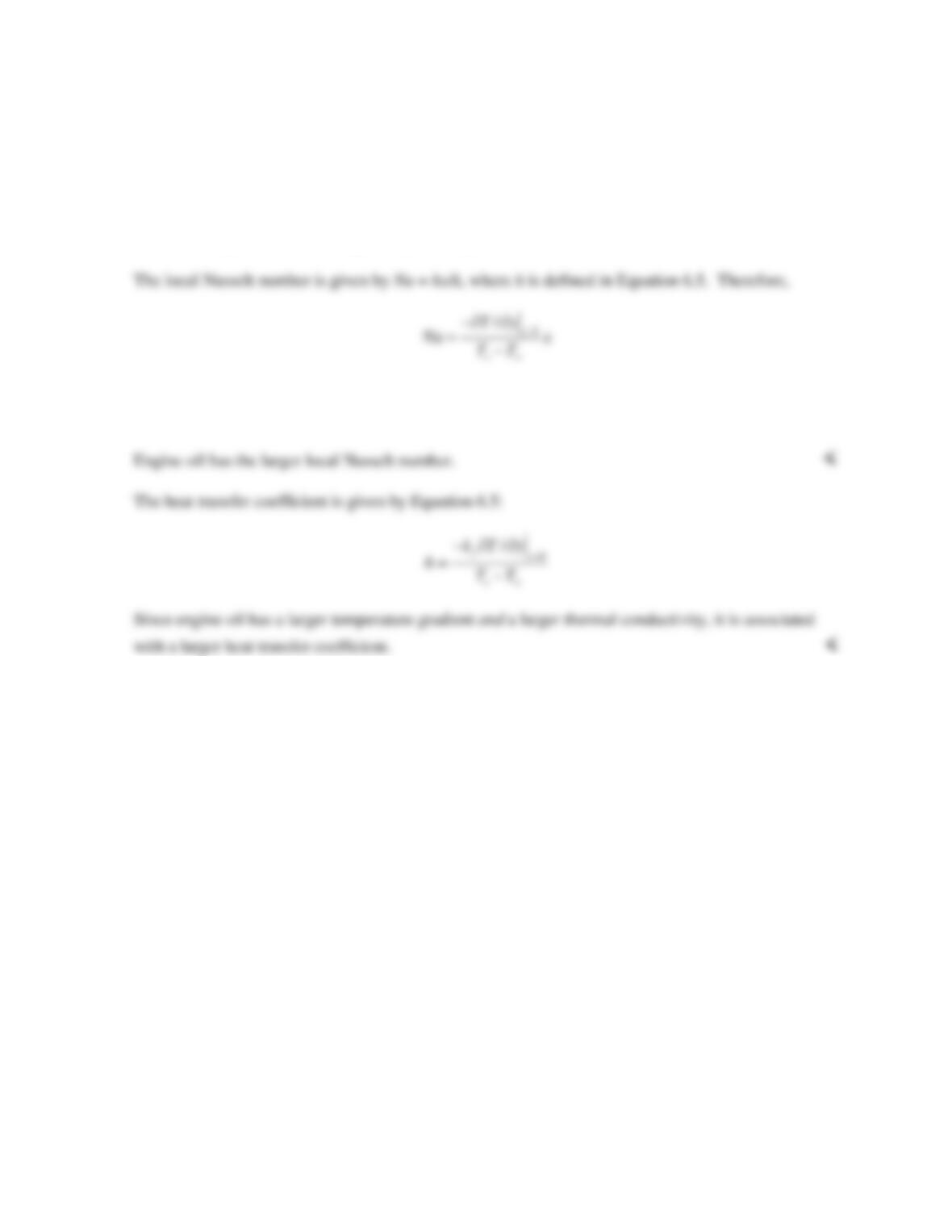
The two fluids are subjected to the same temperature difference between the surface and the free
stream. Since the thermal boundary layer thickness is the distance over which the temperature varies
from the surface temperature to the free stream temperature, the fluid with the smaller value of
δ
t must
have a larger temperature gradient, −∂T/∂yy = 0.
Therefore, engine oil has the larger temperature gradient at the surface. <
At a given x location, since Ts – T∞ is the same for both fluids, the fluid with the larger temperature
gradient has the larger local Nusselt number.
COMMENTS: (1) Since the kinematic viscosity of the two fluids is nearly the same, their local
Reynolds numbers, transition locations, and velocity boundary layer thicknesses are comparable. (2)
The much higher Prandtl number of the engine oil results in a much thinner thermal boundary layer
and consequently a larger temperature gradient at the surface and higher heat transfer coefficient.
PROBLEM 6.31
KNOWN: Expression for the local heat transfer coefficient of air at prescribed velocity and
temperature flowing over electronic elements on a circuit board and heat dissipation rate for a 4 × 4
mm chip located 120mm from the leading edge.
FIND: Surface temperature of the chip surface, Ts.
ASSUMPTIONS: (1) Steady-state conditions, (2) Power dissipated within chip is lost by convection
across the upper surface only, (3) Chip surface is isothermal, (4) The average heat transfer coefficient
for the chip surface is equivalent to the local value at x = L, (5) Negligible radiation.
PROPERTIES: Table A-4, Air (assume Ts = 45°C, Tf = (45 + 25)/2 = 35°C = 308K, 1atm): ν =
16.69 × 10⁻⁶m2/s, k = 26.9 × 10⁻³ W/m⋅K, Pr = 0.703.
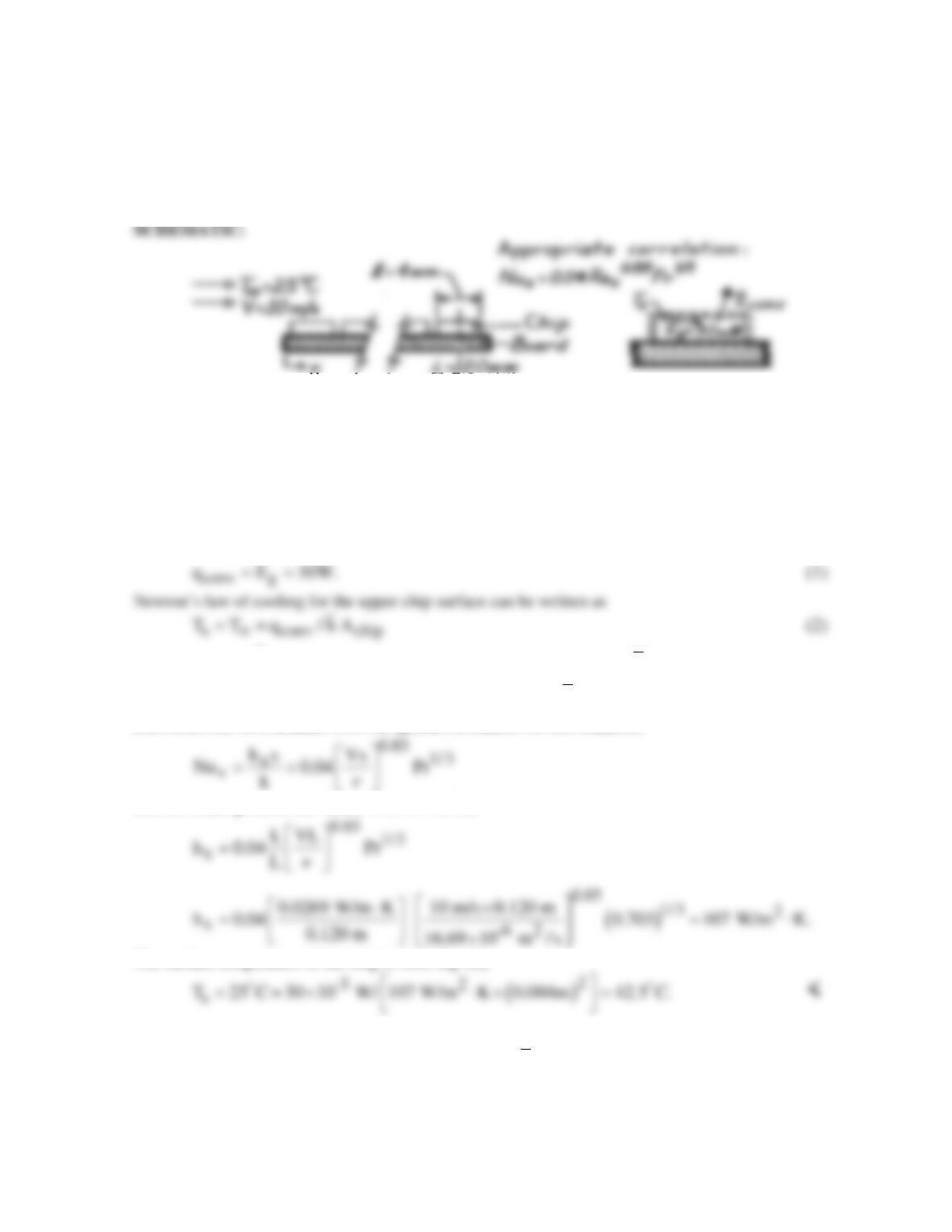
ANALYSIS: From an energy balance on the chip (see above),
where
2
chip
A.=
Assume that the average heat transfer coefficient
( )
h
over the chip surface is
equivalent to the local coefficient evaluated at x = L. That is,
( )
chip x
h hL≈
where the local
coefficient can be evaluated from the special correlation for this situation,
and substituting numerical values with x = L, find
The surface temperature of the chip is from Eq. (2),
COMMENTS: (1) Note that the estimated value for Tf used to evaluate the air properties was
reasonable. (2) Alternatively, we could have evaluated
chip
h
by performing the integration of the
local value, h(x).
PROBLEM 6.32
KNOWN: Expression for the local heat transfer coefficient of air at prescribed velocity and
temperature flowing over electronic elements on a circuit board and heat dissipation rate for a 4 ×
4 mm chip located 120 mm from the leading edge. Atmospheric pressure in Mexico City.
FIND: (a) Surface temperature of chip, (b) Air velocity required for chip temperature to be the
same at sea level.
SCHEMATIC:
ASSUMPTIONS: (1) Steady-state conditions, (2) Power dissipated in chip is lost bey convection
across the upper surface only, (3) Chip surface is isothermal, (4) The average heat transfer
coefficient for the chip surface is equivalent to the local value at x = L, (5) Negligible radiation,
(6) Ideal gas behavior.
PROPERTIES: Table A.4, air (p = 1 atm, assume Ts = 45 °C, Tf = (45 °C + 25 °C)/2 = 35 °C):
k = 0.0269 W/m⋅K, ν = 16.69 × 10⁻⁶ m2/s, Pr = 0.706.
ANALYSIS:
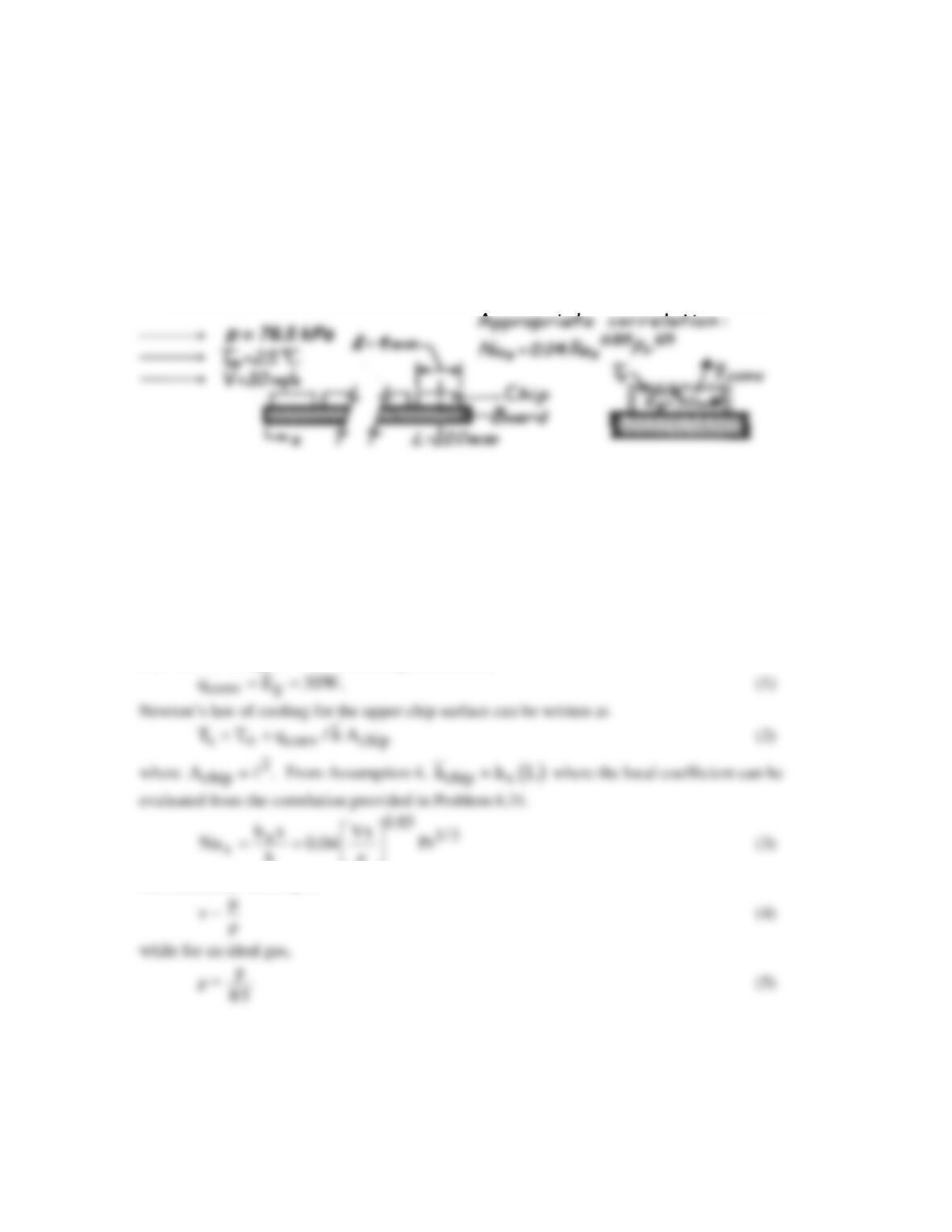
(a) From an energy balance on the chip (see above),
k
ν
The kinematic viscosity is
Combining Equations 4 and 5 yields
-1
ν p∝
(6)
Continued…
PROBLEM 6.32 (Cont.)
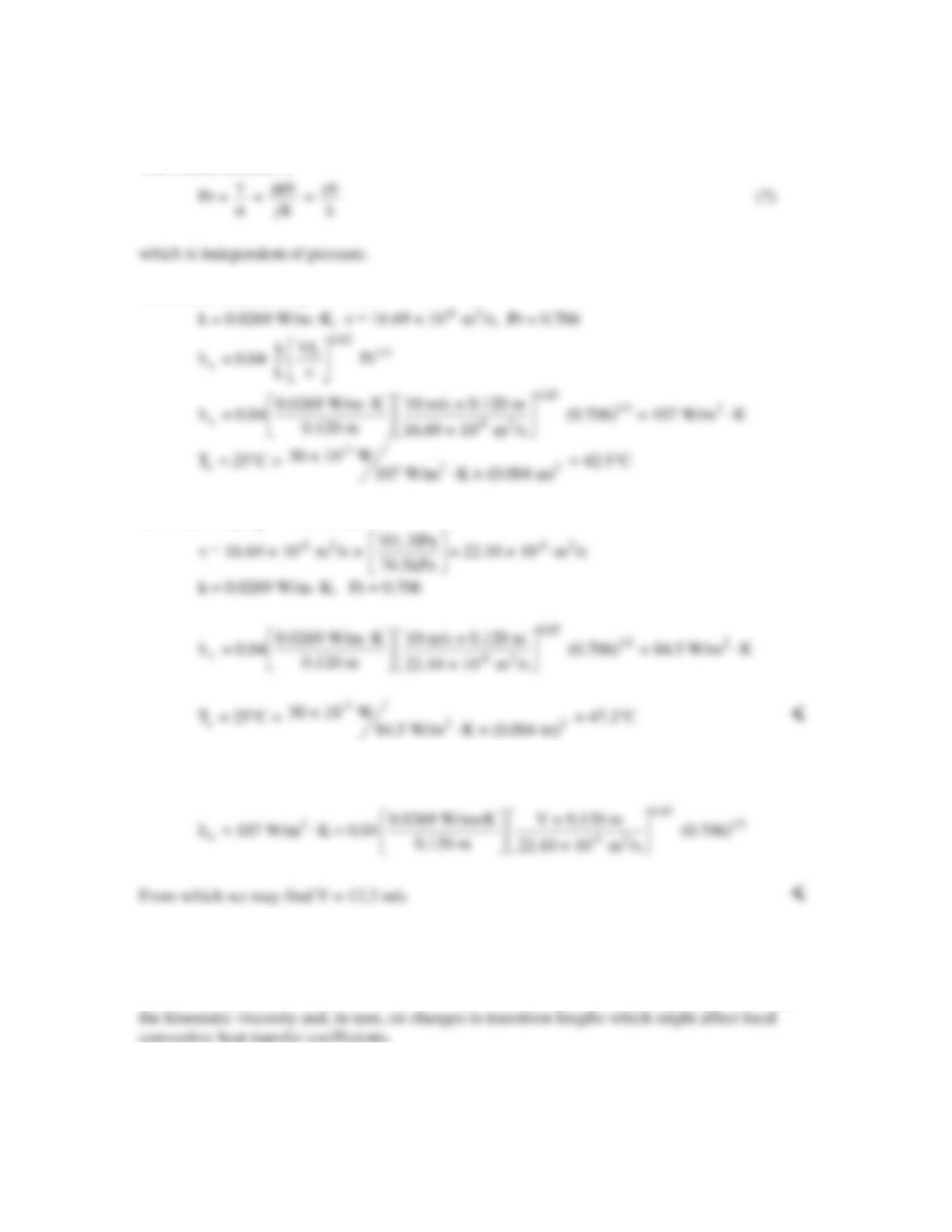
The Prandtl number is
Therefore, at sea level (p = 1 atm)
In Mexico City (p = 76.5 kPa)
(b) For the same chip temperature, it is required that hx = 107 W/m2∙K. Therefore
COMMENTS: (1) In Part (a), the chip surface temperature increased from 42.4 °C to 47.2 °C.
This is considered to be significant and the electronics packaging engineer needs to consider the
effect of large changes in atmospheric pressure on the efficacy of the electronics cooling scheme.
(2) Careful consideration needs to be given to the effect changes in the atmospheric pressure on
PROBLEM 6.33
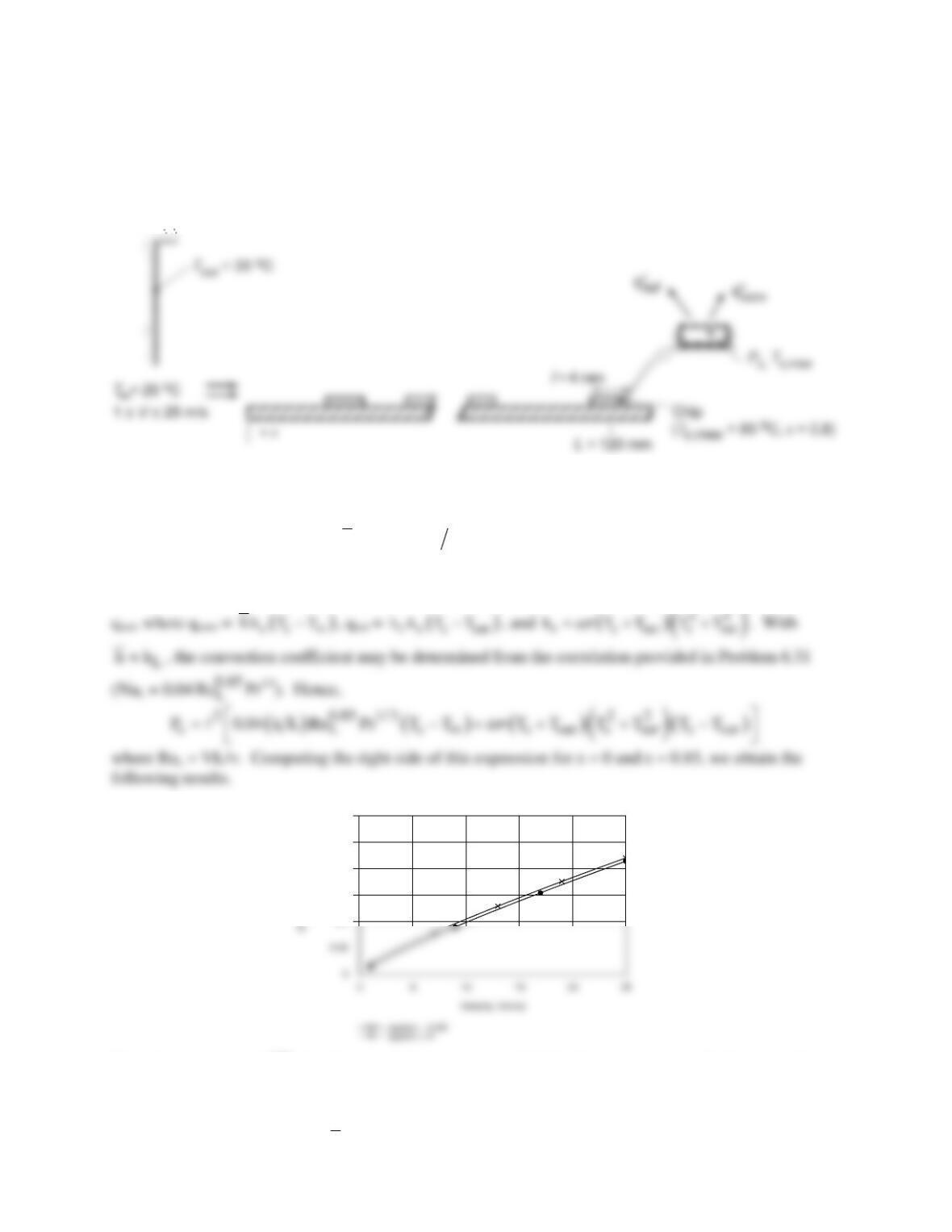
KNOWN: Location and dimensions of computer chip on a circuit board. Form of the convection
correlation. Maximum allowable chip temperature and surface emissivity. Temperature of cooling air
and surroundings.
FIND: Effect of air velocity on maximum power dissipation, first without and then with consideration of
radiation effects.
SCHEMATIC:
ASSUMPTIONS: (1) Steady-state, (2) Negligible temperature variations in chip, (3) Heat transfer
exclusively from the top surface of the chip, (4) The local heat transfer coefficient at x = L provides a
good approximation to the average heat transfer coefficient for the chip surface.
PROPERTIES: Table A.4, air (
( )
c
T T T2
∞
= +
= 328 K): ν = 18.71 × 10⁻⁶ m2/s, k = 0.0284 W/m⋅K,
Pr = 0.703.
ANALYSIS: Performing an energy balance for a control surface about the chip, we obtain Pc = qconv +
0.1
0.15
0.2
0.25
0.3
Since hL increases as V0.85, the chip power must increase with V in the same manner. Radiation exchange
increases Pc by a fixed, but small (6 mW) amount. While hL varies from 14.5 to 223 W/m2⋅K over the
prescribed velocity range, hr = 6.5 W/m2⋅K is a constant, independent of V.
COMMENTS: Alternatively,
h
could have been evaluated by integrating hx over the range 118 ≤ x ≤
122 mm to obtain the appropriate average. However, the value would be extremely close to hx=L.
PROBLEM 6.34
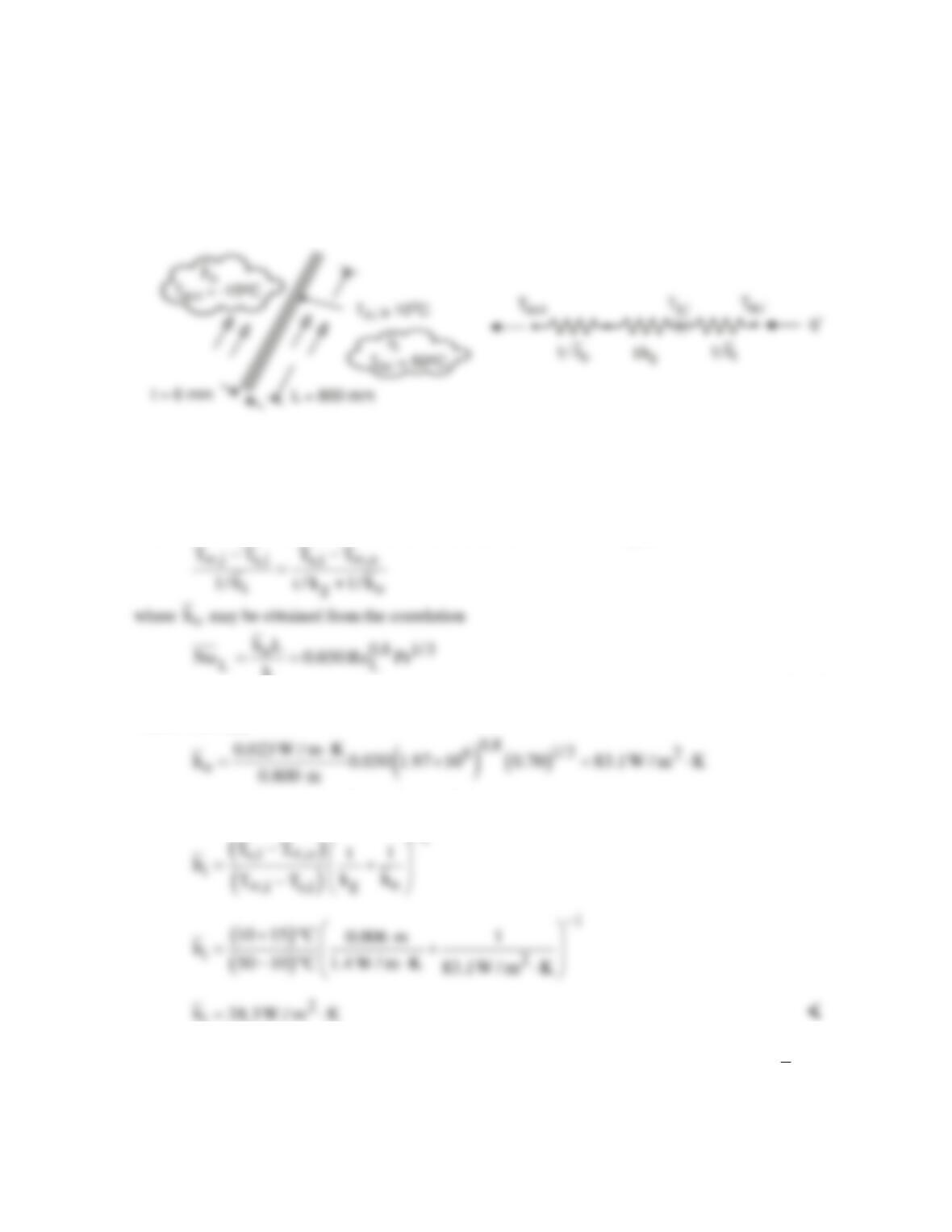
KNOWN: Ambient, interior and dewpoint temperatures. Vehicle speed and dimensions of
windshield. Heat transfer correlation for external flow.
FIND: Minimum value of convection coefficient needed to prevent condensation on interior surface
of windshield.
SCHEMATIC:
ASSUMPTIONS: (1) Steady-state, (2) One-dimensional heat transfer, (3) Constant properties.
PROPERTIES: Table A-3, glass: kg = 1.4 W/m⋅K. Prescribed, air: k = 0.023 W/m⋅K, ν = 12.5 ×
10-6 m2/s, Pr = 0.70.
ANALYSIS: From the prescribed thermal circuit, conservation of energy yields
k
With V = (70 mph × 1585 m/mile)/3600 s/h = 30.8 m/s, ReD = (30.8 m/s × 0.800 m)/12.5 × 10-6 m2/s
= 1.97 × 10⁶ and
From the energy balance, with Ts,i = Tdp = 10°C
i
COMMENTS: The output of the fan in the automobile’s heater/defroster system must maintain a
velocity for flow over the inner surface that is large enough to provide the foregoing value of
i
h.
In
addition, the output of the heater must be sufficient to maintain the prescribed value of T∞,i at this
velocity.
PROBLEM 6.35
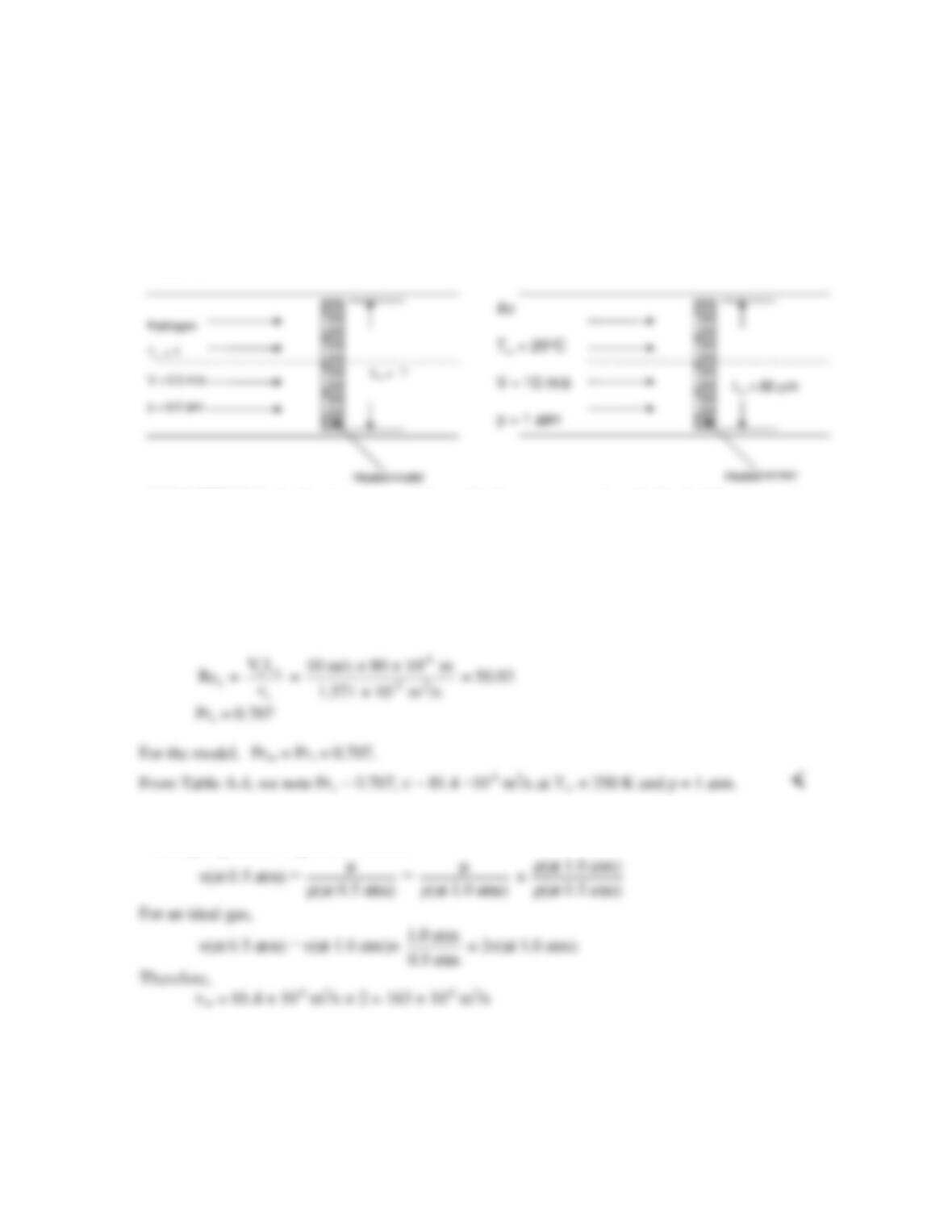
KNOWN: Characteristic length of a microscale chemical detector, free stream velocity and
temperature, hydrogen wind tunnel pressure and free stream velocity.
FIND: Model length scale and hydrogen temperature needed for similarity.
SCHEMATIC:
ASSUMPTIONS: (1) Steady–state conditions, (2) Constant properties, (3) Negligible microscale
or nanoscale effects, (4) Ideal gas behavior.
PROPERTIES: Table A.4, air (T = 25 °C): Prs = 0.707, νs = 15.71 × 10⁻⁶ m2/s, hydrogen (250
K) Pr = 0.707, ν = 81.4 × 10⁻⁶ m2/s.
ANALYSIS: For similarity we require Rem = Res and Prm = Prs. For the sensor,
The value of the Prandtl number is independent of pressure for an ideal gas. The kinematic
viscosity is pressure–dependent. Hence,
For similarity,
Continued…

PROBLEM 6.35 (Cont.)
COMMENTS: (1) From Section 2.2.1, we know that the mean free path of air at room
conditions is approximately 80 nm. Since Ls is three orders of magnitude greater than the mean
free path, the air may be treated as a continuum. (2) Hydrogen can leak from enclosures easily.
By keeping the wind tunnel pressure below atmospheric, we avoid possible leakage of flammable
hydrogen into the lab. Also, if leaks occur, air must enter the wind tunnel. It is much easier to seal
against air leaks than hydrogen leaks. (3) Prm = 0.707 at 100 K also. However, the operation of
the hydrogen wind tunnel at such a low temperature would be much more difficult than at 250 K.
PROBLEM 6.36
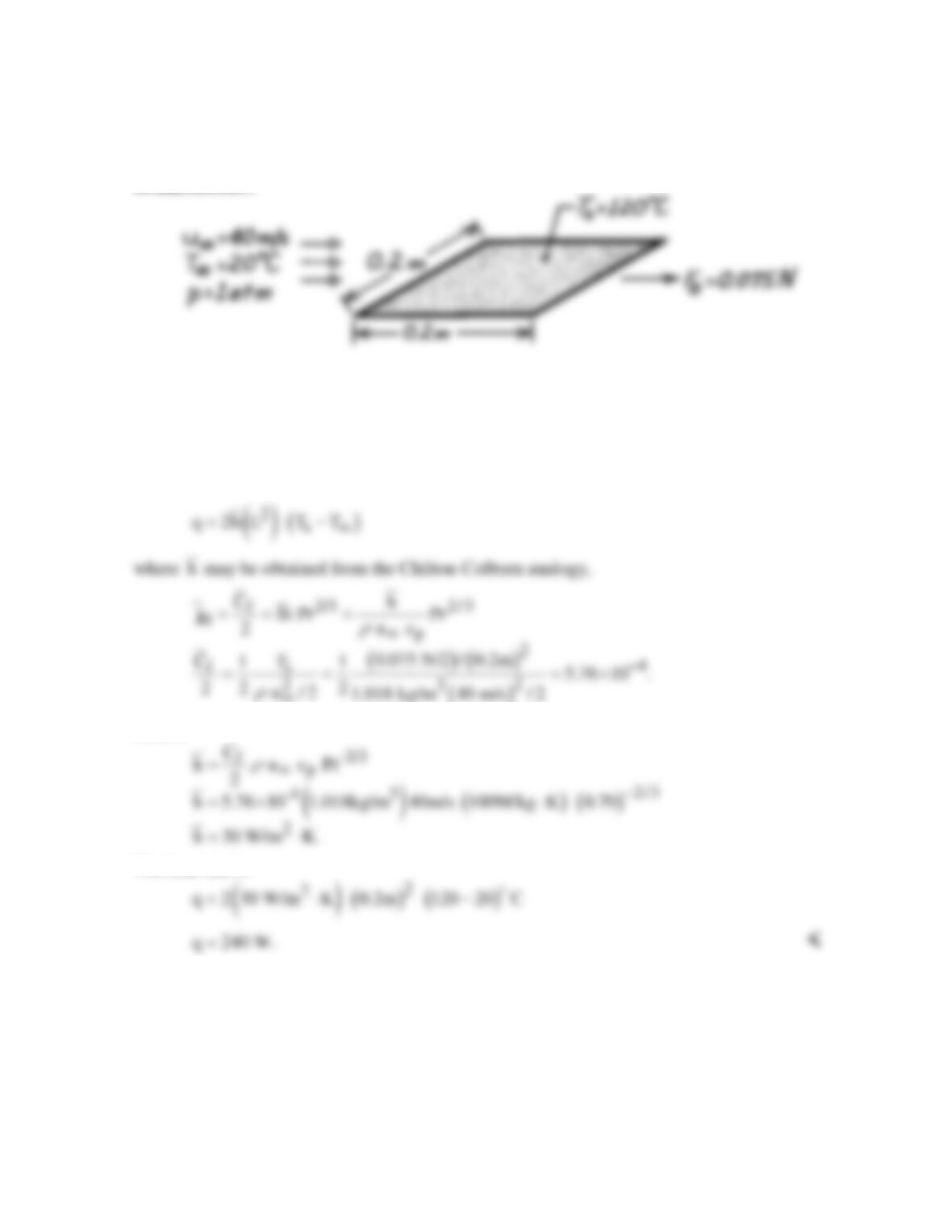
KNOWN: Drag force and air flow conditions associated with a flat plate.
FIND: Rate of heat transfer from the plate.
SCHEMATIC:
ASSUMPTIONS: (1) Chilton-Colburn analogy is applicable.
PROPERTIES: Table A-4, Air (70°C,1 atm): ρ = 1.018 kg/m3, cp = 1009 J/kg⋅K, Pr = 0.70,
ν = 20.22 × 10⁻⁶m2/s.
ANALYSIS: The rate of heat transfer from the plate is
∞
Hence,
The heat rate is
COMMENTS: Although the flow is laminar over the entire surface (ReL = u∞L/ν = 40 m/s
× 0.2m/20.22 × 10-6m2/s = 4.0 × 10⁵), the pressure gradient is zero and the Chilton-Colburn
analogy is applicable to average, as well as local, surface conditions. Note that the only
contribution to the drag force is made by the surface shear stress.
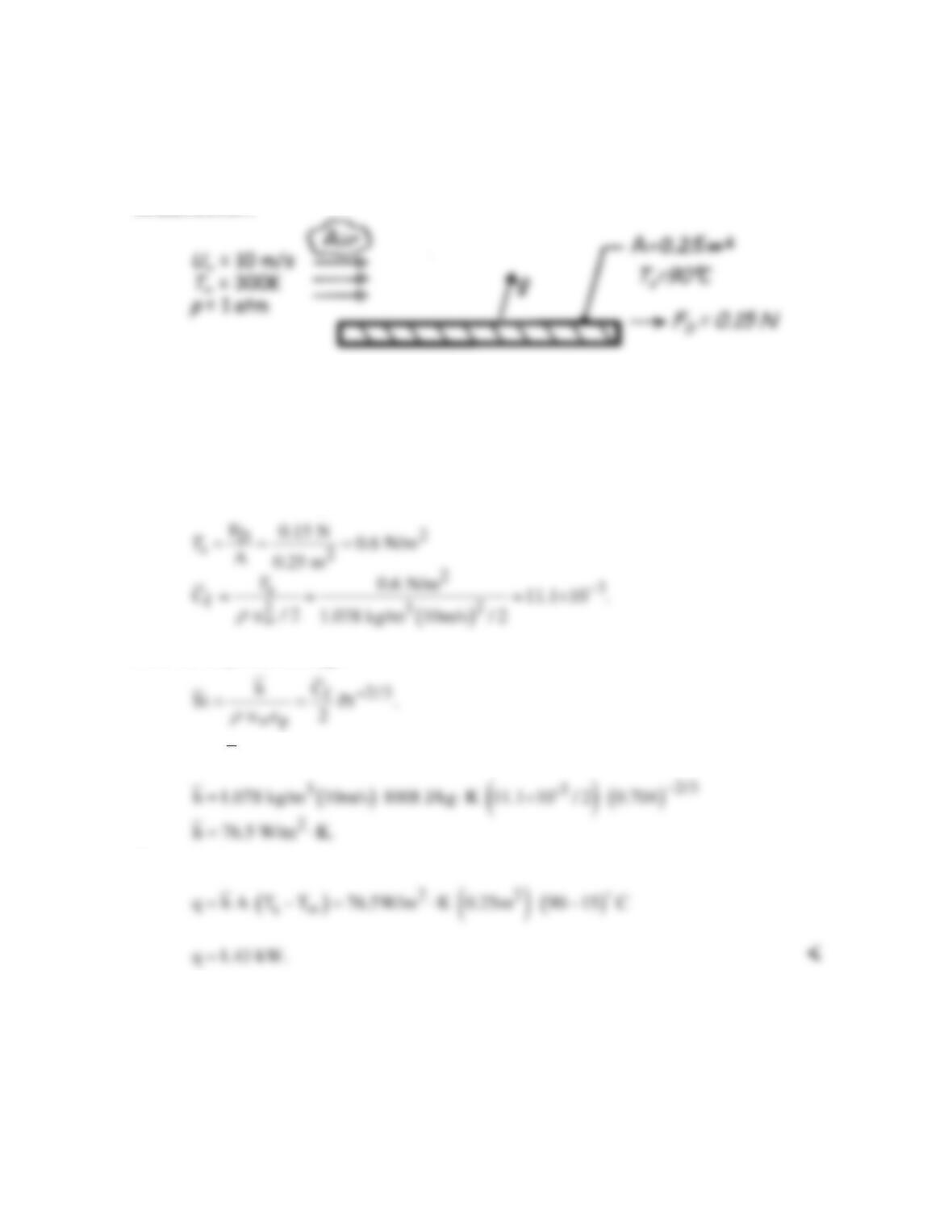
PROBLEM 6.37
KNOWN: Air flow conditions and drag force associated with a heater of prescribed surface
temperature and area.
FIND: Required heater power.
SCHEMATIC:
ASSUMPTIONS: (1) Steady-state conditions, (2) Reynolds analogy is applicable, (3)
Bottom surface is adiabatic.
PROPERTIES: Table A-4, Air (Tf = 325K, 1atm): ρ = 1.078 kg/m3, cp = 1008 J/kg⋅K, Pr =
0.704.
ANALYSIS: The average shear stress and friction coefficient are
From the Reynolds analogy,
Solving for
h
and substituting numerical values, find
Hence, the heat rate is
COMMENTS: Due to bottom heat losses, which have been assumed negligible, the actual
power requirement would exceed 1.43 kW.
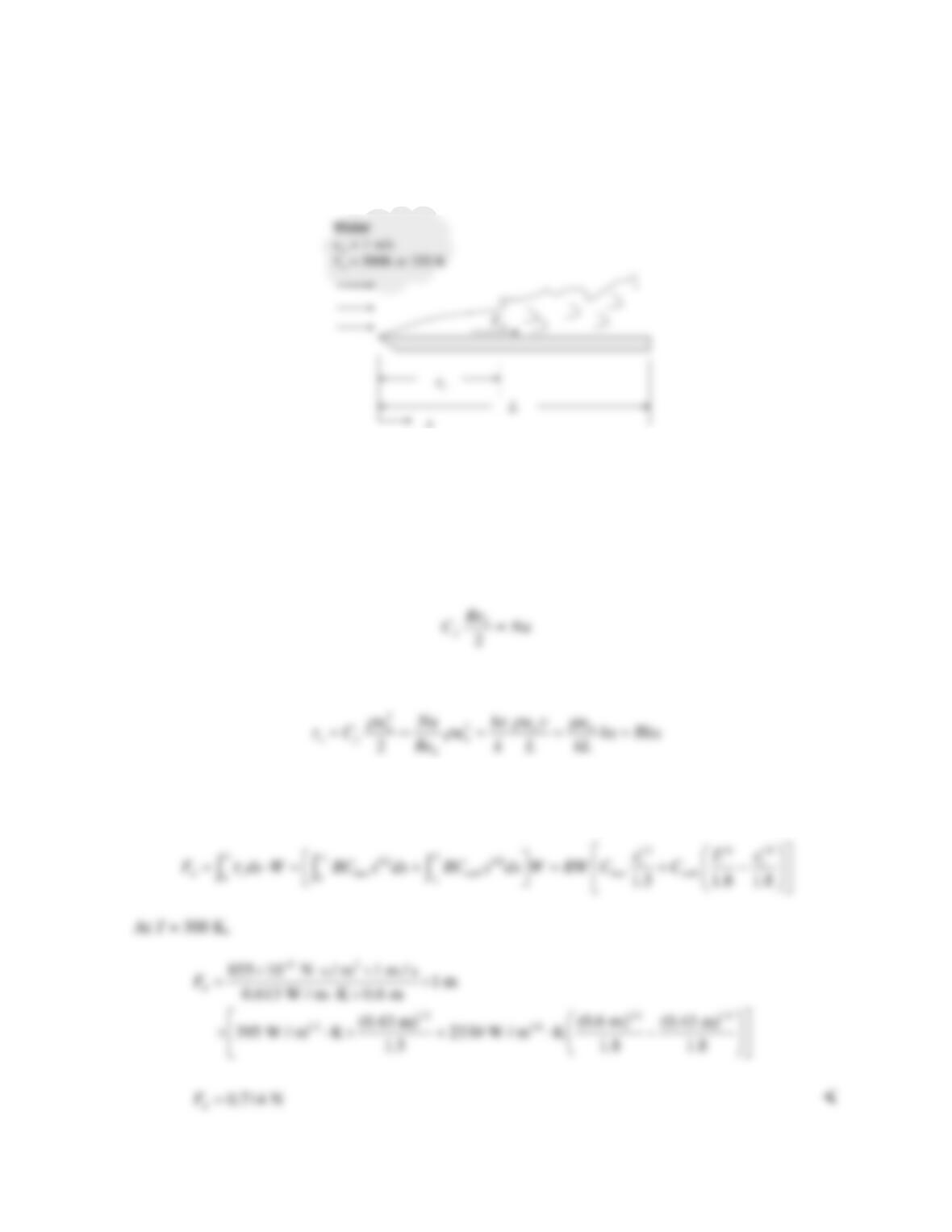
PROBLEM 6.38
KNOWN: Velocity of water flowing over a flat plate. Length and width of plate. Variation of local
convection coefficient with x for T = 300 K and T = 350 K. Locations of turbulence transition.
FIND: Drag force for both water temperatures.
SCHEMATIC:
ASSUMPTIONS: (1) Steady–state conditions, (2) Transition occurs at a critical Reynolds number of
5 × 10⁵, (3) Incompressible flow.
PROPERTIES: Table A.6, Water (T = 300 K):
µ
= 855 × 10-6 N⋅s/m2, k = 0.613 W/m⋅K. Water (T =
350 K):
µ
= 365 × 10-6 N⋅s/m2, k = 0.668 W/m⋅K.
ANALYSIS: According to the Reynolds analogy, Eq. 6.66
This relationship holds for the local values of Cf and Nu. The local shear stress can be expressed as
where B =
µ
u∞/kL. Therefore,
τ
s,lam = BClamx0.5 and
τ
s,turb = BCturbx0.8. Now the drag force can be
found:
Continued…

PROBLEM 6.38 (Cont.)
COMMENTS: (1) Even though transition to turbulence occurs earlier for the T = 350 K case, the net
effect of the much smaller viscosity is a reduction in the drag force. (2) It would be incorrect to apply
Reynolds’ analogy, Eq. 6.66, directly to the average values of Cf and Nu because of the presence of x
in the definition of the Nusselt number. Applying Eq. 6.66 directly to the average values would result
in the incorrect values Fd = 1.36 and 1.22 N for the 300 K and 350 K cases, respectively.
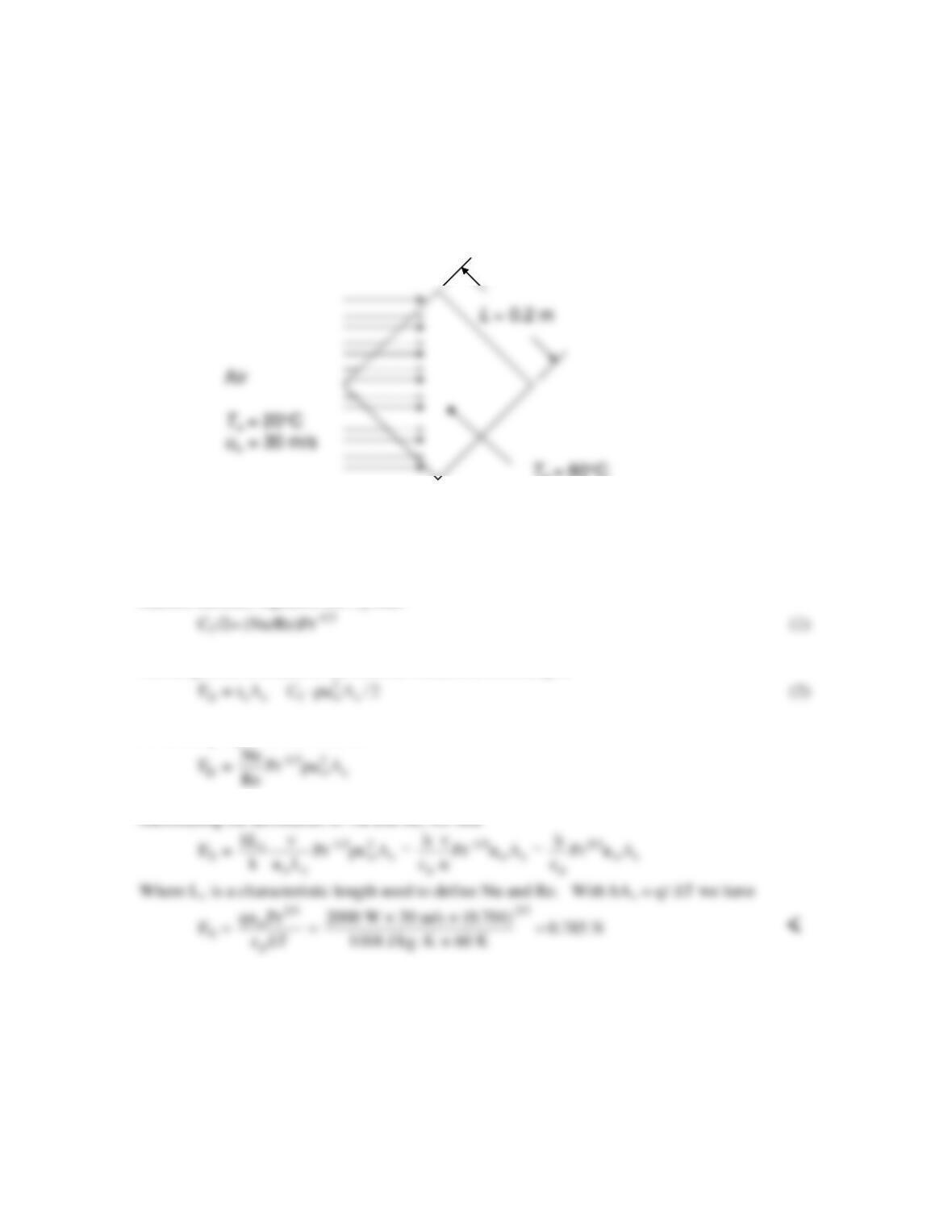
PROBLEM 6.39
KNOWN: Dimensions and temperature of a thin, rough plate. Velocity of air flow parallel to
plate (at an angle of 45° to a side). Heat transfer rate from plate to air.
FIND: Drag force on plate.
SCHEMATIC:
ASSUMPTIONS: (1) The modified Reynolds analogy holds, (2) Constant properties.
PROPERTIES: Table A–4, Air (50°C = 323 K): cp = 1008 J/kg∙K, Pr = 0.704.
ANALYSIS: The modified Reynolds analogy, Equation 6.70, combined with the definition of the
Stanton number, Equation 6.67, yields
The drag force is related to the friction coefficient according to
Combining Equations (1) and (2)
COMMENTS: (1) Heat transfer or friction coefficient correlations for this simple configuration
apparently do not exist. (2) Experiments to measure the drag force would be relatively simple to
implement and measured drag forces could be used to determine the heat transfer coefficients
using the Reynolds analogy. (3) The solution demonstrates advantages associated with working
the problem symbolically and only introducing numbers at the end. First, the length scale in Nu
and Re did not have to be defined because it cancelled out. Second, the properties k, ν, and ρ also
cancelled out.
Ts= 80°C
Ts= 80°C
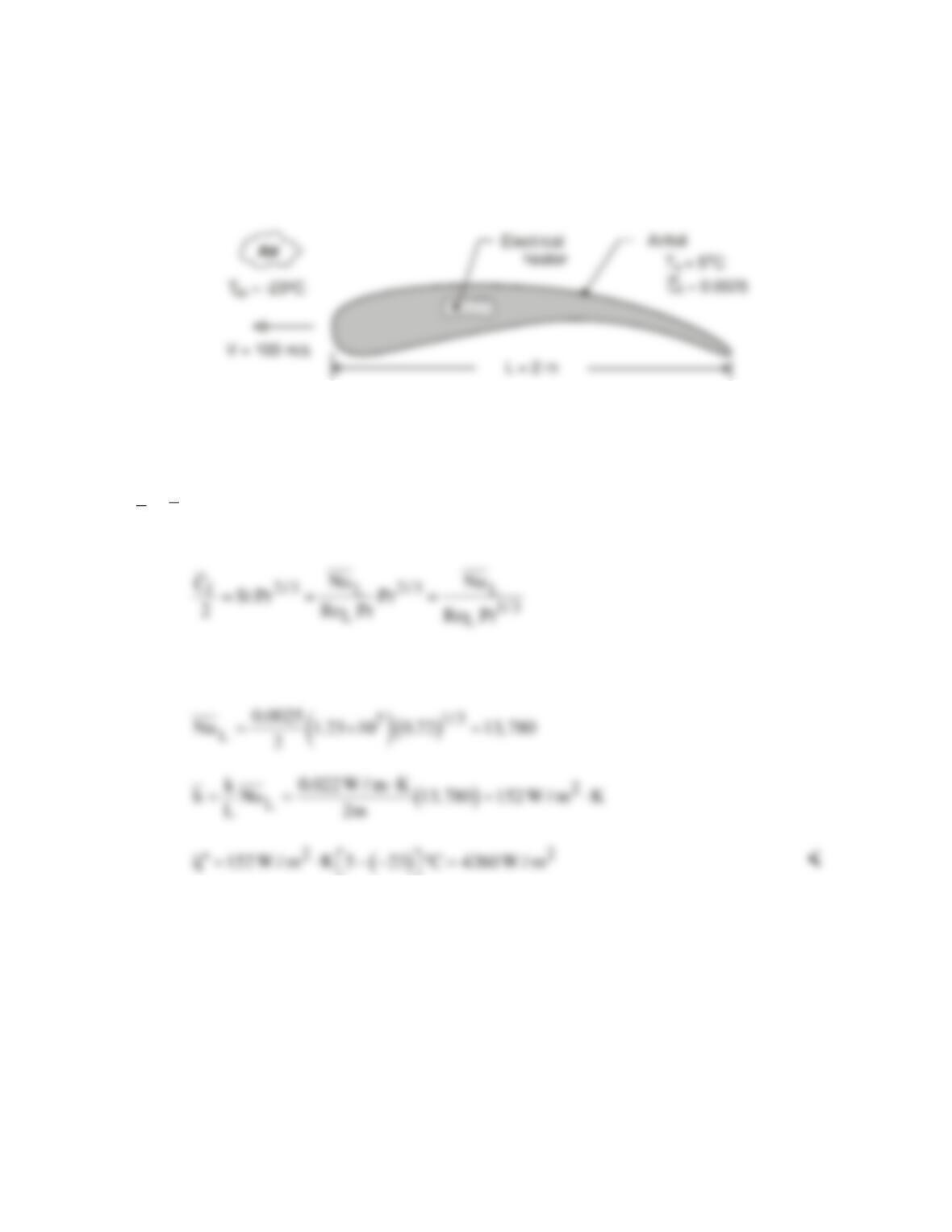
PROBLEM 6.40
KNOWN: Nominal operating conditions of aircraft and characteristic length and average friction
coefficient of wing.
FIND: Average heat flux needed to maintain prescribed surface temperature of wing.
SCHEMATIC:
ASSUMPTIONS: (1) Applicability of modified Reynolds analogy, (2) Constant properties.
PROPERTIES: Prescribed, Air: ν = 16.3 × 10⁻⁶ m2/s, k = 0.022 W/m⋅K, Pr = 0.72.
ANALYSIS: The average heat flux that must be maintained over the surface of the air foil is
( )
s
q hT T ,
∞
′′ = −
where the average convection coefficient may be obtained from the modified
Reynolds analogy.
Hence, with
( )
62 7
L
Re VL / 100 m / s 2m / 16.3 10 m / s 1.23 10 ,
ν
−
== ×=×
COMMENTS: If the flow is turbulent over the entire airfoil, the modified Reynolds analogy
provides a good measure of the relationship between surface friction and heat transfer. The relation
becomes more approximate with increasing laminar boundary layer development on the surface and
increasing values of the magnitude of the pressure gradient.
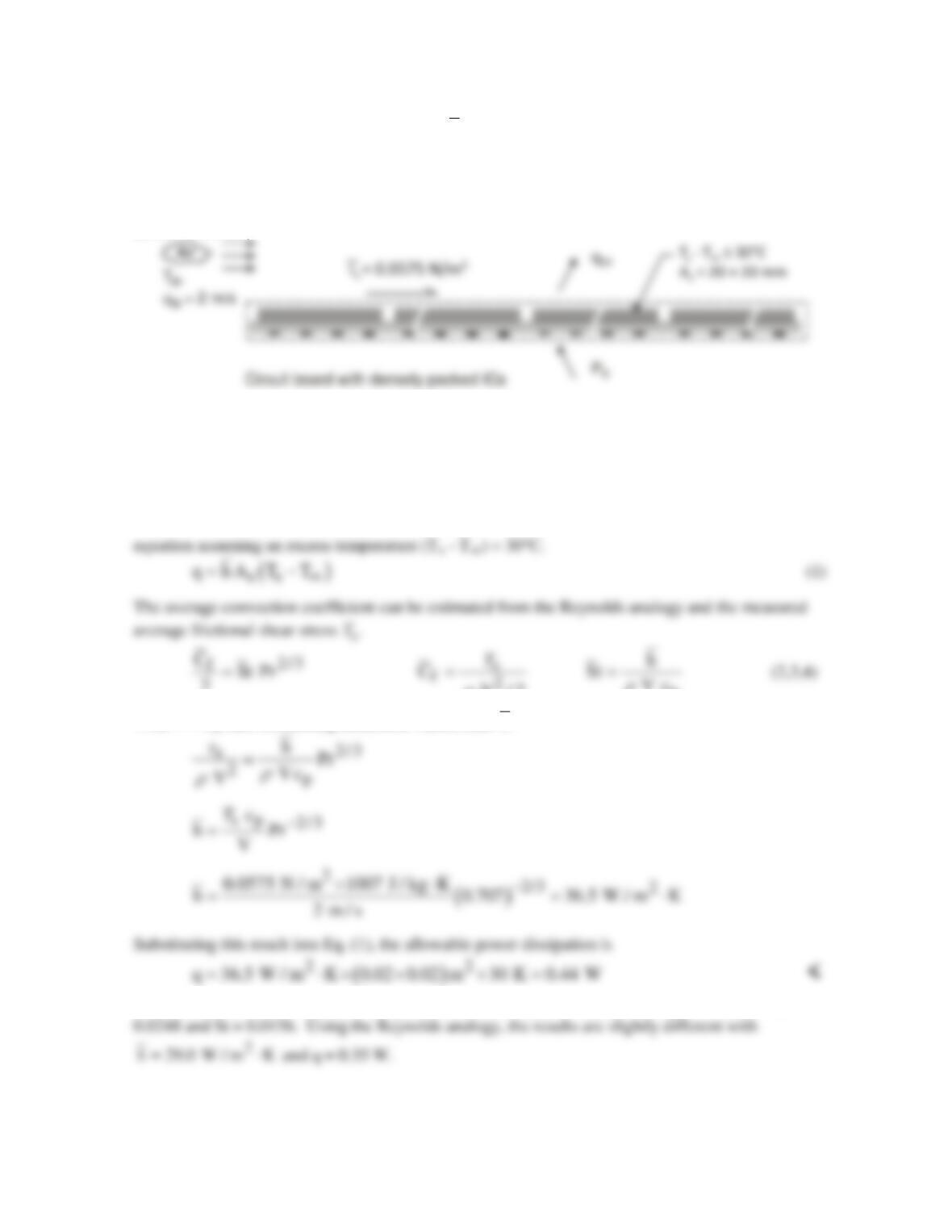
PROBLEM 6.41
KNOWN: Average frictional shear stress of
s
τ
=
0.0575 N/m2 on upper surface of circuit board with
densely packed integrated circuits (ICs)
FIND: Allowable power dissipation from the upper surface of the board if the average surface
temperature of the ICs must not exceed a rise of 30°C above ambient air temperature.
SCHEMATIC:
ASSUMPTIONS: (1) Steady-state conditions, (2) The modified Reynolds analogy is applicable, (3)
Negligible heat transfer from bottom side of the circuit board, and (4) Thermophysical properties
required for the analysis evaluated at 300 K,
PROPERTIES: Table A-4, Air (Tf = 300 K, 1 atm): ρ = 1.161 kg/m3, cp = 1007 J/kg⋅K, Pr = 0.707.
ANALYSIS: The power dissipation from the circuit board can be calculated from the convection rate
2 Vc
V /2
ρ
ρ
With V = u∞ and substituting numerical values, find
h.
COMMENTS: For this analysis using the modified or Chilton-Colburn analogy, we found Cf =
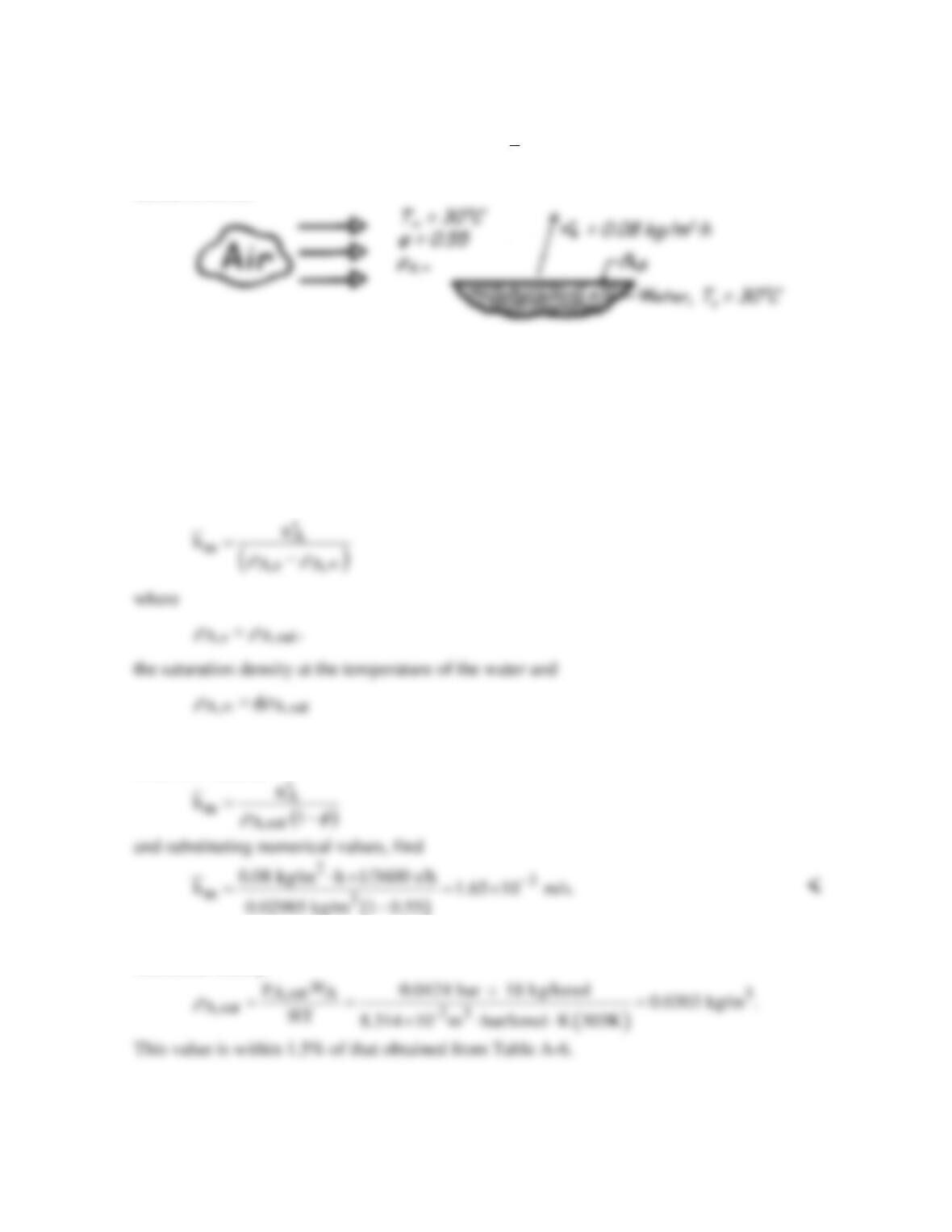
PROBLEM 6.42
KNOWN: Evaporation rate of water from a lake.
FIND: The convection mass transfer coefficient,
m
h.
SCHEMATIC:
ASSUMPTIONS: (1) Equilibrium at water vapor-liquid surface, (2) Isothermal conditions,
(3) Perfect gas behavior of water vapor, (4) Air at standard atmospheric pressure.
PROPERTIES: Table A-6, Saturated water vapor (303K): pA,sat = 0.0424 bar, ρA,sat =
1/vg = 0.02985 kg/m3.
ANALYSIS: The convection mass transfer (evaporation) rate equation can be written in the
form
which follows from the definition of the relative humidity, φ = pA/pA,sat and perfect gas
behavior. Hence,
COMMENTS: (1) From knowledge of pA,sat, the perfect gas law could be used to obtain the
saturation density.
(2) Note that psychrometric charts could also be used to obtain ρA,sat and ρA,∞.
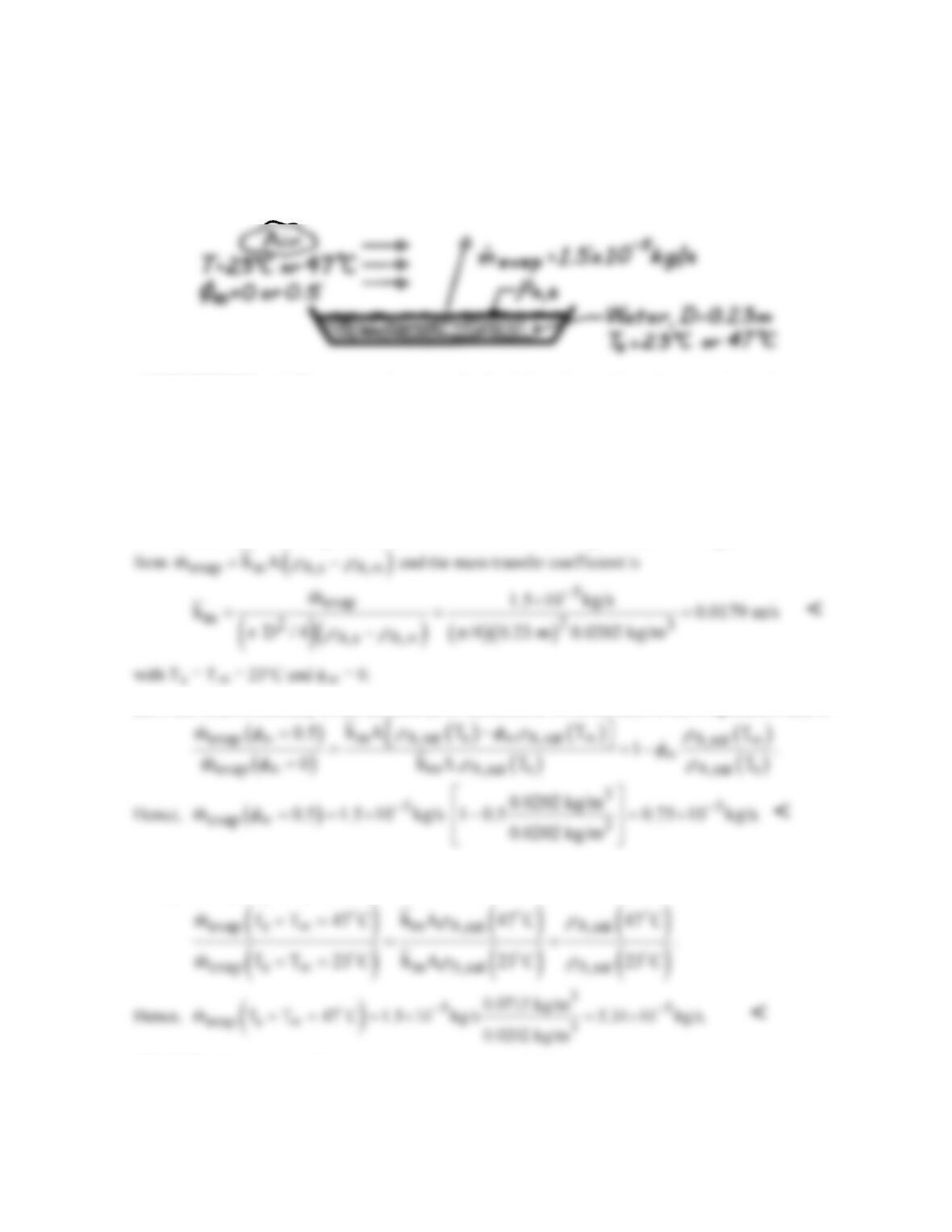
PROBLEM 6.43
KNOWN: Evaporation rate from pan of water of prescribed diameter. Water temperature. Air
temperature and relative humidity.
FIND: (a) Convection mass transfer coefficient, (b) Evaporation rate for increased relative humidity,
(c) Evaporation rate for increased temperature.
SCHEMATIC:
ASSUMPTIONS: (1) Water vapor is saturated at liquid interface and may be approximated as a
perfect gas.
PROPERTIES: Table A-6, Saturated water vapor (Ts = 296K):
-1
A,sat g
v
ρ
= =
(49.4 m3/kg)-1 =
0.0202 kg/m3; (Ts = 320 K):
()
1
-1 3 3
A,sat g
v 13.98 m / kg 0.0715 kg/m .
ρ
−
= = =
ANALYSIS: (a) Since evaporation is a convection mass transfer process, the rate equation has the
(b) If the relative humidity of the ambient air is increased to 50%, the ratio of the evaporation rates is
(c) If the temperature of the ambient air is increased from 23°C to 47°C, with φ∞ = 0 for both cases,
the ratio of the evaporation rates is
COMMENTS: Note the highly nonlinear dependence of the evaporation rate on the water
temperature. For a 24°C rise in
s evap
T ,m
increases by 350%.
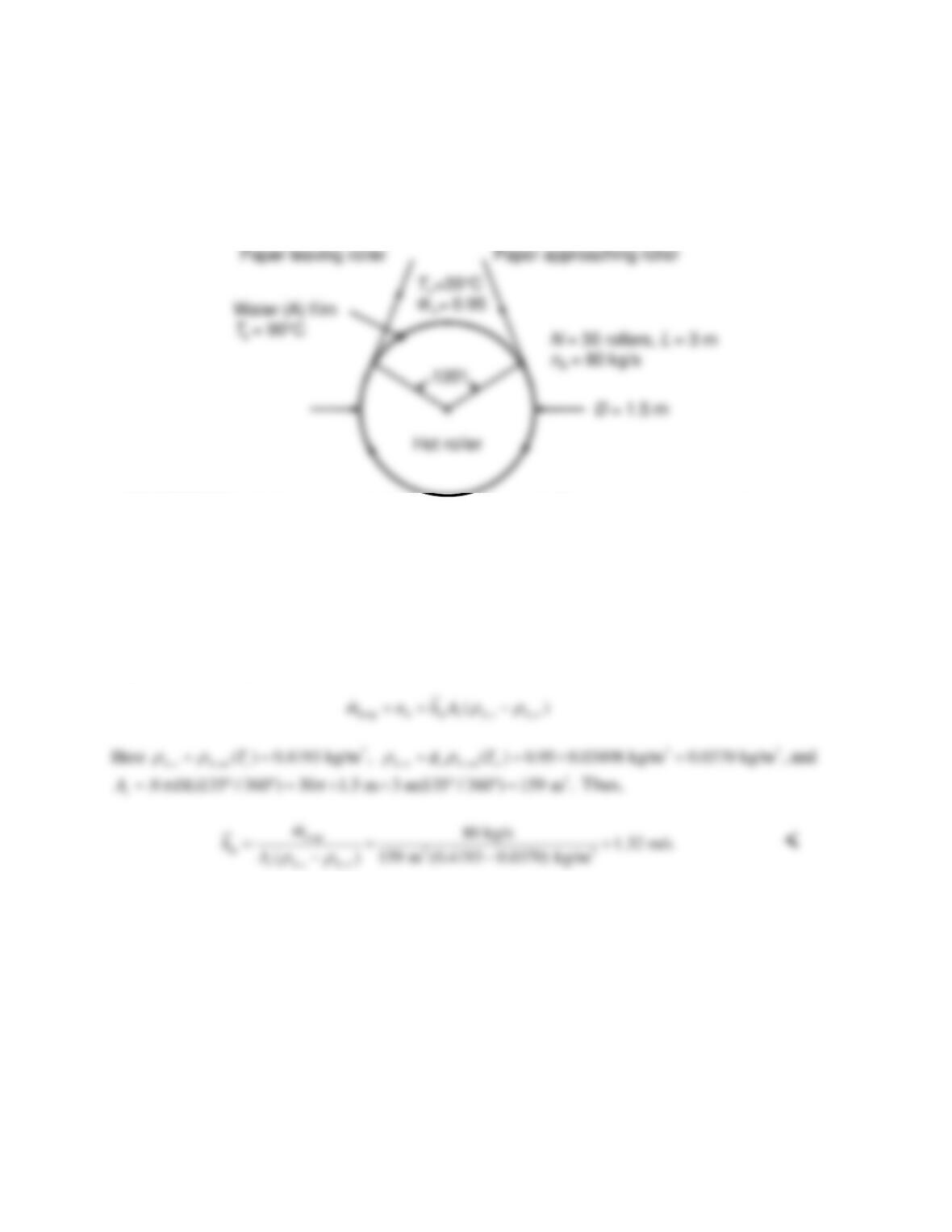
PROBLEM 6.44
KNOWN: Number, diameter, and length of cylindrical rollers. Temperature and evaporation rate of
water film on 135° arc of cylinders exposed to high-velocity air. Air temperature and relative humidity.
FIND: Area–averaged mass transfer coefficient for exposed roller surfaces.
SCHEMATIC:
ASSUMPTIONS: (1) Steady-state, (2) Uniform properties, (3) Water vapor is saturated at liquid
interface.
PROPERTIES: Table A-6, Saturated water vapor (363 K),
13
0.4193 kg/m ;
gg
ρυ
−
= =
Saturated
water vapor (308 K),
13
0.03898 kg/m .
gg
ρυ
−
= =
ANALYSIS: The mass transfer coefficient can be found from the known evaporation rate, area, and
properties according to Equation 6.19:
COMMENTS: (1) The freestream air is nearly saturated. Care must be taken to avoid saturated
conditions (and, in turn, possible condensation of water vapor) by forcibly expelling the moist air from
the plant. (2) Evaporation from the paper that is in contact with the roller occurs at a high rate, and is
driven by a complex heat transfer process involving conduction in the hot roller, a contact resistance at
the roller-paper interface, and conduction in the moist paper.
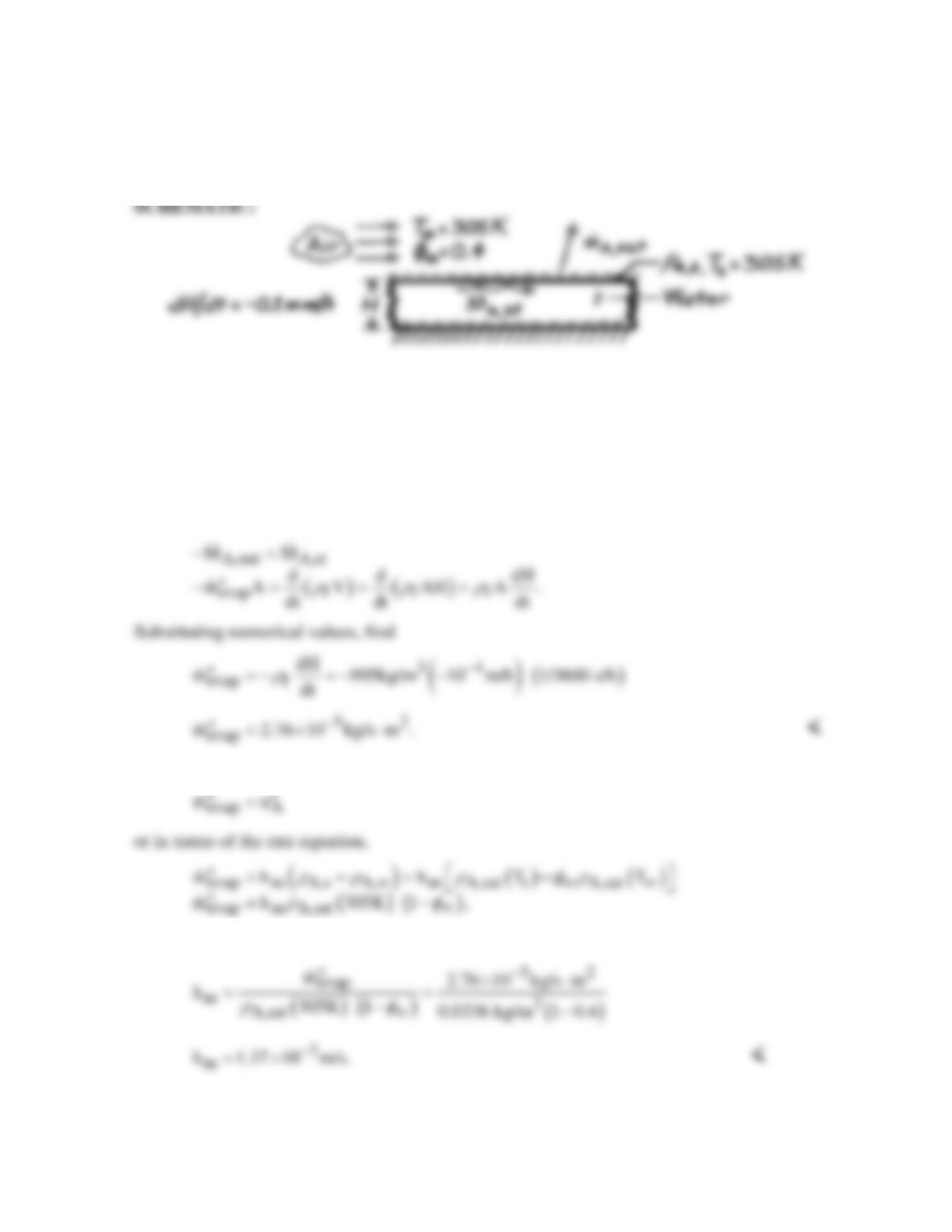
PROBLEM 6.45
KNOWN: Water temperature and air temperature and relative humidity. Surface recession
rate.
FIND: Mass evaporation rate per unit area. Convection mass transfer coefficient.
ASSUMPTIONS: (1) Water vapor may be approximated as a perfect gas, (2) No water
inflow; outflow is only due to evaporation.
PROPERTIES: Table A-6, Saturated water: Vapor (305K),
-1 3
gg
v 0.0336 kg/m ;
ρ
= =
Liquid (305K),
-1 3
ff
v 995 kg/m .
ρ
= =
ANALYSIS: Applying conservation of species to a control volume about the water,
Because evaporation is a convection mass transfer process, it also follows that
and solving for the convection mass transfer coefficient,
COMMENTS: Conservation of species has been applied in exactly the same way as a
conservation of energy. Note the sign convention.
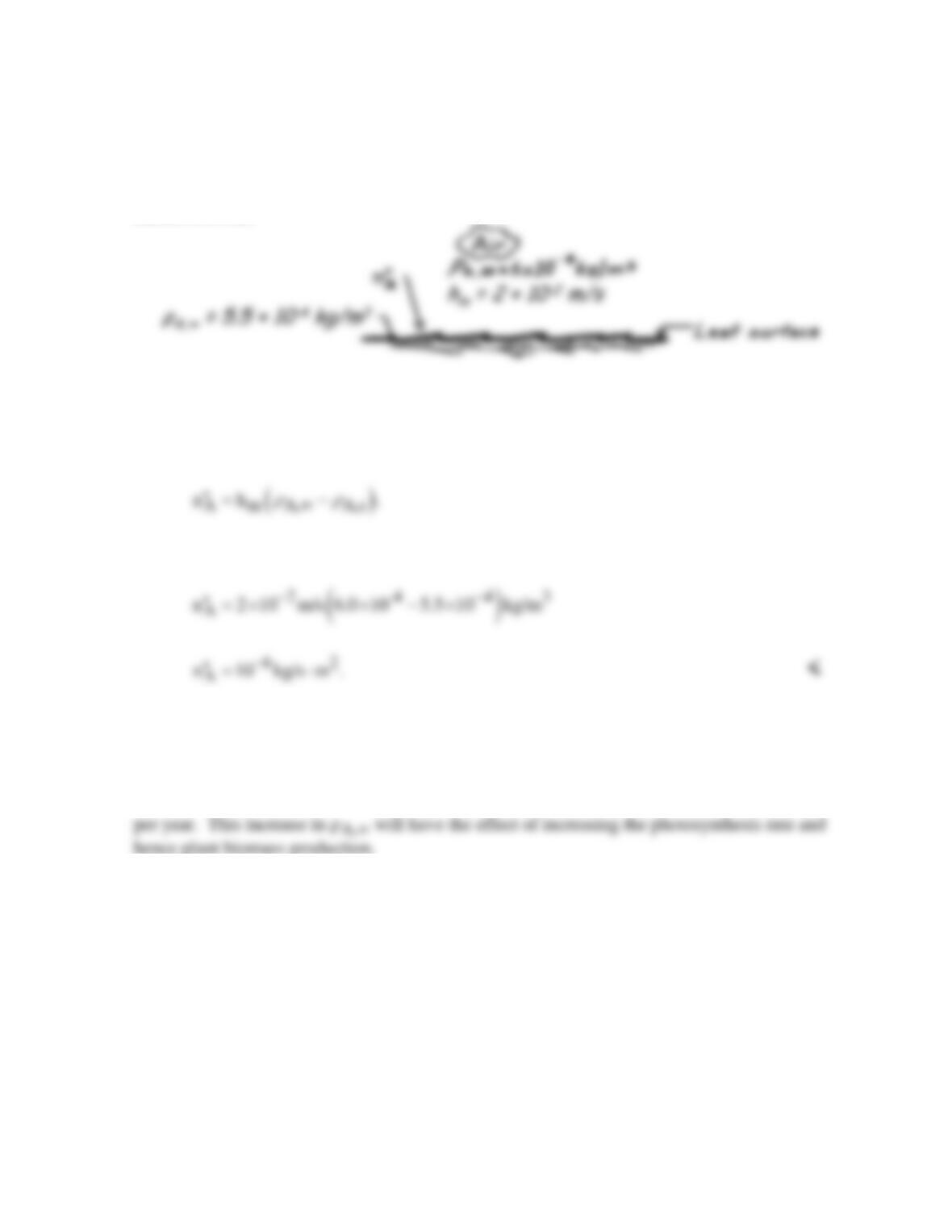
PROBLEM 6.46
KNOWN: CO2 concentration in air and at the surface of a green leaf. Convection mass
transfer coefficient.
FIND: Rate of photosynthesis per unit area of leaf.
SCHEMATIC:
ANALYSIS: Assuming that the CO2 (species A) is consumed as a reactant in photosynthesis
at the same rate that it is transferred across the atmospheric boundary layer, the rate of
photosynthesis per unit leaf surface area is given by the rate equation,
Substituting numerical values, find
COMMENTS: (1) It is recognized that CO2 transport is from the air to the leaf, and (ρA,s –
ρA,∞) in the rate equation has been replaced by (ρA,∞ – ρA,s).
(2) The atmospheric concentration of CO2 is known to be increasing by approximately 0.3%