PROBLEM 6.47
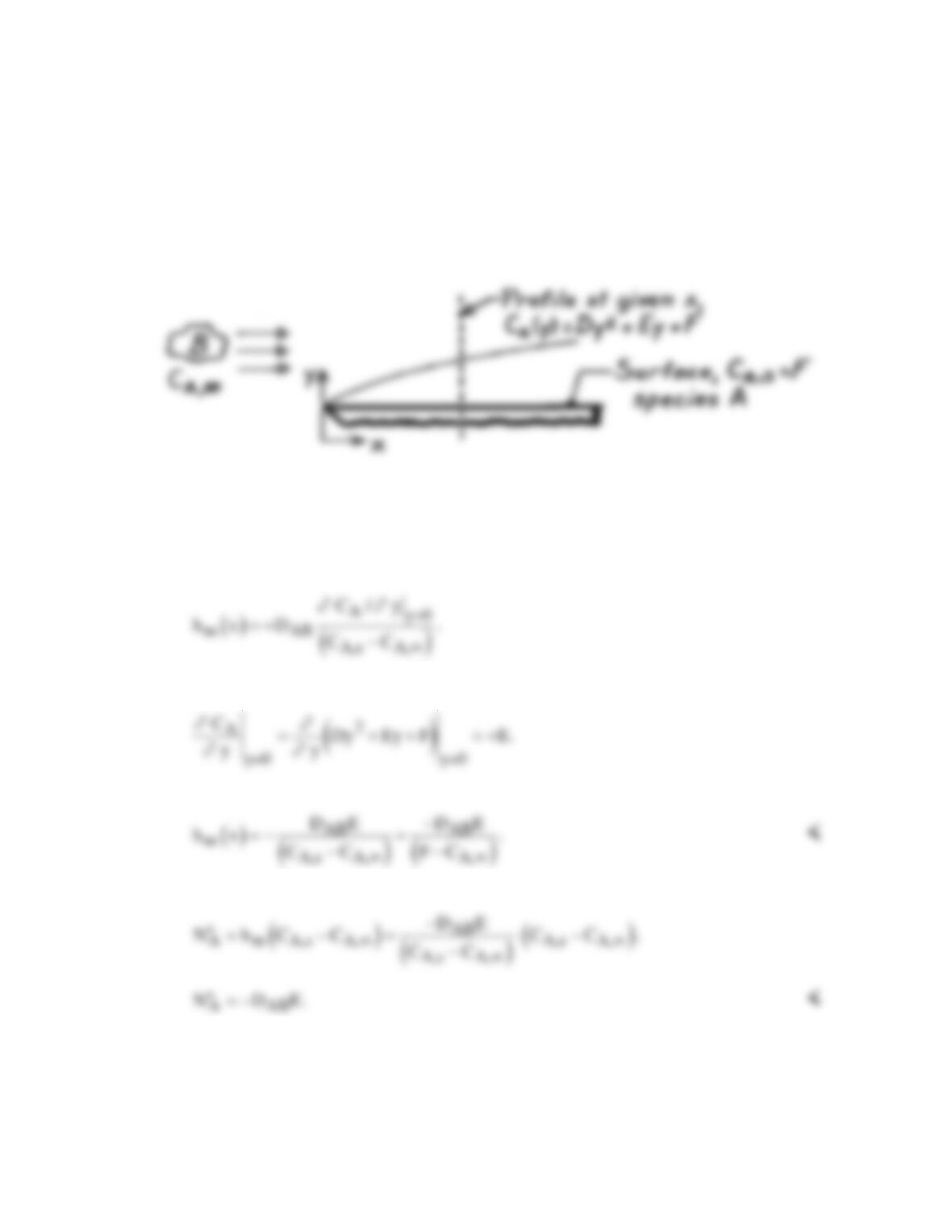
KNOWN: Species concentration profile, CA(y), in a boundary layer at a particular location
for flow over a surface.
FIND: Expression for the mass transfer coefficient, hm, in terms of the profile constants,
CA,∞ and DAB. Expression for the molar convection flux,
′′
N
A
.
SCHEMATIC:
ASSUMPTIONS: (1) Parameters D, E, and F are constants at any location x, (2) DAB, the
mass diffusion coefficient of A through B, is known.
ANALYSIS: The convection mass transfer coefficient is defined in terms of the
concentration gradient at the wall,
The gradient at the surface follows from the profile, CA(y),
Hence,
The molar flux follows from the rate equation,
COMMENTS: It is important to recognize that the influence of species B is present in the
property DAB. Otherwise, all the parameters relate to species A.
PROBLEM 6.48
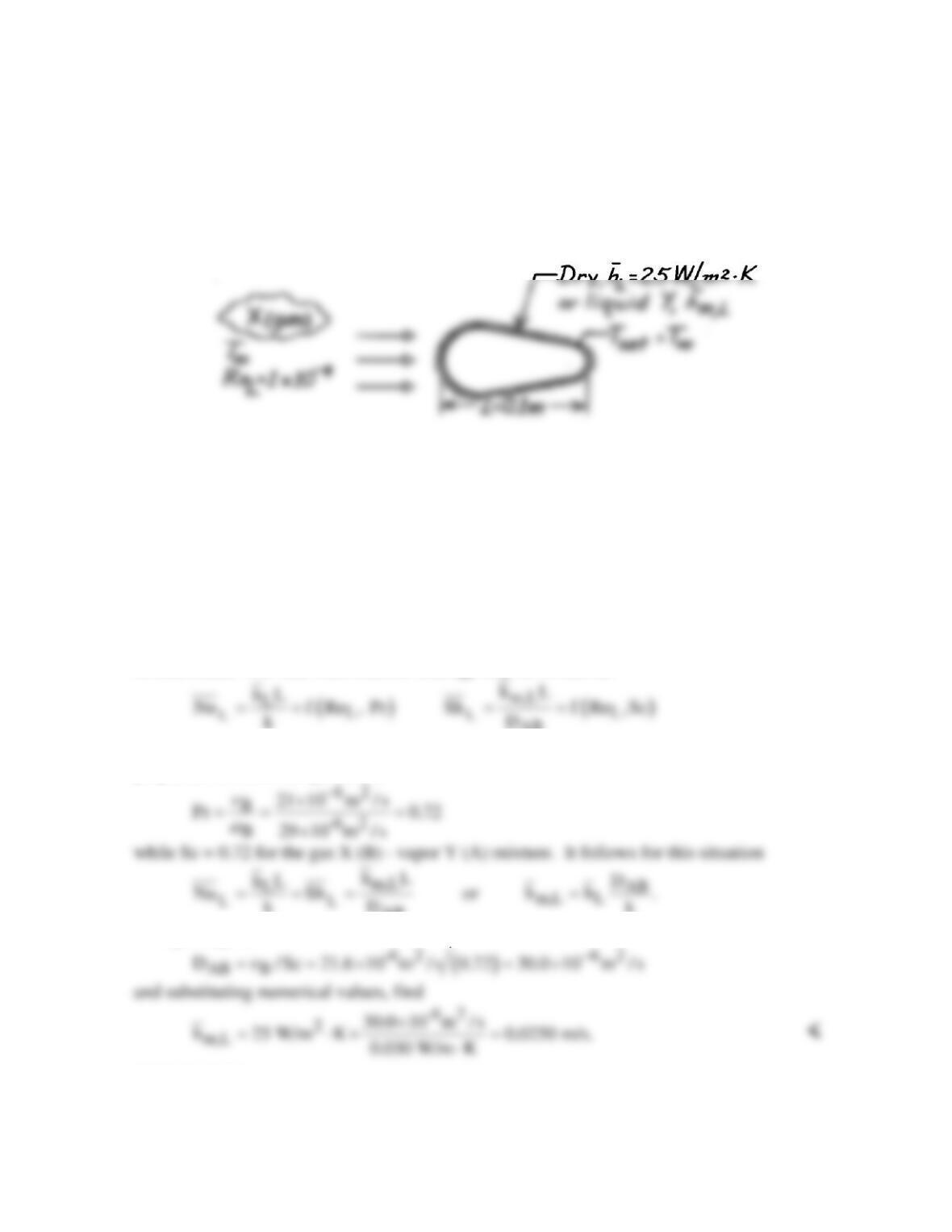
KNOWN: Cross flow of gas X over object with prescribed characteristic length L, Reynolds
number, and average heat transfer coefficient. Thermophysical properties of gas X, liquid Y,
and vapor Y.
FIND: Average mass transfer coefficient for same object when impregnated with liquid Y
and subjected to same flow conditions.
SCHEMATIC:
ASSUMPTIONS: (1) Heat and mass transfer analogy is applicable, (2) Vapor Y behaves as
perfect gas
PROPERTIES: (Given) ν(m2/s) k(W/m⋅K) α(m2/s)
Gas X 21 × 10-6 0.030 29 × 10-6
Liquid Y 3.75 × 10⁻⁷ 0.665 1.65 × 10⁻⁷
Vapor Y 4.25 × 10⁻⁵ 0.023 4.55 × 10⁻⁵
Mixture of gas X – vapor Y: Sc = 0.72
ANALYSIS: The heat–mass transfer analogy may be written as
AB
The flow conditions are the same for both situations. Check values of Pr and Sc. For Pr, the
properties are those for gas X (B).
AB
kD k
Recognizing that
COMMENTS: Note that none of the thermophysical properties of liquid or vapor Y are
required for the solution. Only the gas X properties and the Schmidt number (gas X – vapor
Y) are required.
PROBLEM 6.49
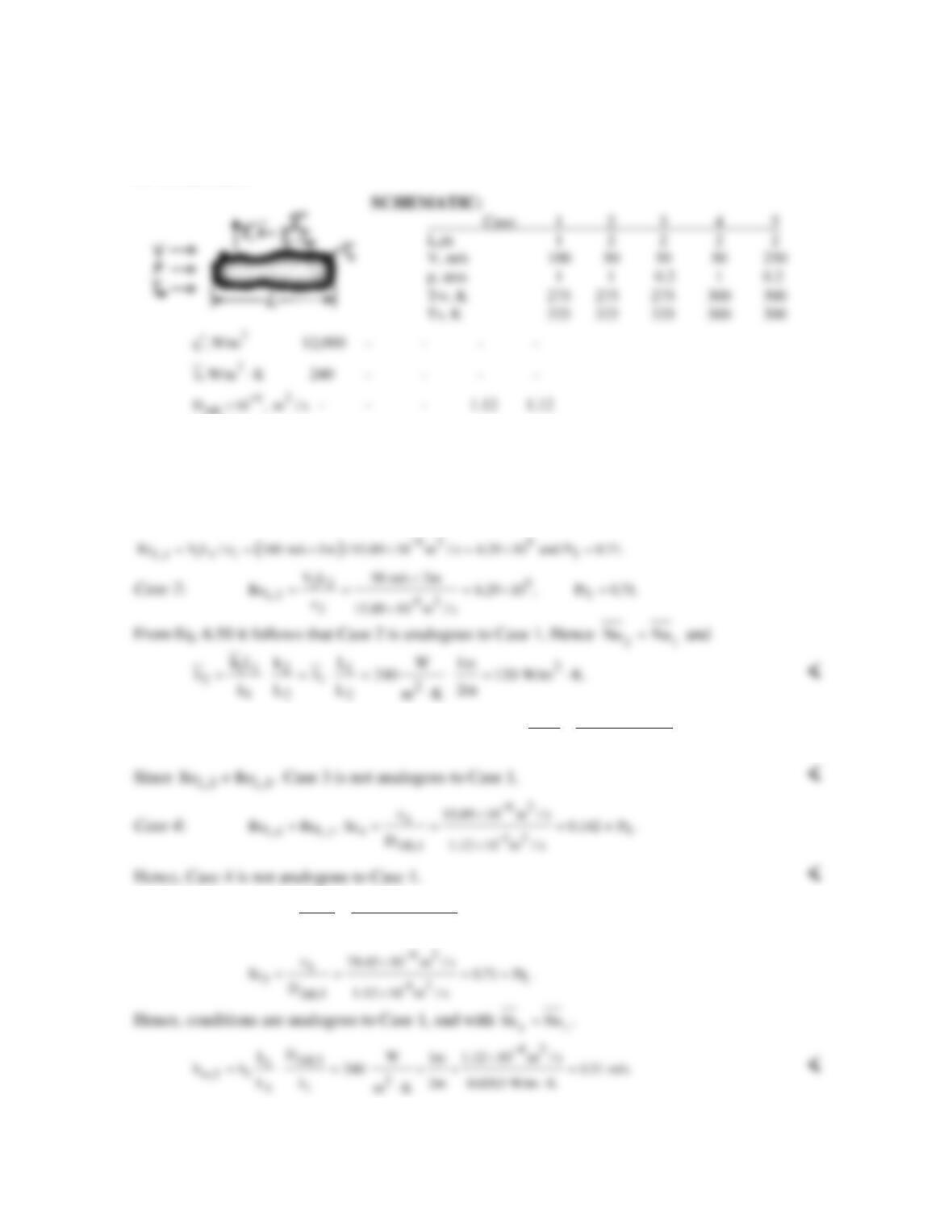
KNOWN: Characteristic length, surface temperature, average heat flux and airstream conditions
associated with an object of irregular shape.
FIND: Whether similar behavior exists for alternative conditions, and average convection coefficient
for similar cases.
AB
ASSUMPTIONS: (1) Heat and mass transfer analogy is applicable; that is, f(ReL,Pr) = f(ReL,Sc),
see Eqs. 6.50 and 6.54.
PROPERTIES: Table A–4, Air (300K, 1 atm):
62
11
15.89 10 m / s, Pr 0.71,
ν
−
=×=
1
k 0.0263 W/m K.= ⋅
ANALYSIS: For Case 1, h = q”/(Ts – T∞) = 12,000 W/m2/50 K = 240 W/m2∙K.
Case 3: With p = 0.2 atm,
62
379.45 10 m / s
ν
−
= ×
and
6
33
L,3 3
-6 2
3
VL 50 m/s 2m
Re 1.26 10 , Pr 0.71.
79.45 10 m / s
ν
×
== =×=
×
Case 5:
6
55
L,5 L,1
-6 2
5
VL 250 m/s 2m
Re 6.29 10 Re
79.45 10 m / s
ν
×
= = = ×=
×
COMMENTS: Note that Pr, k and Sc are independent of pressure, while
ν
and DAB vary inversely
with pressure.
PROBLEM 6.50
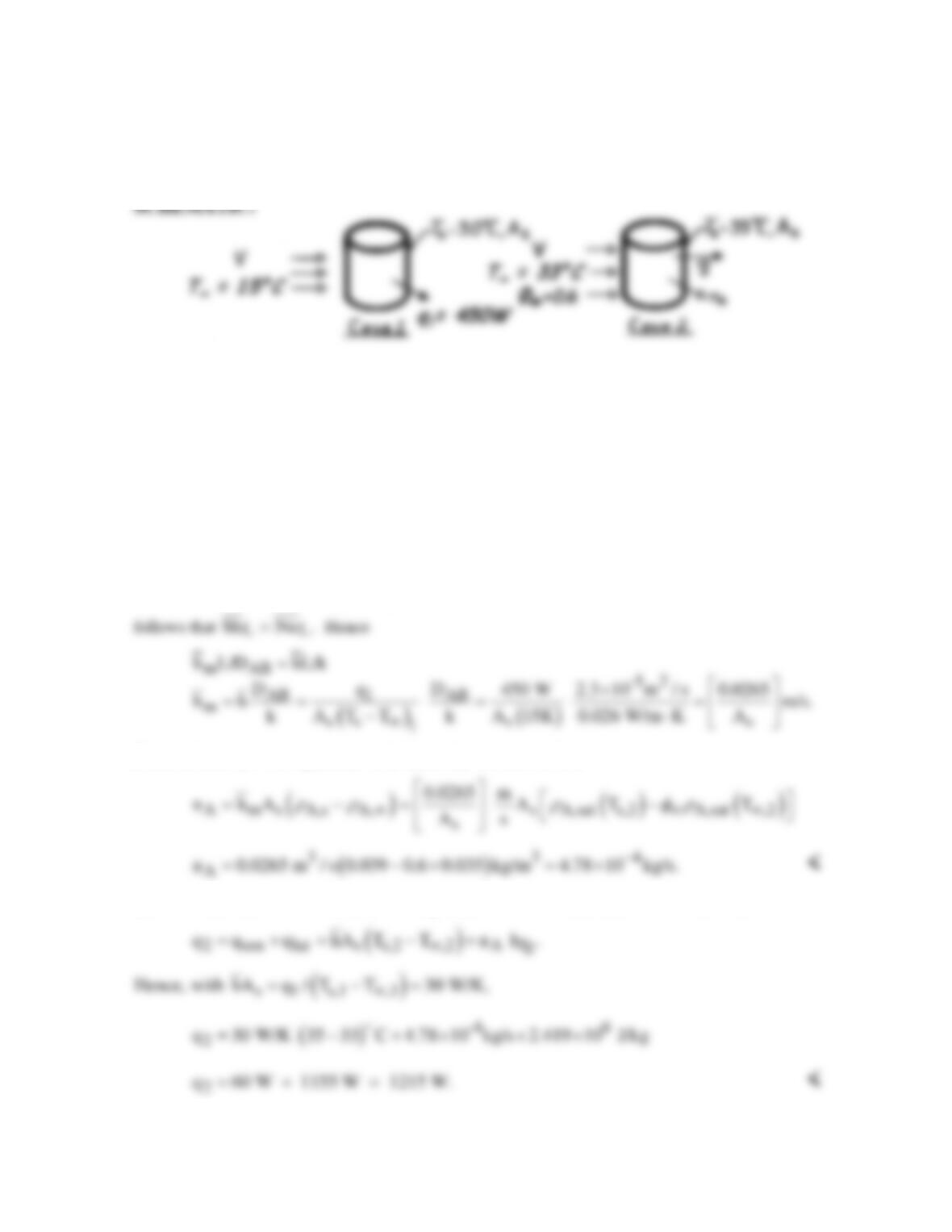
KNOWN: Surface temperature and heat loss from a runner’s body on a cool, spring day.
Surface temperature and ambient air-conditions for a warm summer day.
FIND: (a) Water loss on summer day, (b) Total heat loss on summer day.
ASSUMPTIONS: (1) Heat and mass transfer analogy is applicable. Hence, from Eqs. 6.50
and 6.54, f(ReL,Pr) is of same form as f(ReL,Sc), (2) Negligible surface evaporation for Case
1, (3) Constant properties, (4) Water vapor is saturated for Case 2 surface and may be
approximated as a perfect gas.
PROPERTIES: Air (given): ν = 1.6×10⁻⁵ m2/s, k = 0.026 W/m⋅K, Pr = 0.70; Water vapor –
air (given): DAB = 2.3×10⁻⁵m2/s; Table A-6, Saturated water vapor (T∞ = 306K):
( )
-1 3 -1 3
A,sat g s A,sat g fg
v 0.035 kg/m ; T 308K : v 0.039 kg/m , h 2419 kJ/kg.
ρρ
= = = = = =
ANALYSIS: (a) With
5 2 -5 2
L,2 L,1 AB
Re Re and Sc= /D 1.6 10 m / s/2.3 10 m / s=0.70=Pr,
ν
−
= =××
it
Hence, from the rate equation, with As as the wetted surface
(b) The total heat loss for Case 2 is comprised of sensible and latent contributions, where
COMMENTS: Note the significance of the evaporative cooling effect.
PROBLEM 6.51
KNOWN: Average convection mass transfer coefficient for air flow over a surface coated with
species A (water, naphthalene, or acetone). Characteristic length. Free stream velocity. Air
temperature.
FIND: Values of
LL
Sh , and Re
Sc,
for each case. Values of C, m, and n for Sherwood number
correlation. Area-averaged mass transfer coefficient for evaporation of benzene from the same object.
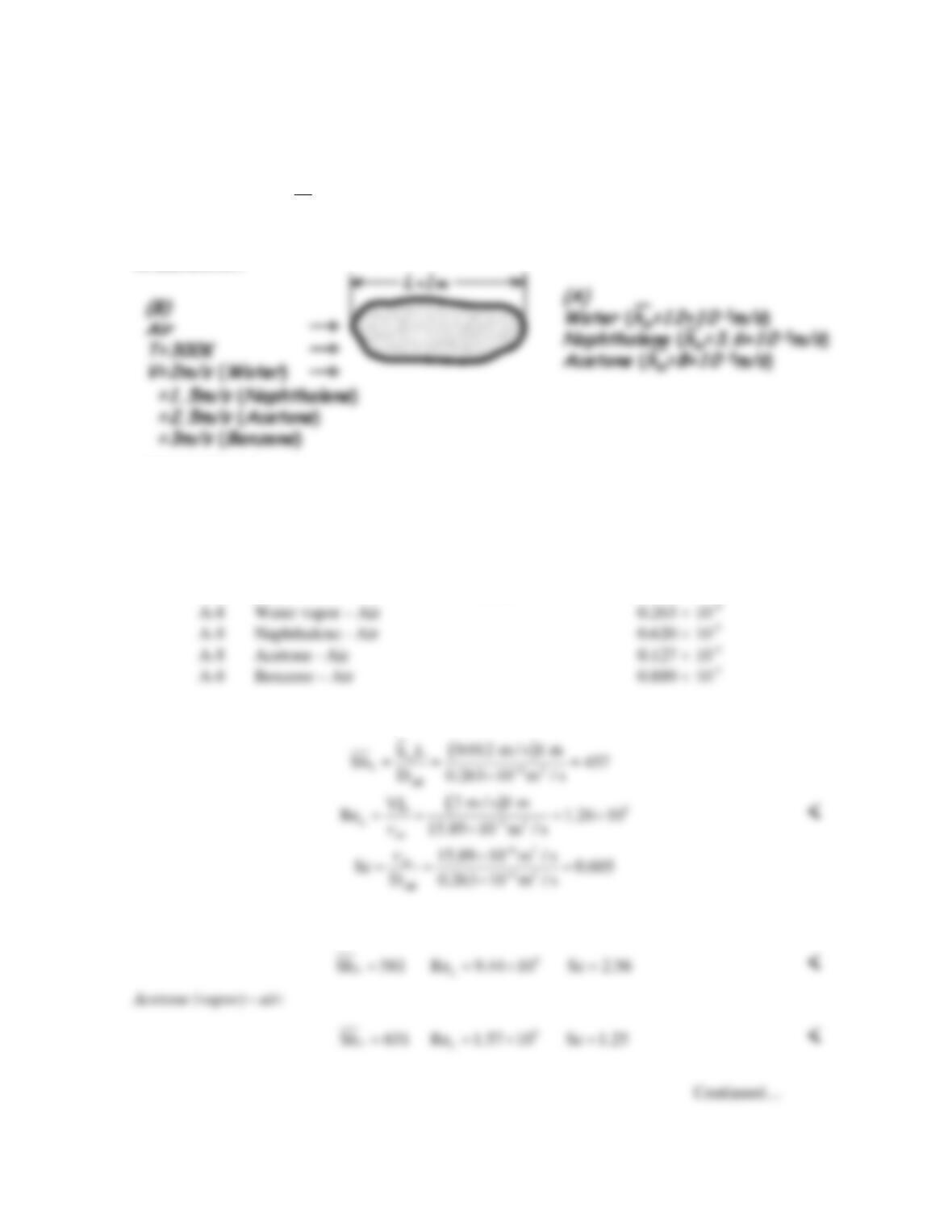
SCHEMATIC:
ASSUMPTIONS: (1) Steady-state, (2) Uniform properties, (3) Species A is saturated at the air–
coating interface, (4) Concentration of species A is small.
PROPERTIES: For the fluids at 300 K, using the temperature correction DAB ~ T3/2:
Table Fluid(s) ν(m2/s)×10-6 DAB(m2/s)
A-4 Air 15.89
ANALYSIS: Water (
ν
apor) – Air:
Naphthalene (
ν
apor) – Air:
PROBLEM 6.51 (Cont.)
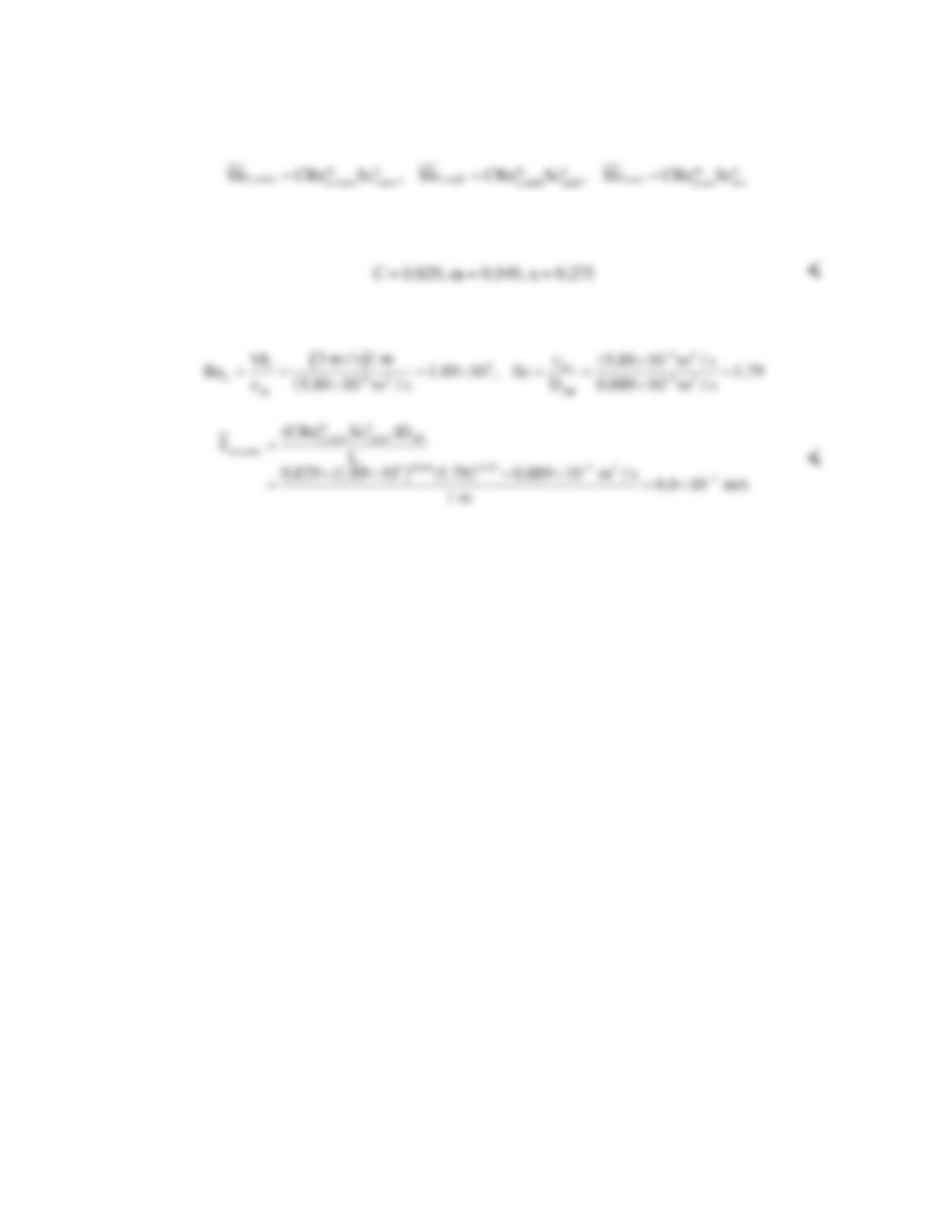
The coefficients C, m, and n can be found by solving the three simultaneous equations:
Solving these using IHT yields:
For benzene evaporating in air flowing at 3 m/s,
COMMENTS: Note that ν should be evaluated for the mixture of A and B. It is assumed that species
A is present in small concentration, so that ν is associated solely with the freestream fluid B.
PROBLEM 6.52
KNOWN: Convection heat transfer correlation for flow over a contoured surface.
FIND: (a) Evaporation rate from a water film on the surface, (b) Steady–state film temperature.
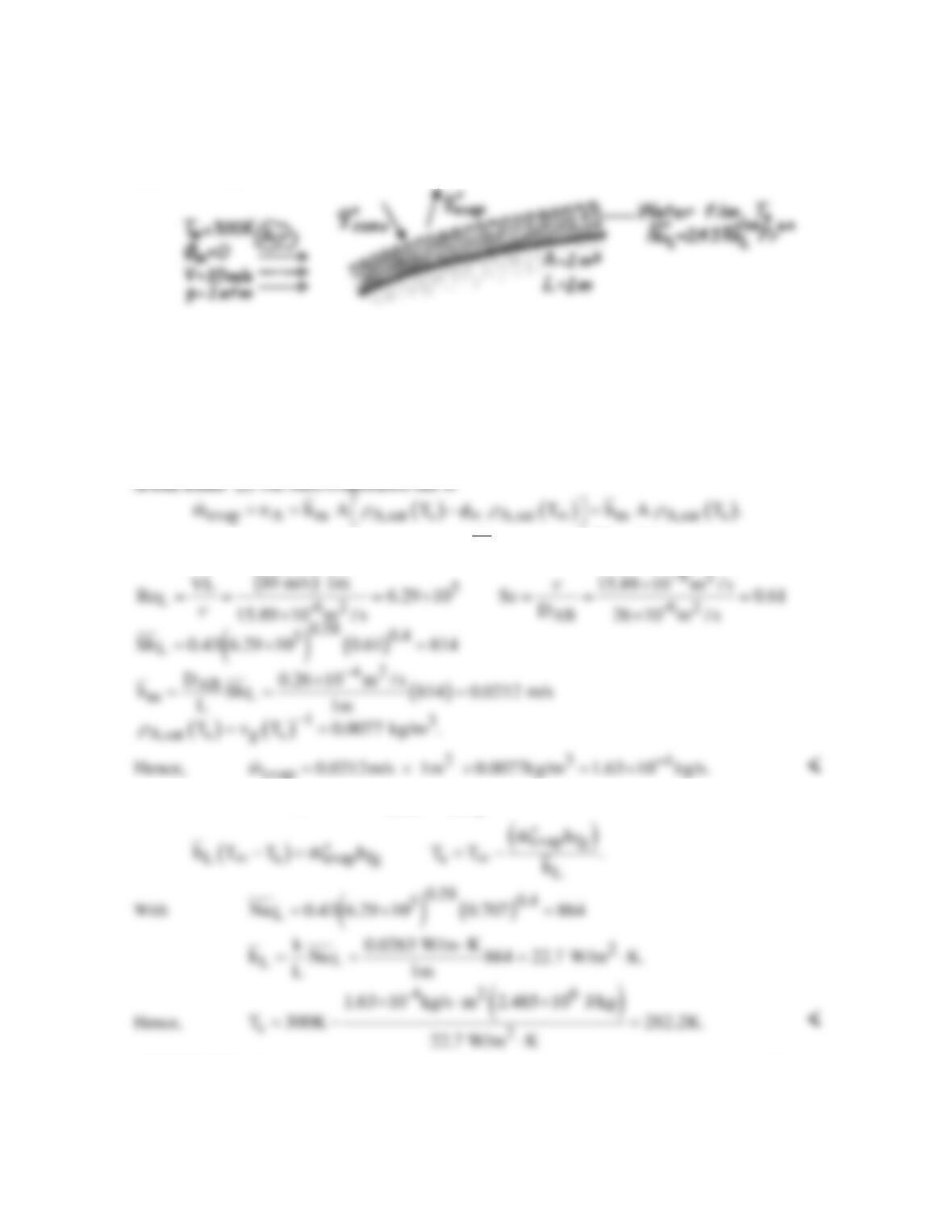
SCHEMATIC:
ASSUMPTIONS: (1) Steady-state conditions, (b) Constant properties, (c) Negligible radiation, (d)
Heat and mass transfer analogy is applicable.
PROPERTIES: Table A-4, Air (300K, 1 atm): k = 0.0263 W/m⋅K, ν = 15.89×10⁻⁶m2/s, Pr = 0.707;
Table A-6, Water (Ts ≈ 280K): vg = 130.4 m3/kg, hfg = 2485 kJ/kg; Table A-8, Water–air (T ≈
298K): DAB = 0.26×10⁻⁴m2/s.
From the heat and mass transfer analogy:
0.58 0.4
LL
Sh 0.43 Re Sc=
evap
(b) From a surface energy balance,
conv evap
q q,
′′ ′′
=
or
COMMENTS: The saturated vapor density, ρA,sat, is strongly temperature dependent, and if the
initial guess of Ts needed for its evaluation differed from the above result by more than a few
degrees, the density would have to be evaluated at the new temperature and the calculations repeated.
PROBLEM 6.53
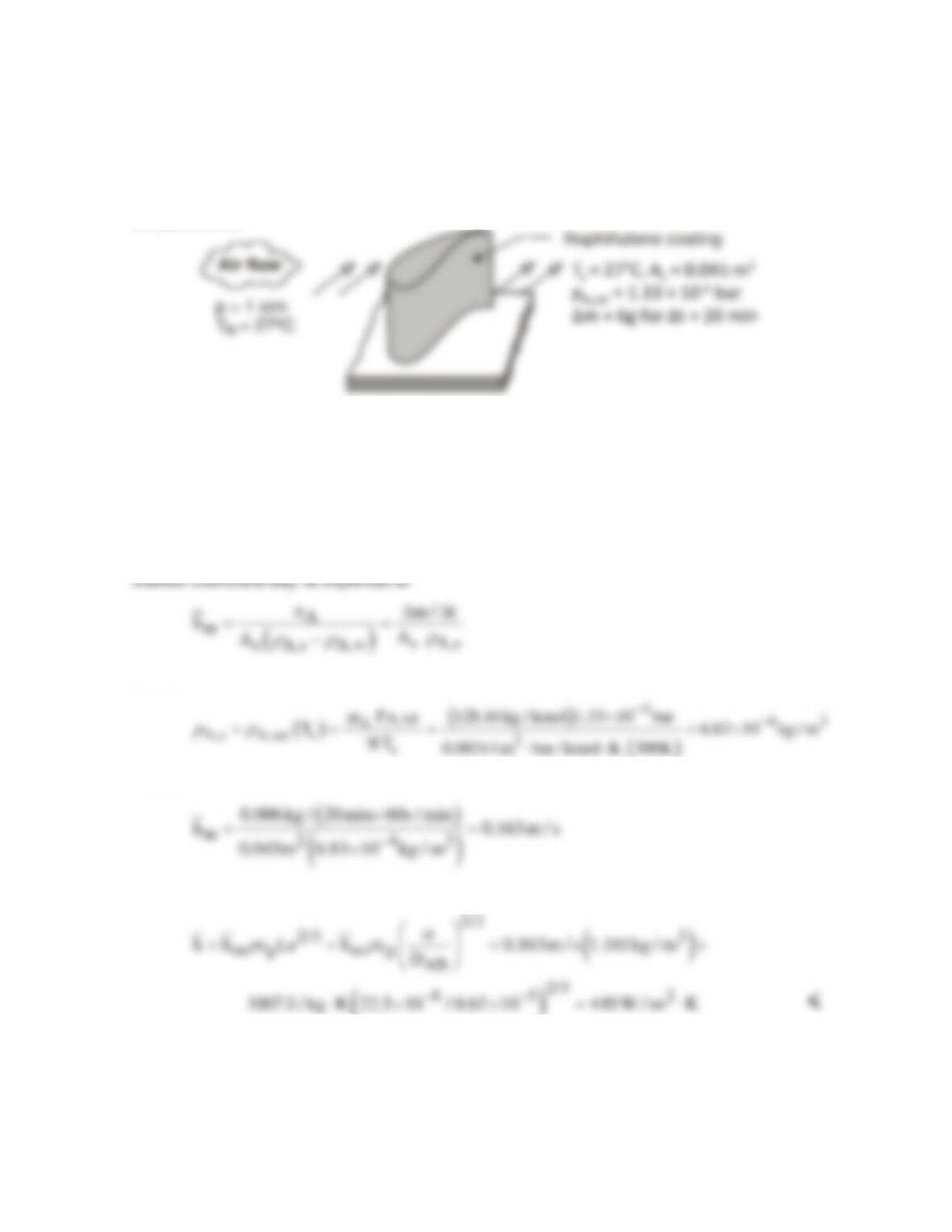
KNOWN: Dimensions of rectangular naphthalene rod. Velocity and temperature of air flow.
Molecular weight and saturation pressure of naphthalene.
FIND: Mass loss after 30 minutes.
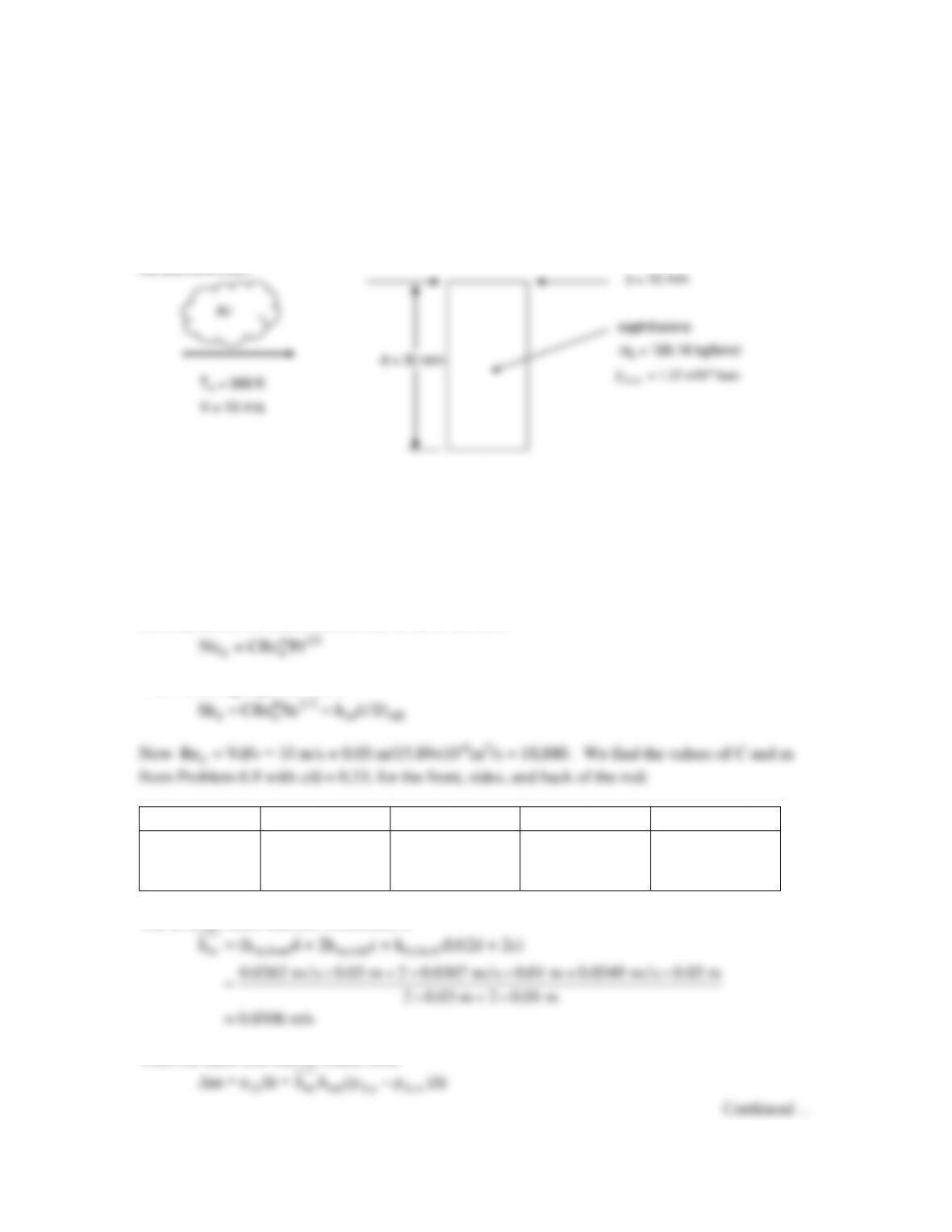
SCHEMATIC:
ASSUMPTIONS: (1) Constant properties, (2) Mass loss is small, so dimensions remain
unchanged, (3) Viscosity of air-naphthalene mixture is approximately that of air.
PROPERTIES: Table A-4, Air (300 K): ν = 15.89 × 10⁻⁶ m2/s. Table A-8, Naphthalene in air,
(300 K): DAB = 0.62 × 10⁻⁵ m2/s,
AB
Sc = ν/D = 2.56.
ANALYSIS: We will use the heat and mass transfer analogy, with the Nusselt number
correlation known from Problem 6.9 to be of the form
Then invoking Equation 6.59,
C
m
Shd
hm(m/s)
front
sides
back
0.674
0.153
0.174
1/2
2/3
2/3
126.7
148.5
168.8
0.0262
0.0307
0.0349
The average mass transfer coefficient is
Then the mass loss can be found from
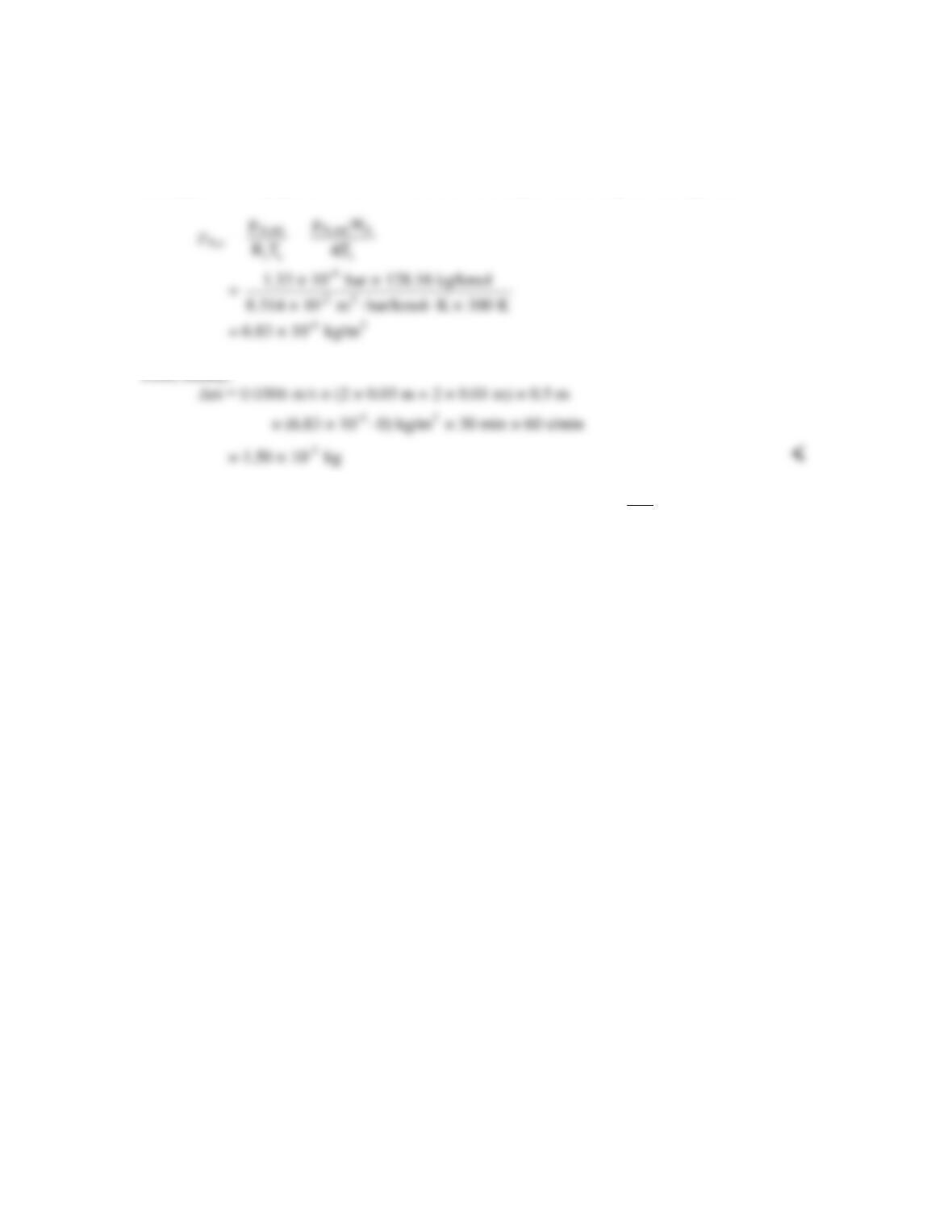
PROBLEM 6.53 (Cont.)
Here ρA,∞ = 0 and ρA,s can be found from the saturation pressure, using the ideal gas law:
Thus, finally,
COMMENTS: The average depth of surface recession is given by
m A,s A, A,sol
δ = h (ρ – ρ )Δt/ρ
∞
where
A,sol
ρ
is the density of solid naphthalene,
A,sol
ρ
= 1025 kg/m3. Thus
δ = 37 μm
and the
assumption that the dimensions remain unchanged is good.
PROBLEM 6.54
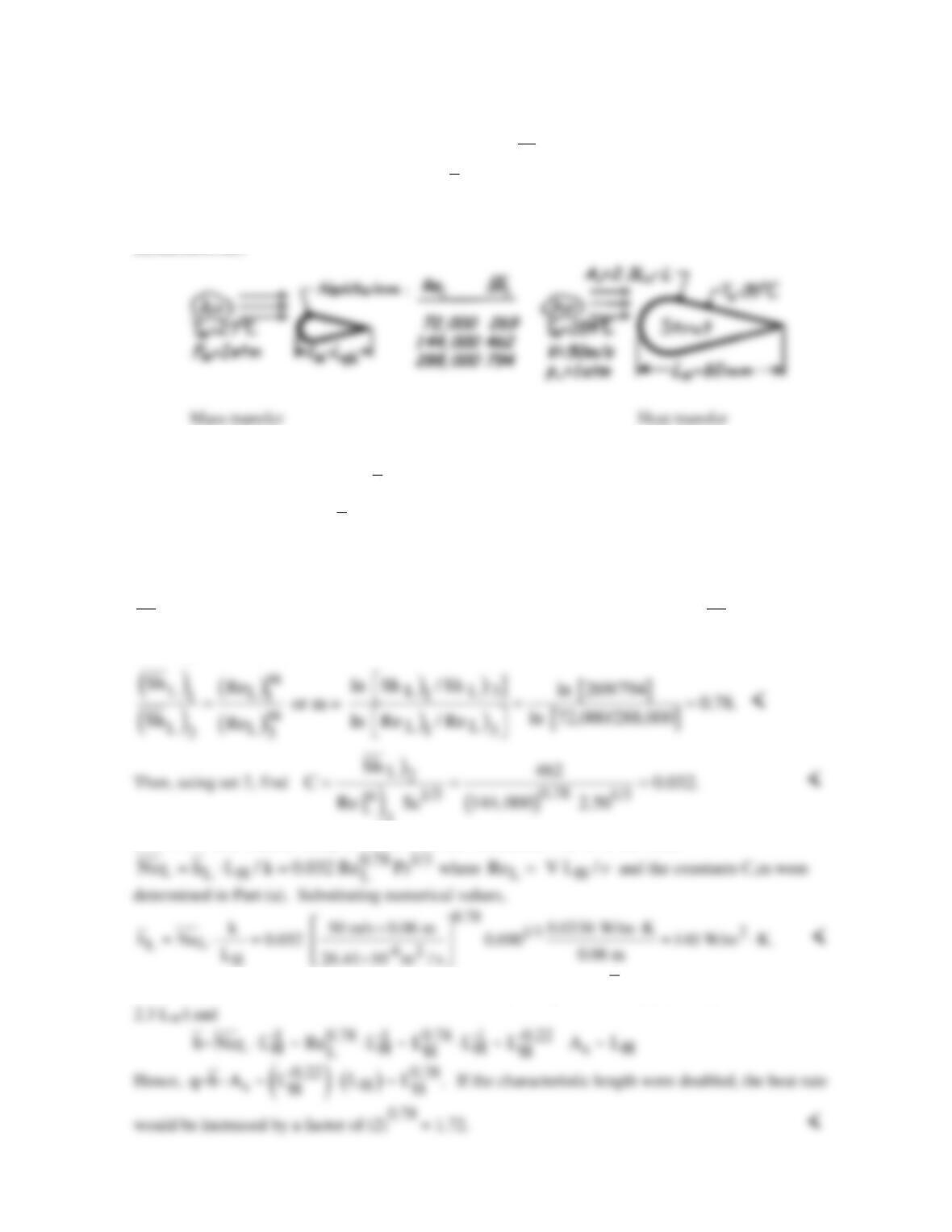
KNOWN: Surface area and temperature of a coated turbine blade. Temperature and pressure of air
flow over the blade. Molecular weight and saturation vapor pressure of the naphthalene coating.
Duration of air flow and corresponding mass loss of naphthalene due to sublimation.
FIND: Average convection heat transfer coefficient.
SCHEMATIC:
ASSUMPTIONS: (1) Applicability of heat and mass transfer analogy, (2) Negligible change in As
due to mass loss, (3) Naphthalene vapor behaves as an ideal gas, (4) Solid/vapor equilibrium at
surface of coating, (5) Negligible vapor density in freestream of air flow.
PROPERTIES: Table A-4, Air (T = 300K): ρ = 1.161 kg/m3, cp = 1007 J/kg⋅K, α = 22.5 × 10⁻⁶
m2/s. Table A-8, Naphthalene vapor/air (T = 300K): DAB = 0.62 × 10⁻⁵ m2/s.
ANALYSIS: From the rate equation for convection mass transfer, the average convection mass
where
Hence,
Using the heat and mass transfer analogy with n = 1/3, we then obtain
()
COMMENTS: The naphthalene sublimation technique has been used extensively to determine
convection coefficients associated with complex flows and geometries.
PROBLEM 6.55
KNOWN: Mass transfer experimental results on a half–sized model representing a strut.
FIND: (a) The coefficients C and m of the correlation
m 1/3
LL
Sh CRe Sc=
for the mass transfer
results, (b) Average heat transfer coefficient,
h,
for the full-sized strut with prescribed operating
conditions, (c) Change in total heat rate if characteristic length LH is doubled.
SCHEMATIC:
ASSUMPTIONS: Analogy exists between heat and mass transfer.
PROPERTIES: Table A-4, Air
( )
( )
-6 2
s
T = T T / 2 400K, 1 atm : =26.41 10 m / s,
ν
∞+= ×
k =
0.0338 W/m⋅K, Pr = 0.690;
( )
62
B
T 300K : 15.89 10 m / s;
ν
−
= = ×
Table A-8, Naphthalene-air
(300K, 1 atm):
5 2 6 2 -5 2
AB B AB
D 0.62 10 m / s, Sc / D 15.89 10 m / s/0.62 10 m / s=2.56.
ν
−−
=×==× ×
ANALYSIS: (a) The correlation for the mass transfer experimental results is of the form
m 1/3
LL
Sh CRe Sc .=
The constants C,m may be evaluated from two data sets of
LL
Sh and Re ;
choosing the sets (1,3):
(b) For the heat transfer analysis of the strut, the correlation will be of the form
(c) The total heat rate for the strut of characteristic length
LH
is
( )
ss
q=h A T T ,
∞
−
where As =
PROBLEM 6.56
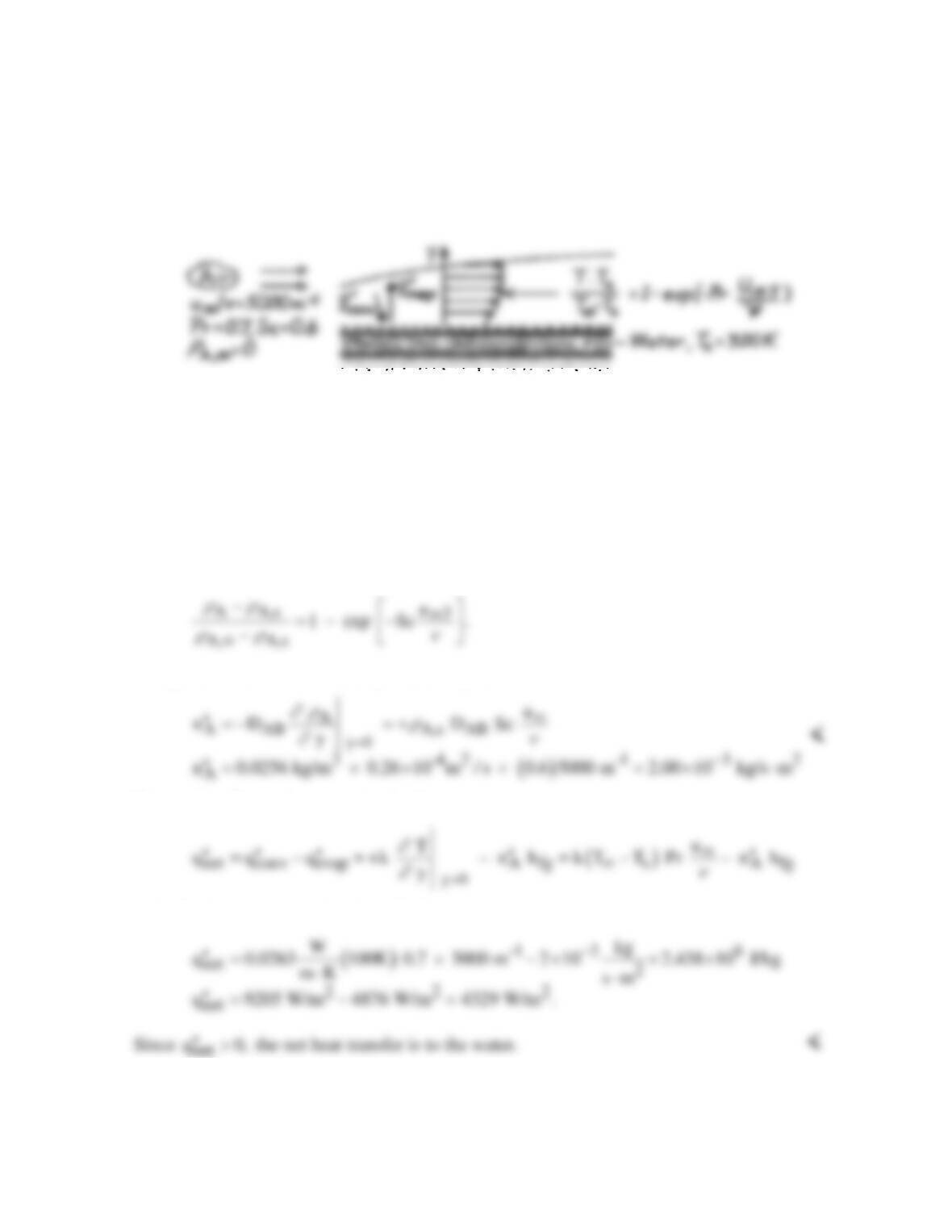
KNOWN: Boundary layer temperature distribution for flow of dry air over water film.
FIND: Evaporative mass flux and whether net energy transfer is to or from the water.
SCHEMATIC:
ASSUMPTIONS: (1) Heat and mass transfer analogy is applicable, (2) Water is well
insulated from below.
PROPERTIES: Table A-4, Air (Ts = 300K, 1 atm): k = 0.0263 W/m⋅K; Table A-6, Water
vapor (Ts = 300K):
-1 3 6
A,s g fg
v 0.0256 kg/m , h 2.438 10 J/kg;
ρ
= = = ×
Table A-8, Air–water
vapor
( )
42
s AB
T 300K : D 0.26 10 m / s.
−
= = ×
ANALYSIS: From the heat and mass transfer analogy,
Using Fick’s law at the surface (y = 0), the species flux is
The net heat flux to the water has the form
and substituting numerical values, find
COMMENTS: Note use of properties (DAB and k) evaluated at Ts to determine surface
fluxes.
PROBLEM 6.57
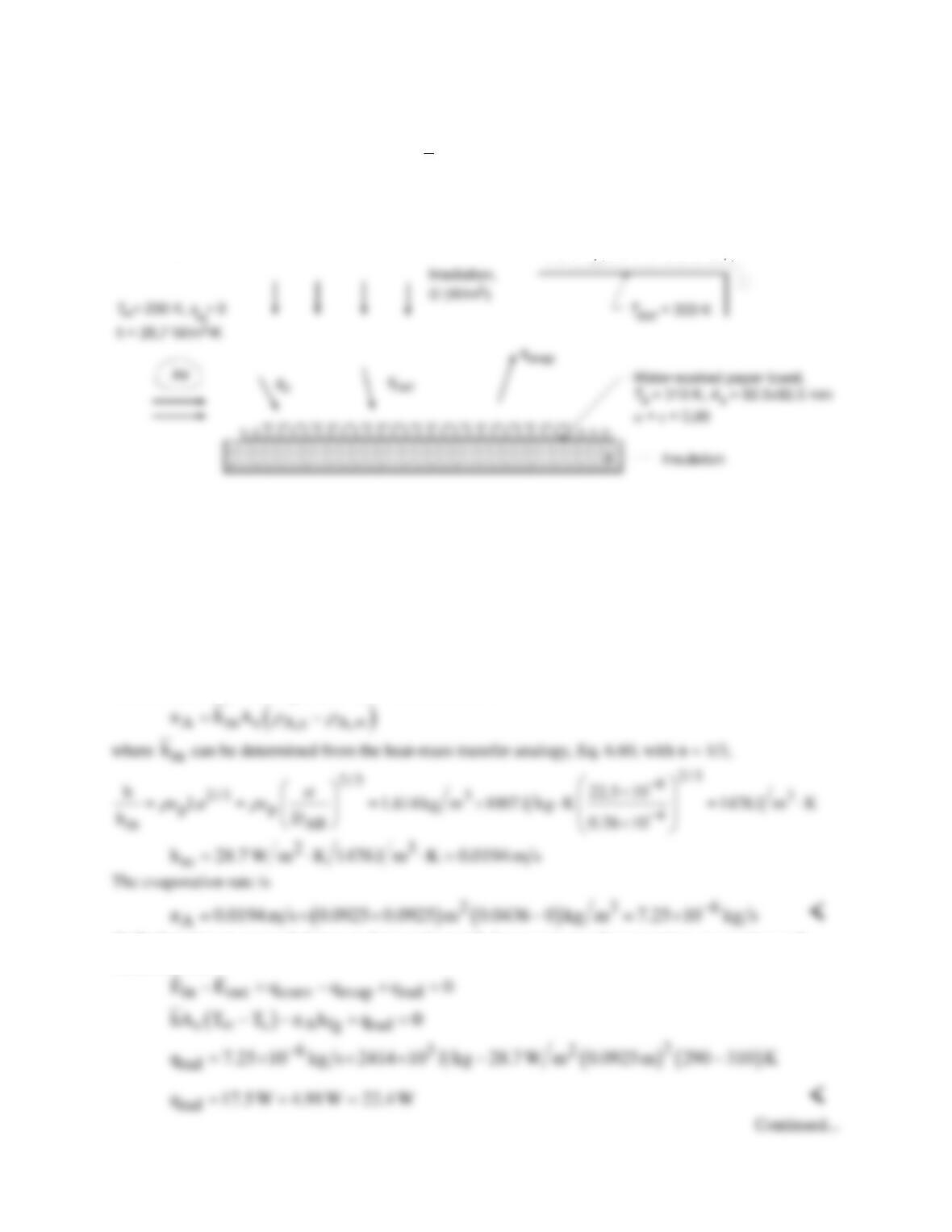
KNOWN: Water–soaked paper towel experiences simultaneous heat and mass transfer while subjected
to parallel flow of air, irradiation from a radiant lamp bank, and radiation exchange with surroundings.
Average convection coefficient estimated as
h
= 28.7 W/m2⋅K.
FIND: (a) Rate at which water evaporates from the towel, nA (kg/s), and (b) The net rate of radiation
transfer, qrad (W), to the towel. Determine the irradiation G (W/m2).
SCHEMATIC:
ASSUMPTIONS: (1) Steady–state conditions, (2) Vapor behaves as an ideal gas, (3) Constant
properties, (4) Towel experiences radiation exchange with the large surroundings as well as irradiation
from the lamps, (5) Negligible heat transfer from the bottom side of the towel, and (6) Applicability of
the heat–mass transfer analogy.
PROPERTIES: Table A.4, Air (Tf = 300 K): ρ = 1.1614 kg/m3, cp = 1007 J/kg⋅K, α = 22.5 × 10⁻⁶ m2/s;
Table A.6, Water (310 K): ρA,s = ρg = 1/νg = 1/22.93 = 0.0436 kg/m3, hfg = 2414 kJ/kg. Table A.8, Water–
Air (T ≈ 300 K): DAB = 0.26 × 10⁻⁴ m2/s.
ANALYSIS: (a) The evaporation rate from the towel is
(b) Performing an energy balance on the towel considering processes of evaporation, convection and
radiation, find
PROBLEM 6.57 (Cont.)
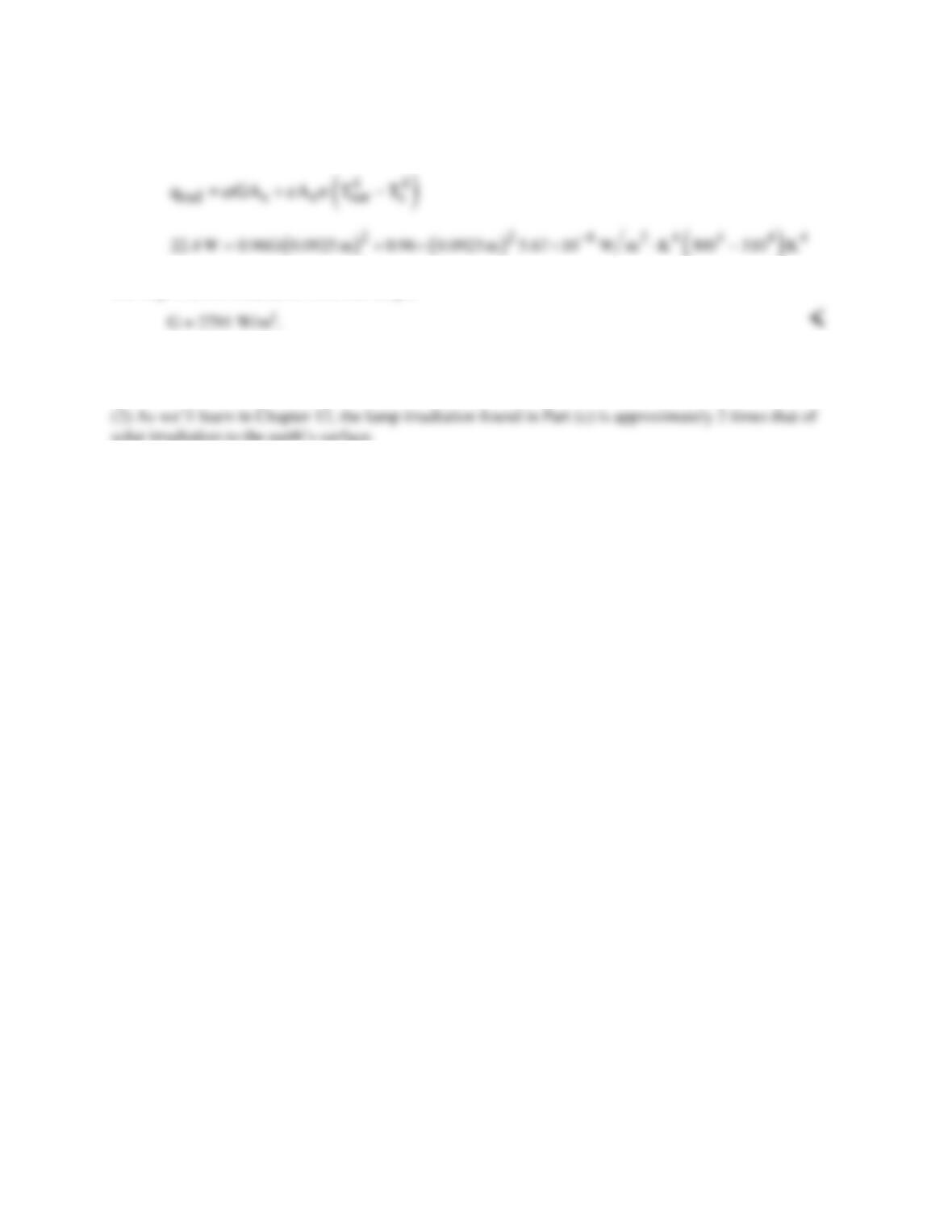
The net radiation heat transfer to the towel is comprised of the absorbed irradiation and the net exchange
between the surroundings and the towel,
Solving, find the irradiation from the lamps,
COMMENTS: (1) From the energy balance in Part (b), note that the heat rate by convection is
considerably smaller than that by evaporation.
PROBLEM 6.58
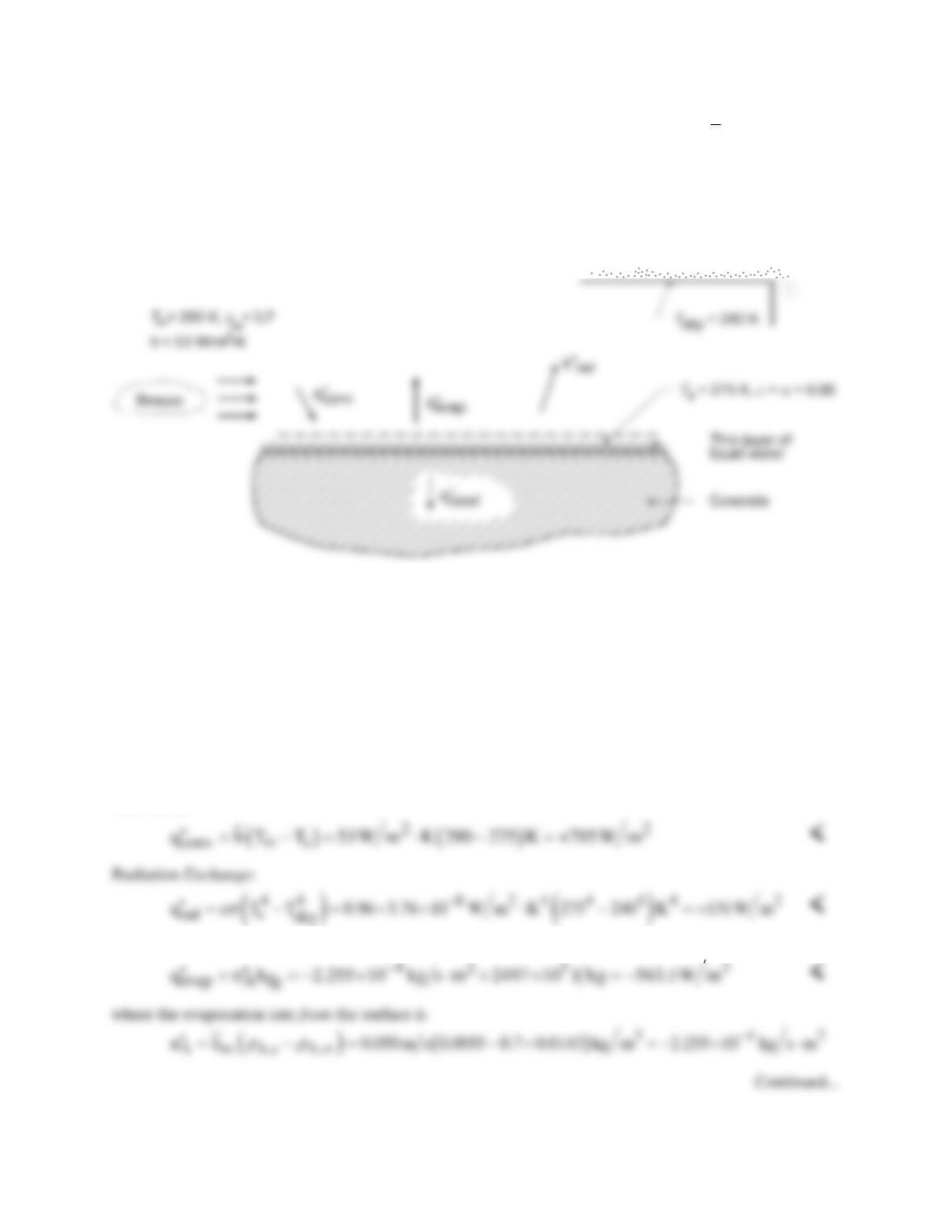
KNOWN: Thin layer of water on concrete surface experiences evaporation, convection with ambient
air, and radiation exchange with the sky. Average convection coefficient estimated as
h
= 53 W/m2⋅K.
FIND: (a) Heat fluxes associated with convection,
conv
q′′
, evaporation,
evap
q′′
, and radiation exchange
with the sky,
rad
q′′
, (b) Use results to explain why the concrete is wet instead of dry, and (c) Direction
of heat flow and the heat flux by conduction into or out of the concrete.
SCHEMATIC:
ASSUMPTIONS: (1) Steady-state conditions, (2) Vapor behaves as an ideal gas, (3) Constant
properties, (4) Water surface is small compare to large, isothermal surroundings (sky), and (4)
Applicability of the heat–mass transfer analogy.
PROPERTIES: Table A.4, Air (Tf = (T∞ + Ts)/2 = 282.5 K): ρ = 1.243 kg/m3, cp = 1007 J/kg⋅K, α =
2.019 ×10⁵ m2/s; Table A.8, Water–air (Tf = 282.5 K): DAB = 0.26 × 10⁻⁴ m2/s (282.5/298)3/2 = 0.24 ×
10-4 m2/s; Table A.6, Water (Ts = 275 K): ρA,s = ρg = 1/νg = 1/181.7 = 0.0055 kg/m3, hfg = 2497 kJ/kg;
Table A.6, Water (
T∞
= 290 K): ρA,s = 1/69.7 = 0.0143 kg/m3.
ANALYSIS: (a) The heat fluxes associated with the processes shown on the schematic are
Convection:
Evaporation:
PROBLEM 6.58 (Cont.)
(b) From the foregoing evaporation calculations, note that water vapor from the air is condensing on the
liquid water layer. That is, vapor is being transported to the surface, explaining why the concrete surface
is wet, even without rain.
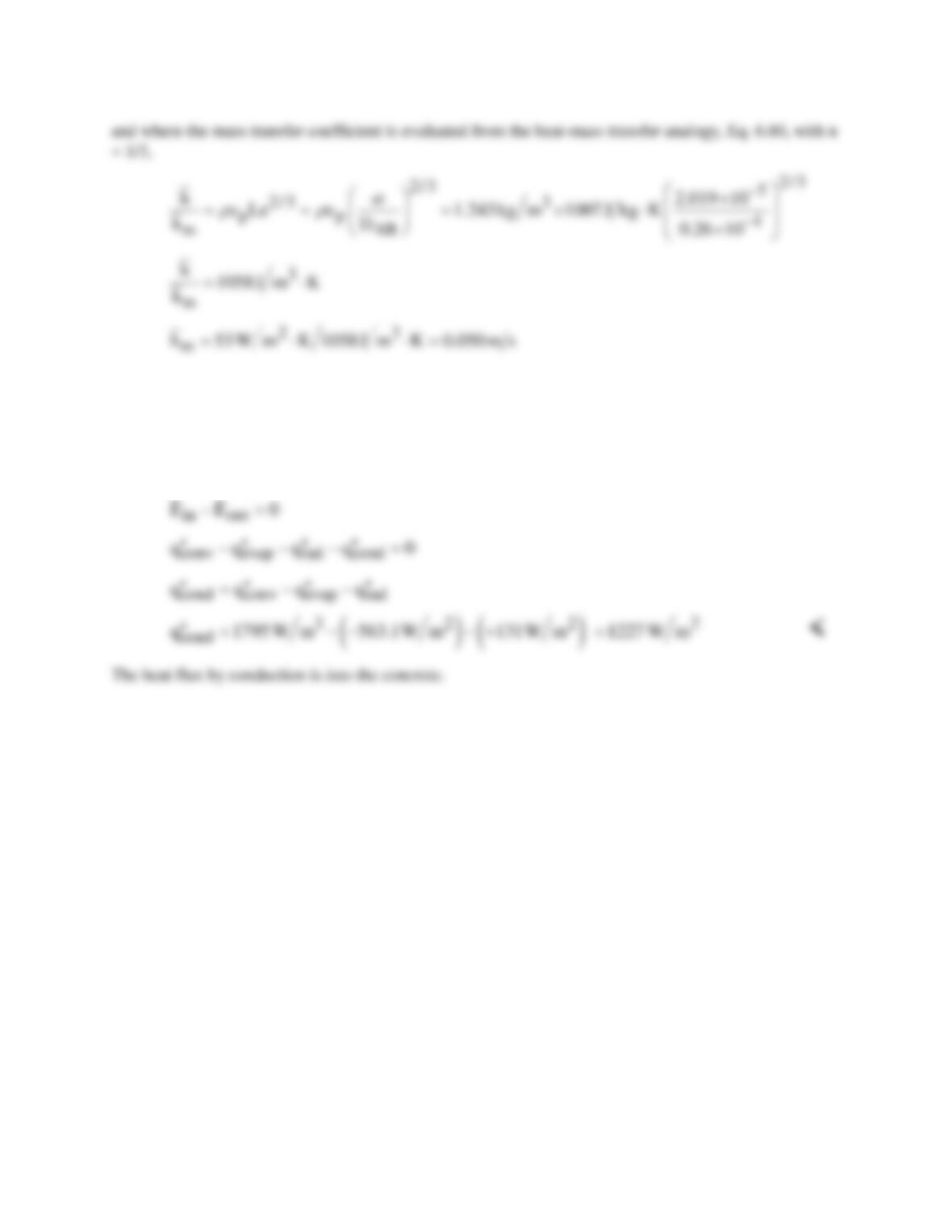
(c) From an overall energy balance on the water film considering conduction in the concrete as shown in
the schematic,
PROBLEM 6.59
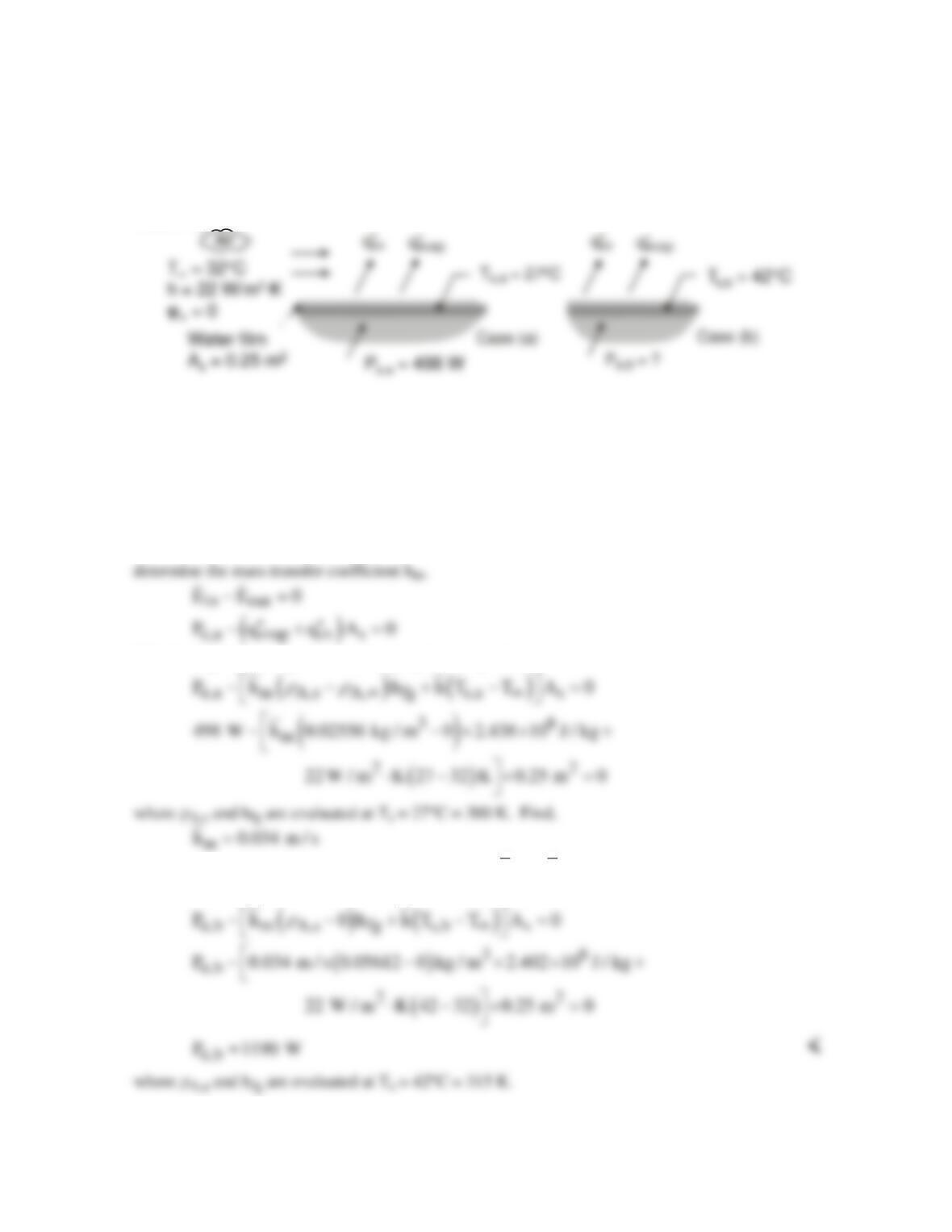
KNOWN: Heater power required to maintain wetted (water) plate at 27°C, and average convection
coefficient for specified dry air temperature, case (a).
FIND: Heater power required to maintain the plate at 37°C for the same dry air temperature if the
convection coefficients remain unchanged, case (b).
SCHEMATIC:
ASSUMPTIONS: (1) Steady–state conditions, (2) Convection coefficients unchanged for different
plate temperatures, (3) Air stream is dry at atmospheric pressure, and (4) Negligible heat transfer from
the bottom side of the plate.
PROPERTIES: Table A-6, Water (Ts,a = 27°C = 300 K): ρA,s = 1/vg = 0.02556 kg/m3, hfg = 2.438 ×
106 J/kg; Water (Ts,b = 42°C = 315 K): ρA,s = 1/vg = 0.05612 kg/m3, hfg = 2.402 × 10⁶ J/kg.
ANALYSIS: For case (a) with Ts = 27°C and Pe = 498 W, perform an energy balance on the plate to
Substituting the rate equations and appropriate properties,
For case (b), with Ts = 42°C and the same values for
m
h and h ,
perform an energy balance to
determine the heater power required to maintain this condition.
COMMENTS: The heat transfer rate due to evaporation is much larger than the sensible heat rate in
both cases.
PROBLEM 6.60
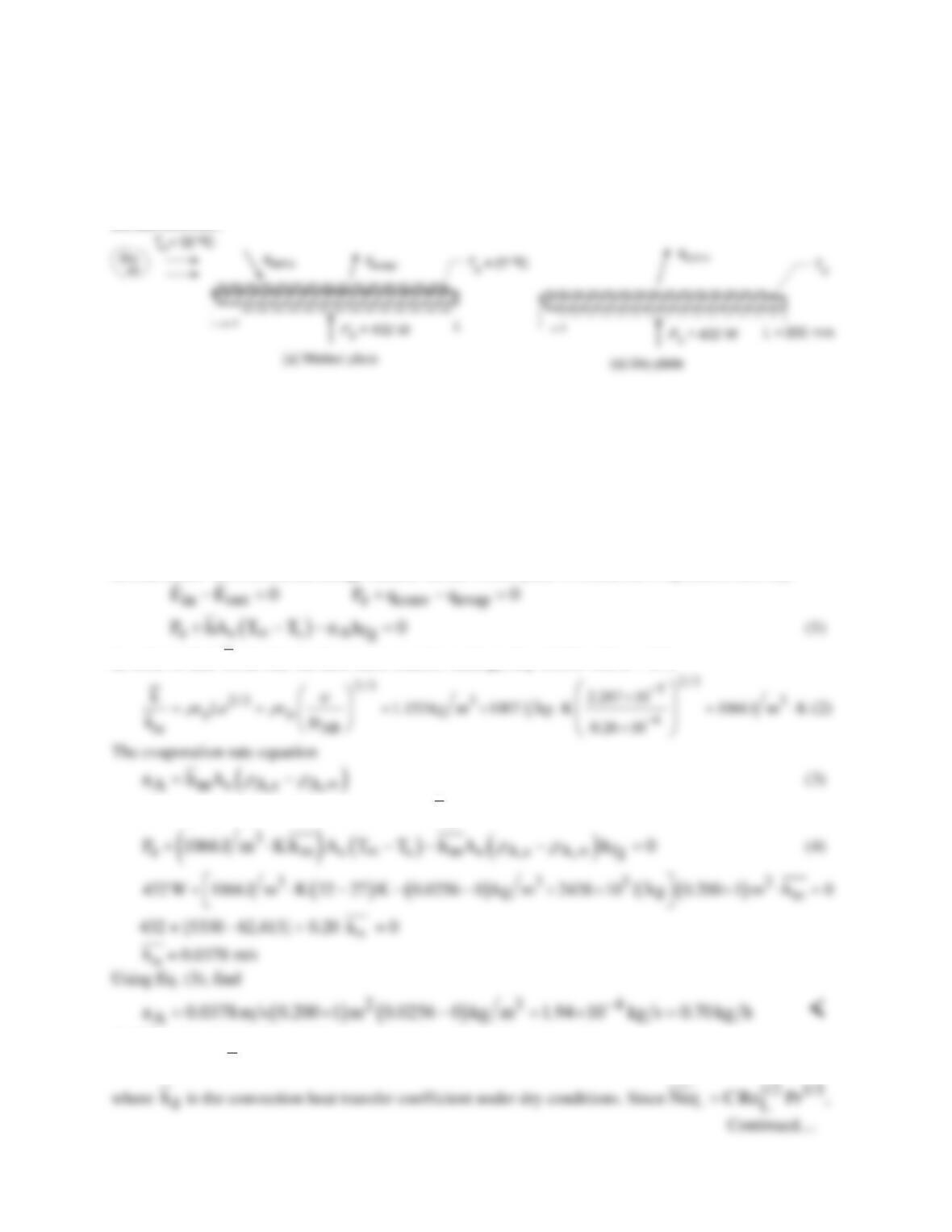
KNOWN: Dry air at 32°C flows over a wetted plate of width 1 m maintained at a surface temperature of
27°C by an embedded heater supplying 432 W.
FIND: (a) The evaporation rate of water from the plate, nA (kg/h) and (b) The plate temperature Ts
when all the water is evaporated, but the heater power remains the same.
SCHEMATIC:
ASSUMPTIONS: (1) Steady-state conditions, (2) Vapor behaves as an ideal gas, (3) Constant
properties, and (4) Applicability of the heat-mass transfer analogy.
PROPERTIES: Table A.4, Air (Tf = (32 + 27)°C/2 = 302.5 K): ρ = 1.153 kg/m3, cp = 1007 J/kg⋅K, α =
2.287 ×10⁵ m2/s; k = 0.02648 W/m⋅K; ν = 1.614 × 10⁻⁵ m2/s; Pr = 0.704. Air (Tf = (86 + 27)°C/2 = 332
K); k = 0.02867 W/m⋅K; ν = 1.911 × 10⁻⁵ m2/s; Pr = 0.703, Table A.8, Water–air (Tf ≈ 300 K): DAB =
0.26 × 10⁻⁴ m2/s; Table A.6, Water (Ts = 27°C = 300 K): ρA,s = 1/νg = 1/39.13 = 0.0256 kg/m3, hfg =
2438 kJ/kg.
ANALYSIS: (a) Perform an energy balance on the wetted plate to obtain the evaporation rate, nA.
In order to find
h
, invoke the heat-mass transfer analogy, Eq. (6.60) with n = 1/3,
Substituting Eqs. (2) and (3) into Eq. (1), find
m
h
(b) When the plate is dry, all the power must be removed by convection,
Pe = qconv =
d
h
As(Ts –
T∞
) (5)

PROBLEM 6.60 (Cont.)
s1/ 2 1/3
52
2dd
m3d
432 W
T 32 C
k Pr
J 1.614 10 m / s
0.2 m h 1066 0.02648 W/m K 0.707
mK
ν
−
= °+
×
×× × × ×
⋅
⋅
which may be solved iteratively or with IHT to yield
PROBLEM 6.61
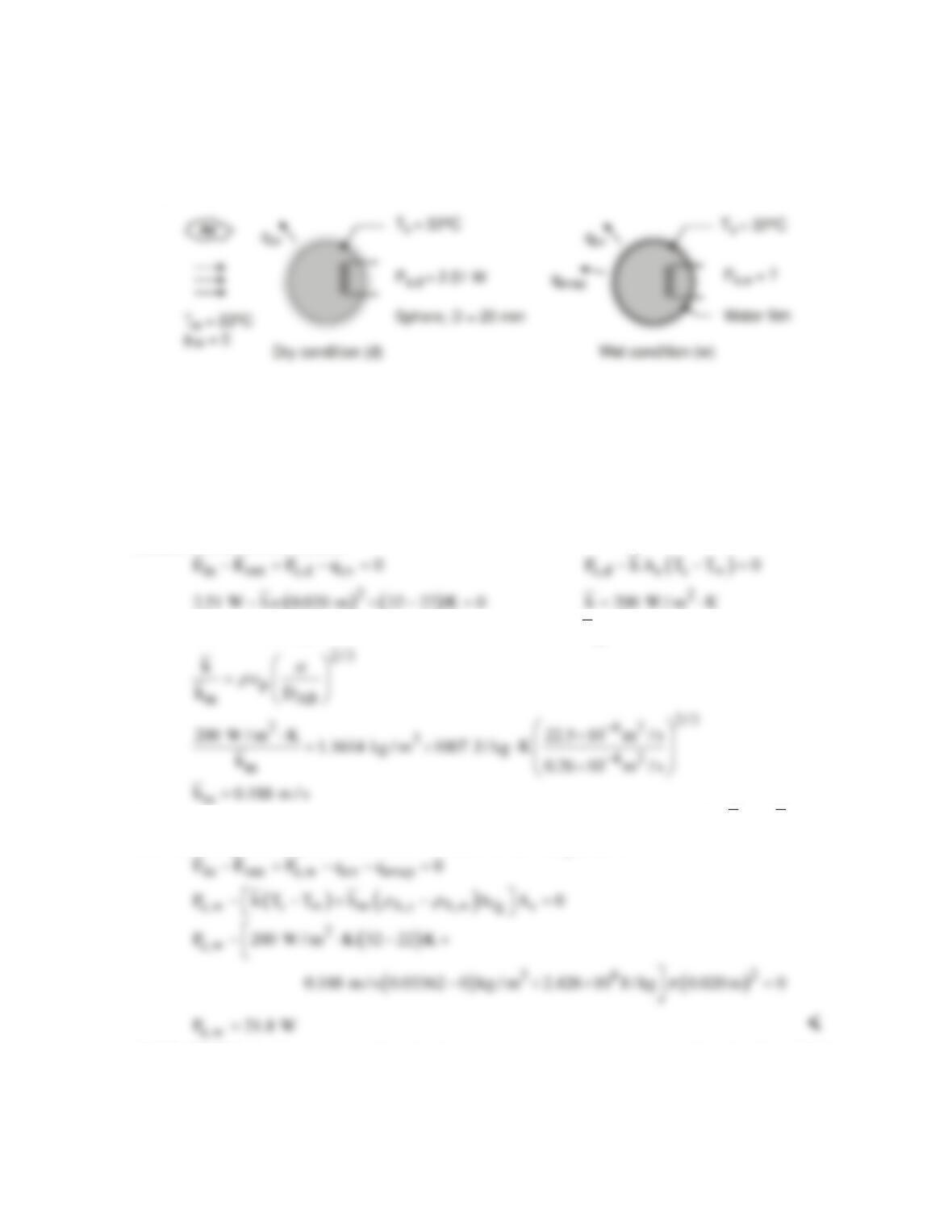
KNOWN: Surface temperature of a 20–mm diameter sphere is 32°C when dissipating 2.51 W in a dry
air stream at 22°C.
FIND: Power required by the imbedded heater to maintain the sphere at 32°C if its outer surface has a
thin porous covering saturated with water for the same dry air temperature.
SCHEMATIC:
ASSUMPTIONS: (1) Steady–state conditions, (2) Heat and mass transfer analogy is applicable, (3)
Heat transfer convection coefficient is the same for the dry and wet condition, and (3) Properties of air
and the diffusion coefficient of the air-water vapor mixture evaluated at 300 K.
PROPERTIES: Table A-4, Air (300 K, 1 atm): ρ = 1.1614 kg/m3, cp = 1007 J/kg⋅K, α = 22.5 × 10⁻⁶
m2/s; Table A-8, Water-air mixture (300 K, 1 atm): DA-B = 0.26 × 10⁻⁴ m2/s; Table A-4, Water (305
K, 1 atm): ρA,s = 1/vg = 0.03362 kg/m3, hfg = 2.426 × 10⁶ J/kg.
ANALYSIS: For the dry case (d), perform an energy balance on the sphere and calculate the heat
transfer convection coefficient.
Use the heat-mass analogy, Eq. (6.60) with n = 1/3, to determine
m
h.
For the wet case (w), perform an energy balance on the wetted sphere using values for
m
h and h
to
determine the power required to maintain the same surface temperature.
COMMENTS: Note that ρA,s and hfg for the mass transfer rate equation are evaluated at Ts = 32°C
= 305 K, not 300 K. The effect of evaporation is to require nearly 8.5 times more power to maintain
the same surface temperature.