6.27: PROBLEM DEFINITION
Situation:
A water jet strikes a block and the block is held in place by friction.
v1=10m/s, ˙m=1.5 kg/s.
μ=0.1,m=1kg.
Find:
Will the block slip?
Force of the water jet on the block (N).
Sketch:
Assumptions:
Neglect weight of water.
Neglect elevation changes.
Neglect viscous forces.
Properties:
ρ=1000kg/m3.
PLAN
Apply the Bernoulli equation, then the momentum equation.
SOLUTION
Force and momentum diagrams
41
y-direction
Analyze friction:
6.28: PROBLEM DEFINITION
Situation:
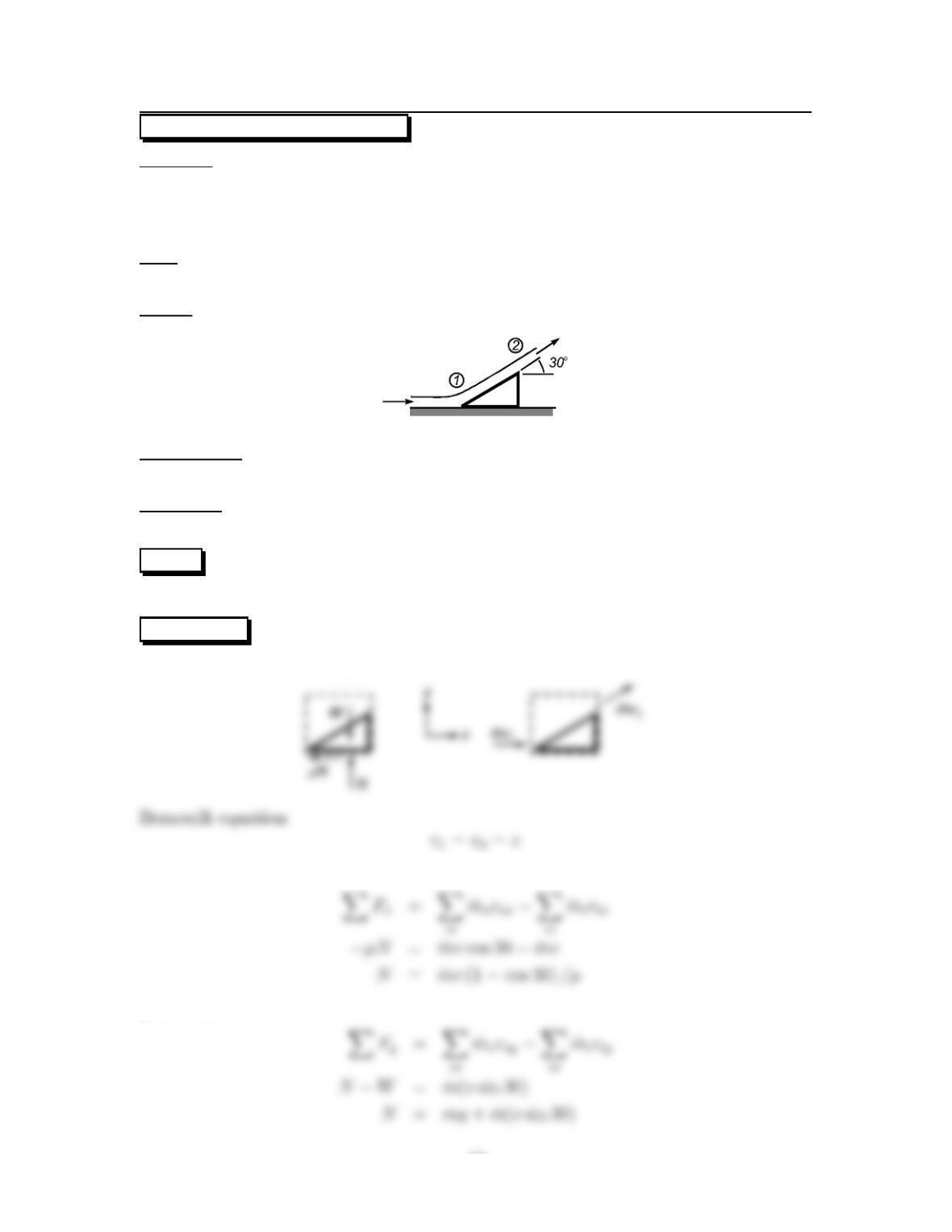
A water jet strikes a block and the block is held in place by friction.
˙m=1kg/s,m=1kg.
μ=0.1,θ=30◦.
Find:
Maximum velocity such that the block will not slip.
Sketch:
Assumptions:
Neglect weight of water.
Properties:
ρ=1000kg/m3.
PLAN
Apply the Bernoulli equation, then the momentum equation.
SOLUTION
Force and momentum diagrams
Momentum equation (x-direction)
y-direction
43
Combineprevioustwoequations
44
6.29: PROBLEM DEFINITION
Situation:
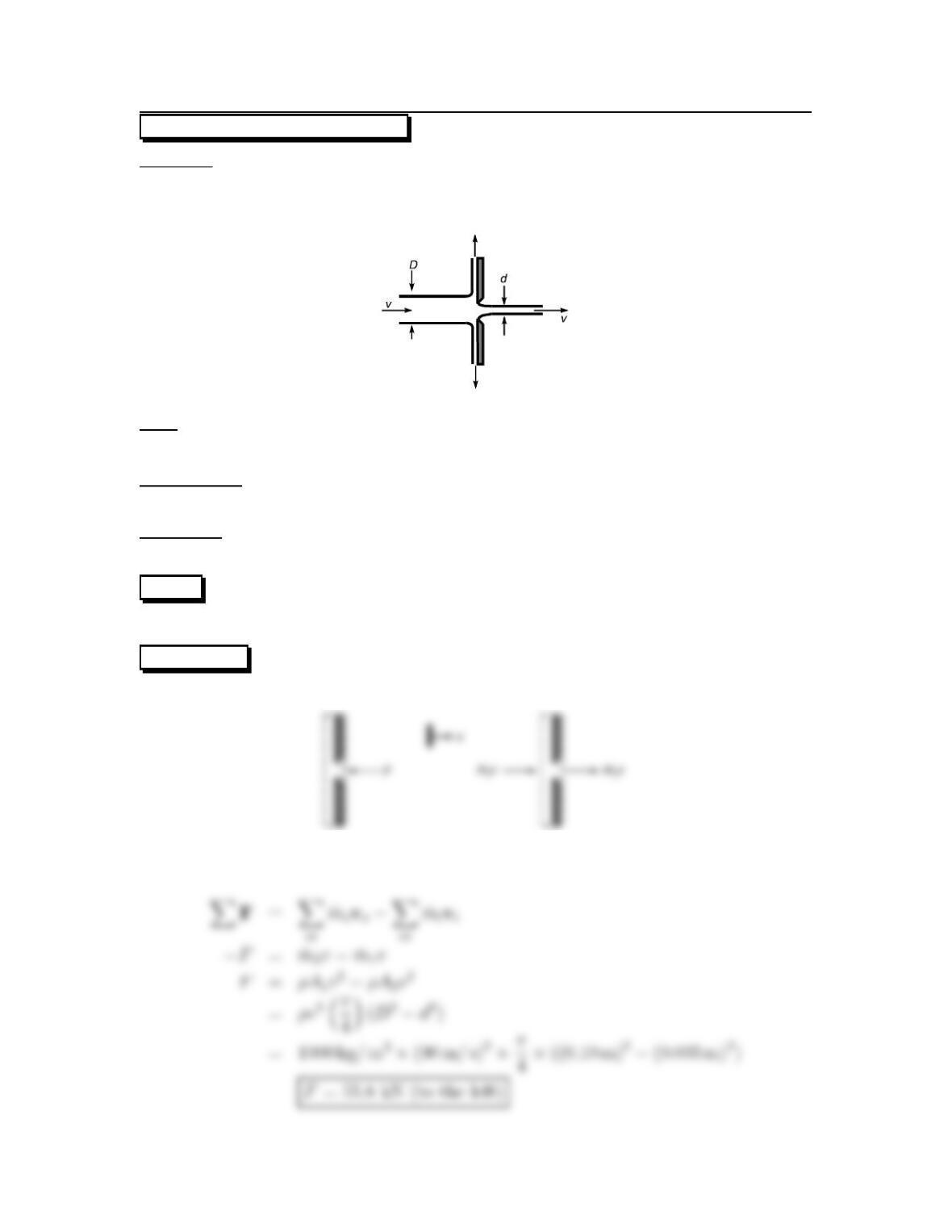
A water jet strikes a plate with a sharp edged orifice at its center.
v=90 m/s, D=10 cm, d=3.5cm
Find:
Force required to hold plate stationary (N).
Assumptions:
Neglect gravity.
Properties:
ρ=1000kg/m3
PLAN
Apply the momentum equation.
SOLUTION
Force and momentum diagrams (only x-direction vectors shown)
Momentum equation (x-direction)
45
6.30: PROBLEM DEFINITION
Situation:
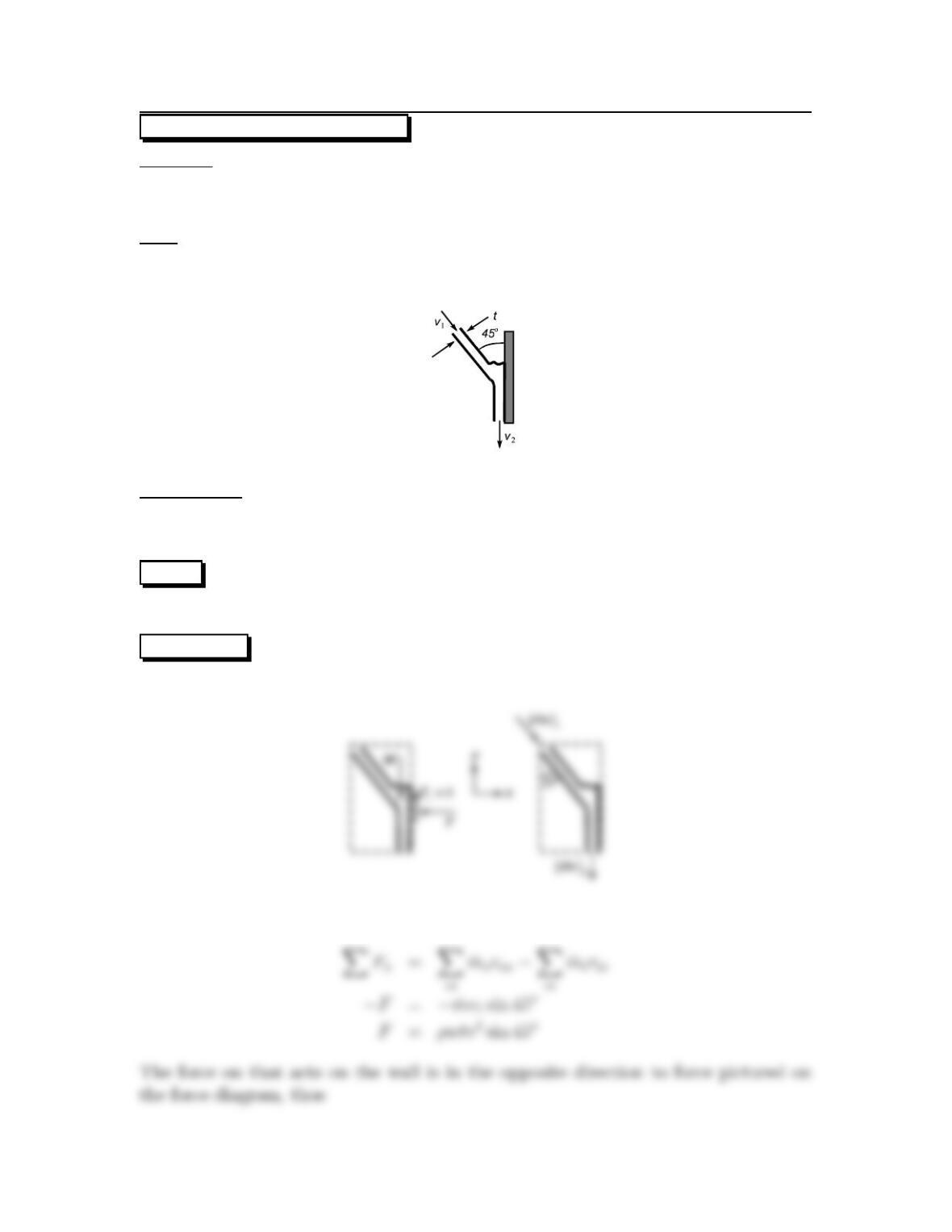
A 2D liquid jet impinges on a vertical wall.
v1=v2=v,θ=45◦.
Find:
Calculatetheforceactingonthewall.
Sketch and explain the shape of the liquid surface.
Assumptions:
Steady flow.
Force associated with shear stress is negligible.
PLAN
Apply the momentum equation.
SOLUTION
Let w = the width of the jet in the z-direction. Force and momentum diagrams
Momentum equation (x-direction)
46
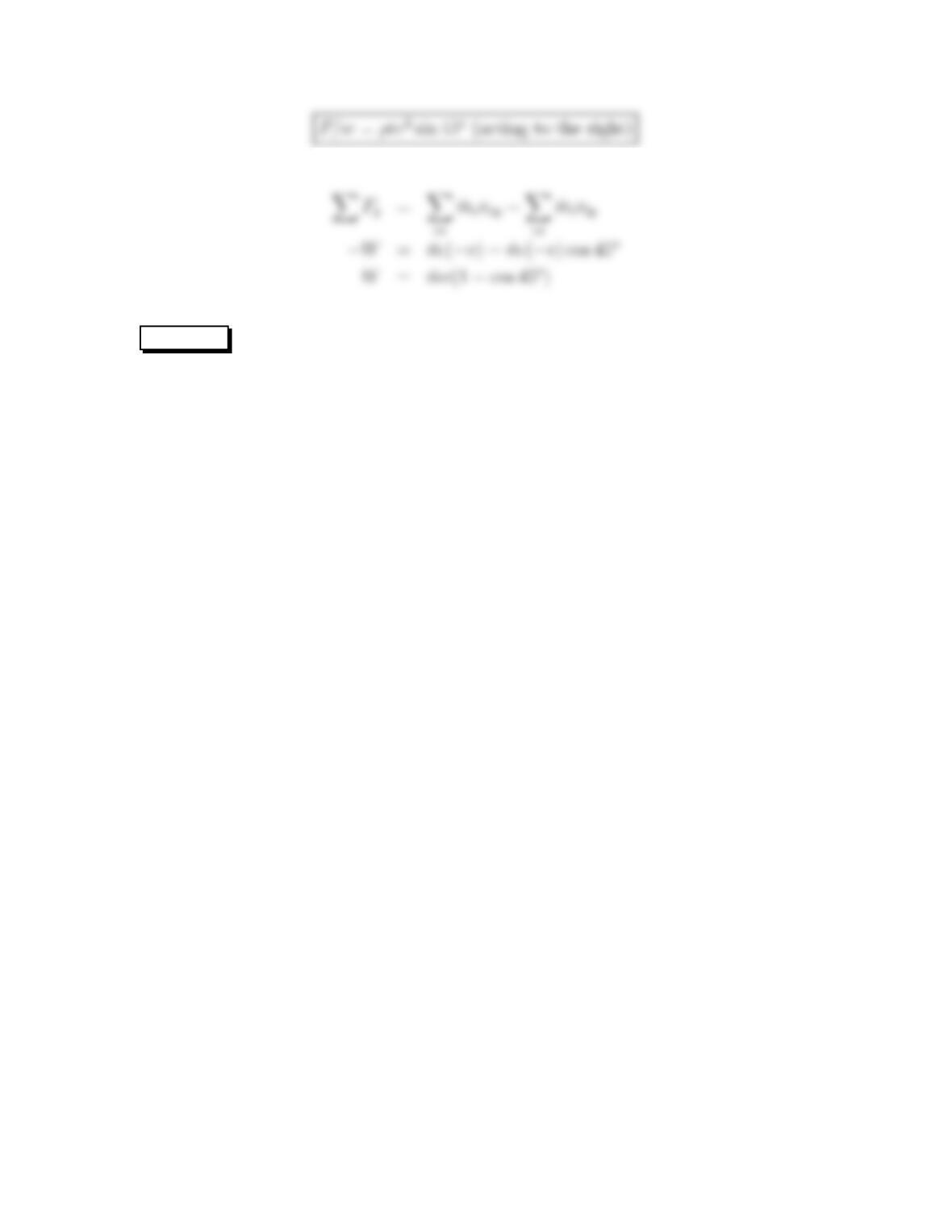
y-direction
REVIEW
Thus, weight provides the force needed to increase y-momentum flow. This weight
is produced by the fluid swirling up to form the shape show in the above sketches.
47
6.31: PROBLEM DEFINITION
Situation:
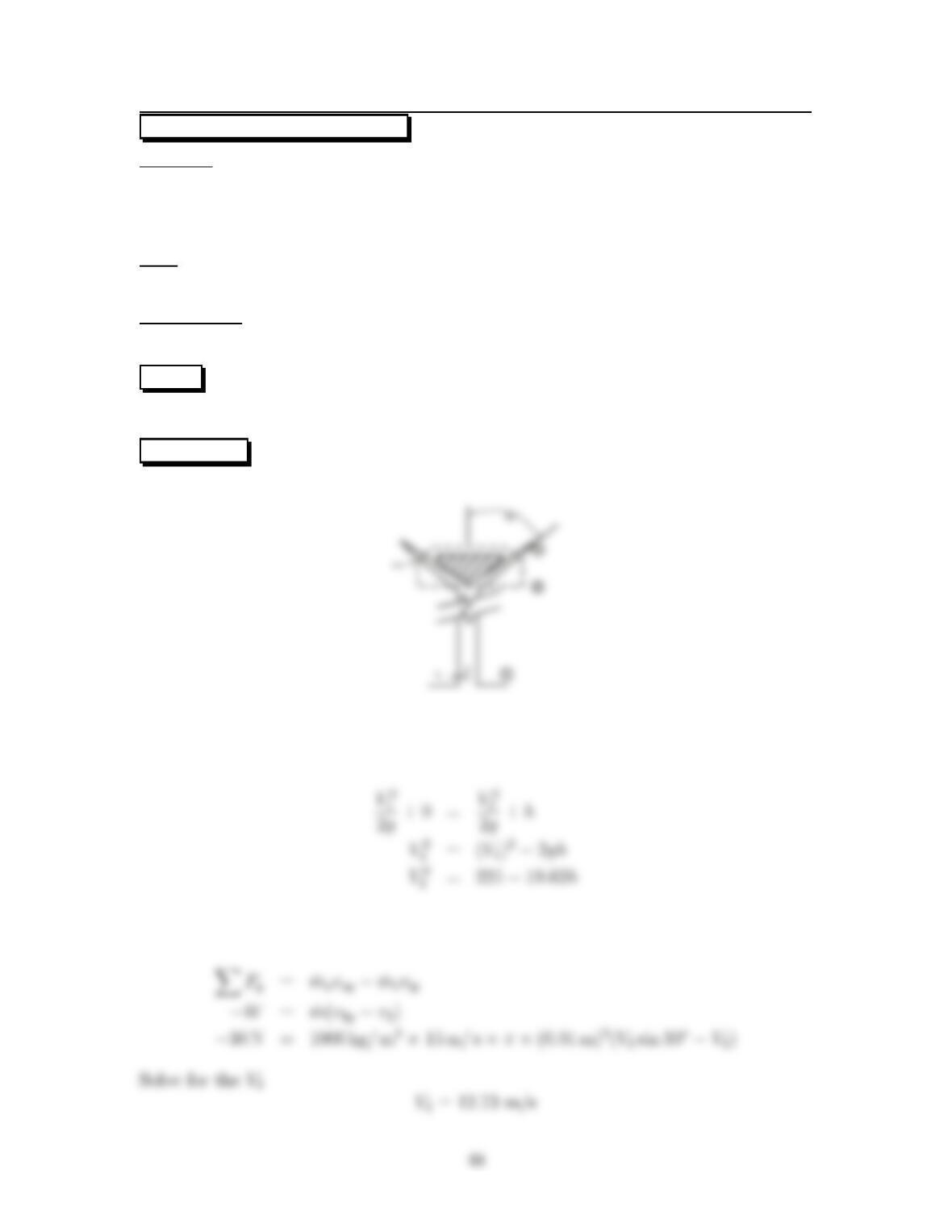
A cone is supported by a vertical jet of water.
W=30N,V1=15m/s.
d1=2cm,θ=60◦.
Find:
Height to which cone will rise (m).
Assumptions:
Speed of the fluid as it passes by the cone is constant (V2=V3).
PLAN
Apply the Bernoulli equation and the momentum equation.
SOLUTION
Bernoulli equation
Momentum equation (y-direction). Select a control volume surrounding the cone.
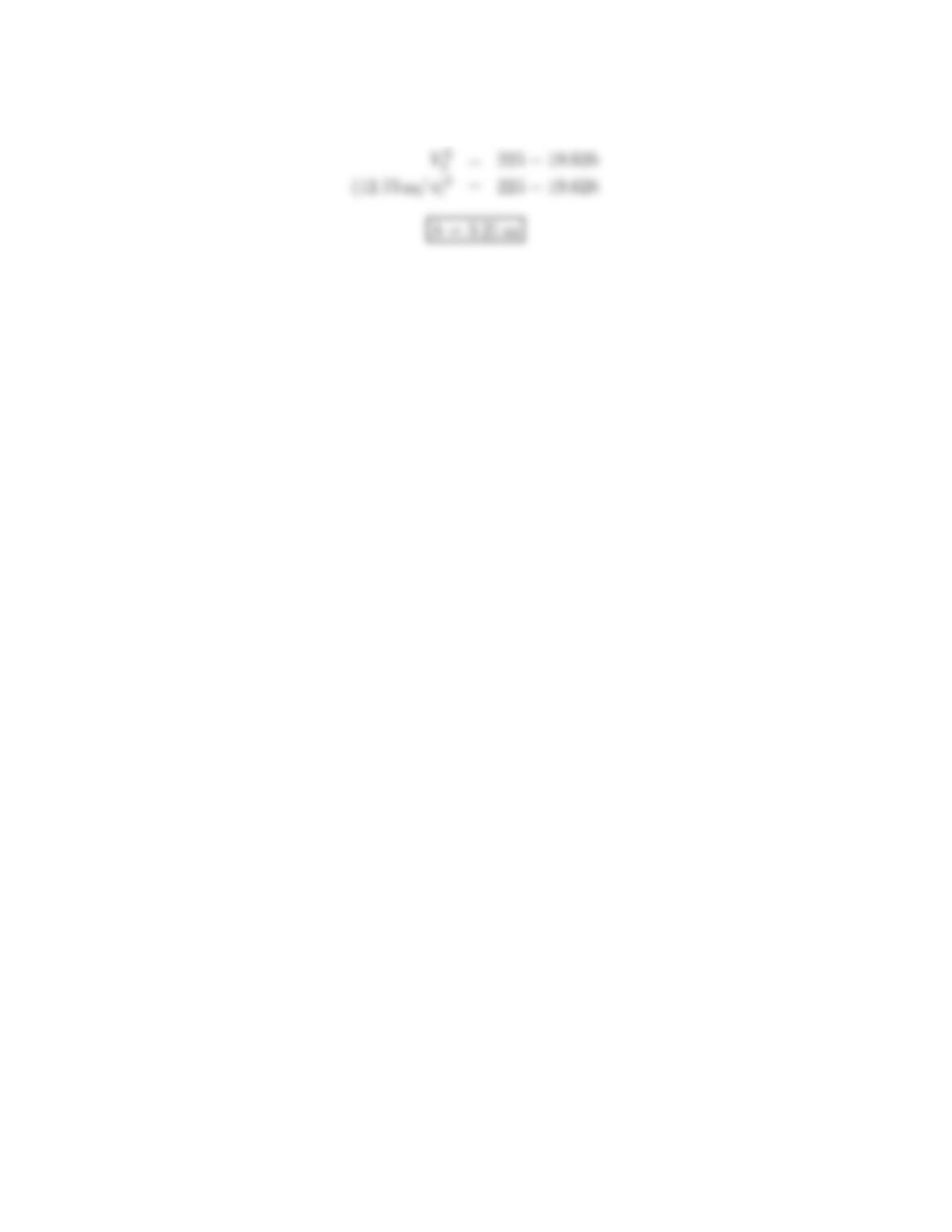
Complete the Bernoulli equation calculation
49
6.32: PROBLEM DEFINITION
Situation:
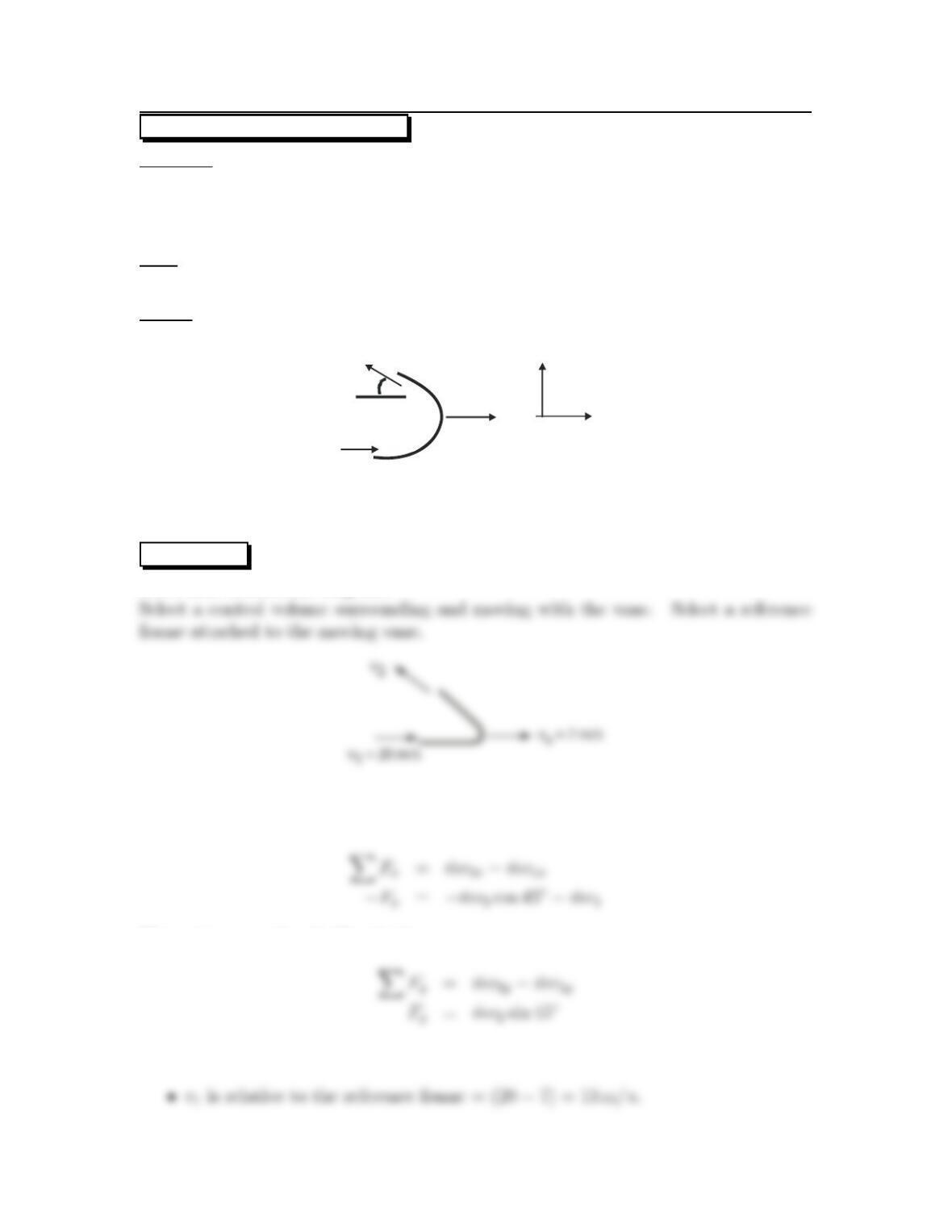
Afluid jet strikes a vane that is moving at a speed.
v1=20m/s,vv=7m/s.
D1=6cm.
Find:
Force of the water on the vane.
Sketch:
45
o
x
y
v
1
v
v
v
2
SOLUTION
Force and momentum diagrams
Momentum equation (x-direction)
Momentum equation (y-direction)
Velocity analysis
50
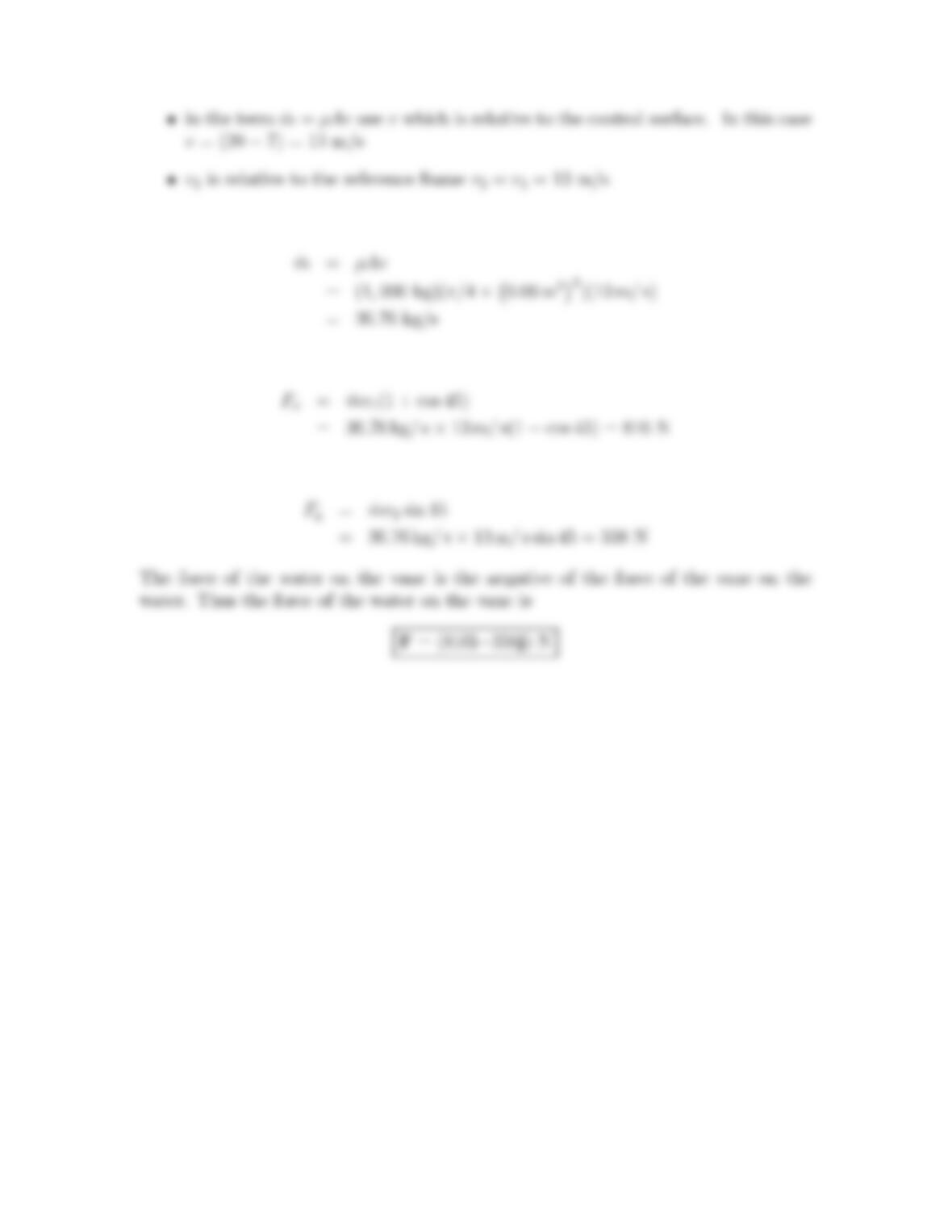
Mass flow rate
Evaluate forces
which is in the negative x−direction.
51
6.33: PROBLEM DEFINITION
Situation:
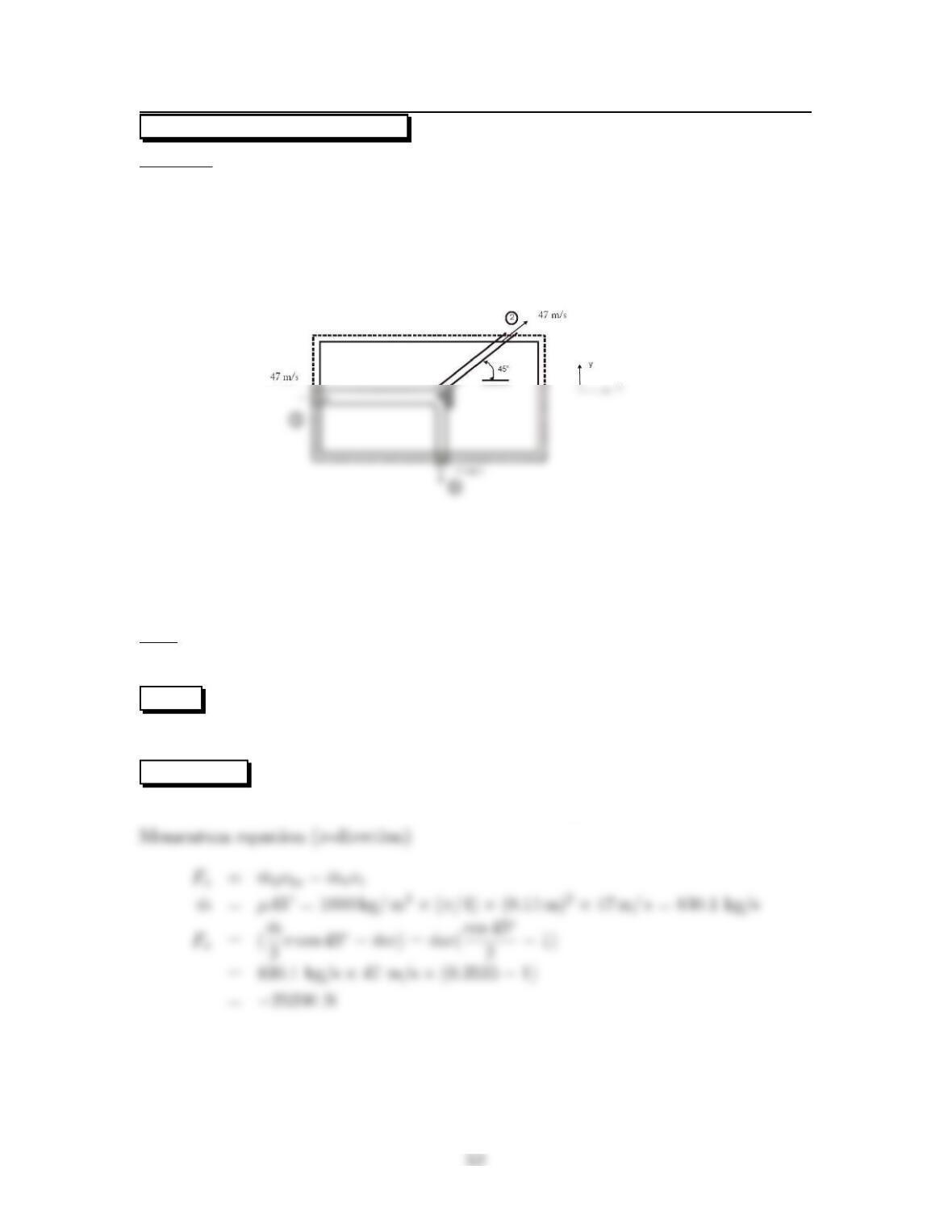
Cart, moving with a steady speed of 3m/s.
Jet, V=50m/s, D=15cm, is being sprayed from behind the cart, and the jet is
divided and deflected by a vane situated on the cart.
Speed of jet as it impacts the vane is 47 m/s, as shown.
Find:
Force exerted by the vane on the jet: F
PLAN
Apply the momentum equation.
SOLUTION Make the flow steady by referencing all velocities to the moving vane
and let the c.v. move with the vane as shown in the figure above.
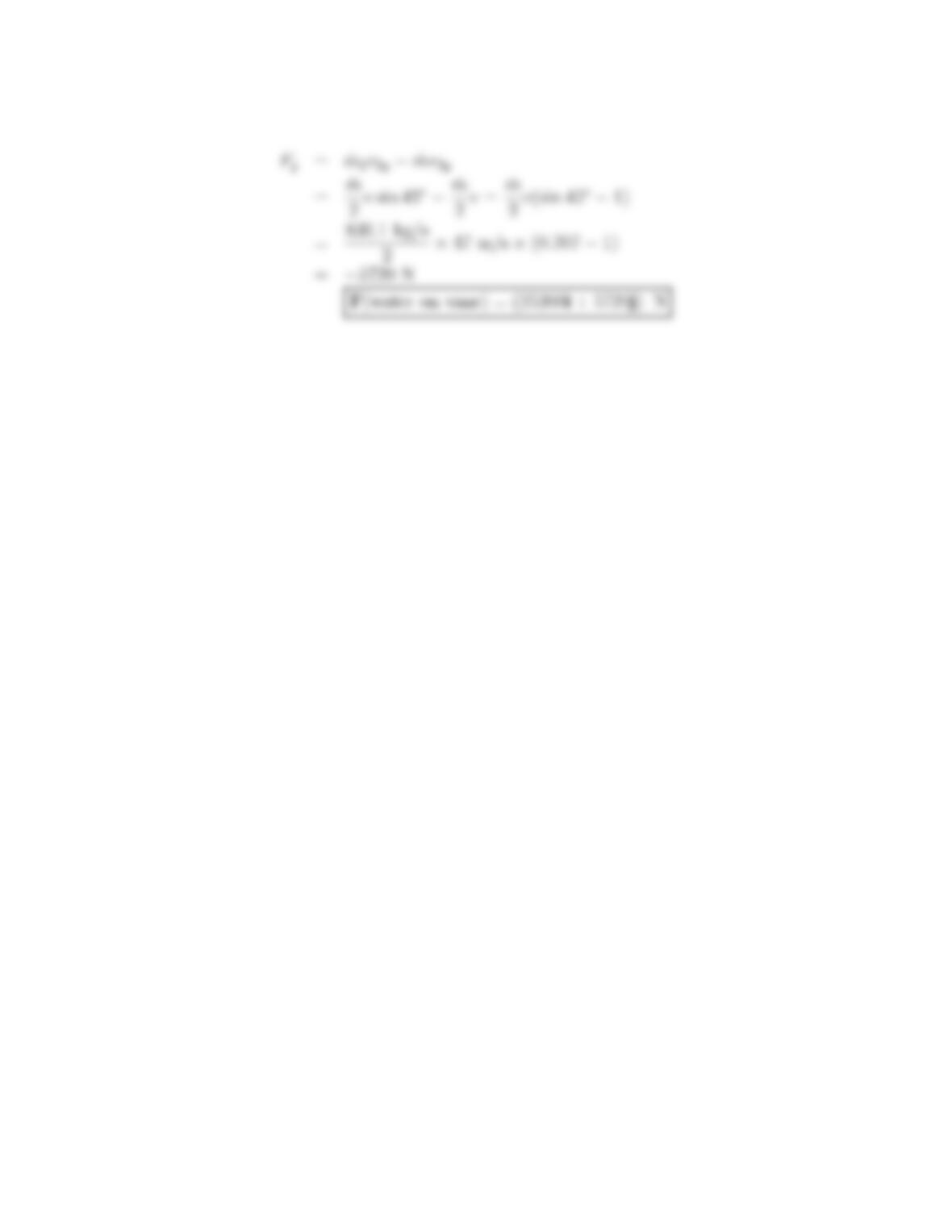
Momentum equation (y–direction)
53
6.34: PROBLEM DEFINITION
Situation:
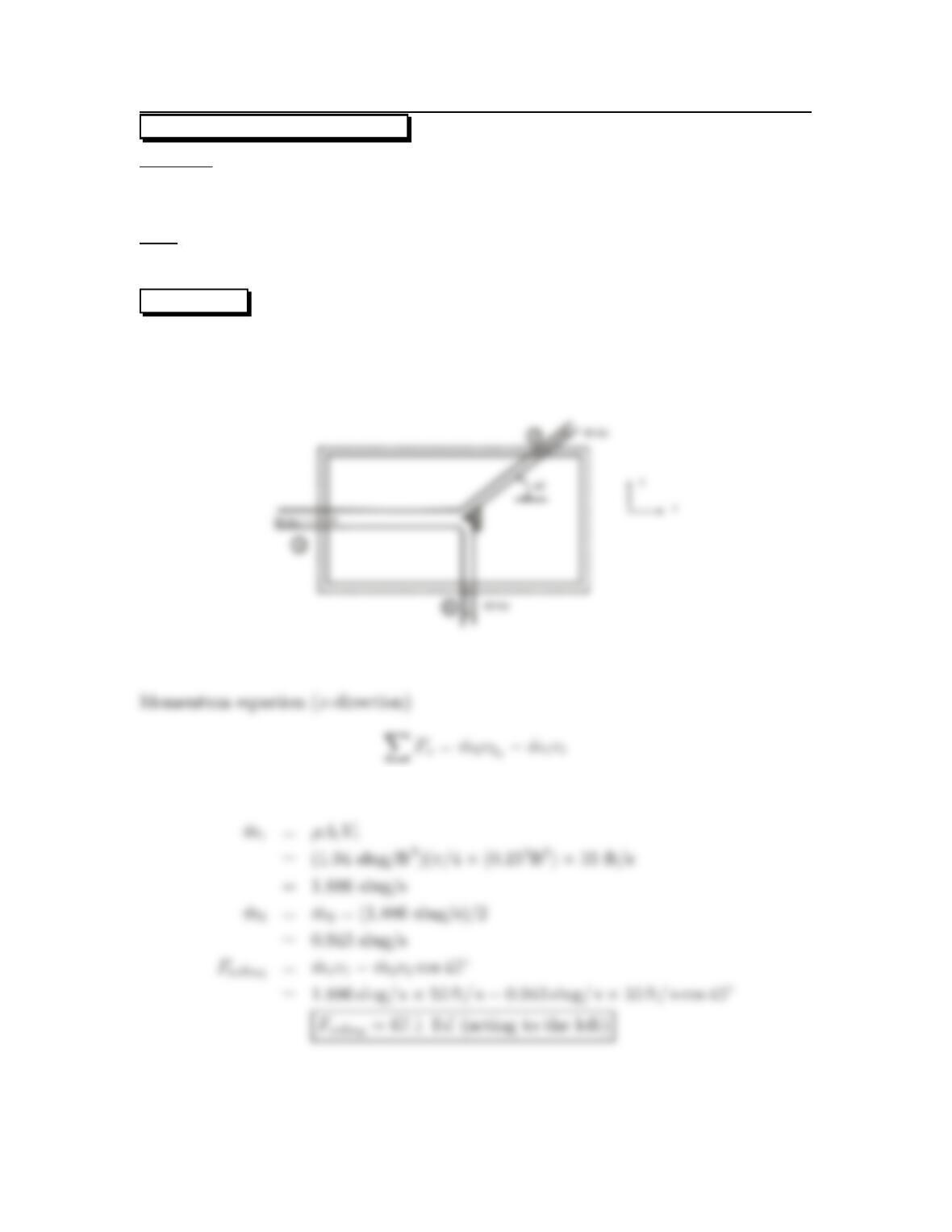
A cart is moving with steady speed–additional details are provided in the problem
statement.
Find:
Rolling resistance of the cart: Frolling
SOLUTION Let the control surface surround the cart and let it move with the cart
at 5 ft/s. Then we have a steady flow situation and the relative jet velocities are
shown below.
Calculations (All calculations need o be fixed)
54
6.35: PROBLEM DEFINITION
Situation:
Awaterisdeflected by a moving cone.
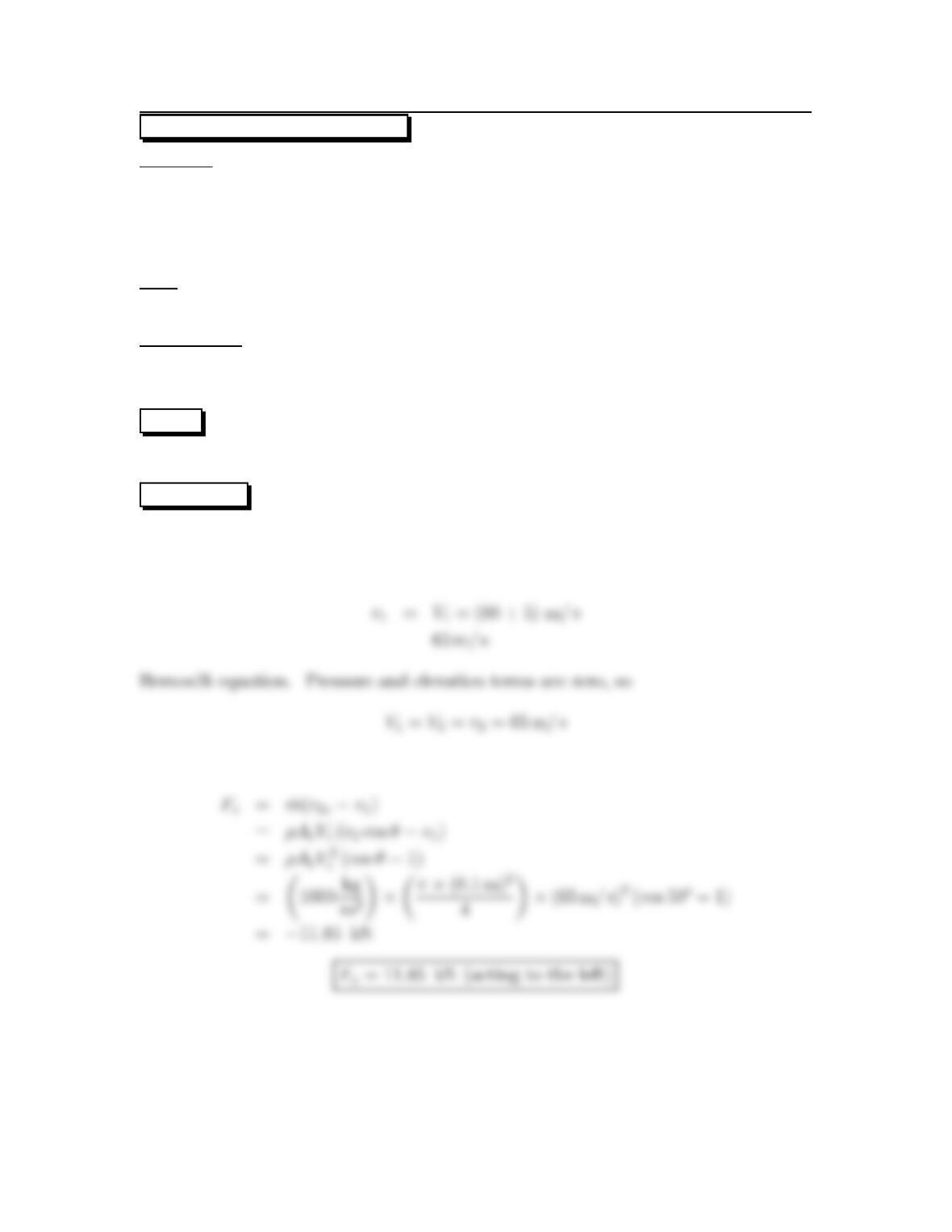
Speed of the water jet is 60 m/s(to the right). Speed of the cone is 5m/s(to the
left). Diameter of the jet is D=10cm.
Angle of the cone is θ=50
o.
Find:
Calculate the external horizontal force needed to move the cone: Fx
Assumptions:
As the jet passes over the cone (a) assume the Bernoulli equation applies, and (b)
neglect changes in elevation.
PLAN
Apply the momentum equation.
SOLUTION
Select a control volume surrounding the moving cone. Select a reference frame fixed
to the cone. Section 1 is the inlet. Section 2 is the outlet.
Inlet velocity (relative to the reference frame and surface of the control volume).
Momentum equation (x-direction)
55
6.36: PROBLEM DEFINITION
Situation:
A jet of water is deflected by a moving vane–additional details are provided in the
problem statement.
Find:
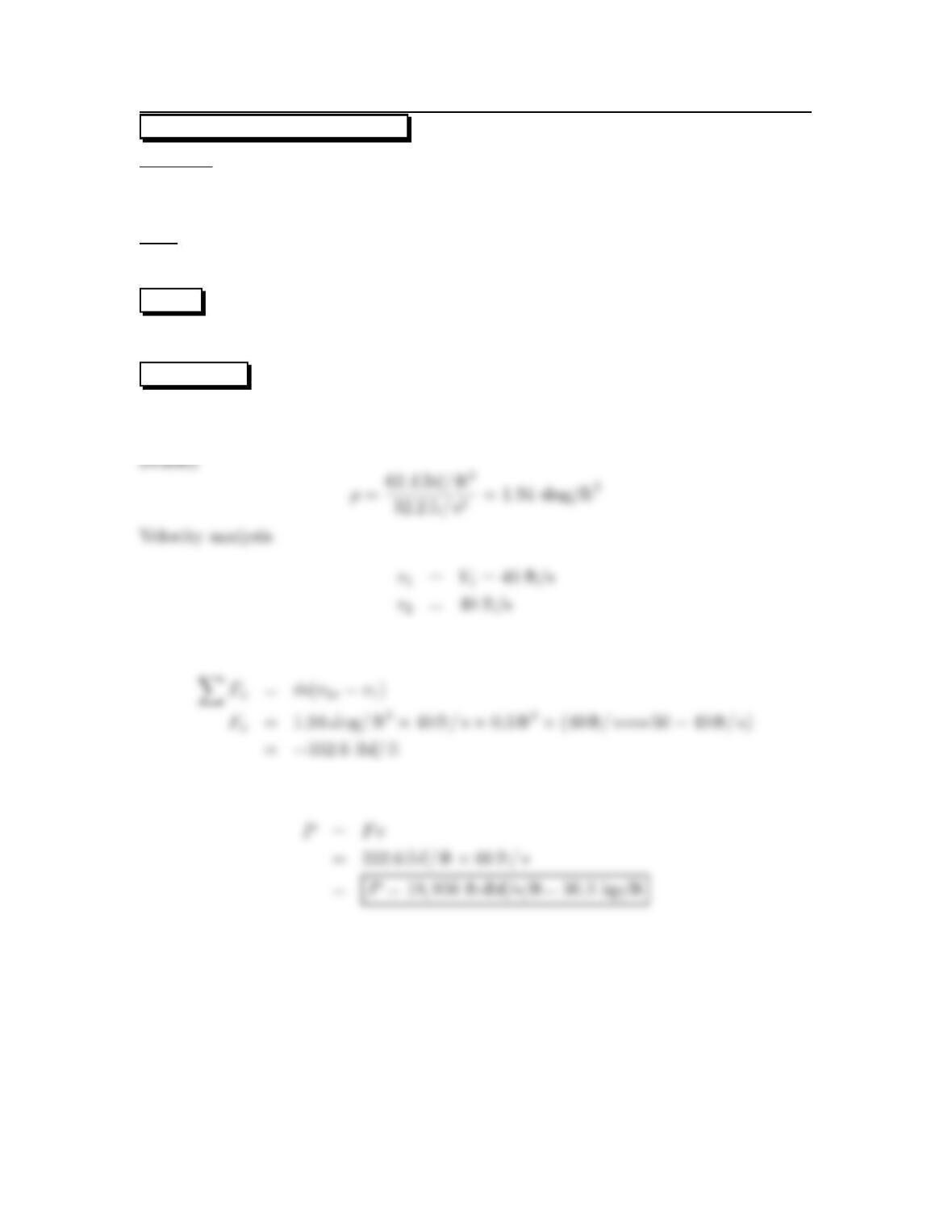
Power (per foot of width of the jet) transmitted to the vane: P
PLAN
Apply the momentum equation.
SOLUTION
Select a control volume surrounding the moving cone. Select a reference frame fixed
to the cone.
Momentum equation (x-direction)
Calculate power
56
6.37: PROBLEM DEFINITION
Situation:
Asledofmassms= 1000 kg is decelerated by placing a scoop of width w=20cm
into water at a depth d=8cm.
Find:
Deceleration of the sled: as
SOLUTION
Select a moving control volume surrounding the scoop and sled. Select a stationary
reference frame.
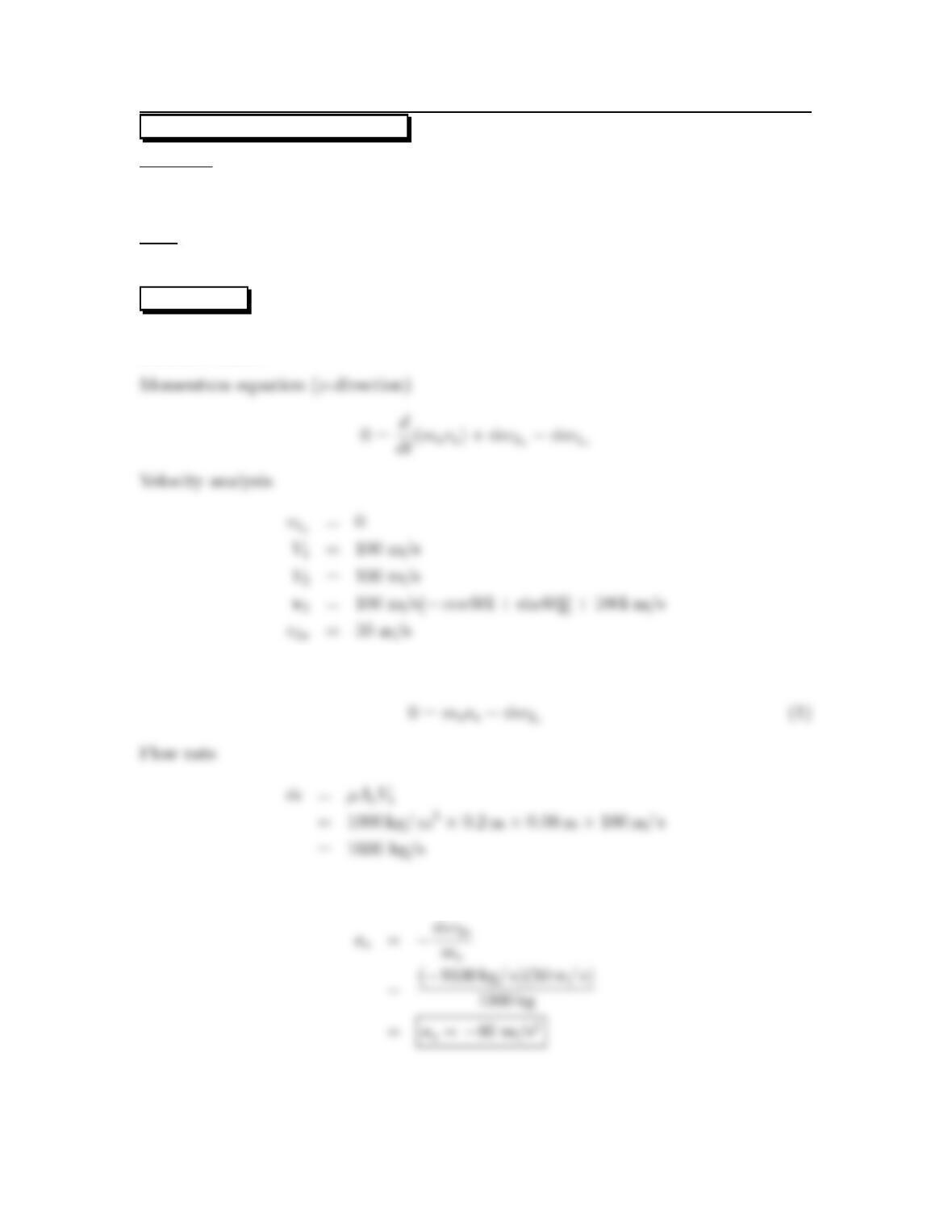
The momentum equation equation simplifies to
From Eq. (1).
57
6.38: PROBLEM DEFINITION
Situation:
A snowplow is described in the problem statement.
Find:
Power required for snow removal: P
PLAN
Apply the momentum equation.
SOLUTION
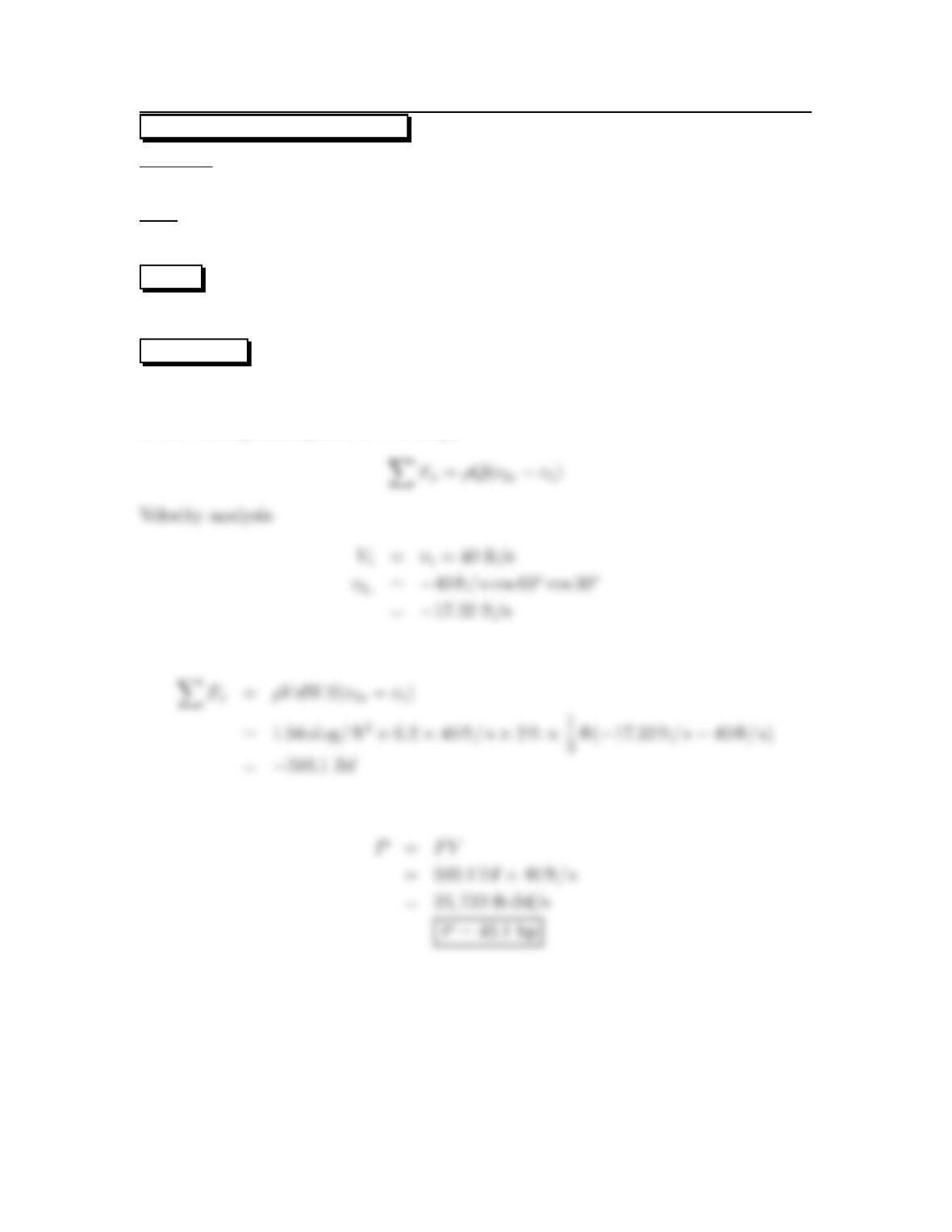
Momentum equation (x-direction)
Select a control volume surrounding the snow-plow blade. Attach a reference frame
to the moving blade.(Snow is 4 in deep)
Calculations
Power
58
6.39: PROBLEM DEFINITION
Situation:
The flow over an airfoil is modeled as the flow in a circular stream tube which has
a diameter equal to the wing span and is deflected by an angle of 2o.New
Find:
The lift and the drag forces.
Assumptions:
Assume the pressure is constant far from the airfoil.
PLAN
Apply the component form of the momentum equation.
SOLUTION
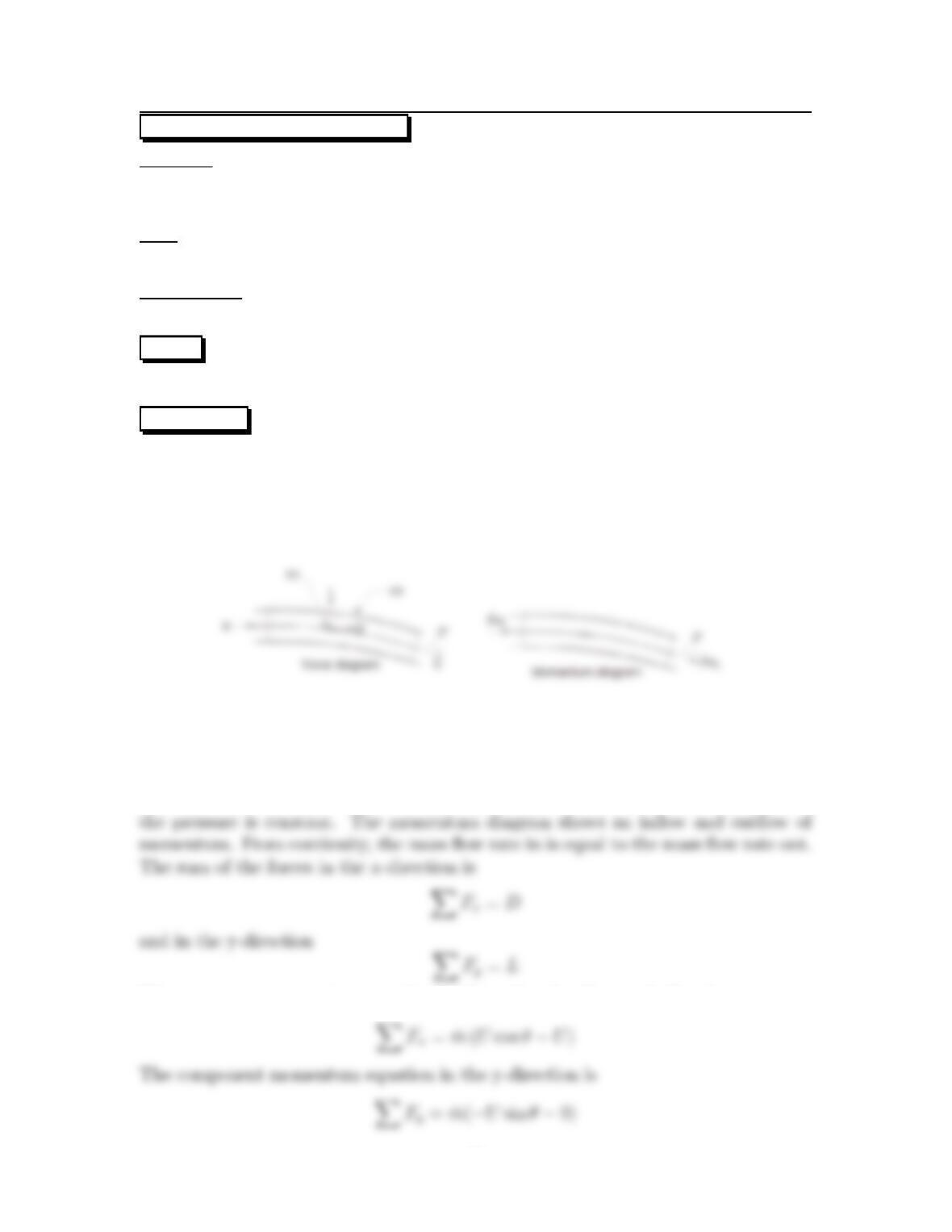
Draw an outer volume that encloses the airfoil far from the airfoil and one around the
airfoil as shown in the diagram. The space between the two volumes is the control
volume
The force diagram shows a lift force and drag force produced by the airfoil and act
on the control surface. There is no net pressure force on the outer surface since
The component momentum equation in the x-direction for steady flow is
59
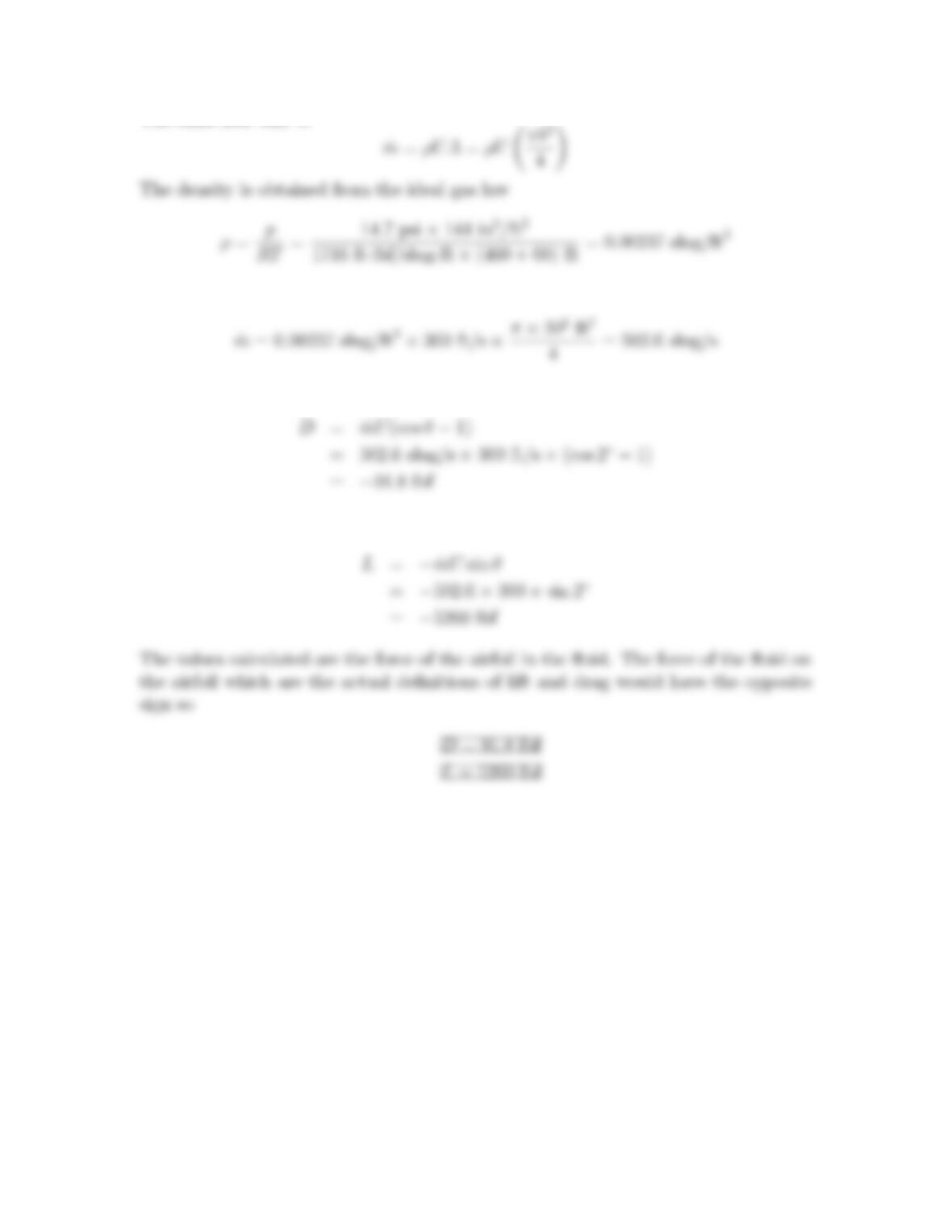
The mass flow rate is
The mass flow rate is
Solving for the drag force
Solving for lift force
60