Chap. 6 Excavation, Grading, and Compacted Fill 6-13
b.
6.23 A series of modified Proctor tests have been performed on a soil that has a Gs of 2.70.
The test results obtained are as follows:
Point
No.
Mass of
Compacted Soil
+ Mold (kg)
Moisture Content Test Results
Mass of Can
(g)
Mass of Can +
Moist Soil (g)
Mass of Can + Dry
Soil (g)
1 3.673 22.11 205.74 196.33
2 3.798 23.85 194.20 180.54
3 3.927 19.74 196.24 177.92
4 3.983 20.03 187.43 165.71
5 3.932 21.99 199.59 171.11
The mass of the empty mold was 1.970 kg.
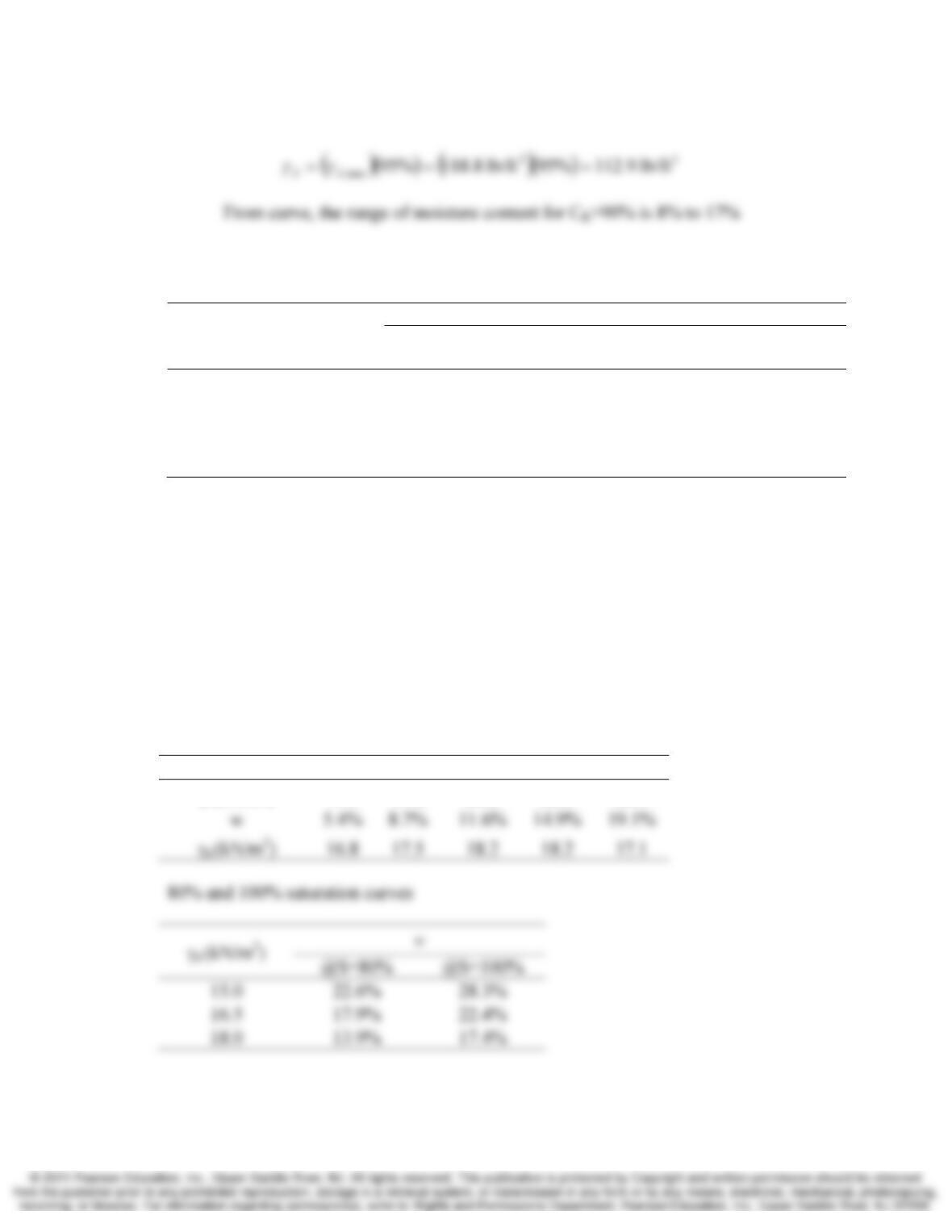
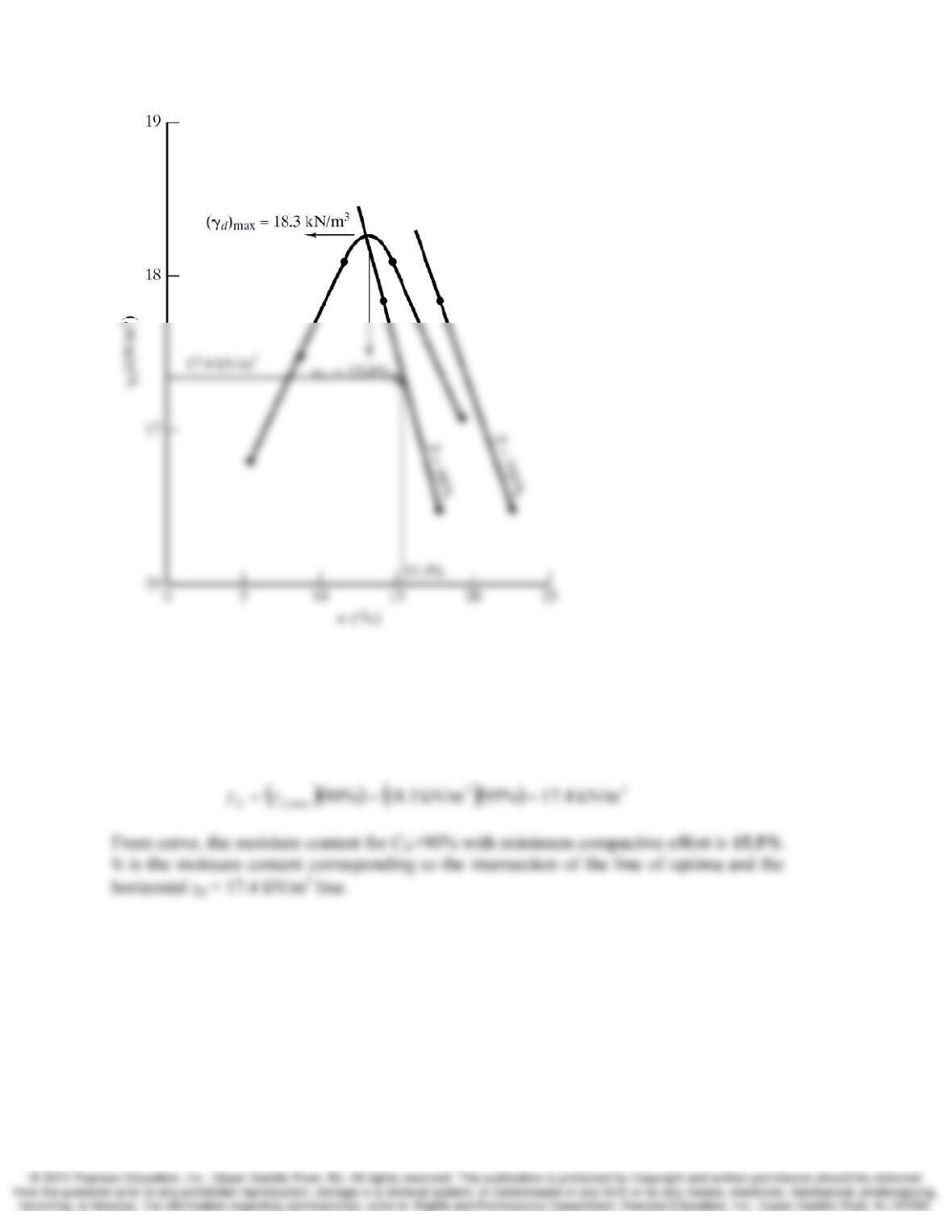
Plot the laboratory test results and the S = 80% and S = 100% curves, and then
draw the modified Proctor compaction curve. Determine the maximum dry unit weight
(kN/m3) and the optimum moisture content, based on the modified Proctor test.
Assuming that the S = 80% curve is the line of optima (a line that passes through
the maximum points of compaction curves from different compactive efforts) and if the
smallest possible compactive effort is to be used, determine the moisture content required
to obtain a relative compaction based on the modified Proctor test of at least 90%.
Solution
Proctor compaction results
Data Point No. 1 2 3 4 5
γ (kN/m3) 17.7 19.0 20.3 20.9 20.4
6-14 Excavation, Grading, and Compacted Fill Chap. 6
Results
3
max, kN/m 18.3=
d
γ
13.0%=
o
w
Chap. 6 Excavation, Grading, and Compacted Fill 6-15
Section 6.5 Field Considerations and Monitoring
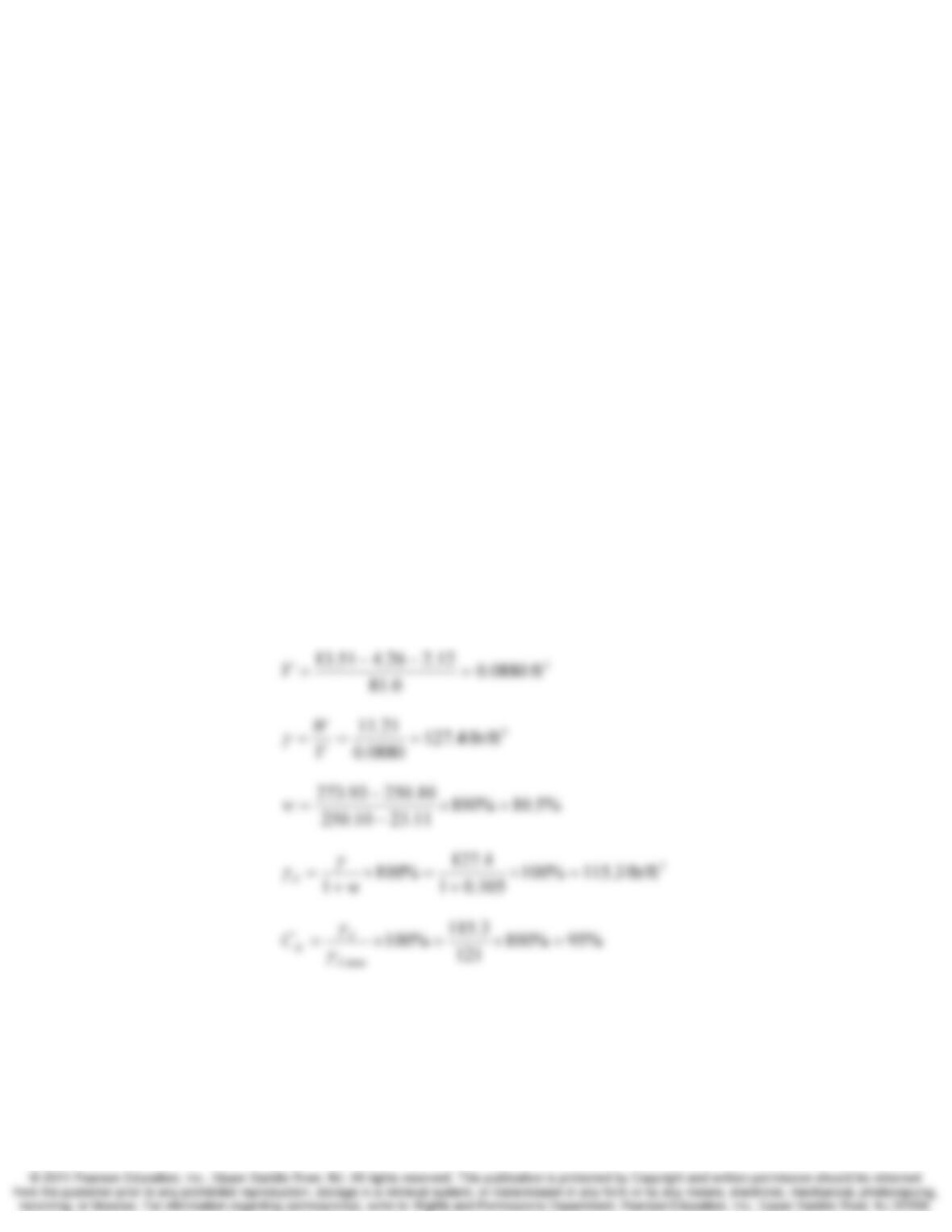
6.24 A sand cone test has been performed in a recently compacted fill. The test results
obtained are as follows:
Initial weight of sand cone + sand = 13.51 lb
Final weight of sand cone + sand = 4.26 lb
Weight of sand to fill cone = 2.12 lb
Weight of soil from hole + bucket = 12.42 lb
Weight of bucket = 1.21 lb
Moisture content test:
Mass of empty moisture content can = 23.11 g
Mass of moist soil + can = 273.93 g
Mass of oven-dried soil + can = 250.10 g
The sand used in the sand cone had a unit weight of 81.0 lb/ft3, and the fill had a
maximum dry unit weight of 121 lb/ft3 and an optimum moisture content of 11.7%, based
on the modified Proctor test. Compute the relative compaction based on the modified
Proctor test.
Solution
lb 11.211.2112.42
=
−=W
6-16 Excavation, Grading, and Compacted Fill Chap. 6
Section 6.7 Earthwork Quantity Computations
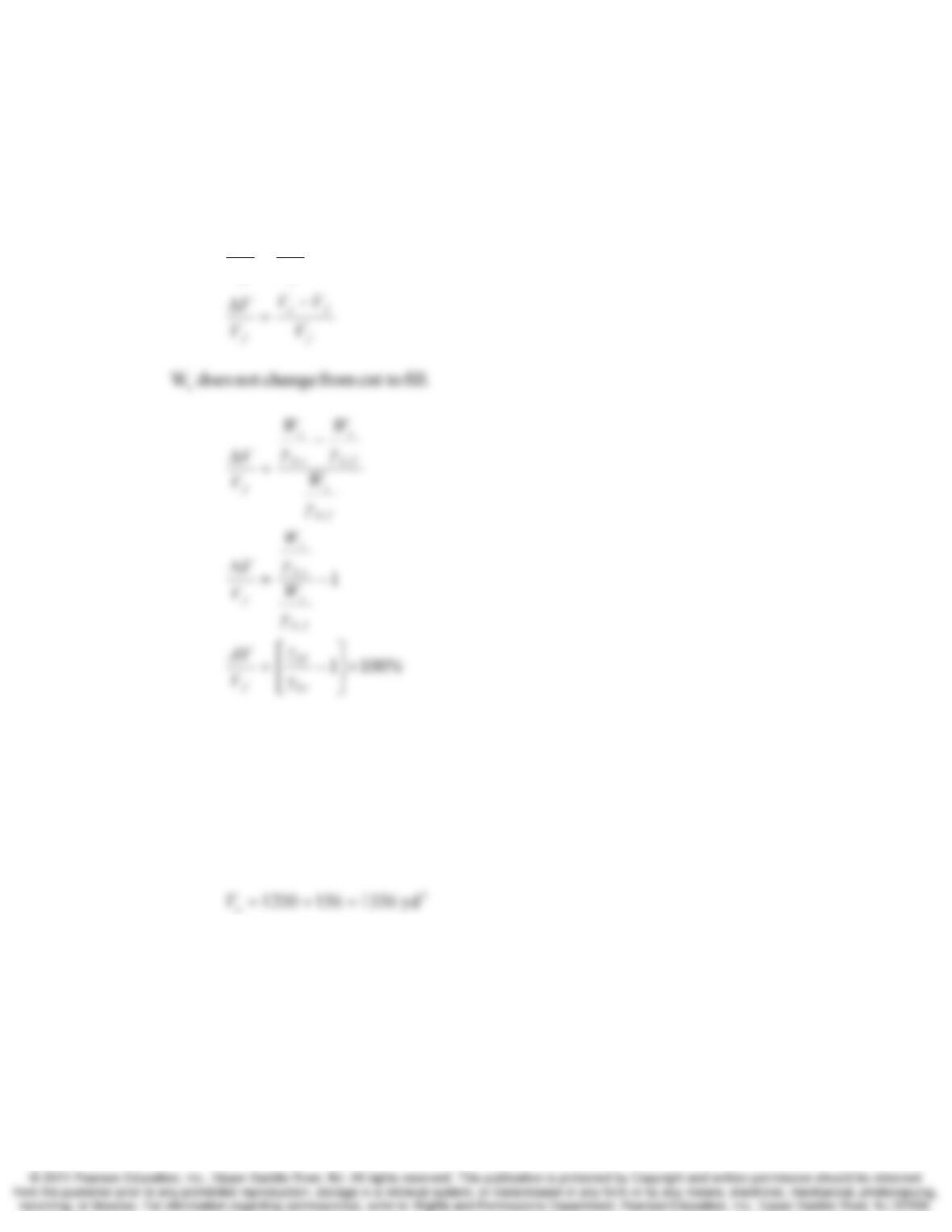
6.25 Derive Equation (6.5).
Solution
ff
V
V
V
V
Δ
=
Δ
6.26 A proposed building site requires 1,200 yd3 of imported fill. A suitable borrow site has
been located, and the soils there have a shrinkage factor of 13%. How many cubic yards
of soil must be excavated from the borrow site?
Solution
()
3
yd 156120013.0 ==ΔV
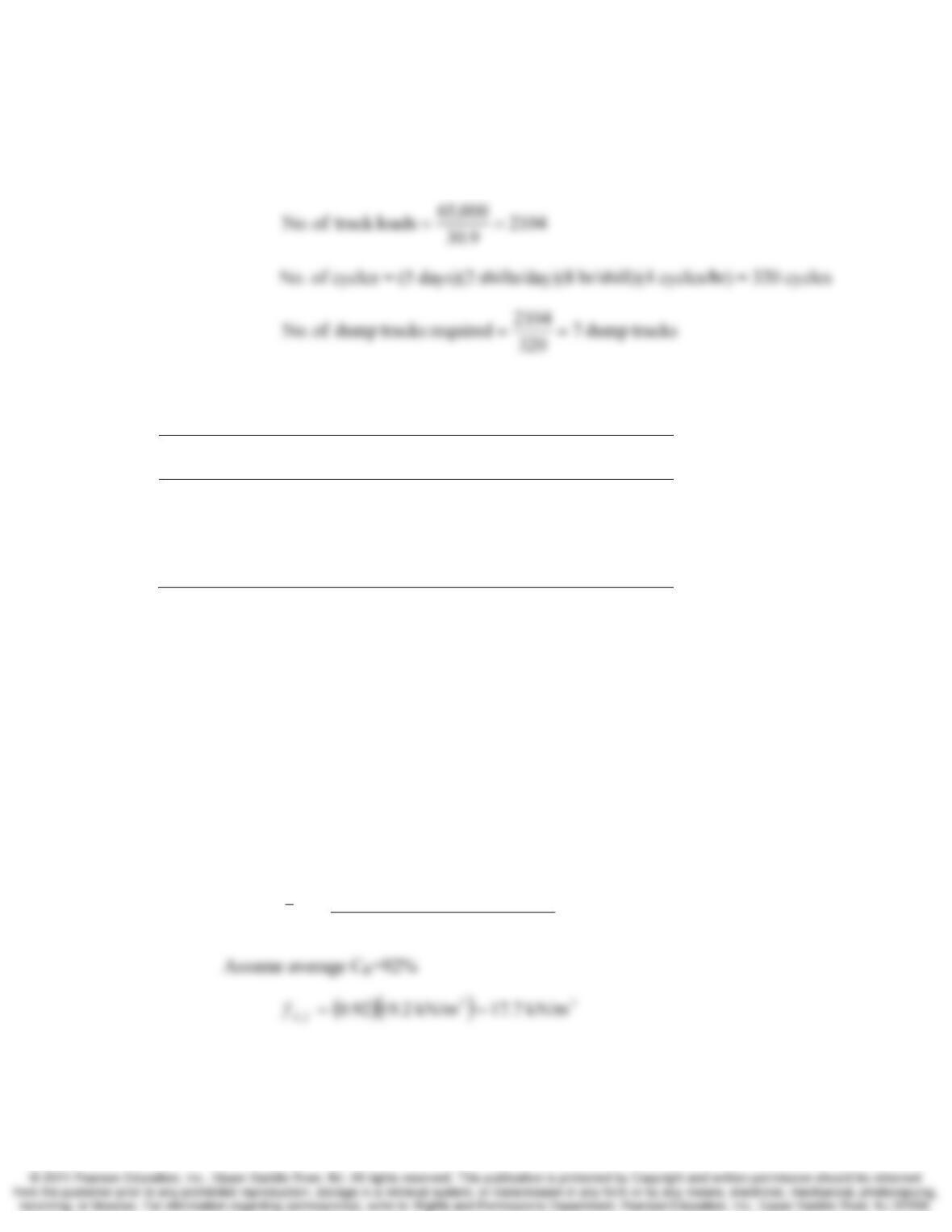
6.27 A contractor needs to excavate 50,000 yd3 of silty clay and haul it with Caterpillar 69C
dump trucks. Each truck can carry 30.9 yd3 of soil per load, and operates on a 15-minute
cycle. The job must be completed in five working days with the trucks working two
8-hour shifts per day. Using a bulking factor of 30%, how many trucks will be required?
Chap. 6 Excavation, Grading, and Compacted Fill 6-17
Solution
()
3
yd 65,00030.1000,50 ==V
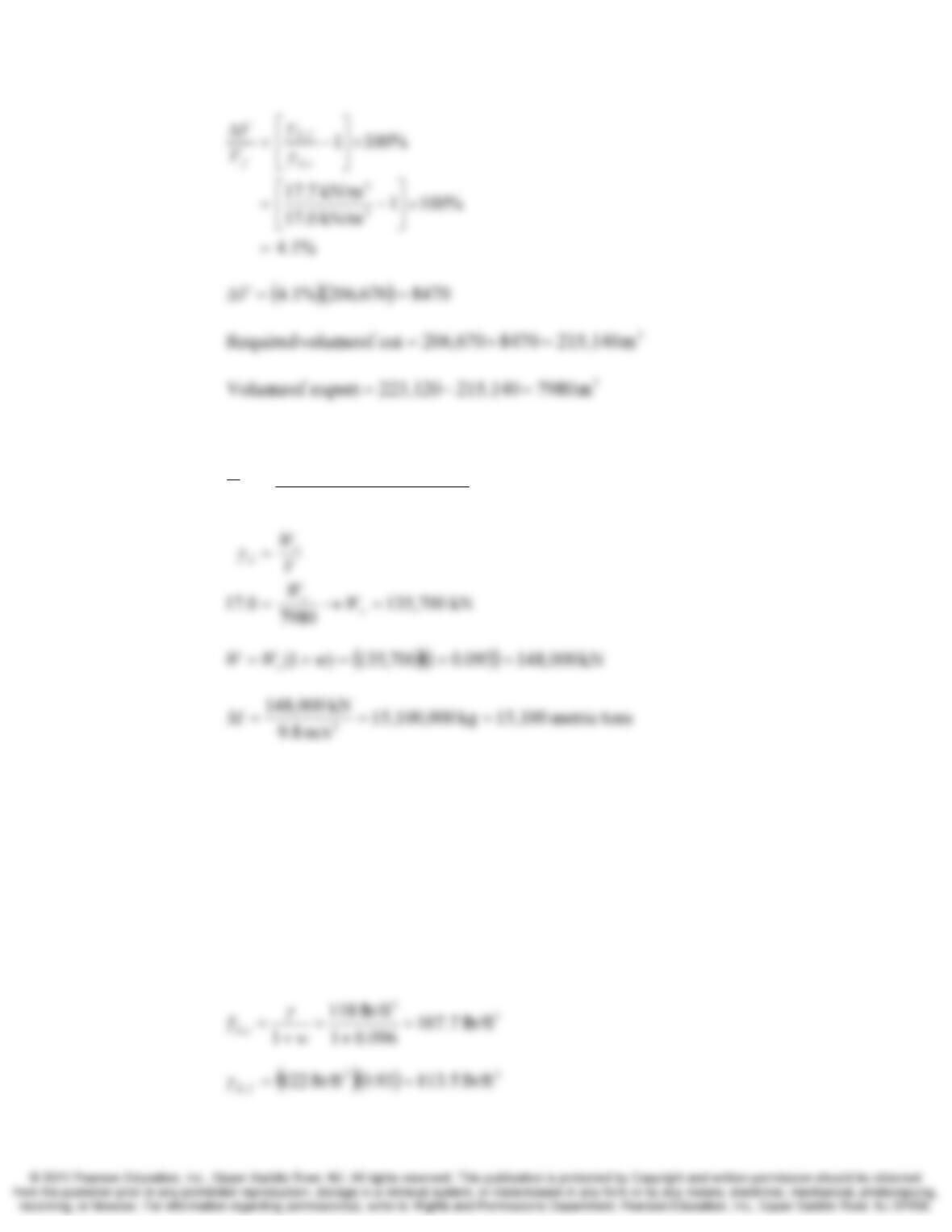
6.28 A proposed grading plan requires 223,120 m3 of cut and 206,670 m3 of fill. Laboratory
tests on a series of undisturbed samples from the cut area produced the following results:
Sample No. Dry Unit Weight
(kN/m3)
Moisture Content
(%)
3-1 17.3 9.1
3-2 17.7 9.5
5-1 16.8 8.9
5-2 17.1 7.2
8-1 16.0 12.0
A series of modified Proctor tests on representative bulk samples produced a maximum
dry unit weight of 19.2 kN/m3 and an optimum moisture content of 10.2%. The project
specifications require a relative compaction based on the modified Proctor test of at least
90%.
(a) Determine the shrinkage factor and compute the required volume of import or
export, if any. Use the dry unit weight of the cut when computing any import or
export quantities.
(b) Determine the weight of any import or export soil, assuming it has a moisture
content equal to the average moisture content in the cut. Express your answer in
metric tons (1 metric ton = 1000 kg = 1 Mg).
Solution
a.
3
,kN/m 17.0
5
0.161.178.167.173.17 =
+
+
+
+
=
cd
γ
6-18 Excavation, Grading, and Compacted Fill Chap. 6
b.
%3.9
5
0.122.79.85.91.9 =
+
+
++
=
cut
w
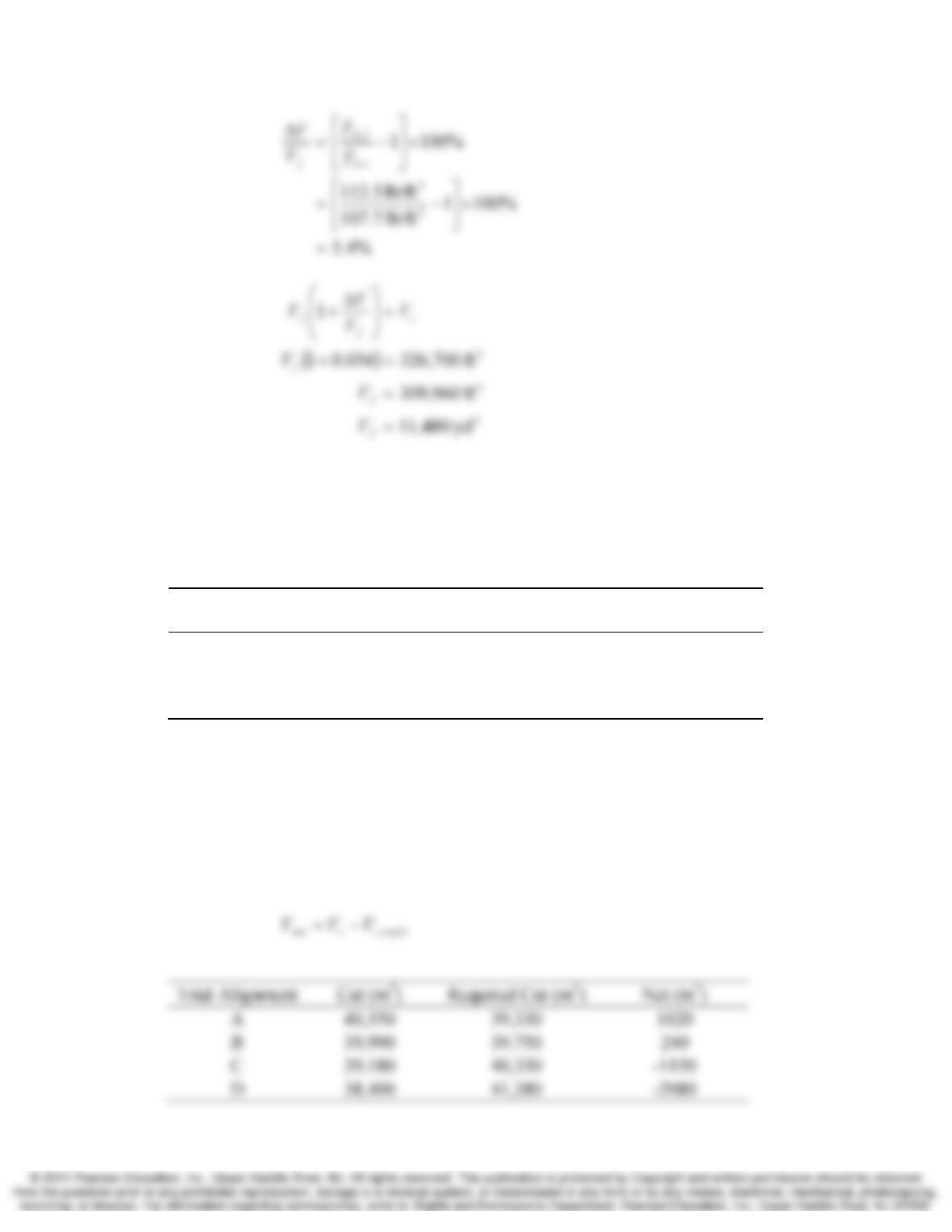
6.29 A 3.0 ft deep cut is to be made across an entire 2.5-acre site. The average unit weight of
this soil is 118 lb/ft3, and the average moisture content is 9.6%. It also has a maximum
dry unit weight of 122 lb/ft3 and an optimum moisture content of 11.1%, based on the
modified Proctor test. The excavated soil will be placed on a nearby site and compacted
to an average relative compaction of 93%. Compute the volume of fill that will be
produced, and express your answer in cubic yards.
Solution
()( )
(
)
32 ft 326,700/acft 43,560ac 2.5ft 3.0 ==
c
V
Chap. 6 Excavation, Grading, and Compacted Fill 6-19
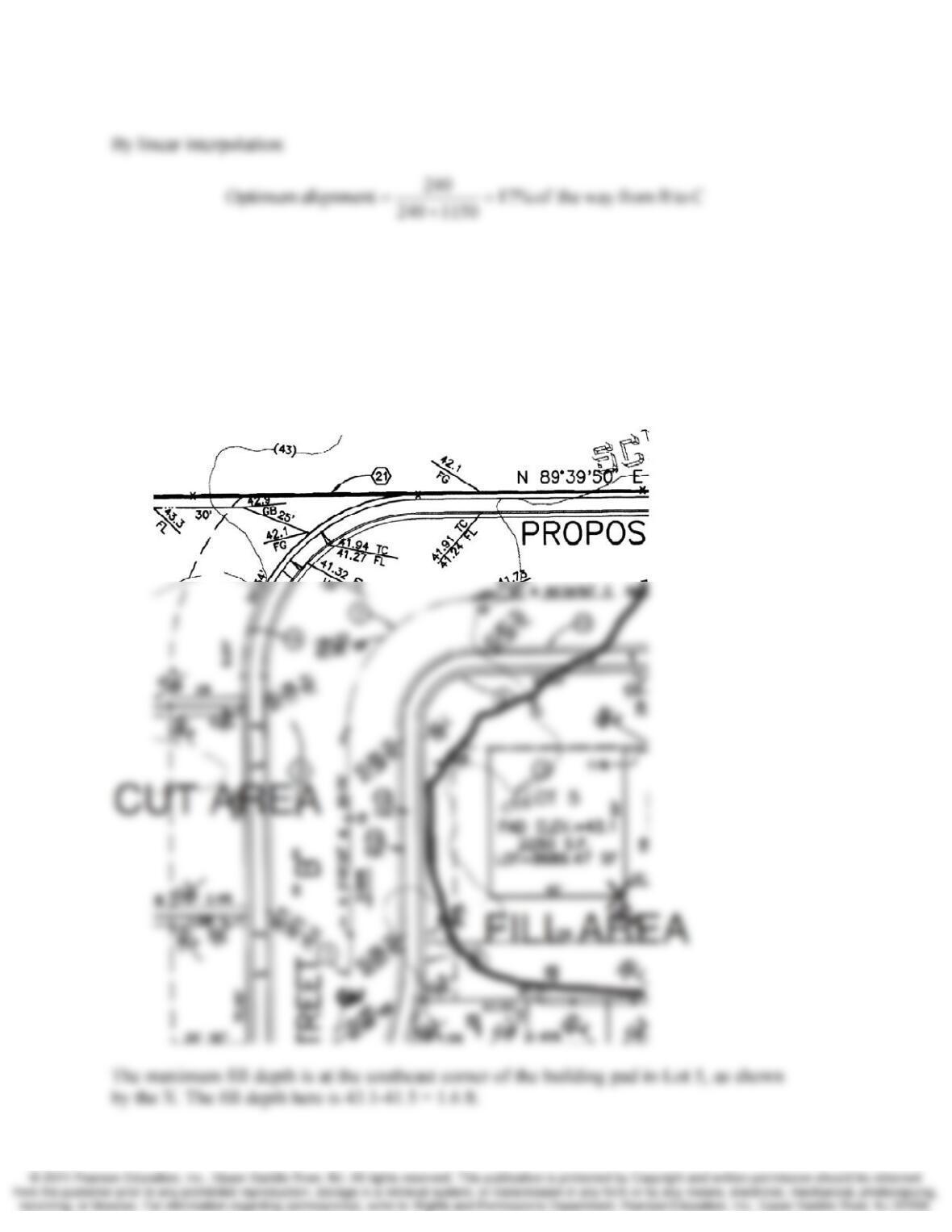
6.30 A proposed highway is to pass through a hilly area and will require both cuts and fills.
The horizontal alignment is fixed, but the vertical alignment can be adjusted within
certain limits to make the earthwork balance. The design engineer has developed four
trial vertical alignments, with A being the lowest one and D being the highest. The
resulting earthwork requirements are as follows:
Trial Vertical
Alignment
Cut Volume (m3) Fill Volume (m3)
A 40,350 35,120
B 39,990 35,490
C 39,180 36,010
D 38,400 36,950
Using a shrinkage factor of 12%, determine which alignment would balance the
earthwork. If none of the trial alignments works, then express your answer in terms of
two of them (e.g. 20% of the way from C to D).
Solution
(
)
fffreqdc VVVVV 12.1/1
,
=
Δ
+=
6-20 Excavation, Grading, and Compacted Fill Chap. 6
6.31 Make a copy of the grading plan in Figure 6.43, and then compare the existing and
proposed grades. Using colored pencils, apply red shading to the fill areas and blue
shading to the cut areas. Consider only the area south of the tract boundary (line 21).
You may interpolate between and extrapolate beyond the two contour lines (the full
drawing, which is much larger, includes many more contour lines). Finally, locate the
area that will receive the greatest depth of fill, and determine this depth.
Solution
Chap. 6 Excavation, Grading, and Compacted Fill 6-21
Comprehensive
6.32 A fill soil with a natural moisture content of 10% and an optimum moisture content based
on the modified Proctor test of 14% is being used to construct a compacted fill. The
contractor is placing this soil in 400 mm lifts, spraying the top with a water truck, and
compacting it using a towed sheepsfoot roller. A soils technician has performed a series
of field density tests in this fill and has found relative compaction values between 80%
and 92%, based on the modified Proctor test. The measured moisture contents ranged
from 10% to 23%. The specifications require a relative compaction based on the
modified Proctor test of at least 90%, so the fill is not acceptable. What is wrong with the
contractor’s methods, and what needs to be done to remedy the problem?
Solution
The contractor is using inappropriate methods, which need to be changed as follows:
6.33 A contractor needs to import 100,000 yd3 (compacted volume) of soil to build a small
earth dam. Two methods of hauling this soil are being considered, as follows:
Method A
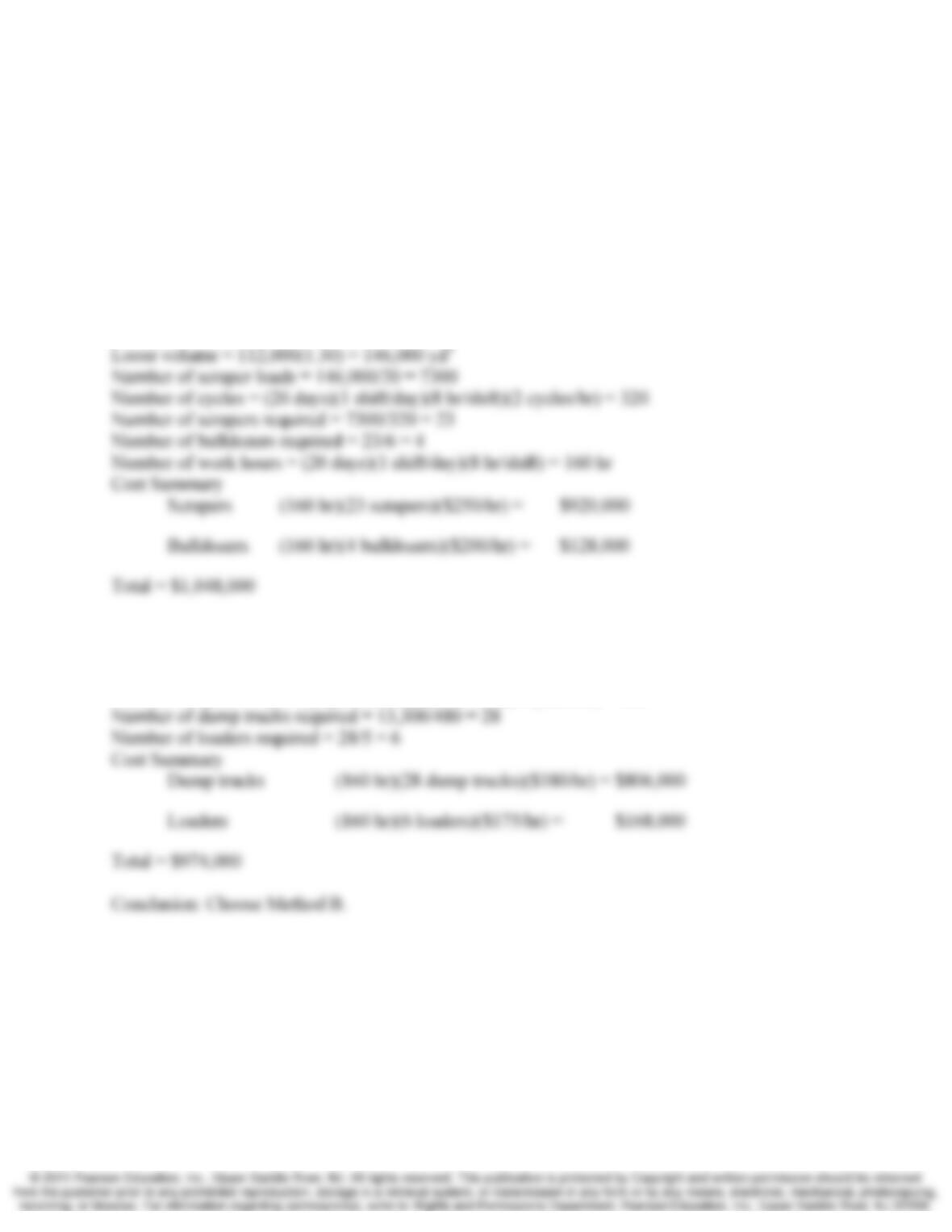
Use model XL37 scrapers, each having a capacity of 20 yd3. These scrapers will
Method B
Use model 98F wheel loaders at the borrow site to load the soil into model 356
dump trucks. Each dump truck has a capacity of 11 yd3, and one loader will be required
to service every five dump trucks. The dump trucks will then haul the soil to the dam site
and deposit it there, which will require a cycle time of 20 min. The labor and equipment
6-22 Excavation, Grading, and Compacted Fill Chap. 6
Determine how many scrapers, bulldozers, loaders, and dump trucks will be
needed to complete the hauling in the required time, then compute the cost of each
method. Based on the computed costs, select the better method for this project.
Note: These hourly rates are not necessarily representative of the actual labor and
equipment costs and are for illustrative purposes only.
Solution
Method A
Cut volume = 100,000(1.12) = 112,000 yd3
Method B
Number of dump truck loads = 146,000/11 = 13,300
Number of cycles = (20 days)(1 shift/day)(8 hr/shift)(3 cycles/hr) = 480
6.34 The proposed grading at a project site will consist of 25,100 m3 of cut and 23,300 m3 of
fill and will be a balanced earthwork job. The cut area has an average moisture content
of 8.3%. The fill will be compacted to an average relative compaction of 93% based on a
maximum dry unit weight of 18.3 kN/m3 and an optimum moisture content of 12.9%
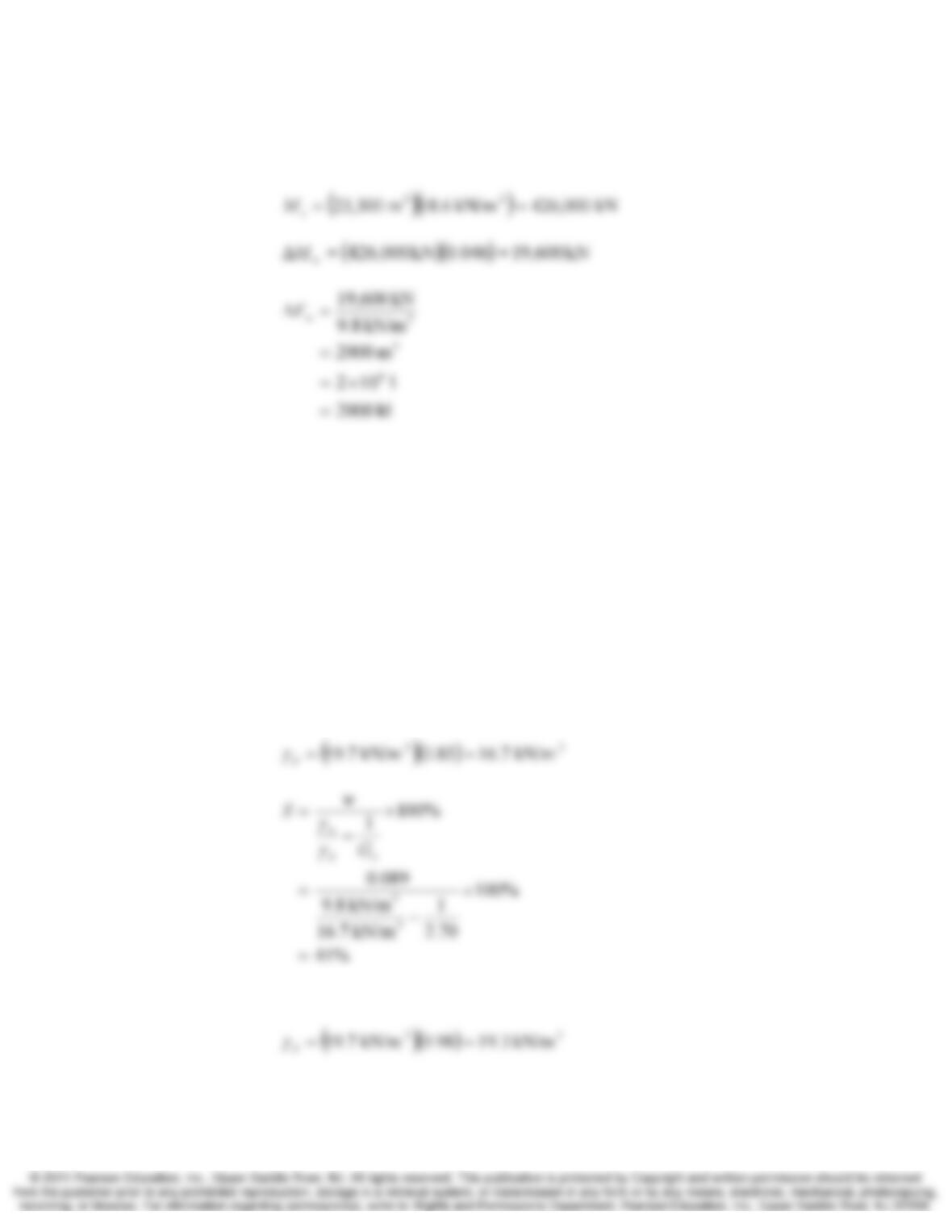
obtained from the modified Proctor test. Compute the volume of water in kiloliters that
will be required to bring these soils to the optimum moisture content.
Chap. 6 Excavation, Grading, and Compacted Fill 6-23
Solution
%6.43.89.12
=
−=Δw
6.35 A well-graded silty sand with a maximum dry unit weight of 19.7 kN/m3 and an optimum
moisture content of 11.0%, obtained from the modified Proctor test, is being used to build
a compacted fill. Two field density tests have been taken in the recently completed fill,
but one of these tests has produced results that are definitely incorrect. Test A indicated a
relative compaction of 85% and a moisture content of 8.9%, while Test B indicated a
relative compaction of 98% and a moisture content of 14.9%. Which test is definitely
incorrect? Why?
Solution
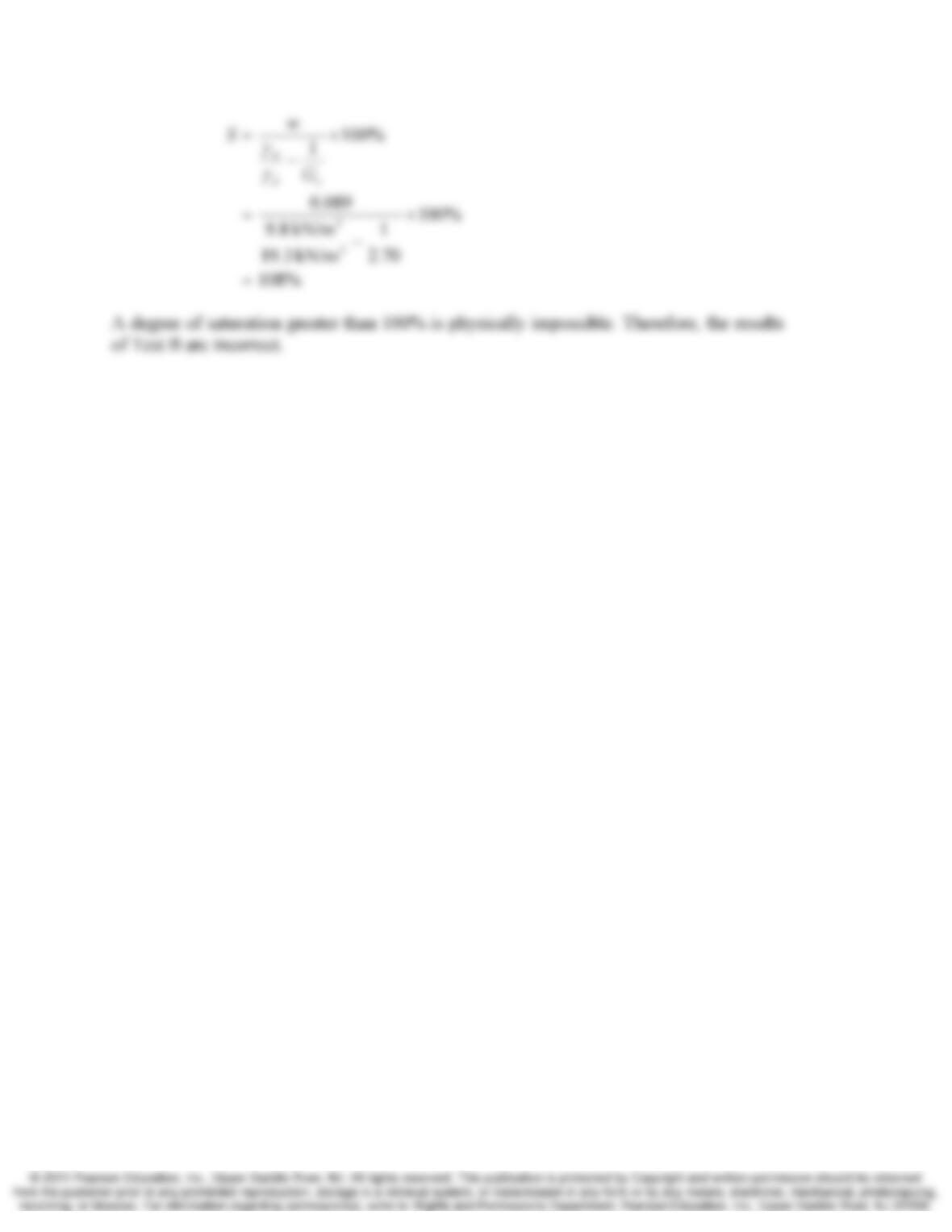
Compute the degree of saturation for each test using an assumed Gs of 2.70 and Equation
4.33:
Test A
Test B
6-24 Excavation, Grading, and Compacted Fill Chap. 6