Introduction to Medical-Surgical Nursing, 6th ed.
56
Lesson Plans for
Psychiatric Disorders
CHAPTER LESSON PLANS & OBJECTIVES
Lesson 56.1:
2. Describe key strategies in communicating therapeutically.
3. Describe the components of the mental status examination.
Lesson 56.2:
4. Identify target symptoms, behaviors, and potential side effects for the following types of medications:
antianxiety (anxiolytic), antipsychotic, and antidepressant drugs.
6. Identify key features of the mental status examination and their relevance in anxiety disorders,
schizophrenia, mood disorders, cognitive disorders, and personality disorders.
7. Identify common nursing diagnoses, goals, and interventions for people with anxiety disorders,
schizophrenia, mood disorders, cognitive disorders, and personality disorders.
CHAPTER TEACHING FOCUS
• In this chapter, students will be introduced to topics related to psychiatric disorders.
• Students will have the opportunity to become acquainted with the nursing assessment of the
psychiatric patient, the mental status examination, and the importance of establishing a therapeutic
relationship.
• In addition, the chapter includes various psychiatric disorders, such as anxiety disorders, somatoform
disorders, dissociative disorders, schizophrenia, mood disorders, cognitive disorders, and personality
disorders.
CONCEPTS
THEME: Emotion
• Concept: Anxiety
• Exemplar: Panic Disorder, p. 1288
• Exemplar: Obsessive Compulsive Disorder, p. 1288
• Exemplar: Posttraumatic Distress Disorder, p. 1288
• Concept: Mood and Affect
• Exemplar: Major Depressive and Bipolar Disorders, p. 1295
• Table 56-5: Drug Therapy: Antidepressant Drugs, p. 1296
• Table 56-6: Drug Therapy: Mood Stabilizers (Antimanic Agents), p. 1297
• Nursing Care Plan: Patient with Major Depression, p. 1299
THEME: Cognitive Function
• Concept: Psychosis

2 Chapter 56 Psychiatric Disorders ____________________________________________________________
Introduction to Medical-Surgical Nursing, 6th ed.
CHAPTER PRETEST
Have the students answer these questions prior to covering this chapter to understand where they stand
in relation to the content.
1) Affect describes a person’s __________.
a) internal conflict and lack of emotion
b) memory of past events as compared to other reliable historians
c) external presentation of a feeling state and emotional responsiveness
d) false ideas not based on reality
2) Which of the following is a characteristic of a therapeutic relationship?
a) Focus is on the personal and emotional needs of both participants.
b) The purpose is to benefit the patient.
c) Relationship develops spontaneously.
d) Has no clear boundaries.
3) A nurse is in a conversation with a patient and another staff member comes in to ask a question. The
nurse tells the staff member that she is busy right now and will talk to the staff member when
finished. This interaction is an example of __________.
a) being available
b) active listening
c) sharing observations
d) clarifying
4) An assessment that includes appearance, mood and affect, thought content, memory, and attention
is a __________ assessment.
a) physical
b) cognitive
c) mental status
d) personality
5) What level of anxiety is considered the optimum level for learning?
a) Mild anxiety
b) Severe anxiety
c) No anxiety
d) Moderate anxiety
6) Soon after witnessing the violent shooting of his son, a patient experiences total blindness. Although
all diagnostic tests are negative, this is an example of __________.
a) an adjustment disorder
b) a conversion disorder
c) dysfunctional grieving
d) a somatization disorder
7) When a person who is very stressed feels outside of himself or herself, or feels as though he or she
is floating overhead and watching what is happening, this is known as __________.
a) hallucination
b) agoraphobia
c) depersonalization
d) dissociation
8) The nurse’s initial approach in caring for a patient with severe depression is to __________.
a) sit with the patient and provide verbal support
b) require the patient to exercise daily
c) encourage the patient to choose his or her own meals
d) provide cheerful activities
9) A patient taking lithium to control her manic episodes is being discharged. What dietary information
would be important to provide the patient?
a) Maintain a table salt–free diet to reduce edema.
b) Do not alter salt intake, which will help prevent lithium toxicity.
c) Do not worry about salt intake; it has no effect on lithium.
d) Maintain a reduced-salt diet, since lithium is a salt.

Introduction to Medical-Surgical Nursing, 6th ed.
10) In the initial care of a patient with schizophrenia who has delusions, the nurse should __________.
a) tell the patient that the delusions are a normal part of the disorder
b) develop trust with the patient
c) encourage the patient to differentiate between the delusions and reality
d) use logic to discourage the delusions
4 Chapter 56 Psychiatric Disorders ____________________________________________________________
Introduction to Medical-Surgical Nursing, 6th ed.
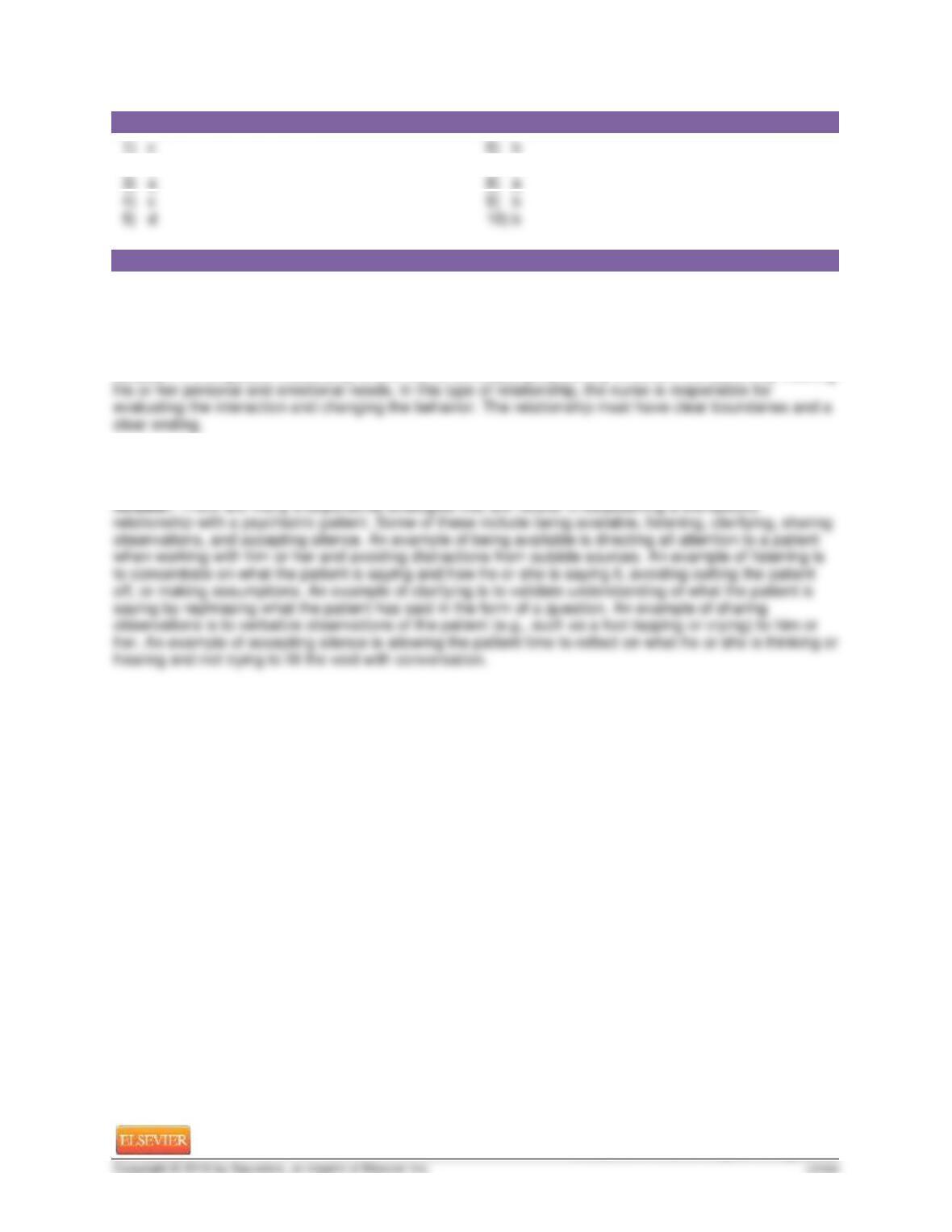
Chapter Pretest Answers
2) b
7) c
CHAPTER BACKGROUND ASSESSMENT
Discuss these questions with your students prior to covering this chapter to understand where they stand
in relation to the content.
Question: What is a therapeutic relationship?
Answer: A therapeutic relationship is one that is developed purposefully to benefit the patient by meeting
Question: What are three interpersonal strategies that are helpful in developing a therapeutic
relationship? Provide an example of each one.
___________________________________________________________ Chapter 56 Psychiatric Disorders 5
Introduction to Medical-Surgical Nursing, 6th ed.
LESSON 56.1
Textbook Objectives Covered
2. Describe key strategies in communicating therapeutically.
3. Describe the components of the mental status examination.
Lesson Preparation Checklist
• Prepare lecture from TEACH lecture slides available on Evolve.
• Student performance evaluation of all entry-level skills required for student comprehension of
principles underlying psychiatric disorders, including:
• Establishing a therapeutic relationship
• Conducting a mental status examination
Materials and Supplies
• computer and PowerPoint
projector
Key Terms
• interpersonal approach
(p. 1284)
• biologic approach (p. 1283)
• denial (p. 1284)
• depersonalization (p. 1289)
• Parkinsonian syndrome
(p. 1292)
• projection (p. 1284)
• repression (p. 1284)
• schizoaffective disorder (p.
1295
Student Preparation
Assignments 2 hours
1
READ – Textbook (pp. 1283-1284)
REVIEW
• Table 56-1: Therapeutic Relationships Versus Social Relationships (p. 1284)
ANSWER – Study Guide
• Part IA: 3, 5-7 (p. 383)
2
READ – Textbook (pp. 1284-1285)
ANSWER – Textbook
• Review Questions for the NCLEX Examination: 2, 3 (p. 1303)
6 Chapter 56 Psychiatric Disorders ____________________________________________________________
Introduction to Medical-Surgical Nursing, 6th ed.
LESSON 56.1
3
READ – Textbook (pp. 1285-1287)
REVIEW
• Table 56-2: Components of the Mental Status Examination (p. 1285)
ANSWER – Textbook
Review Questions for the NCLEX Examination: 4 (p. 1303)
ANSWER – Study Guide
SIMCHART
• Case Study: Casey Hernandez: Bipolar Disorder
• Case Study: Casey Hernandez: Bipolar Disorder, Medication Compliance
50-Minute Lesson Plan
Lecture Outline 20 minutes
Slide 1
Chapter 56
Psychiatric Disorders
1
Slide 2
Mental Health and Mental Illness
• Early cultures believed supernatural forces caused mental illnesses
• Mental illnesses now treated in variety of treatment settings
Slide 3
Theoretic Approaches
• Biologic approach
• Psychoanalytic approach
• Interpersonal approach
• Cognitive-behavioral approach
2
Being Available
• When working with a patient, direct your attention completely toward that person
___________________________________________________________ Chapter 56 Psychiatric Disorders 7
Introduction to Medical-Surgical Nursing, 6th ed.
LESSON 56.1
Slide 5
Listening
• Concentrate on what patient is saying; try to hear how he/she experiences and describes
his/her life
• When listening therapeutically, avoid cutting the patient off or jumping to conclusions
• Get essence of how patient perceives his/her situation, experiences certain symptoms,
and describes circumstances
TALKING POINTS:
• To listen well, you must be aware of your own thoughts and feelings.
• Why are your feelings an important source of data for you?
Slide 6
Clarifying
• One way of validating that you understand what the patient is saying
• Asking questions may also help patients clarify their thoughts
Slide 7
• Patients benefit from knowing what you see and hear while listening
Sharing Observations
Slide 8
Accepting Silence
• Sometimes therapeutic to allow moments of silence between you and the patient
• Important that you feel comfortable with silence because silence enables patients to
consider their own thoughts as well as what you are communicating to them
• Silences allow patients to sort through their feelings and organize their thinking
3
Slide 9
Psychiatric History
• Ask patient to tell you what has been happening recently that has caused him/her to seek
treatment
• Inquire about past psychiatric history
TALKING POINTS:
• What does the mental status examination consist of?
• Nursing diagnoses commonly identified in persons with major psychiatric disorders are
derived from the health assessment.
Appearance
• Appearance in relation to stated age
8 Chapter 56 Psychiatric Disorders ____________________________________________________________
LESSON 56.1
Slide 11
Mood and Affect
• Mood
• A sustained feeling state or emotion that a person experiences in several aspects of
life
• Assessed by intensity, depth, duration, and fluctuation
• Words that describe mood: irritable, anxious, depressed, euphoric, labile (up and
down), and despairing
Mood and Affect (cont.)
• Affect
• External presentation of a feeling state and emotional responsiveness
TALKING POINTS:
• What is an example of affect being considered incongruent with mood?
• The intensity of feelings may be increased or decreased (diminished).
• Feelings also may be stable or consistent rather than labile or rapidly changing.
Slide 13
Speech and Language
• Speech is normal rate, rhythm, volume
• Unusual findings include mutism (not speaking), long pauses before responding, minimal
or very little speech (paucity), and pressured speech (loud and insistent)
• Clues to problems of thought evidenced in a person’s speech (see following section)
Slide 14
Thought Content
• Tangential speech
• Patient starts toward a particular point but veers away
• Commonly an indicator of disorganized thinking
• Thought blocking
• Person stops speaking before reaching the point
• Loose associations
• Continual shifting from topic to topic—and shifting between topics to the point of
incoherence (“word salad”)
Slide 15
Thought Content (cont.)
• Obsessions—repetitious, unwanted thoughts
• Compulsions—actions repeatedly carried out in a specific manner; typically include
washing, counting, or checking
TALKING POINTS:
• This area must be assessed with clear and direct questions.
• Further assessment includes determining whether the patient has constructed any plans
to hurt himself or herself.
• If a patient endorses suicidal ideations, what other questions should be asked?
___________________________________________________________ Chapter 56 Psychiatric Disorders 9
Introduction to Medical-Surgical Nursing, 6th ed.
LESSON 56.1
Slide 16
Perceptual Disturbances
• Involve any of the senses such as vision, hearing, taste, touch, and smell
• Illusion
• Specific stimulus, such as a spot on the wall, misinterpreted
• Hallucination
Slide 17
Insight and Judgment
• Insight
• The ability to understand the correct cause or meaning of a situation
• Judgment
• The ability to assess a situation accurately and determine appropriate course of action
• Insight and judgment are often considered in relation to suicide potential
Sensorium
• Orientation in terms of time, place, person, and self
Slide 19
Memory and Attention
• Assessed by comparing patient’s memory of past events with what is recalled by other
reliable historians
• A quick way to determine recent memory is to ask what was eaten at the previous meal
Slide 20
General Intellectual Level
• Estimated by determining the patient’s vocabulary and knowledge of current events
• Ask patient to name the president of the United States and the name of the previous
president
Suicide Risk Assessment
• Ask if patient has had or is currently having thoughts about suicide
Introduction to Medical-Surgical Nursing, 6th ed.
Slide 22
Question 1
• The approach is based on the theory that (1) humans function at different levels of
awareness, ranging from conscious to unconscious; and (2) people use ego defense
mechanisms to prevent or minimize anxiety.
A. Biologic
B. Cognitive-behavioral
C. Interpersonal
D. Psychoanalytic
TALKING POINTS:
Slide 23
Question 2
• A range of interpersonal strategies that have been found helpful in promoting the patient’s
level of comfort with the nurse include all of the following except ________.
A. accepting silence
B. clarifying
C. sharing observations
D. socialization
___________________________________________________________ Chapter 56 Psychiatric Disorders 11
Introduction to Medical-Surgical Nursing, 6th ed.
LESSON 56.1
Activities
Classroom Choose from below to make 30 minutes
Online
1
ASSESS BASELINE
• Have the class complete the Pretest. Collect
their work and use the results to guide how
you teach the class.
DISCUSS
• Discuss the biologic, psychoanalytic,
interpersonal, and cognitive-behavioral
theories.
• Discuss the differences between social
relationships and therapeutic relationships.
PRACTICE
• Divide the class into small groups. Have
ASSESS BASELINE
• Post the Pretest and the Background
Assessment online and have your class
complete them. Use the results to guide how
you teach the class.
POST AND COMMENT
• Post the following discussion topic online
and have students comment. Provide at
least three examples of communication in a
social relationship, and compare that with a
nurse and patient in a therapeutic
relationship. Ask students to provide
constructive comments on each other’s
2
DISCUSS
• Discuss interpersonal strategies that are
helpful in promoting patient comfort with the
nurse, including being available, listening,
PRACTICE
• Divide the class into pairs or small groups.
Have each group review the strategies for
effective therapeutic communication (being
available, listening, clarifying, sharing
observations, accepting silence). Have each
POST AND COMMENT
• Post the following discussion topic online
and have students comment. Ask students
to prepare and post a video of a nurse and
techniques being used by the nurse.

12 Chapter 56 Psychiatric Disorders ____________________________________________________________
Introduction to Medical-Surgical Nursing, 6th ed.
LESSON 56.1
3
DISCUSS
• Discuss the nursing assessment of a
psychiatric patient.
• Discuss the components of the mental
status examination.
PRACTICE
• Divide the class into groups. Assign each
group a component of a mental status
examination from Table 56-2. Ask each
group to discuss the component and what
POST AND COMMENT
• Post the following discussion topic online
and have students comment. Discuss how
you would conduct a mental status
examination on a patient who displays
reluctance to talk, has minimal eye contact,
and frequently tears up during the
examination.
• Post the following discussion topic online
and have students comment. Ask students
to remember their first physical assessment
Critical Thinking Question
A 36-year-old man is admitted to the mental health unit with a diagnosis of major
depression. The nurse is interacting with him for the first time to complete an assessment.
What are some observations that would be important to make in assessing this patient’s
mental status? What might the nurse expect from a patient who is experiencing major
depression?
Discussion Guidelines: One of the most important aspects in completing an initial psychiatric
assessment is the patient’s mental status. This is accomplished by observing the patient in areas of
Instructor Notes/Student Feedback
___________________________________________________________ Chapter 56 Psychiatric Disorders 13
Introduction to Medical-Surgical Nursing, 6th ed.
LESSON 56.2
Instructor Preparation
Textbook Objectives Covered
5. Summarize current thinking about the cause of schizophrenia and the mood disorders.
7. Identify common nursing diagnoses, goals, and interventions for people with anxiety disorders,
schizophrenia, mood disorders, cognitive disorders, and personality disorders.
Lesson Preparation Checklist
• Prepare lecture from TEACH lecture slides available on Evolve.
• Guest speakers: psychiatric nurse, psychiatrist who administers electroconvulsive therapy
treatments
• Student performance evaluation of all entry-level skills required for student comprehension of
principles underlying psychiatric disorders, including:
• Establishing a therapeutic relationship
Materials and Supplies
• computer and PowerPoint
projector
• drug reference
Key Terms
• biologic approach (p. 1283)
• Parkinsonian syndrome
(p. 1292)
• repression (p. 1284)
14 Chapter 56 Psychiatric Disorders ____________________________________________________________
LESSON 56.2
Student Preparation
Assignments 2 hours
4
READ – Textbook (pp. 1290-1300)
REVIEW
• Table 56-3: Common Anxiolytic Agents (p. 1290 )
• Table 56-4: Drug Therapy: Selected Antipsychotic (Neuroleptic) Agents (p. 1293)
• Table 56-5: Drug Therapy: Antidepressant Drugs (p. 1296)
• Table 56-6: Drug Therapy: Mood Stabilizers (p. 1297)
ANSWER – Textbook
ANSWER – Study Guide
• Part IA: 1, 8, 9 (pp. 383-384)
• Part IE: 1-8 (p. 385)
• Part IIF: 7, 8, 11, 26, 31 (pp. 386-388)
5
READ – Textbook (pp. 1287-1302)
ANSWER – Study Guide
• Part IIF: 18, 22, 24, 25 (p. 387)
6
• Part IB: 1-18 (p. 384)
READ – Textbook (pp. 1287-1302)
ANSWER – Textbook
• Review Questions for the NCLEX Examination: 5, 6, 9 (p. 1304)
•
ANSWER – Study Guide
7
READ – Textbook (pp. 1287-1302)
REVIEW
• Nursing Care Plan 56-1: Patient with Major Depression (p. 1299)
ANSWER – Textbook
• Review Questions for the NCLEX Examination: 1, 7 (pp. 1303-1304)
ANSWER – Study Guide
• Part IIF: 9, 12, 13, 15-17, 32 (pp. 386-388)