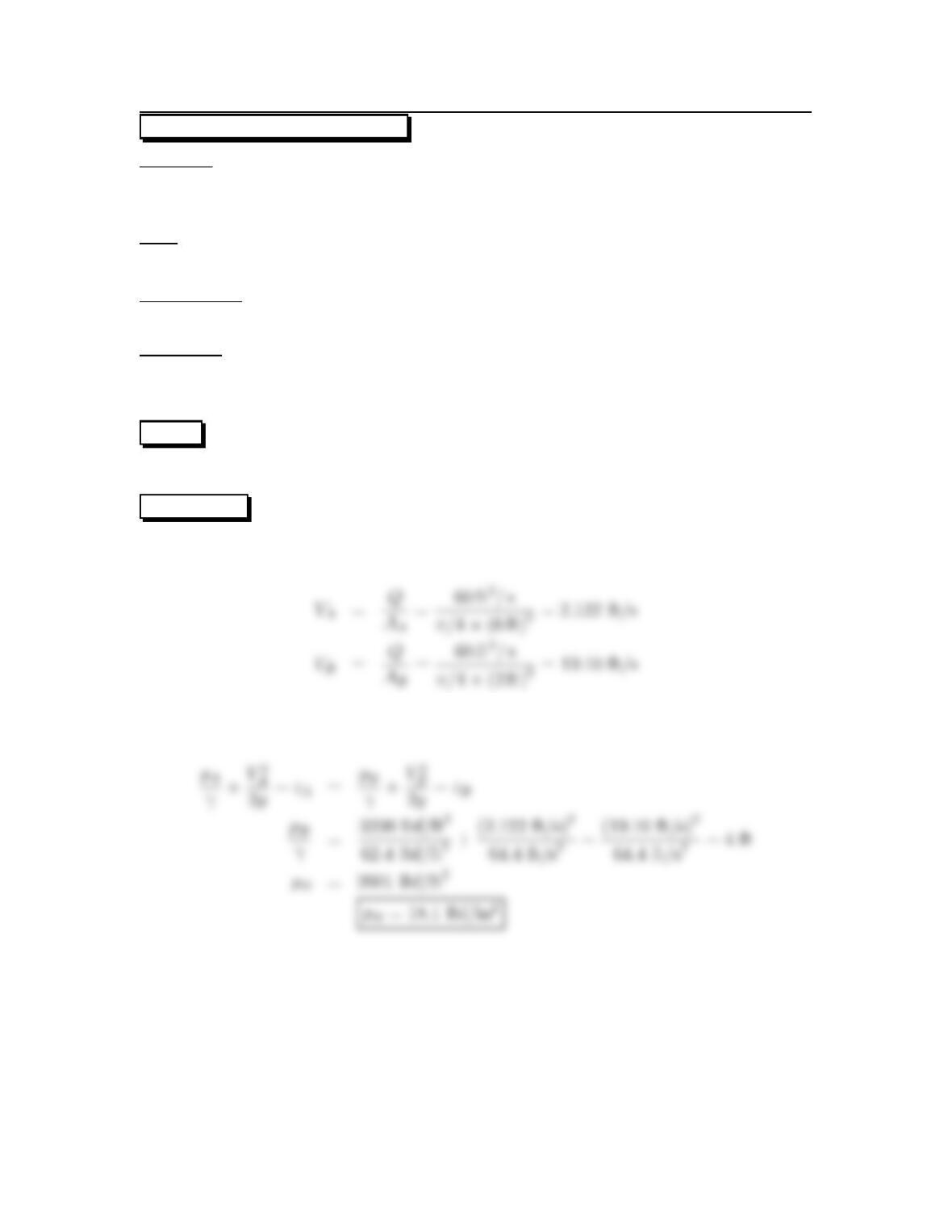
5.94: PROBLEM DEFINITION
Situation:
Water flows in a pipe with a contraction.
Q=60ft
3/s,d=2ft,D=6ft.
Find:
Pressure at point B.
Assumptions:
Water temperature is 50 ◦F.
Properties:
Water (50 ◦F),Table A.5: γ=62.4lbf/ft3.
pA=3200psf.
PLAN
Apply the Bernoulli equation and the continuity equation.
SOLUTION
Continuity equation
The Bernoulli equation
101
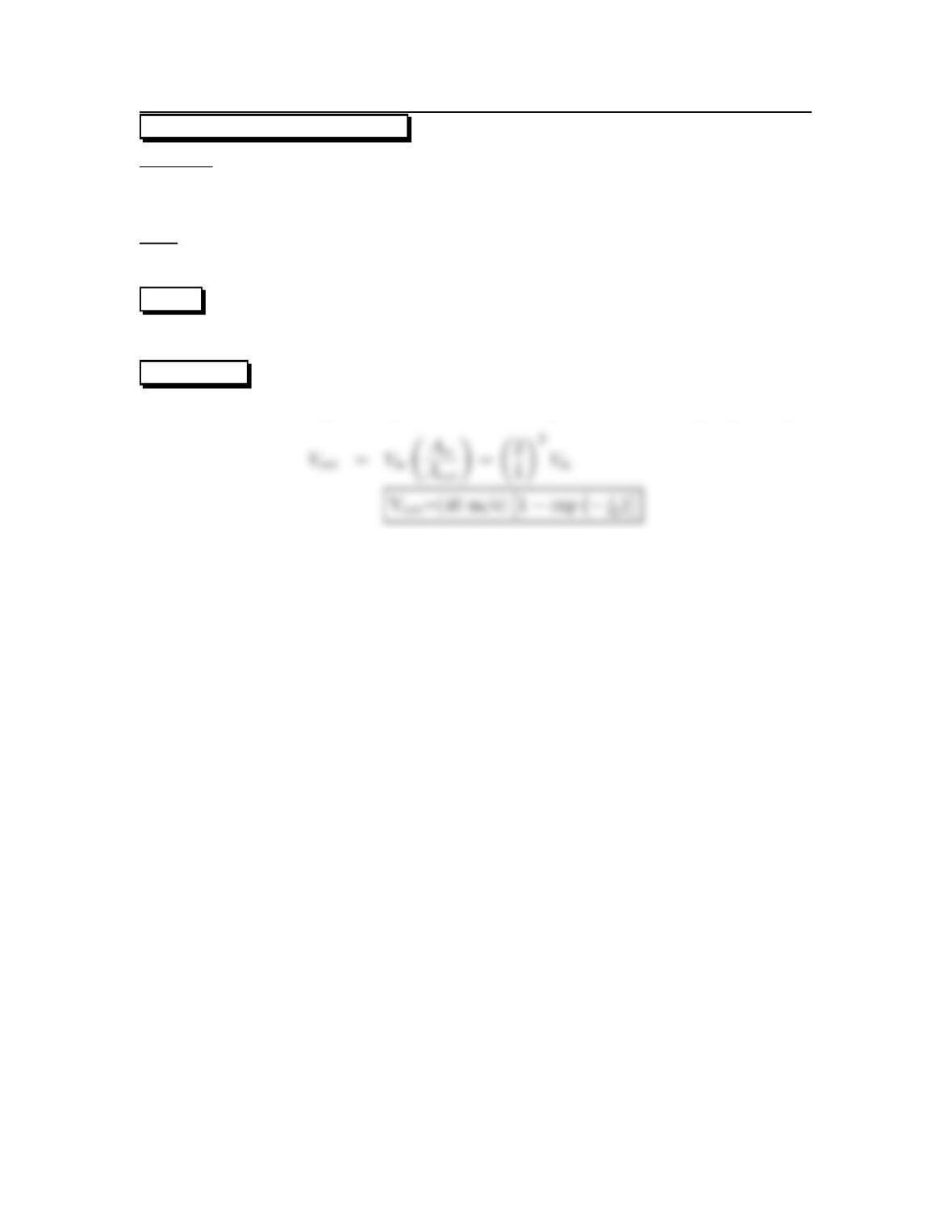
5.95: PROBLEM DEFINITION
Situation:
Water flows through a contraction section of circular pipe.
Vin =(10m/s)[1−exp(−t/10)],Di=2Do.
Find:
Velocity variation at outlet.
PLAN
Apply the continuity equation.
SOLUTION
Because water is incompressible, there is no unsteady term in continuity equation, so
102
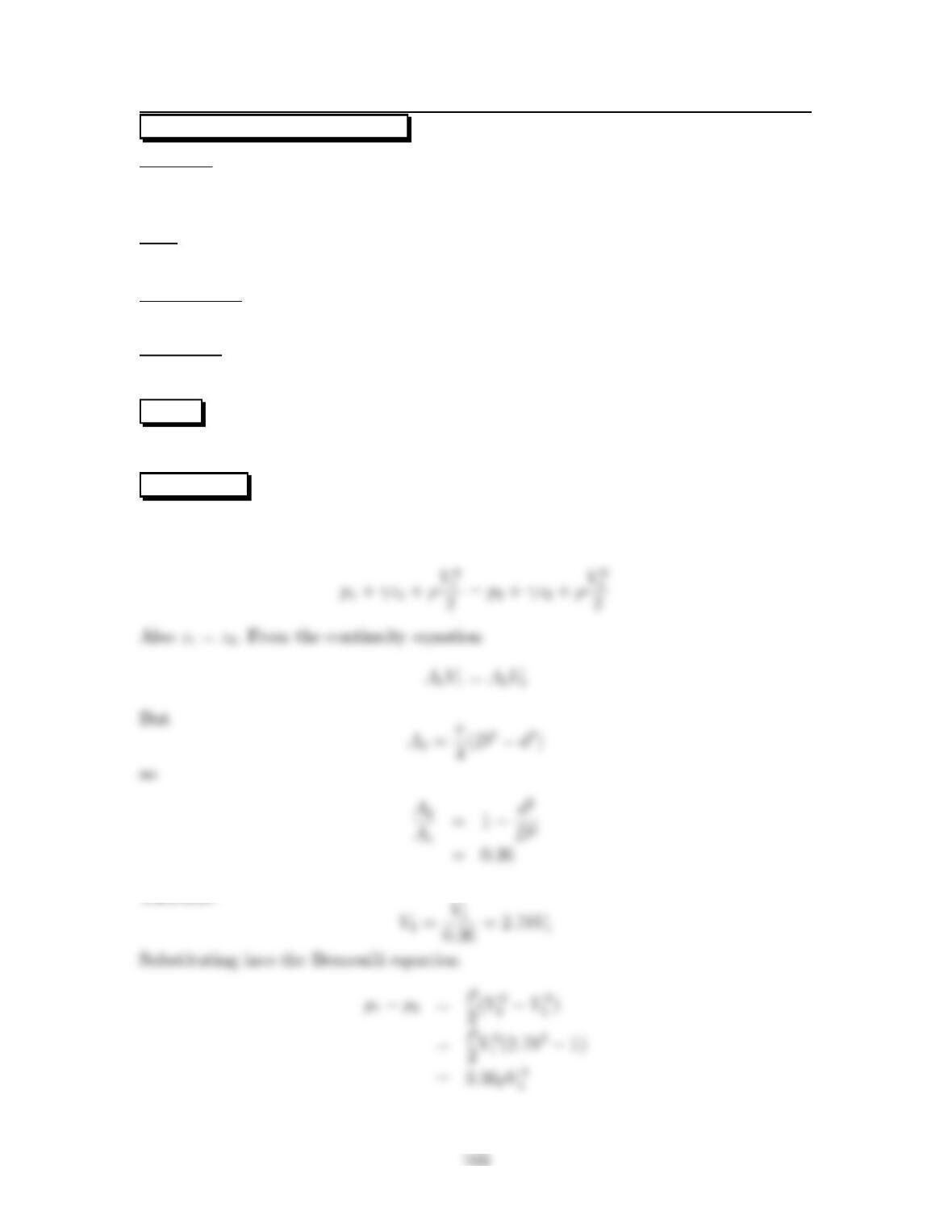
5.96: PROBLEM DEFINITION
Situation:
An annular venturimeter is mounted in a pipe with air flow at standard conditions.
D=6in=0.5ft,d=0.8D.
Find:
Find the volume flow rate
Assumptions:
Flow is incompressible, inviscid, steady and velocity is uniformly distributed.
Properties:
∆p=2inH2O,ρ=0.00237 slug/ft3.
PLAN
Apply the Bernoulli equation.
SOLUTION
Take point 1 as upstream in pipe and point 2 in annular section. The flow is incom-
pressible, steady and inviscid so the Bernoulli equation applies
Therefore
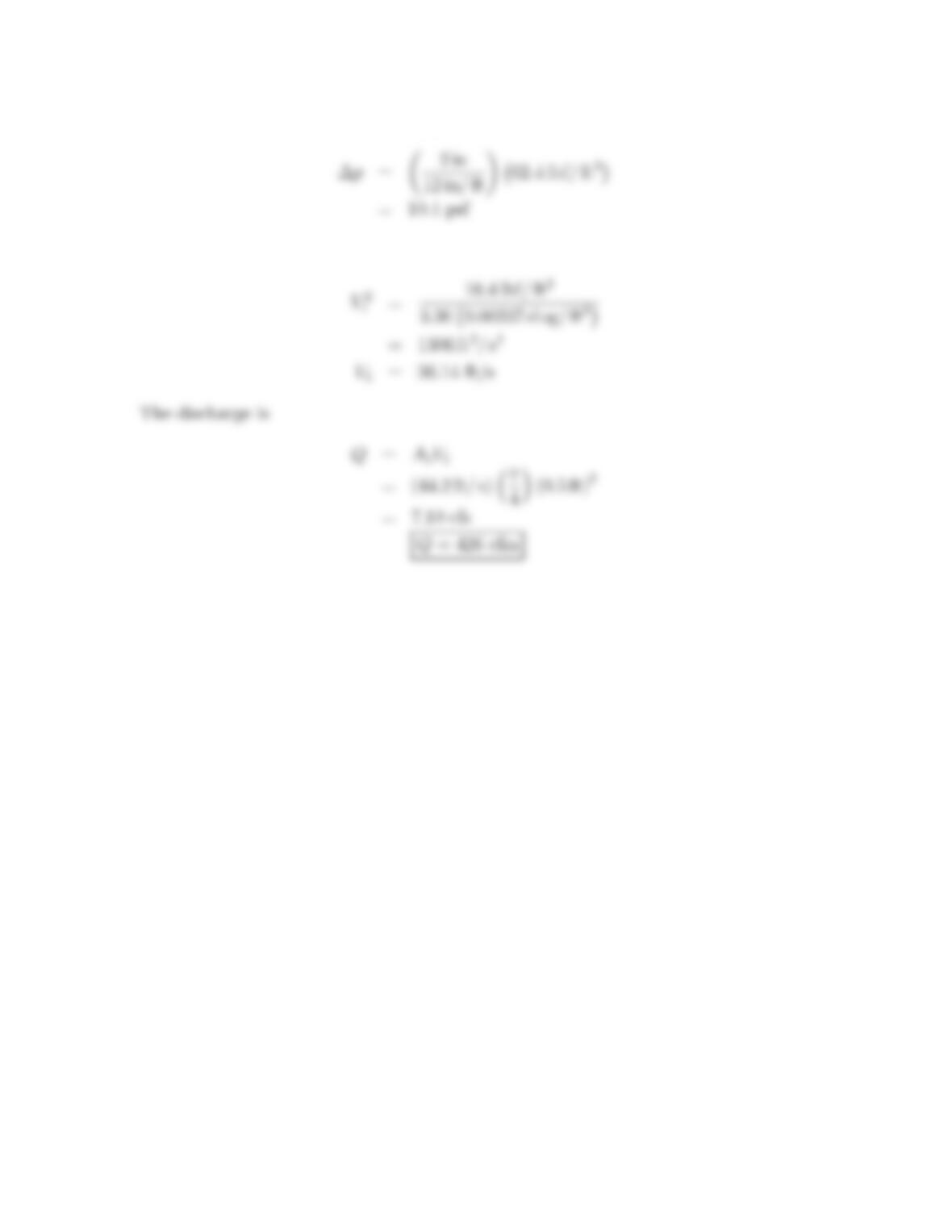
The standard density is 0.00237 slug/ft3and the pressure difference is
Solving for V1
104
5.97: PROBLEM DEFINITION
Situation:
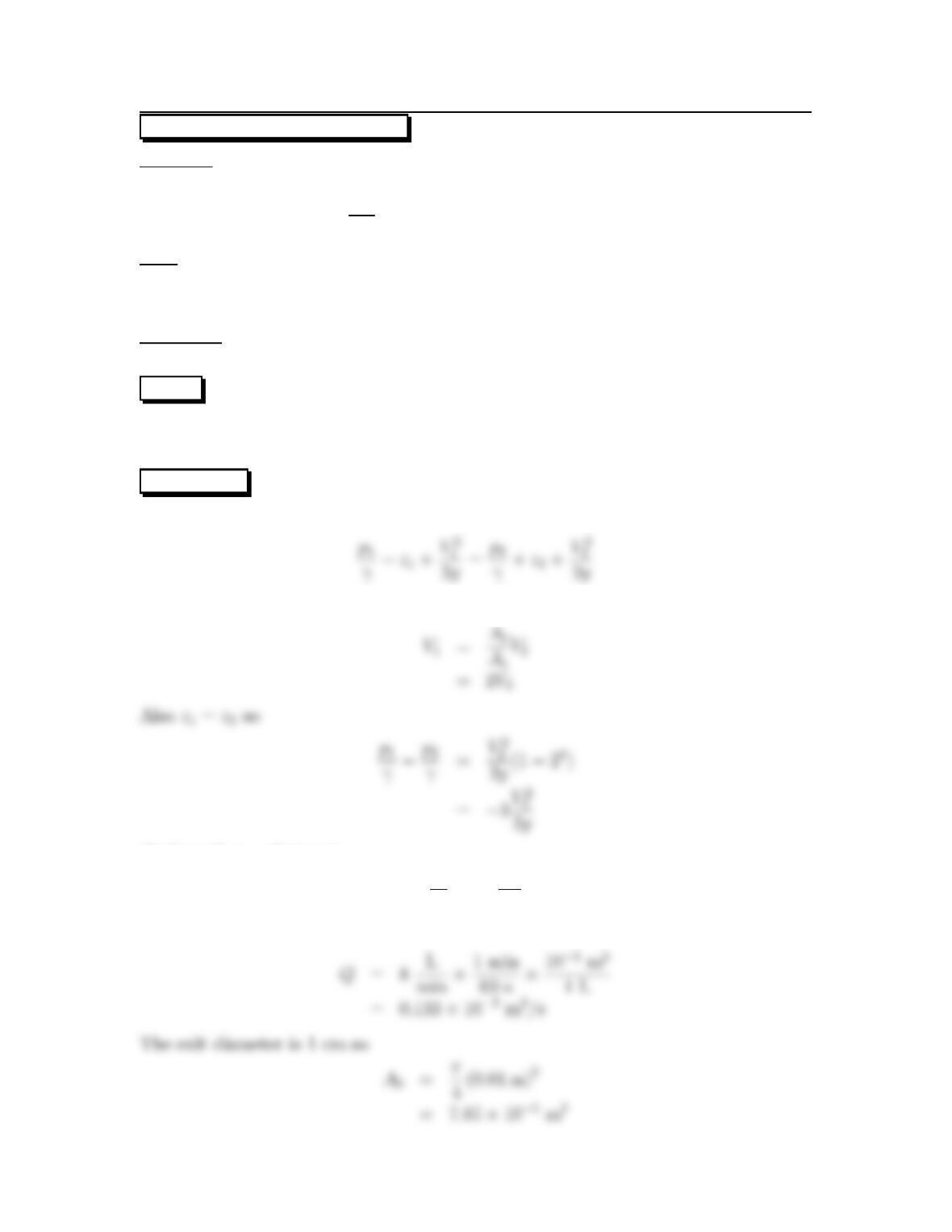
A venturi-type applicator is used to spray liquid fertilizer.
D2=1cm,A2/A1=2,Q=8L/min.
z3=−0.1m,Ql=0.5√∆h.
Find:
The flow rate of liquid fertilizer.
The mixture ratio of fertilizer to water at exit.
Properties:
T=20◦C.
PLAN
Use the continuity and Bernoulli equation to find the pressure at the throat and use
this pressure to find the difference in piezometric head and flow rate.
SOLUTION
The Bernoulli equation is applicable between stations 1 (the throat) and 2 (the exit).
From the continuity equation
At the exit p2=0(gage)
p1
γ=−3V2
2
2g
The flow rate is 8 L/min or
105
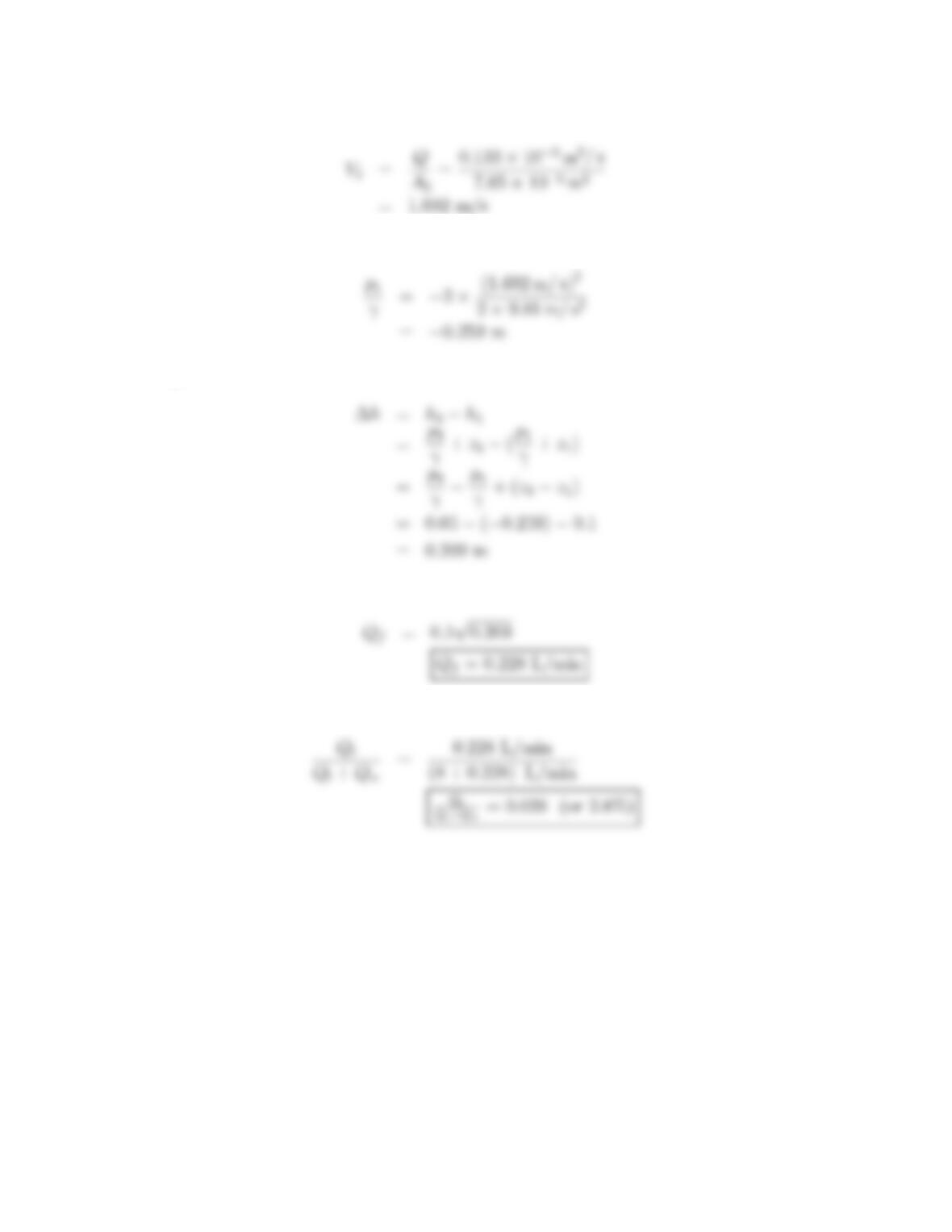
The exit velocity is
Therefore
Let point 3 be the entrance to the feed tube. Then
a) The flow rate in the feed tube is
b) Concentration in the mixture
106
5.98: PROBLEM DEFINITION
Situation:
Air flows upward in a vertical venturi.
V1=80ft/s,A2/A1=0.5.
Find:
Deflection of manometer.
Assumptions:
Uniform air density.
Properties:
ρ=0.0644 lb/ft3,γ=120lbf/ft3.
PLAN
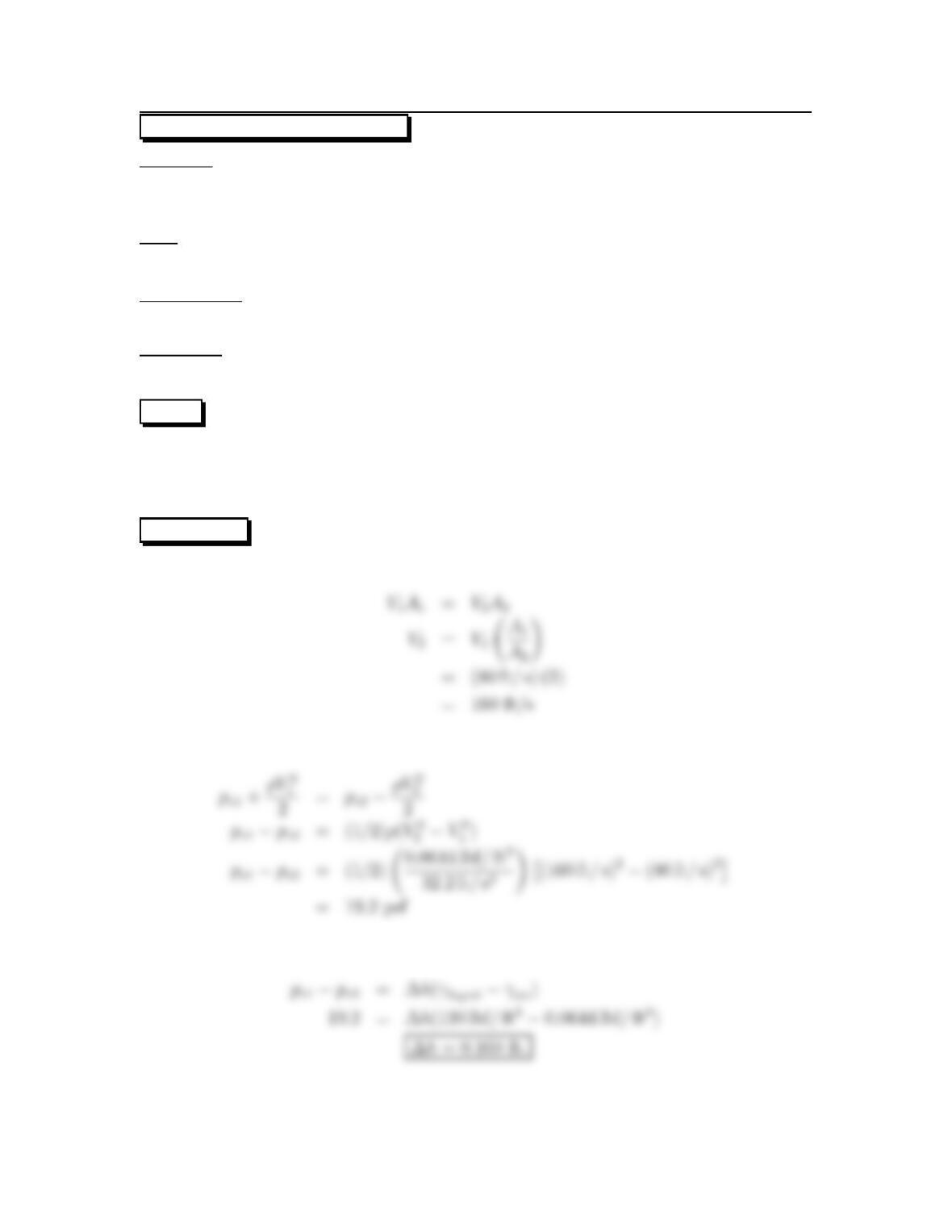
Apply the Bernoulli equation from 1 to 2 and then the continuity equation. Let
section 1 be in the large duct where the manometer pipe is connected and section 2
in the smaller duct at the level where the upper manometer pipe is connected.
SOLUTION
Continuity equation
Bernoulli equation
Manometer equation
107
5.99: PROBLEM DEFINITION
Situation:
An atomizer utilizing a constriction in an air duct.
Find:
Design an operable atomizer.
SOLUTION
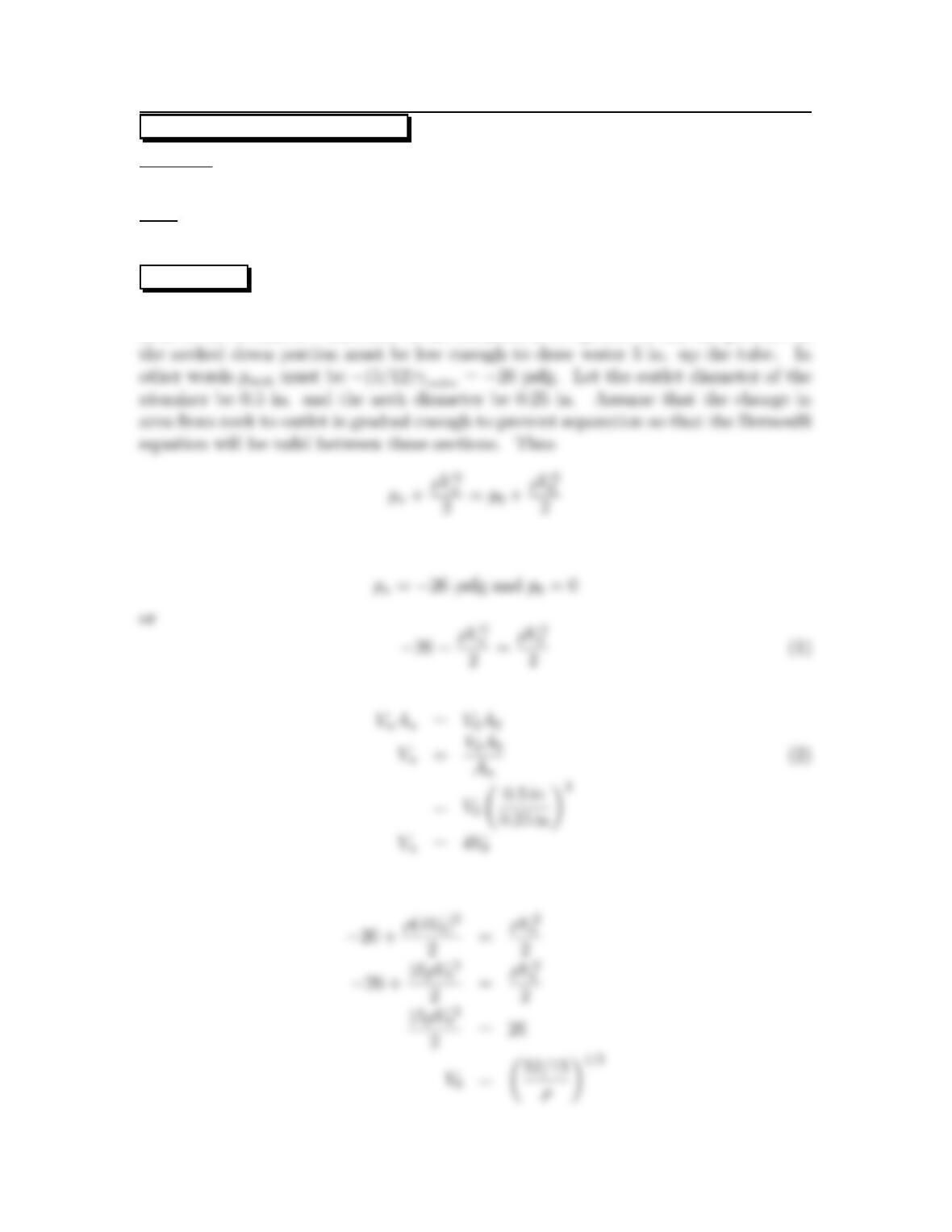
Assume the bottom of the tube through which water will be drawn is 5 in. below the
neck of the atomizer. Therefore if the atomizer is to operate at all, the pressure in
were nand 0 refer to the neck and outlet sections respectively. But
Eliminate Vnbetween Eqs. (1) and (2)
108
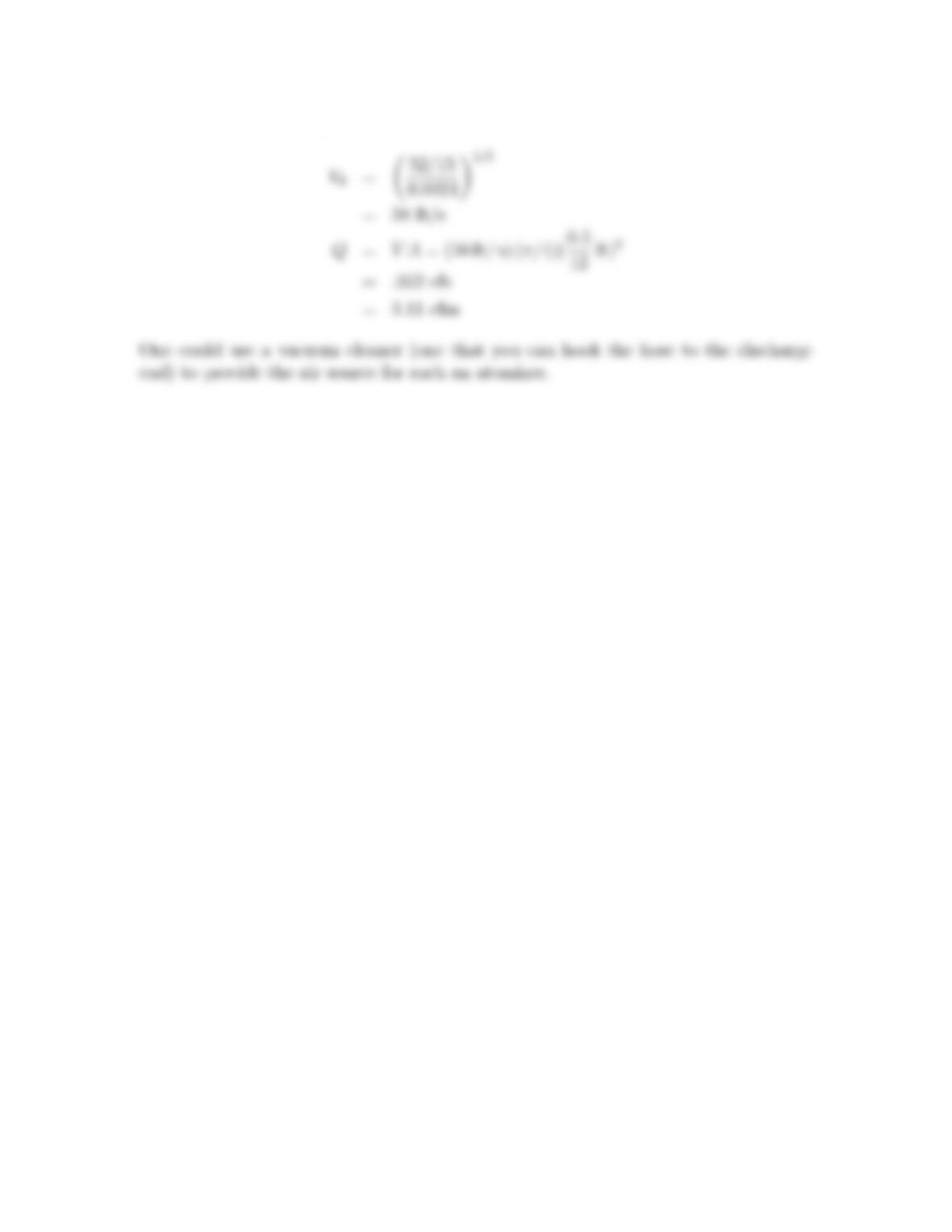
Assume ρ=0.0024 slugs/ft2
109
5.100: PROBLEM DEFINITION
Situation:
A suction device based on a venturi lifts objects submerged in water.
Ae=10
−3m2,At=0.25Ae,As=0.1m
2.
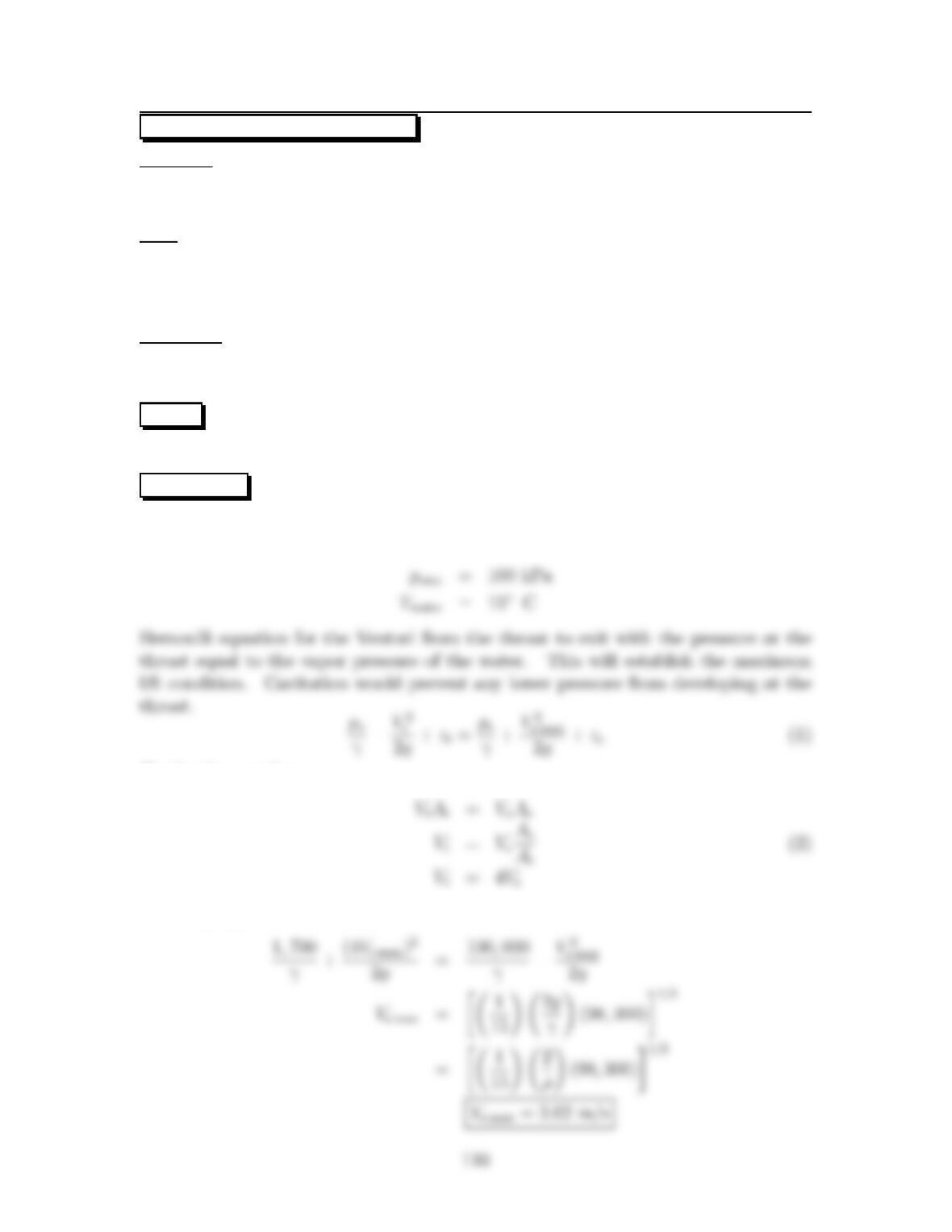
Find:
(a) Velocity of water at exit for maximum lift.
(b) Discharge.
(c) Maximum load supportable by suction cup.
Properties:
Water (15 ◦C) Table A.5: pv=1,700 Pa,ρ=999 kg/m3.
patm =100kPa.
PLAN
Apply the Bernoulli equation and the continuity equation.
SOLUTION
Venturi exit area, Ae=10
−3m2,Venturi throat area, At=(1/4)Ae,Suction cup
area, As=0.1m2
Continuity equation
Then Eq. (1) can be written as
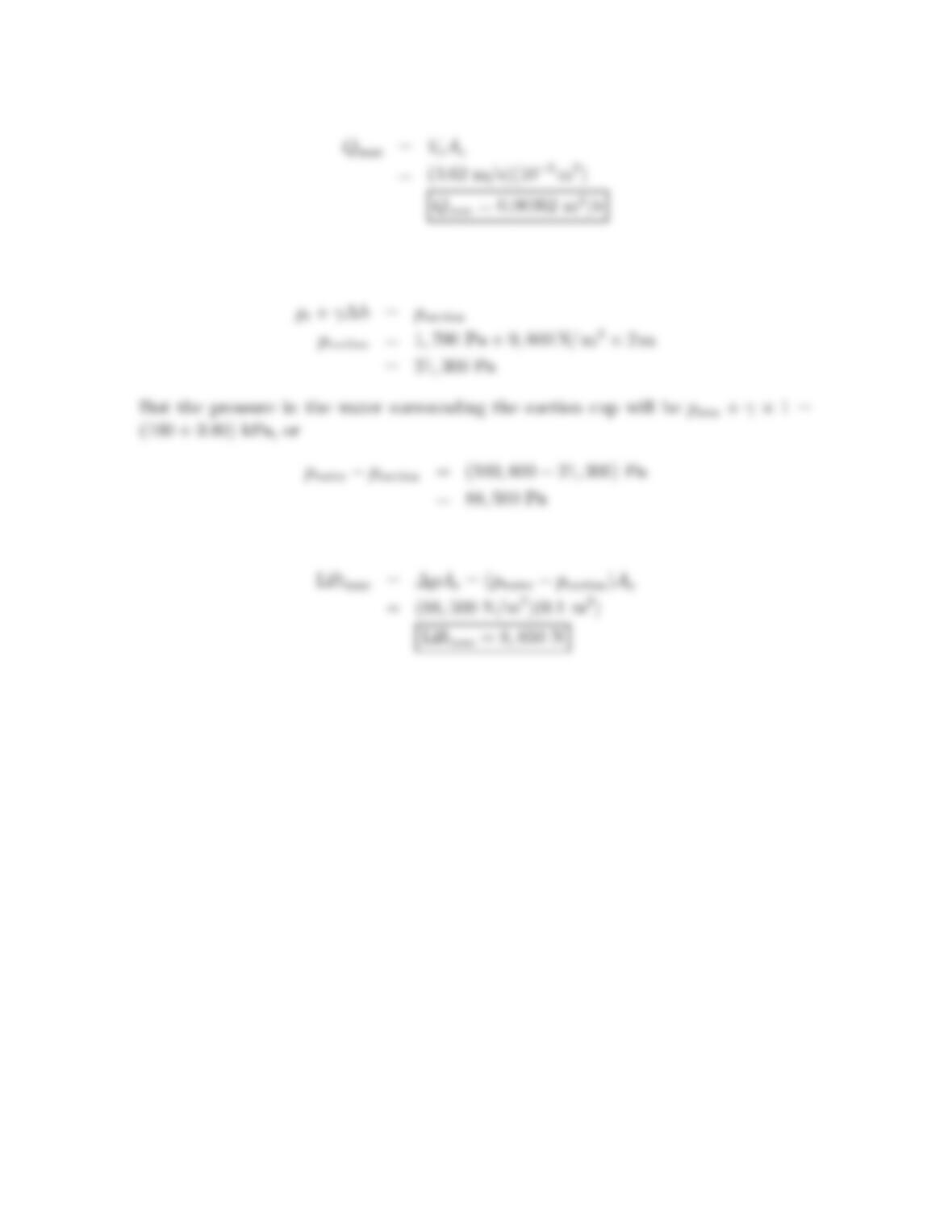
Find pressure in the suction cup at the level of the suction cup.
Thus the maximum lift will be:
111
5.101: PROBLEM DEFINITION
Situation:
A hovercraft is supported by air pressure.
l=15ft,w=7ft,W=2000lbf,
Find:
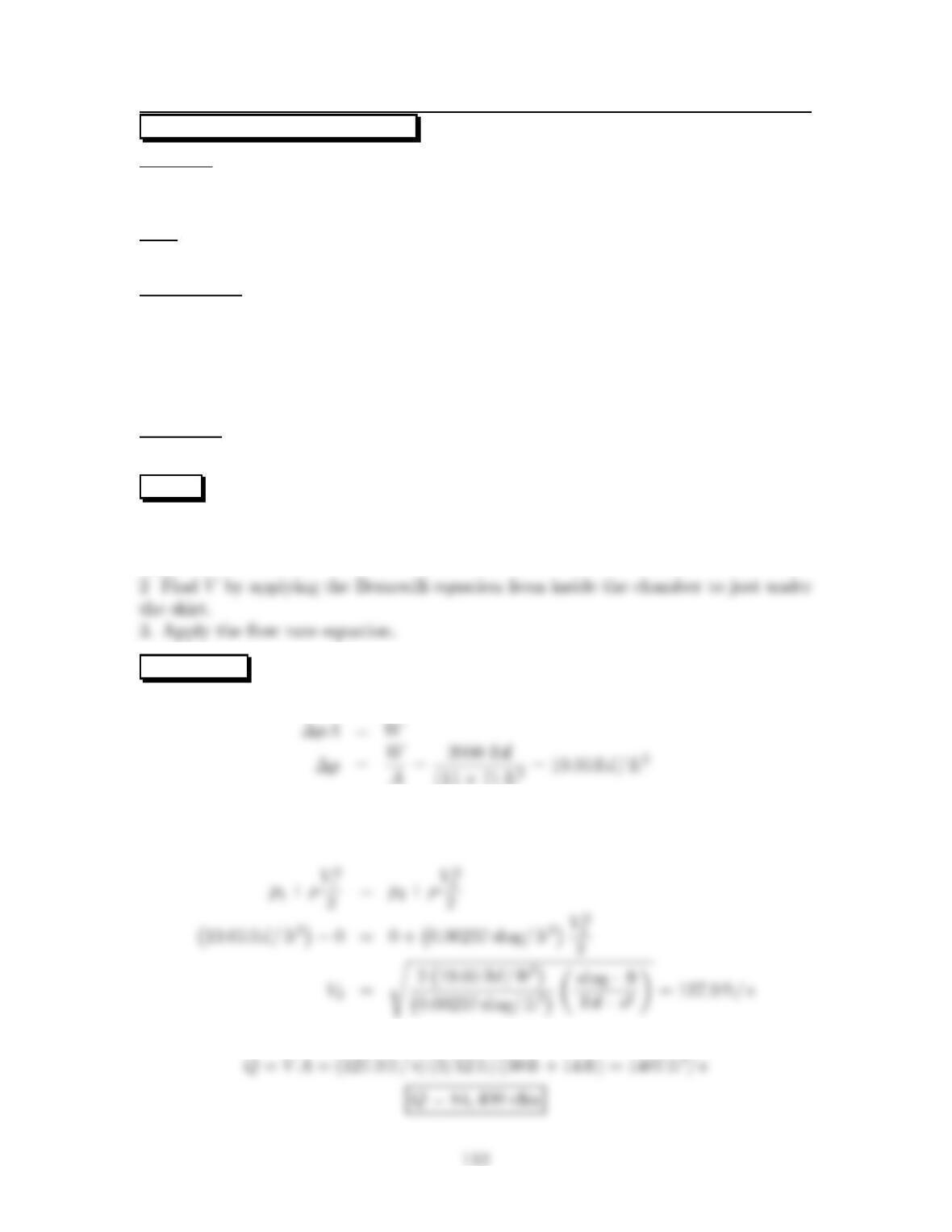
Air flow rate necessary to support the hovercraft.
Assumptions:
Air is incompressible.
Steady flow.
Viscous effects are negligible.
Air in the chamber is at stagnation conditions (V=0,p=uniform)
Just under the skirt p=patm
Properties:
Air (T=60◦F,p=1atm),ρ=0.00237 slug/ft3,Table A.3.
PLAN
Because flow rate is the goal, apply Q=VA.The steps are:
1. Find the pressure in the chamber by apply force equilibrium in the vertical direc-
tion.
SOLUTION
1. Force equilibrium (vertical direction)
2. Bernoulli equation (elevations terms are neglected; point 1 is in the chamber; point
2 is underneath the skirt)
3. Flow rate equation
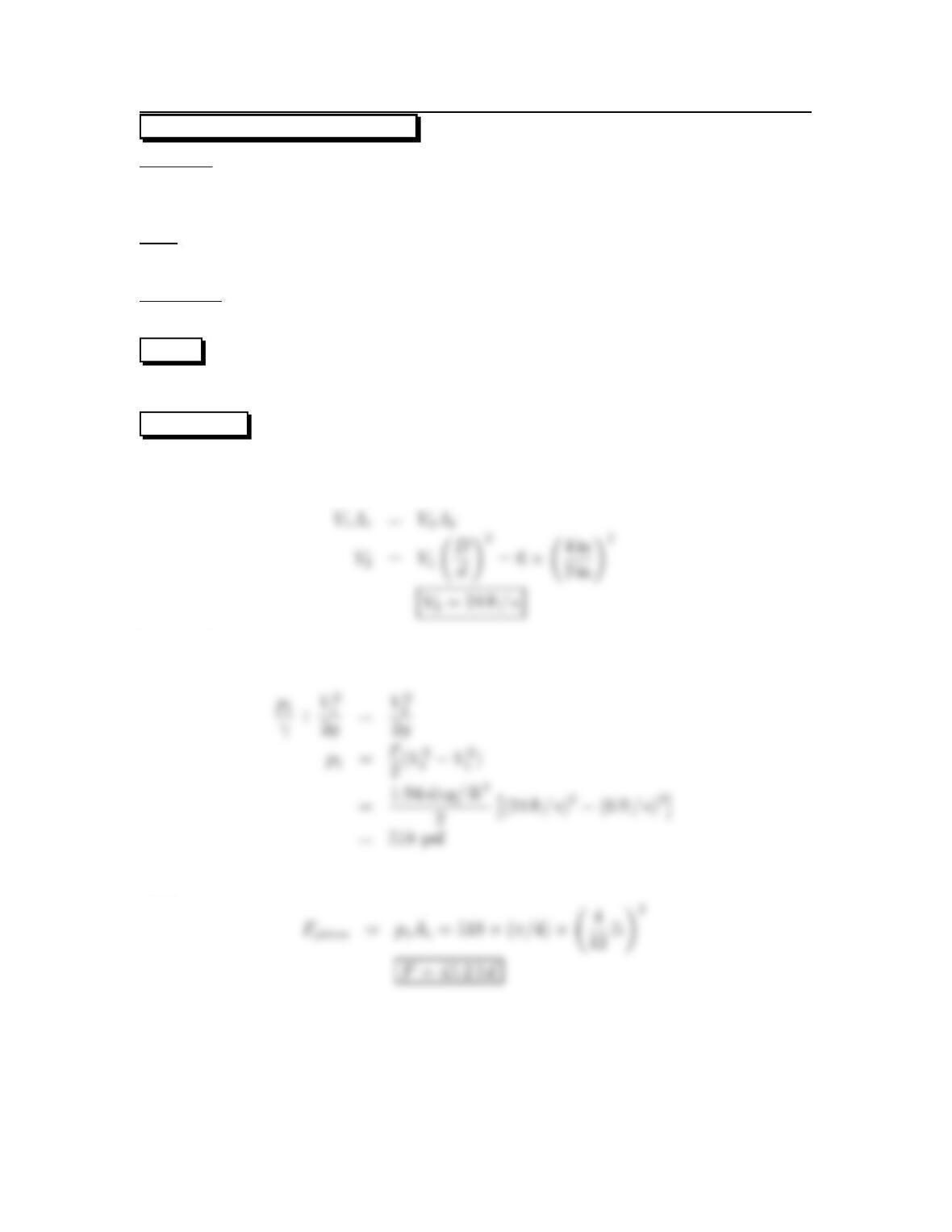
5.102: PROBLEM DEFINITION
Situation:
Water forced out of a cylinder by a piston.
d=2in,D=4in,V=6ft/s.
Find:
Efflux velocity and force required to drive piston.
Properties:
T=60◦F.
PLAN
Apply the Bernoulli equation and the continuity equation.
SOLUTION
Continuity equation
Bernoulli equation
Then
113