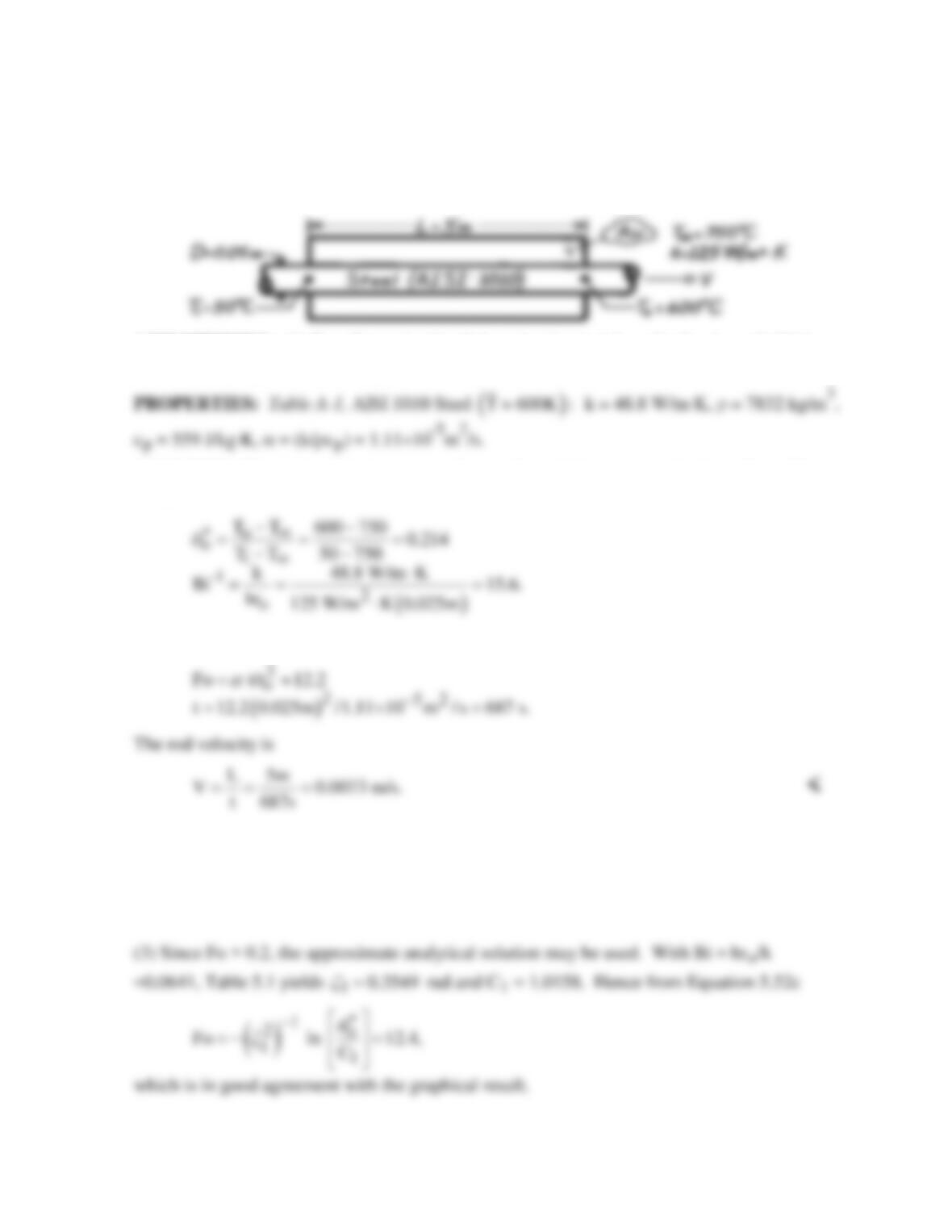
PROBLEM 5S.3
KNOWN: Inlet and outlet temperatures of steel rods heat treated by passage through an oven.
FIND: Rod speed, V.
SCHEMATIC:
ASSUMPTIONS: (1) One-dimensional radial conduction (axial conduction is negligible),
(2) Constant properties, (3) Negligible radiation.
ANALYSIS: The time needed to traverse the rod through the oven may be found from Figure
5S.4.
Hence,
COMMENTS: (1) Since (h ro/2)/k = 0.032, the lumped capacitance method could have been
used. From Equation 5.5 it follows that t = 675 s.
(2) Radiation effects decrease t and hence increase V, assuming there is net radiant transfer
from the oven walls to the rod.
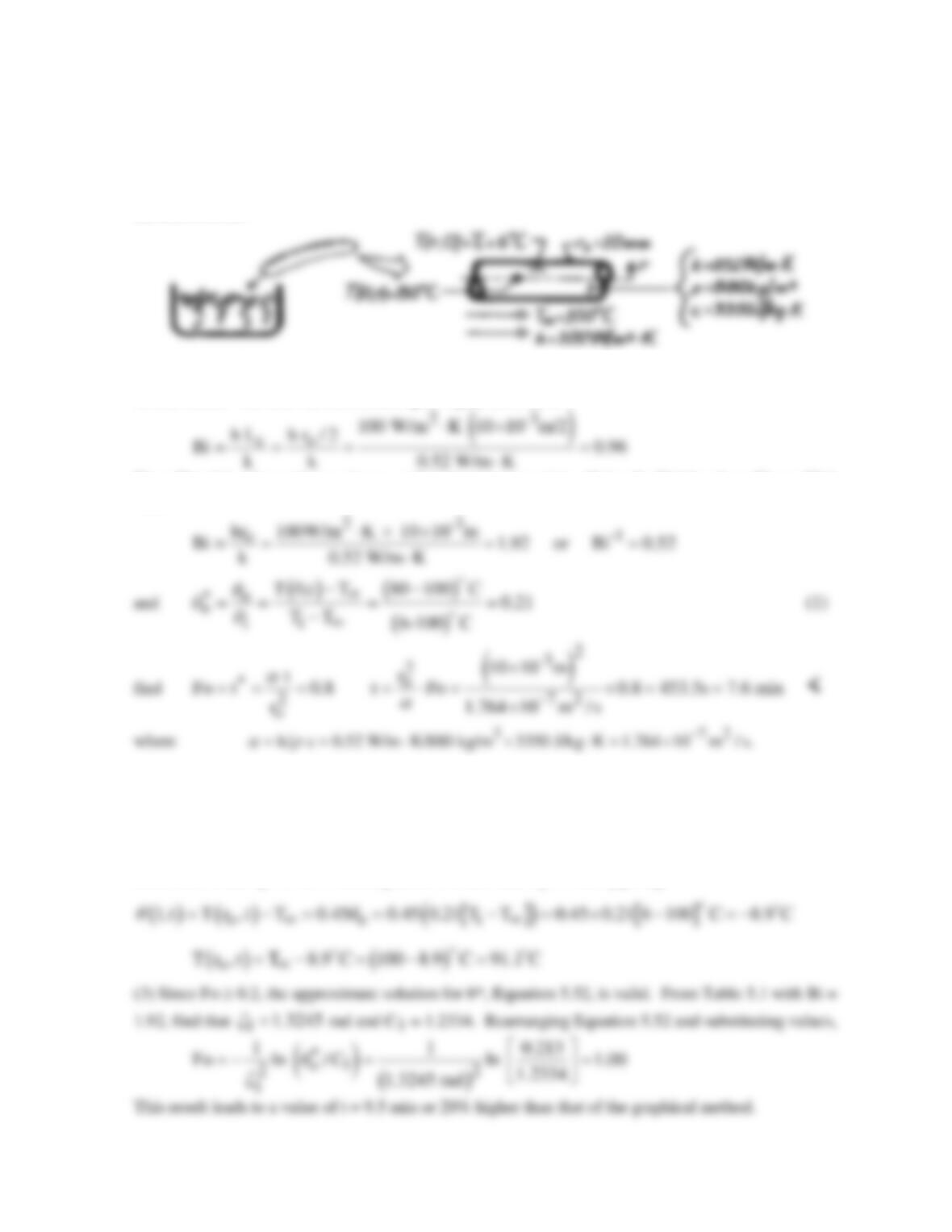
PROBLEM 5S.4
KNOWN: Hot dog with prescribed thermophysical properties, initially at 6°C, is immersed in
boiling water.
FIND: Time required to bring centerline temperature to 80°C.
SCHEMATIC:
ASSUMPTIONS: (1) Hot dog can be treated as infinite cylinder, (2) Constant properties.
ANALYSIS: The Biot number, based upon Equation 5.10, is
Since Bi > 0.1, a lumped capacitance analysis is not appropriate. Using the Heisler chart, Figure 5S.4
with
COMMENTS: (1) Note that Lc = ro/2 when evaluating the Biot number for the lumped capacitance
analysis; however, in the Heisler charts, Bi ≡ hro/k.
(2) The surface temperature of the hot dog follows from use of Figure 5S.5 with r/ro = 1 and Bi-1 =
0.52; find θ(1,t)/θo ≈ 0.45. From Equation (1), note that θo = 0.21 θi giving
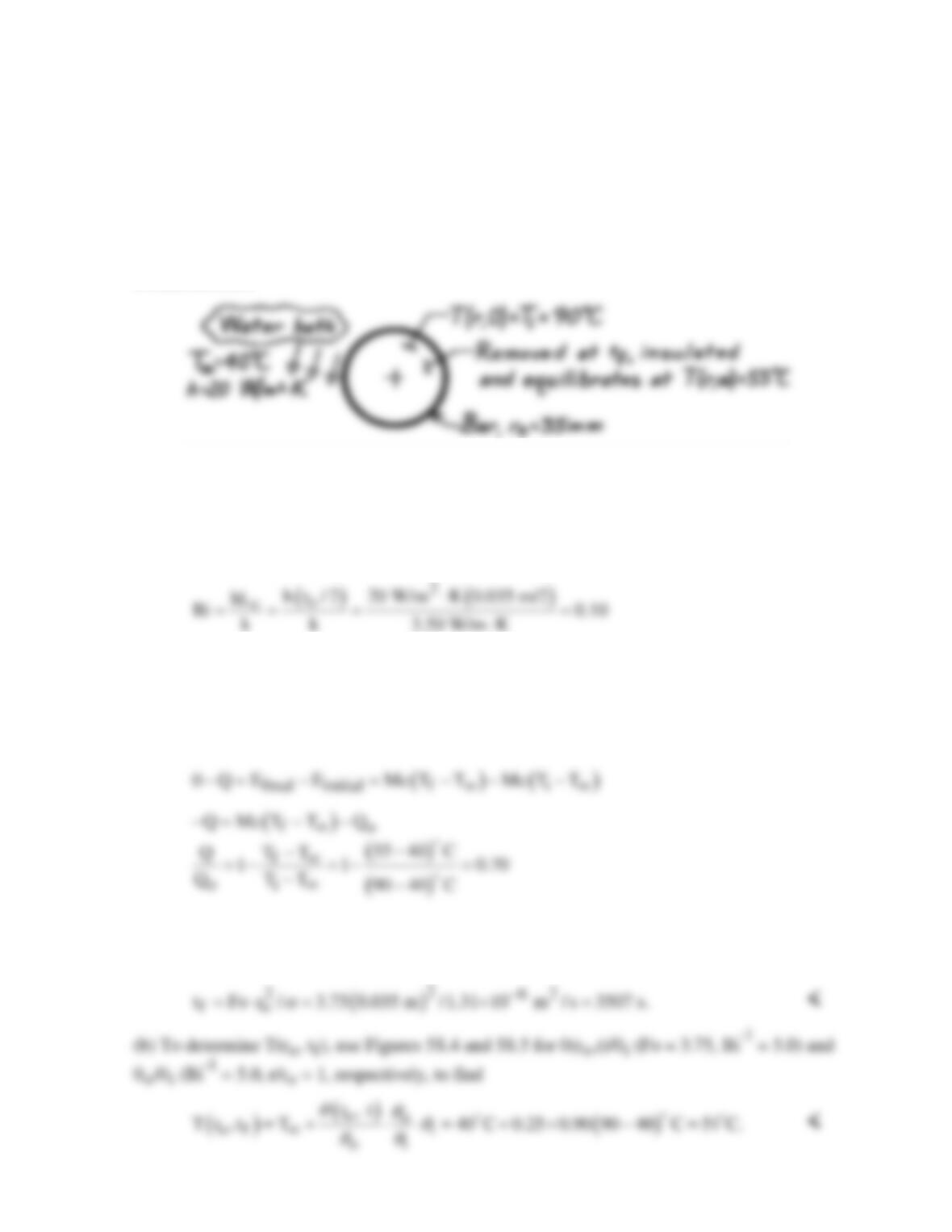
PROBLEM 5S.5
KNOWN: Long bar of 70 mm diameter, initially at 90°C, is suddenly immersed in a water
bath (T∞ = 40°C, h = 20 W/m2⋅K).
FIND: (a) Time, tf, that bar should remain in bath in order that, when removed and allowed
to equilibrate while isolated from surroundings, it will have a uniform temperature T(r, ∞) =
55°C.
SCHEMATIC:
ASSUMPTIONS: (1) One-dimensional radial conduction, (2) Constant properties.
PROPERTIES: Bar (given): ρ = 2600 kg/m3, c = 1030 J/kg⋅K, k = 3.50 W/m⋅K, α = k/ρc =
1.31×10⁻⁶ m2/s.
ANALYSIS: Determine first whether conditions are space–wise isothermal
and since Bi ≥ 0.1, a Heisler solution is appropriate.
(a) Consider an overall energy balance on the bar during the time interval ∆t = tf (the time the
bar is in the bath).
in out
EE E
-=∆
where Qo is the initial energy in the bar (relative to T∞; Equation 5.44). With Bi = hro/k =
0.20 and Q/Qo = 0.70, use Figure 5S.6 to find Bi2Fo = 0.15; hence Fo = 0.15/Bi2 = 3.75 and
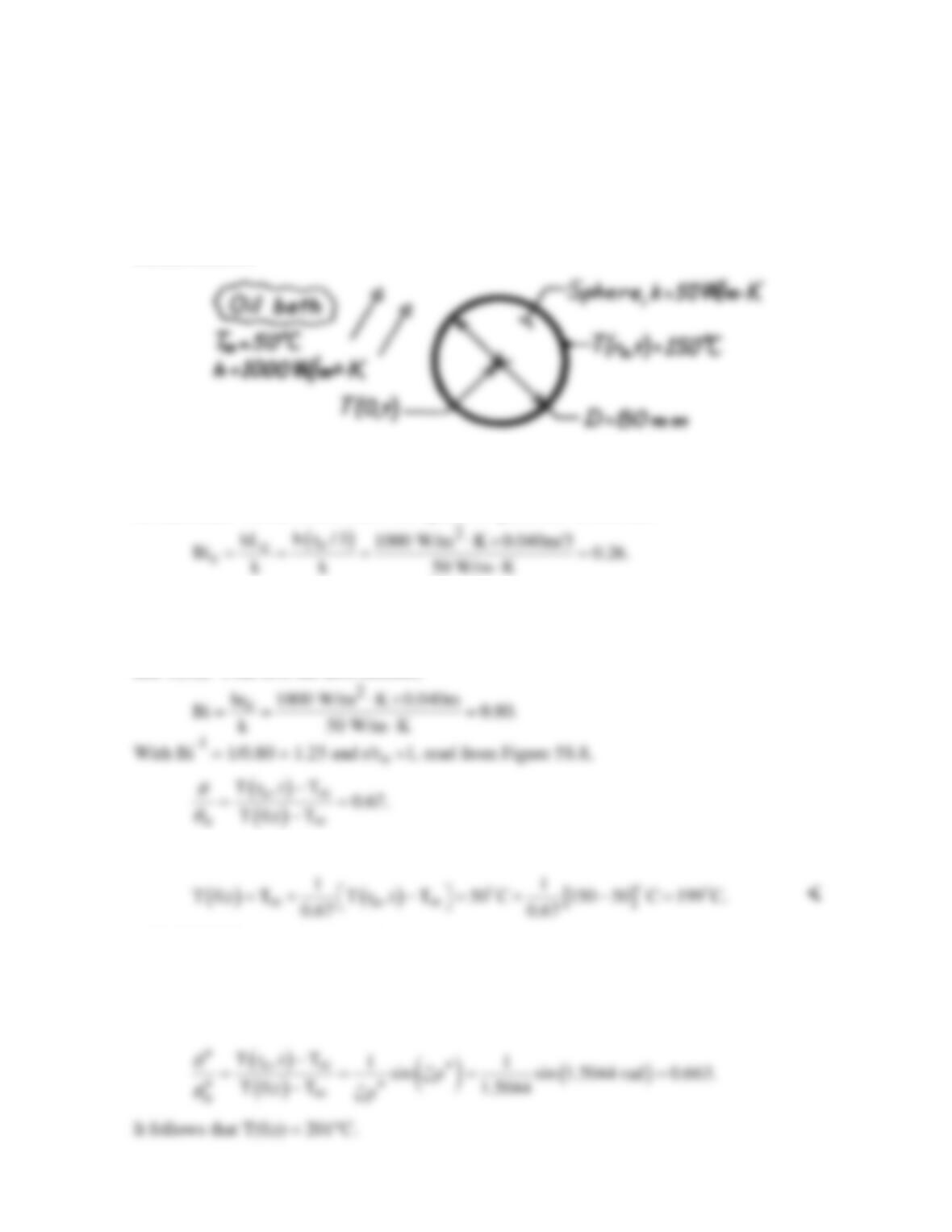
PROBLEM 5S.6
KNOWN: An 80 mm sphere, initially at a uniform elevated temperature, is quenched in an
oil bath with prescribed T∞, h.
FIND: The center temperature of the sphere, T(0,t) at a certain time when the surface
temperature is T(ro,t) = 150°C.
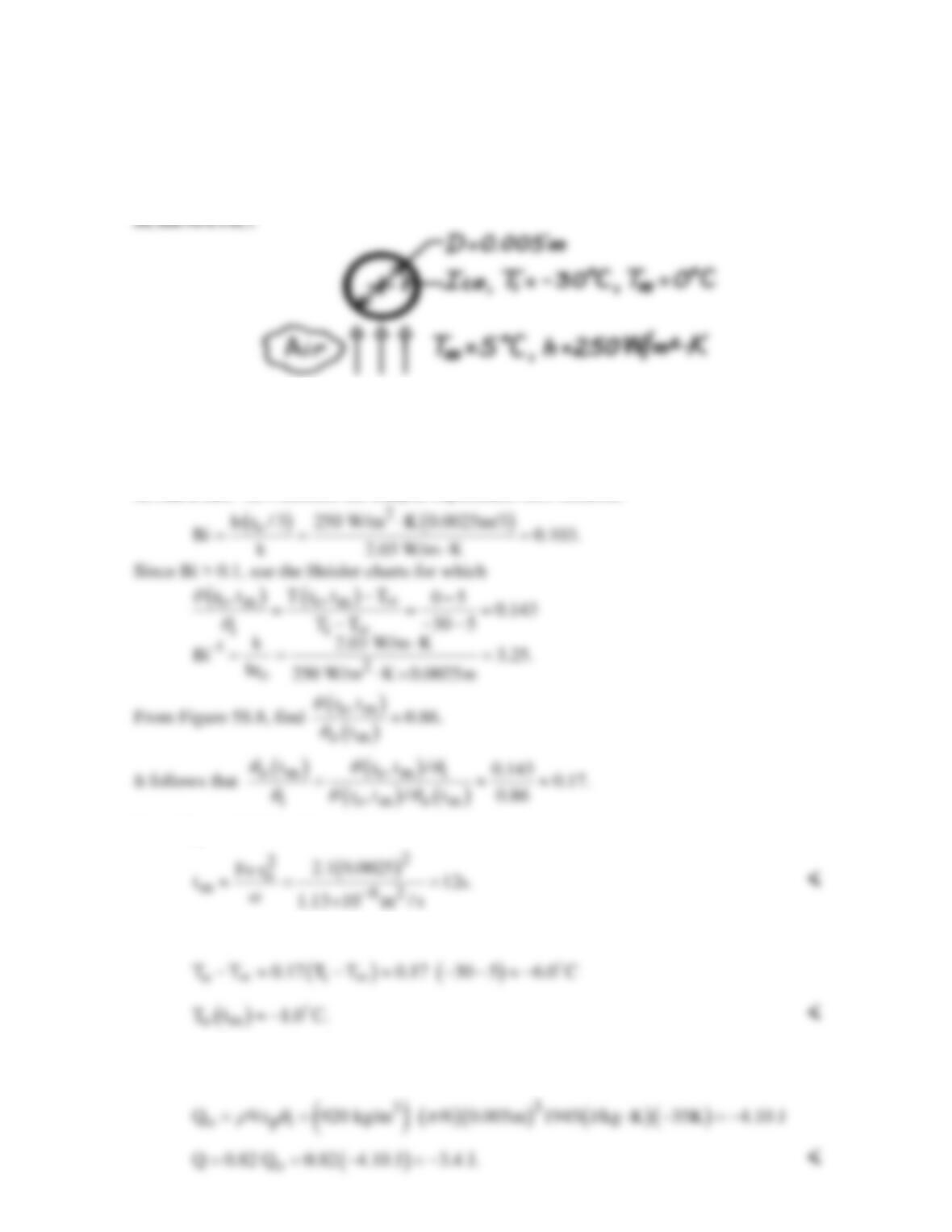
SCHEMATIC:
ASSUMPTIONS: (1) One-dimensional radial conduction, (2) Initial uniform temperature
within sphere, (3) Constant properties, (4) Fo ≥ 0.2.
ANALYSIS: Check first to see if the sphere is spacewise isothermal.
Since Bic > 0.1, lumped capacitance method is not appropriate. Recognize that when Fo ≥
0.2, the time dependence of the temperature at any point within the sphere will be the same as
the center. Using the Heisler chart method, Figure 5S.8 provides the relation between T(ro,t)
and T(0,t). Find first the Biot number,
It follows that
COMMENTS: (1) There is sufficient information to evaluate Fo; hence, we require that the
time be sufficiently long after the start of quenching for this solution to be appropriate.
(2)The approximate series solution could also be used to obtain T(0,t). For Bi = 0.80 from
Table 5.1,
1
1.5044
ζ
=
rad. Substituting numerical values, r* = 1,
PROBLEM 5S.7
KNOWN: Diameter and initial temperature of hailstone falling through warm air.
FIND: (a) Time, tm, required for outer surface to reach melting point, T(ro,tm) = Tm = 0°C,
(b) Centerpoint temperature at that time, (c) Energy transferred to the stone.
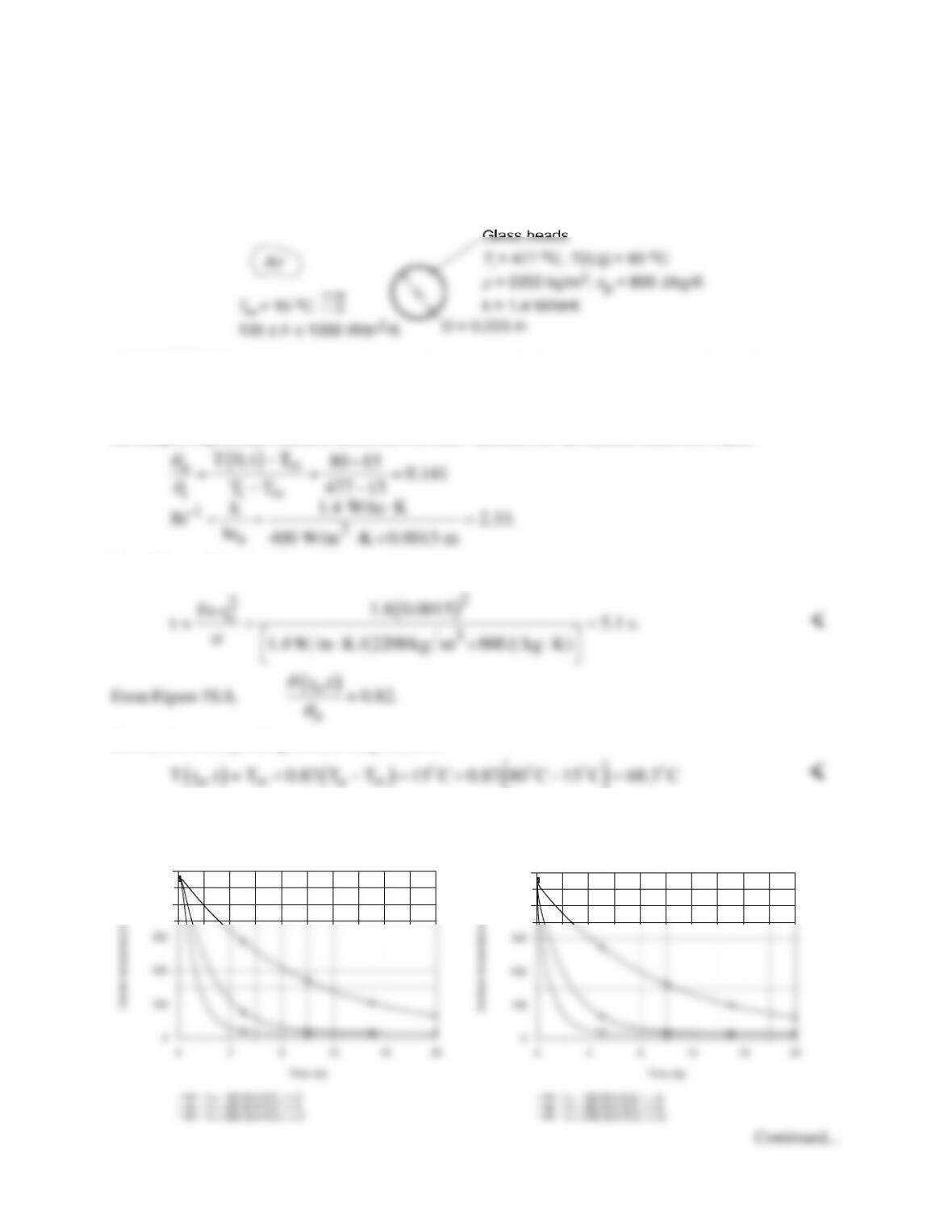
ASSUMPTIONS: (1) One-dimensional radial conduction, (2) Constant properties.
PROPERTIES: Table A-3, Ice (253K): ρ = 920 kg/m3, k = 2.03 W/m⋅K, cp = 1945 J/kg⋅K;
α = k/ρcp = 1.13 × 10⁻⁶m2/s.
ANALYSIS: (a) Calculate the lumped capacitance Biot number,
From Figure 5S.7 find Fo ≈ 2.1. Hence,
(b) Since (θo/θi) ≈ 0.17, find
(c) With Bi2Fo = (1/3.25)2×2.1 = 0.2, from Figure 5S.9, find Q/Qo ≈ 0.82. From Equation
5.47,
PROBLEM 5S.8
KNOWN: Properties, initial temperature, and convection conditions associated with cooling of glass
beads.
FIND: (a) Time required to achieve a prescribed center temperature, (b) Effect of convection coefficient
on center and surface temperature histories.
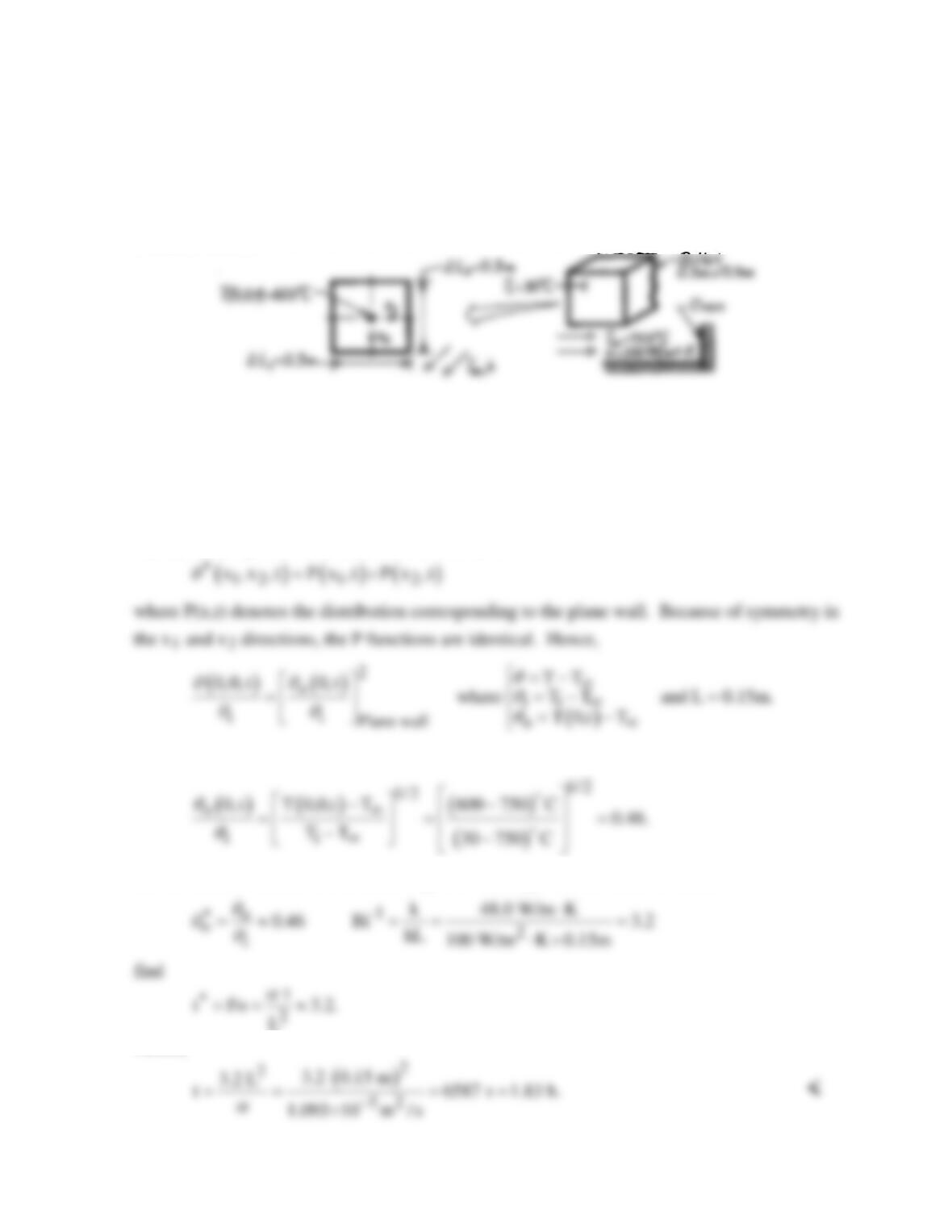
SCHEMATIC:
ASSUMPTIONS: (1) One-dimensional conduction in r, (2) Constant properties, (3) Negligible
radiation, (4) Fo ≥ 0.2.
ANALYSIS: (a) With h = 400 W/m2⋅K, Bi ≡ h(ro/3)/k = 400 W/m2⋅K(0.0005 m)/1.4 W/m⋅K = 0.143 and
the lumped capacitance method should not be used. Instead, use the Heisler charts for which
From Figure 5S.7, find
Fo 1.8.≈
Hence, the corresponding surface temperature is
(b) The effect of h on the surface and center temperatures was determined using the IHT Transient
Conduction Model for a Sphere.
400
500
400
500

PROBLEM 5S.8 (Cont.)
The cooling rate increases with increasing h, particularly from 100 to 400 W/m2⋅K. The temperature
COMMENTS: Temperature gradients in the glass are largest during the early stages of solidification
and increase with increasing h. Since thermal stresses increase with increasing temperature gradients, the
propensity to induce defects due to crack formation in the glass increases with increasing h. Hence, there
is a value of h above which product quality would suffer and the process should not be operated.
PROBLEM 5S.9
KNOWN: Steel (plain carbon) billet of square cross-section initially at a uniform
temperature of 30°C is placed in a soaking oven and subjected to a convection heating process
with prescribed temperature and convection coefficient.
FIND: Time required for billet center temperature to reach 600°C.
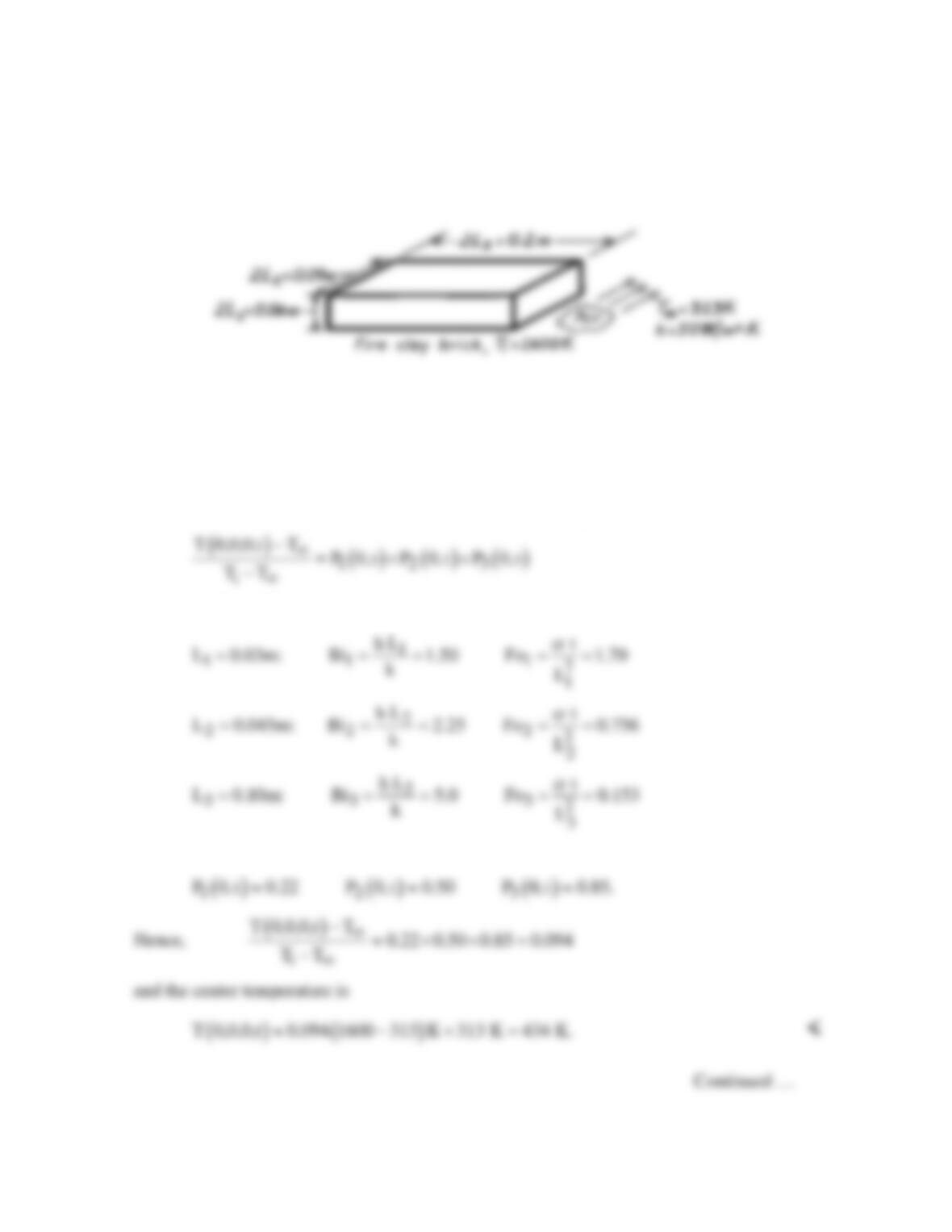
SCHEMATIC:
ASSUMPTIONS: (1) Two-dimensional conduction in x1 and x2 directions, (2) Constant
properties, (3) Heat transfer to billet is by convection only.
PROPERTIES: Table A-1, Steel, plain carbon (T = (30+600)°C/2 = 588K = ≈ 600K): ρ =
7854 kg/m3, cp = 559 J/kg⋅K, k = 48.0 W/m⋅K, α =k/ρcp = 1.093 × 10⁻⁵ m2/s.
ANALYSIS: The billet corresponds to Case (e), Figure 5S.11 (infinite rectangular bar).
Hence, the temperature distribution is of the form
Substituting numerical values, find
Consider now the Heisler chart for the plane wall, Figure 5S.1. For the values
Hence,
PROBLEM 5S.10
KNOWN: Initial temperature of fire clay brick which is cooled by convection.
FIND: Center and corner temperatures after 50 minutes of cooling.
SCHEMATIC:
ASSUMPTIONS: (1) Homogeneous medium with constant properties, (2) Negligible
radiation effects.
PROPERTIES: Table A-3, Fire clay brick (900K): ρ = 2050 kg/m3, k = 1.0 W/m⋅K, cp =
960 J/kg⋅K. α = 0.51 × 10⁻⁶m2/s.
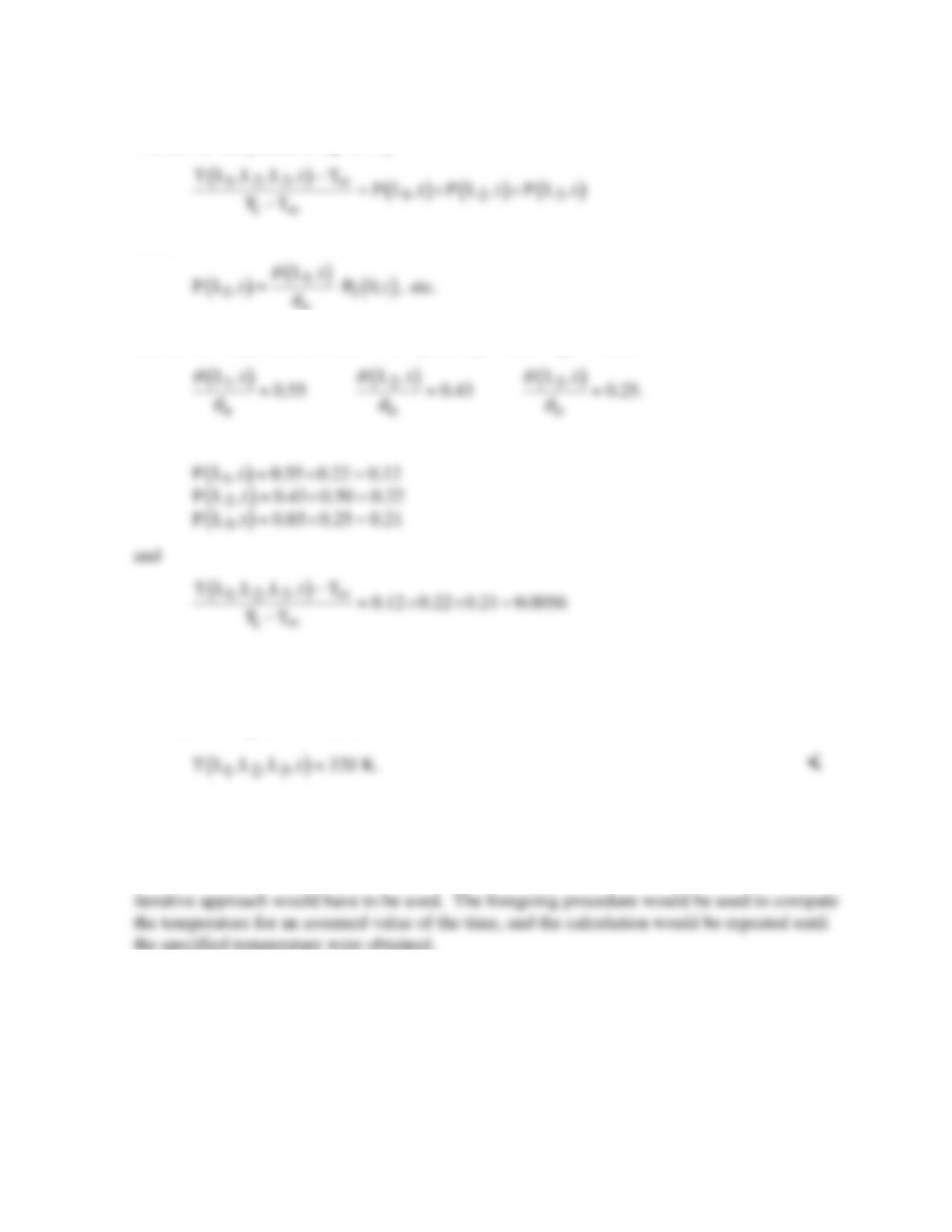
ANALYSIS: From Figure 5S.11, the center temperature is given by
where
P P and P
1 2 3
,
must be obtained from Figure 5S.1.
Hence from Figure 5S.1,
PROBLEM 5S.10 (Cont.)
The corner temperature is given by
where
o
and similar forms can be written for L2 and L3. From Figure 5S.2,
Hence,
or
( )
( )
123
T L , L , L , t 0.0056 1600 313 K 313 K.≈ -+
The corner temperature is then
COMMENTS: (1) The foregoing temperatures are overpredicted by ignoring radiation,
which is significant during the early portion of the transient.
(2) Note that, if the time required to reach a certain temperature were to be determined, an
PROBLEM 5S.11
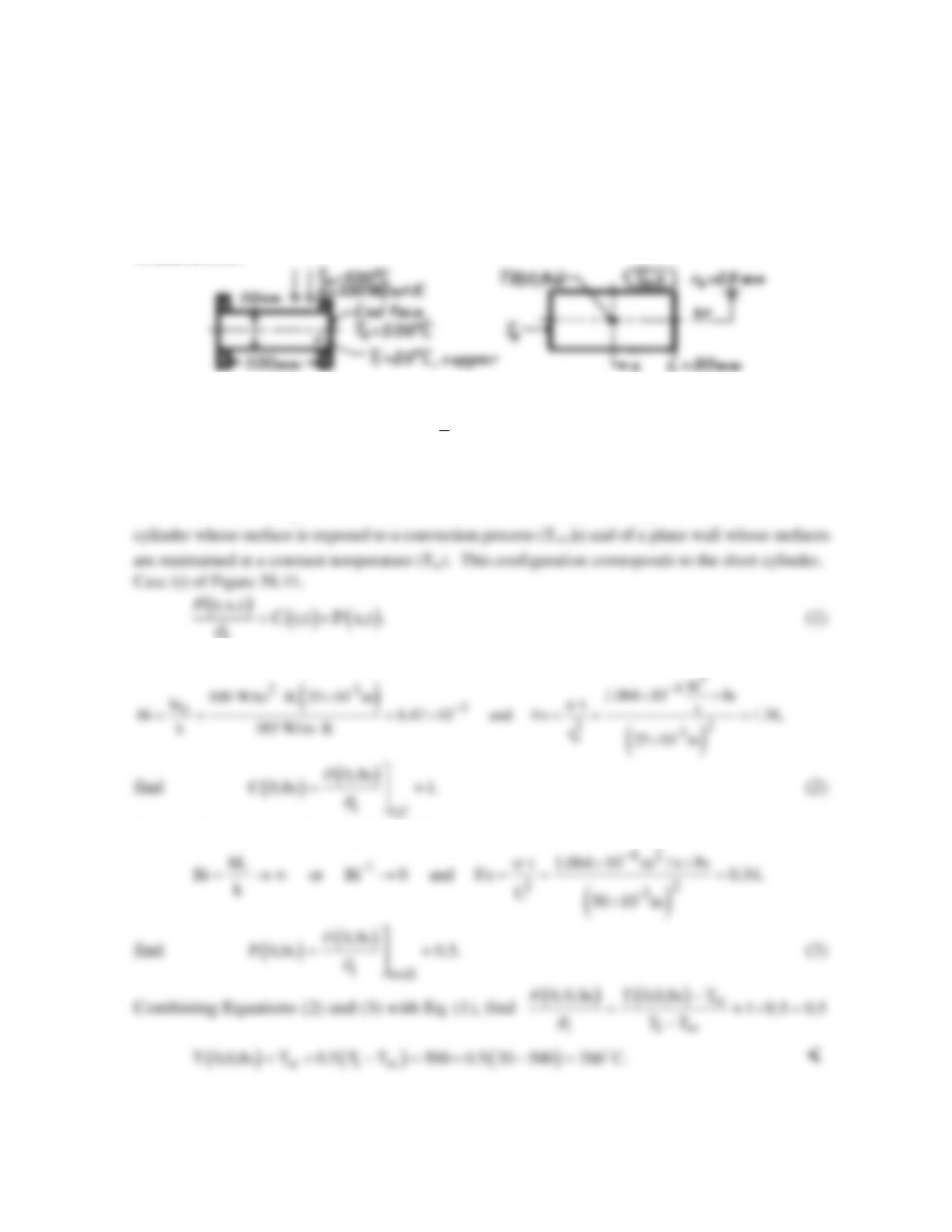
KNOWN: Cylindrical copper pin, 100 mm long × 50 mm diameter, initially at 20°C; end faces are
subjected to intense heating, suddenly raising them to 500°C; at the same time, the cylindrical surface
is subjected to a convective heating process (T∞,h).
FIND: (a) Temperature at center point of cylinder after a time of 8 seconds from sudden application
of heat, (b) Consider parameters governing transient diffusion and justify simplifying assumptions
that could be applied to this problem.
SCHEMATIC:
ASSUMPTIONS: (1) Two-dimensional conduction, (2) Constant properties and convection heat
transfer coefficient.
PROPERTIES: Table A-1, Copper, pure
( )
()
T 500 20 C/2 500K :≈+ ≈
ρ = 8933 kg/m3, c = 407
J/kg⋅K, k = 386 W/m⋅K, α = k/ρc = 386 W/m⋅K/8933 kg/m3 × 407 J/kg⋅K = 1.064 × 10⁻⁴m2/s.
ANALYSIS: (1) The pin can be treated as a two-dimensional system comprised of an infinite
i
For the infinite cylinder, using Figure 5S.4, with
For the infinite plane wall, using Figure 5S.1, with
(b) The parameters controlling transient conduction with convective boundary conditions are the Biot
and Fourier numbers. Since Bi << 0.1 for the cylindrical shape, we can assume radial gradients are
negligible. That is, we need only consider conduction in the x-direction.
PROBLEM 5S.12
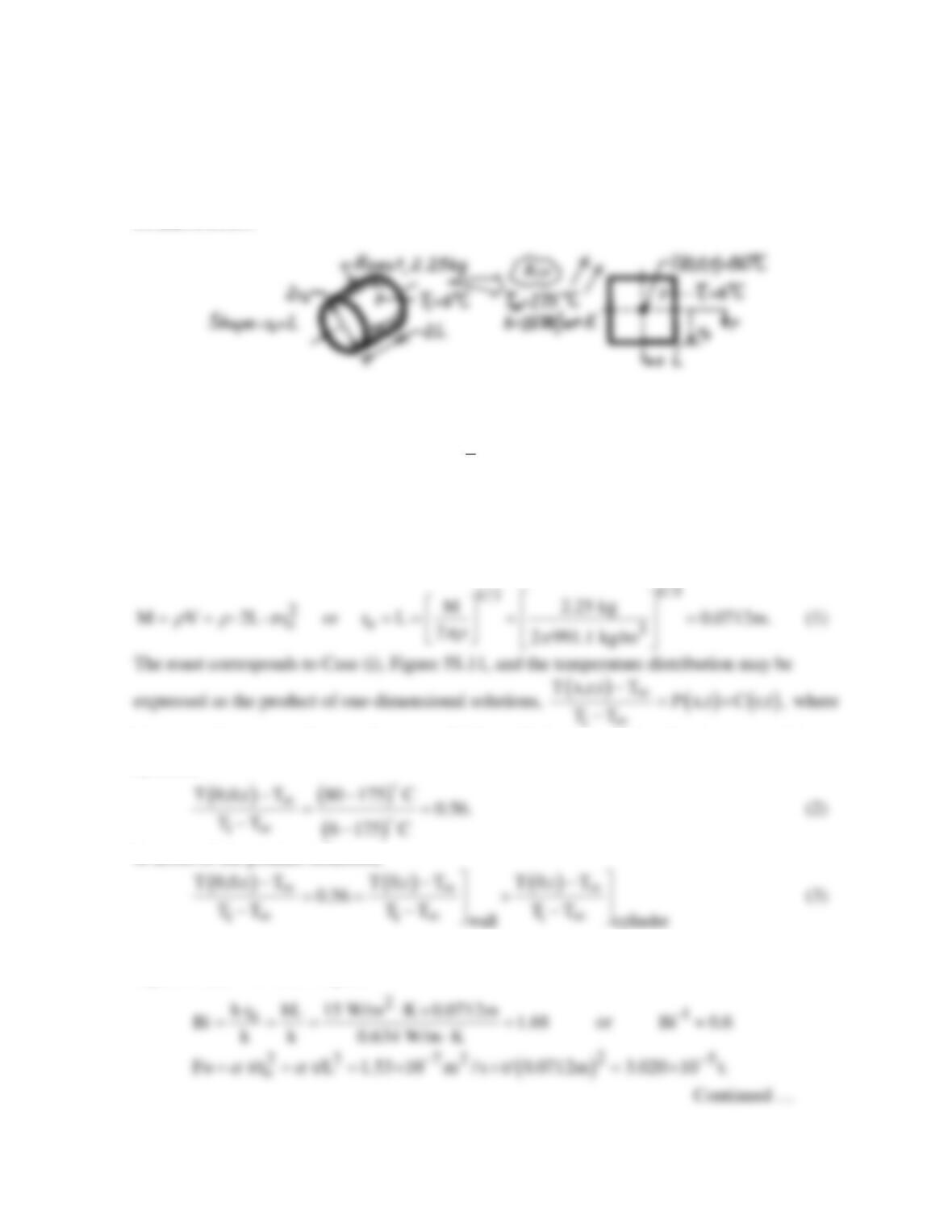
KNOWN: Cylindrical-shaped meat roast weighing 2.25 kg, initially at 6°C, is placed in an
oven and subjected to convection heating with prescribed (T∞,h).
FIND: Time required for the center to reach a done temperature of 80°C.
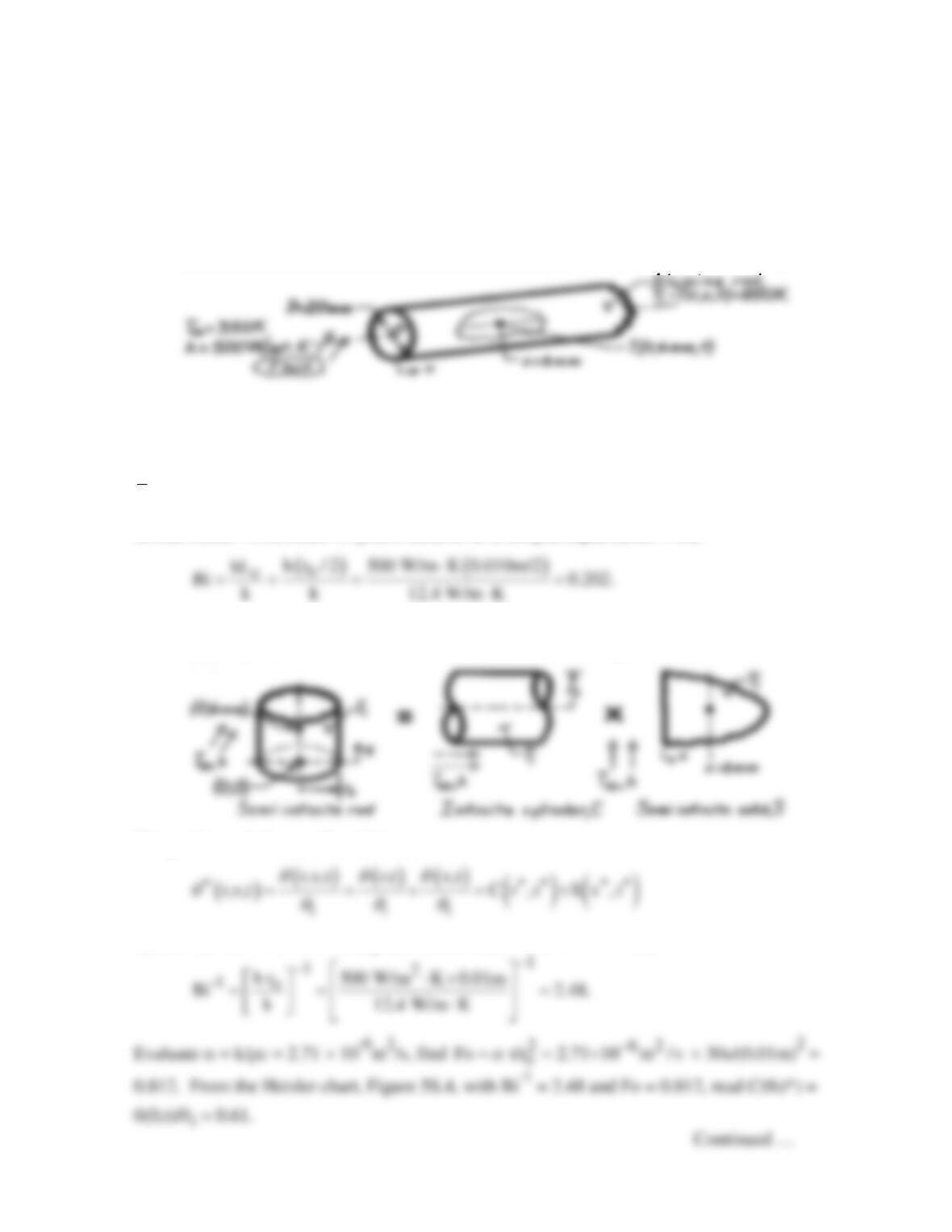
SCHEMATIC:
ASSUMPTIONS: (1) Two-dimensional conduction in x and r directions, (2) Uniform and
constant properties, (3) Properties approximated as those of water.
PROPERTIES: Table A-6, Water, liquid
( )
( )
T 80 6 C/2 315K :=+≈
/
ρ = 1/vf = 1/1.009 ×
10-3m3/kg = 991.1 kg/m3, cp,f = 4179 J/kg⋅K, k = 0.634 W/m⋅K, α = k/ρc = 1.531 × 10⁻⁷m2/s.
ANALYSIS: The dimensions of the roast are determined from the requirement ro = L and
knowledge of its weight and density,
P(x,t) and C(r,t) are defined by Equations 5S.2 and 5S.3, respectively. For the center of the
cylinder,
In terms of the product solutions,
For each of these shapes, we need to find values of θo/θi such that their product satisfies
Equation (3). For both shapes,
PROBLEM 5S.12 (Cont.)
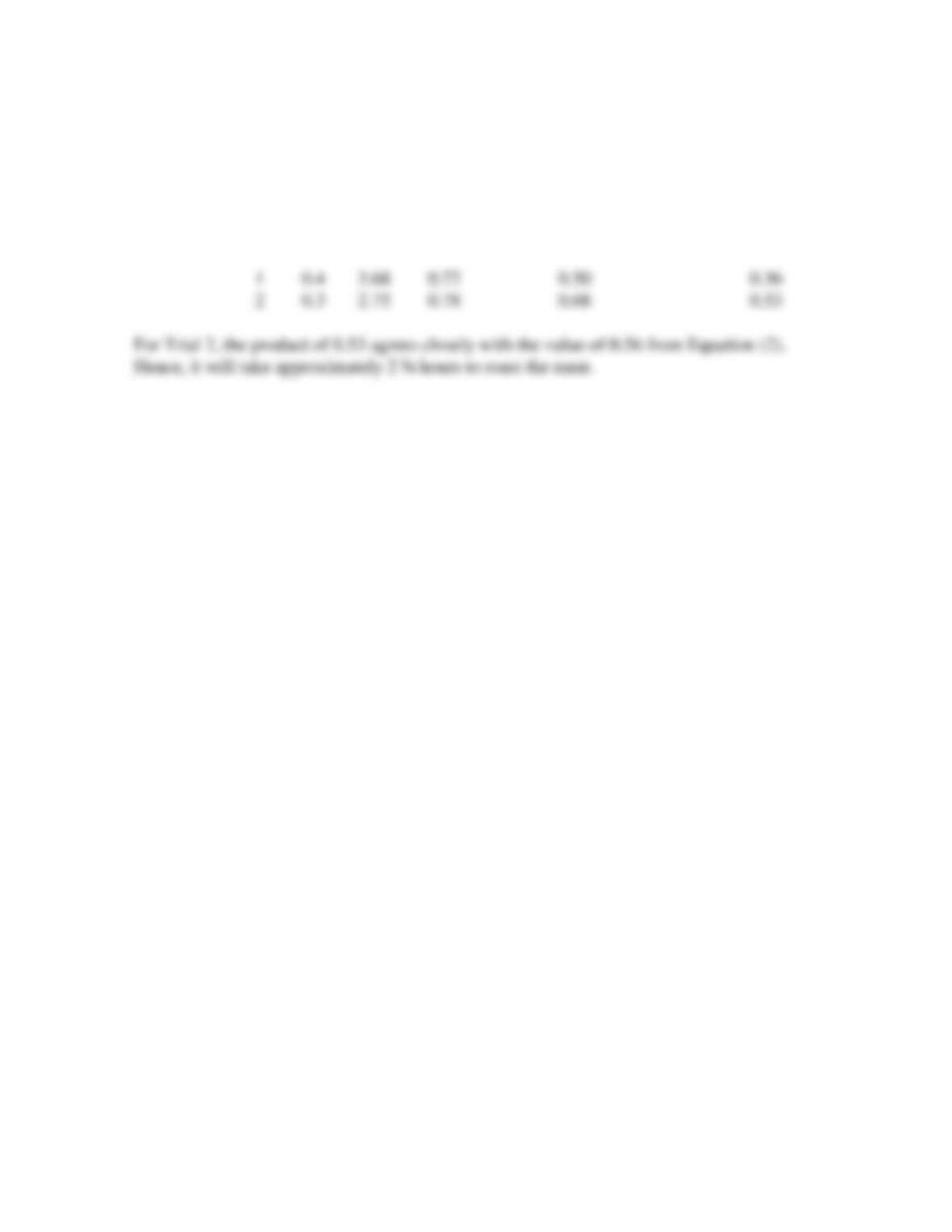
A trial–and-error solution is necessary. Begin by assuming a value of Fo; obtain the respective
θo/θi values from Figures 5S.1 and 5S.4; test whether their product satisfies Equation (3).
Two trials are shown as follows:
Trial Fo t(hrs)
)
oi
wall
/
θθ
)
oi
cyl
/
θθ
oo
ii
w cyl
θθ
θθ
×
PROBLEM 5S.13
KNOWN: A long alumina rod, initially at a uniform temperature of 850 K, is suddenly
exposed to a cooler fluid.
FIND: Temperature of the rod after 30 s, at an exposed end, T(0,0,t), and at an axial distance
6mm from the end, T(0, 6 mm, t).
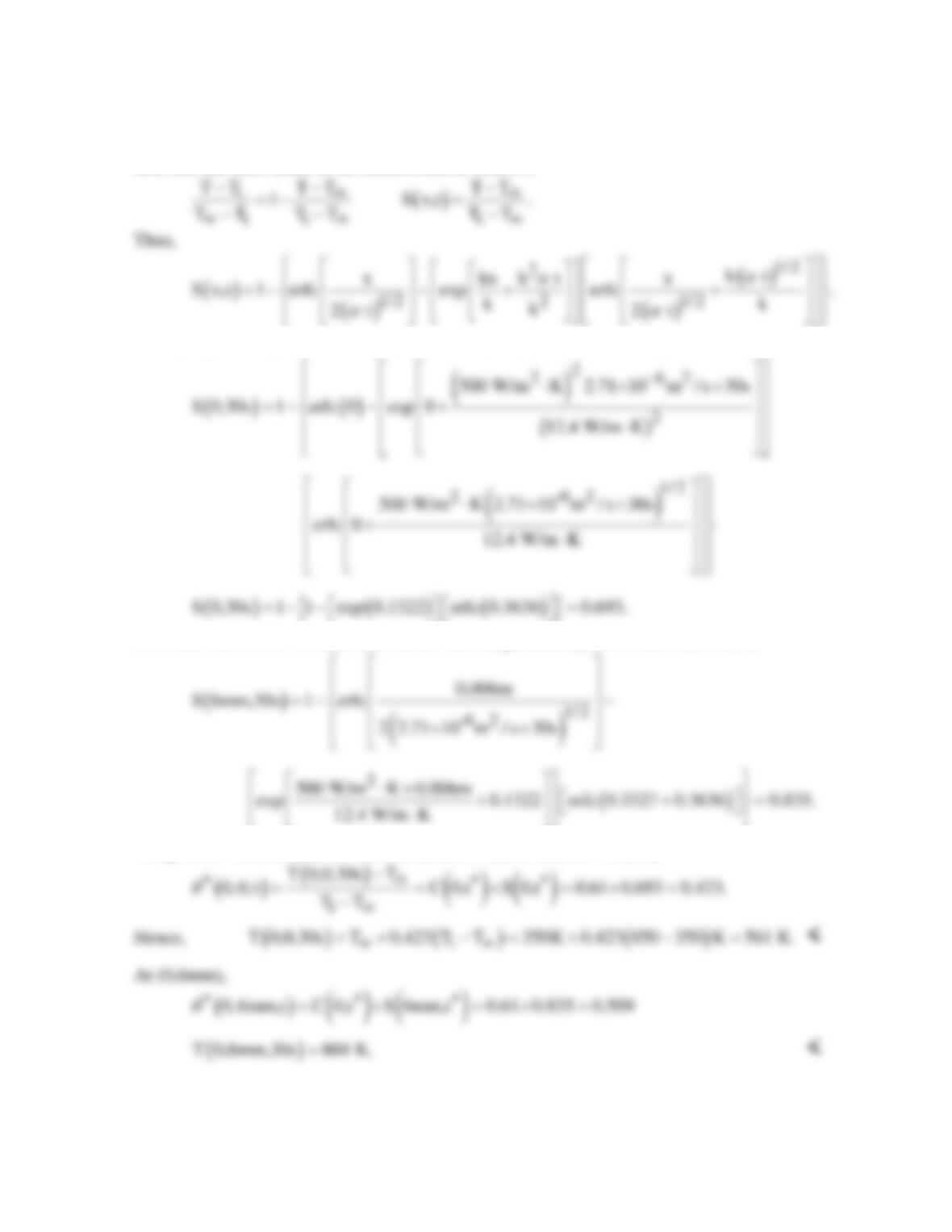
SCHEMATIC:
ASSUMPTIONS: (1) Two-dimensional conduction in (r,x) directions, (2) Constant
properties, (3) Convection coefficient is same on end and cylindrical surfaces.
PROPERTIES: Table A-2, Alumina, polycrystalline aluminum oxide (assume
( )
T 850 600 K/2 725K):≈+ =
ρ = 3970 kg/m3, c = 1154 J/kg⋅K, k = 12.4 W/m⋅K.
ANALYSIS: First, check if system behaves as a lumped capacitance. Find
Since Bi > 0.1, rod does not behave as spacewise isothermal object. Hence, treat rod as a
semi–infinite cylinder, the multi–dimensional system Case (f), Figure 5S.11.
The product solution can be written as
Infinite cylinder, C(r*,t*). Using the Heisler charts with r* = r = 0 and
PROBLEM 5S.13 (Cont.)
Semi–infinite medium, S(x*,t*). Recognize this as Case (3), Figure 5.7. From Equation 5.63,
note that the LHS needs to be transformed as follows,
Evaluating this expression at the surface (x = 0) and 6 mm from the exposed end, find
Note that Table B.2 was used to evaluate the complementary error function, erfc(w).
The product solution can now be evaluated for each location. At (0,0),
COMMENTS: Note that the temperature at which the properties were evaluated was a good
estimate.
PROBLEM 5S.14
KNOWN: Stainless steel cylinder of Example 5S.1, 80-mm diameter by 60-mm length, initially at
600 K, suddenly quenched in an oil bath at 300 K with h = 500 W/m2⋅K. Use the Transient
Conduction, Plane Wall and Cylinder models of IHT to obtain the following solutions.
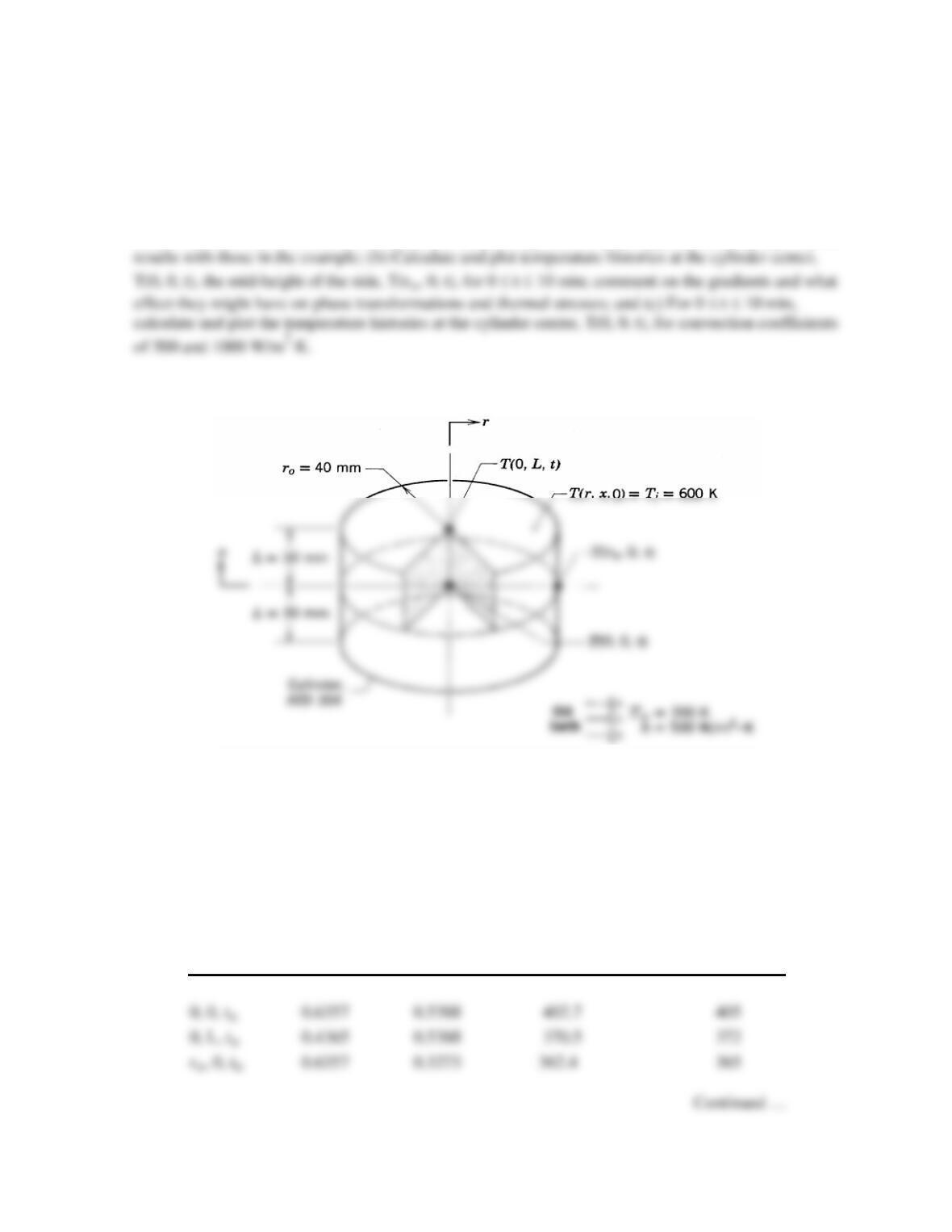
FIND: (a) Calculate the temperatures T(r,x,t) after 3 min: at the cylinder center, T(0, 0, 3 min), at the
center of a circular face, T(0, L, 3 min), and at the midheight of the side, T(ro, 0, 3 min); compare your
SCHEMATIC:
ASSUMPTIONS: (1) Two-dimensional conduction in r- and x-coordinates, (2) Constant properties.
PROPERTIES: Stainless steel (Example 5S.1): ρ = 7900 kg/m3, c = 526 J/kg⋅K, k = 17.4 W/m⋅K.
ANALYSIS: The following results were obtained using the Transient Conduction models for the
Plane Wall and Cylinder of IHT. Salient portions of the code are provided in the Comments.
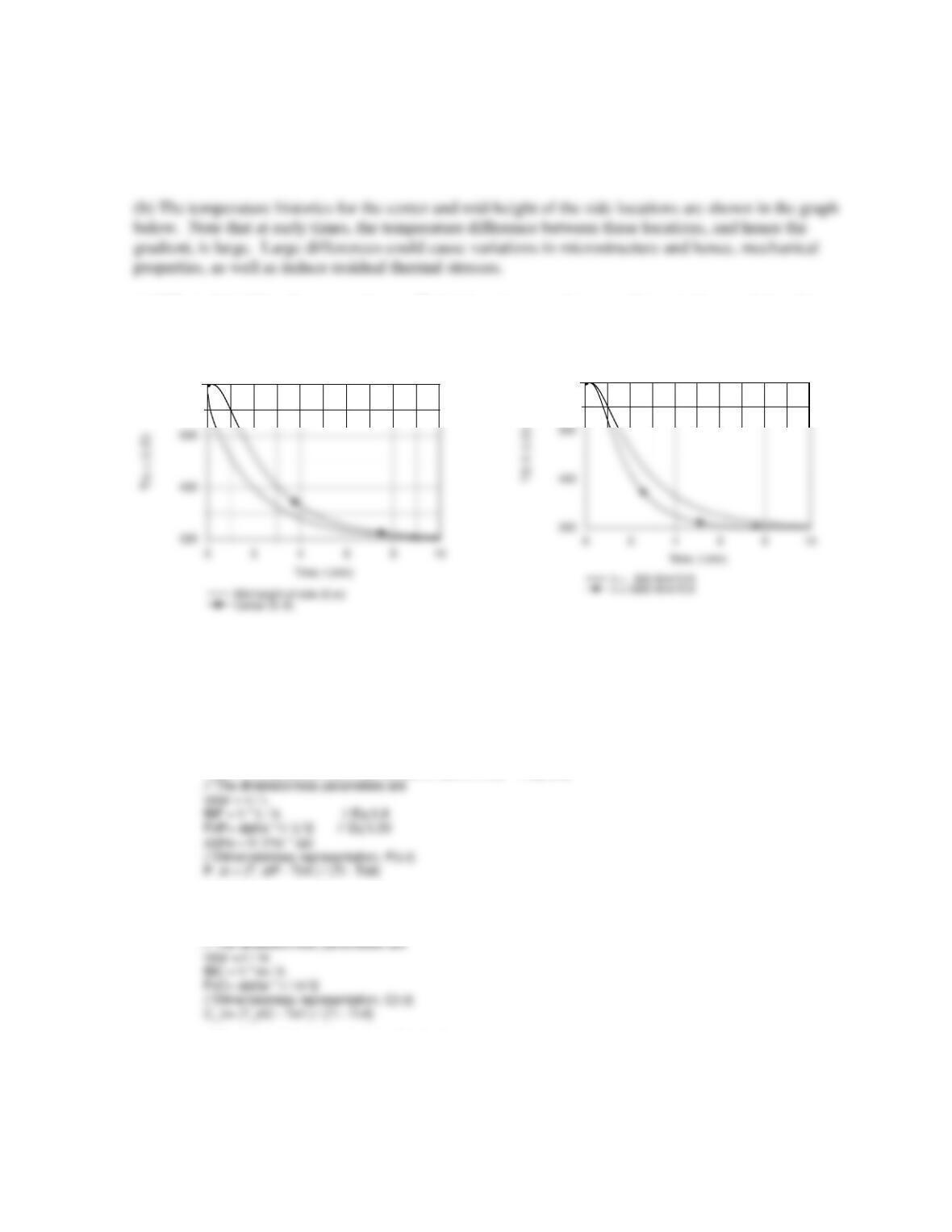
(a) Following the methodology for a product solution outlined in Example 5S.1, the following results
were obtained at t = to = 3 min
(r, x, t) P(x, t) C(r, t) T(r, x, t)-IHT T(r, x, t)-Ex
(K) (K)
PROBLEM 5S.14 (Cont.)
The temperatures from the one-term series calculations of the Example 5S.1 are systematically higher
than those resulting from the IHT multiple–term series model, which is the more accurate method.
(c) Effect of doubling the convection coefficient is to increase the quenching rate, but much less than
by a factor of two as can be seen in the graph below.
Quenching with h = 500 W/m^2.K
600
Effect of increased conv. coeff. on quenching rate
600
COMMENTS: From IHT menu for Transient Conduction | Plane Wall and Cylinder, the models
were combined to solve the product solution. Key portions of the code, less the input variables, are
copied below.
// Plane wall temperature distribution
// The temperature distribution is
T_xtP = T_xt_trans(“Plane Wall”,xstar,FoP,BiP,Ti,Tinf) // Eq 5.42
// Cylinder temperature distribution
// The temperature distribution T(r,t) is
T_rtC = T_xt_trans(“Cylinder”,rstar,FoC,BiC,Ti,Tinf) // Eq 5.50
// Product solution temperature distribution
(T_xrt – Tinf) / (Ti – Tinf) = P_xt * C_rt