5.39: PROBLEM DEFINITION
Situation:
InFig5.11in§5.2ofEFM10e,
a. the CV is passing through the system.
b. the system is passing through the CV.
SOLUTION
41
5.40: PROBLEM DEFINITION
Situation:
Reynolds transport theorem.
Find:
The purpose of Reynolds transport theorem.
SOLUTION
The Reynolds transport theorem is used to relate Lagrangian equations to their
42
5.41: PROBLEM DEFINITION
Situation:
Mass is flowing into and out of a tank.
Vi=10m/s,Ai=0.10 m2,ρi=3.00 kg/m3.
Vo=5m/s,Ao=0.20 m2,ρo=2.00 kg/m3.
Find:
Select the statement(s) that are true.
SOLUTION
Mass flow out
Mass flow in
43
5.42: PROBLEM DEFINITION
Situation:
A piston in a cylinder is moving up and control consists of volume in cylinder.
Find:
Indicate which of the statements are true.
SOLUTION
a) True, there is no flow entering or leaving across the control surface.
44
5.43: PROBLEM DEFINITION
Situation:
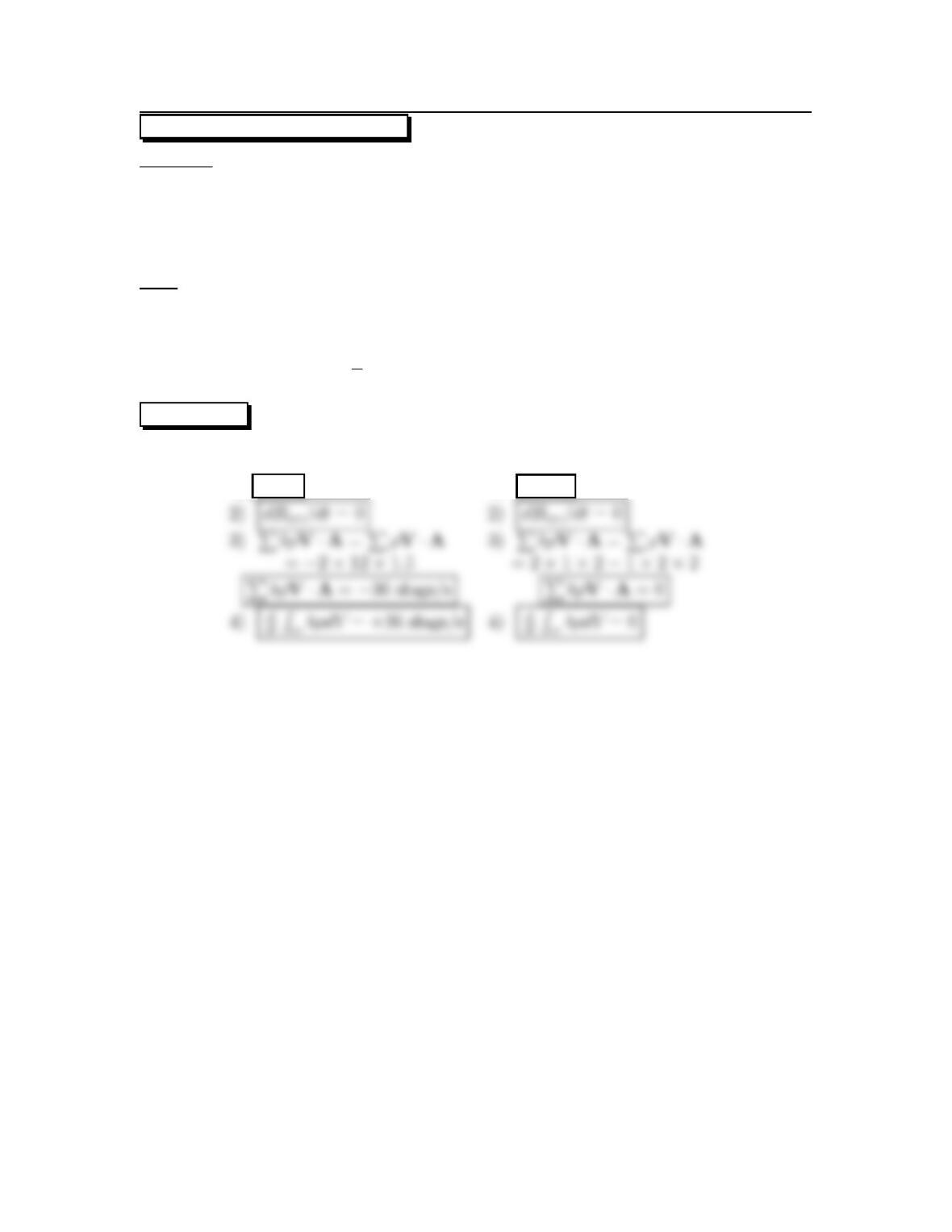
Two flow cases: a closed tank is filled with a fluid and a pipe contracts.
V=12ft/s,A=1.5ft
2,ρ=2slug/ft3..
V1=1ft/s,A1=2ft
2,ρ1=2slug/ft3.
V2=2ft/s,A2=1ft
2,ρ2=2slug/ft3.
Find:
(a) Value of b.
(b) Value of dBsys/dt.
(c) Value of PbρV·A
(d) Value of d/dt Rcv bρdV
SOLUTION
Case (a) Case (b)
1) b=1 1) B=1
45
5.44: PROBLEM DEFINITION
Situation:
The law of conservation of mass for a closed system requires that the mass of the
system is:
a. constant
b. zero
SOLUTION
46
5.45: PROBLEM DEFINITION
Situation:
Consider the simplified form of the continuity equation, Eq. 5.29 of EFM10e. An
engineer is using this equation to find the QCof a creek at the confluence with a
large river, because she has automatic electronic measurements of the river discharge
upstream (QRu) and downstream (QRd)of the creek confluence.
Find:
a. Which of the 3 terms on the left-hand side of Eq. 5.29 will the engineer assume
is zero? Why?
b. Sketch the creek and the river and sketch the CV you would select to solve this
problem.
SOLUTION
a. The engineer will assume that the d
47
5.46: PROBLEM DEFINITION
Situation:
Pipe flows full with water.
Find:
Isitpossibleforthevolumeflow rate into the pipe to be different than the flow
rate out of the pipe?
SOLUTION
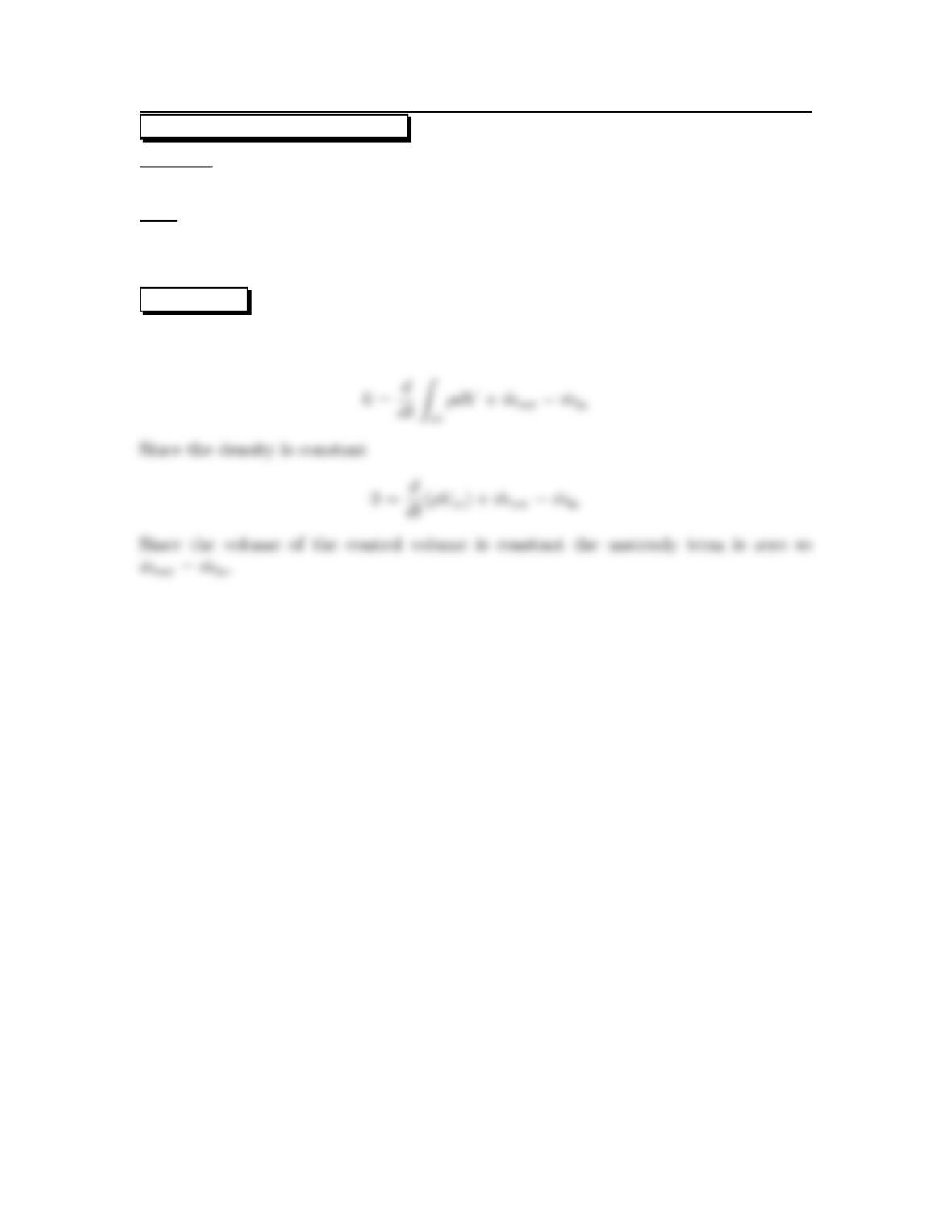
Application of the continuity equation to a control volume passing through the inlet
section and outlet section shows
48
5.47: PROBLEM DEFINITION
Situation:
Air flows in a tube.
Find:
Is it possible for the mass flow rate into the tube to be different than the flow rate
out of the tube?
Air is pumped into one end of a tube at a certain mass flow rate. Is it necessary that
thesamemassflow rate of air comes out the other end of the tube?
Application of the continuity equation over a control surface that includes the inlet
49
5.48: PROBLEM DEFINITION
Situation:
Tire develops a leak.
Find:
How do air and density change with time?
How is air density related to tire pressure?
Assumptions:
Constant temperature.
SOLUTION
If an automobile tire develops a leak, how does the mass of air and density change
inside the tire with time?
Assuming the temperature remains constant, how is the change in density related to
the tire pressure?
50
5.49: PROBLEM DEFINITION
Situation:
Two pipes are connected in series.
D1=2D2,V1=4m/s.
Find:
Velocity in smaller pipe ( m/s).
SOLUTION
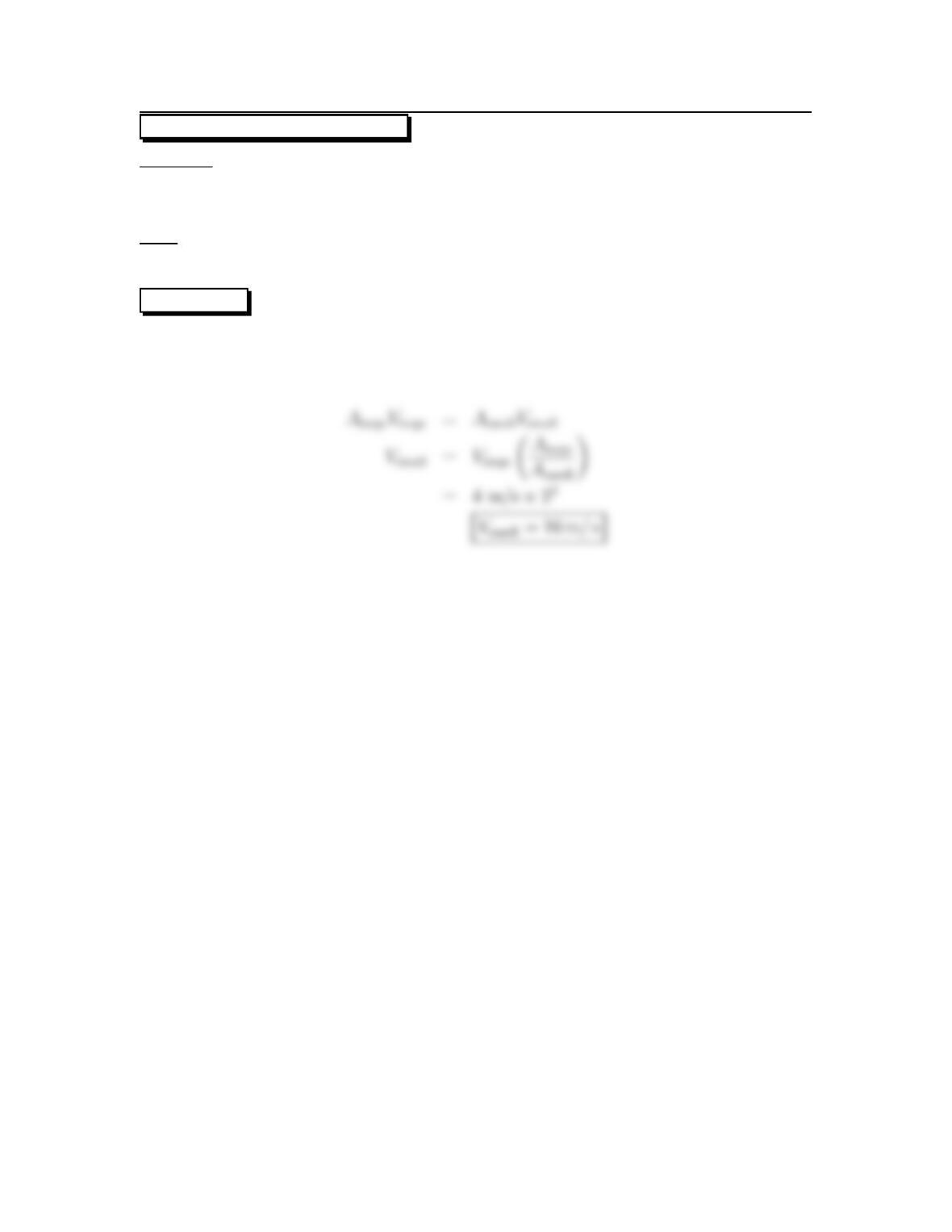
Use continuity equation for discharge. Q=AV which is valid since density is con–
stant.
51
5.50: PROBLEM DEFINITION
Situation:
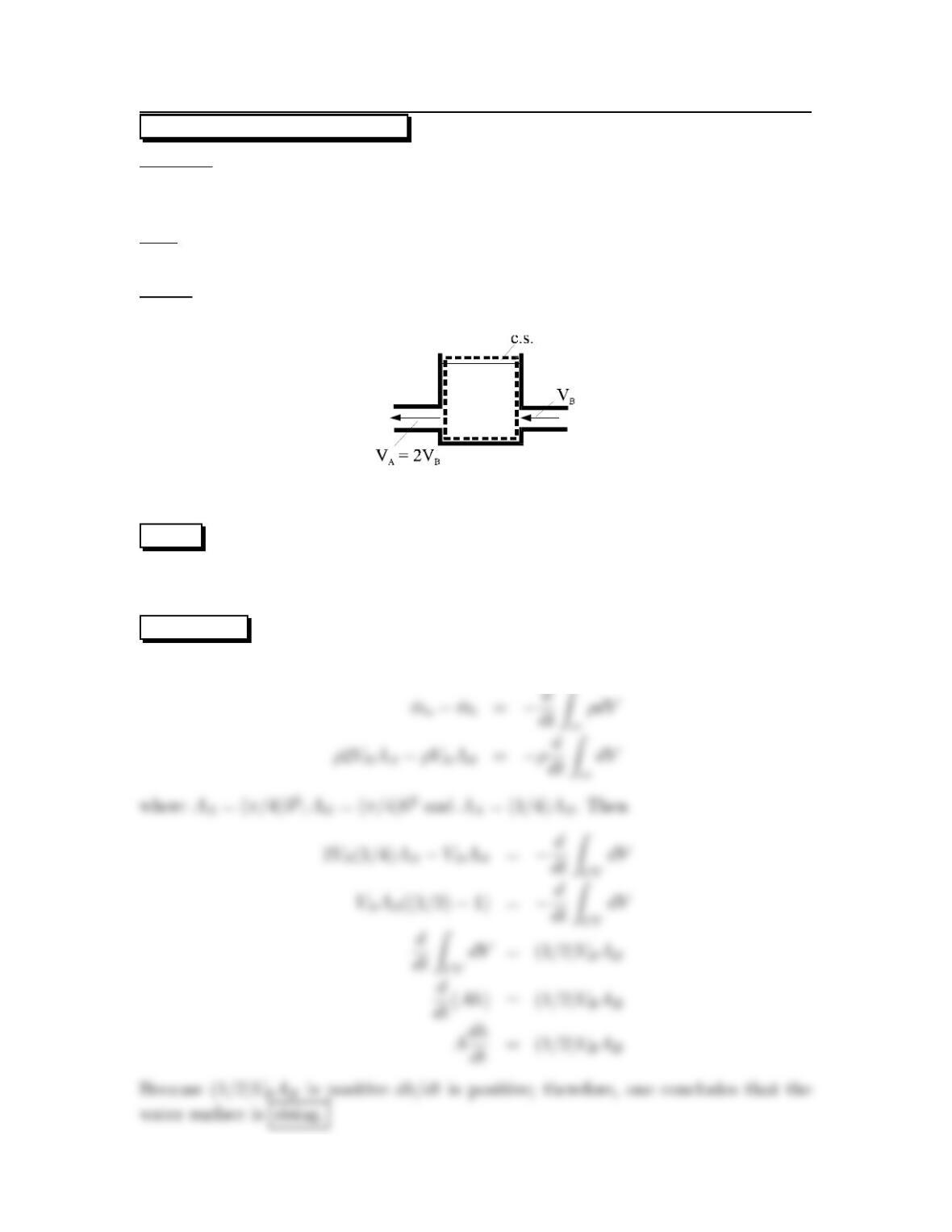
The level in the tank is influenced by the motion of pistons A and B moving left.
VA=2VB,DA=3in,DB=6in.
Find:
Determine whether the water level is rising, falling or staying the same.
Sketch:
PLAN
Apply the continuity equation. Select a control volume as shown above. Assume it
is coincident with and moves with the water surface.
SOLUTION
Continuity equation
52
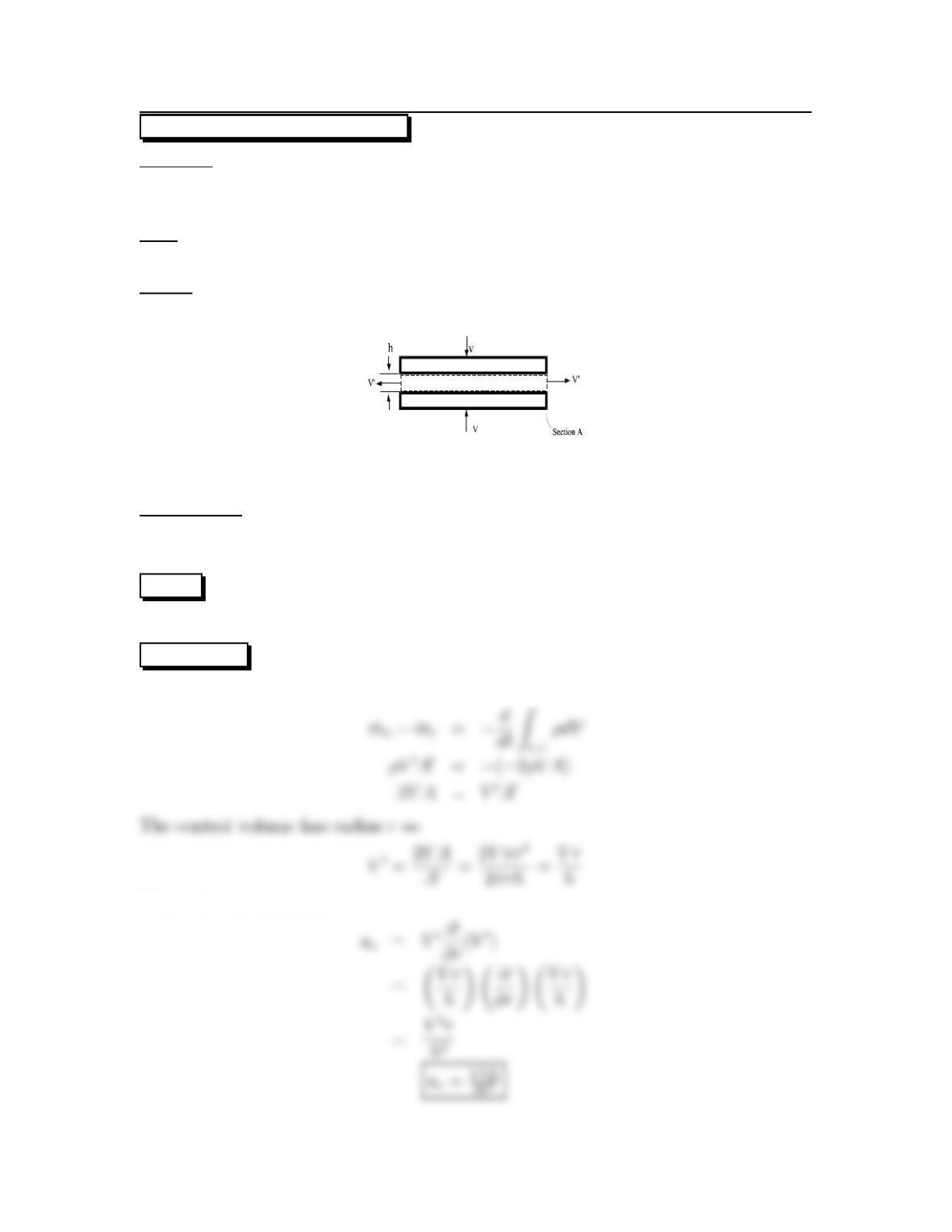
5.51: PROBLEM DEFINITION
Situation:
Two round plates move together. At the instant shown, the plate spacing is h.
Air flows across section A with a speed V0.
Find:
An expression for the radial component of convective acceleration at section A.
Sketch:
Assumptions:
Assume V0is constant across section A.
Assume the air has constant density.
PLAN
Apply the continuity equation to the control volume defined in the problem sketch.
SOLUTION
Continuity equation
Convective acceleration
53
5.52: PROBLEM DEFINITION
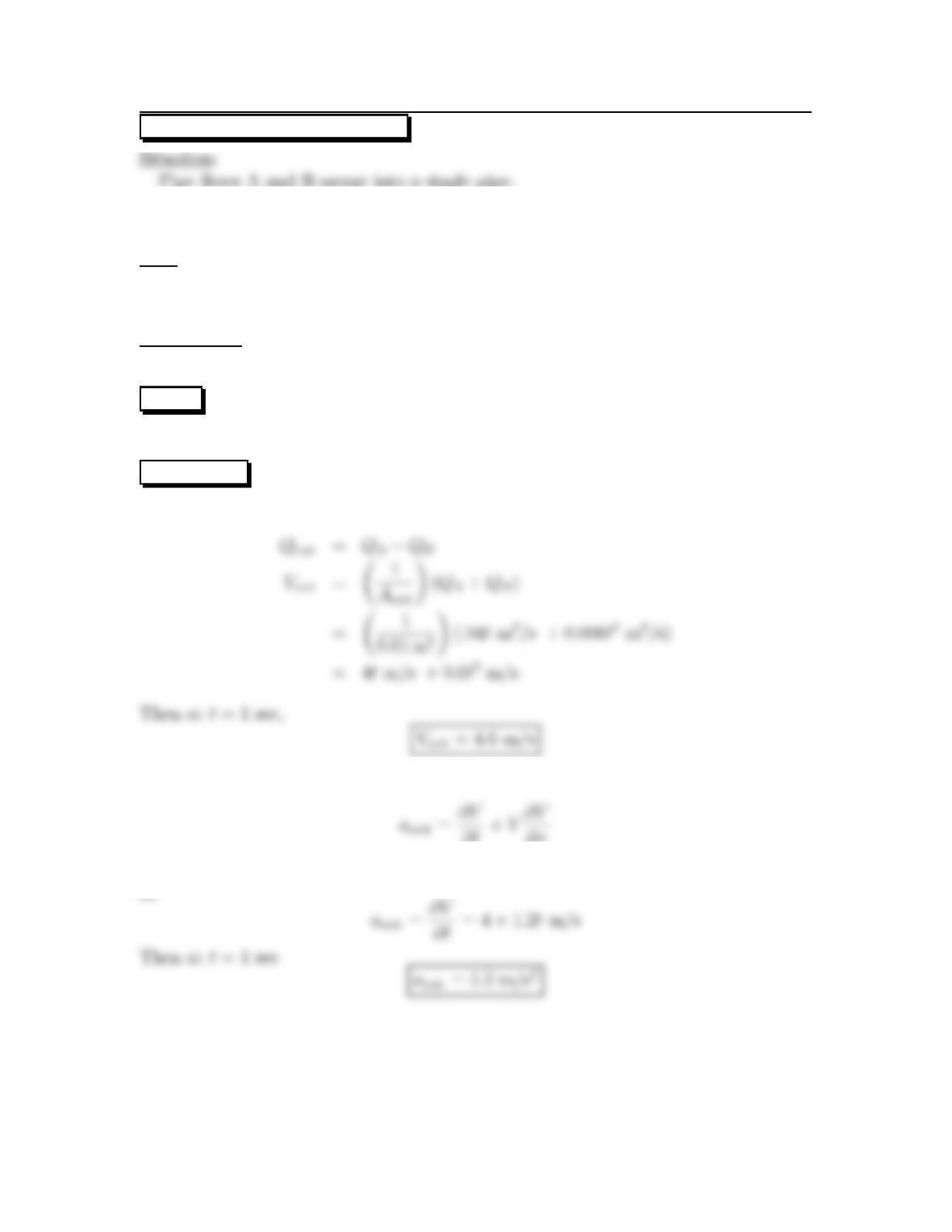
QA=0.04tm3/s,QB=0.006t2m3/s.
Aexit =0.01 m2,t=1s.
Find:
Velo city at the exit, Vexit.
Acceleration at the exit, aexit.
Assumptions:
Incompressible flow.
PLAN
Apply the continuity equation.
SOLUTION
Since the flow is incompressible, the unsteady term is zero. Continuity equation
The acceleration along a pathline at the (s→x)exitis
∂t +V∂V
∂x
Since Vvaries with time, but not with position, there is no convective acceleration
54
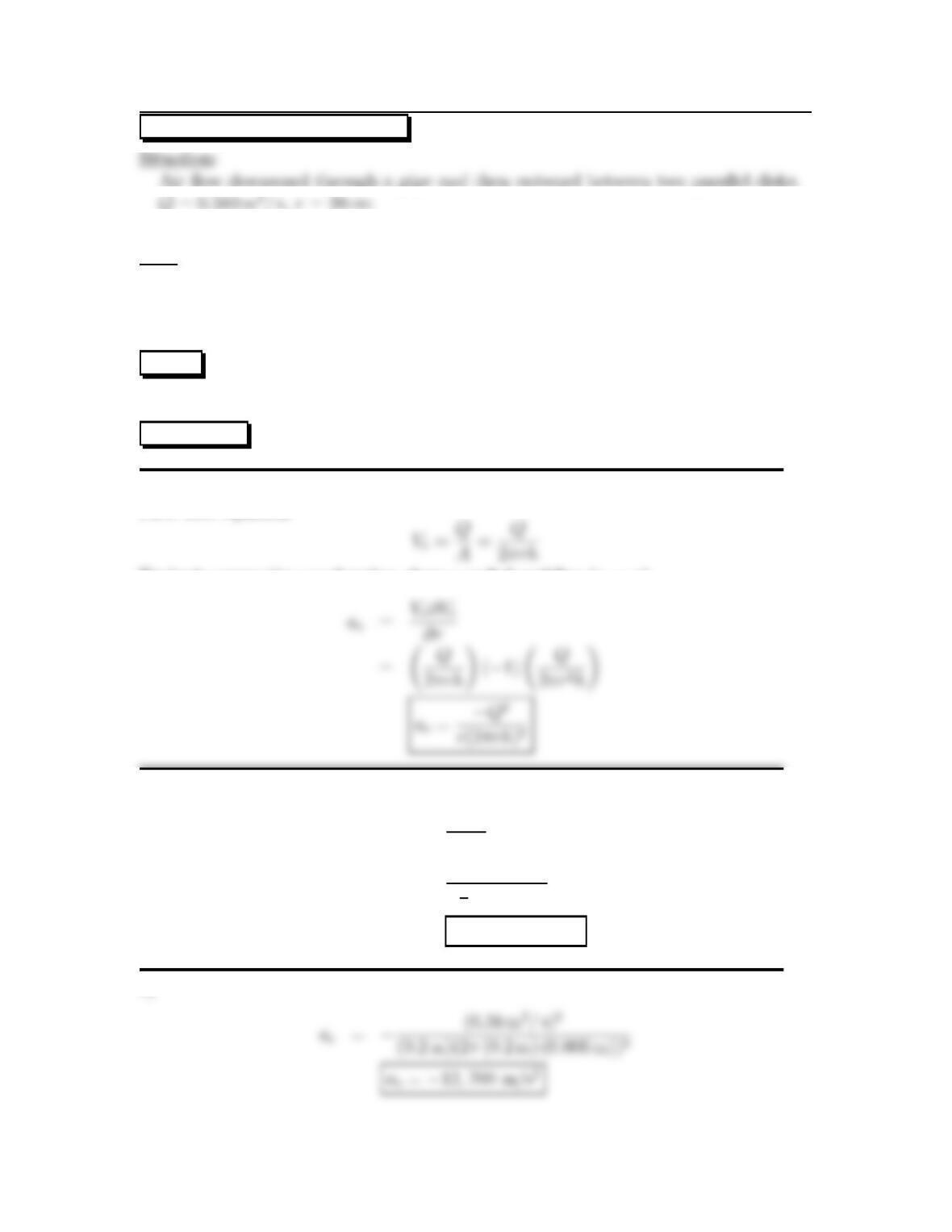
5.53: PROBLEM DEFINITION
D=0.1m,h=0.6cm.
Find:
(a) Expression for acceleration at point A.
(b) Value of acceleration at point A.
(c) Velocity in the pipe.
PLAN
Apply the flow rate equation.
SOLUTION
a)
Flow rate equation
Evaluate convective acceleration along a radial pathline (s→r)
b)
Vpipe =Q
Apipe
=(0.380 m3/s)
π
4(0.1m)
2
Vpipe =48.4m/s
c)
55
5.54: PROBLEM DEFINITION
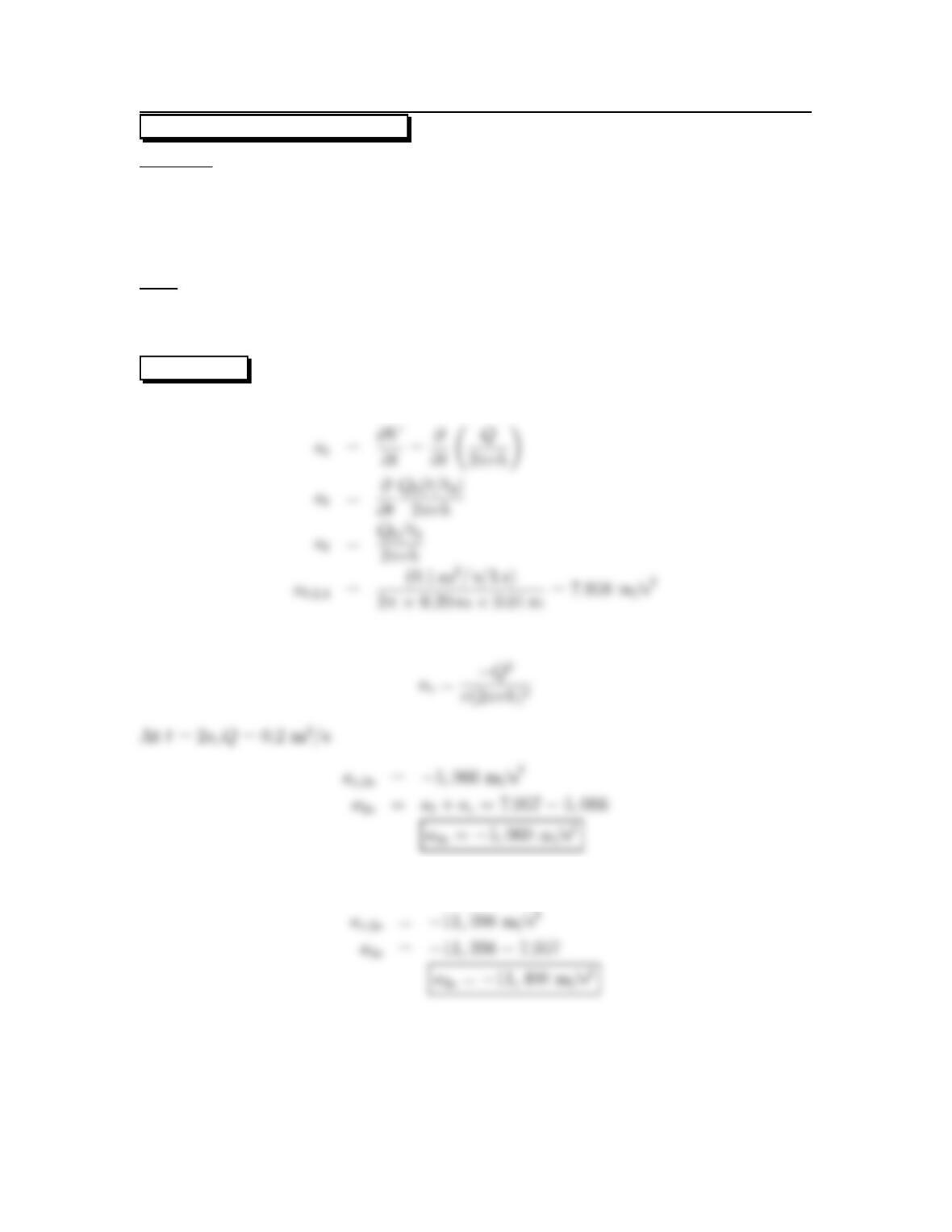
Situation:
Air flow downward through a pipe and then outward between two parallel disks.
Q=Q0(t/t0),r=20cm.
D=10cm,h=1cm.
t0=1s,Q0=0.1m
3/s.
Find:
(a) At t=2 s, acceleration at point A: a2.
(b) At t=3 s, acceleration at point A: a3.
SOLUTION
Local acceleration
From solution to Problem 5.53 in EFM10e
At t=3s, Q=0.3m3/s
56
5.55: PROBLEM DEFINITION
Situation:
Water flows into a tank through a pipe on the side and then out a pipe on the
bottom of the tank.
Aout =Ain =0.0025 m2,Atank =0.1m
2,
At h=1m,dh/dt =0.1m,V =√2gh.
Find:
Velocity in the inlet: Vin.
Assumptions:
Incompressible flow.
PLAN
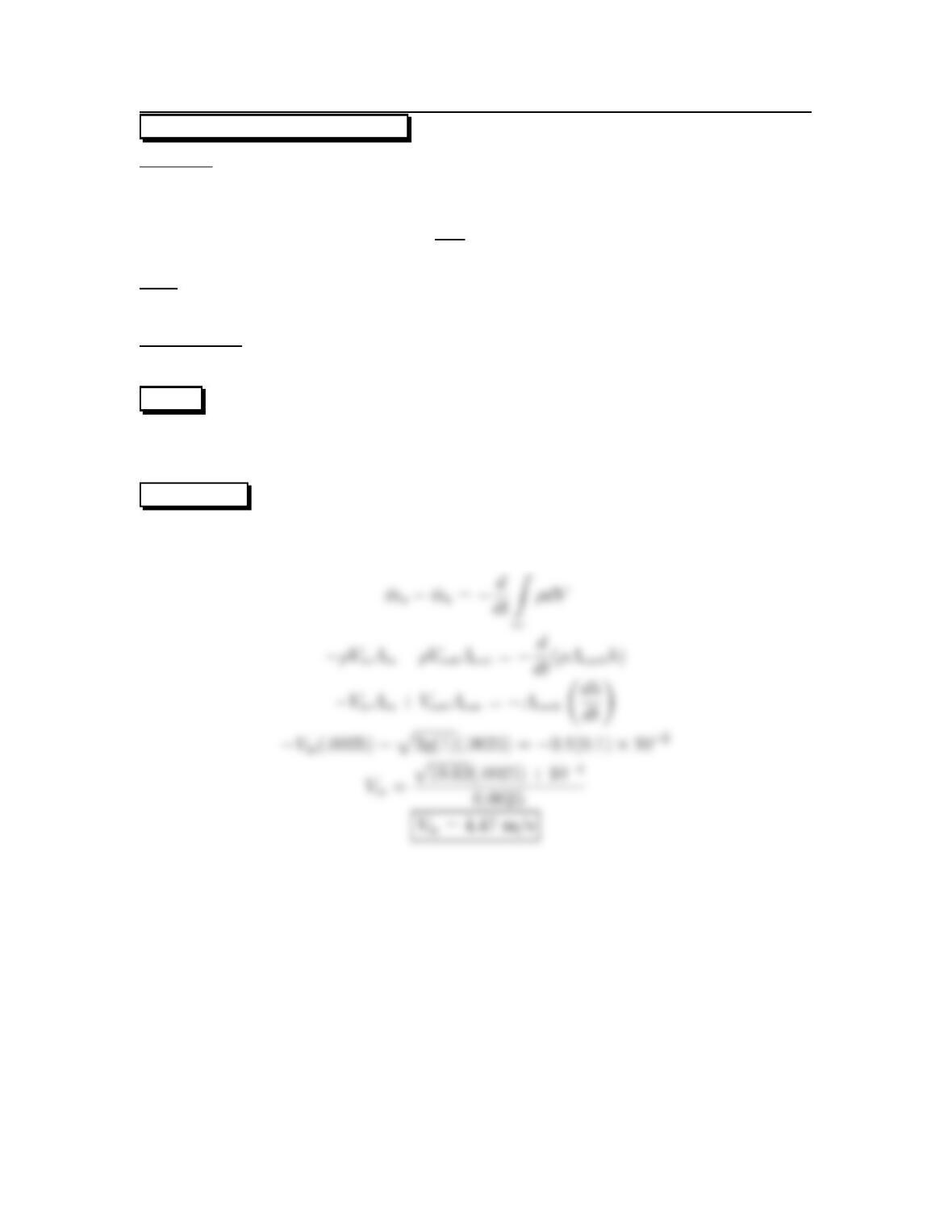
Apply the continuity equation. Let the control surface surround the liquid in the
tank and let it follow the liquid surface at the top.
SOLUTION
Continuity equation
57
5.56: PROBLEM DEFINITION
Situation:
A bicycle tire is inflated with air.The density of the air in the inflated tire is 0.4
lbm/ft3.
V=0.035 ft3,Qin =0.8ft
3/min.
Find:
Time needed to inflate the tire.
Properties:
ρin =0.075 lb/ft3,ρ
CV =0.04 lb/ft3.
PLAN
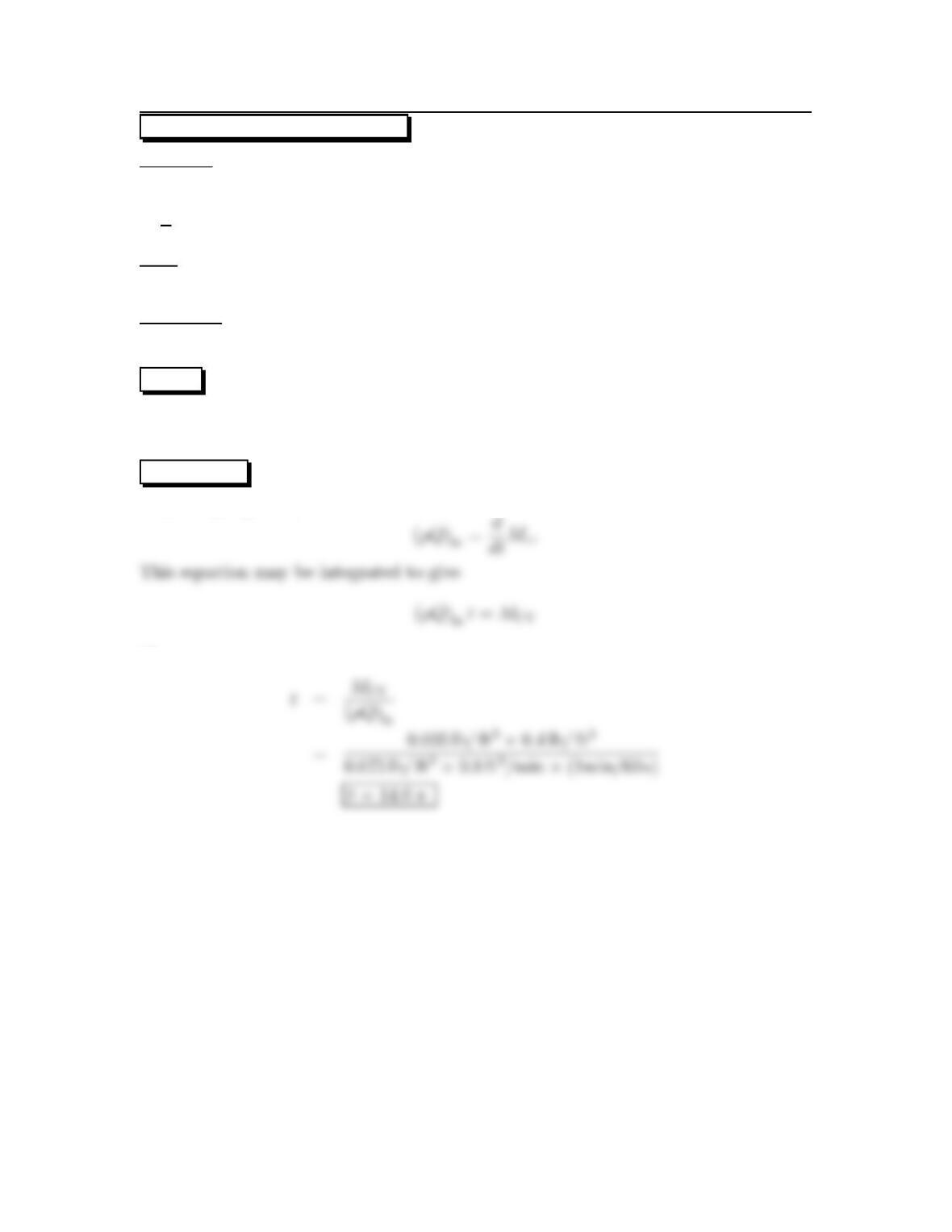
Apply the continuity equation. Select a control volume surrounding the air within
tire.
SOLUTION
Continuity equation
or
58
5.57: PROBLEM DEFINITION
Situation:
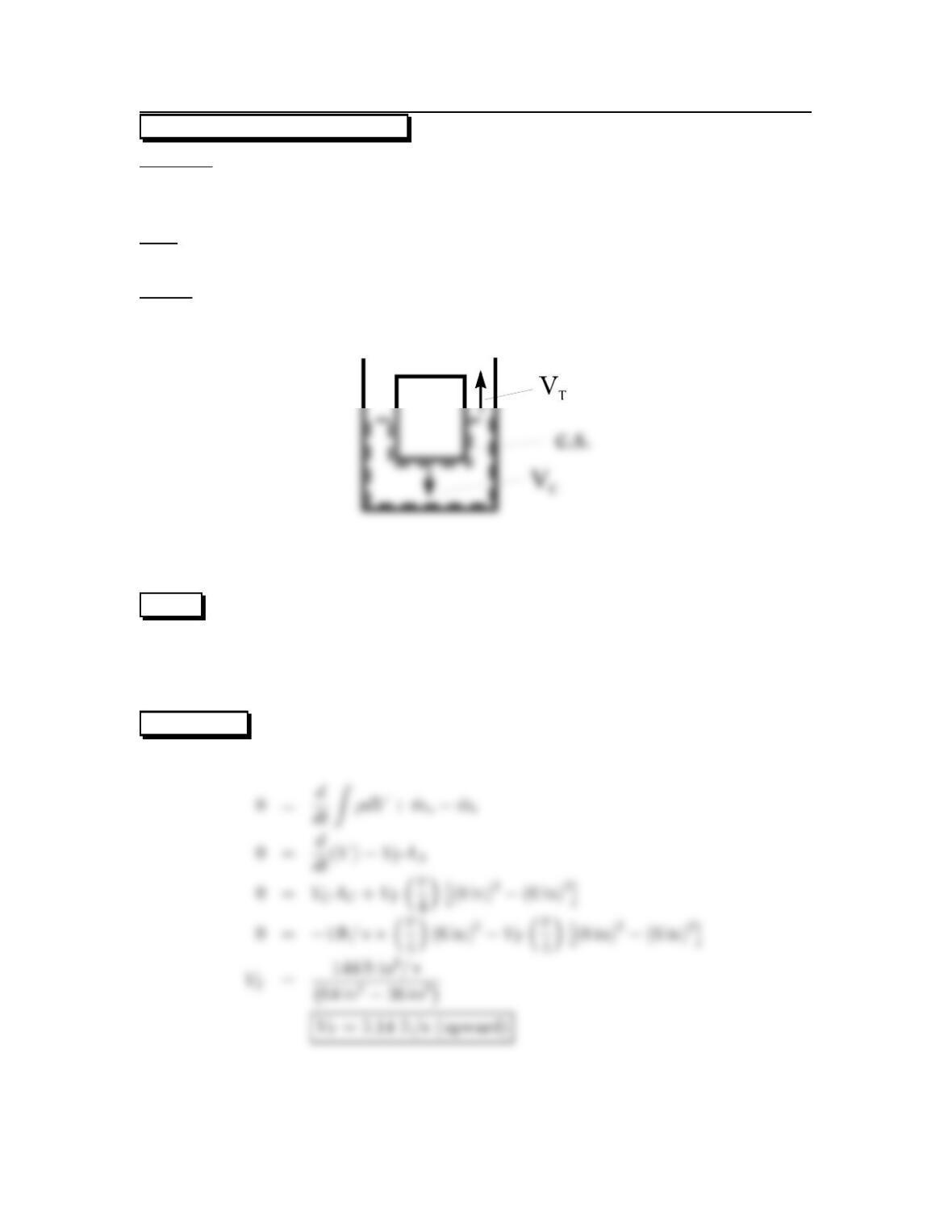
A cylinder falls in a tube containing a liquid.
VC=4 ft/s,Dtube =8in,Dcylinder =6in.
Find:
Mean velocity of the liquid in between the cylinder and the wall.
Sketch:
PLAN
Apply continuity equation and let the c.s. be fixedexceptatthebottomofthe
cylinder where the c.s. follows the cylinder as it moves down. The top of the control
volume is stationary with resepct to the wall.
SOLUTION
Continuity equation
59
5.58: PROBLEM DEFINITION
Situation:
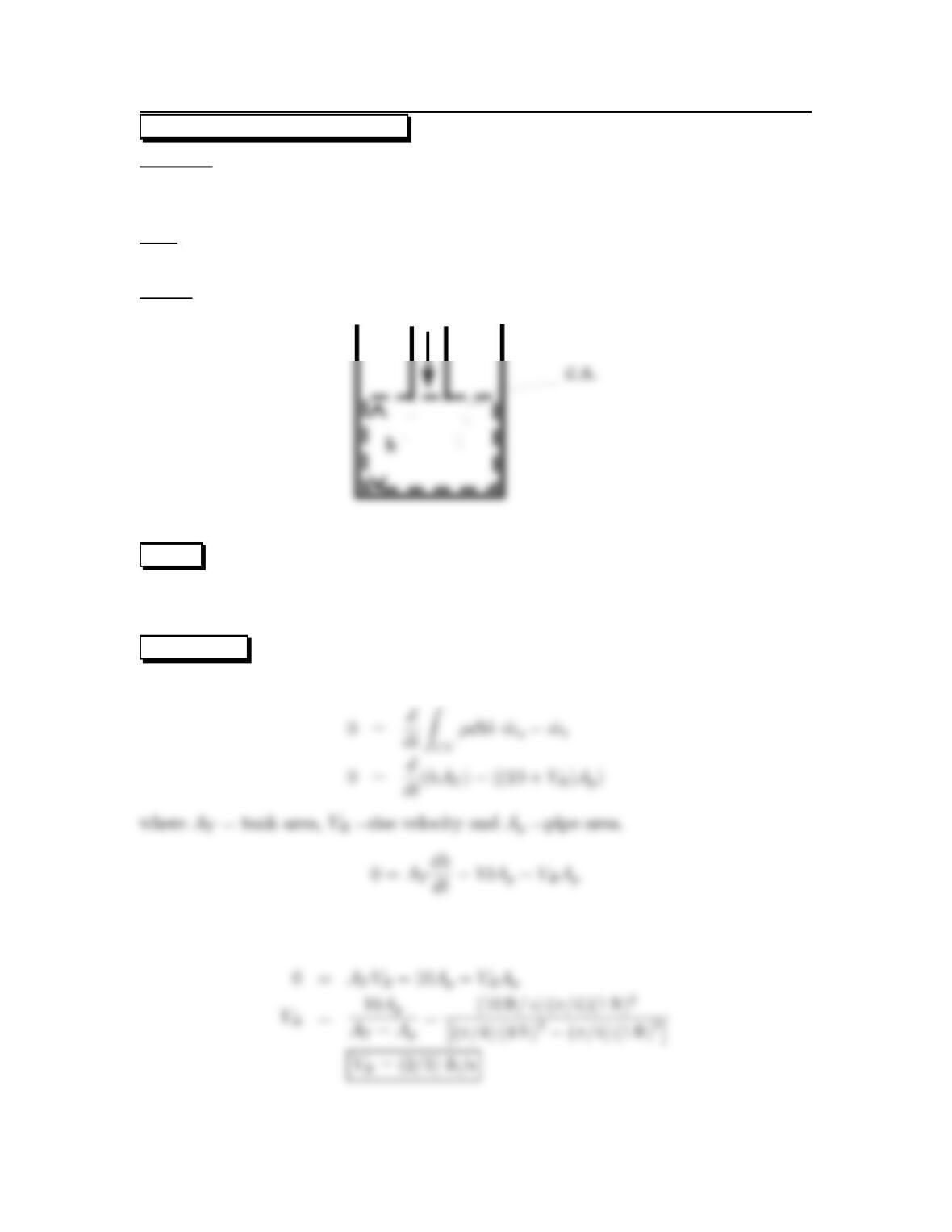
A round tank is being filled with water.
Vp=10ft/s,DT=4ft,Dp=1ft.
Find:
Rate at which the water surface is rising.
Sketch:
PLAN
Apply the continuity equation and let the c.s. move up with the water surface in the
tank.
SOLUTION
Continuity equation
but dh/dt =VRso
60