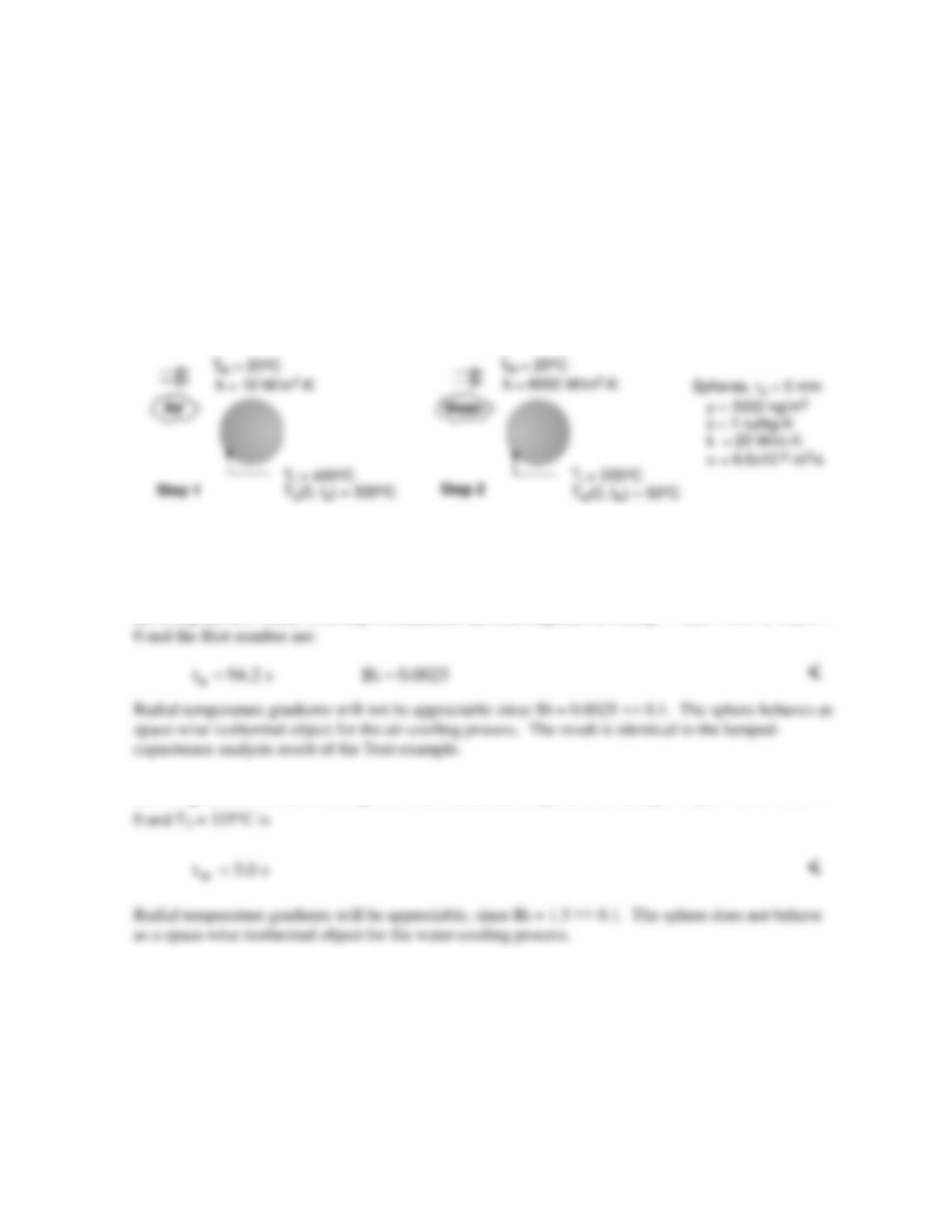
PROBLEM 5.64
KNOWN: Temperature requirements for cooling the spherical material of Example 5.6 in air and in a
water bath.
FIND: (a) For step 1, the time required for the center temperature to reach T(0,t) = 335°C while
cooling in air at 20°C with h = 10 W/m2⋅K; find the Biot number; do you expect radial gradients to be
appreciable?; compare results with hand calculations in Example 5.6; (b) For step 2, time required for
the center temperature to reach T(0,t) = 50°C while cooling in water bath at 20°C with h = 6000
W/m2⋅K; and (c) For step 2, calculate and plot the temperature history, T(x,t) vs. t, for the center and
surface of the sphere; explain features; when do you expect the temperature gradients in the sphere to
the largest? Use the IHT Models | Transient Conduction | Sphere model as your solution tool.
SCHEMATIC:
ASSUMPTIONS: (1) One–dimensional conduction in the radial direction, (2) Constant properties.
ANALYSIS: The IHT model represents the series solution for the sphere providing the temperatures
evaluated at (r,t). A selected portion of the IHT code used to obtain results is shown in the Comments.
(a) Using the IHT model with step 1 conditions, the time required for T(0,ta) = T_xt = 335°C with r =
(b) Using the IHT model with step 2 conditions, the time required for T(0,tw) = T_xt = 50°C with r =
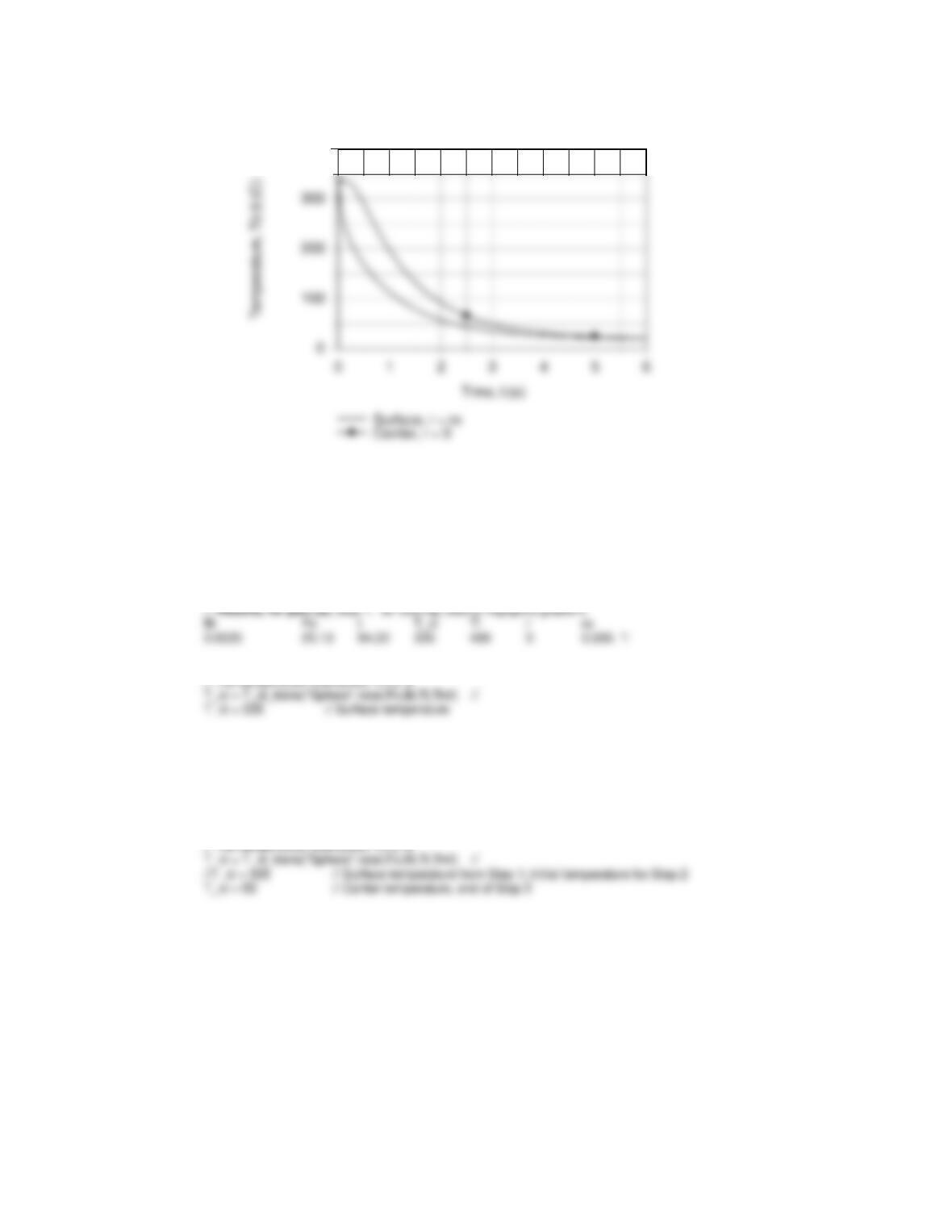
(c) For the step 2 cooling process, the temperature histories for the center and surface of the sphere are
calculated using the IHT model.
Continued …
PROBLEM 5.64 (Cont.)
At early times, the difference between the center and surface temperature is appreciable. It is in this
time region that thermal stresses will be a maximum, and if large enough, can cause fracture. Within 6
seconds, the sphere has a uniform temperature equal to that of the water bath.
COMMENTS: Selected portions of the IHT sphere model codes for steps 1 and 2 are shown below.
// Models | Transient Conduction | Sphere – Step 1, Air cooling
/* Results, for part (b), step 2, water cooling; Ti = 335 C
Bi Fo t T_xt Ti r ro
1.5 0.7936 2.976 50 335 0 0.005 */
// Models | Transient Conduction | Sphere – Step 2, Water cooling
Temperature-time history, Step 2
400
PROBLEM 5.65
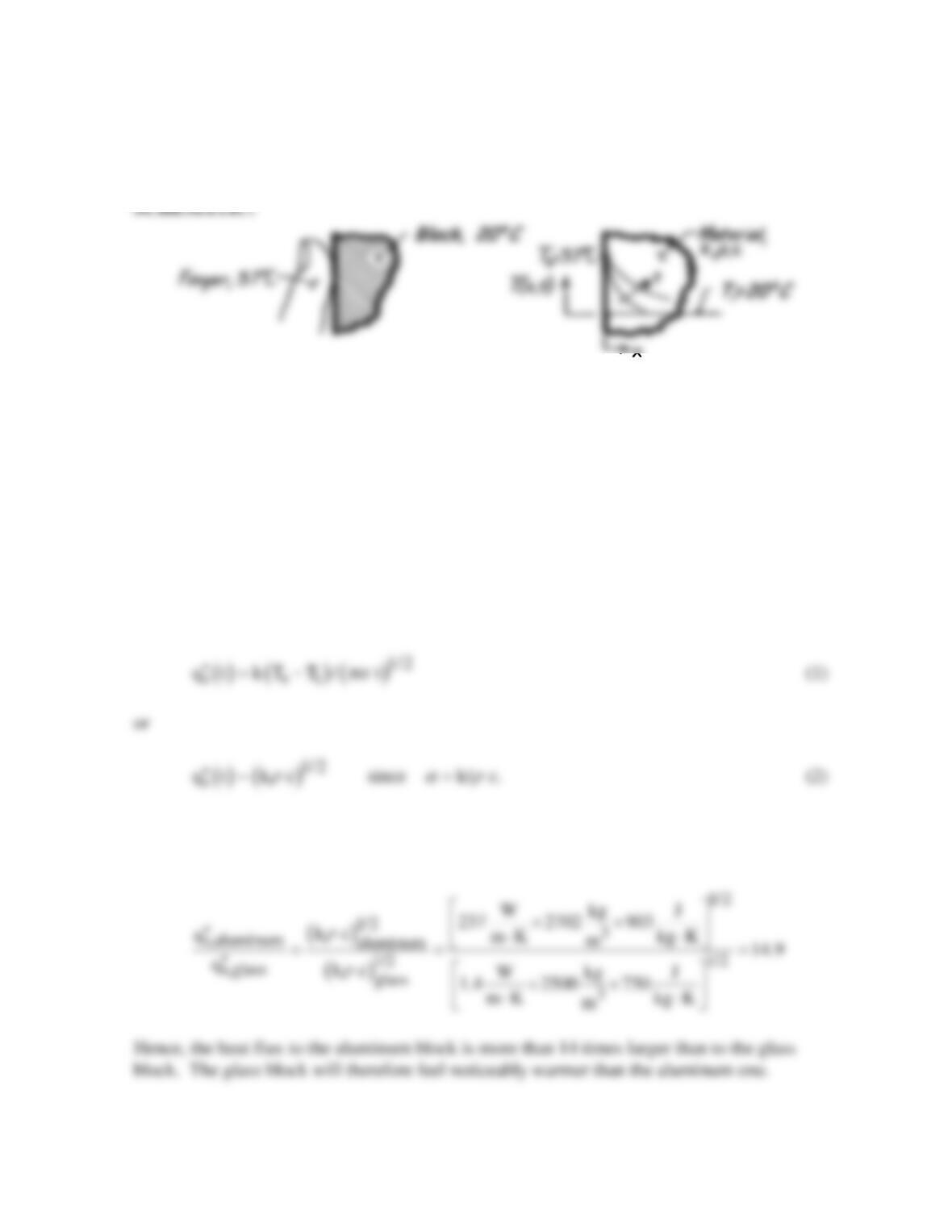
KNOWN: Two large blocks of different materials – like aluminum and glass – at room
temperature, 20°C.
FIND: Which block will feel cooler to the touch?
ASSUMPTIONS: (1) Blocks can be treated as semi-infinite solid, (2) Hand or finger
temperature is 37°C.
PROPERTIES: Table A-1, Aluminum, pure (300K): ρ = 2702 kg/m3, c = 903 J/kg⋅K, k =
237 W/m⋅K; Table A-3, Glass, plate (300K): ρ = 2500 kg/m3, c = 750 J/kg⋅K, k = 1.4
W/m⋅K.
ANALYSIS: Considering the block as a semi-infinite solid, the heat transfer situation
corresponds to a sudden change in surface temperature, Case 1, Figure 5.7. The sensation of
coolness is related to the heat flow from the hand or finger to the block. From Eq. 5.61, the
surface heat flux is
Hence for the same temperature difference,
si
T T,−
and elapsed time, it follows that the heat
fluxes for the two materials are related as
COMMENTS: The analysis could be modified by assuming the hand is also a semi-infinite
solid, suggesting usage of Eq. 5.66.
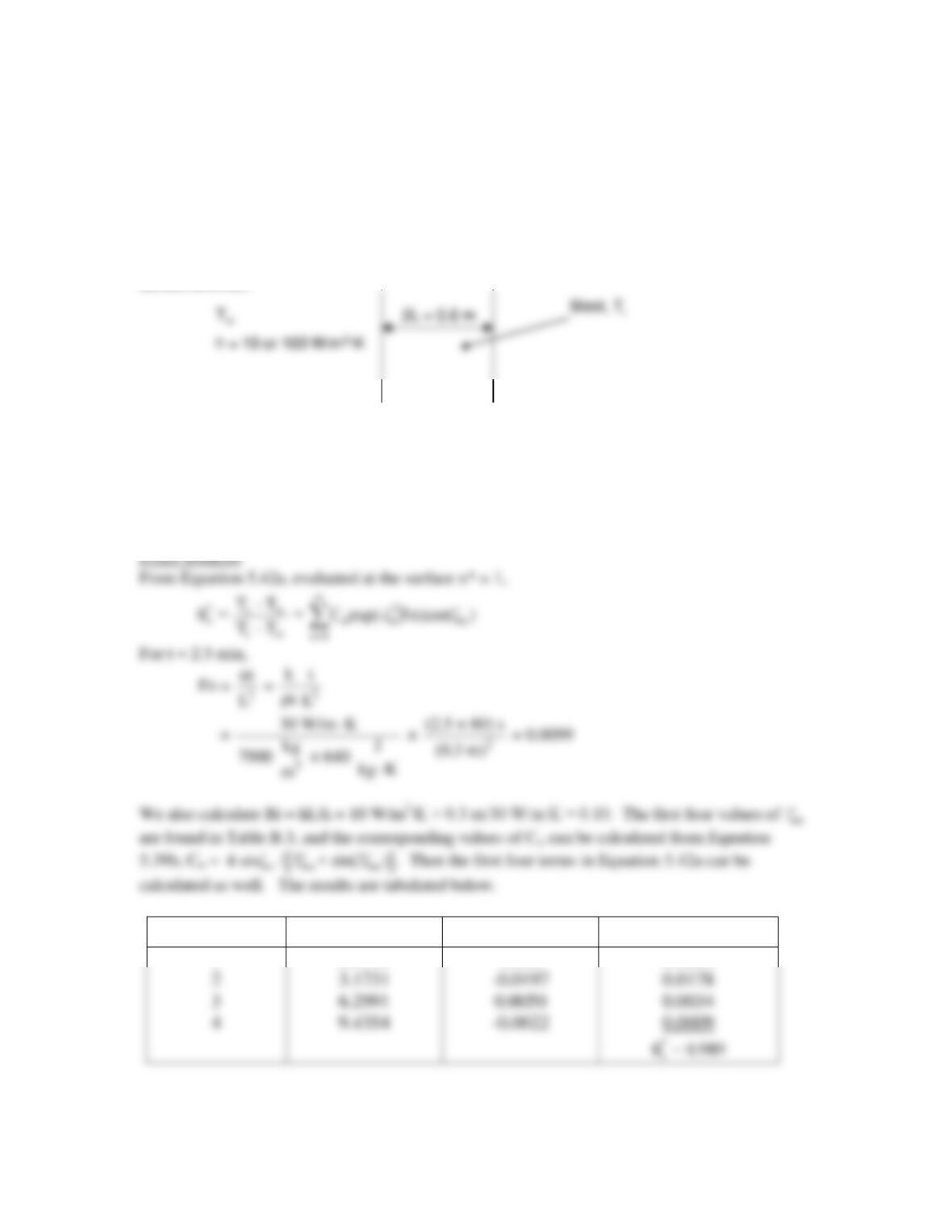
PROBLEM 5.66
KNOWN: Thickness and properties of plane wall. Convection coefficient.
FIND: (a) Nondimensional temperature for six different cases using four methods and (b)
Explain the conditions for which the three approximate methods are good approximations of the
exact solution.
SCHEMATIC:
ASSUMPTIONS: (1) Constant properties.
PROPERTIES: Steel (given): k = 30 W/m∙K, ρ = 7900 kg/m3, c = 640 J/kg∙K.
ANALYSIS:
(a) We perform the calculations for h = 10 W/m2∙K, t = 2.5 min.
n
n
ζ
C
n
2
nn n
C exp( Fo)cos( )−ζ ζ
1
0.3111
1.016
0.9664
Continued…
PROBLEM 5.66 (Cont.)
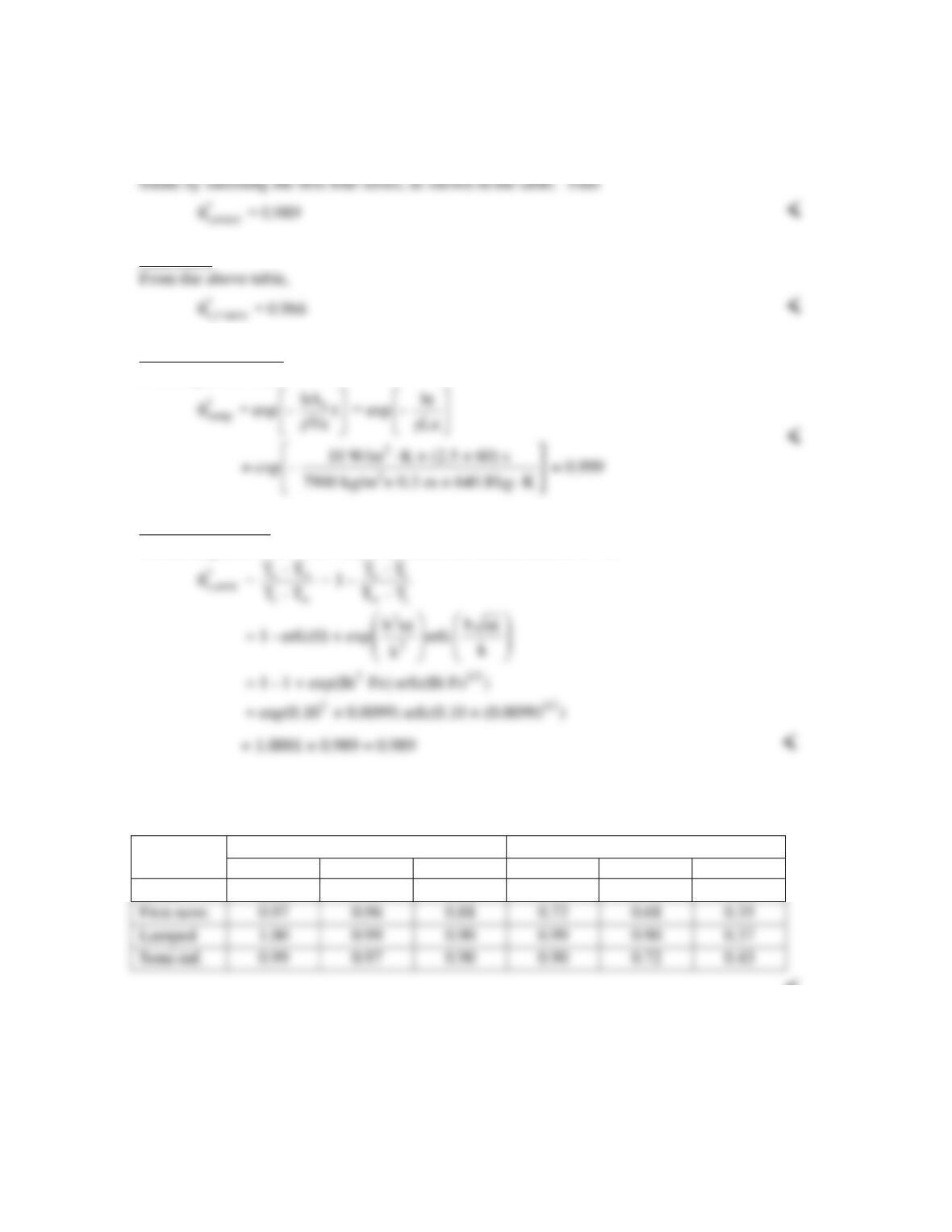
We can see that the fourth term is small, so to a good approximation the exact solution can be
First Term
Lumped Capacitance
From Equation 5.6,
Semi-Infinite Solid
We use Equation 5.63 with x measured from the surface, that is x = 0.
where the error function was evaluated from Table B.2.
Repeating the calculation for the other five cases, the following table can be compiled:
Method
Bi = 0.1
Bi = 1
Fo = 0.01
Fo = 0.1
Fo = 1.0
Fo = 0.01
Fo = 0.1
Fo = 1.0
Exact
0.99
0.97
0.88
0.90
0.72
0.35
0.97
0.96
0.88
0.72
0.68
0.35
0.99
0.97
0.90
0.90
0.72
0.43
<
(b) (i) The first term solution is a good approximation to the exact solution for Fo > 0.2. As
seen in the above table, for Fo = 1.0, the first term solution is correct to two significant digits.
Continued…

PROBLEM 5.66 (Cont.)
(ii) The lumped capacitance solution is a good approximation to the exact solution for
PROBLEM 5.67
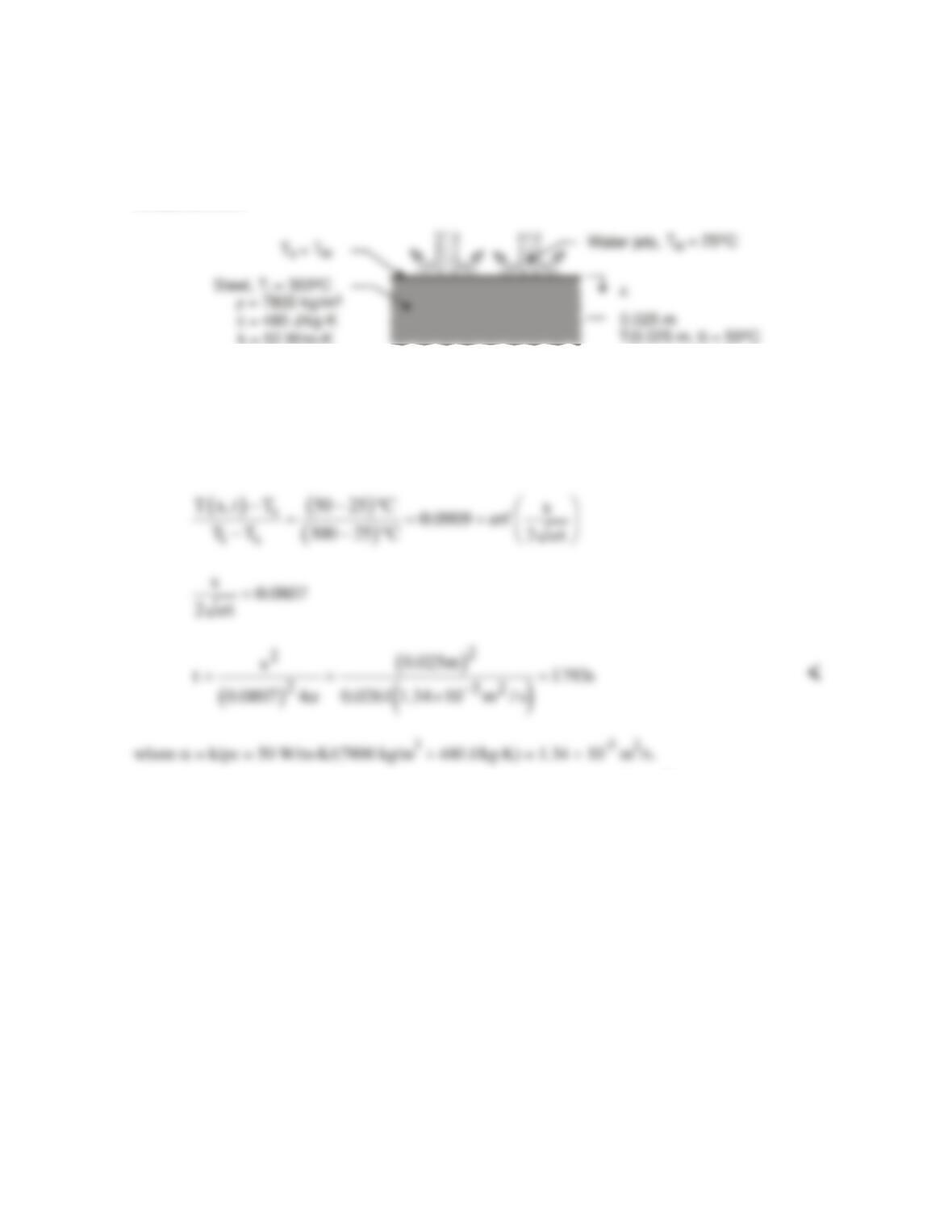
KNOWN: Thermophysical properties and initial temperature of thick steel plate. Temperature of
water jets used for convection cooling at one surface.
FIND: Time required to cool prescribed interior location to a prescribed temperature.
SCHEMATIC:
k = 50 W/m-K T(0.025 m, t) C
o
ASSUMPTIONS: (1) One-dimensional conduction in slab, (2) Validity of semi-infinite medium
approximation, (3) Negligible thermal resistance between water jets and slab surface (Ts = T∞), (4)
Constant properties.
ANALYSIS: The desired cooling time may be obtained from Eq. (5.60). With T(0.025m, t) = 50°C,
COMMENTS: (1) Large values of the convection coefficient (h ~ 104 W/m2⋅K) are associated with
water jet impingement, and it is reasonable to assume that the surface is immediately quenched to the
temperature of the water. (2) The surface heat flux may be determined from Eq. (5.61). In principle,
the flux is infinite at t = 0 and decays as t1/2.
PROBLEM 5.68
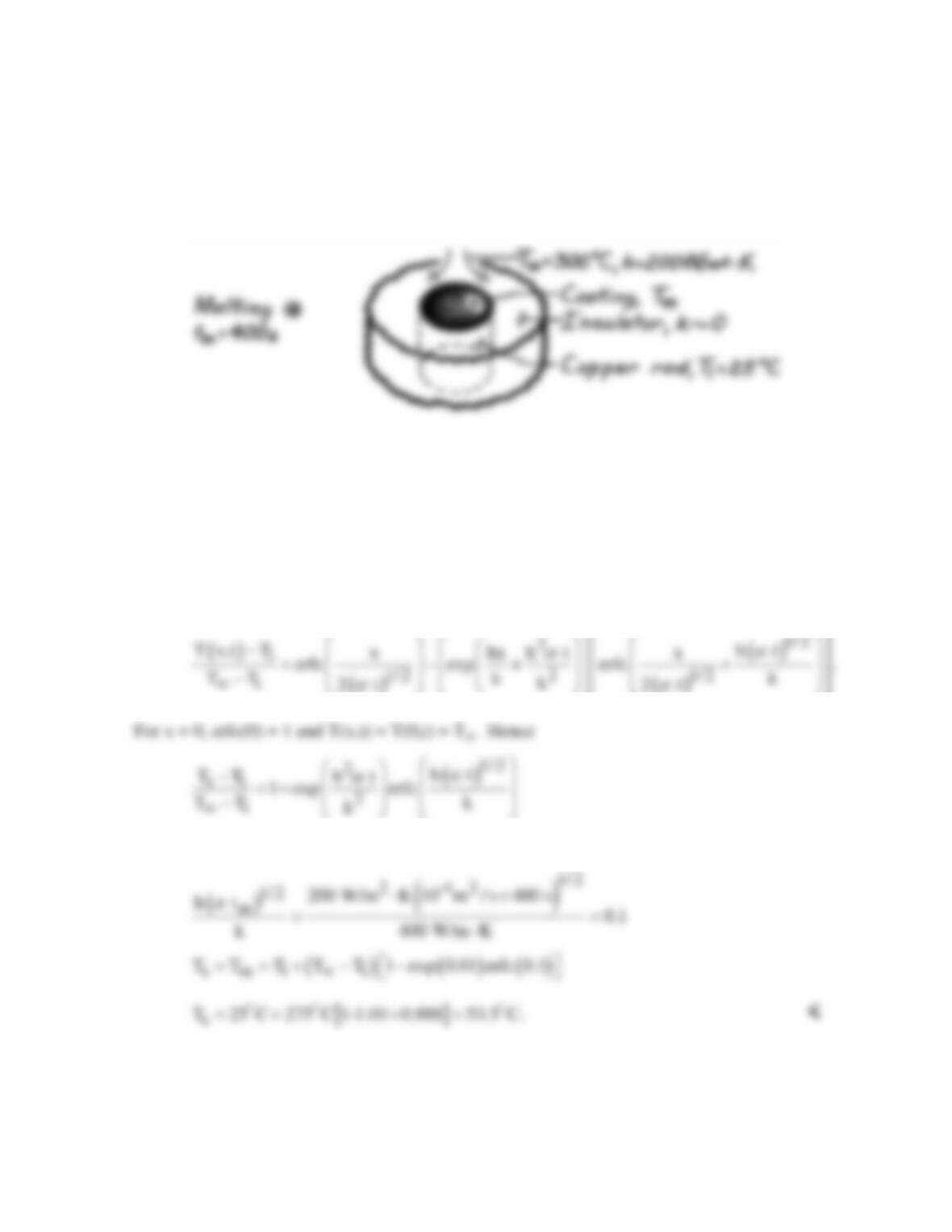
KNOWN: Procedure for measuring convection heat transfer coefficient, which involves
melting of a surface coating.
FIND: Melting point of coating for prescribed conditions.
SCHEMATIC:
ASSUMPTIONS: (1) One-dimensional conduction in solid rod (negligible losses to
insulation), (2) Rod approximated as semi-infinite medium, (3) Negligible surface radiation,
(4) Constant properties, (5) Negligible thermal resistance of coating.
PROPERTIES: Copper rod (Given): k = 400 W/m⋅K, α = 10–4 m2/s.
ANALYSIS: Problem corresponds to transient conduction in a semi-infinite solid. Thermal
response is given by
with
COMMENTS: Use of the procedure to evaluate h from measurement of tm necessitates
iterative calculations.
PROBLEM 5.69
KNOWN: Irreversible thermal injury (cell damage) occurs in living tissue maintained at T ≥ 48°C for a
duration ∆t ≥ 10s.
FIND: (a) Extent of damage for 10 seconds of contact with machinery in the temperature range 50 to
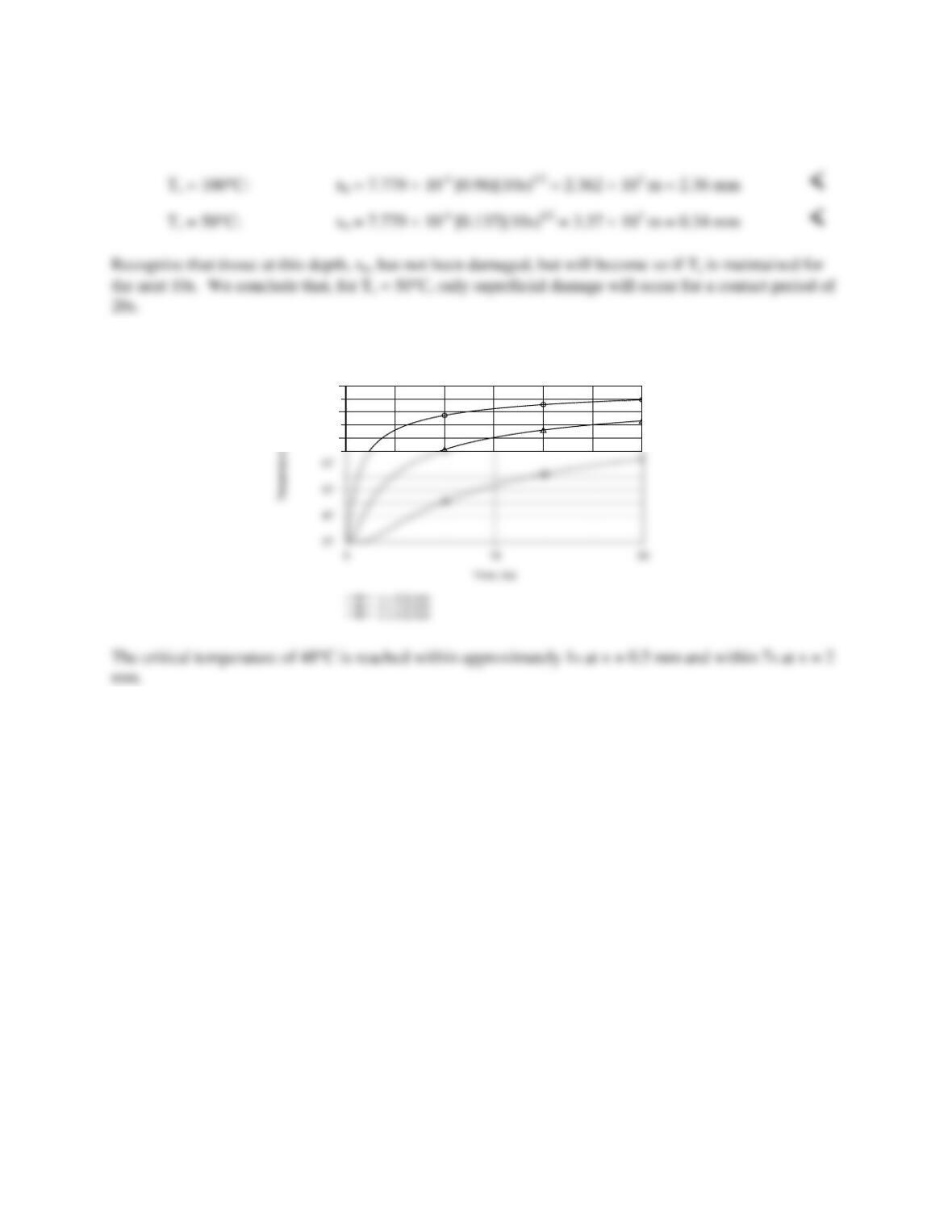
100°C, (b) Temperature histories at selected locations in tissue (x = 0.5, 1, 5 mm) for a machinery
temperature of 100°C.
ASSUMPTIONS: (1) Portion of worker’s body modeled as semi-infinite medium, initially at a uniform
temperature, 37°C, (2) Tissue properties are constant and equivalent to those of water at 37°C, (3)
Negligible contact resistance.
PROPERTIES: Table A-6, Water, liquid (T = 37°C = 310 K): ρ = 1/vf = 993.1 kg/m3, c = 4178 J/kg⋅K,
k = 0.628 W/m⋅K, α = k/ρc = 1.513 × 10⁻⁷ m2/s.
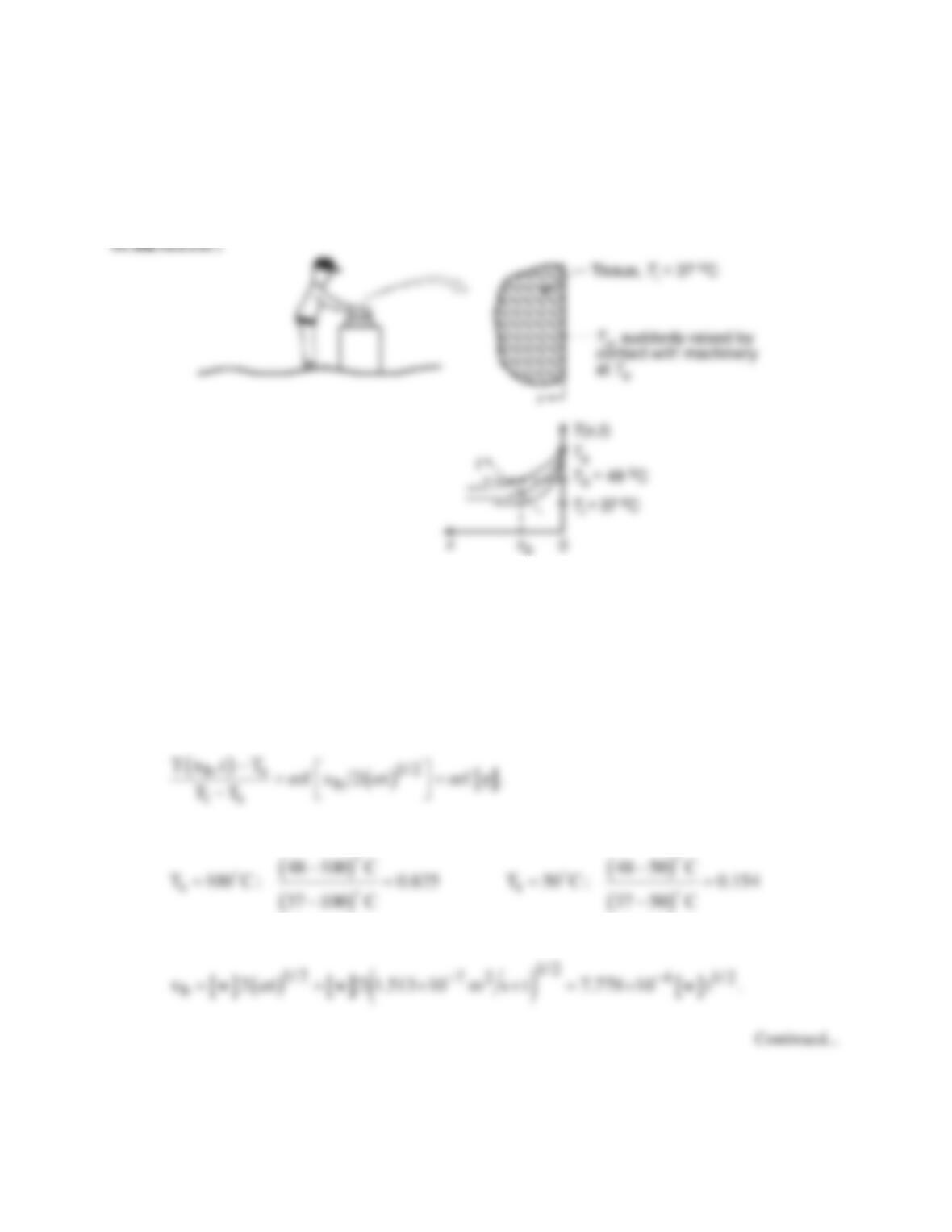
ANALYSIS: (a) For a given surface temperature — suddenly applied — the analysis is directed toward
finding the skin depth xb for which the tissue will be at Tb ≥ 48°C for more than 10s? From Eq. 5.60,
For the two values of Ts, the left-hand side of the equation is
The burn depth is
PROBLEM 5.69 (Cont.)
Using Table B.2 to evaluate the error function and letting t = 10s, find xb as
(b) Temperature histories at the prescribed locations are as follows.
77
87
97
COMMENTS: Note that the burn depth xb increases as t1/2.
PROBLEM 5.70
KNOWN: Thermocouple location in thick slab. Initial temperature. Thermocouple
measurement two minutes after one surface is brought to temperature of boiling water.
FIND: Thermal conductivity of slab material.
SCHEMATIC:
ASSUMPTIONS: (1) One-dimensional conduction in x, (2) Slab is semi-infinite medium,
(3) Constant properties.
PROPERTIES: Slab material (given): ρ = 2200 kg/m3, c = 700 J/kg⋅K.
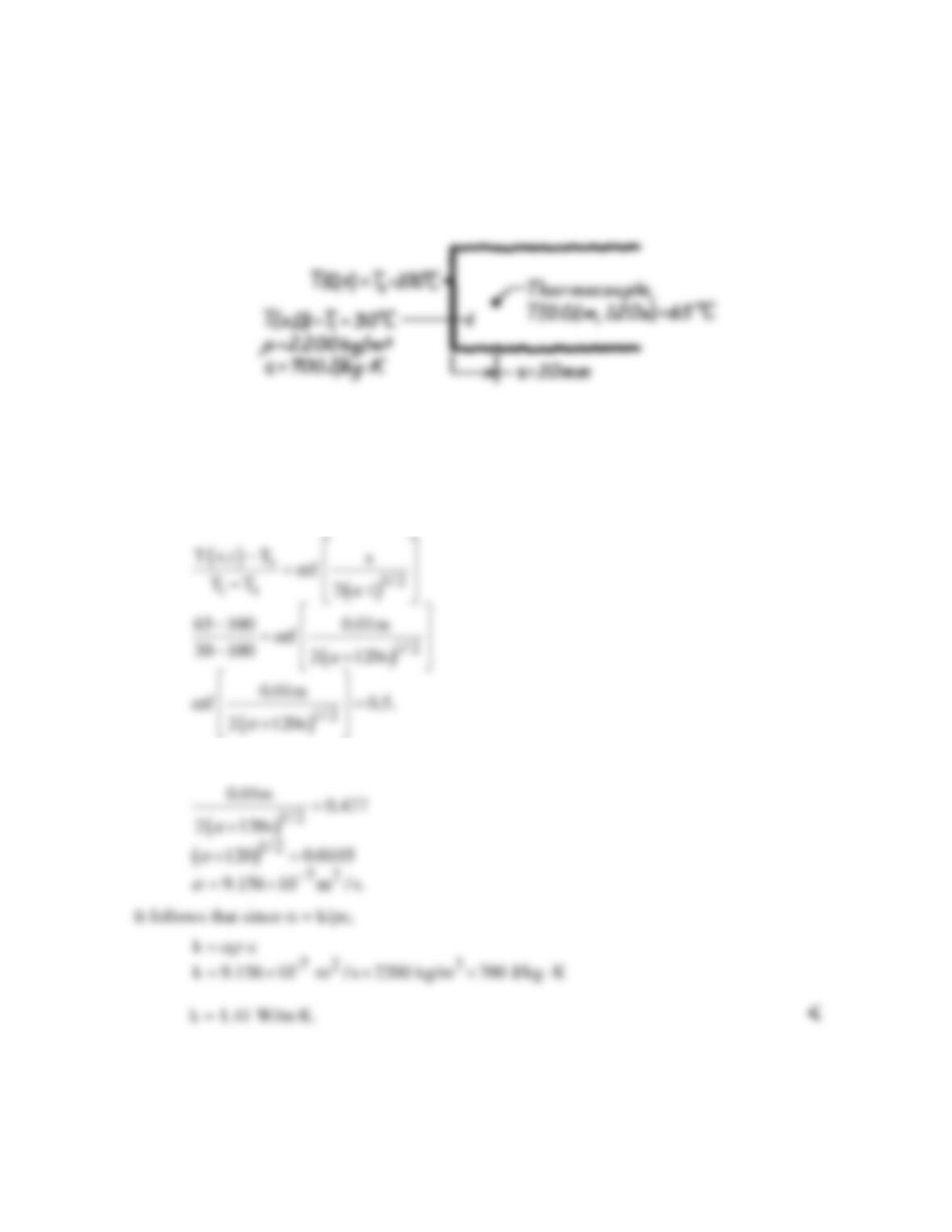
ANALYSIS: For the semi-infinite medium from Eq. 5.60,
From Appendix B, find for erf w = 0.5 that w = 0.477; hence,
PROBLEM 5.71
KNOWN: Gel applied to ultrasound probe window. Gel and window properties. Initial probe
temperatures.
FIND: Required initial gel temperature to ensure gel remains below 12°C.
SCHEMATIC:
ASSUMPTIONS: (1) Gel and window can be treated as semi–infinite solids. (2) Uniform properties.
PROPERTIES: Table A-6, Water (T = 285 K):
ρ
g =1000 kg/m3, cp= 4189 J/kg⋅K, k = 0.59 W/m⋅K.
Given, Window:
ρ
w =1200 kg/m3, cp= 1200 J/kg⋅K, k = 0.2 W/m⋅K.
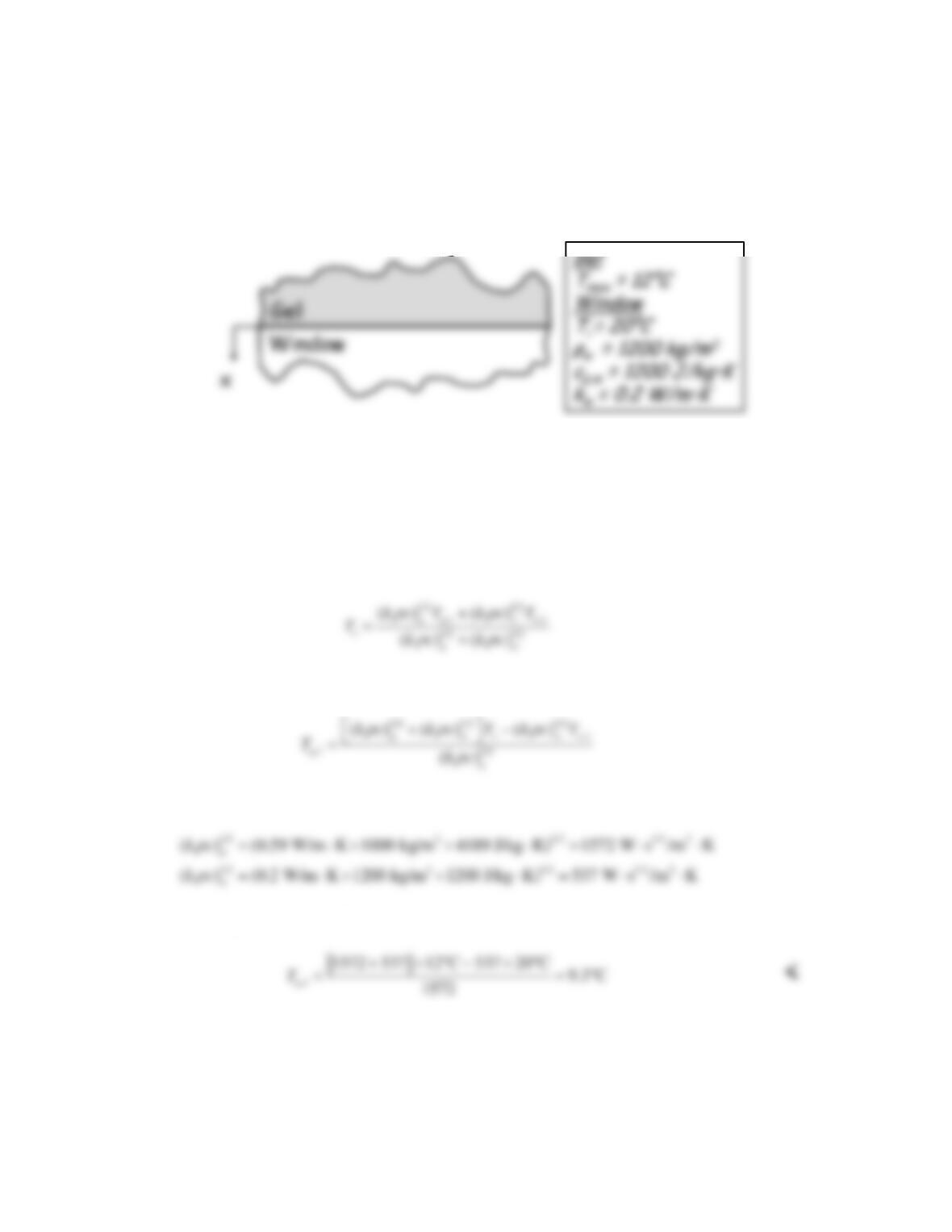
ANALYSIS: The maximum gel temperature occurs at the gel–window interface. For two semi-infinite
materials brought into contact, the interface temperature is given by Equation 5.66:
Solving for the initial gel temperature,
The effusivities of the two materials are:
Thus, with the requirement Ts < 12°C, we find
COMMENTS: The assumption that the two materials can be treated as semi–infinite is only valid for
short times, before the penetration depth,
d
p = 2.3(
α
t)1/2, exceeds the thickness of the material.
PROBLEM 5.72
KNOWN: Thick oak wall, initially at a uniform temperature of 25°C, is suddenly exposed to
combustion products at 800°C with a convection coefficient of 20 W/m2⋅K.
FIND: (a) Time of exposure required for the surface to reach an ignition temperature of 400°C, (b)
Temperature distribution at time t = 325s.
SCHEMATIC:
ASSUMPTIONS: (1) Oak wall can be treated as semi-infinite solid, (2) One-dimensional conduction,
(3) Constant properties, (4) Negligible radiation.
PROPERTIES: Table A-3, Oak, cross grain (300 K): ρ = 545 kg/m3, c = 2385 J/kg⋅K, k = 0.17 W/m⋅K,
α = k/ρc = 0.17 W/m⋅K/545 kg/m3 × 2385 J/kg⋅K = 1.31 × 10⁻⁷ m2/s.
ANALYSIS: (a) This situation corresponds to Case 3 of Figure 5.7. The temperature distribution is
given by Eq. 5.63 or by Figure 5.8. Using the figure with
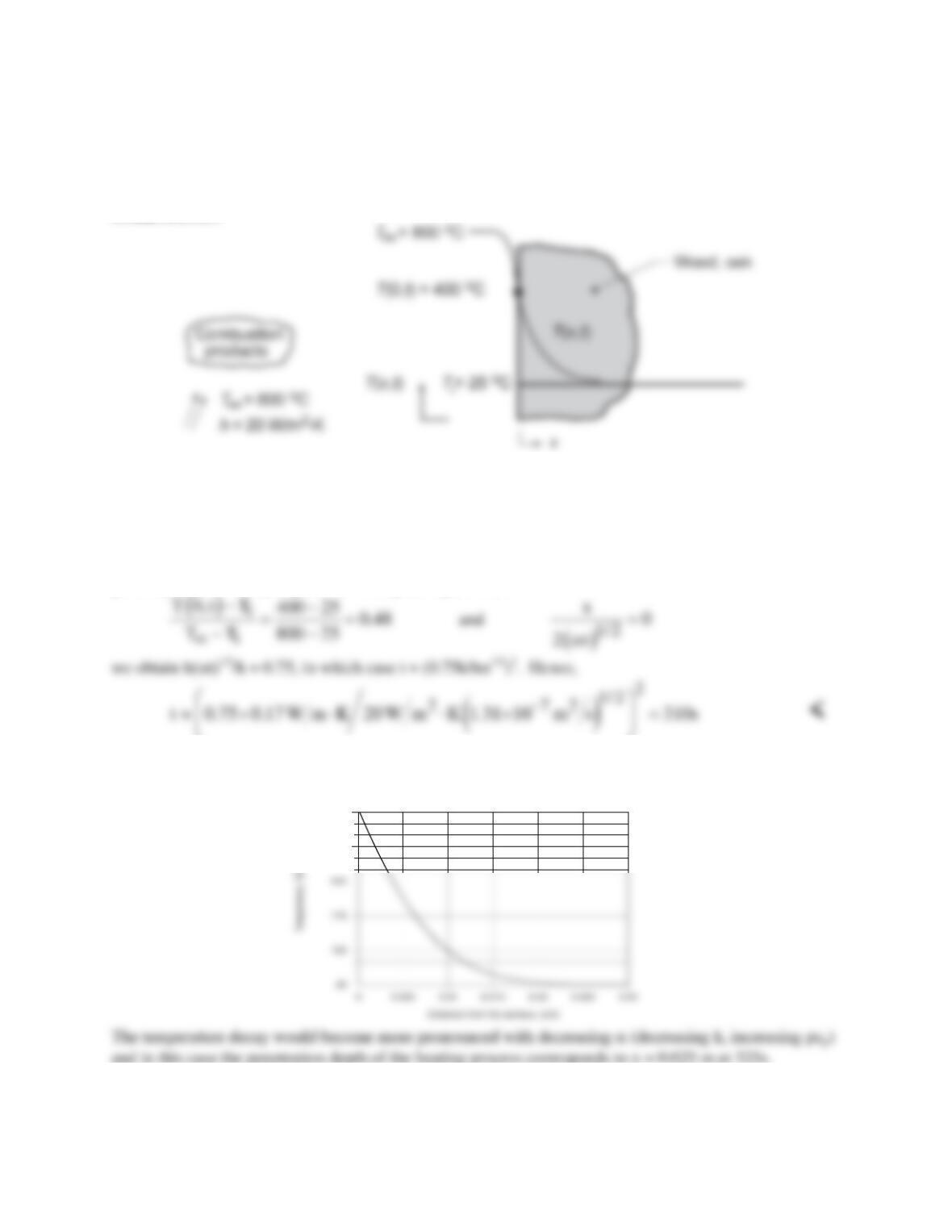
(b) Using the IHT Transient Conduction Model for a Semi–infinite Solid, the following temperature
distribution was generated for t = 325s.
325
400
and in this case the penetration depth of the heating process corresponds to x ≈ 0.025 m at 325s.
COMMENTS: The result of part (a) indicates that, after approximately 5 minutes, the surface of the
wall will ignite and combustion will ensue. Once combustion has started, the present model is no longer
appropriate.
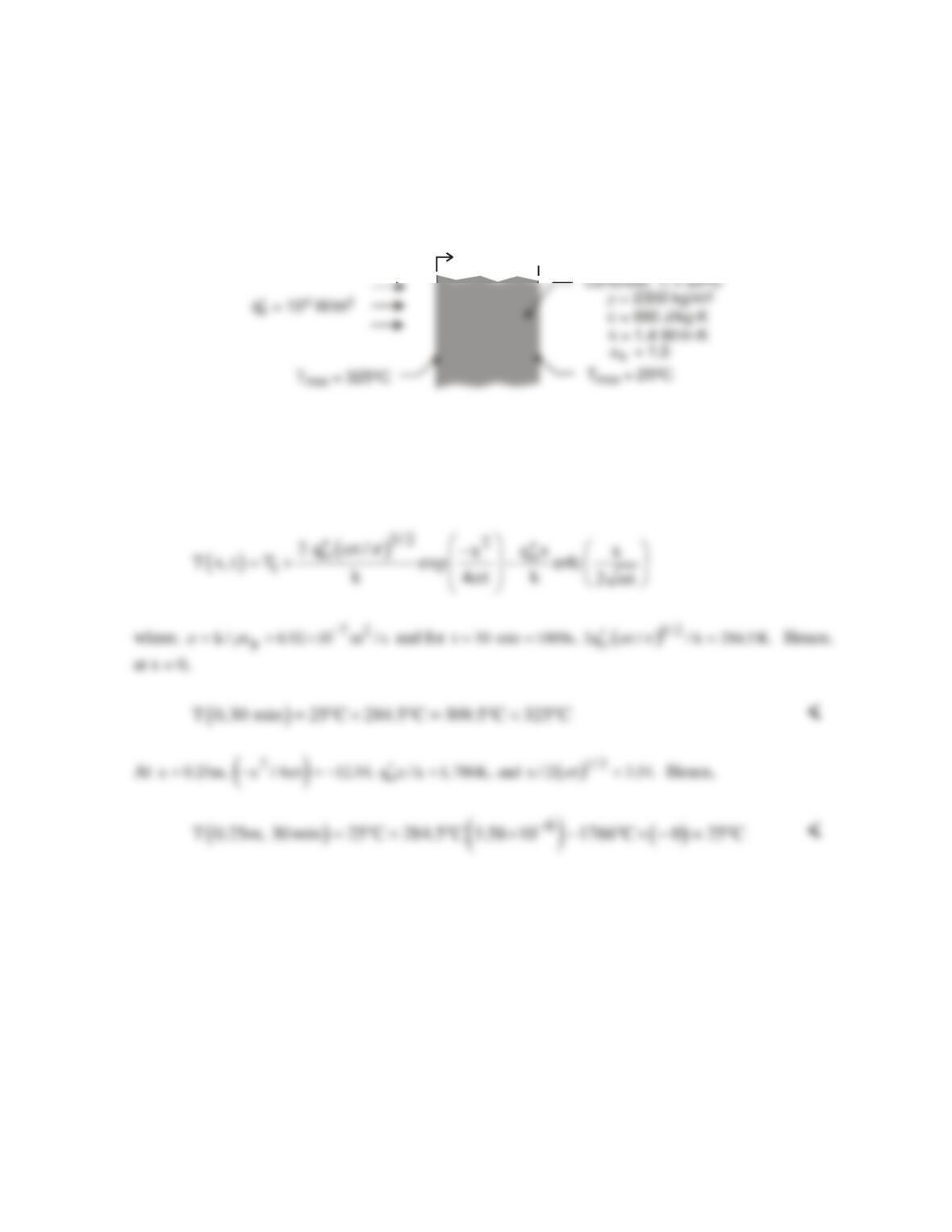
PROBLEM 5.73
KNOWN: Thickness, initial temperature and thermophysical properties of concrete firewall.
Incident radiant flux and duration of radiant heating. Maximum allowable surface temperatures at the
end of heating.
FIND: If maximum allowable temperatures are exceeded.
SCHEMATIC:
L = 0.25 m
x
ASSUMPTIONS: (1) One-dimensional conduction in wall, (2) Validity of semi-infinite medium
approximation, (3) Negligible convection and radiative exchange with the surroundings at the
irradiated surface, (4) Negligible heat transfer from the back surface, (5) Constant properties.
ANALYSIS: The thermal response of the wall is described by Eq. (5.62)
Both requirements are met.
COMMENTS: The foregoing analysis is conservative since heat transfer at the irradiated surface
due to convection and net radiation exchange with the environment have been neglected. If the
emissivity of the surface and the temperature of the surroundings are assumed to be ε = 1 and Tsur =
298K, radiation exchange at Ts = 309.5°C would be
()
44 2
rad s sur
q T T 6, 080 W / m K,
εs
′′ = −= ⋅
which is significant (~ 60% of the prescribed radiation).
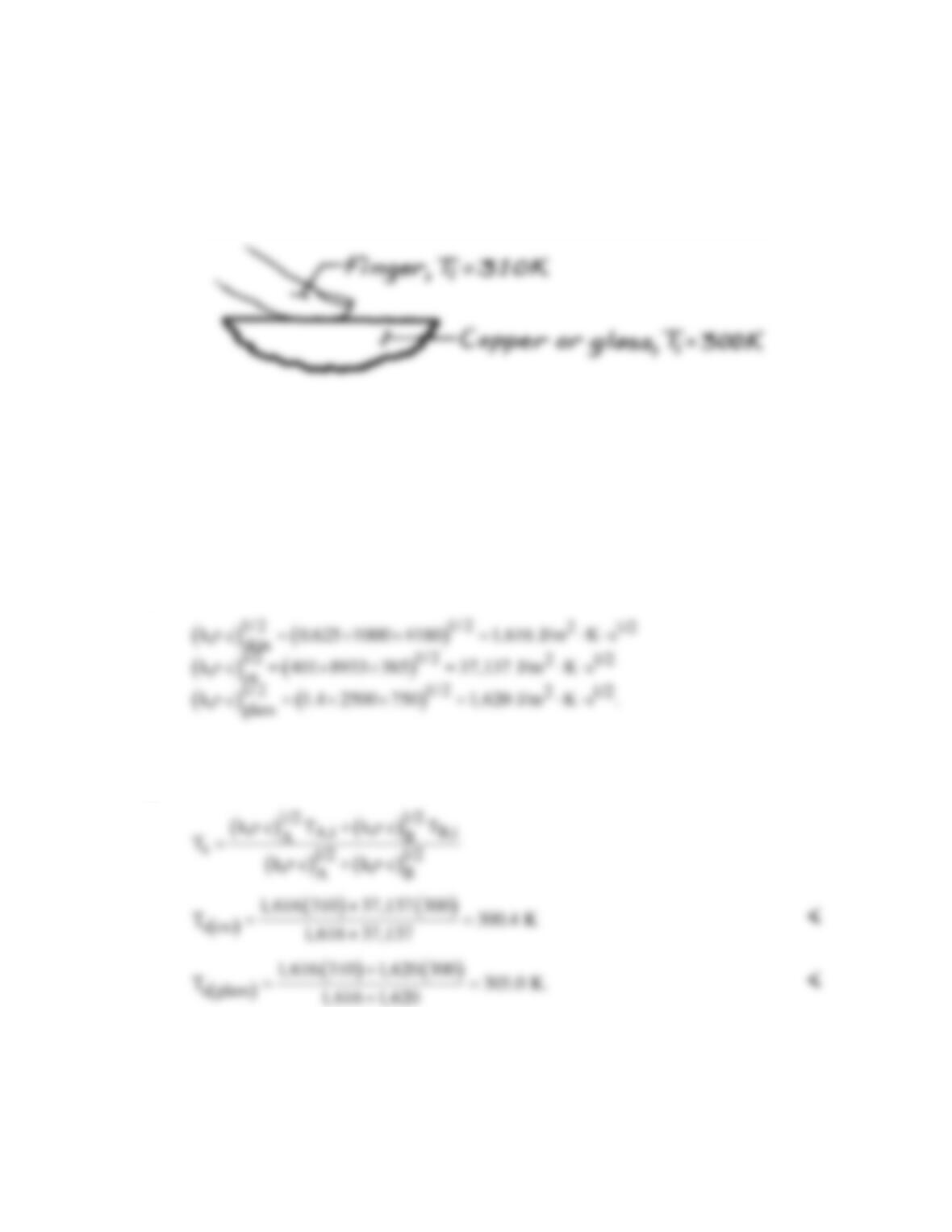
PROBLEM 5.74
KNOWN: Initial temperature of copper and glass plates. Initial temperature and properties
of finger.
FIND: Whether copper or glass feels cooler to touch.
SCHEMATIC:
ASSUMPTIONS: (1) The finger and the plate behave as semi–infinite solids, (2) Constant
properties, (3) Negligible contact resistance.
PROPERTIES: Skin (given): ρ = 1000 kg/m3, c = 4180 J/kg⋅K, k = 0.625 W/m⋅K; Table
A-1 (T = 300K), Copper: ρ = 8933 kg/m3, c = 385 J/kg⋅K, k = 401 W/m⋅K; Table A-3 (T =
300K), Glass: ρ = 2500 kg/m3, c = 750 J/kg⋅K, k = 1.4 W/m⋅K.
ANALYSIS: Which material feels cooler depends upon the contact temperature Ts given by
Equation 5.66. For the three materials of interest,
Since
( ) ( )
1/2 1/2
cu glass
k c k c ,
ρρ
>>
the copper will feel much cooler to the touch. From
Equation 5.66,
COMMENTS: The extent to which a material’s temperature is affected by a change in its
thermal environment is inversely proportional to (kρc)1/2. Large k implies an ability to
spread the effect by conduction; large ρc implies a large capacity for thermal energy storage.
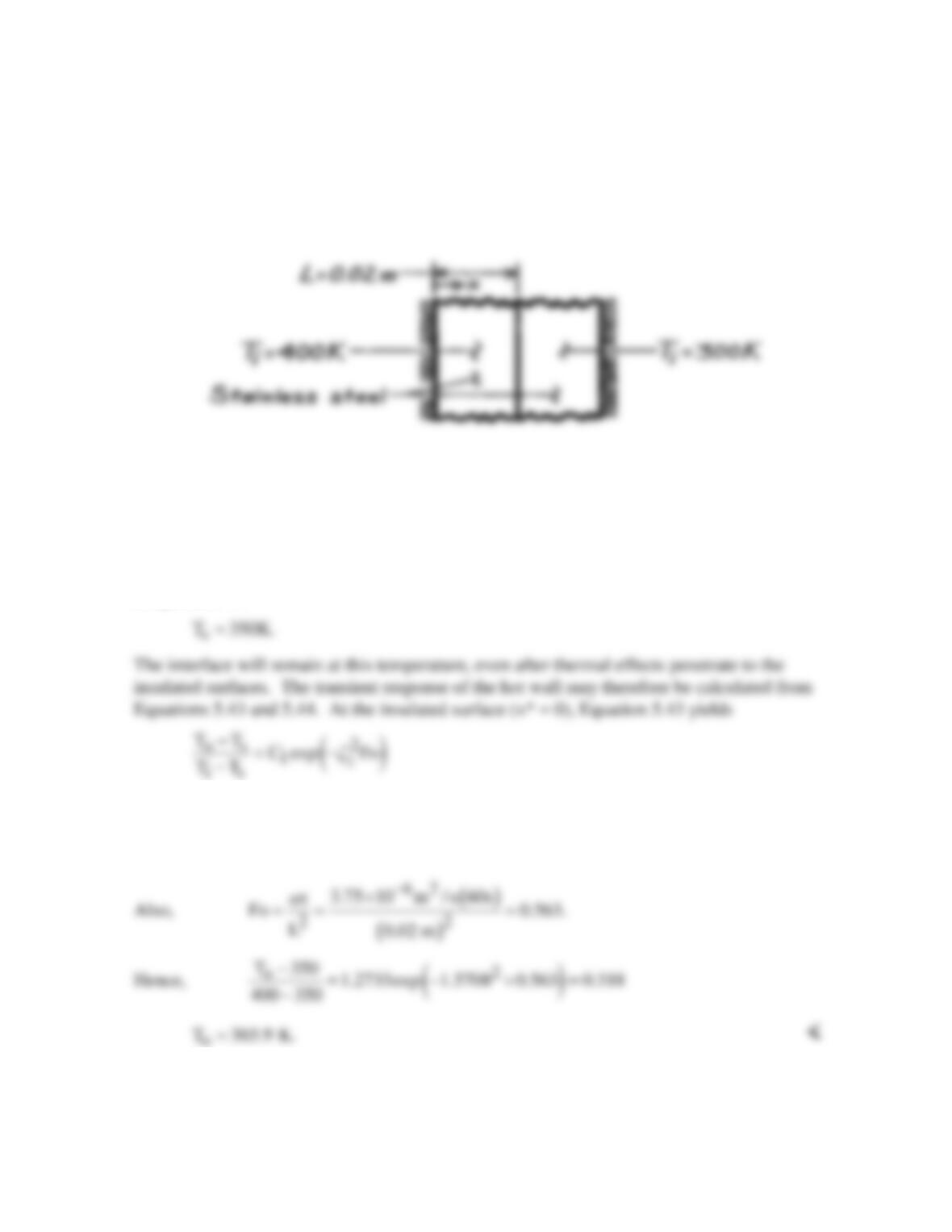
PROBLEM 5.75
KNOWN: Initial temperatures, properties, and thickness of two plates, each insulated on one
surface.
FIND: Temperature on insulated surface of one plate at a prescribed time after they are
pressed together.
SCHEMATIC:
ASSUMPTIONS: (1) One-dimensional conduction, (2) Constant properties, (3) Negligible
contact resistance.
PROPERTIES: Stainless steel (given): ρ = 8000 kg/m3, c = 500 J/kg⋅K, k = 15 W/m⋅K.
ANALYSIS: At the instant that contact is made, the plates behave as semi-infinite slabs and,
since the (ρkc) product is the same for the two plates, Equation 5.66 yields a surface
temperature of
where, in principle, h → ∞ and T∞ → Ts. From Table 5.1, Bi → ∞,
1
ζ
= 1.5708, and C1 =
1.2733.
COMMENTS: Since Fo > 0.2, the one-term approximation is appropriate.
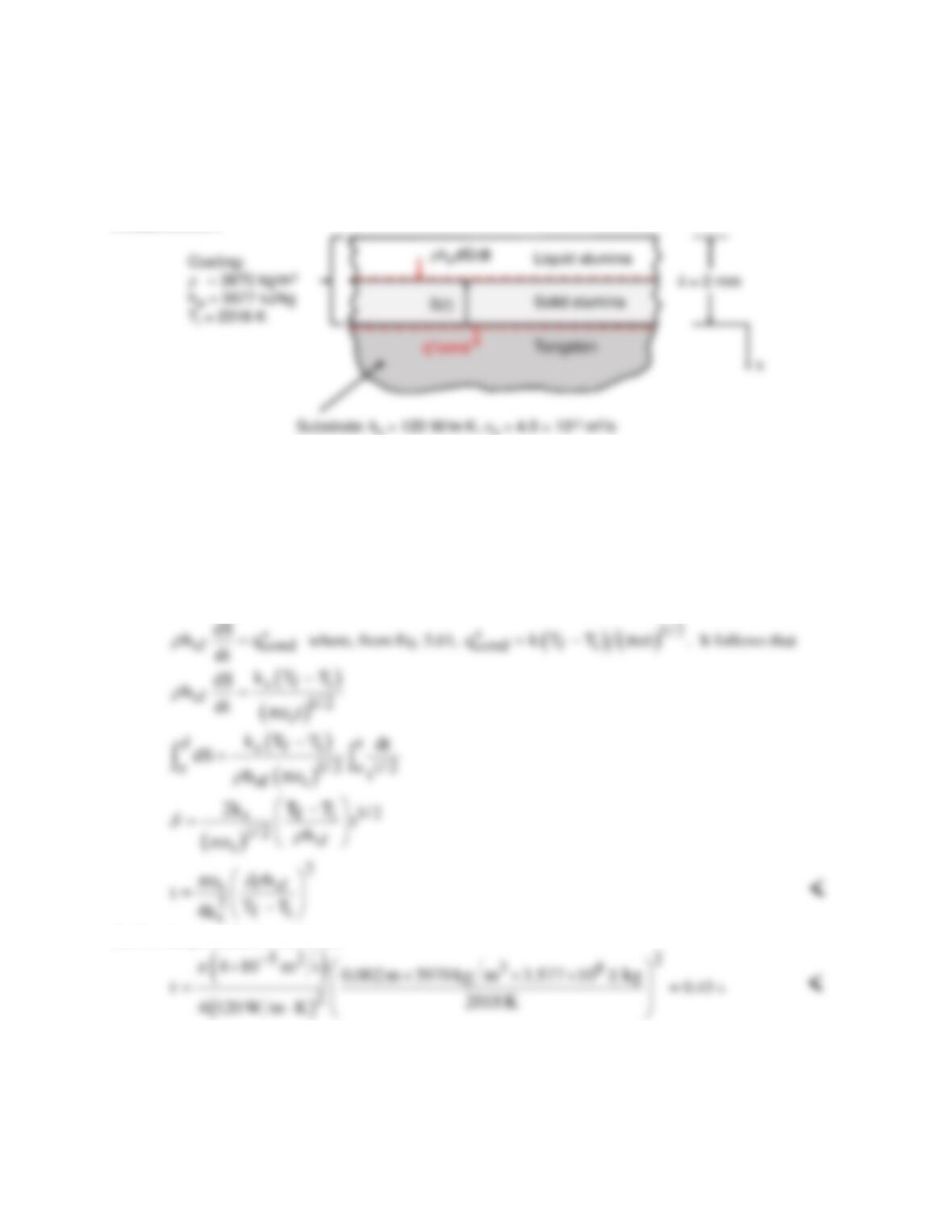
PROBLEM 5.76
KNOWN: Thickness and properties of liquid coating deposited on a metal substrate. Initial temperature
and properties of substrate.
FIND: (a) Expression for time required to completely solidify the liquid, (b) Time required to solidify
an alumina coating.
SCHEMATIC:
ASSUMPTIONS: (1) Substrate may be approximated as a semi-infinite medium in which there is one-
dimensional conduction, (2) Solid and liquid alumina layers remain at fusion temperature throughout
solidification (negligible resistance to heat transfer by conduction through solid), (3) Negligible contact
resistance at the coating/substrate interface, (4) Negligible solidification contraction, (5) Constant
properties.
ANALYSIS: (a) Performing an energy balance on the solid layer, whose thickness S increases with t,
the latent heat released at the solid/liquid interface must be balanced by the rate of heat conduction into
the solid. Hence, per unit surface area,
(b) For the prescribed conditions,
COMMENTS: If solidification occurs over a short time resulting in a change of the solid’s
microstructure (relative to slow solidification), it is termed rapid solidification. See Problem 5.34.
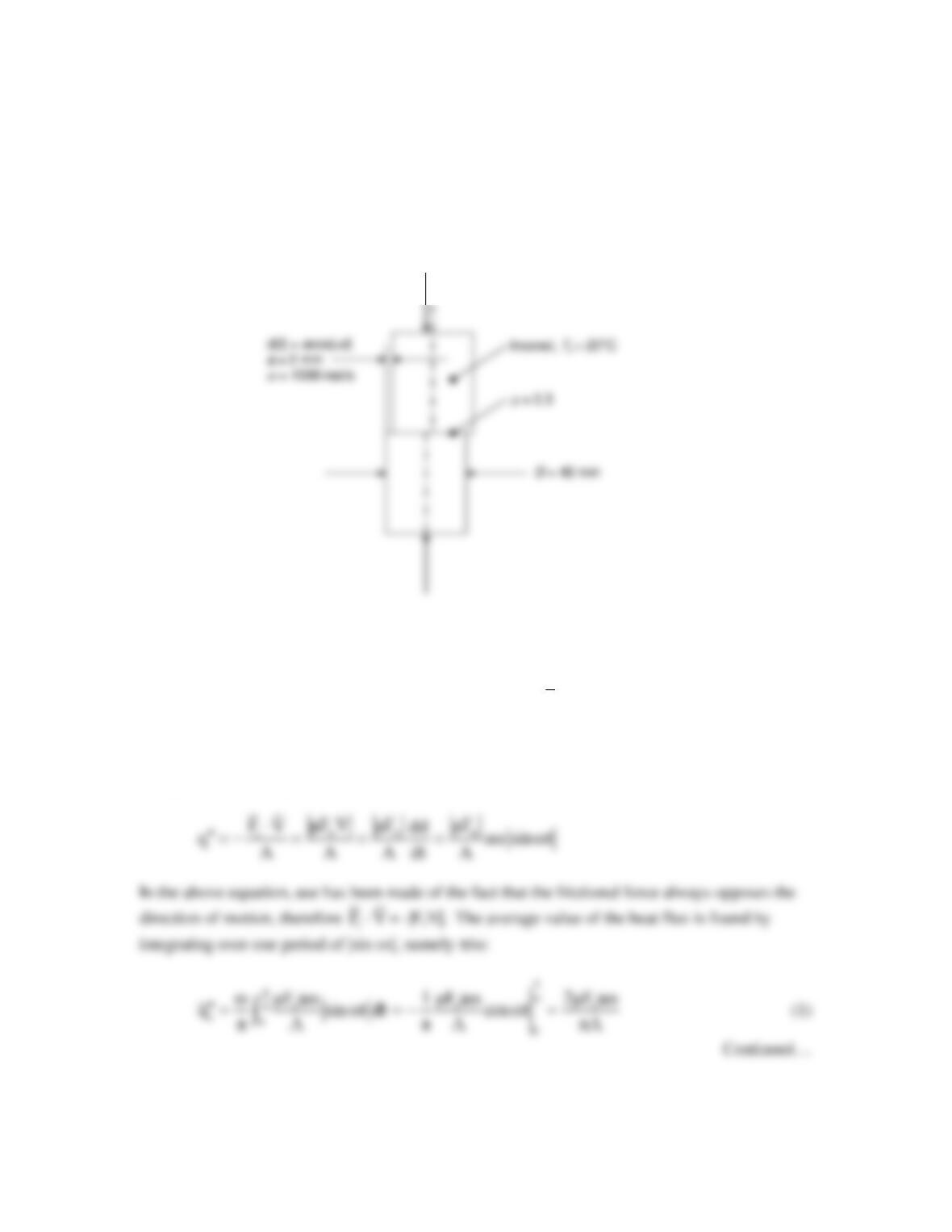
PROBLEM 5.77
KNOWN: Diameter and initial temperature of two Inconel rods. Amplitude and frequency of
motion of upper rod. Coefficient of friction.
FIND: Compressive force required to bring rod to melting point in 3 seconds.
SCHEMATIC:
ASSUMPTIONS: (1) Negligible heat loss from surfaces of rods, (2) Rods are effectively semi–
infinite, (3) Frictional heat generation can be treated as constant in time, (4) Constant properties.
PROPERTIES: Table A.1, Inconel X-750: Tm = 1665 K,
T
= (Ti +Tm)/2 = (293 +1665)/2 = 979
K, k = 23.6 W/m∙K, cp = 618 J/kg∙K, ρ = 8510 kg/m3,
α
= k/ρcp = 4.49 × 10⁻⁶ m2/s.
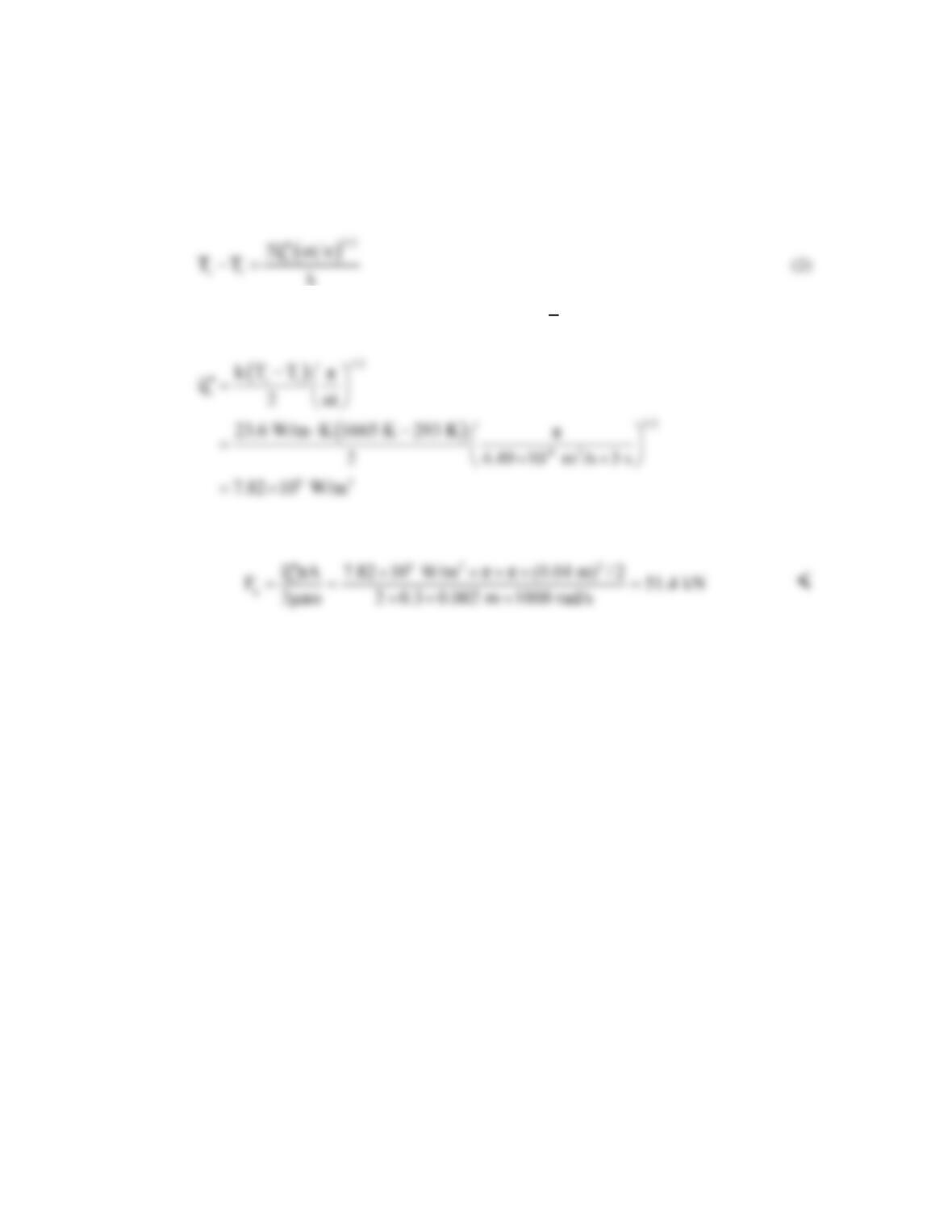
ANALYSIS: We begin by expressing the frictional heat flux in terms of the unknown
compressive force, Fn.
F
F
PROBLEM 5.77 (Cont.)
Note that A = πD2/2, because heat conducts in both directions. We can find the surface
temperature from Eq. 5.62 for the temperature distribution in a semi-infinite solid with uniform
surface heat flux. Evaluating that equation at x = 0 yields
With Ts equal to the melting temperature, we can solve for
s
q′′
:
Then we can solve for Fn from Eq. (1):
Comments: If the displacement were to be large, the heat transfer would no longer be one-
dimensional.
PROBLEM 5.78
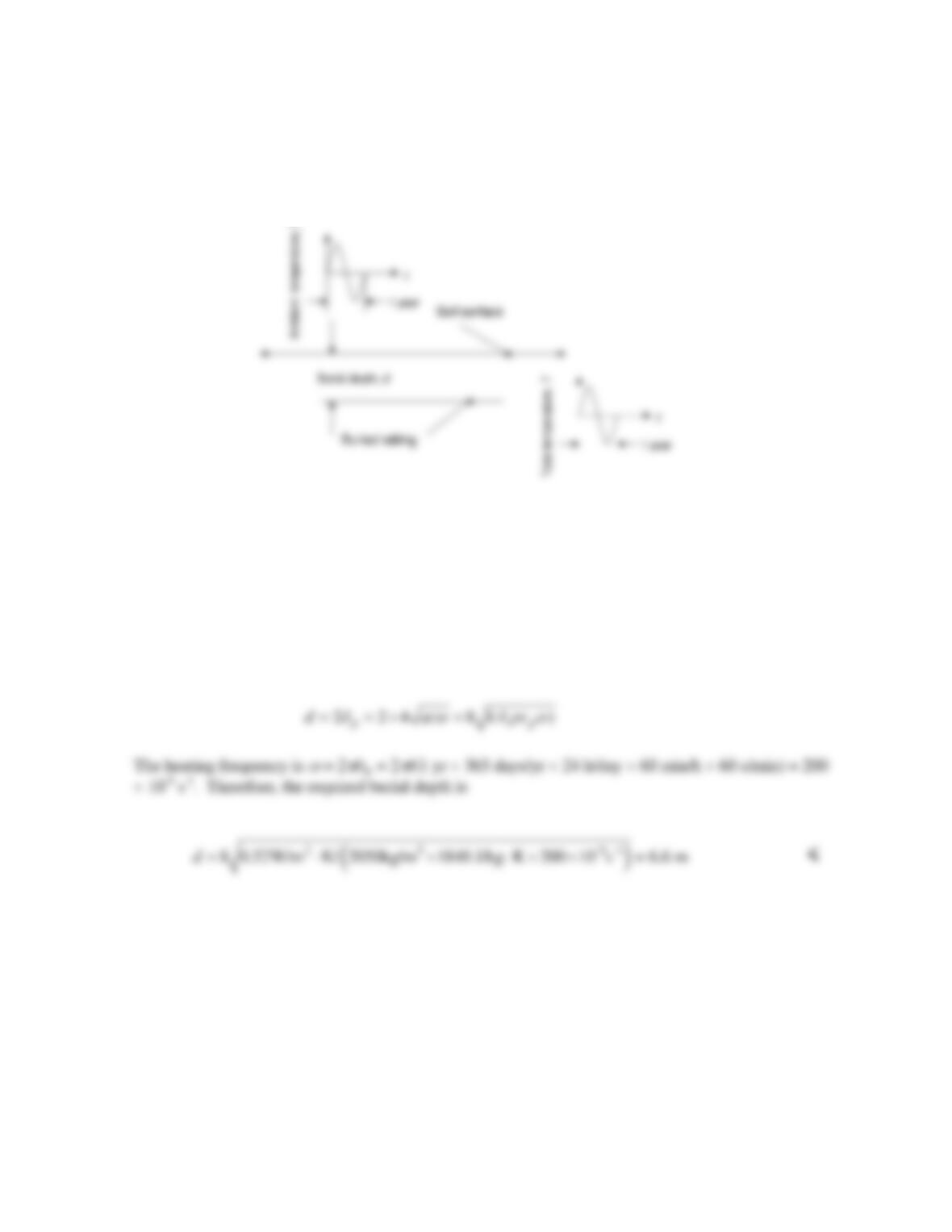
KNOWN: Closely–spaced buried tubing, annual temperature variation.
FIND: Depth associated with the soil behaving as an infinite medium.
SCHEMATIC:
ASSUMPTIONS: (1) Periodic conditions, (2) Constant properties, (3) One-dimensional heat transfer
(closely–spaced tubing), (4) Diurnal variation in ambient temperature is small relative to its annual
variation.
PROPERTIES: Table A.3: Soil (300 K):
ρ
= 2050 kg/m3, k = 0.52 W/m⋅K, cp = 1840 J/kg⋅K.
ANALYSIS: Since soil heating and cooling is associated with annual changes in both the ambient
and buried tubing temperatures, the burial depth, d, must be larger than twice the penetration depth
associated with periodic heating of the soil. Or,
COMMENTS: The installation cost increases as the burial depth increases. A tradeoff exists
between the installation cost and the attainment of constant soil temperature conditions.