Section 5.1
Chapter 5
Section 5.1
5.1.1k~vk=√72+ 112=√49 + 121 = √170 ≈13.04
5.1.2k~vk=√22+ 32+ 42=√4 + 9 + 16 = √29 ≈5.39
5.1.7Use the fact that ~u ·~v =k~ukk~vkcos θ, so that the angle is acute if ~u ·~v > 0, and obtuse if ~u ·~v < 0. Since
~u ·~v = 10 −12 = −2, the angle is obtuse.
5.1.8Since ~u ·~v = 4 −24 + 20 = 0, the two vectors enclose a right angle.
θ3= arccos 1
√3≈0.955 (radians)
θ4= arccos 1
2=π
3(= 60◦)
b Since y= arccos(x) is a continuous function,
lim
n→∞ θn= arccos lim
n→∞
1
√n= arccos(0) = π
2(= 90◦)
5.1.12 k~v +~wk2= (~v +~w)·(~v +~w) (by hint)
227
Chapter 5
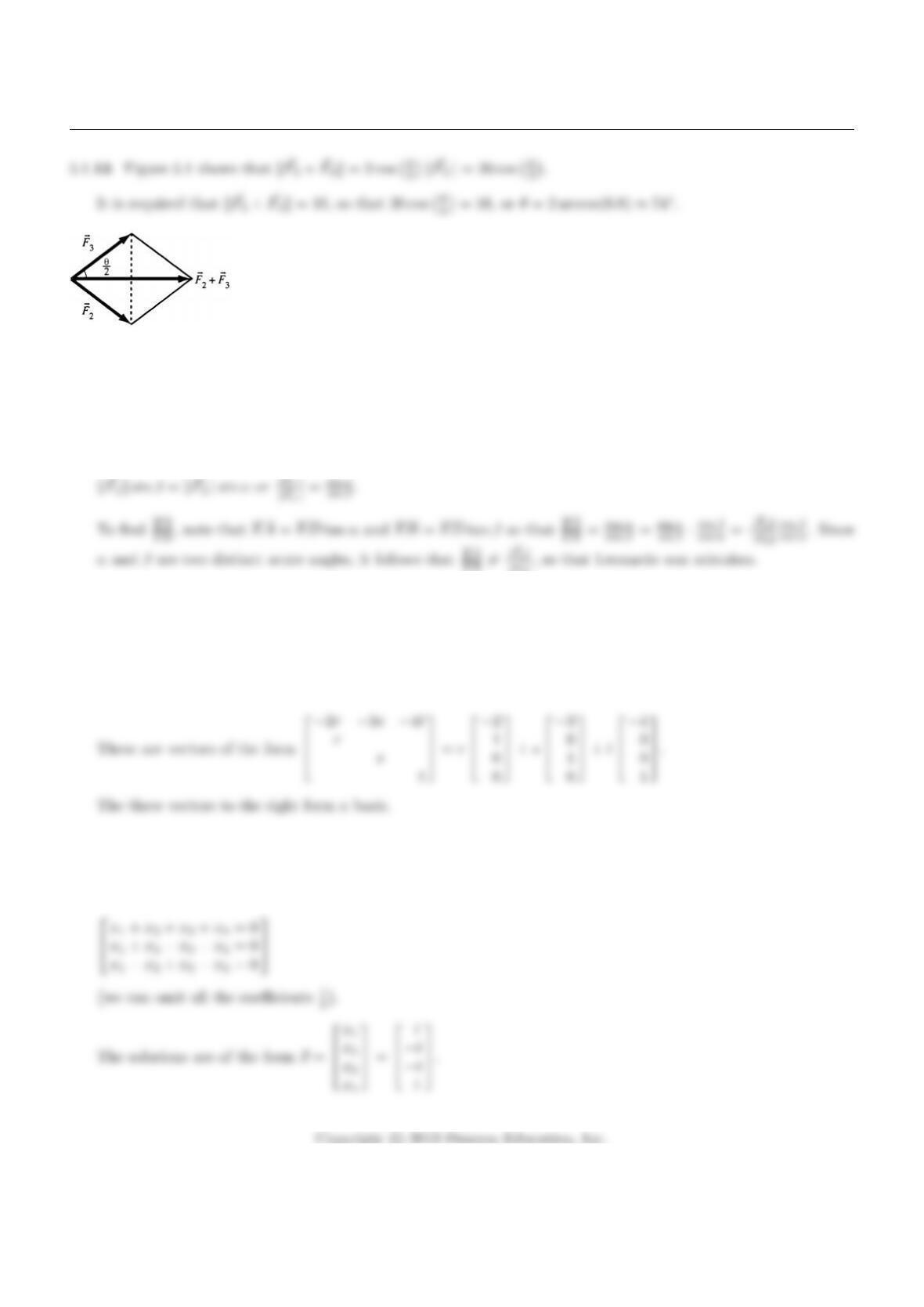
Figure 5.1: for Problem 5.1.13.
5.1.14 The horizontal components of ~
F1and ~
F2are −k~
F1ksin βand k~
F2ksin α, respectively (the horizontal compo-
nent of ~
F3is zero).
Since the system is at rest, the horizontal components must add up to 0, so that −k~
F1ksin β+k~
F2ksin α= 0 or
5.1.15 The subspace consists of all vectors ~x in R4such that
~x ·~v =
x1
x2
x3
x4
·
1
2
3
4
=x1+ 2x2+ 3x3+ 4x4= 0.
5.1.16 You may be able to find the solutions by educated guessing. Here is the systematic approach: we first find
all vectors ~x that are orthogonal to ~v1, ~v2, and ~v3, then we identify the unit vectors among them.
Finding the vectors ~x with ~x ·~v1=~x ·~v2=~x ·~v3= 0 amounts to solving the system
228
Section 5.1
5.1.17 The orthogonal complement W⊥of Wconsists of the vectors ~x in R4such that
x1
x2
x3
x4
·
1
2
3
4
= 0 and
x1
x2
x3
x4
·
5
6
7
8
= 0.
5.1.18 ak~xk2= 1 + 1
4+1
16 +1
64 +··· =1
1−1
4
=4
3use the formula for a geometric series, with a=1
4, so that
k~xk=2
√3≈1.155.
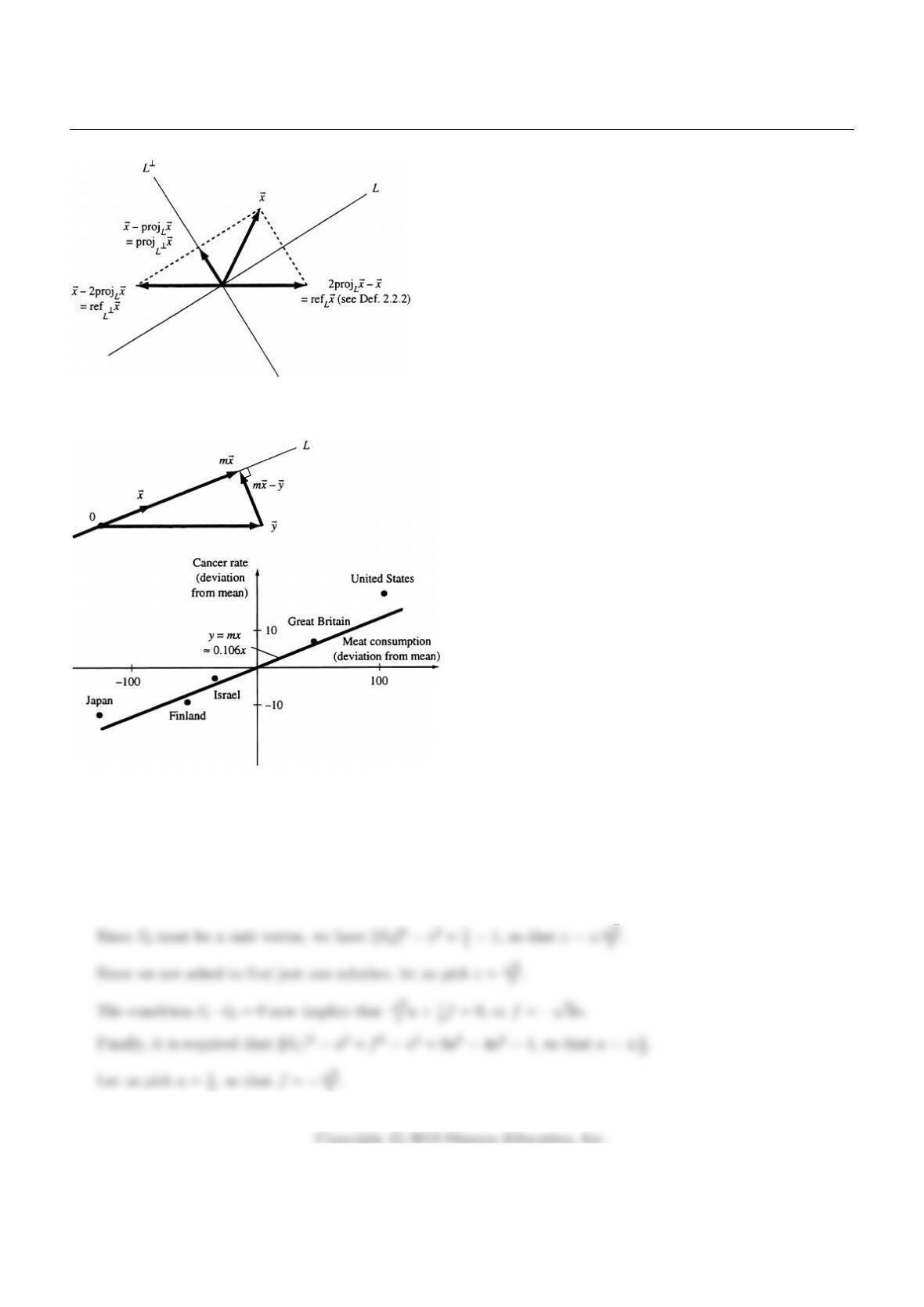
5.1.19 See Figure 5.2.
5.1.20 On the line Lspanned by ~x we want to find the vector m~x closest to ~y (that is, we want km~x −~ykto be
minimal). We want m~x −~y to be perpendicular to L(that is, to ~x), which means that ~x ·(m~x −~y) = 0 or
m(~x ·~x)−~x ·~y = 0 or m=~x·~y
~x·~x ≈4182.9
198.532≈0.106.
229
Chapter 5
Figure 5.2: for Problem 5.1.19.
Figure 5.3: for Problem 5.1.20.
5.1.21 Call the three given vectors ~v1, ~v2, and ~v3. Since ~v2is required to be a unit vector, we must have b=g= 0.
Now ~v1·~v2=dmust be zero, so that d= 0.
Likewise, ~v2·~v3=emust be zero, so that e= 0.
230
Section 5.1
Summary:
5.1.22 Let W={~x in Rn:~x ·~vi= 0 for all i= 1,…,m}. We are asked to show that V⊥=W, that is, any ~x in
V⊥is in W, and vice versa.
5.1.23 We will follow the hint. Let ~v be a vector in V. Then ~v ·~x = 0 for all ~x in V⊥. Since (V⊥)⊥contains all
vectors ~y such that ~y ·~x = 0, ~v is in (V⊥)⊥. So Vis a subspace of (V⊥)⊥.
5.1.24 Write T(~x) = projV(~x) for simplicity.
To prove the linearity of Twe will use the definition of a projection: T(~x) is in V, and ~x −T(~x) is in V⊥.
5.1.25 akk~vk2= (k~v)·(k~v) = k2(~v ·~v) = k2k~vk2
Now take square roots of both sides; note that √k2=|k|, the absolute value of k(think about the case when k
is negative). kk~vk=|k|k~vk, as claimed.
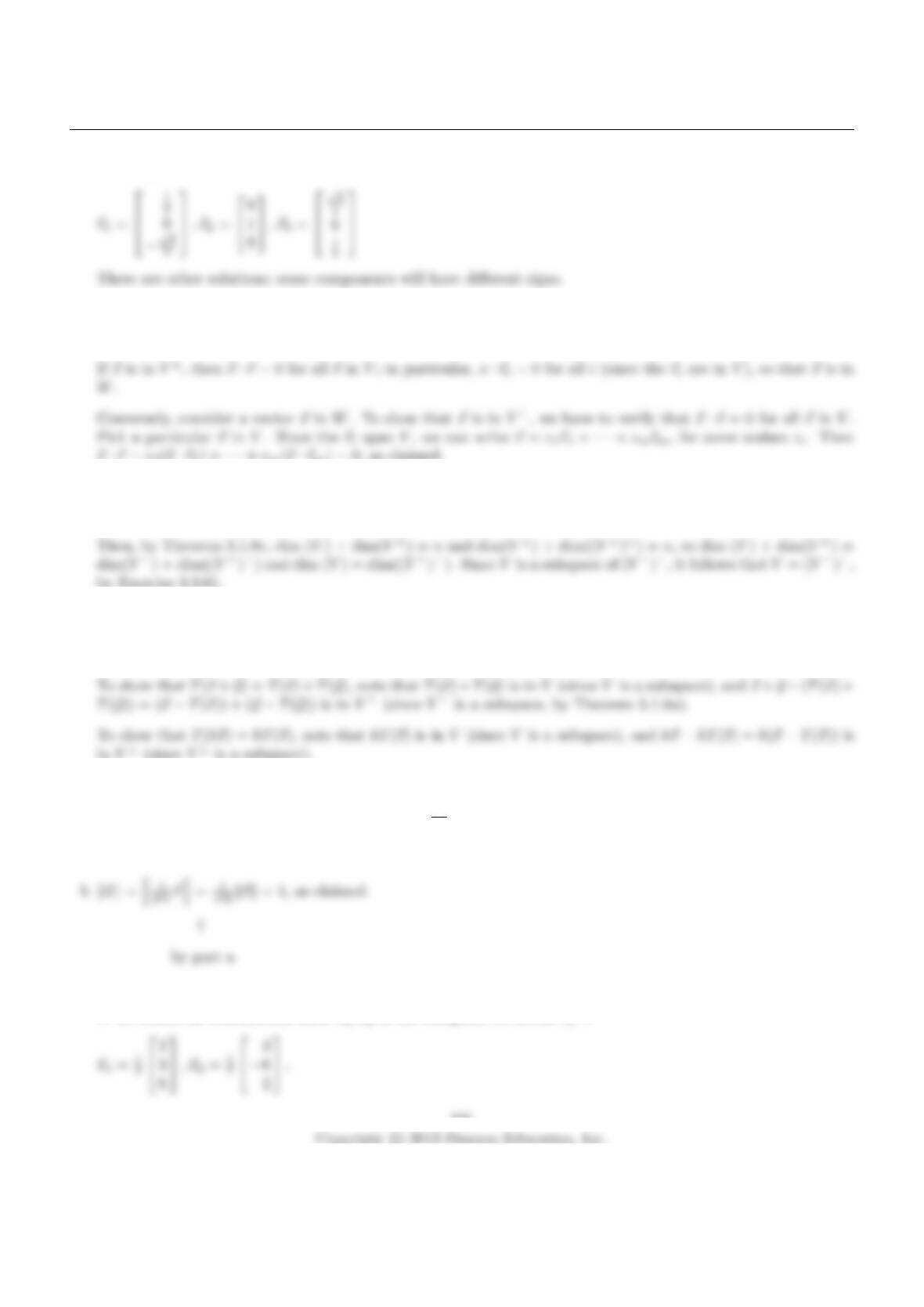
5.1.26 The two given vectors spanning the subspace are orthogonal, but they are not unit vectors: both have length
7. To obtain an orthonormal basis ~u1, ~u2of the subspace, we divide by 7:
231
Chapter 5
5.1.27 Since the two given vectors in the subspace are orthogonal, we have the orthonormal basis
~u1=1
3
2
2
1
0
, ~u2=1
3
−2
2
0
1
.
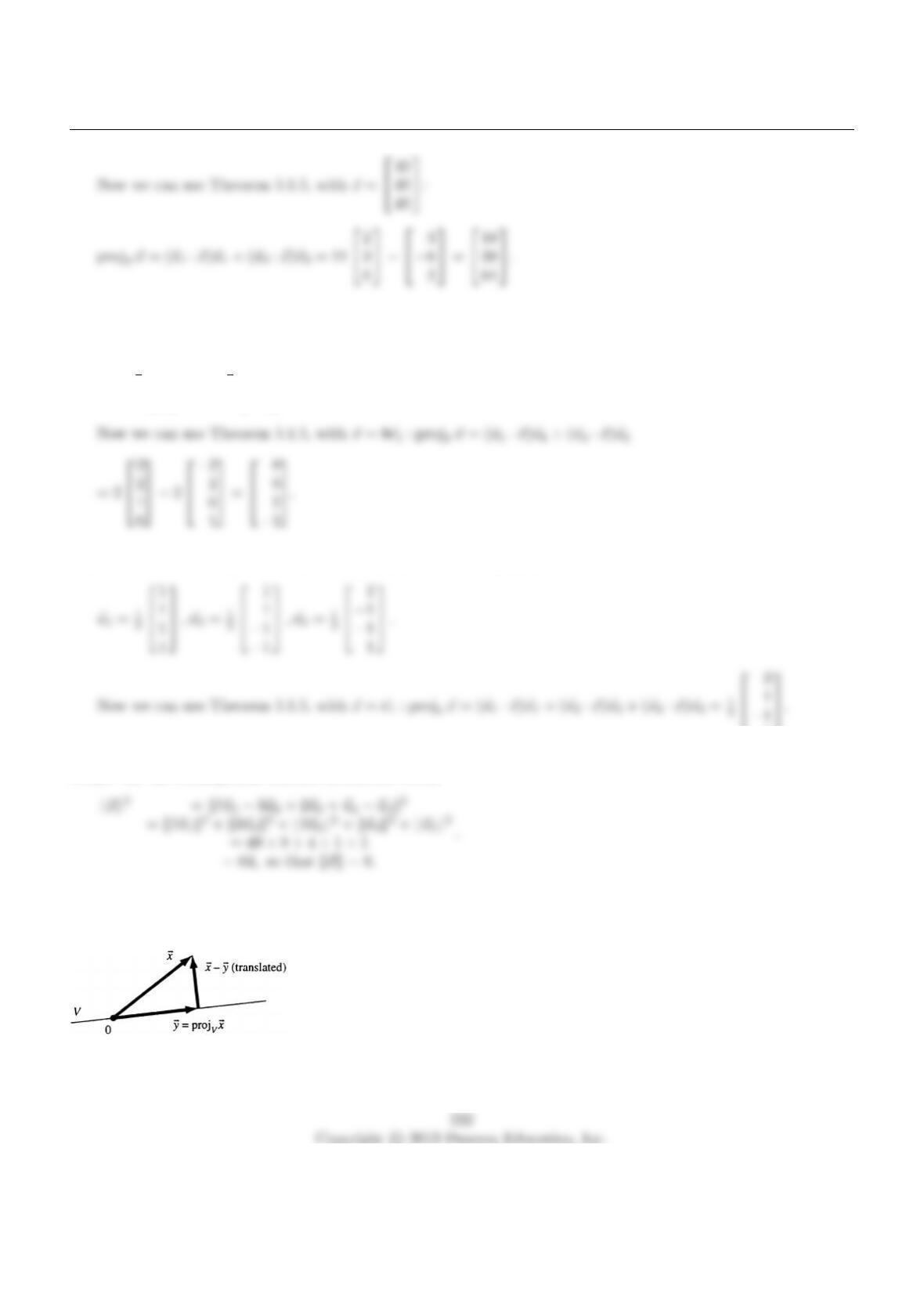
5.1.28 Since the three given vectors in the subspace are orthogonal, we have the orthonormal basis
1
5.1.29 By the Pythagorean theorem (Theorem 5.1.9),
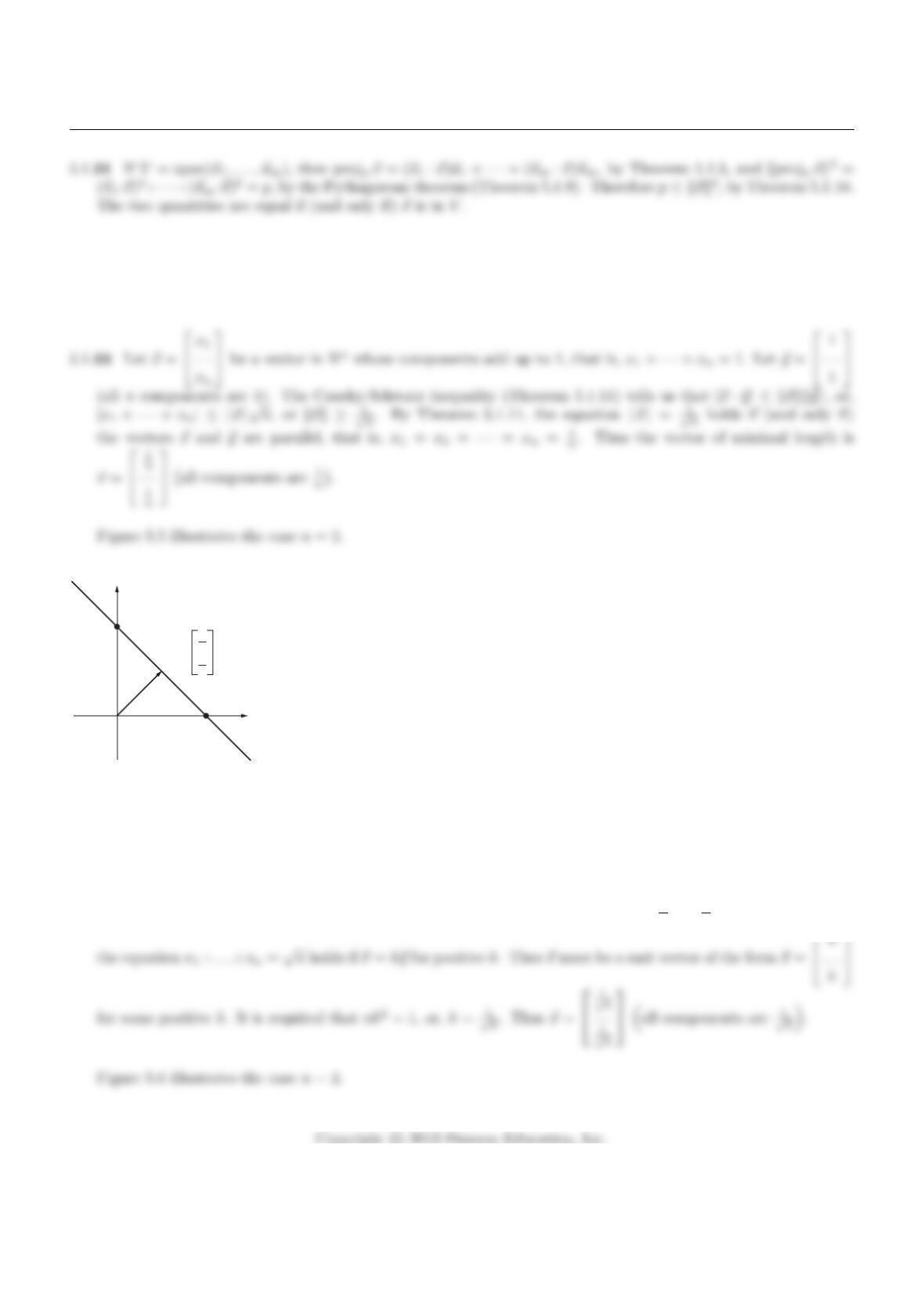
5.1.30 Since ~y = projV~x, the vector ~x −~y is orthogonal to ~y, by definition of an orthogonal projection (see Theo-
rem 5.1.4): (~x −~y)·~y = 0 or ~x ·~y − k~yk2= 0 or ~x ·~y =k~yk2. See Figure 5.4.
Figure 5.4: for Problem 5.1.30.
Section 5.1
5.1.32 By Theorem 2.4.9a, the matrix Gis invertible if (and only if) (~v1·~v1)(~v2·~v2)−(~v1·~v2)2
=k~v1k2k~v2k2−(~v1·~v2)26= 0. The Cauchy-Schwarz inequality (Theorem 5.1.11) tells us that k~v1k2k~v2k2−
(~v1·~v2)2≥0; equality holds if (and only if) ~v1and ~v2are parallel (that is, linearly dependent).
x2
X
→
x1
1
1
x1 + x2 = 1
=
x
1
2
1
2
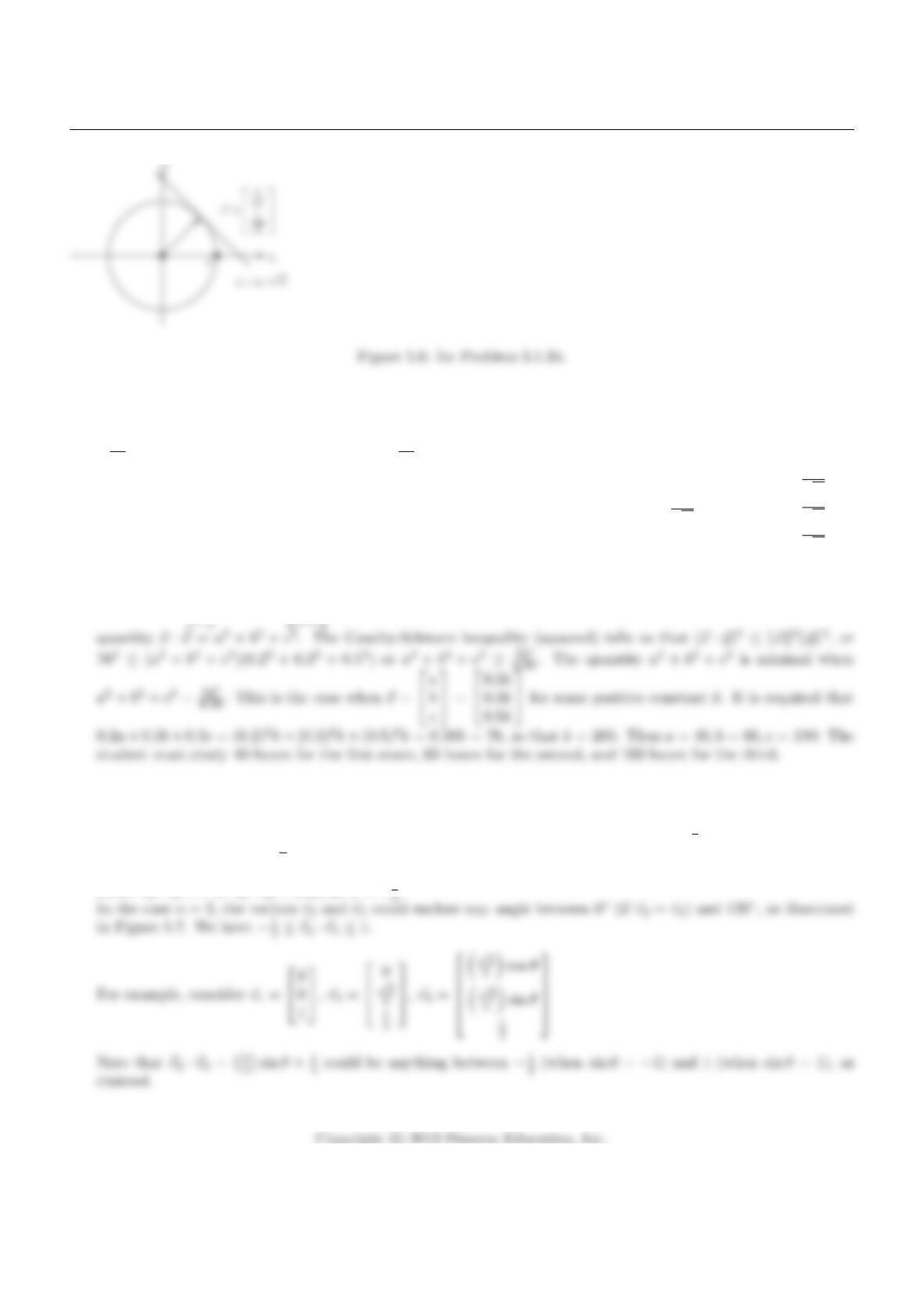
Figure 5.5: for Problem 5.1.33.
5.1.34 Let ~x be a unit vector in Rn, that is, k~xk= 1. Let ~y =
1
…
1
(all ncomponents are 1). The Cauchy-Schwarz
inequality (Theorem 5.1.11) tells us that |~x ·~y| ≤ k~xkk~yk, or, |x1+…+xn| ≤ k~xk√n=√n. By Theorem 5.1.11,
233
Chapter 5
5.1.35 Applying the Cauchy-Schwarz inequality to ~u =
x
y
z
and ~v =
1
2
3
gives |~u ·~v| ≤ k~ukk~vk, or |x+ 2y+ 3z| ≤
√14. The minimal value x+ 2y+ 3z=−√14 is attained when ~u =k~v for negative k. Thus ~u must be a unit
vector of the form ~u =
k
2k
3k
, for negative k. It is required that 14k2= 1, or, k=−1
√14 . Thus ~u =
−1
√14
−2
√14
−3
√14
.
5.1.36 Let ~x =
a
b
c
and ~y =
0.2
0.3
0.5
. It is required that ~x ·~y = 0.2a+ 0.3b+ 0.5c= 76. Our goal is to minimize
5.1.37 Using Definition 2.2.2 as a guide, we find that refV~x = 2(projV~x) −~x = 2(~u1·~x)~u1+ 2(~u2·~x)~u2−~x.
5.1.38 Since ~v1and ~v2are unit vectors, the condition ~v1·~v2=k~v1kk~v2kcos(α) = cos(α) = 1
2implies that ~v1and ~v2
enclose an angle of 60◦=π
3. The vectors ~v1and ~v3enclose an angle of 60◦as well.
In the case n= 2 there are two possible scenarios: either ~v2=~v3, or ~v2and ~v3enclose an angle of 120◦. Therefore,
either ~v2·~v3= 1 or ~v2·~v3= cos(120◦) = −1
234
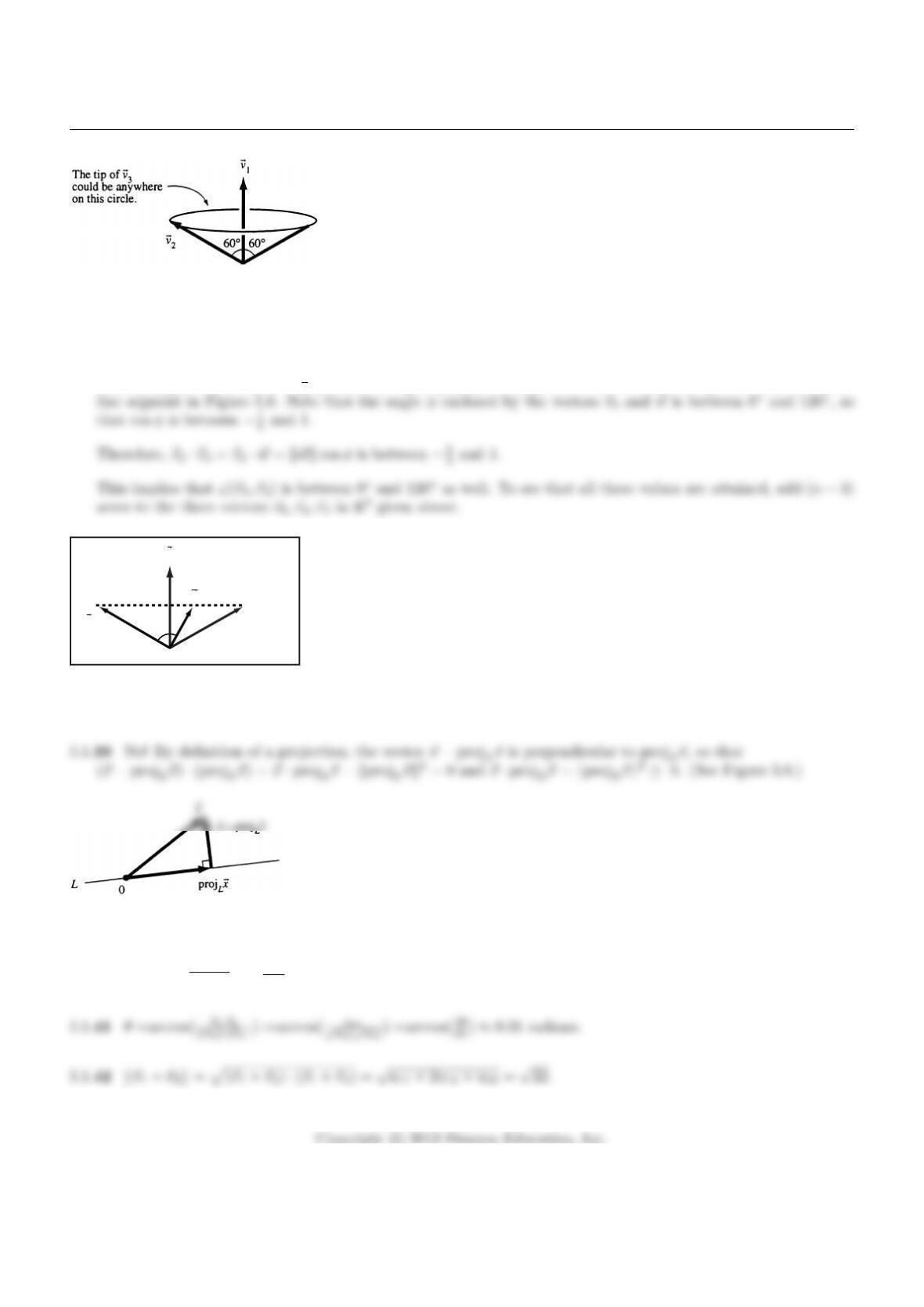
Section 5.1
Figure 5.7: for Problem 5.1.38.
If nexceeds three, we can consider the orthogonal projection ~w of ~v3onto the plane Espanned by ~v1and ~v2.
Since proj~v1~w = (~v1·~w)~v1=1
2~v1, and since k~wk ≤ k~v3k= 1, (by Theorem 5.1.10), the tip of ~w will be on the
φ
w
v2
v1
Figure 5.8: for Problem 5.1.38.
Figure 5.9: for Problem 5.1.39.
5.1.40 ||~v2|| =√~v2·~v2=√a22 = 3.
235
Chapter 5
5.1.44 One method to solve this is to take ~v =~v2−proj~v3~v2=~v2−20
49~v3.
5.1.45 Write the projection as a linear combination of ~v2and ~v3,c2~v2+c3~v3. Now you want ~v1−c2~v2−c3~v3to be
perpendicular to V, that is, perpendicular to both ~v2and ~v3. Using dot products, this boils down to two linear
Section 5.2
In Exercises 1–14, we will refer to the given vectors as ~v1, . . . , ~vm, where m= 1,2, or 3.
~u2=~v⊥
2
k~v⊥
2k=~v2−(~u1·~v2)~u1
k~v2−(~u1·~v2)~u1k=1
7
2
−6
3
Note that ~u1·~v2= 0.
5.2.3~u1=1
k~v1k~v1=1
5
4
0
3
236
Section 5.2
5.2.5~u1=1
k~v1k~v1=1
3
2
2
1
5.2.6~u1=1
k~v1k~v1=
1
0
0
=~e1
5.2.7Note that ~v1and ~v2are orthogonal, so that ~u1=1
k~v1k~v1=1
3
2
2
1
and ~u2=1
k~v2k~v2=1
3
−2
1
2
. Then
~u3=~v⊥
3
k~v⊥
3k=~v3−(~u1·~v3)~u1−(~u2·~v3)~u2
k~v3−(~u1·~v3)~u1−(~u2·~v3)~u2k=1
√36
2
−4
4
=1
3
1
−2
2
.
Chapter 5
−1
5.2.11 ~u1=1
k~v1k~v1=1
5
4
0
0
3
5.2.13 ~u1=1
k~v1k~v1=1
2
1
1
1
1
238
Section 5.2
~u3=~v⊥
3
k~v⊥
3k=~v3−(~u1·~v3)~u1−(~u2·~v3)~u2
k~v3−(~u1·~v3)~u1−(~u2·~v3)~u2k=1
√2
0
1
0
−1
5.2.15 Q=1
3
2
1
−2
, R = [3]
5.2.16 Q=1
7
6 2
5−6
2 3
, R =7 0
0 7
14
5.2.20 Q=I3,R= [ ~v1~v2~v3] =
2 3 5
0 4 6
0 0 7
239
Chapter 5
5.2.23 Q=
0.5−0.1
0.5 0.7
0.5−0.7
0.5 0.1
,R=2 4
0 10
5.2.25 Q=1
15
12 −3
0 2
0 14
9 4
,R=5 10
0 15
5.2.28 Q=
1
10 −1
√20
7
10 01
√2
1
10
1
√20
7
10 0−1
√2
,R=
10 10 10
0√2 0
0 0 √2
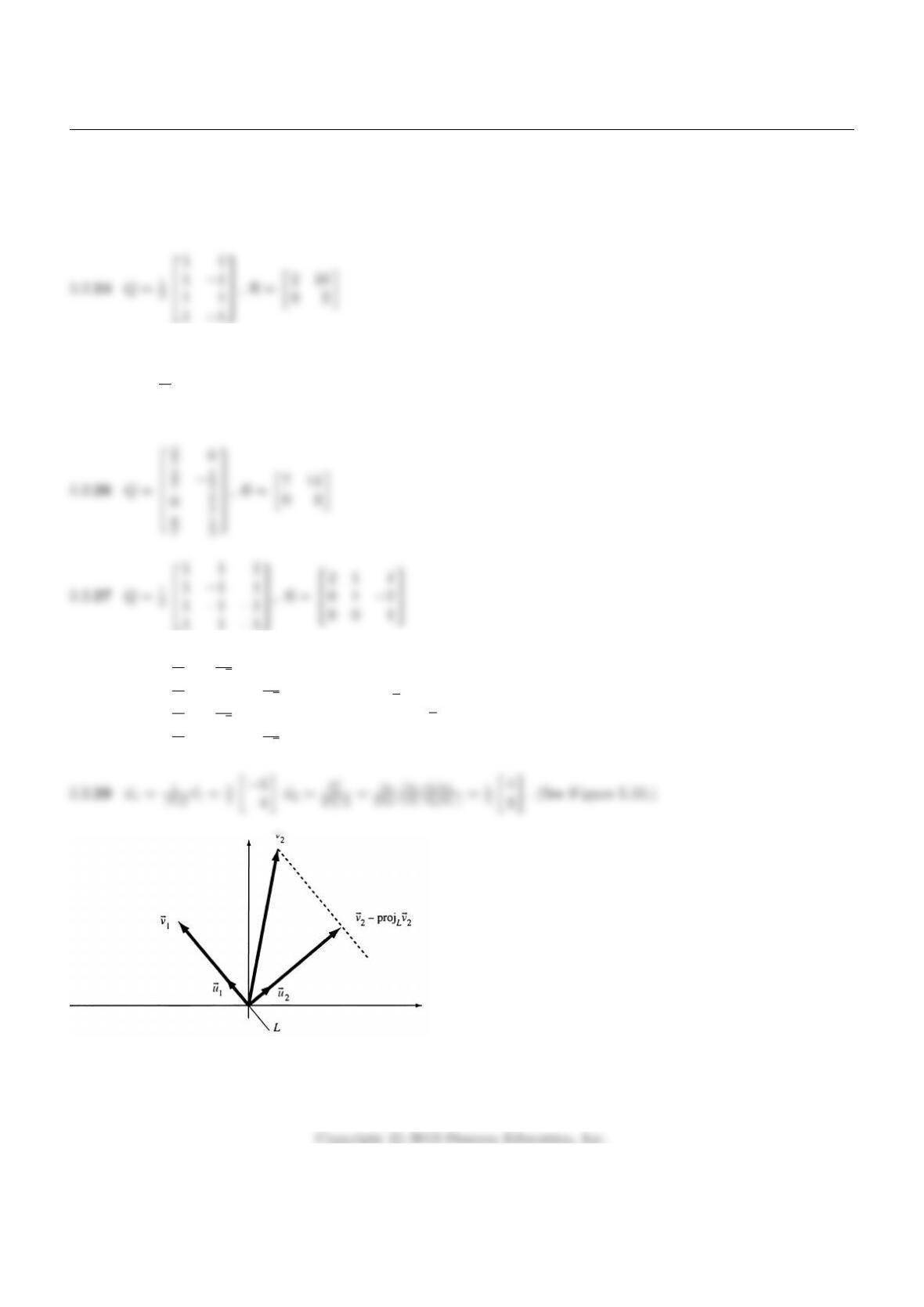
Figure 5.10: for Problem 5.2.29.
240
Section 5.2
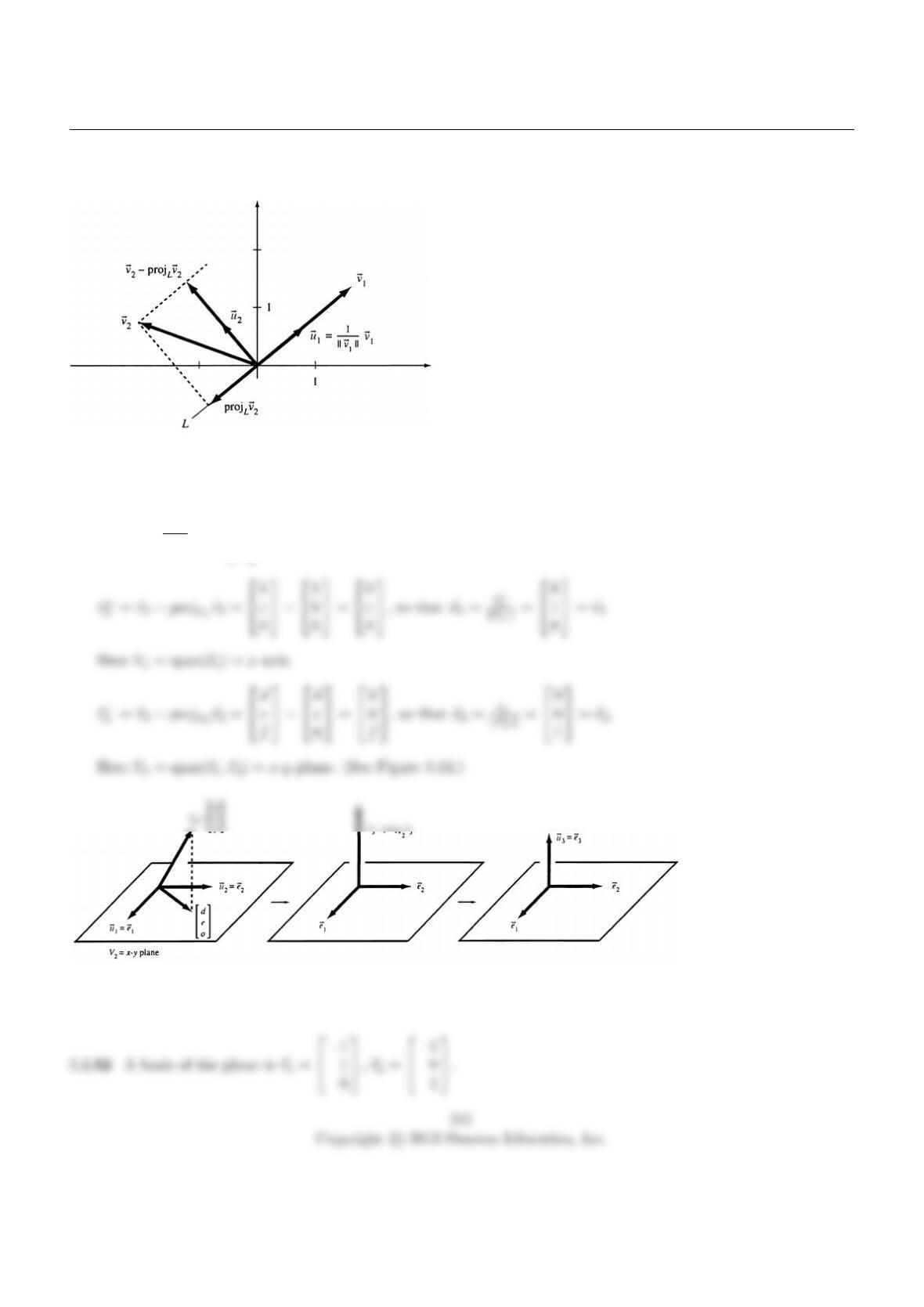
5.2.30 See Figure 5.11.
Figure 5.11: for Problem 5.2.30.
5.2.31 ~u1=1
k~v1k~v1=
1
0
0
=~e1
Figure 5.12: for Problem 5.2.31.
Chapter 5
Now apply the Gram-Schmidt process.
5.2.33 rref(A) = 1 0 0 1
0 1 1 0
5.2.34 rref(A) = 1 0 −1−2
0 1 2 3
We apply the Gram-Schmidt process and obtain
5.2.35 rref(A) =
1 0 1
3
0 1 1
3
0 0 0
242
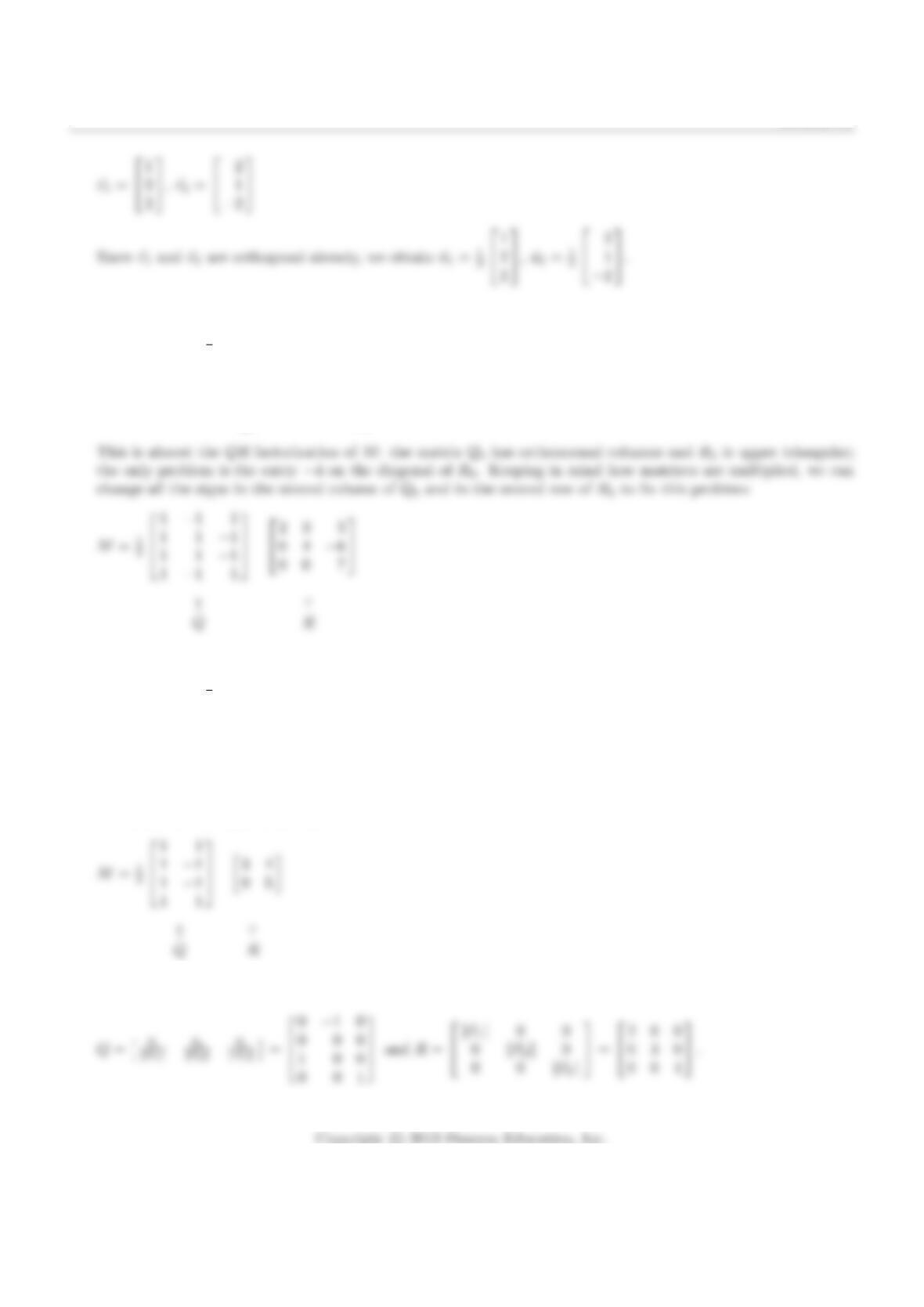
Section 5.2
5.2.36 Write M=1
2
1 1 1
1−1−1
1−1 1
1 1 −1
2 3 5
0−4 6
0 0 7
↑
Q0↑
R0
5.2.37 Write M=1
2
1 1 1 1
1−1−1 1
1−1 1 −1
1 1 −1−1
3 4
0 5
0 0
0 0
↑
Q0↑
R0
Note that the last two columns of Q0and the last two rows of R0have no effect on the product Q0R0; if we drop
them, we have the QRfactorization of M:
5.2.38 Since ~v1= 2~e3,~v2=−3~e1and ~v3= 4~e4are orthogonal, we have
243
Chapter 5
5.2.39 ~u1=1
√14
1
2
3
,~u2=1
√3
1
1
−1
,~u3=~u1×~u2=1
√42
−5
4
−1
5.2.41 If all diagonal entries of Aare positive, then we have Q=Inand R=A. A small modification is necessary
if Ahas negative entries on the diagonal: if aii <0 we let rij =−aij for all j, and we let qii =−1; if aii >0 we
let rij =aij and qii = 1. Furthermore, qij = 0 if i6=j(that is, Qis diagonal).
Figure 5.13: for Problem 5.2.42.
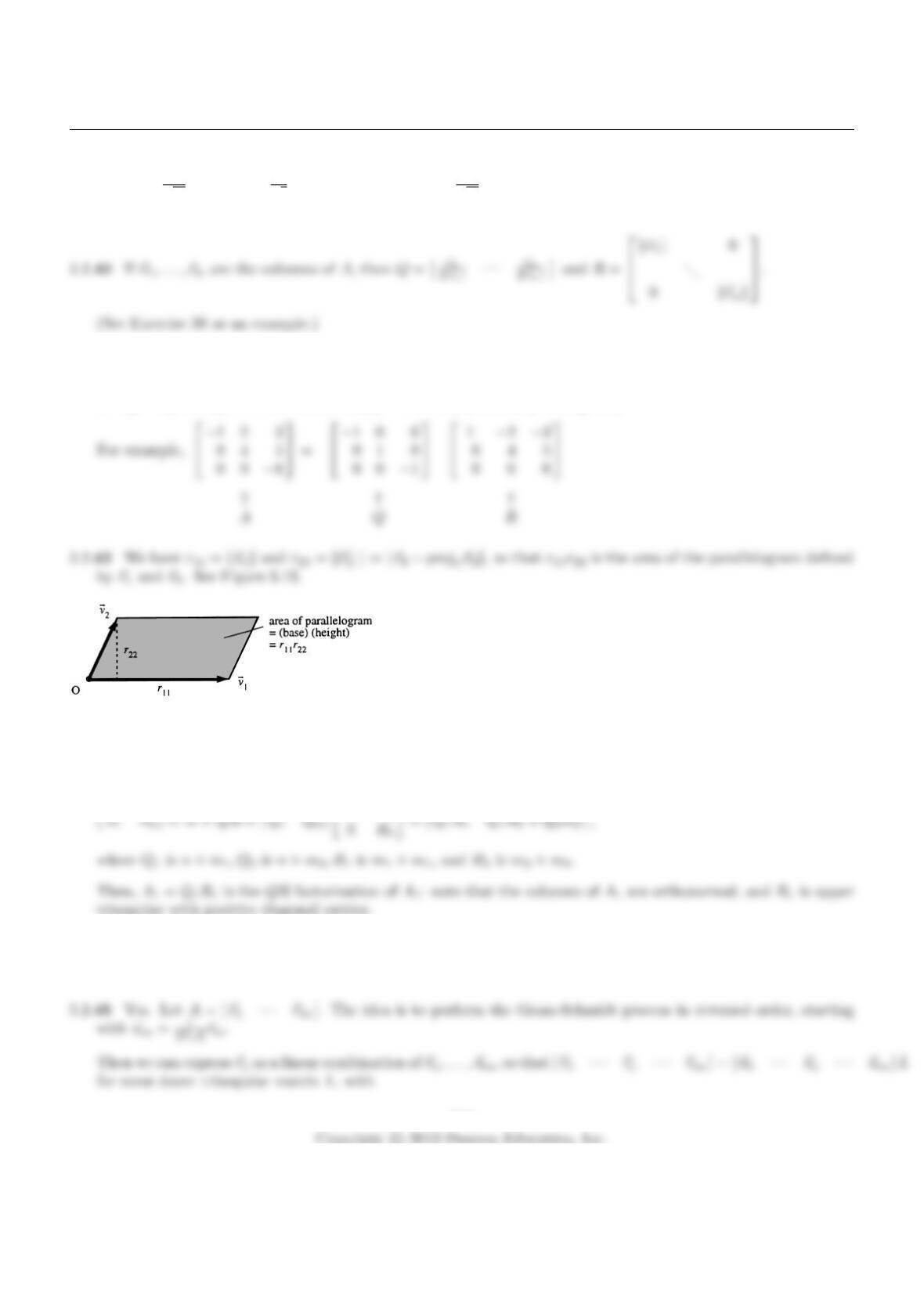
5.2.43 Partition the matrices Qand Rin the QR factorization of Aas follows:
5.2.44 No! If mexceeds n, then there is no n×mmatrix Qwith orthonormal columns (if the columns of a matrix
are orthonormal, then they are linearly independent).
244
Section 5.3
Section 5.3
5.3.1Not orthogonal, the column vectors fail to be perpendicular to each other.
5.3.53Awill not be orthogonal, because the length of the column vectors will be 3 instead of 1, and they will fail
to be unit vectors.
5.3.6−Bwill certainly be orthogonal, since the columns will be perpendicular unit vectors.
5.3.7AB is orthogonal by Theorem 5.3.4a.
5.3.13 3Ais symmetric, since (3A)T= 3AT= 3A.
5.3.14 −Bis symmetric, since (−B)T=−BT=−B.
5.3.15 AB is not necessarily symmetric, since (AB)T=BTAT=BA, which is not necessarily the same as AB.
Chapter 5
5.3.19 This matrix is symmetric. First note that (A2)T= (AT)2=A2for a symmetric matrix A. Now we can use
the linearity of the transpose, (2In+ 3A−4A2)T= 2IT
n+ 3AT−(4A2)T= 2In+ 3A−4(AT)2= 2In+ 3A−4A2.
5.3.23 Not necessarily symmetric. (A−AT)T=AT−A=−(A−AT).
5.3.24 Not necessarily symmetric. (ATBA)T=AT(ATB)T=ATBTA.
5.3.28 We will follow the hint.
(iv)⇒(vi) : If ATA=In, then (A~x)·(A~y) = (A~x)T(A~y) = ~xTATA~y =~xTIn~y =~x ·~y for all ~x and ~y.
(vi)⇒(ii) : If (A~x)·(A~y) = ~x ·~y for all ~x and ~y, then kA~xk=p(A~x)·(A~x) = √~x ·~x =k~xkfor all ~x.
Recall that the equivalence of statements (i) through (v) is proven in the text.
5.3.30 If L(~x) = ~
0, then kL(~x)k=k~xk= 0, so that ~x =~
0. Therefore, ker(L) = {~
0}.
By Theorem 3.3.7, dim(im(L)) = m−dim(ker(L)) = m.
Since Rnhas an m-dimensional subspace (namely, im(L)), the inequality m≤nholds.
246