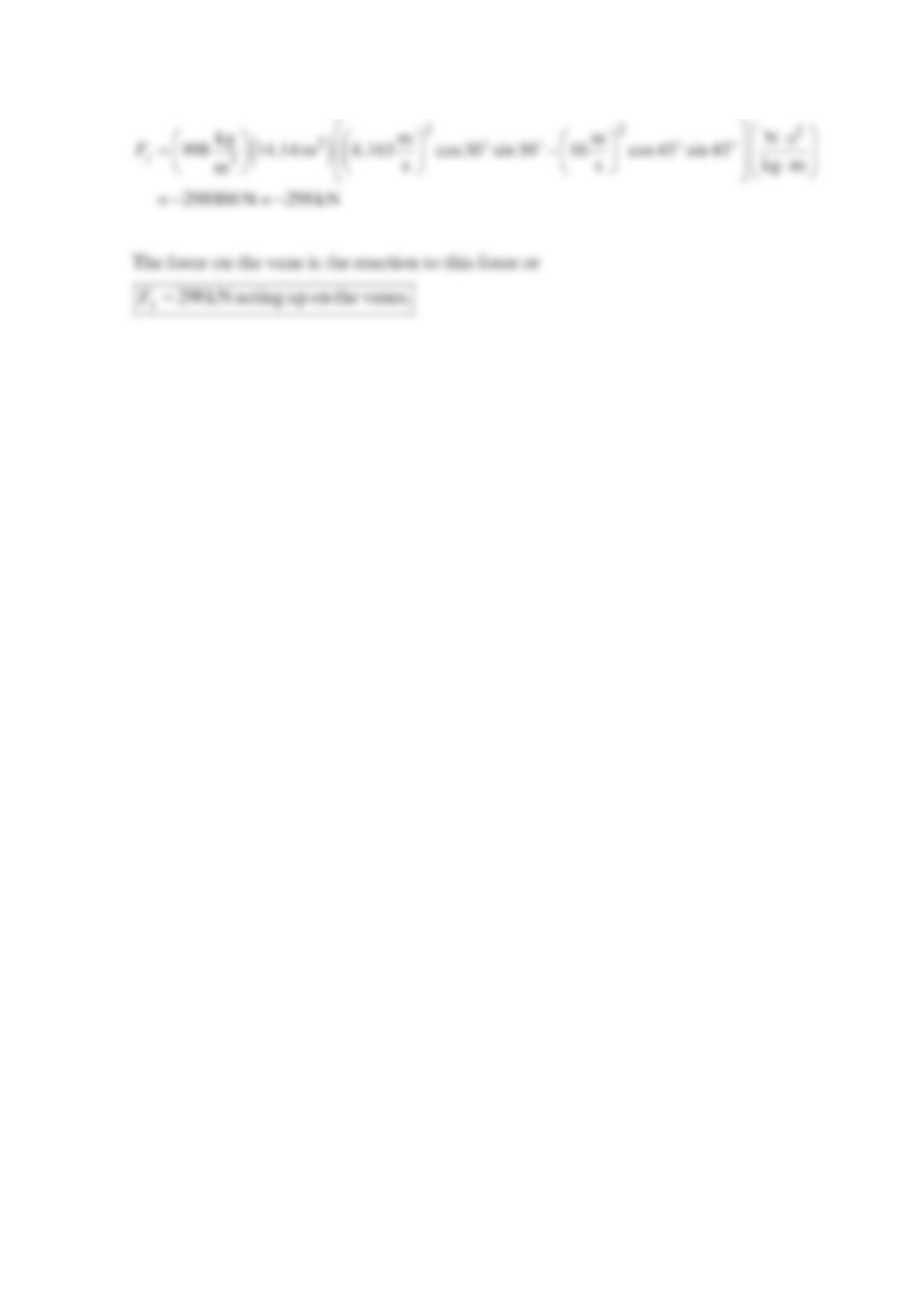
Using the table below,
Problem 5.48
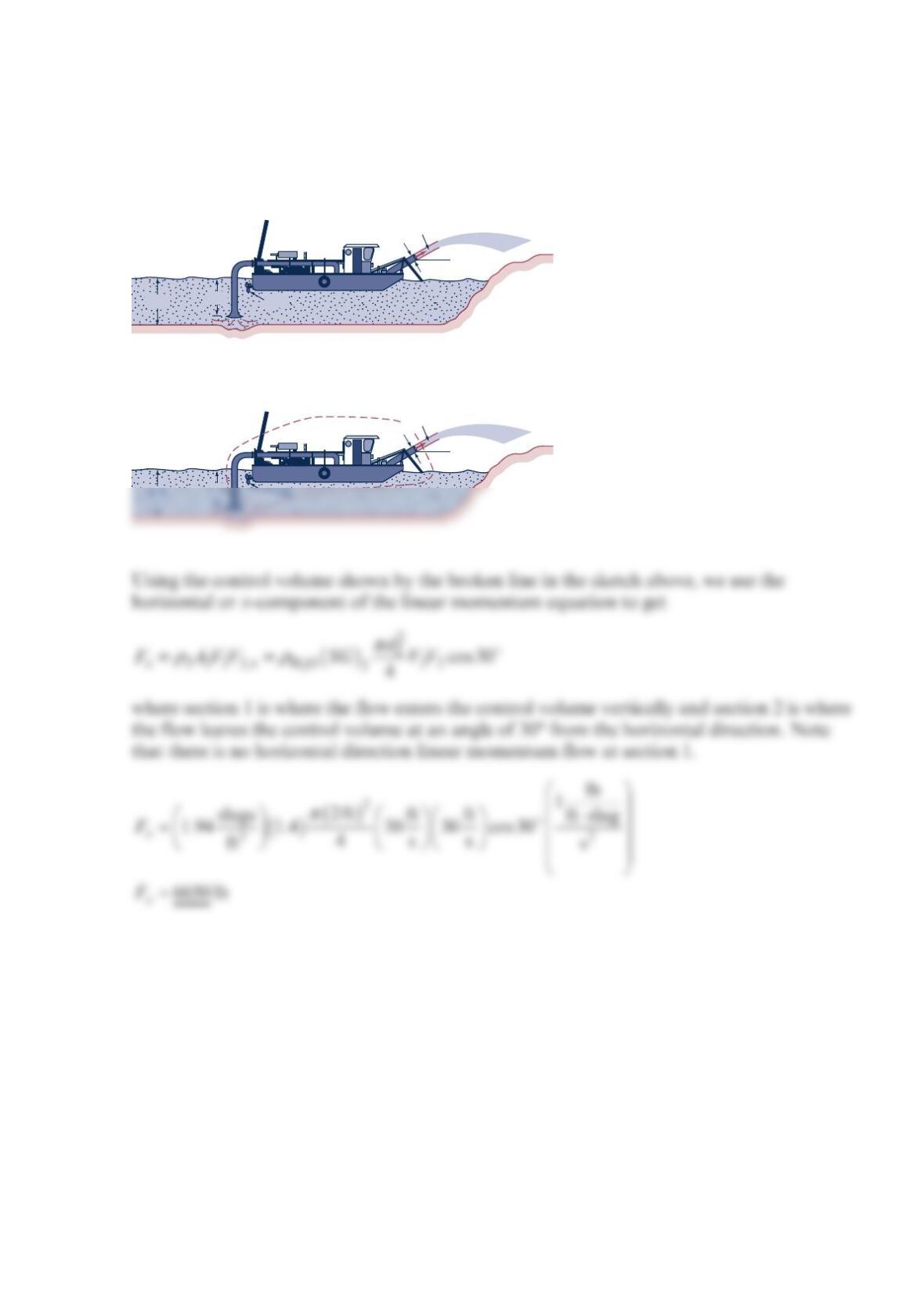
The hydraulic dredge shown in the figure below is used to dredge sand from a river bottom.
Estimate the thrust needed from the propeller to hold the boat stationary. Assume the
specific gravity of the sand/water mixture is 1.4
S
G=.
Solution 5.48
2-ft diameter
30°
30 ft/s
9 ft 7 ft Prop
2-ft diameter
30°
30 ft/s
Problem 5.49
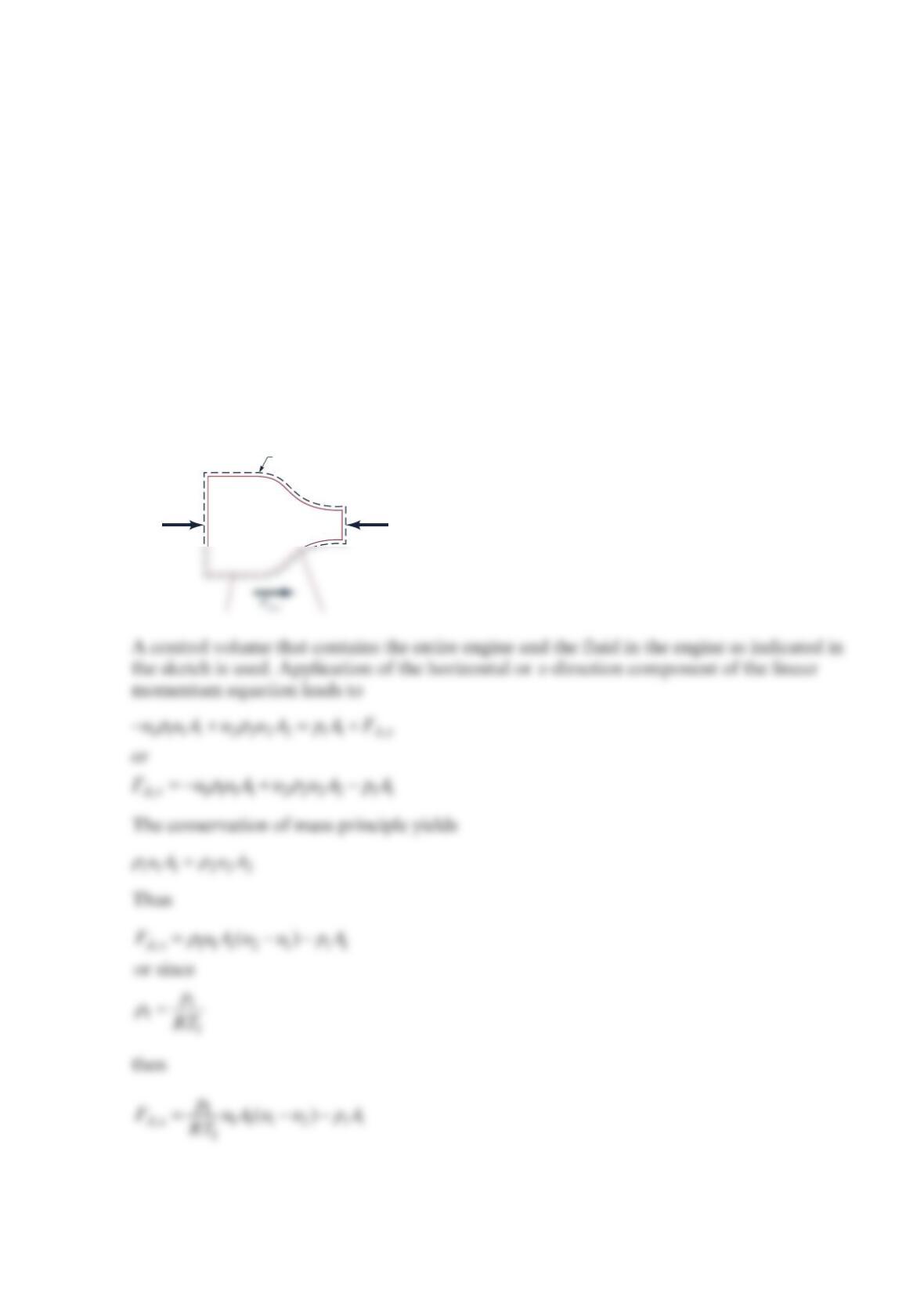
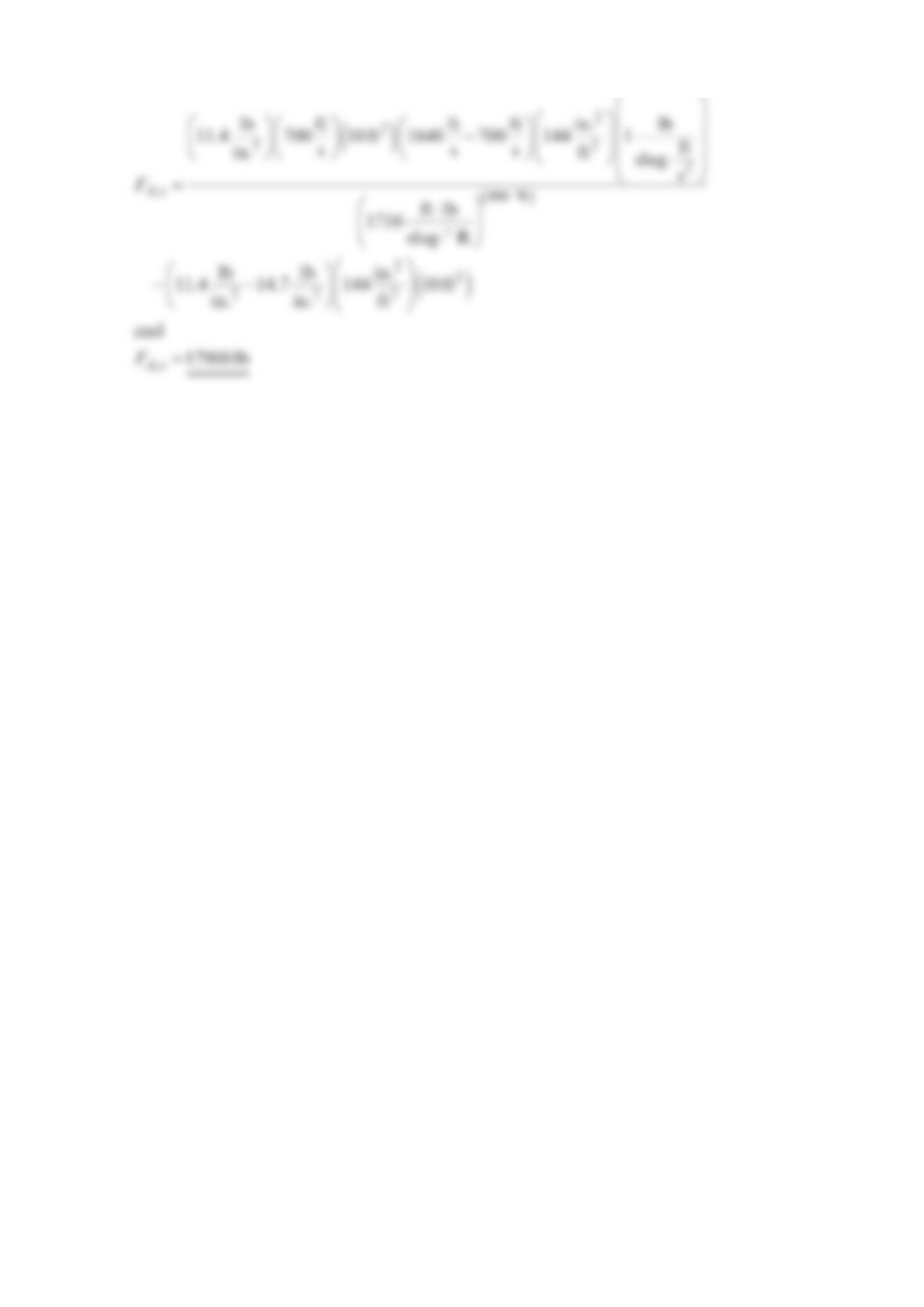
A static thrust stand is to be designed for testing a specific jet engine, knowing the following
conditions for a typical test.
intake air velocity =700 ft/s
exhaust gas velocity =1640 ft/s
intake cross section area =2
10 ft
intake static pressure =11.4 psia
intake static temperature =480 R
exhaust gas pressure =0psig
Estimate a nominal thrust to design for.
Solution 5.49
Control volume
p2A2
p
1A1
Problem 5.50
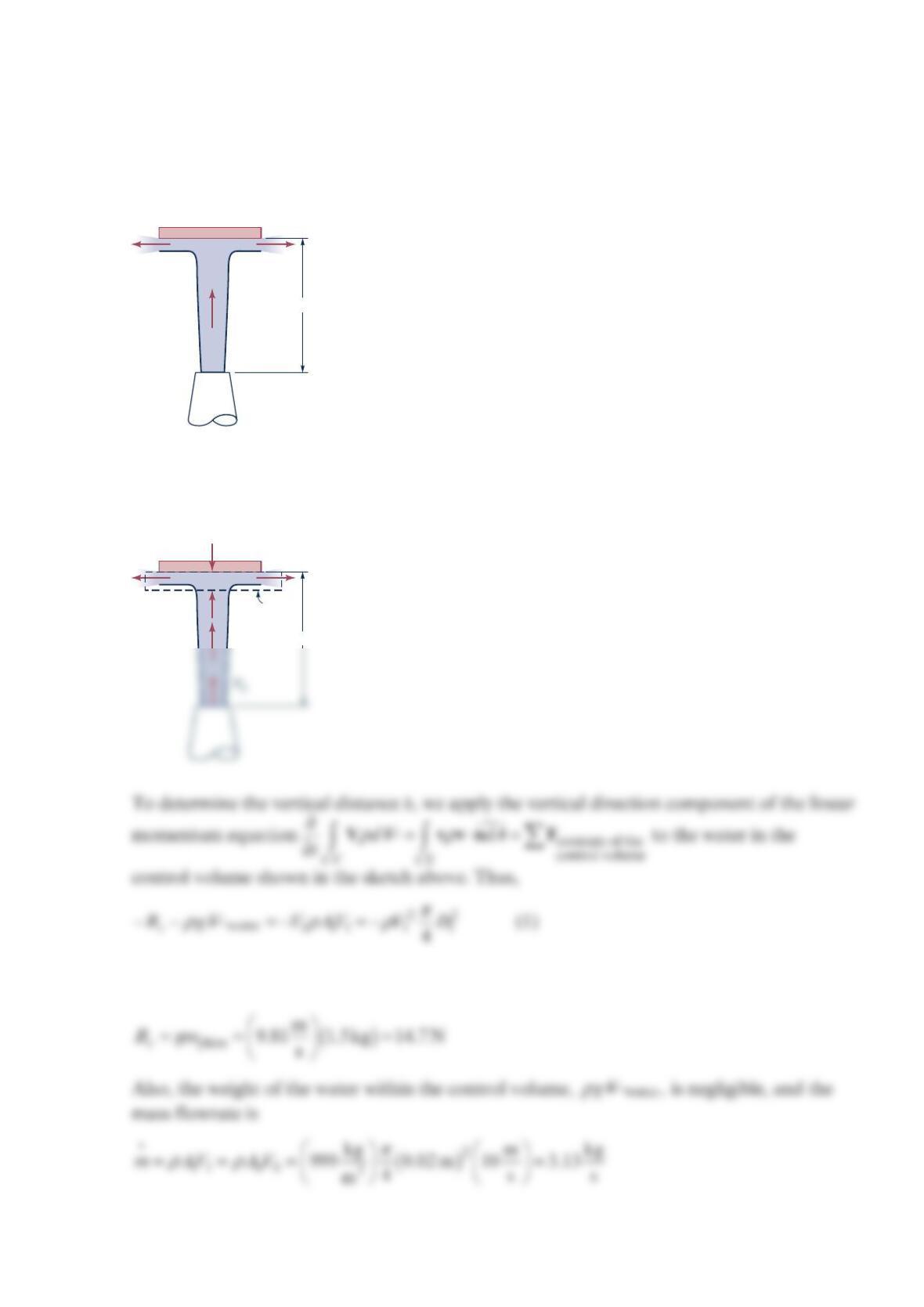
A vertical jet of water leaves a nozzle at a speed of 10 m/s and a diameter of 20 mm . It
suspends a plate having a mass of 1.5kg as indicated in the figure below. What is the
vertical distance
h
?
Solution 5.50
The vertical reaction force of the plate on the water is equal in magnitude to the weight of
the plate, or
h
h
R
z
V
1
CV
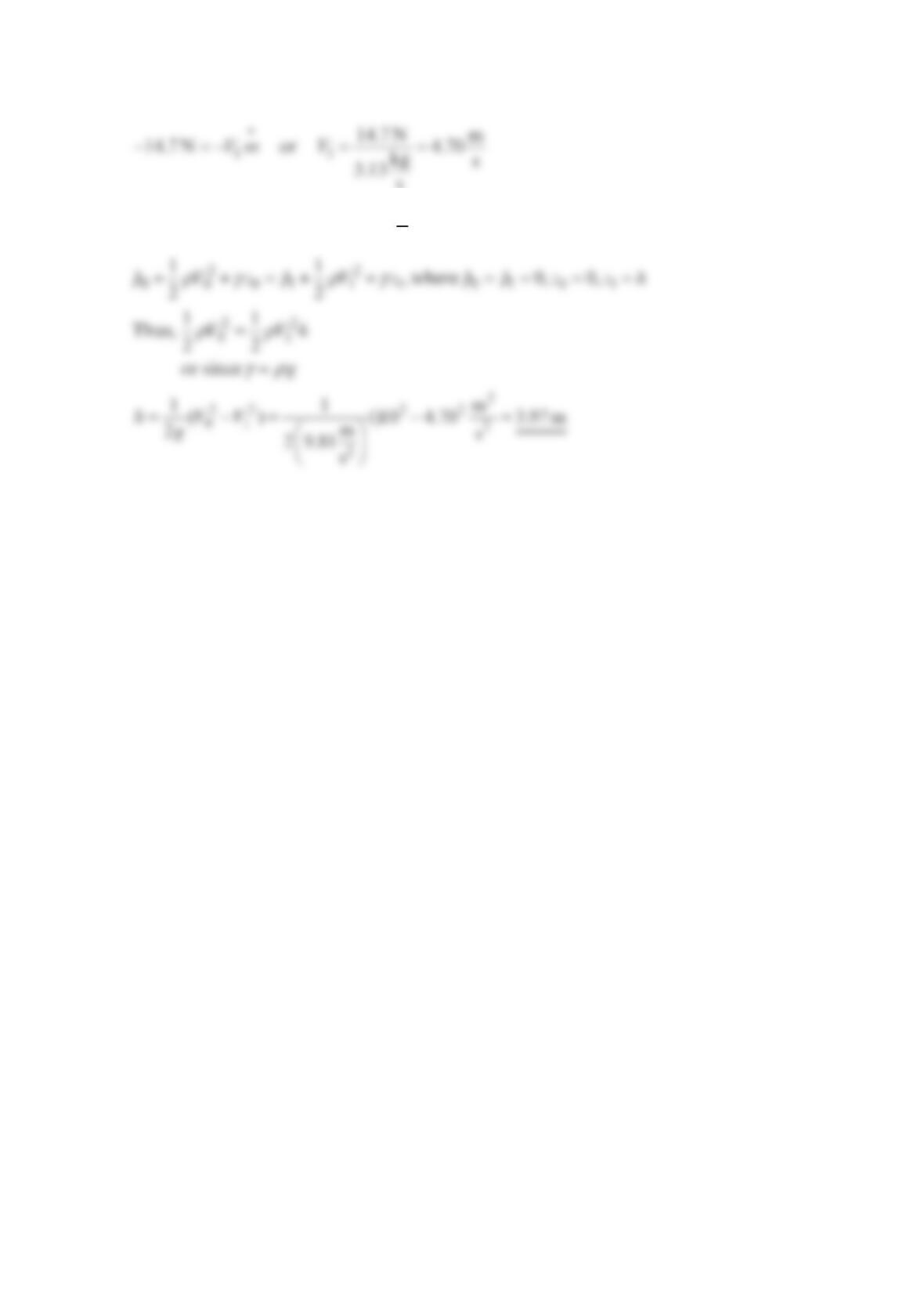
Thus, Eq. (1) becomes
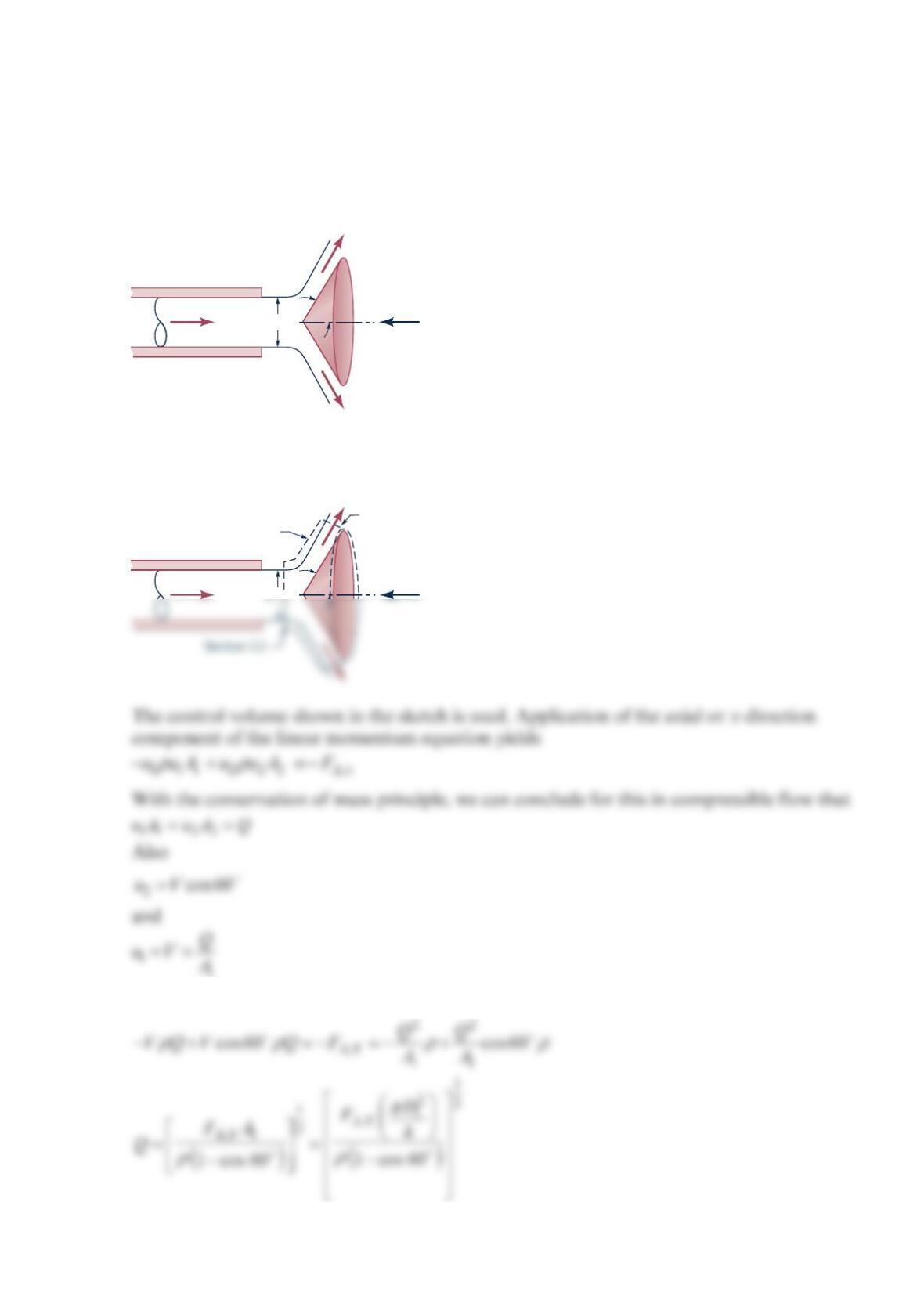
From the Bernoulli equation, 2
1constant along streamline
2
p
Vz
ργ
++= , we have
þ
Problem 5.51
A horizontal, circular cross-sectional jet of air having a diameter of
6
in. strikes a conical
deflector as shown in the figure below. A horizontal anchoring force of 5lb is required to
hold the cone in place. Estimate the nozzle flowrate in ft3/s. The magnitude of the velocity
of the air remains constant.
Solution 5.51
1
Thus
6 in.
60°
F
A
= 5 lb
Control volume
Section (2)
60°
F
A
= 5 lb
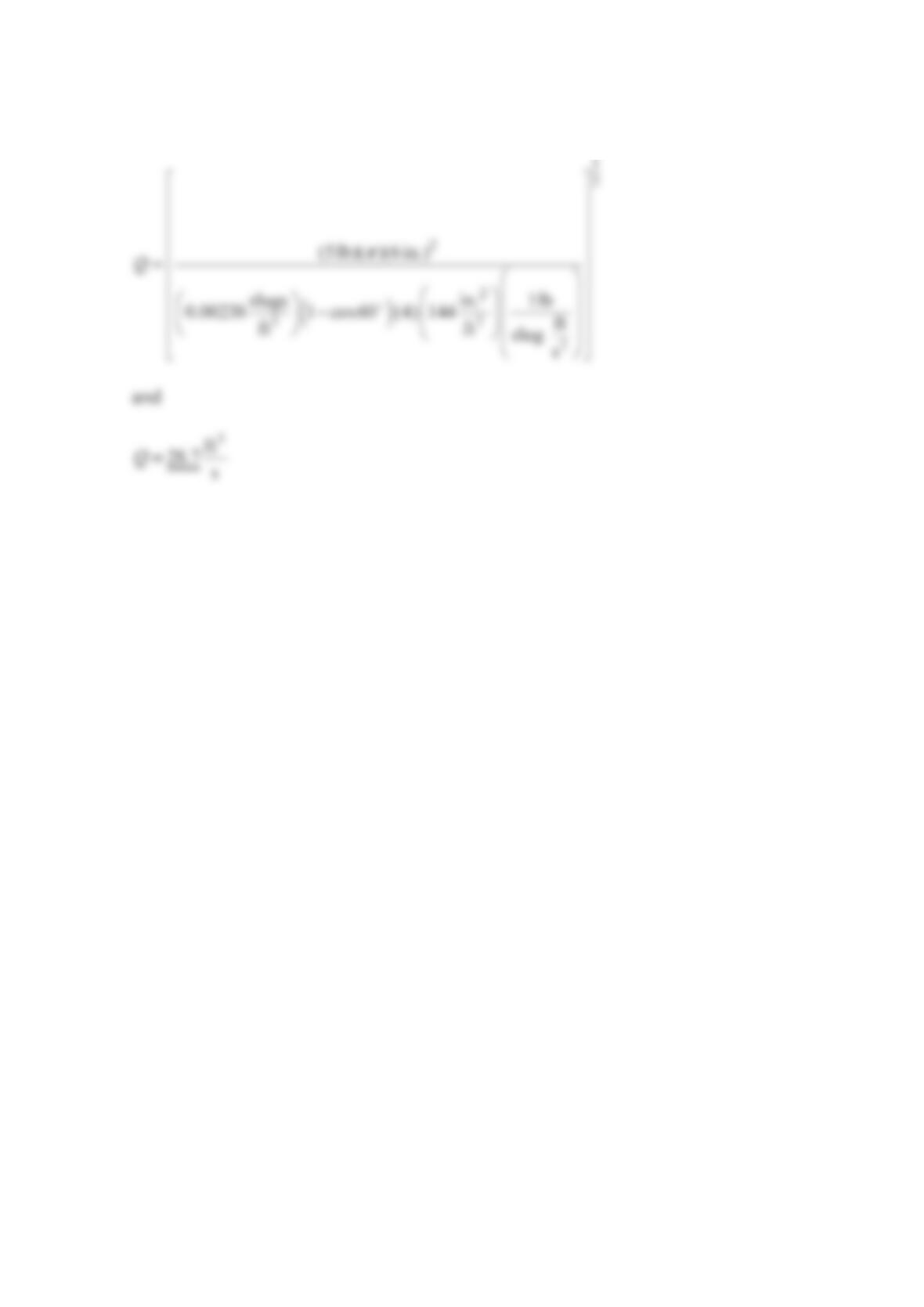
or
Thus
Problem 5.52
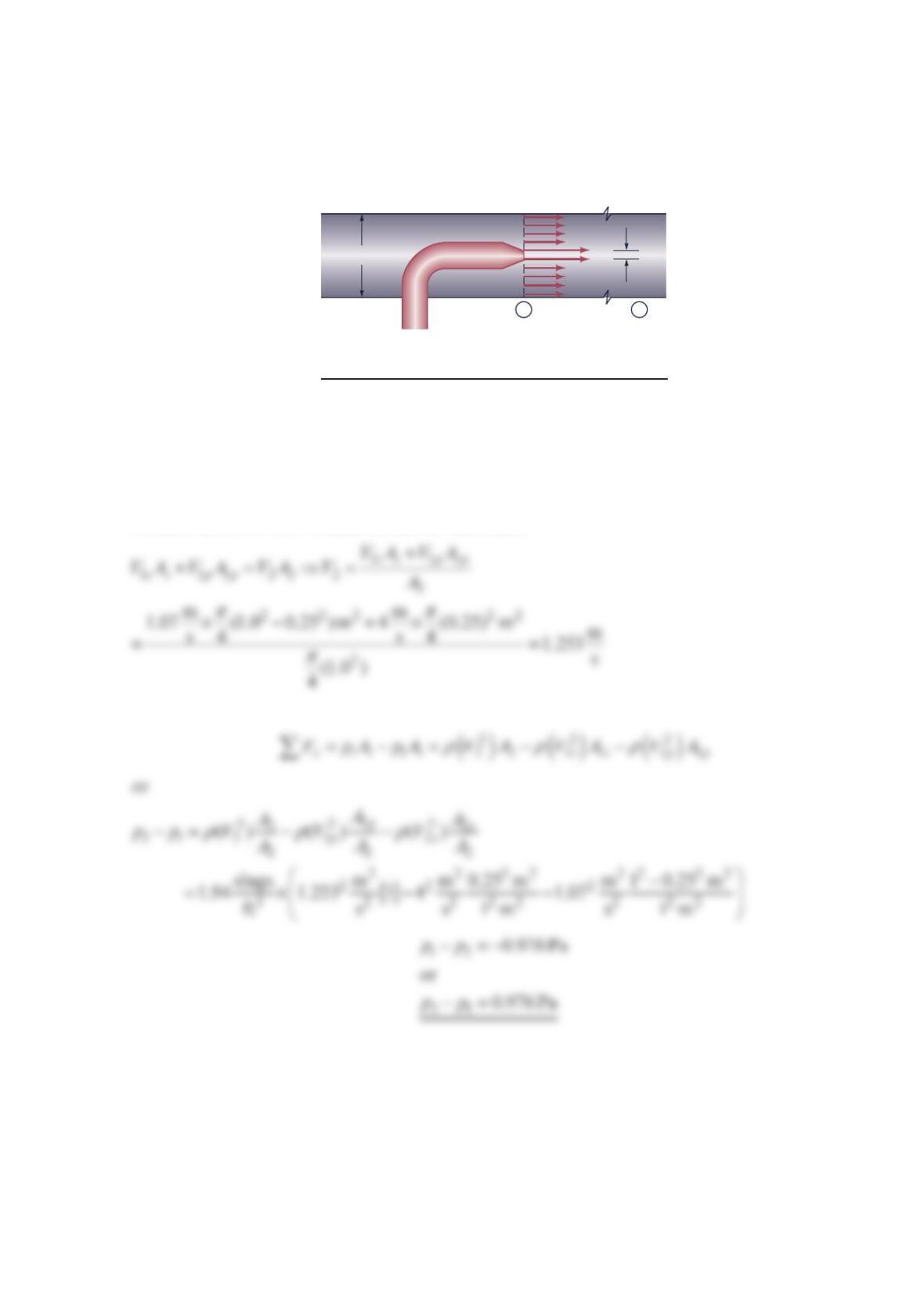
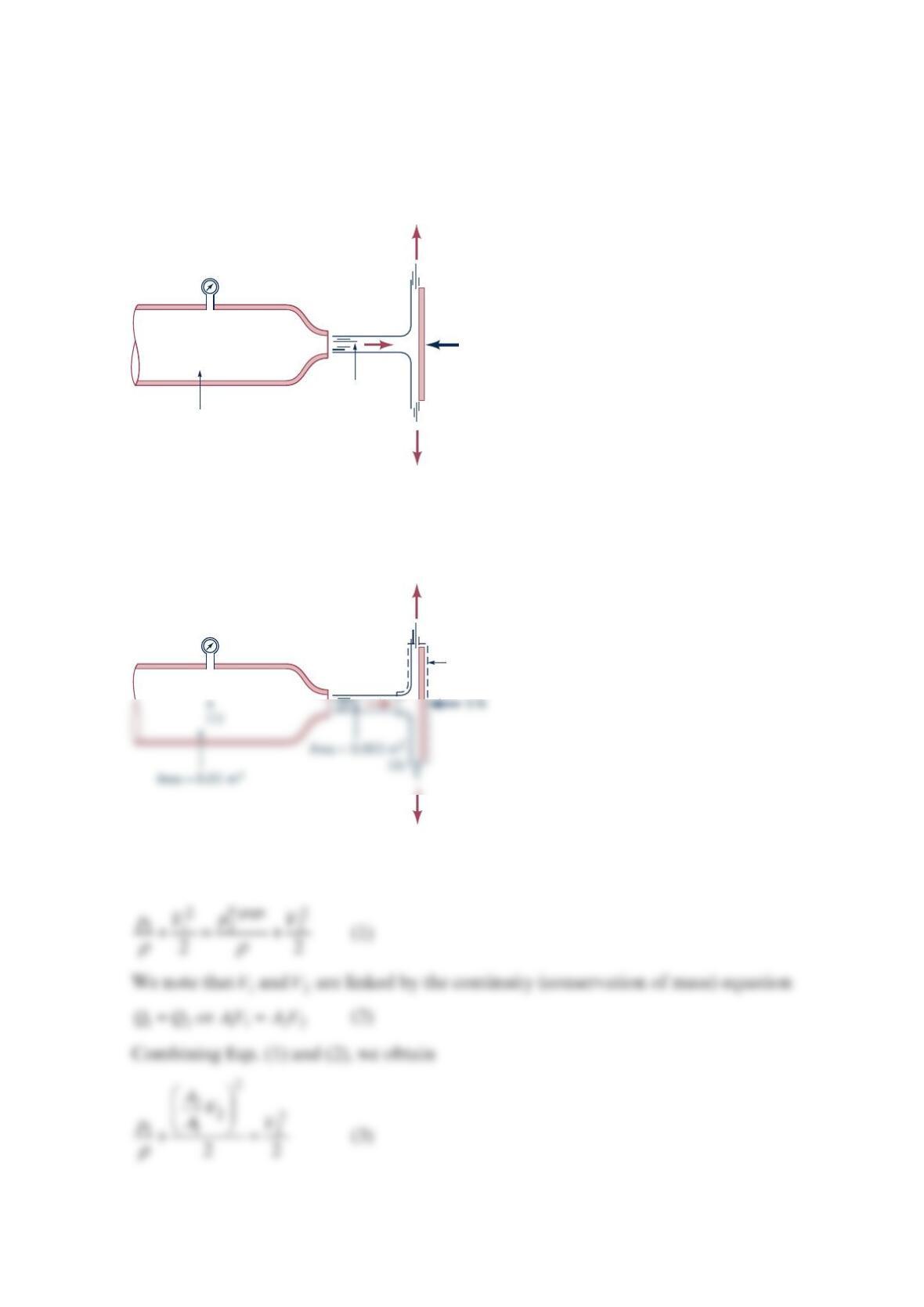
Calculate the pressure change (p2 – p1) for the jet pump shown in the figure below. The fluid
is 20 °C water. Assume negligible friction at the walls and uniform pressure over each flow
area.
Solution 5.52
Assume that the two streams are fully mixed at “2.” The continuity equation gives
11 2sp
QQ Q+=
Assume uniform flow in each stream or substream
Momentum
D
0
= 1.0 m
Dp
= 0.25 m
Vs
= 1.07 m/s
Vp
= 4.0 m/s
1
Vp
Vs
Dp
D
0
2
Problem 5.53
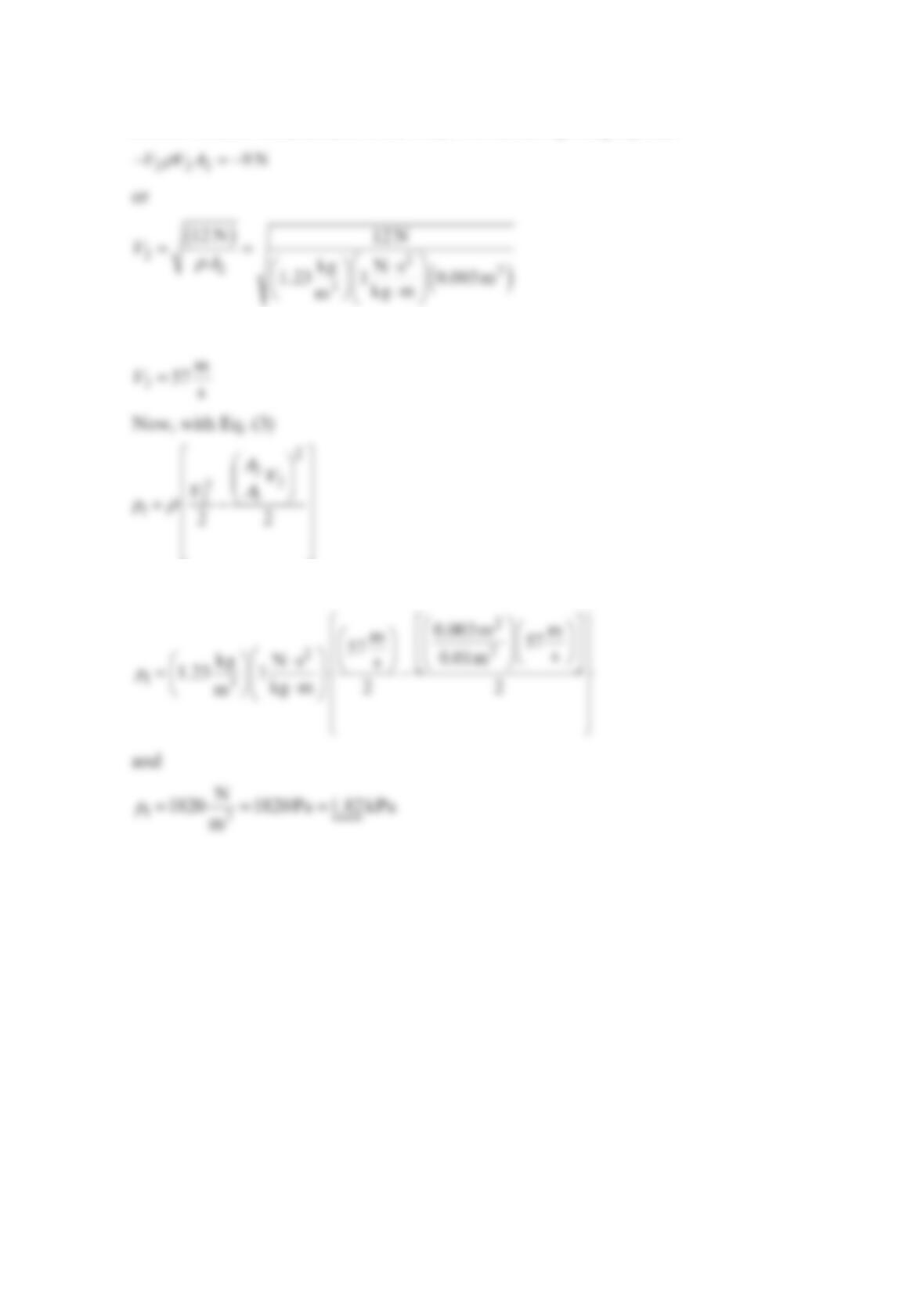
Air flows into the atmosphere from a nozzle and strikes a vertical plate as shown in the
figure below. A horizontal force of 12 N is required to hold the plate in place. Determine
the reading on the pressure gage. Assume the flow to be incompressible and frictionless.
Solution 5.53
To determine the static gage pressure at station (1), we first consider the frictionless and
incompressible flow of air from (1) to (2). Bernoulli equation for this flow is
12 N
p
= ?
Area = 0.01 m2
Area = 0.003 m2
p
= ?
Control
volume
(2)
To determine 2
V
, we use the linear momentum equation for the flow from (2) to (3). For the
control volume sketched above the linear momentum principle yields
and
or
Problem 5.54
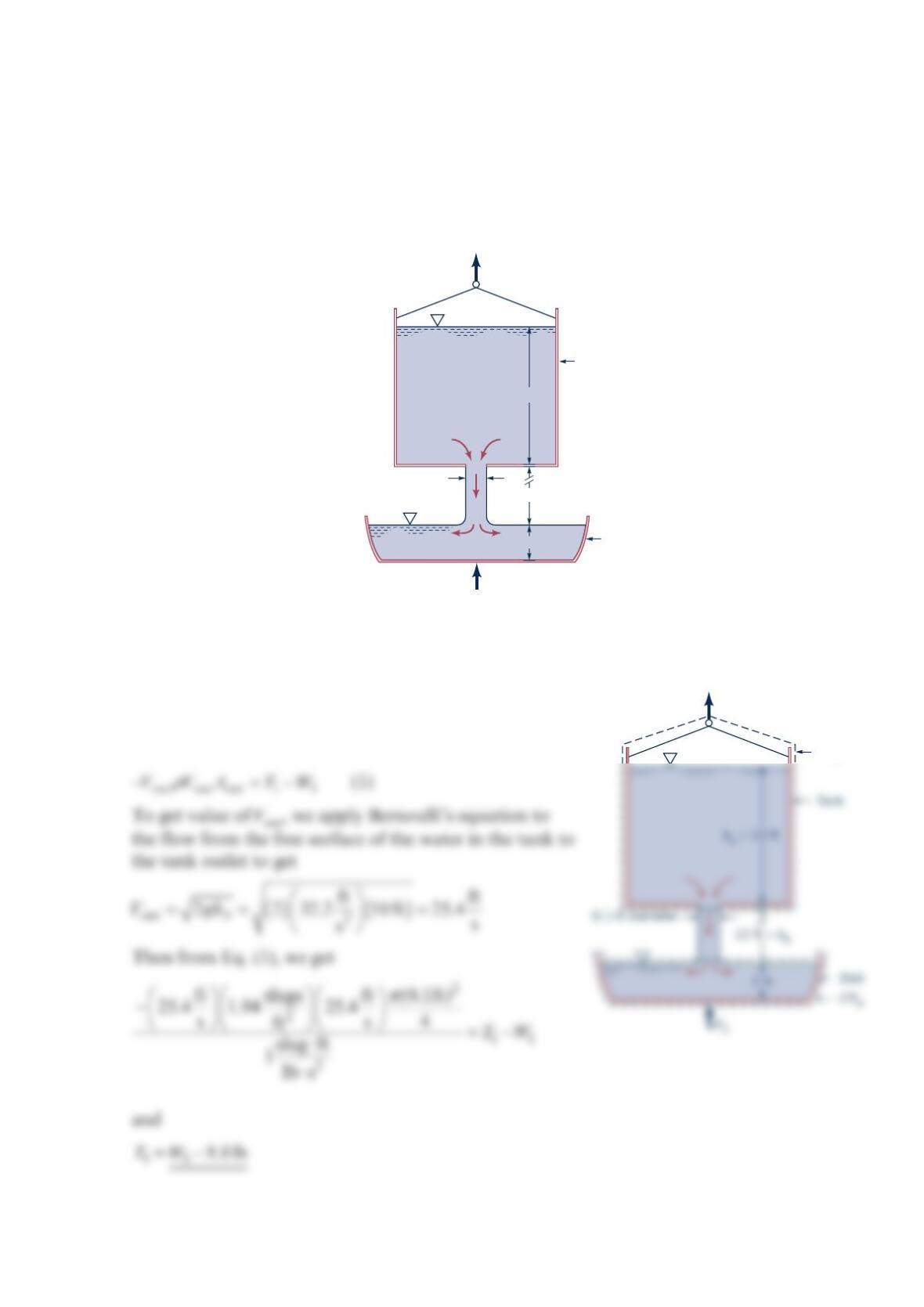
Water flows from a large tank into a dish as shown in the figure below. (a) If at the instant
shown, the tank and the water in it weigh 1lbW, what is the tension, 1
T, in the cable
supporting the tank? (b) If at the instant shown, the dish and the water in it weigh 2lbW,
what is the force, 2
F
, needed to support the dish?
Solution 5.54
For part (a), we apply the vertical component of the
linear momentum equation to the contents of control
volume A, CVA, to get
0.1-ft diameter
Dish
Tank
10 ft
12 ft
2 ft
F2
T1
T1
CVA
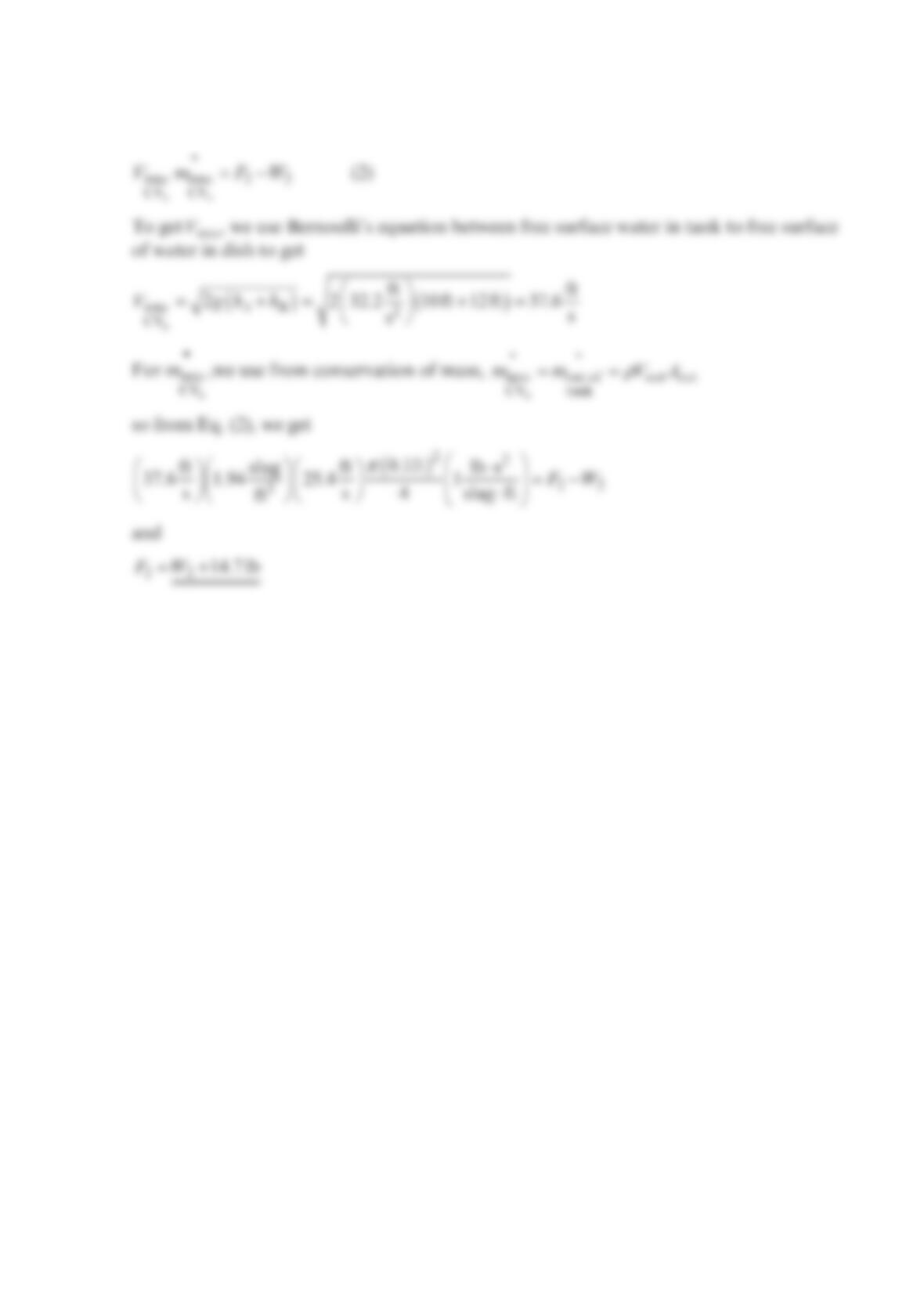
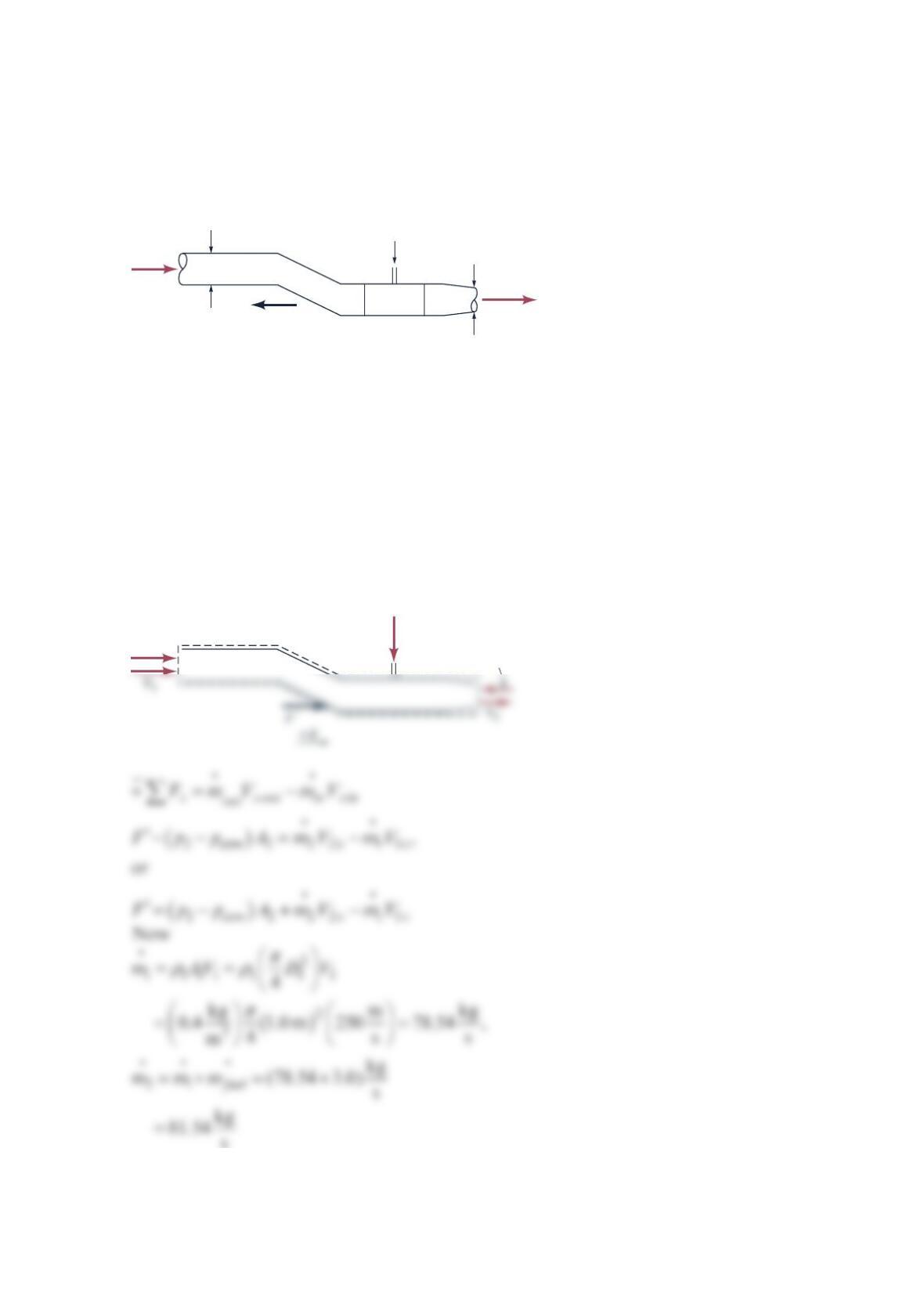
For part (b), we apply the vertical component of the linear momentum equation to the
content of CVB to get
Problem 5.55
The figure below shows the configuration of the center (tail-mounted) jet engine on an
airliner. The airliner is cruising at altitude, and the velocities shown are relative to an
observer on board. Calculate the thrust force that the engine exerts on the airplane.
Solution 5.55
FIND: Trust force
F
of engine on airplane.
SOLUTION: Apply the linear momentum equation to a control volume enclosing the
engine and ducting. ′
F is the force of the airplane on the engine and ducting. For an
observer on the airplane and steady static,
D
1
= 1.0 m
m
•
fuel
= 3 kg/s
Engine
D
2
= 0.75 m
2
= 0.44 kg/m
3
p
2
= 63 kPa
(nozzle exit only)
V
1
= 250 m/s
1
= 0.4 kg/m
3
p
1
=
p
amb
= 40 kPa
F
= thrust force of engine on plane
ρ
ρ
m
•
fuel
p
atm
p
2
A
2
p
1
A
1
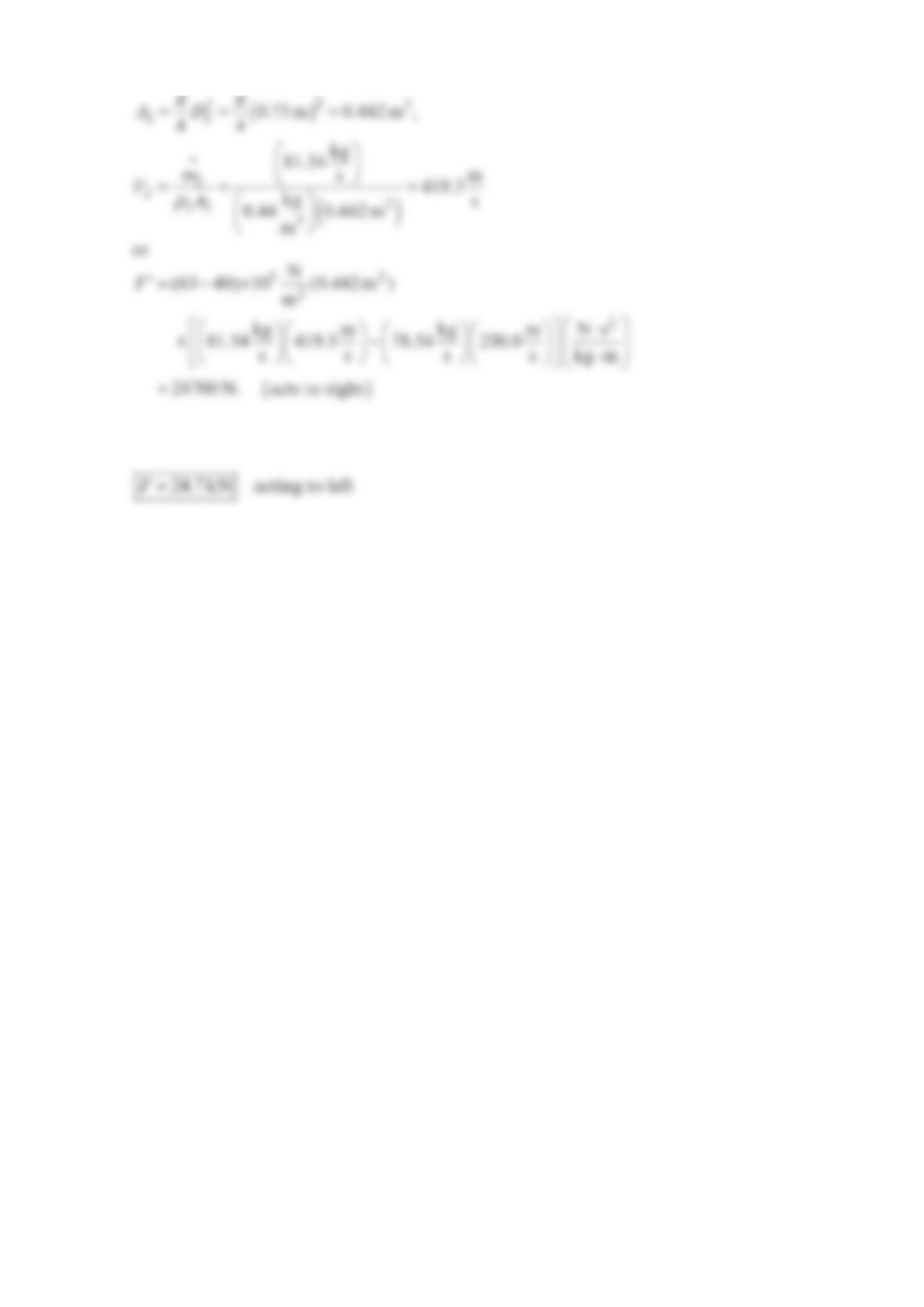
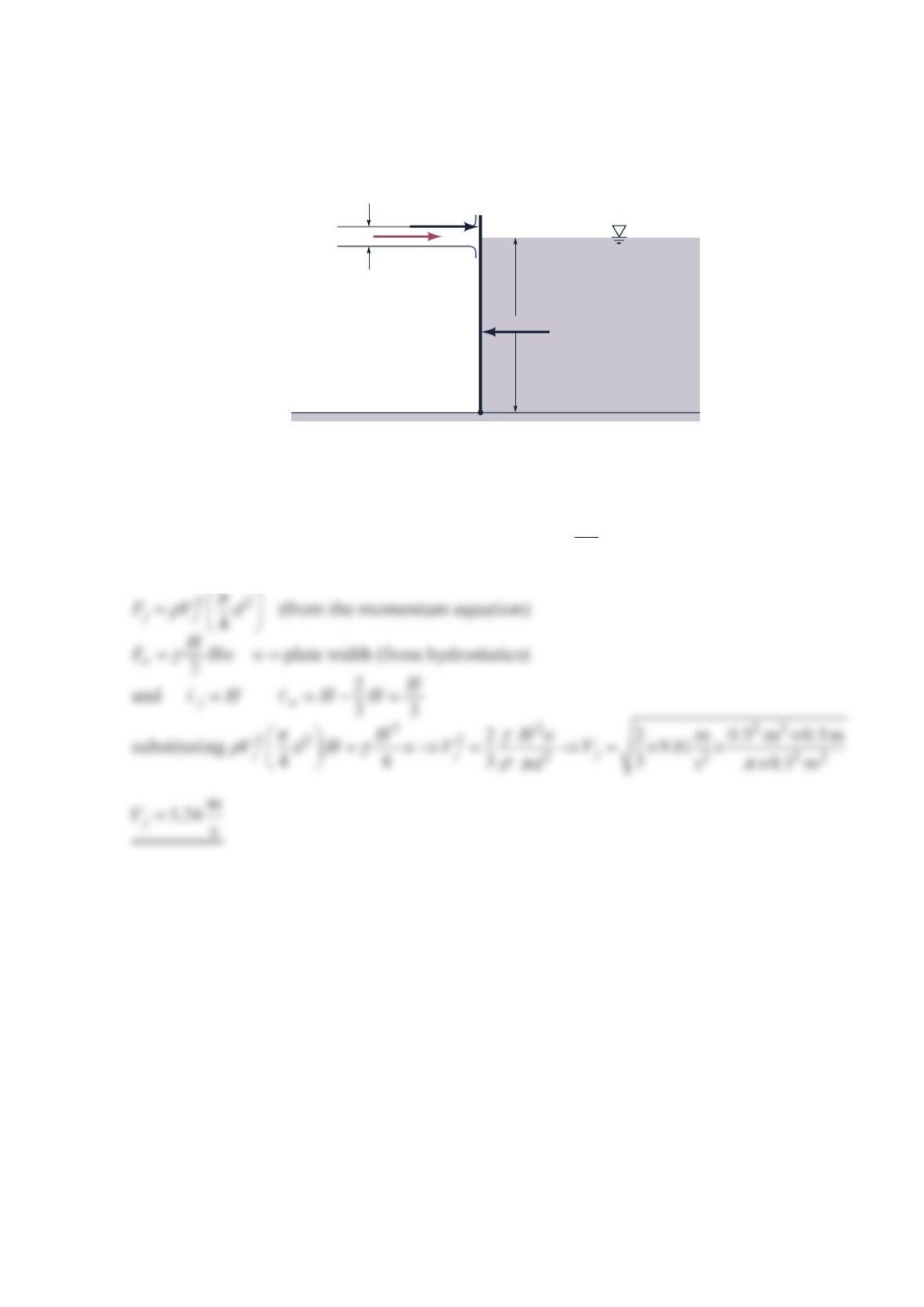
The thrust force
F
of the engine on the airplane is
Problem 5.56
The plate shown in the figure below is 0.5 m wide perpendicular to the paper. Calculate the
velocity of the water jet required to hold the plate upright.
Solution 5.56
The forces on the plate, j
F
and w
F
are shown in the figure. Taking moments about the pivot
w
jj ww j w
j
F
FFF==
where
d = 10.0 cm
Fj
Fw
V
H = 0.5 m
20 °C water
20 °C water jet
Pivot
F
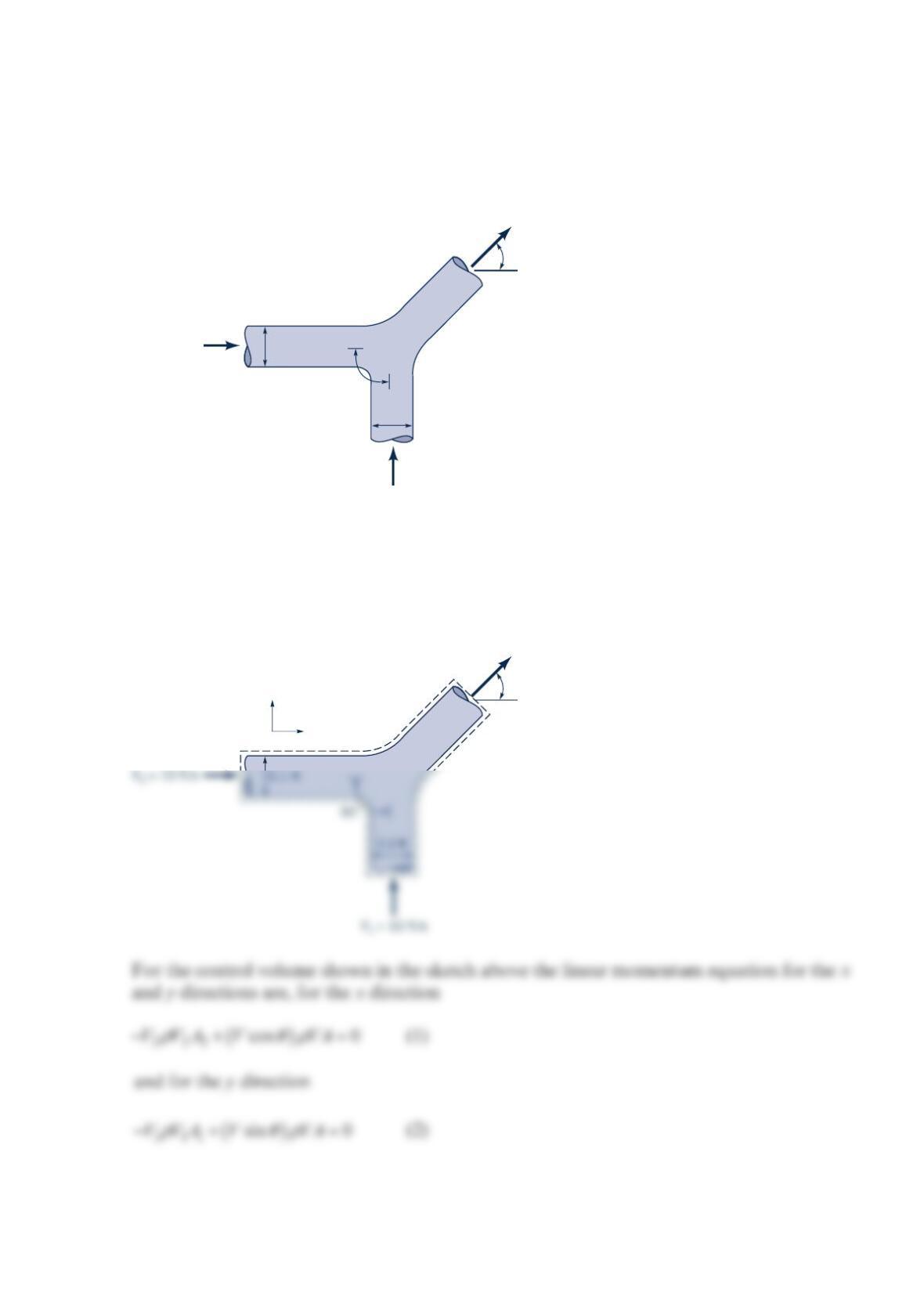
Problem 5.57
Two water jets of equal size and speed strike each other as shown in the figure below.
Determine the speed,
V
, and direction,
θ
, of the resulting combined jet. Gravity is
negligible.
Solution 5.57
90°
V
1
= 10 ft /s
V
2
= 10 ft /s
V
0.1 ft
0.1 ft
θ
V
θ
x
y
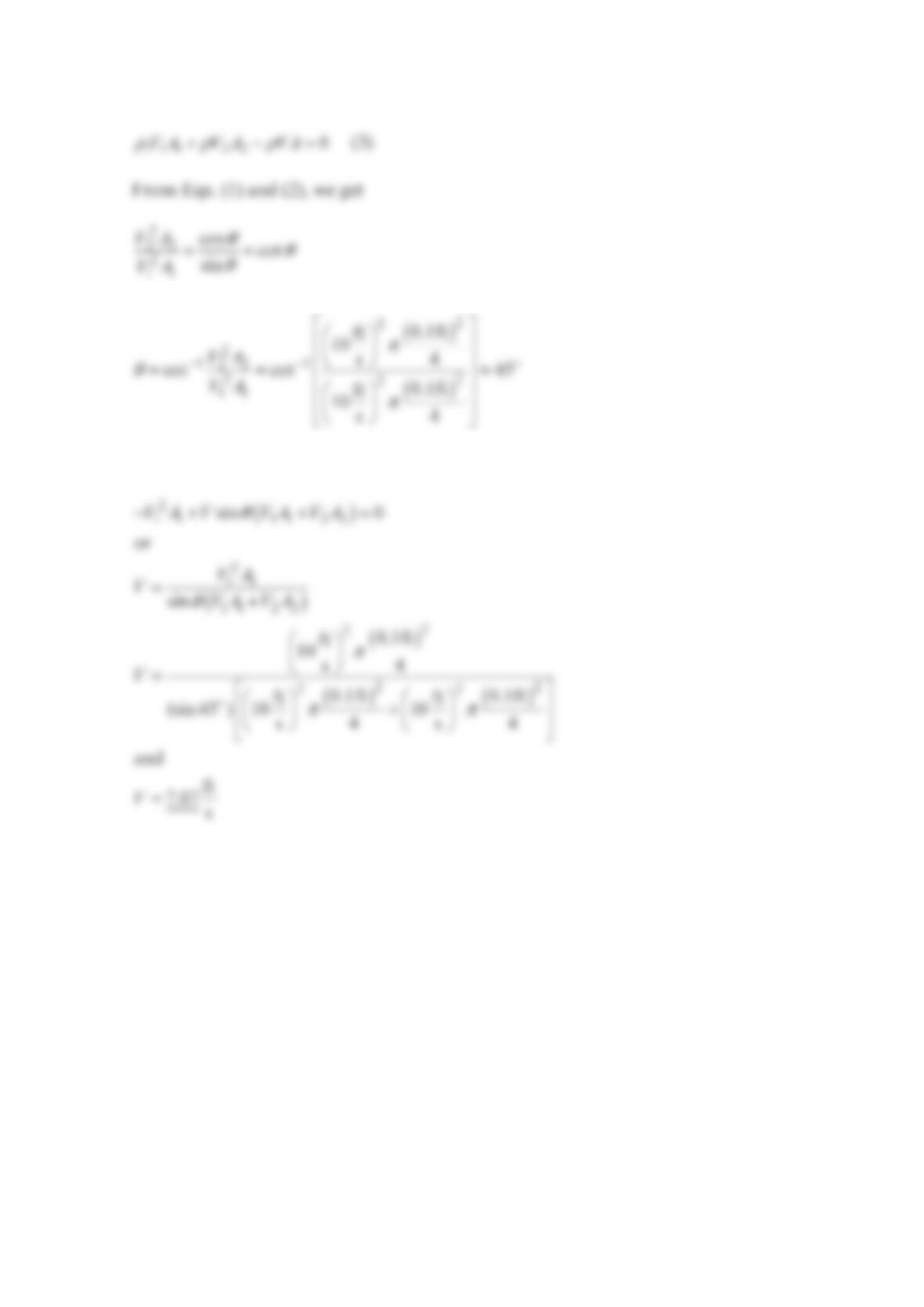
Also for conservation of mass, we have
so
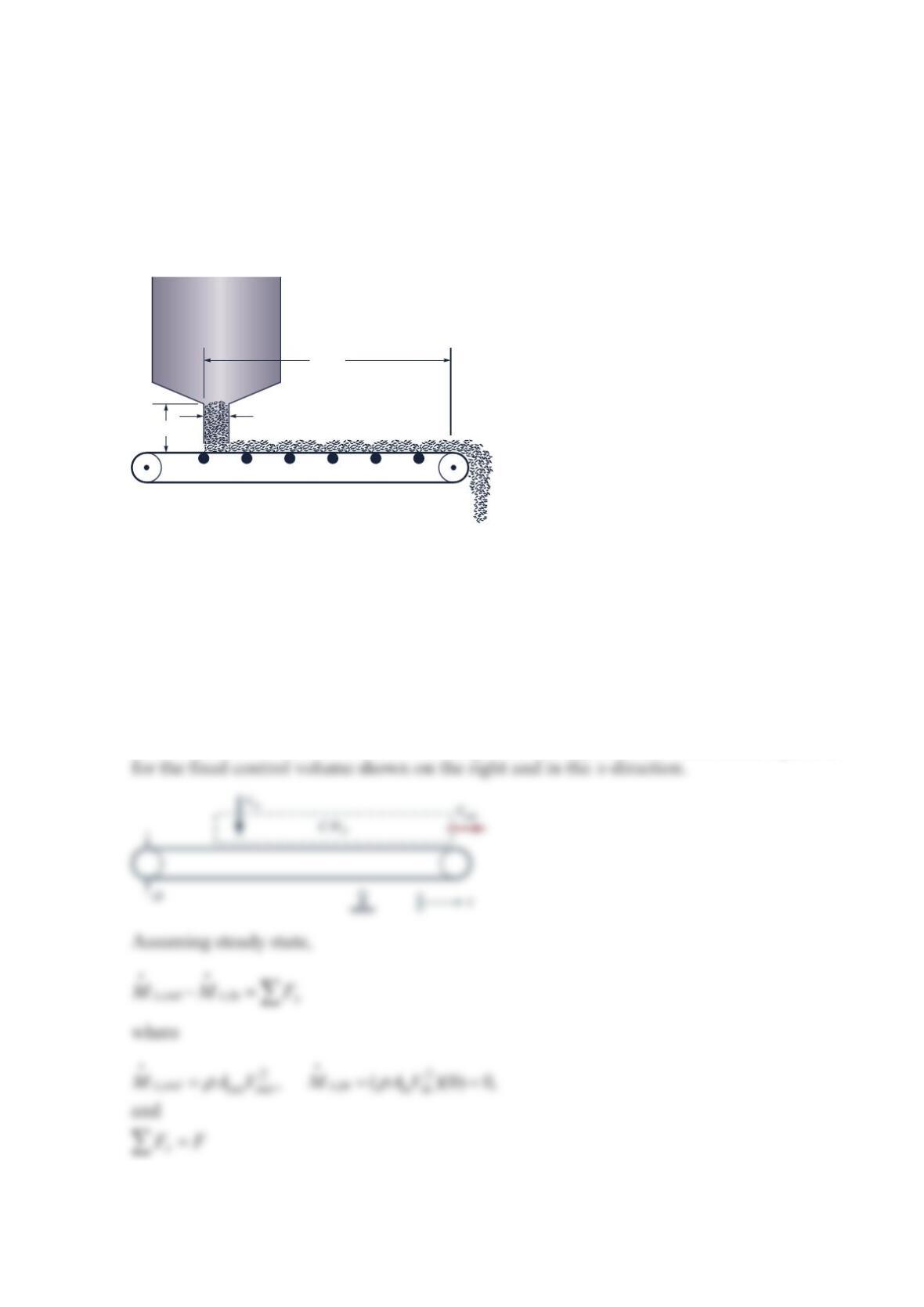
Now, combining Eqs. (2) and (3), we get
Problem 5.58
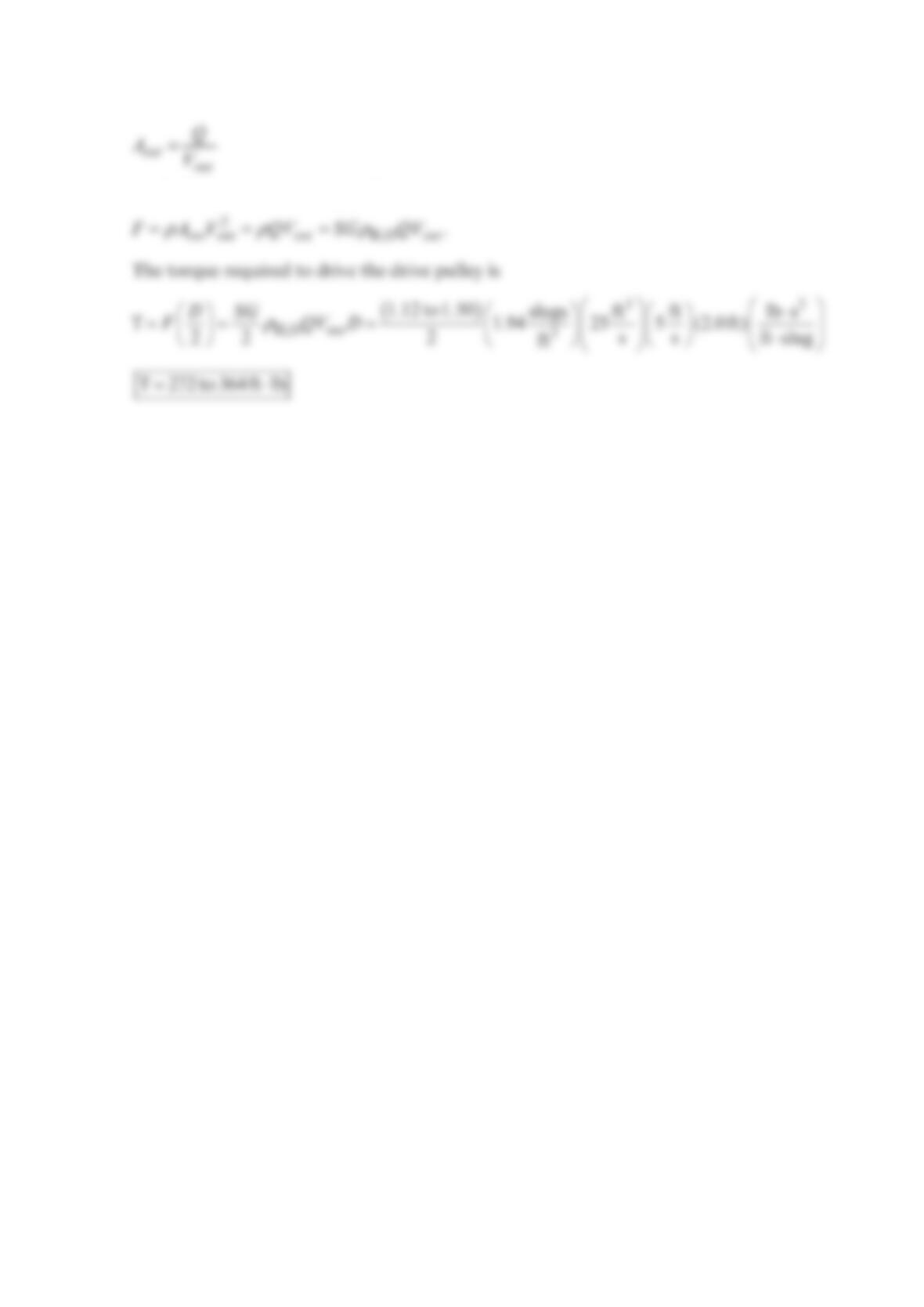
The figure below shows coal being dropped from a hopper onto a conveyor belt at a
constant rate of 3
25 ft /s . The coal has a specific gravity ranging from
1
.12 to 1.50 . The belt
has a speed of 5.0 ft/s and a loaded length of 15.0 ft . Estimate the torque required to turn
the drive pulley of the conveyor belt. The drive pulley diameter is 2.0 ft . Assume that there
is no friction between the belt and the other rollers.
Solution 5.58
GIVEN: Coal dropped onto conveyor belt at =2
25ft / sQ, 1.12 to1.50
S
G= . Belt speed =
=5.0 ft/sV. Drive pulley diameter =2.0 ft.D No friction between belt and rollers.
FIND: Torque
Τ
required to turn drive pulley.
SOLUTION: Consider an observer on the ground writing the linear momentum equation
A = 12 ft2
4.0′
15.0′
Coal
hopper
Now
so the linear momentum equation is